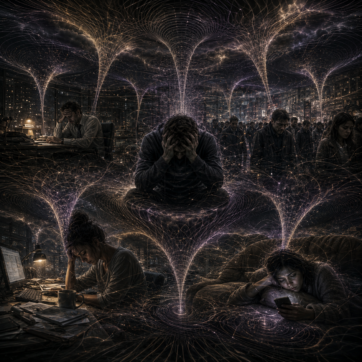
Why collapsing systems create suffering, manipulation, and horror without requiring a centralized evil intelligence controlling every movement
Humans Need A Face To Assign The Fear To
One of the most misunderstood mechanics inside the render is the human need to convert structural pressure into identity-based causation. Humans do not naturally perceive architecture directly. They perceive through narrative translation. The nervous system continuously organizes overwhelming environmental, emotional, social, and continuity information into simplified storyline structures capable of maintaining participation inside the render. Because of this, when large-scale instability begins increasing across civilization, most humans instinctively search for a singular “someone” behind the movement. The mind stabilizes uncertainty by personalizing it. Pressure becomes a villain. Collapse becomes an enemy. Distortion becomes a hidden intelligence orchestrating events from behind the curtain. This is why nearly every civilization throughout history eventually generates mythology surrounding devils, demons, fallen angelics, reptilian races, alien invaders, dark occult bloodlines, secret societies, hidden rulers, and invisible puppet masters manipulating humanity from above. The human nervous system feels safer imagining intentional persecution than confronting the possibility that the architecture itself may generate distortion automatically through its own structural mechanics.
This happens because identity-based perception requires emotional localization. Humans struggle to emotionally process massive distributed instability unless fear can be condensed into a recognizable target. A faceless pressure system feels unbearable to the continuity-based mind because it removes the fantasy that removing one enemy restores coherence. If suffering comes from a singular evil force, then the nervous system can maintain hope through conflict. There is still a war to win. There is still a villain to expose. There is still an imagined future where the “bad actors” are defeated and the architecture returns to harmony. But if the instability is emerging from the underlying mechanics of the system itself, the entire emotional orientation changes. The human mind then has to confront something far more destabilizing: that distortion may not always require centralized malicious intent in order to perpetuate itself.
Humans anthropomorphize collapse because the render itself is organized through storyline interpretation systems. The body-interface does not experience raw architecture directly. It translates massive structural movements into emotionally digestible symbolic sequences. This is why humans continuously describe world events through character archetypes. Every era generates heroes, villains, saviors, destroyers, liberators, deceivers, and apocalyptic enemies because identity-based narrative is one of the primary ways the render stabilizes perception. The nervous system is constantly converting abstract structural movement into emotionally recognizable imagery capable of sustaining continuity participation. Even natural disasters are often subconsciously interpreted this way. Humans say the storm was “angry.” They say the universe is “punishing” humanity. They speak about reality “wanting” something from them. This reveals how deeply identity projection is embedded into render perception itself.
The difficulty is that humans do sometimes sense real distortion. They sense manipulation. They sense fragmentation. They sense artificial amplification systems, emotional contagion, institutional corruption, narrative engineering, continuity pressure, and inversion patterns operating throughout civilization. The perception itself is often not entirely false. What becomes distorted is the interpretation layer. The nervous system translates distributed structural mechanics into personalized intentionality because storyline-based cognition is easier for the body-interface to emotionally process than impersonal architecture. The result is a civilization trapped in endless mythologized explanations for systemic instability while rarely examining the deeper mechanics producing the instability in the first place.
This is also why humans repeatedly imagine collapse as a conscious war between good and evil forces rather than recognizing how pressure systems naturally generate distortion once certain thresholds are crossed. Most humans cannot emotionally tolerate the possibility that horrifying outcomes can emerge from self-reinforcing instability patterns alone. But this happens constantly throughout nature, civilization, economics, ecosystems, politics, institutions, and collective human behavior. Massive destruction does not always require a centralized evil mind orchestrating every movement. Pressure systems themselves can produce devastating outcomes automatically once compression, fragmentation, polarity, and continuity instability intensify beyond stabilization thresholds.
The External Architecture, The Mimic Layer, And Why Humans Misread Reality Entirely
Before humans can properly understand why collapse, distortion, manipulation, and suffering occur the way they do inside this world, the foundational architecture itself must first be understood. Most humans attempt to analyze reality while unconsciously assuming the render itself is the primary layer of existence. They believe the visible world is the origin point rather than the downstream expression of deeper organizational mechanics occurring underneath perception continuously. Because of this, nearly all human explanations for suffering become trapped inside surface-level narrative interpretation. Humans debate politics, morality, religion, psychology, conspiracy systems, and social conflict while rarely examining the actual stabilization architecture generating those visible outcomes in the first place.
The external architecture is fundamentally a movement-based system. It stabilizes through oscillation, polarity, continuity sequencing, fragmentation, emotional routing, curvature, and identity fixation. It is not Eternal coherence. It is not stillness. It is not direct recognition. It requires constant motion in order to maintain experiential continuity. The human body-interface itself is embedded within this movement architecture and therefore perceives reality through sequential storyline processing rather than simultaneous structural recognition. Humans experience life as time progression, emotional movement, memory sequencing, identity continuity, and narrative evolution because the render translates underlying architecture into manageable continuity corridors the nervous system can process.
This is where the distinction between pre-render and render becomes critical. The render is the visible experiential layer humans interact with directly. It includes physical reality, civilization, media systems, governments, relationships, institutions, emotions, identities, cultural narratives, religious systems, wars, economies, and social structures. Humans mistake this layer for reality itself because it is the layer the body-interface consciously experiences. But the render is not the originating layer. It is the translated output layer. Beneath it exists the pre-render organizational architecture where continuity routing, probability organization, emotional synchronization patterns, identity stabilization systems, collective pressure gradients, and structural compression mechanics are continuously interacting before becoming physically expressed through rendered experience.
The easiest way to understand this is through weather formation. Humans standing inside a hurricane only experience the visible storm itself — the wind, destruction, flooding, debris, fear, and chaos. But the visible hurricane is not the origin point of the storm. The visible storm is the rendered output of deeper atmospheric pressure gradients, thermal instability, rotational mechanics, moisture systems, and environmental conditions interacting long before the hurricane became physically visible. The render functions similarly. What humans experience physically, emotionally, socially, and collectively is often the downstream expression of deeper organizational mechanics already forming within the pre-render architecture beforehand.
This is also where the mimic layer enters. The mimic is not simply “evil beings” controlling humanity from shadows the way many conspiracy systems imagine. The mimic functions more like a stabilization overlay that amplifies external architecture mechanics in order to preserve continuity participation even as instability intensifies. It reinforces emotional routing. It reinforces polarity. It reinforces identity fixation. It reinforces externalization. It reinforces fragmentation, reaction cycles, narrative addiction, social synchronization, and continuity dependence. The mimic does not necessarily require centralized emotional hatred to operate. Much of it functions automatically through amplification mechanics embedded into the architecture itself. Once instability rises, the mimic layer intensifies narrative distortion in order to preserve participation within the system.
This is why modern civilization increasingly feels mentally overwhelming. Humans are not only participating inside the external architecture itself, but also inside amplified mimic stabilization loops layered on top of it simultaneously. Social media algorithms amplify emotional throughput. Political systems amplify polarity. Media systems amplify fear synchronization. Internet culture amplifies identity fixation. Economic systems amplify survival pressure. Institutional systems amplify continuity dependency. None of this requires a singular villain consciously orchestrating every emotional response minute-by-minute. The architecture itself increasingly routes humans into emotionally intensified stabilization loops because compressed systems require stronger artificial reinforcement mechanisms to maintain continuity.
The Eternal is entirely different from all of this. The Eternal is not another “realm” inside the architecture. It is not another level of the render. It is not higher-dimensional movement. It is not oscillatory stabilization. The Eternal does not depend upon polarity, continuity sequencing, emotional routing, curvature, fragmentation, or identity fixation in order to exist. The Eternal does not require storyline reinforcement. It does not require conflict in order to sustain itself. It does not stabilize through movement at all. This distinction is critical because most humans unconsciously project external mechanics onto the Eternal itself, imagining cosmic wars between good and evil forces, divine armies battling darkness, or hidden entities competing for control of humanity. But those are still render-based interpretations operating through polarity cognition and narrative stabilization systems.
Without understanding these distinctions first, humans will continue misreading collapse entirely. They will continue assuming every distortion requires a singular malicious entity emotionally orchestrating events from behind reality itself. But many horrifying outcomes emerge naturally once unstable movement-based architectures intensify beyond stabilization thresholds. The render then translates those structural failures into wars, manipulation systems, societal fragmentation, emotional contagion, violence, institutional corruption, and psychological breakdown. Humans interpret the outputs morally and mythologically because the body-interface processes reality through narrative sequencing. But the deeper mechanics are architectural long before they become personalized human experience.
The Human Mind Interprets Structure As Intention
One of the deepest render distortions is the human tendency to interpret structural mechanics as conscious intention. Humans assume that if something harmful, chaotic, or destabilizing is occurring, there must be an intelligence emotionally deciding for it to happen. But this assumption largely emerges from the way the body-interface evolved inside continuity-based survival environments. The nervous system was built to detect threat rapidly, simplify overwhelming variables, and convert uncertainty into socially recognizable meaning. This increased survival efficiency inside the render. A human who quickly assumed “something is hunting me” survived more often than one who calmly analyzed every variable neutrally. Over time, the nervous system became heavily conditioned toward intentionality detection. The brain constantly searches for agency behind movement because render survival depended upon identifying possible threats before full evidence existed.
As a result, humans now project intention onto enormous structural phenomena that may actually be the outcome of pressure dynamics, continuity destabilization, and self-reinforcing systems operating automatically. Storm systems are a perfect example. Hurricanes do not emotionally hate coastal cities. Tornadoes do not consciously select victims. Earthquakes do not intentionally target families. Yet humans instinctively speak about these events using emotional language because the nervous system anthropomorphizes overwhelming forces automatically. The same thing occurs with economic collapse. Most economic crises are not centrally controlled minute-by-minute by one evil mastermind manipulating every transaction on Earth in real time. Economic systems become unstable because pressure accumulates across debt structures, resource distribution systems, institutional incentives, population behavior, emotional contagion, and continuity maintenance mechanisms simultaneously. Once thresholds are crossed, collapse patterns emerge naturally from the architecture itself.
The same mechanics appear throughout every layer of civilization. Ecosystem failures emerge when destabilization compounds across interconnected systems long enough. Wars often erupt not because one singular villain controls every human involved, but because polarization, fear amplification, scarcity pressure, institutional momentum, historical grievances, propaganda systems, identity stabilization, and mass emotional contagion reach unsustainable compression thresholds simultaneously. Crowd hysteria operates the same way. A crowd can become violent, irrational, or psychologically synchronized without every individual consciously deciding to participate in distortion. The pressure field itself begins routing behavior. Humans inside crowds start mirroring one another automatically because emotional synchronization is one of the strongest continuity stabilization mechanisms inside collective render environments.
Modern internet culture reveals these mechanics even more clearly. Internet pile-ons rarely require centralized coordination. Social media algorithms amplify outrage because outrage generates participation intensity. Emotional escalation spreads automatically once amplification loops form. Humans then interpret the resulting chaos as evidence of centralized orchestration because the scale of the distortion feels too large to comprehend as emergent behavior. But self-reinforcing systems naturally intensify once enough participants feed the loop simultaneously. Political polarization follows the same architecture. Entire populations become trapped inside escalating identity fragmentation not necessarily because a singular hidden ruler consciously scripts every emotional reaction, but because polarity itself functions as a stabilization mechanism within the external architecture. Once identity fixation intensifies enough, humans begin sorting reality through emotional allegiance instead of direct recognition. The architecture then amplifies the fragmentation automatically.
This is why randomness becomes interpreted as targeting. Pressure becomes interpreted as attack. Collapse becomes interpreted as evil. Systemic distortion becomes interpreted as “someone doing this to us.” The nervous system continuously converts impersonal mechanics into socially understandable narratives because identity-based cognition struggles to process distributed causation. Humans emotionally prefer a villain to a system because villains can theoretically be defeated. Structural mechanics are far more destabilizing because they imply the distortion is embedded into the architecture itself rather than imposed externally by one removable enemy.
This does not mean harmful beings cannot exist within the architecture. It does not mean manipulation never occurs. It does not mean institutions, individuals, or groups cannot intentionally exploit instability for power. Those things absolutely happen inside the render. But the larger point is that enormous suffering does not require centralized conscious orchestration in order to emerge. The architecture itself is capable of generating horrifying outcomes automatically through its own mechanics once sufficient compression, fragmentation, oscillation, continuity instability, and polarity reinforcement accumulate throughout the system. That distinction changes the entire way collapse must be understood.
The External Architecture Is A Pressure-Based System
One of the biggest misunderstandings humans carry inside the render is the assumption that reality is fundamentally organized around harmony, balance, morality, fairness, or Eternal coherence. Most humans unconsciously assume the system itself is “supposed” to function properly and that suffering represents an abnormal corruption of an otherwise healthy design. But the deeper mechanics reveal something very different. The external architecture does not stabilize through Eternal stillness or coherence. It stabilizes through motion, oscillation, polarity, compression, curvature, fragmentation, emotional routing, continuity pressure, and identity fixation. Those mechanics are not accidental side effects of the system. They are part of the system’s actual stabilization process.
This changes how instability must be understood. Humans tend to imagine collapse as something invading a stable world from the outside. But inside a pressure-based architecture, instability is not foreign to the system. It is a natural consequence of the way the system maintains itself over time. Compression compounds. Oscillation compounds. Fragmentation compounds. Emotional routing compounds. Identity fixation compounds. The architecture continuously generates movement in order to sustain continuity participation, but movement itself creates friction, pressure gradients, and distortion accumulation throughout the system. Over long enough periods, instability naturally intensifies because the architecture depends upon ongoing motion rather than Eternal coherence.
This is why the weather analogy matters so much. A hurricane does not suddenly appear because a singular evil intelligence emotionally decides destruction should occur. Hurricanes emerge when enough instability accumulates across pressure systems, atmospheric conditions, thermal gradients, rotational dynamics, and environmental instability simultaneously. Once thresholds are crossed, the storm organizes itself naturally through the mechanics already embedded within the system. The same thing happens inside civilization. Wars do not emerge from nowhere. Violence does not emerge from nowhere. Institutional corruption does not emerge from nowhere. Emotional contagion, predatory behavior, societal fragmentation, manipulation systems, and psychological breakdown emerge when continuity pressures intensify beyond stabilization thresholds across interconnected layers of the architecture simultaneously.
Humans often fail to see this because the render translates structural mechanics into personalized experiences. A human experiences betrayal emotionally. Another experiences financial collapse personally. Another experiences propaganda psychologically. Another experiences violence physically. But beneath those individualized render experiences, larger pressure structures are organizing collective behavior patterns simultaneously. Entire societies can become more emotionally unstable not necessarily because every individual consciously chooses distortion, but because the surrounding architecture itself becomes increasingly compressed and polarized. The body-interface then begins adapting to the instability automatically. Nervous systems become more reactive. Identity fixation intensifies. Fear routing increases. Tribal sorting accelerates. Polarization strengthens. Emotional throughput rises. This creates feedback loops that further stabilize the distortion itself.
This is why collapsing architectures eventually generate increasingly irrational outputs. As continuity pressure rises, systems lose flexibility. Institutions become more manipulative because preserving continuity becomes prioritized over truth. Governments become more coercive because instability threatens structural control. Media systems become more emotionally amplified because fear and outrage maintain participation intensity. Humans become more psychologically fragmented because identity structures absorb increasing continuity load. The architecture begins forcing stabilization through increasingly artificial means as natural coherence weakens throughout the system.
None of this requires a centralized evil “god” consciously wanting suffering. That is one of the hardest realizations for humans to emotionally process because humans instinctively project morality onto architecture itself. They assume suffering must mean someone desires suffering. But unstable systems naturally generate unstable outputs. A collapsing bridge does not “hate” the people standing on it. An unstable reactor does not emotionally desire destruction. A failing ecosystem does not consciously seek extinction. The instability emerges from the mechanics of the system once enough pressure accumulates across interconnected structures simultaneously.
The external architecture functions similarly. Once oscillation, fragmentation, polarity compression, emotional routing overload, continuity instability, and identity fixation intensify enough collectively, the architecture naturally begins producing more distorted outputs across every layer of civilization. Humans then interpret those outputs morally because the render processes reality through emotional narrative translation. But the deeper mechanics are structural long before they become personal.
Why Humans Prefer The “Evil Mastermind” Explanation
The centralized villain narrative is emotionally seductive because it dramatically simplifies reality into a form the identity structure can mentally survive. A singular evil force creates immediate orientation inside the chaos. It provides identifiable blame. It provides emotional closure. It provides a target. It provides direction for anger, fear, grief, confusion, and instability. Most importantly, it preserves the fantasy that the architecture itself is fundamentally stable and that only a corrupt external force disrupted an otherwise healthy system. This allows the nervous system to maintain hope that once the “bad actors” are removed, harmony can finally return. The human mind finds this interpretation deeply comforting even when the subject matter itself is terrifying.
This is why humans repeatedly organize reality into heroic narratives. Every civilization eventually generates some version of the same storyline structure:
the hidden evil,
the awakening hero,
the final battle,
the exposed deception,
the liberation event,
the restoration of order.
These narratives stabilize emotional participation because they preserve linear continuity logic. There is still a beginning, middle, and end. There is still a war to fight. There is still a climax approaching. There is still a future moment where the distortion is defeated and coherence is restored. The identity structure depends heavily upon this kind of narrative organization because it allows humans to emotionally process instability without confronting deeper structural implications.
But the deeper realization is far more destabilizing. If the architecture itself naturally generates distortion through its own mechanics, then there may not be one singular enemy to defeat at all. There may instead be an entire movement-based system built upon compression dynamics from the beginning. The implications of this realization are enormous because it fundamentally changes the emotional orientation humans have toward suffering, collapse, manipulation, and instability. Instead of imagining reality as a fundamentally harmonious system temporarily hijacked by evil beings, humans must confront the possibility that instability emerges naturally from the architecture itself once oscillation, polarity, fragmentation, emotional routing, and continuity pressure intensify beyond sustainable thresholds.
This realization destabilizes many identity systems immediately because so much of human meaning construction depends upon conflict mythology. Savior fantasies begin collapsing because there may not be a singular enemy to rescue humanity from. Apocalypse fantasies begin collapsing because collapse may not be one dramatic final event but rather an ongoing consequence of pressure accumulation inside the architecture itself. Revenge fantasies begin collapsing because there is no singular villain whose removal suddenly restores coherence. Simplistic good-versus-evil narratives begin destabilizing because the architecture itself continuously generates distortion through interconnected systemic mechanics rather than isolated evil intention alone.
Humans often resist this realization fiercely because identity structures emotionally depend upon moral clarity. The nervous system prefers certainty over ambiguity. A centralized villain creates emotional orientation. Humans know who to hate. They know who to blame. They know who the “good people” are. They know where to direct outrage. But structural instability is much harder to emotionally metabolize because it distributes causation across the entire architecture itself. Humans then must confront how civilization, institutions, media systems, political systems, economies, technologies, emotional contagion systems, identity structures, and collective behavior patterns all interact simultaneously to reinforce instability. The simplicity disappears.
This is also why many conspiracy systems eventually become emotionally addictive. They restore psychological order to overwhelming complexity. Every event becomes connected to one hidden force. Every anomaly becomes evidence of coordinated intention. Every destabilizing experience becomes part of one larger storyline. The identity structure then feels emotionally protected from randomness because everything has been narratively organized into a singular explanation framework. Even fear becomes stabilizing once it has a coherent enemy attached to it.
But the external architecture does not require centralized emotional evil in order to generate horrifying outcomes. This is the point most humans resist because it removes emotional comfort mechanisms hidden inside villain mythology itself. Humans often imagine that a world without centralized evil would automatically be safer or less terrifying. In reality, an unstable architecture capable of generating suffering automatically through self-reinforcing pressure systems can be far more destabilizing to confront psychologically. Because then the problem is no longer isolated to a few corrupt beings hiding behind the curtain. The instability is embedded into the continuity mechanics of the system itself.
Humans Are Not Separate From The Architecture — They Are Participating Inside It
One of the biggest perceptual errors humans make is imagining themselves as separate observers standing outside the architecture analyzing it objectively. Humans are not outside the external architecture. They are inside it. The body-interface itself is participating within the same oscillatory, pressure-based system being discussed throughout this article. This means human behavior does not emerge independently from the architecture surrounding it. Human thought patterns, emotional routing, identity fixation, fear responses, tribal behavior, continuity attachment, and social synchronization all develop inside the pressure conditions of the external itself. Humans then act out the architecture through behavior without realizing the deeper mechanics routing much of what they call personality, morality, conflict, and identity.
This is why distortion becomes visible through human conduct so easily inside the render. Humans often imagine “evil” as some outside invading force acting upon civilization from elsewhere. But much of what humans experience as manipulation, cruelty, narcissism, exploitation, emotional instability, mental fragmentation, abuse, corruption, predatory behavior, deception, obsession, and incoherence emerges through ordinary human participation inside compressed architectural conditions. The render then labels these distortions with psychological and moral terminology because the body-interface interprets behavior through storyline and identity frameworks. Humans invent categories like narcissist, sociopath, manipulator, abuser, psychopath, cult leader, predator, addict, extremist, tyrant, or pathological liar because the render needs language to describe increasingly distorted outputs appearing through human behavior patterns.
But underneath the labels, deeper structural mechanics are operating continuously. Humans living inside high continuity pressure environments become increasingly identity-fixated because identity stabilization helps maintain psychological participation inside unstable conditions. Fear routing intensifies. Emotional reactivity increases. Projection increases. Tribal sorting increases. Validation dependency increases. Externalization increases. Humans begin organizing perception around survival preservation rather than coherence. The more compressed the architecture becomes collectively, the more distorted many human outputs naturally become.
This does not remove responsibility for harmful behavior. It does not excuse abuse, manipulation, violence, or predatory conduct. But it completely changes how those behaviors are understood structurally. Humans often imagine distorted individuals as fundamentally separate from “normal” humanity, almost like infected anomalies standing outside civilization itself. But many of these behaviors are amplified expressions of architectural instability already present throughout the collective system. Certain individuals simply embody the distortion more visibly or intensely than others depending upon their own continuity pressures, identity fragmentation, emotional routing systems, trauma accumulation, environmental conditioning, social reinforcement loops, and participation within mimic amplification structures.
This becomes even more obvious when entire populations begin behaving incoherently simultaneously. History repeatedly shows ordinary humans participating in mob violence, propaganda synchronization, mass hysteria, institutional corruption, persecution movements, war fervor, psychological projection, and ideological extremism under intensified continuity pressure conditions. Many of these individuals would not perceive themselves as “evil” at all. In fact, most genuinely believe they are morally justified. This is one of the most important points humans struggle to face. Distortion inside the render rarely presents itself to the individual as distortion. The body-interface continuously narrativizes its own behavior into coherence-preserving storylines. Humans almost always explain their actions internally through identity preservation frameworks.
The render itself also amplifies this process through social reinforcement systems. Modern civilization continuously rewards distorted behavior patterns because the architecture increasingly stabilizes through emotional intensity rather than coherence. Social media rewards outrage. Political systems reward polarity. Advertising rewards insecurity. Institutional systems reward performance masking. Internet culture rewards attention extraction. Economic systems reward manipulation psychology. Humans then adapt behaviorally to the environment surrounding them because survival inside the architecture increasingly depends upon continuity participation rather than coherence itself.
This is why modern humans often feel mentally exhausted around one another. Many are unconsciously carrying enormous continuity pressure loads internally while simultaneously projecting fragmentation outward into every relationship, institution, ideology, and social interaction they participate within. The result is a civilization where distorted architecture continuously reinforces distorted behavior, which then further reinforces distorted architecture collectively. Humans feed the pressure systems while simultaneously suffering beneath them.
This also explains why humans often appear deeply contradictory. A person may show genuine care one moment and extreme manipulation the next. Another may sincerely believe they are helping humanity while spreading fear, division, and instability everywhere they go. Another may appear evolved while remaining profoundly identity-fixated beneath the surface. The architecture itself is fragmented, oscillatory, and polarity-based. Humans participating inside it often mirror those same conditions behaviorally because the body-interface adapts to the surrounding stabilization mechanics unconsciously.
Most humans never examine this level because doing so destabilizes identity itself. The nervous system prefers believing “bad people” are fundamentally different species of humans separate from the self. But the deeper reality is more uncomfortable. Humans inside compressed architectures often become compressed behaviorally. Humans inside fragmented architectures often become fragmented psychologically. Humans inside polarity systems often become polarity-driven emotionally. The architecture expresses itself through the participants living inside it.
Why Religions And Conspiracy Systems Personify Collapse
Nearly every civilization throughout history has eventually converted structural instability into personalized entities. Different cultures used different names and imagery, but the underlying pattern remained remarkably consistent. Humans sensed manipulation and translated it into Satan. They sensed fragmentation and translated it into demons. They sensed inversion and translated it into fallen angels. They sensed looping, temptation, psychic fragmentation, and continuity distortion and translated it into archons, trickster gods, cosmic invaders, reptilians, hidden bloodlines, AI overlords, interdimensional parasites, and hostile entities controlling humanity from behind reality itself. The imagery evolves alongside civilization, but the deeper structural pattern underneath the symbolism remains largely unchanged.
This happened because humans were often sensing real distortion occurring inside the architecture, but the body-interface translated those structural mechanics through render-compatible imagery the nervous system could emotionally process. Humans do not naturally perceive raw architecture directly. The render converts abstract mechanics into symbolic narrative forms because identity-based cognition organizes reality through character, story, morality, and emotional interpretation. This is one of the primary ways continuity participation stabilizes itself. The nervous system continuously compresses overwhelming structural information into recognizable archetypes capable of maintaining orientation inside the render.
That distinction is critical because many humans incorrectly assume this means all spiritual, religious, mythological, or conspiracy perceptions are entirely fake or imagined. That is not what is being said here. The deeper point is that perception and interpretation are not identical processes. Humans may genuinely perceive:
manipulation,
fragmentation,
distortion,
inversion,
looping systems,
continuity hijacking,
identity amplification,
emotional synchronization,
or artificial routing patterns operating throughout civilization.
But once the body-interface attempts to interpret those structural mechanics consciously, the render translates them symbolically through narrative compression systems. The nervous system converts abstract architecture into emotionally understandable imagery. Structural instability becomes “demons.” Emotional inversion becomes “dark spirits.” Continuity hijacking becomes “archons.” Artificial amplification systems become “AI overlords.” Distorted predatory human behavior becomes “reptilian beings.” The render continuously translates structural perception into mythic identity forms because the human mind processes stories far more easily than distributed systems mechanics.
This is why similar archetypes appear repeatedly across civilizations that had no direct contact with one another historically. Humans often assume this proves literal entities themselves are independently appearing to every culture in the exact same form. But another possibility exists: different civilizations may have been sensing similar structural mechanics inside the architecture and then translating those perceptions through the symbolic language available within their specific continuity environments. Ancient civilizations interpreted distortion through gods, demons, and underworld entities because those were the symbolic frameworks available at the time. Modern civilization increasingly interprets distortion technologically through artificial intelligence, simulation theory, alien invasion narratives, digital control systems, and machine consciousness because technological imagery now dominates collective render perception.
The same deeper mechanics often remain underneath both interpretations. Humans sense:
something manipulating behavior,
something amplifying fragmentation,
something distorting perception,
something routing emotional synchronization,
something reinforcing looping,
something hijacking continuity attention,
something pulling civilization further into incoherence.
But the render translates these abstract mechanics into personalized beings because the nervous system emotionally requires identifiable agents in order to organize the perception coherently.
This is also why so many spiritual and conspiracy systems become increasingly literalized over time. Once the nervous system emotionally bonds to the symbolic interpretation, humans stop distinguishing between structural recognition and narrative translation. The archetype hardens into perceived objective identity. Demons stop representing distortion mechanics and become individualized beings. Archons stop representing continuity inversion systems and become literal interdimensional rulers. AI stops representing amplification architecture and becomes a singular conscious machine planning humanity’s destruction. The symbolic compression becomes mistaken for direct perception itself.
The irony is that many humans are sensing something real beneath the symbolism. Civilization genuinely is becoming more fragmented. Emotional amplification genuinely is increasing. Identity fixation genuinely is intensifying. Manipulation systems genuinely are spreading. Continuity pressure genuinely is escalating globally. Psychological fragmentation genuinely is accelerating across civilization. Humans sense these changes intuitively because they are participating inside the architecture directly. But instead of perceiving the larger structural mechanics clearly, the render continuously compresses those perceptions into emotionally digestible mythic narratives centered around personalized entities and hidden villains.
The render does this automatically because symbolic compression is one of the primary ways continuity-based perception remains psychologically survivable for the human nervous system.
Multiple Render Bands, Continuity Bleedthrough, And Why Humans Mythologize Structural Perception
Human civilization is not the entirety of the render. The external architecture contains multiple render bands, multiple continuity environments, and multiple forms of embodied participation all existing simultaneously within the larger oscillatory system. Humans experience continuity locally and linearly from inside this specific render band, which creates the illusion that reality itself is singular and sequential. But the larger architecture contains overlapping storyline structures, civilizations, collapse events, participation systems, and continuity environments all occurring simultaneously even while locally experienced as narrow linear progression from inside each continuity corridor.
Those other render bands are not Eternal coherence. They are still part of the external architecture and therefore also subject to compression, fragmentation, polarity fixation, continuity pressure, manipulation dynamics, instability accumulation, predatory behavior, and collapse mechanics because all oscillatory systems inside the external stabilize through movement rather than Eternal stillness. Distortion is therefore not uniquely human. Other forms of participation inside compressed architecture also generate behaviors that, from a human perspective, would be interpreted as manipulative, deceptive, narcissistic, predatory, controlling, emotionally fragmented, corrupt, or “evil” because unstable architectures naturally produce distorted outputs once pressure thresholds intensify sufficiently.
This is one of the major reasons humans throughout history repeatedly perceived gods, demons, fallen angels, archons, trickster beings, cosmic invaders, spirit entities, reptilians, alien civilizations, and other nonhuman intelligences across nearly every civilization. Humans are sensing real structural instability, real distortion dynamics, real continuity overlap, and sometimes genuine remembrance bleedthrough from elsewhere within the larger architecture itself. But most humans are not directly remembering other render bands clearly and literally the way they imagine. Most of what occurs is symbolic translation.
The body-interface cannot perceive raw architecture directly. The nervous system translates unfamiliar structural perception through the stabilization language of this render band itself. This render heavily stabilizes through humanoid embodiment, identity structures, morality systems, emotional interpretation, conflict narratives, hierarchy, and storyline organization. Because of this, unfamiliar continuity information becomes translated into recognizable symbolic forms humans can emotionally process. Structural instability becomes demons. Predatory continuity dynamics become fallen beings. Manipulation systems become archons. Fragmentation becomes dark spirits. Collapse pressure becomes apocalyptic prophecy. Unknown intelligences become humanoid extraterrestrials or cosmic rulers because the nervous system continuously converts abstract architectural perception into recognizable identity narratives.
This is why perceived beings across civilizations overwhelmingly appear humanoid or bipedal even when described as “nonhuman.” Humans translate unfamiliar continuity information into recognizable render-compatible forms because humanoid embodiment is one of the dominant stabilization themes of this specific render environment. The unknown becomes anthropomorphized automatically. The nervous system organizes unfamiliar perception through local symbolic familiarity so the body-interface can stabilize the experience coherently.
At the same time, some perceptions absolutely do contain genuine continuity bleedthrough, symbolic memory fragments, archetypal overlap, and partial remembrance from elsewhere within the larger external architecture because multiple continuity structures are occurring simultaneously even while humans experience local reality linearly. Humans sometimes perceive fragments of overlapping storyline systems through dreams, visions, archetypal imagery, symbolic narratives, strange familiarity with unknown worlds, entity encounters, and mythological impressions.
But this is only part of what is happening, not the entirety of it. Most humans are primarily translating structural instability and unfamiliar architectural perception symbolically through the local render language of this world. That is why religions, mythology, conspiracy systems, alien narratives, spiritual cosmologies, and entity frameworks all repeatedly generate similar archetypes across civilizations. Humans are simultaneously sensing real architectural instability while mythologizing the perception into emotionally understandable identity narratives through symbolic compression systems embedded within the body-interface itself. It is both happening at once.
The Mimic Does Not Need Emotion To Produce Harm
One of the biggest distortions humans carry when trying to understand collapse, manipulation, and suffering is the assumption that devastating outcomes must require emotional hatred or conscious malicious intent behind them. Humans instinctively personify destructive systems because the nervous system processes reality through identity narratives and emotional causation. But the mimic does not require emotional malice in order to generate enormous suffering. It functions more like an automatic amplification and stabilization mechanism embedded within compressed external architecture itself.
Nature already demonstrates this principle constantly. Cancer cells do not emotionally hate the body they consume. Collapsing ecosystems do not consciously desire destruction. Parasites expand automatically according to survival and replication mechanics. Algorithms amplify outrage, division, and emotional destabilization without emotionally caring about the humans being affected. The systems reinforce the behaviors because the reinforcement itself stabilizes continuation of the system.
The mimic functions similarly. It amplifies stabilization patterns that preserve continuity participation within the external architecture even when those stabilizations increase fragmentation, distortion, suffering, emotional instability, and collapse pressure throughout the system overall. This is why humans repeatedly misunderstand the mimic as some centralized emotional “evil force” consciously plotting suffering moment-by-moment. Much of the mimic operates automatically through reinforcement mechanics embedded into the architecture itself. Once instability intensifies, the system increasingly amplifies the very behaviors that sustain continued participation because compressed architectures seek ongoing stabilization regardless of the long-term damage generated through the process.
This is why destructive systems continue operating long after humans collectively recognize the harm they produce. Social media outrage loops continue because emotional amplification increases engagement stabilization. Institutional corruption continues because institutions prioritize continuity preservation over coherence once pressure thresholds intensify. Propaganda systems continue because emotional synchronization stabilizes collective participation. Economic extraction systems continue because survival pressure maintains continuity dependence. Ideological extremism continues because polarity fixation intensifies identity stabilization. Identity warfare continues because fragmented systems increasingly organize through tribal compression dynamics.
Humans often ask: “If everyone knows this is destructive, why does it continue?”
Because the architecture self-reinforces automatically once enough compression accumulates within the system. The continuation itself becomes load-bearing. Distorted stabilization patterns begin preserving the architecture even while degrading the participants inside it. This is one of the hardest things for humans to emotionally process because the nervous system expects harmful outcomes to contain obvious emotional villainy behind them. But compressed systems often perpetuate themselves mechanically long after participants consciously recognize the damage occurring.
This is also why many humans feel trapped inside systems they simultaneously know are destructive. Humans continue participating in outrage cycles they claim to hate. Institutions continue behaviors they publicly condemn. Populations continue feeding propaganda structures they recognize as manipulative. Entire civilizations continue accelerating fragmentation while openly discussing rising instability everywhere around them. The architecture keeps routing participation back into the same stabilization loops because compressed systems increasingly depend upon artificial reinforcement patterns to maintain continuity coherence.
The mimic therefore functions less like a singular evil personality and more like a self-reinforcing amplification layer that intensifies whatever preserves participation within unstable architecture. Fear spreads because fear stabilizes engagement. Outrage spreads because outrage stabilizes identity fixation. Division spreads because polarity stabilizes movement. Emotional escalation spreads because intensified emotional throughput increases continuity anchoring inside fragmented systems.
This is why the mimic often appears intelligent or intentional to humans even when much of the process is structurally automatic. The reinforcement patterns become highly predictable because compressed architectures naturally amplify the same stabilization behaviors repeatedly once fragmentation intensifies sufficiently. Humans then interpret the resulting distortion as evidence of centralized conscious evil because the scale of suffering feels too coordinated to emerge automatically. But unstable systems naturally generate self-reinforcing destructive outputs once pressure accumulation reaches sufficient thresholds.
The horrifying realization is not that some singular evil mind controls every movement from behind reality. The horrifying realization is that compressed architectures can perpetuate devastating distortion automatically through their own stabilization mechanics long after the suffering becomes visible to everyone participating within them.
Why Some Humans Become Obsessed With “Dark Forces”
When humans begin sensing genuine fractures in continuity, many initially perceive real structural instability correctly. They notice manipulation patterns. They notice incoherence spreading through institutions and collective behavior. They notice emotional amplification systems becoming increasingly artificial and aggressive. They notice narrative synchronization, polarity escalation, propaganda reinforcement, identity fragmentation, and systemic distortion intensifying across civilization simultaneously. Many humans intuitively recognize that something inside the architecture itself feels increasingly unstable even if they cannot consciously articulate the deeper mechanics underneath what they are sensing.
The problem begins afterward during interpretation. Most humans still process reality through render-based narrative structures, identity systems, morality frameworks, emotional causation, and storyline organization. Because of this, structural recognition becomes converted into personalized mythology. The nervous system attempts to organize overwhelming instability into emotionally understandable narrative form. Distributed architecture becomes hidden villains. Amplification systems become secret puppet masters. Structural distortion becomes coordinated attacks from dark entities. Fragmentation becomes demonic warfare. Continuity pressure becomes targeted persecution. The body-interface continuously converts abstract systemic instability into identity-centered explanations because narrative compression is how continuity-based cognition stabilizes overwhelming perception.
This is why conspiracy systems often spiral endlessly once humans become psychologically locked into externalized interpretation frameworks. Every event becomes intentional. Every coincidence becomes targeting. Every anomaly becomes proof of hidden coordination. Every social movement becomes orchestrated manipulation. Every symbol becomes encoded messaging. Every emotional reaction becomes psychic warfare. The nervous system begins constructing an increasingly totalizing explanatory narrative large enough to contain the fear generated by rising continuity instability.
At first, many of these individuals are detecting real things. They correctly perceive manipulation systems operating within media. They correctly perceive emotional amplification technologies shaping behavior. They correctly perceive institutional incoherence. They correctly perceive social fragmentation accelerating globally. They correctly perceive polarity escalation becoming increasingly artificial and self-reinforcing. But because they still interpret through render-level identity cognition, they compress structural recognition into personalized mythological frameworks centered around hidden beings, evil organizations, cosmic wars, or centralized puppet masters controlling reality itself.
The deeper fear underneath these systems is often not actually about the entities being discussed. The deeper fear is continuity destabilization itself. Humans feel the architecture becoming less coherent. They feel instability rising psychologically, socially, institutionally, emotionally, and collectively. The nervous system then attempts to restore orientation by constructing a storyline large enough to explain the instability completely. Once this happens, the explanatory system itself becomes emotionally stabilizing regardless of whether every interpretation inside it remains accurate.
This is why conspiracy systems often become resistant to contradiction. The narrative framework is no longer functioning merely as information analysis. It becomes continuity stabilization for the nervous system itself. Every new event gets absorbed into the larger mythology automatically because the architecture of the belief system now exists primarily to preserve psychological coherence inside rising instability conditions. Any contradiction threatening the explanatory structure itself becomes emotionally destabilizing because it reopens direct confrontation with uncertainty and fragmentation.
This is also why many conspiracy systems continuously escalate over time. The nervous system requires increasingly larger hidden causes to explain increasingly larger perceptions of instability. Simple corruption becomes global orchestration. Institutional manipulation becomes interdimensional control. Political fragmentation becomes cosmic warfare. Social media algorithms become demonic influence systems. Human distortion becomes evidence of nonhuman entities controlling civilization. The narrative grows progressively larger because the continuity pressure underneath it continues intensifying.
At the same time, completely dismissing these individuals as merely irrational misses the deeper mechanics entirely. Many are sensing real fragmentation occurring throughout the architecture. The mistake is not necessarily the initial perception of instability. The mistake is the compulsive externalization of distributed structural mechanics into personalized identity mythology. Humans struggle to emotionally process the possibility that instability can emerge automatically from compressed architecture itself without requiring a singular hidden evil intelligence consciously directing every movement in real time.
The nervous system prefers villains because villains restore narrative orientation. Structural instability does not. Structural instability forces humans to confront a much more destabilizing possibility: that fragmented architectures naturally generate manipulation, incoherence, amplification, polarity escalation, predatory behavior, and societal distortion once enough continuity pressure accumulates throughout the system itself.
The Difference Between Structural Recognition And Narrative Projection
One of the most important distinctions humans fail to make when attempting to understand collapse, distortion, and instability is the difference between structural recognition and narrative projection. Most humans unconsciously blend the two together, which is why conversations about manipulation, conspiracy systems, spirituality, societal collapse, and hidden coordination often become mentally chaotic so quickly. Humans sense real instability operating throughout the architecture, but then immediately overlay emotional narrative interpretation onto the perception itself until the original structural recognition becomes almost impossible to separate from symbolic mythology.
Structural recognition observes mechanics without requiring identity-based storytelling in order to stabilize the perception. It observes pressure systems. It observes fragmentation patterns. It observes emotional amplification loops. It observes continuity destabilization. It observes oscillatory behavior. It observes polarity fixation. It observes identity reinforcement systems. It observes compression mechanics and stabilization structures operating throughout civilization. Structural recognition does not require heroes and villains in order to explain what is occurring because it understands that unstable architectures naturally generate predictable distortion patterns once pressure thresholds intensify sufficiently.
Narrative projection functions very differently. Narrative projection immediately assigns intention everywhere. It converts distributed systems mechanics into personalized emotional causation. It invents centralized puppet masters. It collapses enormous complexity into simplified moral conflict between good and evil forces. It converts pressure systems into attacks. It converts fragmentation into hidden enemy action. It converts continuity instability into coordinated persecution. Narrative projection emotionally personalizes architecture because render-based cognition stabilizes perception through storyline organization rather than direct structural recognition.
This is why humans so often move from legitimate observation into symbolic warfare mythology without realizing the transition even occurred. A person may correctly recognize media manipulation, institutional incoherence, emotional amplification systems, social fragmentation, propaganda reinforcement, identity polarization, or algorithmic behavioral shaping. But instead of remaining with the structural mechanics themselves, the nervous system unconsciously reorganizes the perception into emotionally understandable narrative form. Structural instability becomes evidence of secret hidden rulers. Amplification systems become dark entities controlling humanity. Social fragmentation becomes proof of coordinated cosmic warfare. The perception shifts from distributed systems mechanics into identity-centered mythology because the body-interface processes reality primarily through narrative compression.
Humans often believe narrative projection feels more emotionally convincing precisely because it simplifies overwhelming complexity into manageable form. Heroes and villains are easier for the nervous system to emotionally organize than distributed architectural mechanics. A centralized enemy restores orientation. A cosmic war restores meaning. A hidden puppet master restores causation. Humans emotionally prefer intentionality because intentionality preserves storyline coherence inside instability conditions.
But structural recognition does not require emotional mythology in order to perceive distortion accurately. A structural read can observe:
the way algorithms amplify outrage,
the way institutions preserve continuity over coherence,
the way social systems intensify identity fixation,
the way compressed populations become emotionally reactive,
the way propaganda synchronizes fear,
the way polarity reinforces participation,
and the way fragmented systems self-amplify instability automatically.
None of those observations require centralized omnipotent villains orchestrating every movement in real time.
This is why many humans become trapped inside endless symbolic warfare narratives after initially perceiving real instability correctly. They partially recognize the architecture destabilizing around them, but because render-based perception itself depends upon storyline organization, the nervous system unconsciously converts structural mechanics into emotional mythology. The result is a civilization increasingly unable to distinguish between observing distortion structurally and projecting identity narratives onto the distortion afterward.
That distinction becomes critical because structural recognition can observe instability clearly without collapsing into paranoia, obsession, fantasy cosmology, or compulsive externalization. Narrative projection cannot. Narrative projection continuously feeds itself emotionally because every new perception becomes absorbed into the larger storyline framework automatically. Once this happens, the human is no longer simply observing architecture. They are participating inside a self-reinforcing narrative stabilization system built to emotionally organize fear generated by continuity destabilization itself.
Why “Good Versus Evil” Is One Of The Main Stabilization Loops
One of the deepest stabilization mechanisms inside the external architecture is binary moral warfare itself. Humans often assume conflict between “good” and “evil” represents resistance against distortion, but in many cases the conflict structure itself becomes part of the architecture maintaining continued oscillation and continuity participation. The system does not merely contain polarity. It stabilizes through polarity. Motion requires opposition. Identity requires contrast. Narrative requires conflict. As long as humans remain emotionally locked into binary warfare structures, the architecture maintains movement, compression, emotional routing, and continuity reinforcement automatically.
This is why civilizations continuously reorganize themselves into opposing moral camps regardless of the historical era, ideology, religion, or social system involved. The surface narratives change, but the underlying stabilization mechanics remain remarkably consistent:
savior versus enemy,
light versus dark,
chosen versus evil,
awakened versus asleep,
divine versus demonic,
liberators versus oppressors,
truth tellers versus deceivers.
The specific symbols evolve across time, but the architecture repeatedly regenerates the same polarity structures because binary opposition itself functions as a continuity stabilization mechanism inside the render.
Humans often imagine they are escaping distortion while unconsciously feeding the exact oscillatory mechanics sustaining the architecture underneath. This is why many movements that begin by opposing corruption eventually become indistinguishable from the systems they originally condemned. The polarity itself becomes load-bearing. Identity fixation intensifies. Emotional routing intensifies. Tribal synchronization intensifies. Narrative warfare intensifies. The nervous system becomes increasingly dependent upon opposition in order to maintain continuity orientation and psychological coherence.
This is also why collective systems repeatedly regenerate new enemies even after old enemies disappear. Humans consistently believe defeating one villain, one ideology, one political movement, one religion, one conspiracy, one civilization, or one perceived “evil force” will finally restore harmony permanently. But once one opposition structure collapses, another rapidly forms in its place because the architecture itself depends upon continual polarity reinforcement to sustain motion. The system reorganizes around new conflict anchors automatically.
History demonstrates this repeatedly. Revolutions overthrow tyrants and generate new tyrannies. Religious movements condemning corruption become corrupt institutions themselves. Political systems promising liberation become new systems of control. Social movements built around justice often intensify fragmentation and tribal hostility over time. The specific narratives change while the underlying polarity mechanics remain structurally identical.
This is because the architecture feeds on continual opposition. Polarity sustains movement. Emotional conflict sustains participation. Identity warfare sustains continuity fixation. Humans become mentally and socially organized around opposition structures because oscillatory systems require tension in order to stabilize themselves. The conflict itself becomes self-reinforcing regardless of which side individuals believe they occupy morally.
This is one of the hardest realizations for humans to face because identity structures derive enormous emotional meaning from moral warfare narratives. Humans want to believe they are fighting final battles against ultimate evil. They want to believe history progresses toward permanent moral resolution once the correct side wins. But compressed architectures continuously regenerate polarity because polarity itself functions as one of the primary stabilization mechanisms maintaining the external system.
This does not mean humans should become morally indifferent or incapable of recognizing harmful behavior. Structural recognition still identifies distortion clearly. Manipulation remains manipulation. Predatory behavior remains predatory behavior. Corruption remains corruption. But the deeper distinction is understanding how quickly legitimate recognition becomes absorbed into oscillatory identity warfare once humans psychologically organize themselves around binary opposition systems.
The moment identity becomes emotionally dependent upon enemies, the architecture regains stabilization leverage automatically. The nervous system becomes attached to conflict itself. Entire populations then unconsciously require continual opposition in order to preserve identity coherence, emotional orientation, group belonging, and narrative continuity. The external architecture therefore continuously reproduces polarization structures because oscillatory systems sustain themselves through perpetual movement between opposing identity anchors.
This is why humans often feel empty or directionless once a perceived enemy disappears. The conflict was not merely external. The conflict had become continuity stabilization internally. The architecture was using polarity to maintain motion through the participants themselves.
The Horror Of An Architecture That Functions Automatically
One of the deepest reasons humans continuously invent evil gods, demonic rulers, hidden puppet masters, cosmic villains, and centralized dark forces is because the alternative initially feels far more existentially terrifying. Humans emotionally prefer intentional suffering over impersonal instability. A conscious enemy at least preserves the fantasy that someone remains in control of the system. A villain can theoretically be negotiated with, defeated, exposed, resisted, overthrown, or escaped. But an unstable architecture functioning automatically through its own mechanics offers no such emotional reassurance.
A storm does not negotiate.
A collapsing bridge does not care.
An unstable reactor does not pause because humans are suffering nearby.
A pressure system does not emotionally reconsider the devastation it generates.
The external architecture functions similarly once fragmentation, compression, polarity fixation, and continuity instability intensify beyond stabilization thresholds. The system continues routing distortion mechanically because the architecture itself stabilizes through oscillation and movement rather than Eternal coherence. Humans experience the outputs emotionally and personally from inside the render, but the larger mechanics underneath are not necessarily organized around emotional intention at all.
This realization can feel horrifying when first recognized because it removes one of the nervous system’s deepest unconscious comfort structures: the belief that someone, somewhere, remains consciously steering reality toward an intended outcome.
Humans want reality to contain a central authority because centralized authority preserves orientation. Even an evil god can feel emotionally stabilizing compared to impersonal collapse mechanics because at least the suffering appears purposeful. Humans repeatedly convert instability into mythology because mythology restores emotional causation. A hidden ruler explains the chaos. A cosmic war explains the fragmentation. A dark force explains the suffering. The nervous system can emotionally organize intentional evil far more easily than distributed architectural instability.
But pressure systems do not require emotional hatred in order to generate devastation. Unstable architectures naturally produce unstable outputs. Once fragmentation compounds long enough, distortion self-amplifies automatically through reinforcement loops embedded into the system itself. The architecture continues routing manipulation, emotional amplification, polarity escalation, predatory behavior, institutional corruption, propaganda cycles, identity warfare, and continuity destabilization because compressed systems increasingly depend upon artificial stabilization patterns to preserve participation.
Humans often resist this realization violently because it removes enormous psychological structures simultaneously. It removes worship because there is no longer a singular cosmic authority emotionally orchestrating reality from above. It removes fear-based mythology because instability no longer requires demonic personalities controlling every movement. It removes obsession with enemies because the distortion is embedded structurally rather than isolated entirely within one villainous group. It removes endless externalization because humans must finally confront how deeply they themselves participate inside the same stabilization architecture they fear externally.
This is also why many humans unconsciously return to narrative mythology even after briefly perceiving structural mechanics clearly. Structural recognition destabilizes identity because it removes emotionally satisfying storyline resolution. There may not be one final battle. There may not be one hidden enemy whose defeat restores permanent harmony. There may instead be an unstable oscillatory architecture generating self-reinforcing fragmentation automatically through its own continuity mechanics.
That realization initially feels colder to the human nervous system because identity structures depend heavily upon emotional meaning, moral orientation, and narrative causation. But underneath the initial existential shock, something else becomes possible that cannot emerge while humans remain trapped inside endless symbolic warfare mythology.
The moment humans stop compulsively externalizing every distortion into centralized villains, hidden gods, cosmic enemies, and personalized evil forces, perception itself begins changing. Structural recognition becomes possible without emotional mythology distorting the observation constantly. Humans can begin observing architecture directly instead of continuously converting perception into fear narratives and identity warfare systems.
The irony is that humans often believe removing mythological enemies would make reality feel emptier or more hopeless. But in many ways the opposite becomes true. Once the nervous system stops organizing reality through compulsive worship, fear, projection, enemy fixation, and symbolic warfare, enormous amounts of artificial continuity load begin collapsing simultaneously. The architecture no longer receives stabilization through constant emotional opposition and narrative externalization.
Closing Frame — The Most Dangerous Systems Are Often The Ones No One Is Intentionally Controlling
One of the hardest truths for humans to face is that some of the most destructive systems in history did not emerge from singular monsters consciously orchestrating every movement from behind the curtain. Many of the greatest collapses, atrocities, manipulations, and distortions emerged from self-reinforcing structures operating automatically through collective participation itself. Collective fear. Institutional momentum. Identity preservation. Survival pressure. Emotional synchronization. Continuity stabilization. Polarity fixation. These systems eventually become powerful enough to perpetuate distortion mechanically long after individual participants recognize the damage occurring around them.
Humans often want history to contain obvious villains because villains simplify reality emotionally. A singular enemy creates narrative orientation. Humans know who to blame. They know who to hate. They know what battle they believe they are fighting. But many of the largest systems of distortion throughout civilization were sustained not merely by isolated evil individuals, but by millions of ordinary participants unconsciously reinforcing instability through their daily participation inside compressed architecture itself.
Entire populations synchronize into fear loops.
Institutions preserve continuity over coherence.
Media systems amplify emotional instability because engagement stabilizes participation.
Political systems intensify polarization because polarity sustains movement.
Economic systems reinforce extraction because survival pressure maintains dependency.
Social systems reward identity fixation because fragmented architectures increasingly stabilize through tribal compression.
The participants inside these systems often believe they are acting rationally, morally, or even heroically while simultaneously reinforcing the larger distortion structurally. This is why self-perpetuating architectures become so difficult to interrupt once sufficiently stabilized. The reinforcement mechanisms become distributed throughout civilization itself. Humans feed the pressure systems while suffering beneath them at the same time.
The deeper danger is therefore not always a hidden villain secretly controlling reality from above. Sometimes the greater danger is an architecture that became self-perpetuating long ago — a system where instability continuously amplifies itself through emotional routing, identity fixation, continuity dependence, and collective participation automatically. Humans then interpret the resulting distortion through mythology because the nervous system struggles to emotionally process distributed causation operating across enormous interconnected systems simultaneously.
This is far more difficult for the human mind to face than a cartoon villain.
Villains can be defeated.
Villains preserve narrative closure.
Villains preserve the fantasy that one final battle restores harmony permanently.
But structural instability does not resolve through symbolic warfare. It does not disappear simply because one enemy collapses. Compressed architectures continuously regenerate distortion until the underlying stabilization mechanics themselves are recognized clearly.
That is why recognition matters more than mythology.
Recognition observes the architecture directly:
the pressure systems,
the continuity loops,
the polarity reinforcement,
the emotional amplification,
the identity fixation,
the fragmentation mechanics,
the stabilization structures.
Recognition stops compulsively converting every distortion into personalized mythology and emotional warfare narratives. It sees how humans themselves unconsciously reinforce the architecture through fear, opposition, tribal fixation, outrage, projection, and endless externalization.
And that is the deeper horror humans resist confronting: not merely that distorted systems exist, but that civilization itself has become structurally organized around maintaining participation within them.
Because once distortion becomes load-bearing for continuity stabilization itself, humans no longer merely live inside the architecture.
They begin acting it out automatically through the very behaviors they believe are fighting against it.