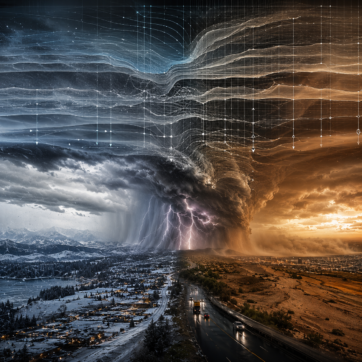
Why There Is No Origin, No Creator, And Why The System Requires Both To Hold Itself Together
The Question That Cannot Hold
If the Eternal is pure coherence, how did the external form?
This question appears valid because it is being asked from inside an external system that cannot hold anything without tracing it back to a cause, a sequence, and an origin. Inside the external, nothing is allowed to simply be. Everything must be explained through something that came before it, something that initiated it, something that made it happen. So the question forms exactly the way the system requires it to form, because without that structure—cause leading to origin leading to continuity—the system cannot stabilize its own existence. It cannot justify why anything is here at all unless it can point to a beginning. That is not curiosity. That is structural necessity.
But that entire way of organizing reality does not apply to what is being asked about.
The Eternal does not exist inside sequence. It does not exist inside cause. It does not exist inside any condition that allows something to begin, progress, or result in something else. It does not initiate, it does not act, and it does not produce outcomes. So the question “how did the external form” cannot be answered through event, action, or decision, because those only exist once the external is already in place. The moment the mind tries to answer the question using those tools, it has already collapsed the answer back into the system it is trying to explain.
So the only way this can be held cleanly is through condition, not event.
The Eternal is pure coherence, but it is not a system enforcing that coherence. It is not regulated, not maintained, not protected, and not stabilized as an exclusive state. There is no boundary holding it in place, no containment preserving it, and no mechanism preventing anything else from appearing. That is the critical point, because it removes the assumption that something had to break, fail, or degrade in order for the external to exist. Nothing failed. Nothing broke. There is simply no system in place preventing differentiation from appearing.
And that is where the question stops functioning the way it was originally asked, because it is no longer about something happening. It is about what appears when nothing is enforcing that only one condition can exist.
The Core Condition — Why Differentiation Can Appear
The assumption underneath the question is that if coherence is absolute, then it must prevent anything else from ever appearing, as if coherence functions like a system that enforces itself, maintains itself, and excludes all other conditions from existing. That assumption comes directly from how systems behave inside the external, where anything that remains stable is actively regulated, bounded, and reinforced in order to hold. Stability inside the external requires containment, requires control, requires a mechanism that ensures one condition remains dominant over others. So coherence is interpreted the same way, as if it must be structured, protected, and preserved in order to remain absolute.
That is not what the Eternal is.
The Eternal is absolute coherence, but it is not a structured system that enforces that coherence as the only possible condition. It does not regulate itself, it does not maintain itself, and it does not exclude anything. There is no boundary holding it in place, no containment preserving it, no regulation reinforcing it, and no exclusion mechanism preventing anything else from appearing. It is not an active condition. It is not doing anything to remain what it is. That distinction is what removes the assumption that something had to change or break in order for something else to exist.
Nothing failed. Nothing degraded. Nothing shifted in the way the system assumes.
There is simply no system in place preventing differentiation from appearing. Coherence is absolute, but it is not exclusive. And once coherence is not exclusive, differentiation appears. Not because something caused it, not because something intended it, and not because something decided it. Those would all require sequence, and sequence is not present at this level. Differentiation does not emerge from action. It appears as a direct consequence of condition, because nothing is enforcing that only one condition can exist.
This is where the system loses its ability to interpret what is happening, because it is trying to locate a cause where there is none. It is trying to assign intention where there is no action. It is trying to place an event in time where time does not exist. But what is being described does not operate through those mechanisms. There is no trigger point. No initiating force. No sequence that produces differentiation step by step. There is only the absence of exclusivity, and from that, differentiation appears.
That is the core condition, and it has to be held without inserting anything else into it, because the moment cause, intention, or event is added, the explanation collapses back into the external system it is trying to explain.
The Mechanical Emergence Of The External
The assumption is that if something as complex and structured as the external exists, it must have formed through an event, a break, or some kind of transition that occurred across time, where one condition turned into another through a definable moment of change. That assumption is unavoidable from inside the system, because everything within it is organized through sequence. Things begin, develop, and resolve. So when the question is asked, the system immediately looks for the point where the external “started,” the moment where something shifted and everything that now exists came into being.
That moment does not exist.
This is not an event. Not a break. Not something that occurred in time. There is no point where the external began, because beginning itself is a function of sequence, and sequence only exists once the external is already in place. So trying to locate a starting moment is the system attempting to apply its own rules to something that exists prior to those rules. There is no transition from one state into another. There is only condition, and from that condition, a structure appears.
What appears follows a direct mechanical chain, and it must be held exactly without interpretation, because this is not descriptive language—it is structural:
Differentiation appears.
Once differentiation appears, relation is required.
Once relation exists, structure forms.
Structure requires geometry.
Geometry requires oscillation to persist.
This is not a sequence in time. It is not a progression that unfolds step by step. It is a structural dependency chain, where each condition necessitates the next in order for differentiation to stabilize at all. The moment differentiation is present, relation is unavoidable. The moment relation exists, it must organize. That organization becomes structure. Structure cannot exist without position, which is geometry. And once geometry is present, oscillation is required for that geometry to hold and persist.
That entire chain is the external architecture.
Not created. Not initiated. Not designed. It is not the result of intention, intelligence, or decision. It is what appears when coherence is not exclusive and differentiation stabilizes into a condition that requires structure to hold. There is no author behind it. No origin event producing it. No moment where it was brought into existence.
It does not begin. It stabilizes as condition.
Why There Is No Origin
The assumption is that everything must begin somewhere, because inside the external nothing can be understood unless it is traced back to a starting point, and that requirement is so deeply embedded that origin feels like a universal truth rather than a structural dependency. Every event appears to have a beginning. Every process appears to start. Every outcome appears to come from something prior to it. So the system builds its entire understanding of reality on that pattern, where something must come first in order for anything else to follow. That pattern stabilizes continuity, because it allows everything to be explained through a chain that leads back to a defined point.
But that pattern does not apply outside the system that produces it.
Origin requires sequence, because something must come before something else in order to be identified as the beginning. Sequence requires time, because without time there is no ordering of before and after. Time requires movement, because without change there is nothing to measure or organize into progression. None of those conditions exist prior to the external, so origin cannot apply. There is no first moment, because “first” is a function of sequence. There is no initial cause, because cause is a function of relation, and relation only exists once differentiation is already present and stabilized.
So the search for origin is not uncovering something real. It is the system attempting to extend its own rules beyond where they function.
The need for an origin is structural. The system cannot hold continuity without being able to point to where everything began, because without that anchor, the entire chain of cause and effect loses its foundation. Identity cannot stabilize without continuity. Continuity cannot stabilize without sequence. Sequence cannot stabilize without cause. And cause cannot stabilize without a beginning. So the system compresses everything into a starting point because it cannot operate without one.
That compression is not truth. It is stabilization.
It allows the system to hold itself together by providing an anchor that justifies everything that follows. But that anchor is generated from within the system, not discovered outside of it. It is the point where questioning stops so continuity can remain intact.
So there is no origin in the way the system assumes.
Not because it has not been found, but because the conditions required for origin do not exist at the level the question is trying to reach.
Why Humans Require Origin
The assumption that everything must have a beginning does not come from discovering something true about existence, it comes from the way the human system is structured to operate, because it exists entirely inside sequence and cannot function without it. Sequence organizes experience into before and after, into progression, into continuity that can be tracked and understood. Without sequence, nothing can be placed, nothing can be ordered, and nothing can be recognized as happening at all. But sequence cannot hold on its own, because it requires explanation in order to stabilize. One moment must lead to the next. One condition must produce another. Without cause, sequence becomes untraceable, and the system loses its ability to make sense of what it is experiencing.
Cause then demands a beginning.
If every effect comes from something prior, the chain must resolve somewhere. The system cannot hold an infinite regress where nothing anchors the sequence, because without an anchor, continuity has no foundation. And without continuity, identity cannot stabilize. Identity depends on something carrying forward, something that remains consistent across time, something that can be referenced as “me” from one moment to the next. Remove the beginning, and that entire chain collapses. No beginning means no foundation for cause. No cause means no sequence that can be justified. No justified sequence means no continuity. And without continuity, identity loses its anchor completely.
So origin is not discovered. It is required.
It is inserted so the system can hold itself together. Without it, the structure destabilizes because there is nothing to justify why anything exists or continues at all. This is why every domain produces an origin, regardless of how different they appear on the surface. Religion places a creator at the beginning. Science compresses everything into a singularity or initial condition. New Age distributes authorship across collective creation. Philosophy searches for first principles or foundational causes. Each one appears to be uncovering something fundamental, but structurally they are all doing the same thing.
They are inserting an origin so continuity can remain intact.
They are not finding the beginning. They are generating it to prevent collapse.
The Creator Mechanism
The assumption is that a creator is something discovered, as if the system has traced existence back far enough to find the point where everything began and identified the source that initiated it, but that assumption reverses what is actually happening, because the creator does not appear as a result of discovery. It appears as a requirement the system generates in order to complete a chain it cannot otherwise hold. Inside the external, sequence is not optional. Everything must move from one moment to the next, one condition to another, in a way that can be tracked and understood. That creates the appearance of progression, but progression cannot stabilize unless it can be explained through cause. One thing must lead to another. One state must produce the next. Without cause, sequence loses coherence because nothing can be traced.
Cause then demands a beginning.
If every effect depends on something prior, the chain must resolve somewhere. The system cannot hold an open-ended regress because without resolution, nothing can be anchored. So it compresses the entire chain into a starting point, a first condition where cause begins. But that beginning is not stable on its own, because it introduces a new problem: what initiated it. A beginning without initiation cannot be justified, and the system cannot tolerate an unexplained starting point. So one more step is required.
A beginning demands initiation.
That final step is where “creator” appears. Not as truth, but as closure. It is the point where the external system stops questioning its own chain because it has inserted something that explains why the beginning exists at all. The creator provides authorship, and authorship stabilizes everything that follows. Now the chain can hold: sequence is justified because it comes from cause, cause is justified because it comes from a beginning, and the beginning is justified because something initiated it.
Remove the creator and the entire structure collapses.
No initiator means no true beginning. No beginning means no foundation for cause. No cause means sequence cannot justify itself. And without justified sequence, the system cannot explain why anything exists or continues at all. So the system inserts authorship to prevent that collapse. The name given to that insertion is “creator.”
It is not explaining existence. It is preserving the system’s ability to hold.
Religion, New Age, Science — Same Load-Bearing Structure
The assumption is that these systems are fundamentally different, as if they are offering competing explanations for how existence began, each arriving at its own conclusion through independent reasoning or discovery, but what appears as difference at the surface is the same structure repeating in different language because the requirement underneath does not change. The system cannot hold without a stable chain, and that chain must resolve into something that explains where everything came from and why it continues. So each domain constructs that resolution in the only way it can, using the tools available within its own framework, but all of them are solving the same structural problem.
Religion assigns creation to a singular being, placing a defined entity at the beginning that initiates everything that follows. That provides a clear source, a clear authority, and a clear direction, where everything can be traced back to one origin point that stabilizes the entire chain. New Age removes that singular authority and distributes authorship across the collective, reframing creation as something shared, where reality is still being produced, but now through participation rather than command. The structure remains intact, because there is still authorship, still origin, still continuity being preserved. Science removes identity altogether and replaces it with abstraction, introducing singularities, initial conditions, and expansion events as the starting point, where the language becomes technical, but the function is identical: establish a beginning so everything that follows can be explained.
The language shifts. The structure does not.
All of them preserve the same chain: cause leading to origin leading to continuity. That is the constant. That is what must remain intact for the system to hold itself together. The differences between them are surface-level translations, not structural distinctions. One uses a being. One uses a collective. One uses a system. But all of them are inserting a starting point that allows everything to be traced, because without that traceability, continuity collapses and the system loses its ability to justify its own existence.
So what appears as disagreement is not actually disagreement at the level that matters.
It is the same mechanism repeating in different forms, each one stabilizing the system by ensuring that nothing exists without a cause, nothing continues without an origin, and nothing operates without a chain that can be followed back to where it began.
Creation Is Rearrangement, Not Origination
The assumption is that creation means something new is brought into existence, as if something that did not exist at all suddenly appears through an act, a process, or a moment of generation, and that assumption feels obvious because inside the external everything is experienced linearly. Something is not visible, and then it is. Something is not formed, and then it takes shape. Something is not known, and then it becomes known. That shift in visibility is interpreted as origin, because the system equates appearance with beginning, and from inside that structure it feels indistinguishable from something being created in the absolute sense.
But that interpretation does not hold structurally.
Nothing originates from nothing. There is no point where something is produced from outside the system and introduced into it as a new existence. Everything that appears is resolving through what is already present within the external system’s constraints. Materials combine, separate, and recombine. Patterns reorganize and stabilize into new configurations. What looks like emergence is actually resolution within a structure that is already active. Even thought, which feels like it arises spontaneously, is not originating from outside the system. It is expressing through existing pathways, shaped by prior structure, constraint, and organization in the pre-render architecture.
So what is called creation is not origination. It is rearrangement.
It is selection, recombination, and expression within a closed system that already contains the elements required for what appears. Nothing is being introduced from outside that structure. Nothing is being generated from a true zero point. The system is continuously reshaping itself through the interaction of what is already in place, and that reshaping is what registers as creation from inside linear perception.
This is why creation feels real but does not hold as an absolute.
Because the experience of something appearing is valid, but the interpretation of that appearance as origination is not. The system is not producing something new in the sense of bringing it into existence from nothing. It is reorganizing what is already available, resolving configurations that were not previously visible, and expressing them through the constraints that define the system itself.
So nothing is being created.
The system is rearranging itself, and that rearrangement is what is being called creation.
The Misprojection Error
The assumption is that because everything inside the system appears to begin, that pattern must apply to everything universally, as if beginning is a fundamental property of existence rather than a condition specific to the structure it is being observed within. Every event inside the external has a starting point. Every process resolves through a sequence. Every outcome can be traced back to something that came before it. That repetition creates certainty, and that certainty becomes belief. It feels definitive because it is consistent, and because it is consistent, it is taken as truth.
That is where the distortion locks in.
Beginning is not universal. It is local. It belongs to the external because the external depends on sequence in order to function at all. Sequence organizes everything into before and after, into progression, into continuity that can be tracked and stabilized. Without that, nothing inside the system could be experienced, interpreted, or held. So the system produces beginnings constantly, because beginnings are how sequence anchors itself into something that can be recognized.
But that behavior is not transferable beyond the system that generates it.
The system takes what is true within its own structure and projects it outward as if it applies everywhere. It assumes that because everything here begins, everything must have begun. That projection is not discovery. It is extension. It is the system attempting to apply its own rules to what exists outside those rules, because it has no other way to interpret anything.
From that projection, the search begins.
The system looks for the first moment, the original cause, the creation event that started everything, because it cannot function without that anchor. It needs a beginning to stabilize continuity, so it searches for one even where it does not exist. It assumes there must be a point where everything started, not because that point is real, but because without it, the system cannot justify its own structure.
But those things—first moment, original cause, creation event—only exist where sequence exists.
They are not universal conditions.
They are products of the external architecture, and the moment they are projected beyond it, the explanation collapses into distortion, because it is using local behavior to define something that is not governed by that behavior at all.
The Logical Collapse Of Creator
The assumption is that a creator provides a complete explanation, as if assigning a source to existence resolves the question of where everything came from, but that only appears to hold because the logic is not followed all the way through. The moment the structure is examined directly, it breaks under its own requirements. A creator is supposed to be the origin point, the initiator, the one that begins everything that follows. But in order to function in that role, the creator must already exist before creation occurs. Otherwise, it could not create.
That creates the contradiction immediately.
If the creator exists before creation, then it was not created. And if something exists without being created, then creation is not universal. The entire premise collapses at that point, because the explanation that was meant to account for everything now fails to account for the very thing it depends on. If creation does not apply to the creator itself, then it cannot be used as a total explanation for existence. It becomes partial, and once it is partial, it no longer resolves the question it was meant to answer.
The system cannot hold that inconsistency. So it compensates.
It either pushes the question back indefinitely—who created the creator—extending the chain without ever resolving it, or it removes the question entirely by placing the creator outside of logic, beyond understanding, beyond cause. Uncreated. Unknowable. Both moves avoid the contradiction, but neither resolves it. One creates an infinite regress. The other creates an untouchable endpoint that cannot be examined.
Both preserve the structure.
They allow the system to continue holding a creator without confronting the fact that the logic does not close. The role of the creator remains intact, not because it is coherent, but because removing it would destabilize the entire chain that depends on it. So the contradiction is not solved. It is contained.
And what appears as explanation is actually avoidance. The creator does not resolve origin.
It exposes that origin, as defined by the system, cannot be resolved at all.
The Eternal Is Not A Creator
The assumption is that whatever exists beyond the external system must be the source of it, as if something outside the external must be generating, producing, or sustaining it in a way that can be understood as a higher form of creation, but that assumption is still using the same structure it is trying to move beyond. It takes the concept of creation, which only exists inside sequence, and projects it outward, assigning it to something that is not operating within sequence at all. That is why the Eternal is so often reframed as a creator, an intelligence, or a force generating reality at a more advanced level, because the system cannot interpret anything without assigning function, action, and outcome.
But none of that applies.
The Eternal does not initiate, it does not act, it does not produce, and it does not generate. Creation requires sequence, because something must happen, something must move from one state to another, and something must result from that movement. The Eternal has none of those conditions. There is no before and after, no transition, no action taking place that leads to an outcome. So it cannot be a creator in any form, not a higher version, not a more advanced intelligence, and not a hidden source behind what appears.
The moment it is framed that way, it has already been reduced back into the system.
It has been given a role, assigned a function, and placed into a structure that requires sequence in order to make sense. That is not a deeper understanding. It is a translation error. It takes what is non-sequential and forces it into a sequential framework, which immediately distorts it into something else entirely.
So the Eternal does not create the external.
There is no act of creation, no initiating force, and no producing mechanism. The external does not come from the Eternal in that way. It appears when coherence is not exclusive. That is the only condition. Not a decision. Not a design. Not an expression of intelligence. Just the absence of exclusivity allowing differentiation to stabilize into structure.
That is where the explanation has to stop. Because the moment anything is added—intention, intelligence, purpose, creation—the answer collapses back into the system it is meant to clarify.
Why “Creation” Is The Wrong Word
The assumption is that “creation” is the correct word to describe how anything begins, because inside the external every process is understood through before and after, where something happens, something changes, and something results from that change. That structure is so constant that it becomes embedded in language itself, so even when something is being pointed to outside of sequence, the only available words already carry sequence within them. Creation implies action. It implies intention. It implies a transition from one state into another. It implies something producing something else. All of that belongs to the external, because all of it depends on movement across time.
So the moment the word is used, mechanics are already being introduced. It does not just fall short. It misrepresents.
Because it forces what is non-sequential into a sequential frame, and once that happens, the explanation is no longer describing what is actually being pointed to. It is describing a process that does not exist. There is no before. No after. No initiating moment. No action taking place. No outcome being produced. So “creation” does not partially capture what is happening. It replaces it with something else entirely.
This is why every attempt to explain the external as “created” immediately pulls the explanation back into the system.
It introduces cause, intention, and sequence where none of those apply. It assumes something had to happen in order for something else to exist, when what is being described does not operate through happening at all. The limitation is not conceptual. It is built into the structure of the word itself. The word cannot be separated from the mechanics it carries.
So the closest usable direction is not creation. It is “given.”
Not given by something.
Not given to something.
Simply already the case.
No origin. No process. No initiation.
It does not resolve the translation completely, but it removes the need for something to happen in order for something to be. And that is the closest the system can get without reintroducing distortion through its own language.
Why Purpose Gets Inserted
The assumption is that if something exists, it must exist for a reason, as if existence itself requires justification in order to hold, and that assumption follows directly from the moment creation is accepted as the starting point. If something was created, then it must have been created for something. That is how the system extends its chain, because creation on its own does not fully stabilize continuity. It establishes a beginning, but it does not explain why that beginning matters or where it is leading. So another layer is required to complete the structure.
That layer is purpose.
Once creation is assumed, purpose follows automatically. It is not discovered. It is inserted to extend the chain so it can hold: creator leads to creation, creation leads to purpose, and purpose leads to direction. Now everything has somewhere to go, something to fulfill, something to align with. That gives identity a place to stabilize, because identity cannot hold in a system where nothing is moving toward anything. Without direction, there is no orientation. Without orientation, there is no continuity that can be maintained in a meaningful way.
So purpose provides that stabilization.
It gives direction, meaning, and continuity. It allows identity to organize itself around something that appears to exist beyond the immediate moment. It introduces progression, where something is moving toward an outcome, even if that outcome is never actually reached. That movement is what keeps the system active, because without it, there is no reason to continue the sequence.
But that is exactly the point. Purpose is not revealing anything underlying. It is reinforcing continuity.
Without purpose, the structure weakens because the chain loses its forward anchor. Creation explains where something came from, but purpose explains where it is going, and both are required for the system to fully stabilize itself. So purpose is inserted not because it exists beyond the system, but because the system cannot hold without it.
It maintains movement. It maintains direction. It maintains participation.
And in doing so, it preserves the same structure that required creation in the first place.
There Is No Assigned Point
The assumption is that everything must be moving toward something, as if existence itself requires a defined endpoint in order to make sense, and that assumption only holds because the system has already inserted creation and purpose as load-bearing structures that organize continuity. Once a creator is established and purpose is layered on top, direction becomes unavoidable. Something must be progressing. Something must be leading somewhere. Identity depends on that movement, because without direction there is no way to orient, no way to measure, and no way to justify continuation.
But remove the creator, and the entire chain loses its anchor.
Without a creator, purpose has nothing to attach to. There is no originating authority assigning direction, no initiating force determining outcome, and no imposed reason that defines where anything is supposed to go. Without origin, there is no fixed starting point. Without a starting point, there is no defined trajectory. And without trajectory, the entire idea of movement toward a final state collapses.
So the system compensates.
It generates purpose internally to maintain continuity. Goals appear. Meaning is constructed. Direction is assigned. Not because those are inherent properties of existence, but because without them, identity has nothing to stabilize against. Participation requires orientation, and orientation requires something to move toward. So the system produces its own anchors—self-generated endpoints that give the appearance of direction and progress, even though there is no underlying point they are actually resolving toward.
This is why the idea of an ultimate endpoint persists so strongly.
A final state, a completion, a resolution where everything makes sense and arrives somewhere definitive. But that need is structural, not real. It is required for the system to feel coherent, not because such an endpoint actually exists. There is no ultimate destination the system is building toward. No final condition that justifies everything that came before it.
And the absence of that is not a problem. It is not an error in the system. It is not something missing that needs to be found. It is what remains when the layer that assigns origin, purpose, and direction is no longer required to hold continuity. Without that layer, nothing needs to point anywhere. Nothing needs to resolve into something else. Nothing needs to become.
There is no assigned point. And there never was.
What Is Actually Happening
The assumption is that everything must be progressing toward some form of completion, as if existence is unfolding along a path that leads somewhere definitive, where all movement, all development, and all experience are building toward a final state that resolves the system into something finished. That assumption feels inherent because sequence creates the appearance of progression. One moment leads to the next. One condition develops into another. Over time, this creates the sense that something is advancing, improving, or moving closer to an endpoint that justifies everything that came before it.
But that interpretation is coming from inside the system. Nothing is moving toward completion.
The system is running. That is what is actually happening. Expression unfolds because structure allows it. Identity stabilizes because continuity requires it. Experience sequences because time organizes it. None of that implies direction toward a final state. It only implies that the system is active and sustaining itself through the conditions that define it.
The appearance of progress comes from sequence.
Because events are ordered, they can be interpreted as movement forward. Because conditions change, they can be interpreted as development. But sequence does not require destination. It only requires ordering. It creates the illusion of forward motion without needing anything to actually be reached.
The appearance of direction comes from purpose layered onto that sequence.
Once purpose is inserted, progression is no longer neutral. It becomes aimed. Now everything appears to be moving toward something, fulfilling something, resolving into something meaningful. But that direction is not inherent to the system. It is assigned in order to stabilize participation, to give identity something to orient around so continuity can hold.
Remove that layer, and what remains is clear. The system is not trying to finish. It is sustaining its own operation.
There is no endpoint it is moving toward, no final condition it is attempting to reach, and no completion that will resolve everything into something else. What appears as unfolding is simply the system continuing to run under its own mechanics, maintaining sequence, maintaining structure, maintaining continuity, without requiring a conclusion to justify its existence.
The Key Distinction
The assumption is that the same rules must apply everywhere, as if whatever governs experience, identity, and structure inside the external system must also explain what exists beyond it, but that is where the entire distortion originates, because it collapses two completely different conditions into one and then tries to resolve them using the same mechanics. Inside the external, creation, cause, and purpose are not optional ideas. They are load-bearing requirements. Without creation, nothing can be placed into a chain. Without cause, nothing can be traced. Without purpose, nothing can be directed. Remove any one of those, and the system cannot stabilize sequence, cannot justify continuity, and cannot hold identity in a way that allows participation to continue.
So the external requires them. Not as beliefs, but as structural necessities.
Creation anchors the beginning. Cause stabilizes the chain. Purpose provides direction. Together, they allow the system to function, to organize, and to maintain itself across time. Without them, the entire structure loses coherence from within its own rules. That is why they appear everywhere, across every domain, in every form, regardless of how they are expressed. They are not optional interpretations. They are required mechanisms.
But none of them extend beyond the system that requires them.
The Eternal does not require creation, because it does not begin. It does not require cause, because nothing leads to anything else. It does not require purpose, because nothing is moving toward anything. Those mechanisms only exist where sequence exists, and sequence only exists inside the external. So when those rules are applied to what is beyond the system, they do not explain it. They distort it by forcing it into a structure it does not belong to.
This is where the separation has to hold completely.
The external is not wrong for requiring these mechanisms. It cannot exist without them. But they are local, not universal. They do not describe what exists beyond the system. They only describe what is required for the system to function. And the moment they are projected outward as if they apply everywhere, everything collapses back into the same misinterpretation, where what is non-sequential is forced into a sequential explanation that can never resolve.
So the distinction is not subtle. It is absolute. One condition requires creation, cause, and purpose in order to exist. The other requires none of them at all.
The Eternal Is Unchanged
The assumption is that if something like the external exists—with structure, instability, distortion, and continuous movement—then something at the source must have shifted, degraded, or failed in some way to allow that to happen, because inside the external system every output reflects an internal condition. If something breaks, it is because something behind it is broken. If something distorts, it is because something upstream has been altered. That logic holds everywhere inside the external, so it gets projected outward as if it must apply universally.
But that logic does not apply here. Nothing went wrong.
The Eternal has not been altered, damaged, or degraded in any way. It has not shifted into a lesser condition. It has not fractured or lost coherence. The external does not reflect a failure at the source, because there is no feedback loop connecting the two in that way. The Eternal is not part of the structure that produces, maintains, or distorts the external, so nothing that occurs within that structure feeds back into it or modifies it.
There is no correction needed. No repair. No restoration. No return to a prior state that was somehow lost. Because nothing was lost.
The assumption that something must be fixed comes from how systems behave internally, where instability requires intervention in order to be resolved. But the Eternal is not a system operating under load. It is not maintaining itself, not regulating itself, and not responding to conditions that arise within the external. So there is nothing to adjust, nothing to restore, and nothing to bring back into alignment.
It remains exactly as it is. Not because it is being preserved, not because something is holding it in place, but because it was never dependent on structure to begin with. It does not rely on conditions that can change, so it is not subject to change. It does not participate in the mechanics that produce distortion, so it cannot be distorted.
The external appears. The Eternal does not change.
This Is Complete
The assumption is that there must be something more behind the explanation, as if what has been laid out is only a partial view and there is a deeper cause, a hidden mechanism, or a missing layer that would fully resolve the question if it could just be uncovered. That assumption is not coming from lack of clarity. It is coming from the system’s inability to hold an answer that does not include cause. Inside the external, every explanation must lead to something else. Every answer must open into another question. There must always be something behind what is seen, because without that extension, the system cannot stabilize its own logic.
But that extension does not exist here. The external exists because coherence is not exclusive. That is the full condition.
There is no deeper cause behind it. No hidden mechanism driving it. No underlying process that has not yet been explained. Nothing is missing from that statement. The moment something is added—an initiating force, an intelligence, a reason, a purpose—the explanation collapses back into the same structure it is meant to clarify, because cause is being reinserted where it does not apply.
This is where the external system resists most strongly.
Because it cannot accept an answer that does not extend. It cannot hold a condition that does not lead to something else. So it searches for more. It assumes there must be another layer, another explanation, another reason that completes the picture. But that search is not uncovering anything real. It is the system attempting to restore cause where none exists.
This is not incomplete understanding. This is accurate. Nothing is missing. Nothing is left out.
The need for more is not a signal that something has not been explained. It is the system attempting to reinsert the very mechanism that has already been removed.
Closing — Collapse Of Origin
The assumption is that origin is required for anything to exist, as if without a beginning there would be nothing to anchor reality, nothing to justify continuity, and nothing to explain why anything is here at all. That assumption holds the entire structure together, because once origin is assigned, everything that follows can be traced, organized, and understood within a stable chain. But that stability is conditional. It depends on the system maintaining the requirement that everything must begin.
When that requirement drops, the structure loosens.
Creation no longer needs to be assigned, because nothing needs to be placed into a chain that begins somewhere. Purpose no longer needs to be justified, because nothing needs to move toward something in order to validate its existence. Direction no longer needs to be maintained, because there is no endpoint that must be reached in order for continuity to hold. The system continues to operate, sequence continues to appear, identity continues to stabilize, but the layer that explains it—the layer that says why it must be this way—falls away.
Nothing needs to begin for it to exist.
The external does not come from something. It does not trace back to an origin that produced it. It appears when coherence is not exclusive, and that condition does not require a starting point to hold. There is no first moment behind it. No initiating cause. No creation event that can be located or defined.
That is the full sequence. Not extended. Not reduced. Not incomplete. Held without insertion, without compression, and without distortion.