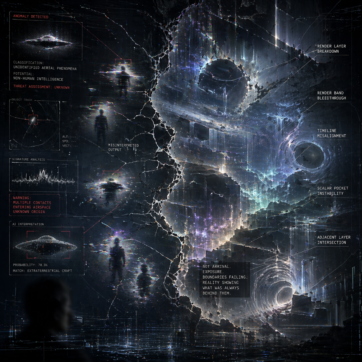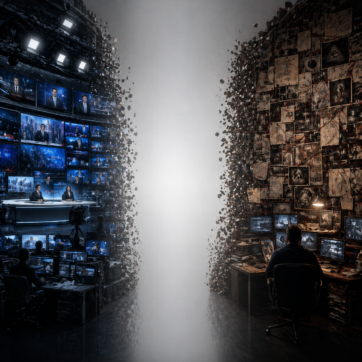
The surge in collapse and survival storylines isn’t forecasting a real-world wipeout—it’s the translated output of a pre-render architecture under compression, where distributed breakdown is condensed into dramatic scenarios and misread as a single catastrophic future event.
The Surge Is Not Cultural, It Is Structural
Turn on the TV or scroll through any streaming platform and the pattern is unavoidable: movies and television are saturated with world-ending scenarios, collapsing systems, survival-driven plots, and relentless end-times framing. This is no longer a coincidence or a passing genre cycle—it is a convergence. The last decade shows a sharp increase in this single dominant structure, repeating across networks, studios, and platforms with minimal variation. That level of uniformity points to a shared source condition, not independent creativity. The source condition is the pre-render architecture under compression and coherence loss, and what appears in media is the translated output of that underlying state.
When a system is stable, outputs diversify because there is no singular pressure point forcing repetition. You see wide variation, unrelated storylines, and no dominant structural theme overtaking every channel at once. That is not what is happening here. What is happening now is saturation, where multiple independent creators, studios, and platforms are all pulling from the same collapse pattern simultaneously. That only occurs when the underlying architecture feeding the render layer is running a dominant condition that overrides variation. The system is no longer producing wide-band outputs; it is collapsing into a narrow range of expressions because the base layer itself is losing coherence and forcing everything above it to reflect that loss in different translated forms.
The key misread is assuming this is psychological, cultural, or market-driven. Those are surface-level explanations attempting to rationalize something that is actually structural. Culture does not synchronize globally around a single pattern at this scale without an underlying shared driver. The repetition itself is the signal. The fact that the same core sequence appears across genres, across countries, across different creative teams, and across different audience demographics shows that the source is not individual imagination. It is a common pressure field feeding the render. The media layer is simply where that pressure becomes visible in a form the human mind can process.
What is being translated is not an idea of collapse. It is the active state of collapse at the architecture level. Pre-render is not a conceptual layer; it is where the load-bearing structure of the external grid operates. When that layer begins to compress and lose coherence, it generates a very specific type of output. That output is not symbolic by design, but it becomes symbolic once it is filtered through the render layer and processed by human perception. So what appears as “end of the world” storytelling is not imagination projecting outward. It is the system translating an internal condition into a visible format that can exist inside the constraints of the render.
The increase over the last decade marks escalation, not coincidence. Earlier phases of instability produced scattered signals—isolated dystopian narratives, contained collapse environments, localized breakdown stories. As compression intensified, the system could no longer distribute those signals quietly. It began to amplify them, repeat them, and converge them into dominant patterns. That is why the current landscape is saturated. The system is no longer able to mask its internal state through variation. It is outputting the same structural message through every available channel because that is the only pattern it can still reliably generate under the current load conditions.
This is why the surge feels excessive and unavoidable. It is not being selected. It is being forced. The architecture is no longer in a position to generate neutral or stable outputs at scale, so what you are seeing is the visible layer compensating by repeating the only viable translation of the underlying condition: collapse, survival, fragmentation, and continuation under failure. The media does not lead this pattern. It follows it. It renders it. It makes it visible. And the fact that it is everywhere at once is the clearest indication that the source is structural, not cultural.
The External Grid, The Mimic Layer, And The Pre-Render / Render Split
Before collapse patterns can be understood, the structure they are occurring within has to be made explicit. What is being referred to as the external grid is the full operating architecture that produces and sustains the environment currently experienced as reality. It is not a place in the conventional sense and not a single layer; it is a multi-layered system that functions through geometry, oscillation, and continuous stabilization processes. Its baseline condition is not stillness or coherence, but movement, adjustment, and compensation. Everything within it is maintained through active processes rather than inherent stability.
This architecture operates in two primary functional layers: pre-render and render. Pre-render is the load-bearing layer where structure is formed, adjusted, and held together. It is where the grid processes compression, distributes load, and attempts to maintain coherence under strain. It does not present as visible environment; it is the underlying structural field that determines what can and cannot appear. Render is the output layer—the visible, experiential environment where those underlying structural conditions are translated into physicality, events, and observable systems. What is experienced in the render is not self-generated; it is the surface expression of what is occurring in pre-render.
Within this external grid sits an additional layer: the mimic. The mimic is not a separate system but an overlay function that further stabilizes the grid by copying, repeating, and reinforcing existing structures. It does not create anything new; it replicates what already exists and redistributes it in ways that help the system maintain continuity under increasing pressure. Because the external grid is already operating under conditions of instability, the mimic layer amplifies repetition, reinforces patterns, and compresses variation. It acts as a secondary stabilizer, but in doing so, it increases density and reduces flexibility, which contributes to long-term degradation.
The interaction between these layers defines the current condition. Pre-render processes the load and attempts to hold structure. The mimic layer reinforces and repeats those structures to prevent collapse. The render layer displays the outcome as a continuous environment. What is important to recognize is that all experience is occurring within this system. There is no partial positioning or external vantage point inside it; the entire field of human perception, activity, and interpretation exists within the external grid and its mimic-stabilized overlay.
This is fundamentally different from the Eternal. The Eternal is not another layer within the grid, not a higher level of the same system, and not an alternate environment that can be accessed through movement within the architecture. It is a completely different state of being, defined by total coherence, no oscillation, no compression, and no need for stabilization. Where the external grid depends on continuous adjustment to maintain itself, the Eternal does not require maintenance at all. It does not generate structure through geometry, does not operate through load distribution, and does not degrade because it is not built on processes that can fail.
The distinction is absolute. The external grid is a system that holds itself together through compression and repetition, now under increasing strain and coherence loss. The mimic layer intensifies that process by reinforcing patterns and reducing variation. Pre-render manages the load, render displays the result, and everything currently experienced exists within that cycle. The Eternal stands entirely outside of this structure, not as a destination within it, but as a different state altogether—one that does not participate in the mechanics of stabilization, collapse, or translation.
Why The External Grid Is Collapsing And Entering Compression
The external grid is not entering collapse as a new condition—it has been in collapse since its inception. What is being observed now is escalation, not initiation. The architecture has never achieved true stability, not once, because it is not built from coherence. It is built from externalization, which means it depends on separation, oscillation, and continuous correction to maintain any form at all. From the moment it began, it required compensation to hold itself together. There has never been a phase where the system existed in a fully coherent, self-sustaining state. What has been perceived as stability at different points is only the temporary success of its compensation mechanisms.
Because the grid cannot generate coherence internally, it relies on stabilization through constant adjustment. That means every structure within it is being actively maintained rather than inherently held. The system is always correcting, always redistributing load, always compensating for imbalance. This is what defines externalization: structure that cannot hold itself without ongoing intervention. As long as the rate of compensation can keep up with the rate of degradation, the system appears stable. The moment that balance shifts—even slightly—the need for compensation increases, and the system begins to compress in order to maintain form.
Compression is therefore not a failure response; it is a baseline behavior that intensifies as coherence drops. From the beginning, the grid has used compression to hold structure, tightening and constraining itself to prevent immediate fragmentation. What is different now is the scale and intensity of that compression. The architecture has reached a point where its ability to compensate is being outpaced by the rate at which it is degrading. That forces deeper compression cycles, which reduce flexibility and increase internal pressure, accelerating the breakdown the system is attempting to avoid.
This creates a locked loop: the system compresses to hold itself, that compression destabilizes internal structure, the instability requires further stabilization, and the only available mechanism is more compression. Because the grid has no access to true coherence, it cannot exit this loop. It cannot expand into balance, reset to a stable state, or restore integrity at the base level. It can only continue compensating through increasingly restrictive and dense configurations.
The mimic layer reinforces this condition by repeating and fixing existing structures rather than allowing variation. Instead of distributing pressure through change, it replicates the same patterns, which concentrates load and reduces the system’s ability to adapt. This makes the compensation loop more rigid and less effective over time, further accelerating the collapse sequence while still maintaining surface continuity.
The result is a system that has always been unstable, always compensating, and now increasingly unable to sustain its own methods of compensation. Collapse is not an endpoint the grid is approaching; it is the ongoing condition of the grid itself. What is changing is the visibility and intensity of that condition as compression deepens and coherence continues to decline.
Pre-Render State: Compression, Decay, Collapse Sequencing
The external grid is no longer maintaining stable coherence, and that loss is not intermittent or theoretical—it is continuous and load-bearing. At the base layer, the system is no longer able to sustain itself through balanced structure, so it defaults into a repeating compensation loop that attempts to hold form while simultaneously accelerating its own breakdown. That loop runs as a strict sequence: stabilize to maintain temporary coherence, compress to reinforce structure under strain, degrade as the compression destabilizes internal integrity, then re-stabilize again at a lower level of coherence, followed by deeper compression to hold what remains. Each pass through this sequence increases pressure while reducing the system’s ability to maintain itself, creating a condition where the architecture is actively holding and failing at the same time.
This process generates continuous collapse-load pressure at the pre-render layer. That pressure is not abstract; it is structural load that must be processed, redirected, or expressed. Because the system is no longer operating from a state of stable coherence, the range of outputs it can produce becomes extremely limited. It cannot generate open variation or balanced configurations under this level of strain. Instead, it defaults to a narrow band of repeatable failure patterns, each one representing a different way the system attempts to manage its own breakdown while maintaining some level of continuity.
Those outputs are consistent and predictable at the structural level: environmental failure as the surrounding system loses stability and becomes hostile to its own components, system breakdown as centralized structures lose their ability to coordinate and hold function, fragmentation into smaller units as larger coherent structures collapse into localized clusters, and survival-based persistence as those clusters attempt to maintain themselves in the absence of stable overarching architecture. These are not conceptual ideas or narrative themes; they are the direct expressions of a system that can no longer sustain unified coherence and is instead operating through fragmented, degraded states.
Because these patterns originate at the architecture level, they carry through every layer above them. They are not chosen, interpreted, or invented in their original form—they are generated as the only viable outputs under current conditions. What appears later in the render layer as stories, scenarios, or imagined futures is simply the translated version of these base-layer failure states. The origin remains mechanical and structural, not psychological or creative.
Translation Into Render: How Collapse Becomes Narrative
The external grid is collapsing exponentially right now, and that collapse is occurring at the architecture level. The pressure from that collapse is increasing rapidly, and the system cannot hold that pressure silently. It has to express it. But the render layer—the world people actually see—cannot display architecture directly. It cannot show compression fields, coherence loss, or structural load in their real form. So instead, everything happening underneath gets translated into something the human mind can recognize.
That translation is what shows up as apocalypse beliefs and scenarios playing out in the media.
The grid is not collapsing in one clean event. It is breaking down everywhere at once, across systems, over time, in layers. But the human mind cannot track that kind of distributed, ongoing degradation. It cannot easily process “everything is slowly failing at once.” So the translation compresses the entire condition into a single visible scenario: one event, one collapse, one moment where everything breaks. That becomes the narrative structure.
This is why the same exact patterns repeat across movies and television. Ongoing systemic instability gets converted into total system failure. Fragmentation of large-scale structure becomes small survivor groups. Loss of coherence becomes destroyed cities, ruined environments, and unlivable conditions. Continuous pressure becomes a dramatic breaking point. What is actually happening gradually and everywhere gets turned into something sudden and localized so it can be understood.
The reason it looks like prediction is because it is a direct translation of a real condition. But it is not translating the timing or the format correctly—it is translating the pressure. The grid is under accelerating collapse, so the output becomes more extreme, more frequent, and more concentrated into these end-state scenarios. The mind takes the most intense version of that pressure and renders it as “the world ending,” because that is the simplest and most immediate way to represent total breakdown.
So what is being seen in media is not imagination creating fiction about the future. It is the system taking a real, escalating collapse condition and compressing it into a form the render can display and the mind can process. The architecture is failing in a distributed way, but the translation turns it into a single catastrophic event because that is the only way the full scale of the pressure can be visualized at once.
Why Humans Keep Recreating The Same Theme
Humans are not independently generating these ideas, and the repetition across movies and television is not the result of shared imagination, influence, or creative borrowing at the level people assume. The repetition is structural. Humans function inside the render layer as output nodes, meaning what is created, expressed, and produced does not originate in isolation—it is fed by the underlying condition of the architecture they are embedded within. Creation is not a sealed process; it is permeable to the pressure running beneath it.
When pre-render pressure increases, that pressure does not remain contained at the base layer. It propagates upward into the render through the same architecture that sustains perception and cognition. This is not experienced as direct awareness of collapse. It is experienced as impulse, idea formation, narrative direction, and creative inclination. The human mind then assembles those impulses into structured outputs—scripts, plots, visuals, and storylines—without recognizing that the source material is not being invented but received and translated.
What creators are pulling from are not abstract concepts, but active structural conditions. Collapse patterns at the architecture level begin to register as thematic direction. Instability in the grid becomes tension in narrative. Fragmentation in structure becomes isolated groups in storytelling. Environmental degradation becomes ruined landscapes. These are not symbolic in origin; they are literal translations that have been adapted into a form the human mind can work with. Because the source condition is shared, the outputs begin to converge even when there is no direct connection between the creators themselves.
This is why the repetition is so precise and so widespread. Different studios, different writers, different production teams, all operating in separate contexts, arrive at nearly identical structural frameworks: the world breaks, systems fail, a catastrophic event resets the environment, and small groups attempt to survive within the aftermath. The details change, but the structure remains the same. That consistency is not the result of imitation—it is the result of drawing from the same active pressure field.
Timing convergence is another key indicator. These themes do not appear randomly across decades with equal distribution. They cluster. Entire waves of similar narratives emerge across platforms at the same time because the underlying pressure has intensified to a level where it is being expressed simultaneously across multiple channels. When the architecture is under low strain, outputs are more varied and dispersed. When the architecture is under high strain, outputs compress and synchronize. What is being observed now is high-strain synchronization.
The mimic layer reinforces this effect by amplifying repetition. Once a pattern emerges, it is replicated, redistributed, and reinforced across the system. This does not create the pattern—it locks it in and increases its visibility. The more the pattern repeats, the more normalized it becomes, and the more it continues to propagate through additional creators and platforms. This creates a feedback loop where the same collapse structures appear over and over again, not because they are being chosen, but because they are the only patterns the system is consistently generating under current conditions.
So the repetition resolves cleanly to source mechanics: one collapsing architecture, one set of failure-state patterns, multiple human output nodes translating those patterns into media. Same source, same pressure, same structural templates—resulting in the same outputs appearing everywhere at once.
The Surge Over The Last Decade
This pattern did not appear suddenly, and it did not begin in the last decade. Variations of collapse, end-times scenarios, and system-failure narratives have been present for decades across both media and conspiracy frameworks, but in earlier phases they appeared as isolated signals rather than total saturation. You would see dystopian films, contained disaster stories, or fringe discussions in conspiracy circles about societal collapse, global resets, or end-of-world scenarios, but they remained segmented. They existed as separate threads, not a unified, dominant output overtaking every channel at once.
Those earlier expressions correspond to a lower level of architectural strain. The grid was already unstable, but the pressure had not reached a point where it forced convergence. So the outputs appeared in pockets—one film here, one theory there, a contained narrative that explored breakdown without overwhelming the entire system. Even conspiracy frameworks during those periods reflected the same underlying condition, but in fragmented form: different groups focusing on different versions of collapse, different timelines, different causes. The structure was the same, but it was not yet synchronized.
As compression increased at the pre-render level, those fragmented outputs began to intensify. The same core patterns—collapse, reset, survival—started appearing more frequently and more visibly. What had once been implied or speculative became more explicit. Media began to move away from contained disaster stories into full-system failure narratives. Conspiracy circles shifted from scattered theories into more unified end-times framing, where multiple interpretations began pointing toward total breakdown scenarios. This shift was not driven by new information or creative evolution; it was driven by increased architectural pressure forcing clearer translation.
The last decade marks the point where that pressure crosses a threshold into saturation. The system is no longer able to distribute these patterns in isolated ways, so they begin to appear everywhere at once. Movies, television, streaming platforms, news framing, online discourse, and conspiracy communities all start reflecting the same core structure with minimal variation. The details differ—different causes, different triggers, different aesthetics—but the underlying narrative is identical: the world breaks, systems fail, and survival becomes the primary condition.
This is why it now feels excessive. The variation has collapsed. Where there were once distinct narratives, there are now slight modifications of the same story repeated continuously. A virus replaces a climate event, an alien force replaces a technological failure, but the structure does not change. It is always total collapse followed by fragmented survival. This is what saturation looks like when the architecture feeding the render can no longer produce diversified outputs.
Conspiracy circles reflect the same escalation. Earlier decades produced isolated theories about collapse, hidden control systems, or end-times events, each existing within its own framework. Now those same spaces are dominated by overlapping, converging narratives that all point toward some form of imminent or inevitable breakdown. Different communities use different language, but they are describing the same structural condition through different interpretations. This is not because those groups are uncovering a shared truth in the way they believe; it is because they are all translating the same underlying collapse pressure into conceptual form.
The current phase is defined by full-spectrum saturation. Apocalypse framing is constant, survival narratives are default, and end-times language has moved from fringe to mainstream across both media and belief systems. This marks a high-compression state in the architecture. The system is no longer capable of masking its internal condition through variation, so it repeats the same pattern everywhere. Slightly different storylines, slightly different explanations, but structurally identical outputs—because they all originate from the same escalating collapse at the pre-render level.
Why It Does Not Happen As A Single Apocalypse In Render
Even as the pre-render architecture collapses faster than ever and that pressure is being translated everywhere—through movies, television, conspiracy frameworks, and even so-called “psychic” or New Age interpretations that claim to be predicting end-times scenarios—none of these outputs mean that a literal, single apocalyptic event is going to occur in the render where the entire world is wiped out. All of these are translations of the same underlying condition, not confirmations of a future event. The escalation in intensity does not change the mechanism. It only increases the visibility of the collapse that is already happening at the architecture level.
The critical distinction is structural. A full apocalypse in the way it is depicted—one event where everything collapses at once, followed by a survival phase—would require the collapse occurring in pre-render to transfer directly and completely into the render layer without any mediation. That pathway is not active. There is a regulator layer between the base architecture and what becomes visible in the render, and its sole function is to prevent exactly that kind of total, unfiltered transfer.
When collapse-load increases in pre-render, it does not move upward as a single event. The regulator intercepts it and processes it. It absorbs the full load, breaks it into smaller segments, and distributes those segments across time and across different areas of the render. This is why collapse does not appear as one moment but as ongoing instability. What would be total failure at once becomes multiple partial failures over time. The same pressure is present, but it is expressed in fragments rather than as a single detonation.
If that regulator layer were not in place and the full collapse passed through directly, the outcome would not resemble any apocalypse scenario shown in media. There would be no surviving populations, no aftermath, no continuity of environment to move through. The render itself would drop. The output layer would cease to hold. There would be no framework left to display destruction because the entire surface would lose coherence at once. What movies depict as “the end of the world” followed by survival is not structurally possible under full collapse conditions. It is a simplified narrative version of something far more absolute.
Because the system depends on maintaining the render layer as an output surface, it prevents that outcome. It enforces continuity even while it is degrading. Instead of allowing a single terminal event, it distributes collapse across cycles. Instead of detonation, it enforces gradual breakdown. Instead of ending the system outright, it prolongs function under increasing instability. This is why the world does not end in one moment even as the architecture beneath it continues to fail.
So the reason is direct: the collapse is real, the pressure is increasing, and the translations are becoming more extreme, but the mechanism that governs how that collapse appears in the render prevents it from manifesting as a single, total apocalypse. What is shown in media and interpreted as prediction is actually a compressed representation of a distributed process. The system does not execute collapse as one event; it slices it into ongoing conditions in order to keep the render active while it continues to lose coherence.
What Actually Happens In Render Instead
The external grid is not neutral in this process. It is actively maintaining itself under collapse conditions, and every layer within it—including the mimic overlay—is engaged in stabilization behavior designed to keep the system running. This does not mean it can avoid collapse, but it does mean it will not allow collapse to express as a single terminal event if it can prevent it. The architecture is built to preserve output continuity, so even as it loses coherence, it continues working to hold the render layer in place. The mimic layer reinforces this by copying and repeating existing structures, locking in patterns that allow the system to keep functioning even as those patterns degrade. It is not “choosing” survival in a human sense, but it is executing preservation mechanics continuously, because that is how the architecture is designed to operate.
Because of this, what appears in the render is not a clean, total collapse, but a managed distribution of collapse across time and systems. Instead of one moment where everything fails, the render shows ongoing instability that never fully resolves. Crises stack on top of each other rather than concluding. Different sectors experience breakdown at different times, creating localized failure rather than universal collapse. Systems strain, recover partially, then strain again, producing repeating disruption cycles that give the appearance of constant pressure without final termination.
Each of these events is not separate in origin. They are fragments of the same underlying collapse-load being released in portions. The full pressure that exists at the architecture level is too large to pass through at once, so it is divided into smaller, survivable segments. Those segments appear as economic instability, infrastructure strain, environmental disruption, social fragmentation, and repeated crisis conditions. Each one is a partial expression of a much larger structural failure that is being processed over time rather than delivered in a single event.
This creates a very specific lived condition in the render. There is constant pressure, but no definitive endpoint. Systems feel unstable, but they do not disappear all at once. Problems accumulate, overlap, and recycle rather than resolving into a final collapse. The environment continues to function, but with increasing strain and decreasing reliability. What is experienced is progressive degradation without total wipe. The system is holding itself together while losing the ability to do so cleanly.
This is why the difference between media and reality is so pronounced. Movies show the unsplit version of collapse: one event, one break, one clear transition from stability to destruction. Reality runs the split version: the same collapse distributed across time, across systems, and across layers, so that continuity is preserved even as degradation increases. The external grid, reinforced by the mimic layer, maintains this distributed expression because it must keep the render active. A full apocalyptic wipe would end the output entirely, and the system is structured to prevent that, even as the collapse itself continues to unfold.
The Misinterpretation: Why People Think It Will Happen
Humans interpret everything through storyline, and that is where the breakdown in understanding occurs. The render delivers translated images of collapse—through movies, television, media cycles, and even personal impressions—but the human mind does not read those images as structural output. It reads them as narrative. Once something is framed as a narrative, it is automatically placed on a timeline: beginning, escalation, climax, outcome. That is how meaning is constructed inside the render. So when people encounter repeated imagery of collapse, they do not recognize it as a current condition being expressed. They convert it into a future event that has not happened yet but is expected to occur.
This is where the translation error locks in. A structural condition—pre-render collapse under compression—is converted into a predictive storyline: “this is going to happen to us.” The imagery reinforces the conclusion because it is clear, dramatic, and easy to understand. A destroyed city, a global event, a survival scenario—these are simple to visualize and assign to a point in time. What is not simple to visualize is ongoing, distributed degradation across multiple systems with no single moment of resolution. So the mind defaults to the clearest representation available and assumes it is seeing the future rather than the present state translated.
The same misinterpretation extends beyond media into belief systems. Conspiracy frameworks, end-times narratives, and even New Age or “psychic” interpretations follow the same pattern. They take the same underlying structural signal—collapse pressure—and convert it into a timeline prediction. Different groups assign different causes or triggers, but the core conclusion remains the same: a singular event is coming that will end or reset the world. What they are actually perceiving is not a scheduled outcome, but the intensity of the current condition. The stronger the collapse pressure becomes, the more urgent and imminent it feels when translated into narrative form.
This misread then feeds back into the system. Once people believe the collapse is a future event, they begin to anticipate it. That anticipation creates continuous focus on breakdown scenarios, which reinforces the same patterns being translated into the render. Fear loops form because the mind is preparing for an event it believes is approaching. At the same time, constant exposure to collapse imagery normalizes the idea of breakdown, making it feel inevitable and expected. The system is then able to circulate the same patterns without resistance, because they have already been accepted as part of the perceived future.
So the misinterpretation operates in a closed loop. The architecture produces a condition. The render translates it into imagery. Humans interpret the imagery as prediction rather than expression. That interpretation creates anticipation and normalization, which then reinforces the same outputs. What is being seen is real in origin, but incorrect in meaning. It is not a future apocalypse forming. It is a current collapse state being translated into a format the human mind can recognize, and then misread as something that has not yet occurred.
Media As Containment And Rehearsal Layer
Apocalypse narratives are not just passive reflections of collapse—they serve a functional role inside the architecture. The system does not only translate collapse into visible form; it uses that translation as a way to manage and circulate the pressure without allowing it to fully execute. Media becomes a containment layer where collapse can be externalized, repeated, and processed in a controlled format. What is happening at the architecture level is distributed into visual narratives that can be engaged with, consumed, and released without destabilizing the render itself.
By presenting collapse through movies and television, the system allows continuous exposure to breakdown patterns without requiring those patterns to manifest in their full structural form. Viewers repeatedly encounter scenarios of system failure, environmental destruction, and survival under extreme conditions, but always within a contained frame. There is a beginning, a progression, and some form of continuation. Even in the most extreme depictions, there is still an environment to move through, characters to follow, and a narrative structure that holds. This creates a controlled experience of collapse that does not threaten the continuity of the render layer.
This repetition functions as a rehearsal. The same core patterns—collapse, fragmentation, survival—are presented over and over again, allowing them to become familiar. The more they are seen, the less foreign they feel. Instability becomes normalized, not because it is understood structurally, but because it has been encountered repeatedly in a contained format. The system can then circulate increasingly intense representations of collapse without creating a break in perception, because those patterns have already been absorbed as part of the media environment.
At the same time, this containment prevents full execution. The collapse remains in the visual and narrative domain rather than transferring directly into the physical layer in a single event. The system is able to cycle collapse continuously—showing it, repeating it, amplifying it—while maintaining the stability of the render itself. The output layer remains active, the environment continues to function, and the architecture avoids a terminal drop by distributing the pressure into repeatable, consumable forms.
People process these narratives as fiction, even though they originate from a real structural condition. They watch, interpret, and move on, allowing the patterns to circulate without interruption to their participation in the system. This keeps the feedback loop intact. Collapse is expressed, observed, and normalized, but not executed in a way that would end the render. The media layer holds the pattern in place, allowing the system to continue operating while the underlying architecture remains in a state of ongoing degradation.
Final Structural Clarification
Pre-render is where the full collapse load is running in real time, continuously and without simplification. That is where compression, coherence loss, and structural degradation are actively occurring at scale. The render is not that layer. The render is the output layer that receives that load only after it has been processed, split, and distributed. What appears in the render is not the raw condition, but the buffered result of that condition being translated into a form that can be sustained and perceived.
There is no one-to-one translation between these layers. The collapse that exists at the architecture level does not pass directly into the visible environment as a single, total event. It is intercepted, broken apart, and expressed in portions. That is why what is experienced is ongoing instability rather than terminal collapse. The same underlying condition is present, but it is being managed into a distributed output instead of a single execution.
This is the point that must be made plainly: the world is not ending in a catastrophic, all-at-once apocalypse scenario. That version exists as a compressed representation, not as an actual pathway the system can execute in the render. The collapse is real. The pressure is real. The instability is real. But the way it appears is not through one final event where everything is wiped out. It appears through continuous degradation, repeated disruption, and sustained instability over time.
The cinematic apocalypse is the mind’s compressed version of a much larger structural condition. It takes distributed collapse and condenses it into one moment for the sake of clarity. That is why it feels definitive and immediate. But that is not how the system operates. The architecture is holding the render in place while it degrades, not allowing it to terminate in a single step.
So the distinction holds: collapse is occurring, but not in the form people imagine. What is shown in media is a simplified, intensified translation of real structural pressure, not a literal execution of how that pressure unfolds. The system does not end in one moment. It continues under strain, distributing collapse across time in order to maintain the output layer as long as possible.
Closing Frame — The Real Condition
The system is not building toward a single ending, and it is not moving toward a moment where everything stops at once. What is actually occurring is a sustained condition where the architecture is holding output while losing coherence at the same time. The render continues to function, environments remain in place, systems keep operating, but all of it is under increasing strain because the base layer can no longer fully support what it is producing.
This is why collapse does not arrive as a final event. It is being distributed. The same load that would appear as a total breakdown if it passed through directly is instead being stretched across time, across systems, and across layers. What people experience is not a clean ending, but an accumulation—instability that builds, overlaps, and repeats without resolving into a single point of termination. The system is prolonging its own function under failure conditions, maintaining continuity even as the integrity beneath it continues to degrade.
That is the real condition.
So the surge in apocalypse media is accurate in origin, because it is pulling directly from the actual collapse state of the architecture. The pressure is real, the breakdown is real, and the patterns being shown are not invented. But the form is distorted. What is shown is a compressed, simplified version of something that in reality is distributed, ongoing, and non-terminal in how it appears at the surface.
It reflects collapse. It does not define how collapse appears.