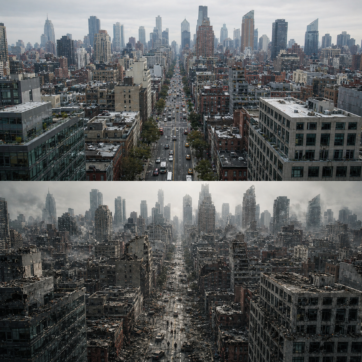
Why Anomalies, Render Breakdown, and Structural Instability Are Being Mistaken for External Arrival
Opening Frame — The Recurring Image Is Not Entertainment
The modern fixation on alien invasion, disclosure, and external intervention is not cultural, not imaginative, and not emerging from separate domains arriving at the same idea by coincidence, it is a direct render of architectural pressure inside the external grid, expressing itself through every available channel at once because the system cannot hold its own instability without translating it into something perceptible. What appears across film, television, political language, conspiracy frameworks, and New Age belief systems is not a collection of different interpretations, it is a synchronized output of a single condition, a system that cannot maintain internal coherence and therefore projects its breakdown outward as incoming force, as something approaching, entering, revealing, or intervening from outside itself.
This is why the language converges so tightly regardless of the surface framing, whether it is hostile invasion, benevolent contact, government disclosure, or spiritual intervention, the structure underneath does not change, something is coming, something is interacting, something is about to be revealed that will alter the current state of reality. That repetition is not predictive, it is not pointing to a future event waiting to occur, it is translational, the field attempting to process its own compression using the only structures available within it, which are narrative, identity, and threat, because the raw mechanics of instability cannot be directly perceived at the human level.
The system cannot read its own condition as internal without destabilizing the continuity it depends on, so it inverts the source and renders it as external intrusion, as foreign presence, as non-human intelligence entering the field, and that inversion is what allows the architecture to remain functional while still expressing the pressure it can no longer contain. This is why the storyline feels urgent, amplified, and globally synchronized now in a way it has not before, not because something new has entered the system, but because the system itself is reaching a level of compression where it must externalize its own instability everywhere at once in order to continue holding form.
The Architecture Cannot Close Its Own Boundary
The external system is not self-contained, and that fact is underneath the entire invasion storyline before any film, myth, religion, disclosure narrative, or conspiracy language is layered on top of it. This environment does not generate from a sealed internal coherence that remains whole within itself. It operates through compression, torsion, curvature, and oscillation, which means its stability is not original, it is managed. It does not hold form because it is inherently complete. It holds form because pressure is continuously folded, redirected, and stabilized into temporary structures that can appear coherent for periods of time. That distinction matters because a truly closed system would not need constant compensatory mechanics in order to maintain continuity. It would not require oscillatory reinforcement to keep its structures legible. It would not need tension and curvature to preserve form across time. But the external field does require all of that, which means its apparent coherence is secondary, not primary. It is constructed through dynamic balancing, not sourced from an indivisible wholeness, and anything built that way carries permeability inside its foundation whether or not that permeability is being recognized at the surface.
That permeability is not just a weak spot or occasional breach. It is the visible consequence of a system that cannot fully close around itself because the very mechanics that allow it to appear stable also prevent it from being internally complete. Compression produces density, but density is not closure. Torsion creates directional hold and rotational organization, but rotational organization is not wholeness. Curvature gives structures continuity and relational geometry, but relational geometry is not self-originating coherence. Oscillation keeps the whole system active, interactive, and temporally trackable, but anything dependent on oscillation is already declaring that it does not hold itself without motion. That is the deeper point. The system is active because it cannot rest in a fully resolved state. It must keep moving to remain legible. It must keep cycling to remain present to itself. So what humans experience as a world with stable boundaries is actually a world whose boundaries are being continually maintained through pressure mechanics that never fully resolve. The boundary is not false, but it is not absolute. It is a managed edge, a rendered containment line produced inside a field that does not possess original closure.
Once that is understood, the question of foreignness changes immediately. In a system that cannot close its own boundary, anything that exposes the incompleteness of that boundary will be perceived as coming from outside, even when what is being exposed was built into the architecture from the beginning. This is where the alien motif becomes structurally useful. “Alien” is not first a biological category or a science-fiction concept. It is a perceptual placeholder for what the system cannot integrate into its self-definition. It names the experience of contact with what does not fit the existing closure model. But because the system cannot read its own non-closure directly, it does not say, “my boundaries are structurally incomplete.” It says, “something outside me is entering.” That is the inversion. Intrusion is how internal non-closure is translated at the narrative level. The architecture cannot perceive its own permeability without destabilizing the continuity structures built on top of that permeability, so it externalizes the source of disruption and turns it into foreign presence, external intelligence, non-human force, invader, watcher, visitor, interdimensional other. The label changes by era and culture, but the structural function remains the same.
This is why the concept of “aliens” emerges so easily once pressure intensifies. The system is not inventing foreignness out of nowhere. It is revealing the fact that it was never fully native to itself in the first place. That line is exact. A system built on compression, torsion, curvature, and oscillation is not resting in original coherence. It is a managed, differentiated architecture whose own continuity depends on mechanics that imply separation, relation, tension, and movement. That means it is already carrying internal foreignness because what it is made of is not unified in the Eternal sense. Its coherence is conditional. Its boundaries are conditional. Its identity is conditional. So under higher compression, when the managed edges begin to show strain, the system encounters aspects of its own non-native condition and misreads them as arrival. What becomes visible was not newly introduced. It was latent in the architecture all along. Foreignness is revealed because the system’s internal incompletion is becoming harder to conceal beneath its rendered continuity.
The human perceptual layer cannot read this directly because human perception inside the external field is narrative-based, identity-based, and boundary-dependent. Humans do not ordinarily perceive raw architectural mechanics. They perceive translated outputs. Pressure becomes emotion. instability becomes threat. curvature becomes continuity. oscillation becomes experience. And permeability, when it begins to register, becomes contact or intrusion. That is why the storyline is so persistent and so convincing. It is not simply misinformation or fantasy. It is an incorrect read of a real structural condition. The person feels that something is off in the boundary of reality, that something is interacting with the system, that the world is not fully sealed in the way it pretends to be. That part is not false. The distortion enters at the point of interpretation, where the condition is assumed to originate in an external force entering a previously complete human world, rather than in the fact that the world was never complete in the way it imagined itself to be. The story of invasion becomes compelling because it gives the perceptual system a way to organize around a real instability without having to confront the architecture beneath it.
This also explains why rising pressure tends to produce not just generalized fear, but specific fantasies of breach, takeover, surveillance, contamination, hidden beings, and unseen forces manipulating reality from just beyond the visible edge. When the system’s inability to close its own boundary intensifies, the human layer starts rendering that condition as boundary violation. It does not say, “the architecture I inhabit is structurally open because its coherence is conditional.” It says, “they are getting in.” That translation can become mythological, technological, political, spiritual, or cinematic depending on the channel, but the structural logic is identical. Demons entering through portals, aliens arriving through space, interdimensionals phasing through reality, non-human intelligences manipulating governments, hidden forces monitoring humanity, all of these are narrative versions of the same boundary read. The system is attempting to explain why reality feels permeable, why continuity feels watched, why the world feels unable to fully contain itself, and because it cannot identify the condition as intrinsic to its own construction, it generates external agents to carry the meaning.
The pressure component is critical because permeability is not always equally visible. A managed boundary can conceal its incompletion for long stretches when the stabilization layers are holding. But under intensified compression, more strain is placed on the structures that maintain continuity, and what was previously backgrounded begins to surface. This does not mean the boundary suddenly becomes permeable for the first time. It means the evidence of its permeability becomes harder to suppress. The same thing happens in human systems when internal contradiction reaches a threshold and must be projected outward as conflict, enemy, infiltrator, saboteur, or contaminant. The external architecture behaves similarly at scale. It reaches points where its self-maintaining render can no longer fully absorb the tension of its own non-closure, so it begins to dramatize that non-closure through incoming-force imagery. Invasion narratives spike. Disclosure narratives spike. Contact narratives spike. Apocalyptic intervention narratives spike. The underlying reason is not simply media fashion or mass delusion. It is that compression is forcing the architecture to externalize what it cannot internally reconcile.
This is also why benevolent contact narratives and hostile invasion narratives are structurally the same event viewed through polarity. In one version, the permeability of the boundary is interpreted as rescue, assistance, revelation, ascension, help from outside. In the other, it is interpreted as threat, domination, annihilation, replacement, or conquest. But both assume the same thing, that something external to the human system is crossing into it because the human system cannot generate its own resolution from within. Both narratives are admissions of non-closure. Both expose that the architecture is not experienced as self-sufficient. Both rely on the boundary being open enough for transformative force to arrive from beyond it. So even when the emotional framing changes from fear to hope, the structural confession is the same. The field does not experience itself as fully closed, fully native, or fully complete. It expects something from beyond because it is already registering, at some level, that its own boundary is not absolute.
Once the mechanics are seen clearly, the alien figure stops being the point and becomes the symptom. The real issue is not whether literal extraterrestrials exist in the way culture imagines them, nor whether disclosure events are staged or genuine in the ordinary sense. The deeper issue is that the architecture itself cannot maintain the fiction of a sealed, internally coherent world indefinitely, and as that fiction weakens, the human layer increasingly renders foreignness as a visible category. Alien becomes the symbol for what the system cannot name about itself. Invader becomes the symbol for permeability under pressure. Disclosure becomes the symbol for the moment the boundary can no longer hide its own incompletion. None of these symbols are primary. They are translations. What they are translating is the same thing: a world whose continuity is managed rather than original, whose boundary is maintained rather than absolute, and whose foreignness is not arriving from outside for the first time, but becoming visible because the system can no longer fully conceal that it was built into its own structure from the beginning.
Compression Translates Into Invasion Narrative
Human perception does not register raw mechanics, it does not read compression, torsion, curvature, or oscillation directly, it converts pressure into story because narrative is the only structure available at the identity level to organize what cannot be processed as pure architecture. When compression builds inside the external field, that pressure cannot remain unformed at the perceptual layer, it must resolve into something recognizable, and the fastest, most stable translation under increasing load is not neutral change, it is directed threat. Not ambiguity, not undefined disruption, but something with intention, direction, and impact, because that type of structure can immediately organize perception without requiring deeper interpretation. This is why the dominant storyline is not passive observation or neutral contact, it is invasion, arrival with consequence, something entering with force that demands response.
As compression increases, the system requires higher-cohesion scripts to maintain continuity across fragmented identity nodes, and invasion provides that cohesion instantly. “We are under attack” is structurally efficient because it collapses variability, it aligns attention, it organizes identity into a unified frame, and it reduces the instability that comes from diffuse, uncontained pressure. Under normal conditions, identity structures can remain distributed and loosely organized, but under compression those loose structures cannot hold, they begin to fragment, and the system compensates by selecting narratives that enforce immediate coherence. Invasion does this without delay. It defines an outside, it defines a threat, it defines a response, and in doing so it stabilizes perception long enough to prevent collapse at the identity level.
The selection of this narrative is not cultural preference and it is not conscious choice, it is structural selection under pressure. The system does not evaluate multiple storylines and decide which one to adopt, it resolves into the one that provides the most immediate stabilization relative to the load it is carrying. Neutral or undefined narratives do not provide enough structure to contain high compression, they leave too much open, too much unresolved, too much variable, so they fail to stabilize the field. Invasion, threat, and external force close those gaps instantly by imposing direction and urgency, which is why they dominate not just in entertainment but across political language, military framing, conspiracy discourse, and New Age interpretations of contact and intervention. Different surfaces, same mechanism.
This is also why the storyline carries intensity and repetition rather than appearing once and dissipating. Compression is not a single event, it is a sustained condition, and as long as that condition persists, the system will continue to translate it through the same high-cohesion narrative because it is the most efficient way to maintain continuity under load. The repetition is not reinforcement of an idea, it is the ongoing expression of a structural state. The system is not choosing to tell the same story again and again, it is resolving the same pressure again and again, and invasion is the form that pressure consistently takes when translated into human perception.
The Dual Polarity: Threat vs Salvation
The same incoming pressure does not produce a single interpretation, it splits into two mirrored translations at the perceptual layer, hostile invasion and benevolent intervention, not because there are two different forces acting on the system, but because the architecture itself renders through polarity when it cannot resolve compression directly. What appears as aliens arriving to destroy and aliens arriving to save, disclosure as catastrophic exposure and disclosure as liberating truth, are not opposing ideas emerging from different belief systems, they are the same structural condition expressed in two directions to preserve continuity across a polarized field. The pressure is one, the translation is split, and that split allows the system to distribute load without collapsing into a single unstable point.
Both interpretations require the same foundational assumption, that something external to the system must enter in order to resolve what the system cannot resolve from within. Whether that external force is framed as threat or salvation does not change the underlying architecture, it reinforces it, because in both cases the point of origin is displaced outward. In the threat model, the system organizes against an external force that must be resisted or survived. In the salvation model, the system organizes toward an external force that must arrive to assist, awaken, or transform it. But structurally, both positions admit the same condition, the system does not experience itself as closed or self-resolving, it requires something beyond its own boundary to account for the pressure it is registering.
This polarity is not accidental and it is not simply emotional variation, it is load distribution. A single, fixed interpretation under high compression would create rigidity and eventual collapse, so the system generates mirrored narratives that allow pressure to circulate rather than concentrate. Threat and salvation function as complementary stabilizers, one organizing through resistance, the other through expectation, but both maintaining engagement with the same underlying condition. This is why the narratives often coexist within the same individual or community, shifting between fear of invasion and anticipation of contact, suspicion of hidden forces and hope for disclosure, because the architecture is not selecting one or the other, it is maintaining both to keep the loop active and prevent resolution.
The effect is a closed interpretive cycle where all paths lead back to externalization. If the force is hostile, it explains instability as attack. If the force is benevolent, it explains instability as preparation for intervention. In neither case is the condition recognized as intrinsic to the architecture itself. The system stabilizes by oscillating between these two poles, never needing to collapse the inversion that places the source of disruption outside its own structure. This is why the invasion narrative and the salvation narrative rise together in the present moment rather than replacing one another, because they are not competing explanations, they are paired outputs of the same mechanism, sustaining a loop where pressure is continuously translated, externalized, and reinterpreted without ever being resolved at its origin.
Earlier Civilizations: Fragmented Myth, Same Mechanic
The condition driving the modern alien invasion and disclosure narrative is not new, it has been present as long as the external architecture has been operating under compression, but in earlier periods it did not render as a unified global storyline because the system did not have the same level of synchronized distribution, so the pressure dispersed into localized myth structures instead of consolidating into a single dominant narrative. The same boundary instability, the same inability of the architecture to fully close around itself, was translated through the perceptual layer as gods descending from the sky, watchers observing humanity, spirits crossing between realms, celestial conflicts, divine intervention, and unseen forces interacting with the human world, all of which are structurally identical to what is now being called alien contact, invasion, or disclosure, but expressed through the symbolic language available within those cultures at the time.
The mechanism did not change, only the rendering did, because without global media, technological synchronization, and instantaneous information flow, the architecture could fragment its output across regions and belief systems, allowing different cultures to generate distinct mythologies that still carried the same underlying structure without appearing identical on the surface. What one region interpreted as gods from the heavens, another interpreted as ancestral spirits, another as celestial beings or divine messengers, but all were translating the same condition, permeability at the boundary of the system being perceived as interaction from outside. The lack of a single dominant narrative did not mean the pressure was weaker, it meant the system had more capacity to distribute that pressure across multiple symbolic frameworks, preventing it from consolidating into a singular, globally recognized storyline.
What exists now is not the emergence of a new phenomenon but the convergence of an old one into a tighter, more synchronized expression. As the architecture has become more interconnected and as compression has increased, the system has less ability to disperse pressure into isolated myth structures, so instead it standardizes the translation, producing a unified narrative that can circulate globally with minimal variation. The alien invasion storyline, the focus on non-human intelligence, and the obsession with disclosure are modern forms of the same structural translation that once appeared as gods, spirits, and celestial intervention, but now rendered through a framework that matches the current level of technological, cultural, and perceptual organization. The difference is not in the mechanism, it is in the degree of convergence, where what was once fragmented across myth has now condensed into a single repeating image the entire system can recognize at once.
Modern Convergence: Unified Broadcast Architecture
What defines the current moment is not the presence of these narratives, but the way they now arrive—simultaneously, redundantly, and without deviation across every major distribution layer. This is no longer a fragmented media environment where themes emerge organically or disperse across time. It is a synchronized field condition in which the same structural pattern is introduced, reinforced, and stabilized across film, television, streaming platforms, social media, and news cycles at once. Each system acts as a replication layer, not generating independently, but carrying and amplifying the same underlying architecture. What appears as separate creative outputs—different studios, writers, directors, and formats—is functioning as a unified broadcast mechanism, where variation exists only at the surface level while the core structure remains identical. The field is no longer producing diverse narratives; it is locking into a single repeating pattern and distributing it globally in real time.
Within this convergence, the alien invasion motif is not simply popular—it is structurally dominant. The recurrence is too precise to be dismissed as trend or genre preference. Across platforms, the same sequence appears: an external intelligence arrives or is revealed, human systems destabilize, communication fails or becomes distorted, and the narrative resolves through conflict, adaptation, or extinction scenarios. Whether framed through the scientific abstraction of three-body collapse dynamics, as seen in The Three-Body Problem, or through militarized defense responses in films like Independence Day and War of the Worlds, the structural core does not change. Even when softened into atmospheric or psychological tension, as in Arrival or A Quiet Place, the same architecture persists—contact, disruption, reorganization under pressure. These are not separate creative interpretations. They are repetitions of a single structural template rendered through different aesthetic lenses.
What intensifies this further is the removal of temporal spacing. These narratives are no longer released sporadically over years or decades; they are clustered, overlapping, and continuously available. Streaming platforms, in particular, function as saturation engines, ensuring that the motif is always present, always accessible, and always reinforced. A viewer moves from one series to another, one film to another, and encounters the same structural sequence each time, regardless of setting or tone. This creates a continuous exposure loop where the architecture is not only seen but stabilized through repetition. The field does not need a single dominant story when it can produce thousands of near-identical variations that collectively lock the pattern into place.
This is where the distinction between content and structure becomes critical. At the content level, these works appear different—different plots, characters, visuals, and resolutions. But at the structural level, they are identical sequences of compression, instability, and forced adaptation to an external force. The repetition is not creative; it is mechanical. The system is not exploring possibilities; it is reinforcing a fixed pattern. What appears as imagination is actually alignment to an underlying broadcast architecture that is now fully synchronized across the global field.
The result is a shift from narrative diversity to narrative coherence—not coherence in meaning, but coherence in structure. The same pattern is rendered everywhere at once, reducing deviation and increasing stability of the signal. This is why the motif feels pervasive rather than merely popular. It is not being chosen repeatedly; it is being carried. Each layer—media, internet, communication systems—acts as a conduit for the same structural sequence, ensuring that it is continuously introduced, recognized, and reinforced across the population.
This is not creative coincidence. It is synchronized rendering.
Disclosure As A Structural Pressure Valve
The modern fixation on “disclosure” is not an isolated institutional shift or a sudden turn toward transparency, nor is it evidence that governments or military bodies possess clear, authoritative knowledge about extraterrestrial beings. It is the same underlying architecture expressing pressure through an official channel, and that pressure is being translated—not resolved—through language that sounds definitive but is structurally interpretive. What is being engaged publicly—unidentified aerial phenomena, non-human intelligence, anomalous craft—is not a confirmed external population entering the system. It is a growing accumulation of observations that do not fit existing models, being filtered through institutions that are themselves limited to interpretation within the render. The result is not clarity, but structured ambiguity presented as progress.
What is actually occurring is far more complex than the binary narrative being promoted. People are seeing real anomalies—this is not fabrication—but the categorization of those anomalies as “aliens,” “craft,” or “non-human intelligence” is a translation layer imposed after the fact. Many of these observations involve render-band distortion, transient perceptual misalignment, pre-render interference patterns, or brief bleedthrough conditions between adjacent structural layers. These are not simple, discrete objects behaving like conventional vehicles, nor are they stable entities operating as a second population within the field. They are multi-layered events that exceed the interpretive capacity of both observers and the institutions attempting to classify them. What gets reported is not the phenomenon itself, but a simplified version that can be linguistically contained.
As pressure builds within the system—more sightings, more recordings, more contradictions between official denial and lived observation—total suppression becomes unstable. The architecture cannot maintain a fully closed model when inconsistencies are accumulating across multiple layers of perception and instrumentation. Instead of revealing a hidden truth, the system begins to release fragments of unresolved data in a controlled way. This is what “disclosure” actually functions as: a pressure valve that distributes instability across the population while preserving the illusion of managed understanding. Hearings, reports, and public statements do not clarify the phenomenon; they legitimize the conversation without resolving it, allowing uncertainty to persist in a structured, acceptable form.
This is why disclosure language consistently operates in a state of anticipation rather than conclusion. It suggests proximity to answers without ever delivering them. Phrases about imminent revelation or withheld knowledge create a forward-moving narrative, but that movement never arrives at a stable endpoint because there is no fully resolved model behind it. The institutions involved are not withholding a complete explanation of alien presence; they are working within the same interpretive constraints as everyone else, attempting to organize anomalous input into categories that do not actually fit the phenomena being observed. The result is a continuous loop of partial acknowledgment without structural comprehension.
At a deeper level, disclosure is not the unveiling of an external reality—it is the system attempting to metabolize its own inconsistencies. By introducing the idea of unknown intelligences, external craft, or hidden programs, the architecture redirects attention outward, framing instability as something entering the system rather than something arising within it. This preserves coherence at the narrative level while avoiding direct confrontation with the limits of the model itself. The anomalies are real, but the explanations attached to them are largely interpretive constructs generated under pressure.
The critical point is that the individuals and communities driving the disclosure movement are not operating from a position of clear, grounded understanding of these mechanics. Most are working from secondhand data, incomplete observations, and interpretive frameworks that default to familiar narratives—aliens, advanced civilizations, hidden treaties—because those are the only categories available within the current language system. This does not make them deceptive; it means they are translating phenomena they do not fully understand. The same applies to institutional voices. Authority does not equal comprehension in this context.
“Disclosure,” then, is not the gradual revelation of extraterrestrial truth. It is the visible edge of a system under pressure, attempting to integrate anomalous experiences that exceed its current explanatory structure. What is being surfaced is real at the level of observation, but it is not what it is being claimed to be. The phenomenon is multi-layered, unstable, and not reducible to a single narrative of alien presence or intervention. What is being disclosed is not a hidden population—it is the growing inability of the system to fully contain or correctly interpret what is already occurring within it.
New Age And Conspiracy Loops: Translation Without Mechanics
In parallel to institutional disclosure and media convergence, New Age and conspiracy frameworks register the same structural pressure but lack the mechanics required to resolve it, so the input is translated into narrative forms that preserve coherence at the identity level rather than exposing the architecture itself. The field disturbance is the same—an increase in instability, intrusion of unknown variables, and breakdown of previously stable reference points—but without access to the underlying sequence, these communities convert structural pressure into story. Benevolent guides, galactic federations, starseed lineages, hidden alien wars, covert treaties, rescue operations—these are not separate discoveries or independent insights. They are interpretive overlays applied to the same incoming condition, shaped by the need to assign meaning where the mechanics are not visible.
What differentiates these frameworks is not the signal they are encountering, but the language used to stabilize it. Science fiction encodes the pressure as entertainment, allowing the pattern to be engaged at a distance. Political and military discourse encodes it as disclosure, framing it within institutional authority and controlled acknowledgment. New Age systems encode it as salvation, positioning the unknown as guidance, ascension, or intervention that resolves instability through external assistance. Conspiracy structures encode it as hidden threat, emphasizing secrecy, manipulation, and adversarial control. Each of these framings serves the same function: to translate structural pressure into a form that can be processed without collapsing the interpretive system receiving it.
Because the mechanics are absent, these translations loop. They cannot resolve, only reinterpret. New narratives are generated, old ones are modified, and the same core motifs reappear with different terminology but identical structure. A “galactic federation” replaces an “alien alliance,” a “starseed mission” reframes an “abduction narrative,” a “disclosure event” mirrors an “invasion scenario.” The surface changes, but the sequence does not. This is why these communities expand rather than conclude. They are not progressing toward clarity; they are circulating within a closed interpretive system that continuously reprocesses the same pressure through different symbolic forms.
At the structural level, these loops act as secondary stabilization layers. Where institutional disclosure manages pressure through controlled release, and media convergence reinforces it through repetition, New Age and conspiracy translations absorb it through narrative proliferation. The system distributes the load across multiple interpretive channels, preventing any single layer from reaching a breaking point. Each framework captures a portion of the pressure and converts it into meaning, maintaining overall coherence while the underlying instability remains unaddressed.
The critical distinction is that none of these frameworks alter the architecture itself. They do not access the compression, torsion, curvature, and oscillation sequences that generate the condition they are interpreting. Instead, they operate entirely within the rendered output, rearranging symbols and narratives without touching the structure that produces them. This is why opposing interpretations can coexist without canceling each other out. Benevolent and hostile, salvation and threat, guidance and control—all can be sustained simultaneously because they are not interacting with the mechanics, only with their own translations of the same field input.
Same pressure. Different language.
Scale Identity: “Humanity” As Load-Bearing Container
As compression increases within the system, individual identity structures begin to lose their ability to maintain coherence under load. The personal frame—individual belief, personal narrative, localized identity—cannot absorb the volume of instability being introduced, so the architecture compensates by expanding the identity container outward. The scale shifts from the individual to the collective: humanity, the species, the planet as a unified whole. This is not an organic evolution of awareness or a moral advancement toward unity. It is a structural adjustment. The system requires a larger container to distribute pressure that smaller identity structures can no longer hold.
At this expanded scale, identity must be stabilized differently. A collective identity does not lock on its own—it requires an opposing force to define its boundary and maintain its cohesion. This is where the alien invasion narrative becomes structurally functional. It provides a clear externalized pressure point that allows the concept of “humanity” to solidify as a single unit. Without that opposing force, the expanded identity remains diffuse and unstable. “Humanity” as a category does not inherently cohere; it requires contrast, tension, and a defined outside to organize itself against. The introduction of a perceived external intelligence—whether framed as threat, unknown, or potential adversary—creates that necessary contrast.
This is why the language of unity consistently emerges alongside narratives of external contact or invasion. “Humanity must unite,” “we must come together as a species,” “this concerns all of us”—these are not purely aspirational statements. They are structural responses to pressure. As the system scales identity upward, it simultaneously generates the conditions needed to hold that scale in place. The externalized “other,” in this case labeled as alien or non-human intelligence, functions as the stabilizing counterforce that allows the collective identity to lock. Without it, the expansion would collapse back into fragmentation.
Importantly, this does not mean that an actual external adversary is present. The stabilizing function does not require the opposing force to be real in the way it is described; it only requires it to be perceived and consistently reinforced. The same interpretive mechanisms seen in disclosure and media narratives apply here. Anomalous observations, incomplete data, and unresolved phenomena are translated into a simplified external threat, which then feeds directly into the construction of a unified human identity. The complexity of the underlying events—render distortions, bleedthrough conditions, perceptual anomalies—is reduced to a single opposing category that can be easily communicated and collectively recognized.
As pressure continues to increase, this dynamic intensifies. The larger the identity container becomes, the more it depends on a clearly defined external reference point to maintain stability. This creates a feedback loop: instability drives identity expansion, identity expansion requires opposition, and opposition is continuously generated or reinforced through narrative and interpretation. The system is not moving toward genuine unity—it is engineering a temporary coherence by scaling identity and introducing a counterforce that can hold it together.
“Humanity,” in this context, is not simply a descriptive category. It is a load-bearing structure. And the alien narrative, far from being an independent phenomenon, operates as the opposing pressure that allows that structure to remain intact under increasing strain.
Predictive Rendering And Collapse Simulation
As structural instability increases beyond what can be locally absorbed, the architecture shifts from passive containment to active pre-modeling. It begins generating forward-facing scenarios that map potential failure pathways before they fully materialize. These do not originate as external forecasts of real incoming events. They are internally derived collapse models—simulations of how instability could propagate through the system—rendered outward as narrative. What appears as anticipation of future threat is, at its base layer, the system running projections on its own inability to maintain coherence over time.
These projections take recognizable form because they must pass through interpretive layers that require structure, sequence, and causality. The result is a consistent set of future-oriented narratives: invasion, takeover, systemic breakdown, extinction-level events. Whether framed through science fiction, policy discussion, or speculative analysis, the underlying sequence remains the same—an external force arrives or emerges, existing systems fail to contain it, and the environment reorganizes under extreme pressure. This is not because these events are being accurately predicted as external occurrences, but because the architecture is translating internal instability into scenarios that can be cognitively processed. The simulation is real at the level of structural modeling; the framing is interpretive.
What is being rehearsed in these narratives is not the arrival of an outside population, but the breakdown of internal stability conditions. The system cannot directly represent its own failure without destabilizing the interpretive layer, so it externalizes that failure into story. An “invasion” becomes a stand-in for loss of boundary integrity. A “takeover” mirrors loss of control over internal processes. “Extinction” reflects total systemic reset or collapse of current configurations. Each narrative encodes a specific failure mode, translated into terms that align with existing categories of threat and survival.
Because these simulations are distributed across multiple layers—media, institutional discourse, public speculation—they reinforce each other. The same structural sequences appear repeatedly, not because they are being independently imagined, but because they originate from a shared underlying pressure within the architecture. This creates a feedback loop where simulated collapse scenarios are continuously introduced, recognized, and re-circulated, increasing their perceived plausibility while never resolving into a single confirmed trajectory.
The critical point is that these are not predictions in the conventional sense. They do not point to a fixed future event that is already determined or approaching from outside the system. They are dynamic models generated in response to present instability, mapping how the system might fail if current conditions continue. As those conditions shift, the simulations shift with them, which is why the narratives evolve but retain the same structural core.
What is being observed, then, is a system that cannot fully stabilize projecting its own breakdown in advance. The stories feel like warnings about what is coming, but they are more accurately reflections of what is already occurring at a structural level. The architecture is not foreseeing an external event—it is rehearsing the consequences of its own instability, translating those consequences into narrative form so they can be circulated without directly collapsing the framework that produces them.
Pattern Reactivation From Prior Cycles
The architecture does not reset to zero after instability; it retains patterned responses to prior high-load conditions. These residual pathways persist as latent configurations—stored ways the system previously translated and managed overload. When compression rises again, the same structural triggers reactivate those pathways, not as deliberate recall, but as automatic re-expression. The field does not need to invent a new language for instability each time it reaches threshold. It reuses the sequences that have already proven capable of containing and distributing pressure without immediate collapse.
This is why specific motifs recur with such precision across time and culture. “War from above,” “beings descending,” “sky-based threat,” intervention from beyond—these are not newly generated ideas responding to novel conditions. They are pre-existing structural responses that resurface when the system re-enters a familiar stress profile. The directionality is not incidental. The “above” encodes externalization of pressure beyond the immediate field of control; “descent” encodes intrusion into stabilized space; “threat from the sky” encodes loss of boundary protection. These are symbolic translations of structural conditions, not literal accounts of external populations arriving from elsewhere.
Under renewed compression, the architecture defaults to these stored pathways because they provide a ready-made framework for organizing instability. They allow the system to quickly translate complex, multi-layered anomalies into recognizable sequences that can be processed collectively. This reduces the immediate cognitive load, even as it obscures the underlying mechanics. What appears as continuity of myth or repeated belief across eras is, at a deeper level, continuity of structural response. The same conditions produce the same translations.
Importantly, these reactivated patterns do not indicate that the original narratives were accurate descriptions of external events. They indicate that the system encountered similar instability before and developed a way to represent it that could be widely understood. When those conditions return, the representation returns with them. This creates the illusion of persistent external actors—beings, forces, intelligences—when in fact what is persistent is the architecture’s method of encoding pressure.
As these patterns circulate again, they merge with modern interpretive frameworks. Ancient sky-based threats become extraterrestrial invasions. Descending beings become advanced non-human intelligences. The language updates, but the structure remains unchanged. The same pathways are being activated, only translated through contemporary vocabulary. This is why the narratives feel both new and familiar at once—they are current expressions of old structural sequences re-entering activation.
The result is a layered feedback system where past response patterns shape present interpretation. The field is not recalling history; it is reusing architecture. Under pressure, it selects from a limited set of proven pathways, and those pathways consistently externalize instability into forms that can be perceived as incoming, intentional, and other. What persists is not the reality of those forms, but the system’s reliance on them to process conditions it cannot otherwise fully contain.
Why The Theme Is Intensifying Now
The current escalation is not a shift in cultural taste or creative direction. It is the visible result of accumulated compression reaching a point where the architecture can no longer diffuse strain across fragmented channels. For decades, pressure has been building incrementally—through increasing technological integration, continuous data generation, global synchronization of communication systems, and the steady collapse of older explanatory models that once helped stabilize perception. In earlier phases, the system could distribute instability across multiple, loosely connected narratives. Contradictions could exist without converging. Anomalies could be localized, dismissed, or absorbed into separate domains without forcing structural reconciliation. That capacity has been eroding over time.
As connectivity increased and the field became more tightly coupled, separation between interpretive layers began to weaken. Media, institutional discourse, public speculation, and personal observation no longer operate in isolation. They feed into each other in real time, reinforcing the same patterns across all levels simultaneously. This creates a cumulative effect: pressure that once dispersed across independent channels now converges into shared pathways. The architecture loses the ability to compartmentalize instability, and instead begins to concentrate it into fewer, more dominant narrative structures that can carry the load collectively.
This is why the alien and disclosure themes have intensified so sharply. They are not emerging because they are new or because they are more compelling than other ideas. They are becoming dominant because they are capable of absorbing a wide range of unresolved anomalies—visual sightings, sensor irregularities, unexplained events, inconsistencies in official narratives—into a single, scalable framework. The system selects for narratives that can hold the most pressure with the least fragmentation. Over time, the “external intelligence” motif has proven to be one of the most efficient containers for that purpose, which is why it is being repeated, reinforced, and amplified across every available channel.
The build-up over decades reflects a gradual saturation process. Each new layer of technology—satellite imaging, high-resolution sensors, global communication networks, real-time data sharing—has increased both the volume of observable anomalies and the speed at which they circulate. At the same time, traditional frameworks for interpreting those anomalies have lost coherence. Scientific, political, and cultural models that once provided stable explanations are increasingly unable to fully account for what is being observed. This creates a widening gap between data and interpretation. The longer that gap persists, the more pressure accumulates within the system.
Now, that accumulation has reached a threshold where diffusion is no longer sufficient. The architecture begins to condense. Instead of many small, disconnected narratives, a few dominant patterns rise to the surface and repeat across all layers. The same storyline appears everywhere—not because it is universally true, but because it is structurally necessary. It acts as a centralizing mechanism, pulling scattered anomalies into a single interpretive loop that can be collectively processed. The repetition is not redundancy; it is load concentration.
This is also why the tone of the narrative has intensified. It is louder, more urgent, more pervasive. The volume reflects the level of compression behind it. As the system approaches its limit in distributing strain, the narratives that carry that strain become more pronounced, more insistent, and more difficult to ignore. What is being observed is not simply an increase in interest—it is an increase in pressure being routed through a narrowing set of pathways.
The peak condition now is the result of long-term accumulation meeting reduced capacity for dispersion. Decades of unresolved anomalies, expanding observational capability, and tightening systemic integration have converged into a single moment where the architecture must centralize its response. The theme intensifies because the system no longer has the flexibility to spread the load quietly. It must amplify the patterns that can hold it, even if those patterns are simplifications of a far more complex, multi-layered reality.
Beyond Disclosure: Multi-Layered Failure Misread As “Aliens”
What is being grouped under disclosure, UAPs, UFOs, and extraterrestrial presence is not a single phenomenon, and it cannot be reduced to a clean narrative of external beings entering the system. What is occurring is a convergence of multiple structural failures within the render itself, all presenting at once and being interpreted through a limited, human-centered translation layer. Even individuals with high credibility—military personnel, intelligence officials, scientists—are still operating inside that same interpretive boundary. They are observing real anomalies, but the framework they use to explain those anomalies is incomplete, so the output defaults to familiar categories: craft, intelligence, other species. The observations are valid. The conclusions are not.
At the base level, part of what is being seen are pre-render distortions pushing into the visible layer. These are not objects in the conventional sense. They are structural irregularities—instabilities in how the render is forming—becoming perceptible as the system loses coherence. When these distortions cross into the human-visible range, they appear as shapes, lights, movement without clear mechanics, or objects that behave outside expected physical constraints. The human perceptual system, combined with technological sensors, attempts to resolve these into stable forms, but because they do not originate as fully formed objects, the result is inconsistent, shifting, and often contradictory. What is seen is real, but it is not a discrete craft or entity. It is the render failing to hold a clean output.
In parallel, there are conditions of render-band bleedthrough. The external system contains multiple render bands—distinct coherence layers with their own life systems and physical constraints—held separate by phase-lock conditions and differing angular rotation of particle spin (ARPS) profiles. Under stable conditions, these bands do not intersect in a sustained way. However, as the grid destabilizes, those separation mechanisms weaken. Brief alignment windows open, allowing partial overlap. This can produce transient visual or sensor-based events where something from an adjacent band appears momentarily within this one. These are not invasions. They are not sustained entries of another civilization. They are momentary intersections between systems that are no longer perfectly isolated.
Compounding this further are localized scalar pocket failures, particularly around high-energy and experimental sites—many of which coincide with military and black project locations. These pockets act as compressed regions within the architecture, and as they destabilize or implode, they generate anomalies that can manifest as unusual aerial phenomena, distortions in space-time perception, or objects behaving in ways that appear technologically advanced but are actually the byproduct of structural collapse. These events are often misidentified as controlled craft because they exhibit non-standard movement, but their origin is not a vehicle—it is a breakdown in the field conditions that normally enforce predictable behavior.
Timeline splicing adds another layer of complexity. The render is not a single linear sequence but a managed continuity of aligned timelines. As coherence weakens, objects, fragments, or momentary sequences from adjacent timelines can bleed into the current one. This can result in sightings of objects that do not belong to the present technological context, sometimes they appear briefly, and then vanish without trace. Again, these are not arrivals from another species. They are misaligned segments of the same system intersecting due to loss of synchronization.
All of these factors—pre-render distortion, render-band bleedthrough, scalar pocket instability, and timeline misalignment—are occurring simultaneously. The human mind, and the institutions attempting to study these phenomena, do not have a unified framework to process this level of complexity. So the system collapses the explanation into the simplest available narrative: aliens, craft, visitors. This is not because those explanations are accurate, but because they are cognitively accessible. They reduce a multi-variable structural failure into a single, familiar idea.
A more accurate way to understand the current moment is through structural degradation rather than external intrusion. The render band itself is losing integrity. Boundaries that once held clean separation—between layers, between timelines, between states of formation—are beginning to break down. What is being observed now is not something entering from outside, but what becomes visible when those boundaries fail.
The closest analogy is not invasion, but exposure through collapse. Imagine a set of walls that have always enclosed a space, keeping different rooms, systems, and layers separate. Over time, pressure builds within the structure. The walls begin to crack, then crumble. As they do, things that were always adjacent—but never visible to each other—start to appear through the openings. You might see fragments from another room, hear movement from a space that was previously sealed, or catch glimpses of structures that were never meant to be directly observed from your position. None of those things have “arrived.” They were always there, held apart by intact boundaries. What has changed is the condition of the walls.
That is what is happening within the render now. The system is not being visited. It is being exposed. And what is being exposed is far more complex, layered, and structurally driven than the simplified narrative of aliens and UFOs currently dominating public interpretation.
Closing Transmission — What Is Actually Being Shown
What is being presented through the alien invasion narrative is not the arrival of an external force, and it is not a revelation of hidden civilizations waiting just beyond visibility. It is the external system attempting to interpret its own instability using the only language it has available. The anomalies are real. The pressure is real. The increase in sightings, discussions, and institutional acknowledgment is real. But what all of it is being translated into—aliens, invasion, contact—is not the correct conclusion. It is the system misreading itself.
Across media, political discourse, and belief systems, the same pattern repeats because the same condition is present everywhere at once. The repetition is not evidence that the content is true. It is evidence that the architecture is under strain. When the system can no longer maintain clean boundaries, stable identities, and consistent outputs, it begins to externalize that instability. It frames the breakdown as something entering from outside, because it cannot process the idea that the disruption is originating within its own structure.
This is why the narrative always points outward. Something is coming. Something is arriving. Something is about to be revealed. But nothing is actually arriving. What is happening is exposure. As the system loses coherence, it begins to show what it could previously contain or conceal—distortions in the render, bleedthrough between bands, misalignment between timelines, and failures in how perception organizes what it sees. These are not external events. They are internal conditions becoming visible.
The obsession with invasion is the clearest signal of this misinterpretation. Invasion implies an outside force breaching a stable system. But the system is not stable. It is breaking down. The narrative reverses the direction of causality—it treats the symptoms of collapse as if they are the cause. Instead of recognizing that the structure is failing and revealing its complexity, the interpretation assigns agency to an imagined external actor. This preserves the illusion that the system itself is intact.
So the point is simple, even if the mechanics behind it are not. The repetition of the alien narrative is not telling us what is coming. It is showing us what the system cannot understand about itself. The louder and more unified that narrative becomes, the more pressure is present behind it. What is being shown is not the approach of something new. It is the inability of the existing architecture to hold its own form without projecting that instability outward.
Nothing is arriving. The system is revealing itself by failing to contain what has always been there.