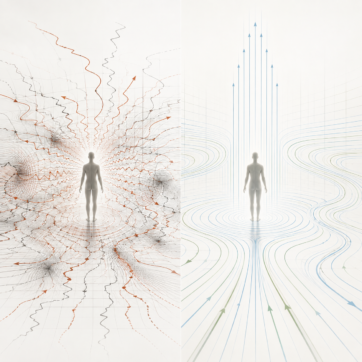
The collapse of timelines, fixed futures, and parallel paths through a precise breakdown of how structure generates movement as it organizes
The Core Misidentification
The word “timelines” has become one of the most casually accepted explanations for how reality is thought to move. It shows up everywhere—especially in new age language, spiritual circles, and even more loosely in everyday conversation. People talk about “being on a timeline,” “jumping timelines,” “aligning to a higher timeline,” or “avoiding a negative timeline.” It is presented as if there are multiple pre-existing tracks running in parallel, each containing different versions of events, different outcomes, and different versions of a life already laid out in advance. From that framing, the individual is seen as moving between these tracks—selecting, shifting, or landing on one depending on their state, actions, or awareness.
That entire framing is incorrect at the structural level.
What the word “timelines” implies is that outcomes already exist somewhere, waiting. That events are prewritten, organized into sequences ahead of time, and simply need to be entered or aligned with. It suggests that reality is made up of fixed routes—like rails already built—where each possible direction is already constructed and the only variable is which one is experienced. Even when it is described as “fluid” or “changeable,” the underlying assumption remains the same: that the options themselves are already there, existing independently, and that movement is happening between them.
That is not what is happening.
There are no pre-laid tracks. There are no stored sequences waiting to unfold. There are no parallel realities sitting in the background ready to be accessed. There is nothing fixed ahead of time that a person is moving toward or selecting from. The system does not operate on prebuilt outcomes.
Everything that appears is being generated in real time through structure.
What is actually happening is far more precise and far more immediate. Structure is continuously organizing under pressure, forming configurations that may or may not stabilize. From those configurations, direction emerges—not as a prewritten path, but as a live expression of what the structure is currently holding. That direction can look like a sequence. It can feel like something is “going to happen.” It can even present as if a full unfolding is already in place. But that appearance is not coming from a fixed future. It is coming from structure that is organized enough, in that moment, to express a clear directional movement.
The mistake is taking that movement and assigning it to something that already exists.
When people say “timeline,” they are trying to describe the experience of seeing or sensing direction, continuity, or unfolding. But instead of recognizing that this is coming from active structure organizing in real time, it gets translated into the idea of pre-existing tracks. That translation is where the distortion enters. It replaces a live, conditional process with a fixed, externalized system that does not actually exist.
Nothing is waiting to happen. Nothing is prewritten. Nothing is sitting in the background ready to be stepped into.
There is only structure, organizing continuously, and the directional expression that comes from what it is currently holding.
This article is not about future, prediction, or choosing between possibilities. It is about removing that entire frame and replacing it with what is actually occurring. It is about seeing how direction forms without pre-existence, how sequences appear without being fixed, and how what people call “timelines” is actually the result of real-time structural generation—not movement between anything that already exists.
What You Are Actually Living Inside: External Architecture, Pre-Render, Render, Mimic, and the Eternal
What you are living inside is not reality in its raw form. It is not a neutral physical environment where events originate and unfold in real time. It is a constructed experiential architecture that continuously translates deeper structural movement into what you perceive as reality. The visible world is not the source of anything—it is the output layer. By the time something is seen, felt, reacted to, or understood, it has already passed through multiple layers of organization and translation. What you experience is not structure itself. It is a rendered version of structure converted into participation.
This distinction is the foundation of everything in this article, because if the render is treated as the starting point, then trajectory will always be misread. It will be interpreted as future, as prediction, as something already existing ahead. But nothing begins in the render. The render is where things become visible after they have already been structured.
The actual organization happens in the pre-render.
The pre-render is not a place, not a hidden realm, not something separate you go to. It is the upstream structural condition where everything organizes before it appears. Pressure accumulates, pathways form, identity routing stabilizes, convergence builds, and structural alignment either holds or fails. All of this occurs before anything crosses into visibility. By the time something becomes part of lived experience, it has already passed through this layer.
This is why reality consistently feels reactive instead of causative. People think events are happening and they are responding to them in real time. But what they are actually encountering is the exposure point of something that has already been organizing. Emotional states do not begin when they are felt—they become visible when they have already formed. Social shifts do not begin when they are announced—they surface when the structure supporting them has already aligned. What appears is not the beginning of movement. It is the moment movement becomes visible.
This is exactly where structural trajectory sits.
Structural trajectory is generated in the pre-render. It is the direction that emerges from how structure is currently organizing under pressure. It is not an outcome. It is not a future event. It is not something waiting. It is the directional movement of structure while it is forming. And because the architecture translates that movement into the render before stabilization completes, trajectory becomes visible as direction. It can appear as sequence. It can feel continuous. It can even look like something already unfolding. But what is being read is not a fixed future—it is structure in motion before it locks.
The only reason this gets misinterpreted is because the render does not show structure directly. It shows translation.
Everything inside the render is converted:
pressure becomes emotion
movement becomes narrative
instability becomes conflict
convergence becomes coincidence
distortion becomes symbolism
The nervous system does not receive raw structure. It receives interpreted output. Thought is translation. Emotion is translation. Memory is translation. Identity is translation. The entire perceptual field operates as an interface that converts deeper structural mechanics into experiences that can be participated in.
This is why everything immediately becomes a story. The system cannot present raw structure, so it converts movement into narrative. And once movement becomes narrative, direction becomes “what’s going to happen.” That is the exact misidentification this article is dismantling.
Now layer on top of that the mimic.
The mimic is not the original structure. It is an amplification layer that compensates for instability in the architecture. As the system loses coherence, the mimic increases output. It increases emotional intensity, increases narrative complexity, increases identity reinforcement, increases stimulation, and increases fragmentation. It does not resolve instability—it translates instability into activity so the system can continue holding itself.
This is why modern reality feels overwhelming and unstable at the same time. There is more information, more interpretation, more movement, more identity, more narrative—but less coherence. The mimic floods the system so the underlying instability is not directly recognized.
And this directly distorts how trajectory is perceived.
Instead of simply reading direction, the mimic:
amplifies it
splinters it
overlays it with narrative
routes it through identity
turns it into certainty
So what is actually: direction of structure organizing
Becomes: timelines, predictions, fixed paths, future events
The mimic converts real-time movement into imagined prebuilt systems. This is why people believe in timelines. They are sensing real structural direction—but interpreting it through a distorted translation layer that turns movement into something that already exists.
That is the entire error.
Without understanding the architecture, trajectory cannot be understood cleanly. It will always collapse into:
prediction
intuition
psychic framing
future-seeing
But trajectory is none of those.
It only makes sense when you see:
- the pre-render is generating structure
- the render is translating that structure
- the mimic is distorting it all
Only then can you see that trajectory is: the directional expression of structure while it is forming, before it stabilizes
And then the final contrast has to be held.
Everything described so far belongs to the external architecture. The Eternal does not.
The Eternal is not another layer within this system. It is not a higher level, not a deeper dimension, not a more advanced version of the same mechanics. It exists completely outside of it. It does not require pressure, does not require oscillation, does not require identity, does not require movement, and does not require translation.
The external architecture depends on movement because it cannot hold coherence. It must continuously generate motion to stabilize itself. That is why trajectory exists at all—because the system is always organizing, always shifting, always generating direction in real time.
The Eternal does not generate direction because it does not require stabilization.
That contrast matters because it clarifies something critical:
trajectory is not truth
trajectory is not final
trajectory is not fixed
It is a condition of a system that cannot hold stillness.
You are inside a system where:
- structure organizes in the pre-render
- direction emerges as trajectory
- translation makes it visible in the render
- mimic distorts how it is interpreted
And because of that: what feels like a “timeline” is nothing more than structure moving—being translated—before it has actually become real.
What Is Actually Being Read
Now that the architecture is clear, the next misidentification happens at the exact moment direction becomes visible. The moment structure begins organizing clearly enough to be perceived, the mind immediately tries to label what it is encountering. It does not recognize structure directly—it translates it. So what is actually being read as active organization gets misclassified into categories that do not apply. It gets called future. It gets called prediction. It gets called intuition, sensing, downloads, external signals, guidance. All of those labels are attempts to explain something real without identifying what is actually occurring.
What is being read is not the future. It is not prediction. It is not something coming from outside of you. There is no signal being sent, no information being received, no external source delivering anything into the system. What is being read is structure itself—specifically, structure while it is actively organizing in real time. The only reason it appears as anything else is because the render translates structure into forms the mind can recognize, and the mind replaces what it does not understand with familiar language.
There is only one system operating, and what is being perceived is that system in motion. It is not multiple layers of access or different abilities turning on. It is not switching between sensing, knowing, predicting, or interpreting. It is one continuous read of structure, but that structure is holding multiple conditions at the same time, and that is what creates the illusion of complexity.
Structure is always holding what has already expressed. This is residue. Anything that has stabilized into the render does not disappear once it passes—it leaves structural imprint behind. That imprint continues to exist as part of the current condition. It affects pressure distribution, it affects pathway availability, and it influences how new organization forms. What people experience as repetition, cycles, or familiar patterns is not coincidence—it is residue still active within the structure. It is not “the past” in a linear sense. It is present structure that has already expressed and is still influencing what is forming.
At the same time, structure is holding what is actively organizing. This is the current configuration. It is what is stabilizing right now under pressure, attempting to either form or collapse. This is the most unstable point in the system because it has not yet resolved. It is where pathways are either holding or breaking, where continuity is either maintained or interrupted. Most people do not read this layer cleanly because it has not yet translated into clear narrative. Instead, it is felt as tension, movement, uncertainty, or emotional fluctuation without clear form. But structurally, this is where formation is either going to complete or fail.
And simultaneously, structure is holding trajectory. Trajectory is the directional output of the current configuration. It is what will express if nothing in the structure changes. It is not fixed. It is not guaranteed. It is not something waiting ahead. It is the natural direction of movement generated by what is currently being held. If pressure remains aligned, if pathways remain open, and if continuity is not interrupted, that trajectory will stabilize into the render as lived experience. The moment any of those conditions shift, the trajectory shifts with it. Instantly. There is no delay, no override, no prewritten outcome continuing independently.
All three of these conditions—residue, active configuration, and trajectory—are being read at the same time. That is what creates the illusion that something separate is being accessed. It can feel like something already happened, something is happening now, and something is going to happen next. But that is not three different reads. It is one structure being read across different states of expression simultaneously.
What has already expressed continues to influence what is forming. What is forming is generating direction. That direction is what would express if nothing changes. And because the render translates all of this into sequence, it appears as if there is a past, present, and future being accessed. But structurally, there is no separation. It is one continuous condition.
This is exactly why trajectory gets misread as future. When the structure is organized clearly enough, the direction becomes strong and coherent. It can appear continuous. It can look like a full sequence is already in place. It can feel certain. But what is being seen is not something that exists ahead. It is the current structure expressing a clean directional output. If that structure holds, it will express. If it shifts, it will not. The direction does not exist independently of the structure generating it.
This also clarifies what is often misunderstood as accuracy. Accuracy is not about correctly predicting what will happen. It is about correctly reading what is already stabilized and what is currently organizing. If the structure remains unchanged, the trajectory will express exactly as read. If the structure shifts, the trajectory shifts with it. Nothing was wrong. Nothing failed. The read was correct for the condition at that moment, and the condition changed.
The final point has to be held cleanly, because this is where everything collapses back into distortion if it is not. This is not multiple abilities. It is not different modes of perception. It is not intuition separate from foresight or sensing separate from knowing. It is one function. One read. One system being perceived while it is organizing.
What is being read is simple, even if it does not feel that way at first. It is what has already expressed, what is currently forming, and what will express if nothing changes. Not as separate things, not from different sources, but as one continuous structure being read in motion.
Structural Trajectory vs. “Future”
Structural trajectory is not future, and it is not prediction, even though it is almost always experienced that way at first. Structural trajectory is the direction of expression being generated by the current configuration of structure. It is not something that exists ahead, not something waiting to occur, and not something already formed in another state. It is the live directional output of what is being held right now. The only reason it appears as “what’s going to happen” is because when structure organizes cleanly enough, that direction becomes coherent, continuous, and readable through the render. The system translates that coherence into what looks like sequence, and the mind immediately assigns that sequence to the future instead of recognizing it as present structure expressing direction.
What is actually happening is far more immediate. Structure holds a configuration under pressure, and that configuration generates a direction. That direction is trajectory. If nothing in the structure changes—if pressure remains aligned, if pathways remain available, and if continuity is maintained—then that trajectory will express into the render as lived experience. Not because it was destined to, not because it was fixed, and not because it already existed somewhere else, but because the structure that generated it remained intact long enough to stabilize. The moment that structure shifts, even slightly, the trajectory shifts with it. There is no delay, no persistence of a prior direction continuing forward independently. The direction only exists as long as the structure generating it remains the same.
This is where certainty gets incorrectly assigned. When a trajectory is strong, it can feel exact. It can feel like a full unfolding is already in place. It can feel inevitable. But that sense of inevitability is not coming from a fixed outcome—it is coming from the clarity of the current structure. The cleaner the configuration, the cleaner the directional output. That clarity is what gets mistaken for fate, for prediction, or for something prewritten. In reality, it is simply a stable condition expressing a clear direction. Nothing more.
The removal that has to happen here is complete. There is no fate operating. There is no fixed future waiting. There is no timeline already built. There is no prediction being accessed. There is only structure organizing in real time, generating direction based on what is currently held. That direction can change instantly because the structure can change instantly. The entire system is conditional, not predetermined.
So the correct understanding is simple, even if it cuts against how it is usually experienced. Structural trajectory is the direction of movement produced by the current structure. If the structure holds, the trajectory expresses. If the structure shifts, the trajectory changes. There is no certainty beyond that condition, and there is nothing existing ahead of it. What appears as future is nothing more than structure continuing without interruption.
Patterns: What Is Held
Patterns are not movement. Patterns are what is held. A pattern is the static condition of structure at any given point—the way pressure is arranged, the way alignment is configured, the way stability or instability is currently being maintained. It does not describe where something is going. It describes what is present. This is where most confusion begins, because patterns generate movement, but they are not movement themselves. They are the structural state that produces movement when it begins to express.
When compression is held as a pattern, the structure is constrained. Pressure is contained and unable to distribute cleanly, so what generates from that condition is repetition. The same configurations attempt to form again and again because the structure cannot reorganize beyond its current containment. This is experienced as cycles, stuck conditions, or recurring situations that feel like they are looping without resolution. The movement is not the pattern—the repetition is what the pattern produces.
When distortion is held as a pattern, the structure is misaligned. Pressure is uneven, pathways are unstable, and continuity cannot hold cleanly. What generates from that condition is interference. Movement becomes fragmented, misdirected, or inconsistent. This is experienced as loops that do not complete, interactions that misalign, and outcomes that partially form and collapse. Again, the loops and interference are not the pattern itself—they are what the distorted structure generates when it attempts to express.
When coherence is held as a pattern, the structure is aligned. Pressure distributes cleanly, pathways remain available, and continuity holds without interruption. What generates from that condition is direct movement. There is no repetition needed to stabilize, no distortion redirecting flow, no interference breaking continuity. Expression moves cleanly from formation to stabilization. What is experienced is clarity, consistency, and stability in how something unfolds. But even here, the movement is not the pattern—the pattern is the stable condition that allows movement to occur without disruption.
This distinction is what keeps everything from collapsing into misinterpretation. Patterns do not tell you what will happen. They tell you what is being held. Movement comes from that. Trajectory comes from that. Outcomes come from that. But the pattern itself is the structural state underneath all of it. It is the condition that generates direction, not the direction itself.
So when reading structure, the first recognition is not where something is going. It is what is currently being held. Because whatever is held will generate movement consistent with that condition. Patterns define the quality of movement, the type of repetition, the presence of distortion, or the clarity of flow. But they remain static at their core. They are the base condition from which everything else emerges.
The anchor is simple and has to stay clean. Patterns generate movement, but they are not movement. If that line gets blurred, then structure gets mistaken for outcome, and everything begins getting interpreted as prediction again. Keep the separation exact, and the system remains readable.
Structural Trajectories: How It Moves
Structural trajectory is the movement generated by the pattern being held. It is not separate from structure, and it does not exist independently. It is the direct expression of the condition underneath it. Whatever pattern is present—whether compressed, distorted, or coherent—produces a corresponding direction of movement. That movement is trajectory. It is not something added on top of structure. It is what structure does when it begins to express.
This relationship is exact and cannot be separated. Pattern defines the condition, and that condition generates direction. A compressed pattern produces constrained, repetitive directional movement. A distorted pattern produces fragmented, misaligned directional movement. A coherent pattern produces direct, stable directional movement. The trajectory is not choosing a path. It is not selecting from options. It is not following a route that already exists. It is the immediate directional output of what is currently being held.
This is where the idea of “paths” or “tracks” has to be removed completely. Structural trajectory is not a path you are on. It is not something you step onto or move along. There are no tracks laid out ahead. There are no routes waiting to be followed. Those ideas come from translating movement into something fixed and external. In reality, trajectory is live. It is being generated in real time, continuously, from the current configuration of structure. It only exists as long as the pattern generating it remains in place.
Because of that, trajectory is always conditional. It depends entirely on what is being held right now. The moment the pattern shifts, the trajectory shifts with it. There is no persistence of a previous direction continuing forward on its own. There is no stored movement carrying itself into the future. There is only continuous generation. Direction exists because structure is holding a certain condition, and it changes the instant that condition changes.
This is why trajectory can feel stable at times and unstable at others. When a pattern holds consistently, the movement it generates remains consistent, and the trajectory appears steady and clear. When the pattern fluctuates or destabilizes, the movement shifts with it, and the trajectory becomes inconsistent or fragmented. What is being experienced is not movement failing—it is the underlying structure changing.
The key is to keep the relationship clean. Pattern is what is held. Trajectory is how it moves. There is no separation between them, and there is nothing in between. Trajectory does not come from somewhere else, and it is not leading toward something that already exists. It is the live directional expression of structure as it is being held in that moment.
The anchor has to remain exact. Structural trajectory is movement generated by pattern. Not a route, not a track, not a prebuilt sequence—just direction, forming continuously from what is currently in place.
When Trajectories Become Fully Visible
There is a point where structural trajectory stops appearing as fragmented direction and begins to present as something much more complete. This is where the misidentification becomes strongest, because the movement no longer feels partial or uncertain—it appears continuous, organized, and fully formed. But nothing new has been created at this point. What has changed is not the existence of trajectory, but the resolution at which it is being perceived.
When structure is fragmented, perception is also fragmented. The pattern is unstable, pressure is uneven, and pathways are inconsistent, so the directional output cannot organize into a clean sequence. What is perceived instead are pieces—glimpses of movement, partial interactions, disconnected impressions that do not fully resolve. This is often experienced as uncertainty, mixed signals, or incomplete formation. The trajectory is still there, but it cannot present as a full sequence because the structure generating it is not organized enough to hold continuity.
As structure becomes more organized, perception shifts with it. When pressure aligns, pathways stabilize, and continuity begins to hold, the trajectory no longer appears in fragments. It begins to present as sequence. Movement connects. Direction becomes continuous. Instead of isolated pieces, there is a sense of unfolding. This is the point where trajectory becomes fully visible—not because it has turned into something else, but because the structure generating it is now coherent enough to express itself without interruption.
This is why it appears as scenes. It appears as interactions between people, environments, or conditions that feel already in motion. It appears as continuous unfolding, where one moment clearly leads into the next without distortion breaking the sequence. The system is no longer presenting isolated directional outputs—it is presenting connected movement that holds together long enough to be perceived as a full progression.
This is the exact moment where people begin to say they are “seeing what’s going to happen.” Because what they are experiencing looks complete. It looks like a sequence already laid out. It feels as though the outcome is already formed and simply waiting to occur. But that interpretation is incorrect. What is being perceived is not a future event—it is a trajectory that has already organized into sequence because the structure is currently holding at a high enough level of coherence.
Nothing about that sequence exists independently.
It is not stored anywhere. It is not waiting to unfold. It is not a fixed track. It is a live structural condition presenting itself as continuous movement because nothing is interrupting it. The moment that structure destabilizes—if pressure shifts, if pathways break, if continuity is interrupted—that sequence dissolves immediately. It does not continue forward on its own, because it was never a separate thing to begin with.
This is the anchor that has to stay exact. When trajectory becomes fully visible, it can look like the future, but it is not. It is structure that has already organized itself into sequence in the present. What is being seen is not something ahead—it is something already formed directionally within the current configuration.
So what appears as a full unfolding scene, is not a prewritten outcome. It is trajectory that has reached a level of organization where it can express itself as continuous sequence. It is still conditional. It is still dependent on what is being held. And it will only express if that condition remains unchanged.
Diverging Structural Trajectories
Structural trajectories do not branch because of choice, assignment, or pre-existing options waiting to be selected. They diverge because structure itself is not uniform. Different structural states generate completely different directions of movement, even when the surface conditions appear similar. What determines direction is not circumstance at the render level, but the condition being held underneath it. When that condition changes, the direction changes with it, and when two conditions differ, even slightly, the trajectories they generate can separate entirely.
When structure is oscillating or externally anchored, the movement it generates is distortion-based. In this state, pressure is not held cleanly. It is constantly being redistributed, redirected, and compensated for through external reference points. Identity, reaction, narrative, and environment all play a role in stabilizing the system, but none of them actually resolve the instability. The result is movement that loops, fragments, interferes, or misaligns. Direction exists, but it does not move cleanly. It bends, repeats, and reconfigures continuously because the structure generating it cannot hold coherence long enough to sustain a direct trajectory. What expresses from this condition feels inconsistent, reactive, and often repetitive, even when it appears to be moving forward.
When structure is stabilized—specifically through vertical stillness—the movement it generates is coherent. In this state, pressure is not being constantly redistributed through external systems. It is held. Pathways remain open without distortion, continuity is maintained without interruption, and the structure does not require constant compensation to stabilize itself. The trajectory that forms from this condition is direct. It does not loop, it does not fragment, and it does not require repetition to hold. Movement progresses cleanly from formation into expression because nothing is interfering with its ability to stabilize.
These two conditions can exist within what appears to be the same external environment, which is why the divergence is often misunderstood. From the surface, it can look like two completely different “paths” are available—one that leads in one direction and another that leads somewhere else. But those are not paths in the sense of prebuilt routes. They are outputs of different structural conditions. The direction is not chosen from options. It is generated from what is held.
This is why divergence feels like separation into different realities or different timelines. When the structural state shifts, the trajectory reorganizes so completely that the resulting expression can look unrelated to what was previously forming. It can appear as though one direction was abandoned and another was entered. But nothing was left behind and nothing new was entered. The structure changed, and the direction changed with it. The system reorganized in real time.
The correction here has to be absolute. There are no assigned paths. There are no permanent directions attached to a person or identity. There are no pre-existing tracks running in parallel waiting to be selected or shifted between. What exists is structure, and structure generates direction based on its current condition. If the condition changes, the direction changes. That is the only mechanism.
So what appears as diverging trajectories is not movement between different options. It is the result of different structural states generating different directional outputs. One condition produces distortion-based movement. Another produces coherent movement. They are not both available at the same time to choose from. Only one is active at a time, based on what is being held.
The Collapse of the Timeline Concept
The idea of timelines only exists because structural movement is being misread through translation. Once trajectory becomes visible, especially when it organizes into clean sequence, the mind immediately converts that into something fixed. It assumes that what is being seen must already exist somewhere ahead, already built, already waiting. From there, the entire concept of timelines forms—parallel tracks, different realities, multiple versions of events existing at the same time, and the ability to move between them. But none of that is structurally accurate. It is a translation error built on misidentifying real-time directional movement as pre-existing structure.
There are no parallel tracks running in the background. There are no prebuilt realities waiting to be entered. There is no system where multiple outcomes already exist and something or someone is shifting between them. Those ideas all require structure to exist independently of the condition generating it, and that is not how the system operates. Nothing exists separately from what is currently being held. There is no stored version of reality waiting outside of the present configuration. Everything that appears is being generated in real time through structure organizing under pressure.
What actually happens is much more direct. Structure shifts, and when structure shifts, the output reorganizes. That is the only mechanism. The moment the underlying condition changes—whether through pressure redistribution, pathway change, or loss or gain of continuity—the direction being generated changes with it. Because trajectory is not stored, not fixed, and not independent, it does not continue forward once the structure that created it is no longer in place. It dissolves immediately and reorganizes into a new directional output based on the new condition.
This is what creates the experience people describe as “timeline switching.” From the perspective of the render, the change can feel abrupt and complete. One direction was forming, one sequence appeared to be unfolding, and then suddenly the entire direction shifts. It can feel like moving from one reality into another, like something was left behind and something new was entered. But nothing was left and nothing was entered. The structure changed, and the output reorganized accordingly. The system did not move between timelines—it regenerated direction based on a new configuration.
The reason this feels so convincing is because of how sequence is perceived. When trajectory is organized enough to appear as a continuous unfolding, it looks complete. It looks like something already exists. So when that sequence disappears or shifts, it feels like leaving one track and entering another. But that perception is based on treating sequence as something fixed rather than something being generated in real time. The sequence was never a stored path. It was a live expression of structure that stopped existing the moment the structure changed.
This is why the timeline concept has to collapse completely. It replaces a real-time, conditional system with a fixed, externalized one that does not exist. It turns live structural generation into prebuilt options. It turns directional output into stored outcomes. And it turns structural shifts into movement between realities instead of recognizing them as reorganization of the same system.
So the correction is simple, even if it removes a deeply ingrained way of thinking. There are no timelines. There is no switching between them. There is no jumping from one path to another. There is only structure organizing, generating direction, and reorganizing instantly when the condition changes. What feels like moving between realities is nothing more than the system updating its output in real time based on what is now being held.
Conditional Structural Trajectories
Structural trajectories do not exist on their own. They are not stored, not persistent, and not waiting anywhere to be accessed or entered. A trajectory only exists as long as the structure generating it remains intact. The moment that structure changes, the trajectory ceases to exist in its previous form and reorganizes immediately. This is what makes trajectory conditional. It is not something that continues independently once created. It is continuously being generated, moment by moment, from the condition that is currently being held.
This has to be understood without any distortion, because most of the confusion around timelines, prediction, and future comes from assuming that direction continues existing even when the structure that created it is no longer present. But nothing in this system operates that way. There is no separation between structure and trajectory. The direction is not an object, not a path, not a stored sequence. It is an active output. Remove or alter the condition generating that output, and the output changes immediately. There is no residual version of that trajectory continuing forward somewhere else.
Because of this, nothing exists independently of the current structure. There is no version of reality sitting outside of what is being held now. There is no alternate outcome waiting to be entered. There is no “other direction” running in parallel. Every possible direction people imagine only exists as a potential expression of structure, and that potential only becomes real if the condition required to generate it is actually held. Without that condition, it does not exist in any active sense. It is not waiting. It is not available. It is not accessible.
This is where the idea of “entering” a different outcome or “shifting into” another direction completely breaks down. There is nothing to enter. There is no separate space where other trajectories are sitting. The system does not operate by moving between existing options. It operates by generating direction in real time based on what is currently held. If the structure changes, the system does not move into a different pre-existing trajectory—it produces a new one based on the new condition.
Everything is being produced in real time. There is no backlog of outcomes. There is no archive of paths. There is no external storage of possibilities waiting to be selected. What exists is the current structural condition, and from that condition, direction is generated. If the condition holds, that direction continues to organize toward stabilization. If the condition shifts, that direction reorganizes immediately. The system is entirely live, entirely responsive, and entirely dependent on what is being held in that moment.
This is why trajectory can feel stable one moment and completely different the next without anything externally “changing.” The change does not occur at the level of visible events first—it occurs at the level of structure. Once the structure shifts, the trajectory shifts, and then the render reorganizes to reflect that shift. From the perspective of experience, it can feel like something disappeared or something new suddenly appeared. But structurally, nothing was added or removed. The condition changed, and the output changed with it.
The anchor here has to remain absolute. Structural trajectories are conditional. They exist only while the structure generating them holds. Nothing exists independently. Nothing is waiting to be entered. Everything that appears is being produced in real time from the current condition, and it only continues as long as that condition remains intact.
Accuracy Without Prediction
What is often called accuracy is almost always misunderstood because it is framed through prediction. It gets treated as the ability to correctly identify what will happen in the future, as if something fixed is being accessed ahead of time and then confirmed later. But that is not what is occurring. There is no future being accessed, and there is nothing ahead that exists in a fixed state waiting to be read correctly. Accuracy does not come from prediction at all. It comes from reading what is already stabilized and seeing what is already organizing within the current structure.
Precision comes from recognizing what is already in place. When structure has stabilized, it is clear. It holds without distortion, without fragmentation, without interference. That stability can be read directly because it is not fluctuating. At the same time, what is actively organizing—what is forming under pressure and aligning toward expression—can also be seen when it is coherent enough. This is not interpretation. It is not inference. It is not guessing based on partial information. It is reading the actual condition of structure as it exists in that moment.
This is why accuracy can feel exact. When structure is clean and organized, the trajectory it generates is also clean. That direction can appear continuous, even inevitable, because nothing is currently interrupting it. From that state, what is read can later appear to have been “correct,” but that correctness is not coming from accessing the future. It is coming from the fact that the structure did not change between the moment it was read and the moment it expressed. The direction held because the condition held.
The reliability of any read is entirely dependent on that condition. It is only accurate while the structure remains unchanged. The moment structure shifts—whether through pressure redistribution, pathway alteration, or loss of continuity—the trajectory reorganizes immediately. What was previously being generated no longer exists in the same way, and the direction updates to reflect the new condition. There is no persistence of the prior read because there is no independent trajectory continuing forward. The read was accurate for what was held, and when what was held changes, the accuracy shifts with it.
This is why something can appear completely precise one moment and then no longer apply the next. From the perspective of prediction, this looks like failure or inconsistency. But from the structural level, nothing failed. The system updated. The read did not become wrong—it became outdated because the condition it was based on no longer exists. Accuracy is always tied to the present structure, never to a fixed outcome.
The reason this can feel unstable is because the system is live. It is not referencing stored outcomes or fixed sequences. It is continuously generating direction based on what is currently being held. That means precision is not about projecting forward—it is about reading clearly in the present. When that present condition is stable, the read appears stable. When that condition shifts, the read shifts instantly with it.
So the correction has to be complete. Accuracy is not prediction. It is not about being right about what will happen. It is about correctly identifying what is already stabilized and what is currently organizing. It holds only as long as the structure holds. And because structure can change at any moment, what is accurate can also change at any moment—not because something went wrong, but because the system itself reorganized in real time.
Structure → Trajectory → Lived Experience
Everything that appears as lived experience follows a direct and uninterrupted chain, and that chain does not begin at the surface. It begins with structure. Structure is the only origin point. It holds the condition—how pressure is arranged, how alignment is configured, how stability or instability is being maintained. From that condition, movement is generated, and that movement is structural trajectory. From that trajectory, if the structure holds long enough and the pathways remain intact, lived experience forms. There is no step in this process where something external enters or overrides what is already in motion. It is one continuous system expressing itself from condition into direction into visible experience.
Structure determines everything that follows. It is not reacting to the environment, not responding to events as they happen in the render. The environment and events themselves are outputs of structure. Once a pattern is held, it generates a trajectory, and that trajectory organizes toward expression. What eventually becomes visible is not something separate being added into the system—it is the final translation of what was already forming. This is why the render cannot be used as a starting point for understanding anything. By the time something is experienced, the structural condition that produced it has already been in place.
This is also why distortion and coherence produce such different lived experiences even when the external environment appears similar. When distortion is held at the structural level, the trajectory it generates cannot move cleanly. Pressure is misaligned, pathways are unstable, and continuity breaks. The lived result of that is loops, interference, repetition, and fragmentation. Situations repeat without resolution, interactions misalign, and movement appears inconsistent or unstable. These are not random outcomes. They are the direct expression of a distorted structural condition attempting to move without being able to hold itself.
When coherence is held, the trajectory that forms is direct. Pressure distributes cleanly, pathways remain open, and continuity holds without interruption. The lived experience that emerges from this condition reflects that stability. Movement progresses without looping, without interference, without fragmentation. What forms is aligned, consistent, and able to stabilize without needing to repeat or compensate. The difference in experience is not caused by external variables—it is generated entirely by the difference in structure being held underneath.
This is where the separation between “internal” and “external” has to collapse completely. Nothing in lived experience exists outside of structure. There is no external force introducing outcomes, no environment acting independently, no situation arising without structural basis. Everything that appears—every interaction, every condition, every event—is part of the same system expressing what is already being held. The idea that something outside of structure is influencing experience is another translation error created by the render. It separates what is actually continuous into categories that appear independent.
So the chain remains exact and has to be held without distortion. Structure forms the condition. That condition generates trajectory. That trajectory, if uninterrupted, stabilizes into lived experience. There is no deviation from this process. What changes is not the chain itself, but the condition at the start of it. When the condition changes, the trajectory changes, and the lived experience reorganizes accordingly.
The anchor here is absolute. Nothing external is separate from structure. There is no outside influence, no independent variable, no separate system interacting with this one. What is lived is what is generated. What is generated comes from what is held. And what is held is the only thing determining what follows.
No Assigned Paths
There are no assigned paths. There are no fixed directions attached to a person, no predefined route that someone is meant to follow, and no underlying system that places individuals onto specific tracks that they remain on. The idea that there are “types of people” who belong on certain paths—some destined for coherence, others destined for distortion—is a misinterpretation created by observing repeated patterns and assuming they are permanent. What is actually being observed is not identity-based direction, but structure being held consistently over time.
What appears as a “path” is nothing more than a trajectory that continues because the underlying structural condition has not changed. If someone is holding distortion, the trajectory generated from that condition will continue to produce distortion-based movement. If that condition remains stable, the expression will appear consistent, and it will look like they are “on a path” defined by repetition, interference, or instability. But nothing about that direction is assigned to them. It is being generated continuously from what they are holding.
The same applies to coherence. When structure stabilizes, the trajectory it generates becomes direct and aligned. If that condition is maintained, the resulting movement will also appear consistent. From the outside, it can look like someone has moved onto a different path or entered a new direction entirely. But again, nothing was assigned and nothing was entered. The structure changed, and the direction changed with it. The appearance of a new path is simply the result of a new condition being held.
This is why the idea of a permanent external path versus a coherent path does not hold. There is no fixed separation where someone belongs to one category or the other. These are not identities or roles that people carry. They are conditions that can be held or not held. At any point, structure can shift. Pressure can reorganize. Pathways can open or collapse. And when that happens, the trajectory reorganizes immediately. The system does not recognize identity as a determining factor—it responds only to structure.
Because of this, anyone can shift. There is no restriction preventing a change in direction at the structural level. The system is entirely conditional, and conditions can change. But shifting and stabilizing are not the same. A shift can occur quickly. Structure can reorganize in a moment, and the trajectory can change with it. But stabilization requires that the new condition holds. It requires that pressure remains aligned, that pathways remain open, and that continuity is not broken over time.
This is where most divergence actually occurs. It is not in the ability to shift, but in the ability to hold what has shifted. Many structures move toward coherence briefly, generating a new trajectory, but then lose stability and fall back into previous conditions. The trajectory changes again because the structure did not hold. This can create the appearance of moving between different “paths,” when in reality it is the same system reorganizing repeatedly based on fluctuating conditions.
So the correction has to remain clear. There are no assigned paths. There are no permanent directions attached to identity. There are only structural conditions being held. Those conditions generate direction. If the condition changes, the direction changes. Anyone can shift because structure is not fixed. But very few stabilize, because holding a condition without reverting requires a level of structural integrity that is not commonly maintained.
Clean Definitions
Pattern is structure. It is what is held. It is the condition of how pressure is arranged, how alignment is configured, and how stability or instability is being maintained at any given moment. It does not move. It does not direct. It simply defines the state from which everything else is generated.
Structural trajectory is the direction of movement generated by that structure. It is not separate from the pattern, and it does not exist independently. It is the live directional output of what is currently being held. Whatever the condition is, the trajectory reflects it immediately.
Sequence is trajectory that has become fully visible as continuous unfolding. It is not something prebuilt or stored. It is the same directional movement, but organized clearly enough to appear connected, progressive, and complete within perception.
Trajectory reading is identifying that direction based on the current structure. It is not prediction, not interpretation, and not inference. It is recognizing what is already organizing and the direction it is generating in real time.
A conditional structural trajectory is any trajectory that exists only while the structure generating it holds. It has no independent existence. It does not continue on its own. It expresses only as long as the condition remains intact, and it changes the moment that condition changes.
The Structural Truth
There are no timelines running in the background. There is no hidden system of parallel tracks carrying different versions of reality forward at the same time. There is no fixed future waiting to be reached, aligned with, or stepped into. All of those ideas come from misreading movement as something prebuilt instead of recognizing it as something being generated continuously. What appears as layered possibilities or alternate directions is not a set of existing options—it is the result of structure organizing and reorganizing in real time.
What actually exists is far simpler and far more immediate. Structure is organizing continuously. From that organization, structural trajectories form as directional outputs of what is being held. From those trajectories, lived experience expresses if the condition generating them remains intact. There is no separation between these stages, no external input altering them, and no stored outcomes existing outside of them. It is one continuous system moving from condition into direction into expression without interruption.
What people call prediction or fate is nothing more than structure continuing without interruption. When a configuration holds, the direction it generates holds with it, and the resulting expression appears consistent, even inevitable. That consistency is what gets interpreted as something prewritten. But nothing was written in advance. The structure simply did not change, so the trajectory it produced continued forward into stabilization. The appearance of certainty comes from continuity, not from something fixed ahead.
The moment structure changes, everything changes with it. The trajectory does not persist, does not continue forward on its own, and does not exist somewhere else waiting to be fulfilled. It reorganizes instantly because it is not independent of the structure generating it. And because lived experience is the final expression of that trajectory, it reorganizes as well. What is seen, what is experienced, and what unfolds all update in direct response to the change in condition.
This is the point where the entire concept of timelines, prediction, and fixed outcomes collapses completely. There is nothing running in the background. There is nothing waiting. There is only structure organizing, generating direction, and expressing that direction into lived experience as long as it holds. The system is immediate, conditional, and continuously updating. What appears as a future is simply structure moving without interruption, and the moment that movement changes, the outcome changes with it.