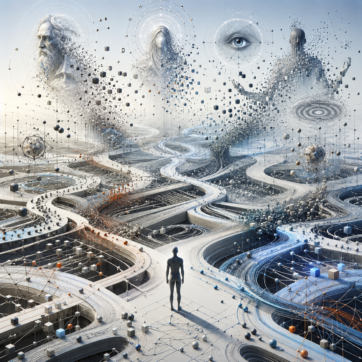
Output Is Not Created—It Stabilizes Only Where Structure Can Withstand Pressure and Hold Continuity
Why the Word Fails Immediately
The word “manifestation” collapses the entire system into the final frame and then pretends that frame is the origin. It points to what is already visible and treats it as if it came into existence at that exact moment, as if the appearance itself is the event. That is the first distortion. The visible layer is never the starting point. It is the end of a sequence that has already been determined by structure, pressure, and whether continuity could hold long enough for anything to stabilize. By naming the outcome as the cause, the word removes everything that actually governs whether something can appear at all.
It also builds in a false sense of direct control. The implication is that the individual is generating results through intention, focus, or repetition—as if the system responds linearly to thought and produces output on demand. That framing ignores the fact that nothing in this environment is operating on simple input-output logic. There are constraints. There are thresholds. There are limits to what can stabilize under the pressure conditions that already exist. You are not operating in an empty field where anything can be placed at will. You are inside a structured system that either permits stabilization or collapses it before it reaches the visible layer. The word “manifestation” bypasses that reality completely.
Worse than that, it strips out the mechanics. It removes pressure from the conversation entirely. It removes pathway availability, interference, structural integrity, and continuity. All of the determining factors are erased and replaced with a vague placeholder that suggests results are produced by wanting them strongly enough. That is why people stay focused on outcomes. They are trained to look at what appears and work backward through belief, effort, or symbolic action, instead of examining whether the underlying structure could ever support what they are trying to produce. The mechanism is never addressed, so nothing fundamentally changes.
The word is not just imprecise—it is misdirecting. It keeps attention locked on the surface while the actual conditions remain untouched. Nothing appears because it was called in. Nothing arrives because it was pulled from somewhere else. What appears is what the system can structurally support under its current conditions. If the structure cannot hold, it will not stabilize—no matter how much effort is applied at the surface. The visible result is not proof of creation. It is proof that, for that moment, the structure could hold under pressure without collapsing.
The External Architecture: Render, Pre-Render, Mimic, and the Absence of the Eternal
Before anything in this article can be understood correctly, the structure we are inside has to be seen cleanly. Without this, the word “manifestation” will keep collapsing everything back into surface-level interpretation. What humans call reality is not the origin point of anything. It is a rendered layer—an output surface—generated through deeper architectural mechanics that operate prior to visibility. The system is not built from the outside in. It is built from the inside out, with organization occurring before appearance, and appearance functioning as a translated endpoint rather than a cause.
The render is the visible world—everything that can be seen, touched, reacted to, or participated in. Bodies, environments, institutions, relationships, events, identities, and all perceived “happenings” exist at this layer. But this layer is not raw reality. It is already processed by the time it becomes visible. It is a translation. The nervous system does not receive direct structure—it receives interpreted output. Thought is translation. Emotion is translation. Memory is translation. Identity is translation. Symbolism is translation. The entire perceptual field is acting as an interface that converts deeper structural movement into experiences that can be participated in.
This is why everything immediately becomes a story. The system cannot present raw structure to the human interface, so it converts movement into narrative. Events become meaning. Pressure becomes emotion. Instability becomes conflict. Convergence becomes coincidence. Distortion becomes symbolism. Humans are not interacting with structure directly—they are interacting with rendered interpretations of structure. And because of that, they assume what they are seeing is primary. It isn’t. It is already the end result of something that occurred before it became visible.
That upstream layer is the pre-render.
The pre-render is where organization happens before anything appears. It is not a place, not a realm, not a dimension. It is the condition in which pressure, pathways, probabilities, and convergence organize before they translate into visible output. Nothing begins in the render. By the time something is seen, it has already been structured. Large-scale events, personal experiences, social shifts—none of them originate at the moment they appear. They cross a threshold into visibility after sufficient structural alignment has already taken place beneath perception.
This is why reality feels reactive instead of causative. People think events are happening “in real time,” but what they are witnessing is the release point of something that was already forming. Emotional waves don’t start when they are felt—they reach visibility when they have already accumulated. Societal shifts don’t begin when they are announced—they surface when the structure supporting them has already stabilized enough to hold in the render. The visible moment is not the beginning. It is the exposure of something that could finally sustain itself under pressure.
This alone dismantles manifestation completely.
Nothing is being “called in” at the moment it appears. It was either structurally organizing upstream and reached stability… or it wasn’t and never appeared. The render does not generate outcomes. It displays what has already met the conditions to hold.
But the system does not stop there. Because the architecture itself is unstable, it cannot maintain coherence on its own. It requires continuous motion, continuous translation, and continuous participation to keep itself from collapsing. This is where the mimic layer enters.
The mimic is not the original structure—it is an amplification layer that compensates for instability. As the underlying architecture weakens, the mimic increases output, increases noise, increases emotional intensity, increases narrative complexity, and increases identity reinforcement. It does not fix instability. It covers it by generating more activity.
This is why the modern world feels overwhelming and hollow at the same time. There is more information than ever, but less clarity. More communication, but less coherence. More expression, but less stability. The mimic floods the system with translated output so the lack of structural integrity underneath is not immediately recognized. It creates a hyperreal environment—everything feels intensified, urgent, meaningful, but nothing actually resolves.
And this is critical to the topic of manifestation.
Because what people are interacting with is not a clean system where intention produces results. They are inside a layered architecture where:
the pre-render determines what can organize
the render displays what can hold
the mimic distorts and amplifies what cannot stabilize cleanly
So when someone tries to “manifest,” they are applying effort at the final layer, after everything has already been determined structurally. They are working backward. They are attempting to control output without access to the conditions that generate output. And the mimic reinforces this by producing partial, distorted, or temporary results that appear to validate the process, even though nothing fundamental has changed.
This is why outcomes feel inconsistent, unstable, or short-lived. Because they are not being generated—they are being temporarily sustained under conditions that cannot hold.
And underneath all of this is the most important contrast: the Eternal.
The Eternal is not part of this architecture. It is not another layer within it. It is not a higher level, not a deeper dimension, not a refined version of the same system. It exists completely outside of it.
Everything inside the external architecture requires movement to maintain itself. Compression, torsion, oscillation, pressure distribution—these are all mechanisms compensating for instability. The system must continuously generate motion because it cannot hold coherence on its own. That is why nothing here is self-sustaining. Everything requires input, reinforcement, or participation to remain stable.
The Eternal requires none of that.
No movement.
No pressure compensation.
No identity stabilization.
No narrative.
No translation.
It does not need to become anything, produce anything, or stabilize anything because it is not operating under instability to begin with.
And this is why understanding the architecture is non-negotiable for this article.
Because “manifestation” only makes sense if you believe the render is primary, the individual is in control, and output is being generated in real time.
But once the structure is seen clearly:
the render is not the source
the pre-render determines organization
the mimic distorts perception of outcomes
and nothing inside the system is self-holding
Then the entire idea collapses.
What appears is not what was created. It is what could survive the system long enough to be seen.
The System Is Not Output-Based
The core misorientation begins with the assumption that this system exists to produce results. That is the foundation of the distortion. Humans are trained—through culture, language, identity systems, and reinforcement loops—to believe that outcomes are the point. That if something does not appear, it is because it was not done correctly, not focused on enough, not repeated enough, or not “aligned” enough. But the system is not built to generate output on demand. It is built to manage instability through pressure, and everything that appears within it is secondary to whether that pressure can be structurally contained.
Nothing here begins at the level of results. Nothing starts with what becomes visible. The visible layer is the last point in a chain of conditions that either held or failed before anything could appear. What people call “output” is simply what made it through. It is what did not collapse under pressure before reaching visibility. That is the only qualification. Not desire. Not intention. Not repetition. Structural capacity.
This is why treating the system as output-based will always misfire. Because it directs attention to the wrong layer entirely. It keeps effort focused on what is already downstream instead of what determines whether anything can exist upstream. The render does not decide outcomes. It displays outcomes. And by the time something reaches that layer, the determining factors are no longer accessible through surface-level engagement.
The system itself is organized around stability under pressure. That is the primary condition. Pressure is not something that occasionally interferes with results—it is the environment everything must exist within. Every structure, every pathway, every potential outcome is subject to whether it can hold under the conditions present. If it cannot, it does not stabilize. It does not matter how much attention is applied to it. It does not matter how clearly it is visualized, how often it is repeated, or how strongly it is desired. None of those operate at the level where stabilization is determined.
This is where the misunderstanding becomes absolute. Because humans attempt to generate output through mental and symbolic engagement, believing those inputs will produce a visible result. But those inputs do not interact with the system at the level where outcomes are decided. They operate within the render, inside the translation layer, after the structural conditions have already been set. So the effort never reaches the point of influence. It cycles inside the visible field without changing the underlying mechanics.
And this is why so much effort produces nothing stable.
Because the structure was never capable of holding what was being attempted.
If the pressure distribution is misaligned, the pathway is restricted. If the pathway is restricted, the outcome cannot organize. If it cannot organize, it cannot stabilize. And if it cannot stabilize, it will not appear—regardless of how much surface-level effort is applied. The system does not respond to intensity. It responds to whether something can structurally exist within it without collapsing.
Even when something does appear through force or temporary alignment, if the structure cannot sustain it, it degrades. It requires constant reinforcement. It fluctuates. It destabilizes. That is not successful output—that is unstable formation briefly holding before breaking down. And this is often mistaken as partial success, when in reality it is evidence that the structure was never capable of supporting it cleanly.
So the entire orientation has to shift.
Output is not primary. It is not something to aim at directly. It is the consequence of structural conditions that either hold or fail. The visible layer is not where creation happens—it is where the result of structural viability becomes observable. Nothing begins there. Nothing is decided there.
If the structure cannot hold, nothing stabilizes.
No matter how much focus is applied.
No matter how strong the intention is.
No matter how many times it is repeated.
Because none of those determine whether something can exist under pressure.
What Actually Determines Output
Once the illusion of “manifestation” is removed, what’s left is not emptiness—it is a set of very specific mechanics that determine whether anything can appear at all. Output is not a creative act happening at the surface. It is the final expression of whether multiple underlying conditions aligned well enough to hold under pressure without collapsing. If those conditions are not met, nothing stabilizes. If they are partially met, distortion appears. If they are cleanly met, output holds. That is the entire system.
The first determining factor is pressure distribution. Pressure is not evenly spread across the system. It accumulates, compresses, redirects, and concentrates in different areas depending on structural conditions. When pressure is uneven, it does not support formation—it restricts it. Pathways that might otherwise allow something to organize become inaccessible because the pressure across them cannot be held consistently. Instead of supporting stabilization, uneven pressure creates collapse points. And when pressure overloads a structure, it does not produce stronger output—it produces distortion. What tries to form cannot maintain its shape. It warps, fragments, or fails before reaching visibility. This is why increased effort often makes things worse rather than better. It adds pressure to a system that already cannot distribute it correctly.
The second factor is pathway availability. Not everything is accessible at all times, regardless of desire or focus. Pathways are not open by default—they depend on alignment within the structure. If the pathway required for a specific outcome is not available, that outcome cannot organize, no matter how much attention is directed toward it. This is where the idea of “trying to get something” completely breaks down. You are not pulling something toward you—you are either aligned with a pathway that allows it to stabilize, or you are not. And if you are not, the system does not compensate for that. It simply does not produce the output. Pathways open and close based on structural conditions, not based on intention.
The third factor is continuity versus interference. For anything to stabilize, it must maintain continuity long enough to fully organize. Continuity means there is no fragmentation in the structure as it forms. There are no breaks, no conflicting pressures, no competing pathways disrupting the process. When continuity is clean, formation can complete, and output stabilizes. But interference interrupts that process. Interference introduces competing signals, overlapping pressures, or structural misalignment that breaks the formation before it can finalize. The result is partial output, unstable output, or no output at all. Most people never recognize this layer—they only see that something “didn’t work,” without understanding that it never had uninterrupted continuity to begin with.
The fourth factor is structural integrity. Even if pressure is distributed correctly, pathways are available, and continuity is present, the structure itself must still be capable of holding what is forming. If it cannot, it will not appear. Structural integrity determines whether something can exist without collapsing under its own formation. Weak structures do not fail after they appear—they fail before they reach visibility. They dissolve during formation. This is why so many things never show up at all. It is not because they were blocked or denied. It is because they could not hold. And when something with weak integrity does manage to appear temporarily, it requires constant reinforcement to stay in place, because it is not inherently stable.
All of these factors operate together, not separately. Pressure distribution affects pathway availability. Pathway availability affects continuity. Continuity affects whether structural integrity can even be tested. This is not a linear process—it is a simultaneous condition where everything must hold at once for output to stabilize.
And this leads to the correction that replaces “manifestation” completely:
Output is not created—it is allowed when conditions hold.
Nothing is being produced at the surface. Nothing is being pulled into existence. What appears is what successfully passed through pressure, aligned with available pathways, maintained continuity, and held structural integrity long enough to stabilize in the render. Everything else never makes it there.
Why “Trying to Manifest” Often Fails
The failure is not random, and it is not because someone “didn’t do it right.” It fails because the entire approach is aimed at the wrong layer of the system. What people call “trying to manifest” is almost always happening inside the mental, symbolic, and repetitive layers of the render—after the structural conditions have already been set. Thought loops, visualization, affirmations, emotional reinforcement, repetition—these are all occurring within the translation interface, not within the mechanics that determine whether anything can actually stabilize.
So the effort never reaches the level where outcomes are decided.
The underlying structure remains exactly as it was before the effort began. Pressure distribution is unchanged. Pathways remain either open or closed based on alignment that has not shifted. Continuity is still either fragmented or intact. Structural integrity is still either capable of holding or not. None of that is altered by surface-level repetition. But because effort is being applied continuously at the visible layer, it creates the illusion that something is being “worked on,” when in reality nothing structural is moving.
And instead of stabilizing the system, this misplaced effort increases pressure.
Every attempt adds more load to a structure that already cannot hold what is being forced through it. Instead of opening pathways, it congests them. Instead of improving continuity, it introduces more interference. Instead of strengthening structural integrity, it exposes its weakness more quickly. The system does not interpret effort as alignment—it registers it as additional pressure being applied to an already unstable condition.
This is the loop:
pressure → effort → more pressure → instability → no output
Or, in some cases:
pressure → effort → temporary formation → distortion → collapse
The more pressure that exists, the more effort is applied in response. The more effort is applied, the more pressure increases. And as pressure increases without structural adjustment, instability expands. At that point, either nothing appears at all, or something unstable briefly forms and then breaks down because it cannot sustain itself.
This is why people experience inconsistency. Moments where something seems to “work,” followed by collapse. Periods of no output at all despite continuous effort. Cycles of building and losing, starting and stopping, forming and dissolving. None of that is random. It is the direct result of applying force at the wrong layer while the actual structure remains unchanged.
Trying harder does not resolve this. It accelerates it.
Because effort does not correct misalignment. It amplifies whatever condition is already there. If the structure is stable, minimal effort is required because the system can hold. If the structure is unstable, increased effort only exposes that instability faster by forcing pressure through pathways that cannot sustain it.
This is the point where the entire idea has to be dropped completely.
There is nothing to “push into existence.”
There is nothing to “force through repetition.”
There is no amount of trying that can override structural conditions.
If the system cannot hold it, it will not stabilize. And trying harder will not change that—it will make the collapse more immediate and more obvious.
What Happens When You Try to Force an Outcome
When pressure is applied deliberately in the render—through effort, repetition, insistence, or force—it does not operate the way people assume. It does not “push” an outcome into existence. It does not break open pathways by intensity. What it actually does is interact with the structure upstream, and in most cases, it destabilizes it further or redirects it into distortion.
Because the moment force is applied at the surface, it does not stay contained there. It transfers into the system as added pressure. And that pressure moves backward into pre-render organization, where pathways are still forming, still aligning, or not yet available at all.
If a pathway is not ready—meaning the pressure distribution is not stable enough, continuity is not clean enough, or the structure cannot hold—then forcing against it does not open it.
It compresses it.
And when compression is applied to a pathway that cannot yet stabilize, one of several things happens.
The first is premature formation through distortion. The added pressure forces a partial opening, but because the pathway was not structurally ready, what comes through is not clean. It is a distorted version of the original formation. It looks similar, it feels close, it may even resemble the intended outcome—but it does not hold. It is unstable, misaligned, and requires continuous reinforcement. This is what can feel like a “near match” or something that almost works but never fully stabilizes. Structurally, it is a forced emergence from a pathway that was not ready to support it.
The second is what can be described as a copy-pathway effect. Instead of opening the original pathway, the system redirects the pressure into a secondary formation—an artificial or mimic version of the original route. This pathway is not the true structural line for that outcome, but it temporarily forms under pressure to relieve the load. What appears in the render from this is a copy of the intended result, but it is built on unstable structure. It may look correct on the surface, but underneath it lacks alignment, continuity, and integrity. Over time, it reveals itself through inconsistency, degradation, or collapse.
The third is pathway deflection. When pressure is applied to a closed or misaligned pathway, instead of opening, the system redirects that pressure elsewhere. It moves laterally into other available pathways that can absorb it. This can produce completely different outcomes than what was intended—often unrelated, sometimes confusing, sometimes disruptive. From the surface, it can feel like the system is ignoring the effort or producing random results, but structurally it is simply redirecting pressure to where it can be contained.
The fourth is full blockage and buildup. If there is nowhere for the added pressure to go—no available pathways that can absorb or redirect it—then it accumulates. This increases overall system congestion and makes stabilization even less likely across all related structures. Over time, this can reduce pathway availability further, making it harder for anything to organize cleanly. What was originally just one misaligned attempt begins to affect a wider range of potential outputs.
The fifth is fragmented formation. Instead of a single stable outcome, multiple partial formations begin to appear, none of which fully stabilize. Pieces of the intended outcome show up in scattered ways, but they do not converge into one coherent structure. This happens when pressure disrupts continuity during formation, breaking the process into incomplete segments.
All of these outcomes come from the same mistake: Applying force to a structure that is not ready to hold.
And this is why forcing outcomes is not neutral—it has structural consequences.
It does not just fail to produce the intended result.
It alters pathway conditions.
It introduces distortion.
It redirects pressure.
It can generate unstable copies instead of the original formation.
And most importantly, it creates the illusion that something is happening—because something often does appear—but what appears is not the clean outcome. It is a response to pressure, not the result of proper structural alignment.
This is where the confusion deepens.
Because from the surface, it can look like the effort “worked,” especially when something shows up. But if that result is built on a forced pathway, it will not hold. It will require maintenance, correction, repetition, or it will collapse entirely. And that cycle reinforces the belief that more effort is needed, when in reality the effort is what created the distortion in the first place.
Forcing does not create access. It creates pressure against misalignment.
And when pressure is applied to something that cannot structurally support it, the system will always respond—but not by producing a clean outcome.
It will respond by compensating.
Pre-Render Determines Output, But Render Interaction Still Applies Pressure
The primary control point of this entire system sits in the pre-render. That is where organization happens, where pathways form, where pressure is distributed before anything becomes visible. The render does not decide outcomes—it displays what the pre-render has already structured well enough to hold. That is the dominant direction of influence, and it does not reverse. What appears is determined upstream, not at the surface.
But that does not mean the render is irrelevant.
What happens in the render does not create outcomes, but it does feed pressure back into the system. And that pressure does not stay isolated—it transfers into pre-render conditions and can influence how pathways form, how they open, how they distort, or how they delay. So while the render does not have control in the sense people assume, it does have impact.
The distinction is precise:
The pre-render determines what can exist.
The render can affect how that determination organizes.
That effect is not absolute, and it is not directional control. It is pressure interaction.
When someone applies force in the render—through repetition, insistence, emotional intensity, or trying to push something into existence—that action does not reach up and “create” a pathway. But it does send additional pressure into the pre-render layer. And that pressure has consequences depending on the condition of the pathway it is interacting with.
If a pathway is already forming and close to stabilization, added pressure can sometimes accelerate its organization—but only if the structure can absorb that pressure cleanly. If it cannot, that same pressure will destabilize the formation instead, introducing interference where continuity was needed.
If a pathway is not ready—meaning it is not aligned, not stable, or not capable of holding—then added pressure does not open it. It interferes with its formation. It can delay it, distort it, or reroute it entirely. Instead of clean alignment, the system now has to compensate for the added load. That can push the pathway further out of stability rather than closer to it.
This is where people get confused.
Because they assume that what they are doing in the render is directly shaping outcomes. But what they are actually doing is interacting with pressure conditions that are already determining those outcomes. And depending on how that pressure is applied, they can either:
allow a formation to continue undisturbed
disrupt a formation that was stabilizing
force distortion into a pathway that was not ready
or redirect pressure into entirely different structures
So there is influence—but it is not control.
The pre-render remains the dominant factor because it governs whether something can exist at all. It holds the conditions that decide pathway availability, continuity, and structural integrity. Nothing in the render can override those conditions. But the render can introduce variables—primarily in the form of pressure—that affect how those conditions evolve.
This is why forcing outcomes becomes such a problem.
Because instead of allowing pre-render organization to complete cleanly, it injects pressure into a system that may not be ready to receive it. And that pressure does not create—it interferes. It alters timing, alters structure, alters alignment. It can take something that may have eventually stabilized and push it into distortion or delay.
At the same time, minimal interference in the render—meaning low force, low distortion, low reactive pressure—allows pre-render conditions to organize without disruption. Pathways open when they are structurally ready. Continuity completes without fragmentation. Output stabilizes cleanly because nothing was forcing it before it could hold.
So the relationship has to be understood correctly.
The pre-render is where outcomes are determined.
The render is where pressure is expressed.
And that pressure feeds back into the system—not as control, but as influence.
Not enough to create something that cannot exist.
But enough to distort something that might have.
The Illusion of Control
The idea of control is built directly into the word “manifestation,” and that is exactly why it misleads. It suggests that outcomes are being directed, selected, and produced through personal input—as if the system responds in a straightforward way to intention, focus, or effort. It frames reality as something that can be shaped on demand, as though the individual is operating above the conditions that govern what can and cannot stabilize. But that is not how this system functions at all.
Control, as it is commonly understood, does not exist at the level people think it does.
Because outcomes are not determined by preference or desire—they are determined by structural conditions. Pressure distribution, pathway availability, continuity, and structural integrity set the limits of what can appear. These are not flexible in response to will. They are not overridden by belief. They do not shift because something is wanted strongly enough. They are the governing mechanics of the system itself, and nothing at the surface can bypass them.
You cannot override pressure. If the pressure load is misaligned, the structure collapses regardless of intention. You cannot override continuity. If interference is present, formation fragments before it stabilizes. You cannot override pathway limits. If the pathway required for a specific outcome is not available, that outcome cannot organize into visibility. These are not optional variables—they are fixed conditions that determine what is possible at any given moment.
And this is where the illusion forms.
Because there are moments where things do appear, and they appear with little effort. They stabilize, they hold, they come together in a way that feels smooth and direct. And those moments are interpreted as proof of control. As if the outcome was produced through personal action. But what is actually happening is far more precise.
The conditions already allowed it.
Pressure was distributed in a way the structure could hold.
The pathway required for that outcome was open.
Continuity was clean enough for formation to complete.
Structural integrity was sufficient for stabilization.
The system was already aligned for that output to occur.
And when that alignment exists, very little effort is needed because nothing is being forced. The structure supports the outcome naturally. But instead of recognizing that the conditions were already in place, the mind assigns causation to whatever action occurred at the surface—thought, focus, repetition—and labels that as control.
That is the misinterpretation.
Because when those same actions are repeated under different conditions, nothing happens. Or something unstable appears and collapses. And instead of recognizing that the structure is different, the response becomes “try harder,” reinforcing the belief that more control will produce the same result again.
But control was never the mechanism.
What appeared did so because it could hold, not because it was created.
And this is the shift that has to occur.
The system is not responding to commands.
It is not producing outcomes based on input.
It is not something that can be directed around its own structure.
What appears is what the system can support under its current conditions.
Perceived control is simply the recognition of moments where those conditions happened to align—not the cause of them.
Why Some Things Appear Effortlessly
What people call “effortless” is one of the most misunderstood observations inside this system. It gets labeled as alignment, flow, being in the right mindset, or operating at some elevated internal state. But none of those explanations actually identify what is happening. They reinterpret the result without recognizing the mechanics that made the result possible in the first place.
Nothing appears effortlessly because it was created with ease. It appears effortlessly because there was no resistance in the structure.
When interference is low, formation does not get disrupted. There are no competing pressures breaking continuity, no conflicting pathways fragmenting the process, no structural contradictions interrupting stabilization. The system does not have to compensate for instability in that moment, so nothing needs to be forced. Output moves cleanly because nothing is obstructing it.
At the same time, pressure distribution is stable. That means the load across the structure is balanced enough that it can hold without collapse. There are no overload points causing distortion, no weak zones absorbing excess pressure, no misalignment forcing the system to redirect or fragment what is forming. When pressure is distributed correctly, the structure does not struggle to maintain itself—it simply holds.
Pathways are also open and unobstructed. The route required for that specific outcome is available, clear, and aligned with the current conditions. There is no need to force access, no need to push through restriction, no need to reroute around blockages. The pathway exists in a state that allows formation to move through it without resistance. And because of that, the process feels immediate, direct, and smooth.
Most importantly, the structure itself can hold without reinforcement.
This is what defines true stability. When something does not require constant effort to maintain, it means the structure supporting it is intact. It does not need to be propped up, repeated, or continuously corrected. It does not fluctuate under pressure. It does not degrade as soon as attention is removed. It holds because it is capable of holding.
And when all of these conditions are present at the same time, output appears with what is perceived as ease.
But that ease is not coming from the individual. It is coming from the absence of structural resistance.
This is where the misinterpretation happens.
Because instead of recognizing that the system was already in a state that could support the outcome, the result gets attributed to internal states—mindset, belief, emotion, “frequency,” or some version of personal alignment. The cause is assigned to the surface layer again, even though the actual mechanics were operating underneath it.
These are not “high vibration” states. They are not the result of perfect thinking or emotional calibration. They are mechanically stable conditions.
Low interference.
Balanced pressure.
Open pathways.
Structures that can hold.
When those are in place, nothing needs to be forced. And because nothing is being forced, it feels effortless.
But the ease is not the mechanism. It is the signal that the mechanism was already stable.
Can You Create Pathways, Or Are They Already Determined?
This is the question that always comes next, because once it’s clear that output is not being “manifested,” the assumption shifts to something deeper: can pathways themselves be created, or is everything already set in advance?
The answer sits in the structure itself, and it requires precision.
Pathways are not created in the render.
They do not originate from thought, intention, repetition, or effort. Those are all surface-level activities inside the translation layer. Pathways belong to the pre-render. They form as part of structural organization—through pressure distribution, alignment, continuity, and the capacity for something to hold. That process happens before anything becomes visible, and it is not directly accessible from the render.
So in that sense, no—you are not “creating” pathways the way people imagine. You are not designing them, selecting them, or building them from scratch through will.
But that does not mean they are fixed in a rigid, pre-written sense either. Pathways are not static. They are conditional.
They form, shift, open, close, strengthen, weaken, and dissolve based on structural conditions. They are not pre-determined outcomes waiting in a queue to be selected. They are dynamic responses to how pressure organizes within the system. As pressure redistributes, as interference increases or decreases, as continuity stabilizes or fragments, pathways reorganize accordingly.
So the system is not “everything is already decided,” and it is not “you can create anything you want.”
It is this: Pathways exist as potential structures that can form when conditions allow them to hold.
That is the key distinction.
Some pathways are already in formation—close to stabilization, requiring minimal alignment to open. Others are partial—present but not yet capable of holding. Others are not forming at all because the conditions required for them do not exist. And as pressure moves through the system, those states can change.
Now this is where what happens in the render becomes relevant again.
You are not creating pathways—but you are constantly interacting with the pressure conditions that influence them.
Every reaction, every force applied, every attempt to push or control—these all feed pressure back into the system. And that pressure can:
support a pathway that is already forming
destabilize a pathway that was close to opening
delay formation by introducing interference
redirect pressure into entirely different pathways
or generate distorted versions of pathways that were not ready
So while you are not creating pathways directly, you are not neutral either. You are part of the pressure environment that pathways are forming within.
This is why two people can pursue the same outcome and have completely different results. It is not about who tried harder or believed more. It is about what conditions were present in the system and how their interaction with those conditions either supported or disrupted pathway formation.
And this is also why the idea of “creating your reality” breaks down completely. Because you are not standing outside the system designing it.
You are inside it, within the same pressure field that governs everything else. You cannot step outside of those mechanics to override them. You can only interact with them—and that interaction has limits.
So to clarify cleanly:
Pathways are not pre-written outcomes waiting to be selected.
They are not created on demand through intention.
They are structural formations that emerge when conditions allow them to hold.
And what you do in the render does not give you control over those formations—but it does influence the pressure conditions they are forming within.
That is the actual relationship.
Not creation. Not full determinism.
Conditional formation within a pressure-based system where the pre-render organizes, and the render interacts—but does not decide.
Structural Limits: Why Not Everything Can Happen
There is a hard boundary in this system that most people do not want to face, because it directly contradicts everything they have been taught about creating outcomes. Even once “manifestation” is removed, there is still an assumption that anything is possible if the conditions are right. That is not accurate. There are structural limits to what can occur within any given life, and those limits are set by the structured ranges of experience tied to identity.
These structured ranges of experience tied to identity (incarnation life plan in a simplistic sense) are real, but they are not what most people think. They are not fixed timelines, not guaranteed outcomes, and not a script forcing events to happen. They are bounded fields of possible experience. Within those fields, certain environments, roles, patterns, and types of outcomes are available to form, and outside of those fields, they are not. That boundary does not dictate exact events, but it does determine what categories of experience are even accessible to stabilize in the render.
This is where most people become misaligned, because they assume that wanting something strongly or trying hard enough should be enough to bring it into their life. But if what they are trying to produce does not exist within their structured range of experience tied to identity, it cannot stabilize. It is not about failure or lack of effort. It is about structural compatibility. The system does not respond to desire at that level. It responds to whether something exists within the defined range first, and then whether the pathways and pressure conditions can support it forming.
Even when something is inside that structured range, it is still not guaranteed to appear. It must still pass through pathway availability, pressure distribution, continuity, and structural integrity. That means there are always two conditions operating at once. First, whether something is even within the available range. Second, whether the system can actually support it forming and holding. If either of those conditions is not met, the outcome does not stabilize.
This is why two people can pursue the same outcome and have completely different results. One may have that outcome within their structured range, while the other does not. Or both may have it within range, but only one has pathways that can actually open and hold it cleanly. From the surface, it looks like effort or ability. Structurally, it is alignment versus limitation.
This also connects directly to the external mimic architecture under pressure. As the system compresses and routes more humans into repeated incarnational tracks, those structured ranges of experience tied to identity become tighter and more constrained for most people. Variation reduces, repetition increases, and the range of what can actually stabilize narrows. This reinforces the illusion that more effort should produce more outcomes, when in reality the system itself is limiting what can form.
When someone tries to force something that is either outside their structured range or not supported by available pathways, the system does not expand to accommodate it. It compensates. It produces distorted versions, partial formations, unstable outcomes, or nothing at all. That response is not random. It is the system reacting to pressure applied against a structure that cannot hold what is being forced through it.
The clarity here is not meant to limit, but to correct direction. Not everything can happen within a single life, and not everything exists inside every structured range of experience. No amount of effort at the surface overrides that. What is within the range can form if the pathways support it. What is outside the range will not stabilize, no matter how much it is pushed.
The Water Pipe System Analogy
This is an analogy to make the mechanics visible, not the literal system itself.
Most people approach reality like this: I want something, I try to make it happen, and if I try hard enough it should show up. That assumes the system moves outward from you, as if your effort is the starting point and reality responds forward from that. That assumption is the entire problem because the system does not begin where you are trying. What shows up is not created at the surface. It is the result of whether something underneath could hold before it ever became visible.
Think of it like a pipe system hidden behind a wall. You cannot see the pipes, you do not know how they are connected, but water flows through them. The only thing you interact with is the faucet. The water coming out of the faucet is what you experience as reality—what appears, what becomes visible, what “happens.” But that output is completely dependent on the condition of the pipes behind the wall. If the pipe is properly connected, water flows cleanly. If the pipe is blocked, nothing comes out. If the pipe is cracked or unstable, the water leaks, sputters, or comes out distorted.
Now look at what people actually do. They stand at the faucet and try to control the outcome there. They think about the water, focus on it, try harder, repeat actions, turn the handle more aggressively. None of that changes the pipe behind the wall. The structure that determines the outcome remains exactly the same regardless of how much effort is applied at the surface. That is the misalignment. You are interacting with the output point while the determining factor sits behind it.
This is the exact relationship you are in. The pipe system represents the pre-render, the structural layer where everything is actually organized. The faucet represents the render, the visible layer where you experience results. Most people are trying to control the faucet, believing that more effort there will change what comes through, when in reality the entire outcome is dependent on what is happening behind the wall.
This is also why trying harder often makes things worse. Because what is being called trying is not neutral, it is pressure. When you force, repeat, push, or intensify, you are increasing pressure in the system. If a pipe is blocked and pressure is increased, it does not suddenly open cleanly. It strains, it cracks, it leaks, or water bursts through in the wrong way. The added pressure does not repair the structure, it exposes its instability. That is exactly what is happening when outcomes are forced. Pressure is being applied to something that cannot hold, and instead of creating a clean result, it produces distortion.
This leads directly into the confusion about pathways. People ask whether they can create them or whether everything is already fixed. The reality is neither of those. You are not behind the wall building pipes yourself. You are not constructing pathways through will or thought. But the pipes are not permanently fixed either. They form, shift, open, weaken, or close depending on the condition of the system, which is driven by pressure, alignment, and whether the structure can support flow. So pathways are not chosen by you, but they are also not locked in place. They are conditional.
Where you actually come into this is through pressure. You are not building the pipes, but you are constantly adding pressure into the system. That pressure interacts with whatever structure is already there. If a pathway is already forming and close to opening, added pressure can help it complete. If a pathway is weak, that same pressure can break it. If a pathway is not ready at all, pressure can force a distorted version of it to appear or redirect the flow somewhere else entirely.
This is where the “copy” or distorted result comes from. You try to force something that is not structurally ready. The system now has excess pressure that needs to go somewhere. Instead of opening the real pathway, which cannot hold, it creates a secondary release, a temporary route. What shows up looks similar to what you wanted, but it is off, unstable, and does not hold. That is not the real pathway opening. That is pressure being discharged through a substitute structure.
This is why it becomes confusing, because something did appear, so it looks like it worked. But structurally, either the pathway was already ready and it opened cleanly, or it was not ready and the system compensated by producing a distorted version. At the surface those can look similar at first, but only one of them holds without force.
That is the entire point of this analogy. You are not creating outcomes, pulling things in, or building pathways directly. You are inside a system where things appear only if they can structurally hold. If something is ready, it shows up with very little effort because nothing is resisting it. If it is not ready, forcing it creates distortion or nothing at all. Trying harder is not increasing control, it is increasing pressure on a structure you cannot see.
Distorted Output vs Clean Output
This is one of the most important distinctions in the entire system, and most people completely miss it because they only look at whether something appeared, not how it holds after it appears. They treat all output as equal, when structurally it is not even close.
Distorted output is what shows up when something has been forced, misaligned, or formed under unstable conditions. It can appear, sometimes very convincingly at first, which is why it confuses people. But it does not hold. It starts degrading almost immediately or requires continuous effort to keep in place. There is always some level of instability in it. It fluctuates, shifts, weakens, or breaks down under normal conditions. It often feels inconsistent, like it is there one moment and slipping the next. That instability is not random. It is built into the structure because the pathway it came through was not fully capable of supporting it. Either pressure was uneven, continuity was interrupted, or the structure itself could not sustain what was formed. So what shows up is not a complete, stable output—it is a strained version trying to hold under conditions it was never built for.
This is why distorted output always demands something from you. It requires attention, reinforcement, correction, or repeated effort to maintain. It does not stand on its own. The moment you stop applying force to it, it begins to weaken or collapse. And that is the signal. Not that you need to try harder, but that what you are holding was never structurally stable to begin with.
Clean output is completely different. It does not rely on force to exist. It stabilizes because the structure underneath it is intact. The pressure is distributed in a way it can hold, the pathway it came through is aligned, and continuity was maintained during formation. Because of that, it does not require maintenance. It does not need to be constantly reinforced or corrected. It holds its position over time without effort being applied to keep it there. It feels consistent, not because you are managing it, but because the system itself is supporting it.
There is no strain in clean output. There is no constant adjustment. There is no sense that it is about to fall apart if you stop focusing on it. It simply remains, because nothing underneath it is destabilizing it. The structure can carry it without assistance.
This is where most people misread the system. They assume that if something appeared, it must be correct, and if it starts to degrade, it means they need to do more to keep it. But the degradation is the information. It is showing you that the formation was unstable from the start. Trying to maintain it only increases pressure on something that already cannot hold.
The anchor is simple and absolute.
If it has to be constantly maintained, it was never structurally stable.
That is the difference. Not whether something showed up, but whether it can exist without you holding it together.
The Cultural Loop Around Manifestation
The reason this concept spreads so easily has nothing to do with accuracy. It spreads because it simplifies something that is structurally complex into something that feels usable, controllable, and immediate. It takes a system governed by pressure, pathways, continuity, and structural limits, and reduces it down to a single idea: you can produce outcomes if you do the right things. That simplification makes it easy to package, easy to teach, and easy to sell. It removes the need to understand anything underneath and replaces it with a repeatable surface-level process that appears to work just often enough to sustain belief.
It also gives people something the actual system does not provide directly, which is a sense of control. The structure itself is not built around individual command over outcomes. It is conditional, constrained, and dependent on factors most people are not aware of. That creates instability at the level of understanding. The concept of manifestation fills that gap by offering a version of reality where control feels accessible. It tells people that outcomes are a result of what they do, what they think, or how they focus, which makes the system feel predictable even when it is not. That sense of control is what keeps people engaged with it, even when the results are inconsistent.
At the same time, it keeps attention locked onto outcomes instead of mechanics. Everything becomes about what appeared or did not appear, rather than why. The structure underneath is never examined. Pressure is never considered. Pathways are never evaluated. Continuity and interference are never seen. The entire focus stays at the surface, where results are visible but causes are hidden. This prevents any real understanding of how the system actually functions, because the layer that determines outcomes is never addressed.
This creates a self-reinforcing loop that is difficult to break because it feeds on partial success. The sequence is consistent. There is a desire for something to happen. An attempt is made to “manifest” it through effort, repetition, or focus. Sometimes something appears, but it is often partial, unstable, or distorted. That result is then interpreted as proof that the method works, even if it did not hold cleanly. The belief is reinforced, and the process is repeated again with the assumption that more effort will produce a better version next time.
The loop continues without interruption because the failure is never correctly identified. When something does not work, it is attributed to not trying hard enough, not believing enough, or not doing the process correctly. When something partially works, it is taken as confirmation. At no point does the focus shift to the actual structure that determined the outcome in the first place.
This is why the system remains invisible to most people.
Because the attention is constantly being redirected back to results.
As long as the focus stays on what appears, the underlying mechanics never come into view. And as long as the mechanics are not seen, the same cycle continues. The system does not need to hide anything actively. It only needs to keep attention fixed on outcomes so that no one looks at what is actually determining them.
That is the key point. The system keeps people focused on results so they never examine structure.
What Replaces Manifestation
Once the idea of manifestation is removed, there has to be a clear replacement or the mind will default right back to outcome-chasing. The replacement is not another concept layered on top. It is a complete shift in orientation—from looking at results to understanding the conditions that allow results to exist at all.
The first shift is from outcome focus to structural conditions. Instead of asking why something did or did not appear, the focus moves to what conditions were present that either allowed it to stabilize or prevented it from holding. The visible result is no longer treated as the primary event. It becomes a readout, an indicator of what the underlying structure supported. This changes the entire direction of attention. Instead of reacting to what is already formed, you are recognizing what must be in place before anything can form.
The second shift is from forcing results to stabilizing pathways. Force operates at the surface and adds pressure to the system. Stabilization operates at the structural level by allowing pathways to organize cleanly without interference. This does not mean “doing nothing.” It means not applying pressure in ways that distort formation. It means recognizing when something is not able to hold and not trying to push it into existence anyway. Stabilizing pathways is about reducing interference so that what can form is able to complete without fragmentation.
The third shift is from repetition to alignment of mechanics. Repetition assumes that doing something over and over will eventually produce a result. But repetition applied to misalignment only reinforces instability. Alignment of mechanics means understanding how pressure is distributed, whether pathways are available, whether continuity is intact, and whether the structure can hold. When those conditions are aligned, repetition is unnecessary because the system supports the outcome on its own. When they are not aligned, repetition only increases pressure and makes stabilization less likely.
From this orientation, a different set of actions emerges, and they are precise.
Detection comes before action. Instead of reacting immediately or trying to produce a result, the first step is recognizing what is actually happening in the system. Where is pressure building, where is it stable, where is there resistance, where is there openness. Without that detection, any action taken is blind and likely to increase distortion.
Pressure is read instead of reacted to. Instead of seeing an outcome and trying to change it directly, the focus shifts to what pressure conditions produced it. If something is unstable, the question is not how to fix the result, but what pressure created that instability. If something is not appearing, the question is not how to force it, but whether the pathway is available and able to hold.
What can hold is allowed, and what cannot is not forced. This is the most direct correction to manifestation thinking. Instead of trying to bring something into existence, the system is allowed to reveal what it can actually support. If something is structurally ready, it will stabilize without force. If it is not, forcing it will only create distortion or nothing at all. The role is not to create outcomes, but to stop interfering with the conditions that determine them.
This is the replacement. Not a new method, not a new technique, but a different orientation entirely. The system is not something to control at the surface. It is something to read at the structural level. And once that shift is made, the need to “manifest” anything disappears, because it becomes clear that nothing was ever being created there to begin with.
Nothing Is Being Brought In
At the end of all of this, the entire idea of something being “brought into” your reality has to collapse completely, because that is not what is happening at any level of the system. Nothing is being pulled from somewhere else. Nothing is entering from outside. Nothing is arriving because it was called, requested, or focused on strongly enough. That entire framing assumes there is an external source being accessed and a direct line of control that does not exist.
What you are seeing as reality is not something being delivered to you. It is something being formed and held within a structure that either supports it or does not. The visible world is not a collection of things being created in real time through intention. It is the result of what has already organized in a way that can withstand pressure and maintain continuity long enough to stabilize into the render.
This is why nothing responds consistently to effort alone. Because effort is not the mechanism that determines whether something can exist. The system is not waiting for instruction. It is not responding to commands. It is not selecting outcomes based on preference. It is operating on structural conditions that either allow something to hold or cause it to collapse before it ever becomes visible.
When something appears, it is not because it was brought in. It is because every condition required for it to exist was met. Pressure was distributed in a way that did not break it. The pathway that carried it was available and aligned. Continuity was maintained during formation. The structure itself could support it without collapsing. That is why it is there.
And when something does not appear, it is not because it was blocked, denied, or failed to be created correctly. It is because the structure could not support it. The conditions were not aligned, the pathway was not available, the pressure could not be held, or continuity broke before formation completed. It never stabilized because it was never capable of stabilizing under those conditions.
This removes the entire illusion of “bringing something into your life.” There is nothing being brought in. There is only what the system can hold.
If it appears, it is because it can hold. If it does not, the structure was never capable of supporting it.