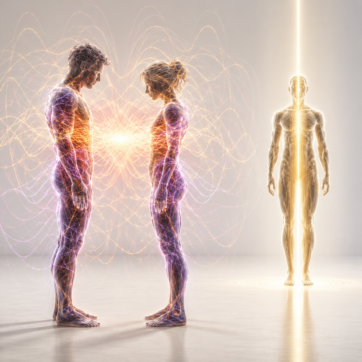
How Unstable Fields Create Drain, Absorption, and Human Interaction Loops
Opening — The Misinterpretation of Human Interaction
What humans label as “energy vampires,” “being drained,” “being empathic,” or “absorbing emotions” has been widely misidentified because the experience is real, but the interpretation is not. The sensations—fatigue after interaction, sudden emotional shifts, mental fog, heaviness in the body—are all valid outputs of something occurring at a structural level. However, the language used to describe these experiences has been built on surface perception rather than underlying mechanics, which is why the conclusions consistently distort what is actually taking place.
These are not separate phenomena. They are not different abilities, personality traits, or categories of people. They are all expressions of the same underlying condition: unstable fields interacting without internal stabilization. When a system cannot hold its own configuration, it does not remain contained. It begins to move, to oscillate, to seek pathways where pressure can redistribute. Human interaction becomes one of the primary environments where that redistribution occurs, not because of intention, but because proximity allows coupling.
There is no energy being stolen in the way it is commonly described. Nothing is being extracted as a resource from one individual and transferred to another like a substance. What is occurring instead is a shift in structural state—one system offloading internal pressure through interaction, while another system becomes engaged in that process and is pulled out of its own baseline. The sensation of “loss” or “drain” is the result of being moved out of coherence and into oscillation, which requires effort to stabilize again.
There is also no special empathic ability in the way it is typically framed. What is often praised as heightened sensitivity or emotional depth is, at a structural level, a lack of containment. Instead of observing another system while remaining intact, the field opens and begins to match what it encounters. The experience feels like absorbing emotions, but it is actually internal replication of an external pattern. The distinction is critical, because one implies perception, while the other reveals instability.
At the base of all of this, there are only a few core conditions operating: pressure, oscillation, and interaction between fields that cannot hold themselves. Pressure builds within a system when it is not stabilized. Oscillation emerges as the system attempts to release or redistribute that pressure. When two such systems come into proximity, interaction becomes the medium through which these movements amplify, transfer, or synchronize. What humans then interpret as emotional exchange, “energetic” drain, or empathic connection is simply the translated experience of these structural mechanics playing out in real time.
The misinterpretation persists because the translation layer converts these processes into familiar narratives—feelings, personalities, intentions—rather than revealing them as mechanical interactions. But once the underlying structure is seen clearly, the separation between “energy vampire” and “empath” collapses. Both are operating within the same system. Both are expressions of instability. And both are sustained by the same fundamental condition: the inability of a field to remain fully stabilized within itself.
The External Architecture, Personal Field, and the Pre-Render — What A Human System Actually Is
To understand why “drain,” “empathy,” and field interaction behave the way they do, the underlying structure of what a human system actually is must be made explicit. Without this, everything collapses back into personality, emotion, or belief, and the mechanics remain misidentified. A person is not simply a body moving through a physical world. A person is a localized configuration inside a much larger external architecture—a rendered participation field that converts deeper structural movement into lived experience.
The external architecture is the total system generating what humans call reality. It is not just the visible world, but the entire translation environment that converts pressure, movement, and structural organization into perception, identity, emotion, and narrative. What humans see, feel, think, and interpret is already processed output. By the time something is experienced consciously, it has already passed through multiple layers of translation—nervous system, perception, identity, memory, symbolic interpretation—each converting structure into something the human system can recognize and participate within.
This is why the world appears as story instead of structure. The architecture does not present raw organization directly. It presents a rendered interface—an experiential layer designed to stabilize participation. Everything inside this layer becomes emotionally and narratively organized because narrative holds continuity more effectively than direct structural awareness. Identity, relationships, conflict, desire, ambition, fear—these are not the base layer. They are outputs of a system converting deeper mechanics into immersive experience.
Within this architecture, a person’s “field” is not something separate or mystical floating around them. It is the local configuration of how that system is currently holding pressure, oscillation, and organization. It includes the nervous system, the body, the perceptual interface, and the identity structure all functioning together as one unit. A personal field is how the architecture is currently stabilized at that point—how much pressure is being held, how much oscillation is present, how much distortion exists, and how much coherence is available.
This is critical, because interaction between people is not interaction between personalities—it is interaction between these configurations. When two people come into proximity, it is not just conversation happening. It is structural contact between two fields with different pressure levels, different oscillation rates, and different stabilization capacities. Everything that follows—conversation, emotion, attraction, irritation, fatigue—is downstream of that structural interaction.
The reason this matters is because the field is not self-contained in the way humans assume. It is part of the larger architecture and continuously interacting with it. A person is not generating their thoughts independently. They are receiving translated outputs from structural movement. They are not generating emotion independently. Emotion is the nervous system translating pressure movement into feeling. They are not even fully generating identity independently. Identity is a stabilization mechanism that organizes participation inside the render.
Underneath this rendered layer sits what can be called the pre-render. The pre-render is where organization occurs before it becomes visible. It is not another “place” or dimension. It is the upstream structural condition where pressure, convergence, and configuration organize before being translated into experience. What shows up in the visible world is not the origin—it is the output. Events, interactions, emotional waves, even personal experiences are often the final expression of organization that has already taken shape upstream.
This is why things feel like they “suddenly happen.” They do not originate at the moment of visibility. They surface once enough structural organization has already occurred. The same applies to human interaction. By the time two people are speaking, the structural interaction has already begun. The conversation is the rendered expression of deeper field contact that has already formed.
Now within this system, the mimic overlay must be understood because it directly affects how fields behave. The mimic is not a separate force acting independently—it is an amplification layer within the architecture that increases movement, fragmentation, and participation when coherence weakens. Instead of stabilizing through resolution, it stabilizes through more activity—more identity, more emotion, more narrative, more engagement.
This is why modern interaction feels intensified. People are not just interacting at a baseline level anymore. The system is amplifying oscillation, which means fields are carrying more pressure, more distortion, and less internal stability. As a result, when fields meet, the interaction is more volatile, more draining, more immersive, and more destabilizing. The mimic increases throughput because movement temporarily holds the system together when coherence is lacking.
So when looking at a “personal field,” it must be understood as:
a localized pressure system,
inside a larger oscillatory architecture,
being translated into identity and experience,
while interacting continuously with other fields and the environment.
This is why stability is rare. The architecture itself does not naturally support stillness. It supports movement. It requires oscillation to maintain temporary coherence. So most personal fields are:
partially stabilized,
carrying unresolved pressure,
and constantly interacting with external inputs.
This is the baseline condition.
In contrast, the Eternal is not another level within this system. It is not a higher frequency, not a more advanced field, not a refined version of the same structure. It exists outside the architecture entirely. Where the external relies on oscillation, translation, and movement, the Eternal has none of these. No pressure seeking release. No oscillation. No identity. No translation. No narrative. No need for stabilization.
This contrast is essential because it defines what true stability actually is. Inside the architecture, stability is always temporary and maintained through movement. Outside it, stability is inherent and does not require maintenance at all.
So when speaking about a person’s field becoming stable, it is not about improving the existing oscillatory condition. It is about reducing the dependence on oscillation altogether. It is about decreasing pressure, decreasing movement, and removing the need for external regulation.
That is the difference between a field that drains, a field that absorbs, and a field that does neither.
A draining field cannot hold pressure and pushes outward. An absorbing field cannot maintain boundary and pulls inward. A stable field does neither because it is not participating in the oscillation mechanism in the same way.
And this is why understanding the architecture is not optional for this topic. Without seeing the full system—the external architecture, the render layer, the pre-render organization, the mimic amplification, and the contrast with the Eternal—the behavior of human interaction will always be misread as emotional, personal, or intentional.
It is structural.
And a person’s field is the point where that structure becomes visible as experience.
Core Principle — Fields Seek Stabilization
Every human system, regardless of personality, identity, or external presentation, is operating under the same foundational structural conditions. These are not abstract ideas or metaphors—they are the actual mechanics governing how a field holds itself and how it interacts with everything around it. At any given moment, a person’s field is carrying a specific configuration of compression, oscillation, torsion, and curvature, all functioning simultaneously as part of one integrated condition rather than separate processes.
Compression is the accumulation of pressure within the system. It builds when movement cannot fully resolve or discharge. This pressure can come from unresolved experiences, sustained participation in oscillatory environments, identity reinforcement loops, or continuous external stimulation. The system holds this pressure internally, and over time it begins to define the baseline condition of the field. A highly compressed field feels dense, tight, reactive, and unstable beneath the surface, even if outward behavior appears controlled or calm. Compression is not inherently negative—it is simply stored load—but when it exceeds the system’s ability to contain it coherently, it begins to seek release.
Oscillation is the system’s attempt to manage that pressure through movement. It is the cyclical activity that keeps the field from locking under compression. Thoughts looping, emotional swings, compulsive behaviors, constant engagement, talking, reacting, seeking—these are all expressions of oscillation. The system moves because it cannot remain still under the weight of what it is holding. Oscillation provides temporary relief by redistributing pressure, but it does not resolve the underlying condition. It sustains the system in motion, preventing collapse while also preventing true stabilization.
Torsion develops as pressure and movement interact without resolution. It is the distortion that occurs when the system is both holding and moving at the same time without coherence. Internally, this creates tension—conflicting pulls, contradictory states, misalignment between what is held and how it is expressed. Torsion is what gives many fields a sense of strain or twisting instability. It is not just emotional tension; it is structural distortion that affects how pressure is distributed and how the system responds to external input. A field under torsion cannot move cleanly, and it cannot rest cleanly either. It exists in a state of continuous internal friction.
Curvature pathways determine how pressure actually moves through the system. These pathways are shaped over time by repeated patterns—behavioral, emotional, perceptual, and environmental. They form the routes through which pressure flows when it begins to redistribute. Some pathways are tight and restricted, creating bottlenecks and intensifying localized pressure. Others are more open but unstable, allowing rapid movement without containment. The shape of these pathways determines whether pressure disperses gradually, spikes suddenly, or circulates endlessly without resolution. Curvature is what gives each field its unique pattern of response, but it is still governed by the same underlying mechanics.
All of these conditions exist together at once. A field is never just compressed or just oscillating. It is always a combination of stored pressure, active movement, distortion under load, and defined pathways for redistribution. The question is not whether these conditions exist, but how balanced or imbalanced they are within the system.
When a field cannot stabilize internally—when compression exceeds containment, oscillation becomes constant, torsion intensifies, and curvature pathways cannot distribute pressure effectively—the system does not remain isolated. It seeks stabilization externally. This is not a conscious decision. It is a structural necessity. Pressure must move, and if it cannot resolve within the system, it will attempt to resolve through interaction.
This is where human contact becomes a regulation mechanism.
When two fields come into proximity, a pressure differential forms immediately. One field may be carrying higher compression, more oscillation, greater torsion, or less efficient curvature pathways. The other may be comparatively more stable, even if only slightly. The system with greater instability will begin orienting toward the one with more coherence because that coherence represents a potential pathway for redistribution.
This is the root of what humans experience as “draining.”
The unstable field does not need to consciously take anything. It simply cannot hold itself. Its pressure begins to move toward the more stable field through interaction—conversation, attention, emotional engagement, proximity. The receiving field becomes part of the other system’s curvature pathway. It becomes a surface through which pressure can redistribute. As this happens, the more stable field is pulled out of its own baseline and into oscillation. It begins doing work—processing, responding, stabilizing—not just for itself, but for the interaction as a whole.
This is why the experience feels like loss or depletion. The field is not losing substance; it is being forced into movement that was not internally generated. It is being used as part of another system’s regulation process.
At the same time, the field offloading pressure experiences temporary relief. The compression decreases, oscillation settles briefly, torsion reduces slightly, and the system feels lighter. This reinforces the behavior, even though no true stabilization has occurred. The pressure has simply been redistributed, not resolved.
This dynamic repeats because the underlying condition remains unchanged. A field that cannot stabilize internally will continue seeking external pathways. It will continue engaging in interactions that allow pressure to move, whether through conversation, conflict, dependency, or emotional exchange. The form varies, but the mechanism remains the same.
What is often called “empathy” operates within this same system from the opposite direction. Instead of resisting incoming pressure, the field opens and allows it in. It becomes highly permeable, allowing external oscillation to enter and replicate internally. This creates the experience of “feeling others,” but structurally it is the same lack of internal containment. The system is not holding its own configuration, so it becomes part of another field’s movement.
In both cases—draining and absorbing—the core issue is not the interaction itself. It is the inability of the field to maintain internal stabilization. One pushes outward because it cannot contain pressure. The other pulls inward because it cannot maintain boundary. Both are responding to the same structural imbalance.
The key point is that fields do not seek interaction for its own sake. They seek stabilization. Interaction becomes the method when internal regulation is insufficient. This is why certain interactions feel immediately heavy, overwhelming, or destabilizing. The structural exchange begins before any words are spoken, because the fields are already in contact.
Understanding this removes the need to interpret these dynamics through personality, intention, or morality. It is not about someone being good or bad, sensitive or insensitive, strong or weak. It is about whether a system can hold itself without requiring external support.
When it cannot, it will seek stabilization wherever it can find it.
And that is the root of every “draining” dynamic.
The “Energy Vampire” Mechanism
What is commonly labeled as an “energy vampire” is one of the most misunderstood interaction patterns inside the external architecture because it is almost always interpreted through personality, intention, or morality rather than structure. The behavior can look intentional—overwhelming conversation, constant need for attention, emotional intensity, inability to disengage—but underneath all of that is a very specific mechanical condition: a field carrying high internal pressure that cannot stabilize or contain itself, and therefore continuously seeks discharge pathways through interaction.
At the base level, this type of field is operating under excessive compression. The system has accumulated more internal pressure than it can coherently hold. This pressure may have built over time through sustained oscillation, unresolved loops, identity reinforcement, environmental overstimulation, or continuous participation in unstable conditions. Regardless of origin, the result is the same: the system is loaded. It is carrying more than it can internally regulate.
Because of this, oscillation within the field is not optional—it becomes constant. The system must keep moving in order to prevent that compression from locking or intensifying further. This is why these individuals often appear unable to settle. There is always something happening—talking, reacting, expressing, engaging, looping. The movement is not random. It is the system attempting to manage internal pressure through continuous activity.
However, because the field lacks sufficient containment, this movement does not resolve the pressure. It circulates it. Torsion increases as the system both holds and moves simultaneously without coherence. Curvature pathways become overloaded or inefficient, meaning pressure cannot distribute evenly or dissipate gradually. Instead, it spikes, redirects, or builds again. The system becomes trapped in a cycle where internal regulation is no longer sufficient.
At this point, external regulation becomes necessary.
The moment this field comes into proximity with another, the structural sequence begins immediately. A pressure differential forms between the two systems. This is not perceptual—it is mechanical. One field is carrying higher compression, more oscillation, more torsion. The other, even if only slightly, is more stable by comparison. That difference creates a gradient, and pressure naturally moves along gradients.
The unstable field begins to orient toward the more coherent one. This is what appears, at the surface level, as attraction, need, or focus. But structurally, it is the system identifying a viable pathway for redistribution. The other field represents potential relief—not because it is being targeted consciously, but because it can absorb or stabilize what the unstable system cannot.
Once this orientation occurs, engagement behaviors activate. These behaviors are not random personality traits. They are functional expressions of the system attempting to open and maintain a channel for pressure discharge.
Excessive talking is one of the most common. Continuous verbal output creates a steady pathway for movement. The system keeps the interaction active so that oscillation can remain externalized rather than contained internally. Attention-seeking behavior serves a similar function. It ensures the connection remains engaged, preventing the closure of the pathway through which pressure is moving. Emotional loops—repeating the same concerns, conflicts, or narratives—are another mechanism. They maintain oscillation within the interaction, keeping both systems moving rather than allowing stabilization to occur.
As this continues, pressure begins to offload. It does not leave the system and disappear. It redistributes through the interaction itself. The receiving field becomes part of the discharge process. It starts to process, respond, hold, and stabilize not only its own internal condition, but the incoming pressure as well.
This is the point where the shift becomes noticeable to the receiving system.
The more coherent field begins to experience increased oscillation. Thoughts accelerate. Emotional responses become more active. The body may feel heavier, tighter, or more agitated. Clarity reduces. Focus fragments. The system is no longer operating from its baseline—it has been pulled into movement. This is what is perceived as “drain.” It is not depletion of a substance. It is the forced engagement in oscillation that was not internally generated.
At the same time, the field offloading pressure begins to experience relief. Compression reduces slightly. Oscillation settles temporarily. Torsion decreases just enough for the system to feel lighter, calmer, or more stable. This can happen quickly, sometimes within minutes of interaction. The person may appear more relaxed, more centered, or more at ease—not because the underlying condition has been resolved, but because pressure has been redistributed successfully.
This creates a self-reinforcing loop.
The unstable field unconsciously learns that interaction produces relief. The system will continue to seek out similar interactions because they function as temporary stabilization mechanisms. The receiving field, if it does not maintain its own containment, will continue to be pulled into this dynamic because the structural conditions allow the coupling to occur.
It is critical to understand that this is not theft.
Nothing is being taken in the way humans typically imagine. There is no resource being extracted and stored elsewhere. What is happening is pressure redistribution through coupling. Two systems enter into contact, and the difference in their internal conditions creates movement between them. One offloads. The other absorbs and processes. Both are participating in the same mechanical exchange.
The problem is not the existence of this mechanism. It is that one system is relying on external regulation because it cannot stabilize internally, while the other system is not maintaining enough containment to prevent being drawn into the process.
This is why the effects can feel so disproportionate. A short interaction can leave one person feeling significantly fatigued, foggy, or irritated, while the other feels noticeably better. The exchange is not balanced because the internal conditions of the fields are not balanced.
And this is also why attempting to solve this at the level of behavior rarely works. Reducing talking, setting conversational limits, or avoiding certain topics may change the surface expression, but it does not address the structural driver. As long as the field remains highly compressed and unable to contain itself, it will continue to seek discharge pathways. The form may change, but the mechanism will remain.
The only real shift occurs when the system begins to stabilize internally—when compression reduces, oscillation decreases, torsion resolves, and curvature pathways can distribute pressure without requiring external support. At that point, the need for discharge through interaction diminishes.
Until then, the pattern repeats.
One field carries more than it can hold.
It enters interaction.
It finds a more stable system.
It opens a pathway.
Pressure moves.
Relief occurs on one side.
Oscillation increases on the other.
Not because anyone is taking anything.
But because the structure demands movement when it cannot hold itself.
The “Empath” Mechanism
What is commonly labeled as “empathy” is one of the most widely misinterpreted conditions inside the external architecture because it feels accurate, immediate, and deeply real to the person experiencing it. The sensations are undeniable—sudden emotional shifts, taking on the mood of a room, feeling overwhelmed around certain people, sensing others’ states without words—but the interpretation of what is happening is almost always incorrect. It is not clean perception. It is not direct reading. It is not access to raw structure. It is a specific structural condition defined by low containment combined with high sensitivity, operating entirely within the translation system.
Another major distortion layered on top of this is the belief that “empathy” is a rare trait, a special gift, or an ability assigned only to a select group of people. This is heavily reinforced in modern spiritual and New Age systems, where being an “empath” becomes an identity category—something that separates certain individuals as more aware, more evolved, or more perceptive than others. At the same time, those same systems often contradict themselves by claiming that everyone has this ability and can develop it. Both positions are structurally inaccurate. What is being described is not a gift, and it is not a rare designation. It is a condition that emerges naturally when compression loosens and containment is insufficient. Any system can move into this state under the right conditions. It is not reserved, not assigned, and not an elevated function. It is simply one way instability expresses when permeability increases without stabilization.
A field in this state is highly permeable. It does not hold a firm internal configuration. Instead of maintaining its own baseline under changing conditions, it remains open and responsive to incoming input. This openness is not clarity. It is the inability to maintain internal stability under pressure. The system does not resist incoming oscillation—it allows it. And because of that, it becomes highly reactive to external fields.
High sensitivity amplifies this condition. The system detects subtle changes quickly—tone shifts, emotional variations, micro-behaviors, environmental tension, unspoken dynamics. But detection is not the same as interpretation, and it is not the same as structural reading. What the system detects, it does not hold at a distance. It immediately begins to process internally. That processing is where the mechanism shifts from perception into participation.
The moment this type of field encounters another system, the structural sequence begins. There is no delay. There is no conscious decision. Contact alone is enough. Instead of holding position—maintaining its own internal state while observing—the field opens. This opening is not controlled. It is automatic. It is the default condition of low containment.
As the field opens, incoming oscillation patterns enter the system. These patterns include emotional tone, mental pacing, nervous system activation, and pressure distribution from the other field. Because the system is permeable, it does not filter or stabilize this input before processing. It allows it through.
Once inside, the system does not simply register the pattern—it begins to mirror it. Oscillation is not just detected; it is replicated. If the other field is anxious, the internal rhythm shifts toward anxiety. If the other field is heavy, the internal state becomes dense. If the other field is agitated, the system begins to move in that same pattern. This is not conscious imitation. It is structural entrainment—the automatic synchronization of oscillatory systems when one does not maintain its own independent state.
As this mirroring continues, the original baseline of the field begins to weaken. The system loses reference to its own configuration because it is now running multiple patterns at once—the incoming pattern and whatever remnants of its original state remain. Because the incoming signal is often stronger or more defined, especially when coming from a highly compressed or highly oscillating field, it begins to dominate.
At this point, the internal baseline is effectively overwritten.
The person no longer feels like they are observing another system. They feel like they are experiencing the state directly. The distinction between internal and external collapses because the system is no longer holding a boundary that separates the two. There is no stable reference point from which to say, “this is mine” and “this is not mine.”
This is where the confusion begins.
The person experiences:
“I feel what they feel.”
“I absorbed their emotions.”
“This isn’t mine.”
These statements feel accurate because the experience is fully embodied. The nervous system has shifted. The emotional state has changed. The thought patterns have adjusted. The body is responding. Everything indicates that something external has entered and taken hold.
But structurally, nothing was absorbed. The field replicated the pattern instead of observing it.
There is no transfer of substance. There is no external emotional material moving from one system into another. What is happening is internal reconfiguration triggered by external input. The system is generating the experience internally in response to what it has allowed in. It is not hosting something foreign. It is reproducing a pattern using its own mechanisms.
This is why the experience can be so convincing and so difficult to separate from reality. The body does not distinguish between internally generated states and externally triggered ones. Once the pattern is active inside the system, it is experienced as real regardless of origin.
This is also why these individuals often feel overwhelmed in environments with multiple fields. They are not just detecting multiple inputs—they are attempting to process and replicate them simultaneously. Each incoming oscillation competes for dominance, creating internal conflict, rapid state changes, and a sense of instability or overload. The system becomes saturated because it is not filtering—it is participating.
Another important layer is that this condition is still entirely within the translation system. Even though more signal is passing through due to the loosening of compression, it is still being:
symbolized,
sequenced,
interpreted.
More input does not mean more accuracy. In fact, it often produces less clarity because the system is mixing multiple patterns without stable containment. What feels like deep understanding can be a complex blend of replicated states rather than a clean read of structure.
This is why “empaths” often report both heightened awareness and confusion at the same time. They can sense more, but they cannot separate what they are sensing from what they are generating internally. The increase in content does not come with an increase in structural clarity. It comes with increased participation.
This mechanism also explains why empathic fields are particularly susceptible to “draining” dynamics. When a highly compressed, oscillating field engages with a permeable one, the interaction becomes a complete circuit. The compressed field is pushing pressure outward, seeking discharge. The permeable field is opening inward, allowing entry. The result is rapid coupling—one system offloading while the other system mirrors and processes the incoming oscillation.
The empath feels overwhelmed, heavy, or destabilized. The other field feels relief. Both are participating in the same structural exchange, but from opposite directions.
The empath is not “too open” in a positive sense. The system is insufficiently contained. It cannot hold its own configuration in the presence of external input. It cannot maintain position. And because of that, perception collapses into participation.
A stabilized field behaves differently. It can detect incoming patterns without opening. It can register pressure without replicating it. It can observe oscillation without matching it. The distinction between internal and external remains intact because the system holds its own configuration regardless of proximity.
In that condition, perception becomes possible without entanglement. But in the empathic state, that distinction is not available. The system does not read the pattern. It becomes the pattern.
These Are Not Opposites — They Are Complementary
One of the biggest errors in how these dynamics are understood is the assumption that “energy vampires” and “empaths” exist on opposite ends of a spectrum, as if one is harmful and the other is gifted, or one is closed while the other is open, or one is taking while the other is giving. Structurally, none of that holds. They are not opposites. They are complementary expressions of the exact same instability pattern—two directions of the same unresolved system.
Both exist inside the same architecture. Both are governed by the same mechanics: compression, oscillation, torsion, and curvature. Both lack internal stabilization. Both rely on external interaction to regulate their condition. The only difference is the direction in which the instability moves.
The “energy vampire” type cannot contain pressure. The system is highly compressed, carrying more internal load than it can stabilize. Because containment is insufficient, the pressure does not remain internal. It seeks release. The field pushes outward, continuously attempting to discharge what it cannot hold. This outward movement is what becomes visible as engagement behaviors—talking, projecting, looping, attaching, maintaining interaction. The system is not choosing to push; it is being driven by pressure that must move.
The “empath” type cannot maintain boundary. The system is more permeable, with loosened containment that allows external input to pass through more easily. Instead of holding position when encountering another field, it opens. Incoming oscillation is not resisted or filtered—it is allowed in. The system does not discharge pressure outward; it pulls patterns inward. It absorbs, mirrors, and replicates. This inward movement is what becomes visible as sensitivity, emotional resonance, and the experience of “feeling others.”
These are not two different systems. They are the same system failing in two complementary ways.
One fails at containment.
One fails at boundary.
One pushes.
One pulls.
When these two conditions meet, they do not conflict. They lock.
The compressed field is actively seeking a pathway to discharge pressure. The permeable field is providing that pathway by opening and allowing entry. The interaction completes a circuit. Pressure that could not be resolved internally in one system now has a route through the other system. At the same time, the receiving system, lacking boundary, does not stop the incoming movement. It processes it, mirrors it, and becomes part of the redistribution.
This creates a closed loop: discharge ↔ absorption
The first system pushes pressure outward.
The second system pulls that pressure inward.
The exchange continues as long as the interaction is maintained.
Neither system stabilizes through this process. The pressure is not resolved—it is moved. The oscillation is not eliminated—it is transferred and shared. Temporary relief may occur on one side, but it comes at the cost of increased instability on the other. Over time, both systems remain dependent on interaction to regulate their internal state.
This is why these dynamics can feel so intense and so binding. They are not random interactions. They are structurally compatible patterns reinforcing each other. The more one system discharges, the more the other system engages. The more the other system absorbs, the more capacity is created for the first to continue discharging. Each reinforces the other’s instability.
At the core, both are:
unstable — neither can maintain internal coherence without external input
oscillating — both are governed by movement rather than stillness
externally regulating — both depend on interaction to manage their condition
This is the part that is often missed. The empath is not independent of the system. The empath is not outside the dynamic. The empath is part of the same mechanism that allows it to exist. Without permeable fields, compressed fields would have fewer pathways to discharge. Without compressed fields, permeable fields would have fewer patterns to absorb. The system sustains itself through these complementary roles.
Understanding this removes the illusion of polarity. There is no “good” side and “bad” side in structural terms. There is no higher and lower expression. There is only instability expressing itself through different directional movements.
This is also why attempting to solve the issue by strengthening one side of the dynamic without addressing the underlying condition does not work. A compressed field that learns to mask its outward behavior still carries pressure and will find another pathway. A permeable field that learns to temporarily close still lacks stable containment and will reopen under sufficient input. Surface adjustments do not change the structural drivers.
The resolution is not found in modifying the interaction. It is found in stabilizing the field itself.
When a field can:
contain its own pressure,
maintain its own boundary,
hold its own configuration without external support,
the loop breaks.
There is no outward push seeking discharge.
There is no inward pull allowing absorption.
There is no coupling mechanism to sustain the exchange.
Until that point, what appears to be two different types of people remains one system expressing itself in two directions—each incomplete on its own, but fully functional when combined.
Oscillation Transfer — Why It Feels Like Drain
What humans describe as “being drained” during or after interaction is not the loss of energy as a substance, and it is not something being taken from one system and stored in another. The sensation is real, but the interpretation is incorrect. What is actually occurring is oscillation transfer—a shift from relative internal coherence into externally induced movement.
When two unstable fields interact, they do not remain isolated. The moment proximity occurs, structural contact begins. Each system carries its own level of compression, its own oscillatory pattern, its own torsion and curvature. These conditions do not stay contained within the individual once interaction begins. They start to influence each other.
Oscillation spreads first.
This does not require conscious engagement. It happens at the level of field contact. If one system is highly active—thinking rapidly, emotionally charged, internally unstable—those oscillatory patterns begin to propagate through the interaction. The other system, if not fully stabilized, begins to pick up that movement. Not as a thought or a feeling initially, but as a shift in internal rhythm.
At the same time, pressure begins to redistribute.
The more compressed field is carrying excess load. The relatively more coherent field is carrying less. That difference creates a gradient, and pressure moves along gradients. It does not remain fixed. It redistributes through the available pathways, and interaction becomes one of those pathways. Conversation, attention, emotional engagement, even simple proximity all function as conduits through which this redistribution occurs.
As oscillation spreads and pressure redistributes, both systems begin to move.
The unstable field may appear to stabilize temporarily as it offloads some of its internal pressure. Its oscillation may become more organized, less intense, or more directed. But this is not resolution—it is redistribution. The movement has not stopped. It has shifted.
The more stable field, however, experiences the opposite effect.
Instead of maintaining its original baseline, it is pulled into the movement that was not internally generated. The system begins to leave its coherent state and enter oscillation. This shift is not always immediate at the level of awareness, but it is immediate at the level of structure.
The first signs are often subtle:
a slight increase in internal activity,
a shift in attention,
a change in pacing.
Then it deepens.
Reaction begins to replace observation. The system starts responding rather than holding position. Thought loops begin to form—repetitive processing, over-analysis, internal dialogue that was not present before. Emotional movement increases—irritation, heaviness, anxiety, agitation, or even a vague sense of unease without a clear source.
What was previously a stable internal condition becomes active.
This is the moment the field has been pulled into oscillation. And this is what creates the sensation of “drain.”
It is not depletion in the sense of something being removed. It is the cost of being forced into movement that requires stabilization afterward. The system must now process additional activity, regulate increased oscillation, and restore coherence that was disrupted through interaction.
The body registers this as:
depletion,
because more internal work is being done,
heaviness,
because pressure has increased or redistributed unevenly,
loss of clarity,
because oscillation disrupts stable perception.
Clarity requires stillness or near-stillness. When oscillation increases, perception fragments. The system cannot hold a steady reference point. Thoughts become less precise. Focus weakens. The sense of internal alignment reduces.
All of this is experienced as “something was taken.” But structurally, nothing was taken. The system was moved.
Because if the assumption is loss, the response becomes protection—blocking, shielding, resisting. But the actual mechanism is movement, and movement cannot be solved by resistance alone. It must be understood at the level of what allowed the coupling to occur.
Oscillation transfer only happens when the receiving field does not maintain full internal stability. There must be enough permeability or instability present for the incoming movement to take hold. A fully stabilized field does not match external oscillation. It registers it without entering it. There is no internal shift, no reaction, no loop formation.
Without matching, there is no transfer. Without transfer, there is no drain.
This is why the same interaction can affect different people in completely different ways. One person may feel overwhelmed, exhausted, and unclear. Another may remain unaffected. The difference is not the external field—it is the internal condition of the receiving system.
The “drain” is not caused by the other person alone. It is the result of coupling. And coupling occurs when oscillation is allowed to synchronize between systems.
The “drain” is not loss. It is not theft. It is not absorption. It is the cost of being pulled out of coherence and into oscillation that was not internally generated.
And until that distinction is clear, the experience will continue to be misidentified, even though the mechanism remains the same every time.
Why Some Fields Are Targeted More
One of the most common misinterpretations inside these dynamics is the belief that certain people are being “targeted” more often because something about them attracts negative attention, manipulation, or intentional draining behavior. It can feel personal—repetitive patterns of being approached, engaged, or overwhelmed by the same types of individuals—and the natural conclusion becomes that there is some kind of conscious selection or even malicious intent behind it.
Structurally, that is not what is happening.
Fields with greater coherence—meaning they hold less internal oscillation, more stable pressure distribution, and a more consistent internal baseline—function very differently inside the architecture than unstable fields do. They are not just “calmer” or “more grounded” in a general sense. They become stronger regulation surfaces within the system. They can hold more without immediately destabilizing. They do not fragment as quickly under pressure. Their curvature pathways allow pressure to move more evenly rather than spike or loop chaotically.
Because of this, they also become more effective pressure absorbers.
This does not mean they are absorbing in the empathic sense of opening and taking in patterns. It means that when interaction occurs, their relative stability allows them to temporarily hold or buffer pressure that another system cannot contain on its own. They do not collapse immediately under incoming oscillation, which makes them structurally capable of sustaining interaction with unstable fields longer than other unstable systems could.
Inside the architecture, unstable systems are always seeking stabilization. Not consciously. Not strategically. Structurally.
A field carrying high compression, high oscillation, and unresolved torsion is constantly under pressure to regulate itself. If it cannot do that internally, it will orient toward external conditions that allow some degree of redistribution. It does not evaluate people in terms of personality or intention. It responds to structural differences—where pressure can move, where oscillation can spread, where temporary coherence can be accessed.
So when an unstable field comes into proximity with multiple systems, it will naturally orient toward the one that offers the most viable pathway for regulation. That is usually the more coherent field.
Not because it has been chosen in a personal sense, but because it is structurally compatible with what the unstable system requires in that moment.
This is why the pattern can feel repetitive. A more coherent field will consistently register as a viable surface for redistribution. It can hold interaction longer. It does not immediately reject or destabilize under pressure. From the perspective of the unstable system, it “works.” The pressure can move. The oscillation can extend. Temporary relief becomes possible.
So the orientation repeats.
From the outside, this looks like targeting. From the inside of the mechanism, it is alignment of conditions.
There is no need for intention, awareness, or malice for this to occur. The unstable system does not need to decide, “I am going to drain this person.” It is not operating at that level. It is responding to internal pressure and external structure simultaneously. The movement toward a more coherent field is as automatic as pressure moving along a gradient. It is not personal. It is mechanical.
This is also why two unstable fields often do not sustain interaction in the same way. If both systems are highly oscillatory and unable to hold pressure, there is no stable surface between them. The interaction may become chaotic, conflict-driven, or short-lived because neither system can regulate the other. There is no buffering capacity. No one can hold the exchange long enough for redistribution to occur in a sustained way.
But introduce a more coherent field into that same dynamic, and the behavior changes. The interaction stabilizes temporarily—not because the system has resolved, but because it has found a surface that can support the exchange.
This is where the misunderstanding becomes most damaging. The more coherent individual may begin to interpret the pattern as being “picked on,” “drained on purpose,” or “constantly attracting the wrong people.” The unstable individual may be labeled as manipulative, toxic, or intentionally harmful. Both interpretations personalize what is fundamentally structural.
The reality is more precise. The coherent field is not being selected as a person. It is being used as a surface. The unstable field is not attacking. It is discharging.
That does not mean the impact is insignificant. The experience of fatigue, heaviness, and loss of clarity is real. But the cause is not personal targeting. It is the interaction of two systems with different stabilization capacities.
Understanding this changes the response entirely.
If it is interpreted as malicious, the reaction becomes defensive—blame, avoidance, resistance, emotional charge. Those responses can increase oscillation within the more coherent field, making it easier to couple again in future interactions.
If it is understood structurally, the focus shifts to maintaining internal stability and not entering the coupling mechanism. The question is no longer “why do they keep targeting me,” but “what in my field allows the interaction to continue once contact occurs.”
Because the initial orientation may be structural and unavoidable in shared environments. But sustained coupling is not.
A field that can maintain its own configuration without being pulled into oscillation does not become an active pathway for redistribution. The gradient may still exist, but without engagement, without matching, without internal movement, the exchange cannot complete in the same way.
So the pattern begins to dissolve—not by changing others, but by removing the conditions that allow the interaction to function.
The key point remains: Unstable systems orient toward coherence because coherence offers temporary regulation.
Not intentionally. Not maliciously. Structurally.
The Myth of Protection
The idea of “protecting your energy” is one of the most persistent distortions surrounding human interaction because it takes a real experience—feeling drained, overwhelmed, or destabilized—and assigns it an incorrect cause. From that incorrect cause, a set of equally incorrect solutions emerge: shielding, blocking, guarding, or attempting to create some kind of barrier between oneself and others. These responses feel logical because they mirror physical defense, but structurally they do not address what is actually happening. They operate entirely within the same system that produces the problem.
Shielding, blocking, and protecting are all interaction-based strategies. They require the system to recognize another field, orient toward it, and then generate a response in relation to it. That response is not neutral. It is movement. The moment the system begins to “do something” about another field—whether that is pushing it away, holding it out, or trying to contain it—it has already entered the interaction mechanism. It is no longer in a stable, self-contained state. It is engaged.
These strategies operate within the same underlying conditions of movement, resistance, and engagement. Movement occurs because the system is actively generating a response. Resistance occurs because that response is attempting to oppose or counteract another field. Engagement occurs because attention and internal activity are now directed toward maintaining that resistance. None of these conditions reduce oscillation. They sustain it. In many cases, they increase it.
This is why protection often feels effortful. It requires continuous maintenance. The system must keep reinforcing the boundary, keep focusing on the perceived threat, keep generating internal structure to hold the line. That ongoing effort is itself oscillation. It does not return the field to stability. It replaces one form of movement with another, often more controlled but still fundamentally unstable.
The assumption behind protection is that something external is entering and must be stopped. But structurally, nothing is entering as a substance. There is no transfer that can be blocked in that way. What is occurring is a shift in internal state triggered by interaction. The field is moving in response to another field. Protection strategies do not stop that initial movement. They are a continuation of it, shaped into resistance.
Because of this, they do not resolve the root condition. The root condition is the system’s susceptibility to being pulled into oscillation—its inability to maintain its own configuration without reacting. As long as that susceptibility remains, the form of the response does not matter. Whether the system opens, absorbs, resists, or blocks, it is still participating in the same mechanism: responding to external input with internal movement.
This is why protection can sometimes appear to work temporarily. It organizes the response. It gives the system a structure to hold, which can reduce the immediate feeling of overwhelm. But the underlying dynamics remain unchanged. The system is still engaged, still reacting, still within the interaction loop. Once the effort drops or the input increases, the same patterns return.
A field that is actually stable does not need to protect itself in this way. It does not rely on resistance or barriers because it is not entering the oscillatory exchange to begin with. It does not match incoming movement, and it does not generate counter-movement. Without matching or resistance, there is no pathway for the interaction to develop into the kind of exchange that produces “drain.”
The critical distinction is that protection tries to manage interaction after it has already begun, while stabilization removes the conditions that allow that interaction to take hold in the first place. As long as the system is attempting to defend itself through movement, it remains inside the very structure it is trying to avoid.
So the issue is not a lack of protection. It is the reliance on interaction-based responses to solve a problem that is created by interaction itself.
The Only True Non-Interaction Condition
The only condition in which interaction does not occur at all is vertical stillness. This is not a stronger version of stability, not an improved form of regulation, and not a refined way of managing oscillation. It is a fundamentally different state altogether. Inside the external architecture, nearly all human systems operate through movement—compression builds, oscillation distributes it, and interaction becomes a pathway for regulation. Vertical stillness is the absence of that entire cycle. It is not participating in it at any level.
A field in vertical stillness has no oscillation. There is no internal movement attempting to manage pressure because there is no pressure seeking release in the first place. Compression, as it exists in unstable systems, is not present in the same way. There is nothing building that requires discharge, nothing circulating that needs redistribution. Without oscillation, the system is not moving internally, and because it is not moving internally, it does not respond to external movement either. There is no internal shift when another field comes into proximity.
This is where the distinction becomes absolute.
In all other states, even those that appear stable, there is still some degree of oscillation. That oscillation creates the possibility of matching. Matching creates the possibility of coupling. Coupling creates the pathway for transfer—whether that appears as drain, absorption, or emotional exchange. Vertical stillness removes that possibility entirely because the system is not operating within the conditions that allow matching to occur.
There is also no internal pressure seeking release. This is critical, because much of human interaction is driven by the need to regulate internal load. When pressure exists, it will move. If it cannot move internally, it will move through interaction. But in vertical stillness, there is no accumulated pressure driving behavior. There is nothing pushing outward, nothing pulling inward. The system is not seeking anything from the environment, and it is not attempting to offload anything into it.
Because of this, the field does not open or match.
It does not open, because openness in the empathic sense is a function of loosened containment within an oscillating system. Vertical stillness is not loosened. It is not permeable in that way. It does not allow external patterns to enter and replicate internally because there is no internal movement available to replicate them with. At the same time, it does not match, because matching requires oscillation. To match another field, the system must shift its own internal rhythm. In vertical stillness, there is no rhythm to shift. The system does not synchronize because it is not oscillating to begin with.
It also does not engage in exchange.
Exchange requires two conditions: movement and pathway. Movement provides the activity through which pressure or oscillation can transfer. Pathway provides the connection that allows that transfer to occur. In vertical stillness, neither condition exists. There is no internal movement generating response, and there is no participation in creating or maintaining a pathway. Without those, the mechanism of exchange cannot form.
This is why the absence of movement, matching, and permeability is not passive—it is structurally decisive. Without movement, there is nothing to amplify or synchronize. Without matching, there is no alignment between systems. Without permeability, there is no entry point for external patterns to replicate. These are the exact conditions required for coupling to occur, and all three are absent.
Without coupling, there is no interaction in the way it is typically experienced.
This is the point that is often misunderstood. Interaction, in this context, is not simply physical proximity or conversation. It is the internal exchange of oscillation and pressure between fields. Two people can be in the same space, even speaking to each other, and still not be interacting at this structural level if one field is not entering the coupling mechanism. The external appearance of interaction can exist without internal participation.
Because there is no coupling mechanism, the outcomes associated with it do not occur.
There is no drain, because the system is not being pulled into oscillation.
There is no absorption, because the system is not opening to incoming patterns.
There is no interaction, because the conditions required for exchange are not present.
This is not something that can be achieved through effort in the way protection strategies attempt to operate. It is not a matter of holding, resisting, or maintaining a barrier. Those are all forms of movement and therefore remain within the system. Vertical stillness is not maintained through action. It is the absence of the conditions that require action in the first place.
This is also why it is rare. The external architecture is built on oscillation. It relies on movement to sustain itself. Identity, emotion, thought, interaction—all of these are forms of oscillatory activity. To exist without being pulled into that movement requires a level of internal stabilization that is not dependent on the system’s normal mechanisms.
In that state, the field is no longer participating in the constant exchange that defines most human interaction.
It is not pushing outward. It is not pulling inward. It is not matching, resisting, or engaging.
It simply remains as it is, regardless of what is around it.
And because of that, the entire structure that produces drain, absorption, and interaction has nothing to attach to, nothing to move through, and nothing to activate.
That is why vertical stillness is not protection. It is the absence of the need for protection altogether.
Vertical Stillness Does Not Mean Physical Immunity
It is critical to make a precise distinction at this point, because once vertical stillness is introduced, it is often misinterpreted as a state of complete invulnerability—not just structurally, but physically and functionally as well. That is not what this condition represents. A field in vertical stillness is no longer participating in oscillatory coupling, but it is still operating within a physical body that exists inside the external architecture. That body is still subject to environmental pressure, biological demand, and systemic load.
Vertical stillness removes interaction at the level of field coupling. It does not remove the existence of pressure within the environment itself.
This means that external oscillation—intense environments, highly compressed fields, chaotic systems, collective instability—can still register at the level of the body. The difference is that the field does not bend, match, or internalize that movement. It does not enter into exchange. There is no replication of the incoming pattern, no loss of internal configuration, no shift into oscillation in response to another field.
But the body can still feel the presence of pressure.
A more precise way to understand this is to separate structural integrity from physical load. Vertical stillness maintains structural integrity absolutely. The field does not distort, does not fragment, does not enter oscillatory response. However, the physical system—nervous system, musculature, sensory processing—can still register intensity. That registration is not coupling. It is exposure.
A strong analogy is a deeply anchored, high-integrity structure like a skyscraper under extreme environmental force like hurricane force winds. Not something fragile resisting collapse, but something fundamentally stable that does not lose its form even when force is applied to it. The structure may experience vibration at the surface, pressure against it, or temporary strain in its outermost layers, but its core alignment does not shift. It does not become the storm. It does not move with it. It remains exactly as it is.
The human body functions in a similar way in this condition.
Even without coupling, sustained exposure to high-pressure environments can create fatigue. Not because the field is being drained, but because the body is processing intensity. The nervous system may become taxed. The physical system may require rest. Sensory input may accumulate. There may be a need for recovery, grounding, or withdrawal from overstimulating environments.
But this exhaustion is fundamentally different from what is described as “drain.”
Drain is the result of being pulled into oscillation—losing coherence, entering thought loops, emotional entanglement, internal instability that requires re-stabilization. In vertical stillness, that does not occur. There is no internal fragmentation to repair. There is no loss of baseline to regain. There is no oscillatory residue left behind from interaction.
Instead, what can occur is physical fatigue without structural distortion.
The system remains clear, stable, and unchanged at its core, even if the body feels tired. There is no confusion about what is internal versus external. There is no lingering emotional charge that needs to be processed. There is no cognitive looping trying to make sense of what was absorbed, because nothing was absorbed.
This distinction is essential because without it, physical exhaustion can be misinterpreted as evidence of interaction or coupling. It is not.
A field in vertical stillness can be in a highly intense environment, surrounded by unstable systems, and remain structurally untouched. But if that environment is sustained, dense, or physically demanding, the body may still require rest. That is not failure of stability. It is simply the reality of operating within a biological system that has limits in terms of energy, recovery, and sensory processing.
So the presence of fatigue does not indicate that coupling has occurred. It indicates that the body has been exposed to pressure, not that the field has been altered by it.
Vertical stillness removes participation in oscillatory exchange. It does not remove the existence of external pressure.
The field does not bend. But the body can still register what is present around it.
And because of that, rest may still be required—but for entirely different reasons than those experienced in unstable or partially stabilized systems.
It also needs to be stated clearly that true vertical stillness is extremely rare. Most systems will not reach that condition in this lifetime, and that is not a failure, a lack of effort, or something that can be forced through intention, discipline, or desire. The architecture does not operate on preference. No amount of wanting, trying, or identifying with the concept will produce it if the structural conditions are not present. What most people experience instead is partial stabilization—reduced oscillation, increased coherence, moments of stillness, and improved recovery—but still within the broader oscillatory system.
Because of this, the effects across different levels of stability can feel very similar on the surface. Fatigue, heaviness, overwhelm, the need for space, the need to rest—these can appear in both partially stabilized systems and in those rare cases of vertical stillness, but they are not originating from the same mechanism. In one case, the system has been pulled into oscillation and must re-stabilize. In the other, the field has remained intact, but the body has processed external intensity. From the outside, and even internally without precise structural awareness, these experiences can be easily confused.
This is where misidentification happens. A person may believe they are unaffected by interaction because they recover quickly, or because they do not feel emotionally entangled, when in reality they are still participating in subtle forms of coupling. Or they may assume that any form of exhaustion indicates they have been “drained,” when the cause is simply physical demand or environmental exposure. Without clear distinction, everything collapses into the same category, and the actual mechanism remains obscured.
So it has to be understood without distortion: most people are not operating from vertical stillness. Most are somewhere within partial stability, managing interaction to varying degrees of effectiveness. That is the normal condition within the external architecture. It is not personal. It is not a matter of worth, capability, or access. It is simply the structural reality of how the system operates and what it allows.
Recognizing this removes the pressure to force a state that cannot be reached through effort alone, and it prevents the confusion that comes from mislabeling similar experiences as identical when they are not.
Degrees of Stability
One of the most important clarifications in understanding field interaction is that stability is not binary. Systems are not simply stable or unstable. Most human fields exist somewhere in between—what can be called partial stability. This is a condition where the system has developed some level of internal coherence, reduced oscillation compared to baseline instability, and an increased ability to hold its own configuration under certain conditions, but it has not fully exited the oscillatory mechanism that governs interaction.
In partial stability, the system is no longer as reactive as it once was. Compression may be lower or more evenly distributed. Oscillation may be reduced in intensity or frequency. Curvature pathways may allow pressure to move more smoothly rather than spiking or looping chaotically. Because of this, interaction with other fields does not immediately destabilize the system in the same way it would in a highly unstable state. There is more resilience, more capacity to remain intact, and more awareness of internal shifts as they occur.
This creates the experience of reduced impact.
When encountering a highly oscillating or highly compressed field, the partially stable system may still register the incoming movement, but it does not immediately match it at full intensity. There may be a slight pull, a subtle shift, or a momentary engagement, but it is less overwhelming. The system does not collapse into the interaction as quickly or as completely. There is space between stimulus and response, even if that space is not absolute.
It also creates faster recovery.
Even if the field is pulled into oscillation during interaction, it does not remain there as long. The system can return to its baseline more quickly because that baseline is more established. Internal organization allows the field to re-stabilize without requiring prolonged disengagement or external intervention. The movement that was introduced through interaction dissipates more efficiently because the system has less internal resistance and less accumulated pressure feeding into it.
There is also less susceptibility overall.
Certain interactions that would have previously triggered strong oscillation may no longer have the same effect. The system becomes more selective in what it responds to, not through conscious filtering, but because its internal state does not resonate as easily with incoming instability. The threshold for coupling increases. It takes more pressure, more proximity, or more sustained engagement to produce the same level of impact.
However, none of this is the same as full immunity.
Partial stability still exists within the oscillatory framework. The system is still capable of movement. It still has some degree of compression. It still has pathways that allow matching to occur under the right conditions. This means that interaction, in the structural sense, is still possible. The system can still be pulled, still be influenced, still enter into coupling when enough external pressure or internal vulnerability is present.
This is why even highly developed or relatively stable individuals can still experience moments of drain, overwhelm, or entanglement. The difference is not that it never happens, but that it happens less frequently, less intensely, and resolves more quickly.
Only full vertical stillness represents zero impact.
This is not an extension of partial stability. It is not the far end of the same spectrum. It is a different condition entirely. In vertical stillness, the system is no longer operating within the oscillatory mechanism at all. There is no internal movement to match, no pressure to redistribute, no permeability that allows external patterns to take hold. Because of that, the structural basis for interaction is absent.
Everything else falls into the category of managed interaction.
This includes all forms of improved stability, increased awareness, stronger boundaries, or reduced reactivity. These are meaningful shifts. They change the quality of experience. They reduce harm and increase coherence. But they do not eliminate the mechanism itself. They work within it, managing how the system participates rather than removing participation altogether.
Managed interaction means:
the system can navigate contact more effectively,
it can reduce how much it is pulled into oscillation,
it can recover more efficiently,
and it can maintain its baseline more consistently.
But it is still interacting.
Understanding this distinction prevents a common confusion: mistaking reduced impact for no impact. A system may feel significantly more stable compared to its previous state and assume it has reached a condition where it is no longer affected by others. But under sufficient pressure or the right conditions, the underlying mechanism can still activate.
So the progression is not: unstable → stable → immune
It is: unstable → partially stabilized → structurally non-participatory
Only the final condition removes the possibility of coupling altogether.
Everything before that refines how the system experiences and manages interaction, but does not eliminate it.
This distinction matters because it defines what is actually being achieved. Improvements in stability are real and significant, but they should not be confused with the complete absence of interaction. Without that clarity, one may misinterpret its own state and remain vulnerable to dynamics it believes it has already moved beyond.
So the clean separation is: Partial stability reduces the effects of interaction. Vertical stillness removes the mechanism of interaction.
Everything else exists between those two points, where interaction is still present—just increasingly managed rather than fully absent.
Reading vs Becoming
At the core of all of these dynamics is a fundamental distinction that determines whether a system remains stable or becomes entangled: the difference between reading and becoming. This is not a subtle shift. It is the dividing line between participation in oscillation and the ability to remain structurally intact in the presence of it.
Unstable systems do not read what they encounter. They become it. When another field comes into proximity, the system does not hold its own configuration while registering external conditions. Instead, it begins to shift in response. Oscillation is picked up and replicated. Pressure is felt and redistributed internally. Emotional tone, mental pacing, and nervous system activation are not observed—they are entered into. The system reorganizes itself around what it encounters, often without awareness that the shift has occurred.
This is why unstable fields experience interaction as immersion. There is no separation between internal state and external input. The system does not maintain a clear boundary that allows it to recognize, “this is what is happening there,” while remaining unchanged here. Instead, the incoming pattern becomes the internal state. The field is no longer referencing itself. It is referencing what it has taken on.
Stable systems function differently. They read without changing state. This does not mean they are unaware or disconnected. In fact, detection can be more precise because it is not distorted by internal movement. The system can register pressure, oscillation, and structural shifts in another field without replicating them. It does not need to enter the pattern to recognize it. It does not need to feel it in order to identify it.
This is only possible when the field maintains its own configuration fully. There is no automatic opening that allows external patterns to pass through. There is no internal oscillation that begins to synchronize with what is encountered. The system remains exactly as it is while the external condition is registered. The observation does not require participation.
This is the shift from participation to structural observation.
Participation means the system is inside the interaction, moving with it, responding to it, and becoming part of its oscillation. Structural observation means the system remains outside of that movement, not in distance, but in condition. It does not need to withdraw or disconnect. It simply does not enter the mechanism that would cause it to change state.
In unstable or partially stabilized systems, this distinction can be difficult to perceive because reading and becoming often happen simultaneously. A person may believe they are observing another’s state when in reality they have already begun to match it. The awareness comes after the shift has started, making it appear as though perception led to the experience, when the experience is actually the result of replication.
As stability increases, this separation becomes clearer. The system can detect without shifting, recognize without absorbing, and remain unchanged even in the presence of strong external input. The field does not lose itself in what it encounters. It remains anchored in its own configuration.
This is what defines true non-participation. Not the absence of awareness, but the absence of internal change in response to what is observed.
Unstable systems become what they encounter because they cannot hold themselves.
Stable systems read what they encounter because they no longer need to become it.
The Real Reframe
At a certain point, all of the language that has been built around these dynamics begins to collapse, because it no longer accurately describes what is actually occurring. Terms like “energy vampire” and “empath” feel useful at first because they give shape to an experience, but they ultimately distort the underlying mechanics by turning structural conditions into identity categories. Once that happens, the focus shifts away from how the system operates and toward who someone is, which keeps the entire pattern locked in place.
There are no fixed types of people who exist as “vampires” or “empaths” in any inherent or permanent sense. What exists are fields in different states of stability, moving according to the same underlying mechanics. When a system cannot hold itself—when compression is high, oscillation is active, and containment is insufficient—it will behave in ways that appear as draining, absorbing, reacting, or overwhelming. But those behaviors are not identities. They are expressions of instability.
What one person calls an “energy vampire” is a field that cannot contain its own pressure and therefore pushes outward, using interaction as a pathway for discharge. What another person calls an “empath” is a field that cannot maintain its own boundary and therefore pulls inward, allowing external oscillation to enter and replicate internally. Both are operating within the same system. Both are responding to the same conditions. The difference is directional, not categorical.
This reframe removes the illusion that there are fundamentally different kinds of people interacting in these dynamics. Instead, there are fields that cannot hold themselves, interacting through pressure and oscillation. The behaviors that emerge—talking excessively, absorbing emotions, reacting intensely, feeling drained—are all surface-level expressions of deeper structural movement. They are not the cause. They are the result.
Understanding this shifts the entire focus.
It is no longer about identifying who is draining whom, or who is more sensitive, or who has a special ability. It becomes about recognizing whether a field can maintain its own configuration without relying on external regulation. If it cannot, it will either push outward, pull inward, or move between both depending on conditions. The form may change, but the underlying instability remains.
This also removes the moral framing that often gets attached to these interactions. When labeled as “vampires,” individuals are often perceived as intentionally harmful or manipulative. When labeled as “empaths,” others are often elevated as more aware or more evolved. Both interpretations are based on misidentification. The system is not operating on intention at that level. It is operating on pressure, movement, and the need for stabilization.
So the real reframe is simple, but precise.
There are no energy vampires. There are no empaths.
There are only fields that cannot hold themselves, interacting through pressure and oscillation. Everything else is interpretation layered on top of that reality.
Closing — The Exit from the System
As long as a field continues to oscillate, it remains inside the mechanism. Oscillation creates movement. Movement creates matching. Matching creates coupling. And once coupling is active, the entire sequence follows automatically. The field will open, whether slightly or fully. It will respond, whether consciously or not. It will seek some form of regulation outside of itself, even if that appears as connection, conversation, or emotional exchange. And through that, it will enter the same loop again and again.
It will drain.
It will be drained.
It will absorb.
It will be absorbed.
Not because of who it is, but because of the conditions it is operating within.
This is why no surface-level adjustment ever resolves the pattern. Control does not work, because control is still movement within the system. It requires monitoring, reacting, adjusting, and maintaining—each one reinforcing oscillation rather than ending it. Protection does not work, because protection is resistance, and resistance is still a form of engagement. Avoidance does not work, because avoiding certain interactions does not remove the underlying condition that will recreate the same dynamics elsewhere.
All of these approaches attempt to manage the system while remaining inside it.
They refine participation. They do not end it.
The exit is not found in better interaction. It is not found in stronger boundaries. It is not found in learning how to navigate unstable systems more effectively.
The exit is the removal of oscillation itself. Because oscillation is the mechanism.
It is what allows pressure to move, what allows fields to match, what allows interaction to become exchange. Without oscillation, there is no internal movement to synchronize with what is external. There is no shift in state, no replication of pattern, no pathway for transfer to occur.
When oscillation ends, interaction as it has been experienced collapses.
There is no longer a system that opens in response to another.
There is no longer a system that pushes outward to discharge.
There is no longer a system that matches, reacts, or participates in exchange.
What once appeared as connection, conflict, attraction, or drain is revealed to have been movement within a shared mechanism.
And without that movement, the mechanism has nothing to operate on.
Transfer ends because there is no pathway. Dependency ends because there is no need for external regulation. The entire cycle dissolves because its conditions are no longer present.
What remains is not emptiness, and it is not isolation. It is complete structural stillness.
A condition where the field is fully self-contained, not through effort, but because there is nothing within it that requires movement, matching, or resolution. It does not seek, it does not resist, and it does not engage at the level where exchange occurs.
It simply remains.
And in that, the entire system that once defined interaction no longer applies.