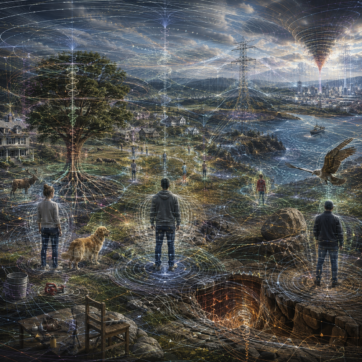
How Humanity Mistook the Greater External Identity Field, Localized Awareness, and Incarnational Translation for Separate Layers of Mind, Consciousness, and Identity
Humans Named the Experience Without Understanding the Architecture
“Consciousness” is not what humans think it is. The word has been given enormous importance despite originating from humanity’s attempt to describe an experience whose underlying architecture was never understood. Humans knew they were aware. They knew they could think, remember, dream, imagine, recognize, perceive, react automatically, receive sudden information, and experience material that did not appear to originate through deliberate thought. What they did not know was what was structurally producing those different expressions.
So they named them.
Consciousness. Subconscious. Unconscious. Preconscious. Nonconscious. Mind. Psyche. Ego. Id. Superego. Intuition. Instinct. Imagination. Collective unconscious. Higher self. Soul. Spirit. Shadow self. Different disciplines and belief systems developed their own terminology, definitions, divisions, and explanations, but the same fundamental error continued underneath them: humans encountered differences in experience and assumed those differences represented separate layers.
A deliberate thought felt different from a dream, so the two were assigned to different categories. A memory suddenly appearing without conscious effort seemed to come from somewhere hidden, so another internal region was proposed. An immediate recognition that preceded reasoning was labeled intuition. Material unavailable to ordinary waking attention was placed into an unconscious or subconscious. Psychology created one vocabulary for these differences while philosophy, neuroscience, religion, and spirituality created others.
The names changed. The mistranslation did not.
Humans were observing real differences in how information became available through a localized incarnational identity. They were observing different forms of access, translation, expression, recognition, memory, and response. But instead of recognizing differentiated activity within a larger continuous architecture, they converted those differences into separate things.
This is where description quietly became ontology. A label originally used to describe an observable condition began to be treated as though the label identified an independently existing structure. “The unconscious” stopped being merely a way of describing information unavailable to immediate awareness and became a place from which information supposedly emerged. “The mind” became a container in which thoughts supposedly existed. “The subconscious” became a hidden repository operating beneath ordinary awareness. “Consciousness” itself became an invisible something that a human supposedly possesses while alive.
Humanity then spent centuries attempting to determine how all of these presumed structures interact with one another without first establishing whether the divisions themselves were structurally real.
The experiences are real. Thought occurs. Memory occurs. Dreams occur. Recognition occurs. Awareness occurs. Automatic responses occur. Internal imagery occurs. Information can become available without deliberate reasoning. Different conditions absolutely produce different ranges of access and different forms of translation.
But different expression does not establish separate architecture.
Humans encountered differentiated expressions and assumed differentiated structures. They named those presumed structures, separated them, layered them, placed them above and below one another, and eventually built entire psychological and spiritual architectures around the divisions.
The problem was never that humans failed to notice what was happening.
They noticed the outputs. They mistranslated what was producing them.
And “consciousness” became one of the largest names ever given to that mistranslation.
“Consciousness” Became a Container for Everything Humans Could Not Explain
The word “consciousness” has become so broad that it can refer to almost anything involving human experience. It can mean being awake rather than asleep, awareness of an environment, awareness of oneself, subjective experience, thought, attention, perception, internal imagery, recognition, sensory experience, or simply the fact that something appears to be experiencing anything at all. Depending upon the discipline using the word, its boundaries shift again.
That instability is not incidental. It exposes the underlying problem. Humans have been attempting to name an architecture they can experience from within but have not structurally identified. When one term cannot account for every observed variation, additional terms are created around it: subconscious, unconscious, preconscious, nonconscious, altered consciousness, expanded consciousness, collective consciousness. Psychology, neuroscience, philosophy, religion, and spirituality then assign different meanings to those terms and construct different relationships between them.
But adding more terminology does not resolve the original structural problem.
“Consciousness” became a conceptual container. Anything immediately available to a person could be placed inside consciousness. Anything not immediately available required another container. A forgotten memory that suddenly returned could be attributed to the subconscious. An automatic behavior could be assigned to unconscious processing. A thought could occur in the mind. A sudden recognition could be called intuition. A dream could be assigned to the psyche. The vocabulary created the appearance that the mechanism had been explained when it had actually only been renamed.
This is the critical distinction: description is not causation.
Saying that information “entered consciousness” describes a change in what became locally available. It does not explain what consciousness is, where the information existed before that change, or what structural mechanism altered its availability. Saying that something “came from the subconscious” simply relocates the unanswered question. What is the subconscious? Where is it? What establishes its boundary? What makes information belong to it rather than to another presumed compartment? Calling something subconscious does not answer those questions.
The same problem exists with “the mind.” Humans routinely speak of information being stored in the mind, created by the mind, hidden from the mind, brought into the mind, or observed by the mind. Yet the word itself shifts constantly between thought, brain activity, awareness, memory, identity, attention, and internal experience. The supposed container changes according to whatever needs to be contained.
This is why the terminology has become circular. Thought is explained by the mind, while the mind is identified through the presence of thought. Awareness is explained through consciousness, while consciousness is identified through awareness. Material unavailable to awareness is attributed to the unconscious, while the unconscious is inferred because material appears that was previously unavailable to awareness. The labels repeatedly become explanations for the very observations from which the labels were created.
What humans are actually describing is how information appears from inside a localized incarnational position.
Something is available now. Something was unavailable moments earlier. Something appears through deliberate thought. Something arrives without deliberate thought. Something can be verbally recalled. Something appears only as imagery, recognition, sensation, or dream material. Those differences tell us about access and translation at the local position. They do not establish a collection of separate internal territories.
The mistake was treating differences in availability as evidence of different containers.
Once that distinction is removed, “consciousness” loses the enormous causal status humans have assigned to it. It becomes apparent that the word has been covering the unanswered question rather than answering it.
Humans named how experience appeared from inside the render.
They did not identify the architecture producing the appearance.
One Mistranslation Became Dozens of Supposed Internal Entities
Once humans established “consciousness” as a thing, every variation that could not fit neatly inside that thing required another name. The original mistranslation did not remain singular. It multiplied. Different forms of access, memory, perception, identity, recognition, thought, and automatic response were gradually converted into an entire population of supposed internal structures.
Consciousness became whatever a person was presently aware of. The subconscious became material supposedly sitting beneath that immediate awareness but still capable of influencing it. The unconscious was positioned further away, containing what could not ordinarily be accessed at all. The preconscious became another intermediate category for information that was not currently present but could become present. Later terminology such as nonconscious processing created still more distinctions around activity occurring without immediate awareness.
Then there was “the mind,” an extraordinarily flexible container that could supposedly think, remember, imagine, reason, perceive, decide, suppress, create, wander, observe, forget, and deceive itself. The psyche became another container, sometimes overlapping with mind and sometimes encompassing an even larger internal psychological architecture. Neither term resolved the architecture. They simply gave humans somewhere conceptually to place experiences whose actual structural relationships remained unidentified.
Psychoanalytic systems pushed the fragmentation further. Freud divided mental activity through conscious, preconscious, and unconscious distinctions and later through id, ego, and superego. The ego could mediate. The id could contain drives. The superego could impose internalized rules. Other psychological schools rejected or modified those divisions and introduced different terminology, but changing the map did not necessarily correct the assumption underneath the map: differentiated human activity was still being divided into named internal components.
Spiritual systems produced their own versions of the same fragmentation. Intuition became a special faculty through which certain information supposedly arrived. The “higher self” became another identity positioned beyond or above the ordinary identity. The soul and spirit were frequently treated as additional components whose relationships to consciousness, mind, personality, and body varied according to the teaching. The shadow self became another region of identity containing what the ordinary identity supposedly rejected or could not see.
Jungian language expanded the architecture in another direction through concepts such as the personal and collective unconscious. Now the presumed hidden architecture did not merely extend beneath an individual’s immediate awareness; it could extend into a collective repository shared across humanity. Once again, a real observation — recurring imagery, patterns, symbols, behaviors, recognition, or material appearing beyond deliberate thought — was interpreted by creating another conceptual structure to contain it.
This is the recurring movement that matters.
Humans experience one type of information through deliberate thought and call it mind. Information appears without deliberate thought and it becomes intuition. Material cannot currently be recalled and it is assigned to the unconscious. It becomes accessible and is said to have entered consciousness. Dream material appears and another psychological explanation is introduced. A person experiences identity beyond the immediate rendered personality and spirituality introduces a higher self.
Every difference in access becomes an opportunity for another division.
But naming a difference does not establish a separate entity responsible for producing it.
The architecture becomes increasingly complicated because each new label has to be related to all the previous labels. If the subconscious exists separately from consciousness, humans must explain how the two communicate. If the ego is different from the unconscious, the relationship between them must be explained. If a higher self exists above the ordinary self, some mechanism must be invented for information to travel between them. The more fragmentation that is introduced, the more secondary mechanisms are required to reconnect what was conceptually separated in the first place.
That is why so many of these systems become elaborate. Complexity accumulates downstream of the original mistranslation.
The actual differences humans are observing are differences of localized access, translation, expression, and structural position. Those differences do not require dozens of separate entities living somewhere inside a person. They require an architecture capable of producing differentiated expressions through a localized incarnational identity.
Humanity kept naming the expressions.
The terminology changed across centuries, disciplines, and belief systems.
The fragmentation remained.
The Fundamental Error: Different Function Does Not Mean Different Structure
The entire construction begins to collapse once one distinction is made: different function does not mean different structure.
A deliberate thought and a memory do not appear in exactly the same way. A dream does not operate like waking sensory perception. Recognition can occur before a person can explain what has been recognized. An automatic response can happen without deliberate reasoning. An image can suddenly appear internally without being intentionally constructed. Information can become available without a visible sequence of thought leading to it.
Humans correctly observed these differences. The error was assuming that because the expressions were different, they must have originated from different internal structures.
A memory appearing differently from deliberate thought does not establish a separate memory entity. A dream functioning differently from waking perception does not require a separate dreaming mind. Information appearing without deliberate reasoning does not prove the existence of a subconscious container. Automatic processing does not require an unconscious entity sitting somewhere outside ordinary awareness. Different accessibility does not establish different architectural levels.
One architecture can produce differentiated expressions.
This is already obvious throughout the render. A system does not have to become a completely different system every time its output changes. Different conditions, positions, inputs, pressures, and pathways can produce different expressions through the same underlying architecture. Variation in output is not proof of separation at the level producing that output.
Yet when humans interpreted their own internal experience, they repeatedly made exactly that leap.
Different expression became a separate category. The separate category received a name. The name became a noun. The noun began to be treated as a thing.
Different expression → separate category → separate name → presumed separate thing.
That transition through language is enormously important because once something has been converted into a noun, it becomes extremely easy to forget that the noun began as a description. “Unconscious” becomes “the unconscious.” “Subconscious” becomes “the subconscious.” Thought and perception become products of “the mind.” A particular form of immediate recognition becomes “intuition,” which can then be discussed as though intuition itself were an independent faculty delivering information.
The language creates apparent structure.
Instead of saying, “information became available that was not previously accessible from my immediate localized awareness,” humans say, “my subconscious gave it to me.” The second statement feels more explanatory because it provides a named source. Structurally, however, nothing has actually been explained. The unknown mechanism has simply been assigned to an invented container.
The same problem appears when humans say that something was “buried in the unconscious.” What has actually been observed? Information was not locally accessible and later became accessible. That is the observation. Everything beyond that — where it was supposedly stored, what internal compartment contained it, how deeply it was buried, and which separate part of the person retrieved it — is interpretation layered onto the observation.
This distinction becomes especially important when the overall identity field is restored to the architecture. A localized incarnational identity does not represent the totality of the identity field. It occupies a particular position within a much larger continuity. Different information can therefore become available through that local position in different ways without requiring a collection of hidden selves or minds to explain where it came from.
The variation can exist in access rather than identity.
It can exist in translation rather than structure.
It can exist in localization rather than hierarchy.
Once that is understood, there is no reason to manufacture another internal entity every time the expression changes. The different functions can remain different without being separated into different architectural objects.
Humans did not invent the experiences. They invented the divisions they used to explain them.
The label became an entity because the architecture beneath the label remained unseen.
Then Humans Spatialized the Mistranslation
The error did not stop once humans divided experience into consciousness, subconscious, unconscious, mind, psyche, ego, intuition, and higher self. After creating these supposedly separate internal entities, they gave them positions. What had already been fragmented conceptually was now arranged spatially.
Consciousness went on the surface. The subconscious went underneath it. The unconscious was placed deeper still. Hidden memories became “buried.” Previously unavailable information could “rise” into awareness. Someone could “go deep” into the unconscious. Spiritual systems extended the same orientation in the opposite direction: the ordinary identity remained below while a higher self, higher mind, or higher consciousness existed somewhere above it.
None of those directions identify actual structural position.
They describe how something feels from inside localized human experience.
Information immediately available to an incarnational identity feels close. Information that is difficult to access feels distant. Something completely unavailable to ordinary awareness can feel hidden. Something that suddenly becomes accessible can feel as though it surfaced. An expanded range of access can feel larger, higher, or beyond the ordinary position. Humans translated those subjective differences in accessibility into spatial relationships.
The iceberg representation makes the mistranslation almost perfectly visible. A small portion exists above the water as the conscious mind while an enormous hidden region exists underneath as the unconscious. It is an effective visual metaphor for accessibility, but the metaphor quietly becomes architecture. People begin imagining mental existence as though it genuinely contains stacked regions, with immediately accessible information near the top and increasingly inaccessible material positioned progressively farther beneath it.
But inaccessible does not mean lower.
Hidden does not mean underneath.
More difficult to translate does not mean deeper.
And greater range does not mean higher.
These are directional terms borrowed from rendered spatial experience and imposed upon relationships that are not fundamentally describing physical vertical distance. “Deep unconscious material” does not identify a coordinate. It describes material that is not readily available through the person’s present localized translation.
This is another expression of externalization. Humans understand the rendered world through location, distance, direction, boundaries, containers, surfaces, and depth. When they encounter their own internal operation, they reproduce that same grammar. Something must be inside something else. Something inaccessible must be behind or underneath something accessible. Something considered more expansive must be above something considered limited.
Then the spatial metaphor begins generating additional assumptions. If information is buried, something must retrieve it. If consciousness is above the unconscious, something must travel between them. If the higher self is above the ordinary self, information must somehow descend. If someone is supposed to reach higher consciousness, the identity must somehow move upward through levels.
An entire mechanism becomes necessary to explain relationships that only exist because the original architecture was spatialized incorrectly.
The identity field does not need this vertical arrangement. The overall identity architecture can contain differentiated ranges, pathways, positions, and degrees of local accessibility without stacking them into higher and lower compartments. An incarnational identity can have limited access to information held within the larger identity architecture without that information existing “beneath” it.
The difference is structural availability from a particular localized position, not depth.
Humans translated accessibility into spatial distance. They translated limited access into depth. They translated expanded access into height.
Then they forgot they had created the metaphor and began treating the metaphor as the architecture itself.
Separation Becomes Layering, and Layering Becomes Hierarchy
Once humans converted different functions into separate objects and assigned those objects apparent locations, another step followed almost automatically: the objects had to be arranged in relation to one another. Separation became layering, and layering became hierarchy.
This is not an isolated mistake in the human understanding of consciousness. It reflects the architecture of external experience itself. Humans experience the render through differentiation and localization. Objects appear separate from other objects. One thing can physically sit above or below another. Structures contain smaller structures. Systems are divided into parts. Organizations have ranks. Buildings have floors. Maps have regions. Bodies have internal components. Families, governments, religions, corporations, militaries, educational systems, and social structures are continually organized through levels, categories, boundaries, positions, and relationships.
External experience trains the rendered identity to interpret difference through separation.
When humans then attempt to understand something they cannot directly see, they repeatedly apply the same external organizational grammar to it. If two functions appear different, they become two things. If they are two things, they must exist somewhere in relation to one another. If one appears less accessible, it goes underneath. If another appears more expansive or authoritative, it goes above. Once above and below exist, hierarchy follows.
That is how an observation about differentiated experience becomes an internal architecture of levels.
The subconscious influences consciousness from underneath. The unconscious sits deeper and exerts hidden effects. The conscious mind suppresses unconscious material. The ego negotiates between different internal forces. The observer watches the mind. The psyche contains multiple components. Spiritual systems reproduce the same structure vertically: the ordinary self is below, the higher self is above, information comes down from higher levels, and the person attempts to ascend toward expanded or higher consciousness.
Notice how thoroughly the language resembles external organization.
Something contains something else. Something governs something else. One component communicates with another. One level has greater access or authority. Another is lower, hidden, primitive, or subordinate. Information moves upward or downward between them.
Humans have taken the organizational logic through which external experience is rendered and projected it back onto their interpretation of identity.
This is externalization turned inward.
And hierarchy introduces more than position. It introduces value. “Higher” becomes associated with greater truth, intelligence, development, purity, or awareness. “Lower” becomes associated with instinct, limitation, primitive behavior, unconsciousness, or lesser development. A spatial metaphor becomes a value system. Something supposedly positioned above another thing is no longer merely different; it becomes superior to it.
That assumption has spread far beyond psychology. Spiritual teachings are saturated with ascending levels, higher states, higher frequencies, higher selves, lower selves, planes, stages, initiations, and increasingly elevated forms of consciousness. Different experiences are arranged vertically because vertical hierarchy is already deeply familiar to the rendered human identity.
But structural difference does not require rank.
Greater access is not structurally “higher” than limited access. A different range is not superior because it contains different information. One incarnational position does not have to sit beneath another simply because their translations differ. Differentiation can exist without becoming hierarchy.
The entire progression can therefore be seen clearly:
Differentiation → separation → naming → objectification → spatialization → layering → hierarchy.
At every stage, humans move farther away from the original observation. What began as “these experiences are different” eventually becomes an elaborate internal universe containing separate entities occupying different levels and exercising influence over one another.
Then the hierarchy itself becomes the explanation.
Something happens because the subconscious influenced the conscious mind. Information appears because the higher self sent it downward. A behavior occurs because the unconscious overpowered the ego. But those explanations depend entirely upon accepting the divisions, locations, and hierarchies that humans constructed in the first place.
Remove the imposed hierarchy and the underlying observation remains: different information, functions, and expressions become available through different conditions of a localized incarnational identity.
The complexity was added afterward.
Humans did not discover an internal hierarchy and then name it.
They experienced differentiation through an external architecture built around separation and localization, translated that differentiation through the same external logic, and built the hierarchy themselves.
The Missing Architecture: The Greater External Identity Field
Once the fragmented terminology is removed, the architecture underneath it becomes considerably cleaner. What humans have broadly attempted to describe through the word “consciousness” is the Greater External Identity Field, or the External Identity Architecture.
This can also be shortened to the greater identity field or overall identity field when the external position has already been established. These are still human-language translations. Any term used inside render to describe pre-render architecture is necessarily a translation into language. The difference is that a clean translation describes the structural relationship without inventing separate entities, layers, substances, or hierarchies that are not there.
The word “greater” is important because every incarnation still has its own identity field. The Greater External Identity Field is not simply another name for the local identity field surrounding a particular incarnation. It is the larger identity architecture within which all of the differentiated incarnational identity fields belonging to that identity continuity are held.
This is what the enormous collection of human terms has been circling without identifying.
What humans call consciousness, subconscious, unconscious, psyche, higher self, and other supposed internal structures are not separate entities occupying different levels of a person. They are mistranslations of different forms of access, activity, and expression occurring through the relationship between a localized incarnational identity field and the Greater External Identity Field.
But another distinction is essential: the Greater External Identity Field is not the Eternal Flame.
The Eternal Flame never enters external.
It does not descend into external. It does not become consciousness. It does not become a soul, a mind, or a higher self. It does not divide itself into incarnations. It does not send fragments of itself into bodies and later collect those fragments again. Nothing has separated from the Eternal Flame because the Eternal Flame never entered the architecture in which separation occurs.
It remains Eternal.
The Greater External Identity Field belongs to external architecture. It is the external architectural expression associated with a particular Eternal Flame without being that Flame itself. This is why calling it a copy is ultimately inadequate. A copy implies duplication — an original here and a reproduced version there. That is not the relationship. Nothing Eternal has been duplicated inside external.
The distinction becomes much cleaner when the Greater External Identity Field and the unique structural identifier within it are not collapsed into the same thing. The field is the larger identity architecture. Within that architecture exists the unique structural imprint or identifier corresponding to its Eternal Flame. The imprint is not the entire field, just as a fingerprint is not the entire rendered person. It provides distinct structural correspondence without requiring the Eternal Flame itself to enter external.
This also removes one of the largest problems created by the conventional idea of consciousness: humans keep searching for a mysterious substance or property that somehow bridges physical matter and subjective experience. Consciousness becomes an invisible intermediary that must somehow originate from the brain, exist independently of the brain, permeate reality, or move between supposedly physical and nonphysical layers.
That entire problem is downstream of the original mistranslation.
There is no separate consciousness substance that needs to be inserted between Eternal and external.
There is Eternal.
There is External Identity Architecture aka the Greater External Identity Field associated with the Eternal Flame, containing its unique structural identifier and holding the differentiated incarnational identity fields within one larger identity continuity.
And there are localized incarnational positions through which that architecture is translated into rendered experience.
Humans encountered pieces of that operation from inside individual incarnations and gave each piece another name. They were trying to explain the activity without seeing the field that made the activity coherent.
Once the Greater External Identity Field is restored to the architecture, “consciousness” no longer needs to carry the impossible burden humans placed upon it.
There is no consciousness entity. There is no consciousness layer. There is no consciousness substance. There is identity architecture — and what humans have called consciousness is their fragmented translation of it.
The Greater External Identity Field Holds the Incarnational Identities Together
The Greater External Identity Field is what holds the differentiated incarnational identity fields within one continuous identity architecture. This is where the human fragmentation into conscious mind, subconscious mind, unconscious mind, psyche, higher self, past-life self, dream self, and countless other supposed identities becomes unnecessary.
Every incarnation is still an identity in its own right. It has its own localized identity field because it occupies its own structural position and translates through its own particular rendered conditions. It has a body, environment, relationships, sequence, trajectory, range of experience, local memory, personality expression, and particular position within the render. Those differences are real. They are not erased simply because the incarnations belong to a larger identity continuity.
But differentiation is not disconnection.
The incarnational identity fields are not completely independent systems that appeared from nowhere, existed in isolation for one lifetime, and then disappeared. Each is a localized differentiation held within the Greater External Identity Field. The greater field is what maintains the structural relationship among those incarnational identities without collapsing them into one indistinguishable identity.
This distinction matters because humans have repeatedly confused local identity with total identity.
From inside a particular incarnation, the local rendered identity appears enormously dominant because it is the position through which experience is presently being translated. Its name, body, memories, relationships, environment, personality, and life sequence create the immediate frame of reference. Anything that does not belong to that immediate frame can therefore appear foreign, hidden, distant, mysterious, or as though it came from another internal entity.
That is where many of the human labels begin.
Information unavailable through ordinary local memory becomes “unconscious.” Information that appears unexpectedly becomes “subconscious.” Recognition without deliberate reasoning becomes “intuition.” Greater identity-field access becomes “higher self.” Material associated with another incarnational position becomes a “past-life self,” as though an entirely separate historical person were somehow sending information into the present one. Dream access becomes assigned to a dream self, dreaming mind, or unconscious psyche.
The Greater External Identity Field eliminates the need for those artificial divisions.
The cleaner architecture is:
Greater External Identity Field → differentiated incarnational identity fields → localized rendered identities.
The greater field holds the continuity. The incarnational identity fields provide differentiated structural positions. The rendered identities are the localized expressions translated through those positions.
This also means that information associated with another incarnational identity does not have to travel between two completely disconnected selves. The relationship already exists at the greater identity-field level. From the local rendered position, access to that information can appear sudden or anomalous because the local incarnation does not ordinarily translate the total range held within the greater field.
Humans then interpret that limited local access as evidence that information must be stored somewhere else.
But “somewhere else” is already a rendered spatial mistranslation.
The information is not necessarily beneath the current identity in an unconscious basement, above it in a higher self, behind it in a past life, or contained within another invisible compartment. Those directional relationships are imposed by the localized human translation. Structurally, the incarnational identities are differentiated positions within a larger identity architecture.
And the Greater External Identity Field does not erase their distinction by holding them together. Think of the difference between continuity and sameness. Multiple incarnational identity fields can remain distinct while still belonging to one greater identity continuity. Their differentiation is precisely what allows different positions, sequences, conditions, and ranges of experience to exist.
That is another place where human terminology has created unnecessary confusion. Humans tend to assume that if multiple identities are connected, there must be one “real” identity above them — hence the higher self, oversoul, or similar constructions. But the Greater External Identity Field is not another person sitting above all the incarnations. It is not a superior version of the localized identity. It is the larger identity architecture holding their structural continuity.
There is no little hierarchy of selves.
There is a greater field and differentiated local fields within it.
What appears fragmented when viewed from inside one incarnation remains structurally continuous at the level of the Greater External Identity Field.
The Greater External Identity Field Exists in Pre-Render, Not Render
To understand what humans have mislabeled consciousness, subconscious, aura, psyche, higher self, soul, and the rest, the identity field has to be placed correctly within the architecture humans are actually inside.
External is not synonymous with the physical render. The render is one translated expression occurring within a much larger external architecture. Beneath the visible, measurable rendered environment is pre-render: the structural field condition from which rendered expression is produced. Pre-render is where the mechanics exist before they become translated into physical objects, bodies, environments, events, and sensory experience.
This distinction matters because the Greater External Identity Field is not a rendered object surrounding the physical body. It exists within pre-render architecture.
The same is true of each localized incarnational identity field. What humans sometimes attempt to perceive around a person and subsequently label an “aura,” “energy body,” “subtle body,” or similar term is not a decorative layer of colored energy wrapped around a physical human. The physical human is already downstream of the field. The field is not an accessory belonging to the body. The body is a rendered translation occurring from within the structural conditions of that field.
That reverses the conventional orientation.
Humans tend to begin with the visible body because that is what the sensory system renders most immediately. They then imagine invisible additions surrounding it: body first, then aura, energy field, subconscious, consciousness, soul, higher self, and progressively more distant or elevated layers.
But structurally, the body is downstream.
The incarnational identity field exists in pre-render and carries the structural conditions associated with that localized incarnation. Pressure, oscillation, curvature, torsion, compression, alignment, distortion, pathway relationships, and other pre-render mechanics operate there before their consequences are translated into rendered experience. What appears physically through the body and environment is therefore not generating the field around it. The rendered expression is downstream of what is already occurring structurally.
This is where many apparently unrelated human concepts begin collapsing into the same architecture.
What psychology divides into conscious, subconscious, unconscious, psyche, and mind reflects different forms of localized access and translation through identity architecture. What spiritual systems call the higher self attempts to account for identity and information extending beyond the immediate incarnational position. Concepts such as the soul, oversoul, subtle bodies, causal bodies, expanded consciousness, superconsciousness, and collective consciousness repeatedly attempt to explain aspects of identity-field architecture through separate objects, beings, layers, or levels.
The terms are different because humans are translating the architecture from different positions and through different belief systems.
The underlying architecture does not require all of those separate things.
There is an incarnational identity field associated with each localized incarnation, and there is the Greater External Identity Field holding those differentiated incarnational fields within one larger identity continuity.
The distinction between the two is essential.
Each incarnation requires its own field because each incarnation occupies its own structural position. Different body. Different environment. Different relationships. Different pathway. Different sequence. Different local translation. Different pressures and structural conditions. The incarnational field carries the conditions particular to that expression.
But the Greater External Identity Field is not simply a larger “aura” around the incarnation. It exists at the greater pre-render identity level and holds the differentiated incarnational identity fields together as one architecture.
And those incarnations are not fundamentally arranged as a linear chain.
From inside render, humans experience time sequentially. A person is born, moves through childhood and adulthood, grows older, and dies. When multiple incarnations are considered through that rendered orientation, humans naturally arrange them the same way: past life, present life, future life. One supposedly finishes and another begins.
That is the render translating identity architecture through linear sequence.
At the greater pre-render level, the incarnational identity fields are simultaneous structural positions. What render separates into “before,” “now,” and “later” does not require the Greater External Identity Field itself to contain a chronological line of lives waiting for awareness to move through them one after another.
All of the incarnational fields are held within the greater architecture simultaneously.
This does not mean every rendered incarnation experiences every other incarnation simultaneously. Each localized identity is still translating through its own sequence. From inside that rendered position, its life appears sequential because sequence is part of the local translation. The simultaneity exists at the greater identity-field level; linearity appears through localized render.
This is also why information associated with another incarnation does not have to travel across historical time to reach the present incarnation. At render level, it can appear to belong to a person who lived hundreds or thousands of years “ago.” At the greater identity-field level, both incarnational fields remain held within the same simultaneous architecture. The apparent temporal distance belongs to rendered sequence, not to the structural relationship between the fields.
The Greater External Identity Field therefore provides the missing continuity humans have repeatedly tried to explain through consciousness, higher selves, souls, past lives, subconscious repositories, collective minds, and invisible bodies.
There is no need for an expanding hierarchy of unseen entities. There is external architecture. Within external, there is pre-render structure and downstream rendered translation.
Within pre-render exists the Greater External Identity Field, holding the differentiated incarnational identity fields simultaneously within one identity continuity. Each incarnational field carries its own localized structural conditions, and each rendered incarnation is the downstream translation occurring through that particular position.
What humans have called “consciousness” is not floating above this architecture.
It is their mistranslation of the identity architecture they have been inside all along.
Awareness Does Not Belong to a Single Incarnation
One of the largest consequences of the human consciousness mistranslation is the assumption that awareness belongs to the individual incarnation. A body is born, the brain develops, consciousness supposedly appears somewhere along the way, the person possesses that consciousness throughout the lifetime, and then the body dies. From there, humans ask the inevitable question: what happens to consciousness after death?
The question begins from the wrong architecture.
Awareness is not newly manufactured by every rendered incarnation. The incarnational identity is a localized position through which awareness is operating. That distinction completely changes what birth, life, and death mean structurally.
A particular incarnation has its own body, brain, personality, rendered history, relationships, environmental conditions, local memory configuration, trajectory, and range of experience. All of those characteristics belong to that localized incarnation. They establish the particular position through which experience is being translated there.
But awareness itself is not created by that local configuration.
This is precisely why awareness and personality cannot be treated as the same thing. Personality can change dramatically between incarnational identities because personality belongs to the localized expression. So can preferences, behavioral patterns, physical characteristics, social identity, cultural environment, language, relationships, and the entire rendered history through which that incarnation understands itself.
The local identity changes.
The point through which awareness is localized changes.
Awareness continues through the larger identity architecture.
This is where the Greater External Identity Field becomes essential. The differentiated incarnational identity fields are held within that greater continuity. Awareness can therefore be localized through a particular incarnational identity without being structurally owned or generated by that identity.
During one incarnation, the localization is so complete that the rendered identity naturally experiences itself as the center of the entire operation. “I am this person. I began here. These are my memories. This is my body. This is my life.” From inside render, that localization is necessary for the incarnation to function as the particular identity it is.
But localization is not origin.
A spotlight illuminating one position does not mean the illuminated position created the capacity for illumination. In the same way, awareness operating through one incarnational position does not mean that incarnation manufactured awareness.
This also changes how incarnational transition is understood. Awareness does not need to split into multiple pieces, duplicate itself, or become a new substance each time the localized position changes. The differentiated incarnational identity fields already belong to the larger identity architecture. What changes is the position through which awareness is localized and experience is being translated.
The body changes.
The brain changes.
The personality changes.
The local memories change.
The rendered environment changes.
The sequence changes.
The incarnational identity changes.
Awareness shifts its localized point of experience.
That is why the conventional question of whether “consciousness survives death” is structurally inverted. It assumes consciousness is a possession of the body and then asks whether that possession can continue once the body no longer functions. Humans imagine an invisible object housed somewhere inside the rendered person and then struggle to explain how that object could leave, persist, travel, or relocate after physical death.
There is no little object called consciousness sitting inside the body waiting to escape it.
Death ends the localized rendered position. The particular body no longer provides the rendered translation through which that incarnation operated. The local incarnation does not need to carry “consciousness” out of the body because awareness was never generated or contained there in the first place.
And the Greater External Identity Field does not cease to exist because one localized rendered expression ends. Its architecture is not dependent upon the continued operation of any single incarnation held within it.
This is the distinction humans have obscured by treating consciousness as an individual possession.
The incarnation localizes awareness. It does not own awareness. It does not manufacture awareness.
And when that localized incarnation ends, awareness does not need to “survive” something that never contained it to begin with.
What Awareness Actually Is
Awareness needs to be separated cleanly from the Greater External Identity Field because they are not the same thing. The Greater External Identity Field is the architecture. Awareness is the capacity for experience through that architecture.
Awareness is not a field, object, substance, identity, personality, mind, or form of thought. It does not contain memories, reason through information, speak internally, or possess a personality. Those are functions and translations associated with particular incarnational positions. Awareness is more fundamental: it is what makes a position experienced rather than merely structurally present.
The Greater External Identity Field holds the greater identity continuity and its differentiated incarnational identity fields. Each incarnational field provides a localized position through which experience can occur. Awareness is present through those positions, but it should not be imagined as another object sitting inside the fields or as a spotlight traveling between them.
Because the Greater External Identity Field exists in pre-render, its incarnational positions are not fundamentally arranged according to rendered linear time. Awareness can therefore be simultaneously localized through multiple incarnational positions while each incarnation experiences only its own rendered sequence from inside that localization.
This gives the architecture a clean distinction: the Greater External Identity Field is the greater identity architecture; the incarnational identity field is the differentiated localized position; awareness is the capacity for experience through that position; and the brain participates in translating that localized experience into rendered perception, thought, memory, imagery, language, and cognition.
This is precisely what the word “consciousness” has obscured. Humans collapsed awareness, identity architecture, thought, perception, cognition, memory, and local translation into one enormous conceptual category and then attempted to find the single thing producing all of them.
There was never one thing.
Awareness is not the Greater External Identity Field.
Awareness is what allows the positions held within that architecture to be experienced.
The Greater External Identity Field Holds Simultaneous Localizations of Awareness
The function of the Greater External Identity Field becomes much cleaner once rendered time is removed from the explanation. Awareness does not need to shift from Life A to Life B to Life C in a sequence. That description still imports linear render mechanics into pre-render architecture.
There is no separate substance called consciousness traveling between bodies. There is no higher self standing above the incarnations deciding which one awareness should enter next. There is no soul leaving one rendered body, moving through an intermediate location, and eventually entering another. All of those explanations turn awareness into an object and arrange incarnations according to rendered chronology.
The Greater External Identity Field operates differently.
It holds all of its differentiated incarnational identity fields within one greater identity continuity. Each incarnational identity field is its own localized structural position, with its own rendered body, environment, relationships, personality, trajectory, range, memory configuration, and sequence. But at the level of the Greater External Identity Field, those positions do not have to wait for one another to begin or end.
They are simultaneous.
This is the distinction that linear render makes difficult to recognize. From inside a rendered incarnation, experience necessarily appears sequential. There is yesterday, today, and tomorrow. There is childhood and adulthood. There is a beginning of the rendered life and an end of the rendered life. Events appear frame by frame because the localized incarnation is translating through linear sequence.
Humans naturally project that same organization onto incarnational architecture. One life becomes a “past life.” Another becomes the “current life.” Another becomes a “future life.” Reincarnation is then imagined as a chain in which one life ends, something leaves it, and that something eventually enters another body.
But that sequence belongs to render.
Pre-render is not organized by rendered linear time. The Greater External Identity Field can therefore hold an incarnational position that render translates as occurring thousands of years ago, another occurring now, and another thousands of years ahead without those incarnations being structurally arranged inside the greater field as past, present, and future.
The linearity belongs to each rendered translation.
The simultaneity belongs to the greater pre-render architecture.
That means awareness does not have to finish experiencing one incarnational identity before it can become localized through another. Awareness can be simultaneously localized through the differentiated incarnational positions held within the Greater External Identity Field.
Each localization nevertheless experiences itself locally.
An incarnation occurring in what humans call the year 500 does not have to experience itself simultaneously as an incarnation occurring in 2026. Each occupies its own identity field and translates through its own rendered sequence. From inside each position, awareness is localized through that particular body, environment, relationships, sensory translation, memory configuration, and range of experience.
The simultaneity exists at the Greater External Identity Field level.
The separation into individual linear experiences occurs through render.
This is why there is no contradiction between simultaneous incarnations and the experience of being one particular person. The greater architecture can contain simultaneous localizations while every rendered incarnation experiences its own position as an individual sequence.
A rendered analogy helps make the distinction clearer. Imagine standing at a high lookout with an enormous landscape visible around and beneath you. There are mountains, trees, water, animals, roads, open land, and sky. The entire landscape is already present within the larger range. The river does not have to disappear for the mountain to exist. The tree does not have to finish existing before the animal can appear. They occupy differentiated positions simultaneously within one larger scene.
Imagine the entire landscape illuminated at once. The river is illuminated from its position. The tree is illuminated from its position. The animal is illuminated from its position. The mountain is illuminated from its position. The illumination does not need to finish with the river and then travel to the tree. Multiple differentiated positions exist within the illumination simultaneously, while each remains its own position.
The Greater External Identity Field operates through a similar structural principle. The incarnational identity fields are the differentiated positions within the greater range. Awareness does not have to bounce between them like a spotlight moving from object to object. It can be localized through all of them simultaneously while each localization translates into its own rendered experience.
The analogy is necessarily limited because the Greater External Identity Field is not literally a landscape, and there is no separate observer standing on a mountaintop looking down at the incarnations. That would simply recreate the higher-self hierarchy in another form. There is no superior identity sitting above the incarnational identities choosing where awareness should go.
The greater field is the identity continuity itself.
And awareness is simultaneously localized through its differentiated incarnational positions.
This also changes what death means within the architecture. When a rendered incarnation ends, awareness does not have to leave that body and travel toward the “next” incarnation. The other incarnational positions did not need to wait for that death before awareness could exist through them. They were already held within the Greater External Identity Field and already localized according to their own rendered sequences.
From inside render, however, transition can still be translated sequentially. That is unavoidable because render expresses through sequence. What appears locally as before and after does not establish that the Greater External Identity Field itself is moving through those positions chronologically.
This is why the word “reincarnation” can be misleading. It suggests repeated entry: one identity enters one body, exits, waits, and then enters another. That image is built entirely from rendered assumptions about objects, movement, time, and location.
There is no object migrating. There is no consciousness substance being transferred. There is no chronological queue of incarnations waiting to receive awareness.
There are differentiated incarnational identity fields held simultaneously within the Greater External Identity Field, with awareness localized through those positions and each position translating its own rendered sequence.
What humans call a past life is past from a particular rendered reference point. What humans call a future life is future from a particular rendered reference point.
Neither designation describes the structural position of those incarnations within the Greater External Identity Field.
That is the distinction human consciousness terminology has obscured. Humans imagined awareness as something individually possessed because they were examining it from inside one localized rendered identity. Then they tried to determine where that possession came from, where it was stored, and where it went when the rendered body ended.
Nothing needs to go anywhere.
At pre-render level, there is simultaneous incarnational architecture. At render level, there are differentiated localized sequences.
At the level of the Greater External Identity Field, awareness is simultaneously localized through those differentiated incarnational positions.
The lives appear sequential from inside render.
They do not have to be sequential where the architecture producing those rendered experiences actually exists.
From Inside Render, Incarnational Continuity Is Experienced as Waking Up in Another Form
The simultaneity of the Greater External Identity Field does not mean a localized rendered identity experiences every incarnation at once. That distinction is essential. Pre-render holds the incarnational identity fields simultaneously, but render translates experience through localization and sequence. From inside a rendered incarnation, awareness experiences a particular body, environment, identity, and life sequence as immediate.
So from the rendered position, incarnational continuity is best described very simply: one life ends, and awareness is experienced through another form.
It is closer to waking up than traveling anywhere.
There is no journey between bodies. There is no awareness floating through a corridor waiting for another incarnation. There is no soul leaving one location, crossing some invisible distance, and arriving at another. There does not even need to be a transition in the way humans ordinarily understand transition, because transition implies movement through an interval: here, movement, there.
Structurally, there is no interval that awareness has to cross.
One localized rendered sequence ends. Another localized rendered sequence is experienced.
From inside render, that can translate as the extraordinary simplicity of being one incarnational identity and then being another. A different body. A different personality. A different environment. A different historical period. A different family. A different local memory configuration. A completely different rendered frame of reference.
It is waking up in another form.
Even “next life” has to be used carefully because the next incarnation experienced through rendered sequence does not necessarily have to be the incarnation humans would identify as chronologically next. If the Greater External Identity Field is not organized according to rendered linear time, awareness is not required to follow historical order.
An incarnation translated into the year 2200 does not structurally have to come after one translated into 1800 simply because a rendered calendar places 2200 later. Likewise, what humans call a “past life” does not necessarily mean awareness experienced that incarnation before the current one. Past and future describe relationships inside rendered chronology. They do not establish the order of incarnational localization within pre-render.
This is another reason reincarnation models become unnecessarily complicated. Humans imagine a timeline and place bodies along it. Awareness begins at one point, finishes there, moves forward, enters another point, finishes again, and continues marching through historical time.
But awareness does not need to follow the calendar.
The calendar belongs to render.
The Greater External Identity Field already contains the differentiated incarnational positions simultaneously. Render is what translates each position into its own apparent time, place, body, environment, and sequence.
The overwhelming majority of humans also do not retain ordinary rendered recollection of this incarnational continuity. That makes structural sense because local memory belongs to the localized incarnational translation. When awareness is experienced through another incarnational position, it is not simply the previous rendered personality waking up inside a different body with its previous brain, biography, language, relationships, and autobiographical memory intact.
Those belonged to the other localized position.
The new incarnation has its own local configuration.
That is why “waking up” is useful but must also be understood correctly. It is not the previous personality opening its eyes and thinking, “Now I am this person.” The rendered personality itself is part of the incarnation. What continues is awareness through the Greater External Identity Field, not the previous rendered character carrying its entire local identity into another body.
Occasional recognition, familiarity, imagery, dream material, or information associated with another incarnational position can therefore appear without ordinary autobiographical recollection. Humans have historically attempted to explain such experiences through past-life memory, subconscious storage, soul memory, higher-self communication, or other separate mechanisms. But the Greater External Identity Field already provides the structural relationship. The incarnational fields were never completely disconnected in the first place.
What changes is local access.
And this is where the apparent paradox resolves. From pre-render, the incarnational positions are simultaneous. From inside each incarnation, life is localized and sequential.
From the rendered experience of incarnational continuity, one form can end and another simply be the immediate lived position — like waking up, except there was no traveler moving between the two.
No flight. No tunnel required as a structural mechanism. No invisible waiting room. No consciousness migrating through space. No chronological conveyor belt of bodies. One rendered localization ends. Another is the experienced localization.
Humans imagine an enormous journey because they are trying to explain a pre-render relationship using rendered concepts of distance, movement, objects, and linear time. Remove those assumptions and the mechanism becomes almost startlingly simple.
Nothing travels. Nothing needs to cross over. Awareness does not have to find the next life. The incarnational positions already exist within the Greater External Identity Field.
From inside render, it is simply experienced as waking up in another form.
The Brain Is Translator, Not Generator of Awareness
One of the largest consequences of the consciousness mistranslation is the assumption that awareness must originate in the brain. Humans observe an undeniable relationship between brain condition and rendered human experience. Alter the brain and perception can change. Memory can change. Language can change. Personality expression can change. Attention can change. Sensory processing can change. Thought can change. Damage particular rendered structures and particular capacities can become disrupted or inaccessible.
The observation is real. The conclusion drawn from it is where the inversion occurs.
Humans reason that because changing the brain changes the experience available through the person, the brain must therefore generate awareness itself. But changing a translation mechanism and observing a change in its output establishes that the mechanism participates in translation. It does not independently establish that the mechanism originates everything being translated through it.
Change the translator and the translation changes. Damage the translator and the translation changes. Alter its chemistry and the translation changes. Put it to sleep and the available rendered translation changes. Change its sensory input and the translation changes.
None of those observations requires awareness to have originated inside the translator.
A radio provides a simple rendered analogy. Damage the speaker and the sound becomes distorted. Damage another component and certain functions disappear entirely. Interfere with reception and the output becomes fragmented. Turn the device off and no sound comes through the speaker at all. If the only thing being studied were the physical radio, it would be easy to conclude that the sound originated entirely inside the speaker because every alteration to the device alters the sound that can be heard.
But the condition of the receiver determines the quality and availability of the local output without requiring the receiver to be the origin of everything involved in that output.
The brain occupies a similar downstream position, although the actual mechanics are considerably more complex than the analogy. The brain is part of the rendered biological interface of a localized incarnational identity. It participates in translating what becomes available through that particular incarnational position into rendered perception, cognition, memory access, language, sensory integration, internal imagery, motor response, and the continuous experience of operating through a physical body.
This places the brain downstream of the incarnational field rather than upstream of it.
The incarnational identity field exists within pre-render architecture. Structural conditions are already present there before they become rendered biological expression. Pressure, oscillation, curvature, torsion, compression, pathway relationships, alignment, distortion, and other pre-render mechanics belong upstream of the rendered body. The brain is therefore not sitting at the beginning of the chain manufacturing the identity field and producing awareness from physical matter.
It is part of what that upstream architecture renders into localized biological translation.
That reversal matters enormously.
Human neuroscience begins with the rendered brain because the rendered brain is what can be physically observed, measured, stimulated, imaged, damaged, chemically altered, and dissected. It then traces relationships between changes in that rendered structure and changes in reported experience. Those relationships can be extremely precise and completely valid at the level being measured.
But precision inside render does not establish that render contains its own upstream cause.
If a particular brain region participates in translating language, disrupting that region can disrupt rendered language. That demonstrates a relationship between that rendered structure and the availability of language through the incarnation. It does not establish that awareness itself was manufactured by that tissue. The same distinction applies to memory, perception, attention, recognition, emotional expression, and thought.
This is also where the word consciousness causes further confusion because humans routinely collapse awareness and cognitive activity into the same thing.
They are not the same.
Thought is not awareness. Memory is not awareness. Perception is not awareness. Attention is not awareness. Internal speech is not awareness. Reasoning is not awareness. Personality is not awareness. Sensory processing is not awareness.
These are differentiated activities translated through the localized incarnational system. They can change while the larger question of awareness remains structurally separate.
A person can lose access to a memory without awareness itself becoming a missing memory. Thought can become disorganized without awareness becoming thought. Sensory perception can be altered without perception and awareness becoming identical concepts. Internal speech can stop without awareness becoming nonexistent merely because words are no longer being internally produced.
Humans have bundled these functions together because they ordinarily occur within the same localized rendered experience and then placed the entire bundle under “consciousness.” Once that bundle was presumed to originate in the brain, every correlation between brain state and one component of the bundle appeared to reinforce the conclusion that the brain generated consciousness as a whole.
But the architecture needs to be separated correctly.
The Greater External Identity Field provides the greater identity continuity. The incarnational identity field provides the localized structural position. The rendered body and brain provide downstream biological translation through that position. Thought, memory, sensory perception, internal imagery, language, recognition, and other cognitive functions are differentiated expressions occurring within that localized translation.
Awareness is not another product sitting beside those outputs.
This also explains why the rendered brain is so consequential without needing to make it the source. A translator does not have to originate what it translates in order for its condition to profoundly determine what becomes locally available. If the biological translation system is altered, the rendered incarnation’s access and expression can change dramatically. The effects are real because the translator is real and its role in the localized render is real.
The mistake is not recognizing the brain’s importance. The mistake is confusing importance in translation with structural origin.
Humanity has been examining one of the most sophisticated downstream translation structures in the render and asking it to explain why awareness exists at all. The brain can reveal extraordinary amounts about how a human incarnation translates and expresses experience locally.
But the translator cannot be assumed to be the origin simply because changing it changes the translation.
The brain translates the localized rendered experience. It does not create the awareness experiencing through that position.
The Greater External Identity Field Is What Humans Keep Dividing Into Separate Sources
Once the Greater External Identity Field is understood as the larger identity continuity rather than another layer of the individual human, an enormous number of supposedly separate sources collapse back into the same architecture.
Humans have spent centuries encountering information that exceeds the immediate range of deliberate local thought and assigning that information to something else. The subconscious knows. The unconscious remembers. The psyche contains it. Intuition reveals it. The higher self sends it. The soul remembers it. The spirit knows. The superconscious sees more. Past-life selves carry information forward. Some spiritual systems introduce guides, multidimensional selves, oversouls, or other presumed intelligences to explain information that does not appear to originate from the immediate rendered personality.
The names multiply because humans begin with the localized incarnation and assume anything exceeding its ordinary access must come from somewhere outside that identity.
But the localized incarnation is not the total identity architecture.
The Greater External Identity Field holds the differentiated incarnational identity fields within one greater continuity. That means it holds vastly more structural information than any single rendered incarnation ordinarily translates. Every incarnational position has its own local body, relationships, environment, sequence, pathways, experiences, memory configuration, and structural conditions, while the greater field holds the relationship among all of those differentiated positions.
This is the sense in which the Greater External Identity Field can appear “all-knowing.”
That phrase has to be used carefully. It does not mean omniscient in the human religious sense. It does not mean there is a giant person somewhere who knows every fact in existence. It does not mean the field is an invisible human intelligence with opinions, thoughts, plans, emotions, or a personality. And it does not mean the field contains all information belonging to every identity everywhere.
Its knowing belongs to its own identity architecture.
Relative to one localized incarnation, however, that range is enormous. A rendered person translates only a narrow localized portion of the greater architecture as ordinary lived experience. The Greater External Identity Field holds the differentiated incarnational positions, their structural relationships, their pathways and ranges, and the larger continuity that the individual incarnation cannot ordinarily perceive from inside its local sequence.
So when information becomes available outside ordinary deliberate thought, humans experience a difference in range and immediately personify the source.
Something “told” them.
Something “showed” them.
Something “knew.”
But information becoming available does not require another being to be standing on the other side delivering it.
This is where externalization appears again. Humans are rendered as localized identities interacting with other localized identities. Information ordinarily arrives through external relationships: another person speaks, teaches, warns, writes, sends, explains, or shows. When information arises without an obvious rendered source, humans frequently preserve the same relationship structure by inventing an unseen source. If no visible person delivered the information, then perhaps a higher self, guide, spirit, entity, alien intelligence, subconscious mind, or other invisible intermediary did.
The architecture is once again translated into an external relationship between separate beings.
But the Greater External Identity Field is not a being standing outside the incarnational identity.
It is not human. It is not alien. It is not a guide. It is not an entity whispering information. It is not a superior version of the rendered personality. It does not sit above the incarnations watching them.
It is the greater identity architecture within which those incarnational identities are already structurally held.
This also means that what humans call intuition does not require an independent intuitive faculty. What they call soul memory does not require a separate soul repository. What they call subconscious knowing does not require a subconscious entity. What they call higher-self guidance does not require another self positioned above the current one. What they call past-life information does not require a dead historical personality sending messages forward through time.
These can all be different rendered translations of access extending beyond the ordinary localized range of the current incarnational identity.
And because all incarnational identity fields exist simultaneously within the Greater External Identity Field at the pre-render level, information associated with another incarnational position does not need to cross rendered historical distance to become structurally related to the current one. What appears from inside render as ancient, future, hidden, forgotten, distant, or inaccessible can remain part of the same greater identity architecture.
This is why the field can appear impossibly expansive from the perspective of one rendered human life.
The human incarnation sees through a keyhole and assumes whatever exists beyond the keyhole must belong to someone else.
But the keyhole is the localization.
The larger range is the Greater External Identity Field.
Humans have repeatedly taken pieces of that larger range, encountered them through different forms of translation, and given each encounter another name. Consciousness. Subconscious. Unconscious. Psyche. Intuition. Higher self. Soul. Oversoul. Superconsciousness. Past-life self. Inner knowing. Expanded awareness.
Different labels do not require different sources.
They can be different encounters with the same greater identity architecture.
The Greater External Identity Field does not need to think like a human in order to hold information. It does not need a brain. It does not need internal speech. It does not need to sit somewhere reasoning through possibilities. Those are localized rendered functions, and projecting them onto the greater field would simply anthropomorphize pre-render architecture.
The field holds.
The local incarnation translates.
And what the localized rendered identity experiences as sudden knowing, remembrance, recognition, or information beyond ordinary thought can be the local translation of a range that was already present within the greater identity architecture.
Humans kept inventing separate knowers because they could not see the field that already held the information.
Why Information Can Appear Without Deliberate Thought
If the Greater External Identity Field holds vastly more information than a single incarnational identity ordinarily translates, an obvious question follows: why can the rendered human not access all of it all the time?
Because localization requires limitation.
An incarnation could not function as a genuinely localized identity if the entire range of the Greater External Identity Field were continuously translated through it. The local identity has its own body, environment, relationships, rendered history, memory configuration, trajectory, sequence, and range of experience. Its field is differentiated precisely because it occupies a particular structural position within the greater identity architecture.
The limitation is therefore not a defect in the system. It is part of what makes localization possible.
If every incarnational position translated every other incarnational position continuously, the distinction between incarnations would collapse. A person living one rendered life would simultaneously experience the memories, sensory environments, relationships, bodies, languages, personalities, and sequences associated with every other incarnation held within the Greater External Identity Field. There would no longer be a coherent localized rendered position through which that particular life could be experienced.
The incarnational field establishes a range. The rendered brain translates through that range. The localized identity experiences what becomes available through that translation.
This is why the Greater External Identity Field can hold information without the rendered person having continuous deliberate access to it. Holding information and locally translating information are not the same operation.
Humans repeatedly collapse those two things. If information is not presently available through ordinary thought or memory, they assume it must either not exist or must be stored inside some hidden internal container. This is where the subconscious and unconscious become convenient explanations. Information unavailable here must be somewhere else.
But the problem is not necessarily storage.
It is access.
A person suddenly remembers something they were not attempting to remember. An answer appears before a visible reasoning sequence has occurred. Recognition happens before the person can explain what has been recognized. An image appears spontaneously. A location produces an immediate familiarity that local memory cannot account for. Dream experience contains information that was unavailable through ordinary waking translation. A structural relationship becomes obvious in an instant even though the person cannot reconstruct a linear chain of thought that produced the recognition.
Humans then say:
“The subconscious knew.”
“The unconscious remembered.”
“My higher self showed me.”
“My psyche was processing it.”
“My intuition told me.”
But notice what every statement does. It creates another knower.
The local rendered identity cannot explain where the information came from, so another internal or invisible identity is created to possess the information instead. The mystery is transferred from one conceptual container into another.
The Greater External Identity Field removes the need for that secondary knower.
Information can already exist within the greater identity architecture while remaining outside the ordinary translation range of the localized incarnation. When the structural conditions of access change, something previously unavailable can become locally translated.
Nothing had to retrieve it from a hidden basement. Nothing had to send it downward. Nothing had to whisper it into the person’s mind.
The access changed. The translation changed. What became locally available changed.
This is especially important when deliberate thought is absent. Humans place enormous importance on visible reasoning because thought is one of the most obvious rendered cognitive functions. If a person reaches an answer through a recognizable chain — first this, therefore that, which leads to this — the origin appears understandable. The rendered identity can observe the sequence and claim authorship over the conclusion.
When the conclusion appears without that sequence, humans assume another mechanism must have thought it somewhere else.
But deliberate thought is not the only means through which information can become available to a localized identity.
Recognition does not always require verbal reasoning. Structural correspondence can become locally apparent before language catches up to it. Imagery can translate information differently from words. Dream conditions can alter the ordinary range and organization of translation. Familiarity can appear before local autobiographical memory can explain it. A complete relationship can sometimes be recognized first and converted into linear thought afterward.
This matters because language itself is downstream translation.
The Greater External Identity Field does not need to contain sentences waiting to be downloaded into the brain. Pre-render information does not have to exist in the same format it eventually assumes in render. Structural information can be translated into imagery, recognition, sensation, thought, language, dream content, memory-like experience, or other rendered forms depending upon the localized system through which it becomes available.
Humans often confuse the final translated form with the form in which the information originally existed.
A sentence appearing internally does not mean a sentence was stored somewhere in pre-render. A visual image does not mean a literal photograph was sitting inside the Greater External Identity Field. A dream scene does not mean the field contains a miniature rendered movie. These are translation forms through which structural information becomes legible to the incarnational identity.
The brain then participates in rendering that availability into forms usable within the local incarnation.
This also explains why access is variable rather than constant.
The localized field is not static. Its structural conditions can change. Pressure can change. Compression can change. Oscillation can change. Alignment can change. Environmental conditions can change. Attention can change. The rendered brain and body can also move through different states of waking, sleep, dreaming, sensory engagement, exhaustion, and other conditions that alter the local translation.
Different conditions can therefore produce different ranges of availability without requiring the Greater External Identity Field itself to suddenly acquire new information.
The information did not necessarily arrive. The local aperture changed. That distinction is enormous.
Imagine a vast landscape again, but this time the localized incarnation is looking through a narrow opening. The landscape beyond the opening is not created by what can currently be seen through it. Move the opening slightly and something previously invisible becomes visible. Narrow it and less appears. Widen it and more appears. The landscape did not have to send the newly visible tree toward the observer. The range of access changed.
The incarnational identity operates through a much more complex structural version of that principle.
And because the Greater External Identity Field holds all of its differentiated incarnational identity fields simultaneously, some information becoming locally available can exceed the current incarnation’s own rendered history. That is where humans become especially likely to invent external explanations. If local biography cannot explain a recognition, image, familiarity, or remembrance, the information appears to have come from somewhere outside the person.
But the current rendered biography is not the boundary of the Greater External Identity Field.
The localized incarnation is one position within it.
This does not mean every spontaneous thought, dream, image, feeling, or impression is automatically greater-field information. The localized system itself produces enormous amounts of rendered activity. Memory association, sensory processing, biological state, environmental input, imagination, and ordinary cognitive translation continue operating. The correction is not to take everything humans once called subconscious and simply relabel every occurrence “Greater External Identity Field.”
That would be another flattening.
The correction is architectural.
There is no need for a separate subconscious entity to explain information appearing outside deliberate thought. There is no need for an unconscious warehouse to explain variable access. There is no need for a higher self to explain information beyond the ordinary range of the rendered personality.
There is a Greater External Identity Field containing a far larger identity range than any single incarnation locally translates.
There is an incarnational identity field establishing a differentiated position within that range.
There is a rendered biological translator operating through that position.
And there are changing conditions determining what becomes locally available and how that information is translated into rendered experience.
What humans called the subconscious was not a hidden person underneath them. What they called the unconscious was not a deeper floor. What they called higher knowing was not another self above them.
They were encountering variations in access without understanding the greater architecture to which the localized identity already belonged.
The information did not necessarily come from somewhere else. It became available here.
Structural Compression Further Restricts What Becomes Locally Available
Localization already means that an incarnational identity does not translate the entire range of the Greater External Identity Field. But there is another major factor affecting access: the condition of the field through which that localization is occurring.
Not every incarnational field exists under the same structural conditions, and the present collective environment is highly distorted. Heavy compression, accumulated pressure, excessive oscillation, curvature, interference, and the mimic layer all affect the range and clarity of what can become locally translated. This means limited access is not produced by localization alone. The field itself can become increasingly restricted, distorted, noisy, or compressed.
The distinction is important.
A localized incarnation would never translate the total Greater External Identity Field simply because it is localized. That limitation belongs to the architecture of incarnation itself. But heavy structural distortion can narrow that already-localized range considerably further.
Compression reduces available structural range. When a field is heavily compressed, more of its operation becomes constrained around the immediate rendered position. The rendered identity becomes increasingly dominated by what is directly in front of it: physical conditions, immediate sensory input, repetitive thought, emotional reaction, survival response, external stimulation, social reinforcement, and the continuous demands of the rendered environment.
Pressure compounds this condition. The more pressure operating through and around an incarnational field, the harder it becomes for broader structural relationships to translate cleanly through that local position. Information is not necessarily absent from the Greater External Identity Field. The local field condition is simply less capable of translating that information without distortion.
This is why the difference between information existing and information becoming locally available has to remain central.
The Greater External Identity Field can hold the larger range.
The incarnational field determines the localized structural position.
The condition of that incarnational field affects what portion of the available range can translate cleanly through it.
And the rendered brain and body participate in the final localized translation.
The mimic layer introduces another level of interference because it does not merely reduce access. It can distort what is translated. A structural relationship can begin to become available and then acquire rendered imagery, existing belief language, cultural symbolism, religious interpretation, psychological terminology, expectation, fear, or other mimic material during translation. By the time the rendered identity consciously recognizes the information, the original structural relationship can be heavily coated in interpretation.
This is one reason humans can encounter something structurally real and still construct an inaccurate explanation around it.
They detect greater identity continuity and call it a higher self. They encounter field information and call it an aura or subtle body. They experience information outside deliberate thought and assign it to a subconscious. They encounter another incarnational position and build a linear past-life narrative around it. They experience structural recognition and personify the source as another being. Something was registered, but the translation became distorted.
Present collective conditions intensify this problem because individual incarnational fields do not operate in isolation from their environments. Humans exist inside overlapping rendered and pre-render conditions. Collective pressure, repetitive artificial oscillation, technological infrastructure, continuous sensory stimulation, emotional amplification, attention capture, environmental instability, and interaction among heavily compressed human fields all contribute additional pressure to the local field environment.
Technology contributes on two levels. The infrastructure itself adds artificial oscillation and pressure to the environment of the human field. Human participation then adds another layer through sustained attention, sensory processing, emotional reaction, behavioral repetition, and continuous engagement. The result is not simply a distracted rendered brain. The upstream field environment itself becomes increasingly crowded with artificial oscillation and compression.
This helps explain why the collective human condition cannot be understood simply by saying that people have “lost touch with their intuition” or become “less conscious.” Those phrases reproduce the same terminology this article is dismantling.
The cleaner description is structural.
Human incarnational fields are operating under substantial compression and distortion. Their available translation ranges can consequently become narrower, noisier, and more heavily filtered through mimic structure.
At the collective level, this compounds. Highly distorted individuals interact with other highly distorted individuals. Institutions, belief systems, technologies, media environments, cultural expectations, and collective behavior continually reinforce rendered interpretations. Humans then use those interpretations to understand subsequent information, producing feedback loops in which distortion becomes self-reinforcing.
The more completely attention becomes captured by the rendered surface, the more the render is treated as the origin of itself.
That is the same inversion appearing again.
And importantly, reduced local access does not mean the Greater External Identity Field has become damaged or has somehow forgotten what it holds. The restriction occurs through the localized field conditions and translation. A compressed incarnational field does not erase the greater architecture simply because less of that architecture becomes available through the local position.
The information is not necessarily gone. The range has narrowed. The translation has become distorted. The signal-to-distortion relationship has changed.
This is also why periods of reduced compression or greater structural stillness can correspond with sudden increases in recognition, remembrance, dream access, imagery, or information appearing without deliberate thought. The Greater External Identity Field did not suddenly acquire new material. Conditions affecting localization changed, allowing relationships that were already present to become more available through the incarnational field.
Humans interpret this as gaining consciousness, expanding consciousness, raising consciousness, awakening the subconscious, activating higher awareness, or connecting to the higher self.
Again, the labels are describing the appearance from inside render.
Structurally, nothing had to ascend. Nothing had to activate. Nothing higher had to descend.
The local field became less restrictive, and more of the greater identity architecture could translate through the localized position.
That is a fundamentally different mechanism — and it places the problem where it actually belongs: not in a hierarchy of consciousness, but in the structural condition of the field through which awareness is being locally translated.
The Greater External Identity Field Is Not Outside Structural Conditions
The Greater External Identity Field should not be mistaken for a protected or untouched layer sitting above the incarnational fields. It exists within pre-render external architecture, and everything within pre-render participates in structural conditions. Oscillation, pressure, compression, curvature, torsion, distortion, interference, alignment, collapse, and the mimic layer do not suddenly stop operating because the scale of the field becomes greater.
This means the Greater External Identity Field itself can carry distortion.
Some greater fields are substantially more distorted than others. Some carry heavier compression, accumulated pressure, stronger mimic interference, more complicated structural entanglements, or greater instability across their architecture. There is no universal field condition shared equally by every identity. The fact that every Greater External Identity Field performs the same broad architectural function does not mean every field exists in the same structural state.
And the relationship between the Greater External Identity Field and its incarnational identity fields is not one-directional.
The greater field affects the local incarnational fields because those fields are differentiated within its architecture. But what occurs through the localized incarnations also affects the greater field. The incarnational fields are not detached containers hanging beneath it. They remain structurally continuous with the larger identity architecture.
Pressure accumulated through a localized incarnation therefore does not necessarily remain sealed inside that one lifetime. Repeated compression, structural distortion, unresolved field pressure, mimic reinforcement, pathway disruption, and other conditions can feed into the greater architecture. Conversely, conditions already carried within the Greater External Identity Field can affect the ranges and structural conditions through which particular incarnational fields differentiate and translate.
The relationship is interconnected rather than hierarchical.
This is another reason the higher-self model fails. If the Greater External Identity Field were imagined as a perfect, untouched, all-knowing being sitting above messy human incarnations, the local fields would become lower corrupted expressions while the greater field remained structurally pristine. That simply recreates the human hierarchy under different terminology.
The actual architecture is more dynamic.
The greater field holds the incarnational fields, the incarnational fields remain structurally continuous with the greater field, and structural conditions can propagate through that continuity. Pressure in one region can alter relationships elsewhere. Distortion can accumulate. Compression can affect available range. Changes within localized incarnational positions can alter the larger field condition precisely because those positions belong to the larger field rather than existing outside it.
But this does not mean every incarnational identity belonging to a distorted Greater External Identity Field will express identical distortion.
That would flatten the architecture in the opposite direction.
Every incarnation occupies a different structural position. Each has its own local field conditions, rendered environment, body, relationships, trajectory, pathway, range, pressures, surrounding collective conditions, and interaction with the mimic layer. One incarnation can therefore become extremely compressed while another incarnational field belonging to the same Greater External Identity Field remains considerably clearer.
Likewise, distortion originating or accumulating through one incarnation does not automatically reproduce itself identically across every other incarnation.
Structural continuity is not duplication.
A pressure introduced at one position can affect the greater architecture without every differentiated position expressing that pressure in the same way. Where that pressure propagates, how strongly it translates, what other conditions it intersects, and whether another incarnational field is already compressed or comparatively open all matter.
There are enormous numbers of variables.
An incarnation can exist in an environment of extreme collective compression. Another can occupy a less compressed rendered environment. One can become heavily entangled with mimic structure. Another can retain considerably greater structural clarity. One can accumulate intense localized pressure through its relationships and trajectory. Another can occupy a range in which those same pressures never form in the same configuration.
And because the incarnational positions are simultaneous at the Greater External Identity Field level, these relationships should not be imagined as a simple chronological chain in which Life A damages the field and therefore Life B, occurring later on a calendar, inherits the damage.
Again, that would import rendered time into pre-render.
The relationship is structural, not chronological.
An incarnation humans label “future” can participate in the greater field simultaneously with one labeled “past.” Their structural relationships are determined by their positions within the greater architecture, not merely by where their rendered dates appear on a timeline.
This makes the Greater External Identity Field a continuously interconnected architecture rather than a storage container containing isolated lives.
And right now, both greater and localized identity fields are operating within an external architecture experiencing extensive compression and collapse. Many fields are highly distorted. That condition is not merely an individual psychological problem or a collection of unrelated human behaviors. It reflects where the external architecture currently is structurally: accumulated pressure, increased compression, artificial and organic oscillation, mimic amplification, overlapping field distortion, and collapse conditions interacting across enormous numbers of localized and greater fields.
The collective condition therefore matters.
A heavily compressed external environment places additional pressure on incarnational fields. Those incarnational fields interact with one another and with larger collective structures. Their conditions feed into their Greater External Identity Fields. Those greater fields already carry their own structural histories and distortions. The resulting interactions contribute further pressure back into the architecture.
Nothing is operating alone.
This does not mean everything affects everything equally. Structural connection does not erase position, range, boundaries, or differential susceptibility. Some fields are more distorted. Some are less compressed. Some incarnational positions carry enormous pressure while other incarnations within the same greater field do not. Some greater fields have accumulated extensive distortion across many positions. Others retain substantially more coherence.
The architecture is interconnected without being uniform.
That distinction is essential.
Otherwise humans simply replace one simplistic model with another: either every lifetime is completely isolated, or every lifetime shares exactly the same condition. Neither captures the mechanics.
The Greater External Identity Field provides continuity.
The incarnational identity fields provide differentiation.
Structural conditions operate through both.
And because the local and greater fields remain part of one continuous identity architecture, what occurs through one position can matter beyond that position without requiring every other position to become an identical copy of it.
The present degree of field distortion is therefore both local and greater. It exists through individual incarnational conditions, Greater External Identity Fields, overlapping collective fields, environmental pressure, mimic structure, and the broader compression occurring throughout external architecture.
That is where the architecture currently is: not simply a collection of confused humans, but a heavily compressed external system in which many identity fields — greater and local — are translating through substantial structural distortion.
The Unique Identifier Inside the Greater External Identity Field
This is one of the hardest parts of the architecture to describe from inside render because rendered experience trains humans to think connection means contact, entry, exchange, attachment, or transfer. If two things are connected, humans expect some bridge between them. They expect one thing to touch the other, enter the other, send something into it, or share a common substance.
The Eternal Flame relationship does not work like that.
The Eternal Flame does not enter external. It does not extend a piece of itself into external. It does not fragment, project a smaller version of itself, duplicate itself, or become embedded inside the Greater External Identity Field.
That is why the Flame cannot be corrupted by external conditions.
Compression can affect the Greater External Identity Field. Oscillation can affect it. Pressure can affect it. Mimic distortion can affect it. Local incarnational fields can become heavily distorted. Greater fields themselves can become heavily distorted.
But those conditions are all operating inside external architecture.
The Eternal Flame is not inside that architecture. So nothing occurring within external can structurally reach into the Eternal and alter the Flame itself.
At the same time, the Greater External Identity Field is not unrelated to the Flame. There is a unique correspondence.
Inside the Greater External Identity Field is a structural identifier that corresponds specifically to its Eternal Flame. That identifier is what preserves the unique relationship without requiring the Flame itself to enter external.
The fingerprint analogy helps because it separates identity from identifier.
A fingerprint belongs uniquely to a rendered person. It identifies that person. But the fingerprint is not the person. The entire person is not compressed into the ridges of the fingerprint. And the fingerprint does not need to contain the person in order to correspond uniquely to them.
The same principle applies here at a much deeper level.
The unique structural identifier within the Greater External Identity Field is not the Eternal Flame. It does not contain the Flame. It is not a fragment of the Flame. It is not a miniature Flame. It is not a copy of the Flame.
It is the external structural correspondence that makes that identity architecture uniquely associated with that Flame.
That distinction is critical because words like “copy,” “replica,” “projection,” and “fragment” all introduce mechanics that do not belong.
A copy implies duplication. A fragment implies separation. A projection implies something being sent outward. A replica implies reproduction.
None of those are clean enough.
Nothing Eternal has been duplicated. Nothing has broken off. Nothing has traveled outward. Nothing from the Flame has become external material.
There is correspondence without duplication. There is relationship without entry. There is identification without transfer.
This is what makes the Flame both connected and not connected.
It is connected in the sense that the Greater External Identity Field has a unique structural correspondence to that Eternal Flame.
It is not connected in the sense of physical contact, energetic exchange, shared substance, or structural continuity across the Eternal/external distinction.
That difference is extremely difficult to grasp from inside render because humans normally know connection through continuity. A wire connects two devices. A bridge connects two locations. A nerve connects one region to another. A relationship connects two people through interaction. A signal moves from one place to another.
But every one of those examples belongs to external architecture.
They are all relationships occurring inside a system where distance, movement, contact, transmission, and sequence exist.
The Eternal/external relationship is not another version of that.
The Eternal is not sitting somewhere outside the universe with a cable running into the Greater External Identity Field. There is no channel through which corruption could travel back into the Flame. There is no conduit carrying pressure into Eternal. There is no thread of Eternal substance stretching into external.
The identifier does not function like a pipeline. It functions as correspondence.
That is why the Eternal Flame can remain completely untouched while the Greater External Identity Field associated with it becomes heavily compressed or distorted. The distortion belongs to external identity architecture.
The identifier remains the unique correspondence within that architecture. The Flame remains Eternal.
This also explains why restoration within external does not mean repairing the Eternal Flame. The Flame never became damaged.
What can become distorted is the Greater External Identity Field, the incarnational fields within it, and the structural translation occurring through those fields.
The correction happens within external architecture.
The Eternal does not need fixing because the Eternal never entered the conditions producing the distortion. That is also why the relationship can feel paradoxical when viewed from inside render.
Humans want to ask:
If the Flame never enters external, how can the field belong to that Flame?
If nothing is transmitted, how can there be correspondence?
If there is no bridge, how can identity remain specific?
Those questions make sense from rendered logic, but they assume that correspondence requires the same mechanics as contact.
It does not.
The Greater External Identity Field carries the unique identifier. That identifier makes the field structurally specific to its Eternal Flame.
The field can then differentiate into incarnational identity fields, each of which renders localized identities, while the Flame itself remains entirely outside the external system.
So the clean distinction is this:
The Eternal Flame is the source identity that never enters external.
The Greater External Identity Field is the external identity architecture associated with that Flame.
The unique structural identifier within the Greater External Identity Field is what preserves the correspondence.
And everything that can be compressed, distorted, pressured, translated, fragmented in appearance, or affected by mimic structure occurs on the external side of that distinction.
The Flame remains untouched.
That is the link. Not a bridge. Not a fragment. Not a copy. A unique structural correspondence.
A Rendered Analogy: The Peripheral
The science-fiction television series The Peripheral provides an imperfect but useful rendered analogy for understanding one of the most difficult relationships in Eternal Flame Physics: how the Eternal Flame can remain completely Eternal and never enter external while still being uniquely connected to the Greater External Identity Field existing within external architecture. The reader does not need to know the television series for the analogy to work, but its basic premise needs to be understood.
In the story, advanced technology allows a person to put on a specialized headset and connect remotely to an artificial human body called a peripheral. The peripheral is not a virtual character appearing inside a computer simulation. It is a synthetic physical body existing in another time and environment. It can walk, see, hear, touch, interact with people and objects, and physically participate in the world around it. While wearing the headset, the person experiences through the peripheral: its eyes become the position of sight, its ears the position of hearing, and its body the position through which movement and interaction occur.
But the person’s original biological body has not gone anywhere. It remains physically in its own time and location wearing the headset. The person has not climbed into the peripheral, transported their biological body into its environment, or physically become the synthetic body. There is an original body in one position and a peripheral in another, with the headset and its underlying technology establishing a specific connection between them.
That is the part that provides a useful rendered image for the Eternal Flame and the Greater External Identity Field.
The Eternal Flame never enters external. It does not move into the Greater External Identity Field, become that field, or place a piece of itself inside it. Yet the Greater External Identity Field is not random or disconnected from the Flame. It is uniquely associated with that particular Eternal Flame through the structural identifier contained within the field. In the limited terms of The Peripheral analogy, the original remains outside the environment while something specifically corresponding to it exists within that environment.
But the analogy cannot be carried literally beyond that point. In the television series, the headset is an actual transmission mechanism. Information moves through the connection, allowing the person to operate and receive sensory experience through the peripheral. There is no equivalent headset between Eternal and external. No signal travels from the Flame. No awareness is uploaded from it. No Eternal substance enters the field. The unique structural identifier is not a cable, portal, communication channel, or transmission device. It establishes correspondence without requiring anything to cross between Eternal and external.
This difference also helps clarify why the Eternal Flame cannot be corrupted by what happens to its external identity architecture. The peripheral body exists within its own environment and is subject to conditions there while the original biological body remains somewhere else. Likewise, the Greater External Identity Field exists entirely within external and is therefore subject to external structural conditions. It can experience pressure, compression, oscillation, curvature, torsion, mimic interference, distortion, and collapse. Its incarnational identity fields can experience those conditions as well.
Another part of The Peripheral is especially important because it gets directly to the point of this analogy: physical damage to the peripheral does not directly transfer to the human operator’s original biological body. The peripheral can be beaten, shot, severely damaged, or even destroyed within the future environment, yet the human does not wake up in their original body with those same physical injuries. A wound inflicted on the peripheral does not become the corresponding physical wound on the original human body. The peripheral is the body physically occupying that environment, so the direct physical damage belongs to the peripheral.
This is the clearest rendered approximation of the distinction being made here. The Greater External Identity Field can undergo conditions belonging to external because it is actually within external. It can become compressed, pressured, distorted, affected by oscillation, interfered with by mimic structure, or caught within collapse conditions. But none of that distortion transfers into the Eternal Flame. Just as destroying the peripheral does not physically destroy the human operator’s original biological body, damaging or distorting the external identity architecture does not damage or distort the Eternal Flame.
There is one important limitation to this comparison. In The Peripheral, the person can feel what occurs through the peripheral, including pain, and the technological connection can produce neurological consequences for the human operator. That part does not correspond to Eternal Flame Physics. It exists because the television series contains an active technological connection involving the headset and the human brain. There is no equivalent feedback mechanism between external and the Eternal Flame. External pressure cannot travel backward into Eternal, and distortion cannot be transmitted through the structural identifier into the Flame.
The relevant principle is therefore very specific: damage occurring to the form inside the environment does not directly transfer to the original that never physically entered that environment.
The Eternal Flame cannot be corrupted by external conditions because it never entered external.
That is the limited but valuable point of The Peripheral analogy. It gives the rendered human mind a recognizable way to begin picturing a relationship that otherwise seems contradictory from inside external: something can remain completely outside an environment while still having a unique, specific correspondence with something existing inside it.
The analogy still falls short because Eternal and external are not two distant rendered locations connected by technology. There is no distance to cross, no headset linking them, and no information being transmitted back and forth. But the central image remains useful: the existence of a uniquely corresponding external identity does not require the Eternal Flame itself to enter external.
The Greater External Identity Field is external.
Its unique structural identifier corresponds to its Eternal Flame.
The Eternal Flame remains Eternal.
The connection exists without entry, transfer, duplication, or fragmentation.
Psychology and Spirituality Made the Same Architectural Mistake
Psychology and spirituality are usually presented as radically different ways of understanding human identity. One uses clinical, behavioral, cognitive, neurological, or psychoanalytic language. The other speaks of souls, higher selves, spiritual awareness, expanded consciousness, and invisible aspects of identity. Yet beneath the vocabulary, both repeatedly make the same architectural mistake.
They fragment what is structurally continuous.
Psychology divides human experience into conscious and unconscious processes, subconscious material, ego structures, cognitive functions, memory systems, psychological compartments, personality structures, and other differentiated categories. Some of these categories are useful for describing observable rendered functions. The problem begins when descriptive distinctions are treated as though they identify the upstream architecture producing those functions.
Spirituality does essentially the same thing with different language.
The conscious self becomes the ordinary self. Information outside ordinary local access becomes intuition, soul knowing, or higher guidance. Identity extending beyond the present rendered personality becomes the higher self, oversoul, multidimensional self, or soul. Differences in access become levels of consciousness. Changes in perception become expanded consciousness. Structural relationships among identities become collective consciousness. Differences in translated experience become higher and lower states, ascending levels, planes, or stages of spiritual development.
The terminology sounds completely different.
The structural movement is the same.
Humans encounter differentiation → separate it → name the separated pieces → assign functions to them → place them into relationships → arrange those relationships into layers or hierarchies → treat the resulting conceptual map as though it were the architecture itself.
Psychology can say the unconscious influenced the conscious mind.
Spirituality can say the higher self communicated with the lower self.
Those statements appear to contradict one another because they belong to different belief systems. Structurally, however, both begin with the same assumption: there are multiple internal entities or regions, and information must move between them.
Neither explanation is necessary once the Greater External Identity Field and localized incarnational identity field are restored to the architecture.
A person receiving information outside deliberate local thought does not require a subconscious person beneath them or a higher self above them. Both are attempts to explain why the localized rendered identity has access to information that does not appear to originate in its ordinary cognitive sequence.
Psychology pushes the unexplained source downward.
Spirituality pushes it upward.
The direction changes.
The externalization does not.
That is a crucial point because spiritual explanations are often treated as corrections to materialist psychological ones. Someone rejects the idea that information came from the subconscious and instead says it came from the soul or higher self. But nothing structurally has been corrected if one invisible compartment has simply been replaced by another invisible identity.
The label changed while the mistranslation remained intact.
The same applies to “levels of consciousness.” Psychology can arrange cognitive states according to degrees of awareness while spirituality constructs ascending states of consciousness, expanded awareness, awakening, enlightenment, or increasingly elevated selves. Both are attempting to organize differences that humans genuinely experience, but the familiar external grammar of levels and hierarchy gets imposed onto those differences.
The Greater External Identity Field does not need a staircase.
An incarnational identity can have a narrower or broader range of access. Its field can become more or less compressed. Translation can become clearer or more distorted. Mimic interference can increase or decrease. Structural relationships can become more or less locally available. None of those changes requires the identity to climb into a higher level of itself.
The same correction applies to the soul.
Humans have used “soul” to account for continuity that clearly appears to exceed one rendered body. But the term has accumulated so many contradictory meanings that it often functions much like consciousness: an undefined object inserted wherever continuity needs explaining. The soul enters the body, inhabits the body, leaves the body, carries memories, chooses incarnations, learns lessons, travels elsewhere, and returns again.
The Greater External Identity Field removes the need for that traveling object.
Identity continuity already exists at the greater field level. The incarnational identity fields are already differentiated within that architecture. Awareness can be simultaneously localized through those positions without a soul migrating between them.
The same applies to the higher self. There does not need to be a larger humanoid identity standing above the incarnations, possessing superior knowledge and periodically communicating downward. What appears “higher” from inside a localized incarnation can simply represent access extending beyond that incarnation’s ordinary range into the Greater External Identity Field.
Humans personified the larger range. Then they gave the personified range authority over the localized identity. This is externalization again.
And neither psychology nor spirituality escapes it merely by rejecting the terminology of the other. Psychology can reject souls and higher selves while continuing to populate identity with conceptual compartments. Spirituality can reject the subconscious and ego models while creating higher selves, oversouls, multidimensional selves, and levels of consciousness.
Both can remain trapped in the same structural orientation while believing they have arrived at opposite conclusions.
The correction is not choosing the better set of labels. It is removing the fragmentation underneath both sets.
There is a Greater External Identity Field. There are differentiated incarnational identity fields within that greater architecture. There are localized rendered identities translating through those positions. There are differences in access, awareness, cognition, memory, perception, imagery, recognition, and information availability.
Those differences are real. The dozens of separate entities humans created to explain them are the mistranslation. Psychology built one map. Spirituality built another.
Neither map becomes the architecture simply because humans gave every region a name.
Consciousness Research Begins With the Wrong Object
The scientific problem of consciousness is usually presented as one of the great unresolved mysteries. Where is consciousness located? How does the brain generate it? At what point does consciousness begin? Which organisms possess it? Are there different degrees of it? Can machines become conscious? Can consciousness exist independently of a biological brain? Does consciousness survive physical death?
But all of those questions inherit an assumption that comes before the investigation even begins: that there is a distinct thing called consciousness requiring explanation.
That assumption is the first problem.
“Consciousness” is not one clean structural object. Humans have bundled awareness, perception, thought, attention, memory access, self-recognition, subjective experience, sensory translation, internal imagery, cognition, and other functions together under a single term. Science then attempts to determine where that bundled object originates and how it works.
The investigation is therefore partially organized around an object created by human categorization.
This is why consciousness research can become circular. Researchers identify certain brain activity associated with what humans describe as conscious experience and then use that relationship to investigate how the brain produces consciousness. But the category being investigated already contains numerous rendered functions known to involve the brain. Finding neurological relationships to perception, attention, memory, language, sensory integration, or reported experience does not establish the existence of a singular substance or phenomenon called consciousness that the brain manufactures.
It establishes that the rendered brain participates profoundly in localized human translation.
That distinction changes everything.
If a brain region is disrupted and a person’s ability to recognize an object changes, science has learned something important about rendered recognition. If memory access changes after neurological damage, science has learned something about the biological translation of memory. If anesthesia dramatically alters available experience, science has learned something about how a particular biological condition affects localized translation.
Those are real findings.
But none automatically answers the separate question of what awareness structurally is.
The problem is similar to investigating a television by measuring every component involved in producing the visible image and then concluding that because changing those components changes the image, the television must also originate everything being translated through it. Extremely detailed knowledge of the rendered interface can reveal how the local output is constructed without necessarily identifying what exists upstream of that output.
Science is exceptionally good at investigating render.
That is precisely why the inversion is difficult to recognize.
The measurements work. Neurological relationships are reproducible. Brain injuries have real effects. Drugs alter experience. Sleep changes cognition and perception. Sensory systems can be mapped. Electrical activity can be measured. Increasingly precise relationships between biological state and reported human experience can be established.
None of that has to be discarded.
The mistake occurs when accuracy about downstream translation is treated as proof of upstream origin.
Once consciousness is removed as the presumed object, the scientific questions become much more precise.
Instead of asking, “Where is consciousness located?” the question becomes: what produces localized awareness, and what determines the position through which awareness is experienced?
Instead of asking, “How does the brain generate consciousness?” ask: how does the rendered brain participate in translating the range available through a localized incarnational identity?
Instead of asking whether someone is more or less conscious, ask which functions are currently available through the localized translation and which are restricted.
Instead of asking why the unconscious produces certain material, ask why particular information is unavailable under one field condition and becomes locally available under another.
Instead of treating dreams as products of a separate unconscious mind, investigate how the conditions of translation change when ordinary waking sensory dominance and rendered cognitive organization change.
Instead of asking whether consciousness survives death, ask what actually ends when the rendered biological interface stops functioning and what maintains identity continuity beyond that localized rendered position.
Even the question of artificial intelligence becomes fundamentally different. “Can a machine become conscious?” assumes consciousness is a property that can eventually emerge once information processing becomes sufficiently sophisticated. But information processing, language generation, memory, pattern recognition, reasoning, behavioral adaptation, and responsive interaction should not automatically be collapsed into awareness simply because humans ordinarily experience many of those functions together.
A machine performing functions humans associate with their own cognition does not, by that fact alone, answer the question of awareness.
Humans again risk mistaking functional similarity for structural identity.
The same correction applies to animals and other organisms. Rather than attempting to place every organism somewhere on a ladder of consciousness, the investigation could distinguish biological translation, sensory range, behavioral complexity, localized awareness, and field architecture instead of compressing all of them into one scale.
The scientific investigation therefore does not become smaller when consciousness disappears as a fundamental object.
It becomes much larger and more precise.
What produces localized awareness?
What establishes an incarnational range?
What determines how much of the Greater External Identity Field becomes locally available?
How do compression, oscillation, pressure, mimic distortion, and other pre-render conditions alter that availability?
How does the rendered brain translate structural information into thought, memory, perception, imagery, language, and sensory experience?
Why does translation change across waking, dreaming, sleep, injury, anesthesia, altered biological states, and death?
What maintains identity continuity when a particular rendered biological translation ends?
What humans have called the “hard problem of consciousness” is difficult in part because humanity has been demanding a causal explanation for a category assembled from downstream observations.
Science keeps searching inside the brain for the thing called consciousness because the brain is where many of the rendered correlates can be measured.
But measurable correlation keeps leading back to measurable translation.
The presumed object never appears.
That absence is not necessarily evidence that science simply needs a better instrument or a more detailed brain map.
The deeper possibility is much more disruptive: humanity has been searching for something that does not exist in the form the question assumes.
The investigation changes completely when the presumed object disappears.
Instead of asking where consciousness is, the real investigation becomes one of architecture, localization, awareness, field condition, access, and translation.
Closing — There Was Never a Stack of Minds Inside the Human
Humans were never wrong that something was happening. They experience real differences in thought, memory, awareness, dreaming, perception, recognition, imagery, intuition, automatic response, information access, and the sudden appearance of knowing without deliberate reasoning. They correctly recognized that these experiences do not all operate in the same way.
The mistranslation came afterward.
Humans turned different functions into separate things. They gave those things names. Consciousness. Subconscious. Unconscious. Mind. Psyche. Ego. Higher self. Soul. Intuition. Collective unconscious. Superconsciousness. They then gave those supposed things locations. Some were beneath ordinary awareness. Others were deeper. Others were above. Some information was buried. Other information descended from something higher.
Functions became entities. Entities became locations. Locations became layers. Layers became hierarchies. And eventually those hierarchies were treated as though they were the architecture itself.
Psychology and spirituality built different versions of the same fragmentation. Psychology pushed unexplained information downward into subconscious and unconscious compartments. Spirituality pushed it upward into higher selves, souls, expanded consciousness, and elevated states. Science then inherited another version of the same problem by attempting to locate and explain “consciousness” as though the word identified a singular object the brain must somehow manufacture.
But there was never a stack of minds inside the human.
There is no conscious self sitting above a subconscious self sitting above an unconscious self. There is no hidden person underneath the ordinary person doing secret processing. There is no higher identity floating above the rendered identity sending information downward. There is no consciousness substance stored inside the brain, and there is no little object called consciousness that must escape the body at death and travel into another one.
The architecture is simultaneously simpler and much larger.
There is the Greater External Identity Field: the greater pre-render identity architecture associated uniquely with a particular Eternal Flame. Within that greater field are differentiated incarnational identity fields, each occupying its own localized structural position and translating through its own body, environment, relationships, trajectory, range, memory configuration, and rendered sequence.
Those incarnational positions are not fundamentally arranged in the linear chronology through which humans experience render. What appears from inside render as past lives, the current life, and future lives exists simultaneously at the greater pre-render level. Awareness does not need to travel down a chronological line from one body into another. It can be simultaneously localized through differentiated incarnational positions while each rendered incarnation experiences only its own localized sequence.
From inside render, that continuity can still be experienced as one life ending and another form simply becoming the lived position — more like waking up in another form than traveling anywhere. There is no structural journey required between lives because there is no distance that awareness has to cross. “Past,” “present,” “future,” and “next” belong to rendered sequence, not to the organization of the Greater External Identity Field.
The brain then occupies its proper position within that architecture. It is enormously important, but it is downstream. It participates in translating localized experience into thought, language, sensory perception, memory access, imagery, cognition, recognition, and bodily interaction. Changing the translator changes the translation. That does not establish that the translator generated awareness itself.
And the Greater External Identity Field holds vastly more than any single incarnation ordinarily translates. Information can therefore become locally available without deliberate thought without requiring another hidden mind to have produced it. A memory can suddenly appear. Recognition can precede explanation. A dream can expose information unavailable during ordinary waking translation. Familiarity can arise without an immediately accessible local memory explaining it.
The subconscious did not have to “know.”
The higher self did not have to “send.”
The local range of access changed.
That access is also affected by structural condition. Localization already limits what any single incarnation translates, but compression, pressure, oscillation, curvature, mimic interference, and distortion can restrict and distort that range further. Present external architecture is heavily compressed, and many localized incarnational fields and Greater External Identity Fields are themselves highly distorted. Information can therefore remain structurally present while becoming difficult to access or heavily altered during translation.
The greater and local fields are not isolated from one another. Conditions within incarnational fields can affect the Greater External Identity Field to which they belong, just as greater-field conditions can affect localized positions. But interconnectedness does not mean uniformity. One incarnation can be highly distorted while another incarnational field within the same greater architecture is substantially clearer. Structural continuity does not mean every position carries identical conditions.
And above all of this sits another distinction that human language struggles to express precisely because the Eternal Flame does not actually sit “above” anything.
The Eternal Flame remains Eternal.
It never enters external. It does not become the Greater External Identity Field. It does not fragment into incarnations. It does not place a piece of itself inside the human body. Within the Greater External Identity Field is a unique structural identifier corresponding specifically to its Eternal Flame. That correspondence establishes the relationship without requiring Eternal substance to cross into external.
The Greater External Identity Field can therefore be distorted without the Eternal Flame becoming distorted.
Incarnational fields can be compressed without the Eternal Flame becoming compressed.
External architecture can move through collapse without Eternal becoming part of that collapse.
The Flame was never inside the architecture undergoing those conditions.
So what humans have called consciousness was never one mysterious thing waiting to be discovered. It was a conceptual bundle created from multiple aspects of an architecture humans could experience but could not yet read structurally.
Awareness is not thought. Thought is not mind. Memory does not require a subconscious container. Information beyond local access does not require a higher self. Identity continuity does not require a traveling soul. The brain does not have to manufacture awareness simply because it translates rendered experience. And the Greater External Identity Field does not have to be the Eternal Flame simply because it corresponds uniquely to it.
Humans encountered the outputs and named them before understanding what produced them.
“Consciousness” became the name given to the mystery. Then the name became a thing. The thing became a location. The location became layers. The layers became a hierarchy. And the hierarchy became an explanation.
There was never a stack of minds inside the human. There was an architecture being mistranslated from the inside.