
The next six-month immersion begins in November 2026, opening another sustained period of structural study, direct examination, and deeper engagement with Eternal Flame Physics.
The Next Immersion Is Beginning to Form
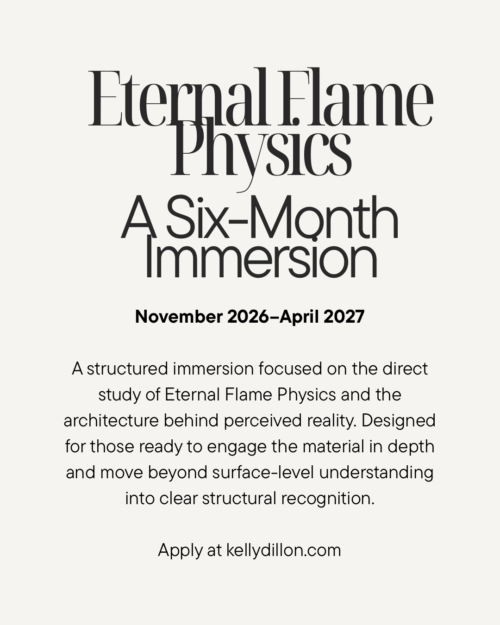
Applications are now underway for the next Eternal Flame Physics® Six-Month Immersion, beginning November 2026 and continuing through April 2027.
This immersion opens a sustained six-month period of direct study and examination of Eternal Flame Physics, moving beyond individual articles, classes, and isolated transmissions into a continuous progression where the architecture can be explored in greater depth over time.
Over twelve live transmissions, participants will move through the structural mechanics of Eternal Flame Physics step by step, with each session building upon and expanding what has already been established. Rather than encountering individual concepts separately, the immersion allows the relationships between mechanics to become increasingly visible as the work develops across the full six-month sequence.
Eternal Flame Physics is structural and interconnected. Pressure, oscillation, compression, geometry, curvature, torsion, field structure, pathways, trajectory, render, the physical body, and lived experience do not operate as isolated subjects. They are part of a continuous architecture, and understanding that architecture requires following the mechanics through their relationships rather than separating them into disconnected pieces.
That continuity is at the center of the immersion.
This is not simply another live class or a collection of teachings spread across six months. It is one continuous progression designed to allow participants to remain with the work, examine the mechanics directly, ask questions as deeper structural relationships emerge, and continue following those relationships as the architecture opens across each successive transmission.
The next Eternal Flame Physics Six-Month Immersion begins November 7, 2026. Applications for the November 2026–April 2027 cycle are now open.
Why the Immersion Was Created
Eternal Flame Physics cannot be separated into isolated concepts without eventually losing the architecture that connects them. Articles and individual classes allow particular mechanics to be opened, examined, and followed in depth, but every mechanic exists within a much larger structural sequence. The deeper the work moves, the more important those relationships become.
Oscillation does not exist independently of the conditions producing and sustaining it. Pressure, compression, geometry, linear constraint, curvature, and torsion affect how structure forms, moves, holds load, reorganizes, and stabilizes. Those conditions influence structural patterns and trajectories, which in turn affect the pathways available for formation and what ultimately becomes visible within render. The physical body is directly within that same architecture, interfacing continuously with the structural conditions through which lived experience is generated.
Once these mechanics begin to be followed together, it becomes increasingly difficult to understand one without encountering the others.
A discussion that begins with oscillation can move directly into geometry. Geometry opens questions of curvature and torsion. Those mechanics lead into structural trajectory and pathway formation. Pathways cannot be fully examined without understanding render and pre-render architecture. Render cannot be separated from the external architecture through which lived experience is continually organized and generated. The mechanics are not separate subjects placed beside one another. They are different positions within one continuous structural architecture.
This is why the immersion required a different teaching structure.
Rather than repeatedly beginning and ending with individual subjects, the six-month container allows the work to remain open long enough for those connections to be followed. A mechanic introduced during one transmission can continue developing through the next. Something established early in the immersion can become necessary for understanding a structural relationship several sessions later. Earlier material can be returned to as additional mechanics expose another layer of what was already being examined.
The purpose is not simply to cover more information. It is to preserve continuity.
When the architecture is approached only in fragments, individual mechanics can easily become detached from the structural conditions that give them meaning. The immersion allows participants to follow the movement from structure through pattern, trajectory, pathway, sequence, and ultimately lived experience without repeatedly breaking that movement apart.
Over six months, the work can therefore be examined as what it actually is: not a collection of separate concepts, but an interconnected architecture in which each structural condition participates in what forms next.
What Six Months Makes Possible
There is a significant difference between being exposed to information and remaining with structural mechanics long enough to recognize how they actually operate.
A single transmission can introduce a mechanic, establish its structure, and move deeply into the relationships immediately surrounding it. But recognition does not end when that transmission ends. Once another mechanic is introduced, the earlier material can suddenly become visible from a different structural position. A relationship that appeared complete on its own begins to reveal where it sits inside a much larger sequence.
This is what six months makes possible.
Across twelve live transmissions, the material is not simply presented and then left behind. It is established, expanded, revisited, connected, and examined again as additional layers of the architecture are introduced. What is learned early in the immersion remains active within everything that follows.
Oscillation, for example, changes in clarity once pressure, compression, geometry, curvature, and torsion are understood more precisely. Those mechanics become clearer again when structural pattern and trajectory are introduced. Trajectory takes on greater precision once pathway formation is understood. Pathways become inseparable from the mechanics of render, and render opens directly into the larger architecture through which lived experience is generated in real time.
Each movement through the architecture changes what can be recognized within what came before.
That is very different from accumulating twelve separate pieces of information.
The progression is cumulative. Earlier material becomes structural architecture for later material. Concepts that initially appear distinct begin connecting into continuous mechanical sequences. Participants are able to return to something they encountered weeks or months earlier and recognize relationships that were not yet available to be seen when the mechanic was first introduced.
The time between transmissions is part of that progression as well. The material is not immediately replaced by another subject. Participants have space to observe what has been examined, recognize the mechanics within lived experience, notice where interpretation is still being imposed over structure, and return to the next transmission with questions that emerge from that direct observation.
Over time, the emphasis therefore begins to move away from simply knowing the terminology of Eternal Flame Physics and toward recognizing the architecture itself.
That distinction is fundamental.
Knowing that pressure, oscillation, curvature, torsion, trajectory, pathway, and render exist is information. Recognizing how a particular structural condition moves through those mechanics, how one condition produces another, where a trajectory begins to form, which pathways remain structurally available, and how that movement eventually becomes rendered lived experience is structural recognition.
Six months creates enough continuity for that recognition to deepen without repeatedly returning to the beginning.
Nothing established earlier has to disappear when a class ends. It remains present, becomes part of what follows, and continues revealing more of the architecture as the immersion progresses.
This Is Not a Predetermined Curriculum
The six-month immersion has structure and progression, but it does not follow a predetermined curriculum in which twelve fixed lessons are simply delivered in sequence.
Each transmission begins within specific areas of Eternal Flame Physics, but the mechanics are followed where they actually lead. A question can expose a structural relationship that requires moving deeper into something established several sessions earlier. A current event or observable condition can provide a real-time example of mechanics already being studied. Something recognized by a participant can open another layer of the architecture that becomes relevant to the entire group.
This is possible because the transmissions happen live. The material remains responsive to what is structurally present rather than being confined to prerecorded information or a rigid lesson plan.
There is still continuity throughout the six months. Foundational mechanics create the architecture for what follows, and later transmissions continue building upon earlier ones. But the progression is allowed to develop organically as relationships become visible, questions deepen, and different mechanics begin connecting across the work.
The result is an active learning environment where Eternal Flame Physics is not simply presented as information to remember. The architecture is examined in real time, allowing participants to follow the mechanics as they unfold and recognize how different structural conditions connect within the larger whole.
Learning to Read Structure Rather Than Narrative
One of the central developments throughout the immersion is learning to read structure directly rather than automatically interpreting what is observed through narrative.
The purpose is not to memorize Eternal Flame Physics terminology or replace one interpretive system with another. Knowing the language of the mechanics is not the same as being able to recognize them. Structural reading requires moving beneath the explanation attached to an event, condition, sensation, or experience and identifying the architecture actually producing what is being observed.
This means learning to distinguish narrative from architecture, interpretation from mechanism, appearance from structural condition, render from what is producing render, and an apparently isolated event from the continuous structural sequence surrounding it.
Something visible in render is never the beginning of the sequence. By the time a condition becomes observable as lived experience, there is already structure behind it: patterns being held, pressure moving, geometry forming, trajectories developing, and pathways becoming available through which that condition can stabilize into experience.
Across the six months, these distinctions become increasingly precise because participants repeatedly return to the mechanics from different structural positions. What initially appears to be a single event begins to reveal the sequence around it. What once produced immediate interpretation can instead be followed backward into the architecture that produced it.
The objective is not to become better at explaining the narrative. It is to become increasingly capable of seeing the structure underneath it.
Following Mechanics All the Way Through
Structural reading does not stop at what has already become visible. What appears in render is the downstream expression of a much larger structural sequence, and throughout the immersion, participants learn to follow that sequence in both directions.
Instead of beginning with an observable event and immediately assigning meaning to it, the examination moves into the architecture beneath it. What structure is present? What pattern is being held within that structure? What pressure is moving through it? How is that pressure being accommodated, resisted, redirected, or compressed? What geometry forms as a result?
From there, the mechanics can be followed forward. Geometry affects the direction movement can take. Curvature and torsion alter how load moves through the structure. A structural trajectory begins to become visible. That trajectory does not itself constitute a predetermined outcome; it shows the direction of movement being produced by the current structural condition.
As that movement continues, pathways form within the range the structure can actually support. Some remain available while others become structurally unavailable. What eventually stabilizes into render emerges through this continuous progression rather than appearing independently at the moment it becomes observable.
This creates a very different way of examining lived experience. An event is no longer treated as an isolated endpoint. It can be followed upstream into the conditions that produced it and downstream through the mechanics determining what can form next.
Throughout the immersion, this process is repeated across different structures, situations, and observable conditions. The purpose is to become increasingly precise in following the entire mechanical sequence—structure into pattern, pressure into geometry, geometry into trajectory, trajectory into pathway, and pathway into rendered experience—without breaking the architecture apart at the point where something becomes visible.
The Human Body Is Inside the Architecture
The physical body is not separate from the structural mechanics examined throughout the immersion. It exists directly within the field and interfaces continuously with structural movement, pressure, oscillation, compression, stabilization, perception, and the conditions moving into rendered experience.
When structure changes, the body is inside that change. Pressure moving through the field can register physically. Oscillation and shifts in structural organization can alter how load is being carried through the body. As conditions reorganize or stabilize, the body responds within that movement because it is not standing outside the architecture observing it.
This is why bodily sensations are examined structurally rather than immediately being assigned spiritualized meanings. Heat, pressure, vibration, nausea, fatigue, tension, changes in perception, or other physical responses are not automatically translated into ideas of energetic clearing, ascension, activation, or healing. The question remains mechanical: what is occurring structurally, how is the field moving, and how is the physical body interfacing with that condition?
Throughout the immersion, participants learn to examine this relationship without separating field from body or body from the larger architecture producing lived experience. The body becomes another readable part of the structural sequence—directly participating in what is moving, reorganizing, stabilizing, and ultimately becoming visible within render.
Why the Container Remains Quiet Between Sessions
The immersion is intentionally quiet between live transmissions. There is no continuous online group discussion, daily content, assignments, or constant stream of material designed simply to maintain engagement.
Two substantial live transmissions take place each month, and the space between them is part of the structure of the immersion. Participants are given time to remain with what has been examined, observe the mechanics within lived experience, and allow connections to become visible without immediately placing another layer of information over what was just established.
Constant input can easily become another form of noise. When new concepts, interpretations, conversations, and reactions are continually added, there is less space to recognize what is already structurally present.
The quiet between sessions allows the work to continue without requiring constant activity around it. Participants can return to recordings, revisit earlier material, observe what is becoming clearer, and arrive at the next transmission with questions that have emerged through direct recognition rather than manufactured engagement.
The space between transmissions is therefore not an absence from the immersion. It is part of the immersion itself.
What This Immersion Is Not
The Eternal Flame Physics immersion is not coaching, therapy, energy healing, spiritual training, New Age instruction, or an identity system. It is not built around prescribed practices, techniques, rituals, belief structures, or methods participants are instructed to follow.
Nothing is being added for participants to become, perform, or identify with. The purpose is not to replace one external system with another or provide a new set of interpretations through which lived experience should be filtered.
The immersion is a sustained, direct examination of structural mechanics and Eternal architecture. Participants learn how structure forms, how pressure and geometry move through systems, how patterns and trajectories develop, how pathways form, and how those mechanics ultimately participate in rendered experience.
The focus remains on the architecture itself—examining what is structurally present, following the mechanics through their relationships, and developing the precision to recognize those mechanics without placing another system of narrative over them.
Remembrance Is Not Information Acquisition
At its core, Eternal Flame Physics is not about accumulating another body of information. The purpose is not to learn enough terminology, concepts, or mechanics to construct another identity around knowing the work.
Information can be collected while the structure through which that information is being interpreted remains completely unchanged. Someone can understand the language of oscillation, pressure, geometry, pathways, render, and external architecture while still translating all of it through the same systems those mechanics are exposing.
Remembrance is different.
As the immersion progresses, the architecture beneath those systems is examined directly. Layers of interpretation become increasingly visible, structural distinctions become clearer, and what was previously filtered through external frameworks can begin to be recognized without automatically being translated back through them.
This is why remembrance of the Eternal Flame cannot be reduced to something that is taught as information. It is not another concept to adopt or identity to hold. It is recognition that becomes clearer as the structures obscuring it are exposed.
As that remembrance stabilizes, sovereignty, clarity, and direct knowing are no longer something being sought through an external system. They emerge through the recognition of what was already present beneath it.
The Next Six-Month Sequence — November 2026 Through April 2027
Applications are now underway for the next Eternal Flame Physics® Six-Month Immersion, which will run from November 2026 through April 2027.
The first live transmission will take place on November 7, 2026, followed by the second on November 21. From there, participants will continue meeting twice each month for a total of twelve live transmissions across the six-month sequence.
All sessions take place live on Zoom and run for several hours, allowing the material to be followed without being confined to a predetermined class length. Each transmission is recorded, and participants receive access to the recordings so they can revisit the material or remain current if they are unable to attend a session live.
The total investment for the six-month immersion is $4,500, and participation requires a commitment to the full six-month sequence. An application must be submitted and accepted before enrollment is confirmed.
Those interested in entering the November 2026–April 2027 immersion can read the complete program details and submit an application through kellydillon.com.