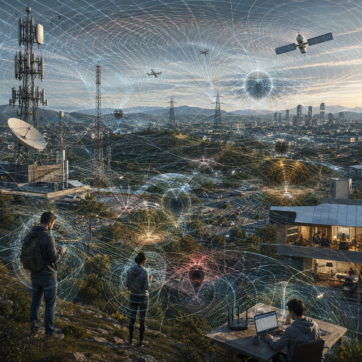
Why Artificial Intelligence Is the Latest Technological Expression of a Much Older Structural Drive to Externalize Within Render
AI Is Being Treated as Something Entirely New
Artificial intelligence is being discussed as though humanity has suddenly crossed into an entirely new condition. The language surrounding it reinforces that impression: a new technological age, a new relationship between humans and machines, a new question about what happens when functions once performed by people are handed over to technology. At the level of technological capability, something significant has certainly changed. The speed, scale, responsiveness, and range of what artificial intelligence can now perform represent a major development. But structurally, the underlying movement is not new at all.
Humans have been externalizing functions for as long as they have been creating tools, systems, records, institutions, and technologies. Something that once had to be remembered internally was placed into writing. Something that had to be calculated internally was transferred into counting systems and eventually machines. Orientation was externalized into maps. Timekeeping was externalized into clocks and calendars. Stored knowledge expanded from oral transmission into books, libraries, databases, and eventually the internet. Images that once survived only through direct perception and memory could be preserved through photography and video. Communication that depended upon physical proximity was progressively externalized through letters, telephones, radio, television, and digital networks.
The technologies changed dramatically, but the structural movement underneath them remained remarkably consistent. A function that existed within human activity was given an exterior form. It could then be stored, extended, repeated, automated, amplified, or returned to the human through something outside the individual.
Artificial intelligence belongs directly within this history.
What makes the present moment appear so different is the kind of functions now being externalized. Earlier technologies often externalized relatively distinct operations. A camera preserved an image. A calculator performed calculation. A telephone carried a voice. A database stored information. Modern artificial intelligence brings many such functions together while extending externalization into language, synthesis, organization, comparison, pattern recognition, interpretation, prediction, and forms of decision assistance. The external apparatus is no longer merely holding information or executing one narrow task. It can receive human input, process enormous amounts of existing material, reorganize it, and return a response that appears conversational and individually directed.
That is technologically new. The movement that produced it is not.
This distinction matters because focusing only on artificial intelligence makes the present development appear disconnected from the much longer structural history that preceded it. It creates the impression that humans have suddenly begun transferring their functions into machines, when humanity has actually been moving functions outward into rendered objects and systems throughout its history. Artificial intelligence represents an enormous increase in the complexity of that externalization, but it did not originate the tendency.
From Eternal Flame Physics, the deeper question therefore sits upstream of artificial intelligence itself: why does humanity externalize so much in the first place?
The answer begins with the architecture in which human experience is occurring. This is external architecture. Experience here proceeds through differentiation, individuation, localization, exteriorization, and relationship. A rendered human does not exist in total Eternal coherence, containing everything internally without separation or mediation. The individual occupies a particular body, location, sequence, perspective, and range of experience. What is not locally held is encountered through what appears outside: another person, an object, a record, a structure, an institution, an environment, a machine.
Human civilization has consequently become filled with external structures that hold and perform portions of what no single individuated human can contain or continuously perform internally. Technology is one enormous expression of that condition.
Artificial intelligence matters, then, not because it suddenly introduced externalization into human life, but because it makes the existing structural condition unusually visible. Humanity has now created an external technological apparatus capable of receiving questions, processing information, producing language, organizing material, and returning apparent answers almost instantaneously. Functions that once appeared far more inseparable from the individual human are becoming increasingly reproducible through something exterior to that human.
That is why the current AI moment should not be read only as a story about machines becoming more capable. It is also a story about humanity becoming increasingly capable of placing its own functions outside itself.
AI matters structurally because it exposes one of the defining conditions of human existence inside external architecture: humans externalize.
It Is Called External Architecture for a Reason
To understand why humans externalize so consistently, the question has to move upstream from artificial intelligence and technology altogether. Externalization did not begin when humans invented machines, writing, institutions, or computers. Those are rendered expressions of a much deeper structural condition. Humans externalize because human experience is occurring inside external architecture.
In Eternal Flame Physics, external architecture is the entire movement-based architecture through which differentiated physical experience is generated. It is not simply the visible world outside the human body. The term includes the pre-render structural mechanics operating before physical appearance, the rendered environment those mechanics produce, and the additional mimic layer operating within that external architecture. Pre-render and render are therefore not two separate realities. They are different positions within the same external architecture: one structurally upstream of visible physical experience and the other its translated physical expression.
Pre-render is where the structural mechanics exist before they become recognizable rendered objects, events, environments, bodies, and sequences. Pressure, oscillation, curvature, torsion, compression, trajectory, pathway, structural instruction, and other relationships operate here before the finished physical result appears. This is why looking only at render can never reveal the entire architecture producing an experience. By the time something is visible, measurable, audible, or physically encountered, a tremendous amount of structural activity has already occurred upstream of that appearance.
Render is the physical translation of those preceding conditions. It is the world humans ordinarily identify as reality: bodies, buildings, roads, trees, technologies, objects, conversations, weather, events, locations, movement, distance, sequence, and physical interaction. Render gives structural conditions recognizable exterior form. Something that exists as relationship and mechanics upstream becomes something that can be encountered as an object, circumstance, sensation, environment, or event downstream.
The mimic layer exists within this external architecture as well. It is not the origin of external architecture, nor should externalization itself be confused with mimic. External architecture already operates through movement, differentiation, translation, and exteriorized relationship. Mimic introduces additional distortion, repetition, inversion, interference, and false structural organization within that existing architecture. This distinction is important because not everything external is mimic. Physicality itself is not mimic. Differentiation itself is not mimic. Externalization itself is not mimic. Mimic operates through and upon conditions that already belong to external architecture.
The complete distinction is therefore essential: the Eternal is not external architecture. The Eternal does not sit somewhere farther back inside pre-render waiting to become physical. Pre-render is already external. The moment there is movement, differentiation, structural processing, pathway, translation, and eventual physical rendering, the architecture being described is external architecture. The Eternal remains original and internally coherent rather than becoming another layer within that movement-based sequence.
Human beings are rendered within this architecture. They therefore experience existence from a localized and individuated position. There is a particular body here and another body there. There is an object outside the body, another person across the room, information held somewhere else, an event occurring somewhere else, and knowledge possessed by someone else. Experience continually presents itself through distinctions between self and other, internal and external, here and there, known and unknown, held and encountered.
That condition means the rendered human does not operate from total internal coherence. This is not a human failure or some defect civilization needs to correct. It is inherent to the nature of individuated experience inside external architecture. An individuated rendered human necessarily occupies a localized position rather than containing the entirety of the architecture internally. Information must be encountered. Relationships must occur. Environments must be navigated. Objects must be interacted with. Knowledge can exist outside the individual’s immediate awareness. Other people can hold information the individual does not possess.
Externalization naturally develops inside those conditions, and it extends far beyond the technologies humans create. Humans externalize nearly every aspect of experience here. They create exterior forms capable of holding, extending, preserving, communicating, organizing, validating, representing, or performing what cannot remain completely contained within one localized rendered individual. A book can hold information after its author is gone. A map can hold spatial relationships the person does not have to memorize. A photograph can preserve a rendered visual moment. A computer can store quantities of information no human could continuously retain.
But humans also externalize authority into governments, institutions, religions, teachers, experts, laws, and social structures; value into money, status, credentials, awards, and possessions; identity into names, roles, careers, clothing, affiliations, and social position; memory into objects, photographs, monuments, archives, and traditions; belonging into families, communities, nations, and groups; and determination into systems that tell them what is correct, acceptable, valuable, successful, or true.
Even internally experienced conditions are continually given exterior representation through language, art, music, ritual, symbols, relationships, and physical creation. Technology is therefore only one branch of a much larger structural tendency. It progressively expands the range of functions that can be placed into an exterior rendered form, but the deeper movement toward externalization runs throughout human experience inside external architecture.
Artificial intelligence therefore sits very far downstream of the actual cause. It is not responsible for humanity’s drive toward externalization. It exists because that movement was already embedded in the architecture of human experience. AI is another object and system humans have constructed within render to receive, process, hold, reorganize, and return functions through something exterior to the individuated human.
That is why the phrase external architecture matters. Humanity did not accidentally develop an obsession with putting things outside itself. Humans are rendered participants inside an architecture where experience itself is continually encountered through exteriorized differentiation and relationship. AI is simply one of the newest places where that ancient structural condition has become impossible to miss.
Individuation Changes the Structural Condition
Individuation is critical to understanding why externalization becomes such a fundamental part of human experience. The Eternal is internally coherent, but an individuated identity operating through external architecture is no longer experiencing from that undifferentiated condition. Individuation establishes distinction. There is now a particular identity following a particular range and trajectory through external experience rather than the totality being held as one internally coherent condition.
Once that identity is translated into render, localization becomes even more explicit. There is this body rather than every body, this location rather than every location, this sequence rather than every sequence, and this immediate field of perception rather than the totality of everything occurring throughout external architecture. The human experiences from somewhere. That localized position is fundamental to what physical experience here actually is.
This means the rendered human cannot contain the totality of external architecture internally. Perception is localized to what can be encountered from a particular position. Memory does not contain every event. Attention cannot occupy every point simultaneously. Knowledge is necessarily partial because enormous amounts of information exist outside the individual’s immediate rendered experience. Another person knows something this person does not. A book contains information not currently remembered. A distant location contains conditions that cannot presently be perceived. External architecture continually places the individual into relationship with what is not locally held.
That is where externalization becomes structurally natural. Humans create exterior ways of preserving and extending what cannot remain completely contained within the localized individual. Information is written down. Memories are recorded. Knowledge is collected. Measurements are stored. Tasks are transferred into tools. Systems are built to maintain functions beyond the capacity or presence of any single person. Technology continually expands this process by allowing increasingly complex functions to exist outside the individual and remain available for later interaction.
Externalization, then, is not evidence that humans somehow failed to remain self-contained. Total self-containment would contradict the structural condition of individuated experience itself. Once there is individuation inside external architecture, there is necessarily relationship with what appears exterior to the localized identity. Human externalization grows directly from that condition. AI is simply a modern technological expression of something already built into the structural nature of being individuated here.
Humans Have Always Externalized Their Functions
Once the structural mechanics are understood, the history of human technology looks much less like a series of unrelated inventions and much more like a continuing expansion of externalization. Humans repeatedly take functions that would otherwise depend upon the immediate capacity, presence, memory, perception, or action of an individual and construct something outside themselves that can hold, extend, reproduce, transmit, or perform that function. The specific technologies change, but the underlying structural movement remains remarkably consistent.
Writing is one of the clearest examples. Before something is recorded, information has to be remembered, spoken, repeated, and carried by living people. Writing allows language and memory to be placed into an external physical form. A thought can remain available when the person who produced it is absent. Information can travel farther than the speaker. Knowledge can survive beyond an individual lifetime. The written object becomes an exterior location where something that once depended upon human memory can persist independently of the person’s immediate internal retention.
Maps perform a similar function with spatial orientation. Instead of having to personally know or remember every road, boundary, landmark, or relationship between locations, humans externalize those relationships into a visible representation. Clocks and calendars externalize systems for tracking and coordinating time. Libraries take the externalization created through writing and expand it collectively, allowing enormous amounts of accumulated human knowledge to exist outside any single person. No individual has to contain the whole library internally. The information remains externally available and can be accessed when needed.
Photography and recording technologies extended this movement into perception itself. A visual moment no longer had to survive only as human memory; a camera could preserve a rendered image. Recorded sound allowed a voice, performance, or event to remain externally reproducible after the original occurrence had ended. Film and video extended that preservation into moving sequences. Humans progressively developed technologies capable of holding increasingly complex portions of rendered experience outside the person who originally experienced them.
Calculators and mechanical computing introduced another important shift because technology was no longer only preserving something humans had already produced. It could perform an operation on their behalf. Mathematical procedures that once required direct human calculation could be transferred into an external device. Computers expanded this enormously. Storage, calculation, sorting, retrieval, processing, organization, and eventually communication could all occur through external computational systems. Functions that previously required separate physical tools increasingly converged inside a single technological apparatus.
Telecommunications produced another expansion. Letters had already allowed language to travel without the speaker, but telegraphs, telephones, radio, and later digital communication progressively reduced the limitations of physical distance. Human communication became increasingly mediated through external technological infrastructure. A person could speak in one location and be heard somewhere else almost immediately. Eventually text, voice, images, video, records, financial activity, work, social interaction, and enormous portions of daily human organization could all pass through external digital systems.
None of these inventions created humanity’s tendency to externalize. They were possible because that tendency was already structurally present. Humans living as individuated identities inside external architecture continually encounter limits to what can be locally remembered, perceived, calculated, communicated, preserved, or performed. Technology becomes a rendered answer to those conditions by giving those functions an exterior physical or computational form.
This is why artificial intelligence belongs to a much longer continuum rather than standing outside human technological history as an inexplicable rupture. What has changed is the complexity of the functions being externalized and the sophistication of the external system performing them. The structural movement underneath it is familiar. Humans externalized memory into writing, orientation into maps, timekeeping into clocks, visual preservation into cameras, calculation into machines, communication into telecommunications, and information processing into computers. Artificial intelligence extends that same movement further into synthesis, language production, classification, interpretation, pattern recognition, and increasingly complex forms of assistance.
Technology therefore does not cause externalization. Technology is one of the things externalization produces. The rendered invention appears downstream of a structural condition already inherent to human experience inside external architecture. AI is simply the newest major technological expression of a movement humanity has been participating in all along.
AI Did Not Suddenly Arrive
The current conversation around artificial intelligence often creates the impression that humanity abruptly entered an entirely new technological condition within the last several years. Generative AI became highly visible, conversational systems entered everyday life, and suddenly people began talking about humans interacting with machines as though that relationship had appeared almost overnight. But the transition was far more gradual. Long before people were routinely typing questions into conversational AI systems, they were already living among automated and computational systems that received human input, processed it according to programmed or learned conditions, classified information, made selections, and returned outputs.
Phone automation is one of the simplest everyday examples of that progression. For decades, people have called businesses and encountered an automated voice instead of another human being: press one for billing, press two for technical support, press three to hear account information. The person supplies an input, the external system processes that input according to its structure, and the interaction is directed down a particular pathway. Later versions no longer required a numbered keypad selection. The system could ask what the caller needed, recognize portions of spoken language, classify the response, and determine where the call should be routed. The interaction became progressively more responsive while remaining so ordinary that most people stopped thinking about what was actually occurring.
The same progression was happening almost everywhere else. Email systems began identifying spam automatically. Search engines ranked enormous amounts of information and determined which results appeared first. Navigation systems calculated routes, evaluated traffic conditions, and redirected drivers. Online stores and streaming platforms recommended products, music, films, or programs based upon previous activity and detected patterns. Banks used automated systems to identify unusual transactions. Social platforms increasingly determined which information each person would encounter and in what order. Customer-service systems classified questions and generated increasingly sophisticated responses.
Not every automated system was technically artificial intelligence, and an old phone tree is not equivalent to a modern machine-learning system. That distinction matters. But structurally, these technologies show the gradual progression toward increasingly responsive external systems. Humans were becoming accustomed to handing an input to a technological apparatus and allowing that apparatus to process, classify, select, calculate, route, recommend, or return something long before generative AI became a recognizable cultural phenomenon.
The shift therefore did not occur in one sudden leap. Technology progressively moved from storing human information, to performing fixed operations, to automating processes, to recognizing patterns, to making predictions and classifications, and eventually to generating complex outputs in response to human prompts. Each development expanded what could be performed outside the individual human through an external computational structure.
Generative AI made this progression much more visible because the interaction changed form. Instead of an invisible algorithm ranking a search result or a navigation system quietly selecting a route, the external system could now communicate directly through language. A person could ask a question in ordinary words and receive what appeared to be an individually constructed answer. The machinery of externalization suddenly became conversational.
That visibility is part of why AI feels so new. Many earlier computational systems operated quietly underneath everyday life. People used their outputs without necessarily recognizing how much selection, classification, prediction, and automated processing was already occurring between their input and the result they received. Conversational AI brings that relationship directly to the surface. The person can now watch an external computational system receive something that would ordinarily be directed toward another human—or worked through internally—and immediately return an organized response.
The present AI expansion is therefore significant, but it is not the beginning of humanity’s relationship with externalized computational function. It is another stage in a much longer technological trajectory. What has changed is the sophistication of the systems, the range of functions they can perform, the speed at which they can perform them, their ability to respond flexibly to different inputs, and the degree to which they are becoming integrated into ordinary human activity.
AI did not suddenly introduce humanity to externalization through machines. Humanity had already been building toward this condition piece by piece. What has arrived now is a far more expansive version of something humans were already doing: constructing increasingly capable external systems and transferring more functions into them.
What Makes Modern AI Different
Placing artificial intelligence within the much longer history of human externalization does not mean that nothing important has changed. Modern AI represents a substantial shift in what humans are now capable of placing into an external technological system. The structural movement is old, but the range, complexity, and responsiveness of the externalization have expanded dramatically.
Earlier technologies generally externalized narrower and more clearly defined functions. A calculator performed mathematical operations. A camera recorded an image. A telephone transmitted a voice across distance. A database stored and retrieved information. A navigation system calculated routes between locations. Even highly sophisticated computers were often experienced through separate programs designed for particular tasks. The human selected the appropriate tool because each tool had a relatively identifiable function.
Generative AI begins collapsing many of those previously separated functions into a single responsive system. The same external apparatus can retrieve and organize information, compare ideas, summarize material, produce language, identify patterns, restructure existing content, generate possibilities, assist with analysis, translate between forms of expression, and return recommendations based upon the information it has been given. Instead of the human always determining the individual operation that needs to occur, the person can increasingly describe the desired outcome and allow the system to determine portions of the processing required to produce it.
That is an important development in the history of technological externalization. Humans are no longer only externalizing memory, storage, calculation, recording, or communication. They are increasingly externalizing combinations of functions that, when performed together by a human, are ordinarily associated with thinking: comparing, synthesizing, organizing, interpreting, evaluating possibilities, constructing language, identifying relationships, and determining possible next steps.
This does not mean the machine has become internally coherent or that it possesses the originating condition from which human recognition arises. It means the rendered technological system has become capable of reproducing increasingly sophisticated outputs associated with those functions. That distinction is essential. An external system can produce an organized answer without becoming the origin of what is true. It can generate a convincing interpretation without possessing the structural condition being interpreted. It can reproduce the appearance of reasoning at the level of output while remaining an external apparatus processing and returning material.
And this is precisely why modern AI is such a revealing development within external architecture. The externalized tool is moving closer to functions humans previously regarded as inseparable from their own internal activity. A camera clearly sits outside the human who uses it. A calculator clearly performs a defined operation. But when an external system receives an unfinished thought, reorganizes it, identifies relationships within it, and returns a coherent articulation, the boundary can feel less obvious. The externalized function begins to resemble the internal process it is assisting or replacing.
The structural significance of this stage is therefore not that externalization has suddenly begun. It is that technological externalization has reached farther inward toward functions humans traditionally experienced as their own thinking, interpretation, and determination. The more capable the external system becomes, the more important it becomes to distinguish between using an exterior tool and relocating the point of determination into that tool.
Modern AI represents a major expansion in what can be externalized, but it remains downstream of the same structural condition that produced the technologies before it. Humanity has not stopped externalizing and begun doing something fundamentally different. It has developed a far more sophisticated external apparatus through which increasingly complex portions of human function can now be performed outside the individual.
The External System Now Talks Back
One of the reasons conversational AI feels like such a dramatic break from earlier technology is simple: the externalized system now talks back. Humans have spent thousands of years placing information, memory, instruction, ideas, observations, and accumulated knowledge into external forms. A person could open a book and encounter the thoughts of someone who lived centuries earlier, search an archive for information, consult a map for direction, or enter a query into a database. But the external object remained largely fixed. The human had to locate what was relevant, interpret it, establish relationships between pieces of information, and determine what applied to the particular question being asked.
A book does not reorganize itself because a reader arrives with a different question. It does not rewrite its chapters around that person’s circumstances, compare three separate passages because the reader asks it to, or produce a new explanation using the reader’s own terminology. The information has been externalized, but the interaction with that information still requires substantial activity from the human accessing it.
Conversational AI changes that relationship. A person can now place a question, uncertainty, unfinished thought, problem, set of facts, or competing possibilities into an external system and receive an immediate response organized around that particular input. The system can restructure information, compare possibilities, identify relationships, change the level of explanation, answer follow-up questions, and continue adjusting its output as the interaction develops. Externalized information has become dynamically responsive to the person accessing it.
That is a significant change in the rendered interface, even though the deeper structural movement remains the same. Humanity has not suddenly begun looking outside itself for information, answers, organization, direction, or assistance. What has changed is the speed and intimacy of the return. Instead of searching through multiple exterior sources and assembling the material independently, the human can ask the external apparatus directly and receive a synthesized response in ordinary language within seconds.
This creates an entirely different experience of externalization. The system no longer feels like a passive repository waiting to be searched. It appears responsive. It can be questioned, corrected, redirected, challenged, and asked to continue. The interaction begins to resemble communication with another human even though what the person is engaging with is a technological system generating outputs from externalized information and computational processing.
That responsiveness also allows humans to externalize uncertainty itself in a much more immediate way. A person does not need to arrive with a fully formed question or even understand exactly what they are trying to determine. They can place fragments into the system: an incomplete idea, conflicting information, a decision they cannot organize, language they cannot find, or something they simply do not understand. The external system can then return those fragments in a more organized form. What previously might have required internal processing, extended research, conversation with another person, or simply remaining with an unanswered question can now produce an exterior response almost instantly.
This is what makes modern conversational AI such a clear demonstration of the larger structural condition. The externalization that has always been present becomes visible in real time. The human places something outward; the external apparatus processes it; something comes back. And because that return now arrives through language that can sound coherent, direct, and personally relevant, it becomes easier than ever for the external system to occupy functions humans have historically distributed across many different people, objects, institutions, and technologies.
The system talking back is therefore not the beginning of externalization. It is a new stage in the interface between the individuated human and what has been externalized. Humanity has progressively built external structures that can preserve, carry, calculate, organize, and process. Now those structures can return their processing conversationally. That makes AI feel radically different, but beneath the new interface remains the same movement that has been operating throughout external architecture all along: something is placed outside the individual, held or processed there, and encountered again through exterior relationship.
Tool Versus External Authority
The structural issue with artificial intelligence is not whether humans use it. Humans have always used external tools, and tools are a natural development inside external architecture. The more important distinction is what function the external tool is being allowed to occupy. AI can remain exactly what it is: a rendered technological apparatus that receives material, processes it, and returns something that the human can then examine. Or it can become another external location into which the human transfers determination itself.
Used as a tool, AI can function as a highly responsive reflective surface. A person can place information into it, ask for relationships to be identified, compare possibilities, reorganize material, challenge an assumption, or have something returned in a form that makes an existing pattern easier to see. The returned material is then brought back through the person’s own recognition. It can be accepted, rejected, questioned, corrected, expanded, or discarded. The external system assists with processing without becoming the final authority over what the person determines to be true.
In fact, disagreement with an external system can sometimes be as useful as agreement. Something can be returned and immediately register as wrong. That resistance can expose where the person already holds a clearer recognition than they had been able to articulate. The tool has not supplied the recognition; it has created an exterior point of contrast through which something already present becomes easier to identify. In that relationship, externalization is being used consciously without surrendering the point of determination.
The relationship changes when the human begins treating the external return as authority simply because it has been returned. What should I believe? What should I think? What should I do? Tell me what this means. Tell me whether I am right. Those questions reveal a different movement. The person is no longer merely using an exterior apparatus to assist with a function. Determination itself is being pushed outward, with the expectation that something external will resolve what has not been internally established.
Artificial intelligence did not create this behavior. Humans have repeatedly transferred authority outward throughout history. Religions have been asked to determine ultimate truth. Institutions have determined what is legitimate. Experts have been given authority over specialized knowledge. Governments and laws establish permitted behavior. Social groups establish belonging and acceptability. Media systems influence what is considered important or credible. Credentials, rankings, statistics, books, leaders, teachers, algorithms, and cultural consensus have all served as external points humans consult when deciding what to believe, value, trust, or do.
That does not make every form of external authority inherently wrong or unnecessary. An individuated human cannot personally contain all available knowledge or independently perform every specialized function required to live within a complex rendered environment. External expertise, records, systems, and tools are unavoidable consequences of localized experience. The structural distinction is between consulting something outside oneself and surrendering the originating point of determination to it.
AI intensifies this distinction because it is extraordinarily responsive. Instead of searching through several external authorities, a person can now ask one system almost anything and receive an immediate answer presented in coherent language. The response can sound certain even when the underlying information is incomplete. It can sound organized where the person feels uncertain. It can supply a conclusion before the human has established one. The speed and fluency of the return can make external authority feel almost frictionless.
That is where the deeper significance of AI appears. Humanity has created an external tool capable of occupying more of the space between uncertainty and determination than most previous technologies ever could. Used cleanly, it can remain a powerful exterior instrument for reflection, organization, comparison, and assistance. Used differently, it becomes another place where humans can hand over functions they have not internally resolved.
The technology is new in its capability, but the structural temptation is ancient. Humans have always looked outward for something that will tell them what is true, what something means, what should happen next, or whether their own recognition can be trusted. AI simply provides an extraordinarily sophisticated new recipient for that much older movement of externalization.
AI Reveals Something Much Bigger Than AI
The most revealing thing about artificial intelligence is ultimately not artificial intelligence itself. The technology deserves attention because its capabilities are expanding rapidly and because it is changing how humans work, communicate, create, research, organize information, and make decisions. But if the examination stops with the machine, it remains at the level of the rendered product. The deeper question is what humanity’s relationship with that product reveals about the architecture in which both the human and the technology are appearing.
AI did not create humanity’s tendency to externalize. Technology did not create it either. Both sit downstream of a structural condition that existed before any particular technological expression emerged. Humans have continually created external repositories, tools, authorities, representations, systems, and machines because they are individuated within an architecture where experience occurs through differentiation, localization, exteriorization, and relationship. The external forms humanity builds continually reflect the conditions already operating within that architecture.
This is why the progression from writing to libraries, clocks, cameras, telecommunications, computers, automated systems, algorithms, and artificial intelligence is structurally important. Each development appears historically as an invention, but underneath those inventions is a recurring movement: more can be held outside the individual, more can be performed outside the individual, and more can be returned to the individual through an external structure. The rendered technologies become increasingly sophisticated while the underlying direction remains recognizable.
AI brings that movement into unusually sharp focus because the external apparatus can now participate in functions that humans have strongly associated with their own internal activity. A person can place a question outside themselves and receive an answer. They can place disorganized material outside themselves and receive organization. They can place uncertainty outside themselves and receive possibilities, interpretations, recommendations, and apparent conclusions. The machine has not created the impulse to externalize any of this. It has simply become capable of receiving far more of what humans are already structurally inclined to place outward.
Seen from Eternal Flame Physics, this returns the discussion to the difference between Eternal coherence and individuated experience inside external architecture. The Eternal does not require an exterior repository, intermediary, authority, or reflective mechanism in order to be internally coherent. Human experience here is different. Individuation establishes localization. Render establishes exterior relationship. A human encounters other identities, objects, environments, information, systems, and conditions as apparently outside the localized self. Externalization is therefore not an unusual side effect appearing only in technologically advanced civilization. It is woven throughout the experience of being individuated here.
Technology has continually reflected and expanded that condition. AI is simply the latest major rendered expression of it. Its sophistication makes the pattern easier to recognize, but it does not originate the pattern. And whatever eventually follows artificial intelligence will likely appear just as unprecedented when viewed only from the level of technological development. New systems will externalize functions in ways that currently seem impossible, just as conversational AI would have appeared extraordinary within an earlier technological period.
But the form should not be mistaken for the cause. The rendered expression can change repeatedly while the structural condition producing that direction remains intact. Writing was not the origin. Computers were not the origin. AI is not the origin. The next technological development will not be the origin either.
To understand what humanity is doing with artificial intelligence, then, it is necessary to look beyond artificial intelligence. The machine is showing humanity something about itself and about the architecture it inhabits. It reveals how consistently the individuated human moves functions outward, builds exterior structures to hold them, and then enters into relationship with those structures.
AI is the current expression. Externalization is the much older movement beneath it.
The structural condition producing it remains upstream.