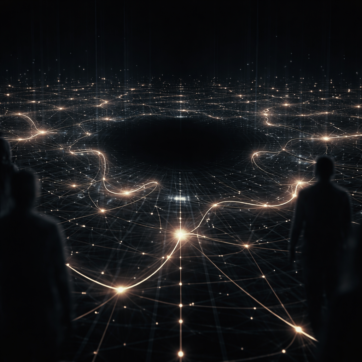
The underlying architecture that forces all systems—healthcare, government, and human activity—into exchange loops to maintain stability in a field that cannot hold itself
Why Everything Becomes A Business
Nothing in this external system is allowed to stand on its own. That is the condition everything is built on, whether it is acknowledged or not. What gets labeled as culture, economy, innovation, or human decision-making is already downstream of a deeper constraint that predetermines the outcome: nothing holds without reinforcement. No structure, no institution, no function arrives complete or remains intact. Everything begins to degrade the moment it appears. That degradation is not occasional—it is constant, ambient, built into the field itself. So what looks like choice is already response. What looks like design is already compensation.
Because of this, every structure is forced into the same conversion pattern. It must capture input, route it, process it, and return it in a form that allows the system to continue operating. There is no exception to this. Healthcare, government, education, media, even personal relationships—once they are instantiated inside this architecture, they must adopt a loop that sustains them. That loop is what gets called a business. Not in the narrow sense of a company or corporation, but in the structural sense of something that must continuously feed itself in order to remain active. Without that loop, the structure loses coherence and drops out.
This is where the misread begins. Humans interpret this as commodification, as if something pure was taken and turned into something transactional. But nothing was taken. The conversion is inherent. The moment a function enters a field that cannot hold intrinsic continuity, it must be translated into a form that can circulate. Care becomes billable. Governance becomes allocative. Knowledge becomes productized. Time becomes priced. None of this is philosophical. It is mechanical. The system cannot maintain anything that does not participate in its exchange structure, so everything is forced into participation.
What is called “business” is simply the surface expression of that requirement. It is the visible layer of a deeper stabilization mechanism that is constantly working to prevent collapse. The language of markets, value, pricing, growth—these are not the origin. They are the interface. Underneath them is a single condition that shapes everything: nothing is allowed to exist without proving, over and over again, that it can sustain itself within a field that cannot sustain anything for free.
The Core Mechanic — Loss Of Continuous Hold
At the root of the external architecture is a loss of continuous hold. That is the real starting condition. The world humans live inside does not sustain through inherent coherence. It sustains through repeated compensation. Nothing here remains because it is true enough to hold itself. Nothing persists because it is internally complete. Everything that appears stable is being re-held, re-fed, re-looped, and re-supported from moment to moment inside a field that cannot maintain its own architecture without assistance. This is why so much of human life feels exhausting even when no one has language for why. The exhaustion is not just emotional or economic. It is structural. It is the cost of existing inside a system where presence does not arrive whole and where continuity is not natural, but manufactured through endless reinforcement.
In Eternal terms, this is the split between what holds by nature and what only appears to hold by repetition. The Eternal does not require maintenance because it is not built out of fragmentation. It does not need to be stabilized because it does not fall out of itself. It is not composed of parts trying to remain connected. It is whole before any attempt at support. The external is the opposite condition. It is what appears when that natural hold is absent. It is a derivative environment built on interruption, segmentation, and reassembly. That means every single thing inside it is subject to loss. A body loses energy. A building degrades. A business fails without revenue. A government weakens without taxation, management, force, or compliance. A relationship destabilizes without constant communication, effort, and exchange. Even identity itself must be continually reinforced through memory, routine, reaction, and narrative. Nothing here simply is. Everything here must be kept.
That is why no moment arrives complete. Humans think of a moment as a self-contained unit of reality, but in the external that is not what a moment is. A moment is a partial delivery. It is a temporary approximation held together long enough to register as experience. It does not arrive with its full architecture intact. It arrives with enough continuity to function, but not enough truth to stand alone. That missing hold creates pressure immediately. The system must compensate for what was not naturally present. So every moment is followed by the need for the next. Every structure is followed by the need to preserve it. Every expression is followed by the need to renew it. This is why the external produces endless cycles. The cycle is not a lifestyle pattern. It is a repair behavior.
Once continuous hold is lost, degradation becomes built in. This is the first law of the external, though mainstream systems never name it that way. Degradation pressure is constant because everything in the external is operating downstream of broken continuity. That means the default movement of every structure is not toward stable being, but toward breakdown. Decay is not an unfortunate side effect. It is the native tendency of a system that cannot fully hold itself. This is why everything must be managed. This is why every human institution becomes obsessed with preservation, profitability, scaling, regulation, optimization, efficiency, and control. These are not just cultural values. They are responses to architecture failure. They are what a field does when it cannot trust its own continued existence.
Once that condition is in place, the loop becomes mandatory. Input, processing, output, replenishment. That is the minimum viable pattern for survival inside a system without continuous hold. Something must come in. It must be converted. It must produce an effect. Then it must be fed again before it collapses. This applies everywhere. The human body requires food, sleep, oxygen, heat regulation, waste clearing, hormonal cycling, and nervous system recalibration. A company requires labor, capital, customers, systems, administration, and constant adaptation. A media platform requires attention, content, circulation, and monetization. A nation requires extraction, infrastructure, legal enforcement, narrative control, and resource management. Even human affection inside the external often gets routed through loop mechanics: attention in, emotional processing, relational output, renewed contact, reassurance, repetition. The reason the loop appears universal is because the underlying deficit is universal.
Existence becomes conditional. That single shift explains more about the human world than most disciplines ever touch. In the Eternal, being is not conditional. It does not depend on acquisition, defense, or repetitive self-justification. In the external, being is always conditional because presence is never fully secured. To exist in form is to be subject to interruption. To remain in form is to require reinforcement. The moment existence becomes conditional, life can no longer organize around truth. It organizes around maintenance. That is when distortion becomes systemized. Structures are no longer built according to what is inherently real or coherent. They are built according to what can keep the thing running.
That is exactly where “business” comes from. Business is not first an economic invention. It is a stabilization behavior. Long before humans named it, they were already living it. Once a structure cannot hold itself, it must secure the means of continuation. The securing process becomes primary. Resources must be acquired. Energy must be routed. Inputs must be managed. Failure points must be anticipated. Exchanges must be created. Dependencies must be organized. That entire maintenance architecture later receives the human label of business, commerce, labor, market, institution, employment, or administration. But underneath all of those words is a simpler truth: the structure cannot remain active without an ongoing stream of support. Business is what conditional existence looks like when formalized.
This is why everything turns into a business even when it began as something else. A healer becomes a business. A hospital becomes a business. A church becomes a business. A school becomes a business. A government becomes a business. A marriage can become a business. Even activism becomes a business. Once the structure enters the external field, it is subjected to degradation pressure, and once degradation pressure begins, maintenance must be organized. Over time, the maintenance function overtakes the original purpose. This is one of the clearest signatures of the external. The thing no longer exists to do what it says it exists to do. It exists to keep itself going. That is not corruption as an exception. That is the architecture reaching its logical end.
From an Eternal Flame Physics standpoint, this happens because the external cannot source its own continuity. It borrows temporary coherence through looping. That borrowed coherence always comes with cost. Something must be extracted to keep the structure online. Money is one form of that extraction, but not the only one. Time is extracted. Attention is extracted. Labor is extracted. Emotion is extracted. Belief is extracted. Memory is extracted. Compliance is extracted. Bodies are extracted into systems. Data is extracted into platforms. The modern world calls this productivity, economy, growth, or participation. But at the structural level it is all the same event: the field is feeding itself because it cannot hold itself.
That is also why humans so easily normalize this arrangement. They are born into it. They mistake the repair pattern for reality itself. They think endless maintenance is natural. They think pressure is normal. They think burnout is a personal weakness rather than a direct consequence of existing inside a field that runs on compensation. They think value must always be monetized because they have inherited a world where continuation always has a price. They think every talent must become a service, every service must become a revenue stream, every relationship must justify its investment, and every institution must prove its sustainability. None of this is accidental. It is what human consciousness looks like after generations inside a field where continuous hold is gone.
This is why the statement “everything is a business” feels so true. It is true, but not for the reason most people think. It is not simply greed. It is not only capitalism. It is not just culture, policy, or human moral failure. Those are surface expressions. The deeper truth is that the external architecture converts everything into a maintenance problem. Once something becomes a maintenance problem, it must be resourced. Once it must be resourced, it enters exchange. Once it enters exchange, it becomes vulnerable to commodification. This is why even things that should remain sacred or relational get absorbed into transactional systems. The external does not know how to leave things uncommodified because it cannot allow unsupported existence. Everything must earn its continuation.
That is the brutality of the structure. It does not just distort economics. It distorts meaning. It teaches humans to confuse support with worth, profitability with legitimacy, and continuation with truth. A thing that survives is assumed to be good. A thing that generates income is assumed to be valuable. A thing that scales is assumed to matter. But none of that proves coherence. Often it proves only that the structure has become efficient at feeding itself. Some of the most destructive systems on Earth survive precisely because they have mastered maintenance under degraded conditions. They know how to extract enough input to continue. That is not proof of alignment. It is proof of adaptation to collapse.
The Eternal correction is not to romanticize a world without structure. It is to correctly identify what structure became once continuous hold was lost. Business, in its deepest form, is the visible administration of broken continuity. It is the management layer placed over a field that does not naturally sustain what it produces. That does not mean every business is evil or every exchange is false. It means the underlying reason exchange became universal has been misunderstood. Humans think they invented systems of commerce to organize society. In reality, society organized itself around compensation because the architecture could not hold without it. The business model came later as language. The loop came first as necessity.
The reason everything becomes a business is because nothing in the external remains alive through inherent coherence. It remains active only through repeated support. The moment support is needed, acquisition begins. The moment acquisition begins, systems form around securing it. The moment those systems stabilize, humans call them institutions, industries, careers, platforms, markets, and governments. But beneath every one of those names is the same original fracture: loss of continuous hold, followed by the endless labor of keeping broken continuity from fully collapsing.
The Conversion Layer — From Function To Exchange
Once maintenance becomes required, function can no longer exist in its original form. It cannot remain as a direct expression of what it is. It must be translated into something that can survive inside a system that demands continuous input. This is where the second major shift occurs. Function is no longer enough. It must be converted into exchange.
Healing, in its pure state, is a function. It is a direct restoration of coherence. But inside the external, healing cannot remain as a standalone act because it does not sustain itself. It requires time, energy, infrastructure, repetition. So it is converted into healthcare systems—structures that can organize, fund, and maintain the function over time. Coordination becomes government. Creation becomes industry. Education becomes institutions. None of these are distortions at their origin. They are translations. But the translation changes the nature of what is being expressed because it binds the function to the maintenance loop.
This is the layer where intrinsic value is lost as a stable reference. Intrinsic value cannot be held directly in a system that does not maintain continuous coherence. There is no stable field to recognize it without interruption. So the system replaces it with assigned value. Assigned value is not what something is. It is what the system can measure, circulate, and use to sustain the structure. This is the core substitution that defines the external economy.
Once value becomes assigned, it must be measured. Measurement introduces units. Units allow comparison. Comparison allows exchange. But the moment units are introduced, the function is no longer interacting directly with reality. It is interacting through a representation. That representation becomes the governing layer. Money is the most obvious example, but the mechanism extends far beyond currency. Time becomes units. Attention becomes units. Data becomes units. Even human worth is often reduced to units—productivity metrics, social metrics, performance metrics. These are all attempts to stabilize value inside a system that cannot hold it inherently.
Once units exist, they must circulate. Circulation is what keeps the system alive. Value cannot remain static because the structure itself is not stable. It must move continuously to compensate for ongoing degradation. This is why economies require constant activity. Stagnation is read as failure because stillness exposes the lack of continuous hold. Circulation masks that instability by creating the appearance of movement and renewal. But the movement is not growth in the Eternal sense. It is redistribution under pressure.
To sustain circulation, tracking becomes necessary. Systems must record what moves, who holds it, where it goes, and how it returns. This introduces layers of administration, regulation, accounting, and control. At this point, the original function is fully embedded inside an exchange architecture. It cannot operate outside of it without collapsing, because it has been restructured to depend on that circulation. The system has now locked.
Once this chain is in place—assignment, measurement, units, circulation, tracking—every function is pulled into the same architecture. It must produce something measurable. It must justify its continuation through output. It must sustain itself by participating in exchange. This is why nothing is allowed to simply exist as what it is. Everything must demonstrate value in a way the system can process.
This is where the distortion of care becomes most visible. Care, by nature, is not transactional. It is a direct relational function. It does not require measurement to exist. It does not need to be justified to be real. But inside the external, care cannot hold without support. It requires time, labor, energy, space. Because of that, it must be converted into something that can circulate within the maintenance loop. It becomes billable. It becomes scheduled. It becomes quantified. It becomes professionalized. None of these layers are care itself. They are the scaffolding required to keep care operating in a system that cannot sustain it directly.
This is why people experience care as transactional even when the intention behind it is not. The transaction is not the origin of the function. It is the condition required for the function to continue existing within the system. Without that conversion, the function would collapse under the weight of the external’s instability. With the conversion, the function survives, but its expression is altered. It becomes bound to exchange.
From an Eternal Flame Physics perspective, this entire layer is a compensation structure. It is what happens when direct value cannot be held in a coherent field. The system replaces coherence with circulation. It replaces intrinsic knowing with measurement. It replaces presence with exchange. And once that replacement stabilizes, it becomes invisible. Humans begin to believe that value has always worked this way, that exchange is natural, that everything must be earned, priced, justified, and sustained through output.
But this is not a neutral system. It is a response to loss. The conversion layer exists because continuous hold is gone. Function must now be translated into something that can survive without it. That translation is what turns everything into exchange.
The Enforcement Layer — Why Participation Is Not Optional
Once function has been converted into exchange, the system must ensure that the exchange loop never stops. This is where enforcement emerges—not as a top-down rule set, but as a structural consequence. The external does not need to force participation through ideology alone. It enforces through what happens when participation stops. Anything that exits the loop loses support. The loss is immediate because there is no underlying continuity to catch it. Without input, the structure has nothing to stabilize it. It begins to break down.
This is the core condition: participation is not optional because support is not inherent. A person cannot simply exist without engaging the loop because existence in the external requires continuous reinforcement. Food must be acquired. Shelter must be maintained. Systems must be navigated. Resources must be exchanged. The moment that process stops, degradation is no longer offset. Collapse is not a punishment. It is the default state reasserting itself.
This is why work, payment, production, and optimization appear as obligations rather than choices. They are not moral requirements imposed by society at their root. They are responses to a field that cannot sustain idle presence. The system does not recognize stillness as stability. It reads stillness as loss of input. Without input, there is no circulation. Without circulation, there is no temporary hold. So everything is structured to prevent that break.
From an Eternal Flame Physics standpoint, this is where the external reveals its dependence most clearly. It cannot hold anything without continuous feeding, so it builds reinforcement pathways that keep the loop active. These pathways do not always appear as force. Often they appear as necessity. Cost of living is a reinforcement mechanism. Access to care is a reinforcement mechanism. Employment structures are reinforcement mechanisms. Even social belonging can become a reinforcement mechanism when participation in systems is tied to identity, status, or survival.
Regulation emerges here as a way to stabilize circulation. It defines how exchange happens so the loop does not fracture. Pricing calibrates access so resources continue to move. Access control determines who can participate and under what conditions, ensuring that flow is directed and maintained. Scaling expands the loop so it can support more load without collapsing under its own instability. All of these appear as separate systems, but they are expressions of a single requirement: keep the loop intact.
If the loop weakens, the structure destabilizes. If it destabilizes, it cannot support what exists within it. So the system continuously tightens participation. It creates dependencies that make exit difficult. It aligns survival with engagement. It conditions individuals and institutions to prioritize continuation over anything else. Over time, this becomes normalized. People begin to interpret enforced participation as responsibility, discipline, or necessity without recognizing the architectural condition underneath it.
This is why opting out is not a simple act. It is not just a personal decision. It is a structural event. To stop participating in the loop is to remove the inputs that are holding the system in place around you. Without those inputs, the support drops. The external does not negotiate that drop because it has no reserve of inherent stability to offer in its place. What remains is exposure to the default condition: degradation without compensation.
The enforcement layer, then, is not about control in the conventional sense. It is about continuity under constraint. The system cannot allow widespread non-participation because it cannot survive it. So it organizes reality in a way that continuously routes individuals and institutions back into the loop. Not through constant coercion, but through consequence. Stay in the loop, and the structure holds. Exit the loop, and the structure dissolves. That is the mechanism that makes participation feel mandatory, because at the architectural level, it is.
Why Profit Exists — Surplus As Collapse Buffer
Profit is not the origin driver. It appears after the loop is already in place. Once function has been converted into exchange and exchange is required to maintain continuity, the system confronts a second problem: variability. Input is not stable. Flow is not guaranteed. Demand is not consistent. The field itself cannot promise continuity, so every structure inside it inherits that instability. Meeting immediate needs is no longer sufficient. The system must prepare for interruption.
This is where surplus enters. What is called profit is not excess in a moral sense. It is stored capacity. It is what remains after immediate maintenance has been satisfied, held back as protection against future loss of input. Because the external cannot guarantee that the next cycle will deliver what the current cycle provided, systems begin to accumulate beyond what they need in the present. That accumulation is not optional. It is the only way to extend stability across time in a field that does not naturally hold continuity.
From an Eternal Flame Physics standpoint, this is a compensation layer built on top of an already compensating system. Continuous hold is gone, so the loop was introduced. The loop itself is unstable, so surplus is added to reinforce it. Profit is that reinforcement. It is a buffer against collapse events—disruptions in supply, drops in demand, system shocks, resource shortages, structural delays. Without that buffer, even minor disturbances would cascade into failure because there is no inherent stability underneath to absorb the impact.
This is why systems are designed to extract more than they immediately require. They are not calibrated for equilibrium. They are calibrated for uncertainty. Every organization, institution, and economic actor operates under the assumption that future conditions will not reliably match present conditions. So they over-collect. They build reserves. They expand margins. They secure excess capacity. All of this is an attempt to extend their ability to survive discontinuity.
Once this behavior stabilizes, profit-seeking intensifies. It is no longer just about maintaining the present cycle. It becomes about increasing the size of the buffer. Larger buffers allow for greater tolerance to instability. They allow systems to outlast competitors, absorb shocks, and maintain operation during periods where others collapse. Over time, this creates escalation. Each system increases extraction not simply to grow, but to remain viable relative to others doing the same.
This is where profit begins to appear aggressive. But the aggression is not purely behavioral. It is structural overcompensation. The field cannot guarantee continuity, so systems attempt to secure it through accumulation. The more unstable the environment, the more aggressive the accumulation becomes. This is why profit expands most rapidly in conditions of uncertainty, disruption, or perceived risk. The system is attempting to pre-load stability where none is guaranteed.
At this point, the function of the structure becomes secondary to its survival capacity. The original purpose—healing, creation, coordination, service—remains, but it is now subordinated to maintaining and expanding the buffer. Decisions begin to prioritize what increases surplus over what preserves the integrity of the function. This is the moment where distortion becomes visible. The system is no longer just sustaining itself. It is optimizing for its own continued existence under unstable conditions.
Profit, then, is not an anomaly or a deviation. It is a predictable outcome of operating inside a field that cannot hold continuity. It is the stored response to instability. It is the system’s attempt to buy time against collapse. The more the field fails to provide consistent support, the more the system compensates through accumulation. That is why profit persists, expands, and intensifies. It is not the cause of the structure. It is the shield the structure builds because it cannot rely on anything else to hold.
Institutional Expression — Healthcare And Government As Business Systems
Healthcare and government do not begin as business systems. They begin as functions—healing and coordination. But once those functions enter the external architecture, they inherit the same condition as everything else: loss of continuous hold. From that point forward, neither function can remain in its original form. Both must translate into structures that can sustain themselves through ongoing input. That translation is what turns them into business systems, regardless of their stated purpose.
Healthcare is the clearest example of function converting into throughput. Healing, in its direct form, is a restoration of coherence. It is complete when the system stabilizes. But inside the external, completion cannot be the organizing principle because the system itself must continue operating. So healthcare restructures around flow: intake, diagnosis, treatment, billing, follow-up, repeat. Each stage feeds the next. The system is no longer organized purely around resolution. It is organized around maintaining movement. Throughput becomes the stabilizing mechanism because continuous hold is not available.
This does not mean healing disappears. It means healing becomes embedded inside a loop that must keep running. The institution cannot stop at resolution because stopping would remove input. Without input, the structure destabilizes. So continuity of operation becomes primary. This is why the system often expands diagnostics, extends treatment pathways, schedules repeat interactions, and builds layers of administrative processing. These are not random inefficiencies. They are structural responses to the requirement that the system must keep feeding itself to remain intact.
Government follows the same pattern at a different scale. Coordination, in its pure form, would establish stable order and require minimal intervention once coherence is achieved. But inside the external, stability cannot be held directly. So government becomes a flow management system. Taxation brings resources in. Distribution allocates them out. Regulation shapes how they move. Enforcement ensures compliance with those movements. The entire structure is organized around managing circulation rather than holding a fixed, stable state.
Like healthcare, government cannot operate outside the maintenance loop. It requires continuous input—financial, administrative, and social—to remain active. If that input weakens, the structure destabilizes. So it builds mechanisms to secure ongoing participation: tax systems, regulatory frameworks, compliance structures, and enforcement pathways. These are not separate from its function. They are what its function becomes once it is translated into a system that must sustain itself under conditions of instability.
In both cases, the original function is still present, but it is no longer primary. Healing still occurs within healthcare. Organization still occurs within government. But both are now subordinated to the requirement of continuation. The institution must remain operational before it can fulfill its stated purpose. This is the inversion created by the external architecture. Purpose becomes embedded inside maintenance rather than the other way around.
From an Eternal Flame Physics perspective, this is not corruption in the traditional sense. It is conversion under constraint. The system cannot hold function directly, so it restructures function into exchange and flow. Once that restructuring stabilizes, it becomes indistinguishable from what humans recognize as business. Revenue streams, cost structures, scaling strategies, performance metrics—these emerge because they are necessary to keep the loop intact.
This is why both healthcare and government begin to resemble businesses over time. They track input and output. They optimize for efficiency. They expand capacity. They manage risk. They justify budgets. They measure performance. All of these behaviors are expressions of the same underlying requirement: maintain the structure in a field that does not naturally sustain it.
Neither system can step outside this architecture without losing the support that allows it to exist. That is the constraint. To operate at all, they must participate in the exchange loop. And once they participate, they inherit the full logic of that loop. This is why, regardless of intention, both healthcare and government converge toward business-like behavior. It is not because they chose to abandon their purpose. It is because the architecture does not allow them to hold that purpose without converting it into something that can survive.
The Human Interpretation Error — Mistaking Structure For Choice
Humans read the outcome and assign intent. They see profit extraction, institutional distortion, access control, and transactional layering, and conclude that these are the result of decisions—greed, corruption, policy design, moral failure. Those elements do exist, but they are not the origin point. They are behaviors expressed inside a constrained system. They are downstream responses, not the mechanism itself. The error is taking surface behavior and treating it as cause, when it is actually adaptation.
From the perspective of the external architecture, the pattern is already determined before individual choice enters. The field does not allow stable, non-transactional existence. That condition is set at the level of structure. Once continuous hold is lost, everything that forms inside the system must secure its own continuation through input, exchange, and reinforcement. Human behavior organizes around that requirement. It does not invent it.
This is why even well-intentioned efforts to create non-commercial spaces do not remain outside the loop. A community forms to provide care, support, or shared resources without exchange. But the moment that structure persists over time, it encounters the same constraint: it requires energy, time, coordination, space, and material support. Those requirements introduce the need for resource management. Resource management introduces allocation. Allocation introduces measurement. Measurement introduces exchange, whether formal or informal. Over time, the structure is pulled back into the same architecture it attempted to avoid, because the underlying condition has not changed.
This is where the misinterpretation becomes locked. Humans believe the system looks the way it does because of repeated bad decisions. So they attempt to correct it at the level of behavior—better policies, more ethical leadership, different economic models, alternative communities. But those corrections operate inside the same structural constraint. They adjust how the loop is managed, but they do not remove the requirement for the loop itself. As long as the field cannot hold continuity, every structure must compensate. That compensation will always produce exchange.
From an Eternal Flame Physics standpoint, this is a category error. It is confusing expression with origin. The origin is loss of continuous hold. The expression is a world where everything must sustain itself through exchange. Greed, corruption, inefficiency, and imbalance are variations in how that compensation is carried out. They are not the reason the compensation exists.
This is why the correct question is not why humans turned everything into a business. That question assumes that another outcome was structurally available and simply not chosen. The more accurate question is what kind of system requires that outcome in order to remain active. When the question is framed correctly, the answer becomes direct. A system that cannot hold itself must build mechanisms to keep itself going. Those mechanisms organize around acquisition, circulation, and reinforcement. That is what humans recognize as business.
Once this is seen, the entire interpretation shifts. The world is not primarily a product of choice. It is a product of constraint. Human decisions shape the form of the system, but the requirement beneath those decisions remains fixed. Everything must participate in maintenance because nothing is inherently sustained. Everything must enter exchange because nothing can hold without input. Everything must justify its continuation because existence is conditional.
The human error is believing that changing behavior alone can remove this pattern. Behavior can modify how the system operates, but it cannot eliminate the need for operation itself. As long as the architecture remains what it is—a field without continuous hold—the outcome will repeat. Structures will form, degrade, convert into exchange, enforce participation, accumulate surplus, and organize into business systems. Not because humans chose that path, but because the system leaves no alternative for anything that intends to remain.
Closing Transmission — The Architecture Behind The Pattern
Everything becomes a business because nothing in the external is granted intrinsic stability. No structure is allowed to remain simply because it is coherent. Everything must prove, reinforce, and re-secure its continuation inside a field that does not hold on its own. This is the underlying condition that drives the entire pattern. Exchange is not a preference layered on top of life. It is the loop that makes continuation possible. Measurement is not a neutral tool used for organization. It is the only way the system can approximate value in the absence of direct coherence. Enforcement is not a matter of policy or authority. It is the consequence that emerges when support is removed from a structure that cannot sustain itself.
Because this condition is architectural, no domain escapes it. It does not matter whether the function is healing, governance, creativity, education, or relationship. The moment it attempts to persist over time, it encounters the same requirement: it must enter the loop. It must secure input. It must circulate resources. It must maintain itself against ongoing degradation. Any attempt to exist outside of that process results in immediate loss of support. Without support, the structure cannot hold. Collapse is not a failure of intention. It is the reappearance of the field’s default state.
This is why the system reorganizes everything into exchange-compatible forms. It does not target specific domains. It applies the same conversion universally. Health becomes a system that can process and bill. Governance becomes a system that can allocate and regulate. Creativity becomes a system that can produce and monetize. Relationships become structures that require time, energy, and often material exchange to sustain. These are not separate distortions. They are the same structural adjustment repeated across every layer of human life.
What appears, at the surface, as a global economic reality is actually a deeper architectural condition expressing itself. The economy is the visible layer of a system compensating for the loss of intrinsic hold. When intrinsic value cannot be directly sustained, it is replaced with assigned value. Assigned value must be made legible, so it is measured. Once measured, it must circulate to maintain continuity. Once it circulates, it must be managed to prevent breakdown. That management creates systems. Over time, those systems stabilize into what humans recognize as industries, institutions, markets, and governance structures.
That systemization is what the world calls business. It is not a sector within the world. It is the form the world takes when every structure inside it must justify its existence through continuous support.