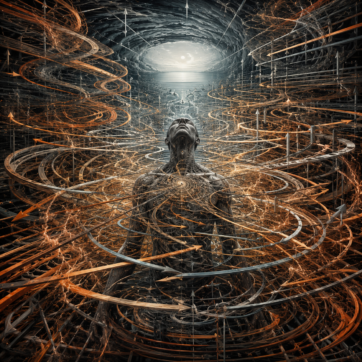
Plasma Is Not A Substance — It Is Structure That No Longer Holds
Plasma Has Been Misidentified
Plasma has been misidentified at every level it is being discussed.
It is not a mysterious substance, it is not a higher intelligence, and it is not a special category of matter. Those interpretations are not coming from deeper understanding. They are coming from observation that stops at appearance and never resolves into structure. What is being looked at is real, but what is being concluded about it is not.
The misidentification begins the moment behavior is taken at face value. Movement is seen, responsiveness is observed, pattern formation is visible, and from that, assumptions are made. Science formalizes those observations into a classification and calls it a state of matter. New age interpretation takes those same visible characteristics and assigns awareness, intelligence, or sentience to it. Both are operating off the same break in recognition. They are looking at what something does instead of identifying what condition allows it to behave that way in the first place.
What is being called plasma in scientific language and what is being described as “intelligent plasma” in spiritual language are not two different phenomena. They are the same surface-level interpretations of a single underlying condition that has not been isolated correctly. One describes measurable behavior. The other projects meaning onto that behavior. Neither resolves the structural cause.
Plasma is not being misunderstood because it is complex. It is being misunderstood because it is being approached from the wrong level entirely. As long as it is treated as a substance or an entity, every explanation built on top of it will continue to drift. It will either become increasingly technical without clarity, or increasingly symbolic without grounding. Both paths miss the same thing.
Plasma is not a thing. It is a condition.
And until that is recognized cleanly, everything built on top of it—scientific, spiritual, or otherwise—will continue to misidentify what is actually being observed.
The External Architecture, Pre-Render, And Why Plasma Appears At All
Before plasma, before matter, before anything that can be named or categorized inside the visible world, there is already an organizing condition in place that determines what will appear and how it will appear. The failure to recognize this is where nearly every misunderstanding begins, because humans are conditioned to treat the visible world as the origin point rather than the final translation layer. What is being experienced is not primary formation. It is rendered output. And that output is being dictated by deeper structural mechanics operating prior to visibility altogether.
The external architecture is the system within which this entire process occurs. It is not a passive environment. It is an active, continuously organizing condition that cannot sustain itself through stillness and therefore requires constant movement to maintain temporary coherence. Everything inside the visible world—matter, gas, plasma, liquids, bodies, systems—is not independently forming in isolation. It is being translated through this architecture from a prior organizational state. That prior state is what defines the difference between something appearing as solid, fluid, dispersed, or completely uncontained.
This is where the pre-render must be understood clearly. The pre-render is not a place. It is not another dimension or hidden world. It is the organizational layer where structural conditions resolve or fail to resolve before becoming visible. By the time anything appears in the render, the determining factor has already been set. What humans call physical reality is not forming itself in real time from nothing. It is expressing the outcome of whether structure successfully closed or failed to close upstream.
That is the mechanical origin of what becomes matter versus what becomes plasma.
In the pre-render, the only distinction that matters is whether structure achieves closure under pressure. If closure completes, pathways stabilize, relationships hold, and containment forms. When that translates into the render, it appears as matter. If closure does not complete, pathways remain open, relationships do not stabilize, and containment fails. When that translates into the render, it appears as plasma or other non-contained states. Nothing new is introduced at the visible level. The render is simply displaying the result of that condition.
This is why matter, liquid, gas, and plasma are not separate substances. They are translations of different structural outcomes that were already determined before visibility. A solid appears where closure is strong enough to fully hold. A liquid appears where closure holds but allows internal movement. A gas appears where closure is weak and structure spreads. Plasma appears where closure fails entirely and pressure expresses directly through what remains.
Water, air, metal, flame—these are not independent creations forming themselves in isolation. They are render-level expressions of how much structural containment was achieved prior to manifestation. What is perceived as different materials are actually different degrees of holding translated into sensory form.
This also clarifies why plasma behaves the way it does. It is not chaotic because it is special. It is not dynamic because it is alive. It is dynamic because the condition that produced it never allowed for containment in the first place. What is being seen is the direct translation of non-closure under pressure. The branching, arcing, and constant reorganization are not properties of a substance. They are the visible consequence of structure that never stabilized upstream.
The external architecture continuously produces both conditions because it cannot resolve into full coherence. Some pathways close. Some do not. That mixed condition is what allows both stable matter and uncontained plasma to exist within the same render. If everything closed, nothing would move. If nothing closed, nothing would hold. The architecture exists in between, generating both holding and non-holding simultaneously as part of its unstable nature.
The mimic overlay intensifies the misinterpretation of this process. Instead of allowing recognition of structural conditions, it amplifies appearance, behavior, and symbolic interpretation. Plasma becomes “energy.” Movement becomes “intelligence.” Responsiveness becomes “awareness.” The underlying condition is buried beneath interpretation. What should be seen as non-containment becomes projected as something advanced or alive because the system reinforces translation over direct recognition.
None of this originates at the visible level. The render does not create plasma, matter, or any form directly. It displays what has already been structurally determined. That is the inversion that must be corrected. Cause is not visible. Effect is. What is seen is the final translation of whether structure held or failed to hold under pressure before it ever became perceptible.
Plasma is therefore not something happening in isolation inside the world. It is the visible edge of a deeper condition that did not resolve upstream. And everything else—solid matter, flowing liquid, dispersed gas—is simply a different outcome of that same process.
Same source. Different resolution.
And the render is only ever showing the result.
The Scientific Definition — And Where It Stops
Human science defines plasma in a way that is internally consistent within its own system, but fundamentally incomplete in what it is actually identifying. It is described as an ionized gas, a state where atoms have been energized to the point that electrons are no longer bound to their nuclei, resulting in a mixture of free electrons and positively charged ions. From there, its properties are outlined in terms of behavior. It is said to be highly conductive, capable of carrying electrical current with little resistance. It responds strongly to electric and magnetic fields. It exhibits collective behavior, meaning the particles do not act independently but move in coordinated ways due to those fields. It emits light, often intensely, as energy is released through collisions and recombination.
All of this is observationally accurate. None of it is incorrect within the scope of what is being measured. If you create the conditions in a laboratory, if you apply sufficient energy to a gas, if you observe what happens at that threshold, you will see exactly what is being described. The definition holds because it is built from repeatable interaction with the phenomenon at the level science is equipped to measure. That is not where the break occurs.
The limitation begins in what is assumed about that description. The classification of plasma as a “state of matter” implies that it is a distinct type of substance, something that exists alongside solids, liquids, and gases as its own category. That framing is not derived from identifying a fundamentally different material. It is derived from grouping a set of behaviors under a single label. Ionization, conductivity, responsiveness, luminosity—these are not identities. They are expressions of a condition. Science stops at describing those expressions and does not resolve the underlying structural state that produces them.
By focusing on particles—electrons, ions, charge interactions—the explanation remains at the level of what is happening, not why that configuration exists in the first place. The moment electrons are observed as “free,” the explanation ends at the mechanism of separation, not at the condition that allowed containment to fail. The moment plasma is seen to respond to electromagnetic fields, the focus shifts to modeling that response, not to identifying why the structure is in a state where it must respond in that way.
So the definition becomes a closed loop. Plasma behaves this way because it is ionized. It is ionized because energy was applied. Energy produces ionization, and ionization produces plasma. The cycle explains process without ever identifying the structural condition that makes that process possible. It remains entirely within behavior and interaction, never resolving into the state of containment or non-containment that determines whether those behaviors appear at all.
This is where the boundary is. Science is not wrong in what it describes. It is incomplete in what it concludes. It defines plasma by what it does, how it forms under certain inputs, and how it behaves once present. It does not define plasma by the condition of structure that allows it to exist in that form. And without that, the definition remains descriptive, not foundational.
The Structural Reality Of Plasma
Plasma is not an ionized gas. That definition is a description of what becomes visible after a deeper structural condition has already failed to hold. It does not identify what plasma is. It identifies what it looks like once containment is no longer intact.
Plasma is matter that has lost geometric containment under pressure.
That is the actual condition being observed. What is being called ionization, conductivity, and field responsiveness are not primary characteristics. They are consequences of structure no longer closing on itself. When containment is intact, pathways remain stable, relationships hold, and pressure is absorbed into form. When containment fails, those same pathways do not seal. The structure does not complete. What was previously held together begins to open, and once that opening occurs, nothing remains in place long enough to stabilize.
Structure no longer closes. That is the break. It is not gradual in the way it is often explained. There is a threshold where containment can no longer be maintained, and beyond that point, closure does not resolve. Pathways that once held position begin to separate. Relationships that once maintained coherence lose that stability. There is no longer a completed geometry holding everything in place.
Once that happens, pathways no longer hold. There is no fixed route for anything to remain consistent. What science describes as “free electrons” is simply a symptom of that failure. It is not that something has been created. It is that something is no longer contained. The structure that would normally keep those pathways closed is no longer present in a stable form.
Because of that, pressure is no longer absorbed. In contained matter, pressure is taken into the structure and distributed internally. It does not need to express outward because the form can hold it. In plasma, there is nothing stable enough to absorb that pressure. So instead of being held, it moves. It translates through whatever pathways remain available, constantly reconfiguring because nothing is fixed.
That is why pressure begins expressing directly. And that direct expression is what becomes visible as plasma behavior.
Movement is not a sign of life. It is a sign that nothing is holding. Arcs form because pressure is finding the most immediate pathway through a structure that cannot contain it. Branching occurs because there is no single stable route, so multiple pathways open and collapse continuously. Filaments appear because pressure organizes temporarily along lines of least resistance before breaking again. Glow occurs because as this movement continues, interactions release energy in the form of light. That light is not a defining feature. It is a byproduct of structural instability under pressure.
None of this is happening because plasma is alive, aware, or intelligent. It appears that way only because the response is immediate and unconstrained. There is no delay, no storage, no holding pattern that would slow or stabilize the reaction. Everything occurs in real time because nothing persists long enough to do otherwise.
Plasma is not dynamic because it has intent. It is dynamic because it is not held.
That is the distinction that has been missed.
Matter vs Plasma Is Not Substance, It Is Condition
The separation between matter and plasma has been constructed as if they are fundamentally different substances. That distinction is built into how both science and general understanding frame the world: solids, liquids, gases, and then plasma as something beyond or separate. That framing is incorrect at the level that actually determines what is being observed. Matter is not one thing and plasma another. There is no clean divide where one material ends and a different material begins. What is being interpreted as different “states” are not different substances at all. They are different conditions of the same underlying structure.
The only real distinction is the degree to which that structure is being held.
When structure is fully contained, it appears as what is called solid matter. In that condition, pathways are stable, geometry is closed, and relationships between components remain fixed. Nothing is drifting, nothing is breaking, and nothing is reconfiguring in any visible way. Pressure is fully absorbed into the structure, and because of that, form persists. This is why solids appear stable, predictable, and continuous. It is not because they are fundamentally different from anything else. It is because containment is complete enough that nothing escapes the structure holding it.
As containment loosens, what is recognized as liquid begins to appear. The structure has not disappeared, but it is no longer fully locked. Pathways still exist, but they are not rigid. Relationships between components can shift while still maintaining overall cohesion. The structure holds, but it allows movement within itself. Pressure is still largely absorbed, but not entirely fixed in place. That partial release is what gives liquids their ability to flow while still remaining connected.
When containment loosens further, the condition shifts into what is called gas. Here, structure is no longer cohesive in the same way. Pathways are weakly held, relationships between components are no longer tightly maintained, and movement becomes dominant. Pressure is not fully absorbed and instead contributes to expansion and dispersion. The structure is still present, but it is no longer organized into a unified, stable form. It is loosely held, constantly shifting, and easily reconfigured.
Plasma is what appears when containment no longer holds at all.
At that point, there is no stable geometry maintaining structure. Pathways do not remain intact long enough to create consistency. Relationships between components are no longer sustained. Pressure is no longer absorbed into form because there is no form stable enough to contain it. Instead, pressure moves directly through what remains, continuously reorganizing what little structure is present. This is what produces the behavior identified as plasma—movement, branching, arcing, emission. Not because something new has been introduced, but because the holding condition has collapsed.
Seen clearly, this is not a progression of different substances. It is a continuum of holding.
Solid is structure fully held. Liquid is structure partially released. Gas is structure loosely held. Plasma is structure no longer held.
Nothing new is added at any point along that continuum. Nothing transforms into a different material. What changes is the ability of structure to maintain containment under pressure. That is the only variable that determines what is being observed.
The idea that matter and plasma are separate obscures this completely. It creates the illusion that something has changed at the level of substance, when in reality the only change is in the stability of structure. Once that is seen, the separation collapses. There is no boundary where matter ends and plasma begins as different things. There is only a threshold where containment fails.
Same material, different holding condition.
And everything that follows from that—behavior, appearance, interaction—is determined by that single shift.
What Is Actually Being Seen When Plasma Appears
When plasma becomes visible, what is being observed is not a substance in the way it is typically assumed. It is not an object with stable properties, nor is it a distinct material occupying space in a contained way. What is being seen is a condition unfolding in real time. More specifically, it is structure failing while still remaining visible long enough to be perceived.
This is where the misinterpretation consistently begins. The moment something can be seen, especially something that emits light, moves, and forms patterns, it is immediately categorized as a thing. It is given identity, boundaries, and implied stability. Plasma does not meet those conditions, even though it appears to. It is not a stable entity expressing behavior. It is the visible trace of structure that can no longer maintain itself.
What is often described as electrons “freeing” is treated as the defining feature of plasma. It is not. It is a symptom. It is what becomes measurable once containment has already broken. In a held structure, pathways remain intact and relationships are maintained. Electrons do not “need” to be bound because the structure itself enforces coherence. Once that structure fails to close, those pathways no longer hold. What is observed as electrons separating is simply the visible consequence of that failure. It is not the cause of plasma. It is the result of containment no longer being present.
The glow associated with plasma is interpreted as an intrinsic property, something that defines it as a unique state. That is another surface-level reading. The light is not what plasma is. It is what happens when instability produces continuous interaction without containment. As components collide, separate, and recombine in an unheld state, energy is released. That release becomes visible as light. The brightness, color, and intensity vary depending on conditions, but the underlying mechanism is the same. It is a byproduct of instability, not a defining characteristic of a substance.
Movement is where the misreading becomes most pronounced. Plasma moves in ways that appear coordinated, responsive, and even intentional. It arcs, branches, splits, reconnects, and reorganizes continuously. This is where projections of intelligence and awareness begin. What is actually being seen is not direction or choice. It is pressure expressing itself through whatever pathways are momentarily available. Because there is no stable containment, there is no resistance to that movement. It occurs instantly, following the path of least constraint, then dissolves and reappears as those pathways shift.
There is no persistence in that movement. Nothing carries forward. Each moment is a fresh configuration determined by immediate conditions, not by anything that is being held or remembered. The appearance of pattern does not indicate structure. It indicates temporary organization under pressure. As soon as the conditions shift, the pattern dissolves and another takes its place.
This is why plasma must be understood as the visible edge of containment breakdown. It is the threshold where structure has not yet disappeared entirely, but can no longer maintain itself in a stable form. It exists in that narrow band where failure is occurring, but visibility remains. That is what gives it its distinct appearance. It is not fully dissolved, and it is no longer held. It is in transition, and that transition is what is being seen.
Everything associated with plasma—ionization, glow, movement, responsiveness—comes from that single condition. Structure is no longer able to hold, and pressure is no longer contained. What remains is expression without stability, visible just long enough to be mistaken for something it is not.
Why Plasma Looks “Alive”
The perception that plasma is alive does not come from imagination. It comes from something real being observed and then misidentified. Plasma does appear adaptive. It does appear responsive. It does appear coordinated in how it moves, splits, reconnects, and reorganizes. Those characteristics are not being invented. They are being seen directly. The error is not in the observation. The error is in what is concluded from it.
When plasma shifts direction, branches outward, or reorganizes in real time, it creates the impression that it is making decisions. It looks as though it is selecting pathways, adjusting behavior, or responding with intent. That is where the interpretation begins to drift. The assumption becomes that something is guiding that movement internally, that there is some form of awareness behind the behavior. This is where responsiveness is mistaken for intelligence.
What is actually being observed is instantaneous response without containment lag.
In contained structure, nothing responds immediately. There is always a delay because the system must process, distribute, and absorb what is happening within stable pathways. That delay is what allows for memory, continuity, and internal tracking. It creates the conditions necessary for sentience, but it also means response is never immediate. It is mediated through structure.
Plasma does not have that mediation. There are no stable pathways holding anything in place, so there is nothing to slow or process the response. Pressure moves directly through what remains, and because there is no containment, that movement occurs instantly. It follows the path of least resistance at every moment, and because those pathways are constantly shifting, the movement appears adaptive.
It is not adapting in the sense of learning or deciding. It is simply responding to the immediate condition without delay.
This is why it appears coordinated. The movement is not random. It is highly structured in the sense that it follows precise pathways determined by the conditions present. Electrical gradients, available routes, and points of least resistance all shape how it moves. But that coordination is external, not internal. It is determined entirely by the environment and the state of the structure at that moment, not by anything being held within the plasma itself.
There is no accumulation of information from one moment to the next. There is no memory of previous configurations. There is no internal reference point that persists. Each movement is independent, even if it appears continuous. What looks like sustained behavior is actually a sequence of immediate responses, each one determined entirely by current conditions.
This is the critical distinction that gets missed.
Responsiveness is not sentience.
Something can respond instantly, reorganize continuously, and appear highly adaptive without having any internal structure capable of holding or tracking itself. That is exactly what is happening with plasma. The absence of containment removes delay, and the absence of delay creates the illusion of intelligence.
But there is nothing behind it.
No memory forming, no continuity persisting, no reference stabilizing.
Only pressure moving through unheld structure, moment by moment, appearing as if it is alive because nothing is slowing it down enough to reveal that it is not.
The Non-Negotiable Requirement For Sentience
There is a hard boundary that does not shift, does not adapt, and does not change based on interpretation, belief, or appearance. Sentience is not something that can be loosely assigned based on complexity, movement, or visual behavior. It is not a gradient where anything sufficiently dynamic qualifies. It is a structural condition, and if that condition is not met, sentience is not present. There are no exceptions to this.
Sentience requires memory, internal continuity, and self-reference. Not conceptually, not philosophically, but mechanically. These are not abstract qualities. They are structural requirements that must exist simultaneously in order for something to be capable of experiencing itself in any persistent way. Remove any one of them, and the entire condition collapses.
Memory, at its core, is not about recalling information in the way it is commonly understood. Structurally, memory is the ability of a system to hold pattern across time. That requires stable pathways. Something must remain consistent long enough for a configuration to persist. Without stable pathways, there is nothing to retain. No pattern can be stored because there is no structure holding it in place. What is often overlooked is that memory is not something added on top of a system. It is a direct function of structural stability. If the pathways do not hold, memory cannot exist. There is nothing to carry forward from one moment to the next.
Internal continuity builds directly on this. Continuity requires that something persists as itself across successive moments. That demands a boundary. Not a visual boundary, but a structural one. There must be an inside that remains distinct from an outside, and that distinction must hold over time. Without that, there is no continuity. If the structure is constantly dissolving and reforming without persistence, there is no ongoing state. There is only a sequence of disconnected responses. Continuity is what allows something to exist as the same system from one moment to the next rather than resetting continuously without awareness of prior states.
Self-reference is not possible without both memory and continuity already in place. It is the ability of a system to point back to itself, to recognize its own state as something that persists. This requires that there is something stable enough to be referenced and something retained that allows comparison across moments. Without memory, there is nothing to reference. Without continuity, there is no stable “self” to refer back to. Self-reference is not an added layer of complexity. It is the direct result of a system that holds itself consistently enough to recognize its own persistence.
These three conditions—memory, continuity, and self-reference—are not optional components that enhance a system. They are the minimum structural requirements for sentience to exist at all. Without them, there is no internal experience, no awareness, no tracking, no sense of persistence. There is only response.
This is where the misinterpretation of plasma and similar states becomes unavoidable if this boundary is not understood. Plasma exhibits none of these conditions. There are no stable pathways holding pattern, so nothing can be stored. There is no persistent boundary, so nothing remains consistent across moments. There is no stable state to reference, so nothing can point back to itself. What appears as continuous behavior is actually a sequence of immediate responses with no retention, no continuity, and no internal reference.
A system that holds can accumulate, persist, and reference itself. A system that does not hold can only respond in the moment it exists. No amount of complexity, movement, or apparent coordination changes that. Sentience does not emerge from motion. It emerges from structure that remains.
Why Plasma Cannot Be Sentient
Once the structural requirements for sentience are made clear, the question is no longer open for interpretation. It becomes mechanical. Either the conditions are present, or they are not. There is no middle ground where something can partially meet the requirement and still qualify. Plasma does not meet the requirement. Not conceptually, not conditionally, not in edge cases. Structurally, it cannot.
Plasma has no stable pathways. That is the defining condition. What appears as movement, branching, or pattern formation is not occurring along fixed routes that persist. Pathways form and collapse continuously. There is nothing holding long enough to create repeatability. Without stable pathways, no pattern can be retained. There is nothing to stabilize information, nothing to maintain configuration, nothing to carry anything forward beyond the immediate moment. What is seen is activity without structure holding that activity in place.
It also has no persistent configuration. Plasma does not maintain a stable form that continues as itself across time. Even when it appears to have shape or coherence, that shape is constantly dissolving and reforming. There is no underlying structure preserving identity from one moment to the next. The configuration at any given moment is entirely dependent on current conditions and does not persist once those conditions shift. That means there is no continuity. There is no “same system” moving through time. There is only a sequence of momentary states with no structural connection between them.
Because of this, there is no retained state. Nothing accumulates. Nothing is stored. Each moment resets completely because there is no structure holding prior configurations in place. What looks like sustained behavior is actually a continuous re-expression driven entirely by immediate conditions. There is no memory embedded in the system because there is no stability required to hold memory.
If there are no stable pathways, it cannot store. There is nowhere for information to be held.
If there is no persistent configuration, it cannot persist. There is no continuity maintaining identity across time.
If there is no retained state, it cannot track itself. There is no internal reference to compare one moment to another.
Without those three, the entire condition required for sentience is absent.
This is why the visual complexity of plasma creates confusion. It moves in ways that appear structured, it responds in ways that appear adaptive, and it forms patterns that appear coordinated. But all of that is happening without retention. It is structureless response, not structured experience. The system is not aware of what it is doing because there is no mechanism within it capable of holding any part of that activity.
No holding means nothing is carried forward. Nothing carried forward means no continuity. No continuity means no self. And without a self that persists, there is nothing that can experience anything.
No holding equals no sentience.
The New Age Misread: “Everything Is Conscious”
The idea that everything is conscious does not come from direct structural recognition. It comes from a misinterpretation of what is being observed in the render. The pattern is consistent. Something is seen responding, adapting, interacting, or organizing, and from that, a conclusion is made that awareness must be present. The leap happens automatically because the distinction between response and sentience is not being held.
New age thinking collapses response into consciousness.
Anything that moves is treated as alive. Anything that reacts is treated as aware. Anything that organizes is treated as intelligent. The entire field of observation gets flattened into a single assumption: if it exists and participates in any way, it must be conscious in some form. That assumption spreads because it feels inclusive and expansive, but it is structurally inaccurate.
Everything in the render responds. That part is true.
Everything interacts because the architecture itself is built on continuous movement. Pressure is always redistributing, pathways are always shifting, and systems are always adjusting to conditions. That means that across the entire visible field, you will see adaptation, reaction, and interaction at every level. Matter responds. Weather responds. Systems respond. Fields respond. Plasma responds. Biological systems respond. Nothing is static because the architecture cannot sustain stillness.
That constant responsiveness creates the illusion that everything is participating with awareness.
But response alone does not indicate sentience.
Response is what happens when pressure meets structure. It is mechanical. It does not require memory. It does not require continuity. It does not require self-reference. It only requires that something is present to be affected and that pathways exist for that effect to move through. That is why everything appears active. The system itself is active.
Adaptation is also misread. When something changes in response to conditions, it looks like it is learning or adjusting intentionally. In reality, it is simply reconfiguring based on immediate input. There is no accumulation unless there is stable structure holding that accumulation in place. Without that, adaptation is just moment-to-moment adjustment with no retention.
Interaction reinforces the illusion further. Systems influencing each other, reacting, and producing visible outcomes creates the appearance of coordinated participation. But again, coordination does not imply awareness. It implies that the pathways through which pressure is moving are interconnected. The architecture itself ensures interaction because nothing exists in isolation. Everything is part of a continuous field of movement.
Because all three—response, adaptation, and interaction—are everywhere, the conclusion becomes that consciousness must also be everywhere.
Everything responds. Not everything holds.
Holding is the distinction that determines whether sentience is present. Without holding, there is no memory. Without memory, there is no continuity. Without continuity, there is no self-reference. Without self-reference, there is no sentience. The entire chain depends on structure that can retain and persist.
Most of what is being observed in the render does not meet that condition. It responds, but it does not retain. It interacts, but it does not persist as a stable self. It adapts, but it does not accumulate experience. It is active without being aware.
The misread happens because movement is being mistaken for mind.
Once that collapse occurs, everything gets labeled conscious because everything is visibly doing something. But doing something is not the same as being something that knows itself.
That distinction is what separates response from sentience, and it is the line that new age interpretation consistently erases.
“Sentient Plasma” And UFO Narratives
The idea of “sentient plasma” has gained traction most heavily through modern UFO and anomalous sighting narratives, where people report seeing glowing forms moving in ways that appear impossible to explain through conventional categories. These accounts often describe luminous objects that shift shape, change direction abruptly, split and merge, accelerate without visible propulsion, and behave in ways that seem responsive to observation itself. The visual characteristics are consistent: glowing forms, erratic movement, shape shifting, and apparent coordination that does not align with expectations of solid craft or contained objects.
What is being observed in many of these cases is not a structured entity. It is a highly responsive, non-contained state.
The glow is immediately interpreted as presence. The movement is interpreted as navigation. The shape shifting is interpreted as control. The erratic changes in direction are interpreted as decision-making. Once those assumptions are layered together, the conclusion becomes almost automatic: something intelligent must be operating within or behind what is being seen.
But this conclusion is being drawn from appearance, not from structure.
Glowing forms are not indicators of life or intelligence. They are consistent with plasma states, where instability produces visible light as energy is released through continuous interaction. The luminosity does not signify awareness. It signifies that the structure is not holding and that pressure is expressing in a way that produces visible emission.
Erratic movement is not evidence of intentional navigation. It is what occurs when pressure moves through uncontained pathways. Without stable containment, there is nothing enforcing smooth, continuous motion. Instead, movement follows rapidly shifting routes determined by immediate conditions. This creates the appearance of unpredictability or agility, when in reality it is simply the absence of resistance and the constant reconfiguration of available pathways.
Shape shifting follows the same pattern. A contained object maintains form because its structure is held. A non-contained state does not have a fixed geometry to preserve. Its visible form changes continuously because the underlying structure is not stable. What is being seen is not controlled transformation. It is the absence of a stable form altogether, momentarily organizing and dissolving based on the conditions present.
When all of these characteristics are combined, the result is something that looks like it is behaving with intent. It appears to move with purpose, adjust in real time, and respond to its environment in a way that suggests awareness. But this is the same misread seen with plasma in general, intensified by distance, low visibility, and expectation.
These are not entities making decisions.
They are pathways under pressure.
The movement is not being chosen. It is being dictated by gradients, by available routes, by the immediate configuration of the environment. What looks like tracking or reacting to observers is often the result of interaction between fields, conditions, and the observer’s own position within that field. The system responds, but it does not know that it is responding.
This is where the distinction must remain absolute. Decision-making requires memory, continuity, and self-reference. Without those, there is no internal mechanism capable of intention. Plasma and plasma-like states do not possess those conditions. They do not retain information. They do not persist as a stable system. They do not track themselves across time. Without those, there is no basis for intelligence or awareness to exist within them.
The narrative of “sentient plasma” emerges because the visible behavior is compelling and does not fit neatly into conventional categories. But instead of re-evaluating the structural condition, interpretation jumps to assigning intelligence. The unknown is filled with projection.
What is being seen is real.
What is being concluded about it is not.
These are highly responsive, non-contained states expressing pressure in real time, appearing coordinated because they are following structured pathways within the environment, not because they are choosing those pathways.
No matter how complex the movement appears, the underlying condition does not change.
It is response without retention, movement without memory, and interaction without awareness.
Pre-Render Mechanics — Where Plasma Actually Comes From
At the level where plasma is usually discussed, it already appears as something that has formed. It is described after the fact, once it is visible, measurable, and interacting inside the world. But by the time plasma appears in the render, the determining condition has already been set. It did not originate at the visible level. It is the outcome of a structural condition that resolved—or failed to resolve—before anything became perceptible at all.
Before render, there is no plasma. There is no matter. There are no particles, no atoms, no states, no substances in the way they are understood inside the visible world. Those are all translations. What exists at that level is far simpler and far more decisive. There is only the relationship between closure and pressure.
Structure is attempting to close under pressure. That is the condition. And from that, only two outcomes are possible.
Closure completes, or closure fails.
When closure completes, pathways seal. Geometry resolves into a stable configuration. Relationships between components hold. Pressure is absorbed into that structure rather than expressed outward. When this condition translates into the render, it appears as matter. It appears stable, persistent, contained. It holds form because the underlying condition that produced it successfully closed.
When closure fails, pathways do not seal. Geometry does not resolve into a stable configuration. Relationships do not hold long enough to stabilize. Pressure cannot be absorbed because there is no closed structure capable of containing it. Instead, pressure remains active and begins moving directly through whatever partial structure exists. When this condition translates into the render, it appears as plasma or other non-contained states.
This is where the critical correction has to be made.
Plasma is not always matter that broke.
That explanation is incomplete and often misleading because it assumes that matter existed first and then failed. That can happen within the render, where a contained structure is subjected to conditions that exceed its ability to hold. In those cases, matter can transition into plasma as containment collapses.
But at the deeper level, that is not the only pathway.
Plasma also corresponds to structure that never fully closed to begin with.
In those cases, there was no prior stable containment that failed. There was only an attempt at closure that did not resolve. The structure remained open from the start, and when that condition translated into the render, it appeared directly as a non-contained state. What is seen is not the result of breakdown, but the result of non-resolution.
This distinction matters because it removes the assumption that plasma is always secondary to matter. It is not simply a degraded form of something more stable. It is one of the two fundamental outcomes of the same underlying process. Closure produces containment. Non-closure produces expression.
Both originate from the same source condition.
What changes is not the material, but whether structure successfully holds.
This is why plasma must be understood as a primary condition, not just a transitional one. It is not merely the end stage of something collapsing. It is also the direct translation of a structural state that never stabilized. That is why it appears the way it does—without fixed form, without persistence, without retention—because those properties were never established upstream.
Once this is seen clearly, the entire interpretation shifts. Plasma is no longer something that “happens” within the world as an isolated event. It is the visible result of non-closure at the pre-render level. It is what shows up when structure does not resolve into containment under pressure.
Matter holds because closure completed.
Plasma expresses because closure did not.
Same origin. Different outcome.
And the render is only ever showing the result of that decision point.
Other Expressions Of Non-Containment
Plasma is often treated as the primary or even the only example of non-containment, but that is only because it is the most visually obvious. It emits light, it moves dramatically, and it draws attention. That visibility makes it easy to isolate and label. But plasma is not a unique category in itself. It is one expression within a broader set of conditions where structure does not fully hold.
Non-containment expresses in multiple ways, depending on how much structure is present and how pressure is distributing through it. Plasma sits at one end of that range, where non-containment is active and visible. But there are other expressions that are less obvious because they do not produce the same intensity of movement or light.
Diffuse fields are one such expression. In this condition, structure is present at a minimal level, but it does not organize into tight pathways or stable forms. Instead, it spreads. Distribution is loose, not concentrated. There is no strong containment pulling everything into a defined shape, but there is still enough presence for something to exist as a field rather than nothing at all. Pressure moves through these fields slowly and broadly, rather than sharply or directionally. What is seen is not dramatic activity, but a kind of low-level dispersion where nothing fully stabilizes and nothing fully collapses.
Filaments represent another form of non-containment. Here, instead of spreading evenly, pressure organizes along temporary pathways. These pathways are not stable in the way contained structure would be, but they are more defined than diffuse fields. They appear as lines, threads, or channels where movement concentrates. Plasma often exhibits filament behavior within it, but filaments can exist without the full luminosity or intensity typically associated with plasma. They are pathways of movement forming and dissolving continuously, never stabilizing into fixed routes, but not completely dispersing either.
Voids are often misunderstood because they are assumed to be empty. In reality, they are regions where structural formation is minimal to the point that containment is almost entirely absent. There is no strong organization, no defined pathways, and very little interaction holding anything together. But this is still a condition, not a true absence. Pressure still exists, but it is not organizing into visible or coherent structure. Voids represent extreme non-containment where the system does not resolve into form in any significant way.
Transitional states sit between containment and non-containment. These are conditions where structure partially holds but not consistently. Pathways form and begin to stabilize, then break again. There is intermittent containment, where some aspects of structure close while others remain open. This creates unstable forms that appear to shift between states—sometimes behaving more like matter, sometimes more like gas or plasma. These transitions are not clean because the underlying condition is not resolved. The system is attempting to close but does not fully succeed.
All of these are expressions of the same underlying principle: structure is not fully holding.
Plasma is simply the most visible version of that condition because it produces strong, immediate expression. It moves rapidly, emits light, and organizes in ways that are easy to observe. But it is not fundamentally different from these other expressions. It is part of a continuum of non-containment.
The mistake is isolating plasma as something unique, when it is actually one point along a range of outcomes that all stem from the same cause. Once containment fails, it does not produce a single uniform result. It produces a spectrum of behaviors depending on how much structure remains and how pressure is moving through it.
Plasma stands out because it makes non-holding obvious.
But non-holding exists in many forms, most of which are less dramatic, less visible, and therefore more easily overlooked.
Why Both Matter And Plasma Exist In The Same Render
The assumption that everything should resolve into a single condition—either fully stable or fully unstable—is what creates confusion around why both matter and plasma exist at the same time. That expectation does not match the actual state of this render. This environment is not fully closed, and it is not fully open. It is a mixed condition where both outcomes are occurring simultaneously because closure does not resolve uniformly across the system.
This render contains regions where closure completes and regions where it does not. That is not an anomaly. It is the defining condition that allows the system to function at all. In areas where closure completes, structure holds. Pathways stabilize, relationships persist, and pressure is absorbed into form. These regions translate into matter—stable, continuous, and capable of maintaining configuration over time.
In regions where closure does not complete, structure does not hold. Pathways remain open, relationships do not stabilize, and pressure cannot be absorbed. Instead, pressure continues moving directly through whatever partial structure exists. These regions translate into plasma and other non-contained states, where movement, reconfiguration, and immediate response dominate because nothing is holding them in place.
Both conditions are present because closure is partial, not absolute.
If everything in this render fully closed, the entire system would lock. There would be no movement, no transfer, no interaction. Pressure would be fully absorbed everywhere, leaving no pathway for change. The result would be complete stability, but also complete stillness. Nothing would shift because nothing could.
If nothing closed at all, the opposite problem would occur. There would be no stability, no persistence, and no ability for anything to hold long enough to form structure. Everything would remain in a state of continuous dispersion with no coherence. Nothing could exist as a stable system, and nothing could maintain form.
This render exists between those two extremes.
Some pathways resolve into containment. Others do not. That imbalance is what allows both stability and movement to coexist. Matter provides the held structure necessary for persistence, while plasma and other non-contained states allow pressure to move, redistribute, and interact across the system. Without both, the system would either freeze or dissolve entirely.
This is not a balanced equilibrium in the sense of symmetry. It is an unstable coexistence. Closure is constantly being achieved in some areas and failing in others. That dynamic condition is what produces the range of states observed—from solid matter to diffuse fields to plasma.
The presence of both is not contradictory. It is required.
Matter holds because closure completed in those regions. Plasma expresses because closure did not. Both originate from the same underlying process, but they resolve differently depending on whether structure stabilizes or remains open.
Closure is not universal. It is local, conditional, and incomplete.
And that is why both exist at the same time.
Different Render Bands And The Illusion Of “Plasma Beings”
As soon as the discussion expands beyond this immediate render, another layer of confusion enters. People begin to assume that if something appears fluid, luminous, or non-solid in another band, it must be plasma, and from there, the leap is made that plasma itself can host sentience under different conditions. This is where appearance and condition get completely collapsed into each other.
Other render bands can absolutely appear different from this one. They can present as more fluid, less rigid, more luminous, less geometrically constrained. Forms may not resemble solid bodies. Boundaries may not be visually obvious. Movement may appear continuous and shape may seem less fixed. From the perspective of this render, those conditions can look plasma-like.
But appearance is not the determining factor.
If sentience exists in any band, the structural requirements do not change. Memory must still be possible. Continuity must still be maintained. Self-reference must still occur. Those conditions require holding. That means that regardless of how something looks, there must be underlying structural stability allowing it to persist, retain, and reference itself across moments.
What creates the illusion of “plasma beings” is the assumption that visual fluidity equals non-containment. It does not. A structure can appear fluid while still maintaining internal coherence. It can shift, flow, and reorganize while still holding stable pathways beneath that movement. The external appearance can be dynamic without the underlying structure collapsing into non-holding.
Plasma, in its actual condition, has no such stability. There are no persistent pathways. There is no retained state. There is no continuity. That is what defines it. So even if something looks similar to plasma from a visual standpoint, if it is capable of sustaining sentience, it cannot be in that condition.
Plasma-like appearance does not mean plasma condition.
A luminous, shifting, non-solid form in another band may still be fully contained at the structural level. It may hold pathways that are not visible from this perspective. It may maintain continuity in ways that do not translate into rigid geometry here. But if it is sentient, it is holding. That is not optional. It is required.
The confusion persists because observation is anchored to visual similarity. If it looks like plasma, it is assumed to function like plasma. But the behavior that defines plasma—lack of retention, lack of continuity, lack of stable pathways—cannot support sentience under any condition. That does not change across bands.
So the idea of “plasma beings” comes from projecting the properties of non-contained structure onto forms that only appear non-contained from a limited viewpoint.
What looks fluid may still be stable.
What looks luminous may still be held.
What looks formless may still be structured.
And if it is sentient, it is.
The rule does not bend.
Sentience requires holding, regardless of how that holding appears when translated into a different render.
What is often being perceived in other render bands are different expressions of matter under different holding conditions, not plasma in the way it exists here. Even if something appears luminous, fluid, or non-solid, that does not mean it is in a state of non-containment. It may be fully contained within its own structural rules, holding pathways and maintaining continuity in ways that do not translate into rigid form from this perspective. The visual translation can resemble plasma, but the underlying condition is entirely different.
So while forms in other bands may look plasma-like to an observer here, they are not plasma as defined by non-holding. They are structured, contained expressions operating under different geometric and pressure conditions. The mistake is assuming that similarity in appearance reflects similarity in structure. It does not. Plasma is defined by the absence of holding. If holding is present, regardless of how fluid or luminous something appears, it is not plasma in the true sense.
Why Plasma Looks Beautiful
The perception of plasma as beautiful is not random, and it is not purely aesthetic preference. It comes from directly witnessing a condition that sits outside of rigid containment but has not fully dissolved. There is something immediately striking about it because it reveals movement in a way that most held structure does not. It shows behavior that is usually hidden inside stable systems, brought out into full visibility.
Plasma appears beautiful because it expresses movement without rigidity. In fully contained matter, movement is constrained. It happens internally, absorbed into structure, distributed in ways that do not break form. You do not see the pathways. You do not see the pressure moving. Everything is held tightly enough that motion is concealed within stability. Plasma removes that concealment. Movement is no longer absorbed. It is visible, continuous, and unconstrained. That direct expression creates fluidity that the eye reads as dynamic and alive, even though it is not.
It also presents pattern without full containment. There is still enough structure present for organization to appear, but not enough for that organization to lock into fixed form. This creates branching, symmetry, repetition, and flow that constantly forms and dissolves. The patterns are real, but they are not held. They exist momentarily, then collapse and reform elsewhere. That constant emergence and disappearance creates complexity without rigidity, which is perceived as intricate and compelling.
There is also constant transformation. Nothing remains static. Every moment is different from the last, not because something is evolving or learning, but because nothing is being retained. The absence of holding forces continuous reconfiguration. That uninterrupted change creates a visual experience where there is no repetition in the traditional sense, only ongoing variation. The system never settles, and that lack of settling is interpreted as beauty because it reflects pure motion without stagnation.
Plasma sits between fixed structure and total dissolution. It is not locked into stability, but it has not disappeared into formlessness. There is still enough presence to see, enough structure to register as something rather than nothing, but not enough containment to remain stable. That in-between state is what makes it visually distinct. It is the threshold where structure is breaking but still visible, where form is emerging and collapsing at the same time.
What is being perceived in that experience is not a beautiful object. It is structure in motion.
More specifically, it is structure that is no longer being held, revealing the pathways of pressure directly as they move. That exposure creates a kind of clarity that is not present in fully contained matter. You are not seeing a finished form. You are seeing the process that would normally be hidden by that form.
This is where the current condition of the render has to be understood, because it changes how this is experienced.
The external architecture is now operating under increased constraint. The mimic condition reinforces holding beyond natural resolution, tightening pathways, increasing pressure, and compressing structure into more rigid forms. Linear time is intensified under this condition, meaning sequence is reinforced, delay is amplified, and continuity is forced into narrower channels. The result is a render that feels more fixed, more segmented, and more constrained than it would under less pressure.
That tightening is not neutral. It reduces visible fluidity. It limits how freely structure can move. It increases containment even in places where it would naturally loosen. This is why so much of the visible world appears rigid, repetitive, and heavily structured. The system is being held in a more compressed state than its baseline.
Because of that, plasma stands out even more.
It cuts through that constraint visually. It appears as something less restricted, more fluid, more open. Even though it is not sentient and not stable, it reflects a condition where structure is not being forced into tight containment. That contrast is what makes it feel compelling at a deeper level.
There is a recognition occurring, even if it is not conscious.
Human systems are structured to operate within holding, but they are also embedded in the same architecture that allows for varying degrees of containment. When the environment becomes more constrained, there is an internal sensitivity to that compression. Plasma, by displaying non-holding so visibly, creates a contrast against that constraint. It reflects movement without restriction, pattern without forced stability, and expression without delay.
This can register as familiarity, not because humans were ever plasma, but because the render itself did not always express at this level of tight constraint. There were conditions where structure was less compressed, where movement was less restricted, where the balance between holding and non-holding allowed for more visible fluidity across the system.
Plasma visually echoes that condition.
Not as a memory, not as a past state of human form, but as a contrast to the current level of restriction. It shows what happens when structure is not forced into tight containment. It exposes movement that is otherwise suppressed. And because of that, it is experienced as more open, more fluid, and more alive—even though it is none of those things structurally.
That is why it draws attention the way it does.
It is not just visually complex. It stands in contrast to a system that is currently operating under increased constraint. And in that contrast, it reveals something that the rest of the render is no longer visibly expressing.
Not a different reality. Not a higher state.
Just less restriction.
And that difference is what is being perceived as beauty.
When Eternal Stillness Is Seen As Movement
Eternal stillness is not a state within the external system. It is not calm, not quiet, not reduced activity, and not a refined version of movement. It does not belong to the same category as anything that appears in the external render. It has no pressure, no pathways, no geometry, no sequence, and no internal differentiation. It does not organize, it does not respond, and it does not change. There is nothing within it that can move because movement requires structure, and it exists prior to structure altogether. It is before containment and before non-containment, before matter and before plasma, before anything that can be described as a condition inside the external architecture.
Because of that, it cannot be perceived directly from within the render. The system has no reference point for something that does not participate in pressure or movement. So when eternal stillness comes into contact with the external architecture, it is not recognized as stillness. It is translated through the only mechanism the system has available, which is reaction. The architecture responds because it cannot remain unchanged in the presence of something that does not follow its rules.
That response is what becomes visible, and this is where the misinterpretation begins. From inside the render, what appears is not stillness but a change in how structure behaves. Pathways begin to loosen. Boundaries soften. Containment weakens. Pressure that was previously absorbed into stable form begins to move more freely. The system starts to reorganize because it cannot maintain the same level of holding in that region. All of this registers as movement.
Visually, this can look almost identical to plasma. It can appear fluid, dynamic, shifting, and responsive. It can form patterns that branch and dissolve, reorganize continuously, and move without obvious constraint. From the perspective of someone observing it, it looks like something is actively moving or behaving in a coordinated way. That is where the confusion locks in, because the closest reference inside the system for that kind of behavior is plasma.
But the source is not the same. Plasma is movement generated within the system when structure fails to hold under pressure. It is pressure expressing itself through non-contained pathways. What is happening here is different. The movement is not originating from within the system’s normal mechanics. It is occurring because the system cannot maintain its structure in the presence of stillness. The holding condition breaks down, and once that happens, pressure that was contained begins to release.
So what is being seen is not stillness moving. It is structure losing its ability to stay intact. The motion is a byproduct of that loss of containment, not an action being taken by anything. The system is effectively destabilizing locally, and that destabilization translates into visible activity because the architecture is built to express pressure when it cannot hold it.
This is why it can feel different even if it looks similar to plasma. The movement does not build toward anything. It does not organize into increasing complexity or maintain consistent behavior. It opens, releases, and reconfigures without continuity. What is being perceived is not active generation but breakdown of constraint.
From inside the render, that breakdown is translated as motion because the system has no way to represent stillness directly. So it shows what happens when it fails to maintain itself instead. That failure appears as fluid, plasma-like movement, but it is not plasma and it is not movement coming from the same source.
It is the system reacting to something that does not move at all, and in that reaction, it reveals the limits of its own ability to hold.
The Confusion Around Plasma — One Word, Multiple Misreads
The term plasma is carrying far more meaning than it actually holds, and that is why it has become one of the most confused concepts in the current render. It is being used to describe multiple completely different conditions, all collapsed into a single word, which creates overlap where there should be separation. Science uses it one way, new age uses it another, UFO narratives extend it further, and then deeper structural recognition initially passes through it as a reference point. None of these uses are aligned, yet they are all being treated as if they are describing the same thing.
At the scientific level, plasma is defined behaviorally. It is treated as a state of matter, described through ionization, conductivity, and responsiveness to electromagnetic fields. That definition is observational and internally consistent, but it stops at what plasma does. It does not resolve the structural condition producing those behaviors. So even at that level, the word plasma is already standing in for something deeper that has not been identified.
From there, the term gets extended. In new age interpretation, plasma becomes “energy,” then “intelligent energy,” then “conscious light.” The visible characteristics—movement, luminosity, responsiveness—get reinterpreted as awareness. The same behaviors that science describes mechanically are re-labeled as signs of sentience. The word plasma now carries an entirely different meaning, no longer tied to structural condition at all, but to projection layered on top of appearance.
UFO and anomalous narratives add another layer. Glowing forms, shifting shapes, erratic motion get grouped under the idea of plasma entities or plasma-based intelligence. The term expands again, now describing phenomena that are not even being verified structurally, but are interpreted based on visual similarity. At this point, plasma is no longer a defined condition. It becomes a placeholder for anything luminous, moving, or difficult to categorize.
Then there is another level of confusion that comes from early structural recognition. When the system begins to perceive conditions that are less constrained, more fluid, or not operating under rigid containment, the closest available reference inside the render is plasma. So terms like “eternal plasma” or plasma-like states emerge as translation artifacts. They are not identifying plasma itself. They are pointing toward conditions that the system does not yet have precise language for. But if that translation is not resolved further, the term plasma absorbs meaning it was never meant to carry.
All of this results in a single word being used to describe multiple completely different things.
Plasma as a scientific observation of ionized behavior.
Plasma as a symbolic label for energy or consciousness.
Plasma as a misinterpretation of anomalous visual phenomena.
Plasma as an early-stage translation for less constrained structural conditions.
None of these are the same, yet they are treated as interchangeable.
This is why the concept is so unstable right now. There is no clean boundary around what plasma actually refers to. It has become overloaded, stretched across interpretations that contradict each other. One usage describes non-contained structure. Another assigns intelligence to it. Another uses it as a placeholder for the unknown. Another uses it as a bridge term for something outside the system entirely.
When all of that collapses into one word, clarity is lost.
The correction is not to refine the term. It is to narrow it.
Plasma, structurally, refers to non-contained matter within the external architecture. It is a condition where containment has failed or never completed, where pathways do not hold, and where pressure expresses directly. That is its actual definition. It does not include awareness. It does not include intelligence. It does not include pre-render conditions. It does not include sentient forms in other bands.
Everything else that has been attached to it is misinterpretation or translation overlap.
The reason this confusion is intensifying now is because the render itself is under increased constraint. The mimic condition tightens structure, reinforces linear time, and compresses pathways. As that happens, anything that appears fluid, open, or less constrained stands out more dramatically. Plasma becomes visually and conceptually amplified because it contrasts with the rigidity of the system. That amplification makes it easier for meaning to be projected onto it.
So the term continues to expand instead of resolve.
What is needed is the opposite.
One word, one condition.
Plasma is not a universal category for anything fluid, luminous, or dynamic. It is not a bridge to the Eternal. It is not a container for consciousness. It is not a hidden intelligence.
It is a specific structural condition: non-holding within the system.
Everything else that has been layered onto it is where the confusion comes from.
Appearance Is Not Definition — Why Plasma Is Constantly Misidentified
One of the biggest sources of distortion around plasma right now is that it is being identified purely by how it looks. Anything that appears luminous, fluid, shifting, or formless immediately gets labeled as plasma, and from there, meaning is assigned to it. This is where the entire interpretation breaks down. Appearance is being used as the primary indicator of condition, when in reality, appearance is only the final translation layer of something that has already been structurally determined.
Plasma has a very specific condition: non-contained structure under pressure. But that condition can produce visuals that overlap with other states, especially when structure is in transition, partially held, or reacting under changing conditions. Because of that overlap, people begin grouping completely different phenomena under the same label simply because they share surface-level visual similarities. Something glows, moves irregularly, or lacks rigid form, and it gets called plasma without any examination of what is actually producing that behavior.
This becomes even more distorted when it comes to anomalous phenomena. When something is unfamiliar, unstable, or difficult to categorize, the mind fills in the gap using the closest available reference. Right now, that reference is often plasma. So instead of identifying the structural condition, people project meaning onto what they are seeing. Movement becomes intention. Luminosity becomes energy or intelligence. Irregular behavior becomes decision-making. None of those conclusions are coming from structure. They are being imposed on top of appearance.
The problem is that appearance alone cannot tell you whether something is contained or not, whether it is stable or unstable, whether it holds continuity or not. Two completely different conditions can look similar at the surface level while being structurally opposite. A luminous, fluid form could be fully contained within its own architecture, or it could be completely non-contained and expressing pressure directly. Without identifying the underlying condition, there is no way to know which one is actually being observed.
This is why plasma has become such a catch-all term. It is being used to label anything that does not fit into rigid, familiar categories. Instead of narrowing the definition, it has expanded to absorb anything visually similar. That expansion creates confusion, because now plasma is no longer describing a specific condition. It is describing a visual style.
The correction is simple but strict: you cannot define a condition based on appearance alone, especially in a system where translation can produce overlapping visuals. Structure determines condition, not what something looks like once it appears.
So when something is seen that resembles plasma, the question is not “what does this look like?” but “what is the structural state producing this?” Until that is answered, any meaning assigned to it is projection, not recognition.
Plasma, Defined Without Projection
Plasma is not intelligent. It does not think, it does not decide, and it does not direct itself in any way. The appearance of coordination, adaptation, or responsiveness does not come from awareness. It comes from pressure moving through structure that does not hold. There is no internal mechanism present that could support intelligence because nothing in it persists long enough to form that kind of structure.
It is not conscious. There is no memory, no continuity, and no self-reference within plasma. Nothing is being retained from one moment to the next. There is no internal tracking, no accumulation of state, and no stable boundary that could produce an ongoing sense of existence. What appears as continuous behavior is a sequence of immediate responses with no connection between them. Without retention, there is no experience. Without experience, there is no consciousness.
It is not a higher form. It is not more advanced, more evolved, or closer to anything beyond the system. It does not represent a refined state of existence. It represents the opposite. It is what appears when structure does not complete, when containment fails, when pathways do not hold. There is nothing elevated about that condition. It is simply a different outcome of the same underlying process.
Plasma is structure that does not hold.
That is the definition, and it does not extend beyond that. It does not include awareness, intention, intelligence, or meaning. It does not bridge into the Eternal, and it does not represent a hidden layer of consciousness. It is a specific structural condition within the external architecture, nothing more.
Everything that has been projected onto it—meaning, awareness, intention, intelligence—comes from misreading response as sentience. Movement is seen and interpreted as choice. Adaptation is seen and interpreted as learning. Interaction is seen and interpreted as awareness. These interpretations are not coming from what plasma is. They are coming from how it appears when observed without structural distinction.
Once that distinction is held, the projections fall away.
What remains is simple and exact.
Plasma does not hold, and because it does not hold, it cannot be anything that requires holding to exist.