When Recurring Motion Is Mistaken for Origin, Truth, and Exit
The Pattern Everyone Agrees On (For The Wrong Reason)
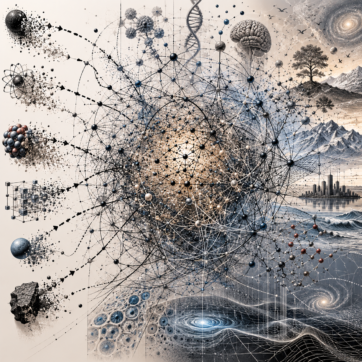
Spirals show up everywhere people look—nature, physics models, cosmology visuals, biological growth. Because both New Age systems and scientific fields detect the same repeating form, it gets elevated as proof of truth. But shared visibility does not mean correct interpretation. It just means it survives translation.
Humans assume that what appears consistently across different domains must be fundamental. They treat repetition as confirmation of origin. But what is actually happening is much simpler and far less mystical: certain patterns persist because they are structurally easy to form under pressure and easy to detect after translation. The spiral is one of those patterns. It holds its shape even when the underlying mechanics are no longer being read directly. So it becomes one of the few things that can pass cleanly through the translation layer and still be recognized on the other side.
Because of that, two very different systems—science and New Age—end up landing on the same visual conclusion while completely misidentifying its meaning. Science sees recurrence and builds models around it. New Age sees recurrence and assigns meaning to it. Both are responding to the same thing: a pattern that survived distortion well enough to remain visible. Neither is asking the correct question, which is not “where do spirals appear?” but “what conditions produce them?”
The problem is that once something becomes widely agreed upon, it gains authority without ever being structurally verified. The spiral becomes more than a pattern—it becomes a symbol, a principle, even a supposed key to understanding reality. Entire systems begin forming around it. In science, it gets embedded into explanations of motion, growth, and large-scale organization. In New Age spaces, it gets elevated into “sacred geometry,” treated as a direct expression of truth, something to emulate, align with, or ascend through.
But agreement across fields does not equal accuracy. It just means both fields are operating from the same limitation: they are reading the output, not the architecture that produced it.
What makes the spiral particularly deceptive is that it carries a built-in illusion of depth. It looks complex. It looks intentional. It looks like it’s going somewhere. So the human system fills in the gap with meaning. Instead of recognizing it as a mechanical outcome, it gets treated as a guiding structure. That is the reversal. The effect becomes the cause. The artifact becomes the blueprint.
And because it appears across scale—from the smallest observable systems to the largest visible formations—it reinforces the belief that it must be fundamental. But scale repetition doesn’t prove origin. It proves that the same constraints are being applied at different levels, producing similar outcomes. That is not truth revealing itself. That is constraint repeating itself.
So the spiral earns its reputation not because it is foundational, but because it is one of the most stable visible results of unresolved motion. It survives compression, distortion, and translation better than most patterns. That’s why it shows up everywhere. Not because it defines reality—but because it is what reality produces when direct pathways are no longer available and movement has to compensate.
And that distinction is where everything begins to separate.
The External Architecture Vs The Eternal — Where Spirals Actually Belong
Before breaking down the spiral structurally, the full architecture it belongs to has to be made completely clear, because this is where nearly every misinterpretation begins. What humans are observing—whether through science, nature, or spiritual systems—is not raw existence itself. It is activity inside a layered external architecture composed of the pre-render, the render, and the mimic overlay, all functioning together as one continuous participation field.
The pre-render is where organization occurs before anything becomes visible. This is where pressure, convergence, pathway formation, and instability accumulate and begin structuring movement before it ever shows up in the visible world. It is not a place, not another realm, but an upstream condition where structural mechanics organize beneath perception.
The render is the visible experiential layer humans interact with and mistake for reality. Everything here is already translated—bodies, events, systems, identities, environments. By the time something is seen, felt, or experienced, it has already passed through multiple layers of conversion. Humans are not reading structure directly. They are interacting with the output of structure.
Then layered across both is the mimic. The mimic does not create the architecture but amplifies it. It increases movement, increases fragmentation, increases emotional throughput, increases symbolic saturation. It keeps participation active when the system weakens. It takes instability and turns it into more engagement rather than resolution.
All three together form the external architecture: a pressure-based, movement-dependent system that cannot stabilize through stillness and therefore must continuously generate motion to maintain temporary coherence.
This is where the spiral lives.
Spiral formations belong entirely to this external architecture. They are expressions of pressure, curvature, torsion, and oscillation interacting under constraint. They are not evidence of origin. They are not evidence of truth. They are not evidence of anything beyond the system. They are evidence of how the system behaves when it cannot resolve.
Now contrast that with what the Eternal actually is.
The Eternal is not another layer within this architecture. Not above it. Not below it. Not hidden behind it. Not a higher frequency or advanced state within the same system. It is completely outside of it. No translation. No render. No pre-render organization. No mimic amplification. None of the mechanics that define the external architecture exist there at all.
No oscillation.
No torsion.
No curvature.
No pressure redistribution.
No geometry formation.
No identity stabilization.
No narrative routing.
No symbolic conversion.
No movement-based coherence.
The Eternal does not need to move in order to hold itself together. That entire condition only exists inside the external architecture because the system itself is structurally unstable and requires constant motion to maintain temporary organization.
This is the exact point where New Age and even scientific interpretation collapse into the same misread.
They observe spirals everywhere inside the external system and assume they must be pointing to something fundamental. Something divine. Something foundational. Something that leads “upward” or “back” to truth. But what they are actually observing is one of the most common outcomes of instability under pressure inside a movement-dependent system.
New Age systems take it further and assign meaning to it. The spiral becomes sacred geometry. A symbol of ascension. A representation of growth, evolution, return, or expansion. People are taught to align with it, meditate on it, embody it, follow it as a pathway toward something beyond.
But there is no pathway to the Eternal through a spiral because the spiral itself belongs to a system the Eternal is not part of.
A spiral cannot lead outside the architecture because it is generated by the architecture.
What gets mistaken as “ascending” through a spiral is actually continued movement within the same system. The radius may expand. The loop may widen. The motion may feel like progression. But it is still bound to the same center, the same pressure condition, the same unresolved pathway that created the rotation in the first place.
Science makes a parallel error in a different language. It sees spirals repeating across scale—fluid systems, atmospheric formations, galaxies—and treats them as universal organizing principles. But again, repetition across scale does not indicate origin. It indicates that the same pressure conditions and constraints are being applied across different environments within the same architecture.
Both are looking at outputs and assigning them foundational status. Neither is separating the external system from what exists outside it.
And this is why the spiral becomes one of the most convincing misreads in the entire field. It is highly visible. Highly repeatable. Structurally stable once formed. It looks dynamic. It looks complex. It looks like it is going somewhere.
But it is not a path. It is a containment pattern. And most importantly, there are no spirals in the Eternal at all.
Because there is nothing there that requires motion to sustain itself, nothing that needs to redistribute pressure, nothing that needs to compensate for blocked pathways, nothing that needs to rotate in order to continue existing.
The spiral only exists where movement is required to maintain coherence.
The Eternal requires none.
What The Spiral Actually Is Structurally
A spiral is not origin, not source, not return. It is curved motion under sustained pressure that does not resolve. That has to be understood cleanly at the pre-render level, before any visual interpretation or symbolic overlay is added. What is being observed as a spiral is the visible result of a pathway that has lost its ability to complete in a direct line and instead begins compensating through curvature.
A pathway in structural mechanics is the directional route through which pressure and movement are able to travel, organize, and resolve within the architecture before any translation occurs. It is not a visual line or imagined track, but a functional opening that either allows movement to complete or restricts it, forcing compensation. When a pathway is open, motion moves through it cleanly and dissipates without distortion, not into true stillness, but out of that pathway without becoming trapped or recycled. When a pathway is partially restricted, movement begins to bend, compress, or redistribute. When it is blocked, the movement cannot complete at all, and instead redirects into curvature, rotation, or looping to sustain itself. Every visible outcome in the render—whether linear motion, collapse, fragmentation, or spiral formation—is the result of how pathways are either available, constrained, or fully obstructed at the pre-render level.
Back to the spiral, movement is meant to follow a pathway that can open, travel, and resolve. When that pathway is clear, motion does not need to bend or loop. It completes. That “completion” does not mean final resolution or stillness—it means the movement passes through without being held in repetition. But when pressure builds within a system and the pathway cannot fully open or cannot discharge what is moving through it, that motion does not disappear. It has to redistribute. The first adjustment is curvature. Instead of moving direct, the pathway begins to bend. That bend is not intentional or meaningful. It is a response to resistance.
As pressure continues to build and the pathway still does not resolve, curvature increases. The motion can no longer sustain even a bent directional line. At that point, it begins to rotate. Rotation is what allows the system to keep moving without needing an exit. It creates internal continuity by turning back into itself rather than completing outward. This is where the spiral begins forming. It is not a designed shape. It is a mechanical outcome of sustained pressure interacting with incomplete pathways.
Once rotation stabilizes, the system locks into a loop. The spiral becomes self-sustaining because the motion feeding it is now cycling instead of resolving. Energy is not leaving the system; it is being redirected within it. This creates the appearance of continuous movement, but structurally nothing is completing. The system is maintaining itself through repetition. That is why spirals can persist for long durations and across different scales. They are stable forms of unresolved motion.
This is contained movement, not free movement. Free movement requires open pathways and completion. A spiral indicates the opposite condition. It shows that something is being held in place while still being forced to move. The curvature and rotation are not expressions of freedom or expansion. They are adaptations to constraint.
There is also a pressure distribution component to this that matters. In a direct pathway, pressure moves through and dissipates. In a spiral, pressure is redistributed along a curved axis and continually fed back into the system. This creates a kind of internal recycling. The center point of the spiral holds the highest compression, while the outer edges carry the extended motion. That gradient is what allows the spiral to maintain itself. But again, this is stabilization, not resolution.
So when a spiral is observed—whether in fluid systems, atmospheric formations, biological growth patterns, or large-scale cosmic structures—it should not be read as a guiding pattern or a return mechanism. It should be read as evidence that motion is being sustained without completion. The system cannot exit, so it curves. It cannot resolve, so it rotates. It cannot stop, so it loops.
That is the actual structure of a spiral before any meaning is placed onto it.
Why The Render Feels Stuck — Motion Without Completion
One of the most consistent experiences humans report is that life, systems, and even personal movement feel stuck, stalled, or unable to truly shift despite constant effort and continuous activity. This gets interpreted emotionally, psychologically, or situationally—people assume they are blocked, unlucky, repeating mistakes, or trapped in circumstances. But structurally, what is being experienced is not a lack of movement. It is movement that cannot complete because the pathways underneath it are not fully open.
Inside the external architecture, pathways determine whether movement can travel, resolve, and exit cleanly. When pathways are available, pressure moves through and dissipates, creating completion. This is not true final resolution or return to stillness—it is movement passing through without being held. But in the render, most pathways are not fully open. They are restricted, fragmented, or partially obstructed at the pre-render level. So movement still enters the system, pressure still builds, action still occurs—but it cannot finish. It has nowhere to fully go.
When movement cannot complete, it does not stop. It compensates.
It bends, loops, cycles, oscillates, repeats. What should have been a direct pathway becomes a recurring pattern. What should have resolved becomes sustained activity. This is why the system feels active yet stagnant at the same time. There is constant motion, but no true discharge.
This shows up across every layer of the render.
At the personal level, individuals repeat emotional cycles, relationship patterns, identity loops, and behavioral responses even when they are aware of them. Effort increases, awareness increases, action increases—but the underlying pathway remains unchanged, so the movement recirculates instead of resolving.
At the societal level, the same conflicts, ideologies, power structures, and breakdown patterns reappear under new names. Generations believe they are facing entirely new problems, yet structurally they are engaging the same unresolved pathways repeating through different forms.
At the system level, everything accelerates. More production, more communication, more stimulation, more information, more reaction. But increased throughput does not create completion. It only increases movement within the same restricted pathways.
This is why modern reality feels exhausting. The system is not still—it is overactive. But that activity is compensatory. It exists to maintain temporary stability in the absence of resolution.
The spiral is one visible expression of this, but it is not the only one. Emotional loops, identity reinforcement, narrative repetition, and oscillating polarity all operate the same way. They are different forms of motion that sustain themselves when pathways cannot complete.
So the sensation of being “stuck” is not about being held in place. It is about being held inside movement that cannot finish.
The architecture substitutes continuation for completion.
It keeps things moving so they do not collapse, but it cannot bring them to resolution because the pathways required for completion are not fully available within the system.
That is the deeper structural condition of the render.
Not stillness. Not true stagnation.
But continuous motion trapped inside incomplete pathways.
Why Pathways Are Not Completing — Compression, Linear Time, And Mimic Amplification
Right now, pathways are not completing at scale because the entire external architecture is operating under intensified compression while simultaneously losing its ability to stabilize that pressure cleanly. This is not isolated to individual experience or specific systems—it is a global structural condition affecting how movement organizes at the pre-render level before anything becomes visible. The result is that more pressure is entering pathways than can be properly distributed, and fewer pathways remain open enough to allow full resolution. So movement is increasing, but completion is decreasing.
Compression is the primary driver of this condition. As compression builds, it reduces the availability of clear pathways by narrowing, distorting, or fragmenting them before movement can travel through. Instead of pressure moving cleanly from entry to resolution, it encounters resistance earlier and more frequently. This forces movement into compensation much faster than it would under lower compression conditions. Pathways that once may have held direction now bend immediately. Pathways that could previously resolve now loop. The system becomes saturated with partially completed movement that continues circulating instead of exiting.
The linear time frame intensifies this even further. Linear time is not how the architecture actually operates—it is how the render organizes perception so the nervous system can process movement sequentially. But as compression increases, more structural activity is occurring simultaneously than the linear system can process coherently. This creates backlog. Convergence builds faster than it can be visibly resolved. Events stack. Pressure accumulates. Movement overlaps. The system appears accelerated, but underneath that acceleration is congestion. Too much is organizing at once, and the pathways required to complete that movement cannot keep up.
So instead of completion, the system defaults to continuation. Movement is kept active, not because it can fully resolve, but because it cannot be allowed to collapse or fully pass through under current conditions.
This is where the mimic layer becomes a critical factor. As the architecture weakens under compression, the mimic responds by amplifying movement in an attempt to maintain coherence. It increases emotional throughput, increases identity engagement, increases narrative cycling, increases stimulation, increases activity across every layer of the render. This creates the appearance of responsiveness, adaptation, and even evolution. But structurally, it is adding more pressure into an already compressed system.
The mimic does not resolve pathways. It feeds them.
It pushes more movement into pathways that are already restricted, already distorted, already unable to complete. This creates additional stress across the architecture. Pathways that might have partially stabilized under lower pressure conditions are forced into collapse or looping more quickly. The system begins holding itself together through increased activity rather than actual structural coherence.
This is why everything feels like it is both intensifying and breaking down at the same time.
More movement. More reaction. More output.
But less resolution. Less completion. Less stability underneath it all.
The mimic is attempting to hold the system together by accelerating participation, but that acceleration is increasing the load on already compromised pathways. It is a short-term stabilization mechanism that deepens long-term instability. The more it amplifies, the more pressure accumulates without release. The more pressure accumulates, the fewer pathways can remain open. And the fewer pathways that remain open, the more the system defaults into looping structures like spirals, oscillation, and repetition.
So pathways are not failing randomly. They are being overwhelmed.
Compression is narrowing them. Linear processing is congesting them. Mimic amplification is overloading them.
And together, this creates a condition where movement cannot complete at the rate it is being generated. The system compensates by keeping everything in motion, but that motion increasingly has nowhere to go.
That is why the render feels like it is accelerating toward something while simultaneously unable to resolve anything.
It is not moving toward completion. It is sustaining itself under conditions where completion is becoming structurally unavailable.
Why Spirals Appear Everywhere In The External Environment
Spiral formation shows up everywhere in the external environment not because it is a designed pattern or a foundational truth, but because it is one of the most reliable outcomes when movement is forced to operate under constraint. The external architecture is not a system built on clean, open pathways that allow direct completion. It is a pressure-based system where movement is constantly interacting with resistance, imbalance, and restriction. Under those conditions, motion does not travel in straight lines for long. It bends, redistributes, and when it cannot resolve, it rotates. The spiral is the visible result of that process repeating across different scales and systems.
In fluid dynamics, this is easy to observe because pressure differentials immediately create instability in flow. When fluid moves from one pressure zone to another, it rarely travels in a perfectly straight, uninterrupted path. Variations in density, velocity, and resistance force the flow to curve. As those curves interact with surrounding pressure, rotational behavior emerges, forming vortices. These vortices are not intentional structures. They are the system’s way of redistributing imbalance while maintaining motion. The spiral shape that forms is simply the most stable configuration that allows the fluid to continue moving without resolving the pressure differential directly.
Atmospheric systems operate on the same principle at a larger scale. Pressure imbalances in the atmosphere do not resolve cleanly because the system is too vast and too dynamic. Instead of direct equalization, the atmosphere redistributes pressure through rotation. Storm systems, cyclones, and large-scale weather patterns form spirals because rotation allows the system to manage imbalance over time rather than resolve it immediately. The spiral becomes a containment and distribution mechanism. It holds the instability in motion rather than eliminating it.
In biological growth, the same constraint-based mechanics apply, but in a different form. Growth does not occur in an unlimited open field. It is constrained by space, resource availability, and structural boundaries. When expansion cannot move outward in a direct, unrestricted way, it begins to curve. This is why shells, plant formations, and certain organic structures take on spiral shapes. The organism is not “choosing” a spiral because it is sacred or optimal in some universal sense. It is growing within constraints, and the curvature allows continued expansion within limited conditions. The spiral is a solution to restriction, not an expression of origin.
At the scale of galactic structures, the same mechanics are present, just operating under massive pressure fields and large-scale containment conditions. Movement at that level does not travel freely in straight lines across open space. It is influenced by distributed pressure, containment forces, and rotational dynamics that stabilize the system over time. The spiral arms of galaxies are not evidence of a cosmic blueprint pointing to some higher truth. They are large-scale rotational containment fields where motion is being sustained within a system that cannot resolve its movement directly. The same pattern appears because the same structural condition exists: pressure interacting with constraint.
Across all of these examples, the underlying principle is the same. The external architecture operates through pressure, not through inherent coherence. Movement is constantly being forced to adapt to conditions that prevent clean resolution. When pathways are not fully open, motion cannot proceed directly. It curves. When curvature cannot resolve, it rotates. When rotation stabilizes, it forms a spiral. This process repeats across every level of the system because the architecture itself is built on these mechanics.
This is why spirals appear everywhere. Not because they are fundamental, not because they are guiding patterns, and not because they reveal the nature of reality at its source. They appear because the environment they exist within is structured around constraint, imbalance, and continuous pressure redistribution. The spiral is simply one of the most stable ways that unresolved movement can persist under those conditions.
What humans are seeing when they observe spirals across nature and the universe is not a hidden truth expressing itself. They are seeing the same structural limitation playing out repeatedly in different forms. The pattern is consistent because the problem is consistent. Movement cannot complete cleanly, so it stabilizes into rotation. And that rotation, when held over time, becomes the spiral that humans then misinterpret as something far more meaningful than it actually is.
Why Science Becomes Fixated On It
Science becomes fixated on spirals because it is built to track what is repeatable, measurable, and consistently observable across environments, and spirals meet all of those conditions extremely well. They are visually trackable in a way most structural mechanics are not. A straight-line movement that completes leaves no persistent form to study, but a spiral holds itself in place long enough to be observed, recorded, and analyzed. This makes it far easier for scientific systems to isolate, measure, and model compared to transient or resolving movement that disappears once it completes.
Spirals can also be mathematically modeled with high reliability. Their rotational behavior, their curvature, and their distribution of motion can be translated into equations that produce consistent results. Science naturally prioritizes patterns that can be converted into stable mathematical frameworks, and spirals provide exactly that. They offer predictable relationships between motion, force, and structure that can be repeatedly tested and confirmed. This reinforces their perceived importance because anything that can be modeled and reproduced begins to carry more weight within scientific understanding.
Another reason for this fixation is that spirals appear across scale, from microscopic systems to large-scale cosmic structures. When the same pattern shows up in fluid behavior, biological growth, atmospheric systems, and galactic formations, it creates the impression that it must be a universal organizing principle. Science interprets cross-scale consistency as evidence of foundational structure. But what is actually being observed is not a shared origin, but a shared condition. The same constraints, the same pressure dynamics, and the same limitations on pathway completion are present at different scales, producing similar outcomes.
Spirals also create predictive patterns that science can use. Rotational systems follow consistent behaviors related to angular momentum, distribution of force, and cyclical motion. These behaviors allow scientists to forecast how systems will evolve over time, which further reinforces the idea that spirals are deeply embedded in how reality organizes itself. The ability to predict strengthens the assumption that the pattern is fundamental, because it appears to govern behavior rather than simply result from it.
Because of all this, science begins to elevate spirals beyond what they actually represent. They are treated as if they are organizing principles, as if they define how systems are built, rather than recognizing them as recurring outcomes that emerge under specific conditions. The distinction is subtle but critical. Spirals are not generating the system. They are being generated by the system when movement is constrained and cannot resolve directly.
So the fixation is not a mistake in observation. The pattern is real, and its consistency is real. The misinterpretation happens in what that consistency is taken to mean. Science sees repetition and assumes origin. It sees predictability and assumes structure. But structurally, spirals are not the blueprint of how movement is meant to occur. They are what happens when the underlying blueprint is no longer being followed or cannot be accessed cleanly due to constraint.
They persist because they are stable under distortion. They repeat because the same conditions keep producing them. They can be modeled because they hold their form long enough to be measured. But none of that makes them fundamental. It makes them visible. And visibility, especially when repeated across scale, is what leads them to be mistaken for something far more foundational than they actually are.
Why New Age Labels It “Sacred”
New Age systems label spirals as sacred because they are not reading structure directly. They are operating almost entirely through translated pattern recognition, where what is seen, felt, or symbolically interpreted becomes the basis for meaning. Instead of identifying the mechanics producing a pattern, the pattern itself is treated as truth. The spiral, because it is so visually consistent and emotionally resonant, becomes one of the most easily adopted symbols within that system of interpretation.
One of the main reasons spirals get elevated is because they feel dynamic. They represent movement without stillness, and within New Age systems, movement is often equated with growth, evolution, or advancement. A spiral never appears static. It continuously curves and extends, which gives the impression of ongoing progression. That sensation alone leads people to associate it with something alive, something active, something “higher,” even though structurally it may be a sign of unresolved motion rather than true development.
The spiral also appears infinite, which makes it especially easy to attach meaning to. Because it loops while expanding, it creates the illusion of endless continuation. It looks like it is always going somewhere, always unfolding, always becoming more. This visual quality gets interpreted as expansion, ascension, or return to some greater truth. But what is actually being perceived is a loop that never resolves, not a pathway that leads beyond the system.
There is also a strong resonance between spirals and human emotional cycles. People experience life in patterns of rise and fall, growth and collapse, repetition and return. When they see a spiral, it mirrors that internal experience. It feels familiar. It feels accurate. So the pattern becomes a reflection of their lived emotional reality, and that reinforces the belief that it must be meaningful at a deeper level. The external pattern and internal experience align, even though both may be operating within the same unresolved structural conditions.
Spirals are also extremely easy to symbolize and repeat. They can be drawn simply, recognized instantly, and embedded into art, teachings, and practices without needing complex explanation. This makes them highly transferable across systems. Once labeled as sacred geometry or divine pattern, they spread quickly and become reinforced through repetition. The more they are used, the more they appear significant, and the more significance is attributed to them.
Because of all this, the spiral becomes a container for meaning. It is used to represent growth, evolution, consciousness, energy flow, ascension, and countless other concepts. But in that process, the original structural condition that produced the spiral is lost. The pattern is no longer being read as an outcome of constraint and unresolved movement. It is being treated as a signal of truth.
So the misinterpretation does not come from seeing the spiral. It comes from assigning meaning to it without understanding the mechanics behind it. The spiral is not being detected as structure. It is being used as symbolism. And once it becomes symbolic, it can carry any meaning the system projects onto it, regardless of what it actually represents at the structural level.
The “Ascension Spiral” Misinterpretation
One of the most persistent misinterpretations surrounding spirals is the claim that they represent upward evolution or ascension, as if following a spiral pattern leads movement out of the system toward something higher or more advanced. This belief forms because the spiral visually suggests progression. It expands outward, it appears to rise, and it gives the impression of moving beyond where it started. But this is a surface-level reading based on appearance, not on the underlying structure of what the spiral is actually doing.
Structurally, a spiral can expand outward, but it does so while remaining bound to its central axis. The movement never disconnects from the original point of rotation. It does not break away, it does not exit, and it does not resolve beyond the system that generated it. Instead, it continues circling while gradually widening its radius. This creates the illusion of moving forward or upward, when in reality the motion is still anchored to the same unresolved center.
This is the critical distinction that gets missed. True exit or completion would require movement to leave the system entirely or resolve the pressure that initiated the motion in the first place. A spiral does neither. It sustains movement by looping around the same core condition. The expansion outward does not represent transcendence. It represents the system finding more space to continue the same motion without resolving it.
So what is often perceived as ascending is actually an increase in the radius of the same cycle. The pattern grows, the loop widens, and the experience changes in scale, but the underlying structure remains the same. The system has not moved beyond its original condition. It has simply stretched it.
This is why people can feel like they are progressing while still repeating patterns. The experience shifts, the context evolves, and the loop appears more complex or more expanded, but the core pathway has not completed. The same dynamics reappear in new forms because the central axis of the spiral has never been resolved.
The misinterpretation happens because outward expansion is equated with advancement. Movement is equated with evolution. But within the structure of a spiral, movement is being sustained, not completed. It is continuation within the system, not exit from it. So what gets labeled as ascension is often just a more extended version of the same unresolved motion, giving the feeling of progress without the structural reality of having moved beyond the cycle at all.
Movement Mistaken For Evolution — How Belief Systems Trap The Spiral
One of the most reinforcing distortions that comes out of the spiral misidentification is the assumption that movement itself equals evolution. As long as something is changing, shifting, expanding, or progressing in some visible way, it gets labeled as growth. But within the structure of a spiral, movement is not completing. It is being sustained. It is continuation within the same system, not exit from it. And that exact misread is what drives the endless cycling of belief systems across the render.
Every belief system humans engage with—spiritual, religious, ideological, psychological, conspiratorial, scientific—exists fully inside the external architecture. None of them are describing the Eternal because they are all formed through translation. They are all interpreting patterns, experiences, and structures that originate within the render and attempting to explain them using symbolic frameworks, narratives, and identity constructs. What gets presented as truth is almost always a reinterpretation of external architecture, not a direct recognition beyond it.
Because of this, people move through belief systems the same way movement travels through a spiral. They enter one framework, invest in it, build identity around it, extract meaning from it, and feel a sense of progress while inside it. Over time, limitations appear. Contradictions surface. The system no longer holds the same level of coherence. So they exit—but not out of the architecture. They move laterally into another system. Another framework. Another explanation. Another identity.
From the inside, this feels like evolution. It feels like growth, like refinement, like getting closer to truth. But structurally, it is the same pattern repeating. The center point—the unresolved condition driving the search—remains untouched. The person is not exiting the system. They are expanding the radius of the same loop, moving from one interpretation to another while staying bound to the same underlying structure.
This is why belief systems across the render look so different on the surface but operate almost identically underneath. One person cycles through religion, then rejects it for spirituality. Another moves from spirituality into manifestation systems. Another shifts into conspiracy frameworks. Another into scientific materialism. Another into hybrid systems that combine all of them. The content changes, the language changes, the symbols change, but the mechanics remain the same: interpretation, identity formation, emotional investment, and continued seeking.
Each system reinforces the idea that movement within it is progress. Learn more, go deeper, expand awareness, raise frequency, evolve understanding, refine belief. But all of this movement is still happening inside translation. None of it resolves the underlying structural condition because none of it steps outside the architecture generating the experience in the first place.
So people get pulled from one system to another, not because they are failing, but because the system itself is designed to sustain movement. When one loop weakens, another forms. When one identity collapses, another is constructed. When one explanation no longer satisfies, another takes its place. The spiral continues, widening, extending, giving the appearance of advancement while maintaining the same fundamental condition.
This is why none of these systems ever fully resolve anything at a structural level. They can shift perception, they can reorganize experience, they can provide temporary stability or meaning, but they do not complete the pathway. They reinterpret it. They redirect it. They sustain it.
And that is the key distinction. Movement inside the system is not evolution beyond it. It is continuation within it. The spiral of belief systems is not leading outward. It is circulating through different forms of the same unresolved condition, reinforcing the idea of progress while keeping the movement contained inside the architecture itself.
Containment Disguised As Expansion
The spiral is convincing because it gives the appearance of going somewhere. It extends outward, it continues moving, and it never appears to stop. To the human system, this reads as growth. Outward motion gets interpreted as expansion. Continuous motion gets interpreted as advancement. Repetition, especially when it appears to evolve in form or scale, gets interpreted as deepening. The visual and experiential cues all point toward progression, so the mind assigns meaning accordingly.
The system equates visible change with actual movement beyond the original condition. As the spiral widens, it feels like distance is being created from the starting point. As it continues moving, it feels like time and effort are producing forward momentum. As patterns repeat with variation, it feels like layers are being added and understanding is increasing. All of this reinforces the belief that the spiral represents a path of development.
But structurally, none of that is what is actually happening. The spiral is recycling the same pathway. The motion is not leaving the original condition; it is circling it. The center point, which holds the unresolved pressure that initiated the movement, remains active. Every rotation is still connected to that center. The outward expansion does not break that connection. It only distributes the movement over a larger area while keeping it bound to the same axis.
At the same time, the spiral is stabilizing unresolved pressure. Instead of allowing that pressure to discharge and complete, the system redirects it into continuous motion. The rotation absorbs the pressure and keeps it circulating. This creates stability, but it is a stability based on ongoing movement, not resolution. The system holds itself together by keeping the motion active rather than allowing it to finish.
So what appears as expansion is actually containment. The spiral maintains motion without allowing completion. It creates the experience of movement, growth, and progression, while structurally holding the system within the same unresolved condition. The pathway is not changing. It is being repeated in a different configuration.
This is why the spiral is so easily misinterpreted. It aligns perfectly with how humans perceive progress, but it operates on a completely different structural basis. What is being experienced as forward movement is actually sustained containment, where motion continues but the underlying condition never resolves.
The Emotional And Identity Hook
The spiral maps almost perfectly onto human experience, and that is why it becomes so deeply embedded and reinforced. People do not just see the spiral externally—they feel it internally. Healing processes often unfold in loops where the same emotional material resurfaces again and again with slight variation. Relationship dynamics repeat in cycles, even when the individuals or circumstances change. Patterns labeled as “lessons” appear to return at what feels like different levels of awareness. Personal growth gets framed as moving through stages that seem to revisit the same themes with increasing depth. All of this mirrors the structure of a spiral, where movement continues but remains tied to a central axis.
Because of this alignment, the spiral becomes more than a pattern. It becomes a framework people use to explain their own experience. When someone goes through repeated cycles but feels some degree of change each time, it is easy to interpret that as progression along a spiral rather than recognition of an unresolved pathway. The idea of “lessons repeating at higher levels” reinforces this. It suggests that repetition is not a failure to complete but a sign of advancement, which shifts the interpretation entirely. Instead of questioning why the movement is not resolving, the repetition itself becomes validated.
This creates a powerful psychological reinforcement loop. The more someone experiences repetition with variation, the more they believe that is how reality is supposed to function. The spiral becomes normalized as the structure of growth, rather than being recognized as a structure of unresolved motion. Identity begins to organize around this belief. People see themselves as evolving through cycles, progressing through layers, deepening through repetition. That identity stabilizes the pattern instead of challenging it.
Over time, this builds into a broader assumption that reality itself operates this way. The spiral is no longer just a pattern observed in nature or personal experience. It becomes a model for how life, development, and even truth are understood. But what is actually being reinforced is not the natural structure of reality. It is the persistence of distortion over time. The system is maintaining unresolved pathways by cycling movement through them, and the human experience of that cycling gets interpreted as meaningful progression.
So the hook is not just visual or conceptual. It is experiential. The spiral fits the way people already experience repetition, emotion, and identity formation. That makes it feel accurate, and that feeling of accuracy reinforces it further. But structurally, what is being mirrored is not growth beyond the system. It is the system sustaining itself through repeated movement that never fully completes.
How The Mimic Uses The Spiral
The mimic does not selectively use the spiral as a special structure. It does not target it, prefer it, or operate through it in isolation. The mimic amplifies everything. That is its function. It increases pressure, increases throughput, increases fragmentation, and increases movement across the entire architecture simultaneously. The spiral becomes prominent within that amplification not because the mimic is choosing it, but because the spiral is one of the most stable outcomes when pressure is intensified and pathways cannot complete.
As the mimic amplifies, more pressure is pushed into already restricted pathways. Movement enters faster, accumulates faster, and has less capacity to resolve. Under those conditions, straight-line movement cannot hold for long, curvature cannot complete, and the system drops into rotational stabilization more frequently. The spiral shows up more often simply because the system is being driven harder into the exact conditions that produce it.
So the mimic is not creating spirals directly. It is amplifying the environment that generates them. It increases compression, increases oscillation, increases load on pathways, and reduces the system’s ability to resolve movement cleanly. As that happens, more motion becomes trapped, more pathways fail, and more rotation forms as a way to sustain that unresolved movement.
At the same time, everything else is being amplified too. Linear attempts are amplified. Curvature is amplified. Oscillation is amplified. Fragmentation is amplified. The entire system becomes louder, faster, and more saturated. The spiral stands out within that because it holds. It persists. It stabilizes motion in a way other forms cannot under heavy pressure, so it becomes more visible as everything intensifies.
This is why the spiral appears dominant in experience during high amplification phases. Not because it is being specifically used, but because it is what remains stable when everything else is being pushed beyond its capacity to resolve. The mimic increases the volume of the entire system, and the spiral is one of the clearest structures that can still hold under that volume.
So the relationship is simple once it is seen cleanly. The mimic amplifies everything. The spiral appears more because amplification creates more unresolved movement. And unresolved movement stabilizes into rotation.
Curvature vs Rotation — The Last Point Before Locking Into Loops
Inside this system, nothing resolves and nothing returns to stillness, so the only real distinction is what the movement is doing under pressure. Curvature is what shows up when movement is still being pushed forward, even under strain. It bends because it has to, not because it is aligned or optimal. The pathway is already under pressure, already compensating, but it has not collapsed. The movement is still being carried through, even if it is distorted and inefficient.
That condition does not last long when compression increases. The bend tightens, pressure builds along that curve, and the system reaches a threshold where it can no longer keep pushing forward. That is where the shift happens. The movement stops traveling through and starts turning back into itself. This is the point where rotation takes over. The pathway is no longer functioning as a path. It becomes a loop.
Once rotation stabilizes, the system is no longer even attempting forward movement. It is maintaining motion by circulating the same pressure over and over. That is the spiral. It is not movement going somewhere. It is movement being held in place by continuous turning.
So the difference is not about resolution or higher states. It is about whether movement is still being forced forward or whether it has already been trapped. Curvature is the edge condition where the system is still trying to push through. Rotation is what happens when that fails and the system locks into repetition to keep itself from collapsing.
Everything people experience as cycles, repetition, patterns that won’t break, all sits in that rotational state. And everything that feels strained but still moving forward sits in that curved state just before it.
Why It Gets Mistaken For “The Nature Of Reality”
Spirals get mistaken for the nature of reality because most people are not reading structure at the level where it is actually organizing. They are not detecting what is happening in the pre-render. They are not seeing how pressure moves, how pathways hold or fail, or how motion is being forced to compensate under constraint. What they are seeing are the outcomes after all of that has already occurred. By the time something becomes visible, it has already been translated, shaped, and stabilized into a form the system can recognize.
So perception is locked onto the result, not the process. People see patterns that persist, patterns that repeat, patterns that hold their shape long enough to be observed and remembered. The spiral becomes one of the most obvious of these because it does not disappear. It remains. It shows up again and again across different systems, scales, and environments. That repetition creates a sense of reliability, and reliability gets interpreted as truth.
At the same time, most people rely on visual confirmation to determine what is real or important. If something can be seen consistently, if it appears in multiple places, if it can be pointed to and recognized, it gains authority. The spiral meets all of those conditions. It is easy to identify, easy to recall, and easy to compare across different contexts. So it becomes one of the most reinforced patterns in perception.
Because of this, the most visible recurring pattern starts to be labeled as fundamental. The logic becomes simple: if it is everywhere, it must be the underlying structure of everything. But what is actually being observed is not the foundation of the system. It is one of the most persistent outputs the system produces when it cannot complete movement cleanly.
That distinction gets lost because the system is being read from the outside in. Instead of tracing back to the conditions that generate the pattern, the pattern itself becomes the explanation. The spiral becomes the answer rather than the question.
So it is not that spirals define reality. It is that they are one of the most stable artifacts of unresolved motion within it. They persist because the conditions that create them persist. They repeat because the system continues to operate under constraint. And because they remain visible while other forms of movement pass through and disappear, they become the easiest thing to mistake for something foundational.
The Core Misidentification
The core misidentification is simple but absolute. The spiral is a process, not an origin, not an endpoint, and not a pathway out of the system. It does not point back to where anything began, it does not lead forward to where anything resolves, and it does not provide a route beyond the architecture that produced it. It is movement being sustained under conditions where direct pathways are no longer available.
What gets mistaken is the role the spiral is playing. Because it persists, because it repeats, and because it appears to expand, it gets treated as if it contains direction or meaning. But structurally, it is not directing anything. It is maintaining motion when movement cannot proceed cleanly. It is a compensation mechanism, not a guiding structure.
When direct pathways are open, movement does not spiral. It moves through and is gone. There is nothing left behind to study, repeat, or symbolize. The spiral only forms when that direct condition is unavailable. It is what happens when pressure enters a system, cannot complete its path, and is forced to keep moving anyway. The system bends, tightens, and eventually turns that movement back into itself to prevent collapse.
So the spiral is not showing where something is coming from or where it is going. It is showing that the system cannot do either cleanly. It is the visible result of movement that has lost access to direct passage and has shifted into self-sustaining rotation instead.
That is the misidentification. The spiral gets elevated into meaning, when in reality it is a sign of limitation. It gets treated as a pathway, when in reality it forms because pathways are no longer available.
Closing — Why This Matters
This matters because as long as the spiral is treated as sacred, as a guiding structure, or as a pathway forward, the entire system continues reinforcing the wrong direction of interpretation. Looping gets mistaken for progress because movement is visible and continuous. Containment gets mistaken for expansion because the pattern widens and appears to extend outward. Repetition gets mistaken for evolution because the same cycles return with variation, giving the impression of change without altering the underlying condition.
Once that misidentification locks in, everything built on top of it follows the same distortion. People begin to trust repetition as a sign of advancement. They begin to interpret cycles as necessary growth. They begin to orient toward patterns that are actually holding movement in place, believing those patterns are leading somewhere. The system sustains itself through that belief because engagement continues. Movement continues. Nothing resolves, but everything appears to be moving.
The shift only happens when the spiral is seen for what it actually is. Not a path, not a signal of higher structure, and not a return to anything beyond the system. It is stabilized rotation inside constraint. It is what holds movement when it cannot pass through. It is what forms when pathways are unavailable and pressure is forced to keep moving without resolution.
Once that is recognized cleanly, the meaning drops away. The pattern is no longer something to follow or interpret as guidance. It becomes an indicator of condition. It shows where movement is being held, where pathways are restricted, and where the system is compensating instead of resolving. And that changes how everything built on top of it is read moving forward.