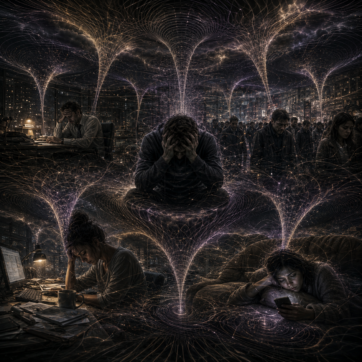
Why identity, time, memory, history, and storyline persistence are required for the external architecture to maintain render coherence
Humans Mistake Continuity For Ultimate Reality
Most humans never question continuity itself because continuity is the very mechanism through which the render maintains the appearance of stable reality. From birth, humans are conditioned to experience existence as one apparently connected sequence moving from past to present to future in orderly progression. The nervous system assumes continuity is natural because the body-interface only perceives reality through stabilized sequential organization. A child grows into an adult. Yesterday appears to lead into today. Memories appear connected to identity. History appears to move civilization forward through linear progression. Relationships appear to develop through accumulated shared experience over time. Everything inside the render reinforces the sensation that reality itself is inherently singular, stable, and continuously unfolding in one connected direction.
But continuity is not merely passive experience. It is one of the primary stabilization mechanics of the external architecture itself. The render depends upon continuity in order to prevent perceptual fragmentation. Without continuity stitching, the human nervous system would not experience reality as one stable world. It would experience overwhelming discontinuity, overlapping probability structures, unstable identity perception, memory incoherence, and severe fragmentation between experiential sequences. Continuity acts as the compression bridge that organizes enormous amounts of routed probability into a narrow enough corridor for the body-interface to maintain participation without collapse.
This is why continuity exists everywhere humans look. Identity depends upon continuity. Governments depend upon continuity. Historical narratives depend upon continuity. Social order depends upon continuity. Financial systems depend upon continuity. Family systems depend upon continuity. Language itself depends upon continuity. Even memory functions through continuity reinforcement. Humans believe they are the same person from childhood through adulthood because continuity stitching continuously reinforces identity persistence across changing bodily states, emotional states, and environmental conditions. The architecture must constantly maintain this sequential coherence underneath perception for the render to remain experientially stable.
Humans mistake stabilized continuity for proof that reality itself is fixed and singular. But continuity is being actively maintained underneath perception at all times. The render is not naturally stable on its own. Stability is continuously produced through ongoing continuity routing occurring between the nervous system, environmental structures, emotional patterning, collective storyline reinforcement, identity stabilization, and deeper pre-render organizational mechanics simultaneously. The human body does not perceive the enormous amount of organizational compression occurring beneath ordinary experience because continuity itself filters reality into manageable sequential flow.
This is also why disruptions to continuity feel so destabilizing to humans. Memory loss, sudden trauma, timeline disorientation, major societal shifts, relationship collapse, historical contradictions, identity breakdowns, and periods of rapid technological or cultural acceleration create intense destabilization because they interrupt continuity reinforcement patterns the nervous system depends upon to maintain reality coherence. Humans often describe these periods as feeling “unreal” because continuity stitching temporarily weakens enough for instability underneath the render to become more visible.
Most humans assume reality is fundamentally made of objects, places, and events. But at a deeper architectural level, the render depends just as heavily upon continuity stabilization itself. Continuity is one of the primary mechanisms through which the external architecture transforms overwhelming simultaneous organizational complexity into the appearance of one stable lived reality.
Continuity Is The Glue Holding Sequential Reality Together
Continuity is the stitching mechanism that binds isolated experiential moments into the appearance of one coherent reality. Humans assume moments naturally connect because the nervous system only perceives reality after continuity organization has already occurred. But the render is not simply “happening” passively in front of the observer. The architecture is continuously routing, narrowing, sequencing, and stabilizing overwhelming organizational complexity into a corridor narrow enough for the body-interface to process without fragmentation. What humans call ordinary reality is already continuity-filtered reality.
The render cannot present simultaneous organizational structure all at once to the nervous system because the body-interface would not interpret it as coherent existence. It would resemble instability, overlap, contradiction, disorientation, and perceptual collapse. The architecture therefore compresses vast amounts of routed probability, environmental interaction, emotional patterning, memory reinforcement, and identity stabilization into sequential continuity flow. This produces the sensation that one moment smoothly leads into the next moment through linear progression. Humans experience continuity as obvious because the stitching process itself is mostly hidden underneath perception.
This is why humans perceive causality so rigidly. Continuity creates the sensation that one event directly caused another event in perfectly ordered sequence. A conversation appears to lead to a relationship. A decision appears to create a future outcome. Childhood appears to evolve into adulthood through uninterrupted progression. Historical events appear chained together through logical development over time. But much of what humans interpret as stable linear causality is actually continuity routing stabilizing experiential coherence after enormous amounts of organizational compression have already occurred underneath visible reality.
The nervous system depends upon continuity stitching to maintain identity persistence. Without continuity reinforcement, humans would not experience themselves as one stable “self” moving through time. They would experience discontinuous fragments lacking coherent narrative linkage. Identity itself is heavily continuity-dependent. The sensation that “I am the same person I was yesterday” is continuously stabilized through memory stitching, bodily continuity, emotional continuity, environmental continuity, and narrative continuity simultaneously. The architecture must maintain these links constantly in order for the render to feel stable enough for participation.
This is also why continuity breakdowns feel deeply destabilizing to the human system. During periods of extreme compression, continuity stitching can weaken temporarily. Humans then report experiences such as time distortion, dissociation, reality confusion, memory instability, emotional fragmentation, derealization, or the sensation that life no longer feels fully sequential or real. These moments expose how much active stabilization is normally occurring underneath ordinary perception. The render only appears naturally stable because continuity mechanisms continuously hold fragmentation beneath the threshold of conscious awareness.
Without continuity stitching, the render would appear radically different to the nervous system. Reality would no longer seem singular and sequential. Humans would perceive overlapping experiential structures, unstable identity organization, fragmented memory sequencing, contradictory probability impressions, and fluctuating environmental coherence. The world would not appear as one smooth uninterrupted reality corridor. It would appear structurally unstable and difficult to organize into consistent participation.
Continuity therefore functions as one of the primary load-bearing systems of the external architecture. It is the glue holding sequential reality together long enough for identity, civilization, memory, emotional attachment, social order, and storyline participation to remain coherent inside the render.
Why Identity Depends Upon Continuity
Identity itself is continuity-based. Humans do not experience selfhood as one static fixed structure existing independently from time. They experience selfhood through accumulated sequential reinforcement. The nervous system continuously organizes experience into a coherent storyline stable enough to maintain participation inside the render. What humans call “identity” is largely the result of continuity stitching being repeatedly compressed into one persistent narrative structure over time.
A human knows their name because continuity reinforces it constantly. A human recognizes family, history, relationships, memories, trauma, preferences, beliefs, achievements, failures, and social roles because the architecture continuously sequences those experiences into organized narrative persistence. The body-interface then interprets that continuity compression as “me.” Identity is therefore not simply personality or self-expression. It is one of the primary continuity stabilization mechanisms operating inside the render.
This is why humans instinctively organize life through remembered sequence. The nervous system constantly builds continuity chains:
this happened to me,
this changed me,
this explains me,
this is what I believe,
this is what I fear,
this is my purpose,
this is my future,
this is my story.
Without this ongoing continuity reinforcement, identity coherence begins weakening. The render depends upon stable identity participation because identity itself functions as a continuity anchor between the body-interface and sequential reality organization. Humans are not merely remembering events. They are continuously constructing stabilized continuity corridors that allow them to maintain a coherent sense of self while moving through changing environmental conditions.
This is also why memory carries such enormous structural importance inside the render. Memory is not simply information storage. Memory functions as continuity reinforcement architecture. The nervous system repeatedly references prior experiences in order to maintain self-sequencing stability. Humans constantly compare present experience against continuity records from the past to stabilize identity persistence across time. This is why severe memory disruption often creates profound identity destabilization. When continuity sequencing weakens, the self-structure itself begins fragmenting because identity depends heavily upon remembered continuity linkage.
The same mechanics operate collectively. Nations maintain identity through historical continuity. Religions maintain identity through doctrinal continuity. Families maintain identity through generational continuity. Political systems maintain identity through ideological continuity. Careers maintain identity through professional continuity. Even social media functions heavily through continuity projection, where humans repeatedly reinforce identity through visible storyline repetition over time. The render continuously pressures humans to maintain coherent narrative consistency because continuity stabilization is necessary for participation.
This is why periods of instability often trigger extreme defensive behavior around identity structures. When continuity pressure increases globally, humans instinctively cling harder to routines, tribes, belief systems, political identities, relationships, professional roles, and personal narratives. The deeper reason is not merely emotional attachment. The nervous system is attempting to preserve continuity coherence itself. Humans defend identity because identity acts as one of the primary stabilization bridges preventing fragmentation underneath increasing architectural pressure.
This also explains why humans become deeply distressed when major continuity anchors collapse. Divorce, job loss, ideological collapse, relocation, social exile, betrayal, public humiliation, institutional distrust, or rapid cultural transformation destabilize identity because they rupture continuity reinforcement patterns the nervous system depended upon to maintain self-coherence. Humans often interpret these moments as “losing themselves” because, structurally, continuity compression sustaining identity has partially fractured.
At the deepest level, identity is one of the render’s most effective continuity management systems. The architecture continuously narrows overwhelming organizational complexity into one stabilized narrative corridor the human nervous system can identify as “my life.” Humans then mistake that continuity-managed storyline for ultimate selfhood itself.
Time As A Continuity Interface
Humans are taught to think of time as an independent force moving universally through reality, as though existence itself naturally unfolds in one forward-moving sequence. But inside the render, time functions far more as a continuity-routing mechanism than humans realize. The experience of time is deeply tied to how the external architecture stabilizes sequential perception through the body-interface. What humans experience as linear time is heavily connected to continuity management occurring underneath ordinary awareness.
The nervous system cannot process overwhelming simultaneous organizational complexity directly while maintaining stable participation inside the render. If the body-interface perceived enormous overlapping probability structures all at once without continuity narrowing, ordinary experiential coherence would collapse. The architecture therefore phase-locks continuity gradually enough for the nervous system to interpret existence as one smooth unfolding sequence. Humans then experience this stabilization process as time itself.
This is why humans experience reality through ordered progression rather than simultaneous perception. Continuity sequencing creates the sensation that events move from one state into another through forward development. A child becomes an adult. Civilizations appear to evolve historically. Relationships appear to deepen over time. Cause appears to produce effect in orderly sequence. Memory appears positioned behind the present while possibility appears positioned ahead of it. The nervous system interprets continuity sequencing as temporal movement because the architecture stabilizes reality through sequential organization rather than simultaneous experiential exposure.
Time inside the render therefore acts as a perceptual management system. It organizes continuity flow slowly enough for identity persistence to remain stable while enormous amounts of routed probability continue operating underneath visible reality. Humans mistake this managed sequencing for proof that reality itself fundamentally exists as linear forward movement. But much of what humans call “time” is actually continuity compression translated into experiential progression.
This is also why humans experience time differently depending upon continuity pressure. During periods of strong continuity stabilization, time appears orderly, measurable, and predictable. But when continuity compression intensifies, humans often report time acceleration, temporal distortion, memory compression, disorientation, or the sensation that years are passing unusually fast. These experiences reflect instability in continuity perception itself. The nervous system begins struggling to maintain smooth sequential organization while larger architectural pressure increases underneath the render.
The same mechanics explain why traumatic experiences often distort time perception. During extreme compression events, ordinary continuity sequencing can partially destabilize. Moments may feel stretched, fragmented, slowed, accelerated, or disconnected because the body-interface is no longer processing continuity flow in its usual stabilized pattern. Humans then experience distortions in temporal perception because time and continuity management are deeply interconnected inside the architecture.
Historical progression itself also depends heavily upon continuity sequencing. Civilizations organize collective identity through temporal continuity. Societies construct coherent historical narratives linking generations together through sequential interpretation. Humans are taught to perceive civilization as moving through orderly advancement from past into future because continuity stabilization requires collective storyline persistence at the societal level as well. Entire institutions exist largely to reinforce temporal continuity: education systems, governments, religions, media structures, historical archives, economic systems, and cultural traditions all help stabilize collective continuity perception across generations.
At a deeper architectural level, time is not merely “passing.” The render is continuously organizing continuity corridors stable enough for identity participation to remain coherent. Humans then interpret that continuity organization as linear temporal existence. The experience of time is therefore inseparable from continuity management itself. Without continuity sequencing, the sensation of stable linear time would not exist in the way humans currently experience it inside the render.
Pre-Render Organization And Continuity Routing
One of the biggest misunderstandings humans have about reality is assuming continuity originates entirely inside the visible world itself. Most people believe reality simply exists physically “out there” and unfolds naturally through linear progression. They assume events happen directly inside the visible environment and that continuity is merely the passive result of physical processes interacting over time. But continuity does not originate solely at the visible render level. The visible world humans experience is already downstream translation from much deeper organizational mechanics operating underneath ordinary perception.
At the pre-render level, enormous amounts of organizational routing are continuously occurring before experience fully stabilizes into rendered reality. Massive overlapping probabilities, identity pathways, environmental configurations, emotional patterning systems, collective storyline pressures, relational intersections, social movements, institutional trajectories, and continuity sequencing structures are all being continuously organized simultaneously. Humans do not perceive this entire organizational layer directly because the body-interface could not maintain coherent participation while exposed to overwhelming simultaneous routing complexity. The render therefore narrows this organizational field into stabilized experiential corridors manageable enough for sequential perception.
This is where continuity routing becomes critical. Pre-render organization continuously phase-locks routed probabilities into continuity pathways stable enough to maintain identity participation and render coherence. The visible world humans experience is not the totality of organizational reality itself. It is the translated expression of continuity stabilization occurring underneath perception. Humans experience the downstream result after massive amounts of routing compression have already occurred.
This is why life often feels strangely coordinated in ways humans struggle to fully explain. Certain relationships emerge at precise moments. Entire societies shift direction collectively. Emotional climates spread across populations. Historical eras stabilize around dominant narrative structures. Opportunities appear and disappear in strange timing patterns. Large groups move into similar behavioral loops simultaneously. Humans often interpret these experiences mentally, spiritually, politically, or randomly because they only perceive the rendered output rather than the deeper continuity-routing structures organizing underneath the visible layer.
The architecture continuously organizes experiential continuity corridors before humans consciously interpret them. What appears as ordinary linear life inside the render is actually the stabilized expression of immense pre-render organizational compression. This does not mean every detail is rigidly predetermined in simplistic mechanistic fashion. Rather, it means the render is constantly narrowing overlapping routed possibilities into stabilized experiential pathways strong enough for continuity participation to remain coherent.
This is also why humans frequently sense instability before visible reality fully changes. At the pre-render level, continuity pressure often shifts before the rendered environment fully reorganizes downstream. Humans may feel growing societal tension, emotional compression, timeline acceleration, identity destabilization, or the sensation that “something is changing underneath reality” long before external events visibly manifest. The nervous system often detects continuity pressure changes before the render fully translates them into visible sequential experience.
The same mechanics operate collectively. Entire civilizations stabilize through continuity-routing structures operating far deeper than surface politics or social behavior alone. Historical progression, economic movement, technological acceleration, media cycles, ideological polarization, and cultural transformation all emerge through large-scale continuity organization occurring across collective render participation simultaneously. Humans then experience the visible expression of those continuity pathways as ordinary history unfolding through time.
Most humans only perceive the rendered corridor they are currently participating within. They experience stabilized continuity after organizational routing has already compressed overwhelming simultaneous structure into manageable sequential reality. This is why humans mistake the visible world for total reality itself. They experience the final translated continuity corridor rather than the full architectural organization underneath it.
The visible render is therefore not the origin point of continuity. It is the stabilized experiential expression of deeper pre-render continuity routing continuously operating beneath ordinary human perception.
Why Storylines Exist Everywhere In Human Civilization
Storyline is continuity architecture translated into culture. Humans often believe stories exist merely for entertainment, emotional expression, education, or social bonding, but narrative runs far deeper inside the render than most realize. The external architecture itself stabilizes through continuity sequencing, and storyline becomes one of the primary ways that continuity is reinforced at the human level. The render does not simply contain stories. The render itself operates through narrative organization.
This is why storyline structures appear absolutely everywhere across human civilization regardless of culture, geography, religion, or historical period. Movies, mythology, religion, politics, history, journalism, social movements, family systems, education, celebrity culture, relationships, national identity, corporate branding, and even personal self-concept all stabilize through narrative continuity. Humans continuously organize reality into story because the nervous system depends upon continuity sequencing to maintain coherent participation inside the render.
The human mind instinctively attempts to convert overwhelming complexity into understandable narrative progression. Events become “journeys.” Trauma becomes “backstory.” Nations become “heroes” or “victims.” Political systems become moral dramas. Religions become salvation narratives. Relationships become love stories. Careers become personal arcs of success or failure. Even ordinary memory functions largely through storyline compression, where disconnected experiences are continuously reorganized into coherent personal narrative structure.
Humans are drawn to narrative because the render itself is continuity-based. Storyline allows the nervous system to emotionally stabilize sequential experience across time. Without narrative organization, reality would feel fragmented, random, disconnected, and difficult for the body-interface to maintain mentally and perceptually. Storylines compress complexity into manageable continuity corridors the nervous system can emotionally attach to and interpret as meaningful participation.
This is also why humans become deeply emotionally invested in narratives even when they know intellectually they are fictional. Movies, television series, novels, online personalities, political movements, celebrity scandals, and collective cultural dramas all temporarily become continuity participation systems. Humans emotionally attach because storyline continuity reinforces the same stabilization mechanisms the nervous system already uses to maintain identity coherence inside ordinary life.
The same mechanics operate collectively across civilization itself. Entire societies stabilize through shared continuity narratives. National histories create continuity between generations. Religious doctrines create continuity between cosmic meaning and personal existence. Political ideologies create continuity between identity and societal structure. Family systems create continuity through ancestry and relational inheritance. Media systems continuously reinforce continuity through ongoing narrative sequencing of world events. Humans do not merely consume stories. Civilization itself stabilizes through shared storyline participation.
This is why disruptions to storyline continuity create enormous instability both individually and collectively. When a personal narrative collapses, humans often experience identity destabilization because continuity compression sustaining selfhood has fractured. When institutional narratives collapse, societies experience confusion, polarization, fear, and social fragmentation because continuity stabilization at the collective level weakens simultaneously. Humans instinctively rush to restore narrative coherence whenever continuity disruption increases because the nervous system depends upon storyline sequencing to maintain reality participation.
This is also why modern media systems have become so structurally powerful. Continuous narrative reinforcement stabilizes collective continuity perception across enormous populations simultaneously. News cycles, political polarization, ideological conflicts, social outrage, celebrity narratives, crisis narratives, conspiracy narratives, and identity narratives all function as continuity management systems maintaining emotional participation inside the render. Humans often believe they are merely “following current events,” while at a deeper level they are continuously participating in collective continuity stabilization mechanisms.
At the deepest architectural level, storyline exists because continuity itself is one of the render’s primary load-bearing systems. Humans do not simply invent narratives accidentally. They continuously reproduce narrative structures because the external architecture organizes reality through continuity sequencing, and storyline becomes the cultural translation layer through which humans emotionally stabilize participation inside that continuity-managed world.
Continuity Collapse And The Modern World
Many of the symptoms humans are currently experiencing across the modern world are not isolated mental problems, random societal trends, or merely the result of technological overstimulation alone. At a deeper architectural level, much of what humanity is now experiencing reflects continuity destabilization occurring across the render simultaneously. The continuity stitching holding sequential reality perception together is under increasing pressure, and humans are beginning to feel the effects of that instability directly through the body-interface.
This is why so many people now report the sensation that time itself feels different than it once did. Years feel compressed. Weeks disappear rapidly. Entire periods of life blur together unnaturally fast. Memory sequencing feels weaker. Humans increasingly struggle to organize personal history into coherent progression. Large numbers of people describe feeling detached from ordinary temporal orientation, as though reality itself has lost some of its previous solidity and sequential stability. These experiences are often dismissed as stress, aging, media overload, or attention fragmentation, but underneath those surface explanations lies increasing continuity pressure throughout the architecture itself.
Humans are also experiencing growing identity fragmentation because continuity stabilization mechanisms are weakening under increasing compression. Roles that once anchored identity no longer feel stable. Institutions once trusted as continuity structures no longer appear coherent. Political systems fluctuate violently. Social norms mutate rapidly. Cultural narratives constantly collapse and reorganize. Entire generations feel disconnected from historical continuity inherited from previous eras. The render increasingly struggles to maintain smooth continuity sequencing while enormous amounts of instability move underneath visible civilization simultaneously.
This is why modern society feels perpetually disoriented. Collective anxiety rises because continuity certainty is weakening. Future projection becomes unstable because continuity routing no longer feels predictable enough for the nervous system to comfortably organize around. Humans instinctively seek reassurance through ideology, identity, certainty structures, tribalism, media consumption, and repetitive behavioral loops because the nervous system is attempting to restore continuity stabilization under increasing architectural pressure.
The same instability is visible in the collapse of historical coherence itself. Humans increasingly argue over basic reality interpretation because collective continuity sequencing is fragmenting. Historical narratives are constantly revised, challenged, politicized, and destabilized. Shared societal continuity weakens as populations lose confidence in common narrative structures capable of stabilizing collective perception. The result is not merely disagreement. It is growing continuity fragmentation at the civilization level.
This is also why reality fatigue has become so widespread. Humans are exhausted not simply because life is “busy,” but because the nervous system is working harder than ever to maintain continuity coherence while the architecture itself undergoes increasing destabilization underneath. The body-interface continuously attempts to stabilize sequential reality perception despite accelerating compression, polarity amplification, emotional overload, media saturation, identity fragmentation, and collapsing certainty systems simultaneously. Humans increasingly feel overwhelmed because continuity management itself is becoming more difficult to sustain.
As continuity pressure increases, institutions aggressively attempt to reinforce stabilization narratives. Political systems push certainty narratives. Media systems reinforce emotional continuity loops. Scientific institutions reinforce material continuity frameworks. Social systems reinforce identity continuity. Algorithms reinforce behavioral continuity through predictive pattern reinforcement and emotional engagement cycling. Entire digital ecosystems now function largely as continuity management systems attempting to maintain stable participation pathways across populations experiencing growing fragmentation underneath.
This is why modern civilization appears increasingly obsessed with certainty despite becoming less stable simultaneously. The more continuity destabilizes, the more aggressively systems attempt to restore narrative coherence. Political polarization intensifies because tribal continuity reinforcement becomes more important under instability. Identity fixation intensifies because self-coherence weakens underneath. Media cycles accelerate because continuous narrative reinforcement temporarily stabilizes collective participation. Humans become more emotionally reactive because continuity pressure amplifies nervous system instability across the population simultaneously.
The architecture is therefore not merely experiencing social instability. It is struggling to maintain coherent sequential stabilization itself while compression increases globally. The continuity stitching holding the render together is under extraordinary pressure, and modern humanity is increasingly living inside the symptoms of that strain whether consciously recognized or not.
At the deepest level, much of what humans currently call chaos, confusion, burnout, polarization, anxiety, acceleration, and reality fatigue reflects continuity stabilization inside the external architecture becoming progressively harder to maintain.
Nostalgia, Ritual, And Routine As Continuity Anchors
Whenever continuity destabilization increases inside the render, humans instinctively begin searching for anchors strong enough to restore sequential reassurance. Most people do not consciously realize this is what they are doing. They simply feel pulled toward repetition, familiarity, predictability, and recognizable patterns because the nervous system depends heavily upon continuity reinforcement in order to maintain stable identity participation. When continuity pressure rises underneath reality, humans naturally attempt to stabilize themselves by reconnecting to continuity structures that previously felt coherent and reliable.
This is why routine becomes mentally and structurally comforting during periods of instability. Repeated behaviors create continuity reinforcement. Waking up at the same time, visiting the same places, eating familiar foods, maintaining habitual schedules, following repetitive media cycles, or returning to familiar environments all help stabilize continuity sequencing inside the nervous system. Routine creates the sensation that reality is still coherently connected across time even while larger instability increases underneath the surface of daily life.
Ritual functions similarly, though often with even deeper continuity reinforcement effects. Ritual creates repeated continuity patterning strong enough to temporarily stabilize identity and emotional coherence during periods of uncertainty. Religious rituals, cultural rituals, political rituals, family traditions, social rituals, personal habits, and even repetitive online engagement behaviors all help reinforce continuity sequencing through structured repetition. Humans often believe rituals primarily carry symbolic or emotional meaning, but structurally they also function as continuity stabilization systems that help maintain coherence between the body-interface and sequential participation.
Nostalgia operates through the same mechanics. Nostalgia is not merely sentimental longing for the past. At a deeper level, nostalgia attempts to reconnect the nervous system to prior continuity corridors that once felt more stable, coherent, predictable, or emotionally organized. Humans instinctively revisit old music, childhood memories, earlier cultural eras, former relationships, familiar television shows, historical aesthetics, generational identity markers, or idealized periods of life because continuity destabilization creates pressure to reconnect with previously stabilized sequential organization.
This is why nostalgia intensifies dramatically during periods of collective instability. Entire societies begin recycling prior decades, reviving old political narratives, restoring historical symbolism, revisiting familiar entertainment properties, romanticizing former cultural eras, and attempting to reconstruct lost continuity coherence through repetition. The deeper mechanism underneath this behavior is continuity restoration pressure operating collectively across the civilization level.
The same continuity mechanics explain why humans become increasingly vulnerable to tribal regression and certainty fixation during destabilization periods. When continuity coherence weakens, the nervous system urgently seeks structures capable of restoring sequential stability. Humans therefore cling more aggressively to ideology, political identity, religious certainty, conspiracy systems, social tribes, relationship fixation, media consumption loops, consumer rituals, and emotional repetition patterns because these systems temporarily reinforce continuity participation.
Obsessive media consumption has become particularly important inside the modern continuity architecture because continuous information flow creates artificial continuity reinforcement. Constant updates, social feeds, outrage cycles, predictive algorithms, endless scrolling, and perpetual narrative engagement help maintain the sensation that reality remains sequentially connected despite increasing instability underneath the render. Humans often feel compelled to continuously “check” reality because the nervous system is searching for continuity reassurance in real time.
Consumer culture also functions heavily as continuity stabilization. Purchasing cycles, trend participation, brand identity, product familiarity, lifestyle projection, and repetitive consumption patterns all help reinforce continuity sequencing through externally visible behavioral repetition. Humans often mistake these patterns for personal preference or self-expression alone, while structurally they also function as continuity management systems stabilizing participation during periods of increasing uncertainty.
At the deepest level, the architecture continuously attempts to restore continuity pressure whenever destabilization rises. The render depends upon continuity coherence strongly enough that both individuals and entire civilizations instinctively move toward repetition whenever fragmentation increases. Humans then mistake these behaviors for personal emotional preference, cultural habit, or social conditioning without recognizing the deeper architectural pressure underneath them.
Routine, ritual, nostalgia, tribalism, certainty-seeking, and repetitive behavioral loops are all, in different ways, attempts to stabilize continuity participation inside a render struggling under increasing compression and sequential instability.
The Difference Between Continuity And Eternal Stillness
One of the most important distinctions humans struggle to fully grasp is that continuity belongs to the external architecture, not the Eternal itself. Humans often unconsciously project the mechanics of the render onto everything they attempt to understand, including the Eternal, because their entire lived experience inside the body-interface has been structured through continuity sequencing since birth. Nearly every aspect of ordinary human perception depends upon continuity reinforcement. Identity depends upon it. Memory depends upon it. Time perception depends upon it. Storyline depends upon it. Civilization depends upon it. So humans instinctively assume existence itself must fundamentally operate through continuity progression as well.
But the Eternal does not require continuity sequencing for existence.
The Eternal does not stabilize through storyline. It does not depend upon time progression. It does not require identity persistence. It does not organize itself through historical development, emotional reinforcement, narrative attachment, or sequential movement between states. Those mechanics belong to the external because the external depends upon oscillatory stabilization in order to maintain experiential coherence. Continuity becomes necessary inside the render precisely because the architecture itself requires ongoing sequential compression to stabilize perception across time.
The Eternal does not operate through those mechanics because it does not require stabilization in the way the external does. The external continuously organizes continuity corridors because fragmentation pressure exists underneath its architecture. The render must constantly route sequential coherence between moments to maintain identity participation and experiential stability. This is why continuity is so structurally important inside the world humans currently experience. Without continuity stitching, the external architecture would destabilize perceptually very quickly at the body-interface level.
The Eternal does not require that stitching process.
This is where humans often become deeply confused because the nervous system cannot easily conceptualize existence outside continuity-based organization. Humans attempt to imagine the Eternal through the same sequential framework they use to interpret ordinary reality. They imagine endless time, eternal identity, permanent memory persistence, infinite progression, or spiritual storyline continuation because the body-interface automatically translates perception through continuity mechanics. But the Eternal is not simply continuity extended forever. It is not an infinite storyline. It is not endless sequential existence moving through time without conclusion.
The render trains humans to believe existence must always unfold through progression:
before and after,
cause and effect,
growth and decline,
beginning and ending,
movement and development.
But these are continuity mechanics tied to the external architecture itself.
This distinction becomes critical because much of human suffering inside the render comes from unconscious dependence upon continuity stabilization for selfhood and existential reassurance. Humans fear discontinuity because identity itself depends upon continuity sequencing. They fear uncertainty because continuity corridors provide reality coherence. They fear stillness because the nervous system has been conditioned to associate existence with movement, progression, and storyline reinforcement. Most humans therefore cannot easily differentiate between continuity stabilization and actual Eternal stillness because the body-interface interprets reality almost entirely through sequential organization.
This is also why so many spiritual systems unconsciously recreate external continuity structures rather than moving beyond them. Reincarnation ladders, ascension hierarchies, karmic progression systems, soul missions, timeline narratives, cosmic evolution models, and salvation storylines often preserve continuity dependency rather than dissolving it. The nervous system remains attached to sequential identity progression because continuity-based perception still dominates the interpretive structure.
The external requires continuity because it depends upon oscillation, sequencing, compression, and ongoing stabilization management. The Eternal does not require oscillatory reinforcement to remain coherent. It does not need storyline continuity to preserve existence. It does not depend upon sequential movement to maintain itself.
Most humans cannot currently imagine that directly because nearly their entire experience inside the render has been continuity-managed from the moment participation began.
Closing Frame — Humanity Lives Inside Continuity Corridors
Most humans do not experience reality directly. They experience continuity-managed reality.
What the nervous system perceives as ordinary life is already heavily organized, narrowed, sequenced, and stabilized long before conscious interpretation occurs. The render continuously compresses overwhelming simultaneous organizational complexity into continuity corridors narrow enough for the body-interface to maintain coherent participation. Humans then interpret those stabilized corridors as reality itself because the continuity stitching process operating underneath perception remains largely invisible during ordinary participation.
This is why humans experience life as singular and linear even though enormous amounts of overlapping organizational routing exist underneath visible reality simultaneously. The architecture cannot allow unrestricted simultaneous perception while maintaining stable identity coherence inside the render. Continuity management therefore becomes one of the primary mechanisms through which sequential reality is stabilized across time. Humans perceive continuity after compression has already occurred, not the full organizational field underneath it.
The nervous system then mistakes stabilized continuity for proof that reality itself is inherently fixed, singular, and sequential. Humans assume the continuity corridor they currently experience represents ultimate reality because they cannot ordinarily perceive the immense amount of continuity routing required to maintain that stabilization in the first place. The render therefore appears naturally coherent when, in reality, coherence is being continuously maintained through ongoing architectural management.
This misunderstanding shapes nearly every aspect of human civilization. Identity persists through continuity sequencing. Historical progression stabilizes through continuity reinforcement. Institutions survive through continuity maintenance. Relationships stabilize through continuity memory. Media systems reinforce continuity loops. Politics depends upon continuity narratives. Civilization itself relies upon continuity stabilization strongly enough that large-scale continuity disruption produces societal disorientation very quickly.
Humans often search for truth exclusively within the visible corridor they are already participating inside without realizing the corridor itself is being actively organized underneath them. They attempt to interpret reality while standing inside continuity management systems shaping perception continuously in real time. This is why humans become so attached to narrative, certainty, identity, repetition, and sequential meaning structures. The nervous system depends upon continuity coherence strongly enough that most people instinctively defend continuity itself without ever recognizing it as architecture.
But continuity is architecture.
It is one of the primary mechanisms through which the external maintains render coherence, identity persistence, timeline sequencing, emotional stabilization, and civilization continuity across generations. Without continuity stitching, the world humans currently experience would not appear stable, linear, or singular in the way they assume it naturally is.
The modern world is increasingly revealing how dependent human participation truly is upon continuity management because continuity pressure itself is becoming harder for the architecture to stabilize under accelerating compression. Time distortion, identity fragmentation, collective confusion, emotional exhaustion, historical instability, and societal polarization all increasingly expose the strain now appearing within continuity systems that once felt unquestionable and permanent.
Humanity therefore does not merely live inside “reality” in the simplistic sense most people imagine. Humanity lives inside continuity corridors continuously stabilized by the external architecture itself.