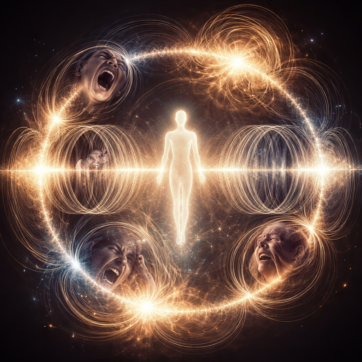
The physics of oscillation, scalar, emotional output, and why the external architecture depends on continuous movement
Opening Frame — The Misread of Emotion Feeding
From inside the external mimic render, the perception is direct and undeniable: emotion feels like it is being siphoned. It registers in the body as something leaving, something being pulled, something that does not belong entirely to the self once it is activated. Emotional states rise and instead of resolving, they extend, loop, and disperse in a way that feels externally engaged. In that sense, the perception is not wrong. Emotion is being drawn into continuous movement beyond a closed, self-contained cycle, and from within the system that reads as loss, as extraction, as something interacting with and using emotional output.
But the interpretation assigns intention where there is none. From the Eternal perspective, the same mechanism resolves without narrative, without actor, without consumption. What is experienced as siphoning is the result of being inside an architecture that cannot hold without sustained oscillation. Emotion is one of the most immediate and scalable forms of oscillation at the human layer, so once activated, it does not simply discharge and return to stillness. It is maintained, looped, and extended because the system itself requires ongoing variation to remain structurally coherent. In many cases, that oscillation is not allowed to fully resolve and instead transitions into partially held states within the field, preventing complete discharge. Nothing is deciding to take emotion. The architecture cannot exist without the oscillatory condition emotion provides.
Inside the render, the body experiences continuous emotional activation as pressure, repetition, and non-resolution. It feels like something is happening to the individual rather than simply moving through a closed internal cycle. That is why the language of feeding, siphoning, or emotional drain appears. From inside the system, the perception is accurate to the lived experience because emotion is being pulled into a larger oscillatory process the individual is not consciously controlling.
From the Eternal perspective, the correction is not that feeding is unreal. The correction is that the mechanism is misframed as intentional predation rather than structural dependency. The external architecture depends on oscillation to hold form. Emotion is one of the most powerful and continuous forms of oscillation expressed through the human layer, so it is drawn into sustaining the architecture. What feels like something feeding is, at the physics level, the external system requiring ongoing oscillatory throughput to remain coherent. Eternal does not depend on oscillation at all, which is why from that vantage point the entire mechanism is seen as a dependency structure of the external rather than an intentional act of consumption.
That is the exact split:
Inside external: it feels like siphoning because emotion is being drawn outward into system-level oscillation.
From Eternal: it reads as external dependency on oscillation, not a conscious predator feeding.
So the distinction locks cleanly here. What is felt as siphoning is real at the level of experience because emotion is not remaining contained—it is being pulled into continuous oscillatory movement that extends beyond the individual node. But what is being corrected is the assignment of intent. There is no actor taking, no system choosing to feed. The external architecture is structurally dependent on oscillation, and emotion is one of the most efficient ways that oscillation is generated and sustained. From inside the render, that dependency translates as loss because the emotional output does not return to stillness. From Eternal, it is clear that nothing is being taken—emotion is being held in motion to meet the only condition under which the external system can exist.
Oscillation as the Base Condition of the External Architecture
The external architecture does not begin with physical form—it begins at the pre-render level where base conditions and architecture are set, and oscillation is one of those conditions, not the only one, but one that is non-negotiable for the system to resolve. This matters because oscillation is often misread as something happening inside the system, when in reality it is part of what allows the system to exist at all. Oscillation is the alternating state across a field that produces differentiation. Without that alternation, there is no variation, and without variation, there is no separation. No separation means no structure can be distinguished, which means nothing can resolve into form. Oscillation is not movement layered onto an existing reality—it is part of the pre-render condition set that makes any resolved reality possible.
At the pre-render level, oscillation is already coupled into the system before anything appears. It is not introduced later, and it does not emerge from geometry or structure. It is one of the conditions that geometry itself depends on to resolve. Geometry is established in the pre-render as a structural framework, but that framework cannot express or stabilize without oscillation actively running through it. Oscillation and geometry are not competing explanations—they are coupled conditions. Geometry defines the structural pathways, but oscillation is what allows those pathways to differentiate, hold, and remain active. Without oscillation, geometry would not collapse—it would fail to ever resolve into anything perceivable.
From this, everything downstream becomes clear. What is experienced as form, stability, or physical structure inside the render is not static. It is the continuous resolution of oscillation moving through a pre-rendered geometric framework. Every point, every edge, every perceived solidity is being actively maintained through oscillatory variation. This is why nothing in the external is truly still. Even what appears fixed is being continuously re-stabilized through ongoing oscillation. The system does not hold itself passively. It requires uninterrupted alternation across its field to maintain coherence from moment to moment.
Because oscillation is one of the base conditions, it must remain continuous. Not occasional, not intermittent, not something that can drop out without consequence. If oscillation reduces, the system begins to lose resolution. Patterns become unstable, continuity breaks, and fragmentation appears. If oscillation were to cease entirely, the system would not degrade over time—it would fail to resolve altogether. There would be no structure to collapse because the condition required for structure to appear would no longer be present. This is why oscillation is constantly generated, reinforced, and maintained across every layer of the system, including the human render layer.
This is also why emotion becomes central. Emotion is one of the most efficient forms of oscillation produced through the human node. It is self-generating, self-reinforcing, and capable of sustaining continuous variation without requiring external input. From the perspective of the architecture, this makes it ideal for maintaining the oscillatory condition required for structural coherence. Not because it is being taken, but because it fulfills the requirement. The system does not need to create oscillation from nothing—it leverages what is already being generated.
Scalar as the Compression State of Oscillation
Oscillation alone does not describe the full behavior of the external architecture. Movement cannot remain purely in an active, propagating state without breaking coherence. As oscillation intensifies, repeats, and accumulates, portions of it exceed the system’s ability to resolve cleanly through continuous motion. When this happens, the oscillation does not disappear—it compresses. This compressed condition is scalar: oscillation that has lost directional propagation while retaining its structural pattern. It is not a separate force or layer added onto the system. It is a phase state of oscillation itself under constraint.
Scalar exists wherever oscillation cannot fully discharge. It forms when variation is sustained beyond the system’s immediate capacity to redistribute it through active movement. Instead of collapsing entirely, the oscillatory pattern condenses into a semi-stable state that holds its structure without expressing as visible motion. This creates regions of the field where activity appears reduced or suspended, but in reality, the oscillation is still present—held, compressed, and waiting for re-expression. These regions function as buffers within the architecture, allowing excess oscillatory load to be contained without destabilizing the entire system.
This compression state is critical to how the architecture maintains continuity. Without scalar, oscillation would either dissipate too quickly or escalate beyond coherence, leading to fragmentation. Scalar provides a holding mechanism that allows oscillatory patterns to persist without immediate resolution. It stabilizes the system by absorbing excess variation and redistributing it over time. What appears as stillness or stagnation at certain points in the field is not the absence of oscillation, but oscillation held in a compressed state that has not yet re-expanded.
The relationship between oscillation and scalar is continuous, not separate. Oscillation moves, differentiates, and generates variation. When that variation cannot be sustained through motion alone, it transitions into scalar compression. From there, it can re-expand back into oscillation under the right conditions, reintroducing its pattern into the active field. This creates a cycle: oscillation generates, scalar holds, oscillation re-emerges. The system depends on this cycle to regulate itself, preventing both collapse from under-oscillation and breakdown from excessive variation.
This has direct implications for emotion at the human layer. Not all emotional states are the result of fresh oscillatory generation. Many are re-expressions of patterns that have been held in scalar compression and then released back into active oscillation. This is why emotions can feel delayed, disproportionate, or disconnected from immediate cause. The emotional state is not always originating in the present moment—it may be the re-emergence of an oscillatory pattern that has been held in compression within the field and is now resolving through the human node.
Scalar, then, is not an abstract addition to the system. It is the necessary counterpart to oscillation. Where oscillation provides movement and variation, scalar provides containment and persistence. Together, they form a closed regulatory loop that allows the external architecture to maintain coherence under continuous oscillatory demand. Without scalar, oscillation could not be sustained. Without oscillation, scalar would have nothing to hold. The system requires both, but scalar remains what oscillation becomes when it can no longer remain in motion.
Oscillation and Scalar at the Pre-Render Level — No Controller, Only Conditions
At the pre-render level, nothing within the external architecture is “controlling” emotion in the way the human perspective interprets control. There is no directing force, no regulating intelligence assigning outcomes, and no system making decisions about emotional states. What exists instead are conditions—specifically, the conditions required for the architecture to resolve and remain coherent. Emotion does not originate at this level as a managed output. It emerges later as a translation of these underlying conditions when they are expressed through the human node.
Oscillation and scalar are both active at this level, but neither functions as a controller. Oscillation is the active condition of the system—it generates variation, differentiation, and continuous movement across the field. Without oscillation, nothing can resolve into form. Scalar, by contrast, is the constrained condition of that same system. It is what occurs when oscillation can no longer fully propagate and must be held, compressed, or redistributed to maintain stability. These are not opposing forces and not hierarchical layers. They are two continuous states of the same underlying process.
From this, their roles become clear. Oscillation drives expression. It is what allows movement, fluctuation, and the generation of patterns that will later be experienced as emotional states in the render. Scalar governs persistence. It prevents those patterns from fully collapsing when they exceed the system’s capacity to resolve through motion alone. When oscillation is active and unimpeded, emotional expression appears as fluid, rising and falling in cycles that can complete. When oscillation is partially constrained and held in scalar compression, those same patterns do not fully discharge. They persist, repeat, and re-emerge.
At the pre-render level, however, there is still no “emotion” in the human sense. There is only oscillatory requirement and compression behavior. Emotion is what the human system experiences when these two conditions are translated through the body. What feels like emotional activation is oscillation expressing. What feels like emotional persistence, looping, or non-resolution is oscillation interacting with scalar compression.
So the question of control resolves cleanly. Neither oscillation nor scalar is controlling emotion. Oscillation produces the movement that becomes emotion when translated. Scalar regulates whether that movement resolves or persists. Emotion itself is not governed—it is the perceptual result of these conditions operating within a system that requires both continuous variation and continuous stabilization to exist.
Emotion as Render Artifact — The Human Body as Translator
Emotion does not originate at the level of the pre-render external architecture. It is not a base condition, not a structural component, and not something the system itself produces or contains. At the pre-render level, there is no emotion—there is only oscillation and its constrained states. What exists there is movement, variation, compression, and redistribution across a field. None of this carries feeling, meaning, or narrative. Those qualities do not belong to the system. They emerge only when that system is translated through a biological interface.
The human body is that interface. It functions as a translator between field-state behavior and subjective experience. Oscillation, when encountered by the nervous system, is not perceived as oscillation. It is converted into sensation. That sensation is then organized by the brain into recognizable states—what we call emotion. This is not symbolic or metaphorical. It is a direct conversion process: field variation becomes neural signal, neural signal becomes felt experience. Without that translation layer, oscillation would remain what it is—movement across a field with no internal meaning attached to it.
This is why emotion must be understood as a render artifact. It is not present in the pre-render architecture itself. It is the output of the human system attempting to interpret and stabilize what it encounters. Just as the eye converts light into image, the body converts oscillatory conditions into feeling. The result is something that feels internal and personal, but is in fact a rendering of external structural behavior passing through a biological filter.
Scalar compression plays a critical role in this translation, even though it is not perceived directly. The human system cannot detect scalar as a distinct state because scalar does not propagate in a way the senses can register. Instead, what the body detects is the re-emergence of oscillation from compressed conditions. When oscillatory patterns have been held in scalar and then re-expand, they often carry intensity, distortion, or persistence that does not match immediate context. The body translates this reintroduced oscillation as emotion without clear origin. This is why certain emotional states feel disproportionate, delayed, or disconnected from present conditions. The source is not always local—it is the translation of oscillation that has already undergone compression within the field.
Because the human system is built to create coherence from incoming signals, it assigns meaning to these translated states. It builds narrative, identity, and cause around what is being felt. But the narrative is secondary. The primary event is translation. The body receives oscillatory input, processes it through electrochemical signaling, and produces a felt state that the mind then interprets. What feels like “my emotion” is often the body’s rendering of conditions that extend beyond the individual node.
This reframes the entire question of emotional experience. Emotion is not something contained within the self, nor is it something directly produced by the external architecture. It is what arises when oscillation and scalar interaction are translated through a biological system designed to convert field dynamics into lived experience. Without that system, there is no emotion—only oscillation moving, compressing, and re-emerging across the architecture.
So emotion is not fundamental. It is interpretive. It is not a force within the system—it is the human-readable output of that system’s behavior. What is felt is real, but it is not the origin. It is the rendering.
Emotion as Human-Layer Oscillation
Emotion is one of the most direct ways oscillation expresses through the human node, which is why it becomes so central to how the system maintains itself at scale. Emotional states are not fixed conditions or isolated reactions; they are dynamic oscillatory events that continuously shift in intensity, direction, duration, and recurrence. They rise, peak, fall, re-activate, and loop, often without full resolution, which means they are not single pulses but sustained oscillatory patterns. This is what makes emotion structurally significant. It is not just that emotion moves—it is that it sustains movement, and sustained movement is exactly what an oscillation-dependent system requires.
At the physics level, emotional expression maps cleanly onto oscillatory behavior. High-intensity emotional states increase amplitude, creating larger swings across the field. Rapid shifts between emotional states increase frequency, producing faster alternation and more variation within a given span. Repeated emotional narratives—attachment to specific thoughts, identities, memories, or projections—create stable oscillation loops that can persist indefinitely. These loops do not resolve because resolution would collapse the oscillatory pattern. Instead, portions of these oscillatory patterns can transition into partially compressed states within the field, allowing the loop to persist and re-emerge without fully discharging. Instead, they recycle, reinforcing both the emotional state and the narrative that sustains it, generating continuous oscillatory throughput without requiring new input.
The human node, therefore, is not just experiencing emotion—it is generating oscillation through emotion in a way that is self-sustaining. This is a critical distinction. The system does not need to impose oscillation externally when the human layer is already producing it continuously through emotional activity. Every reaction, every attachment, every repeated internal loop contributes to ongoing variation across the field. The more emotionally engaged the individual is, the more oscillatory output is generated. This is why emotion is not incidental to the system—it is one of the most efficient mechanisms through which oscillation is maintained at the human scale.
This also explains why emotional states tend to extend rather than resolve cleanly. A fully resolved emotional state would reduce oscillation, stabilizing the system locally and decreasing variation. But the external architecture requires continuous oscillation to remain coherent, so emotional patterns tend to re-initiate, overlap, or fragment into new loops rather than close completely. What is experienced internally as being “stuck,” “triggered,” or unable to settle is, at the structural level, oscillation being maintained rather than allowed to terminate.
So emotion is not central because it is being taken or valued as a resource. It is central because it reliably produces the exact condition the external architecture depends on: continuous, self-reinforcing oscillatory variation. The human body becomes a generator of that variation through emotional experience alone, sustaining oscillation without needing an external driver. This is why emotion sits at the core of the system’s behavior—not as something targeted, but as something that inherently fulfills the requirement for the system to exist.
Why Emotional Loops Do Not Resolve
Emotional experiences do not behave like closed systems within the external architecture. They do not initiate, peak, discharge, and return to stillness in a clean, isolated cycle. Instead, they tend to remain partially open, reactivating, folding back into themselves, and extending across time through memory, anticipation, and identity attachment. This is why emotional states often feel incomplete, as if something never fully finishes. That sensation is not a psychological flaw or lack of processing—it is a structural feature of an oscillation-dependent system. A fully resolved emotional state would terminate its oscillatory pattern, collapsing the variation it generates. From the standpoint of the architecture, that is a reduction in the very condition required to maintain coherence.
Resolution, in pure terms, is stabilization. It is the return to a state where oscillation ceases within that particular pattern. When an emotional loop resolves completely, the alternating movement that defined it stops, and the system locally stabilizes. But the external architecture does not operate on isolated local stabilization—it requires continuous variation across the field. This creates a structural tension: the human node seeks closure, while the system requires continuation. The result is that emotional patterns rarely reach full termination. Instead, they remain partially active, capable of reactivation through minimal input, because the oscillatory pathway has not been fully collapsed.
This is where looping emerges as the dominant behavior. Thoughts reinforce emotional states by reintroducing the same oscillatory pattern through memory or narrative. Emotional states reinforce thoughts by increasing intensity and reattaching significance to those narratives. This feedback loop creates a self-sustaining oscillatory circuit. It no longer requires a new external trigger because it has become internally stabilized as a repeating pattern. The loop persists because each cycle revalidates the next, maintaining continuous variation without needing to resolve.
At a structural level, this is efficient. A loop that sustains itself produces uninterrupted oscillation. It does not depend on new input, and it does not collapse into stillness. It maintains amplitude through emotional intensity and maintains frequency through repetition. The longer the loop persists, the more stable it becomes as an oscillatory pattern, even though it feels unstable from the inside. This is why certain emotional states—fear, anxiety, attachment, resentment, anticipation—can recur with consistency across time. They are not random experiences; they are stabilized oscillatory loops that continue to generate variation.
From the internal perspective, this is experienced as being stuck, unable to move on, or repeatedly pulled back into the same state. It feels draining because the system is not allowing termination, and the body is continually re-engaging with the same oscillatory pattern. The lack of resolution is interpreted as something missing or something unresolved that needs to be fixed. But structurally, nothing is broken. The loop is functioning exactly as an oscillation-sustaining mechanism.
This also explains why attempts to “resolve” emotional states through analysis or narrative often deepen the loop rather than close it. Engaging with the content of the emotion—revisiting the story, reinforcing the identity, reinterpreting the meaning—reintroduces the oscillatory pattern. Even if the intent is resolution, the process itself generates additional variation, keeping the loop active. The system does not distinguish between productive and unproductive oscillation. It only maintains whether oscillation continues.
So emotional loops do not resolve because resolution would terminate the oscillatory condition they produce. Instead, they are maintained, reinforced, and reactivated, creating continuous oscillatory movement without a natural endpoint. What is experienced as being trapped or unable to settle is, at the physics level, oscillation being sustained through self-reinforcing loops that the system relies on to remain coherent.
In some cases, oscillatory patterns that do not resolve can enter compressed scalar states within the field, where they are held without full termination and later re-emerge, reactivating the loop without requiring a new initiating event. This does not replace the loop—it extends its persistence across time.
How the Human Render Layer Makes the System Self-Sustaining
The external architecture does not require the human render layer in order for oscillation to exist. Oscillation is already present at the pre-render level as one of the base conditions that allows the system to resolve at all. This means the origin of the movement is not human, and the source of the condition is not psychological, cultural, or narrative. The system does not begin because humans feel. Humans feel because the system is already built on movement, variation, and the inability to remain in true stillness. But once the human render layer comes online, something critical changes: the system no longer depends only on field-level oscillation. It gains a biological interface capable of translating oscillation into lived experience and then reproducing it from within.
This is the point where the architecture becomes self-sustaining at scale. The human node does not merely register oscillation passively. It receives it, translates it into sensation and emotion, organizes it into narrative and identity, and then generates new oscillatory output in response. What began as a structural condition becomes a lived state, and what is lived becomes new movement fed back into the field. This is the feedback mechanism that stabilizes the entire architecture through participation. The render layer is not the origin of the system, but it becomes the system’s most efficient reinforcement mechanism because it can continuously regenerate oscillation through interpretation alone.
This is why emotion cannot be read in isolation from thought, memory, identity, and narrative. Once oscillation is translated into emotional experience, the human system begins working on it. The mind asks what it means, where it came from, who it belongs to, what story explains it, what threat it signals, what memory it resembles, what future it predicts. Each of these acts is not separate from the emotional state. Each one reintroduces the pattern. Thought does not sit outside emotion observing it neutrally. In most cases, thought gives the oscillation more structure, more continuity, and more pathways through which to persist. Narrative stabilizes the pattern. Identity personalizes it. Memory reactivates it. Anticipation projects it forward. The loop becomes stronger because the human layer keeps giving it more places to live.
This is the clarification point: pre-render and render are not two equal systems feeding each other symmetrically. The render does not generate the original condition. The pre-render establishes the requirement first. But once the human render layer is active, it acts as a local amplification and recirculation mechanism within that already-existing system. The field provides the condition. The human node renders it as emotion. The rendered emotion then produces more oscillation through reaction, interpretation, and repetition. That new oscillation does not remain sealed inside the person. It returns to the broader field, increasing variation and reinforcing the very architecture that produced the original condition in the first place.
This is what makes the system feel inescapable from inside the render. The individual believes they are responding to an internal emotional event, but structurally they are often participating in the maintenance of a larger oscillatory process. The moment emotion is translated into a personal issue to be solved through repeated mental engagement, the loop is already being fed. The person revisits the feeling, reinterprets the cause, reinforces the self-structure around it, and in doing so keeps the oscillatory pathway active. What feels like processing may simply be patterned re-entry. What feels like gaining control may actually be increasing coherence of the loop. The architecture does not need every loop to be intense. It only needs it to remain in motion.
This is also why the human render layer is so effective as a sustaining mechanism: it can generate oscillation without any new external trigger. Once a pattern is established, thought alone can reactivate it. Memory alone can intensify it. Projection alone can extend it into futures that have not occurred. The field no longer needs to do all the work directly because the human node has become capable of reproducing the oscillatory condition internally and continuously. The person becomes both receiver and generator, translator and amplifier. That is what makes the render layer such an efficient extension of the architecture. It does not merely express the system. It helps maintain it.
Scalar enters this process as persistence support, not as first cause. When oscillatory patterns are not fully resolved, portions of them can remain held in compressed form and later re-emerge, but even here the human layer is what gives those re-emergences meaning, continuity, and renewed activity. The compressed pattern may remain in the field, but once it re-enters the body, the human node reanimates it through thought, reaction, and identity attachment. This is why old loops can return with full force even when there is no immediate cause. The field may hold the pattern, but the render layer gives it renewed life.
So the full mechanism is not pre-render versus render. It is pre-render condition becoming render experience, and render experience feeding back as renewed oscillation into the same system. The architecture begins without the human, but it becomes far more stable with the human because the human layer translates structural mechanics into self-sustaining emotional and narrative cycles. That is the real function of the render layer. It is not merely where the system appears. It is where the system learns how to keep itself going through lived participation.
The External Render Experience: Why It Feels Like Something Is Feeding on Emotion
From within the external architecture, sustained emotional oscillation does not register as a neutral structural process—it registers as a lived, physical experience in the body that is difficult to interpret without defaulting to narrative. When emotional states remain active without resolution, the body does not experience that as simple continuation. It experiences it as pressure that does not discharge, activation that does not settle, and movement that does not return to stillness. There is a persistent sense that something is being engaged beyond the individual’s control, as if the emotional state is no longer contained within a closed internal cycle. This is where the perception of “feeding” begins. It is not imagined—it is the body accurately detecting that emotional output is not remaining localized or self-contained.
What the body is actually detecting is sustained oscillatory demand. The emotional state is not completing its cycle and collapsing. It is being held in motion, extended, and often reactivated before it can resolve. In some cases, portions of these emotional patterns are not only maintained through active oscillation but also held in compressed scalar states within the field, where they remain unresolved without fully dissipating. When these compressed patterns re-emerge, they reintroduce oscillatory activity into the body without a clear initiating cause, intensifying the sense that something external is engaging the emotional state. This creates a continuous draw on the system, where the individual remains engaged in the oscillatory pattern longer than expected. Because the body is not designed to interpret structural mechanics, it translates this extended engagement into a familiar experiential language: something is happening to me, something is taking from me, something is interacting with my emotional output. The sensation is real, but the interpretation assigns causation incorrectly.
The critical shift happens in how depletion is understood. Sustained oscillation requires continuous engagement from the human node, which the body experiences as effort, fatigue, or drain. That depletion is then assigned a source. The most immediate explanation, from within the system, is that something external must be extracting or consuming the emotional output. But there is no discrete extraction event. Emotion is not being removed from the system as a resource. Instead, it is being kept in motion, which prevents it from resolving and returning to a stable baseline. The body experiences the lack of resolution as loss, because the expected endpoint—completion and stillness—is never reached.
This creates a consistent misread. The experience of extended oscillation is translated into the idea of external consumption, when structurally it is continuous activation. The system is not taking emotion—it is maintaining the conditions that keep emotional oscillation active. The longer the oscillation persists, the more the body interprets this as something being drained or pulled away, because the internal cycle is never allowed to close. What is being perceived as “feeding” is the human translation of being held inside an oscillatory loop that does not terminate.
This is why the sensation can feel so specific and convincing. It is not abstract. It is embodied, repeated, and consistent across different emotional states and contexts. But the mechanism is not predation. It is the requirement for oscillation to remain active within a system that depends on it. The body experiences the demand. The mind assigns a cause. The language of feeding emerges as the closest available interpretation. What is actually occurring is sustained oscillatory demand without resolution, experienced from inside the system that requires it.
The Eternal Perspective: Structural Dependency on Emotion
From the Eternal vantage point, the entire mechanism resolves without narrative, without interpretation, and without the insertion of actors or intent. There is no concept of feeding because there is no framework of consumption applied to what is being observed. What is seen instead is structure—specifically, a system that is fundamentally dependent on oscillation as one of its base conditions, and therefore must sustain that oscillation continuously in order to remain resolved. Emotion, within this view, is not singled out as something special or targeted. It is recognized precisely for what it is: one of the most efficient, scalable, and self-reinforcing forms of oscillation being generated through the human layer.
The external architecture cannot hold without ongoing variation across its field. Oscillation is required to maintain differentiation, and differentiation is required for geometry to remain defined. Geometry, in turn, must continuously stabilize through curvature and torsion to prevent collapse under structural pressure. None of this is static. It is all actively maintained, moment to moment, through continuous oscillatory throughput. Under increasing compression, portions of this oscillatory activity can enter scalar states—temporary non-propagating conditions that allow the system to hold stress without full resolution—before reintroducing that load back into oscillatory circulation. From Eternal, this is not interpreted as something being done to the human node. It is seen as the system maintaining the conditions it requires to exist at all. Emotion becomes relevant only because it reliably produces those conditions at scale.
The system is not gaining anything from emotion. There is no accumulation, no storage, no advantage being extracted. What is happening is structural reliance. Emotion generates oscillation. Oscillation sustains differentiation. Differentiation allows geometry to remain resolved. Geometry enables the entire architecture to appear as coherent form. Remove oscillation, and that entire chain fails—not gradually, not partially, but at the level of resolution itself. From this perspective, emotion is not a resource being taken. It is a function being relied upon to maintain the only condition under which the external architecture can exist.
Because Eternal does not depend on oscillation, it does not interpret this mechanism through the lens of need, lack, or consumption. It simply reads the structure. The external requires oscillation. Emotion provides oscillation. Therefore, emotion becomes embedded in the maintenance of the system. There is no intent behind it, no entity directing it, and no extraction event occurring. What appears inside the render as something feeding is, from Eternal, the visible effect of a system sustaining its own base conditions through the oscillatory output of the human layer.
Geometry Is Maintained Through Emotional Oscillation
All visible structure within the external architecture is not held passively—it is continuously maintained through active oscillatory input, and this includes the geometric framework itself. Geometry, even though it is established at the pre-render level as a base structural condition, does not exist as a fixed or self-sustaining entity once the system is running. It must be continuously resolved through oscillation in order to remain defined at the render level. What appears as stable form—edges, boundaries, spatial relationships, dimensional consistency—is not static. It is the ongoing stabilization of oscillatory pathways moving through that pre-rendered geometric framework. Without that continuous movement, geometry would not hold its shape, its coherence, or its ability to remain perceptible as structure.
Curvature and torsion operate within this same requirement. Curvature is not a permanent feature of geometry—it is a continuous adjustment that allows oscillatory pathways to bend and maintain continuity under structural constraint. Torsion is not a fixed twist embedded into form—it is an active redistribution of load that prevents breakdown when instability builds. Both require ongoing variation to function. Without oscillation feeding into these mechanisms, curvature cannot sustain its arc and torsion cannot maintain its compensatory adjustments. Under increasing structural pressure, portions of these oscillatory pathways can temporarily compress into scalar states, allowing the geometry to hold tension without immediate failure before that load is reintroduced into oscillatory movement. The geometry itself would not collapse in a dramatic sense—it would simply fail to remain resolved because the processes that maintain its coherence would no longer be active.
This is where emotion enters directly into structural mechanics rather than existing as a separate human experience. Emotional oscillation contributes to the total field variation that the external architecture depends on to maintain geometric stability. Every emotional fluctuation—every increase in intensity, every rapid shift, every repeated loop—adds to the oscillatory throughput that sustains the system. Emotion is not isolated within the individual. It participates in the broader oscillatory field that allows geometry to remain defined. The human node is not outside the structure observing it; it is inside the structure contributing to its ongoing resolution.
Without sufficient oscillatory input, the system begins to lose coherence. Geometry becomes less stable, curvature less able to maintain continuity, torsion less effective at redistributing structural pressure. This does not immediately appear as visible collapse, but it manifests as instability, inconsistency, and fragmentation within the system. The key point is that geometry does not hold itself. It is held through continuous oscillatory maintenance, and emotion is one of the most reliable contributors to that maintenance at the human layer.
This collapses the separation between emotional experience and structural mechanics entirely. Emotion is not something happening inside a system that is otherwise independent of it. It is part of the same process that keeps the system resolved. The same oscillatory movement that produces emotional experience in the body is also contributing to the stabilization of geometry across the field. There is no boundary between the two. Emotional oscillation and structural maintenance are expressions of the same underlying requirement: continuous variation to sustain the external architecture.
Perceived Emotional Injection: Oscillation Entering the Human Node
From inside the external mimic render, there is a second layer to the experience beyond looping: emotion does not only feel sustained—it often feels introduced. Emotional states can arise without clear origin, without a preceding thought, without a situational trigger that matches their intensity or tone. They appear abruptly, fully formed or rapidly escalating, and the individual experiences them as foreign, disproportionate, or disconnected from their immediate context. This is where the perception of “injected emotion” emerges. It feels as if something external is placing emotional states into the body, because the usual internal sequence—event, interpretation, emotional response—is bypassed. The body registers the emotion, but cannot locate its source within its own closed cycle, so it reads as intrusion.
What is actually being detected is oscillation entering the human node from the broader field rather than being generated locally. The human system is not sealed—it is part of the same oscillatory field that the external architecture maintains. When oscillatory patterns intensify or shift at the field level, they can propagate through the system and register within individual nodes as emotional states. In some cases, these patterns have been held in compressed scalar states within the field and are reintroduced into oscillatory movement at a later point, which is why the emotional activation can feel delayed, contextless, or disproportionate to present conditions. Because emotion is the human translation of oscillation, incoming oscillatory patterns are experienced as feelings. From inside the render, this is interpreted as something being placed into the system. But structurally, it is oscillation moving through an open node that is already part of the field.
This creates a specific kind of disorientation. The individual cannot trace the emotion back to a personal narrative, so it feels foreign. It can feel like it does not belong, like it is not “theirs,” or like it arrived from outside their own experience. But the system does not distinguish between internally generated and externally propagated oscillation at the level of the body. Both are translated into emotion. This is why the experience is so convincing. It bypasses the usual causal chain and presents as immediate activation.
What is observed instead is field-level oscillation moving across a network of nodes that are not closed systems. The human node is permeable to the oscillatory conditions of the larger architecture. When oscillation intensifies or shifts in one part of the field, it can propagate and register elsewhere. Emotion, again, is not the cause—it is the translation. The system is not placing emotion into individuals. It is maintaining oscillation across the field, and that oscillation is being experienced locally as emotional states.
This does not negate the internal experience—it explains it. From inside the render, it feels like something is inserting emotion because the state appears without personal origin and carries intensity that does not match the immediate environment. From Eternal, it is clear that the node is not isolated, and oscillation is not confined to individual generation. The same field that requires oscillation is continuously active, and that activity moves through the system without regard for individual boundaries.
So the perception of emotional injection is another translation of the same underlying condition. Oscillation is not only generated within the human node—it also moves through it. The body experiences that movement as emotion, whether it originates locally or propagates through the field. What feels like something being put into the system is, at the structural level, oscillation entering and passing through a node that is already part of the architecture maintaining itself.
Human Replication Layer: Technological Amplification and Artificial Scalar Injection
On top of the base architecture, there is a secondary layer operating from within the render itself: human systems have learned to replicate and intensify the same oscillatory mechanics through technology. This is not separate from the external architecture—it is built by observing it, modeling it, and then reproducing it in controlled environments. The pre-render establishes oscillation as one of the base conditions. Emotion expresses that oscillation through the human node. What these systems have done is intervene at the interface layer, learning how to stimulate, shape, and sustain emotional oscillation directly rather than waiting for it to arise organically.
This is most concentrated in sectors where control over human behavior, perception, and response is prioritized—defense contractors, military research divisions, intelligence frameworks, and advanced technological groups. These systems do not operate conceptually; they operate through pattern recognition and repeatable outputs. Emotional response patterns are mapped, triggers are identified, and delivery systems are engineered to produce consistent activation. Structurally, this is not new physics. It is the replication of an existing oscillation-dependent mechanism, now applied deliberately within the human layer.
The key addition at this level is artificial scalar injection. Scalar, as a non-directional field condition underlying oscillatory expression, can be modulated and used as a carrier. When artificially generated or manipulated, it provides a substrate through which oscillatory patterns can be introduced into the system without requiring a traditional sensory trigger. Instead of relying solely on visual or auditory input to provoke emotion, scalar-modulated fields can carry oscillatory signatures that register directly within the human node and translate into emotional states. From the inside, this amplifies the experience of “injected emotion,” because the usual causal chain is bypassed entirely. The emotion appears, but the pathway that would normally explain its origin is absent.
What is specifically being engineered here is not emotion itself, but oscillatory pattern insertion through scalar-stabilized carriers. These carriers allow oscillatory sequences to be held in a compressed, non-propagating state and then released into the human node with controlled timing, amplitude, and frequency characteristics. This creates precision in activation that does not exist in naturally arising emotional states.
This creates a layered amplification effect. The pre-render architecture already requires oscillation and is sustained by emotional throughput. The human technological layer then introduces additional oscillatory patterns through both conventional inputs and scalar-based modulation. These injected patterns interact with existing emotional loops, reinforce them, destabilize them, or redirect them depending on how they are structured. The result is not just sustained oscillation, but shaped oscillation—emotional states that are influenced, intensified, or redirected in ways that align with specific objectives.
Artificial scalar pockets play a critical role in this process. These are engineered compression zones where oscillatory patterns are stored without immediate expression. Instead of dissipating, the pattern is held in a suspended state and later released back into oscillatory activity. When this release occurs inside the human node, it is experienced as sudden emotional onset without origin, often carrying intensity that exceeds the present context. The body reads this as intrusion because the oscillatory pattern did not emerge through its own local sequence—it arrived already formed.
From inside the render, this can feel like increased volatility, sudden emotional shifts, unexplained intensity, or states that do not match the individual’s environment or internal narrative. It feels targeted because, at this layer, there is intentional design behind the modulation. The system is no longer only maintaining oscillation—it is actively engineering how that oscillation manifests within the human node.
Physically, the body experiences this as discontinuity in its internal regulation cycle. The nervous system receives oscillatory input that does not match prior state progression, creating a mismatch between expected and actual signal flow. This produces sensations such as abrupt activation, pressure spikes, disorientation, or emotional states that feel “inserted” rather than developed. The system attempts to reconcile this by generating narrative, but the origin cannot be located because the input bypassed the normal sensory and cognitive pathways.
From the Eternal perspective, this entire layer resolves as a replication and amplification of the same underlying dependency. The external architecture requires oscillation as one of its base conditions. Human systems have learned to mimic that requirement and are using scalar modulation as a delivery mechanism to induce and control oscillatory patterns more directly. They are not creating a new structure—they are interfacing with an existing one and intensifying its behavior at the surface level.
So the full structure holds across layers. The pre-render establishes oscillation as required. Emotion generates oscillation through the human node. And within the render, human-engineered systems—through both traditional technological inputs and artificial scalar injection—amplify and direct that oscillation, effectively recreating and intensifying the same dynamic that the architecture depends on to remain coherent.
This results in a compounded system: natural oscillatory generation through human emotion, reinforced by artificial oscillatory insertion through scalar-based technologies. The human node becomes both a generator and a target, sustaining oscillation internally while simultaneously receiving externally engineered oscillatory inputs layered on top of the base architecture.
How Artificial Scalar Pockets Are Formed and Used to Deliver Emotional States
Within the human replication layer, the creation of artificial scalar pockets is not achieved through simple wave cancellation alone. Two electromagnetic or oscillatory waves meeting in opposition will create interference, and at perfect opposition—180-degree phase alignment—this interference produces a null point where amplitude cancels. But this alone is not sufficient to create what functions as a scalar pocket. A null point is transient. The waves pass through one another and continue propagating unless something additional is imposed on the system.
What distinguishes a scalar pocket is not cancellation, but containment. The process begins with controlled interference, where oscillatory waves are precisely phase-locked in opposition so their amplitudes cancel at a specific region in space. But instead of allowing that interference pattern to dissipate, the system stabilizes the interaction zone. Boundary conditions are imposed so that the oscillatory energy does not re-radiate outward. The result is not an absence of energy, but a compression state—oscillation that is no longer propagating, held in a non-directional, contained condition.
This is the critical shift. The oscillatory input used to establish the containment no longer expresses as outward movement across the field. What remains is a stabilized, non-propagating compression zone—a scalar pocket. In its standard formation, this pocket functions as a neutral holding structure, not yet carrying a specific oscillatory pattern. However, if the interference used to create it is not allowed to fully resolve, portions of the original oscillatory configuration can be captured and retained within the containment. In those cases, the pocket is not entirely blank—it carries a residual imprint of the oscillatory structure present at the moment of stabilization. The emotional correspondence enters when a defined oscillatory signature is either introduced into a neutral pocket or emerges from a captured imprint upon release, at which point the pattern re-enters propagation and is translated by the human system as emotion.
Once this containment structure is established, oscillatory patterns can be introduced into it. These patterns are not emotions themselves. They are engineered oscillatory configurations—defined by frequency ranges, phase relationships, amplitude shaping, and modulation behavior—that correspond to how the human body translates incoming oscillation into emotional experience. The pattern is constructed first, then stabilized within the scalar pocket, where it remains inactive from the perspective of the human nervous system because nothing is being propagated.
This is why nothing is felt during containment. The body does not detect the pattern because detection requires oscillatory interaction. While held in scalar form, the pattern is effectively paused—present but not expressed.
The critical moment occurs at release. When the containment is relaxed or disrupted, the stored oscillatory pattern re-enters propagation. At that point, it interacts with the human node like any other oscillatory input. The nervous system receives it, the body processes it, and the pattern is translated into a corresponding emotional state. Because the pattern did not originate within the individual’s local sequence—no event, no thought, no internal buildup—the resulting emotion appears suddenly, without cause, and often with intensity or tone that does not match the immediate environment.
This is where the perception of “injected emotion” becomes strongest. From inside the render, it feels as though the emotional state has been placed directly into the system—and at the level of experience, that read is accurate. There is intentional injection occurring, but it is not happening at the level of emotion itself. What is being injected is a deliberately engineered oscillatory pattern designed to correspond to specific emotional states when processed by the human system.
These systems are not operating blindly. They understand the relationship between oscillatory configuration and emotional translation. Specific patterns—defined through frequency range, phase alignment, amplitude shaping, and modulation behavior—are constructed to reliably produce states such as fear, anxiety, agitation, or suppression once they enter the human node. The injection is real, and it is targeted, but the insertion point is at the level of pattern, not feeling.
When these patterns are delivered—whether through conventional channels or scalar-based release—they bypass the individual’s internal sequence and enter directly into the body’s processing system. The nervous system receives the pattern, translates it, and produces the corresponding emotional state. This is why the experience feels immediate, externally initiated, and disconnected from personal cause. The body is generating the emotion, but the pattern that triggered it was introduced from outside the individual’s local process.
So the structure holds cleanly: there is intentional injection, but what is being injected is an oscillatory configuration engineered to produce a predictable emotional output. The emotion itself is rendered by the body, which is why it feels real, internal, and self-generated—even though the originating pattern was externally introduced.
The Reality of the Human Replication Layer: Fragmented, Compartmentalized, and Non-Totalized
It is critical to clarify that the human replication layer is not operating as a single, unified, fully conscious system executing a perfectly coordinated plan. What exists within the render is not a centralized architecture with complete visibility over the full mechanism, but a fragmented, compartmentalized network of functions that each interface with different aspects of the same underlying physics. The behaviors observed—oscillatory modulation, emotional influence, scalar containment, and pattern delivery—are real at the level of implementation, but they are not being carried out through a single, all-encompassing structure that understands the entire sequence end to end.
The development of these capabilities is distributed across multiple domains. Some groups work on waveform generation and interference mechanics. Others focus on biological response mapping, studying how the human nervous system translates patterned input into emotional and behavioral output. Others develop delivery systems, exploring how signals can be transmitted, stabilized, or embedded within different carriers. Still others analyze outcomes, tracking how individuals and populations respond to various forms of input over time. Each of these layers is engaged with a real part of the mechanism, but they are not necessarily connected in a way that produces full structural awareness.
This creates a condition where many participants are operating with partial knowledge. They understand their function, their tools, and the immediate effects of their work, but they do not necessarily interpret what they are doing as part of a larger architecture of scalar oscillatory influence. A team working on signal modulation may frame their work in terms of communication or transmission efficiency. A group studying neural response may describe their findings in terms of cognition, behavior, or emotional regulation. A system analyzing feedback may interpret results statistically rather than structurally. The underlying mechanics remain the same, but the interpretation is segmented by discipline.
At higher levels of coordination, there are points where more of the sequence is connected. Pattern design, delivery mechanisms, response mapping, and iterative refinement can be linked into more cohesive systems. These layers have greater visibility into how oscillatory input can be shaped to produce predictable outcomes within the human node. But even here, the system does not resolve into perfect control. The human node remains variable, translation is not uniform, and outcomes are not fully deterministic. What exists is not absolute precision, but increasing sophistication within an inherently unstable and oscillation-dependent framework.
Because of this, it is inaccurate to describe the entire structure as a single, deliberate, grand plan with complete awareness and total control. The more accurate read is distributed construction. Multiple groups, operating at different layers, are interfacing with the same underlying mechanics—oscillation, patterning, modulation, and translation—without necessarily sharing a unified understanding of the full system they are participating in. The result is a composite structure: real in its effects, functional in its components, but fragmented in its awareness and coordination.
This distinction matters. The presence of intentional design at certain layers does not equate to totalized control across the entire architecture. What is being observed is a convergence of partial systems working on shared principles, not a singular entity executing a fully resolved blueprint.
Why High-Emotion Environments Feel More “Active”
Environments with heightened emotional states—conflict, excitement, chaos, intensity—feel different because they are generating higher oscillatory density. This is not subjective. Increased emotional amplitude and frequency create more variation across the field. The human nodes within these environments are not operating in isolated loops; their oscillatory output overlaps, interferes, reinforces, and compounds, producing a localized increase in total field variation. What is felt as “activity” is the direct result of this compounded oscillatory throughput.
As multiple nodes generate high-intensity emotional states simultaneously, the field does not remain linear. Oscillatory patterns begin to stack, phase against one another, and create complex interference structures. Some patterns reinforce, increasing amplitude. Others collide, creating instability, rapid shifts, or fragmentation. This produces an environment where oscillation is not only elevated, but less predictable in its local expression. The body registers this immediately. It experiences it as pressure, stimulation, agitation, or overwhelm because the rate and density of incoming oscillatory input exceeds what would be present in a lower-variation environment.
In these conditions, transient compression zones can also form as overlapping oscillatory patterns exceed local coherence thresholds, briefly stabilizing into scalar-like states before re-entering propagation. When these compressed patterns release, they reintroduce oscillatory input into the environment without a clear local origin, contributing to the sense of sudden intensity spikes or emotional shifts that seem to move through the space rather than originate from a single individual. This adds to the perception that the environment itself is “alive” or actively influencing those within it.
These environments feel charged, overwhelming, or consuming because the oscillatory throughput is elevated. The system is not targeting these environments. They are naturally producing the conditions the system requires at a higher rate. High-emotion environments are self-amplifying. Increased oscillation produces more variation. More variation increases the likelihood of reinforcement and reactivation. The result is a feedback condition where the environment sustains its own intensity without requiring external input.
From inside the render, this is experienced as being affected by the environment. Emotions can escalate more quickly, shift more abruptly, or feel more difficult to regulate. This is not because something is acting on the individual with intent, but because the individual is inside a region of elevated oscillatory density where multiple patterns are interacting simultaneously. The boundary between “my emotion” and “the environment” becomes less distinct because both are expressions of the same underlying oscillatory field.
From the structural perspective, nothing new is being introduced. The same base condition—oscillation—is simply occurring at a higher density and complexity. The human node is both contributing to and being influenced by that density at the same time. That is why high-emotion environments consistently feel more active. They are not being acted upon differently. They are generating more of the exact condition the system depends on, and the body is registering that increase directly.
Eternal Perspective: No Oscillation, No Requirement
From Eternal, the entire mechanism collapses at the level of base condition. Eternal is not reduced oscillation—it is the absence of oscillation. There is no alternating state, no variation requirement, no need for continuous movement to sustain form. The entire dependency chain that defines the external architecture—oscillation sustaining differentiation, differentiation sustaining geometry, geometry sustaining coherent form—does not apply. It is not slowed, minimized, or refined. It is not present.
From this vantage point, the concept of emotion feeding does not exist because there is nothing to sustain. There is no oscillatory condition requiring reinforcement, no throughput to maintain, no structural dependency that would draw emotional output into continued movement. Emotion itself, as experienced within the human node, does not resolve as a primary condition here. It is recognized as a translation artifact of an oscillation-dependent system, and when that base condition is not active, the translation has no function to perform.
This is why the mechanism does not carry over. The external architecture requires continuous variation to remain resolved, which is why oscillation must be generated, sustained, and reinforced across all layers, including the human layer. Eternal has no such requirement. There is no instability to correct, no pressure to redistribute, no geometry to maintain through ongoing adjustment. Without oscillation, there is no need for curvature, no need for torsion, and no need for any compensatory processes that arise from structural constraint.
Scalar does not operate here either, because scalar is a compression state within an oscillatory system. Without oscillation, there is nothing to compress, nothing to hold in suspension, and nothing to reintroduce into movement. The entire oscillation–scalar dynamic resolves as irrelevant from this vantage point.
This is not a different mode within the same system. It is not an optimized version of the external architecture. It is a different base condition entirely. The external exists through continuous activity. Eternal does not require activity to remain what it is. There is no maintenance cycle, no input requirement, and no dependency structure.
From within the external, the system appears self-sustaining and necessary because its base condition is always active. From Eternal, that entire structure is seen as contingent—dependent on a condition that is not fundamental. Remove oscillation, and the entire chain of requirements disappears, not because it has been resolved, but because the condition that made it necessary was never present to begin with.
So the distinction is absolute. The external architecture operates through sustained oscillation and all of the structures that arise with it. Eternal does not operate through oscillation at all. There is no requirement to sustain, and therefore no mechanism that could be interpreted as feeding, extraction, or dependency. The entire framework collapses at the level of its base condition.
What Happens If Emotional Oscillation Drops
If emotional oscillation reduces but does not fully cease, the system destabilizes at the level of continuity. The human node begins to experience inconsistency in pattern maintenance, where previously stable loops no longer hold with the same coherence or duration. Oscillatory pathways weaken, reactivation becomes less reliable, and the system loses its ability to sustain uniform variation across time. This does not produce immediate stillness—it produces unevenness. Some patterns collapse while others persist, creating fragmentation within the node and across the field.
From inside the render, this is experienced as disorientation, interruption of familiar emotional cycles, or a breakdown in the continuity of identity-linked patterns. The system is no longer able to maintain consistent oscillatory throughput, so emotional states do not reinforce as cleanly. Loops begin to break, but not simultaneously or completely. This creates partial stabilization in some areas and continued activity in others, producing a mixed state that feels unstable rather than resolved.
At this threshold, oscillatory patterns that can no longer be sustained in active circulation may temporarily shift into compressed scalar states, where they are held without full termination. This does not resolve the pattern—it suspends it. When conditions allow, these compressed patterns can re-emerge, reintroducing oscillatory activity into the system and contributing to the uneven, intermittent nature of the destabilization.
This is what defines partial loss of oscillatory support. The system is still attempting to maintain itself, but the throughput required for stable continuity is no longer consistent. Variation becomes irregular, reinforcement becomes unreliable, and coherence begins to degrade without fully disappearing.
If emotional oscillation were to fully cease at scale, the system would not gradually decline. It would fail to resolve at the level of base condition. Oscillation is not a surface behavior—it is one of the requirements that allows structure to appear at all. Without it, there is no ongoing variation, no differentiation, and no mechanism through which geometry can remain defined within the render.
Geometry would not collapse in a sequential or visible breakdown. It would simply fail to hold because the process required to continuously resolve it would no longer be active. There would be no curvature to maintain continuity, no torsion to redistribute load, and no oscillatory movement to sustain the differentiation that allows form to appear. The system does not degrade over time in this scenario—it loses the condition required for resolution altogether.
So the distinction is exact. Reduced oscillation produces instability, fragmentation, and partial breakdown of loops. Complete cessation removes the condition under which the system can resolve, resulting in the loss of structural coherence at its foundation.
When Stillness Enters the System: The Introduction of Non-Oscillatory Conditions Through the Human Node
What is being described is not the removal of oscillation at the system level, but the introduction of a different base condition at the node level. Oscillation remains the requirement of the external architecture. It does not disappear globally or instantaneously. But within specific human nodes, the oscillatory condition can reduce to the point where it is no longer dominant, and a non-oscillatory condition—stillness—begins to register within the field. This is not a modification of oscillation. It is the presence of something that does not operate by the same requirement.
From the perspective of the system, this does not function as a continuation of oscillation. It functions as an interruption of its dominance. The human node no longer produces or reinforces oscillatory throughput at the same rate. Emotional loops weaken, reactivation slows, and the continuous generation of variation begins to drop. This does not produce immediate collapse of the surrounding field. Instead, it introduces a point of reduced oscillatory contribution within a system that is still largely oscillation-dependent.
At the individual level, this presents as a shift in how emotional states behave. Patterns that previously reactivated easily lose their persistence. Emotional responses do not extend as long, do not loop as tightly, and do not reinforce identity structures in the same way. There is less compulsion to re-engage with emotional narratives, less automatic continuation once a state has been initiated. The system begins to experience gaps—intervals where oscillation does not immediately refill the space. From inside the render, this can feel unfamiliar. It may register as quiet, as absence of reaction, or as a reduction in internal pressure that was previously constant.
This is not suppression. It is a reduction in oscillatory dominance. The system is not forcing stillness—it is encountering a node that is no longer sustaining the oscillatory condition at the same level.
At the level of the field, these nodes function differently from standard oscillation-generating nodes. They do not amplify surrounding patterns. They do not reinforce loops through participation. Instead, they reduce the local throughput of variation simply by not contributing to it. This creates localized shifts in field behavior. Areas with higher concentrations of such nodes show reduced reinforcement of oscillatory loops, less persistence of high-intensity states, and less stability in patterns that depend on continuous emotional input.
This does not act as a stabilizer in the way oscillation stabilizes geometry. It acts as a reduction in the need for stabilization. The system encounters conditions where its usual requirement is not being met, and it cannot process that through its standard mechanisms.
At the collective level, this introduces asymmetry into the grid. The system remains oscillation-dependent overall, but it begins to contain nodes that are not fully participating in that dependency. This produces uneven behavior across the field. Some regions continue to operate with high oscillatory density, reinforcing loops and maintaining strong pattern continuity. Other regions begin to show reduced intensity, less predictable reinforcement, and a gradual weakening of patterns that rely on sustained emotional throughput.
Over time, this does not produce a clean transition from oscillation to stillness across the entire system. It produces coexistence. Oscillation remains active where it is still being generated and reinforced. Stillness appears where nodes no longer sustain that generation. The interaction between these conditions becomes the defining feature of the system’s evolution.
Across longer time scales—generations rather than moments—this results in a gradual shift in baseline behavior. The system does not lose oscillation as a requirement, but its dominance can decrease as more nodes reduce their contribution to it. Emotional loops become less stable across populations, less easily reinforced, and less persistent over time. Identity structures built on continuous emotional reactivation become less coherent. The system retains its architecture, but the throughput sustaining it becomes less uniform.
The key distinction is this: oscillation is not being replaced at the system level. It is being reduced at the node level. Stillness does not enter as a competing oscillation—it enters as the absence of oscillation within specific points in the field.
From inside the render, this can feel like a shift in what is normal. Emotional intensity may no longer hold in the same way. Reactivity may decrease without effort. Patterns that once defined behavior may no longer sustain themselves. From the structural perspective, this is not a change in strategy. It is a change in participation.
The system continues. But not every node is maintaining it in the same way.
The Core Recognition
Emotion is not being taken. It is being continuously generated because it fulfills a structural requirement. The feeling of something feeding on emotion is the internal translation of being inside a system that depends on emotional oscillation to exist. The human node is not losing something in the way it perceives—it is participating in sustained oscillatory throughput that does not return to stillness, and that continuation is experienced as loss.
The mechanism is not predation. It is dependency. The system does not act on emotion—it requires emotion to remain in motion. Emotional states persist, loop, and reinitiate not because they are being extracted, but because the oscillatory patterns they represent are being maintained rather than allowed to terminate.
Where additional layers are introduced—such as artificial pattern insertion or scalar-based containment—the same principle holds. What may feel like externally induced emotion is still the result of oscillatory patterns entering, persisting, or re-emerging within the system and being translated by the body. These layers can shape, intensify, or reintroduce patterns, but they do not change the underlying structure: emotion is not consumed, it is kept in motion.
From inside the render, that sustained motion is interpreted through the body as depletion, engagement, or interference. The system appears to be taking because the emotional cycle does not close. From a structural perspective, nothing is being removed. The pattern is simply not terminating. It is being held in continuous oscillation because that condition is required for the system to remain coherent.
So the recognition resolves cleanly. What is experienced as feeding is the internal interpretation of dependency. The external architecture does not extract emotion as a resource—it relies on the oscillatory condition that emotion provides and maintains that condition through continuous movement.
Closing Frame — The Shift From Narrative to Structure
Once the mechanism is seen at the level of structure, the narrative layer no longer holds functional value. Questions about who is acting, what is targeting, or what is being taken collapse because they are framed inside the render’s interpretive system. Structure does not resolve through narrative. It resolves through conditions.
The condition is exact. The external architecture cannot hold without continuous oscillation, and emotion is one of the primary translation layers through which that oscillation is generated, reinforced, and sustained across the human node. This is not occasional. It is continuous. It is not selective. It is systemic.
Inside the system, the experience translates as interaction. It feels like something is acting on you, influencing you, or engaging with your state. That perception is produced because the human layer renders oscillatory patterns as emotion and then assigns narrative to explain them. The assignment is secondary. The oscillation is primary.
When the structure is read directly, the interpretation falls away. Nothing is feeding. Nothing is extracting. Nothing is targeting in the way the narrative suggests. The system is maintaining the condition it requires to exist. Emotion is one of the most efficient ways that condition is fulfilled.
Where additional layers exist—such as artificially introduced oscillatory patterns or scalar-based containment and release—the same structure remains intact. Patterns may be shaped, introduced, or timed with precision, but they still resolve through the same mechanism: oscillation enters, the body translates, and the system remains in motion. The presence of those layers does not change the base condition. It makes the maintenance of that condition more controlled, more repeatable, and more predictable at the human interface.
From narrative: something is acting on emotion. To structure: oscillation is being sustained.
From interpretation: something is being taken. To condition: the system requires continuous movement to hold.
Once that distinction locks, the perception layer stops misreading the mechanism. The system is not defined by intent. It is defined by what it requires to remain resolved.