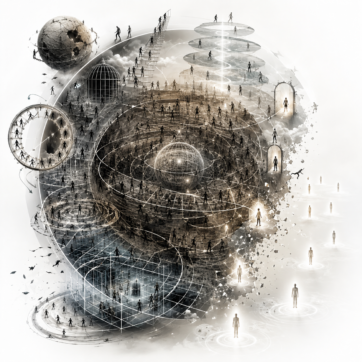
Why Truth Cannot Be Fully Preserved in a World That Is Constantly Re-Rendering
The Render Is Not Permanent
One of the most basic assumptions built into human perception is that the physical world is fundamentally persistent. A building appears to remain in the same place from one day to the next. A photograph sits inside a drawer for decades. A mountain can remain recognizable across thousands of years. The body appears to move continuously through a physical environment that was here before it and will remain after it. From inside the render, all of this creates an overwhelming impression of permanence.
But the render is not permanent. It is continuously resolving.
What appears physically at any given point is the rendered condition of that moment. The next moment is another rendered condition. There is enough continuity between those conditions that the world appears stable, objects appear persistent and identity appears to move uninterrupted through sequence. We experience a chair as the same chair, a house as the same house and a body as the same body because their organization continues to resolve with enough consistency for that continuity to remain recognizable.
That continuity is real, but continuity is not permanence.
This distinction becomes much easier to see when enormous amounts of sequence are considered. A building that appears completely stable over a human lifetime eventually deteriorates. Mountains erode. Landscapes change. Bodies age. Civilizations rise and disappear. Documents decay. Photographs fade. Technologies become obsolete. Even objects deliberately constructed to survive for centuries remain dependent upon physical conditions that continue allowing them to exist in recognizable form.
The difference between a photograph lasting ten years and a mountain lasting millions is therefore not that one belongs to a temporary render while the other has somehow achieved permanence. They are both rendered conditions. They simply maintain recognizable structural continuity across radically different amounts of sequence.
This changes what it means for something to “remain.”
The render does not need to hold one physical moment permanently in place for continuity to exist. Organization can continue resolving from moment to moment while also undergoing alteration. The body provides an obvious example. It is experienced as one continuous physical body even though its physical condition is continually changing. A city can remain identifiable as the same city while buildings are demolished, roads are reconstructed and generations of people move through it. What persists is not an untouched rendered moment. It is sufficient continuity of organization across changing rendered conditions.
The same mechanic applies to everything appearing physically.
There is therefore no rendered moment that becomes permanently fixed simply because it occurred. The moment in which a photograph was taken does not continue existing inside the physical world as that moment. The conversation spoken yesterday is no longer physically occurring. The room occupied ten minutes ago is not being held somewhere as an intact previous version of the room. Those were rendered conditions within sequence, and sequence continued.
What can continue are consequences, alterations, records and other forms of structural continuity produced through those conditions. A conversation can change a relationship. An event can alter a landscape. A decision can produce documents. A person can leave photographs, possessions and written accounts behind. Those subsequent conditions can carry information forward, sometimes for extraordinary lengths of time, but they are not the original rendered moment remaining permanently present.
This is where the ordinary concept of the render as an archive begins to break down. We tend to imagine that because something happened physically, the physical world must somehow permanently contain what happened. Yet the render does not preserve its own history simply by having rendered it.
It keeps rendering.
And once that is recognized, an entirely different question appears: if nothing in the render is permanent, what exactly is a record of something that happened?
The External Architecture — The Pre-Render, the Render and What Exists Beyond Them
Before going further into what a record actually preserves, it is necessary to establish exactly where records, evidence, physical objects and even human perception exist within the larger architecture. Eternal Flame Physics identifies two primary conditions within the external: the pre-render and the render. They are not two separate universes or dimensions. They are different conditions of one continuous external architecture. The pre-render is the structural organization upstream of visible physical expression. The render is the physical, perceptible expression arising through that organization.
Humanity is inside the external right now. This is our present condition. We are not standing outside of it observing it from some neutral position. Our bodies are rendered here. Our sensory systems operate here. Our memories, technologies, institutions, languages, archives and historical records exist here. The ordinary human experience of physical reality is therefore occurring from within the very architecture being examined. That matters enormously because most human attempts to establish truth begin only after something has already reached the render.
The pre-render is upstream of that visible outcome. It is not another physical location hidden behind this one, and it is not a spiritual plane, astral realm, higher dimension or metaphysical world. It is the organizational condition through which structural relationships establish before their rendered expression becomes physically perceptible. The render and the pre-render therefore cannot be understood as two disconnected places. They belong to the same external architecture across translation. What eventually becomes visible in the render is downstream of organization already present in the pre-render.
That distinction becomes critical to the question of truth because human beings ordinarily begin their investigation at the endpoint. Something happens. A person sees it. A camera records part of it. A document is produced. Physical consequences remain. Witnesses remember portions of it. Institutions classify it. Journalists report it. Historians later reconstruct it. Every one of those things exists at the rendered end of a much larger structural condition. By the time we are examining the evidence, we are examining what successfully translated into physical expression and what subsequently remained available through additional rendering.
The render is therefore not the origin of structure simply because it is where structure becomes visible.
A useful distinction is that the pre-render concerns organization while the render concerns expression. If several apparently separate rendered outcomes repeatedly organize around the same underlying relationship, looking only at each visible event can make them appear disconnected. Reading the structural pattern upstream can reveal that they belong to the same organization. Going deeper into the mechanic asks what relationship is actually producing that pattern in the first place. This is why Eternal Flame Physics is concerned with architecture rather than simply accumulating interpretations of visible events.
There is another complication within the external that has to be separated from both of these conditions: the mimic layer. The mimic is not the pre-render itself, and it did not create the external architecture. It operates within an external architecture that was already unstable. It reproduces, amplifies, redirects and overlays existing external structures, increasing distortion while retaining enough recognizable correspondence to what already exists that the copy can be mistaken for the original condition. The distinction matters because otherwise every distortion gets attributed to the external itself, or the mimic gets elevated into some ultimate creator or opposing cosmic power. Neither is structurally accurate within Eternal Flame Physics.
The mimic is still external.
It can affect what organizes, what translates, what becomes emphasized, what becomes obscured and therefore what eventually appears convincing inside the render. That makes the question of rendered truth even more complicated. A rendered condition does not automatically reveal its complete structural origin merely because it physically exists. Something can be physically present and still be the downstream expression of distortion, interference, replication or redirected organization. The existence of something in the render establishes that it rendered. It does not, by itself, explain the entire architecture responsible for its appearance.
And this is precisely where the Eternal must be kept completely separate from the external architecture.
The Eternal is not the pre-render. It is not the deepest part of the pre-render. It is not a cleaner layer hidden underneath the render. It is not another dimension beyond the mimic. The Eternal exists outside the external architecture entirely. The external operates through structure, relationship, translation, movement and rendered expression. The Eternal does not require those mechanics in order to exist. Eternal Flame Physics therefore does not use “upstream” to mean that if we travel far enough backward through the pre-render we eventually arrive at the Eternal. The distinction is categorical, not hierarchical.
This is especially important for the question this article is examining. If we confuse the Eternal with the pre-render, then reading upstream could be mistaken for accessing some absolute Eternal archive of everything that has ever happened. That is not the mechanic. The pre-render is still external architecture. Reading the pre-render means reading the structural organization associated with rendered conditions rather than relying exclusively upon the temporary artifacts that survived downstream.
That changes what investigation itself can mean.
At the rendered level, we ask what happened by examining what remains: the document, recording, photograph, object, physical trace, testimony or memory. At the structural level, the question expands. What organization produced these rendered conditions? What pattern connects them? What mechanic explains why these particular outcomes repeatedly resolved? Where is there continuity? Where is there distortion? Where does the visible evidence correspond cleanly to the underlying structure, and where does the rendered appearance fail to reveal the whole condition?
None of this makes rendered evidence irrelevant. Quite the opposite. Evidence is extraordinarily important because it is part of what has physically resolved and remained available within sequence. But it places evidence in its correct architectural position. A record belongs to the render. The event it describes belonged to an earlier rendered condition. The organization producing that event begins upstream of its visible expression. And the surviving record is another rendered condition carrying some degree of correspondence forward.
That is why the distinction between the pre-render and the render is foundational to everything that follows in this article. If the render is mistaken for the entirety of reality, then truth becomes limited to whatever the render managed to preserve. Once the architecture is understood, a much larger distinction becomes visible: what survived in the render is not necessarily the totality of what structurally occurred.
The Render Is Continuously Rendering
The render is not a fixed physical environment filled with permanent objects that simply remain in existence while time passes around them. Rendering is the continuous resolution of pre-render structural organization into present physical expression. What is visible, tangible and physically occurring exists as the rendered condition of that moment. The render is therefore not something that happened once and then remained assembled. It is continuously rendering.
Every rendered moment is temporary.
A rendered condition resolves, exists as the present physical condition, and is gone. The next rendered moment is not the previous moment being physically carried forward intact. It is another rendering arising through the architecture. This occurs continuously, creating such extraordinary continuity between successive rendered conditions that the result is experienced as one persistent physical world.
That continuity creates the appearance of permanence.
A table appears to remain the same table because its organization continues resolving with enough consistency across successive renderings for the physical expression to remain recognizable. A body appears to remain one continuous body because its organization continues rendering through sequence despite constant physical change. A building can appear to remain standing for hundreds of years because an enormous succession of rendered conditions maintains sufficient organizational continuity for each subsequent expression to remain recognizable as the same building.
But the building that appears today is not evidence that a rendered moment from one hundred years ago somehow remained physically alive for one hundred years. What persisted was continuity through rendering.
This distinction is enormous.
Nothing lasts in the render as a permanently preserved rendered moment. Objects can persist. Structures can persist. Information can persist. Consequences can persist. Patterns can persist. But persistence occurs through continued rendering, not because anything becomes exempt from rendering and achieves permanent physical existence.
Even apparent physical stability is therefore active rather than static. A mountain does not need to visibly transform every second for this mechanic to apply. Its current physical condition is still the condition resolving now. Across enough sequence, changes that were imperceptible from one moment to the next become unmistakable. Rock fractures. Surfaces erode. Landscapes shift. What looked permanent from the scale of a human lifetime reveals itself as another temporary organization maintaining continuity for a much longer span.
The same is true at every scale. Bodies change. Cities change. Coastlines change. Languages change. civilizations disappear. Technologies become obsolete. Archives deteriorate. Physical objects break apart. Nothing acquires permanence simply because its continuity exceeds the length of the sequence from which it is being observed.
This is why the render cannot be understood as an archive.
An archive, in the ordinary sense, implies that something from the past has been retained. But the render does not retain previous rendered moments by continuing to render those moments somewhere behind the present one. The room as it existed yesterday is not sitting intact behind the room that exists today. A conversation from ten years ago is not still physically occurring somewhere inside the render simply because it once occurred. The rendered condition happened, sequence continued, and another condition rendered.
The past is therefore not an enormous warehouse of completed rendered moments stacked behind the present.
What exists now is what can resolve now.
That can include consequences produced by earlier conditions. It can include a scar, a building, an altered landscape, a written document, a photograph, a video file, an archaeological object or an institutional archive. But each of those exists as a present rendered condition. They are not the earlier moment itself. They are current physical structures carrying continuity from conditions that rendered previously.
This becomes the foundation for understanding what a record actually is.
The render cannot preserve the render by keeping a rendered moment alive. It can only establish enough continuity for information corresponding to that moment to become available through subsequent renderings. A photograph can continue rendering. A document can continue rendering. A digital file can continue being maintained across changing physical systems. As long as sufficient continuity survives, information associated with an earlier rendered condition can become accessible again.
And if that continuity breaks, the rendered access can disappear with it.
The photograph can be destroyed. The document can decay. The file can become corrupted. The language required to understand the writing can disappear. The technology required to read the storage medium can cease to exist. The archive itself can be lost. None of these records ever escaped the temporary condition of the render simply because they were created for preservation.
A record is therefore not an exception to rendering.
It is another rendering.
Its significance is that its organization carries correspondence forward through sequence. As long as that organization continues resolving sufficiently, something about an earlier condition remains accessible in the present. Once that continuity can no longer be maintained or translated, the render has no obligation to preserve it simply because it once existed.
The render is temporary by construction. Rendering is continuous. Nothing in it becomes permanently fixed.
A record does not defeat that temporariness.
A record is one of the mechanisms through which continuity is maintained inside it.
A Video Game Makes Continuous Rendering Easier to See
A video game provides a useful analogy for understanding why the render can appear continuous even though no individual rendered moment needs to remain permanently in place.
While a game is being played, the screen appears to contain a continuous world. A character walks through a room, opens a door, moves outside, crosses a landscape and enters another location. From the player’s perspective, it feels like one uninterrupted environment through which the character is moving.
But the screen itself is constantly changing.
What appeared on the screen several moments ago does not need to remain physically displayed behind what is appearing now. The system continuously generates the current visual condition according to the organization of the game. Each new frame replaces the previous visual frame quickly enough that the player experiences movement, continuity and a stable environment rather than a disconnected series of images.
The character therefore appears to walk continuously across the screen because successive rendered frames maintain coherent relationships with one another. One position resolves into the next position. The environment changes in correspondence with the character’s movement. Objects remain where the game architecture determines they should remain. Lighting changes. Perspective changes. New portions of the environment become visible while others disappear from view.
The experience feels continuous because the organization is continuous, not because every previous frame remains on the screen.
If the character walks out of a room and continues through the game, the earlier image of that room is no longer being displayed as that previous frame. The player cannot simply reach backward into the screen and retrieve the exact visual moment that disappeared. To see that location again, the game has to render it again. The player might return to the room, reload an earlier save, restart a level or begin the game again, depending upon how the game is structured. But what appears on the screen is still a new rendering occurring in the present. The previous displayed frame itself did not remain alive waiting to be revisited.
This is particularly important because returning to the same location can create the appearance that the earlier rendered scene was sitting somewhere intact the entire time. But the game does not need to preserve every previously displayed frame as a permanently existing visual world. It preserves enough underlying organization and state information to generate the appropriate scene when that scene needs to appear again.
The distinction is between preserving a rendered moment and preserving the organization necessary for continuity.
That is the useful analogy for the render.
The physical world appears overwhelmingly persistent because successive rendered conditions maintain extraordinary continuity. A room remains recognizable when someone leaves and returns. A building remains standing overnight. A person wakes up with the same recognizable body. Objects maintain relationships to one another. Consequences from previous conditions affect subsequent conditions. Sequence remains coherent enough that the world is experienced as one continuous physical environment.
But continuity does not require every previous rendered moment to remain permanently present.
Like the constantly changing game screen, what matters is what is resolving now and the organization through which the next condition resolves. The present rendered condition carries continuity from what came before without needing to contain the previous rendered moment itself.
The analogy has an important limit. Eternal Flame Physics is not claiming that the external is literally a computer program, that physical reality is a digital simulation, or that some external programmer is generating frames on a cosmic screen. Those would turn a structural analogy into another rendered storyline. The comparison is useful for one specific mechanic: something can appear completely continuous while its visible expression is continually being rendered moment by moment.
A video game makes that mechanic visible because the rendering process is technologically obvious.
The screen keeps changing. The world appears continuous.
And the frame that disappeared does not have to remain anywhere on the screen for the next frame to make sense.
The Render Is Not an Archive of Its Own Past
Once a rendered moment has occurred, that exact rendered condition does not remain sitting somewhere inside the render. It does not become permanently stored simply because it happened. The render continues resolving, and what was physically present as one moment gives way to the next rendered condition.
The previous moment is gone as a rendered moment.
This is different from saying that everything associated with that moment immediately disappears. What can continue are the structural and physical consequences established through it. A fire can alter a building. An injury can leave a scar. A decision can change the direction of a life. An event can produce documents, photographs, recordings, physical evidence and testimony. A conversation can remain in memory. An ancient civilization can leave buildings, objects, writing and changes to the land long after the people and events that produced them are gone.
But all of those things are subsequent conditions.
The scar is rendering now. The document is rendering now. The archaeological object is rendering now. The memory exists through a person who is rendering now. The digital recording depends upon physical systems rendering now that remain capable of storing and translating its encoded information. What survives from an earlier event does not cause the earlier rendered moment itself to remain present.
This creates an essential separation between an event and evidence of an event.
Imagine a room in which something happened one hundred years ago. The room may still exist. Objects from that period may remain. A photograph may show how the room appeared. Someone may have written an account immediately afterward. Physical alterations caused by the event may even remain visible. Those surviving conditions can provide extraordinary amounts of information about what occurred.
But none of them is the event.
The photograph is a photograph produced through the event. The written account is a rendered record produced afterward. The physical alteration is a consequence. The object is something whose continuity survived. Each carries correspondence to the earlier condition, but the original rendered moment itself has already disappeared from the render.
This is why the amount of surviving evidence can never be confused with the continued existence of the past itself. Even an event captured simultaneously by hundreds of cameras does not remain physically alive inside those recordings. What survives is encoded information capable of producing later rendered representations of aspects of the event.
A video makes this particularly easy to misunderstand because it can create an extraordinarily convincing reproduction of temporal continuity. A person can watch someone who died decades earlier walk across a room, speak, laugh and interact with other people. It can appear as though a piece of the past has somehow been preserved intact.
But when the recording is played, the original event is not happening again.
A present technological system is translating stored information into a new rendered audiovisual condition. The screen is rendering now. The sound is occurring now. The information being translated carries correspondence to an earlier rendered event, but the earlier event itself has not returned.
Memory presents the same distinction through another mechanism. Remembering an experience does not make the original rendered experience physically present again. The memory provides present access to information associated with something that previously occurred. Testimony moves that information into another rendered form through language. A written statement can then carry aspects of that testimony farther through sequence. Every transition creates another continuity structure, while the originating rendered moment remains gone.
This also means that what survives from the past is selective by its very nature. Some consequences continue and others do not. Some documents survive while others are destroyed. Some witnesses remember details that others never perceived. Some physical evidence remains accessible while other evidence deteriorates. Some records are deliberately preserved while enormous amounts of ordinary rendered experience leave little or no enduring physical record at all.
Human history is therefore constructed from what maintained enough continuity to remain accessible, not from the continued physical existence of every moment that occurred.
That distinction becomes enormous when considering truth. The present render can contain evidence corresponding to a previous condition, sometimes enough evidence to establish what occurred with extraordinary clarity. But present evidence and the past event are still structurally different things. One is the original rendered condition. The other is what continued rendering afterward and remains available now.
The render does not carry its past forward by preserving every previous version of itself.
It carries consequences forward. It carries alterations forward. It carries information forward. It carries whatever maintained sufficient structural continuity to continue resolving through subsequent rendered conditions.
The past rendered event and the present evidence of that event are therefore never interchangeable. The evidence is what remains accessible now.
The event is what actually occurred then.
So What Is a Record?
If the render does not preserve its previous moments, then the meaning of a record has to change with it. A record cannot literally be the preservation of the original rendered moment because that moment is no longer rendering. What a record preserves is correspondence to that moment through another rendered structure that continues forward through sequence.
A photograph is a clear example. When a photograph is taken, the photographed moment does not become permanently contained inside the image. The people, objects, lighting, physical positions and surrounding conditions that existed at that instant continued changing immediately afterward. The photograph establishes an organized visual representation corresponding to a particular rendered condition, and that representation can continue rendering long after the original condition is gone.
The photograph is therefore not the moment. It is a record of the moment.
Video can make this distinction harder to recognize because it preserves movement and sound across sequence. A recording can show someone walking into a room, speaking, moving objects and leaving again. Decades later, that sequence can be played and experienced almost exactly as though a small section of the past has been reopened. But the event itself is not inside the video. The people are not physically performing those actions again. The original room is not returning to its previous condition. Stored information is being translated through present rendered technology into a present audiovisual representation corresponding to an earlier rendered sequence.
Writing creates another form of correspondence. A person witnesses an event and writes down what occurred. The event is gone, but language becomes a rendered structure through which information about it can continue. Someone can encounter that writing hundreds of years later and reconstruct aspects of an event they never physically experienced. The written record has carried information across an enormous amount of sequence without carrying the original rendered event itself.
The same applies to audio recordings, photographs, government records, letters, books, databases, maps, physical evidence, archaeological artifacts and every other form through which humans attempt to preserve information. Each establishes some form of continuity between an earlier rendered condition and a later one.
That continuity can sometimes be extraordinarily precise. A camera can preserve details no witness consciously noticed. An audio recording can preserve exact words and vocal characteristics. A timestamp can establish sequence. Multiple independent records can overlap and reinforce one another. Physical evidence can establish relationships that were never deliberately documented at all.
But precision does not turn the record into the event.
This distinction becomes especially important because humans commonly speak as though recording something has somehow prevented it from disappearing. “It was captured on video.” “There is a permanent record.” “It is preserved in the archive.” Those expressions make practical sense, but structurally nothing has escaped the mechanics of the render. The recording itself is now another rendered condition subject to continuous rendering.
A record therefore requires a carrier.
Information can be organized through ink on paper, chemical changes in photographic film, magnetic organization, physical grooves, digital storage, carved stone, biological memory or countless other rendered structures. Different technologies use different carriers, but the underlying principle remains: some present organization has to maintain enough correspondence to an earlier condition for information about that condition to become accessible again.
And accessibility requires translation.
A book requires someone capable of reading its language. Film requires a means of viewing it. Digital information requires compatible hardware and software. An archaeological object requires interpretation. Even a photograph requires perception capable of recognizing what its visual organization represents. A record is therefore not merely information sitting independently inside the render. Its continuity depends upon both the survival of its organization and the continued ability to translate that organization.
This is why a record can survive physically while its meaning disappears. An unknown inscription can remain carved into stone for thousands of years while the ability to understand what it says is lost. A storage device can remain physically intact while the technology required to read it disappears. Information can therefore maintain physical continuity without maintaining complete translational continuity.
The record itself can also change. Paper deteriorates. Photographs fade. Digital files corrupt. Copies lose information. Testimony gets rewritten. Archives are reorganized. Context disappears. A record that begins very close to the originating rendered condition can become increasingly separated from it as the systems required to preserve and interpret that correspondence change through sequence.
This reveals what recording actually accomplishes.
A record does not make a rendered moment permanent. It establishes another rendered structure through which some information corresponding to that moment can continue.
The original condition rendered and disappeared as that condition. The record subsequently continues rendering. If its organization survives and remains translatable, correspondence to the earlier condition remains accessible. If that continuity eventually breaks completely, the render does not retain the original moment somewhere else simply because a record once existed.
A record is therefore a mechanism of rendered continuity, not rendered permanence.
It does not stop the render from disappearing.
It allows something about what disappeared to continue rendering afterward.
Every Record Is Dependent Upon Continued Rendering
Once a record is understood as another rendered structure rather than a permanent container for the past, another mechanic becomes unavoidable: the record itself has to keep rendering.
Nothing becomes exempt from the temporary condition of the render simply because humans designate it as historically important. A handwritten letter, government document, photograph, film reel, hard drive, database, monument or archaeological artifact remains subject to exactly the same fundamental condition as everything else here. It can maintain continuity for a period of sequence, but it cannot become permanent.
Paper burns. Ink fades. Film deteriorates. Magnetic storage degrades. Hard drives fail. Servers disappear. Digital files corrupt. Software becomes incompatible. File formats become obsolete. Buildings containing archives are damaged or demolished. Institutions responsible for maintaining records collapse. Languages disappear. Cultural knowledge required to interpret surviving material can be lost. Even stone eventually erodes.
The length of survival changes. The underlying mechanic does not.
A record surviving for five years and an inscription surviving for five thousand years are both examples of rendered continuity. One simply maintained sufficient organization across considerably more sequence than the other. Neither stopped rendering. Neither became permanently fixed inside the external.
This becomes especially visible with digital records because they often create an illusion of immaterial permanence. A digital photograph can be copied thousands of times without the obvious physical deterioration associated with an old paper photograph. A document can exist simultaneously across computers, servers, cloud systems and backup drives. From the human perspective, this can make digital information seem almost detached from physical impermanence.
But digital information still depends upon the render.
It requires physical storage. Electricity. Hardware. Servers. Networks. Software. Compatible formats. Maintenance. Infrastructure. Institutions or individuals continuing to preserve access. Remove enough of those rendered conditions and the information becomes inaccessible regardless of how permanent it once appeared.
The same problem exists with physical archives. Humanity deliberately creates libraries, museums, historical societies, government repositories and preservation systems because records do not preserve themselves. Buildings require maintenance. Documents require controlled environments. Film requires restoration. Digital collections require migration into newer formats. Damaged materials require conservation. Information has to be catalogued so future people can locate it. The enormous human effort devoted to preservation is itself evidence that a record has no inherent permanence.
Preservation is active continuity.
And maintaining the physical carrier is only part of it. A record must also remain capable of being translated.
A written text can physically survive while the language required to understand it disappears. A technological storage medium can survive while the machine required to read it becomes unavailable. A photograph can remain visible while the identities of everyone pictured are lost. An official document can survive while the surrounding institutional context necessary to understand what it meant disappears. A fragment can therefore remain in the render while portions of its informational correspondence are progressively lost.
This introduces another important distinction: physical survival and informational survival are not necessarily the same thing.
The object can remain while its meaning disappears.
Human memory is subject to the same larger condition through a different mechanism. A person can carry information about an event for decades. That memory can later become testimony, writing, audio or video, allowing aspects of it to establish additional continuity outside the individual body. But if it is never transferred into another record, its availability remains dependent upon the continued rendering of the person carrying it. When that body eventually ceases rendering, access to everything remembered but never recorded disappears from the render with it.
Entire portions of human history have disappeared this way.
Countless conversations were never recorded. Countless lives left little surviving documentation. Countless records were deliberately destroyed or accidentally lost. Entire cultures transmitted knowledge orally that later disappeared. Wars destroyed archives. Governments eliminated documents. Fires consumed libraries. Technologies changed. Languages vanished. Ordinary physical deterioration erased information without anyone ever consciously deciding that it should be lost.
What humanity calls history is therefore not everything that happened.
It is what maintained enough continuity to remain recoverable.
That is an enormous distinction for the larger question of truth. The surviving record is already the product of selection through sequence. Some evidence continued rendering and some did not. Some information was recorded and some never was. Some records remained accessible while others became unreadable. Some were copied repeatedly while others existed as a single vulnerable object. Some were intentionally preserved because somebody considered them important, while other information disappeared because nobody recognized its significance at the time.
The present record is therefore dependent upon an entire chain of rendered conditions that successfully continued long enough for it to be encountered now.
And that chain can always end.
This is why the phrase “permanent record” is structurally misleading when taken literally. Permanent can describe an intention, classification or extremely durable form of preservation inside human systems. It cannot make anything inside the render actually permanent.
Recorded has never meant permanent.
It means sufficient continuity was established for information from an earlier rendered condition to remain accessible through a later one. How long that continuity survives depends upon what continues rendering afterward.
Why Complete Rendered Truth Becomes So Difficult to Recover
Once the original rendered moment is gone and what remains are records, consequences, memories and physical traces continuing through later renderings, the problem of establishing complete truth becomes much larger than simply finding enough information.
The original rendered condition is no longer available as that condition.
No investigator can physically stand inside yesterday exactly as yesterday rendered. No historian can enter an event from five hundred years ago and observe every person, conversation, motive, physical position and surrounding circumstance directly. No journalist arriving after an event can recover every aspect of the original moment simply by collecting enough documents. What can be examined are the pieces of that condition that established enough continuity to remain accessible afterward.
This means nearly every attempt to establish what happened in the past involves reconstruction.
History is reconstruction. Journalism is reconstruction. Forensics is reconstruction. Archaeology is reconstruction. Legal investigation is reconstruction. Even personal memory involves reconstructing an earlier experience through information that remains accessible in the present.
The quality of that reconstruction can vary enormously. Sometimes there is overwhelming evidence from many independent sources. There may be video, photographs, documents, timestamps, physical evidence, multiple witnesses and subsequent consequences that all correspond strongly enough to establish an event with extraordinary clarity. In other situations, only fragments survive. Sometimes the available record is contradictory. Sometimes crucial evidence was never created. Sometimes it existed and was later destroyed. Sometimes nobody knew that a particular detail would become important, so nothing preserved it at all.
This is where the difference between truth and recoverability becomes critical.
Something can have occurred regardless of whether the render preserved enough evidence for someone later to prove that it occurred. The structural actuality of an event is not created retroactively by the survival of documentation. A conversation that was never recorded still happened. A decision made without written documentation was still made. An event witnessed by nobody else still occurred. The absence of a surviving record does not reach backward through sequence and erase the original condition.
It changes what can be recovered from the render afterward.
The opposite problem also exists. An enormous quantity of surviving material does not necessarily preserve the complete condition. Ten thousand pages of records can still omit the conversation that changed a decision. Hundreds of photographs can document a location without showing what happened outside the frame. Hours of video can preserve visible action without revealing every condition producing it. Official records can precisely document what an institution formally recorded while leaving undocumented everything that occurred outside those procedures.
The render can therefore provide extraordinarily strong evidence without ever turning the evidence into the totality of the original event.
Every surviving record also has a position. A camera records from somewhere. A witness observes from somewhere. A document is created for some purpose. A measurement measures particular variables. An institution records what its system is designed to record. None of this automatically makes those records false or unreliable. It means that a record preserves correspondence to particular aspects of a condition rather than becoming an unlimited reproduction of everything structurally present within it.
This becomes even more complicated across long periods of sequence because reconstruction can become reconstruction of reconstruction. A historian may rely upon a book written decades after an event whose author relied upon letters written by people remembering what they experienced years earlier. A later documentary may rely upon that historian. Another article may rely upon the documentary. Information can continue moving through the render while becoming increasingly separated from the originating condition.
At that point, something can become culturally accepted as historical truth even though most people repeating it have never encountered the primary rendered records from which the account was originally constructed.
Personal memory demonstrates the same problem at the smallest scale. A remembered event is not the original rendered moment continuing inside the body. The person is accessing information from an earlier condition through the present condition. Details can remain remarkably clear while others disappear. Later information can become associated with earlier memory. Two people who occupied the same room can remember different aspects because neither experienced the total condition from every possible position.
Again, this does not mean truth is impossible or that every account is equally uncertain. That conclusion would simply create another distortion. Rendered evidence can establish facts with tremendous precision. Multiple independent records can converge. Physical evidence can eliminate possibilities. Documents can establish sequence. Video can establish visible action. Records can contradict false accounts. Investigation works precisely because surviving continuity contains real information.
The deeper issue is that the render can only be investigated through what remains available within the render now.
That creates a fundamental limit when the goal becomes complete rendered truth. The total original moment contained more relationships than any single surviving record could preserve. Some information continued. Some disappeared. Some was never recorded. Some became altered. Some remained physically present but lost its context. Some survives somewhere but has never been discovered.
Human beings then attempt to reconstruct the earlier condition from that uneven field of survival.
This is why truth cannot simply be defined as “what the records say.” Records are part of the evidence through which truth is reconstructed. They are not the originating condition itself.
The original rendered event happened once as that rendered condition. Then rendering continued.
Everything afterward is the attempt to determine what happened from whatever maintained enough continuity to remain available.
Evidence Is Not the Event
One of the most important distinctions in recovering truth from the render is also one of the easiest to collapse: evidence of an event is not the event itself.
Evidence exists because something from an earlier condition maintained enough continuity to remain available afterward. It can establish that something happened, reveal how it happened, identify relationships between people or objects, establish sequence, contradict an account, confirm a detail or expose a larger pattern. Evidence can be extraordinarily precise and extraordinarily important.
But it is still downstream of the condition it is being used to understand.
A document can establish that a decision was made, an action was authorized, money changed hands, a warning was issued or a particular statement was formally recorded. That document can become essential to establishing what occurred. But the document is not the entirety of the condition surrounding its creation. It does not automatically contain every conversation that preceded it, every person involved, every motivation, every competing consideration, every action that was never written down or every structural relationship that ultimately produced the documented outcome.
The document establishes what the document establishes.
A photograph has the same limitation through a different form. It can capture a rendered condition with remarkable accuracy. The positions of people, objects, damage, weather, clothing, surroundings and countless tiny physical details can remain visible long after the photographed moment is gone. Those details can become powerful evidence precisely because they preserve correspondence that might otherwise have disappeared.
But the frame is still a boundary.
Everything outside it is absent. Everything immediately before and after the photograph is absent unless another record preserved it. The photograph can accurately show what appeared within one portion of the render at one point in sequence without containing the total condition in which that image occurred.
Video expands the frame across time, but it does not eliminate the distinction. A video can establish movement, speech, timing and visible interaction across a rendered sequence. It can resolve questions that photographs or testimony cannot. Yet there is still a camera position, a beginning and an end, a visible frame and conditions outside that frame. What the video captures can be completely real while still being only part of the larger event.
Testimony preserves another kind of information. A witness can describe something for which no photograph, video or document exists. That testimony can carry direct correspondence from an earlier rendered condition into a later one. But the witness does not reproduce the original event by describing it. The testimony is a present rendered expression of information associated with that earlier condition.
Physical evidence works similarly. A broken window, damaged vehicle, fingerprint, biological trace, altered landscape or displaced object can reveal that something occurred and constrain what could have produced the condition now visible. The consequence remains available even though the event producing it has already disappeared as a rendered moment.
But the consequence does not contain the complete architecture that produced it.
This is where evidence and truth have to remain separate terms.
Evidence is not unimportant because it is incomplete. Its incompleteness is not a flaw. It is a consequence of what evidence structurally is. Evidence is surviving rendered correspondence to a condition that is no longer present as its original rendered moment.
Truth belongs to what actually occurred.
Evidence belongs to what remains available afterward.
The two can correspond extremely closely. Enough independent evidence can establish portions of an event beyond reasonable dispute. Records can reinforce one another. Physical evidence can correspond with video. Video can correspond with testimony. Documents can establish a sequence that explains physical consequences. As more independent pieces converge, a reconstruction can become increasingly precise.
But even perfect correspondence does not make the evidence become the event.
This matters because the render continually encourages the opposite assumption. What survives becomes what can be examined, and what can be examined can gradually become mistaken for the totality of what existed. The archive begins to stand in for history. The photograph begins to stand in for the moment. The official record begins to stand in for the entire institutional condition. The surviving testimony begins to stand in for every relationship operating around an event.
What disappeared becomes much harder to account for precisely because it is no longer visibly present.
An absence in the record therefore cannot automatically be treated as an absence in the original condition. Something can occur without leaving a surviving document. A conversation can happen without being recorded. A structural relationship can operate without anyone naming it. A critical piece of evidence can once have existed and later disappear. The present render only reveals what remains accessible within the present render.
At the same time, this distinction cannot be used to dismiss evidence whenever it conflicts with a preferred explanation. Evidence constrains reconstruction. A document establishing a date matters. A recording establishing what was said matters. Physical evidence establishing that a condition existed matters. The fact that evidence is not the entire event does not make evidence optional.
It establishes its proper structural position.
Evidence is downstream information.
The event is the rendered condition that actually occurred.
Truth is the actuality of that condition.
And investigation is the process of using what remains available in the render to reconstruct as accurately as possible something that no longer exists as that rendered moment.
Why Multiple Records Can Produce Different Versions of the Same Event
If every record preserves correspondence to an earlier rendered condition rather than preserving the entire condition itself, then multiple records of the same event do not necessarily have to look identical.
They can each carry different portions of the same truth.
Two photographs taken at exactly the same moment from opposite sides of a room can produce dramatically different images. One camera may show an interaction clearly while the other has its view obstructed. One may capture an object that is completely outside the frame of the other. Neither photograph has to be inaccurate. Each is preserving correspondence to the same rendered condition from a different physical position within it.
The event was larger than either frame.
But there is another layer even before the photograph is taken: a human usually determines where that camera is positioned, when the shutter is pressed, what is considered important enough to photograph and what is left outside the frame. The mechanical device can capture what is physically available to it, but the creation of the record itself has already occurred through a localized human position.
The same is even more apparent with written records. A person decides what to write down. They encounter a condition through their own localized position and then translate that encounter into rendered language. Their identity, existing beliefs, assumptions, prior experiences, available terminology, attention and understanding can all participate in that translation. What eventually appears on the page is therefore not the originating condition moving cleanly and completely into written form. It is a rendered account produced through an individual translator.
Some translations are considerably cleaner than others. A person can be careful, precise and highly disciplined about separating what they directly observed from what they inferred. Another person can unknowingly fill gaps, impose an existing belief onto what occurred or describe an observation through assumptions they never recognize as assumptions. Deliberate dishonesty is therefore only one way a human-created record can diverge from the condition that produced it. Distortion can enter through translation without the person intending to distort anything at all.
No human translation is completely outside the localized position through which it is produced.
Witnesses operate through this limitation before they ever give testimony. Ten people can occupy the same location during the same event without encountering precisely the same rendered information. Their physical positions are different. Their lines of sight are different. One person may hear a conversation another person cannot hear. Someone standing near an entrance may see who arrived while someone farther inside sees what happened afterward. One person may directly encounter only the beginning of an event while another encounters its consequences.
Then each person has to translate that localized encounter.
What they noticed, what they considered significant, how they understood what they saw, which details remained accessible, what language they used and what meaning they assigned to the event can differ. By the time the encounter becomes testimony, the record has passed through both localized access and localized translation.
Their accounts can therefore differ without automatically making one of them false.
This becomes especially important when differences between records are immediately interpreted as contradictions. A genuine contradiction certainly can exist. One record can directly conflict with another. A witness can be wrong. A document can contain inaccurate information. A photograph can be misidentified. Records can be altered, incomplete or deliberately deceptive.
But difference alone is not contradiction.
Sometimes two records appear incompatible because they preserve different positions within a larger condition. Sometimes the difference enters through how those positions were translated. And sometimes both are occurring simultaneously. Once additional evidence establishes the relationship between those records, what initially looked contradictory can become understandable as different rendered correspondences to a condition larger than either one.
Documents create another version of this problem because every record is produced within a particular function and context. An administrative document may accurately establish what one department approved while saying nothing about what another department was doing. A financial record may establish that a transaction occurred without explaining the circumstances surrounding it. An internal email may reveal what particular people knew at one point in sequence without establishing what everyone involved knew.
Even institutional records ultimately pass through people. Someone determines what information is collected, what categories exist, what questions are asked, what language is used, what is considered relevant and what is omitted. Procedures can make that translation more standardized and sometimes much cleaner, but standardization does not transform the resulting record into the originating condition itself.
Each record can be accurate within the portion of the condition it preserves while remaining radically incomplete as an explanation of the whole.
This is why a large collection of records can reveal something that no individual record reveals on its own.
One document establishes a date. Another establishes an action. A photograph establishes a physical condition. Testimony establishes a conversation. A later record establishes a consequence. Viewed separately, each describes a limited portion. Placed into relationship with one another, they can reveal sequence, repetition, inconsistency, causation or larger rendered relationships that were never explicitly documented in any single record.
But even the assembled collection remains a reconstruction through surviving correspondence. It does not become the full originating condition simply because more pieces have been added.
This is also why the survival of records matters so much. The collection available in the present is not necessarily a balanced representation of everything that originally existed. One side of an event may have generated extensive documentation while another generated almost none. One institution may have preserved its archives while another destroyed them. One witness may have recorded an experience immediately while another left no record at all. One photograph may survive while fifty others disappear.
What remains can therefore create a narrowed rendered view of something that was originally much larger.
That narrowing does not occur only because information is false. It can occur because information is missing, because access was localized, because the structure of the record could carry only certain information, because the person creating it translated what they encountered through their own position, or because other records capable of correcting or expanding that view never survived.
The surviving record becomes an opening through which an earlier rendered condition can be examined. The size and position of that opening determine what remains accessible through it. More records can create additional openings, allowing portions that were previously unavailable to become recognizable and relationships between them to emerge.
The structural error occurs when one opening is mistaken for the entire condition.
A single document becomes “what happened.” One photograph becomes “the scene.” One witness becomes “the story.” One institutional record becomes the definitive history. The surviving fragment is elevated from evidence of a condition into the condition itself.
But the original condition was never confined to the record that happened to survive it.
Rendered truth becomes narrowed by the position, capacity, translation and survival of the record carrying correspondence to it. A human-created record adds another translation boundary because the individual producing it is part of the process through which the information becomes rendered documentation.
Understanding a past condition therefore requires more than simply accumulating evidence. It requires examining how the pieces relate, where they originated, what portion of the condition each could access, how that information was translated, what each record was capable of preserving, what it excludes and what becomes recognizable when multiple forms of correspondence are placed together.
The records can differ. The translations can differ. The portions of truth they carry can differ. The condition from which they originated was still larger than all of them.
Human Memory Is Also a Continuity Record
Human memory does not sit outside these mechanics. A person who experienced an event does not carry the original rendered moment forward intact simply because they were physically present when it occurred.
The same distinction between an event and its surviving record applies inside the individual field.
As explored in Why Memory Fades in the Render — The Mechanics of Loss, Reconstruction, and Continuity, memory is not a permanent internal archive of lived experience. It is a reconstruction process. What remains from an experience is not the original rendered event stored somewhere inside the person, but an imprint within the individual field that can continue to provide enough structural correspondence for aspects of that experience to be reconstructed later.
This places memory directly inside the larger mechanics of rendered continuity.
A photograph carries visual correspondence to an earlier rendered condition. A document carries organized information about it. A physical object can carry material consequences from it. A video carries encoded audiovisual correspondence across a rendered sequence. Memory carries an individual structural imprint through which portions of an earlier experience can become accessible again.
These mechanisms are different, but none of them preserves the originating rendered moment itself.
And when a human creates a rendered record from memory, another layer of translation is added. A person writes something down, gives testimony, records an interview or otherwise converts what they remember into another rendered form. That information is not moving directly from the originating event into the new record. It is passing through the individual field first and then through the person’s present translation of what remains accessible there. Their identity, beliefs, assumptions, prior experiences, language and existing understanding can all affect how that correspondence is translated into the record they create. Some people translate what they encounter considerably more cleanly than others, but human-created records still pass through an individual translator to some degree.
When a person remembers something that happened twenty years ago, they are not reopening that rendered moment or retrieving an intact recording of it. The remembering is occurring now. Whatever remains sufficiently supported within the individual field is translated again through the present body and brain into imagery, language, sensation, spatial relationship, sequence and narrative. The result can correspond extremely closely to what occurred, but it is still a present reconstruction arising from continuity established through an earlier condition.
This means translation is already participating before the remembered experience ever becomes testimony. What originally became available to the person was localized. What became imprinted arose through that localized encounter. What becomes accessible later is reconstructed through the present field. And what the person then says or writes is another rendered translation of that reconstruction. The resulting testimony can carry extremely accurate correspondence while still never becoming a completely unmediated transfer of the original condition.
This explains why eyewitness testimony occupies such an important but structurally specific position within evidence.
A witness can carry information that exists nowhere else. Someone may have seen an action that no camera captured, heard words that were never recorded, noticed an object that later disappeared or directly encountered a portion of an event for which no other rendered record survived. Their memory can therefore become one of the only remaining continuity structures connecting the present investigation to that earlier rendered condition.
But the witness is not an archive of the event.
The first narrowing already occurred when the event was originally experienced. No individual encountered the total rendered condition from every position simultaneously. Each person occupied a particular physical and structural position within it. Attention was directed differently. Different details were perceived. Different portions of the event were available to different people. What became imprinted was therefore already a localized encounter with a much larger condition.
That localized encounter is also occurring through an individual identity. Two people can occupy nearly identical physical positions and still not translate everything available to them identically. Existing beliefs can influence what receives attention and how it is understood. Prior experience can affect what appears significant. Familiar narratives can provide immediate explanations for something before the person recognizes that interpretation has entered. Identity does not automatically make the resulting memory false, but it means human observation is never equivalent to a perfectly neutral recording device. There are cleaner and less clean translations, and distinguishing observation from the interpretation attached to it becomes essential.
Then sequence continued.
The imprint moved through the same larger architecture that prevents anything in the render from remaining permanently fixed. Structural support changed. Some details remained strongly reconstructable while others weakened. Similar experiences could become compressed. Later information could affect reconstruction. Repeated recall could reinforce a reconstructed version rather than the originating condition. Translation continued every time the memory became accessible again.
This is why two people can sincerely remember the same event differently without either difference automatically establishing deception.
They did not begin with identical imprints of a complete event. They encountered different portions of one rendered condition, carried different structural imprints forward and later reconstructed those imprints through different individual fields. Their memories can overlap substantially in some places and diverge sharply in others because each is preserving a different continuity relationship to what originally occurred.
The same mechanic also explains why certainty and accuracy are not identical. A memory can feel extraordinarily vivid because its reconstruction pathway remains strong. Repetition can make a particular version increasingly stable and accessible. Emotional intensity can maintain certain portions with exceptional clarity. None of those conditions transforms the memory into the original rendered event.
Persistence is not permanence here either.
The larger connection is important because human memory is one of the primary mechanisms through which humanity attempts to carry its past forward. Personal history depends heavily upon it. Families transmit history through it. Witness testimony enters legal systems through it. Journalism relies upon it. Oral histories preserve events through it. Entire historical accounts can begin with what one person remembers and then move into additional rendered continuity structures when that memory becomes testimony, writing, audio or video.
A single event can therefore move through several stages of rendered translation.
An event occurs. A person encounters part of it. An imprint forms within the individual field. Years later, that person reconstructs the experience as memory. The memory is translated into spoken testimony. The testimony is recorded. A journalist later transcribes the recording. A historian eventually encounters the transcript.
And every human position in that chain introduces another translation point. The witness translates the reconstructed memory into language. The journalist determines what is selected, organized and emphasized. The historian later encounters that surviving record through another individual field and another present understanding. Correspondence can remain remarkably strong across that chain, but there is no point at which the human translator disappears from it.
At every stage, correspondence to the originating condition can continue.
But the originating rendered moment itself has not traveled through that chain.
This is the same larger mechanic operating across individual and collective history. A person does not possess a complete internal archive of their life, just as the render does not possess a complete archive of its own past. The individual maintains enough continuity to experience a coherent personal history. Humanity maintains enough records, artifacts, memories and consequences to construct a coherent collective history.
Neither continuity is the same as total retention.
The past feels continuous because enough survives to connect one point to another. Memory fills portions of that continuity at the individual level. Records fill portions of it at the collective level. Narrative connects surviving fragments. What results can be remarkably detailed, strongly evidenced and highly accurate while still remaining a reconstruction from what continued rather than the original rendered condition preserved intact.
This brings the problem of recovering truth into its clearest form.
Documents are downstream.
Photographs are downstream.
Video is downstream.
Physical evidence is downstream.
Testimony is downstream.
Memory itself is downstream.
Every one of them can carry real and important correspondence to what occurred. Every one of them can contribute something essential to reconstructing the truth. But none becomes the originating condition simply because it survived that condition.
Once that distinction is understood, the next movement becomes unavoidable.
If every rendered route backward eventually leads to surviving correspondence rather than the original rendered moment itself, then recovering deeper structural truth cannot depend exclusively upon accumulating more downstream fragments.
At some point, the examination has to move upstream.
The question is no longer only what the person remembers, what the photograph captured, what the document recorded, what the video preserved or what physical evidence survived.
The deeper question becomes:
What structural organization had to be present for all of these rendered conditions to occur?
Reading Structural Mechanics in the Pre-Render — Fields, Patterns, Imprints, Pathways and Structural Trajectory
Reading the pre-render is fundamentally different from reconstructing truth exclusively through what remains physically available in the render. Rendered investigation begins with rendered correspondence: documents, photographs, recordings, testimony, objects, physical traces, locations, biological evidence, digital information and whatever else has survived into the present condition. Reading the pre-render accesses the structural architecture upstream of physical expression itself.
Every individual has a pre-render field. The Incarnational Identity Field is the localized pre-render structural organization through which the rendered body and lived physical position arise. The field is not an invisible physical body surrounding the visible one, and it is not a separate spiritual layer attached to a person. It is the structural organization upstream of rendered physical expression.
But pre-render organization is not limited to individuals.
Groups establish relational fields. Families do. Institutions do. Communities do. Populations and larger collectives do. Locations hold structural organization. Relationships between individuals establish organization between fields. Repeated interactions can alter those relationships. Multiple fields can participate in larger structural configurations without losing their differentiated positions within them.
This means structural reading can occur at many scales. An individual field can be read. A relationship between two fields can be read. The larger organization established through a group can be read. A location can be read. A collective condition can be read. The relationships between these structures can also be read.
What is being accessed is architecture.
Within that architecture, patterns can be read. Imprints can be read. Pathways can be read. Pathways that have collapsed can be read. Pathways that have opened or formed can be read. Pathways presently forming can be read. Compression, torsion, distortion, coherence, narrowing, instability and pressure relationships can be read. Movement through those conditions can be read. Structural trajectory can be read. Relationships between fields can be read. Conditions that have already organized can be differentiated from conditions actively organizing toward rendered expression.
These are not interchangeable pieces of information. They describe different structural features and mechanics within the pre-render.
A pattern is what is held.
Pattern describes the structural configuration maintained at the position being read. Compression can be held as pattern. Torsion can be held. Distortion can be held. Coherence can be held. Oscillatory instability, narrowing, pressure concentration, restriction and other structural configurations can be maintained within a field.
The pattern is the condition being held. It is not the movement generated through that condition. It is not trajectory. It is not a future event. It is not the recurrence of similar rendered events.
Patterns generate movement, but they are not movement.
This distinction becomes particularly important when repetition appears in the render. Repeated rendered outcomes can correspond to a pattern being maintained upstream, but the repetition itself is downstream expression. The pattern does not become a pattern because the same kind of event has happened ten times. The pattern is the held structural configuration through which movement continues organizing in a way capable of producing repetition.
Reading the pattern therefore identifies something that rendered observation alone cannot establish simply by grouping similar outcomes together. It identifies what the architecture itself is holding.
An imprint provides different information.
An imprint is retained structural correspondence established through prior interaction, resolution or experience. Something has resolved through the architecture and correspondence established through that interaction remains structurally accessible.
Imprints matter enormously when reading individuals, relationships, groups, collectives and locations because previous interactions do not have to remain as permanent rendered moments in order to remain structurally relevant to the present condition. An interaction can establish correspondence in an individual field. Repeated interactions between people can establish correspondence across a relationship. Sustained or high-intensity activity can leave correspondence associated with a location. Larger collective conditions can carry accumulated structural correspondence established through enormous amounts of interaction across sequence.
An imprint and a pattern are not the same thing.
The imprint carries retained structural correspondence. The pattern describes what is presently being held. An imprint can reinforce a pattern, contribute to its formation or participate in the mechanics maintaining it, but the two cannot be collapsed into one category.
And neither exists independently of the rest of the architecture.
A field can hold a pattern while simultaneously carrying imprints, maintaining some pathways, restricting others, losing others, forming new ones and organizing movement through the resulting structural condition. Reading only the pattern would therefore provide important information while still leaving much of the mechanic unread.
Pathways are a major part of that larger reading.
A pathway is not simply another name for a pattern. Pathways concern structural availability for movement and resolution. A pathway can be open and structurally available. It can be restricted. It can narrow. It can destabilize. It can become inaccessible. It can collapse. A pathway that previously could support movement can cease to hold. A pathway that was unavailable can form. A new pathway can be actively organizing before its downstream expression is fully visible in the render.
This means the pre-render contains structural conditions that are not merely static descriptions of what already exists. Architecture is continually organizing. Conditions are forming. Existing organizations are destabilizing. Pressure is redistributing. Pathways are opening and closing. Relationships are reorganizing. Movement is resolving through some structures while being prevented from resolving through others.
That developing organization can be read.
This is where structural trajectory becomes essential.
Trajectory is not pattern. Pattern is what is held. Trajectory concerns how movement is organizing through the architecture from the conditions presently available.
A field holding heavy compression can generate movement differently from a field holding coherent organization. But the trajectory cannot be understood only by naming the pattern. Pathway availability matters. Structural relationships matter. Pressure distribution matters. Intersections with other fields matter. Existing imprints can matter. The stability of the surrounding architecture matters. A pathway can begin forming and alter the available trajectory before a corresponding rendered event has occurred.
Structural trajectory can therefore reveal a condition organizing toward expression before that condition has fully resolved in the render.
This is not the same thing as declaring a predetermined future.
The pre-render is upstream of rendered physical resolution. If a trajectory is already structurally organizing, that organization is real. It can be read as an existing structural condition. But structural trajectory remains architecture in movement. Pathways can reorganize. A developing pathway can collapse. A restriction can release. An intersection can alter movement. A field can reorganize. The surrounding structural condition can change before the trajectory completes its rendered resolution.
Reading structural trajectory therefore means reading what is actually organizing, not inventing a future from nothing and not pretending the future already exists as an unchangeable rendered scene.
This is also why structural readings can sometimes be translated into what a condition could look like when it reaches the render.
The translation can be highly mechanical. A pathway is forming in a particular direction. Several structural positions are converging. A trajectory is organizing toward contact. A previous pathway has collapsed and movement is redirecting elsewhere. From that architecture, a rendered translation can begin to take shape: an encounter, separation, movement toward a location, interruption, convergence, change in physical circumstances or another downstream expression corresponding to the structural organization being read.
The rendered description is a translation of the architecture.
That translation can remain predominantly mechanical: compression, pathway, intersection, collapse, formation, movement, trajectory, convergence. Structural information can also translate visually and can appear with scene-like or movie-like clarity. A past structural correspondence can translate into imagery of what the corresponding rendered condition looked like. A forming trajectory can translate into imagery of what its downstream resolution could look like if that organization continues to hold.
The existence of visual translation does not erase the distinction between the structural information and its rendered interpretation.
That distinction is the precision point.
The pre-render can contain enough structural information for someone to translate architecture into a recognizable rendered configuration. That does not mean every image, scene or interpretation is automatically structurally exact. It means structural information can translate through the reader into a rendered form capable of representing what is being accessed.
The translation can therefore occur at different degrees of resolution.
A person might first register compression. Reading deeper reveals where the compression is held. Reading the mechanic reveals what is maintaining it and what it is preventing from reorganizing. Pathway reading reveals where movement is available and where it has been blocked. Imprint reading reveals correspondence participating in the condition. Trajectory reading reveals how movement is presently organizing through the available pathways. Further translation can reveal what that organization corresponds to or what its rendered expression is taking shape to become.
The same can occur when reading backward through structural correspondence.
An imprint can carry enough correspondence for aspects of a prior condition to translate into recognizable rendered information. That information can sometimes resolve visually, including as a scene. The important distinction is not that visual or event-like information cannot be read. It can. The distinction is that the pre-render information and the rendered image through which it is translated are not identical conditions.
A scene is the rendered translation through which structural information becomes perceptible to the reader.
This is different from the pre-render functioning as a permanent film archive containing every historical moment exactly as it once appeared physically. The pre-render does not need to preserve an old rendered frame as an eternally existing physical scene for structural correspondence from that condition to remain accessible. The architecture can carry enough correspondence for aspects of that condition to translate again.
That distinction preserves both realities: structural reading can produce highly specific and even visual information, while the original rendered moment still does not have to remain permanently stored somewhere as an intact copy.
The same precision applies when structural information does not translate that clearly.
A person can register a real pattern and then impose a cause that was never actually read. Someone can encounter compression at a location and decide that a death occurred there. They can register an imprint and immediately build a historical story around it. They can sense instability and translate that into a familiar supernatural explanation. In those cases, real structural registration has been followed by human narrative completion.
But that is not the only possibility.
There is a difference between inventing a story from a structural sensation and receiving enough structural information for a specific rendered translation to form.
That distinction cannot be resolved simply by declaring all scene-like information narrative. The actual question is how much of the architecture is being read and where interpretation enters the translation.
A straight mechanical read remains critical because it provides the structural foundation beneath every further translation. What is held? What imprint is present? What pathways exist? Which have collapsed? Which are forming? Where is pressure accumulating? Where is movement organizing? What trajectory has established? What relationships between fields are participating? What is stable? What is changing? What has already resolved structurally, and what is still in formation?
Those mechanics provide the architecture against which any more specific rendered translation can be understood.
This becomes particularly important when reading locations.
A location can hold patterns established through its present structural organization. It can carry imprints associated with prior interaction. It can contain pathways created through repeated movement. Some pathways can remain strongly available while others have collapsed. Geographic conditions, infrastructure, repeated human interaction, high-intensity events, structural interference, converging fields and accumulated pressure can all participate in the condition being read.
A location therefore cannot be reduced to a single historical story.
Two locations can hold similar compression patterns for completely different reasons. Two locations with very different patterns can carry imprints from superficially similar rendered events. A location can retain correspondence to prior interactions while its present pattern has already changed. It can maintain an old pattern even after the rendered people who reinforced it are gone. A new pathway can begin forming through a location and change its structural trajectory without erasing the imprints already present there.
The architecture has history, present configuration and developing movement without collapsing those into the same thing.
Individuals operate through the same fundamental distinctions.
An individual field can carry imprints from prior experience while holding present patterns that have been reinforced across sequence. It can contain pathways established long ago, pathways presently restricted, pathways that have collapsed and pathways only now becoming structurally available. Movement through those pathways establishes trajectory. Relationships with other fields can reinforce, destabilize, redirect or reorganize portions of that structure.
Reading an individual structurally therefore extends far beyond describing what the person presently feels or how they behave in the render. The rendered condition is downstream. Structural reading can identify organization that has not yet become obvious through rendered circumstances.
Groups and collectives add further complexity because multiple differentiated fields participate in larger relational architecture.
A group can hold patterns that no single member alone accounts for. It can carry accumulated imprints established through repeated interaction. Pathways can exist through the collective structure itself. Some members can occupy positions through which particular movement repeatedly routes. Other positions can function as restrictions, convergence points or destabilizing intersections. Collective pathways can collapse or form as relationships change. Movement through the larger architecture can establish structural trajectories whose downstream effects later become visible as changes in the group, institution, community or population.
A collective field is therefore not merely a statistical description of many individuals behaving similarly. It is pre-render relational organization established through the interaction of differentiated fields.
The same is true across scales. An individual field can participate in a family field while that family participates in larger institutional, geographic or collective structures. Structural conditions can intersect without becoming identical. A pattern held at one scale can interact with pathways operating at another. Imprints established through one relationship can influence later organization elsewhere. A developing trajectory can encounter another field and reorganize.
Reading mechanics means following those relationships rather than isolating one structural feature and treating it as the entire field.
Pattern reveals what is held.
Imprint reveals retained structural correspondence.
Pathways reveal where movement and resolution are structurally available, restricted, collapsed or forming.
Movement reveals what the held architecture is generating.
Structural trajectory reveals how that movement is organizing through available conditions toward resolution.
Relationships between fields reveal how differentiated structures are interacting, reinforcing, redirecting, constraining or reorganizing one another.
Mechanic reveals how all of those conditions are actually operating together.
And translation is what allows any of that structural information to become understandable here in the render.
Sometimes the cleanest translation remains purely mechanical. Sometimes the architecture translates into recognizable physical circumstances. Sometimes retained correspondence translates into information about what a prior rendered condition looked like. Sometimes a forming trajectory translates into what its downstream expression is organizing to look like before that expression has fully arrived.
None of those translations should be confused with the architecture itself.
But neither should the readable architecture be artificially reduced simply because its translation can become specific.
Reading the pre-render is not merely identifying a static condition behind the physical world. It is reading an active structural architecture: what is held, what remains impressed, what has collapsed, what has formed, what is forming, what is available, what is restricted, what is moving, where that movement is organizing, what fields are intersecting and what conditions are moving toward physical expression.
That is the larger structural read.
The render provides the physical resolution.
The pre-render provides access to the architecture through which that resolution is being organized.
Structural Truth Still Has to Be Translated Into the Render
Reading structural mechanics in the pre-render does not eliminate the problem of translation. It changes where the information is being accessed, but the moment that information is communicated, documented, taught or recorded, it still has to resolve into the render.
That creates an important boundary between the mechanic itself and any rendered description of the mechanic.
A structural mechanic operates as architecture. It exists through actual organization, relationship, pressure, pathway, pattern, movement, trajectory and translation within the pre-render whether or not there is rendered language available to describe it. The mechanic does not require a name in order to operate. Compression does not begin when the word compression is assigned to it. A pattern does not come into existence because someone identifies it. An imprint does not depend upon a definition of imprint. The architecture is already doing what it is doing before human language enters the process.
Language comes afterward.
When a structural condition is read and then described, something that was directly structural has to be translated into words capable of representing it in the render. A diagram does the same thing visually. A recorded explanation translates it through speech and sequence. A written article organizes it through sentences, definitions and relationships between concepts. A class or teaching translates it into a form another person can encounter through rendered perception.
None of those forms is the mechanic itself.
They are rendered representations of a mechanic operating upstream of their representation.
This is not the same limitation as simply having incomplete historical evidence. A photograph of an event and a written description of a structural mechanic are different kinds of rendered records, but both demonstrate the same larger boundary: the render can carry correspondence to something without becoming identical to the thing to which it corresponds.
A diagram of compression is not compression. A sentence describing a pathway is not the pathway. A definition of pattern is not the held structural pattern. A description of an imprint is not the imprint. Even an exceptionally precise structural explanation remains a rendered translation arranged to correspond as cleanly as possible to architecture that is not made out of words.
That distinction becomes especially important because language necessarily separates what architecture can hold simultaneously.
A structural configuration can contain multiple relationships at once. Pattern, pressure, pathway availability, imprint, movement and surrounding structural relationships can all participate in one present organization. In the pre-render, those relationships do not have to wait for one another to be described sentence by sentence. They are structurally related as part of the condition itself.
Rendered language cannot operate that way. A sentence begins, proceeds and ends. One distinction is established before another can be explained. Terminology has to divide aspects of architecture so that they can be examined clearly. An article has to place one section before the next. A diagram has to use boundaries, arrows, labels or positions to represent relationships that are not literally composed of boundaries, arrows and labels.
Translation therefore introduces sequence into the explanation of architecture that is not itself dependent upon the explanatory sequence.
This is one reason structural mechanics can become distorted even after something real has been read. The distortion does not always begin at the point of structural access. It can begin during translation.
A person can register a structural condition accurately and then choose the wrong rendered concept for it. Several mechanics can be collapsed under one familiar word. One mechanic can be divided into several artificial categories because existing language does not contain a clean equivalent. A relationship can be turned into an object. A condition can be translated as a place. Structural movement can be translated into intention. An imprint can be turned into a story about the past. A pattern can be mistaken for prediction. Once that happens, the rendered explanation begins carrying assumptions that were never contained in the structure itself.
This is precisely why terminology has to remain subordinate to the architecture.
The purpose of a term within Eternal Flame Physics is not to create the mechanic. It is to establish a sufficiently precise rendered reference so the mechanic can be recognized, differentiated and discussed without continually collapsing it into something else. The terminology matters because distinctions matter, but the terminology is not where the truth ultimately resides.
The same is true of definitions.
A definition establishes a rendered boundary around how a term is being used. That boundary is necessary because without it, familiar human meanings immediately begin entering the translation. Pattern becomes repetition. Field becomes an invisible substance surrounding a body. Imprint becomes a recording. The pre-render becomes another realm. Structural reading becomes prediction. Each mistranslation begins when the rendered term is allowed to replace the mechanic it was introduced to describe.
Precise definitions prevent that collapse, but memorizing the definition is still not the same as reading the architecture.
Someone can memorize that pattern means what is held and still fail to recognize a held structural pattern. Someone can repeat the distinction between pattern and movement while continuing to interpret rendered movement as though it were the pattern itself. Someone can know the terminology for imprint while converting every structural correspondence into a historical narrative. The rendered sentence can be reproduced perfectly while the mechanic remains unread.
That is why Eternal Flame Physics cannot ultimately be reduced to vocabulary, diagrams, or memorized propositions. All of those are necessary rendered translations through which the architecture can be communicated, differentiated and examined. None of them becomes the architecture by describing it.
This also places a limit on the idea that structural truth could ever be perfectly preserved simply by recording enough explanation.
More writing can increase precision. Better terminology can reduce mistranslation. Diagrams can expose relationships that are difficult to communicate through prose. Recordings can preserve explanations across sequence. Multiple forms of documentation can reinforce distinctions and make later reconstruction far stronger. But an unlimited collection of rendered descriptions still would not turn the rendered record into the pre-render mechanic itself.
There remains a translation boundary.
The structural condition is what it is. The reading encounters that organization. The human translator resolves that recognition into a form available in the render. The resulting words, diagrams, recordings and teachings then become rendered structures of their own, subject to the same conditions of continuity, access, interpretation and survival as every other rendered record.
That means even the clearest description of structural truth has to be encountered and translated again by whoever receives it.
A sentence is written from one structural recognition, but another person encounters that sentence through their own present translation. The words can remain identical while the structure they understand through those words differs dramatically. Existing paradigms, established definitions, familiar categories and prior explanatory systems can all be imposed onto the language. The rendered record can survive perfectly while its structural meaning is progressively mistranslated.
Preserving the words is therefore not necessarily the same as preserving the recognition that produced them.
This is one of the deepest limitations of recording truth in the render. The problem is not only that physical records disappear, evidence becomes incomplete or historical events cannot be perfectly reconstructed. Even when the subject being recorded is structural truth itself, that truth must still cross into rendered representation before it can become an article, diagram, recording or teaching.
The representation can correspond to the mechanic with extraordinary precision. It can establish distinctions cleanly. It can allow another person to recognize architecture they had previously been unable to differentiate. It can preserve enough continuity for the work to remain accessible across rendered sequence.
But correspondence is still correspondence.
The mechanic remains the mechanic.
The description remains the rendered translation of it.
And the difference between those two has to remain intact, because the moment the terminology is mistaken for the architecture, the rendered explanation has once again replaced the structural truth it was created to describe.
Truth Belongs to the Condition; Evidence Belongs to the Render
Truth is not created by documentation.
A condition either structurally occurred or it did not. Whether anyone witnessed it, photographed it, recorded it, wrote about it, remembered it or preserved physical evidence of it is a separate question. Documentation can establish correspondence to what occurred. It can provide powerful evidence that something happened. It can preserve portions of a rendered event with extraordinary precision. But documentation does not create the truth of the originating condition, and it can never contain that condition in full.
This distinction reaches the central mechanic beneath the entire problem of recording truth.
Full truth is never in the render.
The render is physical expression arising through architecture upstream of it. What becomes visible, measurable, audible, recordable or otherwise physically accessible is therefore already a rendered resolution of a larger structural condition. The render can express that condition. It can reveal consequences of it. It can preserve correspondence to portions of what resolved. But it cannot contain the totality of the architecture through which that expression became possible.
The full truth of anything cannot therefore be reduced to the collection of rendered evidence left behind by it.
This is true even at the moment something is physically occurring. A rendered event is not waiting until later documentation to become incomplete. The limitation already exists because what appears in the render is downstream expression. The visible event is real, but the visible event is not the entirety of the structural condition producing and organizing it.
A person standing directly inside an event therefore does not automatically possess its full truth simply because they witnessed it firsthand. They occupy a localized position within its rendered expression. They encounter what resolves through that position. Another person positioned elsewhere can encounter another portion. A camera captures what enters its frame. A microphone preserves available sound. A document records what someone chose or was able to document. Physical evidence preserves particular consequences. Human memory reconstructs from correspondence retained through an individual field.
None carries the whole truth.
That distinction becomes even greater after the originating rendered moment is gone. The event itself is no longer physically present as that same rendered moment. What remains are subsequent rendered conditions carrying correspondence forward: photographs, recordings, documents, testimony, physical traces, memories, objects and other surviving evidence.
Investigation then works through those surviving openings.
Enough correspondence can establish a rendered fact with overwhelming certainty. A video can show an action occurring. Records can establish that a transaction happened. Multiple independent witnesses can establish that a person was present. Physical evidence can establish contact between people or objects. None of this makes evidence meaningless simply because it is incomplete. Evidence matters precisely because it creates reliable correspondence between the present investigation and a condition no longer physically available as its original rendered moment.
But strength of evidence and completeness of truth are different questions.
An enormous rendered record can exist around an event and still fail to contain its full structural truth. Thousands of photographs do not move upstream simply because there are thousands of them. Hundreds of witness statements do not collectively become the originating condition. Every available document can be preserved without those documents containing every structural relationship operating through what occurred.
Quantity can dramatically strengthen reconstruction without eliminating the boundary between evidence and truth.
The reverse is equally important. A condition does not become untrue because the render failed to preserve sufficient evidence of it.
Something can structurally occur and leave almost nothing behind. A conversation can happen without being recorded. An interaction can occur without witnesses. A decision can be made without documentation. A physical trace can disappear. A document can be destroyed. A witness can die. A memory can lose accessibility. Technology can fail. Records can be altered, separated from context or never created in the first place.
The absence of a surviving rendered record establishes a limitation in what can presently be demonstrated through rendered evidence. It does not travel backward and erase the condition that actually occurred.
This creates a difficult but necessary distinction between truth and provability.
What can be proven in the render depends upon what correspondence remains available in the render. What was structurally true does not depend upon whether the render successfully preserved enough correspondence for someone later to prove it.
Those two things can align extremely well. They can also separate dramatically.
This is why incomplete evidence cannot automatically be equated with incomplete truth. The truth is not incomplete because the record is incomplete. The record is incomplete relative to the truth.
The same problem exists when a rendered record is abundant but misleading. Evidence can be authentic and still represent only one portion of a larger condition. A photograph can be genuine while excluding what occurred immediately outside its frame. A document can accurately state what it was designed to record while omitting relationships outside its purpose. A witness can truthfully describe what they encountered while lacking access to another part of the event. A video can preserve exactly what occurred during its recorded interval while revealing nothing about the structural conditions that organized what happened before, during or after it.
Rendered accuracy is therefore not the same thing as structural completeness.
This is also where structural reading and rendered investigation have to remain differentiated.
Structural reading accesses architecture: what is held as pattern, what correspondence remains through imprint, how relationships are organized, what mechanics are operating, how movement is being generated and how trajectory is organizing through those conditions.
That can reveal aspects of truth that rendered evidence alone cannot expose because those aspects belong to the architecture upstream of physical expression.
But structural truth still has to be translated when it is brought into the render. The moment a structural mechanic is described in words, drawn in a diagram, spoken into a recording or taught to another person, a rendered representation has been created. That representation can correspond extremely cleanly to what was read without becoming the structure itself.
The same boundary remains. Truth belongs to the condition. Evidence belongs to the render.
A record can correspond to truth. A memory can correspond to truth. A structural description can correspond to truth. A photograph can correspond to truth. A surviving artifact can correspond to truth. Correspondence can be weak or extraordinarily precise. Multiple independent forms of correspondence can converge so strongly that particular rendered facts become effectively undeniable.
But correspondence never becomes total possession of the truth itself.
This is not a reason to abandon evidence. It is a reason to understand exactly what evidence is.
Evidence is one of the ways the render carries correspondence forward after the originating rendered moment no longer exists as the present moment. It allows later positions in sequence to reconstruct portions of what occurred. It allows facts to be established, claims to be tested, contradictions to be exposed and historical conditions to be examined long after their original rendered expression has disappeared.
Its power does not require pretending it is complete.
In fact, understanding its limitation makes evidence more precise. A record can be evaluated for what it actually establishes rather than being forced to answer questions it cannot answer. A witness can be understood as carrying a localized encounter rather than treated as an archive of the event. A photograph can establish what was physically visible within its captured position without being mistaken for the entire surrounding condition. Structural patterning can be read for what is presently held without being converted into an invented historical narrative. An imprint can establish retained structural correspondence without being treated as a recording of the past.
Each form of access has a boundary.
And behind all of those boundaries is the larger fact that the full truth was never contained entirely in the render to begin with.
The render is where structural conditions become physically expressed. It is where evidence appears. It is where records are created. It is where testimony is spoken, photographs are viewed, documents are preserved and investigations are conducted. But the total truth of a condition extends through the architecture that organized its rendered expression, not merely through the physical evidence that expression happened to leave behind.
That is why no perfect archive of the render could ever become an archive of full truth.
Even if every rendered moment could somehow be photographed from every angle, every conversation recorded, every document preserved and every physical movement measured, the resulting archive would still be an archive of rendered expression. It would provide an extraordinary record of what resolved physically. It would not become the pre-render architecture through which those conditions organized, nor would it eliminate the distinction between structural condition and rendered expression.
Full truth cannot be preserved as an object in the render because full truth was never a rendered object in the first place.
What the render can preserve is correspondence.
What investigation can do is follow that correspondence as carefully and completely as possible.
What structural reading can do is move upstream of physical evidence and examine architecture that rendered evidence alone cannot contain.
And what neither should ever do is mistake the portion available through its own form of access for the totality of the condition itself.
Closing — Nothing in the Render Gets to Become Permanent
Nothing in the render gets to become permanent.
That is the larger recognition beneath the question of records, evidence and truth. The render continuously changes because rendering itself occurs through temporary condition after temporary condition. What appears stable is being maintained through continuity. It is not escaping the mechanic of rendering.
Records do not escape it either.
A photograph, document, recording, artifact, building, body or archive can persist across enormous amounts of sequence, but persistence is still not permanence. Each remains available only while sufficient structural continuity exists for it to continue resolving into the render. What humanity calls preservation is therefore the maintenance of enough continuity for information to remain accessible, transferable or capable of becoming available again later.
And even perfect preservation would not place the full truth inside the render.
The rendered record is downstream correspondence. The full condition extends through the pre-render architecture that organized what physically occurred: the patterns held, the imprints established, the pathways available or collapsed, the movement generated, the structural trajectories formed and the relationships through which the condition resolved.
That changes the question.
It is no longer only: What survived?
It becomes: What structure produced what survived, what did not survive, and what does that architecture reveal about what actually occurred?
The render can leave evidence of truth. It can never become the whole of it.