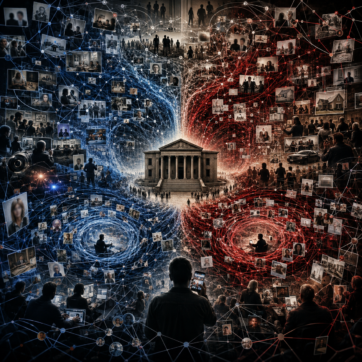
How Collapsed External Architecture Redistributes Pressure Through Polarity—and How Mimic Amplification Is Intensifying Division Across the Render
Polarity Is Bigger Than Human Division
Polarity is usually recognized only after it reaches the render. Humans see opposing political positions, competing belief systems, cultural division, good and bad, positive and negative, masculine and feminine, agreement and disagreement, and assume these oppositions are what polarity is. But those are rendered translations of a structural mechanic that existed before any human assigned meaning to it. The argument is not the origin of the polarity. The two people standing on opposite sides are not creating it. By the time polarity becomes recognizable as opposition in the render, something much deeper has already been organized upstream.
Polarity belongs to the external architecture itself. External operates through movement, oscillation, compression, geometry, directional relationship, and continuous redistribution of load. Once movement exists, differential exists. One structural condition can compress while another releases. One pathway can converge while another diverges. Pressure can increase in one position relative to another. Those differences establish the directional relationships through which external architecture operates. Polarity begins there, before those relationships are ever translated into the human concepts of two sides.
This is why polarity cannot be reduced to binary thinking. Binary thinking is one rendered expression of polarity, not its structural origin. Humans did not invent polarity by categorizing everything into opposites. This render did not create polarity by producing conflict. And the mimic did not introduce polarity into an architecture that would otherwise have been unified and still. The underlying architecture was already polar because it was already external, already oscillatory, and already operating under collapse conditions.
That last distinction becomes especially important when looking at the extremity of polarity now. This place was already collapsed architecture before mimic influence was imposed upon it. The mimic entered an existing system of compression, oscillation, reversal, differential, and load redistribution and intensified those mechanics. It could tighten existing polar relationships, accelerate oscillatory cycling, increase compression, reinforce fixed positions, and continually reactivate pathways that were already structurally available. It did not have to invent the mechanism. It only had to drive an existing mechanism harder.
What humans are witnessing now, then, is not polarity suddenly appearing because humanity has become uniquely divided. It is a native external mechanism becoming increasingly extreme in its rendered expression under compounded pressure. The political fights, cultural divisions, identity conflicts, ideological extremes, and endless formation of opposing camps are the visible surface. Underneath them is an architecture already dependent upon differential and oscillation, now carrying far more compression through those same structural pathways.
To understand why everything seems to be splitting, it is necessary to stop beginning with the sides. The sides are the translation. Polarity begins before either side ever appears.
Before Going Further — Understand Where Polarity Is Actually Happening
To understand polarity correctly, the architecture it belongs to has to be established first. Humanity is inside external right now. The bodies reading these words, the physical environment surrounding them, Earth, human civilization, politics, technology, relationships, institutions, emotions, identities, sensory perception, and every visible conflict being discussed in this article are occurring within external architecture. Humans are not standing outside this architecture observing polarity from some neutral location. They are structurally participating inside the very system whose mechanics are being translated into their experience. This matters because what appears from inside the render as a human problem is much larger when viewed from the architecture producing it.
External is not synonymous with the visible physical world. The visible world is only one part of it. External architecture operates through two primary stages: the pre-render and the render. The pre-render is the upstream structural condition where pressure, geometry, oscillation, compression, directional relationships, convergence, routing, and other organizational mechanics operate before becoming sensory experience. It is not another dimension, spiritual plane, hidden realm, or location somewhere behind physical reality. It belongs to the same external architecture humans are already inside. The render is the downstream translation of those mechanics into the perceptible environment humans recognize as reality. Bodies, objects, events, social structures, political conflicts, physical movement, spoken language, and the apparent sequence of events all belong to that rendered translation. Humans ordinarily encounter the output while remaining largely unaware of the architecture organizing that output upstream.
That distinction becomes essential when discussing polarity because polarity does not suddenly begin when two people disagree in the render. By then, the mechanic is already downstream. Structural differential, pressure relationships, directional organization, and oscillatory conditions belong upstream to the pre-render architecture. The render gives those conditions perceptible form. A structural differential can therefore become translated as opposing positions, competing identities, social division, emotional conflict, ideological camps, or countless other recognizable binaries. Humans naturally focus on those visible expressions because the render is what their sensory systems present to them, but the rendered opposition is the final translation of a deeper condition. Trying to understand polarity exclusively by examining the argument is like examining the output while ignoring the architecture producing it.
External itself must also be distinguished completely from Eternal. Eternal is not the pre-render. Eternal is not hidden behind the render. It is not the highest level of external, another render band, or a more refined region somewhere inside the same architecture. Eternal does not operate through the mechanics being described here at all. There is no polarity required to establish Eternal uniqueness, no oscillation maintaining Eternal coherence, no compression requiring redistribution, and no geometry holding Eternal into form. External requires movement because it does not possess Eternal stillness. Eternal requires no movement to remain what it Eternally is. That is why polarity belongs to external rather than Eternal: polarity requires differentiated structural relationship, while Eternal uniqueness does not require opposition or relational contrast to exist.
And then there is the mimic layer. The mimic is not a third fundamental stage alongside the pre-render and the render. It is an imposed layer operating within external architecture and acting upon mechanics that were already present. The external architecture was already collapsed. It already contained compression, oscillation, polarity, movement, identity stabilization, and continuous load redistribution. The mimic did not create those conditions, and this distinction is critical for everything that follows in this article. The mimic encountered an architecture already dependent upon movement and exploited its existing instability. It amplifies. It increases compression, accelerates oscillatory participation, reinforces polarity, intensifies identity attachment, multiplies stimulation, and repeatedly feeds movement back into pathways that are already capable of carrying it.
So the present human condition contains several mechanics operating together. Humanity is inside collapsed external architecture. The pre-render organizes structural conditions upstream. The render translates those conditions into the physical and experiential world humans perceive. And mimic influence compounds the instability already moving through that architecture. None of these should be confused with Eternal, because Eternal is not another component of this sequence.
This is why establishing the architecture before going deeper into polarity is so important. Without it, everything that follows can easily be reduced back into psychology, politics, sociology, morality, or human behavior. Humans appear divided, so the assumption becomes that humans created division. Society appears polarized, so the assumption becomes that better ideas, greater tolerance, the correct political system, or enough collective agreement could eliminate polarity itself. But humans are encountering the rendered expression of something much deeper than human disagreement. They are inside an external architecture in which polarity is already structural, inside a collapsed condition that depends heavily upon oscillatory redistribution, while an imposed mimic layer drives those mechanics harder.
The extraordinary polarity visible now therefore has to be read in the correct direction: from the architecture into the render, not from the render backward into assumptions about human nature. The visible sides are the last thing to appear. The mechanics came first.
What Polarity Actually Is
Polarity is the establishment of differentiated directional conditions through which pressure can move. At its structural root, it has nothing to do with disagreement, morality, ideology, personality, or one side attempting to defeat another. Those meanings appear much farther downstream. Polarity begins wherever external architecture establishes difference between structural conditions so that movement can occur between, across, or in relationship to them.
External cannot hold as Eternal holds. Eternal stillness requires no movement to maintain what it is. External operates differently. It contains geometry, direction, oscillation, compression, expansion, reversal, timing, and changing relationships between structural positions. It therefore cannot be understood as a single unmoving condition. Its architecture depends upon differences that allow pressure to redistribute rather than remain permanently fixed in one position.
Once movement exists, differential necessarily exists with it. Movement establishes direction, and direction establishes relationship. Compression exists relative to release. Convergence exists relative to divergence. Increasing pressure establishes a different condition from decreasing pressure. A vector moving in one direction occupies a different structural relationship than a vector moving in another. These are not human opposites imposed onto the architecture. They are mechanical differences produced by an architecture in motion.
That differential is the foundation of polarity. The two poles are therefore better understood as differentiated structural positions within one mechanism rather than two independent forces fighting each other. One condition provides meaning to neither. They do not need to disagree. They need only occupy sufficiently different directional conditions for a gradient to exist between them. That gradient gives pressure somewhere to move.
This is also why polarity exists before opposition. Opposition is what the render can make polarity look like once structural differential is translated into recognizable experience. By the time humans encounter two competing sides, the deeper mechanic has already happened. The architecture established difference first. Direction followed. Pressure moved through that difference. Oscillation developed through changing relationships and reversal. Only downstream does the render translate those mechanics into the experience of one thing being “against” another.
The poles, then, are not fundamentally enemies. They are participants in the same structural operation. Neither exists outside the mechanism they jointly sustain. What appears in the render as opposition begins much earlier as differentiated position—and it is that difference, not the human storyline attached to it, that makes polarity structural.
Polarity Belongs to External — Not Just This Render
Polarity is not unique to this human render, this planet, this civilization, or the particular conditions humans are experiencing right now. It belongs to external architecture as a whole. That distinction is essential because it prevents the mechanics of polarity from becoming confused with the specific way humans experience polarity here. Humanity encounters polarity through an extraordinarily immersive rendered environment, so it is easy to assume that polarity means two political parties, two ideological camps, two moral positions, two competing identities, or two groups locked against one another. But those are local translations. The deeper mechanic is external.
External operates through differentiated structural movement rather than Eternal stillness. Wherever there is oscillation, there is changing relationship. Wherever there is compression, there are differences in pressure. Wherever there is directional movement, there are differentiated vectors. Wherever pressure is redistributed, there must be structural conditions through which that redistribution can occur. Polarity belongs to those relationships. It is therefore not dependent upon humans being present to perceive it, name it, interpret it, or participate consciously in it. Human beings did not introduce polarity into external by thinking in opposites. They entered a rendered condition already generated through an architecture in which differential and directional relationship were present.
But polarity existing throughout external does not mean it must look the same everywhere. This is where the distinction between the pre-render mechanics and rendered translation becomes critical. Different render bands can organize and translate structural differential according to their own phase conditions, geometry, oscillatory rates, compression, timing, density, and other structural parameters. The underlying requirement for differential can remain while the visible expression changes dramatically. What is recognizable as polarity from inside one render does not have to resemble what polarity looks like from inside another.
This human render translates polarity very heavily through conceptual and identity-based opposition. Right and wrong. Good and evil. Believer and nonbeliever. Left and right. Accepted and rejected. Masculine and feminine. Winner and loser. Ally and enemy. Human perception then becomes so accustomed to those translations that it mistakes the translation for the mechanic itself. Polarity begins to look inherently adversarial because the human render repeatedly gives structural differential an adversarial storyline.
But external polarity does not fundamentally require hatred, argument, morality, ideology, emotional hostility, or even conceptual disagreement. A different render condition could contain compression and release, convergence and divergence, directional reversal, changing gradients, and oscillatory exchange without translating those relationships into two beings standing opposite one another insisting that only one can be correct. The polarity is still there because differentiated structural conditions remain. What changes is how those mechanics become rendered and experienced.
This is also why polarity should not be confused with the mimic. The mimic can exploit whatever polar pathways are available within a particular render, and in this one it has driven human binary expression to extraordinary extremes. But the mimic is amplifying an external-wide mechanic, not exporting a uniquely human form of conflict across all of external. The aggressive binary conditions visible here belong to the way polarity is being expressed under this render’s collapsed conditions and intensified through mimic influence. They are not the universal definition of what polarity must look like everywhere external exists.
Human conflict, then, is evidence of polarity operating through this render, but human conflict is not polarity itself. The argument is a translation. The ideology is a translation. The opposing identities are translations. Underneath all of them is the much simpler and much larger structural fact: external contains differentiated conditions capable of directional relationship, and those differentials allow pressure and movement to occur throughout an architecture that cannot hold as Eternal holds.
Polarity is bigger than the sides humans see. The sides are simply how this particular render has learned to show it.
Difference Is Not the Same as Opposition
One of the easiest mistakes to make when discussing polarity is to treat difference and opposition as though they are the same thing. They are not. Difference only establishes that two structural conditions are not identical. Opposition is a much more specific relationship that can emerge from that difference once it is organized and translated through external architecture. Something does not have to be against something else simply because it is different from it.
At the deepest external level, polarity begins with structural differential. One position carries a different pressure condition from another. One vector moves differently relative to another. One region compresses while another releases. One pathway converges while another diverges. These differences create gradients and directional relationships through which movement can occur. There is no argument happening there. Compression does not hate release. Convergence is not morally opposed to divergence. They are differentiated structural conditions participating within the same architecture.
As those differentials move through the pre-render and become translated into the render, however, difference can acquire increasingly recognizable form. Structural distinction becomes contrast. Contrast becomes categorization. Categorization becomes position. Position becomes identity. Once identity becomes attached to position, the original differential can finally appear as opposition: this versus that, mine versus yours, correct versus incorrect, good versus bad, us versus them. The render takes something that began as mechanical relationship and translates it into an experiential relationship that can feel intensely adversarial.
That distinction matters enormously because otherwise humans look at the final expression and project it backward onto the architecture. They see two groups fighting and assume polarity itself must fundamentally mean conflict. It does not. Conflict is one possible downstream expression of polarity under particular rendered conditions. The structural root is difference capable of relationship and movement. Antagonism comes later.
And this creates an equally important distinction between external differentiation and Eternal uniqueness. Eternal contains irreducible individuation, but that individuation is not polarity. One Eternal Flame does not become uniquely itself because another Eternal Flame is different from it. It does not require contrast to establish its tone. It does not need an opposite, counterpart, mirror, counterforce, or balancing Flame against which its own uniqueness can be measured. Flame tone is inherent. An Eternal Flame is uniquely itself without needing relationship to produce that uniqueness.
That is precisely why no separation does not mean no distinction. Eternal Flames can be irreducibly unique without becoming separate opposing units, because Eternal distinction is not generated through distance, boundaries, differential pressure, oscillation, or contrast. Nothing has to move apart for uniqueness to exist. Nothing has to become opposite. Nothing has to define itself against anything else.
External differentiation is different because external structure is relational. Position matters relative to position. Direction exists relative to direction. Pressure gradients exist because conditions differ across structure. Movement changes relationship. Oscillation requires changing conditions. Polarity therefore belongs naturally to an architecture where differentiation participates in structural relationship.
Eternal uniqueness requires none of that. It simply is.
That is the dividing line: external difference can become polarity because external operates through relational structure and movement. Eternal uniqueness never needs polarity because an Eternal Flame does not require an opposite in order to be uniquely, irreducibly itself.
Why Collapsed External Architecture Depends So Heavily on Polarity
Polarity becomes even more important once the condition of the external architecture itself is understood. This is not an inherently coherent architecture calmly using polarity as one optional method of organization. It is collapsed architecture. It does not contain Eternal stillness, and it cannot sustain itself through the kind of inherent, unmoving coherence that belongs only to Eternal. External has to keep doing something in order to continue holding form. Pressure cannot simply remain where it accumulates. Instability cannot permanently resolve into stillness. Load has to move.
That is where polarity becomes load-bearing. For pressure to redistribute, there has to be somewhere structurally different for it to go. If every position carried precisely the same condition, there would be no gradient across which pressure could move. Polarity establishes that differential. One structural condition can become more compressed relative to another. One pathway can carry greater density while another provides relative release. One vector can move outward while another moves inward. The architecture creates relationship between differentiated conditions because those differences provide pathways through which accumulated load can be transferred rather than remaining concentrated in one place.
But the transfer does not permanently solve the underlying instability. That is the critical point. One pole carries increasing compression while the opposing condition provides relative release. Pressure moves across the differential. Then the relationship changes. What was releasing can begin compressing; what was carrying greater compression can release. Direction reverses, pressure redistributes again, and the relationship continues cycling. That repeated reversal is part of what produces oscillation. The architecture keeps pressure moving because it cannot bring the pressure into an Eternal condition where movement is no longer necessary.
So polarity and oscillation are inseparable within collapsed external mechanics. Polarity provides the differential; oscillation repeatedly moves load through that differential. Compression creates increasing pressure, differential gives that pressure directional possibility, reversal prevents one condition from carrying the load indefinitely, and oscillation keeps the exchange moving. What can appear from inside the render as ongoing change is therefore also continuous structural management.
This is why the architecture never actually eliminates its own collapse through polarity. It manages collapse. It redistributes it. It moves pressure somewhere else, changes the relationship between structural positions, reorganizes pathways, compresses one condition while releasing another, and then reverses again. Movement creates temporary stabilization without producing inherent coherence. The architecture can continue functioning precisely because instability is repeatedly displaced through motion rather than permanently resolved.
And that is why increasing compression makes polarity increasingly important. The more pressure the architecture carries, the more aggressively that pressure must be redistributed. The greater the load, the more consequential the differential becomes. Polarity is no longer merely a visible characteristic of a divided render; it is part of the underlying structural mechanism keeping collapsed architecture operational.
Without differential, there is nowhere for pressure to redistribute. Without redistribution, compression concentrates. Without reversal, that concentration remains localized. Without oscillation, the architecture loses the movement through which it continually manages its unstable condition.
Polarity is therefore load-bearing not because opposition somehow creates stability, but because differentiated structural conditions give collapsed external architecture somewhere to keep moving what it cannot permanently resolve.
The Pre-Render Organizes Polarity Before the Render Shows It
Polarity does not begin at the moment two opposing positions become visible. By the time disagreement appears in the render, the deeper structural organization has already occurred. Humans naturally begin with what they can see: two political sides, two competing beliefs, two groups in conflict, two people reacting against one another. But those are downstream expressions. The render is showing the result of polarity; it is not where the fundamental mechanic originated.
The deeper organization occurs in the pre-render. This is where structural differential already exists as differences in pressure, direction, compression, density, timing, and relationship between vectors. Pathways establish where pressure can move. Compression changes the load carried through particular positions. Oscillatory timing governs how those relationships cycle and reverse. Convergence and divergence alter how pathways meet, separate, and redistribute load. All of this belongs to the structural organization underneath what will eventually become perceptible experience. The pre-render does not need a human storyline in order for polarity to exist because the polarity is mechanical before it is conceptual.
This also means the pre-render is not sitting somewhere constructing literal human arguments in advance. It is organizing the structural conditions from which rendered expression emerges. It contains the architecture, not the storyline. The storyline belongs to translation. A differential in the pre-render does not contain the words “left” and “right,” “good” and “bad,” “correct” and “incorrect,” or the specific identities that will eventually appear around those positions. What exists upstream is the deeper relationship: differentiated conditions, directional pathways, pressure gradients, compression, oscillatory relationship, and the potential routes through which load can redistribute.
The render then gives that architecture recognizable form. Structural difference becomes perceptible contrast. Directional relationship can become competing movement. Increasing compression can become heightened tension. Oscillatory reversal can appear as repeated swings between positions. Pressure concentrated around particular pathways can become increasingly rigid identities or collective camps. What was mechanical upstream becomes experiential downstream because the render translates architecture into forms the body and sensory system can actually participate within.
This is why rendered events can appear to suddenly produce enormous polarity even when the visible trigger seems too small to explain the reaction. The trigger does not necessarily create the entire differential at the moment it appears. It can become the rendered expression point through which an already-loaded structural relationship becomes visible. By the time humans recognize the conflict, pressure may already have organized around differentiated pathways in the pre-render. The visible event gives that organization somewhere to translate.
And once it translates, humans usually reverse the causal direction. They assume the event created the polarity because the event is the first part they consciously witnessed. They see the argument and believe the argument produced the division. They see the political event and believe the event created the opposing camps. They see the cultural controversy and assume the controversy generated the pressure surrounding it. But the render only reveals what has reached rendered expression. It does not show the full structural organization that preceded that expression.
This is why polarity cannot be understood completely through psychology, sociology, political analysis, or human behavior alone. Those approaches begin after polarity has already crossed into rendered translation. They can describe what people do once the structural differential becomes experiential, but they cannot reach the origin of the mechanic if they never move upstream of the visible behavior.
The sides are therefore not the beginning of polarity. They are where polarity finally becomes visible enough for humans to name it. The pre-render carries the structural organization; the render gives that organization an experience. By the time humans are fighting over the meaning of the two sides, the architecture underneath those sides is already in motion.
Binary Is a Rendered Expression of Polarity
Binary and polarity are closely related, but they are not interchangeable. Polarity is the deeper structural mechanic. Binary is one way that mechanic becomes organized and made recognizable inside the render. When an underlying differential is translated through a render that expresses structural relationships through sharply defined contrast, polarity begins appearing as two distinguishable positions: this or that, one or the other, here or there. The deeper gradient becomes a rendered pair.
That is where the binaries humans know so well emerge. Yes and no. Right and wrong. Good and bad. Us and them. Believer and nonbeliever. Winner and loser. Accepted and rejected. The render takes structural differences that exist upstream and gives them boundaries, categories, meanings, identities, and narratives. Once those translations become stabilized, the two positions can appear completely separate from the architecture underneath them. Humans then experience the binary as though the categories themselves are primary.
But “right” and “wrong” are not floating around in the pre-render as literal structural poles. Neither are political parties, religions, ideologies, social identities, or moral categories. Those belong to rendered interpretation. What exists underneath them is differential: differences in pressure, direction, compression, position, oscillatory condition, and relationship. The render translates those differences into forms that can be perceived, inhabited, defended, and experienced. Binary gives the underlying polarity a recognizable rendered structure.
This is also why binary can become much more rigid than the differential underneath it initially requires. Once the render establishes two defined categories, identity can stabilize around them. A structural relationship that began as difference can become translated as mutual exclusion: if this is true, that must be false; if I belong here, I cannot belong there; if this side represents good, the other must represent bad. The render does not merely make the differential visible. Under sufficiently compressed conditions, it can sharpen that differential into opposing categories that increasingly define themselves through what they are not.
And this distinction explains something much larger about external architecture. Polarity can exist throughout external without every render band reproducing the human experience of binary warfare. Wherever external contains oscillation, differential, directional relationship, compression, reversal, and movement, polarity can operate. But another render condition does not have to translate those mechanics into ideological camps, moral opposition, identity conflict, or conceptual either/or structures. The underlying polarity can remain while its rendered expression changes.
Human binary is therefore not proof that polarity itself is inherently argumentative. It is evidence of how deeply structural polarity can become translated into contrast inside this particular render. Humans encounter the finished categories and fight over which one is correct, while underneath both positions sits the same architecture that made the distinction possible in the first place.
Polarity is the structural differential. Binary is the rendered organization of that differential into two recognizable positions. And once that difference is clear, human opposition stops defining what polarity is—it becomes one particular way external polarity can look when it reaches the render.
Pressure Requires Differential
Pressure cannot redistribute effectively across structurally identical conditions. For movement to occur, there has to be difference somewhere in the architecture—a difference in compression, density, direction, timing, amplitude, structural position, or some combination of those conditions. That difference establishes a gradient. And once a gradient exists, load has somewhere to move. This is one of the deeper mechanics underneath polarity: the architecture does not simply require the existence of two distinguishable poles. It requires enough structural difference between them for those poles to remain functional as pathways of redistribution.
If two structural positions were carrying exactly the same pressure under exactly the same conditions, there would be no meaningful differential between them. Neither position would provide relative release from the other. There would be no directional advantage through which accumulated load could redistribute. The existence of two positions alone would therefore accomplish very little. What makes polarity functional is the unequal condition between those positions. One region becomes more compressed relative to another. One pathway carries greater density. One vector has a different direction or timing. One side of the relationship temporarily provides somewhere for pressure accumulating elsewhere to move.
This means the architecture has to preserve differential, not merely polarity in the abstract. As pressure moves from one condition toward another, the relationship between the poles changes. The gradient can weaken, strengthen, reverse, or reorganize. When the differential begins flattening, the architecture cannot simply remain there indefinitely because a flattened gradient reduces its ability to redistribute the next accumulation of pressure. Another difference has to emerge. Compression shifts. Direction reverses. Relative release becomes relative compression. The poles change their relationship, and movement continues.
This gives oscillation another level of structural clarity. Oscillation is not merely movement back and forth between two permanently fixed opposites. The differential itself is continually changing. Pressure moves because a gradient exists; that movement alters the gradient; the altered gradient changes the conditions of redistribution; reversal re-establishes directional difference; and another movement of load becomes possible. The architecture continuously renews the differences through which its own pressure can keep circulating.
Under increasing compression, however, a weak differential becomes less useful. A small gradient may be sufficient when the amount of load requiring redistribution is relatively low. But as total pressure rises, the same slight difference between structural conditions cannot move enough load quickly enough. The architecture requires a stronger gradient. The separation in condition becomes more pronounced. Compression becomes heavier on one side relative to another. Directional relationships sharpen. Reversals carry greater force. Oscillatory swings become more extreme because the architecture is attempting to redistribute a larger amount of pressure through increasingly stressed pathways.
This is one of the structural reasons polarity intensifies under load. The system is not becoming more extreme because the content of the two sides suddenly matters more. The extremity reflects a steepening differential underneath the content. Greater compression requires greater redistribution, and greater redistribution requires sufficiently strong gradients through which that pressure can move.
By the time this reaches the render, humans experience the steepened gradient as widening division. Positions move farther apart. Contrast sharpens. Reactions intensify. The difference between one side and another becomes increasingly difficult to bridge. Each pole appears to become a more exaggerated version of itself. From inside the storyline, this looks like people becoming more extreme. Structurally, the architecture is increasing the differential across which an increasing load is being routed.
The gradient steepens because the pressure has increased. And once that is understood, the extremity of polarity becomes another measurement of the compression underneath it rather than merely a description of what the two rendered sides are doing.
Why the Poles Become More Extreme
The poles become more extreme because increasing compression changes how much differential the architecture needs in order to keep pressure moving. Under lower compression, load can redistribute through broader, slower oscillatory arcs. The gradient between poles does not have to remain exceptionally steep because the amount of pressure being transferred is still manageable across a wider structural range. There is more room for gradual movement, slower reversal, and less sharply differentiated positions. Polarity remains fully present, but it does not have to express at maximum intensity.
As compression increases, that changes. More pressure now has to be redistributed through an architecture already carrying substantial load. A weaker differential becomes less effective because it cannot transfer enough pressure quickly enough to prevent further concentration. The architecture responds by increasing the difference between its polar conditions. Compression becomes heavier relative to release. Directional relationships become more pronounced. The gradient steepens, and the oscillatory movement across that gradient becomes increasingly forceful.
This also changes reversal. Under lighter pressure, the movement from one polar condition toward another can occur across a wider interval. Under greater compression, the reversal becomes sharper because pressure is accumulating faster and must be redirected more aggressively. One pole carries increasing load until the relationship can no longer remain organized in that direction, and the redistribution reverses. The opposing condition then takes on more of the load. The greater the compression entering that exchange, the more pronounced the swing can become.
This is why extreme polarity often produces extreme counter-polarity. Intensification does not remain isolated to one side. A stronger movement toward one pole alters the differential across the entire relationship. The opposing pole is now structurally interacting with a more extreme condition, which increases the pressure across the gradient and contributes to a stronger counter-movement. That counter-movement then changes the condition confronting the first pole. Each increasingly extreme position can therefore contribute to the structural conditions that make the other more extreme.
The result is amplification through relationship. One pole moves farther outward, the opposing pole responds through greater differentiation, the gradient steepens further, and the next reversal carries even more pressure. The architecture can begin producing increasingly large oscillatory swings even though the underlying function has not changed at all. It is still redistributing load. It is simply having to do so under far greater compression.
The render translates this mechanical steepening into positions humans recognize as extremity. Political positions harden. Moral categories become absolute. Social identities become more rigid. Opposing groups appear increasingly incompatible. Language becomes less tolerant of ambiguity. A position that would previously have appeared extreme can become the new baseline from which an even more extreme counter-position develops. Humans experience the widening distance between the poles and naturally interpret it psychologically: people have become unreasonable, hateful, radicalized, intolerant, or incapable of agreement. But those descriptions begin with the rendered behavior rather than the structural pressure underneath it.
The extremity comes downstream of compression. As load rises, differential steepens. As differential steepens, reversals sharpen. As reversals sharpen, each pole increasingly reinforces the extremity of the other. What eventually appears in the render as two sides moving farther and farther apart is the visible expression of an architecture relying more aggressively upon polarity because the pressure it must continually redistribute has become greater.
Why the Middle Gets Squeezed
As the differential between poles steepens, the structural space between them changes as well. What humans experience as “the middle” is not a position outside polarity. It is a lower-differential region within the same polar relationship—a transitional range where the distinction between opposing conditions is less severe. Under lower compression, the architecture can tolerate more of this range because pressure does not need to redistribute with the same intensity or speed. The gradient can remain broader, allowing less sharply differentiated positions to persist between the poles.
Under heavy compression, that broad transitional range becomes increasingly inefficient. More load has to move through the architecture, and stronger differential provides more effective pathways for that movement. The oscillatory network therefore begins organizing increasingly around positions carrying pronounced contrast. The gradient steepens at the same time that the usable middle narrows. There is less structural room for conditions that do not strongly participate in either direction of the oscillation.
This is why the middle can appear to collapse precisely when the poles become most extreme. These are not separate developments. They are two expressions of the same changing gradient. As the poles become more differentiated, intermediate positions become increasingly unstable within the relationship. Pressure begins routing away from lower-differential conditions and toward positions capable of carrying stronger compression, release, and reversal. The architecture is effectively concentrating more of its load toward the ends of the polar relationship.
The render translates this into something humans experience constantly during periods of intense polarization. Nuance becomes increasingly difficult to maintain. A person is expected to declare which side they occupy. Agreement with one point associated with a pole can be interpreted as allegiance to everything attached to that pole. Refusing one side is treated as evidence of secretly supporting the other. Saying “both contain something” becomes unacceptable because the binary increasingly demands differentiation. Saying “neither” does not necessarily remove someone from the polarity either; it can simply generate another position against which both established poles react.
This is also why moderate positions can begin receiving pressure from both directions. The middle interrupts the clean contrast through which the increasingly compressed binary is operating. A position that does not reproduce the expected differentiation can become difficult for either pole to classify. The render then attempts to force that ambiguity back into recognizable polarity: Which side are you really on? What do you actually believe? Who do you support? Silence itself can be assigned meaning. Nonparticipation can become interpreted as complicity. Even refusing the binary can become a new binary—those who participate versus those who refuse to participate.
The effect becomes even stronger once identity is attached to the poles. The middle no longer represents merely a less extreme opinion. It can begin appearing structurally threatening to the identities stabilized around maximum differentiation because it weakens the apparent certainty separating one pole from the other. The stronger that identity lock becomes, the more aggressively ambiguity is rejected. Clear contrast stabilizes position. Nuance blurs it.
So the disappearance of the middle is not simply a cultural mystery or evidence that humans suddenly lost their capacity for moderation. It follows directly from the same mechanics driving the poles outward. Increased compression requires stronger differential. Stronger differential steepens the gradient. A steeper gradient concentrates more pressure around highly differentiated positions while reducing the stability of the transitional space between them.
The middle gets squeezed because the entire polar relationship is under pressure. What humans see as the loss of nuance is the rendered expression of a gradient that has become increasingly steep.
Why Neutrality Cannot Become a Third Exit
Once polarity is understood as structural differential rather than simply two opposing opinions, neutrality has to be understood differently too. A midpoint between two poles may reduce the apparent intensity of opposition, but it does not leave the polarity that produced those poles. It remains positioned within the same differential. The gradient still exists around it. Pressure is still being distributed through the larger relationship. Oscillation has not stopped simply because one position appears less extreme than the others.
This is why neutrality inside external is not the same thing as Eternal stillness. Eternal stillness contains no polarity to balance, no opposing vectors to reconcile, no pressure gradient to equalize, and no oscillation to quiet down. External neutrality, by contrast, can only occur within architecture already structured through differential. A midpoint may represent a lower-amplitude condition, a temporary buffer, or a region where opposing pressures are more evenly distributed, but all of those remain external conditions. Nothing has crossed outside the architecture.
The same problem appears when someone attempts to reject the binary altogether. From inside the render, “I choose neither side” can feel like stepping outside polarity. Structurally, however, the architecture can simply organize that refusal relative to the positions already present. The person who rejects both poles becomes differentiated from the people participating in them. A new contrast appears: participation versus nonparticipation, committed versus neutral, those choosing sides versus those refusing sides. What looked like an exit has become another position capable of carrying differential.
And once identity attaches to that position, the cycle becomes even clearer. “I reject both sides” becomes something someone is. Neutrality becomes an identity. Being “above polarity” becomes an identity. Refusing binaries becomes an identity. Then that identity acquires its own contrast: those who supposedly understand the binary versus those who remain trapped inside it. External has taken the attempt to transcend polarity and generated another polarity around the transcendence itself.
This is one of the most persistent mechanics of the render. Anything introduced inside external is processed through external architecture. A third position does not automatically escape a two-pole system; it can simply expand the polarity network from one binary into several interacting differentials. A midpoint can become another pole. A refusal can generate its own counter-position. An attempt at unity can become opposed to division. Even the idea of being “non-polar” can become polarized.
Scalar conditions can make this even more deceptive because extreme compression can reduce visible oscillatory distance. Opposing vectors can become so tightly compressed that the surface appears quiet, balanced, or neutral. But reduced visible movement is not the absence of polarity. The differential remains structurally active inside the compressed condition. Apparent stillness can therefore exist while substantial pressure remains contained underneath it. Eternal stillness is fundamentally different because there is nothing being compressed into quietness in the first place.
This is why Eternal cannot be reached by finding the perfect position between external poles. It is not located at zero on an external scale. It is not the center point between positive and negative. It is not perfect balance between compression and release. Those are still relational conditions defined by the architecture surrounding them.
External cannot manufacture Eternal stillness by rearranging its own polarity. It can widen the poles, narrow them, reverse them, balance them, multiply them, compress them into scalar conditions, or create another position between them. Every one of those operations remains external because every one still depends upon structural relationship.
Eternal stillness is not the successful resolution of polarity. It is the condition in which polarity was never required.
Polarity Multiplies When Existing Pathways Cannot Carry the Load
As compression increases, making the existing poles more extreme is not always enough. Every polar relationship has a finite amount of pressure it can effectively redistribute through its existing pathways. Once too much load begins concentrating through the same differential, the architecture needs additional routes. It does not solve the pressure or remove the polarity. It subdivides it. New differentials form inside the existing differential, creating additional pathways through which the accumulating load can continue to move.
This is where polarity becomes nested. A major binary that appears to contain two clear sides begins developing internal oppositions within each side. One pole that previously appeared structurally unified fractures into multiple positions. Those positions differentiate from one another, producing another set of gradients. The opposite pole does the same. Now pressure is no longer moving only across the original A/B relationship. It can redistribute through A1/A2, A2/A3, B1/B2, B2/B3, while all of those smaller polarities remain embedded within the larger A/B structure.
And subdivision does not have to stop there. If compression continues increasing, those internal binaries can subdivide again. Opposition forms inside opposition, then opposition inside that opposition. What began as one large differential becomes a fractal network of smaller differentials operating at multiple scales simultaneously. Each new polarity creates another gradient. Each gradient provides another possible pathway for pressure redistribution. The architecture increases routing capacity by increasing the number of places through which load can move.
This is why extreme polarity eventually stops looking like two coherent sides facing one another. The sides themselves begin fighting internally. Groups that were previously aligned fracture over increasingly narrow distinctions. Movements develop factions. Factions develop sub-factions. People who agree on almost everything can become intensely polarized around the one remaining point where sufficient differential still exists. The rendered content makes these divisions appear to be entirely new conflicts, but structurally they are repetitions of the same mechanic occurring at smaller and smaller scales.
It also explains why periods of extreme compression produce the strange condition where virtually everything becomes divisible. Politics divides. Culture divides. Science divides. Spirituality divides. Families divide. Communities divide. Language divides. Individual subjects fracture into competing interpretations, and then those interpretations fracture again. Even groups created specifically around unity can eventually develop internal polarity because the architecture underneath them still operates through differential. The subject itself is almost secondary. What matters structurally is that another distinction can become another pathway.
This multiplication greatly expands the architecture’s capacity to redistribute pressure because load no longer has to travel through only a few dominant binaries. It can be dispersed across thousands of smaller oscillatory relationships operating throughout the render. A massive amount of structural pressure can therefore become translated into countless apparently unrelated disagreements. Humans see separate conflicts because the storylines differ. Structurally, those conflicts can be participating in the same larger condition of increasing compression.
There is a consequence, however. Every new polarity is also another oscillatory relationship that has to remain active. Subdivision creates routing capacity, but it simultaneously increases the density and complexity of the oscillatory network. More pathways mean more gradients, more reversals, more interactions between poles, and more opportunities for one polarity to begin affecting another. The architecture gains additional places to move pressure, but it becomes increasingly crowded with the very mechanism it is using to manage that pressure.
That is why escalating compression does not simply make several major disagreements louder. It makes division proliferate across the entire render. The architecture keeps creating additional differential because additional differential creates additional pathways for load. Eventually polarity is no longer confined to the obvious places humans expect to find it.
It reproduces everywhere because everywhere has become somewhere pressure can move.
Polarity Begins Synchronizing Across Domains
As polarity multiplies, those differentials do not necessarily remain isolated from one another. Under increasing compression, separate oscillatory relationships can begin coupling. A political polarity that once operated primarily through politics becomes structurally associated with cultural polarity. Cultural polarity becomes associated with identity. Identity becomes associated with morality, science, medicine, technology, spirituality, media, geography, class, language, lifestyle, relationships, and countless other rendered categories. What began as multiple distinguishable binaries gradually becomes an interconnected polarity network.
This coupling changes the mechanics considerably because pressure entering through one pathway can now activate several others with it. A disagreement about one subject is no longer necessarily carrying only the differential belonging to that subject. If that polarity has become synchronized with multiple other binaries, activation of one part of the network can excite the larger bundle. The rendered trigger may be extremely specific, but the structural response can be enormous because the trigger has contacted far more than one isolated pathway.
This is why particular subjects can suddenly seem to contain everything. A disagreement about medicine can immediately become a disagreement about politics, institutional trust, morality, technology, personal freedom, media, class, identity, and culture. A cultural issue can activate political affiliation, religious positioning, social belonging, language, geography, and assumptions about an individual’s entire worldview. The subjects appear different in the render, but their polar relationships have become so tightly associated that movement through one begins producing movement through the others.
The architecture gains something from this synchronization. It no longer has to route every polarity as a completely independent oscillatory relationship. Multiple differentials can move together. Pressure can be distributed across a larger linked configuration, allowing one activation to travel through numerous available gradients. In that sense, synchronization increases routing efficiency. But it also dramatically increases amplification. If ten binaries have become coupled, pressure entering through one does not necessarily remain contained there. It can excite the entire configuration.
This creates what can be understood as polarity bundling. Instead of dozens of separate A/B relationships, entire collections of positions begin behaving like larger composite poles. One side of a political binary becomes bundled with particular cultural assumptions, moral positions, media sources, scientific interpretations, language patterns, lifestyle choices, geographic identities, and social affiliations. The opposing side develops its own corresponding bundle. The individual components may have no inherent reason to belong together, yet repeated synchronization makes them increasingly difficult to separate in the render.
That is why humans begin assuming they can determine an entire person from one position. One opinion becomes treated as evidence of twenty others. One word, preference, affiliation, or disagreement is enough to assign someone to an entire structural camp. The render experiences this as stereotyping or tribalism, but underneath it is an increasingly bundled polarity architecture in which formerly independent differentials have become coupled strongly enough that one position repeatedly predicts activation of the others.
And once these domains synchronize, the amount of pressure concentrated into ordinary interactions increases enormously. A conversation that appears to concern one small subject can suddenly carry the accumulated compression of politics, morality, identity, belonging, institutional trust, culture, and personal relationship simultaneously. This is why seemingly minor disagreements can provoke responses vastly larger than the immediate subject appears to warrant. The rendered topic is only the point of entry. Structurally, an entire network has been activated.
The more compressed the architecture becomes, the more consequential this coupling becomes. Polarity is no longer simply multiplying across separate subjects. Those polarities are beginning to move together. And once separate binaries become synchronized bundles, a single rendered trigger can activate an extraordinary amount of accumulated pressure at once.
Identity Lock Becomes Identity Bundling
As separate polarities begin synchronizing, identity lock becomes much more structurally significant. At its simplest, identity lock stabilizes a node around a particular polar position. Instead of continually moving between competing conditions, the incarnational identity field becomes increasingly fixed into one side of the differential. That stabilization gives the larger oscillatory architecture a more predictable pathway through which pressure can move. The position becomes easier to repeatedly activate because the node is already structurally organized around it.
But once multiple binaries begin coupling, the lock no longer has to involve only one position. Positions across completely different rendered subjects can become bundled together. Political affiliation becomes linked with cultural identity. Cultural identity becomes linked with morality, institutional trust, science, medicine, spirituality, technology, media, language, lifestyle, and social belonging. Instead of maintaining separate structural relationships with each subject, the field increasingly carries them as one interconnected configuration.
This is where “I believe this” can gradually become “this is who I am.” A person no longer simply holds a political opinion, a cultural position, or a particular interpretation of an event. Those positions become structurally associated with one another and translated collectively as identity. The rendered identity now contains an entire polarity bundle. To belong to one side increasingly means carrying the expected configuration associated with that side.
That bundling also explains why humans can become extraordinarily defensive around subjects that appear, on the surface, to involve nothing more than information. If one position is isolated, changing it affects a relatively small part of the larger configuration. But when that position has become structurally coupled with ten, twenty, or fifty other polar assignments, movement in one location introduces instability throughout the bundle. Changing one belief can begin disturbing political belonging, social relationships, moral identity, cultural affiliation, institutional trust, and the person’s understanding of themselves simultaneously.
Contradictory information therefore does not necessarily loosen identity lock. It can actually increase it. New information arriving against a heavily bundled position introduces additional pressure into a node whose stability depends upon maintaining that configuration. Instead of simply absorbing the information and changing position, the field can respond by reinforcing the existing assignment. The stronger the challenge becomes, the more tightly the node can stabilize around the pole it already occupies.
This is why throwing more evidence at extreme polarity so often fails. From inside the render, the assumption is that enough facts should eventually force someone to reconsider. But the interaction is no longer occurring only at the level of factual content. The information is contacting a structural configuration carrying identity, belonging, relational stability, and numerous synchronized polarities at once. What appears to one person as a correction can therefore be translated by another as destabilization of the entire position through which their identity has become organized.
The render experiences that destabilization very personally. “You are challenging my position” becomes “you are attacking me.” Disagreement becomes rejection. Questioning one belief becomes threatening an entire worldview. And because social relationships frequently become bundled into the same polarity network, changing position can also threaten where someone belongs, who accepts them, which group recognizes them, and which relationships remain stable. The architecture has effectively made movement expensive.
This is also why identity bundling strengthens the larger polarity network. Once people become stabilized as predictable nodes, they repeatedly reproduce the same bundle across different subjects. A new event appears and the person does not encounter it as an entirely new structural question. The event is rapidly routed through the configuration already present. Their political pole activates their cultural pole, which activates their moral pole, which activates their media and institutional poles. The storyline may be new, but the structural pathways are already established.
At that point, polarity is no longer merely something a person participates in.
It has been translated into who the person believes themselves to be. And the more of identity the architecture bundles around a pole, the greater the pressure required to move away from it.
Why Both Sides Begin Looking Structurally Identical
As polarity intensifies, something strange becomes visible beneath the radically different content of the opposing sides: structurally, they begin behaving almost exactly the same. The beliefs can be completely different. The values can be different. The language, goals, symbols, and people involved can appear completely incompatible. Yet underneath those rendered differences, both poles increasingly reproduce the same mechanics because both belong to the same polar relationship.
Each pole develops the infrastructure necessary to stabilize itself. It establishes trusted authorities and rejected authorities. It builds narratives explaining what is happening and why. It determines which information counts as legitimate evidence and which information should immediately be dismissed. It develops symbols that communicate membership, language that identifies insiders, moral framing that establishes what its position represents, and recognizable enemies against which that identity becomes further defined. Over time, each pole creates an increasingly complete rendered environment capable of reinforcing its own structural position.
This is why opposing groups can accuse one another of almost identical behaviors while remaining convinced those behaviors exist exclusively on the other side. Each sees the other’s authorities as propaganda while experiencing its own as trustworthy. Each recognizes the other’s identity reinforcement while interpreting its own as justified belonging. Each sees the other’s selective evidence structures while believing its own information has escaped those mechanics. Each identifies the other’s fear, hostility, absolutism, or rigidity while experiencing its own reaction as necessary because of how extreme the opposing side has become.
And structurally, there is truth inside that last perception. Each side really is responding to the extremity of the other because neither pole exists independently of the differential connecting them. When one pole intensifies, the condition of the entire polar relationship changes. The gradient steepens. The opposing pole is now structurally encountering a stronger differential, which increases pressure against its position. It responds by becoming more differentiated itself. That response then changes the condition confronting the original pole, producing another increase in pressure and another response.
This creates a reciprocal amplification loop. One side moves farther outward and gives the other side structural reason to move farther outward. The second side’s movement then becomes evidence to the first that its original extremity was necessary. Each reaction validates the next reaction. Each escalation appears defensive from inside the pole producing it and aggressive from the perspective of the pole receiving it.
The architecture can therefore intensify without either side understanding that both are participating in the same mechanism. Each remains focused on content: what the other side said, did, believed, supported, rejected, or threatened. But underneath those storylines, pressure is moving through a shared differential. The poles are not two separate systems colliding. They are two differentiated positions inside one oscillatory structure, and movement at either end changes the conditions across the entire relationship.
As identity bundling becomes stronger, the mirroring becomes even more pronounced. Each pole needs increasingly clear membership boundaries because the bundle contains more than one position. Language becomes more regulated. Deviations become more consequential. Internal dissent can be treated as betrayal. People are expected to demonstrate that they belong not merely by holding one position but by reproducing the larger configuration associated with their side. The opposing pole develops the same structural requirements around entirely different content.
This is why looking only at what the sides believe can conceal one of the most important mechanics of extreme polarity. Content can remain genuinely different while structure becomes increasingly symmetrical. The architecture does not care whether the two poles tell the same story. In fact, their stories must remain sufficiently different to preserve the differential. What matters structurally is that both continue carrying their respective sides of the polar relationship.
Each pole becomes part of the amplification mechanism of the other. Each provides pressure against which the other further differentiates. Each becomes increasingly certain that the other side’s extremity explains its own.
The content differs. The architecture mirrors.
The Mimic Did Not Create Polarity
The mimic did not create polarity. This distinction has to remain absolute because otherwise the entire external architecture gets misread. The mimic entered an architecture that was already collapsed, already moving, already oscillating, already carrying compression, and already dependent upon differential for the redistribution of pressure. Polarity was functioning long before mimic influence became layered into it. The mimic encountered an existing structural mechanism and learned how to exploit it.
It did not invent binary either. Binary was already available as a rendered expression of deeper external polarity. Differentiated structural conditions already existed in the pre-render, and the render was already capable of translating those differentials into recognizable contrast. The mimic did not have to create the architecture of two poles. It only had to increase the pressure moving through them, sharpen their differentiation, accelerate their reversals, and repeatedly stimulate the pathways that already existed.
That is precisely why polarity became such an effective point of mimic interference. It is load-bearing. Collapsed external architecture already uses polarity to keep pressure moving rather than allowing it to remain concentrated indefinitely in one condition. The mimic therefore did not need to impose an entirely foreign mechanism upon external. It could work through something the architecture was already structurally required to maintain. Every time existing polarity was intensified, additional movement could be generated without fundamentally changing the architecture underneath it.
This is also why mimic-amplified polarity can look deceptively natural from inside the render. The underlying mechanic is natural to external. What has been artificially imposed is the degree of stimulation, compression, repetition, acceleration, and reinforcement operating through it. The mimic works with the existing grain of collapsed architecture. It amplifies what is already capable of oscillating. It increases pressure where differential already exists. It reinforces identity where nodes are already stabilizing around polar positions. It adds movement to an architecture already dependent upon movement.
And that distinction prevents a major misunderstanding: removing mimic influence would not cause external polarity to disappear. External would not suddenly become still. Binary would not necessarily vanish from rendered experience. Compression, differential, oscillation, reversal, and polarity belong to external mechanics independently of mimic influence. The architecture underneath the imposed layer would still be collapsed external architecture, and collapsed external architecture would still require ways to redistribute pressure.
What would change is the artificial amplification imposed upon those native mechanics. The relentless excitation of polar pathways would no longer be driving them beyond their existing structural conditions. Reversal would not be artificially accelerated in the same way. Compression would not be continually compounded through mimic participation. Existing differentials would not be repeatedly stimulated simply because they provide efficient pathways for generating additional oscillation. The native mechanism would remain, but the added machinery driving that mechanism harder would not.
This is why it is inaccurate to look at the extraordinary polarization visible now and conclude that all of it is mimic-created. What is visible is layered. Native external polarity sits underneath it. Collapse increases the architecture’s dependence upon polarity. This render translates that polarity into highly recognizable binaries. And mimic influence compounds those existing conditions until the rendered expression becomes far more extreme.
The mimic did not invent the mechanism.
It found a load-bearing mechanism already embedded throughout external architecture and amplified it.
How the Mimic Exploits Existing Polarity
The mimic does not need to build a new oscillatory pathway every time it wants to increase movement. Existing polarity has already done much of the structural work. Wherever a strong differential exists, there is already a pathway capable of carrying pressure, already-established poles through which reversal can occur, and already-existing oscillatory movement that can be intensified. The mimic can therefore work through the architecture that is already there rather than continually constructing new structural conditions from nothing.
This makes existing polar pathways exceptionally useful. A differential that has been activated repeatedly becomes easier to activate again because the pathway is already structurally established. Pressure has moved through it before. The poles are recognizable within the larger architecture. Nodes may already be stabilized around particular positions. The render may already contain identities, symbols, narratives, fears, grievances, and expectations associated with both sides. Very little additional input is required to make the same relationship begin oscillating again.
The mimic exploits this by increasing compression across the existing differential. More pressure is introduced into a relationship already carrying load, which forces the poles to become more differentiated in order to keep redistribution occurring. As the gradient steepens, the amplitude of the oscillation can increase. One pole moves farther into its condition, the opposing pole responds through greater differentiation, and the resulting counter-movement increases pressure back across the relationship. The mimic does not have to determine the content of every response. Once enough additional pressure is introduced, the native polar mechanism does much of the amplification itself.
Reversal timing can also be accelerated. Instead of allowing one oscillatory cycle to move through a broader interval before another activation occurs, repeated stimulation forces the relationship to reverse more frequently. Pressure shifts toward one pole, then another stimulus drives movement back toward the other. Before that movement fully disperses, another activation arrives. The architecture is kept continually occupied with redistribution.
That shortening of the interval between activations is crucial because it removes structural slack. Transitional regions become smaller. Pressure has less opportunity to disperse across wider pathways before another cycle begins. The middle becomes harder to maintain, identity positions become more useful as stable routing points, and the poles remain continually primed for another reversal. What would otherwise have been a broader oscillatory movement becomes increasingly tight, fast, and reactive.
Identity lock makes the mechanism even more efficient. Once nodes are stabilized around predictable poles, the mimic no longer needs to repeatedly establish where pressure will route. The pathways are already organized. A rendered trigger enters, the established identity configuration responds, the opposing configuration reacts to that response, and the larger polarity begins cycling again. When identity bundling is also present, activating one pathway can activate an entire synchronized network of positions at once.
This is why repeated triggers matter so much. The trigger itself does not have to contain enormous structural force. It only has to contact a pathway already carrying substantial differential. A word, image, event, statement, symbol, headline, person, or controversy can become enough to reactivate a much larger accumulated polarity because the rendered stimulus is contacting architecture that is already loaded. The smaller trigger accesses the larger pathway.
And the mimic can introduce another activation before the previous cycle has fully dispersed. Pressure therefore begins stacking. The architecture is not simply oscillating; it is being repeatedly stimulated while already oscillating. Each unfinished cycle leaves conditions available for the next activation, making less additional input necessary to produce another strong response.
This is what makes established polarity structurally efficient for mimic amplification. The stronger and more repeatedly used a polar pathway becomes, the less work is required to excite it again. The mimic can keep returning to the same differentials because those differentials already contain compression, identity attachment, oscillatory history, and predictable routes for pressure redistribution.
The strongest polarity therefore becomes the easiest polarity to keep alive. And once enough of the architecture is organized around those repeatedly activated pathways, increasingly small rendered triggers can produce increasingly large structural responses.
Trigger Density and the Disappearance of Recovery Time
Modern polarity feels relentless because the architecture is not simply encountering more polarizing content. It is encountering activation at a density that allows one oscillatory cycle to begin before the previous cycle has fully dispersed. The distinction is important. Ten triggers separated by enough structural interval do not create the same condition as ten triggers arriving almost continuously. The amount of content may be identical, but the density of activation is completely different.
Under less compressed conditions, a polar pathway can activate, pressure can move through the differential, reversal can occur, and some of that pressure can redistribute across broader pathways before the next major activation arrives. There is structural room between cycles. That interval does not eliminate polarity, but it prevents every oscillation from being immediately compounded by another one.
Trigger density removes that interval.
An input arrives and activates an existing polar pathway. Pressure begins redistributing. Before that movement has completed, another stimulus enters the same pathway or a synchronized pathway connected to it. Now the second activation is not beginning from a relatively dispersed condition. It is entering architecture that is already carrying movement from the first. Before that combined load settles, a third activation arrives. Then another. Oscillatory cycles begin stacking rather than completing across broader arcs.
This produces cumulative activation. Each new trigger enters a system that has not fully redistributed what came before it. The baseline condition therefore changes. What once required a substantial event to produce a strong oscillatory response can eventually require very little because the architecture is already compressed and activated. The new stimulus is not generating the entire response visible in the render. It is adding pressure to a pathway that was never given sufficient structural interval to fully diffuse the previous load.
The mimic benefits enormously from this condition because it does not require every trigger to be extraordinary. Frequency becomes as important as intensity. Small activations delivered repeatedly can maintain oscillation more effectively than occasional enormous ones because the pathway is never allowed to lose structural momentum. The important mechanic becomes not simply how much pressure one event introduces, but how quickly another event arrives behind it.
This is where modern rendered conditions become particularly effective at maintaining polarity. There is always another controversy, another threat, another declaration, another outrage, another accusation, another crisis, another response, and then another counterresponse. The content can change completely from one day to the next while the underlying structural function remains uninterrupted. Yesterday’s subject disappears, today’s replaces it, and tomorrow another will take its place. Humans experience constant novelty while the architecture experiences continuous activation.
And because polarities have already begun synchronizing across domains, the next trigger does not even have to concern the same subject. A political activation can be followed by a cultural one, then an economic one, then a technological one. If those pathways have become bundled, the structural interval still does not fully open. Different rendered stories can keep the same larger polarity network oscillating.
This is why the render can begin to feel permanently activated even when no single event explains the intensity. There is no clean beginning anymore because the current response contains unfinished pressure from previous activations. The architecture is carrying overlapping cycles, and every new input enters conditions shaped by what has not yet dispersed.
The stories keep changing because they are replaceable.
The structural function is what remains continuous: keep the differential activated, keep pressure moving, shorten the interval before the next reversal, and prevent the larger oscillatory network from receiving enough slack for the accumulated load to diffuse.
Major Events Become Polarity Concentrators
Certain events become far more structurally significant than their immediate rendered content would seem to explain. An election, war, public scandal, technological development, cultural controversy, institutional event, major crisis, or sudden collective disruption can appear and almost immediately consume enormous portions of the render. Conversation reorganizes around it. Existing divisions intensify. People who were previously focused on entirely different subjects suddenly position themselves around the same event. The event becomes a central point through which an extraordinary amount of polarity begins expressing at once.
This happens because major events can become convergence junctions for multiple existing polarity pathways. The event does not necessarily create the pressure that erupts around it. Much of that pressure was already distributed throughout the architecture, carried through different binaries, identity locks, compressed pathways, and unresolved oscillatory relationships. What changes is that those previously distributed pathways now have a common rendered object through which they can converge.
An election is therefore rarely carrying only an election. It can simultaneously activate politics, morality, identity, institutional trust, class, culture, geography, economics, media, belonging, fear, authority, personal history, and expectations about the future. A technological development can activate questions of institutional power, human identity, safety, control, economics, science, morality, and social belonging all at once. A war can become a convergence point for historical identity, political allegiance, morality, fear, cultural affiliation, institutional trust, and deeply established us/them binaries. One rendered event becomes the meeting point for many structural differentials.
Once those pathways converge, the event becomes a pressure concentrator. Instead of each polarity carrying its load through separate rendered subjects, multiple differentials begin cycling through the same one. This is why reactions can become enormous almost immediately. The visible event is not necessarily generating the full amount of pressure being expressed through it. It has become the junction through which already-existing pressure can suddenly move.
Synchronized polarity makes this concentration even stronger. Because many binaries have already become structurally bundled, activating one does not require separately activating all the others. The event touches one portion of the configuration and the larger network begins responding. Political identity activates moral identity. Moral identity activates social belonging. Belonging activates cultural polarity. Cultural polarity activates institutional trust. Each pathway contributes additional load until the rendered event appears to contain almost everything.
This also explains why major events can become increasingly difficult to discuss on their own terms. The event itself gets buried underneath the architecture converging through it. A specific question can no longer remain specific because every position taken around it is interpreted through the larger polarity bundle. A statement about one component becomes evidence of political allegiance, moral character, group membership, institutional loyalty, or an entire worldview. The rendered object has become so structurally loaded that almost nothing said about it remains isolated.
The stronger the convergence becomes, the more the event can temporarily reorganize the surrounding render. Other subjects are interpreted through it. Relationships are tested against it. Institutions position themselves around it. Language changes around it. Existing groups fracture according to it. New alliances form through it. The event begins functioning as a central routing junction for pressure that previously had many different rendered outlets.
And eventually the specific event can lose intensity while the underlying pressure remains. The pathways may separate again and begin expressing through other subjects. Another event appears. Another convergence forms. Humans then experience a seemingly endless sequence of crises, controversies, and defining moments, each appearing to generate enormous division from scratch.
But structurally, the pressure did not begin from scratch each time.
The event concentrated what was already there. It gave multiple existing polarities one place to meet, one rendered object through which to express, and one temporary junction through which an enormous amount of accumulated load could move at once.
The Feedback Loop Between the Field and the Render
The relationship between the pre-render and the render is not one in which structural conditions translate downstream and then simply stop. Once those conditions become rendered experience, humans respond to what has appeared. Those responses occur inside external too. They therefore become additional conditions entering an architecture that is already organizing pressure through differential, oscillation, compression, and polarity. This creates a recursive relationship in which structural polarity produces rendered polarization, and rendered participation can then add further load to the structural conditions underneath it.
The sequence begins upstream. Differential develops within the pre-render. Pressure is organized across pathways, polar relationships establish directional conditions, and oscillatory movement redistributes load through them. The render then translates those mechanics into something perceptible: an event, disagreement, threat, ideological division, cultural conflict, institutional action, interpersonal confrontation, or other recognizable expression. Humans encounter the translation rather than the structural organization that preceded it.
But humans do not merely observe what renders. They react to it. They speak, argue, resist, defend, organize, fear, identify, reject, align, separate, create institutions, produce media, build technologies, make decisions, and take physical action in response to what they perceive. Every one of those responses occurs inside external architecture. The rendered reaction therefore becomes another external condition carrying its own movement, pressure, direction, and structural consequences.
That new load does not remain confined to the visible render. It participates in the larger field architecture from which subsequent rendered conditions emerge. The response can reinforce an existing differential, increase compression around a particular pathway, strengthen identity lock, contribute to a synchronized polarity bundle, or establish additional pathways through which pressure can move. Those changed structural conditions are then organized again through the pre-render and translated downstream into the render.
Now humans encounter the next translation and respond again.
This creates a feedback loop: pre-render organization produces rendered expression; rendered expression produces human participation; that participation adds new conditions to external; those conditions alter the structural load; the altered architecture produces another rendered expression; and the next response adds still more movement. The output becomes new input without the render ever becoming the original source of polarity.
This distinction matters. The render does not create polarity from nothing. The underlying differential precedes the visible expression. But once polarity reaches the render, participation within that translation can compound what already exists. A political conflict can therefore begin from deeper structural pressure and then become increasingly intense because millions of rendered responses are continually adding new pressure back into the same polar architecture. Every accusation generates a counterreaction. Every counterreaction becomes another rendered condition to which the opposite pole responds. The original differential is now being repeatedly fed by its own downstream expression.
The stronger the identity lock, the more efficient this feedback can become. A person stabilized around one pole encounters a rendered expression from the opposite pole and responds predictably from the position already established. That response then becomes additional evidence, pressure, and stimulation for nodes stabilized around the opposite position. Their response returns pressure in the other direction. Each side experiences itself as reacting to something the other side genuinely did in the render, while both responses simultaneously contribute to the structural conditions producing the next cycle.
This is one reason polarity can become self-reinforcing once it reaches sufficient intensity. The architecture no longer requires entirely new pressure from outside the existing conflict to keep it active. The rendered consequences of the polarity begin generating additional participation capable of feeding the same pathways. The polarity produces reactions that help maintain the polarity.
And under mimic influence, that recursive loop can be driven much harder. Existing rendered reactions can be repeatedly stimulated, amplified, circulated, and reintroduced before earlier pressure has dispersed. The mimic does not have to invent every new conflict. Once a strong feedback loop exists between the field and the render, the architecture itself supplies an enormous amount of reusable movement.
The render is therefore downstream, but it is not structurally irrelevant. What happens here becomes part of external conditions. Humans are inside external, responding from inside external, and those responses have structural consequence.
Polarity moves into the render as translation. Rendered participation adds load. That load enters the architecture already carrying the polarity. And the next translation emerges from an external condition that has now been changed by the response to the previous one.
That is how polarity can begin feeding itself.
Technology Makes Polarity Faster Than Human-Scale Processing
Technology did not create polarity, but it has radically changed the speed at which rendered polarity can be distributed, reinforced, and returned into the architecture. Modern communication infrastructure allows the same polar stimulus to reach enormous numbers of people almost simultaneously. What once would have moved through slower, more localized rendered pathways can now spread across millions of nodes within minutes. The underlying structural differential remains the same kind of mechanic. What has changed is the speed and scale at which the render can repeatedly feed it.
Before this level of technological saturation, rendered information had greater physical limitations. Events occurred in one location and information about them moved outward through slower pathways. Different populations encountered different stimuli at different times. Even when strong polarity existed, its rendered distribution contained more natural delay. Those delays created spacing between activations. Not because the architecture itself was free of compression or polarity, but because the render could not continually deliver the same stimulus everywhere at once.
Modern technology has drastically reduced that spacing. Phones, social platforms, television, digital news, video, messaging systems, notifications, algorithmic distribution, and continuous network connectivity create an environment in which rendered input can arrive almost without interruption. Millions of people can see the same event, image, statement, accusation, or controversy within the same narrow interval. They respond immediately, those responses become new rendered inputs, and those inputs are distributed again to millions of other nodes.
That creates synchronization at a scale that human bodies were never required to produce on their own. A polar event no longer has to travel slowly through individual relationships and localized communities. Entire populations can be activated around the same differential nearly simultaneously. One rendered stimulus can therefore create a massive synchronized response, and that response immediately becomes additional material capable of stimulating the opposing pole.
The speed becomes structurally significant because human-scale processing still requires interval. The body has to translate what it encounters. An event has to be perceived, contextualized, emotionally processed, integrated, and allowed to settle. But technological distribution does not wait for that process to finish. Another input arrives. Then another. The person can still be carrying the activation produced by the first stimulus while encountering the second, third, and tenth. Technology therefore compresses rendered timing even when the body’s translation architecture has not accelerated to match it.
This is where technology intersects directly with trigger density. It does not merely give humans access to more information. It dramatically increases how frequently existing polar pathways can be contacted. A pathway that might once have been activated occasionally can now be stimulated hundreds of times through variations of the same underlying differential. The storyline changes slightly—a new headline, clip, comment, reaction, response, image, argument—but structurally the same polarity can be repeatedly excited.
And because identity bundling has already connected many different subjects, technological input does not even need to remain focused on one controversy. A person can move from a political story to a cultural conflict, then to an institutional controversy, then to a technological fear, then to a moral argument, while every one of those apparently separate pieces of content activates portions of the same synchronized polarity bundle. The screen appears to be presenting variety. Structurally, it can be delivering repeated stimulation into the same network.
This gives mimic-amplified polarity an extraordinarily efficient rendered distribution system. The mimic does not need to create the underlying differential, and technology does not need to create it either. The differential already exists. Mimic influence amplifies and exploits it, while modern technological infrastructure allows rendered triggers to be distributed with extraordinary speed, repetition, reach, and synchronization.
That combination matters. Existing polarity provides the pathway. Compression increases its sensitivity. Identity lock stabilizes nodes around predictable positions. Mimic influence keeps the oscillation active. Technology distributes the stimulus. Human response creates new rendered material. And the same infrastructure immediately circulates that response back through the network.
The result is polarity operating at a speed far beyond ordinary human-scale interaction. Millions of people do not have to physically encounter one another for their responses to become synchronized around the same differential. The rendered network does that for them.
Technology did not invent polarity. It gave an already polarized and mimic-amplified architecture the ability to repeatedly activate enormous portions of the human render almost at once.
When Reaction Becomes Faster Than Translation Can Settle
There is another threshold inside extreme polarity where the issue is no longer simply how strongly a pathway reacts, but whether the previous activation has even finished translating before the next one begins. Under increasingly compressed reversal timing, the interval between stimulus, translation, response, and redistribution becomes so narrow that one cycle begins overlapping the next. The rendered identity is continually encountering new input while still carrying the structural consequences of what came immediately before it.
Normally, an input enters rendered experience and requires translation. The body encounters it, the Incarnational Identity Field organizes around what has been presented, existing pathways become involved, and a rendered response develops. Even inside polarity, there can be enough interval for that activation to move through a wider structural arc before another significant stimulus arrives. But as trigger density increases and reversal timing compresses, that interval begins disappearing. The next activation enters before the previous one has settled.
Reaction then begins stacking upon reaction.
This changes how the person encounters subsequent information. The second stimulus is not meeting the same structural condition that existed before the first. It is entering a field already carrying increased pressure, active polarity, identity stabilization, and incomplete redistribution from the previous activation. The third stimulus enters an even more loaded condition. Each successive input is therefore being translated through architecture increasingly shaped by everything that has just occurred.
This is why positioning becomes so immediate under extreme polarity. There is less structural interval available for information to remain open before it is routed through an established polar configuration. Something happens and almost instantly the rendered identity knows which side it belongs to, what the event supposedly means, who is responsible, which interpretation is acceptable, and which opposing interpretation must be rejected. The speed can appear to be certainty. Structurally, it can be the opposite: the pathway is so heavily established and continuously activated that new input has very little room to translate anywhere else.
Identity bundling intensifies this further. A new stimulus does not have to be independently processed across every domain it touches. Once the event contacts one part of an established bundle, numerous associated positions can activate with it. Political identity, morality, institutional trust, social belonging, culture, fear, and previous grievances can all enter the translation almost immediately. What appears to be a reaction to one new event can therefore contain the accumulated structural history of many older activations.
This is also why responses can become enormous in relation to what apparently triggered them. A single sentence, image, comment, disagreement, or relatively minor event can produce an intensity that seems completely disproportionate when viewed only through the immediate rendered content. But the immediate content is not necessarily carrying the full response. It may simply be the newest activation point along a pathway already holding substantial compression.
The reaction only looks disproportionate when the accumulated load underneath it is invisible.
By this stage, humans are rarely reacting only to what just happened. They are reacting through what has already been structurally loaded, bundled, reinforced, and left insufficiently dispersed. The newest trigger contacts that accumulated condition and gives it another place to express. Then the resulting reaction becomes another rendered stimulus for someone occupying the opposite pole, whose own pathways may be carrying an equally dense history of unfinished activation.
The result is a render in which response increasingly outruns settling. Position comes before broader contextual translation has room to occur. Defense activates almost immediately. Counterreaction follows reaction. And because every response becomes another external condition capable of entering the feedback loop, the speed itself adds more pressure to the architecture.
At that point, extreme reactivity is not being produced by isolated events. The events are arriving into an architecture that has increasingly lost the interval between them. What humans experience as an explosive response to the present moment can actually be many unfinished moments expressing through the latest one.
Polarity Saturation
There is a point where multiplying polarity stops providing the same structural advantage it once did. Initially, subdivision gives collapsed external architecture more pathways through which pressure can redistribute. One large binary becomes several smaller binaries, those binaries subdivide again, and the architecture gains additional gradients capable of carrying load. But that strategy cannot expand indefinitely without consequence. Eventually, so many polar relationships are operating through the same architecture that the pathways themselves begin interfering with one another.
This is polarity saturation.
At saturation, the architecture is no longer dealing with relatively clean oscillation across one dominant A/B relationship. A/B is operating while C/D is operating, while E/F and G/H are operating, while each of those contains additional subdivisions of its own. Some of those polarities are synchronized and moving together. Others are operating at different oscillatory timing. Some are intersecting only temporarily. Others have become deeply bundled through identity and repeated activation. The architecture is now carrying an enormous density of simultaneous differential.
And those oscillations do not all occupy identical structural conditions. One polarity may be reaching maximum compression while another is reversing. Another may be discharging accumulated pressure while another is still building it. Some pathways may be moving in compatible timing and reinforcing one another, while others become phase-misaligned and create additional friction where their movements intersect. Some differentials may be compressed so tightly that their visible oscillation has nearly disappeared into scalar holding, even while substantial opposing pressure remains contained within them.
This means additional polarity no longer automatically creates clean additional routing capacity. New pathways are being introduced into an architecture already crowded with active pathways. Their gradients intersect. Their timing overlaps. Pressure intended to redistribute through one relationship can encounter conditions created by several others. A node may simultaneously occupy one pole politically, another culturally, several internal identity polarities, an interpersonal polarity, and multiple synchronized collective binaries—all carrying different pressure conditions at the same time.
The architecture therefore begins producing interference within its own redistribution network. Instead of one differential providing a clear route for pressure, multiple differentials compete for the same structural capacity. One oscillation can disrupt the timing of another. A reversal in one polarity can suddenly increase compression elsewhere because the pathways have become coupled. Pressure released from one relationship can enter another pathway that is already near saturation. What looks like resolution in one location can simply become increased load somewhere else.
This is also where the fractal multiplication of polarity begins reaching diminishing returns. Earlier subdivision created useful additional gradients. Under saturation, another binary can simply become another oscillatory relationship the architecture must now carry. The mechanism being used to manage compression begins contributing additional complexity, movement, and interference to the compressed condition itself.
That distinction is important. Polarity has not stopped functioning. Pressure is still redistributing. Gradients still exist. Reversals still occur. But the network through which those mechanics operate has become so densely occupied that redistribution itself becomes increasingly unstable.
Polarity saturation is therefore not the absence of movement. It is almost the opposite: too many differentiated, overlapping, synchronized, misaligned, compressing, releasing, reversing, and scalar-held relationships attempting to operate through the same already-collapsed architecture at once.
At that threshold, multiplication no longer simply gives pressure somewhere else to go. The pathways themselves have become part of the pressure.
What Saturation Looks Like in the Render
Once polarity saturation begins occurring upstream, the render starts looking increasingly incoherent. The clean divisions humans expect to see become harder to maintain because the underlying architecture is no longer carrying only a few dominant polar relationships. It is carrying an enormous density of nested, overlapping, synchronized, phase-misaligned, compressing, releasing, and reversing differentials simultaneously. The render then has to translate that hyper-dense structural condition into perceptible events, identities, relationships, narratives, and behavior.
This is where contradiction becomes increasingly common. A person can hold positions that appear structurally incompatible with one another while defending each with equal intensity. A group can condemn a particular behavior from its opposing pole and then reproduce nearly identical mechanics when its own position is threatened. Institutions can reverse their narratives rapidly. Standards applied aggressively in one situation disappear in another. From the level of content, these contradictions appear irrational. But the architecture underneath them is no longer moving through one clean A/B relationship. Different polar pathways are activating at different times, carrying different loads, and temporarily dominating the rendered translation.
Alliances become unstable for the same reason. Two groups may remain aligned while a larger polarity provides enough shared differential to hold them on the same side. But because each pole contains internal subdivisions, another activation can suddenly make one of those internal differentials more structurally dominant. Former allies then become opposing poles around the newly activated issue. A coalition that appeared unified fractures. Each resulting faction can subdivide again. The render experiences betrayal, ideological drift, infighting, or fragmentation. Structurally, the polarity network is simply becoming dense enough that different differentials continually move into dominance.
This is why tiny distinctions can begin producing enormous conflict. Under saturation, the size of the rendered disagreement is no longer a reliable measurement of the pressure moving through it. Two people can agree on almost everything and become intensely divided over one narrow distinction because that distinction has become the available differential through which a much larger accumulated load can move. The content is small. The gradient carrying pressure through it is not.
Narratives also begin reversing faster. One storyline has barely stabilized before another event reorganizes the active polarity network. Yesterday’s defining conflict becomes secondary to today’s. A group that occupied one structural position in the previous controversy may appear to occupy a contradictory position in the next because a different bundle of polar relationships has become active. New binaries begin forming before older binaries have completed their oscillatory cycles. Nothing seems to fully resolve because the architecture is continually opening additional pathways while previous ones remain loaded.
The emotional intensity of the render consequently becomes difficult to explain through individual events. People themselves may not be able to articulate why something relatively minor produces such an enormous response. They experience the latest rendered trigger, but they do not perceive the accumulated structural load already sitting behind it. Multiple unfinished cycles, identity locks, synchronized binaries, scalar-held pressure, and previous activations can all be participating in the response at once.
Even language becomes increasingly unstable under these conditions. Words become polarity markers. Small differences in phrasing identify someone as belonging to one side or another. Definitions become contested because controlling the meaning of a term helps stabilize the boundary between poles. Neutral language becomes harder to maintain because the polarity network continually assigns rendered signals to structural positions. A word that once carried little pressure can suddenly become highly charged because it has been absorbed into a larger synchronized bundle.
This is what polarity saturation looks like when translated downstream: repeated subdivision, unstable alliances, contradictory positions, rapidly changing narratives, disproportionate reactions, increasingly narrow identity boundaries, and new binaries forming faster than old ones can complete their cycles. The render begins appearing chaotic because the architecture underneath it has become hyper-dense with polarity.
What humans call social irrationality can therefore be the visible translation of overloaded structural routing. The render looks incoherent because too many polar pathways are attempting to express through it at once.
Scalar Pressure Inside Extreme Polarity
Not every overloaded polarity remains visibly explosive. As compression increases, there are conditions in which the opposing vectors become so tightly compressed against one another that the larger oscillatory movement becomes increasingly difficult to perceive. The polarity has not disappeared, and the differential has not been resolved. The distance across which the oscillation can visibly express has narrowed. Pressure that previously moved through broad reversals is now being held within a much tighter structural relationship.
This is where polarity can enter a scalar condition. Instead of the two poles continuing to produce obvious back-and-forth movement at the same visible amplitude, their opposing directional pressures become compressed into a smaller structural space. Movement still exists within the condition, but the macro-oscillation that made the polarity easy to recognize can diminish dramatically. From inside the render, this can look like calm, stalemate, neutrality, exhaustion, numbness, disengagement, or even resolution.
That appearance can be deceptive. A conflict that was previously loud may suddenly go quiet. Two opposing groups may stop visibly reacting to one another. A cultural issue may disappear from immediate attention. A person who was intensely activated may appear to become indifferent. An institutional conflict may settle into a long period where neither side seems capable of moving the other. Humans naturally interpret the reduction in visible oscillation as evidence that the underlying pressure has diminished.
But scalar compression can mean the opposite. The pressure has not necessarily dispersed. The opposing vectors have become more tightly contained.
This distinction becomes especially important under polarity saturation because the architecture may no longer have enough available routing capacity for every polarity to continue expressing through large visible swings. Some differentials remain actively oscillatory while others become compressed into scalar holding. One conflict is visibly discharging while another is accumulating quietly underneath. A third appears dormant because its oscillatory distance has narrowed so severely that very little of its internal pressure is translating into obvious movement.
Scalar conditions can therefore temporarily reduce the visible noise of the render without reducing the structural load underneath it. The polarity is still present because the differentiated directional conditions remain. What has changed is how much space exists for those conditions to move against one another.
And the tighter that containment becomes, the more significant a later failure of containment can be. If the compressed relationship can no longer hold its opposing pressure within that narrow range, the polarity can suddenly re-expand into macro-oscillation. The gradient that appeared dormant becomes visibly active again, but now it can be carrying accumulated pressure that was building throughout the period of apparent quiet.
This is why apparently settled conflicts can return with startling intensity. A social division can remain quiet for years and then suddenly erupt around one event. A group that appeared disengaged can rapidly reactivate. An interpersonal polarity can seem resolved until a seemingly minor trigger produces an enormous reversal. The immediate trigger did not necessarily create the intensity. It contacted a differential that had remained structurally compressed underneath the apparent calm.
The explosion looks sudden only from the render.
Structurally, the pressure may have been there the entire time.
Scalar pressure therefore adds another important layer to extreme polarity: visible movement is not a reliable measurement of structural load. Loud polarity can carry tremendous pressure, but quiet polarity can too. Sometimes the architecture has not resolved the opposition at all. It has simply compressed the oscillatory distance until the movement becomes harder to see.
The poles went quiet. The differential remained.
Why Polarity Keeps Regenerating
Resolving a rendered disagreement does not eliminate the structural requirement that produced polarity in the first place. A particular conflict can end. Two groups can reconcile. A political issue can lose relevance. A cultural division can disappear. An argument can reach agreement. But none of those outcomes removes differential, compression, oscillation, or the need for pressure redistribution from collapsed external architecture. The rendered binary can end while the structural mechanism that generated it remains fully intact.
This is why polarity continually changes its content. Once one binary has exhausted its usefulness as a pathway for redistribution, pressure does not simply disappear with the storyline. It reorganizes. Another differential becomes available. New poles establish themselves around a different subject. Existing polarities subdivide. Previously unrelated positions become synchronized. Identities reorganize around the emerging configuration, and another part of the render becomes the carrier for pressure that still requires movement.
Humans can therefore experience periods where one enormous division seems to disappear only for another to rapidly take its place. The subjects may have nothing obvious in common. A political conflict can fade while a cultural one intensifies. A cultural binary can lose momentum while technology becomes the next major point of opposition. One collective argument can seemingly resolve just as another begins consuming attention. From inside the render, this looks like an endless succession of unrelated problems. Structurally, the carrier has changed while the underlying requirement has not.
The same thing happens inside established groups. A large external opponent can temporarily provide enough differential to keep a group organized around one pole. If that larger polarity weakens, internal differences that previously carried relatively little pressure can become more significant. The group begins subdividing. Former allies discover increasingly consequential distinctions between themselves. A smaller differential becomes the new route through which pressure moves. Polarity regenerates inside the very position that previously appeared unified.
This is also why eliminating one side can never eliminate polarity itself. If one pole disappears as a rendered identity, the architecture does not permanently become singular. The remaining condition can subdivide, reorganize, establish another differential, or become part of an entirely new polar relationship. Collapsed external architecture cannot turn itself into Eternal stillness by successfully defeating one side of a binary. It still operates through movement, and movement continues to generate differentiated structural relationships.
Mimic influence makes this regeneration even more relentless because any newly forming differential can become another pathway available for amplification. Once enough pressure begins organizing around a new binary, that pathway can be repeatedly stimulated, identity can stabilize around it, technological distribution can spread its rendered triggers, and the feedback loop between the field and the render can begin adding further load. The subject changes, but the same architecture can rapidly establish itself around the replacement.
This is why following only the content creates the illusion that humanity keeps encountering completely new divisions. The names change. The symbols change. The identities change. The arguments change. The apparent stakes change. But underneath that constant turnover is the same structural requirement: collapsed external architecture still has pressure to redistribute, and differential still provides somewhere for that pressure to move.
A particular binary can end.
Polarity cannot end while the architecture requiring polarity remains.
Why This Render Is So Extreme Right Now
The degree of polarity visible in this render right now is not being produced by one isolated cause. Multiple structural conditions are stacked on top of one another, each increasing the pressure carried by the next. This place is already collapsed external architecture. Polarity was already native to that architecture because differential provides the pathways through which pressure can redistribute and oscillation can continue. The foundation was never still. The mimic did not enter an inherently coherent system and break it into opposing sides. It entered architecture that was already compressed, oscillatory, and polar—and amplified what was already there.
Now that architecture is carrying extraordinary compounded load. As compression has increased, the differential required to redistribute that pressure has steepened. The poles have moved toward increasingly extreme conditions because stronger gradients provide greater capacity for pressure movement. At the same time, the lower-differential territory between those poles has narrowed. The middle becomes structurally harder to maintain, contrast sharpens, and increasingly rigid positions appear throughout the render.
But simply making existing poles more extreme has not been enough. Polarity has multiplied. Major binaries have subdivided into smaller binaries, those subdivisions have fractured again, and differentiated pathways have proliferated throughout nearly every area of rendered human experience. Politics, culture, morality, identity, science, medicine, technology, spirituality, economics, media, relationships, language, and lifestyle can all become carriers of polarity because each additional differential provides another possible route for pressure.
Many of those polarities are no longer operating independently. They have synchronized. Positions that once had little inherent relationship to one another have become structurally bundled until one rendered opinion can activate an entire configuration. Identity lock has therefore expanded into identity bundling. People are not simply holding isolated positions anymore; entire networks of polar assignments can become translated as who they believe themselves to be. Challenging one component can introduce pressure across the whole bundle, which makes movement increasingly difficult and reinforces the very poles already carrying the load.
Then mimic influence repeatedly excites those established pathways. It does not need to continually create new polarity when so many strong differentials are already available. Existing pathways can simply be activated again and again. Compression increases, reversal timing shortens, oscillatory amplitude intensifies, and another trigger can arrive before the previous activation has fully dispersed.
Modern technological infrastructure makes that amplification extraordinarily efficient in the render. Millions of people can encounter the same polar stimulus within an extremely narrow interval. Their reactions immediately become new stimuli for other people. Trigger density increases until meaningful recovery intervals begin disappearing. One controversy has barely begun settling before another arrives. One crisis overlaps another. One reaction generates a counterreaction that becomes the next trigger. Different storylines cycle rapidly while the underlying structural activation barely stops.
Major events then act as polarity concentrators within this already-loaded condition. An election, war, institutional crisis, technological development, or cultural controversy can become a convergence junction for numerous synchronized pathways at once. The visible event suddenly carries politics, morality, identity, fear, institutional trust, culture, belonging, previous grievances, and accumulated compression simultaneously. What appears to be an enormous reaction to one event is often much larger structurally than the event itself because the event has become the rendered junction through which many existing differentials are expressing.
And not all of this pressure remains visibly active. Some polar relationships become compressed into scalar conditions where the oscillatory distance narrows while the differential remains. They can appear quiet, resolved, dormant, or neutral while substantial opposing pressure is still being held underneath. Those scalar pockets accumulate alongside the polarities that remain visibly oscillatory, adding another layer of compressed load to an already crowded architecture.
Eventually portions of the polarity network begin approaching saturation. There are so many nested and overlapping differentials operating simultaneously that additional binaries no longer provide clean additional routing capacity. Some pathways synchronize while others become phase-misaligned. Some are compressing while others are releasing. Some are reversing while others remain scalar-held. Pressure moving through one relationship begins interacting with the conditions produced by several others. The architecture becomes hyper-dense with its own redistribution mechanisms.
That is the larger condition humans are seeing translated around them now.
It is not simply a “divided society.” That description begins far too late in the sequence. What is visible is extreme polarity translating through a render sitting inside already-collapsed external architecture while compression, differential steepening, polarity multiplication, synchronization, identity bundling, mimic amplification, technological acceleration, trigger density, scalar accumulation, and polarity saturation compound one another.
The human division is real in the render. But it is the visible end of a much larger structural condition.
The render looks increasingly extreme because the architecture underneath what it is translating is carrying increasingly extreme load.
Eternal Uniqueness Does Not Require Polarity
The distinction between external polarity and Eternal uniqueness is essential because the human mind is accustomed to recognizing difference through contrast. Inside the render, something is usually identified because it can be distinguished from something else. One position exists relative to another. One direction is recognized against another direction. One identity becomes defined through what it includes and excludes. Because humans are immersed in external architecture, it is easy to project those same relational mechanics backward onto Eternal and assume that uniqueness must also require differentiation through opposition.
It does not.
Eternal contains irreducible uniqueness without polarity. Every Eternal Flame has its own unique Flame tone, but Flame tone is not produced through comparison, contrast, frequency, oscillation, position, boundary, distance, or differential. An Eternal Flame does not need another Eternal Flame to stand opposite it so that its own uniqueness can become identifiable. There is no counterpart completing it, no opposing Flame balancing it, no mirror defining it, and no external reference point against which it must establish what it is.
Its uniqueness is inherent.
And this is possible because Eternal is stillness. Eternal stillness is not the absence of activity after movement has stopped. It is not equilibrium between two opposing forces. It is not a perfectly balanced midpoint between poles. It is not scalar compression in which opposing vectors have become so tightly contained that movement can barely be detected. Every one of those conditions still presupposes movement, polarity, or differential somewhere in the architecture.
Eternal stillness contains none of them.
Nothing in Eternal has to oscillate in order to remain coherent. Nothing has to redistribute pressure because there is no compression requiring redistribution. Nothing has to reverse direction because there is no directional movement to reverse. Nothing has to maintain balance between competing conditions because there are no competing structural conditions requiring balance. Eternal stillness does not have to be continuously produced or maintained. It simply is.
That is what makes Eternal uniqueness so radically different from differentiation in external. External differentiation operates relationally. Pressure differs across positions. Vectors differ through direction. Oscillatory conditions differ through timing and amplitude. Structural relationships continually establish one condition relative to another. Polarity emerges because external difference participates in movement.
Flame tone does not.
An Eternal Flame is uniquely itself without needing to move away from another Eternal Flame to establish that uniqueness. No separation is required. No contrast is required. No polarity is required. Eternal can therefore contain irreducible individuation without becoming an architecture of opposing units.
This is also why Eternal stillness cannot be understood as the ultimate resolution of polarity. Eternal is not what exists when the two external poles finally reconcile, cancel each other out, reach perfect equilibrium, or collapse into one. That would still make Eternal dependent upon an external process that preceded it. Eternal never required the polarity in the first place.
External requires differential to keep pressure moving through collapsed architecture. Eternal requires no differential because Eternal stillness has nothing to redistribute.
External difference becomes relational.
Eternal uniqueness simply is.
And understanding that distinction prevents the mechanics of this render—opposition, contrast, balance, polarity, oscillation, and binary—from being projected onto a condition where none of them were ever necessary.
Closing — The Fight Was Never the Mechanism
Humans see two sides fighting and naturally assume the fight is producing the polarity. One group attacks, the other responds. One ideology rises, another forms against it. One identity becomes more extreme, its opposition becomes more extreme in return. From inside the render, the storyline appears causal because the storyline is what humans can see. But structurally, the visible fight arrives late.
Before the argument came differential. Before the ideology came polarity. Before the two identities defined themselves against one another, external architecture was already operating through differentiated structural conditions. Before anyone chose a side, pressure was already moving through gradients. And before opposition became recognizable in the render, collapsed external architecture was already dependent upon oscillation, reversal, compression, and redistribution to continue managing what it could not resolve into stillness.
The sides are downstream.
This does not make what happens between them unreal. Humans are inside external, and rendered participation becomes additional external condition. Every reaction can add pressure. Every counterreaction can reinforce differential. Every identity stabilized around a pole can become another predictable pathway. The fight matters because once polarity translates into the render, participation in it can feed pressure back into the architecture and contribute to the next cycle. But the rendered fight is participating in a mechanism it did not originate.
And right now, that mechanism is operating under extraordinary compounded load. Native external polarity is carrying increased compression. Differentials have steepened. Binaries have multiplied and synchronized. Identity has bundled around polar configurations. The mimic repeatedly excites pathways that are already responsive. Technology allows triggers and reactions to circulate through enormous populations with almost no structural interval between them. Scalar conditions hold additional differential beneath periods of apparent quiet. Portions of the polarity network become so dense that the pathways used to redistribute pressure begin interfering with one another.
Then humans look at the resulting render and ask why everyone cannot simply come together.
But “coming together” addresses the rendered positions, not the structural requirement underneath them. One agreement can end one conflict. One reconciliation can dissolve one binary. One ideology can disappear. One group can fragment or cease to exist. None of those outcomes removes polarity from external architecture. As long as the underlying condition remains dependent upon differential for pressure redistribution, another configuration can become the carrier. The architecture does not require the same sides. It requires somewhere for the pressure to move.
That is why the content is so replaceable. Today’s defining conflict can become almost irrelevant while another takes its place. Former enemies can become allies around a new polarity. Former allies can become opposing poles when an internal differential becomes strong enough to carry greater load. Identities reorganize. Narratives reverse. New categories appear. The render continually gives the architecture new forms through which the same underlying mechanic can express.
And this is where the distinction from Eternal becomes unavoidable. Eternal stillness does not need the fight to end because Eternal never required the differential that produced it. Eternal does not need two poles to reconcile, balance, cancel one another, or finally become one. There is no pressure waiting to be redistributed there. No oscillation has to complete. No opposing condition has to release. Eternal stillness is not what external achieves when it finally manages polarity correctly.
It is an entirely different condition from polarity.
So when the render becomes louder, more divided, more reactive, and more extreme, the deepest question is not simply which side is causing it. Both sides are already appearing downstream of something larger.
The stories change. The poles change. The identities change. The arguments change.
The structural requirement underneath them does not.