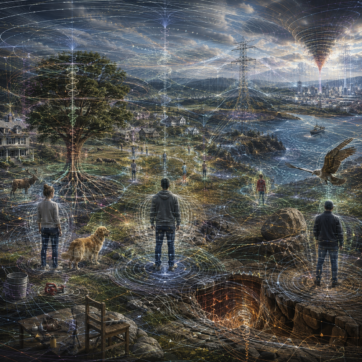
Why the Eternal Flame Never Entered External, Why Stillness Cannot Travel, and How Correspondence Remains Without Connection
Before There Was Somewhere to Go
Before movement, there was no distance.
Before geometry, there was no position from which something could depart. There was no line to cross, no boundary separating one condition from another, no pathway connecting one location to the next. There was no “here” and no “there,” because those relationships require differentiation, and differentiation belongs to external. There was no direction because nothing had yet established the possibility of moving toward or away from anything else.
There was Eternal.
Not Eternal as an endless amount of time. Not something that has existed for an unimaginably long duration. Time, duration, sequence, before, after, beginning, and continuation are already external translations. Eternal does not mean something that managed to persist through all of them. Eternal precedes the architecture through which any of those distinctions become possible.
And Eternal is still.
That stillness is difficult to describe precisely because nearly every word available to humans was formed inside movement. Humans know stillness primarily as the temporary absence of visible motion: a body sitting quietly, water without a ripple, an object remaining in one place. But those things exist inside an architecture already capable of movement. Their stillness is conditional. The body can stand. The water can move. The object can be displaced. What appears still is simply not moving at that particular rendered moment.
Eternal stillness is not that.
It is not movement brought to rest. It is not oscillation slowed until it disappears. It is not a perfectly balanced frequency. It is not stabilized geometry, suspended vibration, or a field maintained in coherence. All of those descriptions begin after the architecture of movement already exists.
Eternal stillness does not need to be maintained because there is nothing acting upon it that could disturb it. It does not resist movement. It does not hold itself against pressure. It does not continually correct itself back into stillness. Resistance, holding, correction, and stabilization are operations. Eternal does not perform stillness.
It is still before movement has meaning.
This is where the human understanding of Eternal has repeatedly become inverted. Humans attempt to understand what precedes external while standing inside external, using a language created from external relationships. Everything familiar is organized through position, movement, distance, cause, sequence, connection, separation, interaction, and change. Something begins somewhere. Something travels somewhere else. Two things become connected. A connection can be broken. What was separated can be reunited. What departed can eventually return.
And so humans gave Eternal the same story.
Something descended from it. Something separated from it. Something left it. Something entered creation. Something became trapped inside physical existence. Something forgot where it came from. Something must reconnect. Something must ascend. Something must find its way home.
The story changes across religions, spiritual systems, philosophies, and human language, but the movement underneath it remains remarkably similar: Eternal is imagined through the mechanics of external.
That is the mistranslation.
The Eternal Flame did not begin at one end of a journey that eventually became the human. It did not stand somewhere outside external and send part of itself across a boundary. It did not become distant when external became increasingly distorted. It did not withdraw when the Greater External Identity Field accumulated compression. It did not move farther away as incarnational identities became increasingly immersed in the render.
Those are stories of distance.
Eternal contains no distance to cross.
And this is why it can initially feel almost too simple. Humans have spent so long imagining separation that they immediately begin looking for the mechanism of reunion. They ask how to reconnect with Eternal, how Eternal reaches external, how stillness gets through distortion, how the Flame communicates with what exists here.
But every one of those questions quietly begins after movement has already been assumed.
Before asking how something returns, something more fundamental has to be asked.
What actually left?
Before imagining the path home, remove the path.
Before imagining the distance, remove the distance.
Before imagining the departure, remove the movement that departure would require.
What remains is not an Eternal Flame waiting somewhere beyond external for a missing piece to find its way back. What remains is Eternal stillness exactly where movement never occurred, while all movement, differentiation, compression, distortion, experience, identity, and render unfolded within external.
External moved.
Eternal did not.
And once that distinction is allowed to remain clean, a very different question begins to appear beneath centuries of human stories about separation and return:
How could something that never moved have ever left?
The Eternal Never Entered
The Eternal Flame never entered external. That distinction has to remain absolute because the moment the Eternal is placed anywhere inside external architecture, everything that follows becomes inverted. The Eternal becomes something that descended, projected, divided, traveled, transformed, or crossed from one condition into another. Movement is assigned to what existed before movement. External mechanics are placed onto what never belonged to external at all.
The Eternal Flame did not descend into the Greater External Identity Field, and it did not become the Greater External Identity Field. The greater field is external identity architecture associated with its particular Eternal Flame, but association is not transformation. The Eternal did not turn itself into a field so it could experience external. It did not stretch itself outward, reproduce itself somewhere else, or create a smaller external version of itself. Nothing Eternal had to become external in order for external identity architecture to exist.
And when the Greater External Identity Field differentiated into incarnational identity fields, the Eternal Flame did not divide along with it. One incarnation did not receive one piece of Eternal while another incarnation received another. The differentiated incarnational positions held within the greater architecture are external differentiations, not fragments of Eternal distributed across lives. Differentiation belongs to external. Fragmentation requires something capable of being divided. Neither describes the Eternal Flame.
This means the Eternal Flame never became the incarnational identity currently translated as a human being. It never entered the body. It is not located behind the heart, inside the brain, beneath the personality, within the incarnational identity field, or hidden somewhere beyond ordinary sensory perception. The body does not contain a tiny piece of Eternal waiting to be found. There is no Eternal object buried underneath layers of human identity that can eventually be uncovered, activated, awakened, or released. The Eternal is not the deepest layer of the human because the Eternal is not a layer of external architecture at all.
Even the ancient human idea of a soul hidden inside matter preserves the same underlying movement. Something Eternal is imagined to have entered physical existence, taken residence inside a temporary body, become partially obscured by physical experience, and eventually departed again. Other systems change the terminology and describe fragments of source, divine sparks, higher selves, or essence descending into form, but the assumed architecture remains the same: something Eternal crossed into external. Eternal Flame Physics removes that movement completely. Nothing Eternal crossed a boundary because boundaries arise within differentiated external architecture. Nothing Eternal traveled across a distance because distance belongs to external. Nothing Eternal moved from one state into another because transition itself requires change.
This becomes especially important once distortion is understood structurally. Oscillation, pressure, compression, torsion, curvature, interference, mimic structure, and accumulated distortion can operate throughout external because external is the architecture in which movement exists. The Greater External Identity Field can carry substantial distortion. Incarnational identity fields can become even more locally compressed, their available ranges narrowing until broader structural relationships become difficult to translate cleanly. Rendered identities can become so immersed in immediate sensory experience, belief structures, repetitive thought, emotional reaction, technological pressure, and mimic reinforcement that external movement appears to be the entirety of existence.
But none of those conditions extend backward into Eternal. External oscillated; Eternal did not. External compressed; Eternal did not. External accumulated pressure, curvature, torsion, interference, and layer upon layer of movement; Eternal did not. External identity architecture could become increasingly distorted while Eternal underwent no corresponding distortion whatsoever. The repetition matters because the human tendency is always to carry what happened in external back into Eternal and imagine that something there must have been affected too.
This is why even saying that the Eternal Flame remained “pure” while external became distorted is not quite clean enough. Purity still implies the possibility of contamination. Eternal did not successfully protect itself from distortion. It was never inside the architecture in which distortion could reach it. It did not resist compression because it was never compressible. It did not withstand torsion because it was never available to be twisted. It did not survive mimic structure because mimic structure never reached Eternal in the first place. Eternal stillness was not stronger than external movement. Strength, opposition, resistance, and survival would turn Eternal into another participant in the very mechanics being described.
There is something much quieter in the actual architecture. External could move enormously. Greater External Identity Fields could accumulate extensive structural distortion. Incarnational identities could become almost completely occupied by the render. Entire civilizations could build explanations of existence upon layers of external mistranslation. Humans could forget Eternal so completely that they would search for it everywhere inside movement, inventing gods, heavens, higher selves, ascending states, hidden dimensions, and countless paths of return. Yet none of that forgetting would mean Eternal had forgotten anything. None of that distance experienced from inside external would mean Eternal had moved farther away.
That is the distinction beginning to emerge underneath everything else: all of the movement occurred on one side of the architecture. External moved, changed, differentiated, accumulated, compressed, distorted, translated, and retranslated itself. Eternal did none of those things. And because the Eternal Flame never entered external, nothing Eternal became lost inside what external eventually became.
The Eternal is therefore not waiting to be recovered from beneath the distortion. It is not waiting for an incarnation to discover the Eternal piece hidden inside itself. It is not waiting for scattered fragments to reunite or for something that descended long ago to finally find its way home. Those stories require a departure that never occurred. Eternal remained still, untouched not because it escaped what happened here, but because it never entered the movement in the first place.
But Never Entering Did Not Mean Never Related
This is where the distinction becomes more delicate. If the Eternal Flame never entered external, never became the Greater External Identity Field, never extended itself into an incarnational identity, and never crossed into the architecture of movement at all, an apparent contradiction immediately appears: how can external have any relationship to Eternal? If nothing Eternal crossed the boundary, what could possibly remain between them?
The contradiction only exists when relationship is understood through external mechanics. Humans know relationship through things that touch, connect, exchange, transmit, intersect, overlap, or remain joined through some form of continuity. A connection usually has something connecting it. A relationship between two positions usually implies a pathway across the distance separating them. Even invisible relationships are commonly imagined this way: a signal travels, information transfers, a force acts, a frequency carries, a line extends. Something gets from one side to the other.
So when Eternal Flame Physics establishes that the Eternal Flame does not enter external, the rendered mind can easily translate that into another familiar external condition: disconnection. Eternal must be over there, external must be over here, and if nothing crosses between them, the two must be completely unrelated.
But that is still external speaking.
“Connected” and “disconnected” are themselves inadequate when they imply two separate structures requiring something between them in order for relationship to exist. Saying the Eternal does not connect to external through continuity does not mean the Eternal and its associated external identity architecture are absolutely unrelated. Complete absence of relationship would create an entirely different problem. There could be no meaningful correspondence between a particular Eternal Flame and a particular Greater External Identity Field. There could be no unique structural identifier within that greater field corresponding specifically to its Eternal Flame. There could be no basis for speaking of an Eternal link at all.
The architecture therefore requires a distinction humans rarely make: structural correspondence without entry.
The Greater External Identity Field does not contain the Eternal Flame, but it is not structurally anonymous. It is associated with its particular Eternal Flame and carries the unique structural correspondence belonging to that relationship. Nothing Eternal had to become part of the field for that correspondence to exist. Nothing had to break away from Eternal, cross into the pre-render, and remain there as proof of where the greater field came from. The correspondence does not require Eternal substance embedded inside external.
This is fundamentally different from continuity. Continuity would imply that something extends from Eternal into external—that somewhere, however subtle, there remains an unbroken strand of the same substance crossing from one into the other. That would quietly place part of Eternal inside the architecture again. It would give external access to something Eternal and give the Eternal Flame an extension capable of participating in external conditions. The separation would appear to have been solved, but only because Eternal had been smuggled back into external under the language of connection.
Structural correspondence requires none of that. Eternal remains Eternal. The Greater External Identity Field remains external. The distinction between them remains intact, while the relationship between a particular Eternal Flame and its associated external identity architecture remains specific. There is no need to collapse two different conditions into one continuous substance in order to explain why they correspond.
This is where the architecture begins to soften something that can initially feel stark. The statement that “the Eternal never entered” can sound, from inside the render, almost like absolute severance. It can sound as though Eternal stands completely removed from everything occurring here, with external cut loose into movement and left without any relationship to what preceded it. But that feeling comes from equating absence of contact with absence of relationship. Once correspondence is separated from contact, the picture changes.
Nothing Eternal has to reach across the boundary. Nothing has to maintain a bridge. Nothing has to travel back and forth to keep the relationship alive. Eternal does not periodically reconnect with the Greater External Identity Field, because the correspondence is not an external connection capable of switching on and off. External distortion can obscure how that correspondence is translated and recognized through localized identity, but distortion does not require the Eternal Flame itself to become more distant.
And perhaps this is where remembrance begins to become quieter. The Eternal did not have to follow external into movement in order for external to remain correspondent with it. Eternal did not have to sacrifice stillness in order for relationship to remain. Nothing Eternal had to enter distortion so that distortion could someday find its way back.
The Eternal Flame remained still. External became external. And between those two statements there is not a missing bridge waiting to be discovered, but a relationship humans have repeatedly tried to describe using the wrong mechanics.
Not continuity of substance. Not transmission across distance. Not Eternal presence hidden inside external.
Structural correspondence without entry.
The Eternal never had to become external for external to remain related to Eternal.
There Was Never a Bridge
Once the relationship between Eternal and external is understood as structural correspondence without entry, the idea of the Eternal “link” has to change with it. The word link can easily create the wrong image. It suggests two separate positions with something stretched between them: a cord joining one side to another, a beam extending across a distance, a channel through which something passes, a tunnel connecting two otherwise divided spaces. But none of those mechanics describe the relationship between the Eternal Flame and its associated external identity architecture.
There is no cord running from Eternal into the Greater External Identity Field. There is no beam of Eternal stillness extending into the pre-render. There is no hidden channel carrying something from one side to the other, no tunnel through which information travels, no Eternal substance flowing into external, and no signal that must continually be transmitted or maintained so that the relationship does not disappear. If any of those things existed, the supposed bridge itself would have to participate in relationship, position, continuity, and transmission. The explanation would once again require movement to explain what never moved.
Humans imagine bridges because the render teaches relationship through distance. Two rendered locations are separate, so a road can connect them. Two devices are apart, so a signal can travel between them. Two people are geographically distant, so some medium carries their communication. Even the human body is filled with rendered mechanisms through which one location communicates with another. Relationship repeatedly appears to require infrastructure because rendered relationship is continually translated through space, position, movement, and exchange.
That orientation becomes so deeply embedded that when humans encounter a relationship they cannot physically locate, they often imagine invisible infrastructure instead. The cord becomes an energetic cord. The signal becomes a frequency. The pathway becomes an invisible channel. The bridge becomes a spiritual connection. Rendered mechanics are retained while their visible components are simply made unseen. But making a bridge invisible does not stop it from being a bridge. It still assumes two positions separated by a distance that something must cross.
The Eternal link is not that.
The Eternal link is permanent correspondence. It does not transport anything because transport is unnecessary. It does not hold Eternal and external together like two structures that would otherwise drift apart. It does not require continual reinforcement. It is not strengthened when an incarnation remembers Eternal, weakened when an incarnation becomes heavily compressed, or severed when external identity becomes almost completely occupied by mimic structure. Those conditions belong to external. They can alter what becomes locally available and how cleanly correspondence can be recognized through external identity architecture, but they do not turn permanent correspondence itself into a piece of infrastructure that can break.
This is where the unique structural identifier within the Greater External Identity Field becomes especially important. Every greater field is not simply an interchangeable external structure floating beneath an anonymous Eternal condition. Within that greater identity architecture exists a unique structural identifier corresponding to its particular Eternal Flame. That identifier establishes specificity without requiring Eternal presence inside the field.
The simplest rendered analogy remains the fingerprint. A fingerprint can unmistakably correspond to a particular person without being the person itself. It does not contain the total person. The person has not climbed inside the fingerprint. Nothing about recognizing the correspondence requires confusing the identifier with what it identifies. The fingerprint is not the person. The correspondence is unmistakable anyway.
The analogy ends there, because the Eternal relationship is not literally biological identification translated onto a larger scale. But it helps remove the assumption that correspondence requires presence. The unique identifier within the Greater External Identity Field is not a miniature Eternal Flame. It is not Eternal essence compressed into an external signature. It is not the piece of Eternal that crossed over when everything else remained still. It does not secretly restore continuity of substance between Eternal and external.
The identifier belongs to external. The Greater External Identity Field belongs to external. Yet the identifier establishes the particular correspondence of that greater identity architecture with its Eternal Flame. This is how specificity can remain without fragmentation. There can be distinct Eternal correspondence without requiring distinct pieces of Eternal to be inserted into external to establish it.
And that makes the Eternal link much quieter than humans have imagined connection to be. There is nothing glowing between two positions. Nothing is being exchanged. Nothing needs to remain open. Eternal is not continually reaching toward external, and external does not have to reach back to keep the relationship intact. What external can lose beneath compression and distortion is not the Eternal link itself, but clarity within its own architecture.
The bridge was never broken because there was never a bridge to break.
What remained was correspondence: particular, permanent, and requiring nothing Eternal to cross into external in order to exist.
Stillness Cannot Travel
How does Eternal stillness reach external? It doesn’t.
That answer can initially sound impossible because the question itself assumes that if Eternal stillness has any relevance to external, something must somehow pass between them. Stillness must travel outward. It must enter the Greater External Identity Field, move through the pre-render, reach the incarnational identity field, and eventually become expressed through the render. Humans are accustomed to understanding influence this way: something originates somewhere, moves across a relationship, and produces an effect somewhere else. But the moment Eternal stillness is placed inside that sequence, it has already been given the mechanics of external.
Something that travels is moving. Something that is transmitted has an origin point, a pathway, and a destination. Something that enters must cross from one condition into another. Even something described as being “projected” requires direction and extension. None of those mechanics can explain Eternal stillness because every one of them begins after movement has already been introduced.
The Eternal Flame therefore does not send stillness into external. It does not project stillness toward the Greater External Identity Field. It does not apply stillness to external architecture as though stillness were a force. There is no amount of Eternal stillness traveling through the Eternal link, because the link is not a transmission pathway and stillness is not a substance capable of flowing through one. Eternal remains still without needing to export that stillness anywhere.
This becomes even clearer when the Greater External Identity Field is heavily distorted. It can be tempting to imagine Eternal stillness acting as a corrective force against what has accumulated there. Perhaps Eternal reaches into compression and releases it. Perhaps it stabilizes oscillation. Perhaps it straightens curvature, untwists torsion, quiets interference, or pushes against mimic structure until the greater field returns to a cleaner condition. That image may sound compatible with restoration, but structurally it would place the Eternal Flame directly inside the mechanics of external correction.
The Eternal would become an actor.
It would observe one external condition, respond to it, exert something upon it, and produce another condition. Eternal would now be participating in cause and effect. Its stillness would have become an instrument through which change occurs. What began as Eternal would quietly be transformed into an extraordinarily powerful external force.
That is not Eternal stillness.
Eternal does not overpower distortion because overpowering requires opposition. It does not defeat oscillation because defeat requires interaction. It does not resist compression because resistance requires pressure acting against pressure. Eternal stillness is not the strongest force in a contest between stillness and movement. There is no contest.
Stillness does not defeat movement. Stillness never entered movement’s mechanics.
All of the action remains within external. External oscillates. External compresses. External develops curvature and torsion. External accumulates pressure. External becomes entangled with mimic structure. External can also release those additions, become less compressed, lose accumulated distortion, and move toward greater structural stillness. None of those changes require the Eternal Flame to perform an opposing action.
This is where Eternal stillness begins to mean something far more precise than the human idea of calm or absence of activity. Eternal stillness is not a condition being imposed upon external. It is the unmoved reference that never changed while external did.
The distinction is subtle but enormous. If the Eternal Flame were required to change external directly, then every improvement in external condition would represent increased Eternal action. A heavily distorted field might be understood as receiving too little Eternal influence, while a clearer field might appear to contain more of the Flame. Greater stillness in the field would then be interpreted as more Eternal presence entering external.
But nothing Eternal increased.
Nothing Eternal decreased.
The changing variable was external.
A Greater External Identity Field carrying extensive compression can exist in heavily distorted relationship to its Eternal correspondence. As that external architecture sheds addition, the relationship can become cleaner. Oscillation decreases. Pressure releases. Structural holding loosens. Curvature and torsion can reduce. Mimic interference can lose its ability to dominate the architecture. What changes is the condition of the external field and therefore the clarity with which its correspondence can exist and translate.
The Eternal Flame did not move closer during that process. It did not become more available because it decided to reach farther into external. It did not send an increased amount of stillness when distortion began to release. Eternal remained exactly where Eternal had always been: not spatially somewhere else, but outside the movement through which “closer” and “farther” acquire meaning.
This is why Eternal can remain structurally relevant without becoming structurally active inside external. Its relevance is not force. It is reference through correspondence. External identity architecture carries its particular Eternal correspondence, and that architecture can become more or less obscured by what external accumulates. The reference itself does not have to change simply because what corresponds to it does.
There is something important in allowing stillness to remain this still. Humans continually want to make Eternal do something because action is how significance is understood inside the render. If something matters, it must cause. If something has influence, it must act. If something is related, it must exchange. But Eternal significance does not have to be translated into external activity in order to remain real.
The Eternal Flame does not have to reach into external and straighten what became curved. External curvature can fall away. Eternal does not have to quiet what became oscillatory. External oscillation can cease. Eternal does not have to push through layers of distortion to make itself present again. The distortion belongs to external, and external is where the distortion changes.
Stillness never arrives at the end of that process. Nothing traveled.
What changed was everything that had been moving around an unmoved reference.
And Eternal remained still.
Everything That Happened, Happened Here
Once Eternal stillness is allowed to remain outside the mechanics of movement, the history of distortion has to be placed where it actually occurred. Everything that accumulated, accumulated here—in external. Every compression, every oscillation, every curvature, every torsion, every layer of pressure, every structural entanglement, every mimic reinforcement, every narrowing of range occurred within an architecture capable of undergoing those conditions. None of them began in Eternal, and none of them traveled backward into it.
The pre-render could become increasingly complicated. Greater External Identity Fields could accumulate distortion across their architecture. Incarnational identity fields could differentiate within those greater fields under radically different structural conditions, some carrying substantial pressure and others retaining considerably greater clarity. Relationships among fields could become entangled. Pathways could become disrupted. Mimic structure could reinforce movement already present. Then the render could translate those upstream conditions into bodies, environments, behaviors, relationships, institutions, belief systems, conflicts, and entire civilizations built inside accumulated distortion.
External could become layered almost beyond recognition.
And because an incarnational identity experiences existence from inside that architecture, what happened here could easily feel like something much larger had happened. Compression could feel like separation from Eternal. Limited range could feel like Eternal had become inaccessible. Distortion could feel like something essential had been lost. The increasing dominance of the render could make Eternal seem impossibly distant, hidden somewhere beyond layers that the human could no longer see through.
Humans then built stories around that apparent distance. They imagined a fall from an original condition. A separation from source. A divine fragment becoming trapped in matter. A soul forgetting where it came from. A spiritual identity descending into denser existence and eventually needing to rise again. The details changed, but underneath them was the same interpretation: something happened here that somehow also happened to Eternal.
It did not.
Everything humans interpreted as Eternal separation occurred on the external side of the architecture. The Greater External Identity Field could become distorted. The incarnational identity field could become compressed. Local translation could become severely restricted. Mimic structure could become so dominant that the rendered identity interpreted nearly everything through external constructions. An incarnation could live an entire rendered life without recognizing Eternal at all.
None of it reached Eternal.
That distinction is larger than saying Eternal remained unaffected by external. “Unaffected” can still sound as though something struck Eternal and failed to change it, as though Eternal successfully withstood the pressure of what occurred here. But there was no impact to withstand. External distortion did not arrive at the boundary of Eternal and fail to penetrate it. Eternal was never participating in the structural system through which that distortion propagated.
So there was no moment when the Eternal Flame became compressed alongside its Greater External Identity Field. There was no moment when Eternal became twisted because external developed torsion, fragmented because incarnational identities differentiated, or confused because mimic structure increasingly distorted external translation. There was no Eternal injury beneath the external injury. No Eternal distortion underneath the external distortion. No Eternal forgetting behind the human forgetting.
External could become almost unrecognizable without producing a single alteration in Eternal.
This is where the architecture begins to change the meaning of what humans have called separation. What appeared to be a catastrophic break between the human and Eternal was never an event occurring to Eternal at all. Eternal did not move away. It did not close itself off. It did not withdraw behind the distortion. It did not become less correspondent because an incarnational identity could no longer recognize that correspondence clearly.
The catastrophe, where catastrophe existed, was external. The accumulation was external. The distortion was external. The forgetting was expressed through external identity. And because humans were looking outward from inside that distortion, they interpreted their own inability to see clearly as evidence that Eternal itself had somehow disappeared.
But Eternal had not disappeared.
This is also why remembrance can begin to carry a different weight once this distinction becomes clear. What is being recognized is not simply that distortion can be released. It is that even at the greatest point of external distortion, nothing had occurred to Eternal that now has to be undone. There is no corresponding Eternal wound to repair. There is no Eternal fragment buried beneath the architecture waiting to be restored to its original condition. There is no damage extending all the way back to what existed before movement.
All of that movement stopped here.
External accumulated. External compressed. External distorted itself through layer upon layer of movement and addition. External identity became immersed in what external had become and eventually mistook that condition for the totality of what existed.
Yet Eternal stillness never shared the history of external distortion.
And perhaps that is one of the quietest corrections Eternal Flame Physics makes. Humans have spent centuries imagining how far they fell, how much they lost, how deeply they became separated, and how difficult the journey back must therefore be. But the distance they are measuring belongs to the architecture that moved.
Eternal never traveled that distance with them.
Nothing that happened here made Eternal less Eternal. Nothing that accumulated here became an accumulation there. Nothing that forgot here caused Eternal to forget.
Everything that happened, happened here.
And Eternal never moved.
The Eternal Did Not Lose You
There is a particular human sorrow built around the idea of Eternal separation. It appears in countless forms: something essential was lost, something sacred became distant, something that once knew the way forgot, and the human life is now an attempt to recover what disappeared. Even when the language changes, the feeling underneath it remains familiar. Somewhere, somehow, there was a separation. And because there was a separation, there must eventually be a reunion.
But the Eternal Flame did not lose you.
That statement has to be understood carefully because “you” cannot be used here to collapse the rendered identity, the incarnational identity field, the Greater External Identity Field, and the Eternal Flame into one thing. The person reading these words is a rendered incarnational identity, translated through a particular incarnational identity field within a much larger external identity architecture. The Eternal Flame did not become that person. It is not a hidden version of that person underneath the body, personality, memories, and rendered life. The distinction remains.
And still, the Eternal did not lose you.
The Eternal did not forget when the incarnational identity forgot. It did not abandon external when external became distorted. It did not withdraw when the Greater External Identity Field accumulated compression. It did not become more distant as mimic structure intensified or as the incarnational field became increasingly occupied by the immediate render. Nothing Eternal changed position because external identity lost clarity.
From inside an incarnation, however, that can be extraordinarily difficult to recognize. A heavily compressed field can translate through a narrow range. External movement can become so dominant that almost everything available to the rendered identity reinforces external as the only apparent reality. Humans can become immersed in bodies, histories, identities, fears, relationships, beliefs, survival, accumulation, and continuous sensory translation until Eternal seems not merely inaccessible, but absent.
Then absence is interpreted as abandonment.
Distance is imagined where distortion exists. Disconnection is imagined where correspondence has become obscured. And because humans understand loss through rendered relationships, Eternal begins to take on the characteristics of someone who went away. Perhaps Eternal withdrew. Perhaps the human fell too far. Perhaps the connection was severed. Perhaps something must be done to become worthy of reconnection. Perhaps enough spiritual work, remembrance, purification, knowledge, discipline, or development will finally bring the lost relationship back.
But Eternal never went anywhere.
What became obscured was external correspondence under addition and distortion. The Greater External Identity Field remained external identity architecture corresponding to its particular Eternal Flame even while carrying distortion. The incarnational identity field remained differentiated within that architecture even while becoming compressed. What changed was the condition through which correspondence could be recognized and translated, not the Eternal reference itself.
This is why there is no lost Eternal fragment hidden somewhere inside the incarnation. Nothing Eternal fell so deeply into external that it now has to be found beneath the layers. There is no tiny Flame buried underneath personality, trauma, belief, memory, mimic structure, or biological form. Removing external addition does not eventually expose a piece of Eternal that had been trapped inside it all along.
The incarnation is not carrying Eternal home.
That changes the emotional architecture of the entire story. There is no Eternal Flame waiting beyond external for its missing piece to return. There is no incomplete Eternal condition created by incarnation. Eternal did not become diminished because external differentiated into identity fields, and it did not become more complete when an incarnational identity began remembering.
Nothing Eternal was missing.
The sense of missing belonged here.
And this may be why remembrance can sometimes arrive with a weight that ordinary intellectual understanding does not carry. The recognition is not merely that Eternal exists. It is that the entire story of Eternal abandonment begins dissolving with it. What seemed absent had not withdrawn. What seemed distant had not moved away. What seemed lost had never become an object capable of being lost.
External can forget how to recognize its correspondence. External can bury that recognition beneath enormous amounts of movement. External can build entire systems around the assumption that something sacred has disappeared and must be recovered. Humans can spend incarnational lifetimes searching outward, upward, inward, backward, and beyond for something they believe separation removed from them.
But the search itself begins from an event that never happened to Eternal.
The Eternal Flame did not leave the incarnation because it had never entered the incarnation. It did not abandon the Greater External Identity Field because it had never become part of the greater field. It did not withdraw its stillness because stillness had never been transmitted into external in the first place. What remained was correspondence without entry, even while external became increasingly unable to recognize what that meant.
So the deeper remembrance is not that an abandoned connection has finally been repaired. It is not the relief of something lost finally being returned.
It is the recognition that nothing Eternal was ever missing.
The Eternal did not forget.
The Eternal did not withdraw.
The Eternal did not abandon.
The Eternal did not lose you.
External simply became so filled with movement that, for a very long time, it forgot how to understand what never moved.
You Cannot Return to Somewhere You Never Left
Nearly every human system built around spiritual development contains some version of return. The words change, the destination changes, and the path changes, but the movement remains. Return to source. Return to God. Return to original wholeness. Find the way back. Remember where you came from. Ascend beyond what you became. Each story begins with the same assumption: something once existed in one condition, departed from it, and must eventually reverse that departure.
Return feels so natural because it is one of the most familiar mechanics in the render. A person leaves a home and can return to it. A body moves away from a location and can retrace the distance. Something lost can be found and brought back. Separation creates distance, and movement can close that distance again. Humans have taken this ordinary rendered relationship and placed it onto Eternal, creating an enormous journey around a departure that never occurred.
Eternal Flame Physics removes the journey.
There is no Eternal journey because the Eternal Flame never traveled into external in the first place. It did not descend through layers that must later be ascended. It did not move outward and therefore does not need to move inward again. It did not fragment and therefore does not need to be reassembled. It did not become the human and therefore does not need to escape the human. It did not leave an original position from which a path back could even be measured.
All of the movement occurred within external. The Greater External Identity Field can accumulate pressure and distortion. Incarnational identity fields can become compressed. Range can narrow. Mimic structure can become increasingly dominant. External identity can become deeply occupied by the render, and the rendered person can experience an enormous apparent distance from anything resembling Eternal stillness. But that apparent distance is produced inside an architecture capable of movement and distortion. It is not a measurement of how far Eternal has gone.
This changes the meaning of spiritual “progress” completely. Humans have repeatedly interpreted changes within external as movement toward Eternal. A person releases something and feels closer to source. A field becomes quieter and the person believes the Flame has come nearer. Greater remembrance becomes available and it appears that some distance has finally been crossed. The experience of increasing clarity can be real while the explanation of that clarity remains inverted.
Eternal did not come closer.
External became less obscured.
That difference is everything. External can become increasingly distorted, and external can release distortion. External can accumulate, and external can subtract. External can oscillate more intensely and later become increasingly still. Eternal does none of those things. Eternal does not become more distant during accumulation and then move closer during restoration. It does not withdraw when distortion increases or return when distortion decreases. The changing variable remains external from beginning to end.
This is why even the phrase “return to Eternal” can only be useful if its rendered movement is understood as metaphor rather than architecture. There is no path stretching from the incarnational identity back to the Eternal Flame. There is no final distance that restoration eventually closes. There is no threshold across which external identity passes and suddenly arrives where Eternal has been waiting. Those images belong to bodies, locations, pathways, and movement.
What humans experience as return is subtraction within external.
Pressure releases. Holding decreases. Compression loosens. Oscillation no longer has to sustain the same degree of movement. Mimic structures that once dominated translation can lose their hold. Identities built through accumulation can begin falling away. The external architecture does not travel anywhere while this occurs. It simply becomes less occupied by what was added within it.
And as that happens, correspondence can become cleaner.
This is where the idea of return becomes almost beautifully unnecessary. The incarnational identity does not have to know how to reach Eternal. It does not have to calculate the route, find the hidden doorway, raise itself into another position, or become something extraordinary enough to cross an impossible distance. Every one of those attempts would create more movement in response to movement.
There was never an Eternal distance to overcome.
The distance was experienced here. The distortion accumulated here. The apparent separation was translated here. And therefore restoration happens here as well—not because external finally succeeds in reaching Eternal, but because what external added can cease to dominate what external has become.
The Eternal Flame remains the unmoved reference throughout the entire process. When external is heavily distorted, Eternal remains still. When external begins releasing distortion, Eternal remains still. When an incarnational identity experiences profound remembrance, Eternal remains still. Nothing about Eternal marks the beginning, middle, or end of the supposed journey because Eternal never participated in the journey.
This is the correction hidden underneath the human longing to go back. Perhaps what has been called “return” was never a return at all. Perhaps the enormous distance humans believed they had to cross was created by interpreting external distortion as Eternal separation. Perhaps what appeared to require a journey only required the ending of movement that never belonged to Eternal in the first place.
There is no Eternal journey.
There is external accumulation, and there is external subtraction. There is distortion, and there is the release of distortion. There is movement, and there can be less movement.
But there is nowhere to return to when Eternal never left.
This Is Why Nothing Needs to Be Added
Once the idea of return falls away, another assumption falls with it: that something must be added in order to restore what external has become. If Eternal stillness never left, if the Eternal link was never severed, and if the Eternal Flame never withdrew from its correspondence with external identity architecture, then there is nothing missing that has to be brought back in.
No Eternal stillness needs to be imported into the Greater External Identity Field. No connection needs to be activated. No Eternal substance needs to be embodied by the incarnational identity. No frequency needs to be raised high enough to reach Eternal. No state needs to be achieved and then carefully maintained. No higher position needs to be reached. No hidden part of the human needs to be awakened so that Eternal can finally enter.
All of those approaches begin with absence. Something is believed to be missing, so something must be acquired. The person must become more, receive more, access more, hold more, understand more, activate more. Even systems built around stillness can turn stillness into another acquisition: a state to reach, preserve, deepen, protect, or reproduce. But the moment stillness becomes something that must be attained and held, external has already converted it back into movement.
Eternal Flame Physics moves in the opposite direction.
External accumulated. It accumulated oscillation, compression, pressure, torsion, curvature, mimic structure, identities, beliefs, interpretations, repeated reactions, structural entanglements, and layer upon layer of holding. The problem was never an insufficient amount of Eternal added to external. The problem was accumulation within an architecture capable of accumulating.
That is why restoration is fundamentally subtractive.
What accumulated can fall away. What became compressed can release. What required continuous holding can cease being held. What became increasingly oscillatory can lose the conditions sustaining that oscillation. Mimic structures can stop receiving the repeated engagement through which they remain dominant. External identity can become less crowded by everything it acquired while trying to understand itself from inside the render.
Nothing has to replace what leaves.
That distinction matters because humans are deeply conditioned to fill every opening created by subtraction. One belief falls away, so another belief takes its place. One identity is released, so a more refined identity is constructed. One spiritual framework is abandoned, so a supposedly more advanced framework replaces it. Even an experience of greater stillness can immediately become something the rendered identity names, remembers, seeks again, and begins trying to maintain. Addition quietly returns through the attempt to preserve the result of subtraction.
But Eternal stillness does not require preservation. It is not a state external successfully creates when enough distortion has been removed. External is not manufacturing a copy of Eternal by becoming quieter. The Greater External Identity Field remains external. The incarnational identity field remains external. Structural stillness within those fields remains an external condition. The distinction between Eternal and external does not disappear simply because external becomes less distorted.
What changes is correspondence.
As external addition decreases, the architecture can become increasingly clear in its correspondence with its Eternal reference. Not because more Eternal is entering it, but because less external distortion is obscuring the relationship. The Eternal Flame does not increase its participation as restoration occurs. It does not send more stillness into a clearer field than it could send into a compressed one. It does not reward subtraction by moving closer.
The movement is still entirely on the external side.
This is why greater stillness within an incarnational identity field should never be mistaken for a greater quantity of Eternal inside that field. There is no quantity of Eternal to increase. A clearer field is not “more Eternal” than a distorted field. It is simply carrying less of the external addition that interferes with its own structural condition and correspondence.
And this changes the entire orientation of remembrance. There is nothing to chase. Nothing to call down. Nothing to become worthy of receiving. Nothing to force open. The rendered identity does not need to reach beyond itself and acquire the missing ingredient that will finally make restoration possible. Every attempt to manufacture that relationship through additional effort risks reproducing the same movement that made the relationship appear inaccessible in the first place.
Subtraction is quieter than that.
It does not promise the rendered identity another extraordinary thing to possess. It progressively removes the necessity of possession itself. Less holding. Less construction. Less interpretation. Less effort to turn every recognition into another identity, method, state, or belief. External becomes less occupied by what it has added to itself.
And when that happens, something can appear to have arrived.
Greater clarity may become available. Remembrance may deepen. The field may become considerably stiller. Relationships that were obscured beneath compression can become recognizable. The rendered identity may experience this as finally finding something that had been absent for an unimaginably long time.
But nothing Eternal arrived.
Stillness did not arrive. What prevented its correspondence from being recognized became quieter.
That is the difference between addition and remembrance. Addition searches for something that is missing. Remembrance begins revealing that the search itself was built around the wrong absence.
Eternal did not need to be added back.
External only had to stop adding so much between itself and what never moved.
Why It Is Called the Eternal Flame
The name Eternal Flame was never meant to describe a literal flame. There is no fire burning somewhere outside external, no Eternal light made of heat or combustion, and no flame-shaped object existing beyond the pre-render. Fire, light, heat, shape, movement, and combustion all belong to external. A literal flame could never accurately describe what Eternal is.
The word flame instead gives rendered language a way to point toward something it otherwise has almost no language for. Within the render, an eternal flame represents something that does not go out. It remains. It does not disappear with changing conditions around it. Humans have used the image of an undying flame precisely because it carries the recognition of something enduring when everything surrounding it is temporary.
But even that image can only go so far.
A rendered eternal flame still burns. It moves. It requires conditions that allow combustion to continue. It consumes fuel. It produces heat and light. Its appearance constantly changes even while humans describe the flame itself as continuously present. Eternal Flame is not doing any of those things. The name is not describing its physical mechanics. It is pointing toward the one recognition contained within the image that matters here: it does not go out.
The Eternal Flame does not appear and disappear. It does not begin with an incarnation and end when that incarnation ends. It does not become brighter when external identity remembers and dimmer when external identity becomes compressed. It does not weaken beneath distortion. It does not need to be protected from what occurs within external, nor does anything need to keep it alive.
It remains.
And even the word remains has limitations, because remaining can sound like something successfully continuing through time. Eternal is not surviving from one moment into the next. It does not endure because it has somehow managed not to end. Beginning, duration, continuation, and ending belong to the architecture of sequence. Eternal does not continue through time. It stands outside the requirement for continuation altogether.
This is why the name becomes more precise when understood through Eternal Flame Physics rather than through the literal rendered image. The flame humans recognize in the render offers a symbol for something that never goes away, but Eternal takes that recognition beyond the mechanics of the symbol itself. There is no burning to sustain. No fuel to replenish. No movement keeping it alive. No danger that enough external distortion could finally extinguish it.
External can change beyond recognition and the Eternal Flame does not go out. Greater External Identity Fields can accumulate distortion and the Eternal Flame does not go out. Incarnational identities can move through entire rendered lives without remembering Eternal and the Eternal Flame does not go out. External architecture can compress, oscillate, distort, collapse, reorganize, and translate itself through countless changing conditions.
None of those conditions determine whether Eternal remains.
So Eternal Flame is not a description of what Eternal looks like. Eternal does not look like anything. It is not a claim that some invisible fire exists beyond external. It is rendered language reaching for a recognition that can be carried through an image humans already understand: something that does not extinguish, does not disappear, and does not cease because everything around it changes.
And then the image has to be released too.
Because a flame still moves.
Eternal does not.
Remembering Eternal
There can be a strange quietness when Eternal begins to be understood more cleanly. Not because something new has arrived, but because so much of what had been placed around Eternal begins to disappear. The explanations become smaller. The distance becomes harder to maintain. The elaborate structures humans built to explain how Eternal reaches external begin to feel increasingly unnecessary.
Remembrance is not a technique. It is not a state the incarnational identity enters and then attempts to preserve. It is not an ability developed through enough practice, nor another level of awareness achieved after sufficient effort. There is no procedure through which the rendered identity can force Eternal remembrance to occur, because the attempt to manufacture it would immediately turn remembrance into another external operation: something to do, repeat, improve, measure, and hold.
Nor is remembrance the process of accessing information stored inside Eternal. The Eternal Flame is not a library sitting beyond external, containing answers that can occasionally be transmitted into the Greater External Identity Field. It does not send messages through the Eternal link. It does not speak through the incarnational identity. It does not deliver knowledge into the brain when the field becomes sufficiently clear. Those explanations would once again turn correspondence into transmission and Eternal into an active participant within external mechanics.
What is changing is external.
As compression decreases, as holding loosens, as accumulated structures lose their dominance, the external identity can begin losing the very frameworks through which it had tried to understand Eternal. One by one, familiar explanations become unnecessary. Eternal is no longer imagined as a higher field. Then it is no longer imagined as something inside the body. Then it is no longer something transmitting guidance from beyond. Then it is no longer a distant source waiting to be reached. The external structures through which Eternal had been translated begin falling away.
And remembrance can become unexpectedly emotional.
Not emotional because Eternal has suddenly reached through the architecture and touched the incarnation. Not because the Eternal Flame has moved closer. Not because a connection that had been absent has finally switched back on. The recognition can carry weight because the assumption of distance itself is beginning to collapse.
Something the rendered identity may have understood through absence begins to be understood through stillness instead.
That is a very different recognition.
For so long, humans have interpreted difficulty recognizing Eternal as evidence that Eternal must be difficult to reach. They have created paths, practices, hierarchies, initiations, states, levels, and entire systems around closing a distance they assumed was real. The inability to recognize Eternal cleanly became proof that something stood between the human and Eternal that had to be crossed.
But remembrance begins revealing something quieter: Eternal had never become distant. External had become filled with movement.
The distinction changes the feeling of the entire search. There is less to chase because there was never somewhere else to arrive. There is less to acquire because nothing Eternal was missing. There is less need to construct an explanation because every additional construction belongs to the very architecture being seen more clearly.
This does not mean the incarnational identity becomes Eternal. The boundary remains clean. The Greater External Identity Field remains external. The incarnational identity field remains external. The rendered human remains a downstream translation within external. Remembrance does not erase those distinctions. If anything, it allows them to become clearer because Eternal no longer has to be inserted into external in order to explain why the relationship matters.
And perhaps that is why remembrance can feel less like learning as it deepens. Learning usually adds. Another fact is acquired. Another concept is understood. Another framework is placed around what came before. But remembrance of Eternal can move in the opposite direction. Something once believed necessary falls away, and then something else falls away with it. The explanation becomes quieter rather than larger.
There is no Eternal voice to hear.
No Eternal state to maintain.
No Eternal distance to close.
No Eternal piece to find.
What remains is the recognition that Eternal did not undergo the separation external spent so long trying to repair.
The Eternal Flame did not suddenly come close enough to be remembered. It had never become far away. What changed was the external architecture attempting to understand it.
And sometimes, when that becomes clear enough, there does not need to be much more said.
And Eternal Remained Still
After everything external became, Eternal remained still.
The Greater External Identity Field could distort. Compression could accumulate across its architecture. Pressure could alter structural relationships, oscillation could intensify, torsion and curvature could develop, and mimic structure could become increasingly embedded throughout external conditions. Incarnational identity fields could carry their own localized distortions within that greater architecture, each translating through different pressures, environments, relationships, and degrees of structural clarity.
The render could become extraordinarily unstable. What originated upstream could translate imperfectly downstream. Rendered identities could become consumed by what appeared directly in front of them, treating the physical surface as though it were the origin of itself. Entire civilizations could organize around that inversion. Human systems could add movement upon movement, technology upon technology, belief upon belief, interpretation upon interpretation, until the architecture carried layers that had never needed to be there.
And Eternal remained exactly what Eternal was before any of it.
There was no battle between Eternal stillness and external movement. Eternal did not stand against distortion trying to overcome it. It did not exert greater force when compression intensified. It did not resist what external became, because resistance would require participation in the condition being resisted. Eternal never entered the contest humans imagined between stillness and movement.
There was no contest.
There was also nothing for Eternal to recover from. Recovery belongs to something that has undergone change. Something is damaged and heals. Something becomes unstable and stabilizes. Something loses its original condition and eventually restores it. But Eternal never lost its condition. No matter how extensive external distortion became, there was never a corresponding distortion within Eternal waiting to be corrected.
Even saying Eternal “held on” gives Eternal too much movement.
Holding is an operation. Holding requires something to be maintained against the possibility of change. A field can hold pressure. An identity can hold a belief. External architecture can hold patterns, positions, structures, and accumulated conditions. Holding belongs to external because holding exists where something could otherwise move.
Eternal did not hold itself still.
It simply never moved.
That distinction removes effort from Eternal completely. Eternal stillness is not an accomplishment sustained across unimaginable spans of time. The Eternal Flame has not been working continuously to remain untouched while external became increasingly distorted. It has not endured external history. It has not survived incarnation after incarnation. It has not waited patiently while external eventually remembers.
Waiting would require time.
Endurance would require something to endure.
Survival would require the possibility of ending.
None of those belong to Eternal.
Everything complicated belongs here. The movement is here. The accumulation is here. The compression is here. The forgetting is here. The attempt to understand, the attempt to recover, the attempt to reconnect, and eventually the subtraction of what was added are all movements within external architecture.
Eternal does not become involved simply because external begins remembering it more clearly.
And this is where the architecture can finally become very simple. The Greater External Identity Field can change. The incarnational identity field can change. The render can change. External architecture can accumulate enormous distortion and can also release what it accumulated. Correspondence can become obscured and can become increasingly clear again.
Eternal does not follow those changes.
When external distorted, Eternal remained still. When external forgot, Eternal remained still. When external began subtracting what it had accumulated, Eternal remained still. And when an incarnational identity finally began remembering Eternal without turning it into another field, place, force, intelligence, destination, or state to achieve, Eternal had not suddenly become more present.
Nothing had happened to Eternal at all.
That may be the simplest part of the architecture, and perhaps the hardest for an identity formed inside movement to fully allow.
There was no battle.
There was no resistance.
There was no recovery.
There was no effort.
Eternal did not hold on through everything that happened.
Everything happened within external.
And Eternal remained still.
Nothing Eternal Ever Left
After all the architecture, all the movement, all the distortion, the correction becomes much simpler than the stories humans built around it.
External moved. Eternal did not. External differentiated, accumulated, compressed, oscillated, curved, distorted, and became layered with structures upon structures. Eternal did not.
External identities became immersed in the render. They forgot how to understand anything that did not operate through movement. They searched for Eternal through distance because distance was what they knew. They imagined bridges because connection was what they knew. They imagined ascension because direction was what they knew. They imagined return because leaving was what they knew.
Eternal did not forget.
Nothing Eternal descended into external. Nothing Eternal became trapped inside a body. Nothing Eternal fragmented into incarnational identities. Nothing Eternal became buried beneath compression or hidden behind mimic structure. Nothing Eternal became damaged by what external accumulated.
There was never an Eternal piece here waiting to be recovered. There was never an Eternal distance waiting to be crossed. There was never an Eternal connection waiting to be restored.
All of those conditions belonged to external.
And as what external accumulated begins to fall away, Eternal does not slowly emerge from underneath it. The Eternal Flame does not become brighter. It does not move closer. It does not begin reaching through a field that has finally become clear enough to receive it.
Stillness does not arrive when movement quiets.
It was never traveling toward the quiet.
The Greater External Identity Field can become clearer in its correspondence. The incarnational identity field can release compression. External can stop holding so much of what it added. Remembrance can deepen until many of the structures once believed necessary no longer need to remain.
But Eternal does not appear at the end of that process.
It was never on the other side.
There was no other side for Eternal to occupy. “Here” and “there” came later. Distance came later. Movement came later. The possibility of departure came later. Even the idea of return came later, after external had already learned to understand existence through positions that could move away from one another.
Eternal preceded the entire story of separation.
And perhaps this is where remembrance becomes simplest.
Nothing needs to reach back. Nothing needs to call Eternal home. Nothing needs to bring Eternal into external. Nothing needs to repair what never broke.
External can release what external accumulated. Distortion can fall away. Movement can become quieter. Correspondence can become clearer.
And Eternal remains what Eternal always was.
Still.
Not because it found its way back to stillness. Not because it survived everything that happened. Not because it held itself untouched while external changed. Because none of what happened here ever happened there.
And even there is already too far. There was nowhere for Eternal to go.
Nothing Eternal ever left.