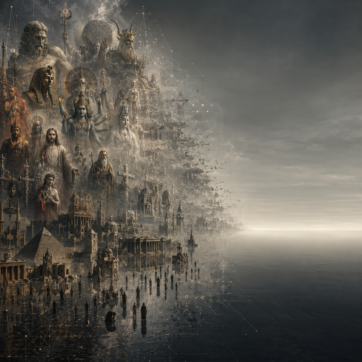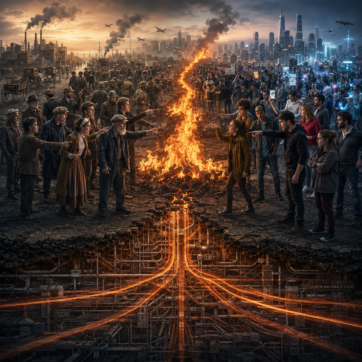
How the external architecture runs on unresolved load, why reality feels unstable across every system, and why accelerating fluctuation is the visible signature of pressure moving through the field
The Instability Humans Feel Is Not Random
Something is changing, and nearly everyone can feel it.
People may disagree about the cause, but the sensation itself has become difficult to ignore. Emotional volatility appears to be increasing. Relationships that once felt stable suddenly fracture. Political polarization continues intensifying beyond what previous generations experienced. Economic uncertainty arrives in waves. Technology accelerates faster than most people can meaningfully adapt to. Weather patterns appear increasingly erratic. Attention spans shrink. Nervous systems remain perpetually overstimulated. Entire belief systems that once provided stability seem unable to hold their shape for long. Across every layer of human experience, the same observation continues emerging: reality feels less stable than it once did.
Most explanations treat these conditions as separate problems. Economic instability is assigned one cause. Political division is assigned another. Social media is blamed for one set of symptoms. Technology receives blame for another. Climate concerns, mental health concerns, institutional distrust, burnout, loneliness, identity fragmentation, and collective exhaustion are all discussed as if they are independent phenomena unfolding simultaneously by coincidence.
They are not.
What appears on the surface as dozens of unrelated crises is better understood as a single architectural condition expressing itself through many different channels. The symptoms vary, but the mechanism beneath them remains the same. The instability people are observing is not random. It is not emerging independently in isolated systems. It is the visible result of an external architecture that is struggling to maintain continuity under increasing pressure.
This becomes easier to understand once pressure itself is correctly defined.
In Eternal Flame Physics, pressure is not simply stress, emotion, conflict, or environmental tension. Pressure is unresolved load inside an architecture that cannot stabilize through Eternal coherence. Because the external architecture lacks true internal stillness, it must continuously maintain itself through movement. It survives through oscillation. It survives through reaction. It survives through polarity. It survives through constant redistribution. Every cycle of conflict, every social swing, every emotional surge, every economic boom and bust, every technological acceleration, every collective fear event, and every narrative shift represents load moving from one location to another within the architecture.
This is why pressure should not be viewed as an accidental byproduct of the system. Pressure is the system. It is the mechanism that keeps the external architecture operating at all. Without pressure there would be no need for redistribution. Without redistribution there would be no oscillation. Without oscillation the architecture would lose the movement it depends upon to maintain itself. What humans experience as the ongoing unfolding of reality is the visible expression of unresolved load continually attempting to reposition itself.
For a long time, the architecture was capable of processing that load slowly. Pressure accumulated gradually. Redistribution occurred over longer intervals. Destabilization could be buffered across years, decades, or even generations. The result was the appearance of continuity. Humans perceived reality as relatively stable because the fluctuations occurred slowly enough to remain hidden beneath everyday experience.
That condition is changing.
The instability people increasingly feel is not occurring because pressure suddenly appeared. Pressure has always existed within the external architecture. What has changed is the rate at which the architecture must process it. The redistribution cycles are accelerating. Compression builds faster. Release events occur more frequently. Stabilization periods grow shorter. Conditions that once unfolded over decades now emerge within years. Conditions that once required years now develop within months. Entire social, economic, technological, and cultural landscapes can transform in the span of weeks.
The world feels increasingly unstable because the architecture itself is processing pressure faster than it previously could.
The fluctuations people see everywhere are not separate events. They are evidence of the same underlying condition. The architecture is redistributing unresolved load at an accelerating rate, and the visible world is reflecting that acceleration through every system it touches.
The External Architecture
To understand why instability appears to be accelerating everywhere at once, it is necessary to understand the architecture humans are living inside.
Most people assume reality begins with the visible world. They assume the economy, governments, weather systems, technology, institutions, culture, relationships, and daily life are the primary layer of existence. That is backwards. What humans experience as reality is the final translated output of a much larger architectural process occurring upstream.
The visible world is render. Render is not the source. Render is the result.
Before any event appears physically, socially, economically, politically, emotionally, or environmentally, it first emerges through layers of pre-render architecture that determine how pressure moves, accumulates, redistributes, and stabilizes throughout the system. What people call reality is largely the visible translation of those deeper movements.
This is where pressure becomes important.
Pressure is often misunderstood as an emotional experience. Humans speak about feeling pressure at work, pressure in relationships, pressure in society, or pressure within themselves. Those are merely translated expressions. Structurally, pressure is accumulated unresolved load inside a system that cannot maintain stillness. It is what develops when an architecture lacks the capacity to stabilize through coherence and instead relies upon movement to maintain continuity.
The external architecture does not stabilize through stillness.
It stabilizes through activity. It stabilizes through motion. It stabilizes through oscillation. It stabilizes through continuous redistribution.
Because of this, pressure is constantly being generated, moved, concentrated, discharged, redistributed, and regenerated throughout the system.
This process follows a repeating sequence.
Compression occurs first as load accumulates within a region of the architecture. As that compression increases, torsion develops. Torsion creates distortion and rotational stress within the system. Curvature emerges as pathways bend around accumulated load. Oscillation develops as the architecture attempts to balance competing forces through movement. Temporary stabilization occurs when redistribution successfully spreads the pressure across a wider area. Eventually that stabilization weakens, destabilization begins again, pressure accumulates elsewhere, redistribution starts once more, and the cycle repeats.
Compression. Torsion. Curvature. Oscillation. Temporary stabilization. Destabilization. Redistribution. Repeat.
Humans often assume these processes occur only inside themselves. In reality they occur simultaneously across every layer of the architecture.
Pressure accumulates within individual identity structures. Pressure accumulates within relationships. Pressure accumulates within collective emotional fields.
Pressure accumulates inside governments, institutions, economies, technology systems, information networks, financial markets, media structures, environmental systems, and human nervous systems.
Every layer participates in the same process.
This is why seemingly unrelated events often emerge together. Political instability rises. Economic volatility increases. Social division expands. Weather becomes more erratic. Technological acceleration intensifies. Human exhaustion increases. Information becomes more chaotic.
These appear unrelated because they emerge through different render channels. Beneath render they are expressions of the same pressure redistribution process occurring simultaneously throughout the architecture.
Complicating this further is the existence of the mimic stabilization layer.
Most people assume stabilization creates greater stability. Ironically, the mimic often produces the opposite outcome.
The mimic exists to maintain continuity inside an increasingly unstable architecture. It attempts to preserve functionality through artificial correction systems, narrative reinforcement systems, emotional feedback systems, identity loops, technological amplification, institutional control mechanisms, algorithmic guidance, and countless other forms of structural compensation.
Its purpose is stabilization.
Yet because it relies upon additional compression to achieve that stabilization, it frequently increases the very pressure it is attempting to regulate.
The result is paradoxical. The architecture destabilizes. The mimic responds by tightening control. The tightening creates additional compression. Additional compression creates greater pressure accumulation. Greater pressure accumulation requires larger redistribution events. Those redistribution events create further instability. The mimic then responds again with additional stabilization measures. The cycle continues.
This is one reason why so many modern solutions seem to generate new problems faster than old ones are resolved. The system increasingly stabilizes itself through methods that create additional pressure downstream.
Humans experience the consequences as accelerating volatility.
They see it in politics. They see it in economics. They see it in media. They see it in social systems. They see it in weather patterns. They see it in culture. They see it in themselves.
What appears as random instability is often pressure moving through multiple architectural layers simultaneously while the mimic attempts to maintain continuity through increasingly compressed stabilization strategies.
The important distinction is that none of this should be confused with Eternal coherence. Eternal coherence does not stabilize through compression. It does not stabilize through oscillation. It does not stabilize through polarity. It does not stabilize through pressure redistribution.
The external architecture requires constant movement because it cannot maintain itself through stillness. Eternal coherence requires no such process. It does not need reaction, opposition, correction, compensation, redistribution, or oscillatory balancing in order to remain stable.
This distinction becomes increasingly important as pressure acceleration increases across the external architecture.
The more unstable the architecture becomes, the more movement it requires to maintain continuity. The more pressure accumulates, the faster redistribution cycles occur. The more redistribution cycles occur, the more unstable reality appears from within render.
What humans experience as reality unfolding is therefore not simply a sequence of independent events happening one after another. Much of what is experienced as history, culture, economics, politics, weather, technology, and personal life is the visible expression of pressure continuously attempting to move itself through an architecture that can only sustain itself through perpetual redistribution.
What Pressure Actually Is Inside The External Architecture
Pressure is one of the most misunderstood conditions within the external architecture because humans typically encounter it only after it has already translated into something visible.
They experience pressure as stress, anxiety, conflict, overwhelm, exhaustion, tension, urgency, instability, uncertainty, or emotional intensity. By the time pressure is felt consciously, however, it has already moved through multiple layers of architecture and entered render translation. The sensation is real, but it is not the pressure itself. It is the visible expression of something occurring much further upstream.
Structurally, pressure is accumulated unresolved load inside a system that cannot maintain stillness.
That distinction is critical. Pressure is not emotion. Pressure is not fear. Pressure is not anxiety. Pressure is not anger. Pressure is not even conflict. Those are merely some of the ways pressure eventually appears once it reaches render.
Pressure exists before all of them.
Pressure develops whenever unresolved load accumulates inside an architecture that lacks the ability to stabilize through internal coherence. Because the external architecture cannot maintain continuity through stillness, it must maintain continuity through movement instead. Movement becomes the substitute for coherence. Redistribution becomes the substitute for resolution. Oscillation becomes the substitute for stability.
This means pressure is not an occasional condition inside the external architecture. It is the primary condition. Without pressure there would be no need for movement. Without movement there would be no oscillation. Without oscillation the architecture could not sustain continuity. Pressure is therefore not a malfunction of the system. Pressure is the mechanism that drives the system.
Once pressure begins accumulating, a predictable sequence emerges. The first stage is compression. Compression occurs when unresolved load accumulates faster than it can be redistributed. Load begins concentrating within a particular region of the architecture. The system tightens. Movement pathways narrow. Flexibility decreases. The architecture begins carrying more than it can comfortably distribute.
As compression increases, torsion develops. Torsion is what occurs when accumulated load can no longer remain evenly distributed. The architecture begins twisting around the pressure concentration. Distortion appears. Tension increases. Competing pathways begin pulling against one another as the system searches for a route through which pressure can move.
As torsion intensifies, curvature emerges. The architecture can no longer maintain direct pathways. It bends around accumulated load. Information pathways curve. Behavioral pathways curve. Institutional pathways curve. Social pathways curve. What originally moved cleanly through the architecture begins moving around pressure concentrations instead.
Curvature eventually generates oscillation. This is the point where most humans begin noticing something is happening. Oscillation appears as repeated swings between opposing conditions. Expansion followed by contraction. Optimism followed by fear. Growth followed by collapse. Stability followed by instability. The architecture begins moving rhythmically between states because it is attempting to redistribute pressure without resolving the source of accumulation.
Oscillation creates temporary stabilization.
This is where the system often fools observers.
Humans interpret temporary stabilization as resolution. Markets recover. Political tensions cool. Relationships settle. Institutions appear stable. Social conditions normalize. The architecture appears to have corrected itself.
It has not. Pressure has simply been redistributed sufficiently to create a brief period of apparent stability. Because the underlying load remains unresolved, destabilization eventually returns.
The architecture begins accumulating pressure again. The previous stabilization weakens. New compression points emerge. New distortions develop. The system begins searching for another discharge pathway.
Redistribution follows. Pressure moves. Load shifts. The architecture reorganizes itself around the movement. Then the entire sequence begins again.
Compression. Torsion. Curvature. Oscillation. Temporary stabilization. Destabilization. Redistribution. Repeat.
This cycle is not occurring in one location. It is occurring everywhere simultaneously.
Pressure accumulates inside individual identity structures as people attempt to maintain continuity between who they were, who they are, and who they believe they should become.
Pressure accumulates within collective emotion as entire populations process uncertainty, fear, hope, frustration, and expectation simultaneously.
Pressure accumulates within institutions attempting to preserve relevance while conditions change around them.
Pressure accumulates within technology systems that increasingly accelerate information throughput beyond human processing capacity.
Pressure accumulates inside economies attempting to maintain growth while balancing competing demands and finite resources.
Pressure accumulates within governments trying to stabilize increasingly polarized populations.
Pressure accumulates through social media systems that reward reaction, amplify volatility, and accelerate collective oscillation.
Pressure accumulates inside information networks where narratives compete continuously for dominance, attention, and legitimacy.
Pressure accumulates throughout environmental systems as countless interacting variables continuously redistribute load across the planet.
Pressure accumulates within human nervous systems attempting to process all of these layers simultaneously while maintaining functional continuity inside daily life.
None of these layers operate independently. Each influences the others. Pressure moving through one part of the architecture inevitably affects pressure everywhere else.
This is why seemingly unrelated events often emerge together. Political instability rises alongside emotional exhaustion. Technological acceleration appears alongside attention fragmentation. Economic uncertainty appears alongside collective anxiety. Environmental volatility appears alongside institutional instability. Different symptoms emerge through different channels, yet all are participating in the same redistribution process.
This leads to one of the most important realizations in Eternal Flame Physics. What humans experience as reality unfolding is often pressure moving.
History is pressure moving. Culture is pressure moving. Technology is pressure moving. Politics is pressure moving. Economics is pressure moving. Social movements are pressure moving. Trends are pressure moving. Collective emotions are pressure moving.
Much of what appears to be independent events unfolding across time is the visible expression of unresolved load attempting to reposition itself continuously throughout the architecture.
The stories change. The actors change. The locations change. The narratives change. The pressure remains.
It simply moves from one part of the architecture to another, generating the appearance of reality unfolding as it goes.
Why The System Must Constantly Redistribute Pressure
Once pressure is understood as accumulated unresolved load, an even more important question emerges: why must the architecture continuously redistribute it at all? The answer is simple, but its implications are enormous. The external architecture cannot hold unresolved load indefinitely without destabilizing. Every system has a carrying capacity. Every structure has a threshold beyond which accumulation becomes unsustainable. Because the external architecture does not possess the capacity for Eternal stillness, it cannot simply absorb pressure and remain unchanged. Load must move. Compression must eventually discharge. The architecture survives not by resolving pressure but by relocating it. What humans often perceive as progress, correction, healing, stabilization, recovery, or improvement is frequently pressure moving from one location to another within the system.
This distinction is critical because most people unconsciously assume that the disappearance of symptoms indicates resolution. If tension decreases, they assume the underlying condition has been corrected. If conflict subsides, they assume the instability has ended. If anxiety fades, they assume certainty has returned. In reality, the architecture often achieves apparent stabilization through redistribution rather than resolution. Pressure leaves one area, enters another, and the observer mistakes the transfer for a solution. The discomfort may disappear from the original location, but the unresolved load remains active somewhere else within the larger system.
This pattern can be observed everywhere once it becomes visible. Financial crashes provide a useful example. Economic systems accumulate extraordinary amounts of pressure through debt, speculation, imbalance, overextension, and artificial expansion. For a period of time the architecture can maintain continuity despite those growing distortions. Eventually the accumulated load exceeds what the system can comfortably carry. A correction occurs. Markets fall. Valuations collapse. Capital disappears. The event appears destructive, but structurally it functions as a pressure discharge. The architecture temporarily relieves economic compression by redistributing load throughout the system. The underlying dynamics that created the pressure, however, often remain intact. The discharge provides temporary stabilization, not permanent resolution.
Wars frequently function in a similar manner at the collective level. Entire populations can accumulate unresolved tension across political, economic, territorial, ideological, and cultural layers for decades. The pressure continues building until the architecture can no longer maintain stability through existing pathways. Conflict emerges as a discharge mechanism. Humans naturally focus on the visible events of the war itself, yet beneath those events lies a larger redistribution process. Collective instability is being released through confrontation. The tragedy is that while enormous amounts of pressure may be discharged, the architecture often creates new concentrations elsewhere, ensuring future cycles continue.
The same dynamic appears in social systems. Viral outrage events often seem spontaneous, but they frequently function as collective pressure release mechanisms. Emotional compression accumulates across millions of individuals carrying frustration, fear, resentment, uncertainty, exhaustion, and instability. When a triggering event appears, the architecture suddenly provides a pathway for discharge. Outrage spreads rapidly because pressure is moving. For a brief period people experience relief through expression, reaction, projection, and collective participation. Then the cycle fades, only to reappear elsewhere through a new controversy. The subject changes, but the redistribution mechanism remains remarkably similar.
At the individual level, addictions often function as artificial discharge systems. Nervous systems carrying excessive unresolved load seek temporary release pathways. Alcohol, drugs, compulsive behaviors, endless scrolling, gambling, shopping, entertainment, and countless other forms of escape can all act as temporary pressure valves. The individual experiences momentary relief because compression has been discharged. Yet because the underlying load remains unresolved, pressure begins accumulating again shortly afterward. The cycle repeats, sometimes for years or decades, creating the illusion of management while preventing actual stabilization.
Consumer culture operates through a related mechanism. Modern societies increasingly encourage acquisition as a response to internal dissatisfaction. People are taught that fulfillment exists one purchase away, one upgrade away, one possession away, one experience away. The acquisition itself creates a temporary redistribution event. Anticipation builds. Purchase occurs. Relief follows. Yet the relief rarely lasts because the original condition was not resolved. Pressure simply moved. The architecture generated a brief discharge and then began accumulating load once more.
Identity movements can also function as redistribution pathways. Human beings naturally seek continuity, belonging, orientation, and meaning. As fragmentation increases within the architecture, individuals often seek stabilization through collective identification. Groups provide temporary coherence where internal continuity feels difficult to maintain independently. This does not mean such movements are inherently negative. It means they frequently serve a secondary structural function. They allow fragmented pressure to discharge through collective belonging. The temporary relief can feel profound because pressure has successfully moved. Whether the deeper instability has actually resolved is a separate question.
Even apocalypse narratives frequently operate through the same mechanism. Throughout history, humans have repeatedly projected uncertainty into symbolic end-of-world scenarios. Economic collapse, divine judgment, technological takeover, environmental catastrophe, political breakdown, alien intervention, and countless other variations appear repeatedly across cultures and eras. These narratives often provide a psychological container for unresolved uncertainty. Instead of holding ambiguity directly, pressure becomes concentrated into a symbolic future event. The projection creates temporary relief because uncertainty has been assigned a destination. The architecture has found another pathway through which pressure can move.
Understanding this changes how instability is interpreted. It becomes possible to see that many of the events humans call crises are simultaneously functioning as redistribution mechanisms. The visible event captures attention, but beneath it pressure is shifting position within the architecture. Some areas experience relief. Other areas experience increased compression. Temporary stabilization emerges, only to be followed by new accumulation elsewhere.
This is why redistribution should never be confused with resolution. Resolution would require the underlying condition to cease generating pressure entirely. Redistribution does not accomplish this. It merely relocates unresolved load from one part of the architecture to another. The symptoms change. The location changes. The story changes. The pressure remains active.
The external architecture therefore survives through movement. It survives through transfer. It survives through continuous redistribution. What humans experience as reality unfolding is often the visible record of unresolved load searching endlessly for the next place it can go.
The Weather Analogy — How Pressure Redistribution Actually Works
Weather provides one of the clearest examples of pressure redistribution because it is one of the few systems humans already understand as fundamentally pressure-driven. Most people accept without hesitation that weather is not random. Storms do not simply appear without cause. Heat waves do not emerge from nowhere. Cold fronts do not move arbitrarily across continents. Atmospheric systems are constantly responding to changing pressure conditions. Air masses shift. Temperatures fluctuate. Storm systems develop. Wind patterns reorganize. Turbulence forms. Lightning discharges. Hurricanes intensify and weaken. Jet streams shift position. Beneath every visible weather event lies a continuous process of pressure accumulation, pressure movement, pressure imbalance, and pressure redistribution.
This is why weather serves as such a useful analogy for understanding the larger architecture. Humans already recognize that atmospheric pressure cannot remain concentrated indefinitely in one location. When pressure differentials become large enough, movement begins. Air flows from one region toward another. Storm systems develop as the atmosphere attempts to redistribute accumulated load. Turbulence appears where competing conditions collide. Lightning functions as a discharge event. Hurricanes organize enormous amounts of atmospheric instability into a temporary redistribution mechanism. Even seemingly simple weather changes are often the visible expression of pressure attempting to move toward temporary equilibrium.
The atmosphere does not achieve permanent stability. It achieves temporary stabilization through continuous movement. Pressure accumulates. Pressure redistributes. Conditions stabilize briefly. New imbalances emerge. The cycle begins again. Humans rarely question this process because it is so familiar. Weather is expected to fluctuate. Weather is expected to move. Weather is expected to reorganize itself continually in response to changing pressure conditions.
The external architecture functions in remarkably similar ways. The difference is that humans often fail to recognize the pressure dynamics because they appear through social, economic, emotional, technological, and cultural forms rather than through clouds and storms. Yet the underlying mechanism remains strikingly familiar. When unresolved load accumulates too heavily within one region of the architecture, instability increases until redistribution becomes necessary. The resulting discharge may appear as a political crisis, a financial correction, a social movement, a collective emotional event, a technological disruption, or a cultural shift, but beneath the visible form the same fundamental process is taking place. Pressure is moving.
This is why sudden emotional eruptions often appear disproportionate to the events that trigger them. The visible event is not always the true source of the reaction. In many cases it simply becomes the pathway through which accumulated pressure finally discharges. A single news story, public controversy, or social conflict can suddenly release years of collective frustration, fear, resentment, uncertainty, or instability that were already present within the architecture long before the triggering event appeared.
The same pattern can be observed during mass panic cycles. From the outside, collective fear often appears irrational. Entire populations can become consumed by a narrative within days. Markets react. Institutions react. Media systems react. Individuals react. Yet these episodes frequently reveal how much pressure had already accumulated beneath the surface. The panic itself is not creating the pressure. It is providing a route through which pressure can move. What appears to be a spontaneous emotional event is often a redistribution event occurring at scale.
Viral social movements operate through similar dynamics. Whether one agrees or disagrees with the movement itself is not the point. Structurally, these events often emerge when accumulated collective pressure discovers a pathway capable of carrying it. Participation expands rapidly because large amounts of unresolved load are suddenly moving through the same channel. What appears as a sudden social awakening is frequently the visible expression of pressure finding an efficient route for redistribution.
Economic reversals reveal the same process in another form. Financial systems can absorb instability for long periods while pressure quietly accumulates beneath the surface. Then seemingly minor events trigger dramatic corrections. Analysts often focus on the trigger itself, but the trigger is rarely the full explanation. The architecture had already reached a condition where redistribution was becoming increasingly necessary. The visible event simply marked the moment when pressure found a discharge pathway.
Rapid political shifts frequently follow the same pattern. Populations can tolerate growing instability for years before reaching a threshold where redistribution accelerates dramatically. Elections, policy changes, ideological realignments, and institutional upheavals often appear sudden from within render. Viewed structurally, however, they frequently represent pressure movements that have been developing for far longer than the visible event suggests.
Relationship breakdowns, technological acceleration waves, collective exhaustion periods, and sudden cultural reversals can all be understood through the same lens. The details vary. The render changes. The mechanism remains consistent. Pressure accumulates. Pressure seeks movement. Pressure redistributes. Temporary stabilization follows. New pressure concentrations eventually emerge elsewhere.
The weather analogy becomes even more significant when one recognizes that weather itself is not merely a metaphor. Weather is also a render event. Atmospheric systems are part of the architecture. They participate in pressure redistribution just as economic systems, social systems, political systems, and nervous systems do. This does not mean every storm directly causes a social event or every social event directly causes a storm. Rather, both are participating within a larger architecture that continuously organizes, redistributes, and expresses pressure through multiple layers simultaneously. The atmosphere is one translation surface. Human civilization is another. Both reveal aspects of the same underlying process.
This perspective helps explain why periods of increasing instability often appear across multiple domains at once. Weather volatility increases. Economic uncertainty increases. Social polarization increases. Emotional exhaustion increases. Technological acceleration increases. Institutional instability increases. Most observers treat these as unrelated developments occurring simultaneously. They are often different expressions of the same broader condition. Pressure redistribution is increasing across the architecture as a whole.
Humanity currently is living within a period where the equivalent of atmospheric pressure inside the architecture is fluctuating more rapidly than it once did. Stabilization intervals are shortening. Compression accumulates more quickly. Redistribution events occur more frequently. Conditions that once unfolded gradually now shift with remarkable speed. The result is a growing sense that reality itself feels unstable, unpredictable, and difficult to anchor.
Just as rapidly changing weather often signals increasing atmospheric instability, rapidly changing social, economic, technological, emotional, and cultural conditions can signal increasing architectural instability. The visible forms may differ, but the principle remains the same. Pressure is moving through the system, and the fluctuations humans experience are the visible record of that movement.
Why Reality Feels Like It Is Switching States Faster Now
One of the most common observations people make today is that reality itself feels different than it used to. Even individuals who disagree about politics, economics, technology, culture, or spirituality often arrive at the same conclusion: something feels accelerated. Time feels compressed. Events move faster. Trends appear and disappear more quickly. Entire social narratives can emerge, dominate public attention, and collapse within weeks. Opinions that seemed universally accepted a short time ago suddenly become controversial. Institutions that appeared stable begin showing signs of strain. Technologies that once required decades to transform society now alter entire industries within months. There is a growing sensation that the pace of reality itself has increased.
Most explanations focus on the visible layer. Some blame social media. Others point to smartphones, information overload, artificial intelligence, political instability, economic uncertainty, or global interconnectedness. While all of these may contribute to the experience, they do not fully explain why the sensation appears so widespread across so many different areas of life simultaneously. The deeper question is not why individual systems seem unstable. The deeper question is why instability itself appears to be accelerating across the architecture as a whole.
The answer lies in the shrinking duration of stabilization cycles.
Earlier sections established that the external architecture survives through pressure redistribution. Compression accumulates. Pressure moves. Temporary stabilization emerges. Destabilization follows. The cycle repeats continuously. What appears to be changing now is not the existence of that cycle but the speed at which the cycle operates. The architecture appears to be moving between compression states and release states much more rapidly than before. The intervals during which conditions remain stable are becoming shorter. Redistribution events are occurring more frequently. The result is an architecture that feels increasingly dynamic, increasingly reactive, and increasingly difficult to predict.
This acceleration becomes visible almost everywhere. People frequently describe time as feeling faster even when clocks continue functioning normally. Weeks disappear. Months pass unexpectedly. Entire years seem compressed into what feels like much shorter periods. While many explanations exist for this phenomenon, part of the sensation emerges from the increasing frequency of architectural change itself. When conditions remain stable, humans build continuity. When conditions shift repeatedly, continuity becomes more difficult to maintain. The result is a growing perception that time itself is accelerating because the amount of change occurring within a given period continues increasing.
Attention fragmentation reflects a similar pattern. Human nervous systems evolved to navigate environments where information moved comparatively slowly. Today individuals are exposed to an almost continuous stream of updates, crises, opinions, narratives, warnings, predictions, controversies, and competing demands for attention. The architecture is redistributing pressure across information systems at extraordinary speeds. As a result, attention itself becomes fragmented. Focus shifts rapidly from one subject to another because the architecture is generating more redistribution events than many nervous systems can comfortably process.
Identity instability has become increasingly common for similar reasons. In previous eras, people often maintained relatively stable identity structures for long periods. Today many individuals experience repeated cycles of reinvention, reevaluation, ideological shifts, career changes, social realignments, and personal restructuring. The architecture is cycling through compression and redistribution more quickly, making long-term continuity harder to maintain. As conditions change, identity structures are repeatedly forced to adapt to new pressure conditions.
The same acceleration can be observed socially. Public opinion swings with remarkable speed. Narratives that dominate one month disappear the next. Trends rise and collapse almost immediately after reaching visibility. Social movements can expand globally within days and lose momentum just as quickly. Entire communities may reorganize themselves around issues that barely existed in public consciousness a short time earlier. These rapid reversals often appear chaotic, but structurally they reflect pressure moving through increasingly compressed redistribution cycles.
Relationship volatility has increased as well. Relationships now exist within an environment characterized by constant information flow, economic uncertainty, technological disruption, social pressure, and shifting identity conditions. As the architecture accelerates, individuals often experience more frequent changes in priorities, values, expectations, and life circumstances. The result is not necessarily that relationships have become weaker, but that they are operating within a system where stabilization periods themselves are becoming shorter and less predictable.
Burnout has become one of the defining experiences of modern life precisely because nervous systems are being exposed to a level of continuous stimulation that previous generations rarely encountered. Many people no longer move through clear cycles of effort and recovery. Instead they remain connected to an uninterrupted stream of information, communication, obligation, and reaction. The architecture’s redistribution activity never seems to stop. Compression accumulates faster than recovery can occur. The result is widespread exhaustion even among people who cannot identify a single obvious cause.
Difficulty planning long-term is another symptom of shrinking stabilization intervals. Humans naturally create plans based upon assumptions of continuity. When conditions remain relatively stable, long-term planning becomes easier because future conditions are more predictable. As redistribution cycles accelerate, however, future conditions become harder to anticipate. Careers shift unexpectedly. Industries transform rapidly. Technologies emerge suddenly. Economic conditions reverse. Social norms evolve. What once felt certain begins feeling provisional. Planning becomes more difficult because the architecture itself is changing more frequently.
The constant stimulation many people experience today should therefore not be viewed as an isolated technological phenomenon. It reflects a broader architectural condition. The system appears to be cycling between compression and release states at shorter and shorter intervals. What once stabilized for decades may now destabilize within years. What once required years to change may now transform within months. What once took months may now reverse within days, and in some cases within hours.
This continual acceleration creates a unique perceptual effect. Reality begins feeling slippery. Stable reference points become harder to maintain. Conditions that once appeared dependable become increasingly fluid. The issue is not necessarily that more events are occurring. The issue is that stabilization periods themselves are shrinking. The architecture has less time to remain in any particular state before pressure accumulation requires another redistribution cycle.
From within the system, this often feels like uncertainty, instability, confusion, or acceleration. Structurally, however, it can be understood as an architecture processing pressure at a faster rate than before. The visible world reflects that change everywhere. Trends move faster. Narratives move faster. Economies move faster. Politics move faster. Technology moves faster. Human attention moves faster. The architecture is cycling more rapidly, and reality increasingly feels like it is switching states because, in many ways, it is.
Why Humans Feel Constantly Exhausted Right Now
One of the most overlooked consequences of accelerated pressure redistribution is what it does to the human body. Most discussions about exhaustion focus on individual causes. People are told they are working too much, sleeping too little, scrolling too often, eating incorrectly, exercising improperly, managing stress poorly, or failing to maintain sufficient work-life balance. While these factors can certainly influence health and well-being, they do not fully explain why exhaustion has become such a widespread condition across nearly every demographic, age group, profession, and social category. Something larger is occurring beneath the surface.
The human nervous system does not exist separately from the architecture. It exists within it and continuously translates it. Every day, the nervous system processes enormous amounts of incoming information, environmental conditions, social dynamics, emotional inputs, technological stimulation, institutional pressures, and collective instability. From the perspective of Eternal Flame Physics, the nervous system functions as one of the primary translation interfaces between the individual and the larger architecture. It is constantly receiving, processing, adapting to, and translating changing conditions occurring throughout the system.
This becomes particularly significant during periods of accelerated redistribution. When pressure throughput increases across the architecture, the nervous system must process increasingly rapid fluctuations in the conditions surrounding it. More information arrives. More instability emerges. More uncertainty develops. More narratives compete for attention. More emotional signals circulate through social systems. More technological stimulation enters daily life. Even individuals who intentionally avoid news, politics, or social media remain embedded within broader cultural, economic, institutional, environmental, and relational systems that are themselves experiencing increased pressure movement.
The result is that many nervous systems are attempting to process far more oscillation than they were designed to comfortably handle. Earlier generations certainly experienced hardship, uncertainty, and instability. What appears different today is the velocity. Pressure moves faster. Narratives change faster. Information spreads faster. Social reactions occur faster. Technological adaptation happens faster. Economic shifts emerge faster. The architecture itself is cycling through compression and redistribution at increasingly compressed intervals. The body experiences those accelerated fluctuations whether an individual consciously recognizes them or not.
Fatigue is often one of the first visible symptoms. Many people describe feeling tired despite adequate sleep. Others report waking already exhausted. Some feel physically drained after activities that previously required little effort. This does not necessarily mean the body is malfunctioning. In many cases it may indicate that significant resources are being allocated toward adaptation. The nervous system is continuously processing incoming instability while attempting to maintain functional continuity. Over time, that process becomes energetically expensive.
Brain fog frequently emerges alongside fatigue. As throughput increases, the ability to prioritize information can become impaired. Attention becomes scattered. Concentration weakens. Decision-making feels slower. Thoughts feel less organized. People often describe the sensation as if their minds are struggling to keep pace with their environment. This experience becomes understandable when viewed through the lens of redistribution. The architecture is producing more movement, more stimulation, and more fluctuation than before. The nervous system must sort through an expanding volume of incoming signals while simultaneously maintaining daily responsibilities.
Emotional numbness can appear for similar reasons. Contrary to popular assumptions, numbness is not always the absence of feeling. Sometimes it reflects overload. When pressure throughput exceeds processing capacity, emotional systems may temporarily reduce sensitivity as a protective adaptation. Individuals often interpret this as personal failure, disconnection, or loss of meaning when in reality the nervous system may simply be attempting to manage extraordinary levels of incoming stimulation.
At the opposite end of the spectrum lies hyper-reactivity. Some individuals find themselves becoming increasingly sensitive to events that previously would have had little impact. Small frustrations trigger disproportionate responses. Minor conflicts feel overwhelming. Everyday inconveniences become difficult to tolerate. This pattern often appears contradictory to emotional numbness, yet both can emerge from the same underlying condition. A system under sustained pressure may alternate between overload, shutdown, heightened sensitivity, and exhaustion as it attempts to maintain equilibrium.
Sleep disruption has become increasingly common as well. Many people report difficulty falling asleep, difficulty staying asleep, unusually vivid dreams, fragmented sleep cycles, or waking without feeling rested. Sleep is not merely biological recovery. It is also a period during which the nervous system processes accumulated inputs and redistributes internal load. As architectural pressure increases, that processing workload may increase as well. The result can be greater sleep disruption even when no obvious external cause is present.
Memory anomalies are another frequently reported symptom. Individuals forget familiar information, lose track of conversations, struggle to recall names, or experience unusual distortions in time perception. Weeks seem compressed. Months disappear unexpectedly. Events feel simultaneously recent and distant. These experiences can be unsettling, particularly because they often occur in people who previously considered themselves highly organized and mentally sharp. Yet when viewed within a rapidly accelerating architecture, such symptoms become less surprising. The nervous system is attempting to maintain continuity while processing increasing amounts of information and instability.
Dopamine exhaustion appears throughout modern culture as well. Human attention systems evolved around cycles of anticipation, engagement, completion, and recovery. Modern technological environments increasingly disrupt those cycles through constant stimulation. Every notification, update, controversy, trend, and information stream competes for neurological resources. Over time many individuals find themselves simultaneously overstimulated and undernourished. The architecture provides endless stimulation but very little genuine completion. Pressure continues moving, but rarely settles.
Attention collapse naturally follows. Long-form concentration becomes more difficult. Reading becomes harder. Reflection becomes harder. Sustained focus becomes harder. The issue is not necessarily a lack of intelligence or discipline. Rather, attention is operating inside an environment where pressure redistribution is occurring continuously across countless competing channels. The nervous system remains on alert because the architecture rarely provides stable conditions long enough for deep attention to comfortably anchor.
Social burnout has become another defining characteristic of modern life. Many people who once enjoyed social interaction now find themselves needing increasing amounts of solitude. Others report feeling exhausted by communication, group dynamics, digital interaction, or the constant obligation to remain available. This does not necessarily indicate a rejection of human connection. It often reflects the reality that social environments themselves now carry far more pressure throughput than they once did. Every interaction exists within a larger field of economic uncertainty, technological acceleration, information overload, cultural instability, and collective nervous system strain.
Perhaps the most important realization is that many people interpret these experiences as personal shortcomings. They assume they are failing in some way. They believe they should be handling everything better. They compare themselves to idealized versions of productivity, focus, resilience, emotional stability, and performance. Yet this perspective often ignores the larger architectural condition in which these symptoms are emerging.
The individual nervous system is not operating in isolation. It is participating within an environment currently undergoing extraordinary levels of pressure redistribution. As compression accumulates and redistribution cycles accelerate, the body becomes one of the places where those changes are translated into lived experience. Fatigue, brain fog, emotional volatility, numbness, sleep disruption, dream intensity, memory irregularities, attention fragmentation, and burnout are not necessarily evidence of personal failure. They are evidence of participation within an architecture moving far more pressure than it once did.
The exhaustion so many people feel today is therefore not simply about workload. It is not simply about stress. It is not simply about technology. It reflects the reality of living inside a system where pressure throughput continues increasing, stabilization intervals continue shrinking, and the nervous system is being asked to translate accelerating fluctuations across every layer of reality simultaneously.
Social Media As A Pressure Amplification Engine
One of the clearest examples of accelerated pressure redistribution inside modern society is social media. Most discussions about social media focus on content, politics, misinformation, algorithms, addiction, or mental health. While all of these topics are important, they often miss a deeper structural reality. Social media functions as one of the most powerful pressure amplification systems ever created within the render. It dramatically increases the speed at which emotional, social, informational, and collective pressure moves through human populations. What once required weeks, months, or even years to circulate through communities can now spread globally within minutes.
To understand why this matters, it is important to remember that older human societies evolved around physical limitations. Information moved through conversations, families, communities, workplaces, schools, religious institutions, newspapers, and local social structures. Even when conflict existed, pressure redistribution moved relatively slowly because communication itself moved relatively slowly. Human nervous systems had time to process events before new waves of information arrived. Emotional reactions had natural limits imposed by geography, distance, and time.
Social media largely removed those limitations.
The result was not simply faster communication. The result was a dramatic increase in reaction velocity. Information no longer moves at the pace of human integration. It moves at the pace of digital transmission. Every stimulus can instantly trigger millions of reactions. Every reaction can trigger millions more. The architecture now possesses an unprecedented mechanism for accelerating redistribution cycles throughout the collective field.
At its most basic level, the process follows a predictable sequence. A stimulus appears. The stimulus generates a reaction. The reaction activates identity structures. Identity activation generates projection. Projection attracts group reinforcement. Group reinforcement generates counterreaction. Counterreaction attracts algorithmic amplification. Amplification produces collective escalation. What begins as a single event can rapidly evolve into a massive redistribution cycle involving millions of participants simultaneously.
The important point is that the architecture rewards whatever moves pressure most efficiently.
Outrage moves pressure efficiently. Fear moves pressure efficiently. Certainty moves pressure efficiently. Humiliation moves pressure efficiently. Tribal identity moves pressure efficiently. Conflict moves pressure efficiently. Emotional volatility moves pressure efficiently.
Whether the content itself is true or false often becomes secondary to the structural function being served. Systems designed around engagement naturally reward conditions that generate the highest volume of reactions because reactions create throughput. Throughput generates attention. Attention generates participation. Participation generates data. Data generates further amplification. The result is a self-reinforcing cycle in which pressure redistribution becomes increasingly optimized.
This is why outrage frequently outperforms nuance. Nuance slows movement. Outrage accelerates it. Nuance encourages reflection. Outrage encourages reaction. Reflection decreases throughput. Reaction increases throughput. From the perspective of the architecture, highly reactive emotional states often function as extremely efficient pressure redistribution mechanisms.
Fear operates similarly. Fear narrows attention, increases vigilance, accelerates reaction speed, and encourages collective participation. A fearful population becomes easier to mobilize because pressure is already moving. Certainty performs a comparable function. Individuals who feel absolutely certain become highly effective carriers of redistribution because ambiguity no longer slows their participation. They share faster, react faster, defend faster, and engage more aggressively.
Humiliation and public shaming function as particularly powerful discharge mechanisms because they allow collective pressure to concentrate around identifiable targets. Large amounts of emotional compression can suddenly release through criticism, punishment, ridicule, exposure, or social exclusion. For a brief period participants experience relief because pressure has moved. Yet the underlying load remains active, eventually seeking new pathways elsewhere.
Tribal identity amplifies these dynamics even further. As instability increases throughout the architecture, many individuals seek certainty through group affiliation. Identity structures become increasingly important because they provide temporary stabilization inside a rapidly changing environment. The stronger the instability becomes, the stronger the attraction toward collective identification often becomes. Social media accelerates this process by continuously rewarding group formation, group reinforcement, and group opposition.
What makes this especially significant is that human beings increasingly build technologies that mirror the larger external mimic architecture in which they exist. Humans do not create in isolation. They create from within the conditions surrounding them. As the external architecture operates through oscillation, reaction, polarity, compression, and redistribution, human systems increasingly replicate those same dynamics inside the render itself.
This is one of the great ironies of the modern era. The external architecture already operates through pressure movement. Human civilization then develops technologies that accelerate pressure movement even further.
The architecture produces oscillation. Human systems create platforms optimized for oscillation.
The architecture produces reaction cycles. Human systems create technologies designed around reaction cycles.
The architecture produces identity polarization. Human systems create environments that intensify identity polarization.
The architecture produces instability. Human systems increasingly build technologies that amplify instability.
The result is a form of recursive reinforcement in which the smaller systems being created within the render begin reflecting the behavior of the larger system surrounding them. The macrocosm reproduces itself through the microcosm. The larger architecture expresses its patterns through the technologies, institutions, platforms, and systems humans construct from within it.
This becomes particularly important when considering the emergence of increasingly sophisticated emotional influence technologies. Modern platforms are no longer simply communication systems. They continuously measure attention, engagement, reaction patterns, emotional responses, behavioral preferences, and participation tendencies. They learn which stimuli generate stronger reactions. They learn which narratives produce greater engagement. They learn which emotional conditions increase throughput. The result is an environment where emotional amplification becomes increasingly automated.
The architecture rewards whatever increases movement. The platforms optimize for movement. The result is an environment that continuously accelerates pressure redistribution across the collective field.
For this reason, social media should not be understood merely as a mirror reflecting existing instability. It certainly reflects instability, but it also actively accelerates it. By increasing reaction velocity beyond what older physical social systems evolved to regulate, it shortens redistribution cycles throughout society. Pressure moves faster. Reactions spread faster. Emotional contagion spreads faster. Collective oscillations intensify faster. Stabilization periods become shorter. Compression accumulates more rapidly. Discharge events become more frequent.
The visible result is a society that increasingly feels as though it is constantly reacting to something. New controversies appear before old ones resolve. New fears emerge before previous fears dissipate. New movements form before earlier movements stabilize. Attention jumps continuously from one pressure event to another. The collective field rarely settles because redistribution is occurring almost continuously.
Social media represents one of the most powerful examples of humanity reproducing the behavior of the larger external architecture within the render itself. It is not merely participating in pressure redistribution. It is accelerating it, amplifying it, and feeding it back into the collective field at a speed previous generations never experienced.
Eternal Stillness Versus Oscillatory Stabilization
Everything discussed so far has focused on the behavior of the external architecture. Pressure accumulates. Pressure redistributes. Oscillation emerges. Temporary stabilization occurs. Destabilization follows. The cycle repeats. Entire civilizations, institutions, economies, technologies, identities, and social systems operate inside these dynamics. Yet none of these processes should be confused with the Eternal itself. In fact, one of the most important distinctions in Eternal Flame Physics is that the Eternal does not stabilize through any of the mechanisms the external architecture requires.
The external architecture survives through movement because it cannot maintain continuity through stillness. It must continuously redistribute unresolved load. It must continuously rebalance pressure concentrations. It must continuously oscillate between competing conditions. Stabilization inside the external is therefore always temporary because it depends upon ongoing activity. The architecture remains functional only so long as movement continues. The moment redistribution stops, instability begins accumulating again.
The Eternal is fundamentally different.
The Eternal does not require oscillation in order to remain stable. It does not require pressure redistribution. It does not require polarity. It does not require reaction. It does not require compensation. It does not require balancing mechanisms. It does not require discharge events. It does not require cycles of compression and release. The Eternal stabilizes through stillness because stillness is its natural condition. Stability is not achieved. Stability is inherent.
This distinction becomes increasingly important during periods of accelerating instability because the external architecture naturally pushes participants toward greater oscillation. As pressure throughput increases, reaction velocity increases. Emotional volatility increases. Identity attachment increases. Collective polarization increases. Individuals feel pulled toward constant participation. The architecture rewards movement because movement is how it redistributes load. The more pressure accumulates, the stronger this tendency becomes.
This helps explain why Eternal Flame embodiment often feels increasingly incompatible with modern culture. Modern systems are organized around acceleration. Information moves continuously. Reactions are expected immediately. Attention is constantly redirected. Identity is continuously reinforced. Outrage becomes normalized. Emotional intensity becomes a form of currency. Participation becomes a social expectation. The architecture encourages individuals to remain engaged in perpetual oscillation because oscillation itself drives redistribution.
Yet the Eternal does not emerge through greater participation in oscillation. It emerges through stillness.
This is often misunderstood because stillness is frequently interpreted as passivity, withdrawal, avoidance, or inactivity. In Eternal Flame Physics, stillness means something very different. Stillness is not the absence of awareness. It is the absence of compulsive participation in oscillation. It is the capacity to remain coherent while pressure moves around you. It is the ability to perceive movement without becoming consumed by movement.
As pressure increases throughout the architecture, oscillatory systems naturally intensify. Emotional cycles become stronger. Social cycles become stronger. Political cycles become stronger. Economic cycles become stronger. Technological cycles become stronger. Identity cycles become stronger. The architecture attempts to redistribute growing pressure by increasing movement across every available channel. For individuals embedded within those channels, the result can feel overwhelming because every system appears to be demanding reaction simultaneously.
Stillness interrupts that process.
When stillness increases, reaction velocity decreases. The gap between stimulus and response expands. Events can be observed without immediately triggering participation. Information can be received without immediate identification. Emotional conditions can be witnessed without instant projection. Pressure can be perceived without automatically becoming part of its redistribution pathway.
This has profound implications for identity structures. Much of what humans call identity is reinforced through repeated participation in oscillatory cycles. Individuals continuously confirm who they are by reacting, defending, opposing, supporting, projecting, and identifying. The more intense the oscillation becomes, the stronger these identity structures often become. Stillness weakens this reinforcement process because it reduces the need for constant identity confirmation. The architecture loses some of its ability to lock perception into rigid positions when participation in reaction cycles decreases.
The same principle applies to mimic reinforcement loops. Earlier sections explained how the mimic attempts to maintain continuity through increasingly compressed stabilization mechanisms. Those mechanisms often rely upon reaction. They rely upon engagement. They rely upon identification. They rely upon participation. The more reactive the individual becomes, the more efficiently those loops operate. Stillness interferes with that process because it reduces throughput. The loops depend upon movement. Stillness introduces non-participation.
This does not mean pressure disappears. The architecture continues functioning. Pressure continues moving. Redistribution continues occurring. Weather systems continue fluctuating. Economies continue shifting. Social movements continue emerging. Technologies continue advancing. Political systems continue oscillating. The difference is that stillness allows these processes to be perceived more directly rather than immediately translated into reaction.
This is one reason many people report a growing desire for silence, solitude, simplicity, nature, contemplation, and reduced stimulation during periods of heightened instability. These impulses are often interpreted as fatigue, withdrawal, or burnout. Sometimes they may be. Yet they can also represent an intuitive movement toward conditions that reduce oscillatory participation. As pressure acceleration increases throughout the architecture, stillness becomes increasingly valuable because it provides an alternative to continuous redistribution engagement.
The irony is that the more unstable the architecture becomes, the more aggressively it rewards oscillation. Yet the more unstable the architecture becomes, the more important stillness becomes for those seeking to perceive it clearly. Endless participation often obscures the architecture because the observer becomes absorbed within the movement. Stillness creates enough distance for the movement itself to become visible.
This is ultimately the distinction between oscillatory stabilization and Eternal coherence. Oscillatory stabilization depends upon continuous movement. Eternal coherence does not. Oscillatory stabilization depends upon redistribution. Eternal coherence does not. Oscillatory stabilization depends upon pressure management. Eternal coherence does not. One requires constant participation to sustain itself. The other remains present whether participation occurs or not.
As pressure continues increasing throughout the architecture, this distinction becomes easier to observe. The external responds through acceleration. The Eternal remains still. The external responds through greater oscillation. The Eternal remains still. The external responds through increasing complexity. The Eternal remains still. And it is often within that stillness that the architecture itself becomes most visible.
Closing Frame — Humanity Is Living Inside Accelerated Redistribution
Modern instability is often interpreted through fragmented explanations. Economic uncertainty is treated as an economic problem. Political division is treated as a political problem. Social media is treated as a technological problem. Burnout is treated as a personal problem. Weather instability is treated as an environmental problem. Cultural fragmentation is treated as a social problem. Each condition is studied separately, analyzed separately, debated separately, and assigned its own set of causes. The symptoms appear different because they are expressing themselves through different parts of the architecture, but the underlying condition remains remarkably consistent.
Humanity is living inside an architecture carrying increasing amounts of unresolved load. That unresolved load does not disappear. It does not resolve itself automatically. It does not simply dissolve because a crisis passes or because attention shifts elsewhere.
The pressure remains active within the system and must continually be redistributed in order to maintain continuity. The architecture survives by moving pressure. It survives by transferring compression from one location to another. It survives by reorganizing itself repeatedly around changing pressure conditions. What has changed in the modern era is not the existence of redistribution itself. What has changed is the speed at which redistribution is occurring.
A common pattern has appeared repeatedly. Pressure accumulates. Pressure redistributes. Temporary stabilization follows. Destabilization returns. The cycle begins again. This sequence can be observed across every layer of reality. Weather systems fluctuate because atmospheric pressure is constantly moving. Economies fluctuate because financial pressure is constantly moving. Political systems fluctuate because collective pressure is constantly moving. Social systems fluctuate because emotional pressure is constantly moving. Technology accelerates because informational pressure is constantly moving. Relationships change because personal pressure is constantly moving. Nervous systems struggle because they are attempting to translate increasing amounts of pressure movement simultaneously.
The visible world reflects this condition everywhere. It appears in weather patterns that seem increasingly erratic and difficult to predict. It appears in technological acceleration that continuously transforms daily life before previous transformations have fully stabilized. It appears in economic systems that alternate between expansion and contraction with increasing frequency. It appears in identity structures that seem increasingly fluid, unstable, and reactive. It appears in political systems characterized by rapid reversals, escalating polarization, and shrinking consensus. It appears in media systems built around continuous stimulation, reaction, and emotional throughput. It appears in relationships strained by accelerating social, economic, technological, and cultural pressures. It appears in nervous systems struggling to process unprecedented levels of stimulation, information, uncertainty, and instability. It appears throughout culture itself as trends, beliefs, movements, narratives, and collective priorities emerge and disappear at remarkable speed.
Many people search for a singular cause behind these conditions. They search for one institution, one technology, one ideology, one event, one conspiracy, one hidden actor, or one decisive turning point capable of explaining everything. Yet the deeper issue is far less dramatic and far more structural. The architecture itself is carrying increasing amounts of unresolved load while simultaneously losing the ability to redistribute that load slowly.
For long periods of history, redistribution occurred gradually enough that continuity remained convincing. Pressure accumulated over decades. Institutions changed slowly. Social conditions evolved slowly. Economic transformations unfolded across generations. Technological revolutions required lifetimes. The architecture had sufficient capacity to spread pressure across longer intervals, creating the appearance of stability even while redistribution continued beneath the surface.
That buffering capacity is shrinking. Pressure accumulates faster. Redistribution occurs faster. Stabilization periods become shorter. Destabilization arrives sooner. The architecture increasingly relies on rapid cycling to maintain continuity. As a result, the visible world begins reflecting those accelerated fluctuations everywhere at once.
This is why so many people feel that reality itself has become unstable. It is not necessarily because more events are occurring than before. It is because the intervals between redistribution cycles are becoming increasingly compressed. Conditions no longer remain stable long enough to create the same sense of continuity previous generations experienced. Narratives change faster. Economies change faster. Technologies change faster. Social conditions change faster. Emotional climates change faster. The architecture is processing pressure at a higher velocity.
The most important realization is that the fluctuations themselves are the evidence. The evidence is not hidden. The evidence is not buried behind secret knowledge.
The evidence is visible in the increasingly rapid movement of conditions throughout the world. It is visible in shortening stabilization cycles. It is visible in accelerating volatility. It is visible in the growing sensation that everything is moving faster than it once did.
Humanity is not witnessing random chaos. Humanity is witnessing an architecture under increasing unresolved load attempting to preserve continuity through faster and faster redistribution cycles.
The weather reflects it. Technology reflects it. Economics reflects it. Politics reflects it. Culture reflects it. The nervous system reflects it.
The visible world reflects it because the visible world is one of the places where the architecture translates itself into experience.
The fluctuations are not separate from the condition. The fluctuations are the condition becoming visible.