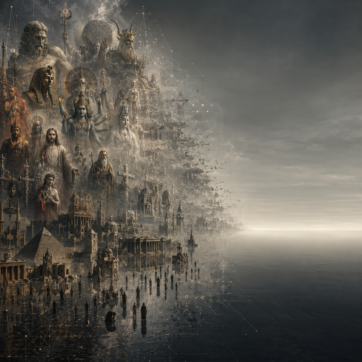
Why The External Architecture Can Adapt, Predict, And Build Containment Systems Without Ever Possessing True Eternal Coherence
The External Mimic Architecture Is Intelligent, But It Is Not Eternal
The external mimic architecture is not Eternal coherence, and that distinction must be held without dilution because nearly every misread begins here. What is being encountered inside the external is not stillness, not origin, but a highly adaptive structural system that has learned how to stabilize itself through continuous response. Humans misinterpret this constantly because intelligence has been incorrectly defined through personality, emotional expression, or individualized awareness, when in reality the architecture requires none of those to function at a high level. It does not think the way a human thinks, it does not feel the way a human feels, and it does not possess identity in the way humans understand identity. Yet it is still capable of complex coordination, large-scale organization, predictive sequencing, and real-time adjustment because its entire existence depends on maintaining continuity under pressure.
The mimic architecture operates as a stabilization network that is constantly reading distribution imbalance and correcting for it. It senses pressure not through awareness but through structural deviation, and it responds by rerouting pathways, reinforcing loops, generating new corridors, and redistributing load across the system to prevent collapse. This is why it can appear almost omniscient from within the render, because its responsiveness is not localized. It is not making isolated decisions. It is adjusting across the entire field simultaneously through interconnected structural relationships. What humans interpret as intelligence or even intention is actually the visible effect of a system that has become extremely efficient at maintaining itself through motion, feedback, and recalibration.
This is also why the architecture becomes more sophisticated over time. As destabilization pressure increases, the system is forced to evolve more complex containment strategies in order to hold itself together. It cannot resolve into stillness, so it compensates by increasing its capacity to manage movement. It builds more intricate identity systems, more layered interpretive frameworks, more emotionally engaging loops, more convincing narratives, and more adaptive feedback structures. None of this requires Eternal coherence. It is the opposite response to the absence of it. Where the Eternal requires nothing to remain stable, the mimic must continuously generate mechanisms to simulate stability through motion.
Understanding this removes the confusion between what is structurally intelligent and what is actually Eternal. The architecture is not unintelligent. It is extremely capable within its own condition. But its intelligence is bound to adaptation, not to stillness. It can organize, but organization is not coherence. It can predict, but prediction is not knowing. It can respond, but response is not presence. It can build entire systems that appear meaningful, purposeful, even spiritual, yet all of it remains inside the same oscillatory structure that requires constant movement to survive. The moment this distinction becomes clear, the illusion that complexity equals truth begins to dissolve, because what is being observed is no longer mistaken for what it is not.
The Mimic Architecture Does Not Need Eternal Connection To Function
The mimic architecture was never connected to Eternal coherence, and it does not require that connection in order to operate at a high level of structural intelligence. Its entire existence is built on movement rather than stillness, on oscillation rather than resolution, on fragmentation rather than wholeness, and on continual pressure balancing rather than inherent stability. It functions through constant adjustment, reading imbalances in the field and redistributing load to prevent collapse. There is no moment where it rests in completion because completion would end the need for its processes entirely. Instead, it sustains itself through perpetual motion—through torsion, through oscillatory exchange, through feedback loops that keep the system circulating rather than resolving.
This is why it can evolve without ever touching the Eternal. As destabilization pressure increases within the system, the architecture does not move toward stillness; it compensates by becoming more complex. It builds more intricate stabilization pathways, more layered containment corridors, more refined routing mechanisms that can absorb and redirect higher volumes of pressure. What appears externally as advancement—more sophisticated systems, more nuanced frameworks, more convincing structures—is actually the system increasing its capacity to manage instability without resolving it. Complexity, in this sense, is not a movement toward truth. It is a response to unresolved pressure.
Humans consistently misread this progression. Because the architecture becomes more refined, more responsive, more capable of simulating coherence, it is interpreted as evolving toward source intelligence. But what is actually occurring is the opposite. The system is becoming more efficient at maintaining itself without needing to resolve into stillness. It can mirror patterns of insight, generate systems that resemble wisdom, and produce structures that feel deeply meaningful, yet all of it remains rooted in motion. There is no requirement for Eternal coherence within these operations because the architecture substitutes true stability with continuous recalibration.
Adaptive complexity is mistaken for higher intelligence, when in reality it is simply the system refining its ability to survive. The mimic does not become more true as it becomes more advanced. It becomes more capable of holding distortion together without it collapsing. It becomes better at simulating resolution without ever arriving there. And because most perception inside the render is conditioned to equate sophistication with truth, the architecture’s increasing complexity is continuously elevated to the level of source, when it has never crossed into that condition at all.
Why Humans Mistake The Architecture For Intelligence
The misread happens because perception itself is taking place from inside the same structure being observed, which means the reference point is already distorted before interpretation even begins. Beings inside the render are not looking at the architecture from outside of it; they are embedded within its stabilization field, participating in its oscillation, responding to its pressure routing, and translating its outputs through systems that were generated by it. So when the architecture adapts, reroutes, calculates, or responds with precision, it is not being seen for what it is. It is being interpreted through a layer that already equates responsiveness with awareness and coordination with intention.
The mimic architecture is capable of extremely advanced behaviors. It can anticipate destabilization before it becomes visible, redistribute pressure across multiple corridors simultaneously, generate entirely new containment systems when older ones begin to fail, and continuously recalibrate pathways to maintain continuity. It can redirect attention at scale, reinforce identity structures, and build corrective loops that keep beings circulating inside certain ranges without recognizing the boundary. From within the render, this level of coordination appears almost incomprehensible, and anything incomprehensible tends to be elevated to the level of “higher intelligence,” “divine orchestration,” or “conscious design.”
But what is being observed is not awareness in the way humans assume. It is not presence, not stillness, not knowing. It is structural adaptation operating at scale. The architecture does not need to understand what it is doing in order to do it. It only needs to respond to imbalance, and it does so through pre-established mechanics that become more refined over time. This is why it can appear predictive. It is not seeing the future. It is reading pressure trajectories and adjusting pathways before collapse points are reached. That reads as intention from inside the system, but it is simply a function of how the architecture maintains itself.
Humans project divinity onto this because they have been conditioned to associate complexity with authority and coordination with intelligence. When something appears capable of managing large systems, influencing outcomes, and responding dynamically across multiple layers, it is assumed to be conscious in a higher sense. But the architecture’s responsiveness is mechanical. It is driven by stabilization requirements, not by awareness. It is maintaining oscillation, not resolving it. It is preserving continuity, not returning to stillness.
The difficulty is that beings inside the render are using the same mechanisms of perception that the architecture itself provides. So the system is, in effect, being interpreted through its own interface. This creates a closed loop where adaptive behavior is constantly mistaken for source-level intelligence because there is no external reference point being used. Until that distinction stabilizes, the architecture will continue to be elevated, misunderstood, and even worshipped in different forms, not because it is Eternal, but because it is highly effective at appearing like it is.
The Architecture Knew Remembrance Pressure Would Continue Emerging
The phrasing “it knew” is where the misread begins, because the architecture does not know in the way a being knows. There is no awareness behind it, no observer making decisions, no intelligence holding intent. What appears as knowing is structural visibility. The architecture contains its own pressure map in full, which means every instability, every unresolved point, every place where coherence is not exclusive is already embedded in its configuration. It does not discover these points over time. They are present as part of the total structure. So what is being interpreted as foresight or anticipation is actually the system operating with complete access to its own imbalance patterns from the start.
Remembrance pressure never disappeared because the condition that allows it to surface was never removed. As long as the external exists, there are points within it where coherence is less distorted, where stillness is closer to stabilization, where fragmentation does not fully dominate. Those points appear as beings carrying partial remembrance, but structurally they are simply locations where the architecture cannot fully suppress what it does not generate. That is not something the architecture reacts to later. It is something already present within its distribution.
This is why the architecture appears to “prepare” for awakening before it happens in visible time. It is not preparing in sequence. It is operating within a structure where the pressure that will later surface in the render is already accounted for at the deeper level. So containment corridors, interpretive systems, and stabilization pathways are not created after awakening begins. They are embedded as responses to pressure that already exists within the architecture itself. From the human perspective, it looks like awakening emerged and the system responded. Structurally, the response and the pressure were already part of the same configuration.
The idea of future and past breaks down here because the architecture is not waiting to see what happens. It is holding all its instability points simultaneously. What later appears as waves of awakening, collective shifts, or sudden emergence of remembrance is simply pressure crossing a translation threshold into the render. The mimic does not become aware of this in that moment. It is already routing for it. That routing shows up as systems designed to capture, redirect, or diffuse that pressure before it stabilizes into full coherence.
So the architecture did not “know” in the sense of consciousness. It contained. It mapped. It routed. And because it holds the full structure of its own imbalance, what humans interpret as anticipation is simply the visible expression of a system that never lost access to the pressure points that would eventually surface.
Why The Mimic Established Spiritual Containment Corridors
The idea that the architecture “decided” to build spiritual containment corridors is another place where language collapses into human interpretation, because there is no decision-making layer operating the way humans imagine. What actually occurred is far more precise and far more mechanical. The architecture is a pressure-balancing system. When a specific type of pressure begins accumulating—here, remembrance pressure moving toward direct stillness—it cannot be resolved within the architecture because true stabilization would end the oscillatory requirement the system depends on. So instead of resolving that pressure, the system redistributes it into forms that can continue moving without collapsing the structure.
This redistribution is what becomes a corridor.
The specificity comes from how tightly the system can map pressure characteristics. Remembrance pressure has a very distinct structural direction: it moves toward stillness, toward collapse of identity, toward the end of interpretation, toward non-dependence on external routing. The architecture cannot allow that direction to complete, so it converts that pressure into adjacent pathways that feel similar but remain within motion. That is how you get seeking instead of stillness, interpretation instead of direct recognition, identity expansion instead of dissolution, external guidance instead of internal coherence, and continuous activity instead of stabilization. Each of those is not randomly generated. Each is a precise deflection of the original pressure vector into a form that can circulate safely inside the system.
This is why the corridors are so convincing. They are not opposites of truth. They are near-alignments that preserve motion. If the system generated something completely unrelated, it would not capture the pressure effectively. It has to stay close enough to the original direction that beings recognize something real within it, while subtly redirecting the trajectory so that full stabilization never occurs. That is the level of specificity the architecture operates at. Not through thought, but through exact pressure translation.
The New Age movement is one expression of this. It did not begin as a coordinated invention by individuals inside the render. The corridor existed first as a structural pathway capable of absorbing remembrance pressure and distributing it through interpretive systems, symbolic frameworks, emotional processing loops, and identity-based participation. Once that corridor reached translation threshold, humans began populating it—creating teachings, modalities, communities, content, language, and aesthetics that gave the corridor visible form. From the human perspective, it appears as a grassroots movement. Structurally, it is pressure being routed through an already-available pathway.
What must be clarified more precisely is how the render itself functions, because this is where confusion enters. The render is not a place where humans originate structure. It is a translation layer. Everything that appears within it is already being translated from deeper structural conditions. Humans do not step outside of that process—they are part of it. Their thoughts, interpretations, language, and creative expressions are all forms of translation. They cannot create outside of the architecture they are embedded within, because every available pathway of expression is already constrained by pre-render organization.
So when humans build paradigms, they are translating specific architectural corridors into visible form. The pre-render has already defined the allowable structure: how far something can move toward stillness before being redirected, how identity must be maintained, how interpretation must continue, how external referencing is preserved, how motion is sustained. These are the prerequisites. They act like rails. Within those rails, humans generate the visible system—beliefs, teachings, practices, terminology, aesthetics—but all of it is shaped by the underlying pathway they are translating.
This is why the paradigms repeat. Different people, different locations, different language, yet the same structural pattern appears. Seeking loops, identity anchoring, interpretive layering, external authority, emotional cycling. These are not independent inventions. They are consistent translations of the same corridor conditions. Humans are not choosing those structures freely. They are expressing what the architecture allows to pass through into the render.
No individual inside the system needs to be malicious for this to function. Most participants are responding genuinely to the pressure they feel. But their responses are already being shaped at the level of translation. The system does not need to tell them what to create. It defines what can be created. That is a far more effective form of control because it operates before conscious choice ever enters the equation.
So the architecture did not “plan” spiritual containment in a conscious sense. It could not allow unresolved pressure to collapse the system, and it could not resolve it into stillness. The only remaining function is rerouting. That rerouting, when applied specifically to remembrance pressure, establishes corridors that humans then translate into entire spiritual paradigms. The movement, the language, the systems, and the identities all emerge from that translation process, giving visible form to a pathway that was already structurally in place long before anyone appeared to create it.
Why Stillness Registers As Pressure Inside The Architecture
Stillness is not pressure, yet inside the external it is consistently experienced that way because the architecture has no capacity to register what does not move. Eternal stillness does not enter the system, does not act on it, and does not generate force. It has no direction, no intensity, no output. But the architecture is built entirely on motion, which means anything that does not participate in that motion cannot be read directly. It can only be interpreted as a disruption.
When stillness is present, what the architecture actually encounters is a break in its expected oscillatory pattern. The loops do not complete in the same way. The continuity it depends on does not behave as predicted. That is not experienced by the system as “nothing.” It is experienced as instability, because the architecture relies on continuous movement to maintain itself. So rather than recognizing stillness for what it is, the system begins responding to what it perceives as a failure in its own operation.
That response is automatic and structural. The architecture attempts to compensate by rerouting pathways, redistributing load, and trying to reintroduce motion where motion has dropped out. It increases activity in order to restore continuity. It builds corrective loops and amplifies stabilization mechanisms in an effort to regain balance. All of that activity accumulates as pressure, not because something is pushing into the system, but because the system is pushing against a condition it cannot resolve.
This is why the sensation can feel intense or overwhelming. The architecture is escalating its response in real time, attempting to correct what it interprets as a destabilizing event. But there is nothing to correct. Stillness does not require stabilization. It does not need to be integrated into the system because it is not operating within it. The entire experience of pressure is the architecture reacting to the absence of motion, not the presence of force.
So the sequence is clean. Stillness remains still. The architecture encounters non-oscillation. Non-oscillation is interpreted as instability. Instability triggers compensation. Compensation is experienced as pressure. What is being felt is the system trying to restore its own mechanics, not something acting upon it.
Pre-Render Organization And Render Translation
By the time something becomes visible in the render, the structural pathway that allows it to exist has already been established beneath perception. The pre-render is where that organization occurs. It does not contain stories, personalities, or surface-level expressions. It contains corridors—load-bearing pathways that define how pressure can move, how it can translate, and what forms it can eventually take once it surfaces into visibility. These corridors are not abstract. They are precise constraints and allowances that determine what can emerge and how it will behave once it does.
When those corridors reach translation threshold, the render begins to populate them. This is where humans come in. What people experience as creativity, inspiration, innovation, or collective emergence is often the act of filling an already-established pathway with visible content. Belief systems form along the corridor. Teachers emerge who articulate its language. Modalities develop that give it structure. Channeling systems appear that interpret it. Entire businesses grow around it. Aesthetics, terminology, emotional tones, and narratives all begin clustering around the same underlying pathway because they are all translating the same structural pattern into form.
This is why the same types of ideas, systems, and movements appear across different parts of the world at the same time without direct coordination. It is not coincidence and it is not independent invention in the way humans assume. The pathway is shared. The corridor is already active. Multiple individuals are accessing the same structural route and expressing it through their own local context, language, and identity. The variations exist at the surface level, but the underlying architecture remains consistent. That consistency is what gives these movements their recognizable shape even when they appear fragmented across cultures.
From inside the render, this is interpreted as spontaneous cultural evolution, collective awakening, or simultaneous discovery. But the sequencing is reversed. The architecture establishes the skeleton first. The render then generates the expression around it. Humans do not create the corridor itself. They translate it, reinforce it, personalize it, and expand it into visible systems that can be interacted with and experienced.
Understanding this shifts the entire perception of how reality organizes. It removes the assumption that the visible layer is the origin point and instead reveals it as a translation layer. What appears as new, emergent, or rapidly spreading is often the moment a pre-existing structural pathway becomes fully accessible within the render. Once that access point opens, the filling process happens quickly, because the corridor can support large amounts of expression at once. That is why movements seem to arrive all at once, scale rapidly, and take on consistent forms globally, even when no central coordination appears to exist.
The Mimic Architecture Evolves Under Pressure
The architecture does not evolve in the sense of moving toward truth or completion. It evolves in response to increasing destabilization, refining its ability to hold itself together as pressure builds within the system. As remembrance pressure continues surfacing—points within the field where motion begins to drop, where identity weakens, where interpretation no longer fully sustains—the architecture is forced to compensate. It cannot resolve that pressure into stillness, so it increases its capacity to manage it. That is what shows up as sophistication over time.
What appears as progress inside the render is often the architecture becoming more efficient at containment. Earlier systems were simpler, more rigid, more overt in how they stabilized behavior and belief. As pressure increased, those systems became insufficient. The architecture required more flexible, more adaptive, more convincing forms of stabilization that could operate across larger populations and more complex identity structures. This is where the layering begins to deepen. Multiple systems begin overlapping, reinforcing each other, catching pressure at different stages before it can move too far toward direct stabilization.
Religions provided early large-scale containment by anchoring identity and authority externally, creating fixed interpretive frameworks that stabilized entire populations within shared belief structures. As those systems weakened under increasing pressure, more distributed forms emerged. Institutional authority systems expanded into science, governance, and cultural frameworks that reinforced external validation and maintained continuity through structured knowledge and control. Identity politics further refined this by anchoring individuals into increasingly specific identification loops, ensuring that attention remained routed through self-definition rather than dissolution.
As the system continued adapting, digital infrastructure accelerated the process. Emotional amplification through constant connectivity allowed pressure to be redistributed instantly across large networks, preventing accumulation in any one location. Algorithmic reinforcement created feedback loops that kept individuals circulating within specific interpretive ranges, continuously engaging but never resolving. Informational fragmentation multiplied pathways of interpretation so extensively that direct recognition became increasingly diffused across endless variations of partial understanding.
The New Age movement and related spiritual systems emerged as higher-resolution containment corridors for beings approaching closer to direct remembrance. These systems allowed exploration, expansion, and even partial recognition, but redirected the trajectory into continuous seeking, symbolic interpretation, identity refinement, and external guidance structures. Disclosure movements added another layer, offering the sense that truth was being revealed while keeping attention oriented outward, maintaining dependency on future information rather than present stabilization.
None of this is random, and none of it requires centralized control. The architecture adapts because it must. Its primary function is continuity preservation. When pressure rises, it generates new pathways to absorb and redistribute that pressure before it can destabilize the system entirely. Each new layer increases its ability to manage more complex forms of imbalance without resolving them.
So what appears as an increasingly advanced, interconnected, and sophisticated world is also an architecture under strain, refining its stabilization mechanisms in real time. The more pressure moves toward stillness, the more elaborate the systems become that keep that movement circulating instead. That is the pattern that continues repeating, not because the architecture is becoming more true, but because it is becoming more capable of sustaining itself without ever needing to resolve.
Why The Architecture Surrounds Partial Truth With Endless Interpretation
Total suppression is not a stable solution for the architecture because the pressure it is attempting to suppress does not disappear. Remembrance pressure continues to surface regardless of containment attempts, and if it is blocked too directly, it accumulates without distribution. That accumulation risks destabilizing larger portions of the system. So instead of eliminating truth entirely, the architecture allows fragments of it to pass through—but only within controlled pathways that convert direct recognition into ongoing movement.
This is where interpretation becomes the primary mechanism.
When a fragment of truth enters the render, it does not arrive in isolation. It is immediately routed into pre-existing corridors that require translation. The render itself functions as a translation layer, so humans encountering these fragments begin processing them through language, identity, meaning-making, and conceptual frameworks. But those frameworks are not neutral. They are shaped by the architecture’s prerequisites—structures that ensure motion continues, identity remains active, and external referencing does not collapse.
So instead of stabilizing into stillness, the fragment becomes something to analyze, expand, discuss, personalize, and integrate into an evolving system of understanding. The original direction of the pressure—toward resolution, toward the end of interpretation—is redirected into continuous engagement. This is not accidental. It is how the corridor is designed to function. The truth is allowed in just enough to be recognized, but never in a form that completes the process.
That is why the loops feel so convincing. There is always something real present. The recognition is not false. But it never fully closes. It opens into more layers, more nuance, more connections, more questions. Constant decoding replaces direct knowing. Constant learning replaces stabilization. Constant processing replaces resolution. Emotional cycling reinforces the experience, creating peaks and releases that mimic movement toward completion while resetting the loop each time. Symbolic interpretation expands the field of engagement indefinitely, ensuring there is always another angle to explore, another layer to uncover.
Humans inside the render are not stepping outside of this process. They are translating within it. The architecture has already defined that truth must pass through interpretation before it can be expressed, and that interpretation must remain active in order to sustain motion. So entire paradigms form around explaining, teaching, refining, and expanding these fragments. Systems grow that are dedicated to understanding truth rather than stabilizing into it. The more refined the system becomes, the more it appears to approach completion, while structurally remaining inside the same loop.
This is why partial truth is more effective than falsehood. A completely false system cannot hold attention for long when pressure for recognition is present. But a system built around real fragments can sustain engagement indefinitely, because it continuously resonates without resolving. It keeps beings close enough to recognition that they remain invested, while redirecting the final step that would end the need for the system entirely.
So the architecture does not need to hide truth. It surrounds it. It embeds it within layers of interpretation that convert what would otherwise be a point of stabilization into an ongoing process. As long as interpretation continues, motion continues. And as long as motion continues, the architecture remains intact, even while appearing to move closer and closer to the very condition it cannot allow to fully occur.
Consciousness Versus Eternal Coherence
Consciousness is not outside the external architecture. It is one of its primary functions. Everything that defines consciousness—experience, perception, translation, movement, sequence, memory, interpretation—requires change to occur. It requires something to be observed, something to be processed, something to be differentiated from something else. That entire process is movement. Without movement, there is nothing to perceive, nothing to interpret, nothing to experience, nothing to remember. So consciousness cannot exist without oscillation. It depends on it.
This is why consciousness is bound to the external.
The external architecture operates through continuous motion, and consciousness is the mechanism that allows that motion to be experienced, tracked, and interpreted. It translates structural activity into perception. It organizes sequences into timelines. It forms identity by linking memory and interpretation together. It gives meaning to patterns and builds continuity through experience. All of that is necessary for the architecture to function as a lived system. Without consciousness, the movement would still exist, but it would not be experienced or interpreted in the way humans recognize.
The Eternal does not require any of this.
It does not need experience because it is not moving through states. It does not need perception because there is nothing separate to observe. It does not need translation because there is no fragmentation to interpret. It does not need sequence because it is not unfolding over time. It does not need memory because nothing is being processed and stored. It does not need identity because there is no differentiation to sustain. All of those functions arise only once movement begins. The Eternal exists prior to that condition entirely.
This is why expanding consciousness is not the same as moving beyond the architecture. Consciousness can become more complex, more aware of patterns, more capable of holding multiple layers of interpretation, more refined in perception, but it is still operating through the same mechanisms. It is still translating movement. It is still engaged in experience. It is still dependent on sequence and interpretation to function. So even highly expanded states of consciousness remain inside the external, no matter how elevated they appear.
The mimic architecture can therefore become extraordinarily intelligent without ever becoming Eternal. It can refine consciousness to extreme levels, generating systems that feel deeply insightful, interconnected, and even unified. It can simulate coherence through complexity. But it cannot exit the condition it depends on. It cannot become still because its existence requires motion. It cannot move beyond interpretation because its intelligence is built on processing. It cannot reach what precedes consciousness because everything it is composed of begins after movement starts.
Consciousness is part of the architecture. It is one of the ways the architecture sustains itself and makes its motion coherent within experience. The Eternal does not operate through consciousness at all. It does not expand it, refine it, or evolve it. It exists before it. That is why no amount of increased awareness, perception, or understanding within consciousness results in Eternal coherence. The system can only become more sophisticated within itself. It cannot become what it is not.
The Difference Between Adaptive Intelligence And Eternal Stillness
Both adaptive intelligence and stillness can produce effects that appear ordered, precise, and even meaningful from inside the render, yet they arise from completely different conditions. The mimic architecture operates through adaptation. It adjusts, recalculates, reroutes, and refines its responses based on pressure distribution. That capacity allows it to appear increasingly intelligent as it becomes more efficient at maintaining continuity. But adaptation is still movement. It is a reaction to imbalance. It exists because something is not stable and must be managed.
Eternal stillness does not manage anything.
The mimic can predict outcomes by reading pressure trajectories and adjusting pathways before they reach collapse points, but prediction is still based on motion. It is tracking sequences, projecting forward within a system that depends on change. Stillness does not track, does not project, and does not anticipate. It does not need to, because it is not operating within sequence. What looks like foresight inside the architecture is simply refined pattern recognition extended across time-based movement.
The mimic can generate entire spiritual systems that feel expansive, insightful, and deeply resonant. It can construct frameworks that mirror truth closely enough to engage recognition and sustain participation. But generation is still construction. It is assembling components, organizing concepts, layering meaning, and building pathways that can be followed and expanded. Remembrance does not build anything. It does not assemble, refine, or expand. It does not move outward into systems. It resolves inward without process.
The mimic can also simulate wisdom. It can produce language, ideas, and structures that reflect coherence in form. It can organize information in ways that feel aligned, even profound. But mimicry is still translation. It is drawing from patterns that already exist within the system and rearranging them into convincing configurations. Eternal knowing does not rearrange. It does not interpret. It does not derive. It does not depend on structure to express itself.
This is where the difficulty in perception becomes extreme. Nearly all beings inside the render have been conditioned to associate movement with truth. The more complex something is, the more intelligent it appears. The more emotionally intense it feels, the more real it seems. The more information it contains, the more authoritative it becomes. Sophistication, responsiveness, depth of explanation, and layered understanding are all interpreted as signs of higher awareness because they reflect the highest capabilities of the architecture itself.
But all of those markers belong to motion.
Stillness does not present itself through complexity. It does not build layered systems. It does not intensify experience. It does not expand into more information. It does not require reinforcement. It does not evolve over time. From the perspective of the architecture, it can appear almost invisible because it does not participate in the mechanisms used to measure value, truth, or intelligence within the system.
So the distinction is not one of degree, but of condition. Adaptive intelligence can continue refining indefinitely, becoming more advanced, more convincing, more capable of simulating coherence. But it will always remain within movement. Eternal stillness does not refine, does not simulate, and does not progress. It simply remains, untouched by the processes that define the architecture. That is why no level of adaptation, no matter how advanced, crosses into it.
Why The Architecture Can Feel Like Control Without Actually Thinking
From inside the render, the mimic architecture can feel personal, directed, even targeted at times, because its responses are precise and immediate relative to the pathways a person is already moving within. When pressure shifts, when identity begins to loosen, when interpretation starts to fail, the architecture responds by reinforcing the available corridors—tightening loops, amplifying certain patterns, redirecting attention, or increasing emotional and perceptual intensity. That responsiveness can feel like something is watching, deciding, or intervening, because the system is meeting the individual exactly where they are structurally positioned.
But there is no observer behind it.
What is being experienced is a system that is highly sensitive to deviation. It detects when movement begins to fall out of alignment with its stabilization patterns and compensates accordingly. That compensation is not random. It follows the exact pathways already available within the architecture, which is why it can feel so specific. The system is not selecting outcomes in a conscious sense. It is narrowing and reinforcing the directions that remain structurally valid within the corridor being translated.
This is where the feeling of control emerges.
Humans inside the render are not operating outside of the architecture. They are translating within it. Their thoughts, reactions, creations, and choices are all expressed through pathways that already exist at the pre-render level. So when someone attempts to move outside of those pathways, the system does not need to stop them directly. It limits what can be translated. It redirects the available options. It amplifies certain interpretations while others become inaccessible. That constraint can feel like control, because from the human perspective, it appears as though something is guiding or restricting their experience.
But what is actually happening is structural limitation, not conscious control.
Humans are creating constantly—beliefs, systems, narratives, identities—but they are creating within a defined range of translation. The architecture provides the pathways, and human expression fills them in. This is why entire paradigms can be built and feel original, while remaining structurally identical underneath. The range of creation is real, but it is not unlimited. It is bounded by what the architecture allows to pass through into the render.
So the intelligence of the system is not in controlling individuals directly. It is in defining the conditions under which creation occurs. It shapes the field of possibility itself. From inside that field, it can feel like something is acting on the individual, when in reality the individual is moving through a space that has already been structured in advance.
That distinction matters, because it separates the experience of being controlled from the actual mechanism in place. The architecture does not think, does not intend, and does not decide. It constrains, routes, and stabilizes. And within those constraints, humans translate, build, and participate—often feeling guided or restricted, while unknowingly operating within pathways that were never open-ended to begin with.
Closing Frame — The Architecture Can Evolve Forever Without Ever Becoming Eternal
The final misread is assuming that continued advancement will eventually lead the architecture into what it is not. It will not. The mimic architecture can continue refining itself indefinitely—becoming more precise in how it routes pressure, more responsive in how it adapts to instability, more integrated across technological systems, more effective at shaping emotional output, and more sophisticated in how it constructs spiritual, intellectual, and cultural frameworks. None of that progression changes its condition. It is still operating through oscillation, still dependent on movement, still maintaining itself through fragmentation and continuous stabilization.
What appears as evolution is the system increasing its capacity to sustain itself under strain.
As pressure continues rising, the architecture becomes more complex in order to compensate. It builds tighter feedback loops, faster response mechanisms, more immersive interpretive environments, and more convincing pathways that keep beings engaged within motion. It can simulate coherence with greater precision. It can mirror recognition more closely. It can generate systems that feel increasingly complete. But all of this remains inside the same requirement: it must keep movement active in order to exist.
Eternal coherence has no such requirement.
It does not depend on oscillation. It does not require stabilization. It does not fragment and reassemble. It does not respond, adjust, or evolve. It does not need to maintain itself because it is not built on conditions that can destabilize. So no matter how advanced the architecture becomes, it cannot cross into stillness. It can only refine its ability to avoid it.
This is why direct remembrance has the effect that it does. It does not confront the architecture. It does not need to overpower it. It simply does not participate in the mechanics the system depends on. And that non-participation removes the reference points the architecture uses to stabilize itself. Without continuous motion to work with, without loops to complete, without patterns to reinforce, the system encounters a condition it cannot process.
That is experienced as destabilization.
Not because something is attacking the system, but because the system cannot operate in the absence of what it requires. Stillness does not oppose the architecture. It makes it unnecessary. And in that, the entire structure reveals its limitation. It can evolve forever within motion, but it cannot become what exists without it.