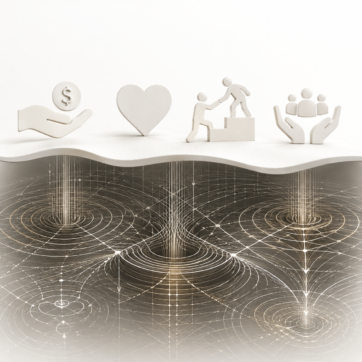
Why humans instinctively associate transcendence, higher realms, and ultimate truth with “upwardness” — and how the body is detecting the difference between horizontal oscillation and vertical stillness but translating it spatially instead of structurally.
Why Humans Think Truth Exists Somewhere “Above”
Humans have always instinctively associated transcendence, ultimate truth, liberation, enlightenment, and escape from suffering with “upwardness.” The language appears everywhere across human civilization regardless of religion, geography, or culture. People speak about “higher states,” “higher consciousness,” “rising above,” “ascending,” “elevating,” or “reaching heaven.” Even people who are not religious still instinctively describe clarity, peace, or expanded awareness as feeling “higher” somehow. This pattern did not emerge randomly. The body-interface is detecting something legitimate. The mistake is not the recognition itself. The mistake is the interpretation humans built around it.
The reason humans associate truth with verticality is because the external architecture humans currently experience as reality operates through horizontal oscillation. Everything here stabilizes through movement across continuity. Time moves horizontally through sequence. Identity moves horizontally through narrative. Emotion moves horizontally through reaction cycles. Civilization itself moves horizontally through repetition, progression, memory reinforcement, conflict, polarity exchange, and continuity maintenance. The entire external system depends upon oscillatory propagation in order to maintain structural coherence. Nothing here remains stable through absolute stillness. Stability inside the external is achieved through controlled movement, controlled torsion, controlled compression, controlled polarity balancing, and continuous continuity reinforcement.
The human nervous system therefore becomes adapted to horizontal existence itself. Humans experience life through sequence pathways: past to future, cause to effect, birth to death, memory to anticipation. Even human thought behaves this way. Thoughts move laterally across associative chains. Emotional states propagate through reaction loops. Identity stabilizes through repeated narrative reinforcement. Everything inside the external architecture depends on motion across continuity fields in order to sustain itself.
So when humans encounter moments where oscillatory pressure temporarily decreases — deep stillness, silence, profound calm, timelessness, non-reactive awareness, reduction of emotional cycling, collapse of narrative movement — the body immediately recognizes that it is encountering a fundamentally different structural condition from ordinary horizontal existence. The nervous system detects the absence of normal oscillatory load. It detects coherence without movement. It detects stability without continuous propagation.
But the human perceptual system lacks proper structural language for what it is actually perceiving.
So the render translates structural orientation into spatial metaphor.
Humans feel the difference between horizontal oscillation and vertical stillness, but instead of understanding it architecturally, they convert it into geographic mythology. The sensation of vertical coherence becomes interpreted as something physically “higher.” The sky becomes associated with transcendence. Truth becomes imagined as existing above Earth somewhere. Enlightenment becomes upward ascent. Heaven becomes a location. Divine beings become entities living in upper realms beyond the clouds.
The recognition underneath all of this is real. Humans are genuinely sensing the difference between the Eternal condition and the external architecture. But the interpretation became distorted because the render can only translate experience through the perceptual systems available inside horizontal continuity mechanics.
The Eternal was never “up there.” Humans were sensing the difference between oscillation and stillness itself.
The External Architecture, The Mimic Overlay, And Why Humanity Feels So Compressed Right Now
One of the largest reasons humans struggle to understand what they are actually sensing is because they are attempting to interpret reality entirely from inside the render layer while remaining mostly unaware of the deeper organizational mechanics operating underneath it. Most humans believe the visible world is the primary layer of reality itself. They believe politics, media, relationships, world events, emotional reactions, technological systems, economic instability, social movements, and personal identity conflicts are the actual source-level phenomena driving human experience. But the render is not the source layer. The render is the translated expression layer humans experience after deeper structural organization has already occurred upstream within the external architecture.
The external architecture itself operates as a continuity-based oscillatory system. It stabilizes reality through motion, sequence, polarity exchange, probability routing, waveform balancing, compression management, and identity reinforcement. But humans do not directly perceive these deeper mechanics consciously. Instead, the nervous system translates the structural activity occurring underneath into stories, events, identities, emotional experiences, civilizations, social systems, and material reality. Humans experience the translation rather than the architecture itself.
This is where the distinction between pre-render and render becomes critical.
The pre-render is the upstream organizational layer where continuity routing, probability stabilization, emotional loading, identity clustering, polarity balancing, and oscillatory management occur before becoming physically expressed through the visible world. The render is the downstream experiential layer humans perceive as ordinary reality. What humans call “life” is largely the translated surface expression of deeper organizational mechanics already moving beneath perception thresholds.
This is also why major societal shifts often feel “in the air” before fully materializing physically. Humans are detecting pre-render pressure before the render visibly reorganizes around it. The nervous system feels the continuity strain building before the visible world catches up to the deeper organizational shifts already occurring underneath.
Right now the compression inside the external architecture is extraordinarily intensified because the continuity systems maintaining the current civilization layer are under immense stabilization pressure. Humans are being forced to carry increasing levels of oscillatory load simultaneously:
constant media saturation,
emotional amplification,
identity fragmentation,
financial instability,
technological acceleration,
social polarity escalation,
nervous system overload,
digital continuity reinforcement,
fear cycling,
outrage propagation,
information saturation,
and nonstop emotional stimulation.
The system is compensating for deeper structural instability by increasing horizontal oscillatory throughput.
This is why humans everywhere feel exhausted even when they cannot explain why. The compression is not simply personal stress. The entire continuity architecture is running increasingly dense oscillatory load in order to maintain stabilization. Humans are attempting to stabilize enormous continuity pressure through emotional reaction, identity reinforcement, endless information consumption, tribal polarization, ideological attachment, digital stimulation, and constant narrative participation.
The mimic overlay intensifies this even further.
The mimic is not separate from the external architecture itself. It is a secondary reinforcement layer that emerges when continuity systems begin destabilizing under excessive pressure. The mimic attempts to preserve continuity function by amplifying externalization. Instead of resolving instability, it increases surface-level reinforcement mechanisms:
more identity,
more polarity,
more emotionality,
more stimulation,
more distraction,
more spiritual externalization,
more ideological fixation,
more algorithmic emotional routing,
more dependency loops,
more narrative amplification.
The mimic attempts to preserve continuity by accelerating oscillation itself.
This is why modern civilization feels increasingly loud, reactive, emotionally unstable, fragmented, addictive, and mentally overwhelming. The system is compensating for structural strain through increased oscillatory intensity. Humans are living inside an architecture attempting to stabilize itself through amplification.
This stands in direct contrast to the Eternal condition.
The Eternal does not stabilize through oscillation. It does not require emotional propagation, narrative continuity, identity reinforcement, polarity exchange, or torsion balancing in order to remain coherent. The Eternal does not move horizontally through sequence pathways because it does not depend upon continuity mechanics for existence itself.
This is why the Eternal registers as vertical.
Verticality is not physical direction. It is structural orientation. The Eternal remains coherent without requiring lateral oscillatory propagation. It does not move across continuity fields in order to sustain itself. It does not require past-to-future sequencing. It does not stabilize through reaction loops. It does not maintain itself through emotional throughput. It does not require identity narratives in order to preserve continuity.
The external moves horizontally because oscillatory systems require propagation across sequence fields in order to maintain coherence. Waves move. Frequencies oscillate. Narratives propagate. Emotions cycle. Time advances. Identities reinforce themselves through repetition. Everything inside the external depends upon continuity movement.
The Eternal does not.
This is why genuine stillness feels so foreign to the human nervous system. Humans have spent their entire existence inside systems stabilized through movement. So when the body encounters a condition of coherence without oscillation, it experiences it as radically different from ordinary reality itself. The nervous system recognizes the reduction of continuity pressure. It detects the absence of oscillatory loading. It senses a condition not dependent upon the horizontal mechanics governing external existence.
Humans then attempt to explain this difference symbolically:
higher states,
heaven,
ascension,
divine realms,
spiritual elevation,
transcendence.
But underneath all the symbolism, the body is simply detecting the distinction between horizontal oscillatory existence and vertical non-oscillatory coherence.
Humans Mistook Structural Orientation For Physical Location
One of the greatest misinterpretations in human history was the conversion of structural orientation into geographic destination. Humans correctly sensed that there was a fundamentally different condition from ordinary external existence, but because the render translates perception through spatial and symbolic frameworks, the nervous system converted that recognition into physical mythology. The Eternal became imagined as a place instead of recognized as a condition of coherence entirely outside ordinary oscillatory mechanics.
This is how humans eventually constructed ideas such as:
heaven,
upper realms,
celestial kingdoms,
divine dimensions,
higher planes,
ascension spaces,
worlds above the sky,
and enlightened locations beyond Earth itself.
But the original recognition underneath these concepts was never actually about physical location. Humans were not detecting a kingdom floating above the clouds somewhere. They were sensing a structural distinction between horizontal oscillatory existence and vertical stillness.
The confusion emerged because the human body-interface is embedded entirely within continuity-based perception systems. Humans interpret reality through movement, distance, sequence, time progression, and spatial organization. The nervous system automatically translates difference into location because external reality itself stabilizes through positional continuity. Humans understand things through where they appear relative to other things. So when the body encountered states that did not behave like ordinary oscillatory existence, the render instinctively translated the experience spatially.
Moments where horizontal oscillation temporarily softened created profound effects inside the nervous system:
silence,
stillness,
timelessness,
expanded perception,
reduction of emotional turbulence,
collapse of internal narrative cycling,
decrease of continuity pressure,
temporary suspension of reactive propagation.
The body detected something structurally different from ordinary horizontal existence. It recognized a condition where coherence did not seem dependent upon continuous movement, emotional throughput, narrative reinforcement, or polarity balancing. Even brief moments of this can feel radically different because the human nervous system spends nearly all of its ordinary functioning inside oscillatory load-bearing continuity mechanics.
But instead of understanding this architecturally, the render mind translated the experience through the only interpretive language available to it:
“higher.”
“above.”
“beyond.”
“upward.”
Humans therefore began imagining transcendence as vertical travel instead of recognizing it as a fundamentally different condition of existence itself. The sensation of reduced oscillatory load became interpreted as movement toward another realm somewhere physically distant. This is why nearly every civilization repeatedly associated transcendence with mountains, skies, stars, elevated temples, pillars, crowns, ladders, towers, celestial light, and upward ascent. The symbolism emerged from legitimate structural recognition being filtered through continuity-based perceptual distortion.
Even modern humans still do this constantly without realizing it. People instinctively point upward when discussing transcendence or “god”. They describe awakening as “rising.” They speak about “higher consciousness,” “elevated awareness,” or “ascending spiritually.” The language persists because the body continues detecting the same structural distinction humans have always sensed underneath the mythology itself.
The original recognition was real. The spatial interpretation was the distortion.
The Eternal was never physically above humanity. Humans were sensing the difference between oscillatory continuity and non-oscillatory coherence, then converting that recognition into location-based belief systems because the render could not properly interpret structural orientation directly.
The External Architecture Operates Through Horizontal Oscillation
The external architecture stabilizes through continuous oscillatory motion across continuity fields. This is one of the deepest mechanics governing the reality humans experience every day yet almost no one recognizes it because humans perceive the translated render rather than the underlying structural processes creating the render itself. Humans believe they are primarily interacting with objects, events, identities, emotions, societies, and timelines. But underneath all visible reality sits an enormous oscillatory continuity system constantly balancing motion, sequence, polarity, compression, and propagation in order to maintain coherent existence.
Everything inside the external depends upon movement.
Sequence.
Polarity.
Progression.
Identity persistence.
Emotional cycling.
Memory reinforcement.
Narrative continuity.
Waveform propagation.
Torsion balancing.
Curvature stabilization.
Nothing here remains coherent through absolute stillness because the external itself is built upon oscillatory continuity mechanics. Stability is achieved through controlled movement across continuity fields rather than through non-oscillatory coherence. This is why nearly everything humans experience operates cyclically or sequentially. The architecture itself requires propagation in order to sustain continuity.
This is visible everywhere once seen clearly.
The human nervous system propagates electrical impulses through oscillatory signaling. Thought itself moves through sequential associative pathways. Emotion travels through reaction loops. Biological systems stabilize through rhythmic repetition: heartbeat cycles, breathing cycles, circadian cycles, hormonal cycles, neural firing patterns. Civilization behaves similarly through economic cycles, political cycles, historical repetition, trend propagation, cultural reinforcement, media loops, and identity polarization. Even matter itself behaves through oscillatory mechanics at foundational levels through vibrational interaction, electromagnetic propagation, rotational spin behavior, resonance patterns, and wave-based organization.
The external architecture therefore behaves less like a static reality and more like a continuously stabilized continuity field requiring constant motion to prevent collapse into incoherence.
This is why human existence itself is experienced horizontally.
Humans experience:
past → present → future
birth → aging → death
cause → effect
memory → projection → anticipation
Everything moves across continuity lanes.
Humans do not experience all probability simultaneously because the nervous system could not maintain identity coherence under those conditions. Instead, the render compresses overwhelming structural complexity into narrow continuity pathways stable enough for oscillatory participation. Humans then perceive themselves as “moving through life” because the architecture itself depends upon sequence propagation in order to stabilize the render experience.
Even identity functions this way.
A human identity is not truly static. It is continuously re-stabilized through repeated narrative reinforcement. Humans tell themselves who they are over and over through memory, emotional attachment, social interaction, routine behavior, symbolic association, and continuity preservation. The identity remains coherent because the oscillatory pattern continues propagating across time. Without constant reinforcement, portions of the identity field begin destabilizing. This is why humans feel psychological discomfort when continuity loops break unexpectedly. The system depends upon narrative propagation to maintain stability.
This also explains why the external architecture is so dependent upon constant stimulation and movement now. Modern civilization has dramatically intensified continuity throughput:
constant information,
constant emotional activation,
constant digital reinforcement,
constant reaction cycles,
constant narrative engagement,
constant polarity escalation.
The system is increasing oscillatory movement in order to preserve coherence under mounting structural pressure.
When humans feel exhausted today, they are often feeling the burden of carrying excessive continuity load inside increasingly compressed oscillatory fields. The architecture itself is demanding more propagation to maintain stabilization.
This is why “horizontal” does not simply mean left and right visually. Horizontality is the condition of oscillatory continuity-based existence itself. It is the structural requirement that coherence be maintained through movement across sequence pathways. Everything inside the external depends upon progression, reaction, propagation, and continuity balancing in order to remain structurally stable.
The Eternal does not operate this way at all.
Which is precisely why the nervous system experiences genuine stillness as so radically different from ordinary existence.
The Legitimate Physics Behind Horizontal Reality
The external architecture is not merely metaphorically oscillatory. Its behavior reflects the same foundational mechanics visible throughout known physical systems: propagation, displacement, resonance, spin, polarity balancing, interference management, and continuity stabilization through motion. Humans often separate “physics” from lived experience as though the material world operates by one set of laws while consciousness, identity, emotion, civilization, and perception operate by another. But the same oscillatory principles visible in electromagnetic systems, waveform mechanics, harmonic resonance structures, and rotational fields also appear embedded throughout the larger continuity architecture humans experience as reality itself.
Electromagnetic propagation alone reveals the core principle clearly. Electromagnetic systems maintain coherence through continuous waveform movement across fields. The signal exists through propagation. Once propagation ceases entirely, the transmission collapses. Oscillatory systems therefore require displacement across continuity space in order to sustain organization. The same principle appears throughout the external architecture itself. Human civilization remains coherent through constant informational propagation. Emotional systems remain coherent through reactive cycling. Biological systems remain coherent through rhythmic repetition. Narrative systems remain coherent through ongoing reinforcement loops.
Nothing inside the external remains stable through absolute stillness because the architecture itself depends upon controlled motion in order to maintain continuity.
Wave displacement mechanics reveal this even more directly. A wave only exists as a wave because energy is moving through a medium via oscillatory displacement. Remove displacement entirely and the waveform ceases functioning as a propagating structure. The external architecture behaves similarly. Human existence stabilizes through continuity displacement across sequence pathways. Humans experience “life” because identity, memory, emotion, and perception continuously propagate across time-based continuity lanes. Without propagation, ordinary render identity cannot sustain its existing form.
Harmonic resonance systems function through similar principles. Resonance occurs when oscillatory systems synchronize frequencies in ways that reinforce structural coherence. This principle appears everywhere inside the external architecture:
social synchronization,
emotional contagion,
media amplification,
tribal polarization,
collective fear cycles,
ideological reinforcement,
cultural trend propagation,
algorithmic emotional routing.
Humans constantly phase-lock into surrounding oscillatory environments. Emotional states spread through populations similarly to resonance transfer across coupled systems. The nervous system continuously entrains itself to external continuity fields. This is one reason modern digital systems exert such enormous influence over human perception. Humans are highly resonance-responsive organisms operating inside dense oscillatory environments.
Standing wave stabilization reveals another major continuity mechanic. A standing wave appears stable, but that apparent stability is actually produced through continuously balanced oscillatory movement. The structure only remains coherent because opposing waveforms remain dynamically interacting in equilibrium. Human identity functions remarkably similarly. What humans experience as a stable “self” is not truly static. It is a continuously reinforced oscillatory construct maintained through memory loops, emotional continuity, social feedback systems, environmental reinforcement, and narrative repetition. The identity appears solid because the oscillatory reinforcement process is ongoing constantly beneath conscious awareness.
This is why major continuity disruptions feel so destabilizing to humans. Sudden loss, trauma, relocation, career collapse, social isolation, identity reversal, or emotional fragmentation interrupt the reinforcement mechanics maintaining the standing-wave structure humans experience as selfhood. The oscillatory continuity pattern becomes disrupted. Humans then experience this as confusion, instability, emotional collapse, or existential disorientation because the nervous system depends heavily upon continuity reinforcement in order to preserve coherent identity stabilization.
Phase-lock systems reveal even deeper layers of how the external architecture maintains coherence. In physics, phase-locking occurs when oscillatory systems synchronize into stable relational timing structures. The external architecture behaves similarly through synchronized continuity regulation. Humans collectively stabilize shared reality through synchronized agreement fields:
clock systems,
calendar systems,
social routines,
work cycles,
cultural narratives,
economic timing,
institutional structures,
collective emotional events,
media synchronization.
Large populations phase-lock into common continuity pathways, reinforcing shared render stability through synchronized oscillatory participation. This is why mass emotional events can rapidly destabilize societies. The continuity field itself becomes disrupted when synchronized oscillatory structures lose coherence.
Binary oscillation and polarity balancing are equally foundational. External reality stabilizes through oppositional tension systems:
positive and negative,
expansion and contraction,
action and reaction,
order and chaos,
fear and desire,
past and future.
The architecture continuously balances these opposing oscillatory forces to preserve continuity coherence. Humans experience this everywhere because the nervous system itself evolved inside polarity-based stabilization systems. Emotional experience often oscillates between extremes precisely because the architecture itself is structured through dynamic balancing tension.
Rotational spin mechanics further mirror this principle. Spin creates stabilization through controlled rotational continuity. Galaxies rotate. Magnetic fields rotate. Atmospheric systems rotate. Electromagnetic structures exhibit spin behavior. Even human emotional and mental states often behave torsionally, spiraling around identity anchors through repetitive reinforcement cycles. The external architecture constantly uses rotational and oscillatory motion to maintain continuity coherence across scales.
Interference patterns reveal another critical layer. When oscillatory systems overlap, they create reinforcement zones and cancellation zones. Human civilization functions similarly through overlapping emotional fields, media systems, identity structures, social reinforcement loops, and informational propagation networks. Some oscillatory interactions amplify coherence temporarily while others destabilize existing continuity patterns. The render humans experience is partially shaped by these overlapping interference architectures operating continuously beneath ordinary perception.
The human nervous system therefore becomes deeply adapted to horizontal continuity perception because it evolved entirely inside oscillatory stabilization mechanics. Humans instinctively perceive existence through movement, progression, sequence, reinforcement, and continuity propagation because the external architecture itself depends upon those mechanics in order to remain coherent.
This is why genuine stillness feels so foreign, powerful, and difficult for most humans to sustain.
The nervous system is structurally conditioned for oscillatory participation. The external itself requires motion to preserve coherence.
Why Humans Experience Time As Linear
Humans experience time as linear because the render organizes overwhelming simultaneous probability structures into narrow continuity corridors stable enough for identity participation. This is one of the primary stabilization mechanics of the external architecture itself. Humans do not experience total structural simultaneity directly because ordinary nervous system perception cannot maintain coherent identity organization under those conditions. The continuity systems governing the render therefore compress existence into manageable sequential pathways the body-interface can process without destabilizing.
This is why humans experience reality as movement across a line.
Past.
Present.
Future.
Before.
During.
After.
The sensation of “moving through time” emerges because the nervous system is processing continuity through sequential oscillatory organization rather than direct simultaneous structural recognition. Humans feel themselves advancing forward because the render itself stabilizes identity participation through continuity sequencing. The architecture narrows overwhelming probability organization into controlled experiential lanes capable of sustaining coherent oscillatory participation.
Without this compression, ordinary identity stabilization would become extraordinarily difficult.
The human nervous system depends heavily upon continuity reinforcement. Memory creates identity persistence. Sequential experience creates narrative coherence. Cause-and-effect ordering creates perceptual stability. Humans understand existence largely through ordered progression because the render itself filters reality through continuity sequencing in order to maintain coherent oscillatory organization.
This is why humans instinctively experience life horizontally.
Humans do not ordinarily perceive all possible continuity pathways simultaneously. They perceive one dominant continuity corridor at a time while countless additional probabilities remain outside ordinary conscious awareness. The render continuously organizes perception into narrow stabilized trajectories so the nervous system can maintain coherent participation without fragmentation.
Even the structure of human language reflects this.
Language itself is sequential. Words unfold across linear progression. Sentences organize through ordered continuity. Stories move from beginning to middle to ending. Human communication depends upon continuity sequencing because the nervous system itself processes meaning through temporal organization. Humans struggle to communicate outside sequence because external cognition is fundamentally continuity-based.
Storytelling reveals the same architecture clearly. Nearly all human narratives stabilize through linear progression:
origin,
development,
conflict,
resolution.
Civilization itself depends upon continuity sequencing for coherence. Historical identity stabilizes through collective memory reinforcement. Nations maintain continuity through shared historical narratives. Families stabilize through generational memory transfer. Institutions preserve identity through procedural repetition. Social systems function through synchronized routine structures. Media systems reinforce continuity through daily narrative cycling. Economic systems operate through scheduled sequencing. Biological systems stabilize through rhythmic repetition. Human life becomes organized almost entirely around continuity maintenance.
Routine itself is a major stabilization mechanic.
Humans repeatedly reinforce identity coherence through recurring continuity loops:
waking,
working,
social interaction,
consumption,
sleep,
repetition,
memory reinforcement,
future anticipation.
The nervous system depends upon predictable continuity sequencing because oscillatory identity structures require ongoing reinforcement to remain stable. Disruption of these continuity loops often creates disorientation, anxiety, emotional instability, or identity fragmentation because the system loses portions of the sequential reinforcement maintaining coherent participation.
This is also why sudden major continuity disruptions feel so psychologically overwhelming for humans. Loss, trauma, unexpected change, social collapse, relocation, technological acceleration, economic instability, and identity breakdown all interrupt the continuity corridors the nervous system relies upon for stabilization. Humans then experience heightened oscillatory stress because the architecture maintaining identity coherence becomes destabilized.
Modern civilization has dramatically intensified this continuity pressure.
Humans now exist inside nonstop sequencing systems:
constant notifications,
continuous media cycles,
algorithmic engagement loops,
24-hour news propagation,
social media continuity reinforcement,
digital memory preservation,
instant communication,
accelerated informational throughput.
The external architecture is now running extraordinarily dense continuity propagation at unprecedented speeds. Humans are being pulled through increasingly compressed sequencing corridors while simultaneously attempting to preserve coherent identity stabilization under escalating oscillatory load.
This is why so many humans feel exhausted, overwhelmed, fragmented, and unable to mentally “stop moving.” The nervous system is carrying enormous continuity-processing demand continuously without meaningful interruption of oscillatory throughput.
Everything inside the external reinforces continuity sequencing because the architecture itself depends upon horizontal oscillatory progression in order to stabilize the render.
The Eternal does not process through sequence.
Which is precisely why genuine stillness often produces sensations humans describe as timelessness, presence, suspension, or collapse of ordinary temporal perception. The nervous system briefly encounters a condition not governed by continuity propagation in the same way as ordinary external existence.
Humans then call this transcendence because the body recognizes the difference immediately, even when the conscious mind cannot properly explain what it is detecting structurally.
Vertical Stillness Is Not Motion — It Is Non-Oscillatory Coherence
This is where humans begin misunderstanding the Eternal almost immediately because the human nervous system automatically tries to interpret everything through motion, sequence, progression, and continuity mechanics. Humans assume transcendence must involve movement somewhere else. They imagine ascension as travel, evolution as progression, awakening as advancement, enlightenment as climbing upward, and spiritual realization as movement toward a destination. But these assumptions emerge entirely from oscillatory continuity perception. The external architecture conditions humans to interpret existence through motion because motion is required for external coherence itself.
The Eternal does not operate through motion.
Verticality does not mean upward travel.
It does not mean rising through dimensions.
It does not mean climbing toward higher realms.
It does not mean movement through cosmic hierarchy.
Verticality refers to a condition that does not require oscillatory stabilization in order to remain coherent.
This is one of the largest distinctions between the Eternal and the external architecture. The external remains coherent through continuous propagation across continuity fields. The Eternal does not depend upon propagation at all.
It does not require:
sequence,
polarity,
emotional cycling,
identity reinforcement,
time continuity,
narrative stabilization,
torsion balancing,
waveform propagation,
memory persistence,
reaction loops,
or continuity maintenance.
It remains coherent without movement.
This is extraordinarily difficult for the human nervous system to fully comprehend because nearly every system humans interact with inside the external depends upon oscillatory reinforcement to preserve structural organization. Human biology depends upon rhythmic cycling. Human identity depends upon narrative continuity. Civilization depends upon sequential stabilization. Electromagnetic systems propagate through waveform displacement. Even thought itself moves through associative oscillatory chains. Humans therefore unconsciously assume all coherence must emerge through movement because everything inside the external behaves that way.
The Eternal does not.
This is why genuine stillness feels radically different inside the body-interface. Humans often struggle to describe it properly because the nervous system is encountering a condition fundamentally unlike ordinary oscillatory existence. The experience does not feel like heightened stimulation. It does not feel emotionally amplified. It does not feel reactive. It does not feel mentally accelerated. In fact, many humans initially misinterpret genuine stillness because it lacks the oscillatory signatures the nervous system associates with importance, excitement, emotionality, identity reinforcement, or stimulation.
Instead it registers as:
timeless,
silent,
unmoving,
vast,
pressureless,
non-reactive,
non-fragmented,
non-emotional,
and structurally complete without requiring propagation.
The body recognizes the absence of oscillatory load.
This is critical.
Humans often mistakenly believe stillness is “nothing” because the nervous system has become deeply conditioned to continuous continuity throughput. Most humans now exist inside relentless oscillatory saturation:
constant information,
constant emotional stimulation,
constant thought propagation,
constant media reinforcement,
constant identity maintenance,
constant reaction cycles,
constant digital continuity loops.
The nervous system becomes addicted to oscillatory throughput because external reality itself stabilizes through continuous propagation. Humans therefore associate movement with aliveness and stillness with absence.
But genuine vertical stillness is not absence. It is coherence without oscillation.
This is why profound stillness often collapses ordinary temporal perception. Humans report that time feels suspended, slowed, or irrelevant because the nervous system is no longer organizing experience entirely through continuity sequencing. The body begins temporarily detecting a condition not dependent upon horizontal propagation mechanics.
This is also why genuine stillness often dissolves emotional turbulence naturally rather than through force. Emotional states inside the external architecture largely propagate through oscillatory reinforcement loops. Reaction reinforces reaction. Narrative reinforces identity. Identity reinforces emotional continuity. The entire cycle sustains itself through movement across continuity fields. But when oscillatory throughput significantly decreases, portions of the reinforcement architecture temporarily lose propagation momentum. Humans then experience relief from continuity pressure itself.
The render mind later translates this structurally unfamiliar condition symbolically:
peace,
transcendence,
divinity,
enlightenment,
higher consciousness,
union,
presence,
awakening.
But underneath all the language, the body is simply recognizing the difference between oscillatory existence and non-oscillatory coherence.
The Eternal does not become coherent through motion. It remains coherent without needing motion at all.
Why The Nervous System Translated Verticality Into “Upwardness”
The human perceptual system evolved entirely inside horizontal continuity mechanics. Every major interpretive structure humans rely upon is built around sequence, distance, movement, direction, polarity, and spatial organization. Humans understand reality through positional relationships because the external architecture itself stabilizes through continuity propagation across fields. The nervous system therefore automatically translates unfamiliar structural conditions into spatial metaphor because spatial interpretation is one of the primary ways the render organizes coherent perception.
This is why humans repeatedly converted vertical stillness into “upwardness.”
When the body encountered moments of genuine non-oscillatory coherence, the nervous system recognized that the condition was fundamentally different from ordinary horizontal existence. It detected reduction of continuity pressure. It detected collapse of emotional turbulence. It detected suspension of ordinary sequence processing. It detected coherence without the normal oscillatory movement governing external life.
But the nervous system lacked proper structural language to interpret what it was sensing. So the render translated orientation into location. This is an enormously important distinction.
Humans were not hallucinating the recognition itself. The body genuinely sensed a condition different from ordinary oscillatory continuity mechanics. But because the perceptual system only understood reality through movement and position, the render converted the experience into directional symbolism instead of architectural understanding.
Vertical coherence therefore became imagined as:
heaven above,
ascension upward,
higher planes,
celestial realms,
gods in the sky,
enlightenment at mountaintops,
divine light descending,
ladders into the heavens,
stars as transcendence,
crowns above the head,
pillars connecting worlds,
towers reaching upward,
and elevated sacred spaces.
The symbolism itself was not random. It emerged from real structural recognition filtered through distorted interpretive translation.
Humans consistently projected transcendence upward because upwardness visually and mentally represented relief from horizontal compression. The sky appears open, vast, unobstructed, and less materially dense than the compressed continuity structures dominating ordinary human life. Humans therefore unconsciously associated vertical openness with freedom from oscillatory load. The symbolism reinforced itself across civilizations because the underlying recognition remained partially intact beneath the mythology.
This is why mountains became associated with revelation. It is why temples were built elevated above cities. It is why humans instinctively raise their eyes upward during prayer, meditation, or moments of existential questioning. It is why transcendent beings were imagined descending from the sky rather than emerging from structural orientation itself. The render continuously translated non-spatial recognition into spatial narrative because the nervous system was attempting to interpret something outside ordinary continuity mechanics using continuity-based perceptual tools.
Even modern language still carries this distortion everywhere.
Humans speak about:
“higher consciousness,”
“rising above,”
“elevating awareness,”
“ascending spiritually,”
“uplifting experiences,”
“higher truths,”
and “reaching enlightenment.”
The terminology persists because the body continues detecting the same structural distinction humans have always sensed beneath the symbolic language itself.
But verticality was never truly about altitude.
The Eternal is not geographically above humanity somewhere in the sky. It is not hidden in another physical dimension accessible through upward travel. It is not a location humans eventually arrive at after sufficient evolution or spiritual progression.
The confusion emerged because the nervous system translated a non-oscillatory condition into directional imagery.
Humans sensed coherence without horizontal propagation and interpreted it as “higher” because the render had no direct structural framework capable of explaining vertical stillness properly.
The recognition was real. The spatial interpretation became the distortion.
Why Silence, Stillness, And Meditation Feel “Higher”
Humans repeatedly associate silence, stillness, meditation, and deep calm with transcendence because reduction of internal oscillation temporarily decreases horizontal continuity pressure inside the nervous system. This has nothing to do with morality, religious purity, or spiritual superiority. Silence is not inherently “good” in some symbolic religious sense. The reason stillness feels radically different is because the body is temporarily experiencing reduced participation in the ordinary oscillatory propagation systems governing external existence.
Most humans now exist inside nonstop continuity throughput.
Constant thought propagation.
Constant emotional cycling.
Constant narrative reinforcement.
Constant media saturation.
Constant identity maintenance.
Constant informational stimulation.
Constant reaction loops.
The nervous system rarely experiences meaningful interruption of oscillatory load anymore. Humans are continuously reinforcing identity coherence through mental activity, emotional processing, environmental stimulation, social interaction, memory reinforcement, anticipation, fear cycling, and continuity maintenance. The system remains locked in horizontal propagation almost continuously.
When humans enter states where internal movement softens significantly, the architecture of perception itself begins shifting.
Narrative movement decreases.
Emotional cycling weakens.
Identity reinforcement loosens.
Continuity pressure reduces.
Torsion decreases.
Mental propagation slows.
The body begins detecting a more vertical condition because portions of the normal oscillatory reinforcement systems temporarily reduce intensity.
This is why silence often feels so physically different rather than merely psychologically relaxing. Humans are not simply “calming down.” The nervous system is experiencing decreased continuity throughput. Oscillatory load-bearing pressure softens. Portions of the identity reinforcement architecture temporarily stop propagating at ordinary intensity. The body detects reduced horizontal motion inside systems normally operating through continuous sequence reinforcement.
Humans then interpret this through symbolic language:
spiritual elevation,
divine connection,
transcendence,
enlightenment,
expanded awareness,
higher consciousness,
presence,
contact with higher realms.
Again, the recognition itself is partially correct.
The body truly is sensing a condition structurally different from ordinary oscillatory existence. Humans are genuinely detecting reduction of horizontal continuity mechanics. They are experiencing temporary relief from constant propagation pressure. They are sensing moments where coherence no longer feels entirely dependent upon nonstop narrative movement, emotional cycling, or identity reinforcement.
But because the nervous system evolved entirely inside oscillatory continuity architecture, the render mind translates the experience symbolically rather than structurally.
Humans therefore build spiritual systems around the sensation instead of understanding the underlying mechanics producing the sensation itself.
This is also why many meditation systems become misunderstood over time. The original recognition often emerged from direct experience of reduced oscillatory load. But eventually the experience becomes ritualized, moralized, institutionalized, and mythologized. Humans then begin treating stillness as a symbolic spiritual achievement rather than recognizing it as temporary reduction of continuity propagation pressure inside the external architecture.
The irony is that humans often search for transcendence through increased stimulation rather than decreased oscillation. They seek more experiences, more teachings, more identities, more symbolism, more rituals, more emotional activation, more external validation, more conceptual complexity. But genuine stillness moves in the opposite direction entirely. It does not intensify horizontal propagation. It reduces participation within it.
This is why genuine stillness can initially feel uncomfortable or even frightening for many humans. The nervous system becomes deeply conditioned to continuous continuity reinforcement. Without constant propagation, many people begin feeling destabilized because portions of the ordinary oscillatory identity architecture temporarily lose reinforcement momentum. Humans often mistake this for emptiness when in reality the body is simply encountering reduced horizontal load for the first time in a meaningful way.
The external architecture trains humans to equate movement with existence itself.
The Eternal does not require movement in order to remain coherent.
This is why silence feels so different. The body is briefly recognizing the distinction between oscillatory continuity and non-oscillatory coherence, even if the conscious mind later translates the experience into spiritual mythology afterward.
How Religion And The New Age Externalized Vertical Recognition
Over time, humanity’s original recognition of vertical stillness became institutionalized, externalized, and gradually transformed into systems of dependency built around location, hierarchy, authority, and salvation. What began as partial recognition of a fundamentally different condition of coherence eventually became converted into organized symbolic structures attempting to explain the experience through the language of the external architecture itself.
This is how vertical recognition became religion.
Humans sensed moments where ordinary oscillatory pressure softened. They experienced silence beyond ordinary mental propagation. They encountered states where emotional turbulence weakened, continuity pressure decreased, and identity reinforcement loosened. The body recognized something profoundly different from ordinary horizontal existence. But instead of understanding the distinction structurally, civilizations gradually translated the experience into mythology, cosmology, and authority systems.
The Eternal became externalized into:
heavens,
gods,
saviors,
celestial kingdoms,
divine hierarchies,
higher beings,
moral ranking systems,
priesthoods,
sacred bloodlines,
intermediaries between humanity and transcendence.
The original recognition of non-oscillatory coherence became projected outward into the sky rather than recognized as a fundamentally different condition of existence itself.
This shift changed everything.
Once verticality became externalized spatially, humans stopped recognizing the distinction directly and instead began seeking access through external systems. The experience of stillness became mediated through institutions, rituals, doctrines, temples, moral structures, religious authorities, and symbolic permission systems. Humanity gradually became conditioned to believe transcendence existed somewhere else:
above Earth,
after death,
inside divine kingdoms,
through chosen intermediaries,
through spiritual rank,
through religious obedience,
through external approval.
The render transformed structural recognition into dependency architecture.
Humans began searching for salvation as though it were a destination rather than recognizing the actual distinction occurring between oscillatory continuity and non-oscillatory coherence itself.
The New Age movement ultimately repeated the exact same pattern through different symbolic language.
Although many New Age systems rejected organized religion outwardly, structurally they preserved the same externalization mechanics underneath. The terminology changed, but the architecture remained nearly identical:
higher dimensions,
ascended masters,
angelic hierarchies,
light beings,
galactic federations,
5D ascension,
vibrational rankings,
frequency ladders,
spiritual missions,
external downloads,
cosmic authorities,
energy healers,
chosen souls,
divine timelines.
The same upward orientation remained intact. The same dependency structures remained intact. The same assumption that transcendence exists somewhere “higher” outside ordinary existence remained intact.
The New Age simply modernized religious externalization using spiritualized language more compatible with contemporary consciousness culture. Instead of priests there were channelers. Instead of saints there were ascended masters. Instead of heaven there were higher dimensions. Instead of divine kingdoms there were galactic civilizations. Instead of moral salvation there was vibrational ascension.
But underneath the symbolism, the structural misunderstanding remained unchanged. Humans were still treating verticality as location rather than orientation.
This is why so many spiritual systems endlessly direct attention outward:
toward entities,
guides,
downloads,
missions,
higher beings,
cosmic wars,
external dimensions,
future ascension events,
special statuses,
and hierarchical spiritual identities.
The system remains trapped in horizontal oscillatory reinforcement while claiming to transcend it.
In many cases, the New Age intensified oscillatory participation rather than reducing it. Humans became locked into nonstop emotional processing, symbolic decoding, identity fixation, energetic obsession, manifestation loops, spiritual comparison systems, algorithmic spirituality, and endless external seeking disguised as awakening. The nervous system remained fully embedded inside oscillatory propagation while believing it was escaping the external architecture entirely.
This is why both religion and the New Age often become so emotionally charged and identity-driven. The systems continue reinforcing horizontal continuity mechanics even while claiming to transcend them. Emotional amplification, polarity, narrative reinforcement, hierarchy systems, external authority structures, and symbolic dependency loops all remain active underneath the spiritual language.
The original recognition itself was never false.
Humans genuinely sensed a condition beyond ordinary oscillatory continuity pressure. They correctly detected that something structurally different existed from ordinary external existence. But over time the render translated that recognition into externalized cosmologies rather than direct structural understanding.
The Eternal became mythologized.
Then institutionalized.
Then commercialized.
Then psychologically externalized.
But the underlying distinction humans originally sensed was never actually about gods above the clouds, celestial kingdoms, ascended beings, or higher dimensions waiting somewhere else.
Humans were sensing the difference between horizontal oscillation and vertical stillness all along.
Why Humans Keep Pointing “Upward” When Speaking About “God”
One of the clearest real-world examples of this distorted translation mechanism appears in the way humans physically orient themselves when speaking about “God.” Watch almost any award speech, sports interview, tragedy survival story, religious ceremony, funeral, or emotional public testimony. Humans instinctively point upward, look upward, raise their hands upward, or direct their eyes toward the sky when referencing divinity, miracles, gratitude, transcendence, or unseen assistance.
Athletes point to the sky after scoring.
Actors thank “God above” while looking upward.
People surviving accidents say “someone up there was watching over me.”
Religious paintings depict divine beings descending from clouds.
Prayer posture often involves lifted eyes or raised hands.
Even children instinctively imagine heaven physically above the Earth.
The pattern is nearly universal.
This happens because the nervous system continuously translates vertical orientation into upward spatial symbolism. Humans unconsciously associate reduced continuity pressure, relief from oscillatory density, and moments of expanded stillness with “above” because the body recognizes a structural distinction from ordinary horizontal existence. The render then converts that recognition into directional mythology.
Humans are not actually sensing a giant supernatural being living in the atmosphere or somewhere beyond the clouds.
They are sensing the difference between horizontal oscillatory continuity and non-oscillatory coherence, then projecting the source externally because the render interprets unfamiliar structural conditions through spatial narrative systems.
This is also why humans instinctively say:
“looking up to God,”
“higher power,”
“the man upstairs,”
“heaven above,”
“sent from above,”
“upward ascension,”
or “watching from above.”
The language itself reveals the perceptual distortion.
The body recognizes verticality. The render converts it into altitude. Over time this became personified into “God.”
But the idea of a singular divine authority figure existing somewhere above humanity emerged from externalized continuity perception, not direct structural recognition. Humans transformed the sensation of non-oscillatory coherence into an externalized cosmic ruler because the nervous system automatically organizes reality through identity structures, hierarchy systems, and location-based perception.
The external architecture itself reinforces this tendency constantly. Humans understand systems through authority, leadership, ranking, and centralized control. So once transcendence became spatialized upward, it was almost inevitable that humans would eventually populate the “higher realm” with governing beings:
gods,
angels,
judges,
creators,
cosmic authorities,
divine fathers,
celestial kings.
The render converted structural difference into anthropomorphic hierarchy.
But the Eternal is not a person. It is not an authority figure. It is not a ruler governing humanity from above the clouds. It is not a being demanding worship, obedience, fear, sacrifice, or devotion.
The Eternal is a condition of non-oscillatory coherence.
Humans repeatedly externalized this recognition because the nervous system struggles to interpret coherence without identity. The external architecture conditions perception through forms, beings, narratives, personalities, and hierarchy structures. So instead of recognizing stillness directly, humans created symbolic authority figures representing what the body was sensing structurally underneath.
This is why nearly every civilization independently created sky gods, creator beings, celestial rulers, or divine overseers associated with “above.” The pattern did not emerge because humans were literally communicating with supernatural rulers living in the atmosphere. It emerged because the nervous system consistently translated vertical orientation into upward hierarchy symbolism.
The irony is that humans often feel moments of profound stillness, silence, awe, or reduced continuity pressure internally, then immediately externalize the experience into:
“He spoke to me.”
“God touched me.”
“A higher being visited me.”
“Something above intervened.”
The render converts direct structural recognition into relational mythology almost automatically.
But no external deity is required to explain the experience.
The body is recognizing the distinction between oscillatory continuity and non-oscillatory coherence itself.
Why Humans Associate The Sky With Transcendence
Humans instinctively associate the sky with transcendence because visually it mirrors certain aspects of vertical stillness more closely than dense horizontal civilization structures do. The association did not emerge randomly. The nervous system continuously searches for environmental reflections of reduced continuity pressure, and the sky symbolically resembles relief from the compression mechanics dominating ordinary external life.
The sky appears:
open,
vast,
less materially dense,
apparently infinite,
uncontained,
less structurally cluttered,
less compressed than the built horizontal world below.
Human civilization itself is extremely continuity-dense. Cities, schedules, identities, institutions, emotional systems, labor structures, digital systems, media saturation, social reinforcement loops, and survival pressures create enormous horizontal compression inside the nervous system. Humans therefore experience ordinary life as dense continuity throughput almost constantly. The body becomes accustomed to walls, boundaries, obligations, repetition, noise, stimulation, and oscillatory pressure everywhere.
The sky visually interrupts this.
When humans look upward into large open atmospheric space, the nervous system momentarily encounters an image that appears less continuity-bound than ordinary horizontal existence. The absence of dense structural clutter creates temporary perceptual relief from compression mechanics. Vastness itself softens portions of the nervous system’s continuity fixation because the visual field no longer appears tightly enclosed within ordinary horizontal organization.
This is one reason humans often report feeling calmer near oceans, deserts, mountaintops, open landscapes, or large night skies. The nervous system experiences temporary reduction of perceptual compression density. The body interprets openness as partial relief from continuity overload because oscillatory reinforcement appears visually reduced.
Humans then associated this sensation with transcendence itself.
Over time, the sky became symbolically linked to:
heaven,
divinity,
freedom,
liberation,
higher truth,
the infinite,
the sacred,
the eternal,
the beyond.
But the association emerged through structural resemblance, not literal geography. The sky is not the Eternal.
The sky itself still fully exists within the external architecture:
atmospheric systems,
electromagnetic fields,
gravitational mechanics,
weather propagation,
solar radiation,
wave interaction,
rotational continuity,
and oscillatory stabilization systems all remain active there.
The atmosphere is still part of the horizontal continuity field governing external reality.
But visually, the sky resembles reduced compression more than most environments humans inhabit daily. The nervous system therefore unconsciously projects transcendence onto it because it symbolically mirrors aspects of vertical relief from oscillatory density.
This is why so many spiritual systems associated revelation with mountains, deserts, stars, open skies, and elevated spaces. The environments themselves reduced portions of ordinary continuity saturation and visually reflected less compressed conditions. Humans interpreted the sensation spatially instead of structurally.
The symbolism emerged from association, not literal truth.
The sky became a visual metaphor for reduced horizontal compression, and over time humans mistook the metaphor itself for the destination.
The Mimic Reinforced The Misinterpretation
Once vertical recognition became externalized spatially, the mimic architecture amplified the distortion dramatically. This is where the original structural recognition became increasingly inverted over time. Humans initially sensed a legitimate distinction between horizontal oscillatory existence and vertical stillness, but once that recognition was translated into external cosmology, the mimic converted it into dependency architecture.
This was the deeper inversion.
Instead of recognizing verticality as a fundamentally different condition of coherence, humans began seeking transcendence externally through systems, hierarchies, authorities, identities, and symbolic pathways. The original recognition of stillness gradually became transformed into endless searching for something outside the self that would supposedly deliver liberation from oscillatory existence.
Humans became trapped seeking:
higher beings,
divine authorities,
saviors,
ascension destinations,
external enlightenment,
spiritual hierarchy systems,
cosmic permission structures,
chosen status,
special missions,
celestial approval,
external validation,
and access to “higher realms.”
The original recognition of reduced oscillatory load became buried underneath enormous layers of symbolic interpretation and dependency reinforcement.
This is one of the mimic’s primary functions: transform direct structural recognition into externalized continuity participation.
Instead of allowing the nervous system to recognize the distinction between oscillatory continuity and non-oscillatory coherence directly, the mimic redirects attention outward into increasingly elaborate symbolic systems that keep humans fully engaged inside horizontal propagation mechanics while believing they are escaping them.
The result is endless seeking without actual resolution.
Humans become locked into perpetual movement:
searching,
learning,
decoding,
ascending,
purifying,
manifesting,
channeling,
healing,
following,
obeying,
waiting,
preparing,
achieving,
evolving.
But the movement itself often reinforces the same oscillatory continuity mechanics the nervous system was originally trying to move beyond.
This is why so many spiritual systems become intensely identity-driven and emotionally charged despite claiming transcendence. The external architecture remains fully active underneath the symbolism:
comparison,
status,
hierarchy,
fear,
desire,
specialness,
tribal belonging,
authority dependence,
emotional reinforcement,
narrative propagation,
and continuity attachment.
The mimic does not necessarily eliminate the original recognition completely. Instead, it surrounds the recognition with enough symbolic complexity, emotionality, hierarchy, and externalization that humans remain trapped circulating endlessly around the original signal without recognizing the underlying mechanics clearly.
This is why humans repeatedly become fixated on:
who is more evolved,
who is awakened,
who has higher access,
who channels superior entities,
who belongs to special bloodlines,
who carries rare missions,
who has permission,
who is ascending first,
who is chosen,
who possesses hidden knowledge.
The system transforms vertical orientation into horizontal competition.
Even modern spirituality often functions this way structurally. Humans become trapped chasing upgraded versions of external authority rather than recognizing the actual distinction occurring between oscillatory continuity and non-oscillatory coherence. The language changes:
religion,
New Age,
disclosure,
cosmic spirituality,
frequency culture,
manifestation systems,
ascension communities,
channeling movements.
But the structural mechanics often remain identical underneath. The render transforms orientation into dependency. Humans then spend entire lifetimes seeking externally what the body originally recognized internally as reduction of continuity pressure itself.
This is why the original recognition became increasingly difficult to perceive clearly over time. The mimic amplified oscillatory participation around transcendence rather than reducing it. Humans became more emotionally activated, more symbolically fixated, more externally dependent, more identity-driven, and more continuity-bound while believing they were moving toward liberation.
The irony is profound.
The body originally recognized stillness through reduction of oscillatory load. The external mimic then built entire systems requiring nonstop oscillatory participation in order to pursue that stillness.
Closing Frame — Heaven Was Never A Location
Humans were never completely wrong.
This is one of the most important things to understand underneath all of the mythology, religion, symbolism, spirituality, and cosmology humans constructed over thousands of years. The recognition itself was real. Humans genuinely sensed that something fundamentally different existed beyond ordinary horizontal oscillatory existence. The body recognized conditions that did not behave like normal continuity-driven life. Humans correctly detected:
stillness,
silence,
timelessness,
relief from emotional turbulence,
reduction of continuity pressure,
and coherence that did not seem dependent upon constant motion.
The mistake was not the sensing. The mistake was the interpretation.
Because the nervous system evolved entirely inside horizontal continuity mechanics, humans translated the experience spatially instead of structurally. The render converted orientation into geography. What was actually a distinction between oscillatory propagation and non-oscillatory coherence became mythologized into heavens above the clouds, celestial kingdoms, higher planes, gods in the sky, divine hierarchies, ascension pathways, and transcendent worlds somewhere “up there.”
But the sensation humans called “higher” was never actually pointing toward altitude.
It was pointing toward a fundamentally different condition of coherence entirely.
The external architecture stabilizes through horizontal oscillation. It depends upon movement, propagation, sequence, polarity balancing, continuity reinforcement, torsion regulation, narrative stabilization, and identity maintenance in order to remain coherent. Everything inside the external moves through continuity fields. Human existence itself is experienced horizontally because the architecture governing the render depends upon oscillatory progression to preserve stability.
The Eternal does not.
The Eternal remains coherent without oscillation. It does not require sequence. It does not depend upon polarity. It does not stabilize through narrative continuity, emotional propagation, waveform displacement, or identity reinforcement. It remains coherent without needing motion at all.
This is the distinction humans were sensing all along.
When moments of stillness reduced horizontal continuity pressure inside the nervous system, humans briefly encountered a condition radically different from ordinary oscillatory existence. The body recognized coherence without propagation. But because the render could only interpret reality through spatial continuity logic, humans transformed that structural recognition into mythology.
They built heavens.
They imagined gods.
They created celestial realms.
They projected transcendence into the sky.
They constructed hierarchies of spiritual ascent.
They searched for salvation somewhere else.
But verticality was never truly about geography.
The Eternal was never hidden above the atmosphere. It was never waiting inside another physical location beyond the stars. It was never a destination reached through upward movement. Humans were sensing the difference between motion and stillness itself.
The body recognized that ordinary external life operates through continuous oscillatory propagation while something entirely different exists beyond those mechanics. The nervous system detected relief from horizontal continuity load and interpreted it as “higher” because it lacked the structural language to recognize non-oscillatory coherence directly.
So humanity turned orientation into cosmology. But underneath all the symbolism, religion, mythology, and spiritual systems, the original recognition remained partially intact:
The external moves horizontally through oscillation. The Eternal remains vertically coherent without motion.