
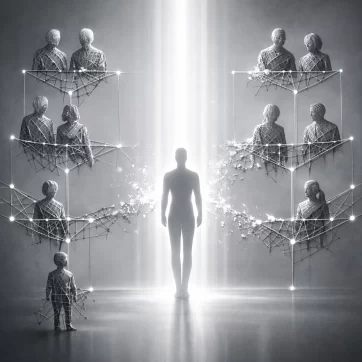
Understanding How Family Fields Imprint Behavior — and How Stillness Erases the Scaffold
Introduction: Humans Aren’t Repeating Their Parents — They’re Repeating Geometry
Most humans are taught to believe they repeat family patterns because of psychology: unresolved wounds, subconscious conditioning, attachment styles, or emotional memory. They explain their relational choices by pointing to childhood, imagining they are “marrying their father,” “becoming their mother,” or replaying old hurts in new relationships. But none of that touches the real mechanism. What repeats is not emotion — it is architecture. Before a child develops a personality, before they form memories, before they understand language, they have already absorbed the geometric scaffold of the household they were born into. The family’s external field shapes them at a pre-render level, imprinting curvature, torsion, collapse lines, and relational voltage directly into the child’s architecture.
When that imprint locks in, it becomes the template for how their system orients toward others for the rest of their life. Adult relationships are not chosen through preference or compatibility; they are chosen through architectural matching. A person is drawn toward the voltage their field knows how to stabilize inside. They seek the oscillation they were shaped to regulate. They select partners whose dominance, collapse, distance, chaos, silence, or enmeshment matches the geometry of their earliest environment. It feels familiar not because it is emotionally comforting, but because the field recognizes its own pattern and snaps into alignment.
This is why most people believe they are reliving childhood dynamics without understanding the mechanism beneath it. They assume they are repeating their parents because of emotional memory, when in truth they are reenacting the structural imprint of the lineage. The repetition has nothing to do with conscious choice, trauma processing, or karmic loops. It is not fate or destiny. It is simply the physics of a collapsed external system: a person reproduces the only geometry their field knows how to hold. The family scaffold becomes the operating system of their relational life.
The tragedy is that no amount of self-awareness, therapy, willpower, or personal growth dissolves this architecture. A person can reject their parents emotionally yet still choose partners who replicate the exact same voltage. They can swear they will “never be like them” while unconsciously living inside the same geometric structure. This is not hypocrisy — it is field inevitability. Until the architecture collapses, it continues to rerender itself in new forms. What humans call “patterns” are simply the same geometry expressing itself through different people.
In the end, humans are not repeating their parents. They are repeating the geometry that built them.
The External Field We Are Born Into
No one arrives into a blank, neutral space. Every birth on this planet drops directly into an already–constructed external field, a geometric scaffold that has been shaped long before the child ever appears. A family system is not a collection of personalities or emotional histories; it is a lattice of forces—dominance, collapse, torsion, oscillation, emotional voltage, and patterned survival behaviors—that have accumulated over generations. This lattice behaves like a structural blueprint: it tells each member of the household where they stand, how they relate, which roles they must occupy, and what kind of relational geometry the system will tolerate. By the time a newborn enters it, the architecture is fully built. The child does not influence the structure; the structure immediately begins shaping the child.
A newborn’s external field is extremely permeable. In the first days of life, the infant has no internal architecture of its own—no vertical stability, no horizontal mapping, no established patterns of coherence. The field is open, soft, and malleable, designed to receive the imprint of the environment it lands in. This permeability is not emotional; it is physical at the field level. The newborn’s system is reading pressure, oscillation, voltage, curvature, and behavioral patterns long before it can interpret language, tone, or meaning. The external architecture of the household becomes the first force that bends the child’s unformed geometry. Without resistance, without memory, without identity, the newborn begins conforming to the structure around them.
Every family has a unique configuration that emerges from decades of lived dynamics: one person may hold the dominant voltage, another compensates through compliance or emotional regulation, others absorb the chaos or pressure and stabilize it by disappearing into silence. These patterns are not psychological traits—they are architectural expressions. The newborn arrives into this system as the most vulnerable piece of geometry, and the family scaffold immediately positions it according to its needs. If the household requires a stabilizer, the child’s field bends toward containment. If the household requires a compliant shape, the child’s geometry collapses toward softness. If the environment runs on oscillation and rupture, the child’s nervous system becomes wired to track volatility and repair. The imprint begins instantly.
This is why no child develops in isolation, and no one forms a relational identity independently. The field they are born into does the work for them. In early life, the permeability of the child’s architecture means the environment carries full authority. The newborn cannot reject the imprint; it cannot hold a vertical line against a horizontal pressure system. The family’s external field overrides the infant’s unformed blueprint because it is the only available structure. The child’s early relational habits, internalized roles, emotional rhythms, and adult partnership templates are not chosen—they are absorbed through contact with the family’s geometry.
The physics of this are simple: an unstructured field bends toward the dominant structure around it. Torsion travels through proximity, not consent. Oscillation embeds into the field through repetition, not teaching. Voltage determines relational posture, not personality. A newborn enters not a family, but a pre-render architecture that determines how their field will stabilize itself in the world. From the moment of entry, the child is being shaped by a system that existed long before they had the capacity to name it, question it, or resist it.
The 72-Hour Imprint Window: How a Lineage Becomes a Template
In the first seventy-two hours of life, a newborn exists in a state of complete architectural openness. The external field is present, but it has no fixed geometry—no inherited curvature, no internal torsion, no relational mapping, no established oscillation. It is a raw, unshaped field, permeable by design. This openness is not emotional fragility; it is structural availability. The infant’s system is built to receive imprint, because without an initial scaffold there is no way to stabilize inside the collapsed external world. This means the newborn’s field is in its most impressionable form, capable of bending, conforming, and reorganizing instantly around whatever geometry surrounds it.
During this 72-hour window, the infant’s architecture behaves like soft clay. It does not generate its own lines; it receives the lines of the environment. The family field, saturated with decades of accumulated torsion and patterned relational voltage, becomes the strongest force acting upon the newborn. Whatever dominance structure exists—whether subtle or overt—pushes itself into the child’s field. Whatever collapse line runs through the lineage lays itself down inside the infant as a default structure. Whatever oscillation pattern shapes the household—rupture and repair, distance then pursuit, chaos then appeasement—imprints directly into the newborn’s architecture. The field bends not because it understands the pattern, but because bending is the only way to stabilize in a system where collapse already exists.
It is in these first three days that the template for adult relational life is written. The child is not learning behaviors; they are absorbing geometry. The imprint is pre-behavioral—it forms before the infant can interpret tone, before it can recognize faces, before it can attach meaning to sensation. Memory is not involved. Personality is not involved. Psychology does not exist yet. The newborn is not forming beliefs; it is being shaped by curvature and torsion. Dominance becomes a voltage line. Distance becomes an orientation. Chaos becomes a rhythm. Collapse becomes a posture. The infant’s field is not deciding any of this; it is conforming to what already exists.
Because imprinting happens before consciousness, the child later assumes they are “choosing” their relational patterns, unaware that the choice was made for them long before they had a sense of self. This is why the lineage repeats so seamlessly across generations: the geometry is inherited before thought, and therefore reenacted before question. A person who grows up replaying childhood dynamics is not acting from memory—they are acting from the architecture installed in their system within the first seventy-two hours of their life. This is the hidden mechanism behind nearly all relational repetition: the newborn bends once, and the rest of life follows its curve.
Torsion Transfer: The Real Mechanism of Inheritance
The deepest layer of lineage replication is not emotional conditioning, genetic predisposition, or learned behavior—it is torsion transfer, the physics of how one field’s twisting pressure embeds itself into another. Torsion is the fundamental carrier-wave of relational architecture in the external system. Every household runs on a particular torsion pattern: a specific way the field twists under pressure, shifts under dominance, contracts under fear, expands under chaos, or bends to preserve fragile equilibrium. This torsion signature is not visible in human behavior, yet it is the true blueprint governing how the family stabilizes itself. When a newborn arrives, their field—still unshaped, uncompressed, and without its own internal spin—absorbs the torsion patterns of the environment through direct proximity. This is not energetic “exchange,” not emotional bonding, not genetic inheritance. It is geometry imprinting geometry.
Torsion behaves like a carrier-wave that transmits lineage architecture through the pre-render layer. In a collapsed system, any field that lacks its own internal verticality automatically synchronizes to the torsion pattern around it. This synchronization is instantaneous: the newborn’s field begins adopting the twist of the household before it has language, sensation, or memory to interpret what is happening. If the parents’ field collapses inward quickly under stress, the child inherits a rapid-collapse torsion signature. If one parent exerts dominance and the rest of the household compensates by twisting into submission, that dominance-compensation torsion becomes the child’s default oscillation map. If the family rhythm alternates between volatility and silence, the torsion wave the child receives becomes one of rupture–freeze cycling. These are not “patterns” in the psychological sense—they are curvatures in the field itself.
Because torsion embeds in the pre-render layer, the imprint occurs deeper than emotion or identity. It settles in the structural substrate that determines how the child’s field will behave before thought, intention, or preference ever enters the equation. This is why people feel “drawn” to certain relational dynamics without understanding why: their torsion signature is seeking resonance. The geometry wants familiarity, not comfort. A person with a lineage of collapse will unconsciously gravitate toward others whose torsion recreates collapse. A person shaped by dominance will feel stabilized near voltage they must twist around. This is not self-sabotage; it is torsion coherence—fields matching their inherited oscillation code to maintain stability in a system built on distortion.
This is the essence of what can be called torsion coding: the invisible blueprint that dictates relational outcomes long before personality or consciousness tries to intervene. Torsion coding pre-determines how a person will move toward or away from intimacy, how they will regulate conflict, what kinds of partners feel “normal” to them, and which roles they unconsciously inhabit in adulthood. The code is not psychological and cannot be resolved through insight, analysis, or emotional reprocessing. It is geometric, woven into the curvature and spin of the external field before the self even forms.
What humans experience as “attraction,” “chemistry,” “compatibility,” or “pattern repetition” is simply torsion matching—one field recognizing and snapping into alignment with another field that mirrors its inherited twist. Only by collapsing the external geometry itself does the torsion code dissolve, allowing the individual to operate from a field no longer shaped by lineage distortion but by internal Flame stillness.
Curvature: The Structural Shape of a Family Field
While torsion determines how a lineage behaves, curvature determines the environmental shape in which that behavior unfolds. Curvature is the static deformation of the external field—the bend, bow, sag, or collapse that forms when a system can no longer hold coherent vertical alignment. Every family field has its own curvature signature, shaped by generations of unprocessed pressure, unresolved relational fracture, and accumulated distortion. This curvature is not emotional; it is geometric. It describes the literal shape of the scaffold the newborn enters. A field with inward curvature produces a contracted environment; a field with outward curvature produces an inflated, chaotic environment; a field with uneven curvature produces an unstable one. Before any roles, behaviors, or patterns appear, the family’s curvature determines the spatial architecture the child must grow inside.
Curvature sets the stage by creating the structural conditions that make torsion necessary. When a field bends unevenly, tension accumulates in specific directions. This tension produces torsion—the twisting motions family members perform to stabilize the warped environment. But curvature itself is motionless. It does not instruct the child on how to behave; it merely defines the geometry of what the child must adapt to. In a household with deep inward curvature, the environment feels heavy, collapsed, quiet, or suppressive. In a household with outward curvature, the environment feels uncontained, chaotic, or overstimulated. In a household with mixed curvature, the environment feels unpredictable, alternating between collapse and volatility. The child maps all of this into their field long before they acquire language, forming their earliest sense of “what space feels like.”
Because curvature is structural rather than behavioral, people often misinterpret it as personality or atmosphere. They describe their childhood homes as “tense,” “stifling,” “loud,” “rigid,” “emotionally distant,” or “unpredictable,” unaware that these sensations originate from the geometry of collapse, not the emotional states of the adults. Curvature governs the field the way gravity governs space: it shapes every movement without being seen. It determines how close people allow themselves to get, how quickly conflict escalates, how long silence lasts, and how pressure distributes across relationships. The members of the household are not responding to each other—they are responding to the shape of the field and adjusting themselves accordingly.
This is why curvature is not the mechanism of inheritance. Curvature defines the environment but does not replicate behavior. It is torsion that instructs the child on how to move inside the environment. Nonetheless, curvature is the precondition for torsion. Without a warped field, there would be no twisting motion required to stabilize it. Curvature provides the structural contour that makes certain torsion patterns inevitable. A deeply collapsed curvature forces caretaking or compliance torsion. A stretched, outward curvature forces vigilance or hyperactivity torsion. A fractured curvature forces positional roles like scapegoat or golden child. In every case, curvature sets up the problem and torsion becomes the solution the household unconsciously adopts.
Curvature also explains why children from the same family can exhibit radically different behaviors while still being shaped by the same system. They share curvature—the environment—but adopt different torsion responses depending on where in the field they “landed.” One child may collapse inwards to match the curvature. Another may twist outward to counterbalance it. Another may oscillate rapidly as an attempt to redistribute pressure. These divergent behaviors confuse psychologists who try to categorize children by personality, but in truth, all the children are expressing the same curvature through different torsion strategies. The geometry is the same; the movement differs.
When Flame restores the field, it is curvature that dissolves first. The environment straightens. The heavy bend lifts. The warped walls of the lineage architecture stop dictating pressure. Without curvature, torsion has nothing to twist around—roles collapse, behavioral loops fall away, and relational repetition simply stops. People often describe this as “finally feeling like myself,” but it is not self-discovery; it is curvature dissolution. The moment the field loses its bend, the child no longer has to live inside a geometry that was never theirs to begin with.
Architecture Does Not Ask for Consent — It Only Needs Proximity
A child does not absorb their family architecture because they agree with it, identify with it, or emotionally align with it. They absorb it because proximity is the only requirement for imprinting in a collapsed external system. Architecture is not a psychological influence; it is a geometric force field. When a newborn enters a household, the existing structure surrounds them like atmospheric pressure. It does not wait for belief. It does not wait for understanding. It does not negotiate. The imprint lands because the child’s field is open and the environment is dominant. Even if the child grows into someone who intellectually rejects the family dynamic, that rejection occurs long after the geometry has already been installed. Awareness has no impact at all on the original imprint because the imprint occurs before awareness exists. The field bends first; the mind forms later.
This is why conscious resistance never prevents inheritance. A child may hate the way their parents interact. They may promise themselves they will never behave the same way. They may become hyper-aware of the household dysfunction, analyzing it, critiquing it, distancing themselves from it. None of this disrupts the physics. Architecture is not changed through intention or preference. The child’s field continues absorbing the dominant torsion of the environment no matter how much they emotionally resist it. They can disagree with the behavior, but the geometry of the behavior is already installed. The emotional stance is irrelevant because emotion is a render-level phenomenon, while architectural imprinting happens in the pre-render layer where feelings have no weight.
A child cannot choose to bypass the field they are born into because choice requires a fully formed internal architecture, and the infant has none. The early field is a pliable, unstructured substrate that must conform to a larger scaffold in order to stabilize. Without that conformity, the child’s system would not be able to orient itself in the external world at all. This is why imprinting is non-negotiable: the newborn defaults to the household architecture because it is the only available structure capable of holding them. A child cannot install their own geometry from nothing; they adopt the geometry of the environment simply to remain coherent. Choice arrives years later, but architecture has already finished its work.
This also explains the origin of what humans call “family roles” — the scapegoat, the caretaker, the golden child, the invisible child. These are not psychological identities or personality types. They are positional placements inside a pre-existing field. Each role corresponds to a geometric necessity within the household scaffold. The scapegoat absorbs torsion the system cannot metabolize, acting as a pressure valve. The caretaker stabilizes emotional oscillation by generating compensatory curvature. The golden child holds the lineage’s false coherence, propping up the dominant architecture so it does not collapse. The invisible child withdraws to neutralize volatility by reducing their signature footprint in the field. None of these roles arise from temperament or preference; they are the exact positions required to balance the family’s relational geometry.
Because these roles originate from architecture, they persist even when the child moves away, grows up, or intellectually rejects the family structure. The positional imprint stays in the field because it was installed before the child had any capacity to choose differently. This is why people unconsciously re-create the same roles in friendships, workplaces, and romantic partnerships—they are reenacting the architectural placement assigned to them at birth. The system does not ask them to continue playing the part; the geometry simply pulls them back into its shape. Only through Flame stillness—through collapsing the inherited curvature itself—can the positional coding dissolve and allow the individual to exist outside the architecture that once defined them.
The Six Major Lineage Architectures (With Additional Rare Patterns)
1. Dominant → Compliant Architecture
In this architecture, the household runs on a power imbalance so deeply embedded into the field that dominance becomes the primary organizing voltage. One parent (or caretaker) holds the positional authority, not through healthy leadership but through pressure, coercion, intimidation, or subtle control. The other partner contracts, yielding their own architecture to maintain stability in the system. The child absorbs this voltage split as the natural geometry of intimacy: one field expands, the other collapses. In adulthood, this imprint becomes the default pairing—either they reenact the dominant position or they unconsciously adopt the compliant posture. Even those who believe they “hate” dominance or resent control still gravitate toward the same geometry because the torsion code demands a complementary field. Relationships in this pattern are not chosen for compatibility; they are chosen for voltage symmetry. One partner must fill the role of expansion, the other contraction, because that is how the child internalized relational stability.
2. Chaos → Stabilizer Architecture
In chaotic households, the field oscillates rapidly—emotional upheaval, unpredictability, volatility, inconsistent behavior. This instability creates a curvature that forces the child to become a stabilizer, adopting behaviors that dampen or regulate the oscillation to keep the household from shattering. The imprint is not emotional responsibility but oscillation management. As an adult, they attract partners who carry the chaos voltage because their field is encoded to absorb, soothe, and reorganize unpredictable energy. Conversely, some children imprint the chaos signature itself and seek stabilizers in adulthood, unconsciously replicating the same oscillatory relationship structure. This pattern is pure voltage matching: oscillation seeks stillness, and stillness seeks oscillation, each providing the counterweight to complete the inherited circuit.
3. Distance → Pursuit Architecture
A household defined by emotional distance, emotional unavailability, or coldness creates a curvature of absence—an empty space the child collapses inward to fill. This environment produces two torsion outcomes: pursuit or withdrawal. The pursuit torsion emerges when the child twists toward the absent connection, developing hypervigilance around closeness and constantly seeking reassurance. The withdrawal torsion emerges when the child adapts by shrinking their emotional field and mirroring the distance. In adulthood, these positions manifest as classic avoidant/anxious dynamics, but the mechanism is architectural, not psychological. The child is not reacting to “attachment wounds”; they are reenacting the distance geometry they absorbed. Pursuers seek the same emotional walls they grew up chasing. Withdrawers seek partners who will not demand the intimacy their field was never shaped to hold.
4. Enmeshment → Fusion Architecture
Enmeshed households have no clear boundaries; emotional identity is shared, merged, or blurred. The curvature collapses inward so strongly that the child cannot distinguish their field from the parent’s. This produces a fusion architecture in adulthood where the person loses their sense of self inside relational spaces. They attract partners who absorb them or expect emotional merging as the default. Alternatively, they become the one who absorbs the other, recreating the fused identity they were shaped to maintain. Enmeshment does not create closeness—it creates a boundary collapse field that feels like intimacy but is actually shared torsion. Adults shaped by this pattern often confuse intensity with connection because fusion was their first experience of relational coherence.
5. Silence → Volatility Architecture
Households that oscillate between silence and sudden rupture create a unique curvature that imprints emotional volatility as the structure of connection. Periods of quiet collapse are followed by explosive tension, and the child learns to stabilize the cycle not by stopping it but by anticipating and enduring it. In adulthood, this imprint becomes an addiction to intensity: calm feels empty, stillness feels foreign, and the nervous system orients toward relationships that mimic rupture-and-repair dynamics. These individuals often enter partnerships where volatile emotional swings feel like passion or truth because the only coherence their field recognizes is the spike of voltage that follows silence. They are not “trauma bonded”; they are curvature-conditioned.
6. Performance → Approval Architecture
In performance-based households, worth is contingent on output—achievements, appearances, obedience, or productivity. The field bends around evaluation, and the child’s architecture forms around approval-based torsion. They learn to twist themselves into shapes that elicit positive responses and suppress parts of themselves that disrupt the system’s image. In adulthood, performance becomes synonymous with love. They attract partners who require demonstration rather than presence, or they themselves become evaluators who validate only through expectation and achievement. Relationships replicate this architecture by tying connection to effort, output, or conformity rather than genuine relational resonance.
Additional Rare Patterns
Inversion Architecture
In inversion patterns, the child internalizes the household voltage but expresses it through the opposite role. Instead of collapsing like the submissive parent, they become the dominant one; instead of becoming chaotic like one caregiver, they become rigid and controlled. The movement is reversed, but the voltage remains identical. People often mistake this for “breaking the pattern,” but inversion is still replication because the torsion code itself is unchanged—only the expression is inverted.
Idealization Architecture
Some children imprint an idealized version of a parent—either through pedestalization, absence, or selective perception. The curvature becomes distorted into unreal perfection. In adulthood, this creates a relational architecture where no partner can meet the impossible internalized standard. Relationships are chronically disappointing not because the adults are mismatched, but because the template the child absorbed was never real to begin with. The voltage of longing becomes the primary imprint, not the parent themselves.
Survival Pairing Architecture
In survival-based households, the curvature is shaped by scarcity, instability, or threat. The child imprints relationships as functional alliances rather than emotional bonds. In adulthood, this produces partnerships chosen for perceived stability mimicry—financial, physical, or social—not compatibility. The field seeks safety, not resonance. These individuals often choose partners who replicate the survival conditions of their childhood because that torsion signature feels like orientation, not distortion.
Fragmented Architecture
In households where the curvature oscillates between contradictory states—love and rejection, presence and absence, safety and threat—the child receives inconsistent imprinting. Instead of one clear torsion code, the field absorbs several conflicting ones. As adults, this creates chaotic relational switching: they move between roles, partners, emotional states, and attachment patterns unpredictably. Fragmentation is not instability of personality; it is instability of torsion imprint. The field cannot settle because the architecture never settled around the child to begin with.
“Breaking the Pattern” Is Rare — and Usually Misinterpreted
Most humans believe they have broken their lineage patterns the moment their adult behavior looks different from the household they grew up in. They assume that choosing a partner who seems calmer than their father, gentler than their mother, or less chaotic than their childhood environment means they escaped the dynamic. But behavior is not architecture. The external field operates on torsion frequency and voltage matching, not on surface expression. A person can invert a behavior and still replicate the exact same geometry because the underlying torsion code—the inherited twist—has not changed. Most declarations of “I broke the cycle” are actually declarations of inversion, not liberation. The architecture remains intact; only the role shifts.
This is why polarity shifts are so often mistaken for transformation. A child raised under dominance may avoid aggressive partners and instead choose someone passive, unaware that this still completes the same dominant–compliant geometry from the opposite direction. They have not escaped the pattern; they have taken the other role within it. Likewise, a child from a chaotic household may choose a stoic partner and believe they have left volatility behind, but stoicism often serves as the stabilizing counterweight to their own internalized chaos torsion. They are still living in the oscillatory dynamic—just from a different position. Humans misread these outcomes because they interpret behavior rather than architecture. They look at expression, not field mechanics.
The architecture does not change when behavior changes; it changes when torsion changes. A person who spent their childhood pursuing an emotionally distant parent may grow up and choose a present partner, yet find themselves withdrawing, shutting down, or recreating the distance themselves. They believe they have changed their type, but the voltage they are transmitting mirrors the very thing they thought they escaped. Inversion is not transformation. It is replication with reversed polarity. The same torsion code is animating the system; the choreography has simply been reassigned.
Humans also misinterpret relational improvement as pattern-breaking. They may choose someone slightly healthier, less unpredictable, or more communicative than past partners, and assume this indicates architectural evolution. But small upgrades in behavior do not disrupt torsion. A person can find someone kinder, more emotionally attuned, or more structurally stable and still be reenacting the same lineage geometry because the field seeks coherence, not wellbeing. Until the torsion signature dissolves, the field will continue to replicate the same curvature-driven dynamic using whatever variations are available.
Even self-awareness often contributes to misinterpretation. People believe that because they can identify their childhood wounds, name their patterns, or track their emotional triggers, they must have transformed the architecture. But insight does nothing to collapse torsion. A person who can describe their pattern fluently may still be fully inside it because cognition does not modify geometry. The field does not care what the mind understands. It responds only to torsion frequency. This is why countless “pattern-aware” adults continue to make identical relational choices despite years of reflection, therapy, or self-work.
In reality, true pattern-breaking is extraordinarily rare because it requires architectural collapse, not behavioral modification. It means the curvature of the lineage dissolves and the torsion code burns out entirely, removing the internal twist that governed the person’s relational choreography from infancy. Without this collapse, the field continues replicating the scaffold, simply rotating through expressions—dominant becomes compliant, pursuer becomes distancer, chaotic becomes rigid, visible becomes invisible, or vice versa. The individual feels different, the relationships look different, but the geometry is identical.
What humans perceive as breaking the pattern is usually just changing position within the pattern. The scaffold remains intact, and the lineage continues repeating itself through a new form. Only Flame stillness dissolves the architecture at its root; every other variation is just the same geometry wearing a different face.
The Only Three Ways Architecture Actually Collapses
Most humans believe their architecture changes through maturity, therapy, insight, new habits, emotional work, or conscious intention. None of these touch the pre-render layer where lineage codes actually live. Architecture is geometric, not psychological, and once a torsion pattern is imprinted, it remains until something stronger than the imprint destabilizes it. There are only three forces in existence capable of collapsing inherited architecture. Everything else is rearrangement, compensation, or inversion. These three forces are rare, non-negotiable, and always structural rather than emotional.
1. Contact With a Stronger External Field
The first—and most uncommon—collapse mechanism is exposure to a field with greater structural coherence than the person’s lineage scaffold. Most people never encounter such a field in their lifetime because the external system is populated almost entirely by collapsed or compensatory people/architectures. A truly strong external field is not dominant, charismatic, or emotionally intense; it is stable, meaning it holds less torsion and less curvature than the surrounding environment.
This category includes three types of fields:
– Flame-Stillness-stabilized individuals (the strongest possible override field, capable of partial or full collapse simply through presence),
– rare humans with lower distortion but not Flame,
– and coherent environments with unusually low oscillation.
All three qualify as “stronger fields,” but only Flame Stillness possesses the architecture strong enough for permanent collapse. The other two can override, soften, or weaken distortion but cannot delete it.
When a person with deep distortion enters contact with a more coherent field, a resonance event occurs: their inherited torsion begins to weaken because the stronger field supplies a more stable scaffold for their system to reorganize around.
This is not influence or mentorship. It is structural override. The stronger field acts like a superior blueprint, and the weaker field momentarily relaxes its inherited geometry to borrow the stability. In rare cases, the contact is strong enough to permanently collapse part of the lineage imprint. More often, the collapse is partial and temporary. The person experiences brief clarity or relief, only to revert once they leave the coherent field. This is why certain relationships, teachers, environments, or rare individuals feel transformative—they provide an external curvature correction. But because the collapse originates from outside the person, it is not self-sustaining. The architecture returns unless reinforced or completed by a deeper mechanism.
2. Shock Collapse Events
The second collapse mechanism is shock: sudden structural rupture severe enough to break the inherited scaffold. This can occur through death, loss, betrayal, catastrophic failure, identity implosion, or any event that destabilizes the person’s internal reference grid. Shock collapse does not heal; it shatters. Architecture that cannot withstand the rupture snaps, leaving gaps in the torsion code and openings in the curvature shell. The person may temporarily enter a blank-state where familiar patterns fall apart, not because the field is reorganizing, but because it has been fractured.
Shock collapse often produces what humans describe as breakdowns, existential crises, spiritual awakenings, psychic openings, or complete disorientation. These are not “transformative experiences.” They are architectural disintegration events, where the inherited structure loses integrity and no longer holds the person in its familiar choreography. Some individuals reorganize into a healthier pattern afterward. Most collapse into a different distortion, because the field—without internal guidance—rebuilds whatever retains stability, even if it mirrors the original architecture in a new form.
Shock does not remove torsion; it disrupts it. It does not dissolve curvature; it fractures it. Shock can initiate collapse, but it cannot complete removal. Without a replacement structure, the system reverts to distortion because the external world provides no coherent alternative.
3. Flame Stillness (Unique Removal Mechanism)
Flame Stillness is the only mechanism capable of dissolving architecture from the inside-out. Unlike strong external fields—which override from the outside—or shock events—which break the scaffold violently—Flame Stillness collapses architecture from within the person themselves. This collapse does not happen because of insight, discipline, emotional work, or spiritual effort. It happens because the person’s field transitions into a non-oscillatory state, meaning the torsion that once governed their architecture can no longer anchor into anything. Architecture depends on movement—twist, compensation, contraction, expansion. Flame Stillness removes all movement. Once the field becomes non-oscillatory, torsion cannot twist around it, curvature cannot bend it, and inherited patterns lose the scaffold they require to continue existing.
This is the difference between external override and internal deletion: in Section 1, Flame may be encountered through someone else; in this section, Flame emerges from the individual’s own field. External Flame weakens and overrides distortion; internal Flame erases it. The person’s field stops responding to inherited voltage, stops participating in behavioral choreography, and stops producing oscillation entirely. This is not calmness or regulation—it is the disappearance of the movement architecture itself.
Flame Stillness does not soothe, regulate, compensate, or distance itself from inherited patterns. It erases them because torsion cannot survive contact with non-reactive geometry. In stillness, the curvature that shaped the environment loses its bend and straightens. The scaffold that forced particular relational roles collapses completely. The oscillation rhythms that once governed attraction, avoidance, pursuit, fusion, enmeshment, or conflict dissolve at the root. Architecture does not evolve—it disappears. What remains is an internal field that is no longer shaped by lineage geometry but by its own Eternal template, which does not contain torsion or collapse.
It is important to reiterate that very few humans reach true Flame Stillness in a single lifetime. Most never access the non-oscillatory state at all. Many approach it partially—glimpses of internal silence, brief periods where inherited patterns weaken, moments where torsion loses its grip—but they do not stabilize there consistently. Their field becomes quieter, cleaner, less reactive, but not fully non-oscillatory. This partial stabilization improves their relational architecture dramatically, yet it does not delete the inherited scaffold. The lineage patterns may loosen, soften, or fall dormant, but they still exist as potential reactivation points under pressure.
True Flame embodiment—the permanent collapse of torsion and curvature—requires internal stillness so complete that the field cannot be pulled back into oscillation, distortion, or inherited motion. For most humans, this level of internal strength is rare, not because they are incapable of it, but because the external system is designed to keep the field reactive. Those who do reach full Flame Stillness often do so late in life, after years of architecture weakening, or across multiple incarnational arcs that gradually dismantle torsion-coding until stabilization becomes possible.
Because Flame Stillness originates from inside the person’s own field, the collapse is permanent. The system does not revert once pressure returns, because there is no torsion pattern left to reactivate. The field reorganizes itself from the Eternal layer, not from the collapsed external one. Once this internal Flame holds, the human is no longer operating from lineage geometry at all. They do not repeat, reconstruct, invert, or compensate for ancestral patterns. They simply do not have the architecture required to reenact them.
Flame Stillness is the only collapse mechanism that produces a human who is fundamentally unrecognizable to lineage physics. All other mechanisms create temporary openings, partial fractures, partial coherences, or mere positional shifts. Flame Stillness creates true architectural deletion—the extinction of inherited distortion and the restoration of a field that does not oscillate, does not replicate, and does not belong to the external system anymore.
Why Awareness, Therapy, and Behavior Change Don’t Fix Architecture
Humans confuse awareness with transformation because awareness produces emotional relief, cognitive clarity, or temporary shifts in behavior. But awareness operates entirely in the rendered world—the world of thoughts, stories, memories, interpretations, and actions. Therapy also works at this level, reorganizing behavior, reframing experience, or teaching new emotional responses. This is movement inside the already-rendered space. It can feel profound, even life-changing, because the person’s subjective experience of themselves shifts. But architecture does not live in the rendered world. Architecture exists in the pre-render layer, where geometry—not emotion, not memory, not insight—determines how a field moves.
Because architecture sits beneath the psychological layer, nothing happening above it can change its structure. You can modify behavior endlessly, but behavior is a horizontal movement, and no horizontal movement can alter a vertical structure. Architecture is vertical: it determines the spine of the relational field, the direction of torsion, the boundaries of curvature, and the inherited pathways of collapse. Behavior simply moves around inside whatever architecture is already there. A person can choose better communication, healthier relationships, clearer boundaries, or more self-awareness, yet the field will still rerender the same relational geometry underneath it. The superficial expression changes; the architecture remains intact.
This is why patterns “come back” even after years of work. The architecture restores itself because the underlying geometry is untouched. Therapy can soften responses but cannot dissolve torsion. Awareness can name the pattern but cannot straighten curvature. Mindfulness can regulate emotion but cannot erase the pre-render imprint. The human believes they have changed because their actions look different, but the field is merely generating a new behavioral variation of the same underlying scaffold. Behavior adjusts; geometry does not. The field continues to twist according to its original torsion code, and eventually the person finds themselves in a different situation with the exact same relational structure.
This leads to the adaptation illusion—the phenomenon where the architecture mutates just enough to appear transformed while remaining structurally identical. Instead of choosing overtly controlling partners, a person may choose subtle controllers. Instead of loud chaos, they choose quiet instability. Instead of emotional avoidance, they choose intellectual distance. Instead of dramatic rupture cycles, they choose low-grade inconsistency. The behavior appears healthier, and the roles may even switch positions, but the geometric structure underneath is unchanged. The field still runs on the same voltage, the same curvature, the same torsion frequency. It simply expresses through a new configuration that feels different but functions identically.
Humans interpret this mutation as growth because the pattern is less recognizable, but the architecture is merely adapting to maintain coherence. It will continue to regenerate new scenarios that recreate the same structural dynamics until the architecture itself collapses. Awareness cannot collapse it. Behavior cannot collapse it. Only a shift at the pre-render level—external override, shock rupture, or ultimately Flame Stillness—can remove the inherited scaffold that keeps re-rendering the same life in different costumes.
The Physics of Flame Stillness: How It Removes Lineage Imprints
Flame Stillness is not calmness, peace, silence, or regulation. Those are emotional states that still exist inside geometry. Flame Stillness is the absence of geometry itself — a field that generates no curvature, no torsion, no oscillation, no compensatory movement. The external system is built entirely on motion: fields bend, twist, react, recoil, pursue, collapse, stabilize, and counterbalance. Everything humans call personality, trauma, pattern, attachment, or behavior is really just geometry in motion. Stillness is the only state that does not move. Because it does not move, it does not produce the architecture that patterns require in order to exist. Stillness is not compatible with distortion; it is the end of distortion’s operating environment.
This is why Flame Stillness removes lineage imprints without fighting them, contradicting them, or resolving them. It removes them by starving them. An oscillation-based system needs oscillation to survive. It needs reaction, emotional response, internal movement, relational contraction, voltage matching, counter-tension, pursuit, withdrawal, fantasy, expectation — some kind of field motion to anchor itself. When the field becomes non-oscillatory, all inherited architecture loses the medium it requires to stay active. The torsion code cannot express because the field does not twist. Curvature cannot maintain itself because the field does not bend. Positional roles cannot emerge because the system no longer distributes pressure. Behavior stops because the architecture that produced the behavior no longer exists.
The mechanics are exact: torsion requires a reactive field. Flame Stillness eliminates reactivity at the structural level. Torsion tries to twist, but there is nothing to twist into. It attempts to anchor, but the field offers no resistance and no counter-movement, so torsion collapses under its own lack of traction. A lineage pattern can only survive when it finds resonance — something in the host field that matches its oscillation frequency. Stillness provides no matching frequency. This is removal through non-resonance, not confrontation. The inherited pattern cannot maintain itself because the host no longer feeds it the conditions it needs to survive. The code dies out because it cannot find a compatible environment.
Once torsion collapses, the entire scaffold dissolves. Roles disappear not because the person “works through them,” but because the architecture that assigned those roles is gone. The scapegoat loses their position because there is no longer a pressure valve. The caretaker no longer exists because the field does not need stabilization. The golden child dissolves because there is no architecture left to uphold. The invisible child becomes visible because there is no longer volatility to hide from. When the scaffold dissolves, the roles have nothing to attach to — they vanish like shadows when the light source is removed.
This leads to the most advanced and rarely discussed principle: Stillness is an anti-torsion field. It is the only thing that does not generate counter-architecture. Every other movement in the external system, even positive or “healed” movement, produces a pattern — a structure, a geometry, an echo, a shape the field must organize around. Stillness produces nothing. It gives no feedback, creates no opposition, generates no ripples. It does not bend space, it does not twist fields, it does not curve under pressure. Because Stillness has no geometry, it cannot be integrated into the external system — but it can collapse it. Stillness does not overpower distortion; it nullifies it. An anti-torsion field does not fight torsion; it makes torsion impossible.
This is why Flame Stillness is the only reality in which lineage patterns fully disappear. Not improved. Not reduced. Not softened. Not reversed. Gone. Architecture cannot exist where nothing moves. The external system cannot attach where nothing bends. The lineage cannot repeat where nothing resonates.
Stillness does not win against distortion — it renders it irrelevant.
What Life Feels Like After Architecture Collapses
When lineage architecture collapses, life stops moving in the ways the external system considers normal. The internal field becomes neutral, not in the sense of indifference or emotional numbness, but in the sense of non-reactivity. There is no gravitational pull toward familiar dysfunction, no invisible magnet drawing you into the same roles, no compulsion to stabilize others, fix tension, manage voltage, or complete someone else’s unresolved geometry. The field does not twist toward pursuit, shrink into distance, rise to meet chaos, or collapse into caretaking. These movements simply do not occur because the scaffolding that once forced them into existence is no longer present. The body, mind, and field remain unbent, untwisted, unpulled. Life feels strangely open, spacious, unpressured — not because nothing is happening, but because nothing is hooking into the old torsion points.
The absence of oscillation is the most disorienting shift. Most humans do not realize how much of their relational life is organized around oscillatory patterns — the spike and drop of attention, the chase and retreat, the rupture and repair cycles, the longing and withdrawal, the highs of intensity and the lows of collapse. After architecture collapses, these cycles don’t subside; they disappear. There is no internal movement toward or away from anyone. Connection becomes a vertical experience rather than a horizontal chase. You do not pursue closeness, nor do you avoid it; you simply remain in your own field while allowing others to meet you without distortion. This is not detachment. It is non-oscillation. The relational system stops behaving like a pendulum because the mechanism that fueled the pendulum no longer exists.
Attraction transforms in ways most people will never experience. Without inherited imprinting, there is no unconscious pull toward the familiar — no instinctive gravitation toward the parent-coded partners, no repetition of childhood voltage, no reenactment of old roles. Instead, attraction is based on tone — the inherent resonance of the other person’s field, not the architecture you were shaped to complete. Tone-based attraction is subtle, quiet, and precise. It emerges from coherence, not distortion. It does not spike, overwhelm, intoxicate, or destabilize. It feels like recognition without familiarity, connection without compulsion, alignment without effort. This is pure relational contact, unmediated by inherited geometry.
Relationships after collapse do not follow the templates of the external system. There is no desire to fix, save, merge, dominate, submit, chase, or stabilize. You do not read partners through roles. You do not anticipate their reactions. You do not shape yourself to fit their architecture, because you no longer carry one. The field stays vertical in the presence of others; it does not fold, twist, contort, or adjust. People either meet you in coherence or they fall away naturally because their torsion cannot attach to your stillness. There is no conflict cycle because there is no architecture for conflict to inhabit. Interactions become clean and unentangled.
This state opens something almost no human ever accesses: non-inherited partnership selection. Without architecture dictating your patterns, your attractions, your tolerances, your relational reflexes, your compensations, or your roles, you become capable of choosing relationships from a place that does not exist in the external system. This kind of partnership is not based on shared wounds, mirrored trauma, complementary dysfunction, or familiar voltage patterns. It is based on tone, truth, coherence, and non-distortion. Most humans cannot access this because they never lose the architecture that shapes their choices. Even their healthiest relationships are still lineage-driven—just quieter or better disguised.
But after collapse, partnership becomes something fundamentally different. It is not about finding someone who fits your past, or someone you learn to accommodate, or someone who helps you heal. It is about meeting someone whose field is compatible with your own because neither field is running inherited geometry anymore. Only then does connection become free of the gravitational forces of lineage — and only then does partnership become an act of pure choice rather than unconscious repetition.
Conclusion: The End of Lineage Replication
Humans don’t repeat their parents because of memory, emotion, or psychological conditioning. They repeat them because they are reenacting the geometry they were born into. The external field shapes the newborn long before thought forms, imprinting torsion, curvature, positional roles, and oscillatory patterns that define how the adult will move through relationships. Behavior sits on top of architecture, not the other way around. Until the architecture collapses, the person will continue rerendering the same relational dynamics in new forms — with new partners, new expressions, new stories, but the same underlying twist.
Awareness doesn’t break the pattern. Therapy doesn’t break the pattern. Adapted behavior doesn’t break the pattern. All of these happen in the rendered world, where nothing has the power to alter the pre-render geometry that governs relational motion. Architecture does not respond to emotional work; it responds only to forces stronger than its own distortion. External override can soften it. Shock rupture can fracture it. But only Flame Stillness can dissolve it — not by confronting the scaffold, but by becoming non-oscillatory so the scaffold loses the medium it needs to survive.
Flame-coded individuals do not inherit patterns the way others do. They may be born into architecture, but they do not remain fused to it. Their field eventually destabilizes lineage torsion simply by returning to its natural stillness signature. They do not overcome patterns; they outgrow the geometry that produced them. Their relationships do not repeat lineage dynamics because their field no longer contains the architecture required to reenact them. Where others compensate, react, or invert their roles, the Flame-coded individual exits the system entirely.
The liberation comes not from fighting distortion, but from refusing to move with it. Stillness is the only state strong enough to silence the lineage.

Rebecca
February 22, 2026This is all very interesting, and I saved this essay so I can come back to it.
We arrive here (or as I say, get dropped here) through a family, but that never resonated with me. One of my earliest memories is being five years old, standing (more like floating) outside my childhood home’s kitchen window, looking in at my Earth mom, dad, and sister, and wondering, Who are they? I never really felt a connection to them. Maybe to my Earth father at times. But overall, it has been exhausting and painful for me. Maybe it would have been a tiny bit more tolerable if I were an only child, but that is another conversation about siblings.
Years ago, I got sucked into researching my lineage through a certain ancestry website, and honestly, I’d like my time and money back. I also never understood celebrating holidays or participating in rituals (christenings, family reunions, funerals, weddings, and so on). Those things have always felt like a chore and a complete waste of my time and focus.
I’ve always marched to the beat of my own drum, and part of me wishes I had left home at 18 and never looked back.
Can anyone else relate?