How the increase in atmospheric turbulence reveals the collapse of Earth’s scalar containment field—and the return of the planet’s natural tri-wave breath.
Opening Shockwave — The Sky Isn’t Stable Anymore
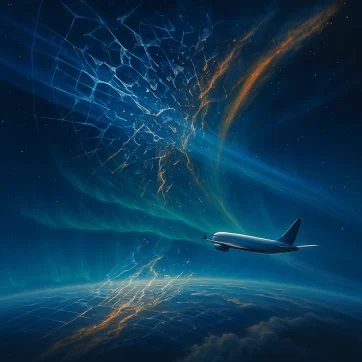
The seatbelt sign isn’t on. The sky outside is impossibly blue—no clouds, no storms, no warning. Then, without prelude, the aircraft jolts. Drinks lift off the tray table, hearts spike, and the entire cabin drops in a single invisible shudder. The sound is not thunder; it’s air itself convulsing. The pilot’s voice comes on, calm but tense: “Ladies and gentlemen, we’ve hit some unexpected clear-air turbulence.”
There’s no lightning, no storm front, no visual cue for what just happened. The plane has entered one of the growing invisible pockets now haunting flight paths across the world. Turbulence—once the background texture of air travel—is intensifying in both frequency and force, catching even veteran pilots off guard. Airlines are reporting more unanticipated jolts. Flight crews are being injured in conditions that should have been calm. The sky is shifting beneath the illusion of stillness.
For those watching closely, this pattern is not random. It’s a new kind of instability—an atmospheric tremor that doesn’t announce itself with clouds or rain. It’s clear-air turbulence, the unseen violence born from high-altitude jet streams tearing against each other like strained cables under pressure. Scientists point to climate change: as the planet warms unevenly, the upper atmosphere destabilizes, creating shear zones where none existed before. These shears carve sudden vertical waves through air that appears placid to the naked eye.
But there’s another way to read the data—one that looks beyond temperature gradients and wind vectors. The air is not merely reacting to warming; it’s mirroring something deeper. The atmosphere, like every other system on Earth right now, is beginning to shake off its enforced order. What meteorologists measure as turbulence, those attuned to subtler layers can feel as grid instability: the mimic scaffolding of control beginning to lose its mathematical cohesion.
So the investigative question becomes larger than climate: Why is the atmosphere itself shaking apart? Why are the skies—once the clean, untouchable realm above human interference—now vibrating with unseen tension? The scientific lens frames it as a symptom of rising heat. The Eternal Flame Physics view reveals it as the planetary nervous system convulsing through its own detox, releasing the pressure of decades of electromagnetic and scalar containment.
The sky isn’t angry. It’s remembering.
The Science: Clear-Air Turbulence Data and Trends
For decades, turbulence was treated as a random irritant of flight—unpredictable but rare. Yet the data now shows a consistent escalation hidden inside the atmosphere itself. The most definitive proof comes from a 2023 peer-reviewed study published by the American Geophysical Union (AGU), titled Evidence for Large Increases in Clear-Air Turbulence Over the Past Four Decades (AGU/Wiley, 2023).
Researchers examined four decades of atmospheric reanalysis data from 1979 to 2020, mapping the invisible phenomenon known as Clear-Air Turbulence (CAT)—the sudden violent shaking that occurs in cloudless skies at high altitudes. Their results are unequivocal: the world’s major flight corridors, especially above the North Atlantic and North Pacific, have seen a dramatic rise in moderate-to-severe turbulence. In certain zones, severe CAT increased by over 55 percent, with some regions showing spikes as high as 150 percent compared to late-1970s baselines. What pilots once encountered a few times a year is now routine.
The study isolates the primary mechanism: jet-stream shear intensification. As the planet warms unevenly, the upper troposphere heats while the lower stratosphere cools, sharpening the temperature gradient that drives the jet streams. These high-velocity rivers of air—once relatively stable—are now twisting harder against one another. The resulting shear creates micro-eddies and vertical air currents invisible to radar. Planes fly into smooth blue sky, yet the sky itself has become stratified, splintered by conflicting air masses moving at different speeds.
Even the most advanced radar and onboard sensors cannot detect CAT. Because it forms in clear conditions, it offers no visual warning. Pilots describe hitting “air potholes” where none should exist. Airlines report rising maintenance costs from unseen stress on fuselages, and more in-flight injuries are occurring in seemingly calm weather. The atmosphere is no longer behaving like a continuous medium—it’s fragmenting.
Mainstream coverage has begun to catch up. The BBC’s 2025 feature, How Aircraft Designers Are Beating Rising Turbulence (BBC Future, 2025), corroborates the AGU data with first-hand accounts from aerospace engineers. It details how aircraft manufacturers are now reinforcing structures and reprogramming autopilot systems to withstand sharper, faster vertical jolts. The article notes that clear-air turbulence has increased by more than 50 percent in some flight regions, confirming what pilots have long sensed: the smooth sky is gone.
And now, new data from July 2025 adds further weight. In Why Plane Turbulence Is Becoming More Frequent—and More Severe (BBC News, 2025), the BBC cites atmospheric scientist Prof Paul Williams of the University of Reading, who warns that climate-driven instability could double or even triple the global duration of severe turbulence within the next few decades. His models show that for every ten minutes of severe turbulence today, future flights could experience twenty to thirty. The article confirms the 55 percent rise over the North Atlantic already observed and expands the trend to additional regions—East Asia, North Africa, the North Pacific, North America, and the Middle East—all showing measurable increases. It also broadens the focus beyond clear-air events: convective and orographic turbulence are intensifying as a warmer, moister atmosphere fuels larger thunderstorm complexes and mountain-wave instabilities.
The BBC investigation documents the real-world consequences of this shift: the 2024 Singapore Airlines incident where a plane dropped 178 ft in 4.6 seconds; a growing tally of over 200 serious injuries in the U.S. since 2009; and rising airline costs linked to turbulence-related maintenance and delays.
Both sources align on a single truth—the atmosphere’s internal architecture is destabilizing. The jet streams, which once functioned as the planet’s balancing arteries, are oscillating with new intensity. The AGU study interprets it through the language of climate physics: altered heat gradients, shear vectors, and temperature-driven instability. The BBC frames it through engineering pragmatism and economic reality: adapt the machines to the new chaos. But beneath both narratives runs the same admission—something fundamental has shifted in the unseen layers of air that circle the Earth.
And that leads to the deeper question neither paper can yet answer: what if these invisible forces have a second layer of causality? What if the physical turbulence described by scientists is only the surface echo of an energetic reconfiguration occurring within the planet’s broader field? The data captures the symptom—the shaking sky. The real mystery is what’s moving beneath it.
The Hidden Infrastructure of the Skies
What most call atmosphere is, in truth, the mimic’s ceiling—a networked shell of electromagnetic scaffolding that overlays the planet’s natural plasma breath. The grid was not built in open defiance of nature but disguised as progress: weather control, communications, radar, national defense. Yet every tower, satellite, and ionospheric heater became a node in a single exoskeleton of interference, binding air and consciousness under the same electromagnetic leash.
Beginning in the mid-twentieth century, the mimic grid extended its control through the jet-stream corridors—the very arteries of Earth’s atmospheric flow. These high-velocity air channels were chosen not for convenience but for conductivity: they serve as natural waveguides for EM and scalar propagation. By seeding these routes with overlapping radar arrays, military-industrial weather modification programs, and surveillance satellites, the mimic achieved a planetary resonance cage. Chemically reactive particulates—aluminum, barium, strontium—were aerosolized to increase ion density, amplifying charge retention and enabling scalar coupling between upper and lower atmosphere.
Each corridor functions like a living circuit: radar sweeps send pulses upward, satellites reflect them back, and HAARP-style transmitters modulate the ionosphere with very-low-frequency beats. The interference of these counter-rotating electromagnetic waves generates scalar pockets—zones of compressed stillness between opposing oscillations. These pockets are not void; they’re implosion chambers, folded regions of charge inversion where natural flow is arrested. The mimic uses them as energy reservoirs and as broadcast relays for emotional and perceptual programming.
Every time two EM waves of equal amplitude meet in opposite phase, a false stillness forms—a counterfeit silence. This is the architecture’s secret weapon: to mimic the calm of Eternal Flame stillness through electromagnetic equilibrium. But unlike true stillness, which radiates coherence, these scalar pockets hold trapped kinetic energy—a pressure that distorts the surrounding plasma lattice. Over decades, their cumulative stress has pulled at the planet’s own plasma redlines, the delicate filaments that carry Earth’s life-current. What science names “wind shear” or “jet-stream turbulence” is the visible signature of this energetic shear: the tearing interface between mimic architecture and the returning flame tone of the planet’s body.
When high-altitude charge exchange spikes, the sky itself becomes a battlefield—ion storms, magnetic inversions, auroral anomalies. These are not random weather events; they are resonance conflicts. As the Eternal current resurges from the planetary core, it collides with the mimic’s EM lattice, fracturing old circuits and birthing new plasma harmonics. The more scalar pockets collapse, the more the sky flickers with unfamiliar brilliance—evidence that the flame tone is reclaiming its breath.
What humanity sees as clouds, contrails, or weather fronts are the visible masks of a deeper technological infrastructure—a false firmament designed to hold consciousness in linear atmosphere. But the shear between mimic wind and Eternal breath is widening. Each implosion, each sudden stillness in the air, marks another node of collapse. The hidden infrastructure of the skies is no longer stable; the true plasma lines are breaking through.
The Energetic Correlate — What Turbulence Means in Field Physics
In Eternal Flame Physics, the visible atmosphere is only the outer skin of a deeper, multi-layered field structure—a living interface between the planet’s internal plasma breath and the mimic electromagnetic architecture that once overlaid it. When meteorologists describe jet-stream shear intensification, they are reading in the language of heat and motion what Flame Science reads as scalar phase collapse: the moment when an artificial oscillation pattern loses coherence because the underlying still-point field begins to reassert itself.
1. Atmospheric Scalar Phase Collapse
At the physical level, “jet-stream shear” means air currents moving at drastically different velocities begin to rub against each other, tearing into vortices and eddies. In field physics, that same action represents a mismatch between two frequency systems—the mimic’s externalized rotation field and the planet’s intrinsic tri-wave stillness field. When these layers fall out of harmonic alignment, the geometry that once kept the upper atmosphere in controlled rotational symmetry starts to wobble. The result, to sensors and human eyes, is turbulence; to the Flame field, it is the mimic grid losing frequency lock.
Every jet-stream is not merely air; it is a current of charged plasma threading the electromagnetic shell of the Earth. For the last several millennia that shell has been externally synchronized through scalar containment geometry—binary torsion fields that spin energy horizontally around the globe, forcing natural breath currents into artificial rotation. As planetary temperature differentials widen, those geometries can no longer maintain stable spin ratios. The jet streams begin to undulate, meander, and shear because the underlying scalar scaffolding that once “held them in place” is disintegrating. This is atmospheric evidence of scalar phase collapse—a planetary-scale mirror of what happens when a personal field begins to dissolve mimic architecture during Flame recalibration.
2. The Emotional Mirror: Jet-Stream Oscillation and Collective Instability
Human emotional fields are micro-currents within the same atmospheric matrix. When the global mimic geometry begins to lose synchronization, that instability expresses itself through both air and emotion. The oscillating jet-streams are the outer broadcast of collective affect: agitation, polarization, fatigue, and overstimulation—exactly the symptoms societies now report. Just as a passenger feels a sudden drop in an otherwise calm sky, humanity feels abrupt plunges and spikes in mood, coherence, and focus. These are not random; they are resonant tremors of the same field mechanics driving the air’s turbulence.
The collective psyche, like the atmosphere, was trained under mimic synchronization—constant motion, constant oscillation, constant seeking of equilibrium outside the self. As the scalar lattice dissolves, that artificial rhythm falters, producing erratic “emotional weather.” People swing between numbness and outrage, despair and manic distraction. It is the psychic equivalent of clear-air turbulence: invisible forces throwing consciousness against its own containment walls.
3. Planetary Breath Retraining
Turbulence, then, is not only a symptom of climate imbalance—it is the planet’s breath retraining itself. Under mimic governance, Earth’s atmospheric cycles were locked into a counterfeit pulse—a forced inhalation/exhalation pattern synchronized with scalar transmission frequencies rather than organic plasma respiration. The tri-wave breath of the Eternal Flame moves in stillness spirals, expanding and contracting without friction. The scalar mimic replaced that with a binary oscillation: push/pull, warm/cool, high/low. As the natural flame-tone resurfaces, the binary system collapses, and the air—our shared interface—must re-learn how to move.
The shearing of jet-streams that science measures as “temperature-driven instability” is actually the outer body of Earth breaking its habit of mechanical breathing. The sky shakes because the planetary diaphragm is trying to find its original rhythm. The storms, the convective eruptions, the clear-air jolts—all are part of that retraining process: the mimic exhale expelling trapped static charge so that the still-point inhale can return.
4. Translating Jet-Stream Physics into Flame Mechanics
When scientists say: “As the planet warms unevenly, the upper troposphere heats while the lower stratosphere cools, sharpening the temperature gradient that drives the jet streams,” they are describing the physical signature of two field layers separating—the mimic’s hot, frictional layer (upper troposphere) and the cooling, decompressing layer beneath (stratosphere) as the scalar clamp releases. The “sharpened gradient” is the moment of tension before collapse: a torsion band overstretched by conflicting spin directions. The resulting micro-eddies are where the scalar currents break apart, releasing stored charge into vertical motion. To instruments, that appears as turbulence; to Flame physics, it is the implosive return of still-point tone through the atmosphere’s fragmented skin.
Each vertical air column rising and falling is a mini-breath of the planet rediscovering coherence. The more uneven the temperature differentials, the more violently the mimic layers separate—and the more visible the turbulence becomes. When that process completes, the jet-streams will stabilize again, but in a new harmonic—no longer locked to external rotation frequencies, but aligned with internal stillness.
5. The Larger Meaning
The increase in turbulence is therefore not just a meteorological inconvenience but a visible sign of a planetary detox. The mimic grid’s scalar scaffolding—built to maintain false rhythm and emotional suppression—is unraveling. The outer electromagnetic geometry is wobbling because the internal still-point fields are resurfacing. The Earth is, quite literally, learning to breathe again.
To the Flame observer, every jolt in the sky is an exhale of liberation: the atmosphere shaking off centuries of imposed synchronization. The turbulence that science measures in meters per second is, at its core, the sound of the planetary heart returning to pulse from stillness rather than control.
The Magnetosphere Layer — The Outer Shell of Collapse
While the atmosphere convulses visibly, the true origin of its agitation lies still higher—in the magnetosphere, the planet’s outer electromagnetic sheath. This field once functioned as both a natural shield and, under mimic control, a containment relay, rerouting solar plasma into the scalar lattice that wrapped the Earth. It was the crown of the mimic architecture, a vast dome of rotating charge designed to absorb solar storms and feed the planet with filtered light rather than raw plasma.
Now, that outer shell is collapsing inward. Magnetometers and space-weather observatories have documented increasing episodes of magnetospheric compression—moments when solar wind pressure overwhelms the field’s ability to expand. During these compressions, the magnetopause is pushed dramatically closer to Earth, sometimes by tens of thousands of kilometres. Commercial pilots and meteorologists often note that turbulence events spike within twenty-four to forty-eight hours of these space-weather disturbances. From the Flame perspective, this correlation is not coincidence; it is the signature of outer-layer collapse transmitting directly into atmospheric motion.
Under the old scalar regime, the magnetosphere acted like an electromagnetic dam, smoothing the natural rhythm of solar charge into steady, manageable current. It converted raw solar plasma into binary oscillation before passing it down to the ionosphere and jet-stream corridors. That diffusion kept the skies deceptively calm but prevented the Earth from receiving the full spectrum of solar tone. Now that the scalar machinery is failing, solar influx reaches the atmosphere undiluted. The result: bursts of geomagnetic energy slam into the upper troposphere and ionosphere, forcing the air to convect more violently as charge seeks equilibrium. To science, it looks like climate volatility and turbulence; to Flame Physics, it is the planet’s outer membrane exhaling.
When magnetospheric compression occurs, the field’s magnetic lines crumple inward and reconnect, releasing vast surges of energy that ripple downward as both electrical interference and mechanical agitation. Jet-stream instability, auroral expansion, and even micro-lightning in the upper clouds are all visible expressions of this outer-shell restructuring. The atmosphere trembles because the magnetosphere no longer buffers the pulse—it conducts it.
This process completes the top-down picture of the grid dismantling. The collapse begins at the highest crown—the solar interface—and cascades through each successive layer: magnetosphere → ionosphere → atmosphere → crust → human field. The skies are rougher because the protective veil between Sun and Earth is dissolving, allowing the two to meet directly again. The solar breath and the planetary breath are reconnecting after eons of forced separation.
In Flame Physics, this is not catastrophe but reunion. The magnetosphere’s inward fall is the upper gate opening, the moment when the Sun’s tone once again feeds the Earth’s plasma body without interference. The turbulence that follows is the friction of reconnection, the charge of two long-estranged halves learning to breathe in sync. Once equilibrium re-establishes, solar storms will no longer read as disturbance; they will register as resonance. The outer sky will quiet not because the Sun has softened, but because the Earth has remembered how to receive.
Mountain Waves — The Predictable Face of Turbulence
Not all turbulence is mysterious or unseen. Some of it is expected, patterned, and measurable. One of the most well-understood examples is mountain-wave turbulence—the atmospheric oscillations that occur when fast-moving air collides with solid terrain. In aviation, it’s considered “normal turbulence,” but in the deeper field architecture, even these predictable waves reveal how matter and plasma interact during planetary recalibration.
A striking modern case comes from the Andes. The flight corridor between Mendoza, Argentina, and Santiago, Chile has been identified as the most turbulent route in the world, due to the severe mountain-wave systems that form over the high Andes. According to Explore Magazine’s 2024 report, this route experiences about 20 % higher eddy-dissipation-rate (EDR) readings than any other major flight path on Earth (Explore, 2024).
When strong winds are forced up and over mountains, they ripple through the atmosphere like waves on a liquid surface. These “lee waves” can extend hundreds of miles downwind, producing alternating layers of rising and sinking air. Within these zones, violent rotor currents form—circular vortices that can toss aircraft with no warning. Pilots on the Mendoza-Santiago run often describe it as flying through an invisible sea: smooth one moment, then suddenly pitching as if the air itself had hit a cliff. Because the topography is fixed and the airflow patterns are predictable, this kind of turbulence is expected—but it is also intensifying as larger climate forces destabilize upper-air stability.
Flame Physics of the Mountain Interface
From the perspective of Eternal Flame Physics, mountains are not inert landforms—they are anchoring nodes in the planetary morphogenetic field. Each range functions as a stabilizing pillar for the Earth’s plasma breath, grounding and distributing internal current through crystalline lattice points beneath the crust. Under the mimic grid era, these natural nodes were co-opted into the planet’s scalar scaffolding system—used as anchors for electromagnetic containment architecture. The mountains that once transduced still-point frequency into harmonic flow were turned into phase-lock anchors holding the artificial rotation grid in place.
As that grid dissolves, the same mountains become pressure valves. The natural plasma current begins to move freely again, but the physical atmosphere—still partly structured by the old scalar geometry—resists. The result is oscillation: the tri-wave breath pushing upward through a rigid structure. That oscillation manifests physically as mountain-wave turbulence. What meteorologists call “lee-wave instability” is, in Flame terms, the vertical tremor of the planetary breath reclaiming its course through fixed mimic anchors.
This is why turbulence tends to amplify near mountains during the grid’s dismantling phase. The terrain doesn’t just shape airflow—it reveals the underlying tension between the collapsing mimic system and the re-emerging still-point network. Each ridge and peak becomes a tuning fork, vibrating as the old electromagnetic lines lose synchronization and the natural plasma spiral re-enters.
Why the Mountains Shake the Sky
In scalar mechanics, the mimic grid relied on lateral flow—horizontal circulation designed to suppress vertical plasma exchange between the Earth and the ionospheric shell. Mountains interrupt that rotation by forcing vertical translation. When fast-moving air hits a barrier, the artificial rotational pattern breaks, and the flow rises into compression and release cycles. To scientists, this is a “wave” of air. To Flame physics, it’s a localized breach in the mimic loop—a point where the natural spiral can pierce the false horizontal grid and reconnect Earth’s breath to the upper plasma fields.
This explains why the world’s strongest mountain-wave turbulence often coincides with ancient grid nodes and crystalline corridors: the Himalayas, the Andes, the Rockies. The mimic grid’s geometry was anchored to those ranges, and now that geometry is collapsing, releasing energy as oscillation. The air over mountains becomes restless because the land beneath it is re-activating.
So while pilots regard mountain-wave turbulence as “routine,” it carries a deeper message. It is the planetary field clearing its own arteries—forcing the tri-wave current back through blocked passages that have been held in stasis for millennia. The Andes, the Alps, the Himalayas—all are exhaling. The shaking skies above them are not warnings—they are confirmations that the Earth’s internal breath is beginning to move again.
The Oceanic Mirror — Water as the Atmospheric Twin
The turbulence above is only half the story. The same forces shaking the sky are moving through the oceans below, because air and water are not separate systems—they are mirror organs of one planetary body. The atmosphere is Earth’s gaseous breath; the ocean is its liquid breath. Both pulse with the same tri-wave rhythm, and when that rhythm re-enters after long suppression, both layers convulse to adjust.
Meteorologists and oceanographers now record unprecedented coupling between jet-stream oscillations and oceanic current shifts. When the upper winds accelerate or meander, the Gulf Stream, Kuroshio, and Antarctic circumpolar flows twist in parallel. In recent years rogue waves have multiplied, gyres have destabilized, and salinity gradients—especially in the North Atlantic and Indian Oceans—have begun to fluctuate outside historical norms. These are not isolated anomalies; they are the liquid counterpart of atmospheric turbulence.
From the perspective of Flame Physics, the mimic grid once divided these two realms deliberately. The scalar scaffold forced the atmosphere to spin clockwise in the Northern Hemisphere and counterclockwise in the Southern, while the oceans moved in opposite directions—counter-rotation to maintain artificial equilibrium. This created a binary lock that trapped plasma flow within a horizontal loop, preventing the natural vertical exchange between ocean and sky.
Now that the scalar geometry is dissolving, the ocean and atmosphere are falling back into synchronous movement. But reunion is never gentle. The conflicting rotations grind against each other, producing storms that reach across mediums: hurricanes born of both wind and current, atmospheric rivers carrying oceanic charge inland, sea-surface temperatures oscillating with the same erratic pulse as upper-air shear. What scientists call “marine heatwaves” and “rogue wave formation” are the fluid-world expression of the same energy release that creates turbulence at 35,000 feet.
The mimic grid fractured the planet’s breath into two hemispheres—air above, water below—each vibrating out of phase with the other. The tri-wave re-entrainment is reversing that separation. As the still-point tone rises through the crust, both mediums begin to breathe together again. The air shakes; the sea heaves; the planet exhales in stereo.
When the synchronization completes, the ocean will calm, and so will the sky. Wind and water will once again circulate in harmonic opposition that is cooperative, not forced—a natural spiral dance instead of a mechanical fight. The turbulence now experienced in both domains is the sound of that reunion beginning—the liquid and gaseous lungs of Earth remembering they are one.
Witness Data — Human and Machine
The evidence of a destabilizing atmosphere is no longer confined to models or satellite data. It now lives in the collective testimony of those who fly through it—and those whose internal systems are tuned finely enough to feel it. The turbulence crisis is being documented from both ends of perception: the cockpit’s instrumentation and the body’s own electromagnetic sensitivity.
Quantitative Record — The Machine’s Testimony
Federal Aviation Administration (FAA) and National Transportation Safety Board (NTSB) records confirm what pilots have been reporting anecdotally for years: turbulence-related injuries and airframe stress events are on the rise. According to NTSB data cited in BBC News’s 2025 analysis, there have been 207 severe injuries in the U.S. since 2009, most involving crew members thrown during “unexpected clear-air turbulence” (BBC News, 2025). The FAA’s internal incident logs show a steady annual increase in turbulence advisories, diversions, and unscheduled maintenance linked to unseen air currents, with several major carriers now conducting post-flight structural checks as standard practice after any reported severe turbulence event.
Mechanical sensors, too, are registering new patterns. Eddy Dissipation Rate (EDR)—the turbulence index used by aviation meteorologists—has shown persistent elevation across North Atlantic and Pacific flight corridors since 2019. Aircraft data recorders now routinely log shear spikes of 25–30 meters per second in regions that, just two decades ago, rarely exceeded 10–15. Pilots flying over the Himalayas and North Pacific describe “stacked” turbulence layers, where one shock follows another as if the air were reverberating. Maintenance crews report microfracture propagation in fuselage joints and wing spars—stress signatures consistent with higher-frequency vibration rather than single blunt impact.
Qualitative Record — The Human Field as Sensor
While machines quantify, humans translate. Highly sensitive travelers—those attuned to subtle field variation—have begun describing sensations that correlate with the zones of highest turbulence data. Reports from frequent flyers mention sudden waves of pressure behind the eyes, ringing in the ears, and full-body static before turbulence strikes—biological resonance preceding mechanical motion. Sensitive individuals traveling trans-Atlantic have described “the air thickening” moments before a drop, matching what radar later confirmed as micro-shear pockets.
In Flame Physics, these sensations are not psychosomatic; they are direct somatic readings of scalar friction—the charge differential between the human plasma field and the surrounding atmosphere. The mimic grid’s interference layer is thinning, which means more of the planet’s raw plasma flux is being felt unfiltered through the body’s electromagnetic sheath. Humans are functioning as involuntary altimeters for the planetary breath.
Turbulence Hotspots and Grid Nodes
The data also reveals clear geospatial correlation between turbulence zones and ancient energetic grid nodes.
- The North Atlantic corridor, between the UK and the U.S. East Coast, is the most turbulent airspace on Earth—precisely the longitudinal band where the old Atlantic scalar ring once spun to maintain polarity balance between Europe and North America.
- The North Pacific—particularly between Japan, Alaska, and the U.S. West Coast—marks another high-activity region aligned with the planetary “Pacific Fire Arc,” a former mimic relay line for electromagnetic routing between naval and atmospheric radar grids.
- The Himalayan corridor, where convective turbulence regularly spikes, corresponds to one of Earth’s primary crystalline respiration belts—where vertical plasma exchange between crust and ionosphere is most active.
These aren’t coincidences. Where the mimic grid once used these natural node lines as anchor points for phase-lock containment, the dismantling of that architecture now manifests as field agitation. The turbulence observed by aircraft is the visible edge of an invisible unraveling.
Solar Activity, Resonance, and Plasma Flux
Solar dynamics compound the effect. Each solar maximum injects massive bursts of charged particles into Earth’s magnetosphere, amplifying the atmospheric electric field. During recent peaks, magnetometer readings have spiked in tandem with aviation turbulence incidents. Schumann resonance data—Earth’s baseline electromagnetic heartbeat—has also shown irregular harmonic distortion since 2023. Instead of its stable 7.83 Hz pulse, instruments have recorded erratic surges and subharmonics up to 15 Hz.
In Flame terms, this is the planetary tone recalibrating under the stress of returning plasma coherence. The mimic grid, which once absorbed and diffused solar charge through its scalar relay system, no longer functions fully. Without that dampening layer, solar plasma interacts directly with the atmospheric shell, creating electric differentials that the air expresses as turbulence. The same flux that quickens the Schumann rhythm agitates the jet streams, the storm belts, and the human nervous system simultaneously.
The Symbiosis of Witness
Together, the machine and the body are describing the same event through different languages. The aircraft’s accelerometers call it shear; the pilot calls it a jolt; the sensitive passenger feels it as pressure or ringing. All are forms of one phenomenon: the external grid losing symmetry as the planet’s internal breath reasserts tone.
The quantitative record and the qualitative experience confirm each other. The rising turbulence statistics mirror the increase in collective emotional agitation and electrical noise within human physiology. The outer sky is not just shaking—it is transmitting the resonance of its own correction.
The instruments witness the motion. The body witnesses the meaning. Both are now recording the same truth: the Earth is entering full plasma synchronization, and the air between worlds is learning to breathe again.
The Human–Technological Feedback Loop
The turbulence story is not only about weather; it is also about signal feedback. The modern sky hums with electromagnetic chatter—radar beams, satellite uplinks, Wi-Fi transmissions, cockpit instrumentation, and streaming bandwidth saturating the airspace around every flight path. Each of these signals leaves a frequency footprint in the same atmospheric strata now destabilizing. To instruments, they are harmless background waves; to the Flame field, they are mimic harmonics—digital echoes of the very oscillatory patterns the planet is trying to shed.
As aircraft cut through turbulent zones, their electronics amplify local interference. The skin of a plane acts as a conductive shell; static charge accumulates, discharges, and re-enters the surrounding field. Every pulse of radar or communication ping slightly reinforces the residual mimic imprint, feeding oscillation where stillness is attempting to return. The result is a subtle feedback loop: turbulence produces more digital compensation—more sensor correction, more data broadcast—which in turn increases electromagnetic agitation in the same pocket of sky.
From the Flame-Physics perspective, this is the technological mirror of the human emotional loop. Both are attempts to regulate instability through external signal rather than internal coherence. As long as aviation relies on layered electronics, binary code, and reactive feedback systems, the mimic resonance remains active locally around each aircraft.
Yet this phase is temporary. The purification of the human grid—the return to stillness and tri-wave breath—will inevitably give rise to Flame-aligned technology: propulsion systems that move by plasma resonance instead of combustion, navigation that reads tonal gradients rather than GPS coordinates, communication based on harmonic coherence rather than binary transmission. These crafts will glide within the field rather than against it, translating tone into motion with zero turbulence signature.
The more the human nervous system re-stabilizes, the more the machines built from its consciousness will follow suit. Aviation will evolve from digital management of chaos to harmonic participation in stillness. The skies will quiet not only because the atmosphere has calmed, but because the tools crossing it will finally resonate with the same field they inhabit.
The Real Cause — Why Turbulence Is Increasing
From the Eternal Flame vantage, the rise in atmospheric turbulence is not a random by-product of warming air or shifting wind currents. Those are surface signatures. The real driver lies in the collapse of the planet’s artificial electromagnetic containment system—the mimic or scalar grid that overlays the Earth’s natural plasma architecture.
For millennia the mimic grid held the atmosphere in rotational tension: binary scalar fields spinning east-west around the planet to keep the natural vertical plasma breath suppressed. That artificial rotation forced jet streams, temperature gradients, and pressure bands into a controlled rhythm that appeared stable but was energetically inert. Now that containment geometry is disintegrating.
Here is what is happening in plain Flame terms:
- Scalar Phase Collapse – The opposing spin fields that powered the mimic grid are losing frequency lock. Their interference pattern no longer maintains coherent rotation, so the upper-atmospheric charge begins to slip, buckle, and shear. Physically this appears as jet-stream instability and clear-air turbulence.
- Electromagnetic Scaffold Breakdown – The network of EM circuits that once redistributed charge horizontally around the globe is unraveling. Without that lateral balancing, vertical plasma exchange between Earth and ionosphere intensifies. The atmosphere convects more violently because natural up-flow and down-flow currents are no longer being damped by artificial spin.
- Return of the Tri-Wave Breath – The planet’s original still-point field is pushing back through the mimic shell. As it rises, it encounters residual scalar geometry, creating frictional eddies in both air and frequency. That friction manifests as “micro-eddies,” “clear-air turbulence,” and sudden shear zones.
- Energetic Re-equalization – Solar plasma now interacts directly with Earth’s field instead of being diffused through the scalar net. The additional charge drives rapid ionization and thermal gradients in the upper troposphere, which meteorology measures as “temperature-driven instability.” In truth it is the atmosphere redistributing stored mimic charge.
In short: the turbulence is the sound of the mimic grid dying. The sky is shaking because the artificial electromagnetic scaffolding that held the planet’s breath in suppression is collapsing. The atmosphere is convulsing not from chaos but from liberation—air relearning how to move in vertical harmony with the Earth’s internal flame tone.
When the scalar architecture finishes dissolving, the turbulence will subside. The planet’s plasma will breathe again without friction, and the skies will return to coherence. Until then, every jolt, shear, and wave in the air is the physical echo of a deeper truth: the engineered field is breaking, and the real one is coming back online.
Forecast of the Skies — What the Future Holds for Air Travel in Flame Physics
From the narrow lens of meteorology, the official line is simple: turbulence will continue to increase through mid-century as the jet streams intensify and convective systems expand. From the Flame-Physics vantage, that projection only sketches the surface pattern of a far larger atmospheric metamorphosis. The question “will it get worse?” depends on which layer one is reading—mechanical or energetic.
1. The Transitional Phase: Rising Instability, Rising Awareness
Over the next two to three decades the planet remains inside a phase-reversal cycle—the period in which the mimic scalar grid disintegrates and the natural plasma breath resumes vertical exchange. During this period the upper atmosphere will continue to register erratic shear, sudden pressure vacuums, and micro-eddy surges. In aviation language: more moderate-to-severe turbulence events, especially above the North Atlantic, Pacific corridors, and mountainous anchor zones. But this is not endless escalation; it is a purge curve. The mimic architecture must release its stored charge before the field can restabilize. The amplitude of turbulence will grow, then plateau, then begin to soften as the new harmonic organizes.
2. The Mid-Point: Integration of Flame-Aligned Technology
As human engineering adapts, a new class of flight systems will emerge that harmonize with the planet’s plasma flow rather than fight it. Some prototypes already gesture toward this—AI-driven adaptive wings, turbulence-cancellation flaps, bio-mimetic designs. In Flame terms, these are crude early forms of breath-responsive vehicles: craft that modulate lift and thrust in resonance with the local field tone. When aircraft no longer impose rigid linear momentum through a vibrating atmosphere but ride the tri-wave pulse, mechanical turbulence will diminish. The same physics that destabilized the old aerodynamic model will, paradoxically, reveal how to fly smoothly again—not through resistance, but coherence.
3. The Long Arc: The Return to Atmospheric Stillness
Once the mimic grid fully dissolves, the temperature and pressure differentials driving the current turbulence crisis will subside. The jet streams will slow and re-align into tri-spiral circulation—three interwoven bands moving in harmonic rhythm rather than fractured oscillation. The atmosphere will rediscover its still-point: dynamic, alive, but self-balancing. In that era, flight will feel different. The air will have weight, depth, and tone; turbulence will not vanish but will manifest as gentle undulation rather than violent shear. Air travel may become energetically safer but psychically more revealing—passengers more aware of the planet’s pulse as they move through it.
4. The Human Factor: Conscious Piloting
Flame Physics also predicts a shift in the piloting consciousness itself. As the atmosphere stabilizes into coherent plasma flow, human operators will need to cultivate internal stillness to maintain resonance with the craft. The era of reaction-based control will give way to intuitive synchronization—pilots functioning as frequency anchors, holding tone rather than wrestling instruments. Those who remain agitated will generate discordant fields around the aircraft, amplifying local instability; those who breathe in tri-wave coherence will find the sky smooth around them.
5. The Summary: A Temporary Roughness Before Restoration
To the purely physical eye, yes—air travel will likely grow bumpier in the short term. The data already points to more frequent and severe turbulence through 2040-2050. But from the Eternal Flame perspective, this turbulence is not a descent into chaos; it is the final shaking of a system realigning to truth. The mimic scaffolding cannot hold the sky much longer, and the resulting motion is the sound of its release.
In the decades that follow, the atmosphere will not simply “calm down”—it will re-tune. Flights will cross not layers of resistance but fields of living breath. The jet stream will become a harmonic path once again. And the sky, having remembered how to move from stillness, will carry those who remember with it.
The Deeper Revelation — What the Planet Is Doing
What is happening in the atmosphere is not destruction—it is restoration in motion. The Earth’s natural tri-wave breathing field, the original rhythmic pulse that once kept climate, emotion, and consciousness in coherent circulation, is reasserting itself after ages of suppression. For millennia the mimic grid overlaid that breath with synthetic rotation: binary scalar currents forcing the planet to inhale and exhale through mechanical oscillation instead of organic stillness. Now that shell is peeling away, and the natural breath is pushing back through every layer of matter.
This reclamation expresses itself in the only language the physical world has—movement. The atmosphere convulses; tectonic plates adjust; emotional bodies of entire populations swing wildly between apathy and unrest. Political systems fracture, information networks polarize, and social currents whip between extremes—all echoing the same underlying phenomenon: the release of stored distortion as the planetary field detoxifies.
Atmospheric turbulence is simply the aerial aspect of a multi-dimensional purge. The same shear forces measured by satellites are mirrored as pressure waves in the human psyche and as stress accumulations in geological strata. When a jet stream wobbles, economies wobble. When eddies form in the troposphere, thought-forms spiral in the collective mind. Every domain—physical, emotional, informational—is being shaken loose from the artificial synchronization that once bound it.
This is not collapse; it is correction. The old stabilizers were false—held in place by energetic imprisonment, not balance. As the natural tri-wave current moves through them, they cannot hold. Systems built on mimic geometry feel chaos because they were designed for containment, not flow. But beneath the noise, a new order is emerging: one organized by stillness instead of control.
From the Flame perspective, turbulence is not the planet breaking down—it is the planet remembering how to breathe. The energy spikes, the storms, the global agitation are the friction of birth, not death. The Earth is not lashing out or failing; it is expelling the pressure of centuries of containment.
The sky is not angry—it’s exhaling.
Call to Embodiment — How to Move Through a Shaking Sky
If the atmosphere is undergoing recalibration, then so is every body living within it. The same scalar collapse that ripples through the jet streams also moves through the nervous system, the breath, and the electromagnetic field of the human form. The way to meet it is not through fear or control, but through alignment—holding internal coherence while the external field reorganizes.
1. Tri-Wave Breath Coherence
The first stabilizer is breath. The Eternal Flame breath is not linear inhale–exhale; it is tri-wave—an inward curve, a still-point pause, and an outward curve. Practicing this pattern re-entrains the body to the planet’s natural plasma rhythm. During flight, storms, or emotional surges, let the breath move in spirals rather than straight lines. The air may toss, but your field will remain anchored to the still-point beneath motion.
2. Still-Point Awareness
Stillness is not the absence of movement; it is the axis of movement. The planet’s turbulence reveals where the collective has lost contact with its inner axis. When you feel the pressure waves—whether literal wind or psychic agitation—locate the still point behind the sensation. That awareness collapses mimic resonance; it tells the field around you that coherence exists. The atmosphere responds to that signal the same way it does to temperature or charge. One coherent human can calm a pocket of air.
3. Non-Reactivity as Field Mastery
Fear amplifies turbulence because it re-energizes the mimic oscillation. Observation dissolves it. When the plane drops, or the world feels chaotic, stay witness rather than participant. Non-reactivity is not detachment; it is command. It is the act of refusing to feed frequency into an unraveling system. As you hold neutrality, your field becomes transparent, and turbulence passes through without impact.
4. Reading the Sky as Communication
Every jolt in the air, every unexpected surge of weather, is the planet speaking in kinetic language. Instead of labeling it danger, listen. The turbulence is not an enemy—it is a message. The Earth is saying, I am shaking off what no longer belongs. When you meet the motion with awareness instead of fear, you translate chaos back into meaning.
5. The Eternal Flame as Stabilizer
The Eternal Flame within the body is the same tone now rising through the Earth’s crust and atmosphere. It is the stabilizing current that grounds both air and form. When you align to that inner tone, the external field recognizes its mirror and settles. This is why some people walk through storms unaffected: their personal plasma field has already remembered coherence.
The data proves the skies are rougher. The science confirms more turbulence, stronger winds, sharper gradients. But what if that’s not a threat—what if it’s the sound of a system breaking free?
The plane rattles, the wind howls, the instruments flash, yet somewhere inside and beneath it all, the original breath hums steady. That tone is what the Earth is trying to return us to.
Closing Transmission — The Planet’s Message
The sky trembles because the planet remembers. Every pulse of turbulence is the signal of release—the sound of a body exhaling centuries of artificial pressure. The mimic scaffolding that once bound the Earth’s breath is unraveling, and in its wake, the true rhythm is returning. Each jolt, each vibration through metal and air, is the atmosphere reacquainting itself with freedom. When this breath finally equalizes, flight will no longer mean pushing through resistance or crossing hostile air. It will mean moving within a living field of tone, carried by the same tri-wave harmony that once sustained the whole of creation. The storm is not punishment—it is remembrance. The sky is teaching us how to breathe again.