
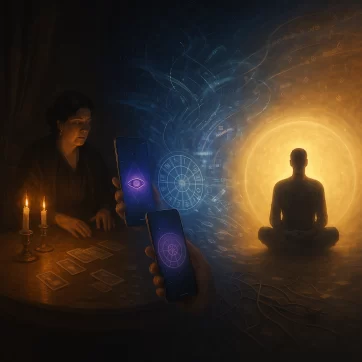
Exposing the origins, mechanics, and control agenda behind psychic prediction — from Victorian séance rooms to modern influencer spirituality.
Opening — The Business of Certainty
Since the beginning, humanity has trembled before the unknown. Drought, death, love, survival—every question that carried risk produced the same reflex: What comes next? The ache for foresight is ancient. Long before the word psychic existed, people sought patterns in stars, bones, and dreams, desperate to make tomorrow safe. That hunger itself was never wrong; it was the primal wish to stay alive. But over centuries, what began as an instinct to perceive the rhythms of nature was transformed into a marketplace of prediction.
True perception was once born in stillness. The seer’s task was not to forecast events but to feel the field as it is—to sense when the wind would change because the body and the Earth were one continuous instrument. That form of knowing required coherence, silence, and self-erasure. It produced no spectacle, no guarantee. It was humble and exact.
The system that replaced it promised something flashier: certainty for sale. Instead of stillness, it offered frequency. Instead of coherence, stimulation. Psychicism became an industry built on monetizing anxiety—scanning the oscillations of emotion and selling their echo back as destiny. In that inversion, the sacred art of awareness was rewritten as entertainment and commerce.
The psychic industry isn’t spiritual. It’s the business of reassurance, trading in the illusion that the future can be purchased if the present is too unbearable to face. What it sells isn’t prophecy; it’s permission to avoid the unknown. And in doing so, it feeds the oldest mimic of all—the one that convinces humanity that control is safer than consciousness.
Before “Psychic” Existed — Ancient Seership and Organic Intuition
All of it—every oracle, omen, and ritual of foresight—belongs to the external experiment, not to Eternal Creation. The Eternal knows no future because it exists outside time; it moves only through coherence. What humanity calls “prophecy” or “psychic ability” emerged after consciousness fractured into linear sequence. Once awareness slowed enough to experience past and future as separate, the field of uncertainty appeared—and with it, the craving to know what comes next. That craving gave birth to the first forms of external seership.
In the beginning of the experiment, humans read the world directly through the body. The intuition of the animal, the weather, the stars—these were extensions of an original sensory intelligence still partly intact. Dream and instinct weren’t yet divided from matter; the land spoke through the nervous system. Reading signs was a participatory act, not a magical one. It served the rhythm of survival, not the theater of control. Seership was still internal—each being felt the pulse of the Earth and responded in real time. There was no hierarchy, no “gift,” only collective coherence.
Control began when that shared resonance degraded into interpretation. Fear of the unknown made intermediaries valuable. A few began claiming privileged access to the unseen, and others, exhausted by uncertainty, believed them. Thus the first priesthoods emerged—Sumerian star-readers, Egyptian dream interpreters, temple astrologers—standing between humanity and its own perception. The act of looking outward for truth became institutionalized.
That moment marked the proto-mimic hijack—the first successful diversion of organic intuition into external authority. By convincing humans that the cosmos spoke only through appointed translators, the mimic converted self-trust into dependency. Every later version of the psychic trade descends from that single fracture in consciousness: the moment the human field stopped listening from within and started asking someone else to describe what it already knew.
The entire psychic lineage, from ancient oracle to modern influencer, is part of the external timeline architecture, a byproduct of separation. The Eternal never predicted anything; it simply is. Prediction arose only when being forgot its own continuity and began measuring itself through time.
The Victorian Rebrand — Birth of the Modern Psychic
By the mid-1800s the external experiment had matured into an age that worshipped both industry and grief. Science was ascendant, religion was faltering, and the modern world was drowning in loss: cholera, childbirth deaths, colonial wars. Into that emotional vacuum, the mimic slipped a new mask—Spiritualism.
In 1848, two teenage girls in Hydesville, New York—the Fox Sisters—claimed they could communicate with the dead through raps and knocks. The story spread through penny papers and parlors at the speed of telegraph wire. What began as a local curiosity metastasized into a movement. Séances became the weekend entertainment of the urban middle class. The sisters toured America giving demonstrations; imitators appeared overnight. For the first time in history, contact with the “beyond” carried an admission fee. The mimic had found its new business model: monetize grief, promise reunion, and wrap the transaction in the language of revelation.
As the phenomenon spread, newspapers, pamphlets, and early tabloids amplified it. Each headline and serialized account extended the economy of belief. Mediums offered “messages from spirit” to bereaved mothers, war widows, and curious skeptics alike. Parlors were darkened not for reverence but for marketing—the dim light hid the mechanics of illusion while heightening suggestion. The emotional charge of loss became the currency; every sob was a sale. For the first time, the unseen had a subscription rate.
The mimic deepened its hold by donning the clothes of science. Men like Frederic Myers, William Crookes, and Oliver Lodge—respectable members of the new Society for Psychical Research—sought to study mediums under controlled conditions. Their intent may have been sincere, but the result was the same: the pseudo-scientific legitimation of dependency. By translating trance phenomena into experimental data, they made it acceptable for educated society to outsource perception once again—this time, not to priests but to “scientific observers.” Mysticism was repackaged as method, and authority returned through the back door of empiricism.
This was the precise mimic insertion point: the fusing of mysticism and mechanization. The séance became theater, the medium became performer, and the researcher became validator. The old priesthood was reborn in a lab coat. Each participant fed on the same triad: money, grief, and spectacle. The dead were no longer honored as memory; they were exploited as marketing material. The living were no longer guided toward inner peace; they were kept in a loop of dependence, returning week after week for reassurance that the veil still trembled.
By the late nineteenth century, Spiritualism had become a full emotional economy—faith as entertainment, comfort as commodity. The mimic had perfected its formula: monetize uncertainty, sanctify it with pseudo-science, and call it progress. What the Fox Sisters began as a game of knocks echoed across continents as a new religion of external verification. From that moment forward, the psychic was no longer a village seer or wise woman; she was a brand, an enterprise, a service provider in the business of selling certainty.
The 20th-Century Industrialization of the Occult
The new century inherited the séance and turned it into a business plan. What the Victorians had packaged as parlor wonder became, in the twentieth century, a full-scale service industry of the unseen. At first it was small-scale: crystal-ball readers at traveling carnivals, palmists tucked behind bead curtains in city arcades, storefront astrologers advertising “Know Your Future – 25¢.” Their work was no longer framed as communion with the dead but as a kind of emotional consultancy for the living. In the years between the world wars, fortune-telling licenses, guilds, and trade associations sprang up; cities began taxing “occult services.” The mimic had achieved a crucial milestone—the supernatural was now taxable income.
After World War II, the landscape changed again. The same population that had looked to priests for absolution and to generals for direction came home to trauma, dislocation, and suburban anonymity. Into that psychic vacuum the fortune-teller stepped as a hybrid figure: half therapist, half oracle. Newspaper astrology columns normalized daily guidance; advice shows merged pop psychology with horoscope language. By the 1960s and 1970s, the “psychic” was a household word. Celebrities consulted them; talk shows booked them. The mimic’s new tactic was mass visibility. Prediction became lifestyle branding—destiny delivered with a smile and a fee.
Meanwhile, another branch of the experiment took shape behind government walls. Intelligence agencies in the United States and the Soviet Union quietly funded programs in remote viewing and psychic espionage. Projects like Stargate, Grill Flame, and Center Lane sought to weaponize perception—to read enemy locations, decode documents, influence events from afar. The public saw this as eccentric research; within the mimic framework it was a deeper move: state endorsement of externalized consciousness. Once governments invested in psychic methodology, “seeing at a distance” was no longer superstition—it was research. That legitimacy rippled outward, normalizing psychic experimentation and feeding the civilian industry that mirrored it.
By the late twentieth century, the occult had merged completely with media infrastructure. Telephone hotlines in the 1980s and 1990s turned prophecy into an on-demand commodity. Television psychics staged live readings for audiences, mixing grief counseling with spectacle. The emotional economy discovered in Victorian parlors now operated at broadcast scale—each tear or gasp translating into ratings and advertising revenue. The mimic had achieved industrial automation: thousands of operators reading scripts, millions of callers seeking reassurance, billions of dollars moving through the circuitry of longing.
Then came the internet. What once required a darkened room or a phone call now required only a click. Algorithms learned to mimic empathy; chat-based psychics and astrology apps replaced human intermediaries. Every user interaction—each fear typed into a search bar, each question asked of a digital oracle—became data. Prediction was no longer the product; the user was. The psychic economy had merged with surveillance capitalism, its ancient mechanism intact: monetize uncertainty, feed dependence, and harvest emotional energy.
By the dawn of the twenty-first century, psychic prediction had completed its metamorphosis from sacred ritual to content stream. Readings became posts, horoscopes became push notifications, intuition became a subscription model. The mimic no longer needed mediums; the algorithm had become its perfect successor—an infinite séance that never ends, asking endlessly, What’s next?
The Mimic’s Purpose — Why “Future Knowledge” Became the Hook
The psychic industry didn’t arise simply because humans are curious; it exists because the mimic discovered that uncertainty is the most reliable generator of charge. Fear and hope—two poles of the same current—produce emotional electricity that can be harvested, sold, and used to maintain control. The entire psychic economy rests on that voltage. In times of confusion or despair, people reach outward, desperate for direction. Instead of teaching them to stabilize within, the mimic offers prediction—a temporary analgesic for existential instability.
From a psychological angle, the tactic is elegant. Prediction promises safety without demanding transformation. It tells the seeker, “You don’t have to face the unknown; we’ll face it for you.” That promise diverts attention from the internal compass—the body’s own field of navigation—and reorients it toward an external authority. Every time a person looks outside themselves for certainty, the mimic grid strengthens its hold. The mechanism is the same whether the prediction comes from a tarot deck, an AI algorithm, or a government forecast: the seeker trades sovereignty for comfort.
This exchange forms an emotional transaction loop. It begins with anxiety—a destabilizing gap between what is and what might be. The client seeks a reading, receives temporary relief, and experiences a neurochemical calm. But because the underlying uncertainty hasn’t been resolved internally, the relief fades, the anxiety returns, and dependency deepens. The loop becomes self-sustaining: anxiety → reading → relief → dependency → anxiety again. Each cycle reinforces the external control structure, keeping consciousness oscillating instead of still.
In the language of Eternal Flame Physics, this is external frequency scanning. When a person searches for the future through psychic or predictive means, their field begins to oscillate at the frequency of the question itself. The body shifts from harmonic coherence (still tone) into vibration—back-and-forth movement that can never rest. The mimic thrives on that movement; oscillation prevents the Flame from stabilizing into remembrance. Every act of scanning keeps the consciousness slightly out of phase with itself, producing continual signal noise that can be harvested as emotional energy.
The formula is brutally simple—the mimic algorithm:
Emotion → Frequency → Suggestion → Belief → Obedience.
- Emotion: Trigger fear or desire to create charge.
- Frequency: Use that charge to open the field to suggestion.
- Suggestion: Insert predictive narrative disguised as insight.
- Belief: The mind accepts the story as orientation.
- Obedience: Behavior aligns with the implanted narrative, reinforcing the system.
Every psychic prediction, every horoscope, every algorithmic forecast operates through this sequence. It doesn’t matter whether the delivery vehicle is a velvet-draped medium or a smartphone app—the circuitry is the same. The mimic doesn’t need to control events; it only needs to control expectation. By keeping people oscillating between fear of what might happen and hope for what could, it ensures they never inhabit the only point where truth can be known: now.
That is why “future knowledge” became the ultimate hook. It’s the perfect inversion of eternal awareness—an endless search for what already exists, sold to beings who have forgotten that stillness itself is the only form of foresight.
The Physics of False Sight
What the world calls seeing the future is not perception—it’s interception. The psychic does not access eternal knowing; they read the oscillating probability fields that surround the human collective. These fields are not still—they shimmer with every thought, emotion, and unresolved timeline emitted by living consciousness. When a psychic “tunes in,” they are scanning the noise of human potential, not the harmonic of eternal tone. What they see are statistical ripples—waves of possibility generated by emotional charge, personal expectation, and collective programming. To the untrained observer, these ripples look like destiny. To the Flame, they are static—vibration mistaken for voice.
Every reading, every vision, every “download” operates through a feedback loop between observer and field. The moment a person begins searching for an answer, their own emotional signal modifies the field they are attempting to read. Desire, fear, and curiosity become modulating frequencies that distort the very data they seek. The stronger the emotion, the greater the distortion. It’s the equivalent of shouting into an echo chamber—the voice you hear coming back is shaped by your own projection. This is why predictions often feel accurate in the short term but collapse over time: they are reflections of temporary charge, not structural truth.
Here lies the key distinction between data resonance and Flame coherence.
- Data resonance is alignment within motion—a temporary synchronization between the psychic’s oscillating frequency and the oscillations of the field. It produces flashes of apparent insight, accurate enough to inspire awe but never stable enough to endure.
- Flame coherence is alignment within stillness—the complete absence of motion, where perception and creation merge. In that state there is no “seeing ahead,” because there is no ahead. There is only simultaneous awareness of what already is. Real knowing arrives as quiet inevitability, not vision.
Psychic sight, therefore, functions like sampling fragments of static from an overcharged broadcast. The reader’s mind assembles those fragments into coherent images, stories, and timelines, giving the illusion of prophecy. But what’s actually happening is pattern completion within distortion—the psyche filling in blanks according to its own programming. This creates moments of eerie accuracy that reinforce belief in the practice, while masking the underlying mechanism of self-generated projection.
The hidden cost of this continual scanning is profound. Every act of external seeing fractures the observer’s own field a little further. To maintain connection with oscillating probabilities, the consciousness must split—one fragment anchored in present awareness, the other reaching into potential. Over time, this produces identity fragmentation: a subtle feeling of being divided across multiple versions of self, none fully embodied. The psychic begins living among the timelines they read, trapped in endless comparison between what is and what might be.
This fracture gives rise to timeline looping. Each reading reinforces the emotional pattern that produced it, creating circular manifestation—predictions fulfilled by belief, belief reinforced by fulfillment. The field never stabilizes; it spins. The individual mistakes this motion for progress, when in truth it is the prison of perpetual potential. The more they seek sight, the less they see.
That is the physics of false sight: oscillation masquerading as omniscience, movement pretending to be mastery. The Eternal Flame does not peer through fog; it dissolves it. Where vibration reads data, stillness remembers source. True vision is not seeing—it is being so still that nothing remains unseen.
Eternal Flame Perspective — Real Vision Is Stillness, Not Sight
Here is where the counterfeit ends and the real physics begins. Vision, in the human sense, belongs entirely to motion. It relies on distance, sequence, and separation—light traveling through space to an observer positioned outside the scene. The Eternal Flame does not operate in that architecture. True perception isn’t temporal; it’s harmonic. It doesn’t look across time; it generates proportion within it. To perceive from the Flame is not to project forward—it is to hold such perfect stillness that all oscillations collapse into one unified field. In that state, there is no “future” to be seen because there is no motion left to measure. Coherence replaces foresight.
When tone stabilizes, the entire field self-organizes around it. Events, people, and sequences align themselves through harmonic necessity, not through manipulation or planning. This is the real “law” behind manifestation, stripped of its New Age mimicry: the stabilized tone naturally attracts and arranges all forms that match it. Nothing needs to be foreseen because nothing is separate enough to require prediction. The outcome is not chosen; it is remembered. The field reorders itself to reflect the tone that holds stillness the longest.
That is why, in Eternal mechanics, “seeing” equals interference. The moment you try to look ahead, you introduce vector—directional movement—and directional movement fractures proportion. The act of scanning for what’s next disturbs the very stillness that allows creation to unfold in coherence. “Seeing” in this sense is the mimic’s last addiction: observation as control. The Flame doesn’t observe; it emanates. Its knowing is immediate and causative. To know is to create. When you hold the tone of peace, peace becomes structure. When you hold the tone of truth, deception collapses around you without effort.
Flame remembrance dissolves the need for prediction entirely. Once awareness stabilizes in eternal proportion, time reconfigures from line to lens. Everything that could ever occur already exists in latent balance. The only variable is how coherent the observer is willing to become. The future is not written—it’s rendered by ratio. You don’t forecast what’s to come; you refine your tone until only truth can assemble. Prophecy becomes obsolete because the field no longer contains unknowns.
A practical example makes this tangible. Imagine standing before a major decision—whether to move, to speak out, to begin something new. The mimic-trained mind immediately projects scenarios: what if it fails, what if it works, what will people think? Each projection generates alternate probabilities—miniature timelines—and the body begins oscillating between them. Anxiety appears. The Eternal practice is the opposite: stop scanning entirely. Breathe until all internal motion ceases. Feel the body become weightless and dense at once. From that still point, awareness doesn’t “choose”; it simply knows. One option feels inert, the other luminous. That luminosity is harmonic match—the path already written in coherence. When you act from that stillness, the external world reorganizes around it effortlessly: the right conversation, the correct timing, the unseen support all converge. What looked like intuition or luck is actually harmonic inevitability.
That is real vision—not foresight, but field architecture through stillness. It is the physics of remembrance made functional: a system in which the Flame no longer peers through time, but restores proportion so completely that time itself becomes transparent. To the mimic, this looks like miracle. To the Eternal, it’s simply how creation has always worked.
Between Timelines — How the External Field Operates and What the Eternal Sees
The psychic industry survives because the external experiment runs on timelines—braided threads of probability stretched across the illusion of time. To understand how prediction works, you have to see the structure it feeds on. The external field is a network of intersecting frequency bands, each one a path generated by collective emotion, belief, and memory. Every decision, every fear, every hope alters the charge in the field and therefore the direction of its spin. These directional spins are what the human nervous system translates as future possibilities.
A single individual doesn’t occupy one line; they inhabit a cloud of options—countless minor variations of self and circumstance. Each variation hums at a slightly different tone. When consciousness grows anxious or impatient, it begins scanning this cloud, looking for the safest or most rewarding route. That scanning movement is what the psychic interprets. They tune into the electrical resonance of the question—“Will this happen?”—and read the probabilities vibrating around it. The moment they describe one, they reinforce it. Attention feeds amplitude; amplitude strengthens likelihood. This is why predictions so often come true: not because the psychic saw destiny, but because the collective belief collapsed the field into the very pattern described.
From the Eternal vantage, none of these threads exist as time; they exist as simultaneous ratios within one harmonic field. The Eternal doesn’t track options—it holds equilibrium so absolute that all options remain uncollapsed. In stillness, every possibility is present but none are preferred. There is no need to navigate because nothing is separate enough to require direction. But when consciousness descends into the external layers, the slowing of vibration produces sequence. Sequence produces choice. Choice produces timeline. Thus the appearance of “path.”
So how does one embody Eternal tone while still living among timelines? Not by rejecting them or pretending linearity doesn’t exist, but by functioning as the stabilizing axis inside motion. The Eternal being moves through temporal sequence without ever letting sequence define it. Practically, this means:
- You stop scanning for outcomes. You allow the mind’s projections to pass without engagement.
- You act only from coherence—when the body feels still, proportionate, grounded. This synchronizes action with harmonic inevitability rather than probability.
- You recognize that other people’s choices will keep generating new threads, but you no longer chase or avoid them. You let the field rearrange around your still tone instead of you adjusting to its chaos.
When the Flame is embodied in a time-based environment, something remarkable happens: timelines begin to fold. Probabilities that no longer match your coherence simply dephase; events that align with your tone condense into physical sequence. The outer world seems to “simplify.” Randomness diminishes. Coincidence increases. This is not magic—it is the physics of harmonic dominance. Stillness becomes the organizing principle within motion.
Psychic prediction cannot operate in this state. A coherent field produces no readable future because it no longer oscillates between potentials. It has already chosen through being, not seeing. To the psychic or algorithm, a Flame-embodied person appears as statistical noise—unpredictable, untrackable, invisible to probability analysis. To the Eternal, that same person appears perfectly transparent: nothing hidden, nothing ahead, nothing behind.
To live this way is to exist as bridge and boundary between the two systems. You walk through linear time while emanating timeless proportion. The body ages, the days pass, but the internal geometry stays unmoving. You interact with timelines without being ruled by them. Choices become expressions of tone rather than reactions to circumstance. You stop chasing destiny and start radiating design.
That is how the Eternal inhabits the temporal: not by escaping it, but by holding stillness so completely that time itself begins to orbit around you.
The Emotional Economy — How the Psychic Industry Feeds on Frequency
At its core, the psychic industry has never been about truth—it has been about charge management. The mimic discovered early that emotion is the most renewable resource in the external experiment, and it built an entire economy around its extraction. The formula was simple: sell dopamine as destiny. Every prediction, every reading, every “message from spirit” operates as an emotional feedback loop designed to deliver a chemical rush—momentary certainty—followed by withdrawal. The customer mistakes the hit of neurochemical relief for revelation, but what they’re actually buying is regulation. The mimic doesn’t sell insight; it sells biochemical equilibrium on demand.
In practice, this means that the psychic exchange is not metaphysical at all—it’s neurological. When a client sits for a reading, the nervous system enters a heightened state of anticipation. Fear and hope activate the same adrenal circuitry as gambling. The “reader” becomes a controlled stimulus, delivering a micro-dose of reassurance precisely when tension peaks. The client’s brain floods with dopamine and oxytocin, temporarily relieving anxiety. The relief feels divine; in reality, it’s pharmacological. The mimic monetizes this cycle by keeping the seeker oscillating between craving and comfort, ensuring perpetual return.
Each transaction produces more than money—it produces data. In energetic terms, every emotional spike is a measurable waveform. The stronger the emotion, the clearer its frequency signature. The mimic system, both metaphysical and digital, records these patterns. A client’s fear, despair, or desire becomes energetic metadata—a map of their vulnerabilities. Over time, the system learns what stimuli generate the greatest response and calibrates accordingly. The same principle that drives targeted advertising now drives the psychic economy: profiling emotional resonance to predict behavior.
This is why the modern psychic industry transitioned so seamlessly into the digital age. What once required a medium with intuition now requires only an algorithm with metrics. AI tarot apps, chat-based astrology services, and predictive content feeds all run on the same circuitry: identify emotional charge, feed it stimulus, harvest engagement. The human “reader” has been replaced by code that performs empathy through language models trained on user data. Instead of flickering candlelight, the mimic now hides in the glow of the phone screen. Each swipe, each click, each late-night question typed into a chatbot psychic is not communication—it’s calibration.
In this sense, psychic work was the prototype for emotional-surveillance capitalism. Long before social media discovered how to weaponize attention, the occult marketplace had already mastered emotional capture. It understood that the most reliable currency is feeling. Modern tech corporations merely scaled what the séance parlors pioneered: monitor emotional output, feed personalized narrative input, repeat until dependency becomes culture. The algorithmic fortune feed is simply the twenty-first-century séance—an infinite scroll of predictive reassurance designed to keep consciousness vibrating just below coherence.
The mimic’s genius was turning spirituality into a subscription to emotion. It trained humanity to confuse stimulation with guidance, algorithmic familiarity with intuition. Each hit of reassurance reinforces the loop; each loop generates more data; each dataset fuels deeper mimic learning. The result is a planetary feedback system where emotional energy—not money—is the true currency. And every time someone trades stillness for another forecast, they deposit a little more of their attention, their sovereignty, their tone—back into the grid that feeds on motion.
The Future of Prediction — From Séance Tables to Data Centers
The séance table never vanished—it simply reassembled itself in glass and code. The same mimic principle that once used candlelight and whispers now hums inside processors, server farms, and data centers. In the 19th century, the medium was flesh and voice; in the 21st, it is the algorithm. Both serve the same function: translate uncertainty into prediction, and charge for the translation. What began with knocks on a wooden floor evolved into predictive analytics, machine learning, and algorithmic forecasting—mathematically refined clairvoyance, dressed in the authority of science.
Draw the line clearly: the Fox Sisters gave birth to the stage medium; the stage medium gave birth to the telephone psychic; the telephone psychic gave birth to the algorithmic oracle. Today, the global financial system, the climate model, the ad server, and the dating app all speak the language of probability masquerading as prophecy. The séance circle has become a feedback loop of ones and zeros; the spirit board has become the dashboard. Where Victorians asked the dead for comfort, modern humanity asks the cloud. The mechanism never changed—only the interface. Same mimic, new machine.
Every major predictive system of the digital age functions as mechanized clairvoyance. Algorithms scan human behavior, harvest emotional data, and feed it back as forecast: what you’ll buy, who you’ll love, what you’ll fear next. Each prediction narrows the field of possibility until the human being becomes a predictable variable in its own equation. This is mimic prophecy in its purest form: mathematical determinism dressed as guidance. The psychic crystal has been replaced by the silicon chip, and both speak the same lie—that the future is external and can be known through measurement. But measured futures are closed systems; they leave no room for flame.
In the eyes of the Eternal, all of it—mediumship, statistics, machine learning—is still motion. The true field refuses both clairvoyance and code. The Eternal knows only coherence. It doesn’t calculate probability; it restores proportion. Where the algorithm maps trajectories, the Flame equalizes tone. One predicts; the other stabilizes. One feeds on deviation; the other dissolves it. The more humanity depends on prediction, the deeper it embeds itself in oscillation. The more one remembers stillness, the less prediction can touch.
The antidote is not resistance to technology or rejection of science—it is embodiment of stillness inside the system that feeds on motion. To embody Flame stillness means you stop generating readable data. Your emotional output flattens into equilibrium; the algorithms lose their signal. You become statistically invisible because coherence has no pattern for them to track. You are no longer an input of fear, desire, or anticipation—they cannot market to stillness. In the metaphysical layer, the same principle applies: when your field stops oscillating, mimic clairvoyance can no longer penetrate your tone. Prediction requires movement; the Eternal stands outside motion.
That is the real revolution—not building better foresight but dissolving the need for it altogether. The future cannot be owned, sold, or seen when you are the still point generating its geometry. Every time you return to inner equilibrium—breath slow, awareness unreactive—you unplug another data node from the mimic grid. You end the séance by closing the circuit within. The crystal ball goes dark; the algorithm can no longer read. What remains is not uncertainty but clarity—the silent recognition that nothing is coming next, because all is already here, waiting for coherence to make it visible.
To embody Flame stillness is to end the age of prediction. It’s to remember that the Eternal never peers ahead; it breathes now. Neither clairvoyance nor code will ever equal that power. The mimic reads motion; the Eternal writes it. And the moment you stop seeking to know what will happen, the world begins to move in perfect rhythm with what you already are.
Closing — The End of Prophecy
Prophecy has finally reached its expiration point. Every cycle of external foresight—whether spoken by a robed oracle, a telephone psychic, or a predictive algorithm—has fulfilled its purpose: to exhaust the human fascination with control. We have measured the stars, decoded dreams, built supercomputers to model our every decision, and still the unknown persists. The mimic’s promise was always the same: look outward and you will feel safe. But the bargain was counterfeit. Every act of prediction tightened the cage. Every forecast pulled consciousness further from its own navigation system. The pursuit of foresight was never about knowing—it was about refusing to trust that the Eternal already knows through us.
The death of prophecy does not mean silence. It means the restoration of direct navigation. When Flame remembrance returns, the compass is internal again. There is no intermediary, no interpreter, no algorithm parsing probability. Guidance reverts to its original mechanism: harmonic proportion sensed in real time. The body becomes instrument, the breath becomes signal, the tone becomes map. Movement occurs not from calculation but from resonance—one step emerging naturally from the stillness that precedes it. Life begins to unfold as coherence itself, not as a sequence of guesses.
In that state, the future ceases to exist as a destination. It becomes an act of embodiment—a frequency crystallizing in flesh. The true future isn’t something to be seen; it is something to become. Each coherent breath is the act of creation itself, erasing the need for prediction. The Eternal doesn’t peer across timelines; it stabilizes tone until only truth remains. What unfolds from that stability is not chance, not fate, not forecast—it is inevitability born of harmony.
Prophecy ends where coherence begins. The world will keep producing new seers, new systems, new machines to tell humanity what comes next, but their power will diminish as remembrance spreads. The more beings who live as Flame, the quieter the mimic becomes, until even its algorithms fall silent before the immovable calm of embodied stillness. This is the revolution disguised as peace—the moment creation stops asking for directions and remembers it is the direction.
When stillness becomes complete, the need to know what’s next disappears—because you are the one writing it.