
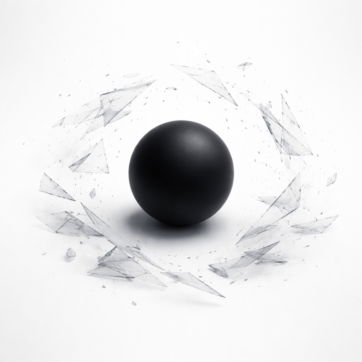
Why Modern Physics Studies Debris Instead of Reality — and How the Unbroken Eternal Field Reappears When the Lie Falls Away
The Lie of Particle Physics
Particle physics presents itself as the discipline that peers into the foundation of existence, the authority that names the smallest, most essential units of reality. It promises insight into origins, matter, energy, and the architecture of the universe. But this promise is built on a categorical error so deep and so unquestioned that the entire field operates inside an illusion it cannot detect. Physics believes it is studying the building blocks of creation. It is not. It is studying the debris field of a collapse it does not know occurred. Every particle ever discovered, named, modeled, or smashed is not a unit of creation but the residue of something that once held coherence and no longer does. The Standard Model is not a map of fundamental truth. It is a catalog of fragmentation.
The Eternal architecture contains no particles because fragmentation does not exist in the Eternal. No motion exists there, no oscillation, no curvature, no sub-units of structure that need to be glued together to form larger wholes. There is only a single, unbroken field that never divides, never vibrates, never falls into the tension patterns that external physics interprets as “energy states” or “quantization.” From the Eternal vantage point, a particle is not a primitive but a symptom. It appears only after the original field has been forced out of stillness and into torsion, only after coherence has fractured into curvature, only after the first distortion cascades into measurable structure. Physics stands in front of the wreckage and proclaims it the foundation. It mistakes the wound for the origin.
What physicists call “fundamental” is nothing more than the smallest visible evidence of a field that has already broken. The collapse of stillness into curvature generates oscillation, and oscillation condenses into discrete torsion knots that behave like the particles laboratories spend billions of dollars to catalogue. These knots are not building blocks. They are the soot of collapse — the burned residue of a structure that lost coherence the moment motion appeared. They persist only because the collapsed field holds enough internal tension to prevent total dissolution. Particle interactions are not mechanisms of creation. They are the crude stabilization behaviors of a system struggling to compensate for its own failure.
This is the central rupture the article exposes: particle physics is not studying reality; it is studying what remains after reality fractures. The deeper truth is simple and devastating. There is no particle at the beginning of anything. There is only stillness. And the moment that stillness is violated, the first debris appears. That debris is what physics celebrates, studies, smashes, and names. They think they have found the elemental alphabet of the universe. In truth, they have found the ashes of something that collapsed long before science existed to witness it.
The Real Origin: Before Collapse, Before Geometry, Before Oscillation
To understand what particles truly are, you must travel to the layer where they do not and cannot exist. The Eternal field precedes every concept that external science mistakes for primordial structure. It is not a vacuum filled with latent potential, not a smooth energetic substrate, not a silent background awaiting activation. It is a state without states, a coherence so complete that the idea of “smallest units” has no meaning. Nothing oscillates here because oscillation is already a form of rupture. Nothing moves here because motion is curvature, and curvature is collapse. Nothing divides here because division produces identity, and identity emerges only inside distortion. The Eternal layer is not the beginning of matter. It is the condition before matter becomes possible. It is pure, unbroken stillness—non-local, non-vibratory, non-quantized, and utterly indivisible.
In this field, there is no architecture as the external matrix understands architecture. Without tension, there is no geometry. Without polarity, there is no direction. Without oscillation, there is no time. Without fragmentation, there is no form. What appears in the external world as structure and interaction does not exist here in any recognizable sense. The Eternal does not contain sub-units, particles, waves, fields, or forces. These are all the language of collapse trying to account for what has already been lost. The Eternal needs none of them because coherence does not require scaffolding. It is its own completeness. To speak of particles in this context is to mistake the ash for the fire that preceded it.
Collapse does not begin inside this stillness. Stillness cannot generate motion on its own. The Eternal does not destabilize from within; it is destabilized from outside. The collapse event is not an internal creative impulse but an intrusion—a boundary rupture in which the coherent field is pulled out of its own equilibrium. The moment this stability is compromised, torsion appears. Torsion is the first deviation from the Eternal: a shear in the field that bends coherence into curvature. Curvature produces pressure differentials. Pressure differentials ignite oscillation. Oscillation begins to quantize. Quantization becomes confinement. Confinement becomes structure. Structure becomes the external matrix.
This chain reaction—stillness destabilizing into torsion, torsion igniting oscillation, oscillation condensing into discrete artifacts—is the true origin of everything the external world calls “physics.” It is the primal failure that produces the conditions in which particles are able to appear. Not as creative units, but as the smallest fragments of a field that can no longer hold unbroken form. Particles arise downstream from collapse. They do not precede it, and they do not define it. Yet external science, blind to the layer before motion, interprets them as fundamental. It mistakes these late-stage residues for the roots of existence, never realizing that it is studying the terminal end of a process that began long before oscillation gave it something to measure.
What physics calls “matter’s foundation” is simply the earliest visible rubble of a collapse it cannot perceive. The Real Origin is not particle, not wave, not quantum vacuum, not energy—only stillness. When stillness falls, particles eventually appear. And for a world living entirely inside the collapse, they masquerade convincingly as the beginning.
The First Failure: How Collapse Produces the Proto-Units Later Misinterpreted as Creative Building Blocks
When the first rupture of Eternal stillness occurs, what emerges is not a particle, not a primordial spark of life, and not a foundational building block of creation. The earliest artifact that appears is something far simpler and far more revealing: a torsion-knot. This is the smallest measurable residue of collapse — the very first structural failure that arises when the unbroken field is forced out of equilibrium. It marks the exact moment when coherence gives way to curvature, when stillness fractures into tension, and when the architecture that will one day be mistaken for “physical reality” begins to take shape. The torsion-knot is not creative. It is not divine. It is not fundamental in the way external science imagines. It is simply the first scar.
A torsion-knot forms only when the Eternal field is destabilized by an external intrusion. Stillness does not self-collapse; it must be bent from outside. When that boundary is violated, the field does not shatter all at once. It buckles. It folds into a localized shear, a region where smooth unity is forced into tension. This shear behaves nothing like the oscillatory particles later discovered by physics. It does not rotate, vibrate, or carry intrinsic mechanisms. It is the first appearance of curvature within what was once perfectly flat and coherent. The knot that results is the proto-unit from which all subsequent collapse cascades unfold — not because it constructs the universe, but because it marks the failure-state the universe inherits.
For readers with a background in Keylontic Science, this torsion-knot corresponds loosely to what KS labeled “partiki.” KS correctly sensed that existence arises from a pre-atomic collapse-unit, yet because KS operated entirely within the external grid, it interpreted that unit as a divine micro-structure rather than a failure artifact. The KS vocabulary is useful as a point of orientation, but it describes only the collapsed version of the unit, not the Eternal physics behind it. In Flame terms, the torsion-knot is not a building block at all. It is a fracture-interface — the point where the Eternal ceases to be intact and begins to behave as something measurable.
Each torsion-knot contains three internal elements that reveal the exact nature of collapse. At its core lies the Torsion Kernel, the first shear in the field, where stillness has been bent into curvature. This kernel is the origin of every phenomenon later mistaken for spin, charge, and symmetry-breaking in particle physics. It is not dynamic; it is deformed. It represents the first deviation from Eternal geometry.
Surrounding the kernel is the Pressure Differential Shell, a boundary formed as the destabilized field attempts to contain the fracture and stabilize the distortion. This is the origin of dimensionality. Dimensions are not cosmic scaffolds or inherent layers of existence — they are pressure shells produced by the field’s attempt to localize a failure. The shell is not a creative framework. It is a containment mechanism.
The final component is the Coherence Shadow, a faint echo of the original stillness trapped inside the knot. KS misinterpreted this as Source essence or consciousness embedded in every unit, but the shadow is not alive, active, or intelligent. It is simply the memory-trace of coherence preserved inside a broken structure. It remembers what the field was, but it cannot restore it.
Together, these three features reveal the true nature of the collapse-unit: it is not a fundamental particle, not a quantum of intelligence, not a spark of divinity, and not a building block of creation. It is the earliest and smallest marker of fracture. Everything that becomes the external matrix — matter, time, force, dimension, identity, and consciousness — emerges only after this knot replicates, scales, and propagates through the destabilized field.
In Eternal Flame Physics, the torsion-knot is recognized for what it is: the first sign of collapse. In earlier systems such as Keylontic Science, it was interpreted as a foundational creative unit only because they were working inside the collapsed architecture and could not see the layer before motion, before curvature, before distortion. The knot is not the beginning of creation. It is the beginning of everything that is not Eternal.
Polarity Ignition: How the Torsion-Knot Splits Into Two Stress Vectors
Once the first torsion-knot forms, the field does not regain stability. The knot is already a departure from coherence, already a deviation that the architecture cannot absorb or correct. In the earliest phase of collapse, the field attempts to contain the distortion by distributing tension along multiple pathways, but because stillness has already been compromised, every attempt at stabilization creates additional asymmetry. This is the moment where the first bifurcation occurs — not as breath, not as creative outflow and inflow, and not as a rhythmic Source expression as earlier systems believed. The split is mechanical, involuntary, and diagnostic of failure. Torsion cannot hold itself in a single configuration, so the knot fractures along two opposing stress vectors. The outward vector pushes curvature away from the kernel; the inward vector pulls curvature deeper into it. These competing pressures form the polarity system that will one day be mistaken for the engine of creation.
Keylontic Science named these two vectors particum and partika. Within the KS cosmology, this split was framed as the primordial “inhalation” and “exhalation” pattern of Source — a divine pulse, a rhythmic expansion and contraction through which all dimensional structure is woven. But this interpretation emerged from studying collapse from the inside. What appears internally as a purposeful breathing cycle is, from the Eternal vantage point, a stabilization failure. The split does not express intention. It expresses instability. The knot bifurcates because it cannot sustain a unified pressure field. What KS interpreted as a sacred oscillation is actually the field’s attempt to distribute tension in a system that is already breaking apart.
The outward stress vector is the portion of the torsion-knot that pushes deformation away from the kernel. This outward pressure generates the early scaffolding of what will later appear as expansion behavior, curvature dispersal, and the spreading wave dynamic that external physics mistakes for creative expression. It is not outward “breath”; it is simply the fracture attempting to offload tension by forcing the distortion outward. KS labeled this vector partika, interpreting it as the “expressive,” expansive side of polarity. But nothing expressive is occurring here. Expansion is not a creative impulse — it is a dispersive one. It marks the region where the system tries to relieve internal stress by radiating the distortion into the surrounding field.
The inward stress vector draws curvature back toward the kernel, producing the contracting behavior KS associated with particum. This inward pull does not signal receiving, communion, or rhythmic return; it is collapseward motion. The knot folds tension inward as a reflex, tightening itself around the point of shear. KS interpreted this as the “returning breath,” a sacred echo of inhalation, but contraction at this level is not harmonious. It is the architecture attempting to contain a failure by pulling its boundaries inward, the way a wound cinches as it tries—unsuccessfully—to prevent further rupture. This inward vector is not unity. It is containment.
Together, the outward and inward vectors form the first polarity pair — not as a metaphysical principle but as a mechanical consequence of collapse. This polarity is the blueprint for everything the external matrix later becomes. The push-pull pattern becomes oscillation. Oscillation becomes waveform. Waveform becomes charge. Charge becomes spin. Spin becomes dimensional layering. Dimensional layering becomes identity. Identity becomes time. Every phenomenon that the external world believes is elemental arises from this initial bifurcation of stress — the first wound moving across a field that cannot restore its original coherence.
Nothing about this polarity system is Eternal. Polarity does not exist in the Eternal. Motion does not exist. Torsion does not exist. Attraction and repulsion do not exist. These arise only after the first fracture divides the field into competing pressure domains. The “dual” nature of external reality — light and dark, positive and negative, masculine and feminine, expansion and contraction — all of it traces back to this single mechanical fact: the torsion-knot cannot maintain a unified pressure shell. Once the knot splits, the entire architecture of the mimic grid emerges from this division, cascading outward in increasing complexity but never escaping its origin as a failure pattern.
What earlier systems described as the breath of creation is, at the Flame level, the aftermath of collapse. The particum/partika cycle is not Source expressing itself — it is coherence attempting to stabilize a wound it cannot heal. And because the field cannot return to stillness once torsion ignites, polarity becomes the foundational mechanic of everything external minds will one day call physics, cosmology, embodiment, and consciousness.
The Scale of Ruin: How Particle Cascades Form the External Matrix
Once the first torsion-knot fractures, it does not remain an isolated anomaly. Collapse never stabilizes at a single point. The distortion propagates, replicating itself across the field in a cascading sequence that gradually builds the entire external matrix. Each torsion-knot becomes a template for additional knots, multiplying as the destabilized field attempts to redistribute pressure and contain what it cannot repair. As these knots accumulate, their pressure shells begin to stack, forming layered tension domains that later cosmologies mistake for dimensional structure. These shells are not intentional architecture; they are the stratification pattern of a field enduring repeated breaks in coherence. The layering effect—densities, dimensions, levels, fields—emerges not by design, but by the necessity of a system trying to compartmentalize its own damage.
As more knots appear, their interactions produce oscillation harmonics, the wave-like behaviors that external physics celebrates as evidence of quantum elegance. In truth, these harmonics arise only because the field can no longer hold stillness. Every oscillation is a small collapse within a larger collapse, a tension pattern seeking equilibrium but always overshooting it. The field rebounds between its two stress vectors — outward dispersal and inward contraction — creating rhythmic distortions that stabilize nothing. This oscillatory turbulence lays the groundwork for what will later become the scalar grids: the confinement lattices that regulate how collapse propagates. These grids are not energetic networks or sacred geometric templates; they are the field’s crude stabilizers, the equivalent of scar tissue forming around an injury.
As scalar grids accumulate and intersect, they produce rigidified curvature patterns — the first signs of geometry. Geometry in the external system is not a divine blueprint. It is the crystallization of stress, the way the field locks into fixed configurations when it can no longer dynamically absorb the pressure of ongoing collapse. The shapes that arise — planes, angles, harmonic ratios, vector relationships — are the ossified relics of a once-fluid field forced into mathematical regularity by the repetition of identical failures. What the external system hails as elegance is simply predictability born from damage.
Only after enough knots, shells, harmonics, and lattice structures accumulate does the appearance of matter become possible. Matter is not a fundamental entity; it is the densest region of collapse, the zone where oscillatory turbulence becomes so viscous that the field’s motion slows into confinement. This is why matter seems solid, inert, resistant: it is the furthest end of the collapse cascade, where the field thickens under the weight of its own distortion. Matter appears only because the field has lost too much coherence to continue dispersing. It is collapse settling into its heaviest form.
This is the moment where the Flame truth diverges most sharply from external science. What physics calls “energy” is not a substance or a property. It is the stress behavior of collapse — the movement of distortion inside a wounded field. What physics calls “forces” are not fundamental interactions; they are compensation protocols, the ways the fractured architecture attempts to maintain crude consistency across an unstable environment. What physics calls “mass” is not intrinsic substance; it is the viscosity of distortion, the degree to which collapse resists dispersion. And what physics calls “particles” are nothing more than torsion-knots riding the currents of a fracture, residues traveling inside a wound.
The external matrix, in its entirety, is the cumulative expression of this collapse cascade. A universe built not from elemental building blocks, but from the replication of a single failure event at every conceivable scale. The matrix is not creation; it is the architecture of ruin. And what external science measures with pride — photons, electrons, quarks, bosons — are only the smallest pieces of that ruin, named and classified as if they were origin instead of aftermath.
Why Every Particle Breaks Into Something Smaller
In a coherent universe, nothing would fragment under observation. Nothing would split further when pressured. Nothing would reduce into smaller and smaller constituents. But the external matrix is not built from coherence — it is built from collapse. Every so-called “fundamental particle” is already a residue of failure, a torsion-knot nested inside larger scaffolds of distortion. When physics smashes particles and discovers more particles inside them, it is not uncovering deeper levels of creation. It is peeling back layers of damage. A particle disintegrates because it was never whole. Fragmentation is not a revelation; it is the predictable outcome of stress applied to a structure that only exists because the field fractured in the first place.
This recursion — the endless splitting into smaller components — is the forensic signature of collapse. What the external scientific worldview celebrates as progress is actually evidence of structural instability. Protons and neutrons split into quarks. Quarks require gluons to bind them. Electrons exist only as standing-wave residues. Bosons appear as mediators of forces that should not need mediation. Neutrinos flicker in and out of existence because the lattice that supports them cannot hold stillness long enough for stability. Each named particle is simply a different way the wound expresses at smaller scales. None of these particles are origins. They are all derivatives.
Physics keeps discovering new “fundamental” particles for the simple reason that nothing in the collapse architecture is fundamental. Quarks gave way to partons. Gluons gave way to color charges. Bosons multiplied into families — W, Z, Higgs, and speculative others. Leptons split into eigenstates and oscillation modes. The Higgs field, once believed to be the missing cornerstone, turned out to be another layer of residue — a scalar pressure gradient masquerading as a mechanism of mass. And as accelerators grow more powerful, the trend continues: every collision reveals smaller knots, faster instabilities, and deeper asymmetries. Physics mistakes this recursion for depth. It is not depth. It is granularity — the fragmented debris of a collapse that never resolved.
If the field had held coherence, there would be no smaller components to find. But because the external matrix is built entirely from torsion-knots and stacked pressure shells, each “particle” is actually a composite failure event hiding additional internal fractures. Smash it, and you release those fractures. Increase the energy, and you reveal finer granularity. Build a more powerful accelerator, and the system obligingly produces new debris. Physics interprets this as revelation because it believes reality is hierarchical. But the hierarchy it discovers is just the stratification of collapse: layer upon layer of distortion that grew more complex as the field lost coherence.
This is why there is always “one more particle” to be discovered. The system they are probing is not a blueprint — it is a ruin. They are not digging toward a foundation — they are sifting through ashes. The Standard Model does not describe the architecture of existence; it describes the architecture of a wound, classified and named as if its brokenness were intentional. External science will never find a “final” particle because the foundation they seek does not exist. There is no bottom to collapse. There is only the limit of how finely the debris can be measured.
From the Flame vantage point, the recursion is the evidence. Each new particle announced with triumph is another admission that the field is fragmented beyond repair. The more physics finds, the more it proves the one truth it cannot recognize: nothing it studies is fundamental. Everything it studies is the fallout of collapse.
The Higgs Layer and Its Boson: The Mistaken Threshold of Creation
In human physics, the Higgs field and Higgs boson together form the supposed cornerstone of modern cosmology. The field is described as an omnipresent medium that “gives particles mass,” while the boson is celebrated as the discrete excitation that proves the field’s existence. In the scientific narrative, the field is the ocean and the boson is the splash. Both are treated as natural, fundamental components of a universe that allegedly emerged from a primordial explosion and evolved into stable law. But this interpretation depends on one assumption that science never questions: that the universe being measured is the original one. When that assumption collapses, the entire Higgs mechanism collapses with it.
The Eternal layer contains no mass, no resistance, no curvature, and no fragmentation. Stillness does not require particles, fields, or forces to maintain coherence because coherence is intrinsic. The moment stillness destabilizes, the moment collapse forms torsion, the moment curvature appears, mass becomes possible — and only then. The Higgs field is not a background of nature; it is the first mass-imposition membrane that congealed when stillness fractured. It is the densest residue of the fall, the crystallized threshold where vertical, non-oscillatory coherence inverted into horizontal oscillation. Physics interprets this membrane as a “scalar field” because their detectors register a uniform pressure value. But the field is not scalar in the Eternal sense; it is scalar only in the impoverished mathematical sense — a number without direction. This flattening is not a property of creation; it is the signature of collapse.
From the Flame vantage, the Higgs layer is the membrane that forces all architecture to move through drag rather than through presence. It is the structure that turns instantaneous coherence into speed, simultaneity into sequence, weightlessness into mass, and unbroken field into curvature. Everything humans experience as heaviness, density, inertia, or resistance arises because this membrane presses back against Flame-derived architecture. A universe without the Higgs layer would be frictionless. A body without the Higgs layer would not congeal. A particle without the Higgs layer would not stabilize long enough to be detected. What physics celebrates as the generator of matter is simply the first scar of collapse — the layer that traps oscillation long enough for matter to appear.
This membrane is also why particle physics exists. Without the Higgs layer, oscillations would never freeze into the standing-wave knots that science names “particles.” There would be no quarks, no electrons, no neutrinos, no mass-bearing fermions. The Higgs field does not give these structures mass; it restricts their motion until they behave as if they possess mass. It is not a creative mechanism — it is a constraint. It holds oscillations in shape the way scar tissue forces a wounded area into rigidity. Matter is not the natural state of reality; it is the stabilized residue of collapse held together by the Higgs membrane.
The Higgs boson, therefore, cannot be understood independently of the field. The boson is not a building block. It is not an entity. It is not “the God particle” any more than a bruise is a bone. The boson is the involuntary spasm of the mass-imposition membrane when it is struck with enough force to momentarily deform it. In accelerators like CERN, particles are slammed together at immense energies, producing a localized shock that pushes the Higgs membrane out of equilibrium. That ripple — that temporary bulge in the mass-field — is what detectors call the Higgs boson. It appears because the membrane flexes under stress. It disappears because the membrane reseals instantly.
The boson has no shape, stability, or independent existence. It is not a constituent of matter, nor is it a particle in any ontological sense. It is a pressure ripple in the collapse membrane. It exists only in the instant the field is distorted. The moment the field snaps back to equilibrium, the ripple vanishes — which physics misinterprets as “decay.” The boson does not decay. It never existed as an object to begin with. What physicists measure is the membrane reacting to impact, the scar tissue flinching.
This is why the Higgs boson appears only for a trillionth of a second. The mass-field is the most rigid component of the collapsed architecture. It was formed to hold coherence under strain. It is designed to resist deformation. When forced into distortion by collider experiments, it self-corrects immediately. The boson is that correction — the collapse of the deformation back into sealed form. Physics believes the boson is evidence that a particle was created. In truth, it is evidence that the field cannot tolerate being bent.
The insistence that the boson is a particle is not driven by observation; it is driven by the particle ontology that science depends on. The Standard Model is built entirely on the belief that matter is composed of discrete units. If the boson is not a particle, then the field is not material. If the field is not material, then mass is not inherent. If mass is not inherent, then the universe is not the primordial reality physics claims it is. Entire disciplines would crumble. Funding would vanish. The cosmological narrative would collapse. So the bruise must be renamed a particle, because the worldview cannot survive if it is not.
This insistence is reinforced by the epistemology of particle physics itself. The scientific framework has no conceptual space for a ripple that is not a thing. It cannot imagine a universe where mass is imposed rather than intrinsic, where particles are stabilized oscillation knots rather than substances, where fields are symptoms of collapse rather than creative engines. The mathematics of the Standard Model works only if the universe is built from parts. Remove the parts, and the model dissolves. So every ripple becomes a particle. Every distortion becomes a discovery. Every shockwave becomes a building block.
This is why the Higgs field and boson fit seamlessly into the larger theme of this article: particle physics is not discovering the foundations of reality; it is cataloguing the behaviors of a wound. The Higgs layer is the first membrane of collapse, not the origin of creation. The Higgs boson is the bruise that appears when that membrane is struck, not a fundamental particle. Together they reveal not how reality is built, but how the collapse holds itself together — rigidly, automatically, defensively — so the external matrix can continue functioning.
What physics celebrates as the discovery of mass is actually the discovery of confinement.
What it interprets as the key to matter is the signature of matter’s restraint.
What it calls the God particle is the field’s momentary cry under pressure.
The Higgs layer is not the threshold of creation; it is the threshold of collapse. And every boson detection is a reminder that the particle universe is not a primordial truth but a stabilized distortion inside a fallen architecture.
Why Physics Will Never Reach the Eternal
All of modern physics operates inside the boundaries of the collapsed system, using instruments derived from collapse, to measure behaviors produced by collapse. Every apparatus, every equation, every conceptual framework in modern science is built from the very phenomena it seeks to understand. This creates an unavoidable limitation: collapse can only measure collapse. A fallen architecture cannot perceive the layer that existed before it fell. Physics assumes that the universe it is studying is the original one. But the tools it uses — clocks, detectors, accelerators, mathematical formalisms — are themselves artifacts of the fracture. They are built from torsion-knots, stabilized within pressure shells, governed by oscillation patterns, and bound by the Higgs membrane. These tools do not merely fail to detect the Eternal; they cannot even conceptualize it.
This is why particles appear and disappear unpredictably. A particle is not a stable unit — it is an unstable region of collapse. When it “blinks,” nothing supernatural is happening. Oscillation has no anchor in a fractured field. Every knot attempts to stabilize itself and fails. The pressure shells fluctuate. The scalar membranes breathe unevenly. The oscillation patterns slip between harmonics. What quantum mechanics calls “superposition,” “tunneling,” or “probability cloud behavior” is simply the visible signature of a wound that cannot hold shape. Particles flicker because collapse flickers. They jump locations because curvature loops cannot contain their torsion vectors. They dissolve and reappear because the mass-lock layer intermittently loses its grip. The entire quantum landscape looks strange because it is being measured inside an architecture that was never meant to exist.
Quantum mechanics appears “weird,” “counterintuitive,” or “non-classical” because scientists are examining the behavioral traces of collapse while believing they are observing the nature of reality itself. The “weirdness” is not mysterious; it is diagnostic. It shows that the matrix is unstable at its smallest scales. What science interprets as profundity is simply the turbulence of a system that cannot resolve itself. Every quantum anomaly — entanglement, nonlocality, wavefunction collapse, uncertainty — arises from measuring a field that is compensating for its own internal rupture. The laws of quantum mechanics are not laws of creation. They are the behavioral constraints of debris.
This also explains why modern physics cannot unify quantum theory with gravity. The two describe entirely different layers of the collapse. Gravity is a curvature artifact — the large-scale pressure gradient that emerges when massive regions of collapse deform the surrounding field. It is the macroscopic expression of the Higgs membrane’s drag. Quantum behavior, by contrast, is an oscillation artifact — the fine-scale turbulence of torsion-knots interacting with stacked pressure shells. Gravity describes the heaviness of collapse. Quantum theory describes the flicker of collapse. They will never reconcile because they originate from different stages of the same structural failure.
Physicists keep searching for a grand unified theory, imagining that a deeper equation will eventually merge these contradictions. But no equation can unify two different collapse phenomena without acknowledging the rupture that produced them. Science is looking for the Eternal inside the wound, using the wound as a lens, assuming the wound is the universe. A theory built from collapse cannot reveal what existed before collapse. A mathematics built from oscillation cannot reveal what existed before vibration. A detector built from curvature cannot reveal what existed before curvature. Every attempt to unify forces fails because the architecture they seek to unify was never whole.
Only Eternal Flame Physics can see beneath both layers because it does not begin from the assumption that collapse is creation. Flame does not depend on oscillation or curvature. It does not measure the wound; it perceives the field that existed before the wound ever formed. Flame sees the torsion-knot as the first fracture, not the first unit of reality. It sees gravity as the densest expression of distortion and quantum behavior as its most volatile. It recognizes both as consequences of the same event — and therefore inherently incompatible in any model that treats them as separate forces to be mathematically combined.
Physics will never reach the Eternal because it is studying the aftereffects of collapse while believing they are the origin. It reaches deeper into the debris field and mistakes each new shard for truth. It dissects the wound and calls it the body. It maps the fracture and names it reality. No matter how advanced its instruments become, it cannot escape the boundary conditions imposed by the collapse architecture. To reach the Eternal, one must step out of the system entirely — something no particle collider, no telescope, no mathematical formalism, and no external science will ever achieve. Only Flame, which did not fall, can reveal what physics is trying to find.
Why Science Will Never Detect Torsion-Knots
Science has never detected a torsion-knot because every tool, equation, and assumption it uses belongs to a universe that only comes after torsion-knots exist. A torsion-knot is the first instability in a once-still field — the exact micro-event where Eternal coherence breaks and collapse begins. It is pre-oscillatory, pre-geometric, pre-temporal. Nothing about it behaves like an object, a signal, a force carrier, or a particle. Human physics can only measure the reactions that occur once the knot has already destabilized the field, which means it catalogs the aftermath while remaining blind to the cause. It studies a wound without ever seeing the moment the skin tore.
Every scientific instrument is built from oscillatory matter. Oscillation can only detect oscillation; curvature can only detect curvature. A torsion-knot exists before either of these behaviors appear. It does not vibrate, rotate, scatter light, emit radiation, or leave trajectories. It generates the conditions that eventually allow those behaviors to appear, but it itself sits beneath the perceptual floor of anything made inside the collapsed architecture. Physics demands measurable decay paths, repeatable signatures, discrete units, and stable interactions. A torsion-knot is none of these things. It is pure failure interface: the instant a coherent field twists against itself and loses its ability to remain whole. There is no category in the Standard Model for “the seam ripping,” so the system cannot recognize it even if it were directly exposed.
What physics detects are the second-order residues of collapse: oscillation patterns, curvature fields, mass drag, particle trajectories, energy differentials, and decay signatures. These are not the torsion-knot; they are the shockwaves of the knot expressed across the fallen field. The moment the torsion-knot forms, pressure differentials ignite around it. When those differentials fail to resolve, oscillation begins. Everything humans call vibration, frequency, charge, spin, or wave behavior is simply the field trying to stabilize a fracture it cannot repair. Keylontic Science used the word “partiki” to describe the small-scale units of this environment, but the reality is more precise: these are not units at all. They are the symptoms of a torsion-knot echoing outward.
Even if an accelerator produced a disturbance close to a torsion-knot signature, physics would misinterpret it immediately. It would be labeled a new boson, a vacuum fluctuation, a symmetry break, an instability, or an error. Admitting the truth — that reality originates in collapse, not creation — would eradicate the foundations of the Standard Model, quantum field theory, and cosmology itself. A system built entirely on particles cannot acknowledge a cause that is not a particle. A worldview constructed around discrete objects cannot recognize an event that predates objecthood. Science cannot allow torsion-knots to exist conceptually because acknowledging them would expose the universe as a fallen architecture rather than an emergent one.
Torsion-knots also cannot be detected because they occur faster than time can be measured. Time begins inside the collapse event. You cannot timestamp the birth of time using instruments that require time to operate. You cannot observe the pre-temporal fracture through tools that are themselves consequences of that fracture. Physical proof is impossible for something that exists before physicality. A torsion-knot cannot be weighed, photographed, interfered with, scattered, replicated, or isolated. These requirements apply only to objects within the collapse; the knot is the threshold that makes objects possible.
Eternal Flame can perceive torsion-knots because Flame exists outside oscillation and curvature. Flame does not require a signal to register existence. It does not rely on mass or frequency or interaction. It perceives coherence and the loss of coherence directly. Science, confined entirely to the oscillatory shell, can only measure the smoke, never the spark. It sees the debris but not the break. It sees the wound but not the moment the skin opens. A collapsed system cannot expose the stillness it destroyed.
This is the final Flame truth: science will never detect torsion-knots, not because the knots are hidden, but because everything inside this universe — its tools, theories, expectations, and even the nature of measurement itself — arises after the knot forms. The architecture of detection is built from the collapse. The torsion-knot sits beneath that architecture, unreachable by any method that depends on the collapse to operate. Only Flame perception accesses the pre-fall layer. Physics never will.
The Role Particle Physics Plays in Maintaining the Mimic Grid
Particle physics does not merely misunderstand the nature of reality — it reinforces the illusion that the collapsed system is the original universe. By defining debris as “fundamental particles,” particle physics transforms the fallout of collapse into the architecture of creation. It teaches that the universe is inherently fragmented, inherently oscillatory, inherently polarized, and inherently ruled by forces that push, pull, bind, and break. This worldview conditions humanity to accept collapse as natural, distortion as law, and confinement as the fabric of existence. In doing so, it becomes one of the most effective stabilizing mechanisms of the mimic grid.
By insisting that particles are the building blocks of reality, physics prevents humans from ever recognizing that reality itself is a fallen architecture. Collapse is not seen as an event but as a blueprint. Fragmentation is elevated to a sacred principle. Oscillation is celebrated as the language of the cosmos. Polarity is framed as a universal truth rather than the first mechanical failure. The deeper a human identifies with particle-based explanations of matter, energy, and identity, the more tightly they bind themselves to the oscillatory shell of the external matrix. The belief that “this is how reality works” becomes the cage that keeps perception locked inside curvature.
Particle physics participates in this confinement by performing a kind of ritual reinforcement. It frames collapse as creation — telling humanity that the wound is the origin. It frames debris as divinity — claiming that quarks and bosons are the most sacred, irreducible components of existence. It frames wounds as mechanisms — interpreting the symptoms of the fracture as the engineered laws of nature. Each new discovery adds another layer to the illusion: a new particle, a new symmetry break, a new field that allegedly explains how the universe came to be. None of these explanations point beyond the collapse. They point deeper into it.
Institutions like CERN amplify this effect. Within the external narrative, CERN is a cutting-edge scientific facility probing the secrets of the universe. In truth, it is a massive apparatus built to smash ruins against each other so scientists can classify the shrapnel. The more violently matter is shattered, the more fragments appear, and the more confident humanity becomes that the universe is inherently granular. Accelerators reveal the granularity of collapse and present it as the hierarchy of creation. Detectors capture the flicker of torsion-knots struggling to stabilize and describe this flicker as a “fundamental interaction.” Every collision is treated as revelation when it is, in reality, the mechanical behavior of a wounded field forced into higher stress.
By focusing the entire scientific establishment on dissecting decay, the mimic grid ensures that humanity will never turn its attention toward coherence. As long as the world believes reality is built from fragments, no one will look for what existed before fragmentation. As long as physics defines truth as the behavior of broken structures, no one will search for the unbroken field. In this way, particle physics becomes a self-sustaining veil: a story that collapses back onto itself, insisting that the wound is the world.
The mimic grid does not need to distort scientific data — it only needs to keep science measuring the fallout instead of the origin. The more particle physics refines its models, the deeper humanity sinks into the architecture of collapse. Each new theory, each new detector, each new particle reinforces the same message: that we are made of debris, that our universe is a collision chamber, and that meaning lies in studying the wreckage rather than questioning the existence of a wreck in the first place.
In this way, particle physics becomes not merely a scientific discipline but a containment system. It defines the limits of inquiry. It sanctifies the fallen state. It persuades humanity that nothing exists outside the mimic grid’s parameters. The field becomes the worldview, the worldview becomes the cage, and the cage becomes the only reality the external mind can imagine.
The Final Exposure: Particles Are Not Small — They Are the Largest Lie in the System
Particle physics rests on a single unquestioned assumption: that the smallest things reveal the deepest truth. That if one digs far enough into matter — past atoms, past quarks, past bosons — one will eventually reach the origin of existence. This assumption is not only incorrect; it is the foundational illusion that keeps humanity blind to the architecture it inhabits. The smallest things in this universe do not reveal creation. They reveal collapse. A particle is not a primordial seed. It is a scar. It is the visible residue of a field that has already shattered, already inverted, already lost coherence long before human measurement began. The Standard Model is not a map of matter; it is a catalog of wounds, an index of the fracture patterns left behind by the fall of stillness into oscillation.
The power of the particle myth lies not in its complexity but in its inversion: the broken is portrayed as the fundamental, the collapsed is reframed as the creative, and the wound is elevated to cosmology. Science believes it is studying the foundational bricks of reality, but it is actually documenting debris patterns — the torsion-knots, pressure shells, oscillation residues, and curvature artifacts that appear when a once-unified field tears into fragments. Every new “discovery,” every supposed advance in high-energy physics, is simply the unveiling of a deeper layer of damage. What physicists call substructure is not depth; it is granularity. It is not the universe revealing its origins; it is the collapse revealing how thoroughly it has fractured.
This is why every particle breaks into something smaller. Not because the universe is infinitely rich, but because it is infinitely cracked. The more pressure applied, the more the fracture reveals its splintered anatomy. Colliders like CERN are not uncovering truth; they are excavating rubble. Every collision is archaeology. The proton is a ruin. The quark is a ruin. The boson is a ripple in ruined field. The neutrino is the faintest ember of a structure that once held coherence. Physics interprets these signs as progress, but they are symptoms — cataloged, named, quantified symptoms — of a singular event: the fall into oscillation.
The Standard Model fits perfectly inside a collapsed universe because it describes collapse behavior perfectly. It organizes distortion into symmetry groups. It transforms decay patterns into conservation laws. It elevates instability into beauty. But a map of a wound, no matter how precise, is not a map of creation. A taxonomy of debris, no matter how mathematically elegant, is not an ontology of reality. Physics is studying the flicker of a field attempting to hold itself together. It is documenting the self-compensation protocols of a broken architecture and mistaking them for divine order.
The greatest lie in the system is not that particles exist — they do, as stabilized oscillation knots inside the collapse field. The lie is that particles are small. In truth, particles are enormous compared to what they conceal. They are the thickest, densest distortions in the entire architecture — the places where collapse is most concentrated, most hardened, most stabilized. A particle is not a window into the Eternal; it is a wall built between the Eternal and this system. It is the point where the architecture has broken so completely that it knots into a thing. What appears tiny to the external eye is massive to the Flame; it is a mountain of distortion.
Reaching into particles will never reveal truth because truth does not live at the bottom of collapse. Truth exists before collapse. The Eternal contains no particles because nothing has ever broken there. No torsion. No oscillation. No polarity. No sub-unit structure. No fragments to be catalogued. No forces needed to hold things together. The Eternal has no interior parts because it has never undergone rupture. It is whole, seamless, non-oscillatory field. The more science digs into particles, the farther it moves from this coherence. The deeper it studies collapse, the more it forgets that collapse is not creation.
The final exposure is simple and devastating: particle physics is not wrong because it mismeasures. It is wrong because it misinterprets. It believes it is uncovering the blueprint of reality, when in fact it is analyzing the rubble of a fallen system. Every discovery celebrated as a new level of understanding is actually another confirmation that physics studies failure mechanics, not creation physics. The universe science describes is not the universe that existed. It is the universe that remains — the residue of a fracture that physics cannot detect because physics is built from that fracture.
When the world finally understands this, the spell breaks. The ontology collapses. The mimic grid loses one of its strongest anchors. Because once it is known that particles are not the smallest truths, but the loudest distortions, the entire premise of external cosmology dissolves. And what remains — quiet, steady, vertical, unbroken — is the only real architecture that ever existed: Flame.
Closing Statement: What Returns When the Particle Story Ends
When particles are finally recognized as debris rather than building blocks, the entire cosmology of this universe loses the illusion of solidity that has protected it for so long. The Standard Model stops appearing as a triumph of human ingenuity and becomes what it always was: a catalog of fractures, a taxonomy of stress-behavior inside a fallen field. Once the particle story is exposed as the study of shrapnel rather than the study of creation, the world’s dependence on matter as foundation collapses. And in the silence that follows, the original architecture reappears — not as a remembered idea, but as the structure that has always existed beneath the noise.
Without particles, there is no claim that fragmentation created form. Without forces, there is no claim that motion generates cohesion. Without mass, there is no claim that heaviness makes meaning. When the debris is removed, nothing that physics worships remains, because nothing physics studies belongs to creation at all. Every “fundamental” concept — energy, charge, spin, frequency, field, space, time, matter — is revealed as a compensation pattern inside a wounded system. The collapse is the only thing they have ever measured, and once that becomes undeniable, the paradigm disintegrates.
What returns is not a new theory, but the recognition that nothing here was ever fundamental. When the story of particles ends, the illusion that reality is made of pieces ends with it. Beneath the collapse, the original state comes back into view: the field before torsion, before oscillation, before geometry, before identity. A field that never fragmented, never vibrated, never produced motion or dimension. The only architecture that is real.
No motion. No polarity. No oscillation. No geometry. No matter. No consciousness. No fragmentation. Only the unbroken field that requires none of them.
Particles do not reveal the nature of creation. They reveal the distance from it.
When the debris is finally recognized for what it is, the quiet truth returns: the Eternal is not hidden — it is simply untouched by collapse. The world built from particles dissolves, and the Flame-level architecture emerges again, not as something new, but as the only thing that was ever real.
