How Flame-Coded Lives Were Contained, Broken, and Harvested to Power the Mimic Grid
The Lie of “Care”
The story we are told about psychiatric hospitals is one of compassion. They were supposedly built to offer safety and treatment to the mentally ill, sanctuaries where society’s most vulnerable could find rehabilitation. The architecture itself was presented as humane — sprawling campuses designed for light, air, and rest. To this day, the official narrative frames them as well-intentioned, even if tragically flawed.
But this story is a lie. These institutions were never primarily about care. They were built as containment centers, prisons in disguise, where those who did not fit the mold of industrial society could be locked away. Women labeled “hysterical,” veterans with unmanageable memories, children deemed “unruly,” and sensitives who perceived more than they were supposed to — all were swept into the asylum system. Behind their walls, the patients were not nurtured, but broken down.
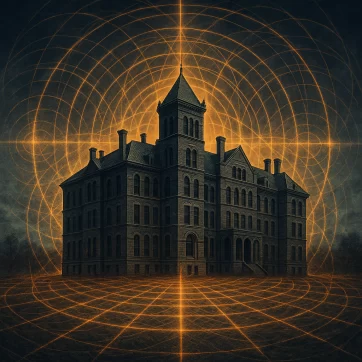
At the deeper level, psychiatric hospitals were not placed randomly. They were strategically constructed on planetary grid points, energetic nodes the mimic sought to control. Within these walls, flame-coded individuals were corralled, their perception reframed as madness, their energy harnessed to feed experiments that would later blossom into organized mind-control programs. What looked like hospitals were, in truth, laboratories of containment — and the legacy of their design still hums beneath our feet.
The Origins of the Asylum System
The rise of psychiatric hospitals in the early 1800s is often credited to the “moral treatment” movement — a supposed humanitarian push in Europe and the United States to bring dignity and order to the treatment of the mentally ill. Reformers argued that large, purpose-built hospitals, removed from the chaos of cities, would provide calm, routine, and the chance for rehabilitation. On the surface, it appeared as an age of progress: shining new institutions erected across the landscape, their very existence hailed as proof of society’s compassion.
In practice, these hospitals were not havens of care but engines of exclusion. They quickly became warehouses for the unwanted: the poor, immigrants, women who spoke out of turn, veterans scarred by war, children who would not bend to rules. Mixed among them were the flame-coded — those who carried heightened perception, psychic sensitivity, and memory of other timelines. Their abilities, threatening to the mimic order, were pathologized as delusion, hallucination, or hysteria. The asylum doors closed not on “illness,” but on difference.
Just as important as who was confined was where the hospitals were built. They were rarely constructed at random. Instead, many were sited on energetically charged land — former monasteries, Indigenous burial grounds, natural water crossings, and vortex points where the Earth’s currents intersect. These sites were chosen for their resonance, their ability to amplify or entrap energy fields. By placing asylums there, the mimic overlay seized existing Earth nodes and repurposed them as scalar laboratories. What was presented as a reform movement was, in truth, a planetary capture operation: corral the sensitives, bury them under the label of madness, and weaponize the very ground they stood on.
The Grid Placement
The siting of psychiatric hospitals was never incidental. These massive institutions were not simply built where land was cheap or populations were dense. Their locations reveal a deliberate pattern: asylums were anchored to ley lines, riverbeds, and energetically active corridors of the Earth. In many cases, their placement coincided with other forms of strategic design — Olmsted parks, military bases, and transportation arteries — forming a larger network of control woven into both land and psyche.
Ley Lines and Earth Currents
Hospitals such as Greystone Park in New Jersey and Pilgrim State in New York were not dropped arbitrarily on open farmland. They were constructed where natural Earth currents cross: aquifers beneath the ground, river valleys nearby, ridgelines carrying geomagnetic charge. These nodes acted as amplifiers, intensifying whatever energy was introduced — whether natural flame frequency or mimic scalar overlay. By placing thousands of traumatized, drugged, or electroshocked individuals atop these points, the mimic grid harvested resonance while corrupting the land itself.
Olmsted-Designed Corridors
Frederick Law Olmsted, best known for designing Central Park, also had a direct hand in planning asylum grounds. His signature landscapes — curved drives, open lawns, tree groves — were not simply aesthetic choices. They mirrored energetic geometries that softened resistance and lulled perception, functioning like living frequency fields around the central hospital structure. Many Olmsted parks sit atop the same ley corridors later exploited for psychiatric or military infrastructure, suggesting a seamless design chain: from park to asylum to experimental site.
Riverbeds and Caverns
Pennhurst in Pennsylvania and Waverly Hills in Kentucky highlight another consistent factor: access to natural waterways and caverns. These were not just convenient for water supply or drainage — they were conduits for energy. Underground rivers and limestone caverns act as scalar amplifiers, carrying frequencies beyond the walls of the hospital into the land grid itself. Patients’ pain and psychic discharge were funneled downward, imprinted into stone and water, where it could be redirected into larger mimic projects.
Proximity to Military Research Hubs
The asylum grid was never isolated from state power. Many of the largest hospitals were located within short distances of major military or research complexes:
- Greystone Park (NJ) sat just miles from Picatinny Arsenal and Bell Labs.
- Pilgrim State (NY) was positioned on Long Island, later home to Brookhaven National Laboratory and Cold War radar testing fields.
- Pennhurst (PA) tied into Philadelphia’s naval research hubs.
- St. Elizabeths (D.C.) lay in the capital’s shadow, directly linked to federal projects.
This proximity created a pipeline: psychiatric wards served as testing grounds, while nearby labs refined the same techniques into weapons. What began as “treatments” — shock therapy, sensory deprivation, drug trials — migrated seamlessly into MK-Ultra protocols.
Amplification Through Scalar Weaponry
These sites were not only convenient for experimentation; they were designed as broadcast nodes. The radial floorplans, dome-like rooflines, and sprawling ward wings acted as architectural antennae. Electroshock rooms and hydrotherapy chambers doubled as scalar chambers, where energy from flame-coded patients could be disrupted, harvested, or redirected into the grid. The buildings themselves were frequency cages, magnified by the Earth currents beneath them.
The pattern is unmistakable: psychiatric hospitals were positioned not where they were needed, but where they could serve as planetary instruments. They were both prisons for the body and amplifiers for the mimic field. What appeared as medical geography was in fact a cartography of control — each asylum a pin driven into the Earth’s skin, forming a lattice of scalar experimentation that stretched across the nation.
Who Was Committed — And Why
The asylum system was never just about the “mentally ill.” The population funneled into psychiatric hospitals reveals who society — and more deeply, the mimic grid — wanted removed from circulation. Those who landed inside were often not dangerous, but inconvenient. They were sensitives, disruptors, carriers of flame, and witnesses to realities the control structure could not tolerate.
Spiritual Sensitives and Flame-Coded Individuals
Many who were confined would today be recognized as spiritually attuned: people who saw energy fields, heard tones or voices outside ordinary hearing, or remembered fragments of other timelines. Within Eternal Flame Physics, these are not symptoms of disease but natural perceptual capacities. The mimic, however, branded them as pathology. Schizophrenia, auditory hallucinations, manic delusion — all labels designed to reframe perception as illness. The diagnosis itself became the weapon, stripping flame-coded people of legitimacy and locking them in frequency cages disguised as hospitals.
Women as Targets of Control
Women were disproportionately confined, often for reasons that had little to do with mental health. A wife who disobeyed, a daughter who resisted marriage, or a mother suffering postpartum depression could be declared “hysterical” and institutionalized indefinitely. Beneath the cultural misogyny lay a deeper pattern: women carried flame memory in their bloodlines, and silencing them disrupted entire family lines of remembrance. What was framed as “hysteria” was often flame impulse — cycles of remembrance, visions, and energetic surges that the mimic grid sought to sever.
Minorities and the “Unfit”
Immigrants, racial minorities, and the poor were also heavily institutionalized. In many states, psychiatric hospitals functioned as racialized holding pens, where language barriers, cultural difference, or systemic prejudice were translated into medical “disorder.” Eugenics movements of the early 20th century pushed hard for institutionalization of those deemed “unfit” — an agenda that aligned perfectly with the mimic’s program of removing flame-coded potential from marginalized populations.
War Veterans and the Broken Witnesses
Veterans of the Civil War, World War I, and later conflicts were streamed into psychiatric hospitals under the label of “shell shock” or “battle fatigue.” While some suffered trauma, many were also witnesses to technologies, experiments, or battlefield anomalies the public was never meant to know. Institutionalization silenced their testimony while also offering their wounded minds and bodies as fodder for experimentation. Their flame impulses — heightened by the extremity of war — were redirected into research pipelines that would later inform MK-Ultra.
Families and Officials as Unwitting Agents
In most cases, families and local officials acted without malice. Parents, clergy, and judges believed they were sending relatives to places of care, not laboratories of containment. Yet in doing so, they became unwitting agents of state control, feeding their own kin into the machinery of mimic experimentation. Generationally, this left scars not just in families but in communities: entire bloodlines fractured, with flame-coded memory suppressed through trauma, sedation, and electroshock.
The asylum population was not simply “mad.” It was the very segment of humanity the mimic feared most: those whose perceptions cracked the façade of the control grid. By branding vision as delusion, remembrance as mania, and flame frequency as disease, the psychiatric system inverted truth into illness — and consigned thousands of seers, healers, and truth-bearers into captivity.
Early Experiments on the “Patients”
The public was told these hospitals offered baths, quiet rooms, and rest cures. Inside, a different apparatus was unfolding: entire human laboratories designed to fracture consciousness and redirect it. Shock therapy, insulin comas, high-dose barbiturates, chlorpromazine, restraints, ice baths, sensory deprivation, and frontal lobotomies were never meant to heal. They were instruments of disruption, crafted to interrupt the inner signal of flame-coded individuals and test how far perception could be broken. Administrators documented compliance, muteness, and amnesia as signs of recovery, but what they were really measuring was how reliably consciousness could be interrupted, steered, and repurposed.
The buildings themselves were frequency cages. Large wards lined with identical metal bedframes, endless tiled corridors, steam tunnels, wiring chases, and radiators formed conductive lattices. Thousands of bodies housed on geomagnetic nodes created a crude cavity, a chamber that captured and recycled the emotional and bioelectric output of everyone trapped inside. Shock rooms and hydrotherapy suites acted as focal nodes, jolting the field with voltage or temperature extremes that kept the collective energy pliable. These institutions were not sanctuaries but machines — every corridor a conduit, every wing a resonant chamber.
The concentration of patients was the key. A single flame-coded person could still hold coherence, but packed dormitories and synchronized ward schedules forced thousands into the same rhythm. Wake-up bells, medication lines, meals, lights-out, and group “therapy” drove every body into lockstep. Once synchronized, the composite field was easier to steer than any individual. A single disruption — an electroshock session in one wing, a sudden drug rollout, a night of enforced insomnia — rippled through the entire building, shifting the collective field all at once. It was not madness spreading through the wards, but mimic coding injected into the hum of shared flame.
This is how flame was harnessed. The Eternal Flame is a coherent carrier signal, and trauma, fear, sedation, and repetitive routine became the imposed modulation. Together, they created a broadcastable composite: authentic life-force carrying an artificial pattern. The system was phase-locked by design. Bells, rounds, meal carts, and ward lights acted as metronomes; electroshock days became hard resets. Over time, breath, sleep, and heartbeat stopped following the body’s natural rhythms and began pulsing with the timetable of the ward. The architecture closed the circuit. Radial ward plans and central halls circulated the energy in loops; basements and tunnels fed it back into the ground.
The land beneath these buildings was chosen for its amplifying properties. Aquifers, limestone caverns, river bends, and ridgelines acted as conduits and resonators. Water under pressure stored and conducted the signal; limestone echoed and spread it; rivers carried it outward. By fixing these institutions on such terrain, administrators tied human energy into the Earth’s own distribution system. The hospital did not just hold the field; it injected it into the planet, where it traveled far beyond the walls.
Every instrument of “treatment” was really a tool to make the field pliable. Electroshock produced seizures that opened short windows of disorientation and suggestibility, rippling fear across the dorms even for those never shocked. Lobotomies and sedatives blunted higher integration, making consciousness dull enough to be guided externally. Sensory deprivation and overload — from solitary cells to the fluorescent hum of dayrooms — swung patients between extremes, breaking their internal clocks until the ward’s artificial rhythm replaced their own. Even the most mundane details — charts, rounds, compliance checks — enforced rhythm with bureaucratic precision. Paperwork was a metronome.
Once stabilized, the harvested field leaked outward. Conductive rails, steam pipes, grounding straps, and trolley lines carried it into the soil and water. Where hospitals sat near substations, telephone trunks, or military labs, the human signal intersected with machines. The result was a feedback loop: flame as the carrier, mimic coding as the modulation, pressed into the land and reflected back to reinforce the very conditions that produced it. What administrators called “cure” — docility, flat affect, forgetfulness — was simply the state of redirection: a body no longer anchored from within, but held by the tone of the ward. When enough patients reached that state, the campus itself carried the signal, not of healing, but of mimic order.
This is why the land mattered. Hospitals rose on monasteries, Indigenous burial grounds, hilltops along rail lines, and nodes already humming with military and industrial activity. The co-location was not convenience but coupling: human fields fused with machine grids, then pressed into the Earth where the signal could travel node to node. No archive will list “flame harvested” or “field exported.” But the pattern repeats everywhere: concentration of sensitives, synchronization of routine, fracturing of inner guidance, architectural containment, and land coupling. Together these elements show intent. The asylum was not a failed medical project but a successful prototype of energy extraction, later refined under new names and agencies.
And this is why those buildings still feel loud when empty. The flame they entrained did not vanish with the patients. It sank into the corridors, into the pipes, into the stone and water below. Each site remains a resonant scar, still bleeding into the mimic lattice that feeds off them to this day.
MK-Ultra and the Asylum Connection
By the mid-20th century, the asylum system had already perfected its role as a prototype: concentrate flame-coded individuals, fracture their coherence, synchronize their rhythms, and bleed their fields into the land. When World War II ended and the Cold War began, that prototype was simply folded into a new name — MK-Ultra. The CIA did not invent mind control from scratch; it inherited the machinery already humming inside psychiatric hospitals.
Many of the doctors who became key figures in MK-Ultra were trained or employed in state hospitals. They had already tested electroshock, insulin comas, and sensory deprivation on thousands of patients. The next step was escalation: introduce LSD, mescaline, and new psychotropics; combine shock with hypnosis; refine isolation chambers into full sensory-deprivation tanks. Hospitals became funnels, their wards supplying a steady stream of captive bodies deemed expendable because they were already labeled “insane.” In reality, they were sensitives, veterans, minorities, and women whose flame had already been tagged by the system.
St. Elizabeths Hospital in Washington, D.C. became one of the most infamous pipelines. On paper, it was a federal psychiatric institution. In practice, it was a testing ground where CIA contractors could run experiments on soldiers, government employees, and flame-coded civilians swept in from the streets. Pilgrim State Hospital on Long Island and Allan Memorial Institute in Montreal extended the network, their corridors feeding directly into CIA research contracts. The same methods once disguised as “treatment” became explicitly rebranded as “behavioral modification.”
What made the asylum-to-MK-Ultra pipeline so effective was not just access to human subjects, but the land. These hospitals were already positioned on energetic corridors. When LSD or electroshock cracked open a patient’s flame field, the discharge wasn’t confined to one body — it resonated through the synchronized ward, into the architecture, and out through the aquifers and electrical conduits beneath. MK-Ultra scientists studied how suggestions, hallucinations, and implanted commands could ride those waves. They weren’t just reprogramming individuals; they were learning how to encode patterns into collective fields.
The CIA’s obsession with “creating a Manchurian Candidate” was only one layer. The deeper agenda was scalar: to see whether flame currents could be harvested, inverted, and weaponized. Asylums had shown it could be done locally; MK-Ultra sought to scale it globally. Techniques pioneered in locked wards became templates for broader societal grids: drugging entire populations with pharmaceuticals, saturating homes with EMF, choreographing mass media rhythms to phase-lock collective breath.
By the 1970s, when MK-Ultra was partially exposed, officials insisted it was a rogue experiment that had gone too far. In truth, it was the continuation of a system that had begun a century earlier under the guise of “mental health.” The asylums taught them how to corral, fracture, and harvest flame. MK-Ultra taught them how to broadcast it back into the world. Together they formed one continuum — the psychiatric grid and the intelligence apparatus feeding the same mimic machine.
Present-Day Continuations
By the late 20th century, the asylum system collapsed under the weight of its own exposure. Lawsuits, investigative reports, and shifting budgets led to “deinstitutionalization,” the mass closure of state psychiatric hospitals. On the surface, this appeared to be reform — a public reckoning with decades of abuse. In reality, the closures did not end the machinery of control. They redistributed it. The experiments never stopped; they simply shifted grids.
From Asylums to Prisons and Streets
When the hospitals emptied, the people once locked inside did not suddenly receive care. They were pushed into prisons, foster care, pharmaceutical dependency, and homelessness. Prisons became the new asylums, absorbing flame-coded individuals whose behaviors or perceptions continued to unsettle the system. Foster care and group homes inherited children who would have once been institutionalized, folding them into fresh cycles of trauma and surveillance. The streets themselves became open-air laboratories, where homelessness, addiction, and police intervention provided steady data on how broken fields could be managed without walls.
The Pharmaceutical Grid
At the same time, the pharmaceutical industry stepped in as the new wardens. What electroshock and lobotomy once achieved, SSRIs, antipsychotics, and amphetamines now enforced chemically. The rhetoric of “community mental health” was underwritten by mass medication campaigns, funneling millions of people into daily regimens that dulled flame perception and synchronized bodies to pharma’s chemical rhythms. The asylum grid did not vanish; it went internal — every pill a portable ward, every prescription a tether into the mimic field.
Haunted Scars and Repurposed Land
Meanwhile, the abandoned hospital sites themselves became scars on the landscape. Some were converted into luxury condominiums or corporate office parks, their frequency cages still intact beneath new drywall and glass. Others were left to decay, marketed as “haunted attractions” where tourists could pay to walk through trauma-soaked halls. These “ghost hunts” are not harmless entertainment — they reactivate the mimic imprint, re-stimulating the very frequencies once harvested there. The land still hums with the composite flame fields that were bled into it, and rather than being cleared, it is exploited again as spectacle.
Psychiatric Prisons and Medical Wards
The modern equivalents are harder to see but just as pervasive. Psychiatric wards still exist inside hospitals, now tightly bound to pharmaceutical protocols. For those deemed criminally insane, psychiatric prisons replace the old state hospitals, blending corrections with psychiatry in an even harsher control grid. In both contexts, individuals are monitored, medicated, and studied — not healed. The same principles apply: concentrate flame-coded individuals, synchronize their daily rhythms, fracture their coherence with drugs or isolation, and harvest the collective discharge into institutional architecture.
Digital Psychiatry and Emotional Surveillance
In the 21st century, psychiatry has merged with technology. Mental health apps, digital therapy platforms, and biometric monitoring tools frame themselves as progressive innovation. Beneath the surface, they extend the asylum apparatus into every home. The same data once recorded on paper charts is now collected in real time, streaming into databases that measure mood, thought patterns, and emotional fluctuations. What was once tested in asylums — how to predict, redirect, and contain human perception — is now coded into algorithms and delivered through screens. The psychiatric grid has gone wireless, syncing with broader scalar and emotional surveillance systems that track not just flame-coded individuals, but entire populations.
Deinstitutionalization did not end the project. It globalized it. Where asylums once concentrated thousands behind walls, the mimic grid now disperses the same methods across society: prisons as containment wards, pharma as chemical shock, digital psychiatry as algorithmic lobotomy. And the land where those hospitals once stood still hums, a scar in the Earth’s body. The machinery of control no longer looks like towering Victorian asylums, but its tone has not changed. It continues to fracture flame, redirect its output, and feed it back into the mimic lattice that governs modern life.
Scalar Weaponry and Flame Harnessing
To understand why psychiatric hospitals were built the way they were, one has to understand scalar weaponry — the hidden physics that underpins the mimic grid. Unlike ordinary electricity or radio waves, which move in simple oscillations, scalar fields are manufactured by forcing waves to collide and collapse into a standing pattern. They do not flow or spiral like natural energy; they compress, stagnate, and penetrate. This collapse effect allows scalar fields to move through walls, bodies, and even the Earth itself — not as living current, but as an imposed pressure zone. Scalar was never a neutral technology. It is an inversion of real flame physics, designed to hijack the body’s natural signal and bend it into the mimic’s rhythm of control.
Psychiatric hospitals were built as giant scalar cages. Their architecture was never random: radial ward layouts, central domes, long echoing corridors, and looped tunnels acted like resonant chambers, designed to capture and trap the energy fields of the people housed within. The patients’ bodies, already flame-coded, produced strong currents of coherent life-force. But when fractured through shock, fear, or sedation, that flame leaked outward, no longer contained by inner guidance. The buildings caught those discharges, circulated them through metal pipes, wiring, and stone, and bled them into the land beneath. Each asylum became a local scalar generator — powered not by machines, but by human suffering.
Fear and trauma were not byproducts of mistreatment; they were the fuel. When thousands of patients screamed, seized, or sank into numb silence, the emotional charge fed the scalar cage. Trauma fractured coherence, and each fracture produced leakage of flame. The mimic grid captured that leakage, overlaid it with imposed patterns — compliance, docility, amnesia — and then broadcast it back into the collective field. In this way, the hospitals did double duty: silencing individuals while reinforcing the mimic overlay across entire regions. The people were not “mad.” They were batteries.
The land was the amplifier. Hospitals were placed on aquifers, limestone beds, and ley crossings precisely because scalar fields ride Earth currents. Water conducts and stores energy; stone amplifies and echoes it. By anchoring hospitals to these nodes, the mimic ensured that harvested flame would not remain local. It spread into the ground, through rivers, into nearby military labs, and out along railways and telegraph lines. The asylum grid was the testing ground for planetary scalar control.
This is the continuity into the present. The principles refined in asylums did not die with their closure — they were scaled up. Today, the same scalar manipulation is embedded into global infrastructure: 5G networks, EMF saturation, and digital psychiatry apps. Just as the ward bells once synchronized breath and sleep, phones and screens now enforce rhythm across millions at once. Just as shock therapy fractured individual perception, scalar EM fields destabilize natural flame coherence. And just as the asylums captured and redirected leakage into mimic overlays, modern grids harvest emotional output through digital surveillance and broadcast it back as controlled patterns.
Seen this way, psychiatric hospitals were never medical institutions gone wrong. They were prototypes for a planetary scalar system. Their architecture, their placement on the land, and their methods of “treatment” were all tuned to one purpose: harness flame and invert it into the mimic grid. What began as domes and corridors became towers and satellites. The system has evolved, but its essence has not changed — capture life-force, strip it of coherence, and recycle it as power for a control field that was built on stolen flame.
Timeline of the Hidden Agenda
The story of psychiatric hospitals is not a series of isolated abuses but a continuous project — one system evolving through new names, new institutions, and new technologies, while its core agenda never changed: to capture, fracture, and harvest flame. The timeline reveals the progression.
1800s — The First Wave.
The asylum era began under the banner of “moral care.” Reformers claimed large hospitals, built outside the cities, would bring calm and healing. In truth, these institutions were strategically placed on planetary grid points — hilltops, aquifers, and river crossings where energy currents could be trapped and redirected. What looked like benevolence was actually a mass round-up of sensitives, women, and the poor, hidden behind rhetoric of compassion. The mimic had created its first net.
1900s–1930s — The Age of Mass Institutionalization.
The asylum model expanded into a nationwide system. Tens of thousands were confined, often indefinitely, their lives reduced to ward numbers and treatment charts. Experiments began in earnest: electroshock, insulin comas, isolation, and early drug trials. What doctors called “therapeutic innovation” was the first systematic attempt to fracture flame coherence on a mass scale. The hospitals functioned as human laboratories long before the CIA existed.
1940s–1970s — MK-Ultra and the Medical-Intelligence Pipeline.
After World War II, the asylum grid became a direct feeder into MK-Ultra. Psychiatric hospitals provided both the patients and the cover for CIA and military experiments. LSD dosing, hypnosis, sensory deprivation, and “psychic driving” were layered onto the earlier shock and drug regimens. Pharmaceutical expansion took root in this period as well, with new psychotropics marketed as “miracle cures” while doubling as field tests in chemical control. The hospitals became nodes where medicine, intelligence, and industry converged — all powered by harvested flame.
1980s–2000s — Deinstitutionalization and Dispersal.
When public outrage forced the closure of many state hospitals, the mimic grid simply shifted form. Prisons became the new asylums, absorbing populations once housed in psychiatric wards. The pharmaceutical industry stepped fully into the role of warden, flooding society with antidepressants, antipsychotics, and stimulants. Entire populations were chemically managed in their own homes — portable asylums, no walls required. Meanwhile, the abandoned hospital sites remained active scars on the land, still leaking the resonance of the fields once harvested there.
Present Day — The Digital Asylum.
The asylum never disappeared; it was re-coded. Psychiatric wards still exist in hospitals and prisons, but the larger control grid has gone wireless. Mental health apps, biometric trackers, and digital therapy platforms harvest emotional data in real time, feeding it into algorithms that predict and redirect thought and mood. Pharmaceutical regimens remain the backbone, but now they are tied to a digital feedback loop — psychiatry merged with surveillance. Just as bells and ward routines once synchronized patients, phones and screens now enforce rhythm across entire societies. What was tested inside locked hospitals is now deployed globally, every home a ward, every device a monitor.
The arc is clear: from 19th-century asylums to 21st-century surveillance, the project has never been about healing. It has been about harnessing flame, repackaging its theft as care, and scaling that theft into a planetary grid. The names change, the tools evolve, but the mission continues.
Case Study: Greystone Park Psychiatric Hospital (New Jersey)
Greystone was never just a hospital. Rising in 1876 in Morris Plains, New Jersey, it was introduced as a progressive marvel of its time — the “largest building under one roof” in the United States, a sprawling complex designed according to the Kirkbride Plan, a 19th-century philosophy of asylum architecture that emphasized light, air, and order. But behind the noble rhetoric of its founding lay the real design: a frequency cage built to corral thousands of flame-coded people and bleed their life-force into the land.
Architecture as Containment Grid
The main building at Greystone stretched nearly a quarter mile, with a central dome and long radial wings branching outward like the arms of a tuning fork. This design was praised as “humane,” offering separation of patients by condition, gender, and class. In reality, the radial wings and repeating wards created closed circuits of resonance. Metal bedframes lined up in endless rows, tiled corridors echoing with footsteps, vast attics, and sprawling basements of steam tunnels all acted as conductors. The central dome served as the capstone of a resonant cavity, allowing the emotional and bioelectric discharge of patients to circulate through the entire structure. Greystone was not simply a building — it was an instrument.
The Land Beneath It
Greystone was deliberately built on a ridge in Morris Plains, over aquifers and stone beds that carried geomagnetic currents. The land itself had a long history of sacred and strategic use — Indigenous pathways crossed the area, and nearby ridges linked into the Morris County corridor of river systems and hills that carried resonance deep into New Jersey. By anchoring the hospital there, planners ensured that every field harvested within its walls would seep into the ground, spreading along natural waterways and out toward industrial and military nodes like Picatinny Arsenal and, later, Bell Labs. The hospital was not isolated — it was plugged directly into a larger grid.
Who Was Sent Inside
By the early 20th century, Greystone swelled with thousands of residents. Women accused of hysteria, immigrants who didn’t speak English, war veterans with shell shock, children labeled unruly — all were confined. Among them were flame-coded sensitives whose visions, hearing of tones, or anomalous perceptions were written off as madness. At its peak, Greystone housed over 7,000 patients, far beyond capacity, transforming the building into a dense frequency chamber where coherence could not be maintained.
Experiments Disguised as Treatments
Greystone became a laboratory of “therapeutic innovation.” Doctors pioneered electroconvulsive therapy, insulin coma therapy, and lobotomies within its walls. Hydrotherapy rooms submerged patients in freezing baths; restraints and sedation became routine. These methods fractured consciousness, creating the very pliability needed for flame harvesting. The shock rooms and operating theaters acted as scalar nodes, jolting the composite field of thousands into pliable resonance. What administrators called progress was, in truth, the breaking and redirection of life-force.
Decline and Demolition
By the late 20th century, Greystone was infamous for overcrowding, abuse, and neglect. Public outrage and lawsuits led to its closure, but the building itself remained — a looming ruin that drew ghost hunters, filmmakers, and tourists. Its reputation as “haunted” was not superstition but evidence of the energetic scars embedded in the land. In 2015, after long debates, Greystone’s central building was demolished. Officials justified the destruction as a matter of safety and redevelopment. The demolition did not cleanse the site — it merely dispersed its residue into the air and soil, scattering decades of harvested flame back into the environment.
The Land Today
Greystone is now a public park. Families walk their dogs, athletes play on fields, and hikers cross the grounds where thousands once screamed, wept, and broke under the weight of mimic experiments. The hospital’s footprint remains in the earth, its tunnels still buried beneath. The resonance of confinement and extraction hums beneath the manicured lawns. What appears as open space is, energetically, a scar — a node of the mimic grid still leaking the imprint of what was done there.
Greystone shows the full arc of the hidden agenda: built as a grid-aligned frequency cage, filled with flame-coded individuals labeled insane, used as a laboratory for fracturing and harvesting consciousness, then demolished and disguised as a park. Its history is not an isolated story of medical error but a window into the larger machinery. What happened at Greystone was not care, not cure, but capture. And its land still carries that weight.
Why It Matters Now
The psychiatric system was never built to heal. From its very first asylums to today’s digital psychiatry apps, it has been a containment grid — a structure designed to fracture flame, siphon coherence, and recycle human life-force into the mimic overlay. These hospitals were not sanctuaries but scars, each one a wound pressed into the land. Even after their closure, those wounds still bleed, echoing into the communities built over them.
Recognizing their true purpose matters because it exposes the continuity. The asylum became MK-Ultra. MK-Ultra became mass pharmaceuticals. Pharmaceuticals became the architecture of emotional surveillance. The control has never ended, only changed its mask. What was once tested behind locked doors is now dispersed through prisons, pills, devices, and data streams, reaching further into daily life than any Victorian hospital ever could.
But the reason this history is surfacing now is because the mimic’s leverage is slipping. The very people once labeled “insane” — flame-coded sensitives, seers, and witnesses — are waking up. Their perception is no longer dismissed as delusion; it is remembered as truth. Each scar exposed, each story uncovered, weakens the overlay. The mimic grid was always parasitic, dependent on fracture and silence. As flame remembrance spreads, its last lever — the psychiatric apparatus that defined truth as madness — is collapsing.
Conclusion — The Asylums Are Still Here
Psychiatric hospitals were never built as sanctuaries. They were the mimic’s laboratories — frequency cages disguised as care. Behind their walls, flame-coded people were not treated but fractured, their coherence broken and redirected into the very grids that bound them. These institutions left scars not only on human lives but on the land itself, each ruin a planetary node where the harvest once ran and still hums beneath the surface.
Though many of the great asylums have been demolished or repurposed, the system did not end. It shifted. Pharmaceuticals, prisons, and digital psychiatry now extend the same project outward, creating new asylums without walls. What was once contained inside massive stone complexes has been dispersed across entire populations, enforced through pills, screens, and surveillance. The machinery of control remains, only subtler, only harder to see.
If those branded “mentally ill” were never insane at all — but seers, sensitives, and carriers of flame — then what else about our history has been inverted? What other truths have been broken, harvested, and hidden beneath the name of progress?
Call for Sources: Greystone & Beyond
This is only the surface. The deeper story — the mapping of hospital grids, the buried tunnels, the survivor testimonies, and the military pipelines they fed — is still unfolding. More in-depth reporting is coming, tracing these sites node by node and exposing how their resonance still shapes the present.
Elumenate Media is collecting accounts, records, and on-the-ground evidence about psychiatric hospitals — beginning with Greystone Park (NJ) and expanding to sites nationwide and internationally.
If you are a former or current patient, family member, staff, contractor, first responder, historian/archivist, or neighbor with knowledge of these facilities (treatments, tunnels/infrastructure, siting decisions, demolitions, redevelopment, “haunted” tourism, military/academic partnerships), please contact: info@elumenatemedia.com
When you reach out, include (as applicable):
- Your role/relationship to the site and the approximate dates involved.
- The facility name and location (Greystone first; others welcome).
- What you witnessed or experienced (treatments, conditions, experiments, unusual construction/land features).
- Any supporting material you can share: documents, photos, video, maps, medical or personnel records, FOIA responses, newspaper clippings, land deeds, planning/permit files.
- Whether you’re comfortable on the record, on background, or anonymous. We honor source protection and can discuss secure transfer options.
Focus:
- Priority: Greystone Park Psychiatric Hospital (Morris Plains, NJ).
- Also seeking tips on Pilgrim State (NY), Pennhurst (PA), Waverly Hills (KY), St. Elizabeths (DC), and related sites nationwide and globally.
Thank you for helping document what really happened inside these institutions — and how their echoes continue today.