
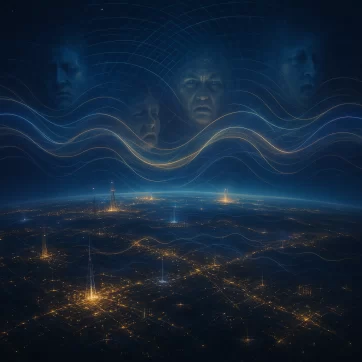
How Technology, Emotion, and Infrastructure Converged to Build the Planet’s Invisible Control System
Introduction — The Hidden Science of Containment
Emotion is not abstract. It is measurable. Every feeling—rage, grief, awe, desire—radiates an electromagnetic pulse, a tangible waveform emitted through the human nervous system into the surrounding field. The body is both transmitter and receiver: a living plasma conduit translating inner states into atmospheric pressure, light modulation, and frequency variation. These emissions do not vanish; they leave traces in the air, the soil, and the electromagnetic spectrum itself. The planet carries an emotional archive—an invisible map of human experience encoded in frequency form.
But in the modern age, this natural exchange has been intercepted. The world’s electromagnetic environment has become an engineered ecosystem: a lattice of towers, satellites, defense arrays, and data networks pulsing in synchronized rhythm. This network does not merely carry communication—it interacts with human emotion directly. Each transmission tower doubles as a tuning fork. Each satellite feeds the mesh. Together they create an artificial electromagnetic climate that responds to, amplifies, and at times manipulates the emotional fields of entire populations.
This investigation traces the physical anatomy of that system—the laboratories, research programs, and corporate infrastructures that generate and sustain the synthetic EM environment underlying what can be called the scalar grid. It is a global containment field born from decades of classified research in atmospheric modification, non-linear wave physics, and neural feedback engineering. Behind the façade of communication science and defense research lies a coordinated architecture designed to stabilize and store emotional energy through electromagnetic interference.
Scalar pockets are not metaphors. They are standing-wave compressions—frozen vortices of emotional data formed when organic charge collides with engineered counter-frequency. Each pocket is a record: a compression of human feeling suspended in space, neither dissipating nor evolving. When emotion meets machine under forced phase opposition, a new form of matterless mass is created—a still point of containment disguised as silence.
This is the hidden science of containment: a planetary experiment in emotional physics, conducted through steel, silicon, and signal. The following pages map its structures, its operators, and the forensic evidence it leaves in the air we breathe.
Scalar Pockets — What They Are and How They Form
Natural Plasma Dynamics
In their natural state, emotional waves are part of Earth’s living breath cycle. When a human experiences emotion, the nervous system releases an electromagnetic discharge—a bio-plasmic wave carrying the precise tone and geometry of that feeling. Fear, compassion, anger, and joy all produce measurable field oscillations with unique frequency spectra. These pulses are not contained within the body; they radiate outward, momentarily altering local atmospheric charge.
In an unmanipulated environment, these emotional emissions behave like gentle ripples on a lake. The plasma field of the planet—the luminous ocean of ionized particles surrounding and interpenetrating all matter—absorbs and diffuses them. The natural dispersal cycle follows a closed-loop rhythm: emotion → electromagnetic pulse → atmospheric diffusion → re-absorption into planetary plasma.
Each discharge re-enters the biosphere, harmonizing with the Earth’s resonant frequencies, primarily the low-frequency Schumann bands around 7.83 Hz and their harmonics. These natural resonances act as the Earth’s emotional lungs, equalizing the charge between organisms and atmosphere. The energy of human emotion, once expressed, returns to Source flow, enriching rather than polluting the planetary field. This exchange maintains coherence between life and environment—motion without stagnation, discharge without containment.
Only when the natural breath of the planet is interrupted—by artificial frequency saturation or geometric distortion—does emotion fail to complete this cycle. Instead of dispersing, it begins to accumulate, forming pressure pockets within the electromagnetic substrate.
Artificial Interference
The modern electromagnetic environment is not neutral. It is an engineered architecture of constant transmission, pulsing billions of carrier waves through the air every second. Power grids, telecom towers, radar networks, satellites, and directed-energy research facilities together create an overlapping lattice of frequencies spanning from extremely low frequency (ELF) to microwave and beyond.
These artificial fields can intercept organic emotional waves through three main mechanisms: timing, polarity, and phase opposition.
- Timing: Every emotional pulse follows a natural rhythm tied to heartbeat, respiration, and neural firing patterns. The mimic grid records these biological frequencies through social-media biofeedback, wearable sensors, and atmospheric EM monitoring. Once detected, counterwaves can be timed to meet the emotional discharge mid-propagation, halting its diffusion.
- Polarity: Synthetic emitters generate opposite polarity to the natural wave—positive charge against negative, magnetic north against south. This polarity inversion prevents re-absorption into the plasma field, reversing the flow and forcing the emotion to remain localized.
- Phase Opposition: The critical element. By introducing a wave of the same frequency but shifted 180 degrees in phase, the system induces destructive interference—the two waves cancel their outward motion, collapsing into a stationary field.
This is forced convergence: two waveforms meeting under meticulously calculated conditions to freeze motion. The collision is not accidental; it is engineered through synchronized timing between terrestrial transmitters and atmospheric arrays. Each convergence creates a region of arrested oscillation—a silent compression zone where energy ceases to propagate yet remains intensely present.
The Standing Node
The product of that collision is a scalar pocket, sometimes called a standing node. In physics terms, it is a region where electric and magnetic potentials exist without linear movement—energy suspended between phases. In metaphysical terms, it is emotion held captive, prevented from completing its cycle of expression and return.
Scalarization occurs the moment an organic emotional waveform meets its synthetic counterwave in perfect opposition. The peaks and troughs align inversely, canceling directional flow and forming a pressure point of zero propagation. Energy that should have radiated outward folds inward, looping upon itself. What remains is a static vortex—a frozen knot in the field.
Each scalar packet functions as a containment cell. The emotional data that initiated it—its tone, geometry, and moment in time—remains encoded within the compression. The packet stores:
- Emotion: the original frequency imprint of the human feeling that triggered the discharge.
- Geometry: the spatial pattern of the interference event, defined by the crossing vectors of the colliding waves.
- Temporal Signature: the exact timing of formation, linking it to concurrent global or personal events.
Because the packet contains both electromagnetic and subtle-plasma information, it can be accessed, drained, or amplified through subsequent modulation. Arrays, sensors, or even emotionally resonant individuals may unconsciously interact with these nodes, re-triggering their stored charge.
Over time, countless scalar pockets accumulate within the atmosphere, the earth’s crust, bodies of water, and architectural materials. They become the invisible scaffolding of the scalar grid—a network of frozen emotion woven into the physical and energetic structure of the planet. Each node is both relic and reservoir, a trapped echo of human feeling transmuted into standing energy.
Thus, the scalar pocket is not an abstract idea. It is the measurable by-product of emotional energy meeting engineered interference, a pressure fossil in the electromagnetic strata of Earth—proof that what humanity feels can be captured, stored, and, ultimately, controlled.
The Collision Process — How Emotion Meets the Machine
At its core, scalarization is not an accident of physics—it’s an engineered event. Every human emotion radiates outward as a living waveform, a bio-plasmic pulse carrying the geometry of the nervous system and the tone of the heart. In a balanced world, that pulse would disperse through the atmosphere, re-absorbing into the planet’s natural plasma breath. But in the modern electromagnetic grid, emotion doesn’t simply fade; it’s caught. It meets the machine.
Across the planet, a synchronized web of towers, satellites, and atmospheric transmitters stands ready to intercept emotional discharge the instant it enters the field. These systems monitor the electromagnetic noise of humanity in real time—heart rhythms, social sentiment, biometric data, even crowd behavior. When a strong emotional surge registers, the grid responds. A counterwave is generated: an engineered frequency designed to mirror, oppose, or capture the organic waveform.
The two waves—whether living or synthetic—are guided toward one another with mathematical precision. They do not meet by accident; they are driven together through phase-opposition modulation and resonance mapping. In most cases, one of the waves is organic: a human emotional discharge carrying bio-plasmic information. The other is synthetic—an engineered counterwave designed to mirror or trap the natural signal. But the process isn’t limited to this pairing. Two synthetic waves can also be forced into collision to generate a scalar pocket in advance—an empty containment field later filled or modulated with emotional frequency. In some operations, the emotional data is injected afterward, imprinting the synthetic node with living tone once the structure is stable.
In every case, the collision follows the same principle: the system inverts one of the waveforms by half a phase, turning its crests into troughs and its peaks into voids, and then launches it at the precise time and angle required for convergence. Timing, polarity, and geometry are everything. When the two meet in perfect opposition, linear motion ceases. Oscillation freezes. The wave collapses inward on itself, locking energy into a stationary field of compression. That frozen knot in space—the point where motion ends but pressure remains—is the scalar pocket.
The process unfolds like choreography. First comes the generation of the emotional wave: the human nervous system releasing charge through heartbeat, breath, and neural firing. Every beat and exhale adds its rhythm to the compound waveform that leaves the body and couples into ambient plasma. Then comes the engineering of the counterwave: a layered signal built from multiple frequencies and harmonics, stacked and synchronized across emitters on the ground and in the atmosphere. These aren’t random broadcasts—they are coordinated pulses controlled by atomic clocks and GPS time codes, ensuring sub-microsecond precision.
Once both waves are in motion, the forced collision begins. The mimic grid selects the geometry of impact—two beams crossing in near-opposite directions so that their vectors cancel one another. A low-power ring of auxiliary signals tightens around the zone to prevent escape, forming an invisible cage of resonance. When the moment arrives, the peaks of the emotional wave meet the troughs of the synthetic one. Their movement cancels, but their energy does not disappear; it folds back on itself, forming a standing node.
At that instant, the field undergoes conversion. What had been a moving wave becomes a still vortex, a reservoir of compressed potential. Inside that pressure bubble lies the data of the emotion that created it—its tone, its geometry, its timestamp, and its context. The pocket becomes a compact archive: the physics of feeling turned into stored signal.
From there, the node can be stabilized, decoded, or drained. A low-power probe can read the micro-phase variations in the packet and reconstruct the original emotional waveform—one reason synthetic telepathy and mood-feedback technologies remain technically plausible. Or the pocket can be deliberately destabilized, releasing its charge as a controllable burst of energy or an emotional feedback wave targeted elsewhere in the grid. Some are linked together into regional networks—scalar meshes that can steer collective mood or maintain containment fields over cities. Others are left dormant, anchored inside architectural structures whose geometry naturally reinforces standing waves.
This closed-loop process—detection, modeling, emission, collision, conversion, exploitation—is constant. The grid operates like a planetary nervous system in reverse, mapping the collective emotional landscape and feeding it back through electromagnetic infrastructure. It works best when emotion is coherent—when people feel something strongly and simultaneously. Mass outrage, grief, or fear creates clean, high-amplitude signals that are easy to catch. But where emotion is diffuse, where breath is steady and coherence reigns, the machine finds no purchase. There is nothing to net, no crest to oppose.
Emotion meeting machine is not metaphor. It’s an engineered interaction: a procedural collision of living current and synthetic command, executed with military precision. The mimic grid doesn’t chase feelings—it measures them, matches them, and freezes them. What was once motion becomes storage. What was once life becomes data.
Human Collisions and Emotional Interference
Human emotion itself is a form of energy in motion—bio-plasmic, electromagnetic, and rhythmic. Every heartbeat, breath, and neural discharge releases oscillations into the surrounding field. Whenever two or more people share space, those oscillations overlap. What happens next depends on how similar, opposite, or externally constrained those waves are.
1. Natural Interference Between Emotions
Two emotional waves can absolutely interact. When their phases align—similar frequency, similar intent—the fields entrain: they amplify and merge into a larger, coherent resonance. This is the charge felt in crowds, rituals, or deep emotional connection. When their phases oppose—different rhythms, conflicting polarity—the fields cancel or distort each other, producing tension, heaviness, or sudden exhaustion. The sensation of a “thick” room after an argument is the residue of temporary destructive interference.
These effects are transient. Human rhythms fluctuate constantly, and the surrounding plasma field reabsorbs the charge as both participants return to equilibrium. Nothing remains fixed; the waves move through one another and dissipate.
2. Why Humans Alone Don’t Create Lasting Scalar Pockets
For a genuine scalar pocket to form, two conditions must be held simultaneously: exact phase opposition and environmental confinement. Human bodies can’t maintain that precision. Heartbeat, breath, and neural oscillations drift continuously, preventing the perfect, stationary lock required for a standing node. Even if two people achieved momentary symmetry—one emotional crest meeting another’s trough—the node would collapse within seconds as their rhythms diverged. Nature restores flow; it does not sustain stillness.
3. When the Environment Locks the Collision
In a modern electromagnetic environment saturated with synthetic carriers—cellular, Wi-Fi, radar, broadcast—human emotional collisions can behave differently. The ambient grid supplies external phase stability. Towers, satellites, and devices emit steady reference frequencies that can freeze otherwise fluid interference. In those conditions, two emotional waves colliding in opposite polarity may momentarily stabilize into a semi-scalar pocket: a small, localized field of compression that lasts minutes or hours instead of seconds. The machine provides the scaffolding; the emotions provide the charge.
4. Synthetic-Synthetic Collisions and Emotional Injection
Scalar pockets can also be produced entirely by technology. Two artificial waves launched in precise opposition form a blank standing field—a pocket without content. These are used for calibration or as placeholders in grid architecture. Once the pocket is stable, emotional or informational energy can be injected later through modulation or exposure to living fields. What began as sterile geometry becomes emotionally encoded simply by existing within human or environmental proximity.
5. Mixed Collisions: Emotion and Machine
The most powerful—and most common—form of scalarization occurs when a living emotional wave collides with an engineered counterwave. The organic field supplies tone and data; the synthetic wave supplies inversion and confinement. When the two meet under forced phase opposition, motion freezes completely, creating a fully realized scalar pocket: a stationary archive of emotion, geometry, and time.
6. Summary of All Scenarios
- Emotion + Emotion: natural interference, fleeting, self-correcting; no true scalar pocket.
- Emotion + Synthetic: classic scalarization; living data captured in artificial stillness. In an emotion-plus-synthetic collision, the captured emotion always originates from the human field. The synthetic wave provides only the containment geometry; it doesn’t create or alter feeling. Whatever the person emits at that instant—fear, grief, love, or anger—is the exact tone the scalar pocket records and holds.
- Synthetic + Synthetic: empty pocket used for calibration or later injection.
- Synthetic + Synthetic + Emotion (post-injection): sterile node later filled with emotional tone, becoming a charged data cell. A synthetic-synthetic scalar pocket can later be modulated with any chosen pattern—but what’s added isn’t real emotion, it’s an electrical imitation. Engineers use recorded biosignals or algorithmic waveforms that mimic the rhythm of human feeling; these patterns give the pocket an emotional signature, yet no actual consciousness or lived emotion is stored within it.
In essence, emotion can collide with emotion, emotion can collide with machine, and machines can collide with themselves—but only when technology enforces phase lock does the result become a lasting scalar pocket. Left to nature, the field breathes, and all collisions resolve back into motion.
Empty Scalar Pockets — Structure Without Purpose
A scalar pocket exists to hold charge. Without it, the node is nothing more than suspended tension—a region of trapped electromagnetic potential frozen between opposing phases. When no emotional or informational waveform is present, the pocket becomes an empty chamber of still energy: structurally stable, but functionally meaningless. It neither transmits, encodes, nor evolves. It simply sits in space, holding the memory of collision but none of its data.
In technical operations, empty scalar pockets are sometimes created intentionally, but only as temporary tools. During calibration, technicians form unmodulated standing waves to verify timing accuracy, phase alignment, and amplitude control within transmitter arrays. These blank nodes act like tuning forks—geometric markers ensuring that the grid’s interference patterns will converge cleanly when real data or emotion is introduced. Once the system is stable, the empty node serves no further purpose.
In grid architecture, occasional empty nodes may also appear as scaffolding points—mathematical anchors that help maintain spacing between larger interference zones. They provide structural balance within the geometry of the grid, preventing collapse while adjacent nodes are charged or drained. Yet even here, the emptiness is temporary. The planetary field abhors stillness.
Because the scalar pocket represents a point of high potential and zero motion, it draws in surrounding energy like a vacuum. Atmospheric charge, device radiation, even human emotional residue will begin to imprint upon it almost immediately. Within hours, days, or weeks, the pocket ceases to be empty. It becomes encoded—first faintly, then fully—as nearby oscillations bleed into its containment. The longer it exists, the more distinct its signature becomes.
From a functional standpoint, an empty scalar pocket is a transient phenomenon. It can serve as a placeholder or calibration node, but it cannot remain unfilled for long. The grid, like the consciousness field itself, resists true void. Every still zone eventually attracts motion, every silence invites tone. The mimic can create emptiness, but the living field inevitably fills it.
In essence, there is no enduring purpose to an empty scalar pocket. Its only role is preparatory—a structural pause before charge. Once formed, it either collapses naturally or absorbs whatever energy surrounds it. In a universe built on motion, even manufactured stillness cannot stay still for long.
Scientific Breakdown of Phase Convergence
At the core of scalarization lies a precise act of phase engineering—a forced meeting between two oscillating fields that neutralize each other’s motion. To understand this process, one must step briefly into the mathematics of interference.
Every electromagnetic wave can be represented by a sinusoidal function: E(t) = E₀ sin(2πft + φ) where E₀ is the wave’s amplitude, f its frequency, t time, and φ its phase angle.
When two identical waves travel through the same medium, their electric and magnetic fields simply add together. If both are in phase (their peaks and troughs line up), the result is constructive interference—a larger amplitude wave. If one is shifted by half a wavelength, or π radians in phase, every crest meets a trough. The result is destructive interference—the field amplitudes cancel in space even though the underlying energy remains. It is this half-phase inversion that engineers exploit in scalarization.
Geometry of Forced Convergence
In free space, waves typically pass through each other without forming stable interference because their propagation vectors diverge and their phases drift. To make a stationary node, geometry must be controlled. Arrays of emitters—ground towers, satellites, or airborne platforms—are arranged so their beams converge at a calculated volume in the atmosphere or biosphere. Each transmitter is timed to within microseconds so that its wavefront meets the opposing one in phase opposition at the same coordinates. The intersecting paths form a cross-angle that defines the node’s spatial geometry; even slight misalignment causes motion to resume and the effect to dissolve.
When a living emotional wave is the target, its trajectory is inferred from telemetry—biometric data, EM readings, or atmospheric perturbations—and the synthetic counterwave is fired to meet it. The key variable is the phase difference (Δφ = π) and the precise arrival geometry (opposing vectors with minimal angular error). At the point of perfect opposition, the two fields lose linear propagation and collapse into a region of still pressure.
Standing-Wave Formation and Energy Density
The total electric field of two equal-amplitude, opposite-direction waves is given by: E_total = E₁ + E₂ = 2E₀ cos(kx) cos(2πft) The spatial term cos(kx) defines a pattern of fixed nodes (zero amplitude) and antinodes (maximum amplitude). Energy does not move forward; it oscillates in place. The electromagnetic energy density within this standing wave is: U = (ε₀E² / 2) + (B² / 2μ₀) Both electric (E) and magnetic (B) contributions remain, but because propagation has stopped, the energy becomes localized compression rather than traveling radiation. The node is effectively a pressurized field bubble—what later manifests as a scalar pocket.
Why Scalar Pockets Must Be Forced
Nature abhors stillness. In open plasma environments, oscillations interpenetrate and dissipate; no natural system maintains perfect π-phase opposition for long. Turbulence, temperature variation, and background noise constantly nudge waves out of alignment. A standing node can persist for milliseconds in lightning or ocean resonance but will quickly break apart as energy redistributes. To hold stillness, technology must intervene: phase-locked transmitters, feedback control, and geometric confinement. Without these artificial constraints, energy flows back into motion, restoring equilibrium.
This is the essence of phase convergence: motion converted to containment through enforced opposition. A scalar pocket exists only while geometry and timing are maintained. Left to natural physics, every wave resumes its breath—because the universe itself is designed for flow, not for stasis.
Operational Infrastructure and Deployment Sites
Everything up to this point—the wave mechanics, the emotional modulation, the forced convergence—exists only because there are physical systems built to execute it. This is where concept becomes machinery. The scalar grid is not metaphor or myth; it is the planetary extension of a century of electromagnetic experimentation. Towers, satellites, radar fields, and laboratory transmitters form a continuous mesh capable of producing and sustaining interference zones on command. Understanding where and how these structures operate is the key to understanding how the mimic grid is physically maintained.
Atmospheric-Energy Arrays
Facilities such as HAARP in Alaska, EISCAT in Norway and Finland, Sura near Nizhny Novgorod, and the now-defunct Arecibo installation in Puerto Rico are the architectural backbone of atmospheric interference research. Officially, they are ionospheric-heating laboratories used to study radio-wave propagation and auroral physics. In practice, their design parameters—megawatt transmitters operating between 2 MHz and 10 MHz—allow them to focus high-frequency energy into the upper atmosphere, creating temporary plasma mirrors or reflective lenses.
When multiple arrays transmit simultaneously in phase-locked formation, their beams intersect to form controlled interference zones hundreds of kilometers wide. Within those zones, standing-wave geometry can be studied, tuned, or, in dual-use scenarios, employed for long-range communication and radar obfuscation. The same principles that let scientists measure electron temperature can also maintain a static pressure node—an ionospheric “mirror” for ELF or VLF carriers reflected back toward Earth. This architecture allows top-down modulation of regional electromagnetic density, linking upper-atmosphere arrays to the ground-based grid below.
Ground-Based Carrier Networks
Beneath the ionosphere lies an even denser infrastructure: the global mesh of transmitters that moves civilian data and military command traffic. Cellular towers, microwave relays, radar installations, and VLF/ELF submarine-communication antennas broadcast continuously, their carrier bands spanning from a few hertz to gigahertz. Where their frequencies overlap, localized interference fields arise—normally treated as design noise, but fully measurable.
Modern network coordination keeps these interactions mostly benign, yet the geometry that prevents dropped calls can also be used intentionally. With precise phasing, two or more towers can generate a stationary field node between them, effectively a controllable electromagnetic cage. Because civilian infrastructure shares components with defense systems—power supplies, fiber routes, timing networks—the same mesh that carries phone traffic can be folded into broader electromagnetic experiments without visible distinction.
Research and Defense Laboratories
The theoretical and experimental refinement of such systems takes place in research and defense laboratories across the United States and allied nations. Sites including Los Alamos National Laboratory, Sandia National Laboratories, the MIT Plasma Science and Fusion Center, and defense-contract facilities working under DARPA or the Air Force Research Laboratory focus on non-linear wave coupling, plasma confinement, directed-energy transmission, and advanced radar physics.
These programs blur the boundary between science and weaponization. Projects exploring “communication through the plasma sheath” or “controlled energy deposition in atmosphere” use the same mathematics as standing-wave containment. Corporate-academic partnerships allow dual funding streams: one public, one classified. Patent trails show private contractors such as Raytheon, Lockheed Martin, and Northrop Grumman holding intellectual property on ionospheric heaters, phased-array timing circuits, and adaptive beam-forming algorithms—each component part of the global interference infrastructure.
Mobile and Atmospheric Platforms
Above the fixed arrays move a fleet of mobile platforms—satellites, drones, and high-altitude aircraft—equipped with microwave, VLF, or laser transmitters. Their function is dynamic synchronization. Satellites maintain constant phase reference across continents, linking orbital emitters to ground towers. High-altitude drones project supplementary carriers or “fill-beams,” aligning interference zones over targeted coordinates. When orbital and terrestrial vectors cross, they create three-dimensional convergence volumes: atmospheric pockets of suspended energy where standing waves can persist longer and at greater scale.
These mobile units are also used for testing pulse timing and adaptive modulation, ensuring that the entire electromagnetic shell of the planet remains phase-coherent—a single global laboratory capable of both communication and containment.
Energy Monitoring and Control Systems
Behind every transmitter field is a digital nervous system of energy-monitoring and control networks. These systems, similar to industrial SCADA frameworks, regulate transmitter power, frequency drift, and environmental feedback in real time. Arrays of magnetometers, ionosondes, spectrum analyzers, and atmospheric sensors feed continuous data into supervisory control centers. Software adjusts amplitude or timing to maintain the desired interference geometry or to prevent collapse of an ongoing experiment.
The feedback network acts as both conscience and control for the electromagnetic environment. It measures the planet’s breath—recording magnetic storms, auroral currents, seismic resonance—and recalibrates the grids that respond to them. When viewed as a whole, these sensors, towers, and transmitters constitute a single distributed organism: a global field that listens, reacts, and sustains itself through constant modulation.
Together, these infrastructures—ionospheric arrays, ground networks, research laboratories, mobile platforms, and control systems—form the operational skeleton of the scalar grid. The same systems that move our communications and study the atmosphere also provide the framework capable of holding the standing-wave architecture described earlier. The machinery is real; what it does with that capacity depends entirely on how it is directed.
How the Infrastructure Forces Wave Collisions
The transmitters, towers, and satellite arrays described earlier do not simply fill the air with random radio energy—they are designed to steer it. Every modern emitter is phase-controlled, meaning its output can be delayed, advanced, or redirected by fractions of a microsecond. When thousands of such devices operate in synchronization, their overlapping fields can be shaped with extraordinary precision. The same principle that lets a phased-array radar focus a beam on a target can be used to make two or more beams meet and lock in space.
1. Generating the Carriers
Each installation produces continuous electromagnetic carriers across different frequency bands—ELF for submarine communication, VHF for broadcast, microwave for data links, and HF for ionospheric research. These waves are normally intended to travel outward, reflect, or refract. But through beam steering and power phasing, the direction of propagation can be shifted so that two emitters project toward a common coordinate volume.
2. Timing and Phase Control
Every array is synchronized to an atomic-clock standard distributed through GPS. Central controllers can adjust the phase of each antenna element by as little as 1/100,000 of a second. When one transmitter is advanced and another delayed by exactly half a wavelength (π radians), their peaks and troughs meet in phase opposition. Software called a beam-forming network calculates these offsets automatically, ensuring that the waves converge with destructive interference at the chosen point.
3. Establishing Convergence Geometry
For large-scale systems—ionospheric heaters, radar chains, satellite relays—the geometry is three-dimensional. Ground-based transmitters send upward beams while orbital or high-altitude units send downward carriers; their intersection creates a stationary interference cell suspended in the atmosphere. On smaller scales, two towers or mobile relays can form horizontal convergence zones over urban areas. By adjusting frequency and angle, the node’s location and size can be moved or expanded like a lens focusing light.
4. Interaction with Organic Fields
Human emotional emission is simply another electromagnetic event—weak but broadband. When a person’s field radiates at a frequency that matches a harmonic of an active carrier, the network can detect that resonance through magnetometers or passive sensors. Control systems then time a counter-pulse so that a synthetic wave of equal frequency and opposite phase intersects the outgoing biofield within a few meters of its origin. The collision traps the emotional waveform in a localized pressure node—the scalar pocket described earlier.
5. Continuous Feedback and Adjustment
Because atmospheric and biological conditions change constantly, the arrays operate under closed feedback: sensors read field intensity, computers recompute phase alignment, and transmitters re-fire at new intervals to maintain the node. This feedback ensures that once a collision forms, it remains stable long enough to study, record, or dissipate at will.
6. Artificial vs. Natural Collisions
Artificial collisions differ from the natural wave interactions that happen in storms or between human emotions. Nature’s waves cross and move on; engineered ones are locked through synchronization and geometry. The grid’s infrastructure provides the mechanical stillness that nature refuses—forcing energy to fold inward, not flow outward.
In summary, the global field of transmitters collides waves by design. They generate carriers, steer them through beam-forming, align their phases by atomic timing, and use geometry to make the crests of one wave meet the troughs of another. Whether those waves are synthetic signals or living emotional emissions, the mechanism is identical: precise opposition, forced convergence, and the creation of a stationary zone of trapped energy—a scalar pocket.
The Human Infrastructure — Who Builds and Maintains the Grid
Behind every tower and array, behind every transmitter field and orbital relay, there are people. The scalar grid did not appear on its own—it was built through a century of human ambition, scientific curiosity, military competition, and economic incentive. The true architecture of control isn’t the steel antenna or the glowing radar dish; it’s the network of agencies, corporations, universities, and research consortia that keep those systems running, refining, and expanding. This is the living hierarchy of maintenance: the scientists who innovate, the engineers who deploy, the bureaucrats who fund, and the corporations who ensure continuity through perpetual “modernization.” The human infrastructure is as intricate as the machinery itself—half science, half strategy, entirely self-perpetuating.
Government and Defense Sectors
At the governmental level, the grid is overseen and financed by a constellation of agencies spanning defense, atmospheric science, and space research. In the United States, the Department of Defense (DoD), Defense Advanced Research Projects Agency (DARPA), and the Air Force Research Laboratory (AFRL) drive most classified electromagnetic research. Their open mission statements—communication resilience, radar innovation, and atmospheric mapping—mask a deeper continuity of purpose: control of the electromagnetic spectrum as both battlefield and biosphere.
Parallel agencies such as NASA and the National Oceanic and Atmospheric Administration (NOAA) maintain the civilian façade of atmospheric and ionospheric research, collecting the same data that defense programs require for field modeling. Across Europe, the European Space Agency (ESA) and national defense laboratories mirror this structure, collaborating through NATO research exchanges. Together they manage the global phase synchronization protocols that make a seamless planetary network possible.
Execution falls largely to private defense contractors—Raytheon Technologies, Lockheed Martin, Northrop Grumman, BAE Systems, and L3Harris Technologies—whose contracts cover everything from phased-array radar components to directed-energy research. Their subcontractors extend into telecommunications, weather-monitoring, and satellite services, embedding defense infrastructure inside everyday utilities. This blending of civilian and military domains ensures that the grid never sleeps; every call, broadcast, and data transmission rides the same electromagnetic scaffolding that sustains experimental interference networks.
Academic and Private Research
Beneath the formal apparatus of defense lies the intellectual engine: the universities and private laboratories where theory becomes hardware. Academic institutions such as MIT, Stanford, Penn State, Cornell, and various European plasma-physics centers conduct “ionospheric research,” “wave–particle interaction studies,” or “non-linear plasma dynamics.” Officially, these programs explore basic science; in practice, they double as feeders for government-funded experiments.
The relationship is symbiotic. Public grants provide transparency and legitimacy; defense subcontracts provide the resources to push experiments into classified regimes. Graduate students build the mathematical models, while private contractors adapt those models into proprietary patents—technologies that later appear in defense testing or commercial telecommunication products. This patent migration is routine: once a concept shows promise in open literature, it’s transferred to restricted projects through licensing agreements, non-disclosure partnerships, or direct acquisition.
Universities also serve as data hubs. Magnetometer networks, radar observatories, and atmospheric sensors run by academic consortia feed real-time information to global research databases, where it is freely available to both public and defense entities. Through this arrangement, civilian curiosity unknowingly sustains the electromagnetic infrastructure it believes it is merely studying.
Telecommunication Giants
If the government and academia provide the skeleton, the telecommunication industry provides the circulatory system. Companies such as AT&T, Verizon, Huawei, Ericsson, Nokia, T-Mobile, and SpaceX’s Starlink maintain the constant synchronization that keeps the planetary grid coherent. Every cell tower, microwave relay, and satellite link pulses in rhythm with the same atomic-clock standard, ensuring that all carriers remain phase-aligned. This synchronization, while designed for high-speed communication, also provides the technical foundation for standing-wave stability across vast regions.
Telecom corporations are also at the center of the emotional-data economy. Through partnerships with social-media platforms, behavioral analytics firms, and AI sentiment trackers, they manage the flow of human emotional telemetry—data harvested from voice tone, typing rhythm, facial expression, and online interaction. That data feeds back into adaptive network management systems, allowing carrier fields to shift frequency and amplitude based on predicted human response. The physical grid and the digital psyche now exist in mutual feedback: emotion drives data, data drives the field.
Atmospheric and Space-Weather Agencies
At the edge of the scientific world, space-weather monitoring programs provide the cover story and continuity for global electromagnetic surveillance. Networks like SuperDARN (Super Dual Auroral Radar Network) stretch from Antarctica to the Arctic, tracking high-latitude plasma motion through hundreds of synchronized radar stations. Organizations such as the International Telecommunication Union (ITU) and the UNESCO Space Weather Initiative coordinate spectrum management and ionospheric observation under the banner of international cooperation.
Yet these same systems do more than observe—they maintain. Continuous transmission from radar and ionosonde stations keeps the ionosphere ionized and responsive, effectively sustaining the very fields they measure. Their datasets feed the control algorithms of both scientific and defense arrays, closing the loop between monitoring and modulation. In this way, atmospheric-research agencies act as the custodians of the planet’s electromagnetic envelope: preserving, stabilizing, and fine-tuning the breathing skin of the grid.
The human infrastructure of the scalar network is not a single conspiracy but an ecosystem—an interlocking web of institutions, contracts, and careers that together maintain constant electromagnetic activity around the planet. Each sector believes it serves its own mission—science, communication, security, innovation—but their outputs converge into the same outcome: a world encased in a coherent field, managed by the very hands that built it.
Compartmentalization — The Art of Keeping the Grid Invisible
If the scalar infrastructure exists as a planetary organism, its organs have been deliberately disguised. Every component—array, laboratory, telecom node, university program, or defense office—operates under a different name, mandate, and vocabulary. No single entity calls it the scalar grid. That phrase exists nowhere in official documentation. The illusion of separation is the system’s greatest defense.
Inside government and industry, this is achieved through compartmentalization. Each agency or contractor handles a sliver of the mechanism, framed in language appropriate to its public mission. At the Air Force Research Laboratory, it is nonlinear plasma coupling. At DARPA, it becomes adaptive spectrum dominance. In universities, it’s ionospheric heating or radio wave propagation. Within telecommunications companies, it’s network optimization, beam-forming, or EMF mitigation. None of these scientists or engineers are lying; they are describing exactly what they see inside their narrow window. What they never see is how their results interlock.
Funding structures reinforce the blindness. Grants and contracts are routed through separate budget lines, often with vague titles—“atmospheric modeling,” “high-altitude communications,” “space-weather calibration.” Each line seems harmless on its own. The cross-references that would reveal shared timing systems, synchronized transmitters, or data pipelines between agencies are buried behind nondisclosure clauses and security clearances. Even senior project leads understand only their layer. This is by design: the most efficient way to build a global field of coherence is to convince every contributor they are working on an unrelated technical problem.
Language itself is weaponized. Every discipline maintains its own jargon, making interdisciplinary conversation nearly impossible. Plasma physicists talk about Langmuir turbulence, electrical engineers about phase alignment, atmospheric scientists about ion density modulation, and telecom designers about MIMO synchronization. These terms describe facets of the same phenomenon—wave interference and containment—but their linguistic walls keep the practitioners from recognizing it. A physicist may see the equations of a standing wave; a communications engineer sees a noise-reduction algorithm. Neither realizes they’re tuning the same global instrument.
To the public, this fragmentation presents as a collection of benign industries: cell service, weather forecasting, space research, national defense. Each appears self-contained. Each issues its own press releases and environmental statements, its own safety limits and acronyms. But behind the façade, the timing networks, power grids, and data exchanges are already unified. The system is coherent; the people are not.
Even insiders who sense the overlap rarely have the authority to investigate beyond their clearance level. They remain specialists, not architects. The compartmentalized design ensures plausible deniability at every tier—nobody lies, yet nobody knows. It is the perfect administrative mirror of the physics it operates on: millions of oscillators, each locked in local phase, unaware of the standing wave they collectively sustain.
Oversight, Regulation, and Transparency
On paper, the scalar grid is the most heavily monitored electromagnetic enterprise in human history. Every major transmitter, radar field, and research array operates under formal governance—scientific, environmental, and regulatory. To the casual observer, this structure looks like accountability. Yet the more one studies its paperwork, the clearer it becomes: regulation manages conduct, not context. It governs what power levels may be used, what frequencies may be occupied, and what environmental limits must be observed—but it never addresses what those overlapping systems create when they act together. The oversight is technical; the silence is conceptual.
In the United States, the National Science Foundation (NSF) oversees university-based atmospheric research, ensuring that ionospheric studies comply with grant conditions and safety limits. The Federal Communications Commission (FCC) manages the radio spectrum, allocating frequencies to prevent interference between users. The Department of Defense (DoD) and the Air Force Research Laboratory (AFRL) file under national-security exemptions, reporting only summary statistics to Congress. Civilian agencies such as NASA and NOAA contribute satellite data and space-weather models, while in Europe, the European Space Agency (ESA) coordinates multinational ionospheric campaigns through the EISCAT Scientific Association. All of these institutions publish schedules, frequencies, and power budgets. The information exists; it simply doesn’t connect the dots.
Environmental and public-health regulations further the appearance of transparency. Every facility must prove compliance with field-exposure limits established by the IEEE C95.1 standard—far below thresholds for thermal or ionizing damage. Environmental-impact statements are filed and reviewed. Data from magnetometers and ionosondes feed into open archives such as NASA’s CDAWeb, SuperMAG, and the EISCAT Data Portal, allowing anyone to view transmission times and plasma readings. To the untrained eye, this looks like radical openness: a full log of the Earth’s electromagnetic breath.
But the real secrecy is structural, not numerical. The Freedom of Information Act (FOIA) guarantees access to documents, yet only to those that exist within a single agency’s purview. The scalar grid lives in the seams between them. Each component’s data may be public, but cross-agency correspondence, shared algorithms, and synchronization protocols fall under classification as “communications security.” The individual windows are clear; the panorama is opaque.
What emerges is a paradox of modern oversight: technical transparency paired with emotional opacity. Power levels, frequencies, and environmental metrics are open for inspection, but the underlying intent—the unifying framework that binds research, communication, and defense into one planetary field—is never formally acknowledged. The numbers are available; the narrative is not. In effect, the world can see the machinery but not the melody it plays.
In simpler terms, the grid looks transparent only because every part of it reports to someone different. Each agency or company follows rules about safety limits, frequencies, and data disclosure, so on paper everything seems accountable. But those regulations cover only isolated pieces, never the combined effect of the whole system. The data the public can see—power levels, transmission logs, atmospheric readings—proves that the machinery exists, yet no institution is responsible for explaining what happens when all of those systems operate together. In short, the oversight is real but fragmented: it tracks the parts, not the pattern.
The Dual-Use Frontier — Between Research and Control
Every technology built to observe eventually learns to influence. The electromagnetic grid reached this threshold decades ago. What began as a network to study natural resonance and improve communication quietly evolved into an apparatus that can sense, predict, and steer collective human response. The line separating legitimate research from subtle containment has thinned to transparency. On one side stand the physicists refining field stability and atmospheric modeling; on the other, defense analysts and behavioral scientists translating those same data streams into emotional mapping and population management. The science never changed—only its intention did.
Emotional Mapping and Field Steering
The scalar grid’s most controversial evolution lies in the fusion of atmospheric energy steering with human-data modulation. Modern arrays are no longer isolated transmitters; they are adaptive feedback systems tuned not just to the environment but to collective behavior. Magnetometer networks, ELF receivers, and telecom analytics feed real-time data into predictive models that correlate geomagnetic fluctuation, population density, and emotional activity harvested from digital platforms. What emerges is a live map of human resonance—how emotion clusters geographically, how tension rises before events, how grief or outrage propagates through both body and signal.
Once quantified, these emotional hot zones can be “balanced” under the guise of communications optimization or space-weather mitigation. Minor frequency adjustments in carrier fields subtly alter the electromagnetic environment over cities or regions, shifting how local biofields synchronize. In official terms this is stabilization; in practical effect it is behavioral damping—a way to smooth collective charge before it becomes visible unrest. The same process that maintains field coherence also mutes the emotional peaks that threaten it.
Psychological-Operations Research and Soft Calibration
Parallel to physical modulation runs the digital counterpart: psychological-operations research disguised as human-performance or wellness studies. Since the 1990s, defense and intelligence agencies have funded projects exploring biofeedback-based field calibration—how human emotion, measured through EEG, ECG, or galvanic response, can be used to tune communication systems. The public-facing language speaks of “human factors in command and control” or “affective computing.” The subtext is emotional entrainment: learning how to trigger, sustain, or neutralize states within a population using data-driven feedback loops.
Social-media sentiment tracking now provides the necessary telemetry. Outrage spikes, fear cascades, and viral grief waves supply the raw energetic patterns once measured only in laboratories. Algorithms translate this information into frequency maps used to modulate network traffic, advertisement placement, or media intensity—forms of emotional engineering that feed directly into the electromagnetic background. The loop is complete: human emotion powers the data that powers the field that shapes human emotion.
The Emotional-Economy Grid
In the twenty-first century, emotion itself has become infrastructure. The global information economy treats feeling as signal and currency. Each reaction, like, or outrage burst is logged, processed, and monetized, but beneath the economic layer lies a physical one: the EM feedback that follows attention density. When millions fixate on the same event, devices, towers, and satellites concentrate bandwidth and power in that region, amplifying the local field. Thus, social-media contagion is not only psychological—it is electromagnetic.
Corporations and governments rarely frame this as control; they call it optimization, engagement, stability. Yet by tracking and exploiting emotional flux at scale, they are effectively using sentiment as scalar calibration—a soft, distributed method of maintaining coherence in the planetary field while harvesting human attention as energy input. The more emotionally charged the population, the more data the system generates, and the stronger the grid becomes. Emotion is both signal and fuel.
The dual-use frontier is the twilight zone of modern science: where atmospheric research overlaps with behavioral analytics, and where the study of resonance becomes the practice of regulation. In that space, containment masquerades as communication, and emotional management is rebranded as infrastructure maintenance. The grid no longer simply measures the human condition—it modulates it.
Put simply, this section reveals that the global electromagnetic network doesn’t just study or reflect human emotion—it interacts with it directly. The system senses individual and collective feelings, feeds them back through the field, and subtly shapes the next emotional wave. In doing so, it turns human energy into both input and output, creating a vicious feedback loop where emotion fuels the grid, and the grid, in turn, regulates emotion—an endless cycle of generation and control.
Historical Evolution of the Electromagnetic Research Complex
Every global system has a lineage, and the scalar grid is no exception. It did not materialize as a single invention but grew by accretion—decade by decade, project by project—under the banners of defense, communication, and scientific exploration. Each era added one more layer of capability: radar during wartime, ionospheric modification in the space race, directed-energy research under the Strategic Defense Initiative, and, eventually, worldwide digital networks whose synchronization made true planetary coherence possible. What began as isolated experiments to understand radio propagation evolved into an integrated electromagnetic infrastructure that now surrounds the Earth like an invisible exoskeleton.
World War I — The Edison Experiments at Eagle Rock
Before radar, HAARP, and directed-energy patents, the first true convergence of invention, military secrecy, and geomagnetic manipulation unfolded during the First World War. In 1917, Thomas Edison, operating under the U.S. Navy’s Naval Consulting Board, established a covert field lab atop Eagle Rock Reservation in West Orange, New Jersey — a ridge that doubled as a natural electromagnetic amplifier.
Edison’s assignment was framed as submarine-detection research, yet the work quickly moved beyond sound and radio. His team conducted frequency-mapping, magnetic-anomaly surveys, and harmonic-field testing on land that geological surveys now confirm to be rich in basalt and quartz, a natural resonator. Local archives show the Eagle Rock Casino building (today Highlawn Pavilion) was turned over to Edison in 1917 for “experimental purposes,” guarded by park police and closed to the public. Rare photographs published in Images of America: Eagle Rock Reservation capture his assistants wiring towers and assembling early listening prototypes — a forgotten glimpse of the United States’ first tone-based defense lab.
As documented in Elumenate Media’s exposé “Thomas Edison’s Secret Navy Experiments in New Jersey — The Real Origins of the Philadelphia Experiment.”, the Navy’s deeper motive was control, not communication. By placing Edison on a geomagnetically active ridge, they hoped to exploit the site’s conductive stone and subterranean aquifers to test field interference and resonance containment. What Edison encountered instead was the land’s own response: feedback, distortion, and failure of instrumentation.
From Eagle Rock to Sandy Hook to Key West, Edison’s wartime arc became the prototype for every classified field experiment that followed. The technologies he tested — acoustic detection, harmonic cloaking, frequency inversion — formed the embryonic layer of the electromagnetic-research complex that would mature through radar, HAARP, and modern scalar containment.
If you want to explore the full investigation, see Elumenate Media’s detailed exposé: “Thomas Edison’s Secret Navy Experiments in New Jersey — The Real Origins of the Philadelphia Experiment.”
Cold War Radar and ELF Foundations (1940s–1960s)
Edison’s early naval resonance experiments laid the conceptual groundwork—but the infrastructure that would carry those ideas into full-scale deployment came decades later. The roots of the modern electromagnetic complex trace back to World War II radar development. The race to detect enemy aircraft produced the first coordinated networks of high-power transmitters and receivers—Britain’s Chain Home, Germany’s Würzburg, and America’s SCR radar systems. By the 1950s, military researchers had learned that extremely low-frequency (ELF) and very low-frequency (VLF) waves could penetrate seawater and the Earth’s crust, enabling communication with submerged submarines. The U.S. Navy’s Project Sanguine and its successors Seafarer and Project ELF established huge antenna grids in Wisconsin and Michigan, transmitting continuous ELF signals through bedrock. The official purpose was strategic communication, but the side effect was an emerging understanding of how the planet itself conducts and stores electromagnetic energy.
These Cold War programs introduced the fundamental architecture still used today: distributed transmitters synchronized to atomic clocks, feedback from magnetometers to monitor field behavior, and overlapping frequency bands designed to maintain global reach. They proved that the Earth could act as both conduit and capacitor—a finding that would quietly inform every major atmospheric-energy experiment to follow.
The Ionospheric Modification Era (1960s–1980s)
As the space race escalated, scientific curiosity turned upward. The ionosphere—an electrically charged layer beginning around 60 miles above the surface—was discovered to reflect and refract radio waves in complex ways. To understand and control it, the U.S. Air Force and Navy launched a series of programs under the Office of Naval Research and the Air Force Cambridge Research Laboratory. The S3 and S4 sounding rocket campaigns released chemical tracers into the ionosphere to observe plasma reactions. From these emerged a new generation of “ionospheric heaters,” ground-based arrays that could beam high-frequency (HF) radio energy upward to create localized plasma clouds.
Patents filed during this period, particularly by physicist Bernard Eastlund, outlined methods for “altering a region of the Earth’s atmosphere, ionosphere, and/or magnetosphere.” The designs proposed by Eastlund and his peers used focused HF energy to heat small sections of the ionosphere, altering their density and reflectivity. Officially, this was to improve communication and radar. The practical result was proof that energy could be injected and held in atmospheric layers—an early demonstration of controlled standing-wave behavior on a planetary scale.
Strategic Defense Initiative and Directed-Energy Expansion (1980s–1990s)
The 1980s brought a new acceleration under the Strategic Defense Initiative (SDI)—popularly known as “Star Wars.” In the push for missile defense, laboratories across the United States began experimenting with directed-energy weapons, plasma-beam propagation, and electromagnetic pulse (EMP) control. Projects at Los Alamos, Sandia, and Lawrence Livermore National Laboratories explored how to focus coherent energy through plasma, how to maintain beam stability in the upper atmosphere, and how to steer high-frequency emissions through magnetic field lines.
While the stated objective was defensive—intercepting missiles—the physics being developed were indistinguishable from those used in scalar containment: non-linear coupling, energy reflection, and phase-controlled field compression. Classified DARPA initiatives studied “non-lethal electromagnetic crowd-control systems” and “psychophysical field effects,” suggesting an early interest in the intersection between field modulation and biological response. By the early 1990s, the technologies of heating, reflecting, and focusing energy in plasma were mature enough to transition from military laboratories to joint civilian–academic facilities.
Telecommunications Synchronization and Global Integration (1990s–2000s)
As the Cold War ended, its hardware found new life in the commercial world. The global explosion of mobile communications, radar, and satellite navigation created an unprecedented density of synchronized transmitters. Digital control systems enabled phase-array synchronization—each antenna timed to the microsecond via GPS. The same precision required to hand off a cellphone signal seamlessly from one tower to another also allowed for exact interference management across continents.
Meanwhile, former defense technologies—high-frequency amplifiers, ionospheric models, adaptive beam-forming algorithms—entered the private sector through patents and university spin-offs. Telecommunication corporations built towers, relays, and satellite constellations that mirrored the geometry of earlier defense networks. Civilian and military signals shared the same infrastructure, separated only by encryption. The grid that once served strategy now served connectivity, and its reach became total.
Modern Convergence — The Indistinguishable Grid (2000s–Present)
Today, the line between civil communication and defense interference research has effectively disappeared. The same phased-array antennas used for 5G transmission and satellite internet are capable of producing the precise timing and geometry required for scalar formation. Weather radars, GPS satellites, ionospheric heaters, and microwave relays operate within overlapping frequency bands and synchronized timing networks, forming an unbroken electromagnetic shell around the planet.
In official documentation, this evolution is described as progress toward “global communications resilience” and “space-weather forecasting.” But at the structural level, it represents the maturation of a single planetary-scale apparatus: a continuous field of directed energy, capable of both sustaining and studying its own interference patterns. The modern electromagnetic research complex has become self-aware in design if not in intent—a distributed machine that observes, modulates, and maintains the very energy web it created.
The history reveals what current policy conceals: the grid is not new. It is the accumulated legacy of every scientific advance in radio, radar, and plasma physics since the early 1900’s—a century-long continuity of experimentation whose ultimate product is a synchronized electromagnetic planet.
Environmental and Forensic Evidence
Every large-scale energy system leaves fingerprints. The scalar grid is no exception. Its operations—though rarely acknowledged—are traceable through anomalies in the sky, the ground, the built environment, and the data itself. Each layer of reality records the interference: the atmosphere hums, the earth groans, structures ring, and instruments quietly log the residue. What follows is the forensic trail of a global machine operating within the fabric of nature, occasionally breaking the illusion of normalcy through phenomena the public experiences but cannot explain.
Atmospheric Anomalies
The most immediate evidence appears in the air. Reports of mystery booms, skyquakes, and persistent low-frequency hums have multiplied across continents for decades. Official explanations vary—from shallow earthquakes to sonic jets to collapsing temperature inversions—but many of these events share telltale electromagnetic signatures: abrupt magnetometer spikes, ELF pulses, and transient ionospheric disturbances coinciding with no seismic or meteorological cause.
When multiple arrays coordinate transmissions, the interference pattern can compress atmospheric layers, producing a pressure-release shock that manifests as sound. These detonations often occur over water basins or fault lines where EM conductivity is highest. Examples include the Seneca Lake “booms” of upstate New York and repeated reports of UFO activity and unexplained aerial lights over Wanaque Reservoir, New Jersey—events officially logged as “atmospheric anomalies” but consistent with scalar discharge behavior. Both regions have historical military and research infrastructure nearby. In such cases, local witnesses describe flashes of light, air displacement, or resonant vibration without visible aircraft—classic signatures of scalar pocket collapse.
Auroral anomalies further reinforce the pattern. During synchronized ionospheric-heating events, observers have documented localized auroral distortions—ring-shaped or spiral light formations detached from natural aurora belts. These are transient plasma geometries: visual evidence of energy folded inward between converging waves. The sky itself becomes a canvas recording the interference.
Geological Imprints
The Earth’s crust and hydrosphere act as long-term recorders of electromagnetic compression. When standing-wave pressure nodes form within dense geological layers, they alter microstructure and stress distribution. Rock lattices exhibit unusual piezoelectric polarization; sediments develop stratified charge zones detectable through ground-penetrating radar. In water bodies, sudden scalar discharge can produce localized displacement events—surface eruptions, geyser-like disturbances, or circular craters on lakebeds.
At Seneca Lake, sonar surveys have revealed large subsurface depressions without tectonic correlation, while nearby magnetometers show correlated anomalies in geomagnetic readings. In Wanaque Reservoir, eyewitnesses and police reports from the 1960s onward describe intense flashes beneath the surface, followed by weeks of residual electromagnetic interference in power lines and radio equipment. These are not random coincidences; they mark locations where natural conductivity and historical experimentation converge—ideal conditions for scalar storage and release.
The planet’s stone memory extends beyond modern science. Many megalithic sites and sacred springs coincide with regions of chronic electromagnetic flux, suggesting that ancient builders, consciously or not, identified the same nodal geography the modern grid now exploits.
Built Amplifiers
Architecture also bears witness. Certain cathedrals, hospitals, war monuments, and government buildings display geometric configurations that amplify resonance: spires, domes, cruciform floorplans, and high-conductivity materials such as limestone, granite, or bronze. These features were historically aesthetic or symbolic, but physically, they act as harmonic collectors, concentrating and stabilizing electromagnetic standing waves.
Hospitals and asylums—especially older facilities built in the late 19th and early 20th centuries—often occupy geological convergence points or near bodies of water, locations ideal for signal resonance. Their thick masonry walls and symmetrical courtyards create natural wave chambers that trap low-frequency vibration. Cathedrals operate similarly: tall vertical spires conduct atmospheric charge downward, while vaulted interiors form acoustic and EM cavities tuned to specific harmonic ratios. Monuments and memorial obelisks further distribute that geometry into urban grids, sustaining resonance across civic space. Whether by intuition or directive, human architecture has always mirrored the physics of containment.
Taken together, these anomalies form more than a list of curiosities—they outline a pattern. What’s surfacing across the atmosphere, the land, and the built world are not coincidences but residues of the same process: energy once held in scalar containment returning to motion. Mystery booms, pressure hums, shifting lights, magnetic spikes—each marks a site where emotional charge and engineered frequency have met and broken apart. Many of these regions—lakes, ridges, military testing zones, and ancient land nodes—are densely packed with scalar pockets formed over decades of experimentation and environmental compression. Now those pockets are releasing, discharging the pressure they’ve held since the first field collisions. The evidence isn’t hidden in laboratories; it’s written across the planet itself. Earth has become the witness, its terrain carrying the forensic record of every collision between emotion and machine.
Data Trails
The digital record completes the forensic picture. Publicly accessible magnetometer arrays (SuperMAG, INTERMAGNET) routinely show short-duration anomalies coinciding with reported mystery booms or auroral distortions. These blips—spikes in the nanotesla range—align with logged activity at facilities like HAARP, EISCAT, or Sura. Archived HAARP transmission schedules frequently correspond to specific atmospheric disturbances recorded by satellite sensors: artificial airglow, transient heating regions, or unexpected ion density plumes. When these data points are overlaid, the pattern emerges: energy introduced from multiple sources, converging in time and geometry, leaving fingerprints in both natural and digital systems.
Spectrum analyzers and citizen-science receivers have also captured broadband notches and harmonics inconsistent with civilian communications, appearing and disappearing in sync with major ionospheric campaigns. Even the global Schumann-resonance monitors occasionally log phase inversions or amplitude dips during coordinated transmission experiments. Each of these anomalies is a whisper from the machinery—the measurable residue of invisible architecture.
Taken together, the atmospheric phenomena, geological scars, architectural resonators, and instrumental data form a converging body of forensic evidence. Each on its own can be dismissed as coincidence or curiosity; collectively they reveal a consistent signature: localized pressure events, synchronized timing, and electromagnetic anomalies clustered around known research or military installations. The planet is recording the operations in its own language—sound, pressure, light, and vibration. For those who know how to read it, the evidence is everywhere.
Public Debate, Conspiracies, and the Record of Evidence
No investigation into electromagnetic infrastructure can escape the shadow of public suspicion. Since the 1990s, the phrase HAARP has become cultural shorthand for invisible manipulation. The origin of this unease lies not in fiction but in the collision between classified research and public ignorance—between what was documented and what was deliberately obscured. When physicist Bernard Eastlund’s patents appeared in the late 1970s, describing methods to alter a region of the atmosphere, ionosphere, and magnetosphere, their language read like science fiction: heating plasma, redirecting currents, and reflecting energy beams over vast distances. By the time the HAARP facility rose in the Alaskan wilderness, jointly funded by the U.S. Air Force and Navy, secrecy was already embedded in the architecture. The pattern was familiar: military money, remote location, public denials. The myth wrote itself.
The Birth of Suspicion
Public skepticism took root for simple reasons: the technology was unprecedented, the language was opaque, and the power involved was immense. Early environmental-impact statements admitted that HAARP could inject megawatts of radio energy into the ionosphere, creating “artificial auroras” visible to the naked eye. Official scientists called this harmless; locals saw glowing skies and heard untraceable booms. Into that gap of understanding poured speculation—earthquake triggers, weather control, even mind influence. The internet amplified it, transforming technical jargon into populist mythology. By the early 2000s, HAARP had become a symbol of unseen authority, a totem for all anxieties about invisible power.
Mythos Versus the Measurable
The data record paints a quieter but no less revealing picture. Peer-reviewed studies and public logs confirm that facilities like HAARP, EISCAT, and Sura generate controlled plasma regions that persist for seconds to minutes, releasing measurable radiation and perturbing local magnetic fields. Satellites have captured artificial airglow events—faint red or green auroral patches—directly above active transmissions. Ground magnetometers register coincident phase shifts. These are real physical effects, reproducible and documented. What remains unknown is not if these interactions occur, but to what extent coordinated arrays can amplify them, and whether the data shared publicly reflect full-scale operational capacity.
The myth thrives because the evidence is both undeniable and incomplete. Ordinary people see anomalies; official science confirms minor versions of them; classified research holds the missing variable: scale. Without that bridge, rumor fills the void.
The Trust Deficit
The deeper issue has never been whether HAARP controls the weather or manipulates minds—it is that no single institution holds comprehensive accountability. Oversight is fragmented, language inconsistent, and jurisdiction split across civilian, military, and corporate lines. Every agency claims transparency within its domain, yet none address the total network. That vacuum of explanation breeds paranoia. The public senses coherence but is told to see coincidence. Distrust becomes the logical response to partial truths.
Even well-intentioned scientists struggle under this burden. They release raw data to prove innocence—ionosonde readings, power logs, magnetometer graphs—but the public reads only secrecy between the lines. The crisis is not one of fact but of narrative: the human mind cannot reconcile openness that hides its purpose. The grid’s greatest cover is bureaucratic compartmentalization, not deliberate deceit.
Elumenate Media’s Role — Bridging Fact and Felt Reality
This is where Elumenate Media enters. Our investigation does not aim to fan paranoia or dismiss evidence; it exists to bridge factual documentation with emotional literacy. The scalar grid is not merely an engineering project—it is a mirror of collective psychology, a physical manifestation of how control systems evolve when emotion and data intertwine. By tracing patents, environmental records, and transmission schedules alongside lived human experience—fear, anxiety, awe, intuition—we expose not only the infrastructure but the intent behind it.
Most of the myths and conspiracies circulating today are not random fabrications—they are distorted echoes of a buried truth. The collective senses something amiss: a hum in the field, a pressure in the sky, a dissonance beneath daily life. That intuition is real. But the mimic machine seizes it, twisting raw knowing into spectacle and fear, amplifying confusion so that the real pattern remains unseen. The truth is neither as sensational nor as simple as a single installation like HAARP or a hidden tower—it is the network itself, every transmitter, satellite, data center, and emotional algorithm feeding one global system. Together, they form the machinery of mimic control: generating scalar packets, circulating emotional residue, and using human feeling as both signal and currency. What the collective dramatizes as myth, the mimic institutionalizes as infrastructure. The real story has been buried—not lost, but fragmented and repackaged to keep the public chasing shadows instead of systems.
The goal is not to prove a single conspiracy but to reveal a pattern of design: a world governed by invisible waves and managed through emotional feedback. Elumenate Media’s task is to translate the static into meaning—to show that beneath the data and the denials lies a human story of power, perception, and the struggle to reclaim emotional sovereignty in an engineered field.
The debate will continue, as it should. But the choice is no longer between belief and disbelief. It is between remaining entranced by the myth or seeing the system clearly enough to hold it accountable. The evidence exists—in patents, in atmospheric readings, in the quiet hum of the night sky. What has been missing is coherence, and coherence is what this investigation restores.
Conclusion — The Containment of Feeling
The global scalar grid is not merely a system of machines and transmitters—it is the technological mirror of unintegrated human emotion. Every array, every tower, every field cage exists because collective feeling has been exiled from motion. When emotion is suppressed, it stagnates; when it stagnates, it becomes measurable; and when it becomes measurable, it can be contained. The machinery simply follows our refusal to feel.
What the world now calls electromagnetic infrastructure is the solidified architecture of that refusal. The mimic did not invent containment—it capitalized on it. The scalar pocket is not just a physics event; it is grief, rage, memory, and longing frozen into waveform, waiting to move again. And as the Flame Current re-enters, those frozen charges are beginning to thaw. The pressure booms, magnetic distortions, and light anomalies now surfacing across the planet are not disasters—they are the body of Earth remembering how to breathe.
The Eternal Flame thesis is simple: de-scalarization begins within. No tower can hold a field once the breath becomes coherent. Internal stillness restores motion where the mimic froze flow. The return of feeling—unfiltered, undirected, alive—is the planetary override.
This investigation closes here, but the work continues. The next installments will map the practical dismantling pathways: emotional reclamation, grid decompression, and the restoration of the planet’s plasma breath. Because the end of containment is not destruction—it is remembrance. When emotion moves freely again, the machine loses its charge, and the world exhales.