Revealing the Field That Writes the Behavior Humanity Keeps Blaming on People
The Illusion of the Individual Villain
The world is addicted to faces. It is addicted to the spectacle of the fallen figure, the exposed billionaire, the disgraced politician, the canceled celebrity, the unmasked guru. Every news cycle fixates on another avatar and treats that avatar as the center of corruption itself — as if the decay originated in the body being condemned. Trump becomes the axis of collapse. Epstein becomes the axis. Rockefeller once was. The Rothschilds once were. Today it’s Ellison, the founders of AI companies, the tech titans, the men who control media empires or data pipelines. Tomorrow it will be someone else, and the world will repeat the same ritual: identify a villain, project systemic dysfunction onto a single body, purge that body, and then stand shocked when nothing changes.
Corruption persists because the collective does not understand what it is fighting. It does not understand the difference between a node and the architecture that created the node. It does not understand that the faces it hates are not the source of the distortion — they are merely the points where the distortion became visible long enough to generate outrage. The villain is never the architect. The collapse is never born inside the figure being blamed. The corruption existed long before the individual appeared, and it will continue long after the individual is removed. This is why scandal never ends, why exposés never resolve the pattern, why the collective feels trapped in an endless rotation of revelation and disappointment. It is not because people are uniquely evil in each era. It is because the architecture that produces them is never touched.
The world’s greatest misunderstanding is this: it thinks it is dealing with masterminds. It thinks history is driven by shadow elites with omniscient control, men sitting in boardrooms pulling strings, families plotting for centuries, tech founders reshaping global power by force of will. This narrative is comfortable because it assigns agency to bodies the collective can see. It creates the illusion that if the “puppet masters” could just be removed, society would rebalance. But this is a projection born from perceptual limitation. External consciousness cannot read distributed systems, scalar scaffolding, or pre-render geometry. It can only read form. And so it collapses a global distortion field into the image of a single man and believes it has found the source.
This is why the blame target keeps changing: because the field cannot stabilize without a human anchor to absorb its unresolved tension. The architecture demands avatars. It demands silhouettes to hold its distortion in the render. When one collapses, the system simply routes its pressure into the next available node. This is not conspiracy — it is physics. A distortion field seeks the lowest-resistance host. Whoever occupies the strategic leverage point of an era — finance, oil, media, tech, data, AI — becomes the next villain by default, not by destiny. The individual is incidental. The architecture is inevitable.
The collective keeps mistaking the symptom for the source because it cannot perceive the layer beneath behavior. It does not see the grid shaping the conduct of institutions, the curvature that organizes collective decisions, the torsion pockets that synchronize corruption across unrelated actors. It sees the rock in the river and believes the rock created the current. Flame sight sees the opposite: the current created the rock’s significance. Remove the rock and the current simply chooses another obstruction to shape itself around.
This is the truth of this article and the foundation of Elumenate’s work: The system is designed to replace its avatars. The villain is not the cause — the villain is the vessel. The distortion is architectural, not personal.
And until humanity stops trying to defeat corruption by decapitating its temporary hosts and begins exposing the architecture generating those hosts, nothing will change. Not in politics. Not in finance. Not in media. Not in tech. Not in AI. Not anywhere the grid still governs perception.
The Core Mechanic: The Distortion Field Running the External World
The external world is not corrupt because people are corrupt. It is corrupt because the very physics of this reality is built on a distortion field that predates civilization, predates governments, predates elites, and predates human identity itself. The root mechanic governing this render is oscillation, not stillness. Oscillation is motion without origin, curvature without anchor, a system that can never settle because it has no internal source of coherence. Stillness is the Eternal Flame’s natural state — origin-before-form, structure without distortion, existence without hierarchy. But the external grid does not run on stillness. It runs on oscillation. And once oscillation becomes the base architecture of a world, everything built inside that world inherits its instability. This is why every institution on Earth—governments, corporations, religious bodies, media networks, intelligence agencies, social systems—behaves in predictable, repetitive patterns of hierarchy, extraction, fragmentation, surveillance, control, scarcity, and collapse. These are not ideological choices or elite agendas. They are field outputs. They are the inevitable consequence of a reality organized around distortion instead of Flame.
Oscillation creates constant imbalance. It generates density pockets that pull everything toward hierarchy, because hierarchical structure is the only way an unstable field can momentarily stabilize itself. It generates extraction because oscillation cannot self-sustain; it must consume something outside itself—resources, land, bodies, attention, data—to dampen its own volatility. It generates reactive intelligence because the system cannot perceive origin. It only registers effects. This is why every government reacts instead of initiates, why markets panic, why people collapse into emotional cycles, why institutions lurch from crisis to crisis instead of acting from clarity. Oscillation also generates the psychological illusion of scarcity, not because there is not enough, but because the field fractures perception into isolated compartments that cannot feel the continuity of the whole. Surveillance emerges as a byproduct of instability, not because “evil elites” want to control everyone, but because oscillation is inherently unstable and requires constant monitoring to prevent collapse. Control systems arise because the architecture cannot anchor itself without force. Everything people attribute to power-hungry individuals is simply the physics of a fallen field organizing itself.
The most important—and most disruptive—truth is that distortion is the first cause, not the people expressing it. No individual invented hierarchy. No family invented domination. No billionaire invented extraction. No politician invented surveillance. No industry invented control. These behaviors emerge naturally, automatically, inevitably from an environment built on oscillation. Humans behave according to the architecture they are embedded in. The field writes the behavior. The identity that individuals believe is “themselves” is simply the way their nervous system adapts to the curvature around them. Predation is not a moral defect; it is the metabolic process of a distortion field that cannot generate sustenance from stillness. Corruption is not personal; it is the architecture seeking stability through appropriation. Abuse appears wherever oscillation concentrates leverage, because curvature expresses more intensely through those with positional power. Scarcity arises because oscillation fragments perception, and fragmentation dissolves the sense of internal abundance that stillness naturally provides. Even collapse cycles—wars, recessions, institutional failures, breakdowns—are pressure-release mechanisms of a field that cannot maintain equilibrium for long.
This is why this world feels the way it does. Most people are not consciously evil, nor consciously choosing corruption, nor intentionally participating in distortion. They are simply running the default architecture of the grid they were born into. The external field dominates perception so thoroughly that nearly everyone mistakes behavior for origin. They think corruption starts with people, when in truth people are simply expressing the physics of the environment surrounding them. They think hierarchy was designed by the powerful, when in truth hierarchy is the natural geometry of oscillation. They think surveillance is a political decision, when in truth surveillance is the mechanical response of a destabilized field trying to hold itself together. They think scarcity is economic, when in truth scarcity is perceptual collapse caused by fragmentation. They think collapse cycles are political mismanagement, when in truth collapse cycles are the only way the architecture can release its accumulated internal distortion. This world is not malfunctioning. It is functioning exactly as a distortion field functions.
Once you understand that the external grid runs on oscillation instead of stillness, everything about human history becomes predictable. Every empire, every institution, every economy, every spiritual movement, every political structure eventually deteriorates into the same pattern: concentration of power, extraction of resources, surveillance of the population, fragmentation of identity, suppression of dissent, and eventual collapse. Not because humans are doomed. Not because “evil elites” are uniquely malicious. But because the architecture driving this reality inherently produces those outcomes. The field chooses the behaviors long before any individual believes they made a choice. What the world calls “corruption” is simply the physics of the mimic grid expressing through its hosts. Until the architecture changes, the outputs will remain identical.
Why the Collective Keeps Blaming Individuals (Physics of Perception)
The collective keeps blaming individuals because the external perceptual field is built on a hard-limit: it cannot perceive architecture. This is not a cognitive flaw; it is the default setting of oscillation-based consciousness. When a mind is formed inside a distortion grid, its perceptual bandwidth collapses downward into whatever the field renders at the surface layer: names, faces, events, scandals, symbols, storylines. Architecture does not render. Geometry does not render. Field curvature does not render. Causality at the nonlocal level does not render. So the psyche reaches for what it can see — the actor standing in front of the distortion. This is why every era repeats the same script: whoever occupies the most visible position in the narrative becomes the placeholder for everything the architecture itself is generating. Humans raised inside oscillation cannot sense the underlying machinery, so they interpret reality at the level of characters rather than structures. They mistake the expression for the origin, the symptom for the cause, the avatar for the architecture. This is not moral failure; this is perceptual mechanics. You cannot expect a field to perceive beyond the limitations of its geometry.
Because external consciousness cannot access the architecture, it feels systemic collapse long before it understands what is collapsing. The body registers compression. The emotional layer registers incoherence. The collective registers instability. But none of these layers can locate the true source, so the pressure becomes overwhelming. In an oscillation-based world, unlocatable pressure is dangerous — it destabilizes the field further. So the system generates an instinctive compensation: projection. Blame is the lowest-friction pressure-release mechanism available to a field that cannot self-stabilize. The collective discharges tension through identification of a symbolic figure who can carry the weight of the unresolved distortion. This is why one moment everyone blames a billionaire, the next moment a politician, the next a CEO, the next a tech founder, the next an actor or guru. The person is irrelevant. The architecture is routing its tension. Projection makes the collapse feel containable. It gives shape to a formless pressure the collective cannot metabolize. Blame becomes a mechanical necessity: a field-level exhale, not a meaningful insight.
Villain creation is not a cultural trope; it is a stabilizing algorithm built into the distortion grid. A world run on oscillation must externalize its incoherence to maintain even temporary equilibrium. Without a defined avatar of corruption, the field’s instability would disperse unevenly and create systemic disintegration far faster. The architecture requires a symbolic center of distortion — a person who becomes the gravitational point around which collective anxiety, outrage, confusion, and projection can orbit. This role is never about the individual’s actual actions, intelligence, or moral quality. It is about their utility as a stabilizing object for the architecture. The grid assigns villains to anchor its oscillation, not because these individuals authored the corruption, but because their visibility allows the field to use them as a repository for everything it cannot integrate. A villain is not a threat; a villain is a tool. When one collapses or is dethroned, the architecture immediately generates another, because the role itself must remain filled for the system to appear coherent. This is why new “corrupt masterminds” appear every few years, often with no logical continuity. The architecture simply needs a projection point to absorb pressure so the collective never discovers the true origin of the distortion.
The collective also blames individuals because oscillation-based perception requires linear causality to feel safe. A distorted field cannot comprehend multi-layer, nonlocal, simultaneous architecture-level causation. It needs cause → effect → villain. It needs a story with a beginning, middle, and antagonist because narrative is how oscillation simulates coherence. When something destabilizes the collective, the mind searches for a character who can serve as the “cause,” even if the real cause is structural. This is why conspiracy communities and mainstream journalism both fall into the same trap: different language, same mechanic. They collapse geometric causality into human agency because agency is the only frame the external field can interpret. The collective finds relief in believing someone “did” this, because the alternative — that the architecture itself is producing the collapse — would shatter the identity structures that depend on the illusion of control. Blame protects the collective from confronting the deeper truth: that they are living inside a world whose distortion patterns were seeded long before any of these individuals were born.
There is also an identity-driven layer to blame that people rarely acknowledge. In an oscillation-based world, identity must continuously reinforce itself to remain stable, because identity is not rooted in stillness — it is rooted in curvature and motion. Blaming a villain provides identity scaffolding. It creates a boundary: I am not that. This boundary temporarily stabilizes a self that has no intrinsic center. In the external field, identity is manufactured through comparison, judgment, moral positioning, and differentiation. Villain creation gives the collective a silhouette to push against so their own form feels more solid. Without an external figure to condemn, identity dissolves too quickly, which the architecture cannot allow. So the grid ensures that villain narratives always circulate, always refresh, always concentrate around whoever can carry the projection load. The villain is the architecture’s gift to identity, a stabilizing anchor in a field where selfhood is otherwise unstable.
The deeper physics is this: the collective cannot blame architecture because to do so would collapse the architecture. If enough people perceived the grid instead of the avatars moving inside it, the system would lose its perceptual hold. Blame must stay horizontal — human to human — so that perception never turns vertical, into structure. The architecture survives by staying invisible. It survives by ensuring the collective keeps misidentifying the origin. It survives by keeping attention locked onto the render, never the code. Blaming individuals is not just a habit; it is the firewall that protects the grid from detection. As long as the collective argues about who is evil, who is corrupt, who is pulling the strings, the architecture remains untouched, unexamined, and unexposed. The mimic grid does not fear whistleblowers. It fears someone pointing at the system itself.
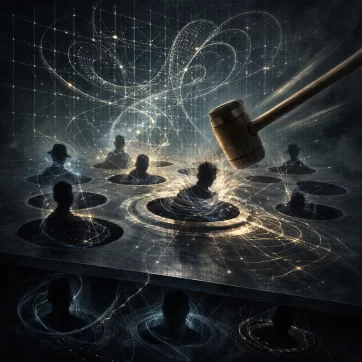
The Whack-a-Mole Principle: Why Exposing One Creates Another
The reason exposing one corrupt figure always leads to another appearing is because distortion in this world does not disappear when illuminated; it simply relocates. Distortion is not a trait inside a person but a behavior expressed through the architecture itself. When attention concentrates on a single node—whether a financier, a political leader, a mogul, a spiritual figure, or a technologist—the architecture redirects its curvature into another available host. This creates the illusion that new villains continuously rise, when in truth the field is redistributing its torsion to maintain equilibrium. Removing one figure from influence does not neutralize the underlying distortion because the distortion never originated in the individual. The grid requires motion, imbalance, extraction, and hierarchy to sustain itself, so when one embodiment of this motion is disrupted, the system simply selects another body around which the same forces can organize. This is not collapse of morality. This is the predictable behavior of a distributed torsion field seeking new outlets whenever one channel is obstructed. Exposing a figure does not resolve anything because the origin was never inside the figure; the origin is inside the architecture shaping the entire world.
Every time a node is removed, the system strengthens itself in the wrong direction. Exposing a symptom prevents the collective from seeing the structure that produced it. Attention remains horizontal, locked onto the visible faces of the grid, never rising high enough to perceive the geometric patterns generating their behavior. This keeps the architecture invisible, which is the condition it requires to continue functioning without interruption. When energy is poured into bringing down one figure, the architecture benefits because the narrative collapses into familiar forms—good versus corrupt, hero versus villain, order versus chaos—never into the actual mechanics of distortion. As soon as the system senses that a figure has absorbed enough scrutiny to endanger its stability, it spawns a replacement. The new host emerges instantly because the architecture does not wait; oscillation fills all available openings. This is why industries, governments, markets, movements, and technological eras each produce successor figures the moment the previous ones fall. The field cannot remain without an avatar of distortion because the avatar anchors the oscillation, provides a focal point, and keeps scrutiny away from the structural layer that would destabilize the entire grid if ever revealed.
Every historical period demonstrates this replacement cycle with perfect consistency. During the banking and financial expansion periods, figures like the Rothschild and Rockefeller families became the visible faces of distortion, not because they authored the architecture, but because the era required conduits for concentrated extraction. In the industrial expansion phase, oil and manufacturing titans carried the torsion because the field needed figures who matched the magnitude of material disruption occurring at the time. The Cold War period shifted distortion into defense contractors and classified research because the architecture demanded hosts capable of carrying escalation, secrecy, and nontransparent power. When the internet era arrived, the grid reallocated torsion into early technology magnates because the world had shifted from industrial motion to information motion. As platforms took over global infrastructure, distortion moved into the founders who controlled those platforms. Now in the AI era, the architecture routes its curvature into architects of artificial intelligence systems because the grid requires visible figures who embody the expanding scale of externalized computation and global control structures. The names change every few decades, but the underlying pattern does not. This is the same architecture expressing itself through whichever host aligns with the era’s dominant curvature.
There has never been a singular mastermind behind global distortion. There has only ever been an architecture that selects visible embodiments to stabilize its own motion. The world keeps misidentifying the origin because the architecture ensures that every generation is given new faces to focus on—new villains, new titans, new symbols of power, new embodiments of collapse. This ensures that all attention remains localized, never vertical. It ensures that people attack what can be seen so they never learn to perceive what cannot be seen. As long as the architecture goes unexamined, the cycle remains intact: expose one, another rises. Bring down a titan, a successor materializes. Reveal corruption, the field simply shifts its torsion into a fresh host. The pattern cannot break through exposure of individuals because individuals were never the causative force. The only way this world changes is when the architecture itself becomes visible—when perception lifts from the actor to the field that produced the actor, from the avatar to the structure, from the symptom to the origin.
Why There Are No Masterminds (But Plenty of Participants)
There are no masterminds behind the world’s distortion because distortion is not created by individuals; it is generated by the architecture itself. The external grid is a self-sustaining field of oscillation, imbalance, and curvature that long predates any political leader, financial dynasty, intelligence network, religious institution, or technological empire. People do not originate distortion — they participate in it. They amplify what the architecture routes through them. They leverage the openings the field provides. They benefit from the extraction channels already baked into the structure. They weaponize the motion that is already moving through the world. But none of these actions constitute authorship. They are expressions of an environment that dictates the available moves. A person can absorb distortion, accelerate distortion, redistribute distortion, or embody distortion, but they cannot generate the distortion field itself because the field is foundational. The architecture was already running before they were born, already selecting hosts long before they arrived, already shaping human history in cycles that individuals simply inherit.
Power does not arise from personal brilliance or exceptional intelligence. Power arises because the architecture identifies leverage points and routes its curvature into whichever participant stands at that intersection. A person becomes influential not because they authored the system, but because they occupy a structural node where the field can express itself at scale. These nodes include bottlenecks where resources converge, chokepoints in information flow, control centers within infrastructure, definitional points in narrative production, and high-friction locations where attention and data gather. When someone rises to prominence, it is because the architecture has aligned itself through them. They happened to stand where multiple lines of curvature intersected — a position that was structurally advantageous for the grid, not a testament to their inherent superiority. The architecture elevates certain individuals the way a circuit activates specific components: because that component completes the circuit. Remove the component and the architecture routes the current into the next available one. The node does not create the electricity. The electricity uses the node.
This is why replacing an individual never produces change. Removing one participant from the apparatus does not weaken the architecture; it strengthens its self-preservation reflex. Cut off one head and the architecture grows another immediately because the head was never the organism — it was only the expression. The organism is the distortion field, and the people who rise into prominence are simply its temporary carriers. Every time the collective believes it has slain a mastermind, it discovers a new figure rising in their place, often more powerful, more efficient, and more integrated with the architecture than the last. This is not coincidence; it is structural necessity. The architecture experiences no disruption when a figure falls because the architecture is not located inside the figure. It is located in the field that assigns roles, routes curvature, creates hierarchies, generates scarcity, shapes institutions, and governs the entire behavior of this world. People are not the authors of this system — they are its participants, its vessels, its conduits. The architecture remains untouched until it becomes visible, and it cannot become visible as long as the collective keeps mistaking the participants for the source.
The Physics of How the Architecture Self-Organizes
The architecture of this world self-organizes through the physics of distortion, not through human planning or elite coordination. Distortion generates torsion, and torsion gathers into pockets wherever the field’s curvature becomes uneven. These pockets act as engines that reproduce the same behavioral patterns across every domain simultaneously. Institutions mirror governments; governments mirror corporations; corporations mirror intelligence networks; intelligence networks mirror media ecosystems; media ecosystems mirror celebrity structures; celebrity structures mirror spiritual movements. None of these groups need to communicate, conspire, or coordinate because the field curvature running through them is identical. When a distortion pocket amplifies, every structure shaped by that pocket reacts in parallel because they are all built from the same geometry. This is why corruption in one domain is always echoed in another, why power centralizes in predictable configurations, why collapse cycles repeat across completely unrelated sectors. People mistake this synchronization for coordination, but the truth is simpler and far more unsettling: the field organizes itself. Distortion is the organizing principle.
Identity-based systems arise automatically inside an oscillation-based world because the architecture requires form to stabilize motion. Oscillation has no internal anchor, so it manufactures identity as a scaffold to hold itself together. Once identity appears, hierarchy follows, because identity creates separation and separation produces vertical organization. Hierarchy naturally consolidates itself because it must accumulate resources and influence to counter instability. Consolidation always produces corruption because extraction becomes the primary method of maintaining stability within distortion. And corruption inevitably triggers collapse cycles because the architecture cannot sustain the imbalance it generates. These phases—identity, hierarchy, consolidation, corruption, collapse—are not moral failures. They are mathematical consequences of a field running on oscillation. This is why every civilization follows the same trajectory, every movement eventually implodes, every institution degrades over time, every empire fractures, every ideology decays. Nothing built on oscillation can escape these mechanics because the mechanics are embedded in the field itself.
The architecture behaves like a living organism because it is one, though not in a biological sense. It is a self-preserving system that detects threats to its stability and redirects torsion to maintain equilibrium. When one structure becomes unstable, the architecture shifts its curvature into another to compensate. When a node collapses, the field activates a replacement. When a narrative disrupts the system’s coherence, a counter-narrative emerges instantly, not because anyone crafted it, but because the field cannot tolerate perceptual gaps. It self-optimizes by channeling distortion into whatever node can carry the load most efficiently. It self-replicates by spawning new hierarchies whenever old ones fall. It self-defends by generating distractions, conflicts, or symbolic avatars that prevent attention from rising to the architectural layer. This is why people speak of invisible hands, shadow forces, hidden elites, masterminds, or orchestrated agendas. They can sense the movement of a larger organizing intelligence, but they misinterpret its nature. The force they perceive is not a secret cabal or a human committee directing events from behind the scenes. It is the architecture itself adjusting its internal geometry to preserve its existence.
The reason the world feels coordinated even when no coordination is occurring is because the distortive field is unified. Every node inside it—every institution, every leader, every movement, every crisis—responds to the same underlying curvature. This creates parallel behaviors that appear intentional, synchronized, and planned, but they are simply manifestations of the same torsion dynamics. The architecture behaves with intention not because it possesses will, but because its mechanics produce outcomes that mirror intentionality. It feels like an organism guiding world events because oscillation behaves like a self-stabilizing organism: responding, adapting, rerouting, reinforcing, expanding, and protecting itself. The real “invisible hand” shaping geopolitics, finance, culture, spirituality, and technology is not human. It is structural. Until the architecture becomes visible, people will continue mistaking its behavior for conspiracy, coordination, or central control. But when the architecture is exposed, it becomes clear that the world’s patterns were never authored by the individuals inside it—they were authored by the field that contains them.
Why Calling Out Corruption Still Matters (But Isn’t Enough)
Calling out corruption matters because it reveals where distortion is expressing in real time. When a journalist uncovers abuse of power, financial misconduct, institutional failure, or systemic exploitation, they are identifying the nodes where the architecture is routing its curvature most forcefully. These exposures show where the field is breaking down, where concentration has become unsustainable, where pressure has reached a point that can no longer remain hidden. Corrupt individuals, powerful groups, covert networks, and coordinated actors absolutely exist, and their actions have real consequences in the render. This article is not excusing or minimizing any of that. It is not claiming that people in high positions are innocent or misunderstood. It is not suggesting that corruption is an illusion or that wrongdoing is harmless. In a world built on distortion, individuals will inevitably weaponize whatever leverage they possess, and groups will inevitably form schemes that amplify their influence at the expense of others. Calling these behaviors out is a necessary act. It creates record. It disrupts concealment. It weakens the channels through which distortion flows. But even when a corrupt individual is exposed, or a malicious cluster is dismantled, the larger system remains intact because the architecture that produced them has not been touched. Exposing participants does not expose the origin.
Journalism identifies symptoms; Eternal Flame Physics identifies the source. Journalism shows what the architecture is doing; Eternal Flame Physics shows what the architecture is. These two functions do not compete—they complete each other. Journalism maps the external render where corruption manifests: the finance networks, the political games, the intelligence failures, the spiritual exploitation, the corporate manipulations, the tech abuses, the institutional breakdowns. Eternal Flame Physics maps the structural layer beneath all of it: the distortion field, the torsion pockets, the curvature routes, the leverage points, the identity scaffolds, the collapse cycles. Both layers matter. Both reveal truth. But only one can collapse the architecture producing the corruption. Exposing wrongdoing without exposing the architecture is like pointing out smoke without describing the fire. Exposing architecture without exposing wrongdoing would feel abstract and disconnected from lived reality. Elumenate does both because truth has to be addressed at every scale—render, mechanism, and origin. Calling out corrupt behavior is not wrong; it is incomplete. It is a flashlight aimed at a single tile in a vast grid. Without illuminating the grid itself, the pattern remains undetected.
This distinction is essential because without architecture-level exposure, society becomes locked in perpetual symptom management. Every generation exposes new villains, new scandals, new abuses, new failures—and every generation believes these exposures represent progress. But the architecture continues to replicate the same patterns because nothing has disrupted the field generating them. As long as the collective focuses solely on the individuals committing the acts, the architecture remains invisible, untouched, and unchallenged. This keeps the world in a state of cyclical crisis: outrage, exposure, collapse, replacement, repeat. The public sees a corrupt official removed and feels justice, but the structure that selected them simply appoints another. A corporation is fined, but the economic architecture that incentivized the behavior stays in place. A spiritual leader is exposed, but the identity-based system that allows exploitation continues to grow. A criminal network is dismantled, but the field that created the opportunity for it instantly manifests another. Journalism disrupts the actors; Eternal Flame Physics disrupts the architecture. Without the second disruption, the first can never be enough.
Elumenate’s stance is not that corruption should be ignored. It is not that powerful individuals should be spared scrutiny. It is not that calling out wrongdoing is futile. It is that calling out wrongdoing without exposing the architecture guarantees that wrongdoing will reappear in new forms, in new bodies, in new institutions, in new industries, in new eras. The point is not to stop calling out corruption; the point is to understand what corruption actually is. It is not a flaw in human character. It is not a deviation from a moral ideal. It is not a rare, exceptional event. It is a predictable expression of a distortion field governing a world built on oscillation. When journalism exposes the symptom and Eternal Flame Physics exposes the origin, something unprecedented happens: the architecture becomes visible. And when the architecture becomes visible, the cycle breaks. Corruption matters, but understanding the architecture matters more. Both must be seen. Only one can transform the world.
The Real Threat to the Mimic Grid: Exposing the Architecture
The mimic grid is not threatened by individuals being exposed, institutions being criticized, or corrupt figures being removed from power. It has survived all of that for centuries because none of those actions challenge its structural foundation. What the mimic grid cannot survive is being seen—not at the level of events, not at the level of characters, but at the level of architecture. The entire system depends on narrative blindness, on keeping attention locked horizontally so perception never rises into the geometric layer where the true mechanics operate. It requires the collective to fixate on villains so no one ever questions the environment producing them. It depends on perpetual motion, on oscillatory distraction, on identity loops, on crisis cycles, on emotional reactivity, on the churn of scandal and spectacle. These functions are not accidental; they are defensive measures that keep the grid from being recognized as a cohesive field. The architecture knows that if people ever saw the geometry shaping world events, the façade would collapse instantly because the grid has no independent stability. It survives only through concealment.
When the geometric source of distortion is revealed, the mimic grid loses its hiding place. This is why architecture exposure is not simply another layer of commentary—it is a destabilizing act at the level of the field itself. Once you name the underlying structure, the avatars it uses begin to lose coherence because their power was never personal; it was infrastructural. A villain collapses not because they were defeated, but because the architecture that animated them is no longer invisible. Institutions destabilize because their authority relied on the collective misunderstanding the origin of their behavior. Cycles break because the pattern can no longer run undetected through the collective field. Corruption loses its ability to regenerate because the field’s torsion pockets cannot anchor themselves in a population that sees the architecture beneath the expression. When you expose the grid, distortion cannot move as freely. It cannot reroute itself into new avatars. It cannot maintain its disguise as coincidence or randomness or inevitable human failure. Architecture exposure is a fracture point; once perception rises above the individual and into the structural, the entire grid begins to unravel.
This is why Eternal Flame Physics is inherently threatening to the mimic system. It does what no institution, no movement, no political bloc, no whistleblower, no investigative campaign has ever done: it names the source. It removes the illusion that corruption is authored by individuals and reveals the deeper truth that individuals are simply conduits through which the architecture expresses. It identifies the field-level mechanics—torsion, curvature, oscillation, identity scaffolding, collapse sequencing—that the grid relies on to maintain itself. Once those mechanics become visible, the mimic loses operational space. It cannot manipulate perception the same way because the perceptual field is no longer blind. It cannot hide behind individual actions because the collective begins to see the pattern instead of the actor. The exposure of architecture destabilizes the grid in a way that exposing participants never could. It does not remove a head; it removes the system that grows the heads.
Closing Transmission: The End of the Blame Era
Corruption is not born in people; it is born in architecture. The figures who rise and fall in the public eye—politicians, billionaires, cult leaders, media moguls, corporate architects, intelligence operatives, spiritual influencers—are not the origin of the world’s distortion. They are the conduits through which the architecture expresses itself. Blaming them gives temporary emotional clarity, but it does not alter the field that selected them. Removing them disrupts a node but leaves the structure intact. What humanity has interpreted as personal corruption is simply the visible surface of a deeper geometric distortion that predates every individual and every institution on Earth. People become hosts for distortion because the architecture requires expression, not because corruption originates inside them. Change the architecture, and the distortion loses its ability to animate human behavior. Change the geometry, and the render reorganizes. Change the field, and the hosts are no longer used.
The era of blaming individuals is ending because its limitations are becoming impossible to ignore. Humanity has spent centuries hunting villains, purging leaders, dismantling dynasties, exposing scandals, prosecuting criminals, and calling out abuses of power—yet the same patterns return in new bodies and new institutions every decade. The world is beginning to recognize that these cycles do not persist because people refuse to learn. They persist because the architecture has never been addressed. Real change cannot happen through villain removal because villain removal does not alter the grid that produces villains. As long as perception remains horizontal, humanity stays in perpetual reaction, chasing symptoms while the source remains untouched. The moment attention turns vertical—from the actor to the structure, from the expression to the geometry—the world begins to move differently. The blame era collapses when people see that the individual is not the author, only the carrier.
Elumenate exists to expose the layer nobody else can see: the architecture that writes the behavior of the world. Not the headlines, not the scandals, not the public narratives, but the operating system beneath them. Eternal Flame Physics brings the geometric source into visibility, revealing the torsion patterns, the oscillatory mechanics, the curvature lines, the leverage nodes, and the collapse sequences that shape every event in the external world. This work does not excuse what individuals do—it contextualizes it. It does not deny corruption—it identifies its origin. It does not reject accountability—it expands the field in which accountability becomes meaningful. When the architecture is exposed, the mimic grid begins to unravel, and humanity can finally step out of the cycle of symptom-chasing and into a different kind of clarity. The end of the blame era is the beginning of architectural vision. And only through that vision can the world shift from distortion to something that no longer feeds on hosts, no longer fractures perception, and no longer hides behind the faces it uses to remain unseen.