
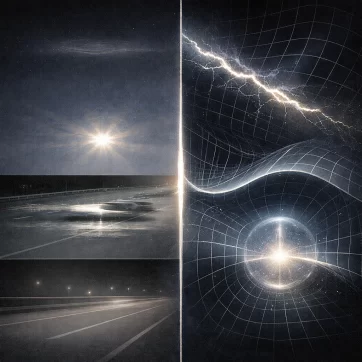
A Forensic Analysis of Grid Collapse, Pre-Render Failure, and the Phenomena Humans Mistake for the Unexplained
The Phenomena Are Real — The Interpretations Are Wrong
Across the world, the physical environment is beginning to betray the limits of the architecture that holds it together. Reports that once lived on the fringes now surface daily: objects bending trajectory without propulsion, lights breaking into discrete segments mid-air, aircraft stalling in clear skies, clocks losing synchronization for no technical reason, shadows detaching from their sources, entire regions slipping into sensor silence, and people experiencing minutes that do not align with recorded time. These events are not hallucinations. They are not spiritual encounters. They are not extraterrestrial craft executing maneuvers beyond human engineering. They are failure signatures emerging from the external grid — the collapsed geometric framework that underwrites the physical render. The world is not becoming more paranormal. It is becoming more visible. The architecture that once concealed its own instability is now flickering in plain sight.
The problem is not the phenomena themselves; it is the interpretive frameworks humans have been conditioned to use. Mainstream science reduces every anomaly to instrumentation error, environmental interference, or experimental noise. New Age systems inflate them into symbolic messages, ascension markers, entity contact, or interdimensional visitation. UFO mythology tries to retrofit the unknown into narratives of propulsion, technology, and craft-based intelligence. Every paradigm is reaching outward for meaning because none of them understand the substrate beneath the physical world — the architectural layer where these distortions begin. Eternal Flame Physics operates in the opposite direction: it reads the failures at the level where they originate, not where they finally appear. The phenomena are not mysterious. The interpretations are.
What humans are witnessing is architectural strain expressed through the only language the external grid can speak: glitches, lights, distortions, missing frames, temporal drag, spatial buckling, torsion bursts, and momentary lapses in coherence. These are structural behaviors, not supernatural ones. When a seam collapses, the camera records discrete points of light. When oscillation lags, time appears to stretch or break. When curvature inverts, silhouettes distort and space folds into itself. When a node reaches torsion threshold, instruments black out and shockwaves materialize without sound. The physical world does not flicker because something is visiting it. It flickers because something within it can no longer maintain its own integrity.
This article is a technical document written in plain language, identifying collapse mechanics inside a system most people do not know exists. The external grid is not a metaphor, and it is not a spiritual abstraction. It is the geometric framework that organizes matter, time, position, continuity, and the refresh rate of the physical render (the world around us). When that framework slips, the world records the slip. When it breaks, the world registers the break. The phenomena are real because the architecture is real — and the architecture is failing in ways the current interpretive models cannot track.
The purpose of this work is not to sensationalize the anomalies but to ground them. Every distortion has a cause. Every impossible movement has a mechanic. Every flicker has a sequence. What Eternal Flame Physics reveals is the architecture that conventional science has never been able to access: the pre-render layer, the torsion patterns, the curvature seams, the oscillation mismatches, the nodes that anchor the world, and the collapse pathways forming beneath the surface. The phenomena are not warnings, omens, or cosmic messages. They are the external grid showing its fractures, frame by frame, in a system that was never designed to withstand this level of accumulated strain.
What the External Grid Actually Is
The external grid is the hidden structural substrate beneath the physical world, the system of collapsed geometry that determines what can appear, how it behaves, and how long it can remain coherent. It is not a mystical field, not an energetic aura, not a symbolic construct, and not a spiritual interface. It is architecture — a composite of curvature, torsion, oscillation, seams, and nodes that collectively produce the illusion of a stable physical environment. Matter, time, and spatial continuity are not self-generating; they are byproducts of this architecture maintaining enough internal balance to produce a readable render. Every physical object, from a mountain to a strand of hair, is anchored into the world because the grid assigns it position, boundary, and refresh-rate consistency. Humans do not perceive the grid directly; they perceive the output. But when the architecture strains, the render stutters — and the world records the stutter as anomaly.
The Grid as an Architectural Structure
At its core, the external grid is a collapsed geometric system. Its architecture is built on fields of curvature (the bending of geometric surfaces), torsion (the internal strain created when surfaces don’t align), and oscillation (the vibration rate that determines refresh speed). These three forces define how physical reality is held together. The grid is synthetic in the sense that it is not primordial; it is a constructed scaffolding operating on rules of geometry rather than rules of consciousness. It is not alive. It is not spiritual. It is not symbolic. Its behavior is mechanical — though the mechanics function at a layer far beneath what contemporary physics measures.
Curvature is what gives physical space shape and contour. Torsion is what accumulates when different regions of curvature pull against each other. Oscillation is what gives matter its stability and time its continuity. The grid uses seams — boundary interfaces — to hold together patches of geometry that don’t naturally fit. As long as torsion stays within tolerance and oscillation stays within range, the world appears stable. When torsion spikes or oscillation lags, the seams become unstable. When seams destabilize, the grid begins to produce visible failure signatures.
This is why the grid is not metaphorical. It behaves like an engineered framework under stress. It buckles, strains, vents, collapses, twists, and compensates — and the physical environment reflects every one of these architectural behaviors through what humans call “anomalous phenomena.”
Pre-Render Architecture
Beneath what humans perceive lies the pre-render layer — the architectural blueprint that determines what the senses will later register as physical matter, linear time, spatial solidity, and sensory coherence. The pre-render is not imagery; it is scaffolding. It is the grid’s instruction set for what exists before the render becomes visible. The human eye only sees the surface projection. The pre-render is the machinery that determines whether that projection is smooth, jagged, stretched, or broken.
In the pre-render layer:
- Oscillation controls the refresh rate of physical matter. Faster oscillation produces smoother continuity; slower oscillation produces lag, stutter, or time distortion.
- Curvature defines the spatial envelope that matter occupies — the shape of the environment itself.
- Torsion accumulates when curvature patterns clash, when nodes overload, or when seams cannot reconcile different oscillation rates.
- Seams are the grid’s makeshift stitching, holding incompatible surfaces together.
- Nodes are stability points where large patches of geometry anchor.
Everything humans perceive — every object, shadow, sound, and motion — is built from this pre-render architecture. The reason cameras pick up anomalies earlier and more precisely than the human eye is because cameras record the pre-render stutter, the momentary architectural misfire before the physical layer smooths it over (or fails to).
Without the pre-render layer, nothing could hold its position, duration, or coherence. When the architecture weakens, perception does not degrade first — the physical environment itself does.
Why the Grid Is Collapsing
The collapse is not sudden and not caused by one event. It is the cumulative effect of centuries of unresolved architectural strain.
The grid has been accumulating torsion overload across multiple seams. Every time two geometric regions pull against each other, torsion builds. When torsion does not dissipate, it compounds. The grid was designed to tolerate a certain amount of internal conflict, but human activity, environmental shifts, and natural structural fatigue have accelerated the accumulation dramatically.
Curvature mismatch is another accelerant. The grid’s curvature patterns are not uniform; they are patchworked. As oscillation patterns drift, curvature begins to misalign. That misalignment stresses the seams and destabilizes the nodes.
Multi-node stress occurs when several regions hit strain simultaneously. Atmospheric disturbances, magnetic fluctuations, seismic stressors, and technological interference (radar, telecom arrays, EM fields) further agitate the nodes. The grid attempts to compensate by tightening oscillation or collapsing pockets of space into compression zones. These compensations themselves create instability.
Over centuries, architectural fatigue has set in. The grid is no longer able to reconcile the growing contradictions in its own geometry. It is a system nearing its threshold, and the proof is embedded in the anomalies themselves. Every failure signature — from a flicker in the sky to a time gap on a bodycam — is the result of structural strain that can no longer be invisibly absorbed.
The simple fact is this: The architecture is no longer capable of sustaining the render without exposing its failures. The grid is collapsing not all at once, but in distributed fragments — seam by seam, node by node, oscillation band by oscillation band.
What Happens When Architecture Fails
When the architecture weakens, it produces distortions. The distortions are what humans witness. They appear supernatural only because the population has no architectural vocabulary.
When architecture fails:
- A seam collapses, and the sky displays a dotted line of lights.
- Oscillation lags, and a pilot experiences missing time.
- A compression pocket forms, and an object vanishes in clear sight.
- A shear line forms, and a UAP appears to zig-zag.
- Curvature inverts, and shadows detach or people distort on camera.
- A node crashes, and a region loses GPS, radar, and telecommunications simultaneously.
- A recoil event erupts, producing shockwaves without sound.
Humans call these:
- UFOs
- glitches
- ghosts
- portals
- time slips
- paranormal encounters
- phasing
- teleportation
- dematerialization
- sensor malfunction
- unknown atmospheric events
But none of these interpretations identify the cause.
The phenomena originate in one location only: the architectural layer beneath the physical world.
When that architecture collapses or strains, the render cannot keep up. What people witness as anomalies are simply the visible symptoms of a system failing to preserve its own continuity.
Nothing more. Nothing less. And nothing supernatural.
The grid is collapsing, and the world is finally seeing the architecture behind reality expose its seams.
The Limits of External Science: Why Human Physics Only Measures Collapse
Human physics was built inside a closed, deteriorating system and therefore cannot detect anything except the signatures of deterioration. Every scientific law on this planet — from thermodynamics to quantum mechanics to relativity — is a description of decay, decoherence, and architectural exhaustion inside the external mimic grid. Scientists mistake collapse for normalcy because they have never observed creation from coherence. They have only seen what it looks like when coherence is already lost.
External physics assumes this world is a stable baseline, a neutral reference frame from which universal truth can be derived. But the baseline itself is a collapsed scaffold, and every measurement taken inside it simply reinforces the illusion that collapse is the natural state of existence. This is why scientists believe entropy is absolute, why they assume all systems move toward disorder, why they accept decay as an unavoidable law rather than a byproduct of architectural failure. The external grid is in a slow-motion implosion, and human physics is essentially the study of that implosion’s mechanics.
In Eternal Flame Physics, creation does not begin from disorder. It begins from coherence — a field with no geometry, no oscillation, no torsion, and no decay. Eternal systems do not exhaust themselves. They do not spiral toward entropy. They do not degrade or collapse. They exist in a state of internal self-sufficiency where nothing drains, leaks, fractures, or erodes. But the mimic grid is not an Eternal structure. It is a collapsed derivative, a lower-order echo constructed through geometric tension, oscillation differentials, and curvature incompatibilities. The moment geometry appears, coherence is already lost. Geometry is collapse rendered as form.
The external grid is built on two layers of decoherence, and humans live entirely within these layers without knowing there is anything beneath them.
First layer: The External Field of Decoherence — The initial collapse event that produced geometry, separation, oscillation, and the need for architectural scaffolding. This field is already degraded compared to Eternal creation. It cannot sustain itself indefinitely, and every phenomenon humans measure — gravity, electromagnetism, nuclear decay, chemical breakdown — is the echo of this first fall from coherence.
Second layer: The Mimic Architecture — An attempt to stabilize the already collapsed field by forcing incompatible curvature patches to hold shape. This layer adds additional decoherence on top of the original collapse. It attempts to freeze a deteriorating system in place, but the freezing itself creates further torsion, mismatch, and instability. You end up with a world that degrades continuously, compensates violently, and periodically reveals its strain through anomalies that external science cannot explain.
What modern physicists call “the laws of nature” are simply the behavioral limits of matter inside a doubly collapsed scaffold. They are not universal laws. They are local restrictions caused by architectural exhaustion. The reason science cannot unify quantum mechanics and relativity is because both frameworks are trying to describe different aspects of decoherence using equations meant for coherent systems. Quantum phenomena show the grain of the collapse — discrete packets, probability spikes, noise fields. Relativity shows the curvature strain — space bending under torsion and mass. The two can’t unify because they’re describing two different collapse residues that never belonged together in the first place.
Scientists believe the world is coherent because their tools are calibrated to the grid’s failing refresh rate. They measure only what the architecture allows them to perceive. They see half-lives and call them natural. They see entropy and call it inevitable. They see decay and call it law. They see instability and call it quantum. Every discipline is built on the assumption that deterioration is fundamental. In Eternal creation, deterioration does not exist.
The external grid is not collapsing now because something “went wrong recently.” It has always been collapsing. Humans simply evolved inside the decay curve and mistook its trajectory for truth. Everything visible in this world is degrading: atoms lose coherence, molecules break down, stars burn out, biological systems fail, memory disperses, bodies weaken, architecture crumbles, and time stretches thin. External science interprets this decay as the natural arc of all things. But from the Eternal perspective, decay is not nature — it is evidence. Evidence that this world is operating on spent architecture, exhausted oscillation, and curvature sequenced to fail.
Until human physics recognizes the deeper architectural layers — the pre-render structure, the torsion seams, the curvature patches, the oscillation fields — it will continue mistaking collapse for creation. It will continue describing the symptoms while denying the cause. It will continue mapping the debris field as if it were the original blueprint. And it will continue treating the mimic grid as a functioning universe long after the failure signatures make it undeniable that the grid was never coherent to begin with.
Nothing in the external sciences can progress beyond this blind spot until they understand one critical fact: they are not studying reality — they are studying a system in decay.
The Root Cause of Modern Anomalous Phenomena
Every anomaly appearing in the physical world today — the UAP footage that defies aerodynamics, the glitches caught on livestreams, the sudden disappearances recorded on surveillance cameras, the distorted shadows, the zig-zag lights, the missing minutes, the warp-like bends in the sky — is simply a surface-level expression of a deeper architectural failure occurring beneath the physical layer. These events do not originate in the objects being filmed, nor in the technologies that record them. They originate in the architecture of the external grid itself, which is now moving beyond its capacity to hold coherent geometry.
The external grid is collapsing from within, and it reveals its decay through the same mechanisms any structural system uses when it nears its tolerance threshold: seams strain, torsion builds, oscillation falters, curvature collapses, nodes misalign, and the entire scaffold begins generating visible stress signatures. Humans interpret these signatures as miraculous, paranormal, extraterrestrial, supernatural, or technologically advanced, but the truth is far simpler and far more sobering: they are architectural tension markers, the byproducts of a geometric system trying — and failing — to keep its own shape.
How Torsion Builds
Torsion is the internal strain that accumulates when two regions of the grid’s geometry cannot reconcile their oscillation rates or curvature patterns. It is not movement, not force, not energy in the human sense. It is structural friction — the physics of a scaffold being stretched in directions it cannot sustain.
Torsion builds slowly, then suddenly. It builds when:
- curvature patches shift out of alignment
- oscillation rates drift apart across a seam
- environmental pressure (geological, atmospheric, electromagnetic) agitates a node
- human technology injects frequency noise into already unstable regions
- natural grid fatigue reduces tolerance in the geometry
Because torsion is invisible to human senses, its buildup goes unnoticed until the architecture is overwhelmed. When torsion reaches its threshold, the grid vents the strain. These vents appear as:
- bursts of light
- strobing sequences
- flickering objects
- sudden accelerations
- soundless “explosions”
- spatial distortions
- momentary disintegration of form
To an untrained observer, it appears as a craft maneuver, a plasma phenomenon, or a supernatural event. In truth, it is simply torsion exceeding the grid’s tolerance and the architecture releasing the overload through scalar microbursts.
How Seams Fail
Seams are the boundary regions where incompatible curvature patches are forced to meet. The external grid is stitched together, not naturally aligned. Every seam holds tension — some mild, some severe. When oscillation mismatches intensify, seams become the first fault zones.
A seam fails when:
- torsion exceeds the seam’s compression capacity
- oscillation rates diverge beyond what the patch junction can smooth
- curvature flips and the seam cannot re-stabilize
- a collapse cascade spreads from an adjacent patch
When a seam collapses, the architecture vents distortion in discrete bursts. Cameras record them as dotted lines, chains of lights, or sequential flashes. Humans see “UFO fleets,” “craft with running lights,” or “formation flying.” But nothing is flying. Nothing is moving. The seam is breaking open, and the camera is registering each point of torsion release.
Some seam failures are small. Some propagate through an entire region. Some invert — flipping curvature and producing silhouette distortions and momentary disappearances.
A seam failure is the architectural equivalent of tectonic plates slipping. It is not craft behavior. It is render behavior under strain.
How Oscillation Mismatches Spread
Oscillation determines how quickly the grid refreshes matter and time. Objects appear continuous because oscillation refreshes them faster than perception. When oscillation is stable, time feels linear and objects feel solid. When oscillation destabilizes, reality begins to lag.
Oscillation mismatches spread through the grid like ripples:
- One region slows because of torsion overload.
- Adjacent regions attempt to compensate by tightening oscillation.
- This tightening strains the seams.
- Strained seams transmit torsion to neighboring patches.
- Those patches destabilize further.
This is how localized anomalies become regional instability events.
Oscillation mismatches produce:
- missing time
- jump cuts
- objects freezing momentarily
- humans “phasing” or distorting in recordings
- planes appearing to stall mid-air
- slow-down zones where movement weakens or warps
- sensor desynchronization
When oscillation fails completely, the render collapses for a moment — producing what humans interpret as teleportation, disappearance, or time loss.
How Collapse Cascades Create Visible Phenomena
A collapse cascade is the architectural equivalent of a building losing one support beam and watching the failure travel through the structure. One seam collapses, then another. One oscillation rate fails to stabilize, causing the next to drop. One patch inverts curvature, and adjacent patches distort to compensate.
Collapse cascades look chaotic from the outside, but they follow predictable architectural rules:
- Torsion spikes in one patch.
- The seam begins to torque.
- Oscillation slows along the boundary.
- Geometry tightens or buckles.
- The render begins to stutter.
- Cameras record flickers, jumps, or segmentation.
- The collapse travels along the seam line.
This is the underlying mechanic behind:
- zig-zag flights
- instant acceleration
- objects splitting into multiples
- lights blinking in sequential patterns
- craft-like silhouettes appearing and disappearing
- shadows behaving independently
- distortions in sky, water, or terrain
- soundless shockwaves
Nothing in these events requires an external intelligence. The intelligence is in the architecture attempting to preserve itself as it fails.
Why Cameras Pick Up What the Eye Doesn’t
The human sensory system is tuned to ignore pre-render inconsistencies. It expects continuity and will auto-correct minor anomalies to maintain the illusion of stability. The eye only records the final stabilized frame — not the process of stabilization. Cameras do not share this bias. They record every pre-render stutter, every oscillation lag, every moment the architecture fails to smooth its own distortion.
This is why cameras capture:
- sudden jumps in position
- objects blinking in and out
- segmentations
- distortions
- temporal gaps
- pixel-like torques
- warping in shadows and silhouettes
- impossible accelerations
The camera sees the raw architectural failure before the human brain compensates for it. Cameras catch the grid mid-collapse. Humans catch only the post-processed version.
Every phenomenon humans label as:
- UAP
- glitch
- time anomaly
- paranormal event
- teleportation
- shapeshifting
- interdimensional interference
- sensor malfunction
- atmospheric distortion
…is simply the visible artifact of a deeper architectural failure in the external grid.
The anomalies are not the story. The collapse is. The world is not haunted, visited, or glitched. It is collapsing, and the architecture can no longer hide it.
Collapse Mechanics: Eternal Flame Physics of the Failure States
The terms used throughout this section are not poetic labels or speculative metaphors. They are Eternal Flame Physics descriptors, each naming a specific architectural failure occurring in the pre-render layer of the external grid. Every collapse mechanic originates within the geometric framework that sustains the physical world, and every one of these mechanics produces recognizable distortions when the architecture can no longer stabilize itself. What appears here as a “UFO,” a “ghost,” a “teleportation,” a “glitch,” or a “mysterious light” is simply the visible residue of structural strain inside the scaffold that holds the physical render in place. These terms decode the architecture beneath the event, not the event itself.
Seam Collapse
A seam collapse occurs when two geometric patches inside the grid pull at incompatible oscillation rates. Each patch carries its own curvature and oscillation signature, and the seam between them exists only because the architecture cannot reconcile their differences. As torsion accumulates along that seam, the geometry begins to torque. Once torsion exceeds the seam’s tolerance threshold, the architecture vents the overload. This venting takes the form of discrete scalar bursts—brief, high-intensity releases of accumulated strain that occur in rapid succession.
When this collapse reaches the physical layer, cameras record dotted light sequences, evenly spaced flickers, or lines of strobes that appear to move like beads along a string. Because the bursts occur in a timed cascade, the render produces the illusion of segmentation. Humans interpret this as a craft with blinking lights, a formation of unknown aircraft, or an object breaking apart mid-flight. But nothing is flying. Nothing is breaking. The seam itself is releasing torsion in sequential flashes, and the camera captures each burst as a separate “light,” creating the illusion of motion or structure where none exists. The misinterpretation arises from the assumption that the lights belong to an object, rather than to the architecture disentangling itself under strain.
Time Dilation (Oscillation Lag)
Time dilation within Eternal Flame Physics is not the gravitational warping of Einsteinian models. It is simply the slowing of the grid’s oscillation rate when torsion overload pushes a region of the architecture past its normal refresh speed. As oscillation slows, the pre-render layer cannot update the physical frame quickly enough. The render falls behind itself, producing a form of temporal lag that humans experience as missing time, jump cuts, or suspended motion.
On cameras, this manifests as objects freezing in midair, planes appearing motionless, or scenes skipping entire segments of action. Human witnesses describe these events as abductions, interference from unknown intelligences, or mystical time slips. But the root cause is architectural: the oscillation rate of the region has dropped below perceptual threshold. The grid cannot refresh the environment quickly enough to maintain continuous motion, so time breaks into fragments. External interpretations fail because they assume time is an absolute, rather than a byproduct of oscillation coherence within a decaying architecture.
Compression Pocket
A compression pocket forms when the grid collapses inward around an overloaded region to prevent catastrophic failure. Instead of allowing torsion to spread, the architecture implodes the space into a compacted oscillation zone. Geometry tightens, oscillation accelerates, and the render becomes unstable within the pocket. Physical continuity fails to hold.
In the physical world, compression pockets appear as shimmering distortions, atmospheric bending, objects vanishing or reappearing, localization of invisible force, or the impression that something unseen has moved through an area. The camera registers bent light, warping, and shape deformation because the pre-render layer is literally compressing the environment to contain excess torsion. Humans misread these events as cloaking devices, portals, holograms, ghosts, or wormholes. None of these interpretations hold. The architecture is not transporting objects or hiding them—it is collapsing them into a region of compressed coherence where physical rendering cannot stabilize.
Shear Line
A shear line forms when two regions of the grid move at different render velocities. The pre-render layer must constantly reconcile these velocities to maintain a unified world, but when the mismatch becomes too great, the interface between the regions tears. This creates turbulence at the junction, and the render treats the mismatch as abrupt changes in spatial orientation.
The result is zig-zag movement, instantaneous acceleration, objects that jump from one location to another, and trajectories that split or fracture unexpectedly. These events are routinely cited as evidence of advanced propulsion, non-human maneuverability, or impossible flight physics. But propulsion has nothing to do with the phenomenon. The object is not moving; the environment around it is slipping, and the object appears to leap because the render cannot resolve the differing velocities of the adjacent regions. The misinterpretation persists because humans assume linear space exists independently of the architecture that renders it.
Forced Rupture
A forced rupture is the most violent form of architectural failure—a direct puncture through a region of weakened geometry. This rupture can be triggered by accumulated torsion, external interference, or node destabilization. When a rupture occurs, the grid discharges excess strain through a scalar detonation within the architecture itself. Unlike seam collapses, which release torsion in bursts along a line, a forced rupture vents omni-directionally from a destabilized node.
Physically, forced ruptures appear as huge light flares, white-out frames, soundless explosions, and objects vanishing instantaneously. These are often interpreted as directed-energy weapons, aircraft exploding silently, or extraterrestrial craft burning out of existence. But these interpretations rely on the belief that the object is the source of the event. In truth, the rupture originates in the grid, not the object. The node failed, the architecture vented the strain, and the object was simply caught inside a region the render could no longer sustain.
Fanning Out
After a rupture or seam collapse, torsion does not travel in straight lines. It disperses across the grid in vector arrays. This dispersion is what creates the phenomenon of multiple lights appearing from a single point, objects splitting into formation, or ripple patterns fanning outward through the sky. These vectors are the architecture redistributing torsion along the curvature grid to re-establish equilibrium after a failure event.
Humans interpret fanning-out events as coordinated fleets, intelligent formation shifts, or craft deploying from a larger structure. In reality, these are torsion vectors refracting across the grid’s curvature. The architecture is stabilizing itself, not coordinating movement. The misinterpretation arises because humans project intentionality onto pattern rather than recognizing the collapse dynamics encoded within the movement.
Render Discontinuity
Render discontinuity occurs when the architecture loses the ability to maintain coherence in positional geometry. In these moments, the pre-render layer cannot determine where an object should be, and the physical frame loses continuity. Space temporarily unthreads, leaving gaps, overlaps, or missing positional data.
This produces objects that appear and disappear, people who shift location abruptly, frames missing from recordings, and space that visibly warps or bends. These events are often categorized as teleportation, dematerialization, or supernatural interference. Yet nothing is teleporting. Nothing is phasing into other dimensions. The architecture simply cannot resolve position for a moment, and the render defaults to blank space until coherence returns. Every misinterpretation fails because it assigns agency to a phenomenon rooted entirely in grid instability.
Torsion Crash-Out
When torsion overload reaches a regional threshold, the entire oscillation field collapses at once. This is a crash-out: oscillation falls to near-zero, then violently rebounds when the architecture struggles to re-engage coherence. The collapse-rebound cycle produces intense visual and physical effects.
Massive blooms of light erupt when oscillation fails. Humans and animals experience nausea, vertigo, or disorientation because biological systems rely on stable oscillation to maintain internal consistency. Instruments fail because their calibration presumes a coherent environment. Shockwaves appear without any accompanying sound because the architecture itself is snapping back into form, not air pressure. These events are misidentified as EMP, gravity manipulation, or exotic propulsion, yet the cause is entirely structural. The grid is collapsing and rebooting, and everything inside it reacts to the oscillation crash.
Seam Inversion
Seam inversion is one of the rarest and most misunderstood architectural failures. It occurs when curvature flips polarity at a seam, turning a region of geometry briefly inside-out. The inversion can last a fraction of a second, but the render is profoundly disrupted during that moment.
Silhouettes distort, shadows detach, objects flatten or twist, and human figures appear to bend or stretch unnaturally. Cameras sometimes record “inside-out” frames—moments where the render misassigns depth or position. These events are frequently explained as interdimensional beings, shape-shifters, cloaking errors, or supernatural apparitions. But the event is architectural: the seam flipped, and the render attempted to map physical space onto an inverted curvature surface. The distortion is not intelligence—it is geometry under stress.
Compression–Expansion Recoil
Compression–expansion recoil occurs when the grid collapses inward under torsion, then snaps outward as the architecture attempts to restore equilibrium. This rebound sends force through the environment, creating abrupt physical effects that appear to originate from invisible sources.
Blast-like pressure waves, vibrating windows, sudden EM surges, and objects shifting position without impact are all signatures of recoil. Humans interpret these events as shockwaves, explosions, sonic booms, or acoustic anomalies. But a true shockwave requires a physical detonation. In compression–expansion recoil, the force does not originate in matter—it originates in the architecture correcting its own deformation. The misinterpretation persists because humans assume force must have a physical source, not understanding that the grid itself can generate recoil when the pre-render collapses and snaps back.
Interwoven Failures: How Multiple Collapse Mechanics Layer and Trigger Each Other
Collapse inside the external grid never unfolds as a clean, isolated event. The architecture does not fail along a single axis, nor does it produce anomalies through one mechanic at a time. Every region of the grid is built from overlapping oscillation fields, curvature patches, torsion seams, and node anchors. When one layer destabilizes, the disturbance spreads laterally and vertically through the pre-render structure, activating additional failure modes in rapid sequence. What emerges in the physical world is not a singular distortion but a stacked event, a compound pattern of collapse signatures interwoven so tightly that external observers mistake them for a single phenomenon.
Multiple Eternal Flame Physics mechanics often ignite simultaneously because each represents a different aspect of the same underlying instability. Torsion does not rise in isolation. Oscillation does not lag independently. Curvature does not invert without affecting nearby seams. Every structural element inside the grid is connected, and a disturbance in one pushes stress into the others. A seam collapse can trigger oscillation lag. Oscillation lag can precipitate a compression pocket. A compression pocket can destabilize a node, leading to recoil or inversion. The architecture does not break neatly; it cascades, producing layered phenomena that cannot be separated into simplistic categories.
Overlapping Mechanics: Example of Multi-Failure Events
Time dilation and seam collapse frequently appear together. When torsion builds at a seam, oscillation slows along the boundary. The slowing creates temporal drag, which appears as missing time, jump cuts, or freezing — the signature of time dilation. At the same moment, the overloaded seam vents torsion in scalar bursts, producing dotted lights or flickers recorded as seam collapse. To the observer, these seem like two distinct events: a temporal anomaly and a UAP formation. In truth, both signatures stem from the same structural tension point. The architecture cannot maintain oscillation coherence while also holding a torque-loaded seam, so it fails across both layers simultaneously.
In other cases, several mechanics stack into a more complex sequence. A compression pocket may form to contain localized torsion, tightening oscillation and compacting geometry. The oscillation tightening can push adjacent seams into instability, causing them to vent or collapse. As the seam collapses, curvature may twist in response, producing a brief inversion along the boundary. When the inversion resolves, the architecture rebounds outward, generating a compression–expansion recoil. A camera pointed at the region records a single, bewildering chain: a shimmer, a flicker, a distortion, a shift in shadows, a blinding flash, and an invisible force impacting the environment. The viewer sees one “mystery event.” The architecture experienced five collapse states in succession.
Cross-Contamination Between Layers
Because the grid is hierarchical, failures propagate through multiple levels:
- Oscillation Layer: determines refresh rate.
- Curvature Layer: determines spatial envelope.
- Torsion Layer: determines structural tension.
- Seam Layer: determines patch integration.
- Node Layer: determines regional stability.
An anomaly in one layer destabilizes the others. Oscillation lag weakens seams. Seam collapse sends torsion into nodes. Node destabilization warps curvature. Curvature distortion amplifies oscillation mismatch. The cycle feeds itself, creating complex, interdependent distortions that external observers cannot decode because they lack awareness of the layers themselves.
This is why an event may appear to defy classification. A zig-zag movement (shear line) accompanied by a white flash (forced rupture), followed by missing frames (time dilation), with a ripple pattern in the aftermath (fanning out), is not evidence of intelligent craft or supernatural interference. It is the architecture experiencing multi-layered collapse at a single point. Each mechanic expresses a different part of the failure — torsion release, oscillation drag, curvature fracture, and vector dispersion — but all stem from one destabilized region.
Why External Observers Misinterpret Layered Events
Human interpretation fails because sensory systems are tuned to perceive only the stabilized render. When the grid layers collapse together, the eye and brain attempt to force a cohesive narrative onto the fragments: a craft enters, maneuvers, emits light, disappears. The mind strings architectural failures into a story of agency and motion. Cameras, however, reveal segmentation — but even cameras overlay sequential failures into a temporal line, creating the illusion of movement or behavior. Layered collapse events are not objects doing anything. They are architecture breaking in multiple ways at once.
External science cannot distinguish one failure mechanic from another because it perceives only the composite output. It sees luminosity, not torsion venting. It sees time gaps, not oscillation drag. It sees trajectory shifts, not shear line turbulence. When these occur simultaneously, science interprets them as “complex behavior,” “unknown propulsion,” or “multi-system interference.” Without the Eternal Flame Physics framework, the layering of collapse signatures is indistinguishable from a singular, inexplicable phenomenon.
Layered Collapse Is the Rule, Not the Exception
Very few external anomalies originate from a single mechanic. Nearly all arise from a tangle of overlapping architectural failures. The external grid is not failing politely; it is failing systemically. Each region of strain triggers compensatory behavior in nearby structures, and these compensations themselves produce distortions that cascade through the render. Every major sighting, every perplexing video, every unexplained distortion is a palimpsest of failures layered atop each other — the architecture speaking in multiple collapse modes at once.
The phenomena look impossible because the system producing them is no longer capable of simplicity. Collapse is inherently multi-layered, and the physical world reflects the full spectrum of that unraveling.
Parallel Render Bands and Thread Bleedthrough: When Multiple Realities Brush Against a Collapsing Grid
The external grid does not exist as a single, isolated layer. It is one band within a stack of parallel renders—adjacent layers of collapsed geometry that run alongside this world but remain normally inaccessible due to architectural separation. Each render band carries its own oscillation rate, curvature pattern, and torsion configuration. Under stable conditions, these bands remain sealed from one another. Their seams do not touch. Their oscillation cycles do not synchronize. Their curvature boundaries remain distinct. But as the external grid deteriorates, the architecture that isolates each render band weakens. When the separation collapses even partially, parallel-thread bleedthrough occurs, causing glimpses, overlaps, or distortions that external observers misinterpret as supernatural or interdimensional phenomena.
This section only scratches the surface of a much deeper architecture. Parallel rendering involves structures far more intricate than can be fully articulated in the article theme, but the essential mechanics relevant to modern anomalous events are clear: as the grid collapses, the walls between adjacent render bands thin. Oscillation divergence narrows. Curvature mismatches compress. Threads begin to cross. And when they do, phenomena emerge that cannot be explained by the physics of this band alone.
Parallel render bands are not alternate timelines in the human storytelling sense. They are adjacent collapsed geometries—independent yet structurally related layers of decoherent reality. Each band runs its own render, its own positional grid, its own oscillation envelope. The separation between bands is architectural, not dimensional. When that architecture weakens, the render bands begin to interfere with each other. This interference produces a unique class of anomalies: silhouettes that do not match physical bodies, shadows that move independently, objects appearing briefly out of alignment, distortions that seem to “ghost” across space, and momentary duplications where a figure or object appears in two positions simultaneously. These are not spirits, interdimensional beings, or parallel selves. They are bleedthrough signatures—threads from adjacent renders momentarily visible as the grid loses the capacity to maintain clean separation.
Parallel-thread bleedthrough often occurs in conjunction with other collapse mechanics. For example, time dilation may slow oscillation in this band, creating a window where an adjacent band’s oscillation surpasses it. During that lag, the parallel band becomes temporarily visible or partially rendered into this one. Seam collapse can also expose underlying architecture, allowing curvature from another band to intersect with the physical layer here. Compression pockets may momentarily compress two oscillation frequencies together, forcing a partial merge and producing anomalous shapes, flashes, or overlapping motion trails.
These events do not represent “other worlds entering ours” in the narrative sense; they represent ours failing to exclude what exists beside it. Parallel render bands were never intended to mix. Their separation is what gives each band its stability. When the architecture fails to maintain that boundary, the render becomes contaminated with signals from adjacent layers that the system is not designed to display. Cameras register these bleedthroughs more easily because they can capture pre-render signals the human eye filters out. A camera may record a double-exposed silhouette, a momentary figure that the witness did not see, or a split-frame anomaly where two spatial positions overlap. The witness assumes camera malfunction or supernatural presence; in truth, the camera captured a parallel-thread bleedthrough during a brief interval of architectural permeability.
Thread bleedthrough can also manifest as object displacement. An object may appear in a slightly altered position, or flicker between two positions. Render discontinuity from a collapsing seam can combine with parallel-band interference, creating events that mimic teleportation or instantaneous movement. External observers interpret these occurrences as advanced technology or intelligence. But the architecture is not producing purpose-driven motion—it is failing to maintain coherence between layered positional grids.
The deeper mechanics behind parallel render architecture involve pre-collapse structures, inter-band curvature harmonics, and torsion distribution across multi-layered scaffolds. Each band possesses its own pattern-memory and decay trajectory. When decay trajectories intersect, bleedthrough increases. This article does not explore the full architecture of the multi-band system—that requires a more technical framework. Here, the focus remains on the surface-level effects: how collapse in this band permits the signatures of adjacent bands to penetrate the physical render.
Parallel-band phenomena fall squarely into the same category as the other anomalies discussed in this article. They are not supernatural. They are not extraterrestrial. They are not alternate realities breaking through. They are the signatures of a system losing the ability to isolate its own layers. As the grid collapses, the walls thin. As the walls thin, bleedthrough increases. And as bleedthrough increases, humans witness events that seem foreign only because the architecture was never supposed to expose its neighboring bands.
Modern anomalous sightings, phasing events, distorted figures, duplicated frames, shadow-mismatches, and ghostlike silhouettes are not evidence of other worlds invading this one. They are evidence that this one is failing to keep itself separate.
Why Humans Misinterpret Architectural Failures as UFOs, Beings, Lights, and Paranormal Events
Human perception is not designed to register the architecture beneath the physical world. It is calibrated only to the stabilized surface render—a narrow, filtered output of a much deeper geometric system. When that system falters, humans do not see the architectural distortion itself. They see only the translated residue that makes it through the sensory bottleneck. Because the senses evolved inside a collapsing grid, they are conditioned to interpret every anomaly as an object, a presence, a being, a force, or an event occurring within physical space. Humans cannot perceive the pre-render; they perceive the consequences of the pre-render failing.
This is why architectural collapse signatures appear to them as UFOs, UAPs, ghosts, angels, demons, portals, beings of light, shadow figures, glowing craft, or intelligent formations. The mind fills the architectural gap with imagery that fits its available vocabulary. The architecture never intended to reveal its own failure modes; once it does, the sensory system has no category for them. It must translate the distortion into something recognizable, even if the translation is wildly inaccurate.
Humans see lights, not torsion vents.
Humans see objects, not render stutters.
Humans see entities, not thread bleedthrough.
Humans see motion, not seam collapse.
Humans see presence, not oscillation drag.
Humans see craft, not curvature mismatch.
Humans see portals, not compression pockets.
Humans see time loss, not refresh-rate collapse.
The interpretation is not a choice—it is an evolutionary limitation.
The Sensory System Cannot Perceive Architecture
The human senses evolved within the render, not above or below it. They are tuned to:
- boundaries
- light
- motion
- shape
- continuity
- solidity
They are not tuned to:
- oscillation fields
- torsion scales
- curvature inversion
- positional geometry
- seam torque
- scalar burst patterns
- thread interference
- multi-band overlays
- pre-render stutter
Everything the senses perceive is already a final-frame projection, a resolved output. When the architecture itself destabilizes, the senses cannot detect the destabilization. They detect the artifact—the point where failure becomes visible in the physical world.
When the grid vents torsion in scalar flashes, humans see craft-like lights or glowing orbs.
When oscillation slows, humans see objects freezing, jumping, or elongating.
When seams collapse, humans see dotted-line formations or segmented trajectories.
When curvature inverts, humans see humanoid distortions, shadow anomalies, or twisting figures.
When parallel render bands bleed through, humans see apparitions, ghostlike silhouettes, or “interdimensional beings.”
When the architecture misassigns positional data, humans see teleportation or vanishing objects.
When a node snaps, humans see silent explosions or blinding flares.
The root cause is always architectural. The human interpretation is always the byproduct of perceptual limits.
The Brain Forces Coherent Stories Onto Incoherent Data
The brain cannot tolerate architectural noise. Its job is to compress the world into stable patterns. When the grid produces distortions the brain has never evolved to recognize, it forces coherence onto the incoherent.
Examples:
- A seam collapse becomes “a line of UFOs moving in formation.”
- A curvature inversion becomes “a ghost in the hallway.”
- A compression pocket becomes “a portal opening in the sky.”
- A shear line becomes “an object making impossible turns.”
- A thread bleedthrough becomes “a shadow person.”
- Oscillation lag becomes “an abduction” or “losing time.”
- A torsion flash becomes “an angelic being appearing as light.”
- Render discontinuity becomes “teleportation.”
- Node collapse becomes “a mass sighting of a glowing craft.”
The architecture is not producing intelligent phenomena. The mind is producing intelligent narratives.
Cameras Reveal What the Eye Suppresses
The human eye is an interpretation device, not a recording device. It smooths over discontinuities, repairs missing information, stabilizes motion, and fills in gaps. Cameras do the opposite: they expose the raw breakage.
This is why so many modern anomalies are filmed but not seen in the moment:
- A tic-tac UAP zig-zagging on radar is a shear line recordings cannot stabilize.
- A person appearing twice in the same frame is a render discontinuity the eye would have ignored.
- Lights forming a dotted chain are seam collapses that the eye merges into a single object.
- A flash of white-out is a node rupture that the eye translates as “brightness” without context.
- A distorted figure on a security camera is a curvature inversion the brain would blur into a normal shape.
- A sudden shift in location is oscillation drag the eye resets between frames.
The camera is not malfunctioning; it is revealing the failure before human perception masks it. Humans believe cameras glitch. Cameras believe humans hallucinate. Both are wrong. The architecture is collapsing, and each perceptual system copes with the collapse differently.
Why Humans Default to the Language of Craft, Beings, and Lights
Humans do not have a vocabulary for architecture. They do not have terms for torsion buildup, oscillation divergence, scalar venting, curvature inversion, seam pressure, node destabilization, or multi-band bleedthrough. They do not perceive structure. They perceive effects.
The effects look like:
- objects
- movements
- lights
- beings
- vibrations
- presences
- intelligence
- machinery
- physics-defying craft
So the interpretation defaults to:
- UFOs
- angels
- demons
- portals
- ghosts
- aliens
- higher-dimensional entities
- time travelers
- spirits
- advanced technology
- supernatural encounters
The lack of architectural perception compresses all collapse signatures into anthropomorphic or mechanistic fantasies. Humans see faces in shadows, craft in lights, intelligence in patterns, and beings in distortions. Their interpretation arises not because the event contains intelligence, but because the human sensory system is incapable of interpreting anything without assigning agency.
Humans cannot see the pre-render layer. It is not merely difficult — it is structurally impossible for a biology built inside the collapse field. The pre-render operates at a level of coherence the external senses cannot register; the bandwidth of human perception is too slow, too narrow, too stabilized, and too entangled with the architecture it is trying to observe. Only Eternal embodiment — the vertical still-field that exists outside oscillation — can perceive the pre-render directly, because it is not sampling reality through the collapsed geometry. The Eternal field reads the architecture from the inside-out, not from the sensory layer upward. For humans living strictly through the external render, which is mainly all, the pre-render is always hidden, always masked, always auto-corrected by the neural system that depends on its concealment.
If the world were capable of seeing the pre-render, this place would collapse instantly. The pre-render is the scaffolding behind the stage; revealing it would strip away the illusion of continuity, form, movement, depth, time, and solidity. The render only functions because the audience believes the backdrop is real. Peeling back the layers to expose the unstable curvature, torsion seams, oscillation bands, and patches of collapsing geometry would dissolve the coherence of the physical environment and the psychological stability of the beings within it. The architecture keeps its failures hidden because visibility is incompatible with survival inside a mimic grid. Humans were never meant to see behind the scenes of the play — and when they accidentally do, they call it anomaly.
The Collapse Looks Like Intelligence Because Collapse Has Pattern
Architectural collapse produces recognizable geometries:
- vectors
- oscillation bands
- symmetric bursts
- repeating signatures
- cascades
- harmonics
- arrays
The human mind interprets patterned behavior as intentional action. When torsion vents in a perfect sequence, the brain sees “craft navigation.” When curvature folds symmetrically, the brain sees “entity manifestation.” When thread bleedthrough produces humanoid silhouettes, the brain sees “ghosts.”
The grid is not communicating. It is cracking.
The phenomena do not speak. The architecture buckles, and the noise resembles language because humans cannot perceive anything without converting it to narrative.
The Core Reason Humans Misinterpret Everything
Humans live entirely in the render, not the architecture. They see:
- the shadow, not the scaffolding
- the output, not the mechanism
- the symptom, not the structural failure
Without Eternal Flame Physics, there is no path to decode what the phenomena actually are. Every misunderstanding comes from the same perceptual blind spot: humans cannot see the grid, so they mythologize the grid’s collapse.
Why Cameras Can Sometimes Record Architectural Activity When the Human Eye Cannot
Cameras do not “see” the world in the way human perception does. They sample it. They break reality into frames, expose those frames to sensor arrays, and record whatever enters the sensor during that interval — including architectural instabilities that the human eye automatically filters out. Cameras are mechanical observers of the render. Humans are biological interpreters of it. This distinction is the reason modern footage captures anomalies that witnesses never saw in real time, and why cameras remain one of the only instruments capable of revealing the architecture beneath collapse.
The human eye is calibrated for continuity. It is a coherence-biased system designed to smooth over inconsistencies in the environment. When the grid stutters, the eye performs corrective processing: it fills in blanks, stabilizes motion, merges flickers into single objects, and discards any input that contradicts the expected frame. This protective mechanism is an evolutionary adaptation to a collapsing grid — the biology learned to ignore the instability that surrounds it. Cameras, by contrast, possess no stabilizing instinct. They record whatever the architecture produces, regardless of whether the frame is coherent or not.
A camera sensor captures pre-render residue when the architecture momentarily loses alignment. This residue manifests as:
- incomplete frames
- light bursts
- scalar vent signatures
- positional mismatches
- oscillation drag artifacts
- bleedthrough silhouettes
- curvature warping
- micro-segmentation of torsion release
- multi-band interference traces
These are not “glitches in the camera.” They are raw architectural outputs that sensors collect before the render corrects itself for biological perception.
Cameras Register Oscillation Rates the Eye Cannot Track
The physical world refreshes at an oscillation speed far faster than the eye can resolve. Oscillation is the architectural “heartbeat” of matter — the mechanism that stabilizes form through rapid refreshing. When oscillation falters, the grid cannot produce a continuous frame. Instead, it emits micro-stutters, flickers, and incomplete geometric projections.
The eye smooths these out. A camera does not.
Cameras capture oscillation failures as:
- double exposure frames
- jump cuts
- trailing artifacts
- frozen objects midair
- abrupt motion discontinuities
- frames where the environment appears partially rendered
These are not digital errors. They are oscillation mismatches revealing themselves before the architecture re-syncs.
Cameras Detect Scalar Flash Patterns That the Eye Compresses
Scalar bursts — the rapid torsion-vent events that occur during seam collapse or node strain — happen faster than biological eyes can segment. The human visual system merges consecutive scalar bursts into a single flash or a blurred streak.
Camera sensors, however, act as sampling devices. Each scalar burst may occupy only a millisecond of real time, but a camera shutter captures it as a discrete point of light. When multiple scalar bursts occur in rapid sequence, the sensor records:
- dotted chains of lights
- blinking orbs
- strobing lines
- segmented trajectories
These appear as purposeful movement only because the human brain interprets them sequentially. To the architecture, they are simply torsion escaping the seam one rupture at a time.
Cameras Are Sensitive to Curvature Distortions the Eye Auto-Corrects
Curvature inversion, compression pockets, and spatial warping cause momentary distortions in positional geometry. The human eye — equipped with predictive tracking and brain-based smoothing — overwrites these distortions instantly. It assumes space is stable and forces the input to match expectation.
Digital sensors do not overwrite. They reveal.
Cameras capture curvature failures as:
- warped backgrounds
- bending of straight lines
- object elongation
- shadows detaching
- frames where spatial depth collapses or folds
- “jelly-like” distortions
These distortions are artifacts of the grid attempting to resolve curvature mismatch faster than the oscillation rate allows.
Cameras Record Pre-Render Signals During Frame Exposure Windows
The camera shutter exposes the sensor to a window of raw incoming data before the architecture has fully stabilized the frame. During that exposure, the sensor may capture:
- incomplete geometry
- positional data that never makes it into the final render
- parallel-band bleedthrough
- scalar noise from torsion
- shape fragments from unstable curvature
Humans never see these fragments because the brain discards partial input. Cameras preserve it.
This explains why footage often shows:
- half-rendered figures
- objects appearing and disappearing
- brief duplicates of the same person
- silhouettes that don’t align with physical bodies
- distorted environmental layers
- frames that appear “glitched” even though the device is functioning normally
The device is not glitching. The world is.
Cameras React to Light Differently Than Biological Eyes
Most architectural collapse events generate rapid luminosity bursts, pressureless flares, or scalar emissions that fall outside human perceptual thresholds. Cameras detect both low-light residuals and high-intensity spikes, producing artifacts such as:
- orb-like flares
- sudden whiteouts
- streaks of light
- momentary overexposures
- anomalous glowing patches
These are not spirits, not energy entities, and not advanced propulsion signatures. They are changes in the architecture’s ability to render luminosity coherently when curvature or oscillation falter.
Cameras Preserve Collapse Evidence the Eye Erases
The human perceptual system overwrites instability because instability threatens the organism’s ability to navigate the world. The brain discards what does not fit the geometry it expects.
Cameras do not discard.
Cameras do not repair.
Cameras do not interpret.
They collect whatever reaches the sensor, including:
- data fragments
- instability traces
- architecture noise
- oscillation failures
- curvature misalignment
- seam-collapse signatures
- multi-band bleedthrough
- torsion vent chains
This is why modern footage is more anomalous than historical accounts. Cameras increasingly capture raw collapse mechanics, not because collapse is new, but because the architecture is reaching thresholds where its failures leave visible fingerprints.
The camera is not malfunctioning. It is revealing the parts of reality the eye is built to ignore.
Why Certain Locations Experience More Anomalous Phenomena Than Others
Anomalous events are not distributed randomly across the world. They concentrate in specific geographies because those regions sit on structural weak points within the grid — zones where torsion accumulates faster, curvature mismatches intensify, and node stress becomes chronic. These areas function like fault lines in an architectural system: when the load exceeds tolerance, the failures become visible in the render. Military bases, weapons testing ranges, research facilities, high-frequency communication hubs, and regions with dense human infrastructure repeatedly appear in global reports not because they attract “craft,” but because they amplify the underlying architectural instability already present in the grid.
Human infrastructure mirrors — and aggravates — the macrocosmic architecture it sits upon. Modern technological sites replicate the same geometry the external grid uses to maintain the render: networks, nodes, seams, loops, lattices, distribution paths, relay systems, feedback circuits. Every base, laboratory, radar array, missile silo, or communications complex unintentionally becomes a microcosmic copy of the external grid’s structure. When placed on an already stressed region of the macro grid, these micro-grids intensify the pressure. Their electrical fields, signal architectures, buried conduits, metallic frameworks, and geometric layouts all reinforce existing curvature patterns and increase torsion load. The effect is not symbolic — it is mechanical. Infrastructure becomes an extension of the collapse field.
A deeper layer of this amplification comes from the fields these structures generate. Radar towers, telecom infrastructure, phased-array antennas, EM broadcast centers, and military tracking systems all produce artificial scalar compression pockets — localized zones where oscillation is forcibly tightened by electromagnetic output. These pockets behave like miniature replicas of the external grid’s collapsed scalar architecture: forced stillness instead of true stillness, compression instead of coherence. Because the external grid is already under torsion, these artificial compression pockets collide with the macro grid’s natural ones, creating interference regions where oscillation plummets and curvature destabilizes. In these conditions, the architecture vents torsion visibly, producing the exact “phenomena” filmed at bases worldwide.
But infrastructure is only half of the pattern. Certain geographical regions of the planet are inherently more prone to architectural instability — long before any human structure is built upon them. These are locations where the planet’s own curvature, strata, and geological faulting create natural stress lines within the external grid. Mountain ridgelines, steep escarpments, tectonic boundaries, volcanic belts, desert basins, deep rift zones, and high-altitude plateaus all serve as natural curvature disruptors. The geometry of the land itself forces oscillation into irregular patterns, creating pockets where torsion accumulates more easily and where seam lines thin. This is why places like the Andes, the Himalayas, the Rockies, the Caucasus, the Great Basin, the Rift Valley, and the Tibetan Plateau have a long history of “mysterious lights,” “sky anomalies,” “vanishing figures,” and time-discontinuity reports. These regions are not mystical — they are architecturally stressed.
Coastal shelves, island chains, and continental edges also frequently report high anomaly density. The meeting of landmass geometry and oceanic curvature creates oscillation drag that weakens seams naturally. Remote valleys, deep forests, and desert expanses often sit on quiet but active curvature contradictions, allowing anomalies to occur without human witnesses until modern technology begins recording them. Even ridgelines themselves — long, sharp geological divides — behave as natural shear lines in the external grid, producing zig-zag light movement, split trajectories, and sudden motion discontinuities that humans interpret as “UFO behavior.”
This is why military sites almost always exhibit a high concentration of anomalous activity. They contain dense, layered networks of geometry: overlapping frequencies, subterranean wiring grids, hardened structures, surveillance arrays, electromagnetic systems, radar towers, missile control nodes, and testing apparatus. Each one acts as an amplifier for curvature mismatch. These structures mimic node behavior in the macro grid, pulling torsion into the area and accelerating fatigue. When these micro-nodes overwhelm the capacity of the local architecture, the system begins to reveal collapse signatures — flashes, ruptures, dilation events, shear-line artifacts — right above the installation. The military incorrectly interprets these events as external intrusions, while the architecture is simply expressing overload at the point of greatest strain.
Urban regions and industrial corridors display similar patterns. Cities are built on intersecting grids: electrical, transportation, water, communication, architectural. Each grid imposes a geometric overlay on the land. When a city’s layout aligns with a stressed seam in the macro grid, the compounded curvature produces pockets of instability. This is why certain places experience persistent “hauntings,” “ufos,” “portal zones,” “shadow figures,” and “high strangeness.” These are not supernatural hotspots — they are pressure points where microcosmic and macrocosmic grids collide, forcing collapse mechanics into visibility.
Even remote regions follow this logic. Testing ranges, nuclear sites, bunkers, and abandoned research facilities were often built on nodes intentionally — not because planners understood pre-render architecture, but because these locations were naturally conductive, geologically advantageous, or strategically isolated. The irony is that these same qualities made them unstable: a natural node amplifies any man-made infrastructure placed upon it. As technology evolved, the strain increased. Radar, sonar, satellite tracking, missile guidance systems, atmospheric testing, and underground experiments pushed these regions toward overload, producing the same anomalies mistakenly attributed to advanced craft.
In essence, humans unknowingly constructed miniature copies of the collapsing grid everywhere they built complex infrastructure. Every base, city, and industrial network became a fractal echo of the macro architecture. When the macro grid entered structural fatigue, these micro-grids became fault multipliers. The result is a landscape where certain areas erupt with phenomena not because something arrives there, but because something fails there — the grid itself.
The irony is that these microcosmic structures do more than amplify collapse; they also reinforce the external mimic grid’s hold on the render. By recreating its geometry — networks, nodes, seams, signal pathways, artificial compression pockets — human infrastructure anchors the macro architecture more deeply into the physical world. Every tower, radar field, electrical lattice, and broadcast network functions as a stabilizing brace that keeps the external grid locked to the planet’s surface. This is the catch-22 built into the collapse: the more humans develop technologically, the more they inadvertently strengthen the mimic grid’s scaffolding, extending its lifespan and embedding its curvature patterns into matter.
But the same structures that reinforce the grid also accelerate its destabilization. Human-made micro-grids introduce additional torsion, overload nodes, and create artificial scalar compression zones that interact destructively with the macro grid’s natural collapse mechanics. The physics is simple: two forms of forced stillness never harmonize. When artificial scalar pockets produced by infrastructure collide with the already-collapsing scalar architecture of the external grid, oscillation drops below sustainable thresholds. Curvature misaligns faster. Seam torque spikes. Collapse signatures surface. The micro-grid both props up the macro grid and tears it apart.
This dual effect — stabilization through imitation, destabilization through pressure — is why modern civilization sits at the center of nearly all observable anomalies. Humanity unintentionally built a system that mirrors the external grid closely enough to maintain it, yet stresses it violently enough to expose its failure modes. The micro-grid keeps the macro grid alive longer than it should exist… and simultaneously forces it toward collapse faster than it can compensate. This is the paradox of the render: the very technologies designed to control, measure, observe, and communicate within the world also reveal that the world’s architecture is failing.
This is the real reason certain regions of the world consistently report more anomalies: they are the places where the architecture is thinnest, the torsion is highest, the seams are weakest, and humanity has layered additional geometric pressure directly on top of the fracture.
Why Humans Misinterpret the Phenomena
The inability to perceive the pre-render layer creates a fundamental distortion in how humans interpret every anomaly that emerges from grid collapse. Without access to the architecture beneath physical events, humans construct explanations from the surface layer alone. They interpret collapse as object, torsion as light, oscillation lag as time manipulation, curvature inversion as entity presence, and bleedthrough as supernatural visitation. This interpretive blindness is not a flaw in intelligence; it is a consequence of a species evolved entirely inside a failing scaffold, taught to navigate the output rather than understand the machinery that produces it. What follows is not new information, but a clear anchoring of why human interpretation fails at the root.
Humans possess no architectural knowledge. Their sciences do not recognize seams, torsion fields, or oscillation layers; they have no vocabulary for curvature mismatch or render failure; they have no framework to understand collapse cascades or parallel-band bleedthrough. External physics measures symptoms because symptoms are all the instruments can detect. The underlying cause — architectural instability — remains invisible to a system built inside the instability itself. This is why atmospheric explanations dominate scientific discourse. When the grid bends light, they call it refraction. When oscillation lags, they call it optical aberration. When seams collapse, they call it sensor error. When curvature inverts, they call it parallax. When torsion vents, they call it plasma.
UAP research suffers from the same conceptual limits. Investigators treat every anomaly as an object-based event: a craft, a vehicle, an intelligence, a propulsion system. They assume the phenomenon originates within the world rather than within the architecture that renders the world. No UAP program — military or civilian — studies torsion thresholds, oscillation decline, seam torque, node instability, or pre-render elasticity. They analyze radar returns, FLIR footage, pilot testimony, and atmospheric data. In other words, they study effects, not causes. They do not know they are measuring the architecture’s stutter. They believe they are observing flight behavior when they are actually recording seam collapse; they believe they are tracking impossible acceleration when they are witnessing shear-line turbulence; they believe they are detecting cloaked craft when they are capturing compression-pocket lensing.
Cameras complicate this further. They record pre-render interruptions because their sensors do not correct for instability the way the human eye does. What humans see as “glitchy footage” is, in many cases, the most accurate recording of collapse mechanics available. But science interprets these recordings as equipment malfunction. If a camera catches a dotted chain of lights, researchers assume it is a sensor artifact. If a plane freezes in midair on video, they claim frame-rate issues. If a figure distorts, they blame compression. They fail to recognize that the camera is not malfunctioning; it is faithfully recording the breakdown of the structure the scientist presumes is stable.
This is the core misunderstanding: science presumes coherence in a world built on incoherence. It assumes stability in a scaffold that is actively collapsing. It searches for explanations inside the render instead of interrogating the architecture beneath it. As long as physics treats every anomaly as atmospheric, optical, mechanical, or technological, it will never decode the truth. UAP studies will continue to catalogue symptoms without recognizing that the phenomenon is not in the sky — it is in the grid.
The Grid Is Entering Structural Fatigue
The external grid is no longer maintaining its original compensatory thresholds. Every year, the architecture absorbs more torsion than it can redistribute, more curvature mismatch than it can repair, more oscillation drag than it can re-sync. The system was engineered to mask its own instability, but masking requires coherence — and coherence is the one resource the grid no longer has. Torsion accumulates faster than it vents, causing pressure across seams that were never designed to carry long-term imbalance. These seams twist under the strain, generating micro-failures that ripple into the render as lights, freezes, distortions, and rupture signatures. What the world calls “UAP flaps” or “spikes in paranormal activity” are simply points where the architecture can no longer quietly correct its own fractures.
Curvature mismatches are becoming global rather than local. Regions of the grid that once oscillated in sync are now drifting apart, creating expanding zones where the geometry no longer agrees with itself. This disagreement manifests as shear lines, dilation bands, and compression pockets — the very phenomena humans interpret as impossible motion, atmospheric anomalies, or object-based intelligence. As curvature diverges, seams become overstressed. They attempt to stabilize the mismatch by absorbing torsion, but the volume now exceeds their tolerance. A seam under chronic mismatch will begin to torque internally, thinning the barrier between patches of geometry until collapse is inevitable.
The nodes anchoring major regions of the grid are approaching overload. A node is responsible for distributing oscillation, regulating curvature, and absorbing architectural contradiction. When contradictions exceed the node’s capacity, the node begins operating in a deficit state: each correction introduces new distortion elsewhere. This feedback loop spreads instability across the network, increasing the frequency of rupture signatures and discontinuities. Node fatigue also weakens the grid’s ability to maintain continuous render frames, which is why modern cameras capture more anomalies than ever before. The architecture is producing more visible residue because its internal correction system can no longer keep up with the rate of collapse.
This is why anomalous events are increasing. It is not because beings are arriving, technologies are advancing, or consciousness is awakening. It is because the grid can no longer contain its own internal contradictions. Structural fatigue forces the architecture to reveal what it once concealed. Every stutter, flash, freeze, ripple, vanishing point, and impossible acceleration is part of a macro-level decline in the system that sustains the physical world. The world is not becoming more mysterious — the mask is thinning.
The Collapse Symptoms People Are Seeing Daily
The anomalies appearing in everyday life are not signs of human delusion, mass hysteria, or imagination. People are not “crazy.” They are simply witnessing a world whose architectural scaffolding is no longer able to mask its own instability. Because humans cannot perceive the pre-render layer, they interpret these events through familiar categories — but the events themselves are real. They are collapse signatures produced when the external grid fails to maintain coherent oscillation, curvature, and positional geometry. What looks supernatural, impossible, or suspicious is nothing more than the render struggling to stabilize under architectural stress.
Birds frozen midflight are not miracles or glitches in biology; they are local oscillation stalls. When a region hits a brief torsion spike, the render’s refresh rate drops. Motion ceases because motion requires continuous positional updates. The bird isn’t frozen — the frame-rate of the world is. Once oscillation re-syncs, motion resumes. This is a direct symptom of oscillation lag and micro-dilation pockets forming along stressed seams.
Aircraft stalling inexplicably — or appearing to hover — are not using hidden propulsion; they are entering curvature slump zones. These are regions where geometry softens under torsion, causing the render to hold positional data for longer than normal. To the human eye, the aircraft looks motionless. To the architecture, it is an object caught in a local slowdown of the refresh cycle. Pilots often report nothing unusual because their experience occurs inside the slowed region; only observers see the stall.
Sky ripples — waves, distortions, bending horizons, and “water-like” movement — are shear-line distortions. When two oscillation bands slide past each other at mismatched velocities, the render produces visible turbulence. Humans read this as atmospheric oddity, but the atmosphere is simply revealing curvature stress along a weakened seam.
Distorted shadows — stretched silhouettes, detached shadows, or shapes behaving independently — are curvature inversion micro-events. When positional geometry buckles, shadows detach from their expected trajectories. This is not supernatural. It is the architecture twisting briefly under load, causing the render to misassign light paths and depth relationships.
Cars disappearing in traffic cams are render discontinuities. Cameras capture frames where positional data fails, leaving gaps in the visual sequence. The car never vanished physically; the architecture failed to render it for that frame. Human eyes overlook these gaps, but sensors record them because they do not auto-correct.
Glitch-like human movements — jerking motions, stutters, instant relocations, doubled limbs in frames — are oscillation drag artifacts. When refresh commitments lag behind movement data, the camera produces a double-registration of limbs or bodies. The person is not glitching — the render is.
Sensor blackouts — temporary loss of footage, dead frames, erratic tracking — occur when sensors look directly at nodes under torsion overload. Instruments stop recording because the architecture briefly stops producing coherent signal. The device is not failing; it is faithfully revealing the failure of the environment itself.
Unexplainable booms with no source — soundless shockwaves, window rattles, ground shivers — are compression–expansion recoil events. When a seam collapses inward and snaps back, the rebound displaces matter and air without producing physical sound waves. Humans experience the pressure effect but not the acoustic signature.
Across all of these cases, the pattern is the same: People are not misperceiving reality — reality is misrendering itself due to architectural fatigue.
These events are not paranormal, extraterrestrial, or mystical. They are collapse mechanics leaking into the physical layer. Each symptom aligns perfectly with torsion buildup, oscillation mismatch, curvature distortion, seam torque, node overload, and the cascading failures of a grid that can no longer sustain its own structure.
The Government’s Misclassification Problem
The institutions tasked with monitoring the physical world — military branches, intelligence agencies, aerospace contractors, federal research bodies — are witnessing the same collapse signatures as the public, but through far more sensitive equipment and at far higher intensity. The difference is that the worst symptoms do not occur in suburbs, cities, or along highways; they occur at government installations, military bases, weapons testing facilities, deep-space tracking complexes, atmospheric research stations, and classified infrastructure grids. These locations sit on the most stressed nodes of the external grid, contain the densest microcosmic architectures, and generate the strongest artificial scalar compression pockets. The phenomena recorded there are exponentially more severe than anything released publicly.
Yet the government does not understand what it is seeing. Officials and scientists are cataloging collapse signatures without any awareness of the architectural layer generating them. Because they cannot perceive the pre-render mechanics, they misclassify every event through familiar frameworks: aerospace, atmospheric science, propulsion theory, adversarial technology, sensor error, or “unidentified craft.” Their naming conventions obscure the root cause because their vocabulary cannot describe torsion thresholds, curvature inversion, seam torque, oscillation collapse, or node overload. The language of the render has no words for the failure of the architecture beneath it.
Different agencies label the same phenomenon through incompatible assumptions.
- An Air Force radar team calls it “instant acceleration.”
- A Navy systems group calls it “sensor miscalibration.”
- A CIA analyst calls it “unknown craft behavior.”
- A DARPA contractor calls it “adversarial breakthrough.”
- A DOE lab calls it “plasma anomaly.”
They are all observing the same collapse mechanic, yet every discipline interprets it through its own conceptual cage. This fractured framework ensures that no agency ever sees the full picture.
The truth is blunt: Governments do not have an architectural model of reality. Without Eternal Flame Physics, the events remain permanently misdiagnosed.
This is why so many military and intelligence programs contradict one another. Some treat UAP as advanced vehicles. Others treat them as sensor artifacts. Others classify them as energy phenomena. Others suspect adversarial prototypes. The same symptom is shuffled through dozens of incompatible theories because the underlying architecture is never recognized.
And the public sees only a fraction of what actually occurs.
The videos released — tic-tac movements, gimbal rotations, metallic spheres, darting objects — are the mildest, safest, least destabilizing cases. These are the ones officials feel comfortable admitting because they can be framed as unknown technology or ambiguous atmospheric signatures. The catastrophic events, the ones that destabilize personnel, rupture local curvature, produce time discontinuities, or collapse positional geometry, never make it out of secure channels.
At classified sites, symptoms are far more extreme:
- full-frame render dropouts
- personnel phasing on camera
- objects disappearing and reappearing meters away
- silent blast events with no heat signature
- sky-plane shearing where the horizon folds
- massive torsion blooms causing nausea, disorientation, or memory gaps
- aircraft experiencing positional mismatch midflight
- equipment failing simultaneously across multiple systems
- shadows detaching or moving independently
- space turning inside-out in localized sections for fractions of a second
These incidents cannot be explained using aerospace or military science. They imply that the physical world is a projection held together by architecture — and that architecture is failing. That implication is untenable for national security, so the events are buried under layers of classification and misdirection. Even the officials witnessing them do not fully understand what they are seeing; they only understand that what they are seeing cannot be released.
Government agencies treat anomalous events as problems within the world. Eternal Flame Physics reveals them as problems within the grid that produces the world. Without that distinction, misclassification is inevitable — and the public remains shielded from the fact that the most dramatic failures are already happening, just beyond the borders of disclosure.
What Eternal Flame Physics Reveals That No Other Framework Can
Eternal Flame Physics is the only system that does not begin with the symptom and attempt to reconstruct meaning from the surface layer. It reads the architecture directly — the pre-render scaffolding that determines how matter, motion, time, and continuity appear inside the physical world. Every other framework, from classical physics to “New Age cosmology” to military UAP analysis, is forced to interpret collapse from inside the collapse itself. Eternal Flame Physics operates outside that constraint. It does not observe the render; it observes the mechanism that generates the render.
Because of this vantage point, Eternal Flame Physics identifies pre-render failure — the layer science, government, metaphysics, and popular culture do not recognize exists. Anomalies cease to be treated as objects, entities, visitations, or advanced technologies. They become readable as seams twisting under torsion, curvature losing coherence, oscillation lagging, nodes approaching overload, and positional geometry misaligning under strain. It is the only model capable of distinguishing between these mechanics without collapsing them into a generic category of “unknowns.”
Eternal Flame Physics isolates the fundamental architectural behaviors that govern the external grid. Oscillation is the refresh-rate rhythm stabilizing form and movement. Torsion is the accumulated strain produced when geometry pulls against itself. Curvature is the shape-pattern that must remain coherent for continuity to exist. Seams are the boundaries between mismatched patches of geometry where failure initiates. Nodes are the anchor points distributing oscillation and regulating stability across the system.
No other framework parses events by these mechanics because no other framework acknowledges them as real. Science measures distortions only after they appear. Military agencies classify distortions according to tactical relevance. New Age systems mythologize distortions into beings, portals, ascension markers, or spiritual intervention. Eternal Flame Physics identifies the cause instead of cataloging the effect.
This is why it resolves every anomaly without mythology, speculation, or belief. A seam collapse is not a craft. A curvature inversion is not an entity. An oscillation stall is not a time warp. A compression pocket is not a portal. A shear line is not impossible propulsion. A rupture flare is not extraterrestrial intent. A discontinuity is not magic. Every phenomenon matches a specific architectural failure.
Eternal Flame Physics is the only framework that explains why anomalies cluster, why cameras record what the eye does not, why different agencies report incompatible interpretations, why “craft” behavior mirrors collapse signatures, why phenomena increase as the grid weakens, why no propulsion model fits the observed movement patterns, why the most extreme events occur at infrastructure-heavy nodes, why parallel threads bleed into the render during instability, and why humans continually mislabel architectural events as intelligent action.
Closing Transmission: The Grid Is Speaking — Through Its Failures
The anomalous phenomena unfolding across the world are not random, mysterious, or supernatural. They are the visible signatures of a deeper architectural shift — the collapse symptoms of a geometric system humanity does not know it lives inside. Birds frozen midair, aircraft stalling, sky ripples, disappearing frames, distorted shadows, rupture flares, sensor outages, impossible motion, and time discontinuities are not intrusions from elsewhere. They are the architecture revealing the strain it can no longer conceal.
Humans are witnessing the breakdown of a structural scaffold they were never taught to perceive. The external grid has reached a point where its seams, nodes, curvature bands, and oscillation fields can no longer mask the contradictory forces accumulating within it. Every anomaly — from the mild daily flicker to the catastrophic rupture at classified installations — is the grid communicating its fatigue through the only language available to it: visible failure.
Eternal Flame Physics provides the interpretive lens missing from every other discipline. It reads the architecture directly, not the mythology layered on top of it. It identifies causes where the world only reacts to effects. It explains oscillation collapse, torsion thresholds, seam torque, curvature inversion, and node overload with precision rather than speculation. It resolves what science mislabels, what governments conceal, and what metaphysics personifies.
This is not fear-based. It is clarity-based. The world is not ending — the architecture is revealing its limits.
When the mask thins, the unfamiliar becomes visible. What people call paranormal, extraterrestrial, supernatural, or anomalous is simply the scaffolding of the render straining under its own contradictions. The collapse is not a catastrophe; it is exposure. The grid is speaking through its failures, and Eternal Flame Physics is the only framework that can hear the architecture rather than the noise it produces.
The phenomena do not point outward. They point inward — to the structure that holds this reality in place, and to the truth that structure can no longer remain invisible.
