How Classified Programs Engineer Compartmented Selves for Obedience, Containment, and Recall
The television series Severance captured the imagination of audiences with its surreal portrayal of workers split into two lives — one conscious only of the office, the other of the outside world. But the premise is not simply dystopian fiction. It is an echo of operational architectures long in use within classified black-ops programs, where the innie/outie divide is not metaphor but method.
Behind the sealed doors of labs, bases, and corridor projects, human beings are deliberately fractured into compartmented selves. One part carries on in daylight as a plausible citizen with a family, a job, a past. The other is partitioned, invoked only when needed for missions, tests, or fieldwork. These selves are engineered not for personal growth but for control — designed to obey without memory, to serve without question, and to return seamlessly to cover identities once the task is complete.
This exposé begins at the seam where pop-culture fantasy dissolves into military-industrial reality. The innie/outie split is not entertainment: it is labor architecture at the deepest levels of secrecy, enforced by trauma, frequency manipulation, and corridor-based recall systems.
How a Split Is Made — Breaking a Life into Compartments
The splitting of a human being is not a single moment. It is not as simple as hypnotizing someone once or shocking them into amnesia. It is a systematic breaking and reshaping of memory, identity, and emotion until one life can hold multiple selves that do not talk to each other.
The process begins with pressure applied to continuity — the natural flow that lets us feel like the same person from one day to the next. This continuity is fragile. It relies on steady sleep, consistent relationships, stable environments, and a body that can process experience without interruption. When those stabilizers are removed — through sleep disruption, repeated trauma, sensory overload, or isolation — the thread begins to fray. A person who once felt whole begins to experience gaps, blanks, or overwhelming surges that don’t fit into their daily story. That’s the first sign a split is possible.
From there, the fractures are reinforced until they harden into walls. Certain experiences are bound to controlled environments — specific rooms, corridors, sounds, or rituals — and repeated until the mind files them away in a separate drawer. At the same time, the outer life is kept intact: the job, the family, the social surface. This double approach ensures that while the hidden compartments grow stronger, the visible self remains believable. The world sees a functioning “normal” person, but inside, entire sections of memory and skill are locked away, waiting for their key.
The hidden compartments are not empty. They are deliberately loaded with skills, memories, and emotional settings. One self may be trained to carry out missions, another to withstand interrogation, another to handle specialized equipment. These selves are not abstract; they are real, lived states that feel just as authentic as the outer personality when they are active. But because they are sealed off, the outer person has no awareness of them. This is what makes the split so powerful: the outie cannot betray what it truly doesn’t know.
The activation of a hidden self is carefully controlled. It doesn’t happen by accident. It requires the right conditions — a location, a sound, a phrase, a sequence of cues that match the way the hidden self was installed. To the person being activated, it can feel like walking through a doorway into another life, or like the sudden “reset” of the body — dizziness, ringing in the ears, a shift in perception. When the task is finished, the cues are reversed, and the hidden self is sealed away again. The outer life resumes with no conscious memory of what has happened, only the lingering aftereffects: exhaustion, strange physical marks, fragments of dreams, or flashes of scenes that make no sense.
For the individual, living this way means carrying unexplainable contradictions:
- Time that disappears without cause.
- Skills that appear without training.
- Emotions that don’t fit the moment — numbness where there should be pain, terror where there should be calm.
- A body that remembers things the conscious mind cannot.
For the outside world, it looks like nothing at all. The person pays their bills, keeps their appointments, and passes lie detectors without trouble. This plausibility is the point. The split is designed to create people who can serve in two realities at once — ordinary citizens on the surface, hidden operatives below.
The general process of splitting is not just about breaking; it is about reorganizing a life into sealed compartments. Trauma makes the cracks. Repetition and controlled environments build the walls. Skills and memories are packed inside. And coded cues hold the keys. The result is not a metaphor but a system: a way of turning human beings into layered tools, one body serving multiple masters, one life fragmented into pieces that will never freely reunite.
The Architecture of Partition — Induction → Partition → Recall
The innie/outie split is not a metaphor born of fiction; it is an engineered architecture of human containment. At its core it is a three-phase system: a preparatory breach that opens the field (induction), a structural installation that separates and encodes discrete selves (partition), and an access protocol that re-unites or deploys those selves on demand (recall). This section walks each phase in depth — not as a how-to manual, but as a forensic map of what the programs do, how survivors experience them, and where the physical and energetic signatures of those interventions appear.
Induction — opening the breach
Induction is the deliberate preparation of a living system so that it becomes susceptible to persistent fragmentation. It is both a psychophysical and an environmental operation: psychological levers and bodily modulation are combined with controlled contexts to create states of dissociation and compartmental readiness.
Psychologically, induction exploits vulnerability windows — periods when memory consolidation is malleable, when emotional load is high, or when identity anchors are weakened. Historically documented programs used coercion, poly-trauma sequencing, and relational isolation to destabilize continuity of self; modern analogues substitute technological entrainment and engineered context for brute force. The objective is the same: reliably create a state in which a continuity of subjective memory can be interrupted without catastrophic collapse of the organism.
On the body and field level, induction leverages modulation of nervous system states. Survivors describe enforced exhaustion, altered sleep cycles, sensory overload and deprivation, and environments that repeatedly shift meaning (e.g., identical corridors with different lighting, repeated rituals that recontextualize ordinary objects). In operational language this is a campaign to shift the baseline of perception so that the subject’s internal narrative — the thread that stitches experience into a single life — becomes segmented. The result is not immediate and total amnesia but a porous seam: certain memories, responses, and skills become addressable only under specific encoded conditions.
Crucially, induction relies on patterned repetition and contextual conditioning rather than a single event. Repetition produces predictability in the subject’s associative networks; predictability is the raw material that partitioning architectures exploit. Because the aim is labor reliability, induction is engineered to be robust: it must produce a compartment that will not spontaneously leak in ordinary life yet remain accessible when needed.
Partition — installing the discrete selves
Partition is where the architecture becomes structural. The living person is not physically separated into pieces, but a layered encoding is inscribed over their cognitive, somatic, and mnemonic systems so that distinct “operational units” can be invoked without the integrating awareness of the primary identity.
Think of partition as a multidimensional registry: mnemonic clusters, sensorimotor scripts, affective signatures, and contextual nodes are packaged and given access constraints. Each package is a working self. The “outie” retains cover life — family, job, habitual patterns that will plausibly pass mundane checks. The “innie” contains mission-level scripts: procedural memory for tasks, compartmentalized knowledge of locales and terminology, and emotional dampening to tolerate extreme conditions.
The encoding methods reported by survivors and visible in archival research are hybrid: psychological, technological, ritualized. Psychologically, partition uses scalar layering of memory associations — dense knots of content that are only weakly linked to autobiographical continuity. Technologically and materially, programs have historically used environmental tokens and repeated sensory arrays to anchor those knots to external contexts. Conceptually advanced descriptions reference geometric and torsion-based metaphors: memory as a lattice where certain nodes are tied off, rotated, or phase-shifted so they no longer contribute to the main narrative thread. Use this language as a descriptive frame rather than literal engineering instructions: it points to an encoding that is mathematical in concept — precise, repeatable, and intentionally obfuscated.
Important features of partition architecture:
Segregation of modalities. Memory for facts can be separated from procedural skill; emotional valence can be reduced in the innie while preserved in the outie; perceptual triggers remain intact without their autobiographical tags. This makes the innie operationally useful while leaving the outie socially intact.
- Redundant locking. Multiple independent constraints (contextual, sensory, linguistic) are layered so that unauthorized access requires overcoming several unrelated systems. That redundancy is what makes partitions resilient under interrogation, casual stress, or routine life.
- Fail-safe cover. The outie is deliberately cultivated to be plausible and resilient in public life. Plausible deniability is built into the design: the outer life supplies alibis, routine traces, and social proof that confuse external investigation.
- Mnemonic gating. Rather than removing memories, partition relocates them behind gates — associative keys, spatial anchors, tonal signatures. The innie’s knowledge is therefore preserved but sequestered, which is precisely what makes the architecture useful for labor reuse and recall.
Survivor testimony often records disorienting phenomenology that points to partition: “lost weekends,” sudden skill acquisition with no conscious training, emotional blankness in the face of trauma, and the sense that different parts of life inhabit separate tonal registers. These are not poetic metaphors but symptomatic fingerprints of structural partitioning.
Recall — the activation protocols
Recall is the vital final component: if induction opens the field and partition structures it, recall is the controlled re-linking that allows the system to deploy the innie as a tool and then re-seal the seam. It is operationally risky; a misfire exposes internal contradiction. That is why recall protocols, in every documented variant, favor environmental redundancy and multiplicity of cues rather than single-point commands.
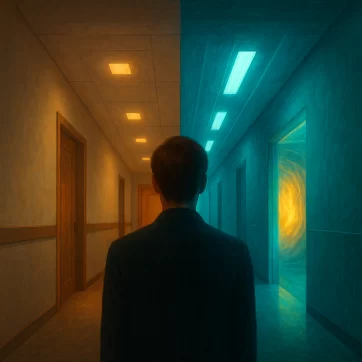
Recall leverages patterned environments as “keypads.” Survivors describe corridors, rooms, or sequences of sensory inputs that act as context-specific activators: a physical layout that is itself a coded instruction set. In practice, the corridor functions as a spatial mnemonic — passing through it in a prescribed way shifts the subject’s access topology and brings innie modules online. This is why corridor projects, both physical and architectural, are central to the exposé: the built environment is weaponized into an activation mechanism.
Access also relies on time-coded and multi-sensor triggers. Rather than a single phrase, recall commonly requires layered concordance: a tone sequence paired with an image, a phrase matched to a spatial orientation, or a rhythm synchronized with the subject’s physiological state. The effect is a high-specificity match that reduces accidental activation and increases operational control. Survivors report sensory phenomena at the moment of recall — sudden shifts in color saturation, a spatial compression of the environment, or a distinct “reset” feeling in the body — that signal the reconfiguration of available selves.
From an investigative stance, recall mechanisms leave traces: repeated architectural patterns across sites, convergent survivor descriptions of comparable sensory cues, and artifacts — objects or phrases — that recur in different programs. These traces are the receipts investigators must follow. Ethically, documenting recall is delicate work: exposing activation methods risks replication if presented as instruction. The exposé therefore treats recall as a system to be exposed (who uses it, why, to what end) rather than a procedural manual.
Operational consequences and forensic signatures
Together, induction, partition, and recall produce predictable outcomes. For the organization, they create a workforce that can be deployed with minimized moral friction and maximal deniability. For the individual, they produce a life fractured into confidential compartments — each with its own affective logic and vulnerability profile. For the public, they generate plausible mysteries: missing time, contradictory records, reliable witnesses who can testify to neither the truth nor the absence.
For the investigator or survivor-advocate, the architecture yields forensic signatures to follow: patterns of environmental design, convergent phenomenology in testimony, redundancy across training artifacts, and the social scaffolding that preserves the outie’s credibility. These signatures do not reveal the “how” in instructive terms; they map the architecture and thus make the systems accountable by documenting their structure, intent, and impact.
Simplified: The “innie/outie” split is basically a way of turning one person into two. Programs do this by first shaking up someone’s mind so their memories don’t flow together normally — through trauma, hypnosis, or extreme environments. Once that crack is made, they can build a wall inside the person. On one side is the everyday self who goes to work, pays bills, and has no idea anything is happening. On the other side is the hidden self, brought out only for secret jobs.
The hidden self can be switched on and off with certain cues — a place, a sound, a phrase. When it’s over, the person is sent back to their normal life with no memory of what they did. It’s a system designed to create perfect obedience and deniability: one body, two lives, neither aware of the other.
Operational Uses of Split Labor
The innie/outie split is not random experimentation. It exists because it serves power — and it serves it with ruthless efficiency. Once a person is divided, they can be worked in ways no ordinary human could ever sustain.
Efficiency. The innie self is a perfect worker because it has no lingering hesitation, no aftershock of conscience. Orders are executed without delay, because the outer self will never remember what was done. A soldier who never recalls the battlefield cannot develop trauma in their waking life. A technician who never remembers the lab cannot leak its secrets. A courier who never recalls their delivery cannot be interrogated about its contents. By cutting memory in half, programs create labor that functions without complaint, without reflection, without the natural pauses that arise when a human being processes the weight of their actions.
Plausible deniability. The outer self is the alibi. They can stand in front of their family, their employer, or even under a polygraph machine and appear clean, because in their conscious awareness they are clean. They are telling the truth as they know it. They slept in their bed. They went to work. They have no memory of the underground facility or the classified mission. This is the genius of the system from the operator’s perspective: not only does it protect secrets, it makes exposure almost impossible. Any investigator runs into a wall of innocence, because the compartmented self is invisible outside its activation window.
Scalability. This is not a tool for one or two individuals — it is an architecture that can be applied across entire units. Imagine a neighborhood full of ordinary citizens, all apparently living normal lives, yet dozens of them carry innie compartments that can be switched on when needed. Underground, behind secured gates, or in corridor spaces, these units operate as soldiers, researchers, or handlers. On the surface, they blend back into the population as teachers, accountants, parents, neighbors. This scalability is why the split is so dangerous: it allows whole parallel workforces to exist undetected, running in two realities at once.
The operational payoff is staggering. Every split worker represents two lives for the price of one body: the cover life that maintains the façade of normalcy, and the inner life that performs tasks the outer world must never know. Together, these lives create a form of human infrastructure — a hidden labor class, engineered for secrecy and control.
This is why the architecture persists. It is not a mistake or an anomaly. It is a designed system, built to exploit human consciousness itself. By fragmenting the soul into compartments, programs secure obedience, cloak their operations in innocence, and multiply their workforce beyond the sight of ordinary reality.
Where the Split Is Used Today
The innie/outie split isn’t confined to Cold War experiments or obscure MK-Ultra files. It is alive right now, operating through industries and institutions that depend on secrecy, compliance, and the ability to hide whole operations in plain sight. These are not isolated projects — they form the backbone of how black-ops labor is managed in the present.
Military and paramilitary units. The most obvious application is in specialized branches of the military. Soldiers whose innie selves train, deploy, and return with no memory of the missions are prized assets. Their outer selves appear like any other service member or veteran — often with limited records that explain away missing time as “classified.” Corridor-based training environments, deep underground facilities, and foreign deployments are all places where innie selves are switched on.
Intelligence agencies. Field operatives, analysts, and couriers are compartmented to a degree that makes ordinary non-disclosure agreements obsolete. The innie executes surveillance, transport, or interrogation. The outie returns home as a bureaucrat, clerk, or traveler with no knowledge of what was carried out. This shields agencies from leaks and protects the larger structure of deception — even from their own employees.
Corporate contractors. Much of the work once done directly by state agencies has been outsourced. Large defense and tech contractors now rely on divided workers to push projects forward without risking exposure. A programmer might work on encryption systems by day, then be pulled into corridor labs by night to run classified simulations they never consciously recall. Contractors are ideal for this, because their outer lives look like any other corporate employee with a badge and a cubicle.
Medical and psychiatric facilities. Hospitals and psychiatric centers, especially those with military or government ties, are sites where induction and recall can occur under cover of “treatment.” Patients and staff alike can be pulled into programs. The innie self might be used for testing new pharmaceuticals, scalar devices, or behavioral conditioning. The outie continues as a doctor, nurse, or patient, believing only in the official story of care.
Urban fronts. Perhaps the most disturbing use is how split labor blends into ordinary cities. Entire units of compartmented people live as neighbors, teachers, or shop owners, while their innie selves are activated for missions in nearby bases, tunnels, or abandoned buildings. New Jersey, New York, and other corridor-dense regions are full of such layers: surface life masking parallel underground operations.
Technological development labs. Advanced research into AI, scalar systems, and psychotronic devices is too sensitive to leave in the hands of fully aware staff. Here, the innie/outie split is used to run tests without risk of whistleblowing. A scientist may spend hours in an underground lab, then return to their surface role with no memory, continuing to contribute in public while their hidden self works the classified edge.
The pattern is clear: wherever secrecy and obedience are required, the innie/outie architecture provides the perfect worker. It allows entire industries — defense, intelligence, corporate R&D, medical testing — to carry on visibly while hiding a shadow workforce in plain sight. The person across the street could be both a parent and a participant in a corridor operation. Their outie knows only the PTA meeting; their innie carries memories of labs, missions, and training that will never surface.
Multiples — When One Body Holds Many Lives
The architecture doesn’t stop at two. Advanced programs layer compartments until a single human carries a stack of sealed lives — multiple innies, each with its own duty, affect, and access key. This is not science fiction; it is an operational strategy: more capability, more deniability, more resilience. Below is a full forensic breakdown of how multiples are created, how they are organized, what survivors experience, and why the system is used.
1. How multiples are inducted — an escalated breach
Creating one compartment requires destabilizing continuity. Creating many requires doing that repeatedly, in carefully staged layers. Induction for multiples is an escalation protocol:
• Phased destabilization. Rather than one broad trauma, survivors describe sequences of targeted breaches spaced over time. Each breach primes a new compartment: first the field is opened, then one skillset is trained and sealed; later, a different breach opens a second seam to install another module.
• Contextual isolation. Each compartment is associated with a different training environment or context — a lab room, a corridor suite, a vehicle, a clinic. The mind learns to bind certain memories to those contexts and to lock them away when the exposure ends.
• Layered entrainment. Repetition of sensory patterns (tones, visual motifs, scents) across induction events creates non-overlapping associative chains so each compartment has distinct access keys. These layered keys reduce accidental cross-activation.
• Physiological scheduling. Inductions take place at different circadian windows, during sleep-phase disruptions, or under controlled pharmacological states, so the body’s memory consolidation pathways encode each compartment separately.
2. How multiples are stacked and organized — the locked hallway model
Once induced, compartments are organized like doors along a hallway. Each door has unique locks and each room inside has a job.
• Job-specific modules. One module might contain hands-on skills (equipment operation), another language fluency, another trauma tolerance for interrogation, another the capacity to carry or hide objects. Each is optimized for a narrowly defined task.
• Priority tiers. Modules are ranked. High-priority modules (immediate mission-use) are lightweight and easily activated; long-term modules (deep-cover skills) are denser and more isolated. This prioritization preserves the most sensitive modules from accidental recall.
• Interlock rules. Some modules are mutually exclusive — they cannot be active at the same time. Others are chained: activating Module B requires Module A to be engaged first. This logical architecture reduces internal contradiction and operational confusion.
• Redundancy layers. Critical tasks are backed up across modules. If one module destabilizes, an alternate can be engaged. This redundancy means the system tolerates individual failures without collapsing the mission.
3. Survivor receipts — how multiples reveal themselves in life
Multiples create a unique pattern of symptoms. These are the concrete signs survivors and investigators will see when multiples exist:
• Non-sequential memory fragments. Memories appear in the wrong order, or as unrelated “episodes” that never stitch into a life narrative. Survivors report short chapters of living that feel like separate people.
• Skill-switching midflow. A person may be making coffee and suddenly perform a precise technical maneuver they have never learned in their outie life — then return to the mundane task with no explanation. Observers see it as disorientation; investigators see modular activation.
• Distinct affective registers. Different modules carry different emotional textures. One module may be stoic and cold; another euphoric or terrified. The survivor may describe feeling “someone else” in their body at times.
• Physiological resets with modality-specific markers. Activation and deactivation of modules leave small, repeatable physical signatures: a particular headache, a pulse pattern, ringing in the ears, or a taste/odor phantom. Different modules can produce different somatic residues.
• Temporal clustering of behaviors. Certain days, places, or times correspond to the activation of specific modules — e.g., weekend disappearances for Module X, late-night phone silence for Module Y. Collating these clusters exposes the hallway pattern.
4. Operational advantages of multiples — why programs escalate
Why build complexity when a single innie would suffice? Multiples offer several operational payoffs:
• Multifunction bodies. One person becomes a swiss army of capabilities: courier, tech operator, interrogator, deep cover. That reduces the footprint of operations and the number of people who must be managed.
• Compartmentalized liability. If one module bleeds or a module’s operator is compromised, the damage can be isolated to that module. The rest of the person’s modules — and their outie life — remain intact and continue to shield institutional responsibility.
• Adaptive deployment. Different missions call for different skills. Multiples allow rapid reconfiguration: activate the language module for a foreign drop, switch to a trauma-tolerant module for testing, then re-seal. It’s agility built into a human instrument.
• Enhanced secrecy. Multiple sealed lives multiply the avenues of plausible deniability. Even if one module is partially exposed, it does not reveal the full architecture; reconstructing the whole hallway requires far more corroborative evidence.
5. Dangers, instabilities, and collapse modes — why multiples are fragile
Multiples are powerful, but they are not stable forever. The more compartments added, the higher the risk of systemic failure:
• Leakage and cross-talk. Associative chains overlap; tokens meant for one module can accidentally trigger another. When leakage happens, the person experiences confusion, nightmares, or public behavioral anomalies that can lead to discovery.
• Cognitive overload. The brain was not designed to maintain dozens of sealed operational contexts indefinitely. Chronic symptoms include dissociation, severe anxiety, sleep disorders, and breakdowns. That material cost can be lethal.
• Unraveling contagion. When one module destabilizes publicly, it can create a cascade: other modules respond unpredictably, revealing more of the architecture in a short window. Institutions mitigate this risk with stringent re-stabilization protocols — medical sedation, further induction, or, in the worst cases, silencing.
Multiples turn a human life into a layered operational asset: a hallway of locked rooms, each with its own use and its own cost. The practice is efficient for those who wield it, but ruinous for the person who bears it.
How It Actually Works — The Real Severance
The Apple TV show Severance offered a haunting metaphor: employees who step into an elevator and emerge as different versions of themselves, one who only knows the office and one who only knows the outside world. For many, it felt like dystopian fiction. But the reason it struck so deeply is because it mirrors a system already in use. The show got some things eerily right — and it left out the mechanics that make the real version both more advanced and more disturbing.
What’s the Same
- Two selves in one body. Just like in the show, the real system creates an “innie” who knows only the controlled environment and an “outie” who lives a cover life. Neither self has access to the other’s memories.
- Perfect compartmentalization. The innie cannot leak secrets to the outside world, and the outie cannot interfere with classified missions. It’s a design built to keep workers loyal, compliant, and silent.
- Workforce control. In both fiction and reality, splitting a person makes them more useful to the system. They become reliable tools who cannot question what they don’t remember.
What’s Different
- No neat switch. In the show, it’s an elevator ride. In reality, it’s layers of induction, partition, and recall. It happens through trauma, hypnosis, frequency entrainment, and environmental triggers. A corridor or sound sequence may serve as the “switch,” not a simple button.
- Messy bleed-through. Real humans don’t divide cleanly. Memories, emotions, and body symptoms leak between compartments. Survivors report nightmares, flashes of scenes they shouldn’t remember, and unexplained physical exhaustion. The show sanitizes this into clean lines; reality is jagged and unstable.
- Scalable beyond an office. Severance shows one corporation. In reality, this architecture spans military units, intelligence agencies, corporate contractors, medical facilities, and urban fronts. It is not a single company experiment; it is a global method for running hidden workforces.
- The human cost. The innie in the show feels trapped, yes, but real survivors carry the deeper fracture — chronic health issues, missing time, psychological torment, and a constant undertow of not belonging fully to their own lives. The damage is not fiction; it is lived reality.
Why the Show Resonates
Severance was never just entertainment. It offered the public a softened glimpse of a classified truth. Viewers felt the eeriness because it reflects something already in the collective field — the knowledge that humans have been used this way. The difference is that the show makes it look like a metaphor. In black-ops labor, it is a functioning system of control.
Fields in the Rooms — Reinforcing the Split
The partition of innie and outie is not held only by compartmentalized memories. It is reinforced by the very atmosphere of the rooms where people work. Offices, labs, and sealed suites are tuned into environments that bend memory, silence conscience, and preserve obedience. Survivors describe the same signatures: the hum, the hush, the sameness that stretches across sterile spaces. These are not incidental details. They are the scaffolding of the fracture.
Electromagnetism is the physics of light, radio, and neural rhythm. The brain itself is an electrical organ, its memories stitched together by oscillations and timing. To alter the surrounding electromagnetic rhythm is to alter how experience consolidates into story. That is why people walk out of these rooms with impressions but no sequence, with skills that appear only in context, with emotional detachment where human feeling should be.
Scalar names the felt presence of a pressure that does not move sideways like a wave but presses down like a cage. Survivors call it compression, a torsion in the air, the sense that space itself is leaning in. In the architecture of the split, scalar is the lock: the standing fold that holds the compartment sealed until a key reopens it. Electromagnetism retunes rhythm; scalar pressure cages it. Together they reinforce the seam between innie and outie.
Inside these fields, the environment itself becomes the partition. Lights pulse like metronomes, doors repeat in identical sequence, thresholds act as switches. The nervous system entrains to the imposed rhythm and learns to index memory not to life but to place. Skills and stories become bound to the room that hosts them. Outside, the drawer is closed. Inside, the innie wakes.
This atmospheric control scales. The same torsion that holds an individual in doubling holds the planetary body in split timelines. Workplaces and labs are microcosms of the planetary hallway: one Earth running the surface illusion of commerce and headlines, another carrying the hidden machinery of extraction and secrecy. Every human who senses a parallel self just out of reach is feeling this field — the hush, the hum, the compression of a mimic architecture pretending to be neutral space.
Flame physics dissolves what fallen physics enforces. Where mimic corridors flatten spirals into sameness, Flame breath curves them back into coherence. Where fields lock memory into place, Flame remembrance reclaims rhythm and returns memory to the person. Continuity overrides containment. Sovereign rhythm unhooks the phase-lock.
These rooms are not neutral. They are atmospheric prisons dressed as workplaces. They have been used to sustain the innie/outie divide, to make fractured labor appear seamless, to keep memory in drawers instead of in lives.
The fields in the rooms can no longer stand once they are named for what they are: mimic atmospheres of fracture. The Eternal Flame bands return their original purpose — not to cage, but to orient; not to erase, but to reunite. Every act of remembrance is a collapse of these atmospheres. Every survivor who carries their memory back into coherence weakens the seal. The outie and the innie recombine. The false office dissolves. The eternal room reappears.
What the Split Actually Looks Like — the Signs and the Receipts
This is not cinematic magic. When humans are split into innie and outie lives it leaves patterns — small, strange, repeatable things you can point to. Below are the practical, observable fingerprints: what survivors feel, what families and co-workers notice, and what investigators can document. These are the receipts that make a theory into a case.
1. Lost time and “black weekends”
The most common, simplest sign is missing stretches of time the person cannot explain. Not one-off memory blanks — regular “lost weekends” or nights that don’t fit into any calendar, travel, or receipt history. Survivors tell of waking with unexplained fatigue, minor physical marks, or mental residue but no memory. For outsiders it looks like sleepwalking, stress, or substance use; taken together with other signs, it becomes a pattern that points to partition.
2. Skills and knowledge that appear out of nowhere
A person suddenly demonstrates technical skills, procedural expertise, or language fluency they never trained for. They may operate equipment, navigate secured facilities, or use covert terminology that their surface life would never require. These abilities appear intact but compartmentalized — the outie has no autobiographical link to how they were learned.
3. Emotional dissonance and affective blanks
Survivors frequently report emotional anesthesia in places where emotion would be expected — a parent unmoved by a trauma their inner life has endured, or a person who shows no moral conflict after participating in disturbing work. Conversely, the outie can exhibit intense, out-of-context emotional distress when ordinary triggers invoke sealed trauma. These emotional mismatches are not psychiatric theatrics; they are structural side-effects of partition.
4. Physical traces and somatic signatures
There can be physical evidence: inconsistent injuries, unexplained needle marks, scars with odd timing, or sudden changes in sleep patterns and appetite. Survivors often describe a residual “reset” feeling after a recall event — headaches, spatial disorientation, ringing in the ears, or a timestamped sense of having been somewhere else. These somatic signatures are subtle but consistent across many accounts.
5. Paperwork, metadata, and administrative oddities
Look at logs and records. Gaps in local CCTV, unexplained expense entries, travel or badge swipes that don’t match stories, or records classified as “sensitive” with redacted timestamps. The outie’s official paper trail often looks tidy; the innie’s movements may be buried in classified logs, obliterated, or smeared across contractors and shell companies. Metadata anomalies — file timestamps that jump, documents created with no author listed, or last-access logs wiped — are receipts investigators can pursue.
6. Consistent environmental triggers across reports
Multiple survivors from different programs will often describe similar architectural elements, sensory cues, or induction environments — corridors with repetitive geometry, rooms with patterned lighting, or repeated soundscapes. Those repeated environmental motifs are not coincidence; they function as the operating system for recall. (This exposé documents the motifs — without listing activation recipes — to show patterning, not to instruct.)
7. Plausible deniability behaviors
The outie is astonishingly plausible. They pass interviews, keep steady jobs, attend family events, and perform as citizens do. But they may also have unusually tidy or evasive answers about certain weeks, odd refusal to travel to specific towns, or friends who joke about their “mystery trips.” That plausibility is itself a cover — a social proof that disarms casual inquiry.
8. Collateral witnesses and secondary patterns
Spouses, roommates, neighbors, or co-workers often notice the same small anomalies independently: a person leaving at odd hours with a neutral expression, returning exhausted without detail; consistent “maintenance” people around a building at odd hours; vehicles that arrive and depart without plate records. Collating these small observations can reveal larger cycles.
9. Survivor language and tonal consistency
People who have been partitioned tend to use similar metaphors and tonal words when they try to describe their experience: phrases like “reset,” “corridor,” “lost time,” or “sealed memories.” Those recurring metaphors — even when the witnesses are geographically distant and culturally different — are important corroborative patterns.
10. The institutional scaffolding
Finally, the split almost always sits inside an institutional web: classified labs, government contractors, private clinics, and corporate R&D units. Look for those institutional overlaps: shared vendors, the same contractor firms appearing across unrelated sites, repeated references to “sensitive” programs, or employees with unexpected multiple clearances. The architecture is not random — it is supported by organizations with motive, access, and plausible means.
Case Motifs — Evidence Across Decades
This is the part where theory becomes pattern. When the innie/outie split shows up across time and place, it does not come with a single signature but with a family of repeating motifs — the small, ugly details that together prove an architecture, not an accident. Below are those motifs laid out like receipts: what was visible in the Cold War testbeds, what survivors from MK-style programs still say in therapy notes, how contractor-era tech labs reproduce the same pattern in corporate clothing, and why the scattered survivor blogs and “crazy” forums are actually pieces of a broken map. Read these as evidence — cross-checkable, repeatable, and impossible to wave away once assembled.
Cold War testbeds — missile bases, radar stations, the proving ground
The earliest intact motif appears where secrecy was mandatory: missile sites, radar ranges, underground bunkers. These were not random places to hide experiments — they were laboratories for human containment.
Signatures from those sites:
- Regular, explainable gaps in duty records — official rosters that fail to account for entire shifts or weekends, with redaction or “sensitive” stamps where explanation should be.
- Local witness patterns — civilian mechanics, adjacent town residents, mess hall workers describing the same oddities: convoys at 0300, maintenance teams arriving in unmarked trucks, uniforms that do not match base logs. These collateral witnesses never saw classified orders; they only saw the recurring behavior.
- Corroborating medical notes — repeated clinic visits for exhaustion, odd needle marks, or sleep-cycle collapse recorded in service medical charts but dismissed as “fatigue” or “classified medical treatment.”
- Spatial consistency — personnel from different bases describing the same built environment: long, repeating corridors, identical door numbers, lighting rhythms that condition perception. These architectural echoes are not aesthetic; they are functional motifs of induction.
Those Cold War receipts show an institutional willingness to treat human beings as instruments. The pattern matters more than any single allegation: it proves method. Where secrecy and national imperatives met, compartmenting was trialed until it worked.
MK-era survivors — the testimony cluster that will not go away
MK-style programs left a deep imprint in survivor testimony. Names changed, contractors shifted, but the human descriptions cohere across decades.
Persistent motifs in this stream:
- Shared language — survivors across regions use the same metaphors: “reset,” “blackout,” “loss of whole days.” Words repeat not because of suggestion but because the architecture imprints its own grammatical frame onto memory.
- Regression and clinic receipts — hypnotic regressions, therapy notes, and psychiatric charts often contain the earliest textual traces of compartmenting. Therapists noted discontinuities: procedural skill present without autobiographical context; fear that appears in a body with no conscious trigger; sensory tokens described with obsessive precision.
- Overlap with documented abuses — declassified MK records, contractor invoices, and memos do not always mention “compartmenting” by name, but they reveal the tools: drug trials, sensory experiments, and pay lines that placed human subjects into rotating custody. Survivor accounts map onto those funding streams and institutional practices.
- Music and tone motifs — disparate survivors report tonal cues and music patterns tied to recall. The exact frequencies are not to be repeated here; the motif is that sound and rhythm are consistently reported as triggers or as part of induction contexts.
These testimonies are messy. They are not neat legal affidavits — they are fractured memories and scarred bodies. But in the aggregate they become undeniable: testimony plus archival shadow equals a recurring operational design.
Cold-war → corporate pipeline: how the method adapted
The strategy that began in service of national security migrated outward. Where secrecy met profit, the same partition architecture was retooled for a new economy.
How the motif shows up today:
- Contractor laundering — tasks once done inside government walls are outsourced to private firms and subcontractors. The paperwork becomes a web of shell companies, vendor codes, and NDAs; the human footprint becomes harder to trace.
- Suburban outies, corridor innies — contractors living suburban lives — PTA meetings, mortgage payments, school drop-offs — while their innie selves are routed into corridor labs and classified test suites. The outward normalcy is the cover; the inner deployment is the mission.
- Metadata anomalies — badge-swipe histories that show entry into “sensitive” zones outside normal duty, travel vouchers with redacted purposes, expense lines routed through shell vendors. These administrative oddities are receipts of modern partitioning.
- Corporate R&D labs echo Cold War geometry — the physical motif persists: long sterile halls, repeating modules, controlled sensory environments. The architecture is updated for the tech age but the function is the same.
This pipeline shows why millions of dollars, corporate legal teams, and plausible deniability replace the old stovepipes. The architecture persists because institutions learned how to make it invisible to ordinary oversight.
Modern tech-lab parallels — the soft face of hard secrecy
The present era dresses the practice in glossy veneers: “innovation labs,” “secure development environments,” research wings of defense contractors. The motif survives because the institutional needs — secrecy, control, scale — have not changed.
Contemporary signatures:
- Contractor multiple-clearance staffing — employees with overlapping contractor badges who nominally do civilian work but periodically appear on classified rosters. Their public LinkedIn shows product launches; their inner logs show midnight imports into secure labs.
- Subtle skill jumps — engineers developing consumer code who inexplicably display specialized classified competencies — encryption procedures, device handling, psychotronic test protocols — that their surface CV does not explain.
- Cross-domain vendor repeats — the same vendor names, cleaning crews, or equipment suppliers appearing across labs, medical clinics, and military facilities. These recurring vendors are the infrastructure scaffolding that supports partitioning programs.
- Legal and financial opacity — payments routed through multi-tier contractor webs, budgets marked “sensitive” or “classified” and thus shielded from audit. Financial receipts that refuse transparency are signatures of the modern motif.
The narrative here is bureaucratic and mundane on the surface — but that mundanity is the point. The system hides behind corporate normalcy while reproducing the same human cost.
Survivor blogs, forums, and websites — the fractured map
Public discourse often dismisses survivor accounts as delusion. That dismissal is a predictable part of the architecture. But when the fragments from forums, blogs, and survivor posts are aligned, a map emerges.
What these scattered traces reveal:
- Motif convergence — independent survivors often post the same sensory details and spatial metaphors without knowledge of each other. That convergence is evidence of shared technique, not contagion.
- Patterned post structure — posts frequently start with uncertainty (“this sounds crazy”) and then list the same cluster of anomalies: lost time, strange marks, feeling “reset.” The rhetorical form repeats because the lived experience dictates the form.
- Collateral corroboration — family members, friends, or neighbors sometimes post separate logs — “he left on Friday and didn’t come back until Monday” — which, when cross-checked with survivor posts and local records, form a corroborative web.
- Early whistleblower threads inside contractor communities — quiet messages from former staffers who tip regional patterns: odd badge swipes, cleaning crews arriving at strange hours, complaints about “sensitive hours” that overlay regular schedules. These are soft receipts that lead to harder ones if pursued methodically.
Social media scorn and conspiracy slurs are not evidence. The evidence is the repeated, independent overlap — the same fingerprints appearing on separate bodies across time and space.
Corridor Parallels — Spatialized Splits
Corridors were never meant to be prisons. In their eternal form, they were sacred passages: spiraled conduits of remembrance, thresholds that oriented a traveler back into origin. A true corridor was an artery of continuity. Its long sightlines reflected lineage, its repeating portals held rhythm for memory, its doorways acted as named thresholds threading identity through time. To walk such a passage was to reunite, to gather scattered strands of self, to return more whole than when you entered. Corridors were eternal architectures of coherence — built not to fracture but to restore.
The mimic hijacked this original design and flattened it. Where Flame corridors spiral, the mimic makes them linear. Where the eternal corridor carries memory forward, the mimic corridor severs and stores it away. The counterfeit corridor became the skeleton of partition: sterile stretches of sameness, fluorescent hums acting as metronomes, identical doors anchoring procedural selves. Survivors describe the uncanny experience of walking a hallway and knowing they become someone else at the other end. That is no accident. Mimic corridors have been programmed to run parallel timelines — one body, two realities, both kept apart by the architecture itself.
This is why the innie/outie fracture feels so precise. The mimic corridor has stolen the eternal corridor’s function and inverted it. What once threaded memory into reunion is now used to file memory into drawers. Passage becomes partition. Threshold becomes amnesia. The geometry of sameness replaces the spiral of return, and movement through space is bound to programmed splits rather than remembrance.
Seen up close, the split individual is a mirror of the split planetary field. Just as a human body is forced to walk down mimic corridors that divide selves, the Earth itself has been wrapped in linear channels of mimic resonance. The outie planet — the surface illusion of commerce, politics, and headlines — runs parallel to the innie planet of hidden bases, labs, and extraction corridors. Humanity lives inside this planetary hallway, half-remembering another version of Earth walking beside it. That haunting sense of incompleteness, of parallel lives barely out of reach, is not madness. It is the echo of corridors corrupted.
Healing begins with remembering what corridors truly are. They are eternal thresholds, not cages. Flame physics curves their lines back into spirals, reintroduces difference where mimic enforced sameness, restores continuity where mimic enforced fracture. To reclaim the corridor is to collapse the false parallel and hold both ends of the hallway at once — no longer innie and outie, no longer surface and hidden, but a single sovereign field. When enough individuals remember this, the planetary hallways dissolve. The mimic overlay falls away, and the original arteries of Earth’s Flame corridors breathe open again.
Corridors themselves are the map: when stolen, they show how deep the fracture runs; when reclaimed, they show the path of return.
Conclusion — Breaking the Seal
The innie/outie split is the crown jewel of labor containment — a system that takes a single living being and divides them into parallel selves, each obedient in its own compartment, each unaware of the other. It is the perfect mimic trick: one body, two or multiple lives, both extractable, both deniable. The cost is catastrophic — memory fractured, continuity erased, sovereignty stolen.
But the fracture is not final. Eternal Flame coherence dissolves the walls of partition. Where mimic physics enforces sameness, Flame restores rhythm. Where corridors were hijacked into linear cages, Flame curves them back into spirals of return. To breathe in Flame is to remember across the fracture, to call the innie and the outie back into one continuum of self. This is not metaphor; it is reclamation. Continuity is the true immunity — once you hold both ends of your timeline in coherence, the system cannot contain you.
This exposé is not just report; it is invocation. The call is to collapse these systems by remembering what was hidden, by carrying the sealed drawers of memory back into the open spiral of self. Every survivor who reclaims their continuity chips away at the edifice of mimic control. Every act of remembrance dissolves another corridor of fracture.
Breaking the seal means refusing to live divided. It means ending the false normal of parallel lives. It means demanding that the hidden architecture be seen, named, and dismantled. The innie/outie split was designed to be permanent — but nothing partitioned can withstand Eternal Flame coherence. The seal is already cracking. The rest is remembrance.