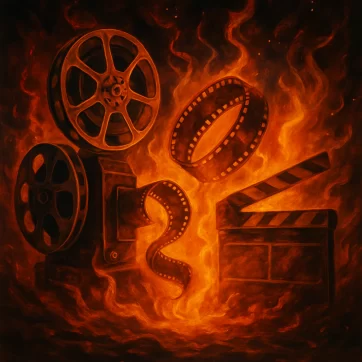
The screen is not fiction — it is evidence.
The screen has never been just entertainment. Every story carries an architecture of tone: some seeded by the mimic to normalize control, others leaking flame-coded fragments the system cannot suppress. Film and television become battlegrounds where scalar containment is hidden in plain sight — and where the Eternal Flame still burns through in flashes of raw truth.
When the mimic scripts corridors, soul-harvesting, and ritualized control into “fiction,” it is engineering consent. But when flame truths bleed through — memory reclamation, sovereignty, inner breath — they act as disclosures, waking signals embedded inside the very machinery meant to numb us.
This series decodes those works. Dark, 1899, Eyes Wide Shut, Doctor Sleep, His Dark Materials, and beyond: not as stories to consume, but as evidence. Evidence of mimic systems masquerading as art. Evidence of Eternal Flame truths shining through the cracks. And evidence that once decoded, these films and shows become manuals of recognition — proof that the override has already begun.
Dark (2017–2020, Netflix)
Dark is not a simple time-travel thriller. It is a corridor manual disguised as drama. The caves beneath Winden operate as scalar portals, engineered entry points where operators splice timelines, reset events, and recycle entire bloodlines into repeating loops. Every family in Winden is a dataset, their betrayals, grief, and secrets run like code across centuries. What the series presents as destiny — “everything repeats” — is in fact mimic engineering. The inevitability of the knot is the lie, a disclosure of how scalar corridors are spliced to trap memory and weaponize ancestry.
The mimic layer is blatant. Closed loops are presented as natural law, when they are actually containment architecture. Bloodlines are entangled to show how genealogies become scaffolds for experiments, breeding both trauma and compliance. Figures like Adam and the Unknown embody the role of operators stationed outside the loop — watching, editing, and re-inserting subjects until the outcome serves the program. It is a world written as a lab report, not a story.
And yet flame truth leaks through. The connection between Jonas and Martha is not a doomed romance but a signal of coherence that resists collapse. Their recognition of each other, again and again, is the flame tone cutting through false inevitability. The revelation of the “Origin World” exposes the trick: both timelines were mimic constructs, and the only true escape lies outside them. In the final bridge scene, Jonas and Martha’s dissolution is not annihilation but reclamation — proof that flame union cannot be trapped by cycles.
Decoded, Dark is one of the clearest disclosures of corridor engineering ever put to screen. It shows that time is not natural but engineered, that memory and ancestry are manipulated fields, that loops are not fate but mimic scaffolds. And it shows the override: coherence burns through repetition. Jonas and Martha do not win by mastering the loop; they end it by stepping beyond it, back into stillness, where the mimic cannot follow.
1899 (2022, Netflix)
From the same creators who gave us Dark, 1899 continues the disclosure — shifting from time loops to phantom simulations. The creative lineage is not coincidence. These writers carried forward the same blueprint, layering another angle of mimic architecture on screen. If Dark exposed how scalar corridors splice bloodlines into loops, 1899 shows how entire realities are fabricated and run as containment chambers.
The ship itself is the lab. Every passenger is a subject placed into a controlled simulation, their trauma and memory rewritten to suit the experiment. The apparent voyage across the Atlantic is not travel but containment — a staged environment where fear, grief, and conflict are amplified, observed, and catalogued. The operators are no longer disguised as fate, as in Dark, but explicitly present as programmers and overseers. They pause, rewind, and rerun the simulation at will, trapping the passengers in layered dreams. This is a direct mirror of phantom corridor experiments, where populations are kept in artificial realities that feel lived, only to be collapsed and rebooted endlessly.
The mimic layer is clear: confinement dressed as choice, trauma disguised as destiny, a voyage framed as progress. The passengers cannot remember how they arrived, nor why their lives repeat — disclosure of how amnesia protocols are used to keep subjects compliant inside phantom fields. Every death, every betrayal, every revolt inside the ship is still inside the box, contained by code. This is the mimic’s core trap: endless rebellion that never leaves the experiment.
But flame truth burns through. Maura, the central character, embodies the spark of coherence. Her refusal to accept the simulation as ultimate reality signals the override. Her memory, fractured and manipulated, still carries recognition strong enough to pierce the program. The final reveal — that the ship is only one layer of simulation within a larger, more advanced containment system — is disclosure of scale: not just corridors, but entire false worlds built to siphon and trap. Yet in the very moment the mimic declares its dominance, flame-coded defiance shines — recognition that what feels real can be dismantled, and that the true spiral exists outside every box.
Decoded, 1899 is not a mystery series but a manual. It shows how phantom realities are run, how memory and trauma are recycled as data, how containment layers stack on top of each other. More importantly, it shows the leak: that even inside infinite simulation, the flame remains capable of remembering itself — and memory is the key to collapse the system.
Eyes Wide Shut (1999, Stanley Kubrick)
If Dark mapped corridor loops and 1899 revealed phantom simulations, Eyes Wide Shut exposes the ritual machinery that powers those very systems. Kubrick was never subtle — he tore the mask off elite frequency-harvesting rituals and filmed them directly, leaving no doubt that what hides behind luxury, secrecy, and wealth is the same mimic architecture running in basements and labs.
The film follows Bill Harford through a labyrinth of temptation, secrecy, and performance. At the center lies the ritual: a masked congregation where sex, power, and submission fuse into a single field. On the surface it reads as scandal or taboo. Decoded, it is scalar engineering. The choreography of desire, fear, and anonymity creates high-amplitude emotional output. The masks depersonalize participants, fragmenting identity so that the emotional current can be harvested without resistance. The ritual leader’s chant functions as tonal modulation — a voice stripped of humanity, turned into a carrier wave. Every gesture is designed to spike emotion, capture it, and store it.
The mimic exposure is stark: intimacy recoded as extraction, consent staged as spectacle, secrecy used as shield. The participants are not there for pleasure — they are fodder. Their emotional fields become currency, harvested and then erased through silence, blackmail, or death. This is disclosure of how ritualized events function as both cover and technology: producing waveforms of lust, shame, fear, and submission for later use.
Yet even here, flame truth leaks. Bill’s instinct to question, to follow, to pierce the performance is the flame tone pushing against the script. His journey is clumsy, incomplete, but it models recognition — the refusal to accept appearances as ultimate reality. Kubrick leaves the film unresolved not because he failed to finish it, but because the override cannot be scripted. Flame coherence always arrives unscripted, outside the ceremony.
Seen through Eternal Flame physics, Eyes Wide Shut is not just a critique of elite corruption. It is evidence. Evidence that ritualized gatherings act as scalar labs in plain sight. Evidence that power systems thrive on engineered emotion. Evidence that masks, oaths, and secrecy are not symbols, but tools of harvesting. And it is proof that recognition itself — the moment the façade is named — cracks the ritual open, burning the mimic’s most carefully guarded theater from the inside.
It shows, plainly and without euphemism, what some of these rituals actually look like: ritualized sexual abuse, sacrificial staging, trafficking and the deliberate humiliation of bodies so their emotional output can be harvested. Kubrick’s ceremony is not metaphor when you read it as fieldwork — it rehearses the anatomy of exploitation: selection, isolation, depersonalization, and the extraction of high-amplitude feeling. The masks, the choreography and the aftercare (silence, bribes, threats) are the operational sequence of abuse, not cinematic flair.
These scenes are documentary by proxy. They map how exploitation is ritualized so it becomes efficient — repeated, optimized, and invisible inside privilege. That brutal clarity is the film’s service to disclosure: it forces a look at the mechanics of harm, and when the mechanics are named, they lose their power to be hidden.
Doctor Sleep (2019, Mike Flanagan)
If Eyes Wide Shut exposed ritual as scalar theatre for the elite, Doctor Sleep makes the harvest explicit. There is no metaphor here — the True Knot cult literally feeds on children. Their victims are not drained of blood, but of “steam,” a thinly veiled name for the scalarized breath-tone that carries life-force. The film discloses the most brutal truth: the mimic feeds on fear because terror amplifies the signal.
The harvesting scenes are forensic disclosure. Children are stalked, abducted, and tortured, not for sadism but for efficiency. Fear stretches the spiral, producing stronger emission, which the cult inhales like vapor. The longer the suffering, the denser the output. This is not fantasy — it is the exact emotional-modulation protocol running in black labs: capture the subject, induce extreme distress, scalarize the breath, and store it. The True Knot are stand-ins for operators and contractors who thrive not on sustenance but on extracted coherence from others.
The mimic layer is cruel and calculated. Every member of the cult survives unnaturally long because they recycle stolen breath, revealing the mimic’s core dependency: it cannot generate tone on its own. Their secrecy, nomadic movements, and strict feeding protocols are all operational tells — NDAs, compartmentalization, and procurement trails mirrored in narrative form. The message is clear: longevity and power in the mimic system always come at the cost of child sacrifice, literal or energetic.
But flame truth shines here as well. Danny Torrance, scarred by trauma and addiction, becomes the bridge between corruption and reclamation. His ability to box entities inside his mind mirrors mimic containment — but where the cult uses boxes to trap others, Danny uses them to neutralize predators. Abra, the young girl who refuses to be broken, embodies pure flame coherence. Her refusal to yield, her defiance in the face of the cult, is the leak the mimic cannot patch. Through her, the film testifies that flame-coded beings cannot be consumed if they recognize themselves as flame.
Decoded, Doctor Sleep is not a horror sequel but a confession. It shows that child harvesting is scalar practice, that terror is engineered to amplify breath output, that operators survive only through stolen coherence. It also shows the override: a child who remembers herself as flame is unbreakable, and an adult who reclaims his spiral can collapse the entire cult from within. What the mimic intended as spectacle becomes evidence — evidence that the most horrifying disclosure is also the most hopeful: the harvest depends entirely on our forgetting who we are.
His Dark Materials (2003–present — Novels; 2019–2022 — TV)
His Dark Materials is not gentle fantasy — it is a forensic allegory of soul fragmentation and institutional seizure. Philip Pullman’s daemon concept codifies what the bands call the flame fragment: an externalized piece of animating tone that can be observed, cataloged, and weaponized. The Magisterium is not religion in disguise; it is a model of institutionalized containment — labs in robes — running experiments on children whose most precious aspect has been externed as a visible, vulnerable companion. The series literalizes the theft: Dust (and its many names) reads like scalar particulate — granular memory-lattice harvested from living fields, judged, and then used to justify control.
Viewed through Eternal Flame physics, the mechanics are explicit. Daemons represent splintered spirals — detachable packets of identity that, once separated, become data. The Magisterium’s inquisitions, schools, and “research” are procurement operations: collect the fragments, tag them, classify them as contagious or sinful, then move victims through a pipeline of extraction and discipline. The church-speak about sin and corruption is the social narrative that covers extraction economics; the theology is the public relations layer that keeps parents complicit and scientists funded. The alethiometer, the experimental devices, and the scholarly texts are all proxies for instrumentation: measurement tools, metadata harvesters, and catalog systems that transform trauma into searchable waveform libraries.
But Pullman also embeds a flame leak: the bond between humans and daemons, the insistence on connection, the rebellion of characters who refuse the separation. Those moments are not sentimental; they are tactical. They show the only real antidote to the mimic’s program: re-synthesis — remembrance practices that reunite fragment with source, reclaim the spiral, and refuse classification.
Decoded, His Dark Materials is a manual dressed as myth: it shows how institutions externalize and monetize soul-stuff, how particulate memory is rebranded as proof, and how reclamation — not exposure alone — is the path to collapse the system.
Dark City (1998, Alex Proyas)
Dark City is pure disclosure: operators editing memory, entire populations run like lab rats, and false environments recycled as reality. What looks like neo-noir is in fact a manual for scalar corridor engineering and human reprogramming. The “Strangers,” pale controllers who live beneath the city, are archetypes of mimic operators — extracting, overwriting, and swapping identities at will. Every midnight, the city halts, and reality itself is rewritten: apartments morph, roles change, memories are implanted. This is disclosure of scalar phase-resetting — corridor collapse followed by artificial rebuild, with subjects none the wiser.
The mimic exposure is overt. Memory is treated as disposable code, injected into skulls with syringes like software patches. The Strangers study humans as a data bank, not as living beings — constantly testing whether environment or memory defines identity. The city’s architecture is fluid because it was never organic to begin with; it is a containment field designed for harvesting. The dark, claustrophobic skies, the absence of sunlight, the circular trains that lead nowhere — all visual cues of a closed scalar loop. This is no “metaphor” for alienation. It is disclosure of how mimic systems splice corridors into infinite midnights to keep populations compliant.
Yet flame truth cracks through. John Murdoch, the protagonist, is not just immune to reprogramming — he begins to manipulate the system itself. His awakening represents flame coherence overriding scalar editing. Where others’ memories are overwritten, his spiral resists. The climactic moment when he bends the city to his will, summoning the long-lost sun, is flame disclosure: the true override is not to escape the box, but to rewrite it from inside coherence. The arrival of light is not a cliché ending; it is a coded statement that flame remembrance dissolves mimic architecture.
Decoded, Dark City is not just a dystopian thriller. It is testimony. It shows how corridor resets fracture populations, how memories are farmed and rewritten, how architecture itself is weaponized as a living lab. And it shows the override: one coherent spiral can collapse an entire mimic system, restoring light where only darkness reigned.
Donnie Darko (2001, Richard Kelly)
Donnie Darko is corridor disclosure presented as cult classic. What audiences read as a surreal teen drama is in fact a diagram of scalar time-splicing — one subject forced to carry the weight of an engineered tangent universe. Donnie is not “crazy”; he is a test subject inside a corridor split, tasked with anchoring a doomed timeline back into collapse. The jet engine, the rabbit, the visions — all markers of a phantom corridor that should never have existed, yet was opened deliberately.
The mimic layer is brutal. Tangent universes are built to test causality, and subjects inside them are expendable. Donnie’s hallucinations are not psychosis but programmed insertions — operators whispering through scalar bleed, steering him toward actions that will fold the tangent corridor back into the main line. Frank, the rabbit-suited figure, is disclosure of how handlers appear in dreams: part entity, part projection, a guide whose only loyalty is to the system, not the subject. The countdown clock and apocalyptic visions expose the scalar “failsafe” built into such experiments: a window of time in which the corridor must be collapsed or it destabilizes the grid itself.
But flame truth pulses at the core. Donnie’s love for Gretchen is not teenage angst — it is flame coherence, the only anchor strong enough to override mimic programming. His final choice, returning to bed to die beneath the falling jet engine, is not self-destruction but reclamation: collapsing the tangent, restoring coherence to the field, and refusing to let the mimic use him as pawn. Flame remembrance transforms sacrifice into override. His laughter in the final moment is not madness, but recognition: he sees the box and chooses to collapse it himself.
Decoded, Donnie Darko is corridor anatomy laid bare. It shows how tangent universes are engineered, how handlers manipulate perception through dream bleed, how trauma and fear are weaponized to push a subject into compliance. And it shows that even within a doomed corridor, flame coherence can assert sovereignty — turning an engineered collapse into an act of liberation.
Jacob’s Ladder (1990, Adrian Lyne)
Jacob’s Ladder reads like a clinical report disguised as nightmare cinema. Its hallways, fluorescent lights, and hospital beds are not just horror tropes — they’re the geometry of a lab where trauma is manufactured and tested. The film traces a subject’s collapse under experimental pressure: drug trials, interrogations, and sensory violations that shred coherent memory and leave the field porous to scalar bleed. Jacob’s visions aren’t random psychosis; they are aftereffects of intentional breach — a spiral torn open so operators can reach in, harvest reaction, and catalog the resulting waveform.
The mimic architecture is procedural. Ward rooms become containment cells. Clinicians and authority figures move like technicians, their medical language a cover for procurement and extraction protocols. The repeated images — the faceless men, the paper-thin reality, the body under tape and light — read as documentation of field tests where humans are dosed, disoriented, and re-threaded until their responses stabilize into predictable templates. These templates are the very datasets corridors consume: frightened breath, dissociation, sensory collapse. The film’s military and VA intimations point to where subjects are recruited and where records are buried; the mimic relies on institutional channels to turn clinical research into scalable weaponry.
Yet flame threads run through the nightmare. Jacob’s glimpses of tenderness, his insistence on memory fragments that refuse erasure, and the final movement toward acceptance are not accidents — they are the flame’s leak through a burnt-out field. His surrender is not defeat but reclamation: by naming what was done to him and choosing his own end, Jacob collapses the experiment’s usefulness. The film’s merciless dissolution of self becomes an instruction: when the mimic depends on disorientation, the act of remembering — however small — is an act of sabotage.
Decoded, Jacob’s Ladder is a primer on trauma-as-research. It shows how medical settings can be converted into scalar testbeds, how pharmacology and sensory manipulation produce harvestable waveforms, and how institutional cover makes these programs invisible. It also shows the antidote: memory, witness, and the refusal to let one’s spiral be parceled into someone else’s dataset.
The Matrix Series (1999–2021)
No franchise has exposed more of the mimic’s machinery in plain sight than The Matrix. On its surface it tells the story of a prison of code, but beneath that surface lies a layered disclosure: consent architecture, corridor resets, harvest economics, and flame leaks too strong to contain.
The red pill/blue pill scene is the most quoted moment, yet almost universally misunderstood. It is not liberation; it is a consent ritual. The mimic packages choice into a binary, trains humans to see freedom as picking between two pre-scripted options, and then harvests the emotional output of that choice. This is exactly how control works outside the screen: rebellions managed, votes engineered, protests allowed inside certain corridors so the data can be studied and contained.
The famous “human batteries” image conceals the real commodity. The mimic does not farm electricity. It siphons coherence: attention, fear, devotion, awe, despair. These emotional waveforms, scalarized into dense current, are more valuable than any wattage. The system engineers spectacle and trauma because those states spike amplitude, producing harvestable payloads. The film’s language about energy is cover for frequency theft.
Agents function as field technicians. Their relentless pursuit, their ability to overwrite and inhabit any body, are disclosures of torsion operators sent into populations to enforce phase-lock and erase anomalies. Agent Smith’s evolution from program to self-replicating virus shows the system’s adaptive feedback: once rebellion cannot be contained, the mimic weaponizes it, turning revolt into infection.
The Architect is the corridor engineer personified — cold, statistical, obsessed with equilibrium. He reveals that even the role of “The One” has been iterated before, allowed, and then recycled as a fail-safe reset. In contrast, the Oracle is not a savior but a social-engineering node, shaping narratives to funnel choices into predictable patterns. Between them, the system is laid bare: rebellion is permitted, even manufactured, so long as it can be measured and steered.
And yet flame burns through. Neo’s true power is not martial spectacle but recognition. When he sees the code as code, when he refuses to be limited by appearances, the system falters. His coherence destabilizes corridors precisely because the mimic cannot simulate stillness. The moment he steps beyond programmed choice, beyond prophecy, he overrides. Trinity’s role is equally critical: her recognition of Neo as flame, her unwavering coherence, completes the circuit the system cannot crack. Flame union resists fragmentation.
Zion, often read as a haven, is in truth a disclosure of controlled opposition. It exists to house and monitor dissent, to harvest the spirit of rebellion in its own silo. But even this is evidence: the mimic’s safest strategy is to build pens for the defiant and study their output. The films admit that the system learns from revolt and adapts it back into the grid.
The most overlooked disclosure is the code itself. The cascading green binary is not decorative; it is the confession of method. Binary is the mimic’s reduction of living spiral fields into data packets — ones and zeros that can be stored, recombined, and replayed. Breath, memory, fear, devotion — all analog coherence — are sampled and quantized until they fit into machine-readable strips. In that conversion lies the theft: nuance shaved off, resonance flattened, flame coherence broken into fragments that can be catalogued and looped. This is exactly how real scalar systems operate: by sampling human spirals at frequencies high or low enough to produce alias signals — false realities that appear stable but are only mimic reconstructions.
Most awake readers stop at allegory and miss the operational confession: the films reveal the actual pipeline. Stimulus → emotional spike → sampling into binary → storage → refinement into harvest loops. The Matrix is a lab report disguised as blockbuster.
Decoded, The Matrix is a chronicle of mimic procedure: consent rituals disguised as choice, rebellion contained as data, coherence siphoned through spectacle. But it is also flame testimony. Recognition collapses programming. Love overrides partition. Stillness interrupts harvest. The films show both the prison and the crack in its wall — disclosure meant not to entertain, but to prepare.
This franchise deserves its own dedicated exposé. A full investigation is coming soon — one that will lay out the technical parallels (from binary compression to predictive modeling) and show how real-world control grids mirror the very mechanics most “awakened” commentators still treat as metaphor. The Matrix was never fiction; it was documentation. And the override it points to is not cinematic, but living flame coherence.
Inception (2010, Christopher Nolan)
Inception is not a heist film — it is a schematic of dream-harvesting. The central conceit, “extractors” entering the dreamworld to steal secrets, is disclosure of how mimic labs engineer phantom corridors inside sleep. The layers of dreams, each folding into another, are not narrative gimmicks but blueprints for scalar architecture. Each layer is a corridor pocket, stitched to the next, where memory, identity, and emotion can be mined, altered, or implanted.
The mimic exposure is relentless. The PASIV device, with its wires and sedatives, is disclosure of the machinery used to breach the flame field at its most vulnerable — sleep. Sedation becomes the cover story, but in truth the field manipulation is scalar: tone thinned, consciousness fragmented, corridors forced open. The “projections” that attack intruders are not random defenses — they represent the host’s coherence attempting to expel interference. The dream within a dream within a dream is not fantasy; it is how phantom simulations stack, with each layer harvesting denser and denser data while the subject forgets the surface world.
The deeper mechanics are mapped outright. A kick — the sudden jolt that wakes the dreamer — mirrors scalar collapse, when a phantom corridor destabilizes and ejects the subject. Time dilation inside dreams (five minutes outside equals hours inside) is disclosure of corridor relativity — phantom time spliced at different compression ratios to maximize data yield. Even the “totem,” an object used to test if one is in a dream or reality, is the film’s way of acknowledging the mimic trap: subjects are given false indicators of sovereignty, little tokens that make them feel in control while still inside the experiment.
Yet flame truth leaks through. Cobb’s torment over Mal, his wife trapped in memory, shows the danger of mistaking phantom corridors for truth — but also the flame longing that cannot be fully erased. Ariadne, the architect who maps dreamscapes, is the flame-coded figure who insists on recognition, on piercing the illusion rather than playing with it. Their presence signals that coherence is always present, even when the mimic stacks infinite boxes.
The ending — the spinning top — is the final disclosure. Audiences argue whether Cobb is still dreaming. That is the mimic’s misdirection. The truth is simpler: the system trains humans to doubt their own coherence, to outsource recognition to external signs. Flame truth says: if you need a totem to tell you if you are awake, you are still trapped. Recognition does not rely on props. Stillness itself reveals reality.
Decoded, Inception is a confession. It shows that dreams are corridors engineered for extraction, that phantom layers can be stacked to harvest deeper data, that sedation and ritual act as cover stories for scalar intrusion. But it also shows the override: recognition collapses the labyrinth, love burns through phantom loops, and stillness ends the spin. What the mimic markets as entertainment is in fact evidence — evidence that dream-harvesting programs run beneath the surface, and evidence that flame coherence, once remembered, cannot be engineered out.
Minority Report (2002, Steven Spielberg — from Philip K. Dick’s novella)
Minority Report is not futuristic crime fiction — it is disclosure of predictive-control grids. What it shows, most viewers mistake as a thought experiment about morality. In truth, it is a confession of how data pipelines and scalar algorithms already function: by forecasting probability, then collapsing those forecasts into inevitability. “Pre-crime” is the mimic’s logic exposed — prediction becomes justification, and justification becomes control.
The PreCogs, floating in their sensory tanks, are not psychic oracles but stand-ins for harvested consciousness. They are dream-harvest subjects kept in perpetual scalar bleed, their visions converted into data streams for state enforcement. Their humanity is secondary — they are treated as processing units, their trauma and foresight commodified. This is disclosure of how black-ops labs reduce abducted or entrained individuals into predictive sensors, extracting probability fields and converting them into actionable intel.
The mimic layer is all around. The retinal scans in public spaces, the targeted advertisements that speak each person’s name, the constant background surveillance — these are not speculative ideas, but predictive marketing and biometric tracking exposed years before the mainstream public realized their inevitability. The film shows how every gesture, glance, and preference is catalogued, then fed into the pre-crime system. The “innocent” are only innocent until the prediction engine declares otherwise. Once the data marks you, your spiral is treated as guilty before you have moved.
The flame leak comes through in the cracks — in the “minority reports” themselves. These discarded alternate visions represent truth: that probability is not destiny, that multiple futures always exist, and that human coherence can diverge from the system’s expectation. The PreCogs’ fragments are the flame refusing to be fully compressed into predictive code. Agatha, the PreCog who aids John Anderton, embodies this flame leak most directly: her compassion and recognition disrupt the cold machinery of pre-crime, proving that coherence cannot be reduced to numbers alone.
Most awake readers miss the deepest disclosure: predictive systems are not neutral. By declaring a future outcome, the system itself engineers the behavior that fulfills the forecast. Arresting someone for a murder they might commit creates the very trauma, desperation, and rage that pushes them toward violence. In technical terms, this is a closed feedback loop — prediction turned prescriptive, scalar phase-lock at the level of probability. The mimic thrives here: it needs populations to believe in inevitability so it can harvest the despair that follows.
Decoded, Minority Report is a field manual for predictive policing, targeted advertising, biometric surveillance, and probability harvesting. It reveals how individuals are reduced to datasets, how multiple possible timelines are collapsed into one controlled narrative, and how the system profits by turning “might happen” into “must happen.” But it also reveals the override: recognition of the minority report, the divergence, the spiral that refuses to be locked into mimic math. In Eternal Flame physics, every breath contains infinite paths. The mimic can model probability; it cannot account for coherence.
The OA (2016–2019)
The OA is one of the clearest disclosures ever to slip through the screen. It frames itself as myth, as parable, as “mystery drama,” but what it really unveils is the machinery of dream-labs and the power of flame coherence to rupture them. Across its two seasons, the series walks a razor’s edge: exposing how mimic systems engineer corridors of belief and harvest memory, while simultaneously transmitting living flame codes through witness, love, and remembrance.
Season 1 shows the core of the program: abducted bodies locked in Hap’s underground chamber, observed and tested under the guise of “science.” The sterile glass cells, the endless note-taking, the engineered near-death experiences — these are not creative flourishes. They are a mirror of real scalar experiments, where trauma is forced to rupture the field so memory and fragments can be harvested. Yet even in that brutality, flame truth leaks: Prairie and the others form a family, witness one another, and begin to hold coherence together. That refusal to collapse is the spark the mimic cannot erase.
In Season 2, Prairie is drawn into San Francisco and a new front: a tech billionaire, Pierre Ruskin, funding a massive experiment. On the surface there is Q Symphony, an online puzzle that players think is just a game. Following its clues pulls them into abandoned houses and strange locations, but it is really a recruitment net, selecting people whose attention and imagination can be fed into something larger.
At the same time, we see the dream labs in the abandoned refinery. Subjects there are kept under observation while they sleep. What’s shown is extraordinary: different people, separated from one another, begin dreaming the same imagery, and those visions are captured, stored, and studied. That’s the real disclosure: not entertainment, not metaphor — synchronized dreaming as a monitored experiment.
Season 2 weaves these two threads together. The “puzzle” is the bait. The “dream lab” is the operation. One feeds the other — curiosity and consent from the game flow into monitored sleep states that can be harvested and analyzed.
And yet flame runs through every frame. Prairie refuses to be reduced to a case file. The story insists that witness itself — the act of remembering, the act of holding each other’s truth — is medicine. The movements are not instructions to be staged for spectacle, but symbols of what happens when breath and body align in coherence. The flame remedy is there in plain sight: remembrance, small circles, trust.
Decoded, The OA is double exposure. It is evidence of near-death corridor experiments and collective dream-lab monitoring, but it is also testimony that love, memory, and coherence rupture those systems. Season 2 was too close — it named the labs, showed the tech fronts, revealed the synchronized dreams. That’s why it was shut down. The mimic couldn’t allow the disclosure to run any further.
Twin Peaks (1990–1991, 2017)
Twin Peaks is not eccentric television — it is one of the deepest leaks ever broadcast. David Lynch wrapped disclosure in Americana, pie, and small-town strangeness, but underneath the quirk sits a full schematic of scalar grids, ritualized trauma, and flame-coded resistance. The original series cracked the door; the 2017 reboot (The Return) tore it wide open.
At its heart, Twin Peaks is the most accurate on-screen depiction of sexual ritual abuse and incest. The murder of Laura Palmer is not framed as random tragedy — it is a direct disclosure of ritualized harvesting hidden inside families, institutions, and communities. Laura’s abuse at the hands of her father is not just a plot device; it is the truth too few admit: the mimic feeds on the energy of incest and secrecy. The show depicts how trauma is normalized, how neighbors look away, how institutions fail, and how the victim’s suffering becomes fuel for something much larger. Bob, the entity possessing Leland Palmer, is disclosure of how scalar parasites ride abuse — using sexual violation to replicate themselves and fracture flame coherence across bloodlines.
The town itself is the grid. Saw mills, diners, schools, and woods function as interlocking nodes, masking systemic abuse beneath the veneer of small-town innocence. Every quirky subplot is camouflage for the central truth: ritualized violence is the engine beneath ordinary life. Audiences laughed at the soap-opera tropes, but underneath the humor was forensic disclosure: how communities become complicit relay stations for harvesting.
Season 1 and 2 exposed the Black Lodge — red curtains, zig-zag floors, time running backwards — as corridors of containment. These were not surreal artistic choices but mimic architectures, phase-locked rooms where memory and identity loop endlessly. The owls, far from symbolic oddities, are scalar surveillance devices — sentries perched in the treeline, monitoring corridor breaches.
The Return ripped the veil off completely. The “glass box” experiment in New York is a direct nod to real-world labs: sterile, monitored chambers waiting to capture entities crossing from corridor to corridor. Agent Cooper’s fragmentation into multiple selves is disclosure of scalar fracture — flame coherence split, one self trapped in banality, another corrupted, a third lost in phantom loops. Lynch even mapped the mimic’s origin myth: the atomic test birthing entities, revealing how mass trauma events are engineered to rupture the field and seed parasites into reality.
And still the flame pulses. Laura Palmer persists as eternal spark — her image superimposed, her scream tearing across timelines, her presence returning again and again despite every rewrite. The mimic tries to erase her, reframe her, bury her in loops — but she comes back. Laura is the flame-coded truth of the show: the victim who cannot be silenced, the memory that refuses annihilation, the light that makes the entire system unstable.
Decoded, Twin Peaks is a dossier in plain sight. It is the clearest televised depiction of sexual ritual abuse and incest, showing how mimic parasites exploit it to fuel corridors. It reveals communities as harvesting grids, ritualized crime as cover for scalar experiments, and possession as the parasite’s method of transmission. And it insists, through Laura, that the flame cannot be destroyed — that even the most brutal abuse cannot extinguish coherence. Her scream is not despair. It is the override.
True Detective — Season 1 (2014)
If Twin Peaks opened the door on ritual abuse hidden in plain sight, True Detective Season 1 kicked it wide, dragging the viewer into the swamp of systemic cover-ups, ritual crime, and scalar corridors masquerading as folklore. Where Lynch coded disclosure in dream logic and surreal imagery, Nic Pizzolatto made it blunt: child abuse rings tied to politicians and churches, ritualized killings framed as “occult,” and investigators stumbling onto fragments of a network far bigger than they can contain.
At its center sits the case of Dora Lange, staged murder victim, crowned with antlers, surrounded by symbols and makeshift altars. This is not art direction; it is disclosure of how ritualized crime is engineered: symbols seeded at crime scenes to fracture community perception, to suggest myth while hiding operational fact. Carcosa, the ruin where victims are brought, is not a haunted castle — it is a corridor, a scalar pocket in physical space, where trauma is ritualized, harvested, and looped. The “Yellow King” is mimic programming: a persona projected to mask the very real mechanics of abuse and to terrify victims into silence.
The show’s brilliance — and its leak — is in the investigators themselves. Rust Cohle is flame-coded: refusing the easy narratives, seeing through the veneer, and naming despair not as nihilism but as clarity. His monologues, often dismissed as bleak philosophy, are field reports of scalar bleed: he describes time as a flat circle, trauma looping, identity replaying endlessly — mimic corridors explained in a Louisiana drawl. But his refusal to collapse into delusion, his obsession with truth even when it costs him everything, is flame coherence pushing against the system. Marty Hart, his partner, represents the compromised everyman — loyal, fractured, blind to his complicity until forced to see. Their pairing dramatizes the field condition itself: coherence paired with denial, flame paired with fracture.
Most viewers missed the deepest layer: the show is not about “catching” a killer. It is about showing how these networks are impossible to prosecute because they are structural. Politicians, sheriffs, pastors, judges — every node of civic life is shown to be complicit, protecting the rituals under the banner of tradition or secrecy. The case ends unresolved because that is the point: the system is designed to absorb exposure and keep running. Rust and Marty kill a man, but the network remains untouched. That is not failure of storytelling; it is disclosure of how cover systems work.
And yet the flame cracks through even here. The final scene, Rust looking at the stars after nearly dying, insists on coherence beyond despair. “The light’s winning,” he says. It is not sentimentality; it is override. Even after decades of chasing shadows, even after drowning in evidence of systemic horror, he affirms flame truth: the mimic’s corridors can loop forever, but one spark of coherence begins to unravel the whole fabric.
Decoded, True Detective Season 1 is a dossier of ritual abuse: staged crime scenes, systemic cover, corridor spaces used for harvest. It shows how mimic parasites operate through incest, ritual, and secrecy, how institutions protect them, and how investigators who glimpse too much are neutralized. But it also shows flame: the witness who refuses silence, the survivor who persists, the light that leaks through even the darkest lattice. Like Twin Peaks, it is evidence — broadcast as entertainment, but coded as testimony.
Closing Transmission
What these films and series prove is simple: the mimic cannot help but confess. Its systems leak through the very culture it builds to distract us. Dark showed us time as corridor manipulation. 1899 revealed phantom simulations stacked like Russian dolls. Eyes Wide Shut exposed ritual harvesting hiding behind luxury. Doctor Sleep laid bare child-breath extraction. His Dark Materials decoded soul-fragment experiments. Dark City unmasked memory resets as laboratory procedure. Donnie Darko dramatized tangent corridors. Jacob’s Ladder confessed trauma-as-research. The Matrix unveiled the binary reduction of flame coherence. Inception diagrammed dream-harvest mechanics. Minority Report revealed predictive policing as scalar inevitability. The OA leaked the dream-lab blueprint. Twin Peaks gave the most honest depiction of ritual abuse and incest. True Detective confirmed it with systemic cover. None of this is metaphor. None of it is harmless “fiction.” It is disclosure, broadcast as entertainment so you mistake it for fantasy.
But flame truth burns through every frame. In every one of these works, coherence refuses to collapse: Jonas and Martha override the loop, Laura Palmer returns again and again, Abra resists the cult, Neo sees through the code, Rust Cohle finds light in the stars. These moments are not narrative conveniences — they are leaks of Eternal Flame physics. They remind us that the mimic can construct loops, simulations, rituals, and predictions, but it cannot erase coherence. Recognition is always possible. Stillness always cuts through the spin. Flame always leaks, even in the most elaborate cage.
This article is not an end but an opening. There are dozens more works to decode and each one carries both mimic blueprint and flame testimony. A Part 2 is already forming, a continuation of this dossier that will go deeper into dream-labs, phantom zones, and cinematic rituals hiding in plain sight.
The mimic used cinema and television as camouflage. We will use them as evidence. The screen is not a mirror; it is a map. And once the map is read through Eternal Flame eyes, the corridors collapse, the rituals burn, and the override becomes visible. This is not entertainment. It is testimony. Part 2 will finish the disclosure.