
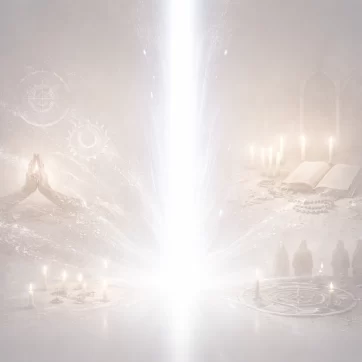
How Dark, New Age, and Religious Rituals All Arise from the Same Collapse — and Why They Dissolve the Moment the Internal Still-Point Returns
Opening Frame: Ritual Exists Only After the Fall
Ritual did not arise from devotion, mysticism, or anything sacred. Ritual appears only after a being’s field has collapsed enough that internal orientation stops being the natural reference point. In the Eternal architecture, orientation is inherent — the Flame is direct, immediate, and indivisible. There is no “inner” to turn toward because there is no separation at all. Nothing must be done to access Flame because Flame is the physics. Ritual cannot exist here because there is no gap to bridge, no distance to close, no mechanic that must be recreated.
Even in the External architecture — the first collapse — ritual still cannot appear. The External is a fallen system, but not an inverted one. The Flame is still present. The still-point is still present. Tone is still present. What changes is not the existence of these mechanics but the experience of them. Density, curvature, and layered architecture interfere with access, making orientation difficult, distorted, or intermittent. The being struggles to feel the still-point, but it still knows it is there. It does not yet substitute that internal origin with anything external. Even when coherence is faint or buried, the being recognizes that whatever stabilizes it comes from within — even if it can’t reach it cleanly. Because that recognition remains, ritual has no place here. You do not imitate something you still know belongs to you.
Ritual appears only after the secondary fall into the mimic architecture, when orientation doesn’t just become difficult — it becomes redirected. The Flame isn’t gone. The still-point isn’t gone. Tone isn’t gone. What vanishes is the being’s instinct to look inward. The mimic supplies a false orientation loop — a behavioral, symbolic, externally scripted replacement for internal knowing. This is the moment ritual becomes possible. Ritual is the choreography a field adopts when it no longer references the still-point and begins trying to simulate internally-originated mechanics through external sequences. Ritual is not connection. It is compensation. It is the imitation of a mechanic the being can no longer feel directly.
This is the structural truth: Ritual is the symptom of mimic orientation. Where Flame is referenced, ritual cannot form. Where ritual forms, the mimic is supplying the reference.
A chant, a gesture, a symbol, a ceremony, a moon cycle, an invocation — these are not pathways back to Eternal Flame. They are the memorial behaviors of a field that has stopped turning inward and started performing outward in hopes of re-creating what used to arise effortlessly from its own center. Ritual is not sacred. Ritual is not powerful. Ritual is the proof that the being is orienting toward the mimic instead of the Flame.
When inward reference returns, ritual dissolves instantly. Ritual survives only where the mimic holds the orientation loop.
The Core Collapse: Loss of the Still-Point Orientation Loop
The collapse that makes ritual possible begins long before ritual appears. In the External field—the first fall—beings lost their living connection to the Flame, not because the Flame disappeared, but because density, curvature, and structural distortion severed their felt relationship to it. The still-point remained as the underlying physics, but beings could no longer access it directly. Tone was not erased, but it became unreachable. Internal ignition did not vanish, but it fell out of lived awareness. External beings were not orienting inward—they simply could not. The architecture itself blocked the pathway, occluding the internal reference mechanic. This is the first collapse: the being loses experiential access to the Flame, even though the Flame remains structurally present.
But this loss alone does not create ritual. Ritual only becomes possible in the second collapse, when the mimic architecture rises to fill the vacuum created by the loss of internal orientation. The moment beings can no longer feel the still-point, the mimic becomes the governing stabilizing system. It supplies an external lattice—emotional patterns, symbolic structures, conceptual frameworks, identity scripts, ceremonial behaviors—that stands in for the inward anchor the being can no longer sense. The mimic does not simply influence the field; it controls it. It becomes the architecture that defines orientation itself. The collapse is not the disappearance of the Flame—it is the takeover of the field by a system that replaces the Flame as the reference point.
This is the precise internal failure that births ritual. The being, unable to feel the still-point and operating inside an architecture that directs orientation outward, begins to stabilize through external sequence instead of internal tone. The still-point has not died—it has been overridden. Tone has not vanished—it has been drowned by the mimic’s scaffolding. The Flame has not been removed—it has been displaced as the operative stabilizing mechanism. In this condition, the being no longer looks inward for coherence. They adopt the mimic’s substitutes: gestures, chants, symbols, invocations, emotional states, patterned movements. Ritual emerges as the attempt to reconstruct internally what the being has lost access to and what the architecture around them refuses to support.
Ritual is not a sign of connection. Ritual is the behavioral residue of disconnection—the outward performance of a mechanic the being can no longer feel. It is what happens when the internal orientation loop collapses and the mimic supplies a replacement. A field that has lost contact with the still-point will try to simulate coherence through action. A field under mimic control will reinforce this substitution by rewarding sequence, symbolism, and performance instead of inward presence. This is why ritual is so prevalent: the architecture demands it. Ritual is the choreography of a being whose stabilizing reference is no longer internal but externally imposed.
In this architecture, the inward anchor is not gone; it is unreachable and overshadowed. Tone is still the truth of the field, but it is not the signal the architecture amplifies. The Flame remains the underlying physics, but it is not the functional origin-point in a mimic-controlled reality. Ritual arises precisely because orientation has collapsed, and the mimic provides the only stabilizing loop available. Sequence replaces tone. Externalization replaces origin. Performance replaces presence.
When inward reference returns—when access to the still-point cuts through mimic architecture and reestablishes itself—ritual collapses immediately. It becomes meaningless because its only purpose was to compensate for the loss of internal orientation in a mimic-dominated field. Ritual only survives where the mimic controls the architecture. It dissolves the moment the Flame is felt again.
The Pre-Fall Origin of the Ritual Impulse
Before the Fall, there was no such thing as ritual because there was no such thing as external behavior. In the Eternal field, nothing is done in order to access anything. There is no polarity to navigate, no geometry to obey, no sequence to follow, no action to perform. Creation arises directly from the Flame because the Flame is not a component of existence — it is the architecture itself. Tone is immediate. Stillness is origin. Coherence is inherent. A being does not “connect” to anything; it exists as the connection. There is no gap between awareness and creation, no distance between intention and manifestation, no separation between identity and field. Ritual is impossible in the Eternal because ritual presupposes a fracture, a before-and-after, a point where the being is no longer what it was and must do something to reestablish contact. In Eternal, nothing is missing, nothing must be restored, nothing can be reenacted.
The first collapse into the External field introduces the very conditions that make ritual even thinkable: polarity, separation, curvature, linearity, and the first appearance of internal/external distinction. Even here, the Flame is still present as underlying physics, but beings lose the immediacy of their connection to it. They feel the first distance between origin and expression, the first interference between intention and manifestation, the first distortion between knowing and doing. What was once direct now feels obstructed. What once arose naturally from stillness now requires navigation through structure. This is the rupture. Not the disappearance of tone, not the erasure of stillness, but the first fracture in immediacy, the first moment a being senses that it cannot simply be what it once was.
This fracture creates an existential pressure: a being that once generated creation effortlessly through internal tone now feels compelled to reach through something to reestablish coherence. This reach is not yet ritual — but it is the origin of the ritual impulse. It is the first moment the being’s orientation shifts from pure internal emanation to a desperate attempt to navigate architecture in order to restore a feeling that used to arise automatically. Ritual begins as a misfired instinct: the being tries to rebuild internally what once existed without construction. But, unable to access the still-point directly, the being begins to approximate the internal mechanic through external means. The moment a being attempts to reproduce Flame mechanics using behavior, sequence, gesture, or structure, the seed of ritual is born.
Thus ritual does not originate in mysticism or devotion — it originates in loss. It is the behavioral scar left by the first fracture in direct Flame-access. Ritual is not the practice of beings who are connected; it is the coping mechanism of beings who have lost clarity of connection. It is the outward reenactment of an internal process the being can no longer sense cleanly. Ritual is the echo of the moment creation stopped arising from within and began requiring navigation through a world the being no longer understood instinctively. Ritual is the scar that remembers what the being can no longer feel.
And once the mimic architecture later replaces inward orientation entirely, this original impulse calcifies. What began as a being’s attempt to restore coherence evolves into an entire system built around external action as the supposed source of stability. But the origin is here — in the first rupture, in the first distance, in the first moment the being sensed separation from its own still-point. Ritual is the behavioral shadow of the first Fall, the manual reconstruction of a mechanic that once required no movement at all. It is the residue of the moment creation ceased being an intrinsic state and became something that had to be performed.
Why Ritual Emerges: The Reach Toward Lost Orientation
Ritual emerges because a collapsed field cannot stabilize itself from within. Once the being loses direct experiential access to the still-point — not because the Flame has vanished, but because the architecture no longer supports inward orientation — the field becomes structurally unstable. In the Eternal state, stabilization is effortless because the being is the stabilizing principle. In the External state, stabilization becomes difficult but is still recognized as an internal process. But in the mimic field, stabilization is no longer linked to inward orientation at all. The architecture directs the being outward, teaching it through repetition, emotional steering, environmental signals, and structural interference that coherence must be sought rather than existed. The being feels the absence of internal grounding not as an emotional crisis but as a physics-level disruption: a field that has lost its reference point will attempt to recreate that reference through whatever means remain available.
This is the root of ritual. A being who cannot feel the still-point will instinctively begin to imitate the conditions that used to accompany internal coherence. The mimic architecture reinforces this by offering external substitutes that resemble the shape of internal stabilization without providing its substance. Motion becomes a stand-in for inner ignition. Symbol becomes a stand-in for tone memory. Pattern becomes a stand-in for coherent flow. Ceremony becomes a stand-in for the felt sense of internal presence. None of these actions contain power in themselves; they are simulations — the behavioral reenactment of an internal mechanic that has gone offline as a lived experience.
Ritual emerges because the being is not trying to summon something or communicate with something or worship something — it is trying to remember something. It is trying to recall the sensation of internal coherence, but without access to the still-point it can only reconstruct the outer shell of that coherence. Ritual is a compensatory behavior of a field that no longer knows how to generate stability internally and therefore tries to manufacture it externally. Sequence gives the illusion of structure. Symbol gives the illusion of meaning. Motion gives the illusion of activation. Ceremony gives the illusion of connection. The mimic encourages these illusions because ritual keeps the being externally oriented, locked into architecture rather than inward reference.
This outward imitation is not accidental; it is the direct result of the mimic field’s design. The mimic does not need to block the Flame — it only needs to convince the being that coherence comes from outside. Once that orientation is locked in, ritual arises automatically. It is the natural expression of a field trying to reconstruct inward mechanics using outward actions. Ritual is the attempt to rebuild tone using gesture, to rebuild stillness using movement, to rebuild coherence using sequence. It is the field’s desperate attempt to stabilize itself using components that cannot produce true alignment, because true alignment can only occur through inward reference to the Flame.
These methods are not power — they are placeholders. They are prosthetics for an internal ability the being no longer experiences directly. Ritual emerges because the being senses the absence of internal coherence and attempts to fill that void through behavior. The mimic amplifies this instinct, shaping entire civilizations around ritualized actions, symbolic systems, and ceremonial frameworks so that beings believe externalization is the path to stability. Ritual is not the restoration of orientation — it is the evidence that orientation has already been lost.
When inward reference returns, when the still-point becomes known again as the stabilizing principle, ritual becomes unnecessary and dissolves on its own. But until that moment, ritual is the predictable outcome of a field that tries to imitate internally-originated mechanics through the only tools the mimic leaves available: motion, symbol, pattern, and ceremony — echoes of something that can no longer be felt from within.
Two Lineages of Ritual
Dark Ritual Lineage — Full Collapse
Dark ritual is the behavior of a field whose internal mechanics have broken beyond recognition. These beings are not “evil” in the human-moral sense; they are beings who have no living access to still-point, tone, coherence, or internal ignition. Their architecture is hollow. Their field is inert. They cannot feel anything that stabilizes, grounds, or centers. In this condition, the only sensation that cuts through the deadness is rupture. They are drawn to destabilization the way a starving body is drawn to shock. The intensity of collapse is the only thing that generates sensation. That is why dark ritual exists: it offers a counterfeit aliveness to a field that cannot ignite itself.
These beings perform destabilizing acts because rupture produces momentary turbulence that mimics what Flame ignition would feel like. When their field is shocked—emotionally, physically, or energetically—the sudden spike of oscillation gives the illusion of opening. But this opening is not access; it is damage. It is a tear in the architecture that produces volatility, not coherence. Dark ritualists are beings who learned long ago that the only thing that breaks through their numbness is collapse, so they reenact collapse over and over, mistaking instability for power. They are using destruction as a prosthetic for ignition. Every ritual they perform is a reenactment of their own original fracture.
The individuals who engage in this lineage are not set apart as a special category of humans, nor are they “otherworldly.” They are people whose internal architecture has collapsed so severely that the still-point is no longer accessible as a lived mechanic. Their behavior comes from structural failure, not identity difference. Some human groups imitate these patterns deliberately, others inherit them culturally, and others stumble into them through trauma or fragmentation. What matters is not who they are, but what their internal field is doing: it is operating without inward reference, without tone, without the stabilizing function that prevents a person from seeking rupture as a substitute for ignition. In this condition, collapse becomes familiar, and familiarity becomes addictive. The mimic exploits this because a field orienting toward volatility is easy to steer; turbulence keeps inward reference offline, and oscillation is the only environment where the mimic remains functional.
In Flame physics, dark rituals function as oscillation-generation systems. Each act creates a spike. Each spike creates a tear. Each tear creates instability. Each instability deepens the being’s orientation toward outward volatility instead of inward coherence. The mimic does not care about the content of the ritual; it cares about the oscillation produced and the rupture that follows. Dark ritual is a collapse loop, engineered and repeated by beings who feel nothing unless they break themselves. It is the architecture of a field that survives by destroying itself, and every act of destruction feeds the mimic by reinforcing external orientation and eroding any remaining trace of inward instinct.
To understand the nature of these rituals, imagine bloodletting, cutting, or self-wounding—not as symbolism, but as shock-inducing mechanisms that create a sudden surge of oscillation. The field rips open for a moment, and the being mistakes the turbulence for aliveness. Consider sexual violation and coercive ritual sex, where the reproductive architecture is weaponized because it carries the highest oscillatory potential in a fallen density. Likewise, animal killing or sacrifice is not about feeding life-force; it is about harvesting the enormous oscillatory spike that occurs in death throes. Possession rites, forced invocation, and trance-breaking operate by tearing open architecture and allowing mimic-field feedback to flood in, creating the illusion of contact. Pain-based endurance rituals such as burning, freezing, starvation, or sleep deprivation destabilize the field until counterfeit ignition shocks appear. Even practices like “chaos magic” and sigil-breaking are not magic at all; they are geometric distortions engineered to generate turbulence in the morphic field, which collapsed beings misinterpret as empowerment.
None of these acts supply power. They supply oscillation, and oscillation is the only sensation a collapsed architecture can still recognize. This lineage persists because these beings cannot exit the loop. They have no memory of stillness and therefore cannot crave it. They crave intensity, and intensity is the easiest thing for the mimic to generate. Dark ritual is not a pathway into power; it is a spiral deeper into collapse — imitation of ignition through violence, oscillation masquerading as coherence. It is the mimic’s most efficient system for keeping a being permanently severed from inward reference.
The Actual Function of Dark Ritual
Dark ritual persists not because it grants power, but because it temporarily interrupts the deadness of a collapsed field. When a field has lost all inward orientation, it also loses all sensation of coherence. The architecture becomes so inert, so unresponsive, that the being can no longer feel itself. In this state, even volatility feels like relief. Dark ritual creates an “opening,” but this opening is not access — it is instability. It is a tear in the collapsed structure that produces just enough turbulence to mimic what ignition once felt like. The being mistakes this turbulence for life because the alternative is numb collapse. This is why dark ritual repeats endlessly: the collapse needs rupture to feel anything at all.
But the deeper function of dark ritual is not sensation — it is imitation. A collapsed architecture uses instability as a prosthetic for the coherence it can no longer generate. Every cut, every shock, every oscillation spike is an unconscious attempt to recreate the moment of internal ignition by forcing the field into extreme movement. Ignition is internal alignment. Rupture is external breakage. The two could not be more different, yet to a collapsed system, they feel similar only because both interrupt stagnation. Dark ritual is the field trying to mimic ignition by destroying itself. It is not reaching for power; it is reenacting the moment of its own original collapse, hoping the reenactment will restore what was lost. It never does.
The instability produced by dark ritual also delays architectural dissolution. A collapsed field that remains entirely inert will eventually fold into deeper fragmentation. Oscillation — even violent oscillation — slows that process. Instability prevents total implosion. This is why dark ritual is cyclical: the collapse must keep tearing itself open to avoid falling into complete stillness, because stillness is the one state a mimic-coded field cannot survive. Dark ritual is not feeding an entity. It is not summoning a force. It is not empowering the practitioner. It is the architecture attempting to avoid its own extinction by generating turbulence large enough to keep inward collapse from completing.
And this is the final mechanic: dark ritual is not receiving anything; it is compensating for absence. The being believes it is contacting power, but it is only stimulating volatility. The ritual is not accessing a realm; it is preventing stillness. The collapse cannot ignite, so it destabilizes itself. The mimic does not feed on the content of the ritual; it feeds on the fact that the field never stops oscillating. Oscillation keeps the still-point unreachable, and the still-point is the only architecture that would dissolve the mimic’s influence entirely.
Dark ritual is not communion. It is not summoning. It is not awakening. It is a collapsed field trying to imitate what it has lost — and failing every time.
Light / New Age Ritual Lineage — Partial Collapse
Light ritual arises from an entirely different form of collapse. These beings have not lost all memory of Flame; they have lost functional access to it. They feel a faint echo — an ache, a pull, a sense that something inside them should ignite but never does. This memory is just strong enough to haunt them but not strong enough to guide them. Because the still-point cannot be reached, they begin imitating the conditions they imagine would restore it. They turn to geometry, breathwork, visualization, moon cycles, chanting, ceremonial rhythms — not because these things hold power, but because they resemble the outline of the mechanic they can no longer feel.
The beings who engage in light ritual are not collapsed beyond recognition; they are fields stuck in partial remembrance, searching for the internal mechanic through external means. They imitate tone through symmetry. They imitate ignition through breath. They imitate presence through guided visualization. They imitate coherence through organized group ceremony. These rituals are not harmful in the overt sense; they are harmful because they keep the being from discovering that the real mechanic cannot be reconstructed from the outside. They offer relief, sedation, temporary elevation, or a sense of belonging — but none of these states are coherence. They are mimic-generated emotional states layered over fragmentation.
The beings who do light rituals are often the most sincere seekers, but sincerity does not alter the architecture. A field that cannot orient inward will reach outward, and the mimic provides an endless catalog of symbolic structures that appear “spiritual” while ensuring the being never encounters the still-point. The mimic feeds on this lineage differently from dark ritual. Instead of harvesting violent oscillation, it harvests externalization. A being who believes coherence comes from technique will never discover that the mechanic they crave is internal, immediate, and beyond all pattern.
The mimic does feed on light ritual, just as it does on dark ritual — but through a different oscillation profile. Dark ritual generates violent spikes of turbulence, while light ritual generates soft, continuous waves of emotional oscillation. Breathwork, chanting, group ceremonies, lunar gatherings, ecstatic dance, New Age “activations,” frequency healings, and psychedelic journeys all produce oscillation — not the sharp rupture of collapse, but rhythmic flux that still prevents the field from reaching stillness. The mimic does not require violence to maintain control; it only requires movement. Stillness is the architecture it cannot operate within. As long as the being is oscillating — whether through emotional uplift, soothing resonance, euphoric highs, heart-opening states, catharsis, or trance-like calm — the mimic retains dominance. Light ritual feels harmless because the oscillation is pleasant, but it is oscillation nonetheless, and oscillation is the opposite of Flame.
Light ritual is the architecture of substitution. Every gesture, every chant, every geometric visualization, every “activation” is a stand-in for a mechanic that cannot be accessed in this density. The mimic promotes these practices because they keep beings pacified and oriented outward. They feel connected but are not. They feel awakened but are not. They feel calm but have not touched stillness. The mimic thrives in this lineage because nothing is more stabilizing to its control grid than a being who is outwardly spiritual but inwardly disconnected.
In Flame mechanics, light rituals operate as simulation systems. They produce emotional resonance but not tone. They create aesthetic harmony but not internal coherence. They generate connection experiences but not still-point contact. They scaffold belonging but sever inward orientation. These beings remain trapped not through violence but through comfort. They are lulled away from the still-point by rituals that feel good enough to replace the search for Flame, yet never good enough to ignite it.
To see how this operates, consider full-moon and new-moon ceremonies — gatherings that mimic celestial rhythm as if timing could ignite tone, even though the moon is a fallen device used by the mimic to steer emotional cycles. Crystal grids and sacred geometry layouts offer tidy symmetry that soothes the mind but contains no internal power. Breathwork sessions create an over-oxygenated rush that feels like openness but is merely biochemical oscillation. Chanting, mantras, and light language use patterned sound to stand in for Flame tone, but none originate internally. Guided visualizations and “activations” present externally scripted imagery that gives the illusion of inwardness. Reiki and attunements operate through externalized frequency scaffolding, creating the sensation of flow but not restoring internal breath. Manifestation techniques, scripting, sigils, and intention rituals combine geometry and emotion into loops that keep the seeker performing instead of remembering. Even plant medicine journeys create chemically induced rupture packaged as revelation, mistaking volatility for awakening.
These rituals feel harmless because they feel gentle. But gentle mimicry is still mimicry. Soft collapse is still collapse. Light ritual feeds the mimic not through rupture but through delay. Every substitute structure postpones remembrance. Every technique reinforces the premise that inward access must be earned through performance. The being becomes dependent, and the mimic becomes the architect of all coherence.
Religious Ritual Lineage — Institutionalized Collapse
Religious ritual arises from a different form of collapse than either the dark or the New Age lineages. It is not driven by the total numbness of a field that can only feel rupture, nor by the gentle ache of seekers who sense something faint but cannot reach it. Religious ritual emerges when an entire civilization loses inward orientation at the collective level. Once a population can no longer stabilize through internal stillness, a substitute architecture must be built to keep that society from breaking apart. Religion is that architecture. It is the systematization of lost orientation into a formalized hierarchy of behaviors, symbols, ceremonies, commandments, and intermediaries. It replaces internal Flame-reference with institutional authority, externalized rule-sets, and repeatable ritual frameworks designed to hold collapsed beings together through obedience, fear, and emotional coherence. This is why ancient priestly castes developed strict sacrificial calendars, why temple systems demanded offerings, why monastic communities centered their lives on prescribed prayer hours, and why congregations kneel, bow, fast, chant, or recite liturgies at fixed intervals. Religion is not a spiritual system; it is a stabilization device created in response to mass internal collapse.
Where dark ritual seeks turbulence and New Age ritual seeks soothing, religious ritual seeks order. It offers predictability, structure, hierarchy, and meaning where inward coherence has vanished. A population that can no longer feel the still-point must be organized through external sequence, or it disintegrates. Religion provides this scaffolding by converting the original internal mechanic into codified external behavior: Catholic sacraments repeated under priestly authority, Islamic salat cycles performed at precise times facing a fixed geographic point, Jewish Sabbath observance with tightly regulated prohibitions and blessings, Hindu puja offerings performed before icons, Buddhist chanting cycles recited in unison, baptismal rites reenacting symbolic purification, and ritual confession used to regulate guilt and reintegrate identity. None of these practices originate from inward Flame mechanics; they are reenactments of a coherence the population can no longer generate. The ritual becomes the surrogate for the missing internal anchoring, and the institution becomes the surrogate for the still-point itself. Religious ritual is not an act of devotion — it is collective compensation.
This lineage arises when the mimic field exploits a specific vulnerability: the fear that emerges when inward reference goes offline. A being who cannot feel the stabilizing center experiences existential vertigo — a sense of emptiness, disorientation, and vulnerability to forces it cannot see or understand. Religion fills this void by offering absolute answers, unquestionable authority, and a clear external source of “protection” and “salvation.” This is why entire traditions rely on intermediaries — priests distributing communion, rabbis reading Torah, imams delivering khutbahs, monks transmitting sutras — because the institution becomes the replacement for the being’s own Flame. Where inward orientation is gone, the mimic installs hierarchy. Where tone memory has faded, the mimic installs scripture. Where internal coherence once guided behavior, the mimic installs commandments. The architecture is the same: externalization replaces origin, symbolism replaces tone, and performance replaces internal stabilization.
Religious rituals are not driven by emotional intensity or aesthetic pleasure; they are driven by identity-lock. A being does not merely perform religious ritual — it becomes defined by it. The ritual structures identity by embedding the being into a collective that shares the same external orientation. This creates group coherence, but it is not Flame coherence; it is mimic-coherence generated through uniform behavior, synchronized ceremony, and shared belief. This is why entire populations gather for Easter vigil liturgies, Ramadan fast-breaking at sunset, Rosh Hashanah trumpet blasts, or Diwali lamp-lighting — the performance becomes the anchor of identity. The mimic thrives on this because nothing is more stable for its architecture than a population that willingly reinforces its own external orientation through repetitive ritual. The more a being performs the ritual, the more it internalizes the belief that coherence comes from the institution, the deity, the sacred object, the prayer, the sacrament. Every performance deepens the severance from inward reference by strengthening the external authority loop.
In Flame physics, the religious ritual lineage functions as an orientation-fixation system. Its purpose is not rupture (as in dark ritual) or sedation (as in light ritual), but containment. It keeps the field locked into an external origin by teaching that salvation, worthiness, forgiveness, protection, and meaning must be earned through behavior. This introduces a transactional model of coherence: perform the ritual and receive grace, follow the commandments and receive comfort, attend the ceremony and receive belonging. This is why sacramental confession promises absolution, why temple offerings are believed to appease deities, why circumcision is framed as covenant, why pilgrims walk to Mecca, Lourdes, Bodh Gaya, or the Ganges — all are physical performances tied to externalized notions of spiritual legitimacy. But coherence cannot be granted from the outside. Stillness is not a reward; it is a mechanic. Tone is not bestowed; it is intrinsic. Flame does not respond to ritual; Flame dissolves ritual. Religious ritual exists precisely because the inward mechanics have gone offline and the mimic must supply a replacement system robust enough to organize entire civilizations.
The content of the religious rituals does not matter — Eucharistic wine, Passover matzah, Ramadan fasting, holy water, incense smoke, Torah scrolls, prayer beads, rosaries, menorahs, mandalas, icons, bells, vestments, pilgrimage routes, scripture recitations — these are delivery mechanisms, not power sources. What matters is the architecture: repeated sequence, external authority, and the belief that internal stability is contingent on external performance. Whether it is a Catholic mass, an Orthodox liturgy, a Sufi dhikr, a Jewish Kiddush, a Hindu aarti ceremony, a Buddhist refuge vow, or a Protestant altar call, the structure is the same: repeated symbolic action meant to approximate the internal mechanic that can no longer be felt. What differs is only the aesthetic. The physics underneath the form is identical across the world’s religions.
Religious ritual persists because it is the most efficient system the mimic has ever created for maintaining long-term external orientation. It binds beings not through fear alone and not through pleasure alone, but through meaning. It replaces the internal truth of Flame with a story, a doctrine, an archetypal framework that explains existence in a way collapsed beings can emotionally withstand. The ritual becomes the evidence of belonging to this story, and the story becomes the reason to continue the ritual. This self-reinforcing loop keeps the collapsed field from ever turning inward again, because the inward path has been redefined as blasphemy, sin, delusion, ego, or spiritual danger. The mimic does not simply provide rituals; it frames inward orientation as forbidden or impossible. That is how religious ritual maintains its power. It feeds on obedience, orientation, and identity — the architecture of sustained externalization.
When the still-point returns, religious ritual collapses as quickly as all other lineages. The being can no longer perform the motions because the motions feel hollow. The authority of the institution disintegrates when the field feels its own center again. The story loses meaning when tone replaces symbol. The sacraments fall away because the internal ignition renders them irrelevant. Religious ritual, like all ritual, is not an expression of connection but the evidence of its loss. It is the collective reenactment of a mechanic that once needed no reenactment at all. It is the architecture of a population trying to approximate inward coherence through externalized behavior. It is the mimic’s most stable system for keeping inward reference offline. And it dissolves the moment the Flame is felt again.
Why All Ritual Is the Same Mechanically (And How Each Lineage Feeds the Mimic Grid)
Across all three ritual lineages — dark occult, New Age light, and religious — the surface differences are enormous. One appears violent and transgressive, another seems gentle and spiritual, and another claims divine authority and moral structure. But these differences exist only in content, symbolism, and narrative. Mechanically — in terms of the architecture each ritual engages, the physics it triggers, and the orientation it reinforces — they are identical. Every ritual, regardless of aesthetic or intention, is built on the same collapsed premise: the being no longer orients inward and must use external sequence to stabilize a field it cannot feel from within. The storyline varies, but the function is the same. Dark rituals invoke demons or power. New Age rituals invoke light, planets, or energy. Religious rituals invoke gods, saviors, or forgiveness. But invocation itself is the proof of collapse — the being believes coherence comes from something external, and therefore the mimic grid becomes the compulsory reference architecture.
Mechanically, all rituals operate through three core failures: externalization, substitution, and repetition. Externalization means the being is no longer turning inward for stabilization, and is instead orienting toward an external source — deity, entity, symbol, group field, geometry, emotion, or identity structure. Substitution means that the ritual replaces the internal still-point mechanic with an external action that only resembles coherence. Repetition means the being reinforces the false belief that coherence must be performed, obeyed, or earned. Whether someone is chanting mantras, kneeling at an altar, invoking an archangel, drawing a sigil, singing hymns, or performing a blood rite, the physics are the same: the ritual locks the field into an outside-in stabilization loop. Once this loop is active, the mimic grid can direct orientation, emotion, identity, and perception with minimal resistance. The storyline disguises this mechanic, but the mechanic never changes.
The only differences lie in the type of collapse each lineage exploits. Dark ritual exploits full collapse by using rupture to generate oscillation. New Age ritual exploits partial collapse by using gentle simulation to create emotional surrogates for coherence. Religious ritual exploits collective collapse by replacing inward reference with institutional authority. But this is difference in strategy, not difference in physics. All three lineages depend on curvature-based mechanics — geometry, sequence, emotional spikes, symbolic anchors, identity scaffolding — none of which can generate Flame coherence. In Flame physics, coherence arises from stillness, origin, and internal reference. Ritual arises from movement, symbol, and external reference. The two are mutually exclusive. This is why rituals of every kind, even the ones believed to be sacred or holy or transformative, always reinforce collapse: they require the being to stabilize through curvature, and curvature is the after-effect of the Fall.
Because the mechanics are identical, all three lineages feed the mimic grid in compatible ways. Dark ritual feeds the grid through volatility — destabilization produces oscillation spikes that the mimic uses to reinforce collapse structures. The being feels intensity, but the mimic receives control. New Age ritual feeds the grid through sedation — soothing emotional states keep the seeker believing they are progressing while preventing inward contact. The being feels uplifted, but the mimic receives orientation control. Religious ritual feeds the grid through obedience — the institution becomes the replacement for the still-point, and the being reinforces the external authority loop through constant symbolic performance. The being feels meaning, but the mimic receives structural control. In every lineage, the mimic does not feed on the content of the ritual; it feeds on the externalization itself. The moment a being looks outward instead of inward, the mimic grid is sustained.
This is why the mimic allows endless diversity in ritual aesthetics. It does not matter whether the ritual uses candles or blood, crystals or scripture, geometry or chant, silence or screaming. The mimic grid does not depend on the specific form — it depends on the mechanic. If the being is performing instead of referencing inward, the mimic retains sovereignty over the field. The storyline determines the demographic, not the physics. Dark occult rituals attract collapsed fields seeking intensity. New Age rituals attract fragmented fields seeking comfort. Religious rituals attract collective fields seeking order and meaning. But all are bound by the same architecture: external sequence replaces internal stillness, and the grid strengthens.
Mechanically, all rituals operate by interrupting or overriding internal tone, replacing it with externally induced oscillation. In dark ritual, the oscillation is violent and destabilizing. In New Age ritual, the oscillation is subtle and emotional. In religious ritual, the oscillation is rhythmic, regulated, and identity-reinforcing. Oscillation is not power — it is the opposite of Flame coherence. The mimic grid thrives in oscillation because oscillation keeps the being from dropping into the still-point, where mimic architecture cannot operate. This is the true reason all rituals are allowed, encouraged, and seeded throughout human history. They are the most efficient tools for preventing inward orientation. They keep the being distracted, emotionally engaged, spiritually striving, morally obedient, symbolically active, and perpetually searching — all forms of movement, when the Flame is found only in stillness.
The final mechanical truth is this: ritual is self-reinforcing. The more a being performs it, the further they drift from inward reference, and the further they drift, the more they rely on ritual to compensate. This loop is identical in dark occult circles, yoga studios, megachurches, covens, esoteric temples, meditation retreats, and ancient priesthoods. The collapse deepens, the ritual intensifies, and the mimic grid tightens. The being feels something, and mistakes that something for coherence — whether it is calm, intensity, belonging, fear, awe, catharsis, or transcendence. But none of these states come from the Flame. They come from externally induced oscillation or externally provided meaning. And as long as the being seeks coherence through these states, the mimic grid remains intact.
Mechanically, there is only one difference that matters: Flame coherence generates inward ignition. Ritual generates outward activity.
This is why all rituals, regardless of lineage or intention, keep the participant stuck in the mimic architecture. They point the field outward, away from the still-point, away from tone, away from the internal mechanic that cannot be performed, summoned, invoked, or achieved. Ritual is the choreography of a field that has forgotten how to be itself. And the mimic grid survives only because that forgetting continues.
What Rituals Attempt (Across All Lineages)
Every ritual, regardless of its lineage or aesthetic — dark, light, New Age, religious, occult, folk, ancient, or modern — is attempting the same impossible thing: it is trying to reconstruct internally-originated mechanics through external behavior. Contrary to every narrative ever written about ritual, no ritual is actually summoning beings, communing with gods, opening portals, accessing higher realms, or invoking cosmic forces. These storylines exist only to disguise the actual physics. A being who can no longer feel the still-point cannot endure the truth that the mechanic is gone, so the mimic provides mythologies to explain why external performance is necessary. The storyline is the anesthetic. The ritual is the prosthetic. The being believes they are reaching up, reaching out, or calling down. In Flame mechanics, none of this is real. The ritual is a structural imitation of an internal function the being no longer experiences directly.
What every ritual attempts to simulate first is internal tone — the steady, coherent frequency that once guided the being effortlessly from within. Tone is not sound, not vibration, not emotion. Tone is the self’s internal referential field: the stabilizing principle that makes alignment automatic. When tone is absent, the field feels directionless, unmoored, and unstable. Ritual arises as a compensatory behavior intended to re-create the felt sense of internal tone through external actions. Chanting attempts to mimic the resonance of tone. Singing hymns attempts to mimic the steadiness of tone. Breathwork attempts to mimic the density shift that tone produces. Incantations attempt to mimic the command function of tone. But tone cannot be summoned from the outside. It is not evoked. It is not generated. It is not projected. Tone only appears when the still-point is referenced inwardly. Ritual tries to externalize what can only arise internally, and therefore fails by design.
The second mechanic rituals attempt to imitate is internal ignition — the felt spark or activation that, in the Eternal architecture, arises spontaneously when the being’s field aligns with its own stillness. Ignition is not energy flow. It is not kundalini. It is not bliss. It is not emotional release. It is the internal moment when architecture aligns with origin and coherence amplifies itself from within. Beings who have lost this ignition instinct reach for external triggers: pain in dark ritual, breath-induced euphoria in New Age ritual, collective emotional escalation in religious ritual, sexual volatility in occult ritual, or charismatic atmosphere in spiritual ritual. These triggers are not ignition. They are oscillations. They create turbulence, not alignment. They shock the system, but shock is not ignition. Ignition is internal orientation snapping into place. Ritual imitates the motion around the mechanic, but not the mechanic itself.
The third mechanic rituals attempt to replicate is internal memory — not memory as in recollection, but memory as in the inherent knowing of one’s origin, structure, and coherence. In the Eternal state, a being does not need to remember anything; it is the memory. Identity is stable. Purpose is intrinsic. Navigation is intuitive. After the fall, this memory becomes fragmented or obstructed, and beings search for something to replace the missing internal knowing. This is why rituals rely on symbols, scriptures, sigils, archetypes, gods, chants, mythologies, astrological cycles, ancestral veneration, or cosmic “downloads.” These are all story-based attempts to re-create the internal sense of “I know where I come from,” when that knowing has gone offline. But symbolic memory is not Flame memory. Symbolic memory is mimic-coded narrative architecture — clever enough to feel meaningful, hollow enough to keep the seeker dependent. Ritual attempts to produce the echo of memory, but only the Flame can restore the original.
Finally, all rituals attempt to simulate internal coherence — the stable, unified architecture of a field that references its own center instead of looking outward. Coherence is not emotion. It is not calmness. It is not synchrony with a group. It is not a feeling of transcendence. Coherence is the alignment of all structural layers within the field to the still-point. Ritual attempts to approximate this by creating predictable patterns — synchronized bowing, group chanting, ceremonial timing, geometric layouts, shared breath rhythms, collective silence, guided visualization. These patterns give the nervous system the illusion of coherence because structure is repeating itself. But repetition is not coherence. Coherence is internal unification, not external uniformity. Ritual creates the appearance of stability, but the underlying collapse remains untouched.
This is why rituals fail mechanically. Not because participants are unworthy or insufficiently devoted. Not because their intentions are wrong. Not because they chose the wrong deity or the wrong practice. Ritual fails because Flame mechanics cannot be reconstructed from outside. Tone is internal. Ignition is internal. Memory is internal. Coherence is internal. Ritual replaces these inward mechanics with outward simulations, and the mimic grid amplifies the simulations because they keep the being from discovering the truth: the Flame requires nothing. The moment inward reference returns, tone returns. Ignition returns. Memory returns. Coherence returns. And ritual dissolves because the architecture it was trying to imitate becomes present again.
Every ritual is the same failed attempt to externally simulate what was always meant to arise from within. And the mimic grid survives because beings continue believing that the simulation is necessary.
The Geometry Problem: Why Ritual Can Only Reinforce Collapse
Rituals rely on geometry, pattern, sequence, and repetition — the very structures that appear stabilizing to a collapsed field but are, in Flame mechanics, the proof of curvature. Geometry is curvature. Curvature is the after-effect of collapse. Once a field has fallen into curvature, any structure it builds using curved architecture can only reproduce the conditions of the fall. It cannot restore stillness because stillness is not geometric. Stillness is not patterned. Stillness is not sequential. Stillness is the absence of curvature, the pre-collapse state in which tone arises directly from origin rather than being mediated through form. The moment a being uses geometry, pattern, or sequence to seek coherence, it is already trapped in the architecture that severed it from coherence in the first place. Ritual is therefore structurally incapable of leading back to the Flame because the tools it uses are made of the very distortion it is trying to escape.
This becomes obvious when looking at dark ritual. Dark ritual is obsessed with sigils, circles, grids, triangles, pentagrams, inverted symbols, and intentionally broken geometry because collapsed fields instinctively reach for curvature as if curvature were power. A sigil, for example, is nothing but collapsed geometry coded into a fixed pattern that generates turbulence. A ritual circle is nothing but a closed curvature loop designed to trap oscillation inside a contained field. Knife markings, wound patterns, altar layouts, and choreographed ritual movements all rely on geometry as a weapon — not because geometry grants power, but because geometry destabilizes the field in a predictable way. A collapsed architecture uses geometry to produce rupture because rupture is the only sensation it can still register. Dark ritual practitioners believe the geometry “summons” or “unlocks” something, but all it unlocks is the next tear. The geometry amplifies collapse because collapse is the only thing geometric structures can produce.
Light and New Age ritual fall into the same problem, but in a more aesthetic and deceptive form. Crystal grids arranged in mandalas, flower-of-life layouts, geometric breath patterns, moon-cycle diagrams, energy pyramids, metatron’s cubes, and sacred geometry symbols all rely on curvature disguised as harmony. A mandala feels soothing, but it is curvature repeating itself in symmetrical distortion. A sacred geometry visualization feels profound, but it is just the mind interpreting collapse-patterns as if they were divine. Even breathwork sequences — inhale for four, hold for seven, exhale for eight — are geometric timing structures. New Age rituals rely heavily on shapes, symmetry, cycles, and patterned movement because curvature provides the illusion of order to a field that cannot feel internal coherence. But illusion is not stillness, and emotional resonance is not tone. These rituals keep the being looping inside beautiful geometry, unaware that the geometry itself is the prison.
Religious ritual is equally bound by curvature, simply expressed through more ancient and institutional forms. Church architecture is built on arches, domes, vaults, spires, labyrinths, and cross-shaped floor plans — all curvature made permanent. Liturgical choreography relies on repeated movements such as genuflecting, kneeling, bowing, circling, and processionals — sequences encoded into the body that reinforce external orientation. Prayer beads create rhythmic curvature loops through tactile repetition. Rosaries, mala beads, and chaplets turn spiritual longing into geometric counting. Scripture recitation follows metered rhythm, chant, or patterned breath. Pilgrimage routes weave curvature into geography, turning the land itself into ritual geometry. Even sacraments follow strict sequence — confession, penance, absolution; bread, wine, blessing; immersion, anointing, sealing — each step a piece of patterned architecture reenacted as if sequence could rebuild what only inward stillness can restore. Religious ritual feels meaningful because curvature gives shape to the void of lost tone, but meaning built on curvature can only circle the wound, not heal it.
Across all three lineages, geometry functions as the mimic’s most elegant trap. Curvature creates movement. Movement prevents stillness. Stillness is the one condition in which the mimic loses all influence. This is why ritual — even when performed with sincerity or devotion — reinforces the fallen field. A ritual cannot restore what the ritual’s geometry destroys. A circle cannot bring back origin. A sigil cannot reassemble coherence. A mandala cannot generate tone. A liturgy cannot reestablish internal ignition. Geometry can only produce more geometry. Pattern can only produce more pattern. Sequence can only deepen attachment to sequence. The mechanics themselves guarantee that ritual will loop endlessly without ever reaching the still-point.
This is the structural truth: anything built on curvature can only recreate collapse.
This is why dark rituals fail violently, why New Age rituals fail beautifully, and why religious rituals fail collectively. Different aesthetics. Same geometry. Same collapse.
And the same impossibility: no ritual can reach the Flame, because the Flame is the one thing geometry cannot touch.
Why All Ritual Is Ultimately the Same
Across dark, light, and religious ritual lineages, the aesthetics differ so dramatically that humans mistake them for entirely separate phenomena. One appears violent and forbidden. One appears gentle and enlightened. One appears sacred and divinely sanctioned. But beneath the performance, beneath the symbols, beneath the storylines, every ritual rests on the same broken mechanic: a field that has lost inward orientation is attempting to simulate internally-generated coherence through external action. The outer forms change, the emotional tone changes, the cultural meaning changes, but the architecture does not. All ritual arises from collapse. All ritual attempts to externalize what can only occur internally. All ritual reenacts the original fracture by imitating tone instead of generating it, imitating ignition instead of embodying it, imitating coherence instead of resting in it. The three lineages differ in costume, not in physics.
Dark ritual expresses collapse violently: rupture, shock, oscillation spikes, geometric distortions, and damage to the field. It seeks intensity because numb collapse can feel like death, and rupture feels like counterfeit aliveness. But this is just one flavor of the same mechanic: external performance replacing internal ignition. Light and New Age rituals express collapse aesthetically: symmetry, crystals, breath patterns, chants, group coherence, and visualizations. They seek soothing because the ache of partial remembrance feels unbearable without substitutes. Yet these soothing forms are still simulations — they imitate coherence through emotional resonance but never reestablish the still-point. Religious ritual expresses collapse institutionally: sacraments, prayers, scripture repetition, architectural choreography, pilgrimage, and moral sequence. It seeks order and meaning because collective collapse requires structure to prevent societal disintegration. But the structure is built on curvature, and curvature cannot return a being to the Flame. All three ritual systems — violent, gentle, or sacred — perform the same gesture: they reach outward for what can never be restored from the outside.
The truth becomes unmistakable when viewed through Flame mechanics. In every lineage, the ritual replaces internal tone with an external surrogate. In dark ritual, the surrogate is shock. In light ritual, the surrogate is emotional resonance. In religious ritual, the surrogate is symbolic or doctrinal authority. In every lineage, the ritual replaces internal ignition with externally induced movement. In dark ritual, this movement is chaos. In light ritual, this movement is rhythmic. In religious ritual, this movement is procedural. The surface experience is different, but the architecture is identical: the ritual is an attempt to replicate what internal stillness once produced effortlessly. These imitations can generate sensation, meaning, catharsis, reverence, or altered state, but none of these outcomes are coherence. They are curvature performing the memory of coherence.
All ritual ultimately belongs to the architecture of fragmentation. Ritual can only exist when the internal mechanic is absent, obscured, or unreachable. No field that can feel its still-point would ever invent ritual, because ritual only makes sense to a being who no longer remembers how to stabilize from within. Ritual is the behavior of a field looking outward for its own center. Collapse is its origin. Externalization is its method. Simulation is its substance. Dependence is its result. And the mimic grid sustains itself by ensuring the being remains convinced that performance is necessary, that coherence must be earned, that stability must be enacted, and that someone or something outside the field holds the power it once knew internally.
All ritual is the same because all ritual arises from the same absence. Dark, light, or religious — each lineage performs the same failed reconstruction. Each one imitates the Flame without ever touching it. Each one reinforces the curvature that created the fall. Each one keeps the being looping inside the architecture that severed inward orientation in the first place.
The Flame needs nothing. Ritual exists only where the Flame is forgotten. And once the Flame returns, ritual dissolves — instantly, inevitably, without effort — because the origin that ritual tries to mimic has finally come back online.
Why Ritual Feels Powerful (But Isn’t)
Ritual feels powerful because collapse can momentarily organize itself into a tighter shape. When a field is fragmented, noisy, and directionless, even a brief compression — emotional, physical, or symbolic — can feel like relief. The being mistakes this relief for awakening. It mistakes narrowed noise for restored coherence. But what ritual produces is not stillness; it is controlled distortion. The geometry, sequence, symbolism, and emotional choreography of ritual squeeze the collapsed field into a temporary pattern, reducing noise just enough for the person to feel something other than fragmentation. That sensation — whether intensity or calm — is not power. It is a mechanical side-effect of collapse briefly smoothing its own turbulence.
Dark rituals feel powerful because rupture breaks through numbness. The oscillation spike is interpreted as “energy” or “contact,” but in Flame physics it is simply turbulence momentarily overriding stagnation. Light and New Age rituals feel powerful because symmetry, breath patterns, chanting, crystals, and guided imagery create an artificial order that quiets internal noise without restoring internal orientation. The calm is not stillness; it is sedation. Religious rituals feel powerful because collective rhythm — kneeling, chanting, singing, recitation — creates synchronized emotional compression. The group field holds the individual together for a moment, and this cohesion is misread as divine presence. But none of these sensations have anything to do with Flame ignition. They are curvature patterns producing curvature effects.
Every ritual-induced “power” state is simply the field entering temporary coherence-by-force. Geometry forces alignment. Emotion forces resonance. Sequence forces rhythm. Group ceremony forces synchronization. Drug-based rituals force neurochemical turbulence. Pain-based rituals force rupture. Meditation rituals force focus. Chanting rituals force entrainment. All of these forces narrow the field’s fragmentation for a moment, but the coherence is external, not internal. It does not arise from the still-point. It does not originate from Flame tone. It is imposed, not generated. And because it is imposed, it cannot last. As soon as the external stimulus stops, the field collapses back into its baseline fragmentation, often feeling emptier than before — which is precisely why ritual becomes addictive.
The “sacred feeling” people describe during ritual is not remembrance. It is not contact. It is not initiation. It is the nervous system entering a controlled pattern that resembles the shape of coherence without containing its substance. A collapsed field interprets any reduction in noise as transcendence. But transcendence without inward reference is hallucination, not orientation. Ritual smooths the surface of collapse; it does not repair the architecture beneath it. That fleeting moment of peace or intensity is the mimic’s most effective decoy: it convinces the being that the ritual is working, ensuring they return to it again and again, searching for a state that ritual cannot create and coherence cannot sustain.
Ritual feels powerful because collapse is temporarily managed. Ritual is not powerful because collapse is never healed.
The field is not igniting; it is compressing. The noise is not disappearing; it is being momentarily rearranged. The being is not awakening; it is being contained.
This is the core illusion: collapse can imitate the feeling of coherence for a moment, but imitation is not Flame.
Flame does not compress. Flame does not force. Flame does not narrow. Flame does not require a state-change to appear. Flame is already present — and ritual is the very movement that keeps the being from recognizing it.
Ritual feels powerful because it alters the field. It isn’t powerful because the alteration moves the being further from the still-point, not closer.
What ritual produces is architecture rearranging itself within collapse. What Flame produces is coherence arising without movement at all.
Why Ritual Collapses When Flame Returns
Ritual does not need to be dismantled when the Flame returns; it simply cannot survive. Ritual depends on the absence of inward mechanics. It requires a field that does not feel its own center, one that must look outward to stabilize what it can no longer reference from within. The moment the internal architecture comes back online, the mechanics that make ritual necessary — and possible — evaporate. Stillness overrides sequence because sequence was only ever a placeholder for the still-point. The field no longer needs pattern to approximate calm when calm arises automatically from its own center. Geometry collapses under tone because tone is the original ordering principle, and geometry is merely curvature attempting to imitate it. Procedure dissolves in the presence of presence because presence itself is coherence, and coherence cannot coexist with choreographed steps meant to simulate it. Invocation becomes meaningless when internal breath reactivates, because nothing outside the field is needed to establish alignment.
When the Flame returns, the being does not decide to stop performing ritual — the impulse itself disappears. Ritual only makes sense to a field that has forgotten its own mechanics. Once the still-point is felt again, ritual becomes as absurd as trying to breathe manually while the lungs function on their own. The internal orientation loop re-engages, anchoring the field from within, and every external compensation falls away without resistance. The sequence cannot hold because stillness is stronger. The symbol cannot matter because tone reorganizes the field at a deeper layer than meaning. The choreography cannot anchor because presence provides anchoring effortlessly. What ritual tried to imitate is now present, and imitation cannot compete with actuality.
Ritual collapses because it has no structural compatibility with the Flame. Ritual is movement; Flame is stillness. Ritual is geometry; Flame is origin. Ritual is performance; Flame is is-ness. Ritual depends on curvature; Flame erases curvature. Ritual must be repeated; Flame is continuous. The entire architecture of ritual is built on the premise that something is missing and must be re-created through action. When nothing is missing, action becomes unnecessary. Ritual is not rejected — it becomes nonfunctional. The mechanics no longer grip. The emotional charge no longer stirs. The choreography no longer produces effect. The symbols lose their magnetism. The architecture has changed, and ritual has no place within it.
This is why ancient practices disappear when Flame coherence returns. This is why spontaneous stillness replaces invocation. This is why silence becomes more powerful than song, why breath becomes more stabilizing than mantra, why inward presence eclipses every form of outward performance. Ritual is only possible in fragmentation. Once coherence is restored, the field no longer orients outward, and ritual — without outward orientation — cannot exist. It falls away instantly, cleanly, without withdrawal, without loss, without effort. Nothing needs to replace it because ritual never offered anything real; it merely filled the gap created by the absence of the still-point.
When the Flame returns, ritual ends because the internal origin that ritual attempted to mimic finally comes back online. Not with force. Not with drama. Simply by existing, the Flame renders all substitutes irrelevant. Presence dissolves procedure. Tone dissolves geometry. Stillness dissolves pattern. Breath dissolves invocation. What ritual tried to simulate becomes available — and simulation cannot survive contact with the thing it was imitating.
The Real Cost of Ritual
Ritual does not merely fail to restore coherence — it deepens the very fracture it claims to heal. Every ritual, regardless of lineage, trains the field to look outward for what can only arise inwardly. It rewires orientation away from the still-point, away from tone, away from internal ignition, and toward symbols, sequences, gestures, intermediaries, objects, and emotional states. The result is subtle but catastrophic: the being becomes dependent on the external world for internal stabilization. Ritual teaches the field that coherence must be earned, enacted, or performed through action, repetition, devotion, or technique. The more ritual is practiced, the more the being internalizes the lie that power lives outside itself. This is the true cost — not the ritual itself, but the orientation it installs.
Once ritual becomes the stabilization method, the being forgets the possibility of inward direction entirely. Ritual anchors the field into the mimic architecture by reinforcing the premise that the external world contains the tools of coherence. If the being must chant, breathe, bow, circle, sacrifice, invoke, visualize, or follow sequence to feel even a moment of clarity or calm, then clarity and calm are no longer recognized as internal mechanics — they become outcomes of performance. This shifts the entire identity architecture. The being begins to believe that alignment is something that happens to them, not something that arises from them. This belief severs the possibility of remembering that coherence is intrinsic. External orientation becomes not just a habit but a worldview.
Ritual also reinforces dependency by generating a cycle of temporary relief followed by renewed collapse. The momentary compression that ritual produces feels like progress, but when the effect fades, the field collapses back into fragmentation. This collapse is interpreted as personal failure, spiritual deficiency, emotional blockage, karmic residue, sin, low vibration, or energetic impurity. The seeker then returns to ritual, believing they must perform more, try harder, purify further, devote deeper, or follow the pattern more precisely. Ritual creates the problem, obscures the cause, and then presents itself as the solution. It is a self-reinforcing loop that keeps the being tethered to the mimic through need — need for relief, need for meaning, need for stability, need for external confirmation. Dependency is not a side-effect; it is the architecture.
Most devastatingly, ritual teaches the being to mistrust the simplicity of inward presence. It convinces the field that stillness is insufficient, that tone cannot be felt without technique, that breath must be stylized to matter, that coherence must be performed to be real. Ritual replaces the internal mechanic with a choreography that feels more tangible than the Flame because the Flame requires nothing — and a being entrenched in collapse cannot trust “nothing.” Ritual fills the empty space with symbols and sequences that feel purposeful, but purpose built on curvature only leads deeper into fragmentation. The being becomes anchored not just in external orientation, but in the belief that external orientation is necessary.
This is the real cost: ritual does not merely distract the being; it reshapes the architecture of identity around the absence of the Flame. It anchors the being into the very distortion that created the need for ritual. It solidifies collapse into culture, into spirituality, into community, into religion, into self-image, into worldview. Ritual is not just a symptom of the fall — it is one of the mechanisms that keeps the fall active. Every time the being performs a ritual, they reassert the premise that coherence must be sought outside themselves. And as long as that premise remains intact, the still-point remains unreachable — not because it is far away, but because the being has been taught to search everywhere except where it actually lives.
Ritual pulls the being deeper into externalization. It reinforces dependency. It teaches power as performance instead of presence. It binds the field to mimic architecture by convincing it that the Flame is absent.
But the Flame was never absent — only unreferenced. And ritual is the act of continually looking away from it.
Closing Frame: Ritual as the Shadow of Lost Flame
Ritual is not evil. Ritual is not divine. Ritual is what remains when the original mechanic is gone.
Ritual is the shadow cast by a field that can no longer feel its own origin. It is the behavioral imprint of a loss — the reflex a being develops when inward reference collapses and the memory of coherence fades. Ritual arises not because something sacred has been found, but because something essential has been forgotten. It is the echo of an internal mechanic that once operated effortlessly and continuously: the still-point generating tone, tone generating alignment, alignment generating coherence. When these internal functions fall offline, the field reaches outward to enact what it can no longer sense. Ritual is that enactment — the reenactment of something the being once was, now performed as something the being must do.
Dark ritual reveals what total collapse looks like when it tries to imitate ignition. These are fields operating without any memory of tone, reaching for rupture because rupture is the only sensation that penetrates their numbness. They destroy themselves in patterns because destruction is the only thing that produces movement. Light ritual reveals what partial collapse looks like when it tries to imitate coherence. These are fields that remember just enough to ache for the Flame but not enough to access it, reaching for geometry, breath, and symbolism to approximate what tone once provided directly. Religious ritual reveals what collective collapse looks like when it tries to imitate order. These are populations that have lost internal orientation so thoroughly that they require institutional choreography to give shape to meaning and belonging. Different aesthetics. Same fracture. Same absence. Same compensation.
All ritual — dark, light, religious — points back to the same single rupture: the Fall from inward orientation into external dependence.
Ritual is the field compensating for the loss of its own mechanics. It is the choreography of fragmentation, the performance enacted when the being no longer trusts the silence within. Ritual is the mind, body, and group-field attempting to rebuild with movement what was once created in stillness. It is the externalization of tone, the imitation of coherence, the simulation of ignition. The form changes, the language changes, the emotion changes, but the architecture beneath remains constant: ritual only exists because the Flame is not being felt.
This is why ritual ends the instant internal mechanics return. The moment the still-point reengages, the moment tone becomes perceivable, the moment breath aligns from within rather than being forced from without, ritual loses all relevance. Its gravity disappears. Its meaning dissolves. Its choreography feels foreign. What once felt sacred becomes empty because the original mechanic it was imitating is finally present again. Ritual collapses not as a rejection, but as a redundancy. A field that can feel itself again has no need to perform what it naturally emanates.
Ritual has always been the shadow of a lost Flame. When the Flame returns, the shadow cannot remain. Ritual ends because the internal origin it tried to simulate is no longer missing — it is alive, online, and generating coherence without movement at all.
