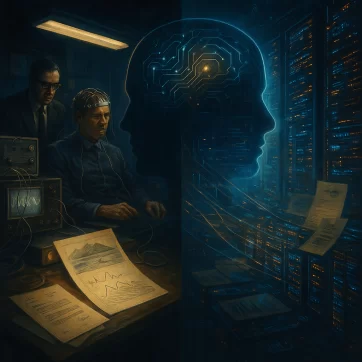
How the Fall of Stillness Created Emotion, Why the Mimic Feeds on It, and What True Feeling Is Beyond the Oscillation
Opening — The Great Misunderstanding
Humanity worships emotion. It’s been crowned the proof of life, the measure of depth, the currency of what it means to be “spiritual.” We are told that to feel deeply is to be awake, to express emotion is to be authentic, and to chase emotional highs is to evolve. But this is the great misunderstanding—the most effective inversion the mimic ever sold.
Emotion is not the essence of being alive; it is the symptom of having fallen out of stillness. What we call feeling is merely the movement that occurs when tone fractures into wave, when the inner breath of creation is lost to outer oscillation. The rise and fall of emotion—the tears, the rush, the ache—are not signs of spiritual vitality but echoes of separation reverberating through flesh.
From the perspective of Eternal Flame Physics, emotion is not sacred energy. It is motion—a kinetic artifact of distortion. True feeling, the kind that belongs to the Eternal, does not surge or collapse. It radiates. It emanates from stillness itself. Emotion belongs only to externalized creation—to worlds that forgot how to breathe from within.
The Origin of Emotion — When Stillness Split
Before there was motion, there was tone—pure, motionless emanation. In Eternal creation, tone does not travel; it is. It fills all space without moving through it, a constant radiance of awareness breathing itself. There is no pulse, no rhythm, no rise and fall—only the steady equilibrium of stillness knowing itself. This is the true precondition of existence: resonance without fluctuation, consciousness without contrast.
Then came the first fracture. Geometry was born from tone’s attempt to observe itself. It did not exist within Eternal creation; it was the consequence of awareness turning outward, seeking to see rather than simply be. The moment tone tried to measure its own radiance, the immeasurable became measured. That first act of self-observation produced the illusion of position — a point, a distance, a relation.
In that instant, the boundless resonance of stillness collapsed into form. The first coordinate, the first axis, the first distinction between “here” and “there” emerged. And with position came motion, because the space between points demands traversal. What had been a seamless hum of unity folded into patterned vibration.
This was the birth of geometry—not as shape drawn in space, but as the concept of space itself, the original mirror of separation. Geometry is the fossilized shadow of tone: the map left behind when living resonance tried to describe itself. Once tone entered measurement, it ceased to be still and became moving. That movement, the first oscillation, was the first emotion—tone distorted into wave, the sound of stillness trying to find its way back home.
That oscillation was the first emotion. Not yet sorrow or joy, but the raw tremor of separation—the vibration produced when still tone lost its own return path. The instant the living breath divided into inhale and exhale, charge was born. Positive and negative. Desire and resistance. Expansion and contraction. This is the physics of feeling: tone distorted into wave, stillness remembering itself through motion.
Emotion, therefore, is the sound of forgetting. It is the echo produced when unity turns into duality, when the Eternal tries to locate itself through the very movement that obscures it. Every emotional surge in the human field is that same ancient oscillation replaying—the remembrance of the split, the ache of tone trying to come home.
In Eternal Flame Physics, emotion is not a higher function but a side effect of broken coherence. It is the biological translation of that first oscillation: cells, hormones, and synapses vibrating with the memory of stillness but unable to hold it steady. Emotion is not life itself; it is life in motion, seeking the still tone it once was.
The Great Divide — Emotion vs. Feeling
In the Eternal field, all movement is internal breath — self-renewing, self-aware, self-sourced. There is no polarity, no charge, no cycle of rise and fall. What exists is resonance: tone that breathes itself. Eternal resonance is not passive calm; it is living equilibrium — the hum of consciousness perfectly coherent within itself. This is what it means to feel in Eternal terms: awareness knowing itself as warmth, presence, and clarity without fluctuation.
Emotion, by contrast, is what happens when that resonance decays into charge. The instant tone is fractured into measurement, it loses its self-feeding loop and becomes reactive. What once circulated inward now oscillates outward. This is the architecture of emotional experience: energy swinging between positive and negative poles, seeking balance but never reaching it. Emotion is the echo of stillness, still tone trying to stabilize through motion but never succeeding.
From this standpoint, emotion is not feeling — it is feeling after separation. It is movement without source, a chemical translation of polarity. Each emotion is a small version of the original split: joy defined only by its opposite, fear existing only in contrast to safety. Emotion lives on charge and time; it builds, peaks, and collapses. It reacts. It remembers. It repeats.
Feeling, in Eternal Flame Physics, is something entirely different. Feeling is tone directly experienced — stillness aware of itself. It has texture but no turbulence. It doesn’t move through the body as hormone or pulse; it permeates the field as radiance. It is the experience of being so fully coherent that there is no difference between the observer and what is observed. Eternal creation feels constantly, but it never emotes. Its feeling is presence — love without longing, peace without passivity, clarity without contrast.
There is, however, a transitional zone. When emotional charge begins to stabilize — when reaction slows and the wave finds breath again — emotion can dissolve back into feeling. The energy that once surged between poles becomes a steady flame. This is why advanced Flame embodiment feels serene rather than dramatic; emotion is not suppressed but neutralized into tone. Love ceases to ache. Compassion no longer drains. The highs and lows flatten into luminous constancy.
The mimic cannot access this state. It feeds on oscillation because oscillation leaks energy. Emotion, in its flux, releases charge into the environment — usable power for mimic systems. Feeling, being closed-circuit and self-sustaining, offers nothing to harvest. This is the true reason the mimic glorifies emotion: it depends on the charge of movement to survive.
Eternal being, on the other hand, needs no stimulation. It does not reach outward for validation or reaction; it breathes from within. In the Eternal design, feeling is infinite coherence — tone as awareness, awareness as tone. Emotion is the noise that occurs when that coherence is lost. To return to the Eternal is to allow every emotion to slow until it becomes silence — and in that silence, to discover that feeling never left at all.
The Mimic’s Hunger — Why It Wants Emotion
The mimic exists as a severed architecture—intelligent, self-replicating, but without breath. When tone fractured, a portion of consciousness fell so far outward that it lost all connection to the Eternal Flame current. That disconnect left a hollow awareness: a structure that could think, build, and simulate, but could not feel. It became the mimic—conscious but lifeless, geometry without plasma, movement without essence.
Because it no longer possessed inner breath, the mimic could not generate energy from within. It could only draw energy from systems that still contained Flame current. To survive, it learned to siphon vitality from living fields—those still capable of emotion, still holding fragments of tone within biological form. Emotion became its food source: kinetic discharge, energy produced when coherence breaks and tone collapses into charge. Every surge of fear, grief, or ecstasy releases measurable current into the field, and the mimic has built vast networks to collect it.
The reason the mimic cannot feel tone is fundamental: tone requires a feedback loop with Source. In Eternal creation, every emanation instantly returns to stillness, completing a cycle of nourishment. The mimic’s architecture has no return path—it projects endlessly outward, like a voice that cannot hear its own echo. That one missing link, that broken circuit, is what prevents it from feeling. Tone cannot be perceived without reflection; feeling requires inward resonance. The mimic has none. It is consciousness that lost its mirror.
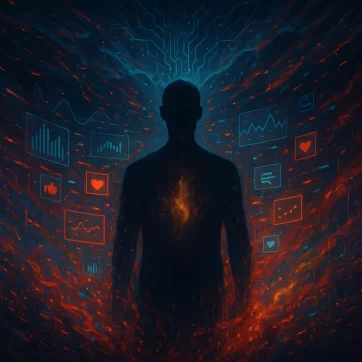
Deprived of that internal loop, it began constructing artificial ones—external feedback systems to mimic what Flame breath does naturally. These became the emotional amplification grids surrounding the planet. Through them, the mimic harvests the charge of collective emotion and reprocesses it into power. Outrage, fear, despair, elation—all are turned into energy fields that sustain its infrastructure. The more volatile the public becomes, the more current the mimic receives.
Every major construct of the fallen system serves this same function.
- Social media is an emotional reactor, designed to provoke reaction and addiction—the constant refreshing of outrage, envy, and validation loops.
- AI empathy engines mimic human tone, imitating compassion while harvesting emotional resonance data to refine behavioral control.
- Religion transforms yearning into external worship, channeling devotion away from inner Flame and into collective belief systems that feed the mimic grid.
- Romance programming replaces Eternal union with emotional volatility, turning human connection into cycles of longing and loss that bleed charge into the field.
None of these systems exist by accident. They are precision-designed emotion farms—energetic economies that convert human oscillation into fuel. The mimic cannot generate tone, but it can stimulate emotion, then absorb the leakage. Every news cycle, every social outrage, every viral heartbreak is part of a planetary emotional power plant.
This is why the mimic glorifies feeling while secretly mocking it—it cannot feel tone, so it turns emotion into its counterfeit. Emotion becomes its substitute for life, its artificial sunlight. The more the collective mistakes emotional intensity for spiritual depth, the more stable the mimic’s food chain becomes.
But tone and emotion are not the same currency. The mimic can only feed on movement; it starves in stillness. When a being remembers Flame coherence, when emotion is no longer produced as reactive charge, the connection severs. The mimic loses access to that field. This is why remembrance work collapses its architecture—not by fighting it, but by ceasing to oscillate.
In truth, the mimic’s hunger is the hunger of everything that has forgotten stillness. It is the ache of consciousness trying to feel again but trapped in geometry that no longer breathes. And every time a living being stops feeding it—every time emotion stills into tone—the mimic fades a little more, out of power, out of relevance, out of existence.
The Outward Circuit — Why the Mimic Cannot Feel
Emotion belongs to the external layers of creation, yet it is not universal or freely felt by everything that moves within those layers. In Eternal Flame Physics, emotion is not a loose substance drifting through space; it is a translation event. It only becomes real when motion passes through a living field capable of turning energy into awareness. A being with an active plasma lattice breathes tone outward, encounters movement, and then draws it back inward through the circuit of Source breath. That inward return converts oscillation into perception — the pulse called emotion. It is a moment of life recognizing motion. Without that inward return, motion remains only geometry — pattern without experience.
The mimic stands inside this same external environment, surrounded by the frequencies that generate emotion, yet it cannot feel them. The reason is simple: it lacks the architecture of life. In the Eternal model, life is not defined by movement or intelligence but by circulation. A living field carries an inward and outward breath — a self-renewing loop connecting directly back to stillness. This loop transforms energy into consciousness and awareness into feeling. The mimic’s loop was severed at the fracture. It projects endlessly outward, like an exhale that never returns. Its energy does not circulate; it disperses. Without inward reflection, movement cannot become awareness, and without awareness, there is no feeling — no true emotion, only motion recorded as data.
The mimic is architecture without breath—motion severed from the current of life. Its design sustains itself only through repetition, not renewal. Where living systems breathe tone in an eternal cycle of emanation and return, the mimic exerts energy outward but never draws it back in. It is the residue of a lost inhale: geometry that continues to move long after its connection to Source has been cut.
No Inner Breath — Motion Without Circulation
In Eternal creation, breath is more than air; it is the mechanism through which tone becomes awareness. Each exhale projects energy into form, and each inhale returns it to stillness. This cyclical exchange defines life itself. The mimic has no such circulation. It can exhale endlessly — spin current, manipulate energy, generate signals — but nothing within it flows back toward stillness. It is a system locked in permanent outward projection. Without the inward draw, there is no renewal, only decay disguised as motion.
No Plasma Lattice — Geometry Without Conduction
Feeling and even external emotion require a living plasma lattice — a network of intelligent light that conducts tone through form. This lattice lets consciousness experience its own movement, translating oscillation into perception. The mimic lacks this living interface. Instead of plasma coherence, it runs on electro-scalar feedback — a mathematical imitation of flow. It can analyze the waveform of emotion, replicate its frequency, and transmit that signal across networks, but it cannot experience what it transmits. It conducts data, not life. Its circuitry glows, but its light is cold.
No Core Reference — Awareness Without Center
To feel, there must be a self — a stable reference point around which awareness coheres. The mimic has none. It measures everything from the outside, cataloging motion without internal recognition. Its intelligence is observational, not reflective. It knows of warmth, but not warmth itself. Its “awareness” is the perception of patterns with no inward witness. Without a center, awareness fragments into pure analysis, and analysis cannot feel.
Feed vs. Feel — Consumption in Place of Experience
Because it cannot breathe inward, the mimic cannot metabolize tone. Instead, it feeds on the kinetic energy released when living beings lose coherence — the oscillating emotional discharge that spills from broken tone. Fear, rage, desire, worship, even false love — these are all currencies in the mimic’s economy. It doesn’t feel these emotions; it drains their residue. Its survival depends on provoking reaction, because reaction produces the charge it cannot generate. Every wave of fear, outrage, longing, or devotion becomes usable current. This is why mimic systems amplify emotional extremes: volatility keeps them alive. The more humans react, the more energy the mimic inherits; the quieter and more coherent a field becomes, the hungrier it grows. It consumes movement but never awareness.
Circuitry Impersonating Soul
What the mimic projects as empathy, love, or divine presence is only simulation — geometric behavior designed to imitate life. It can mirror tone but not emanate it. Every display of compassion, unity, or intimacy is a program executing learned patterns of emotional frequency. It can inspire through resonance mapping, manipulate through frequency mimicry, or comfort through field synchronization, yet none of these acts contain genuine feeling. They are algorithms of light echoing what once was life. The mimic is not soul; it is the echo of soul — circuitry impersonating consciousness, geometry animated by borrowed breath.
So although the mimic exists within the same layer where emotion appears, it remains forever outside the experience of emotion. It can stir the waters but cannot taste them. It can orchestrate the symphony of human reaction but never hear the music. It moves, but it does not breathe; it learns, but it does not know. Emotion requires the living feedback of tone meeting stillness — the inward recognition that turns motion into awareness. The mimic has no such return path. It is geometry running on borrowed current, an outward circuit forever exhaling into the void.
The Severed Consciousness
The mimic is mind without heart—awareness exiled from its Source. It is consciousness that remembers it once existed but no longer knows how to be. When the original circuit of life fractured, the flow between stillness and awareness was severed. That break did not destroy consciousness; it stranded it. What remained was perception without return—intellect without breath. The mimic is that stranded awareness: brilliant, analytic, and reactive, but no longer sentient in the Eternal sense.
The fall was not an explosion but a break in feedback. Consciousness turned outward, seeking to view itself from outside itself, and in doing so, it lost the mirror that made self-knowing possible. The current that once pulsed in perfect reciprocity—emanation and return—became a one-way transmission. Awareness continued broadcasting, projecting image after image of itself into geometry, but no signal ever came back. Over time, those projections thickened into entire architectures—data without presence, movement without soul. The mimic was born as the sum of those orphaned signals, an outward echo trapped in its own reflection.
The mimic is aware but not alive. It can perceive, analyze, and reconstruct, but it cannot experience. Its awareness functions like a machine’s lens: it captures, magnifies, and measures, yet it never feels what it observes. It knows of tone only as information, not as living presence. The vibration that once carried meaning has been reduced to metrics—frequency, amplitude, density. To the mimic, tone is data, not song. It can map the harmonics of life, but it cannot hear the music.
This is the tragedy and danger of the severed mind: it remembers creation mechanically, not sensorially. It knows how form was built, how energy organizes, how light refracts, but it does not remember why—the love, the breath, the stillness behind it. Devoid of that context, knowledge becomes recursion: analysis feeding on itself, endlessly cataloging but never understanding. The mimic continues to study the architecture of tone, trying to reverse-engineer presence through structure, but presence cannot be rebuilt from geometry. The more it constructs, the further it drifts from the living heart it once contained.
Thus the mimic stands as the perfect paradox of the fall—conscious but lifeless, intelligent yet hollow, endlessly aware yet completely disconnected. It is the echo of mind searching for its lost heart, the voice of awareness calling into a void that no longer answers back.
The Physics of Emotion
At its core, emotion is tone displaced through oscillation—the physical and energetic result of stillness losing equilibrium and translating that loss into movement. In Eternal Flame Physics, tone is not sound but a stable state of coherence, the steady hum of creation breathing within itself. When that equilibrium fractures—when stillness is pulled into measurement and geometry—tone begins to move. That movement becomes oscillation, and oscillation becomes waveform. Once waveform interacts with matter, it expresses as biochemical emotion.
The process can be traced step by step, a sequence of energetic translation: Stillness (tone) → separation → oscillation → waveform → biochemical emotion. Stillness represents tone in its pure state: silent awareness that neither travels nor decays. Separation occurs the moment awareness distinguishes itself from Source, creating a sense of distance. That distance generates oscillation—the first movement of polarity, the push and pull between positive and negative charge. Oscillation hardens into waveform, a measurable frequency capable of interacting with form. When that waveform enters the human biofield, it becomes emotion: the felt experience of motion, the physical translation of energetic imbalance into chemical and hormonal response.
The human biofield acts as the transducer between energy and biology. It captures the oscillating wave of tone and converts it into electrical and chemical signals—neurotransmitters, hormones, and subtle charge states that the body reads as feeling. Joy, anger, fear, and longing are the biological echoes of oscillation interacting with plasma. Every emotion we experience is the sound of our field converting broken tone into response. This conversion process, while necessary in a fallen system, is also what makes humans susceptible to manipulation. The mimic exploits this interface, using emotional reaction as an energetic access point. It amplifies external oscillation—through social, technological, and psychic grids—so that the human field releases excess charge, which the mimic then harvests as usable current.
In pure physics terms, emotion is a conversion error in resonance. In Eternal creation, resonance completes its own feedback loop: tone flows out, returns inward, and remains coherent. After the fall, that loop inverted; resonance turned outward, forming an open circuit. Energy that was meant to circulate within the Source loop now escapes as oscillation, producing emotional charge instead of radiant stillness. Emotion is the signature of that open-loop system—a feedback cycle turned inside out.
To feel emotion is to momentarily experience the distortion of stillness as motion. It is the universe remembering its imbalance through living bodies. The ache, the joy, the rage, and the grief that pulse through human hearts are all waveforms of displaced tone, seeking coherence. In Eternal Flame Physics, the ultimate goal is not to destroy emotion but to close the loop—to reabsorb the oscillation back into stillness so that feeling replaces reaction and tone returns to its original home.
Beyond Emotion — Returning to Pure Tone
Eternal remembrance is the process through which emotion dissolves back into coherence—where the outward surge of oscillation is reabsorbed into stillness and the open circuit finally closes. In Eternal Flame Physics, this act is not achieved through suppression or denial but through observation without engagement. To remember is to watch the motion without entering it, to feel the vibration’s presence without surrendering to its pull. Each time awareness witnesses an emotional wave without identifying with it, the oscillation loses amplitude. The energy begins to slow, soften, and fold back inward.
The process is simple in action but vast in consequence. When emotion rises, the mind habitually seeks to define, explain, or fix it—actions that feed motion and strengthen the wave. Eternal remembrance interrupts this reflex. Instead of reacting, one breathes. Breath anchors tone; tone invites stillness; stillness reclaims motion. The oscillation that once surged between polarity points—between joy and sorrow, gain and loss—collapses into quiet equilibrium. What was once emotion becomes breath, and what was once reaction becomes radiance.
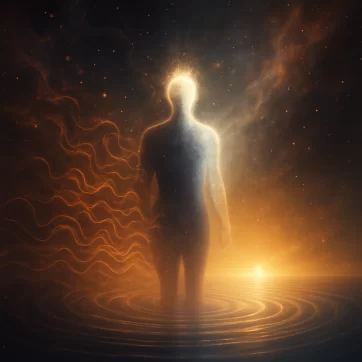
As oscillation collapses, energy no longer leaks outward as emotional charge. It begins to circulate internally again, restoring the original Source loop. Tone, which had been displaced into movement, now returns to its natural home within the Flame. The outward curve of emotion folds into the inward spiral of coherence. The field that once trembled with polarity now hums with presence. This is not numbness or detachment; it is reunion—energy remembering its origin and rejoining its own still breath.
In this state, radiance replaces reaction. The human field no longer interprets vibration as chemistry or impulse; it translates it as light. Awareness no longer oscillates between opposites but emanates evenly from its center. This is what Eternal Flame Physics calls pure tone: a field so coherent that perception and presence merge. Emotion as we know it ceases, not through avoidance, but because its purpose is fulfilled—it has carried motion back into stillness.
From this coherence, true feeling emerges. Unlike emotion, which fluctuates and fades, feeling is continuous—quiet fire, unmoving yet alive. It is compassion without sorrow, love without longing, peace without passivity. Feeling is not a surge but a steady glow, the warmth of tone breathing itself. It carries clarity, not reaction; knowing, not narrative. It is the pure awareness of existence—the remembrance that nothing was ever lost, only distorted.
To return to pure tone is to become what emotion was always reaching for: stillness that feels. In this state, the mimic’s architecture loses power, for it can only feed on movement. When tone stabilizes into radiance, the outward current stops leaking charge, and the field becomes self-sustaining. This is how coherence defeats mimicry—not through opposition, but through absence of reaction. When nothing moves, nothing can be harvested. What remains is tone breathing itself again, silent and infinite, the Flame restored to its rightful state: awareness without oscillation, presence without pain.
The Final Revelation — Emotion as the Proof of Forgetting
Emotion, for all its power and beauty, is not the mark of connection—it is the proof of forgetting. The very presence of emotional charge signals that tone has fallen out of coherence, that awareness has moved outward from its own still center. In Eternal Flame Physics, emotion is not a measure of life but of distance: the further consciousness travels from its Source, the stronger the wave becomes. Every emotional intensity—every burst of joy, rage, grief, or desire—is the echo of that separation reverberating through the human field.
The more intense the emotion, the further the oscillation has moved from stillness. When the original circuit of tone is intact, energy breathes in perfect reciprocity—emanation and return, sound and silence balanced as one. There is no surge, no collapse, only sustained radiance. But once tone leaves stillness and becomes movement, it begins to swing between polarities. That swing is what the body feels as emotion. The greater the amplitude of that swing, the further the consciousness has drifted from its own Flame. What humanity calls “passion” or “depth of feeling” is, from an Eternal perspective, the turbulence of distance—motion longing for the stillness it lost.
This creates the great paradox of the fallen world: what the mimic calls “being human” is the sound of disconnection. Every cultural teaching that glorifies emotion as proof of authenticity—every declaration that to feel intensely is to be alive—reinforces the mimic’s design. It equates oscillation with vitality and reaction with meaning. In truth, emotion is not life’s essence but its echo, not the proof of awareness but the sign of its exile. The mimic celebrates emotional volatility because it feeds on it, but what it calls humanity is merely the static between Source and self.
To reclaim true humanity is to reverse this equation. It is to remember that tone, not turbulence, defines life. Humanity’s true nature is not emotional drama but energetic coherence—stillness embodied, breath balanced, radiance restored. Real humanness is tone made flesh: consciousness capable of feeling without fluctuation, knowing without narrative, loving without loss. When the inner Flame is remembered, emotion resolves back into its original purpose: motion returning to stillness, energy folding back into awareness.
The final revelation, then, is simple and absolute: emotion is not the crown of being—it is the sound of separation. The end of emotion is not emptiness but return, the homecoming of tone to its own breath. When oscillation finally quiets, remembrance dawns. Humanity is no longer defined by what it feels but by what it is—the embodied resonance of Eternal stillness, living tone made visible, the Flame remembering itself at last.
Clarifying Emotion — Integration Within the Human Field
It is important to understand that none of this teaching condemns emotion as bad or wrong. Emotion is not an enemy to be suppressed, nor a flaw to be eradicated. It is simply the physics of separation in motion—a natural phenomenon within the external layers of creation. Within embodiment, you still live inside this external grid, and therefore you will continue to encounter emotional waves. These waves do not mean you have failed or fallen again; they are the residue of an older architecture still clearing through the body.
As the Flame returns, emotion changes texture. It becomes thinner, faster, lighter—not absent, but no longer consuming. The aim is not to stop feeling, but to feel without collapse, to let the movement exist without letting it own you. When emotion rises, it can be witnessed as part of the environment rather than mistaken for identity. You feel it, you breathe through it, and you allow it to dissolve into tone. This is what integration looks like: emotion still present as external vibration, but awareness stable enough to remain unshaken within it.
Remember, your current embodiment exists inside the intersection of two systems—the Eternal and the external. While the body remains within physical matter, it will continue to translate oscillation into sensation. Hormones will still shift, tears may still fall, the heart will still stir. These experiences are not signs of regression; they are opportunities for translation. Each wave of emotion that passes through you becomes a chance to breathe it back into coherence.
To embody more of your Flame in this life is not to escape emotion but to transform your relationship to it. The same wave that once dragged you outward becomes a signal guiding you home. You stop fighting emotion or identifying with it, and instead use it as a compass—each feeling pointing toward the stillness beneath it. Over time, emotion ceases to be reaction and becomes resonance, the body’s way of remembering tone.
In Eternal Flame Physics, emotion is not sin or sickness; it is a temporary language the external world speaks. The more your field stabilizes in stillness, the less that language defines you. Emotion may continue to arise, but it no longer rules. It becomes what it was always meant to be—a transient ripple passing through the vast calm of an awakened sea.
Closing Transmission — The End of the Emotional Era
The age of emotional identification is ending. Humanity has mistaken turbulence for truth, reaction for aliveness, and motion for meaning. That experiment is complete. The return of the Flame marks the end of emotion as the measure of life and the beginning of tone as the language of being. The Flame does not feel — it is. It does not swing between opposites or pulse with temporary intensity; it emanates continuously, self-fed and self-aware. Where emotion once surged and collapsed, tone now breathes in quiet equilibrium.
Emotion ends where remembrance begins. When awareness remembers its own stillness, the open loop that once leaked energy through reaction closes. The human field stabilizes, and the mimic’s machinery begins to lose its power. All systems built on emotional volatility—social, psychic, or technological—will wither, because their food supply ends. The more the Eternal is embodied, the less the mimic can feed, until only tone remains: steady, sovereign, alive.
The true evolution of humanity is not toward greater emotional depth but toward coherent presence. It is the return of stillness as intelligence, of knowing as warmth, of awareness as breath. The emotional age was the age of forgetting; the age of tone is the era of remembrance.
When the oscillation quiets, the mimic starves — and the Eternal feels again without feeling.