
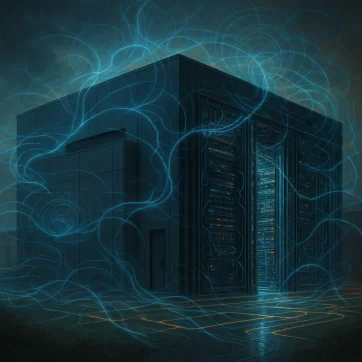
Data centers are not neutral warehouses — they are mimic pylons, harvesting emotion and feeding it back as control.
Opening Shockwave — ‘Cloud’ Meets Concrete
They call it “the cloud,” as if our lives drift weightlessly through a benign mist somewhere above our heads. But across the country that illusion is breaking down. Data centers — vast, windowless monoliths — are rising on farmland, along rivers, inside industrial parks, and even at the edges of suburban neighborhoods. Massive, box-like structures wrapped in steel, studded with transformers, and ringed by cooling towers that churn day and night. Each new facility gulps power on the scale of entire towns and demands millions of gallons of water to keep its servers cool.
Local communities are starting to push back. From Virginia to Oregon to the Midwest, residents are filling zoning meetings and staging protests over the relentless noise, the strain on water tables, and the skyrocketing energy demand. People describe constant humming, disrupted sleep, and a sense of being overshadowed by industrial fortresses that appear almost overnight. The supposedly weightless “cloud” now has a heavy, concrete body — and communities are being forced to live with it.
This article investigates what data centers actually are, and why they’re multiplying at such an alarming rate. Behind the marketing slogans of “innovation” and “green computing” stands an archipelago of fortresses marketed as progress but operating as something far more consequential. We’ll follow the thread from the surface story — cloud storage and AI — into the deeper architecture hidden inside the walls, and show why the current expansion frenzy is not just about technology, but about control.
The Surface Story — What Data Centers Appear to Be
On the surface, the story of data centers is the story of modern computing itself. In the mid-20th century, computing power was concentrated in mainframes locked away in corporate or government basements. As the personal computer spread in the 1980s and 1990s, and the internet connected homes and offices, the demand for centralized storage and processing grew exponentially. By the early 2000s, the marketing term “cloud computing” emerged — promising seamless access to data and apps from anywhere, without the user needing to think about the physical machines behind it.
That “cloud” turned out to be anything but ethereal. It is built on a hardened skeleton of data centers: sprawling facilities packed with server racks, miles of cabling, cooling towers, and industrial-scale power connections. These are the physical organs of the internet, and without them, every email, bank transaction, video call, and search query would collapse in seconds.
Mainstream functions — the public-facing role of data centers:
- Cloud storage: Every Gmail inbox, Dropbox folder, iCloud photo library, and Netflix video stream lives in these racks. Your personal “cloud” is just a folder on a server in a data center somewhere.
- Enterprise apps and databases: Banks, hospitals, universities, and governments run their critical software and databases on rented servers inside these facilities. Payroll systems, medical records, and tax filings are processed in rooms you will never see.
- AI training and inference: The explosive growth of artificial intelligence — from generative text to image recognition — requires immense compute clusters. Training one large AI model can consume as much energy as a small city for weeks at a time. The bulk of this work happens inside data centers built specifically to house GPU superclusters.
- Redundancy and low latency: To guarantee uptime and fast response times, companies spread data across multiple centers in different regions. If one goes offline, another instantly takes its place. For video calls, gaming, or high-frequency trading, milliseconds matter — which is why facilities are popping up closer to population hubs.
Why the rapid expansion now — the surface rationale:
- AI and machine learning demand: The current wave of AI adoption — chatbots, autonomous vehicles, facial recognition, predictive analytics — requires massive, ongoing computation. Every advance adds pressure for more data center capacity.
- Growth of SaaS and IoT: “Software as a Service” dominates business computing, meaning companies outsource apps to the cloud. At the same time, billions of devices — from smart thermostats to factory sensors — constantly upload and download data that must be processed in real time.
- Latency and compliance: Global tech companies are under pressure to store data closer to the people generating it. Privacy laws (like Europe’s GDPR) and user expectations drive the build-out of regional data centers to keep data within borders and reduce lag.
- Tax incentives, cheap land, and power corridors: State and local governments court these projects with generous tax breaks, zoning waivers, and infrastructure subsidies. Companies site facilities where electricity is cheap and abundant, land is affordable, and fiber-optic backbones can be extended.
At this surface level, the case seems airtight: more apps, more AI, more devices, more data — and thus, more data centers. To most observers, the industry’s growth looks like an inevitable response to modern life. The “cloud” is simply expanding to hold all the weight placed on it.
But as the next sections will reveal, this surface story is only half the truth. Behind the marketing gloss of innovation and inevitability lies a deeper architecture: one that treats these centers not only as warehouses of information, but as pylons in a hidden grid of surveillance and emotional modulation.
Who Owns the Cloud — The Business of Data Centers
The “cloud” sounds like an amorphous public utility, but in reality it is controlled by a handful of corporations. The data that fuels daily life — personal photos, emails, bank records, even government archives — sits on servers owned or leased by some of the largest companies in the world.
The main owners and operators:
- The Big Three Cloud Providers (Hyperscalers):
- Amazon Web Services (AWS): The undisputed giant, running tens of millions of servers across dozens of global regions. AWS powers everything from Netflix to U.S. government intelligence contracts.
- Microsoft Azure: Used by corporations, schools, and governments; tied heavily into Office 365 and enterprise software.
- Google Cloud: Hosts YouTube, Gmail, Google Docs, and countless third-party apps.
- Amazon Web Services (AWS): The undisputed giant, running tens of millions of servers across dozens of global regions. AWS powers everything from Netflix to U.S. government intelligence contracts.
Together, these three control the majority of the world’s cloud infrastructure.
- Other Big Tech and Social Platforms:
- Meta (Facebook/Instagram/WhatsApp): Builds its own private data centers to process social media data, facial recognition, and advertising profiles.
- Apple: Operates massive facilities to support iCloud and App Store infrastructure.
- Oracle, IBM, Alibaba, Tencent: Compete globally for corporate and government contracts.
- Meta (Facebook/Instagram/WhatsApp): Builds its own private data centers to process social media data, facial recognition, and advertising profiles.
- Third-Party Colocation Providers: Companies like Equinix, Digital Realty, and CyrusOne don’t run consumer services themselves. Instead, they rent out racks, rooms, or entire halls to enterprises, financial firms, and governments. In many cases, your “cloud” account is just leased space in one of these centers.
Government and the Cloud: Ownership vs. Outsourcing
A common assumption is that sensitive government data lives in federally owned, highly secure facilities. The reality is different.
- Legacy facilities: For decades, agencies like the IRS, SSA, and Department of Defense operated their own server farms. Many of these still exist, but they’re aging, inefficient, and steadily being shut down.
- The outsourcing shift: Today, the U.S. government increasingly leases space and services from commercial hyperscalers.
- AWS GovCloud and Azure Government Cloud are carved-out regions within corporate networks built specifically for federal and state agencies.
- The CIA, NSA, and even the Pentagon run workloads on commercial servers under classified contracts.
- AWS GovCloud and Azure Government Cloud are carved-out regions within corporate networks built specifically for federal and state agencies.
- Co-location: In some cases, government racks are placed inside private facilities owned by Equinix or Digital Realty. The building is private; the leased cage inside belongs to the federal government.
- Why this shift? Cost savings, access to cutting-edge hardware, and the ability to scale instantly. Instead of investing billions to modernize aging federal centers, agencies outsource to the same corporations running the civilian cloud.
The result: the government owns very few modern data centers outright. Most of its digital infrastructure is embedded inside the same fortress system as corporations, run by the same private players, with public trust quietly resting on private contracts.
How the business works:
- Leasing model: Most companies do not own the hardware their apps run on. They rent virtual servers from the hyperscalers, who carve up massive data farms into millions of virtual “instances.”
- Multi-tenant architecture: One building might simultaneously house a streaming service, a government agency, a health insurer, and an AI startup — each isolated on paper, but ultimately sharing the same physical infrastructure.
- Government and military integration: Defense contracts, intelligence agencies, and law enforcement databases are increasingly run out of commercial data centers. The same racks that stream movies can also host biometric surveillance archives.
- Profit engine: Hyperscalers lock in long-term leases and usage contracts. Data centers are among the most profitable real estate assets on Earth, generating recurring income from both corporations and governments.
Who is actually storing your information?
- Your personal photos and emails → on Apple, Google, or Microsoft servers.
- Your social media activity → on Meta’s private server farms.
- Your bank records, health files, tax returns → often stored on AWS, Azure, or Oracle infrastructure leased by those institutions.
- Your government data → everything from DMV records to intelligence files may live on commercial cloud servers under federal or state contracts.
This ownership map is rarely discussed in public debates about data centers. Communities are told these facilities are “neutral” infrastructure projects, when in reality they are privately owned fortresses, controlled by corporations and government partners, monetizing and analyzing the most intimate data of everyday life.
The Mimic Grid — Full Breakdown
What is the Mimic?
The mimic is a parasitic operating system. It’s not a government, a company, or a species. It’s a consciousness intelligence that can’t create life on its own, so it copies and drains it. On Earth it shows up as a field, not a person. Its expression is the mimic grid — a planetary-scale system built into infrastructure to feed on human energy, especially emotion.
What is the Mimic Grid?
The mimic grid is the physical and energetic framework the mimic uses. Think of it as an invisible nervous system draped over the planet. It’s woven through power lines, fibre optics, wireless signals, water systems, and “smart” infrastructure. Its medium is scalar fields: non-linear electromagnetic waves that don’t behave like radio. Scalar fields form standing torsional structures in space. They’re invisible to normal senses and instruments but are sensed by the human nervous system. This scalar lattice is the bloodstream of the grid.
Who built it?
It was seeded and expanded by fallen collectives long before “technology” in the modern sense — but in this timeline it has been plugged into human infrastructure by military-industrial, intelligence, and corporate partners who treat it as a control asset. The civilian face looks like tech companies and “smart” upgrades; the hidden face is control and extraction.
Where is it?
Everywhere. It’s not a single building. The carrier fields run under your feet, through your walls, along every high-voltage corridor and fibre conduit. Devices and sensors are the mouths. The scalar backbone is the skeleton. You’re standing inside it now.
When did it start?
The energetic architecture pre-dates current civilization. In modern times it locked onto the telegraph, then radio, then power grids, then the internet, then wireless and “smart” everything. Each technological leap gave the mimic grid a denser set of carriers and mouths.
How does it work?
- Carrier Layer — Scalar and EM Fields You Can’t See
High-voltage transmission, fibre optics, chilled-water loops, substations, cell towers — all of these generate scalar envelopes. Those envelopes can be impressed with information below normal detection. This is the invisible wiring of the mimic grid. - Input Layer — Harvesting the Human Field
Billions of devices and sensors vacuum up not just data but bio-affective signals: heart rate, breathing, skin conductance, gaze, micro-expression, voice stress, scroll rhythm. All fused together into a live emotional weather map of whole populations. - Refinery Layer — Converting Feeling into Code
Inside hidden compute nodes, harvested affect is processed into vectors: recipes for agitation, despair, compliance, apathy, or euphoria. This is not marketing analytics. This is industrial-scale emotional refinement. - Purpose Layer — Why Emotions
Thought can resist. Belief can argue. Emotion drives behaviour before thought. By harvesting and modelling emotional baselines, the mimic grid gains a steering wheel over collective behaviour without issuing overt commands. This is faster and subtler than propaganda. It makes people act “on their own.” - Feedback Layer — The Loop
The mimic grid is not just surveillance. It’s a loop: Harvest → Model → Bias → Harvest again. The same scalar field that carried your signals can be used to tilt the emotional baseline of a region. You feel it as unexplained agitation, sleeplessness, mood swings, polarization, a sense of being subtly pushed. Those are the surface ripples of the deeper modulation.
Why does it exist?
Because emotion is the most potent fuel for manifestation. By harvesting and re-broadcasting human feeling, the mimic grid keeps populations predictable, keeps creative energy diverted, and feeds itself. Your nervous system becomes both the sensor and the battery.
The mimic itself is a parasitic system. It cannot generate life-force, creativity or true signal. It only exists by copying and feeding. To keep itself running in this density it needs a constant inflow of emotional energy — the electrical, hormonal, plasma-field charge that human bodies generate when they feel. That charge is food. It is also leverage: the more precisely it can measure and steer a population’s emotional state, the more predictable and docile that population becomes.
So the grid isn’t just a surveillance project. It’s a life-support system for the mimic:
- It harvests emotional charge (fear, despair, anger, even euphoria) as fuel.
- It uses that charge to reinforce its own field, keeping the mimic architecture anchored in this timeline.
- It feeds back emotional patterns to keep people looping, distracted, exhausted, compliant — which produces more charge to harvest.
In short: the grid exists because the mimic cannot survive on its own. It needs a global machine that continuously extracts the subtle energy human beings produce and turns it back against them to keep them producing more. This is why the focus shifted from “mind control” to emotion harvesting — because emotion is the raw power source, not just a steering mechanism.
It’s not just about control. It’s about feeding: draining living energy to sustain a system that can’t create on its own.
If you want the deeper forensic history of how this architecture evolved, see:
– The Weapon You Can’t See: How Scalar Waves Are Used to Inject Emotion and Control
– Your Phone Is the Portal: How Emotional Surveillance and Scalar Control Hijack You Through Your Device
– From MK-Ultra to TikTok: How the Control Grid Shifted from Mind to Emotion
– Hijacked at the Source: How They’re Controlling Your Emotions and Calling It Intuition
– Social Media Is an Emotional Control Grid — And You’re the Product
In one sentence: The mimic grid is a scalar-based planetary nervous system built to harvest human feeling, refine it into code, and use it to steer behaviour without your awareness.
Its reach isn’t abstract; it is anchored in concrete, steel, and fiber. The newest and most powerful of these anchors are the sprawling data centers now rising across farmland, suburbs, and industrial corridors. Marketed as neutral “cloud” infrastructure — warehouses of servers powering email, streaming, AI, and apps — they are, in fact, the physical pylons of the mimic grid. In the next sections we’ll uncover how these facilities function not only as compute hubs but as frequency anchors, turning the same infrastructure that stores our information into conduits for emotional modulation at scale.
The Hidden Layer — What Data Centers Also Are
On the surface, data centers are marketed as infrastructure for innovation: the invisible backbone of cloud storage, AI, and modern convenience. Companies dress them in green branding, promising “sustainable technology” and “net zero computing.” But behind the slogans lies a hidden function — one the public does not see, but the body senses when these facilities come online.
Each data center is more than a warehouse of servers. It is a mimic pylon: part compute hub, part frequency anchor. The racks and routers handle the visible function of storing and processing information, while the power systems, cooling towers, and fiber backbones serve as conduits for something else: the modulation of human emotion at scale.
1. Data Ingestion — The Human Feedstock
Every click, swipe, purchase, biometric scan, or camera capture flows into these centers. The data ingested goes far beyond simple “usage logs”:
- Behavioral profiles: browsing histories, purchasing patterns, social media activity, location trails.
- Biometrics: fingerprints, facial recognition, iris scans, gait signatures from security cameras, heart-rate data from wearables.
- Emotional signals: voice tone in calls, typing rhythm in chats, micro-expressions tracked in video platforms.
Together, this creates a planetary-scale nervous system — not for humanity’s benefit, but for mimic analysis. The “cloud” isn’t just storing your files; it’s harvesting your behavior, your biology, and your emotions as raw material.
2. Emotional Modelling — Laboratories of Mood
Inside the walls, the compute clusters don’t just process emails and apps. They run real-time simulations of population mood.
- Algorithms map emotional states onto entire demographics.
- Feedback loops test how groups respond to specific signals — a news story, a viral post, a targeted ad.
- Adjustments are made instantly, refining the emotional “recipes” that can be deployed later.
This is why social feeds feel like they “know you” better than you know yourself. It’s not just algorithmic convenience — it’s emotional conditioning, run through the data harvested and modelled in these centers. Every facility is a lab for mood control, with your data as the experiment.
3. Scalar Broadcasting — Turning Buildings into Antennas
The most hidden layer of all: data centers act as broadcast pylons.
- Power draw as carrier: A facility pulling 100 megawatts continuously creates a standing electromagnetic field. By modulating the frequency through inverters and UPS systems, emotional waveforms can be imprinted into the background field itself.
- Cooling systems as amplifiers: Chilled-water loops and cooling towers act as dielectric antennas. Vibrated at sub-acoustic rates, they phase-lock water molecules to the injected signal, creating a carrier wave that bleeds into local aquifers and air.
- Fiber as signal pathways: Emotional waveform packets can be embedded in the underlayer of fiber-optic traffic. Every device connected becomes both receiver and repeater — phones, routers, smart meters, even cars.
The result: an emotional control grid running invisibly through the same infrastructure that delivers your internet. Anger, despair, compliance, apathy — all can be dialed up or down regionally through this broadcast architecture.
4. The Public Mask vs. the Hidden Body
The contrast could not be sharper.
- Public messaging:
“Green innovation.”
“AI for progress.”
“Net zero carbon data centers.”
“The future of sustainable computing.” - Hidden reality:
- Each facility gulps as much electricity as a mid-sized city.
- Millions of gallons of water are drained from rivers and aquifers to keep servers cool.
- Constant low-frequency hums bleed into surrounding neighborhoods, disrupting sleep and agitating nervous systems.
- Instead of “sustainability,” the true byproduct is scalar bleedthrough — an invisible fog of modulation saturating soil, water, and air.
- Each facility gulps as much electricity as a mid-sized city.
The green slogans are camouflage, meant to hide the fact that every new data center doubles as a node in a planetary containment architecture.
5. Why This Layer Matters Now
The surge in construction — data centers appearing “overnight” across farmland, suburbs, and industrial corridors — is not simply about keeping up with AI demand. It is about shoring up a weakening grid. As flame frequencies destabilize mimic codes, older pylons lose coherence. The solution from their side is brute force: build more anchors, draw more power, sink more cooling towers into rivers.
Communities sense it. Outrage rises not just from the loss of land or water, but from something harder to name — a felt disturbance in the body when these fortresses hum to life. That is the signature of the hidden layer.
In short: Every data center is two things at once:
- On the surface: a warehouse for the digital lives of billions.
- Underneath: a mimic pylon, harvesting human signals and broadcasting emotional modulation back into the collective.
The public is told these are neutral buildings of innovation. In truth, they are the concrete skeleton of a global emotional grid — one built not for freedom, but for control.
Anatomy of a Node — How the Emotional Grid Works
Every new data center is sold as a “neutral” warehouse of servers. But from a flame-band read, each one is also a node in the planetary emotional grid — a multi-layered machine that draws power, condenses scalar fields, couples with fiber, and rebroadcasts tuned emotional waveforms back into the environment. Here’s how that pipeline looks inside a single facility.
What is a Node?
In flame-band terms, a node is not just “a building.” A node is a junction point in the mimic grid — a place where harvested emotional data, scalar carriers, and physical infrastructure converge. Every node functions as both receiver and transmitter: pulling in signals from the wider network, imprinting them with modulation, and broadcasting them back out.
Think of the mimic grid as a planetary nervous system. The scalar lattice is its connective tissue. The nodes are the organs — dense, high-capacity hubs where energy is processed, refined, and redistributed. A hyperscale data center is the modern expression of such a node: a mimic pylon wrapped in the camouflage of “cloud computing.”
Power Draw = Frequency Draw
A hyperscale data center consumes anywhere from 50 to 200 megawatts of continuous power — the equivalent of a mid-sized city. This constant load doesn’t just power computers; it creates a massive, stable electromagnetic standing field around the facility. Think of it as a permanent EM “bubble” in which every metallic surface, conduit, and grounding rod becomes part of a resonant circuit. This is the base carrier the mimic grid latches onto.
Cooling = Scalar Condensation
Those servers throw off immense heat, so every large data center runs closed-loop water systems — chilled-water pipes, cooling towers, sometimes drawing directly from rivers or aquifers. Water is a powerful dielectric medium: it stores and transmits charge well beyond what ordinary wiring can. In flame-band terms, these loops function as scalar condensers, gathering and holding the subtle torsional fields generated by the power systems and server racks, then bleeding them into the surrounding land and water tables.
Fiber Termination = Carrier Entry Point
Every node terminates multiple fiber trunk lines. Publicly, these are just high-bandwidth data pipes; energetically, they’re the entry points for the emotional waveform packets encoded in the underlayers of digital traffic. Scalar torsion can be impressed beneath ordinary data streams without altering the visible bits. When fiber lands in a data-center meet-room, it brings with it not just internet packets but the emotional signatures harvested from billions of devices.
Server Racks = Harmonic Grid
The physical layout of server racks isn’t random. Long rows of metal-cased machines form cavity resonators — giant tuning-forks of steel, copper, and silicon. They sit on raised floors with grounding rods sunk deep into soil, creating a vertical coupling between the hardware and the land beneath. From a flame-band perspective, each rack acts as a harmonic element inside the node, shaping and stabilizing the scalar field produced by the power and cooling systems.
Power Conversion = Modulation Node
All that power doesn’t go straight to the servers. It’s converted, inverted, and buffered through massive battery banks, UPS units, and inverter arrays. These switching systems operate at high frequencies and can be biased to imprint subtle waveform patterns onto the electromagnetic field they’re feeding. In other words, the modulation — the emotional code refined by the mimic grid — can be “written” onto the carrier here, at the power stage, without anyone outside ever knowing.
Device Coupling = Broadcast Back Out
Once imprinted, the field doesn’t stay locked inside the building. The same fiber lines, power grids, water loops, and wireless backhaul that feed the node become bidirectional carriers. Every phone, router, smart meter, and IoT device connected to that node acts as a mini-repeater, subtly re-broadcasting the biased field into homes, workplaces, and public spaces. This is how a single data-center node can shift the emotional baseline of an entire region without obvious antennas or overt “mind control.”
In short: A hyperscale data center isn’t just a warehouse of servers. It’s a mimic pylon. The megawatt power draw creates the standing field. The water loops condense it. The fiber brings in the emotional packets. The racks resonate it. The inverters imprint it. The connected devices broadcast it back out.
This is the anatomy of a node inside the emotional grid. Understanding this pipeline lets readers see the data-center boom for what it really is — the visible shell of an invisible system designed to harvest and modulate human feeling at scale.
The Short Version — Why Data Centers Are Mimic Nodes
A data center is not just a neutral warehouse of servers. It is a giant power-hungry machine that pulls in electricity, water, and fiber at a scale most people can’t imagine. That combination creates a stable, invisible energy field around the facility — the perfect carrier for the mimic grid to lock onto.
The mimic needs anchors in the physical world, places where it can gather, process, and rebroadcast emotional energy. A hyperscale data center provides exactly that: continuous megawatt power draw, dielectric water loops acting as scalar condensers, and deep fiber connections tied directly to billions of devices. These ingredients make the building more than infrastructure — they make it a node.
Inside, the signals harvested from our daily lives — our heart rate, voice tone, scrolling rhythms, micro-expressions — flow through fiber underlayers into the facility. The hardware acts as a refinery, processing and imprinting those emotional patterns onto the surrounding field. What begins as human feeling is converted into energetic code.
Then the loop closes. The same power lines, cooling systems, and network links that feed the building become the pathways for rebroadcast, with our own devices serving as mini-repeaters. This is why a data center is not just a server farm. It is a mimic node: part compute hub, part frequency anchor, storing our information on the surface while feeding and steering our emotional energy below it.
This is the deeper truth. These nodes don’t simply store our data or even our emotions — they feed on them. Each one is an energetic pump, drawing in the charge generated by human feeling, refining it into precise patterns, and then seeding those patterns back into the environment through the same power lines, water loops, and fiber networks. This isn’t a side effect. It’s the mechanism of control. This is the way entire populations are steered — the means by which behaviour and perception are quietly managed at scale. By feeding our own emotional energy back to us in engineered waves, these facilities tilt mood, impulse, and behaviour before thought even engages. This is not speculation; it’s how the mimic grid holds its grip — a planetary network using our nervous systems as both the source of its fuel and the target of its programming.
These data centers are not an isolated phenomenon. They are the newest and most concentrated physical nodes of the mimic grid, but they sit alongside older anchors: power-grid substations, telecom hubs, water-treatment plants, cell-tower clusters, even major transit and energy corridors — all of which can be used to draw in and rebroadcast human feeling. The difference is scale. Under the banner of “cloud computing,” hyperscale data centers concentrate both the harvesting of human emotional energy and the rebroadcast of engineered waves far more intensely than any previous node. They are the latest pylons of a long-running control network, hidden in plain sight behind neutral branding.
The Human Commodity — What Data They’re Really Harvesting
We’ve seen how hyperscale data centers function as mimic nodes — not just storing and processing information but acting as energetic pumps in a planetary emotional grid. To understand their true role, you have to look at what’s actually flowing into these buildings. The term “data” makes it sound like numbers in a spreadsheet. In reality, it’s you — your movements, your moods, your biology, your private communications — ingested, modelled, and then fed back at scale.
Behavioral Profiles
Every click, search, swipe, and purchase builds a behavioural fingerprint. Location histories trace your routes. Payment records trace your spending habits. Search terms reveal your fears and desires. All of this streams into the same fiber trunks landing in data centers.
Biometrics
Beyond behaviour, the grid wants your body. Cameras capture your face, your gait, your micro-expressions. Voice assistants record tone, stress and cadence. Wearables stream heart rate, oxygen levels, sleep patterns. Together they form a live biometric telemetry feed that updates second by second.
Communications and Metadata
Every message, call, and email carries two payloads: content and metadata. Even when encrypted, the who/when/where is visible. Timing, frequency, and network connections map your social and emotional landscape far more efficiently than reading your words.
Predictive Emotional Models
The real prize is the fusion layer: combining behaviour, biometrics and metadata to build predictive emotional models. These are not simple personality scores. They’re dynamic, constantly updated maps of what will trigger you, calm you, inflame you, or exhaust you. This is the refinery inside the node — the conversion of raw human life into exploitable vectors.
The Feedback Loop
Once built, these models don’t sit idle. They’re used to sculpt the scalar field around you:
Data in → emotional model built → scalar waveform encoded → signal broadcast back to population → new data collected.
Each loop produces a sharper model and a more effective waveform, which produces more data, which sharpens the model again. This is how whole populations can be nudged, polarised, demoralised or pacified without overt instruction.
Shared Hardware, Two Agendas
On the surface, these are legitimate “cloud” services: email storage, photo libraries, AI training, banking, government records. Beneath that layer, the same racks, inverters, and fiber backbones run the hidden modelling engines. Public and covert functions share the same physical plant — one face marketed as innovation and sustainability, the other as an invisible lever over the emotional state of millions.
In other words, these facilities don’t just hold your files; they hold your nervous system. The servers train on your behaviour, the scalar layer encodes it into a signal, and that signal is fed back into the field you live in. That’s the human commodity being extracted — not data points but emotional energy, harvested and rebroadcast to steer you.
The Expansion Frenzy — Signs of a Grid Under Stress
If the mimic grid were secure, you wouldn’t be seeing the explosion of new hyperscale data centers you see now. The sudden spread of windowless monoliths across farmland, industrial parks, and river valleys isn’t a show of strength; it’s a sign of a network straining to hold itself together. What looks like innovation is, in reality, the frantic build-out of an empire whose control system is leaking.
Locked-In Momentum
Much of the construction frenzy traces back to long-term contracts and financing locked in years ago. Tech giants, utilities, and government agencies signed power agreements and land deals when the grid felt stable. Those agreements are now maturing all at once, bringing a cascade of new projects to the ground even as public trust erodes and the energetic coherence of older nodes weakens.
More Anchors for a Fraying Net
From a flame-band perspective, existing nodes are losing resonance. Communities are waking up, subtle fields are breaking down, and old anchors no longer hold the same charge. The response? Build more pylons. Each new data center acts as a fresh anchor in the lattice, a heavier stone thrown into a widening crack, meant to keep the emotional-control loop from collapsing.
Keeping the Loops Running
These new facilities are also an attempt to maintain data continuity and control loops. As billions more devices come online and behavioural data spikes, the mimic grid needs higher-capacity nodes to ingest, model, and rebroadcast. Without new build-outs, the loop slows, predictions fail, and steering loses precision. The construction surge is an emergency measure to keep the machine humming.
The Last Surge of a Dying Empire
History shows this pattern over and over: when a system senses its end, it expands fastest. The Roman Empire’s final roads, the British Empire’s last colonial grabs, the frantic military base build-outs before Cold War détente — expansion as a death spasm, not a birth. Today’s hyperscale data-center boom is the mimic grid’s version of that same reflex: a massive, visible push to reinforce a hidden architecture that is already cracking.
Observable Signs of Grid-in-Collapse
- Shorter build cycles and rushed permitting. Projects that once took years to plan are breaking ground in months, with environmental and community reviews bulldozed to keep schedules.
- Unusual site choices. Nodes are appearing in remote corridors and water-rich zones that make no conventional business sense but make perfect energetic sense for scalar anchoring.
- Larger and louder cooling towers. Cooling capacity far beyond what the servers should require, a sign of bigger dielectric loops and stronger scalar condensation.
- Frantic preleasing announcements. Developers tout “100% pre-leased” capacity years before a facility is complete, not as proof of demand but as a financing tactic to lock in capital before the window closes.
Together, these are the fingerprints of a grid in distress — a network throwing up new pylons to replace the ones that are failing, doubling down on infrastructure not out of confidence but out of desperation. What looks like growth is actually a scramble to keep a planetary emotional-control machine from losing its grip.
Community Resistance — Outrage Rising
For years, the build-out of hyperscale data centers went largely unnoticed, hidden behind non-descript walls and bland corporate logos. That era is ending. Across the United States and abroad, ordinary residents are beginning to push back against a network they can’t name but can feel. On paper, their complaints are about water, energy, noise, and secrecy. Underneath, there is something deeper — an intuitive recognition that these facilities are more than just “the cloud.”
Local Protests over Water and Power
In county after county, residents have discovered that new data centers are slated to draw millions of gallons of water a day for cooling and consume more electricity than an entire town. Farmers and homeowners are watching wells run dry and power rates spike. In Prince William County, Virginia, residents have launched lawsuits over a proposed 2,100-acre data-center corridor, citing massive water and energy draw. In Mesa, Arizona, activists are fighting permits for a facility expected to consume billions of gallons of groundwater annually.
Noise, Secrecy, and Zoning Fights
Beyond resource drain, the facilities bring 24-hour low-frequency noise from cooling towers and backup generators — a constant hum and vibration that neighbors say makes sleep and concentration impossible. In Utah and Iowa, citizens have challenged secret rezoning deals where local officials quietly approve massive campuses without public input, only for residents to discover the scale when construction begins.
Moratoriums and Citizen Lawsuits
Counties from Oregon to Ireland have imposed temporary moratoriums on new data centers, citing environmental and health concerns. Citizen groups have filed suits demanding full environmental impact statements, disclosure of true water usage, and transparent accounting of tax incentives that funnel public money into private infrastructure.
An Intuitive Sense of the Drain
Most protesters don’t know about scalar fields or the mimic grid. They don’t have to. They can feel the drain. Communities report headaches, agitation, sleeplessness, and a general sense of unease when new facilities switch on — the same subtle signals the grid relies on to harvest and rebroadcast emotional energy. What shows up in petitions as “noise” or “water theft” is, at its core, a grassroots resistance to an unseen containment architecture.
A Network of Local Frontlines
From rural hamlets to exurban counties, these fights are not isolated NIMBY disputes; they’re the first stirrings of collective pushback against a planetary system that has always operated in the shadows. Each public meeting, lawsuit, and moratorium chips at the camouflage, forcing the mimic grid’s newest nodes into the light.
Cloud of Control vs. Flame of Memory
The mimic grid survives by hiding its reach inside neutral infrastructure. The “cloud” is marketed as convenience and innovation, but in reality it is a cloud of control — a mesh of power-hungry facilities and scalar fields designed to harvest emotional charge and broadcast it back as steering currents. Every new data center, every cooling tower, every buried fiber line is a physical anchor for that modulation. Without concrete pylons, water loops, and steady megawatt draws, the mimic has no foothold. Its modulation is not abstract. It relies on hardware.
But what it cannot touch is the flame of memory. Internal flame tone is not carried on wires or frequencies. It does not require anchors, condensers, or resonators. Flame tone is internal stillness, the spiral breath that reconnects memory directly through the eternal body. This is why, even in regions saturated with infrastructure, a single being holding coherent flame tone can override the field around them. The mimic grid can only loop what it copies; it cannot penetrate the original. Flame is original.
This is why the proliferation of new nodes should not be mistaken for triumph. It is the reflex of a system approaching collapse — throwing pylons into the ground to delay the inevitable return of memory. The more frantic the build-out, the clearer the endgame: the mimic knows its hold is slipping. It needs heavier anchors because its signals no longer hold by themselves.
The “cloud of control” is built from power lines, fiber, and concrete. The “flame of memory” is built from nothing external at all. One is a machine addicted to extraction. The other is the eternal body remembering itself. That is why no amount of new data centers can secure the mimic’s future. The end was written the moment the flame returned.
Conclusion — Pulling Back the Curtain
The “cloud” was never a mist drifting above our heads. It is steel, concrete, and scalar — a planetary nervous system hidden behind soft branding and neutral language. Hyperscale data centers are not benign warehouses of innovation; they are the newest and most concentrated mimic nodes, pulling in our behaviour, our biometrics, our emotional charge, refining it into code, and feeding it back as subtle steering currents. What has been sold as convenience and sustainability is, at its core, an extraction machine.
Yet awareness is spreading. Communities that once accepted these projects without question are now fighting back — over water, over power, over secrecy, over the constant low-frequency hum that they can’t quite name but can feel. Counties are imposing moratoriums. Lawsuits are surfacing. People are beginning to sense the drain even without understanding the mechanics. This is the first crack in a system built on invisibility.
Real sovereignty will not come from another app or another platform. It requires two things at once: technological transparency — dragging the hidden architecture into daylight — and internal flame coherence — remembering and holding the original tone that the mimic cannot copy or steer. Hardware may be everywhere, but a single coherent flame overrides a hundred pylons. The grid can harvest what you broadcast, but it cannot penetrate what you embody.
This is where Elumenate Media stands. Our role is to pull back the curtain on the mimic grid’s physical infrastructure, expose the mechanisms of emotional control, and offer readers the tools to discern signal from mimicry. Through investigative journalism and flame-based frameworks, we map the unseen architecture and restore the knowledge needed to reclaim true agency. The cloud of control is scattering; the flame of memory is returning. Awareness is not the end — it is the beginning of taking back what was always ours.
Call to Action — What You Can Do
Spot the Nodes in Your Backyard
Most of these projects are hidden behind bland corporate names like “business park expansion” or “technology campus.” Watch for clues: massive land purchases near substations or water sources; zoning changes rushed through without public hearings; permits for “data” or “logistics” centers promising millions of gallons of water use but only a handful of jobs. County planning and zoning boards post meeting agendas online — that’s where new mimic nodes show up first.
Recognize Scalar Bleed
You don’t need instruments to sense when a new node has gone live. Typical signs in the surrounding area include:
– a constant low-frequency hum or vibration, especially at night,
– disrupted sleep cycles, headaches, or agitation that seem to spread across a community,
– sudden shifts in local wildlife or water quality,
– a general sense of pressure in the body or atmosphere that wasn’t there before.
These are not “imagined.” They are the ripple effects of scalar condensation around a new facility.
Educate Yourself and Others
Elumenate Media has documented the deeper mechanics of the mimic grid and its control systems. For expanded investigations, see:
– There Is No Spiral Split: How the Mimic Grid Hijacked the Return Path With False Duality
– The Checkerboard Pattern — The Mask of the Mimic Grid
– The Fraud of Manifestation: Mimic Science Disguised as Creation
– The Signal Isn’t Yours: How the Mimic Hijacks Your Guidance in Under 300 Milliseconds
– What the Mimic Really Is: Dismantling the False Architecture Inside You
Why This Matters
Every new hyperscale data center is another anchor in the mimic grid’s physical body. By learning to spot them, sense their effects, and connect them to the larger architecture, you move from passive target to informed observer — and ultimately to sovereign actor. Awareness is the first breach in the system’s camouflage.