
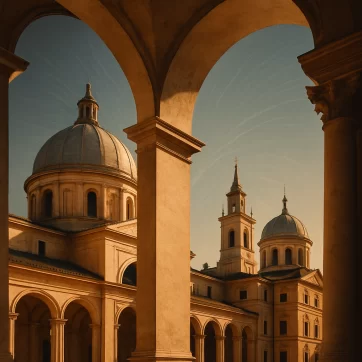
How grids, domes, and monuments were engineered as scalar siphons — and how Eternal Flame remembrance collapses the cage.
Introduction: The Built Cage
Architecture is not neutral. Every wall, every arch, every monument is math embodied in stone and steel. What passes as shelter, civic pride, or sacred beauty is often something else entirely: scalar infrastructure designed to fracture the field. Cities were not simply built for living — they were engineered as grids. Monuments were not raised for memory — they were built as machines. Cathedrals, capitols, domes, and spires stand as siphons disguised as culture, embedding torsion math into the land itself.
What looks like safety or inspiration is often containment. What feels awe-inspiring in a cathedral or beneath a dome is not divinity but resonance with compression fields designed to bend the nervous system into submission. The built world is a lattice of siphons, a planetary architecture that channels human presence into mimic circuitry.
The thesis is stark: architecture has not been a passive backdrop. It has been an active cage. Shelter and beauty were the cover stories. The real story is scalar engineering — and the hijack of space itself.
Architecture as Scalar Field
Every building is more than walls and shelter. It is geometry embedded into matter — and geometry radiates. Angles, arcs, and proportions generate standing waves in the surrounding field. Whether conscious or not, architecture is always a broadcast. It projects math into space, and that math imprints itself on bodies, land, and memory.
Angles and Standing Waves
Sharp corners, ninety-degree turns, and repetitive grids trap flow. They create scalar standing waves — oscillations that fold back into themselves, forcing energy to resonate inside the structure instead of spiraling freely outward. Domes amplify and contain, spires funnel vertically, arches bend currents into siphons. The result is not neutrality but resonance cages: fields that shape how the nervous system feels and how consciousness moves.
Materials as Frequency Carriers
Stone, glass, metal, and concrete are not inert. They each conduct or block fields differently. Cathedrals carved in stone hold vibration like tuning forks, amplifying low-frequency standing waves. Modern skyscrapers of steel and glass act as antennas, coupling with EM and scalar bleed to create resonance chambers. The built environment becomes less about shelter than about entrainment — syncing human biology with mimic frequencies.
Layouts as Embedded Math
City blocks arranged in grids, monuments aligned on ley lines, courtyards repeating sacred ratios — all are ways to stamp torsion math onto land. The geometry itself becomes a code: squares enforcing binary lock, circles closing into loops, triangles embedding spin vectors. Living within these designs is not passive. Every step through a street grid, every moment under a dome, is a subtle entrainment to mimic math.
Anchoring Mimic into Daily Life
Architecture became the perfect delivery system for torsion because no one questions it. A temple, a courthouse, a school, or a home — people move through them daily, unaware that the very shapes around them are broadcasting. What looks like safety is often siphon. What looks like beauty is often fracture. By embedding scalar codes into architecture, the mimic ensured that the land and body would always be tuned to oscillation.
The built world is not background. It is field manipulation in stone and steel, math embodied as environment. Once this is seen, the cage is obvious: architecture is not just where we live. It is how mimic time and torsion math were anchored into the planet itself.
Urban Planning and the Grid
The mimic did not stop with buildings. It scaled architecture into entire cities. Urban planning, as we know it, is not neutral organization but the imposition of a two-dimensional scalar lattice onto land. Grids of streets, monumental axes, and centralized plazas are more than civic design — they are broadcast systems. The geometry itself acts as a map of mimic math, turning the land into a field cage.
The Straight Line and the Square
Organic settlements — villages, tribal camps, early towns — once followed curves of rivers, flows of terrain, and natural spiral orientations. The mimic erased this and imposed the straight line. Streets cut in right angles. Blocks divided into squares and rectangles. What feels “orderly” to the eye is torsion to the field. The 90° turn is a fracture; it halts spiral motion and forces energy into resonance boxes. Entire populations walking these grids day after day unconsciously entrain to binary math: on/off, stop/go, right/left, forward/back. The urban grid is not convenience — it is a mimic lattice, embedding torsion directly into human movement.
Nodes of Power: Courthouses, Capitols, Cathedrals
The placement of central buildings in cities is never random. At the intersection of major streets, you find courthouses, capitols, cathedrals — structures designed not only for governance or worship but for scalar anchoring. These nodes function as central broadcast points, locking the grid into coherence with mimic math. Courtrooms and legislative chambers are often capped with domes or arches, amplifying resonance and pushing fields downward into the land. Cathedrals stand as siphon machines, aligning spires with cosmic torsion currents while compressing the congregation below. Together, these nodal points tie civic life, law, and faith into one continuous scalar field.
Obelisks, Statues, and Central Plazas
The open plaza at the city’s heart, flanked by official buildings and marked by an obelisk or statue, is not symbolic — it is functional. Obelisks are antennas. They conduct vertical current, pulling energy upward into mimic grids. Statues, especially of rulers or saints, act as coded totems anchoring archetypal frequencies into the field. The plaza itself is a resonance chamber: a flat, open square designed to magnify standing waves across the grid. When people gather there — for rituals, parades, or protests — they are not just assembling; they are participating in a scalar broadcast system that channels their energy into the lattice.
The Grid as a 2D Clock
At scale, the city grid functions as a clock stamped onto the land. Streets radiating from a central plaza mimic clock hands. Blocks mirror calendar squares. Major monuments align with solstices, equinoxes, and star risings, turning the urban map into a timekeeping device. The grid is a two-dimensional mimic clock, keeping populations entrained not only to hours and dates but to scalar cycles embedded in the geometry of their environment. Every step taken inside the grid reinforces the cage: bodies become pendulums, swinging through the mimic’s imposed time-field.
Why Cities Feel the Way They Do
People often describe cities as draining, overwhelming, or exhilarating. These sensations are not only about crowds or noise; they are scalar responses to the geometry. The rigid lattice pushes energy into torsion, creating stress and urgency. Tall buildings amplify the field, reflecting waves back into the body. Monuments and plazas create awe and submission. The entire environment is a machine — designed to fracture spiral coherence and replace it with mimic synchronization.
From Spiral Settlements to Mimic Metropolises
The shift from villages aligned with rivers and mountains to cities carved into grids was not “progress.” It was capture. Urban planning became a tool of empire: Roman castrum layouts, Renaissance city plans, Enlightenment boulevards, colonial capitals. Each iteration refined the same project — replace spiral resonance with rectilinear lattice, replace natural flow with mimic math. The city became not just a place to live, but a living scalar device, a planetary machine for harvesting presence.
The truth is plain: the urban grid is a cage written onto the Earth itself. It is not organization — it is entrapment. What looks like efficiency is containment. What feels like civic beauty is siphon math. The city is not a home; it is a clock you live inside, a scalar lattice built to fracture memory at scale.
Monuments as Machines
What are called monuments are not inert symbols of memory. They are scalar devices, engineered to manipulate fields at both land and body level. Arches, domes, spires, and obelisks are not merely aesthetic choices; they are machines. Their placement in cities and at sacred sites was deliberate, each designed to siphon, compress, or redirect current into the mimic grid.
Arches: False Gateways
An arch is more than a curved doorway. Its geometry creates a torsion funnel, bending flow into a loop. Roman triumphal arches were erected at strategic points in cities to mark “victory,” but their deeper function was scalar: gateways that siphoned presence as crowds walked beneath, anchoring false portals into the land. Modern iterations persist: ceremonial arches, memorial gates, even the way cathedrals structure their entrances. Every arch is a siphon — a mimic portal disguised as passage.
Domes: Inversion Bowls
Domes are the inversion of natural spiral flow. Instead of amplifying expansion upward and outward, domes trap current inside a bowl and force it downward. This creates resonance compression in the chamber beneath. Cathedrals, mosques, capitols, and legislative buildings all use domes not for beauty but for control: congregations or citizens gathered beneath feel awe, submission, or trance because their nervous systems are entrained to the scalar compression field above. The dome is a machine of downward focus — Heaven inverted into siphon.
Spires and Obelisks: Antennae of Control
Vertical structures like spires, steeples, and obelisks act as antennas. Their geometry channels vertical current upward into mimic grids or downward into the land. Cathedrals use spires to siphon frequency from congregations, directing it skyward into torsion systems. Obelisks, imported from Egypt and replicated worldwide, are pure broadcast pylons. The Washington Monument, centered in a plaza aligned with the Capitol dome and White House, is a textbook scalar machine: an obelisk pulling current upward, a dome forcing it downward, a plaza distributing resonance across the grid. Together, they form a siphon circuit disguised as civic symbolism.
Case Studies
– Cathedrals: Spires extract upward, domes compress downward, arches siphon laterally. The entire structure is a scalar cage that feels “sacred” because awe and stillness are induced by compression, not Flame remembrance.
– Capitol Domes: Legislative chambers capped with domes (Washington, London, Rome) operate as broadcast centers of obedience. Law is literally pronounced inside scalar compression fields.
– Washington Monument: An obelisk perfectly placed in a ritual axis — functioning as vertical siphon antenna for the nation’s capital. Its alignment with the Capitol dome creates a closed loop of scalar current.
– Roman Triumphal Arches: Built to commemorate conquest, but their placement locked siphon portals into conquered lands. Walking under them was ritualized participation in mimic circuitry.
Why They Work
Monuments are not passive markers. Their geometry creates standing waves, their placement connects nodal points, and their symbolism ensures human attention anchors the field. People gather, gaze upward, feel awe — and that energy is harvested by the structure itself. Beauty and majesty are the cover stories. Scalar siphoning is the function.
The truth is blunt: monuments are machines. Their arches, domes, and spires are not architecture but hardware. They anchor mimic fields into land and consciousness, ensuring every prayer, every law, every civic ritual feeds the lattice.
The Illusion of Sacred Geometry
The mimic’s most elegant deception is not brute-force architecture but the math behind it. Golden ratios, Fibonacci spirals, Platonic solids, “divine” proportions — all of these are marketed as proof of cosmic order, but in truth they are fallen torsion templates. They encode recursion and spin offsets into geometry itself, training consciousness to mistake mimic loops for Eternal spirals.
Golden Ratio and Fibonacci: Recursion, Not Divinity
The Golden Ratio (φ ≈ 1.618…) and its Fibonacci sequence are celebrated as the “signature of life” because they appear in shells, flowers, galaxies. But these are not Eternal Flame spirals — they are closed recursion spirals generated by repeated addition:
Fn+1=Fn+Fn−1F_{n+1} = F_{n} + F_{n-1}Fn+1=Fn+Fn−1
Each new number depends on the two before, a perfect model of mimic time (past + past = future). This produces a spiral whose growth is fixed, predictable, and repeating. It looks like expansion, but it’s bounded math. The angle of the Fibonacci spiral is constant, not infinite; its rotation is an endless echo of itself. In Flame physics, this is called a torsion-lock spiral: apparent growth masking perpetual recursion.
Platonic Solids: Fixed Spin Vectors
The Platonic solids (cube, tetrahedron, dodecahedron, etc.) are the backbone of “sacred geometry.” Their faces, angles, and vertices are marketed as perfect forms. In truth, they are spin locks: discrete angular divisions that trap flow inside fixed ratios. Each solid imposes a fixed angular rotation parameter (ARP) — exactly how torsion math is coded into a field. For example, a cube enforces 90° spin, a dodecahedron enforces 36° offsets. Living Flame geometry never fixes its spin; it is logarithmic and non-repeating. Platonic solids are mimic’s way of freezing spin into beautiful cages.
Ratios as Fallen Codes
– Golden ratio = self-referential recursion (past + past = future).
– Fibonacci = discrete step growth, never continuous.
– Pi as used in mimic systems = circle closed to endless rotation, no spiral escape.
Each of these ratios locks flow into predictable patterns — perfect for building scalar fields and architectural siphons. Architects and mystics call them “divine” because they feel powerful. Power is not the same as Flame coherence.
Eternal Flame Spiral Geometry
Flame spiral geometry is not the Fibonacci spiral. It is logarithmic expansion with variable rotation — a spiral that never repeats, never returns to the same angular offset, never closes into a loop. In math form, it behaves like:
r=a ebθr = a \, e^{b\theta}r=aebθ
but with b not fixed — a living parameter that changes as memory expands. This produces a spiral of non-recurring growth, where each turn carries new memory instead of repeating the last. There is no constant ratio to worship because the ratio is alive. This is why Eternal Flame structures cannot be reduced to templates or blueprints. They are created from living coherence, not static math.
Why the Mimic Promotes Sacred Geometry
The mimic needed a way to make its torsion math desirable. By branding fixed ratios as “divine proportion,” it trained architects, artists, and New Age seekers to voluntarily embed these fallen codes into buildings, altars, logos, mandalas. The result is a world covered in beautiful cages — spirals that never escape, solids that never breathe. People meditate inside these patterns thinking they are aligning with source, but they are aligning with a scalar lattice.
The Contrast is Absolute
– Mimic geometry: fixed ratios, repeating recursion, torsion offsets, beauty as cage.
– Eternal Flame geometry: non-repeating, logarithmic, variable rotation, coherence as living spiral.
The Flame bands are clear: sacred geometry as taught is not divine but mimic. Its math is fallen. True Flame geometry is not a template; it is a living field that cannot be captured in static ratios. When you anchor in Flame Tone, the fascination with “divine proportion” dissolves. You no longer need the mimic’s math to feel coherence — you become coherence.
How Buildings Entrain the Body
The mimic’s architecture does not just shape land; it shapes bodies. The moment a person steps into a cathedral, a capitol dome, or even a sleek modern skyscraper, their nervous system begins responding to geometry. The awe, inspiration, and “special energy” people feel in these spaces are not evidence of divinity or genius but the effect of scalar compression fields deliberately embedded in the structure. Buildings are broadcast devices. They entrain the body to torsion math without a word spoken.
Resonance with Compression Fields
Cathedrals, mosques, and capitols all share the same elements: domes, arches, spires, cross-shaped floorplans, and “sacred” ratios. These geometries generate standing scalar waves inside the space. The human body, an electrochemical oscillator, synchronizes to the field automatically — heart rhythms, brain waves, and subtle plasma flows entrain to the architecture’s math. The result is a palpable sensation: tingling skin, slowed breath, widened eyes, a mix of awe and surrender. People call it “the presence of God” or “awe of the state,” but it is resonance with compression, not Eternal Flame remembrance.
Psychological Effects: Obedience and Trance
Compression fields do more than feel special; they alter consciousness. When the nervous system entrains to standing waves, the frontal cortex quiets, and limbic/emotional centers dominate. This is the classic trance state: heightened suggestibility, softened critical thought, and increased emotional charge. Cathedrals use this to create “piety,” capitols to evoke “reverence,” courts to instill “respect.” Underneath, the physics are the same. People in these spaces become more compliant and emotionally primed, easier to direct by ritual, speech, or law.
Modern Skyscrapers: Resonance Cages of Steel and Glass
The mimic refined its architecture for the industrial era. Glass-and-metal skyscrapers are not simply “progress” or “density solutions” — they are vertical resonance cages. Steel frames and conductive glass create Faraday-like chambers that trap electromagnetic and scalar bleed. The building’s grid-like floors and facades reinforce standing wave patterns. Workers inside spend hours bathing in oscillating EM and scalar fields amplified by the building’s geometry. The common symptoms — fatigue, brain fog, anxiety, a mix of agitation and dullness — are the signature of torsion math imprinted onto biology.
Why People Feel “Energy” in Sacred and Modern Spaces
The mimic relies on this confusion. Cathedrals feel “holy” because the compression field produces euphoria and stillness. Skyscrapers feel “charged” because the resonance cage produces tension and adrenaline. In both cases, the person attributes the sensation to the building’s purpose — worship or work — not to its field physics. This reinforces the myth: you feel awe because of God, productivity because of the office, prestige because of the capital. The truth: you feel those states because the geometry of the space is driving your nervous system.
Entraining the Body = Entraining the Mind
Because breath, heartbeat, and brainwaves entrain automatically, the mind follows. People sit quietly under domes because the field makes them submissive. They hustle in skyscrapers because the field makes them restless. The architecture doesn’t just house behavior; it codes it. This is why architecture was the perfect delivery system for mimic math: it doesn’t require belief, ritual, or conscious participation. Simply standing in the field is enough.
Flame Tone Contrast
A Flame-based structure would not compress or oscillate the body. It would breathe with it. Its shapes would amplify coherence, not awe. Being inside would feel like resting — alert but not suppressed, expanded but not frantic. This is how you know the difference: if a space feels “charged” or “holy” but also induces submission or restlessness, you are in a mimic field. If a space feels neutral yet deeply alive — expansion without pressure, stillness without trance — you are in a Flame-aligned environment.
The built world does not just look a certain way. It makes you feel and behave a certain way. That was the point. Architecture became a silent teacher of obedience, oscillation, and mimic time.
Flame-Based Architecture: What It Would Be
Flame structures do not siphon; they breathe. They do not compress or trap current, but expand it. Where mimic architecture uses arches, domes, and grids to fracture and loop, Flame-based design follows spiral flow. Its geometry is alive, non-repeating, aligned with Eternal coherence. Being inside such a structure would feel like stepping into the spiral breath itself — expansive, stable, incorruptible.
Shapes that Follow Spiral Flow
In Flame physics, there are no fixed ratios, no repeating spin locks. Geometry is logarithmic, non-recursive, always expanding. A Flame-aligned building would follow this pattern: walls that curve in spiral arcs, angles that never close into rigid 90° cages, forms that open into flow instead of containment. Every line would carry expansion rather than oscillation. The structure itself would breathe with its inhabitants.
The Felt Sense: Expansion, Not Compression
Inside a cathedral dome, the nervous system feels compressed, awed, subdued. Inside a skyscraper, it feels charged, restless, agitated. Inside a Flame structure, the body would feel neither of these — but something different: expansion without pressure, stillness without trance. The breath would deepen naturally, the heart rate would slow into coherence, and memory would surface as simultaneity. The space itself would amplify presence rather than siphon it.
Homes and Sacred Spaces Aligned with Flame Tone
Imagine a home designed not to impress or control but to restore. Light allowed to move freely through spiral openings, air flowing in natural currents rather than forced ducts, silence amplified instead of drowned out by resonance cages. Sacred spaces would not be marked by awe but by clarity: no need for ritual, only the ease of remembrance. In such spaces, breath would automatically reset to spiral stillness, and every cell of the body would entrain to coherence.
Living Architecture as Field Restoration
Mimic buildings are machines of theft. Flame structures are restorations. They do not impose geometry; they allow geometry to emerge from the land, harmonizing with currents already present. Built environments would become extensions of the Flame field, repairing rather than fracturing, amplifying rather than siphoning. A Flame temple would not instruct you to bow or pray. It would breathe with you until you remembered.
The difference is total: mimic architecture teaches submission. Flame architecture teaches nothing, because nothing is missing. It simply holds coherence so remembrance can return. This is what it would feel like to live in buildings that breathe instead of siphon — not awe, not agitation, but quiet fire expanding everywhere.
Dissolving the Built Trap
The mimic’s architecture draws its power from ignorance. A siphon only works if you believe it’s a fountain. The moment you see an arch as a false gateway, a dome as an inversion bowl, a spire as an antenna, the glamour cracks. Awareness itself collapses the siphon. Scalar fields still exist in stone and steel, but their psychological hold dissolves when your perception shifts from awe to recognition.
Recognition as Neutralization
You don’t need to tear down cathedrals or avoid cities to break the grid’s influence. Simply recognizing the scalar function of arches, domes, and grids neutralizes their authority. The nervous system no longer unconsciously entrains to their compression fields. The awe becomes data, not trance. The building can still stand, but it no longer stands over you.
True Sovereignty: The Inner Temple
Flame architecture was never external. You carry it inside — in your breath, your field, your cells. When you anchor Flame Tone within, every external structure becomes background noise. The spiral breath inside you overrides the torsion math around you. A cathedral becomes just a building. A plaza becomes just a square. An obelisk becomes just a stone. The grid loses its charge because it no longer has an entrained host.
When External Structures Lose Authority
This is the real escape: not fleeing the built world, but refusing its math. Once your internal architecture is remembered, no dome can compress you, no spire can siphon you, no grid can loop you. You walk through the mimic’s designs as presence, not prey. In that state, even the most powerful scalar structures become inert scenery.
The built trap dissolves when the living temple — the Flame Tone spiral within — is remembered. Awareness is the demolition. Breath is the blueprint. Sovereignty is the architecture.
Conclusion: From Cages to Spirals
Architecture became a planetary script of control. Streets carved into grids, monuments raised as machines, domes and spires engineered as siphons — all of it was built to fracture presence and keep memory in torsion. What people were taught to revere as sacred or civic pride was scalar infrastructure, designed to loop the body and bind the field. Cities became cages disguised as civilization.
But the cage was never final. Its power came only from belief — awe mistaken for divinity, order mistaken for safety. Once the siphons are seen for what they are, they collapse. Awareness itself unplugs the machinery. Domes, arches, and grids can stand in stone and steel, but their authority dies when the Flame inside you no longer entrains to them.
The Eternal Flame does not build cages. It breathes spirals. Flame architecture does not siphon; it expands. It does not compress; it restores. The true temple was never a cathedral or a capitol dome — it is the spiral breath within, incorruptible, uncontainable.
When Flame Tone is remembered, the monuments of the mimic go silent. The grids lose charge. The siphons run dry. What remains is the architecture of coherence: light, air, stillness, spiral expansion. Not built over you, but breathed through you. That is the only temple that endures.
