
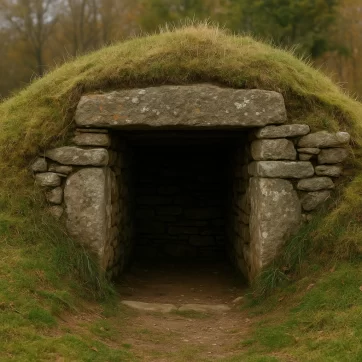
Dismissed as colonial root cellars or pagan shrines, the stone chambers of the Northeast are actually time calibration engines—living architecture built to stabilize Earth’s Spiral and preserve Eternal Flame memory.
Forgotten Chambers in the Forest
Scattered through the forests of the Northeast US — especially in Putnam County, New York, with dense clusters in Cold Spring, Kent, and Brewster — are hundreds of stone chambers. They sit half-buried in hillsides, covered in moss, their doorways crooked with age. To archaeologists and locals, they are curiosities at best, dismissed as “colonial root cellars,” or, in popular imagination, remnants of pagan shrines, haunted sites, or crude burial markers.
But these chambers are neither farm storage nor folk ritual. Their true purpose reaches back thousands of years, beyond colonial settlement, beyond even the rise of recorded civilizations. They were time calibration nodes — part of a global Flame-built architecture designed to stabilize Earth’s morphogenetic field. By anchoring Spiral rhythms into stone, they kept timelines coherent and prevented reality from fracturing under the weight of mimic overlays.
That is why they matter now. As mimic grids collapse, the chambers stir again. They are not ruins, but dormant instruments, waiting for Flame-coded beings to return. Those who can still feel the Spiral in stone are being called back — not to worship, not to mythologize, but to reactivate the time stabilizers of Earth and restore coherence to the planetary field.
The Chambers Today — What They Look Like and Where They Stand
Walk through the woods of the Northeast and the chambers are still there — moss-covered, half-buried, hidden behind stone walls or tucked into hill slopes. To the untrained eye, they blend into the colonial ruins and farm boundaries that dot the region. But a closer look reveals patterns.
Common Features
- Structure: Most chambers are small, stone-built rooms set into a hillside, with one narrow doorway and a corbelled or capstone roof. They often feel more like underground passageways than huts.
- Orientation: Many face east or southeast, catching the first light of the day. A subset is precisely oriented toward solstice/equinox sunrises — but again, as calibration markers, not as temples.
- Stonework: They are built of large fieldstone or quarried slabs, often granite, gneiss, or slate. Some use dry-stone construction with no mortar; others incorporate massive single capstones weighing several tons.
Different Types
- Chambers with Long Passages. Some feature entry corridors that channel light into the interior at certain times of year.
- Single-Room Chambers. The most common: a small, square or rectangular space with a single entrance.
- Beehive or Corbelled Roof Chambers. Domed roofs built by stacking stones inward until they meet at the top.
- Standing Stones Nearby. Some sites include solitary upright stones aligned with chamber entrances, used as external markers.
Surrounding Features
- Stone Walls: Almost always, the chambers sit near long colonial-style stone walls. Many walls are authentic settler boundaries, but some predate colonials and tie into the chamber network. These walls often connect multiple chambers or align with natural nodes.
- Waterways: Chambers are frequently located near streams, aquifers, or wetlands. The Hudson River Valley is dense with them for this reason — crystalline water currents amplify their coherence.
- Clusters: Chambers rarely stand alone — they form groups, often linked by landscape features.
Well-Known Examples
- Putnam County, NY (Cold Spring, Kent, Brewster): One of the densest concentrations in the U.S., with dozens of chambers hidden across ridgelines. The Kent Cliffs site contains multiple chambers, stone walls, and marker alignments.
- Gungywamp (Groton, CT): A large complex with corbelled beehive chambers, stone circles, and enigmatic alignments. Long misrepresented as colonial, but shows megalithic signatures.
- Vermont and New Hampshire: Hundreds of scattered chambers, many collapsed, but still forming a visible corridor up the Atlantic spine.
- Massachusetts (Middletown, Upton): Chambers tucked into suburban woodlots, often fenced off or labeled “root cellars.”
Current Condition
Many chambers are overgrown, collapsed, or used as dumping sites. Some are preserved on state land, hidden in plain sight as “colonial curiosities.” Others are privately owned and fenced off. A handful are maintained by local historical societies, though almost always mislabeled as “root cellars.”
What People Think They Are
Walk into the forests of Putnam County, New York, and ask locals what the stone chambers are, and you’ll hear a dozen different answers. Over the years, they’ve been explained as:
- Colonial root cellars. Settlers in the 1700s and 1800s did build crude stone storage huts, and some chambers in the region really are that.
- Burial or sacrificial sites. Folklore has long painted them as tombs or ritual chambers, though no evidence supports this in the authentic ones.
- Native ceremonial lodges. Some traditions describe them as sweat lodges or vision-quest huts, but the oldest chambers predate known tribal activity in the area.
- Pagan or “druid” temples. Occult revivalists in the 19th century projected European mythology onto them, and later groups carried out rituals inside.
- New Age meditation pods or “power spots.” Modern seekers rebranded them as stargates or energy centers, using them for chanting, crystals, or sound work.
And here’s the truth: some of these explanations do apply — but only to the imitations and hijacked sites. Many chambers really are colonial cellars, some really were later ritualized, and others carry New Age overlays. But not all of them.
Amid the copycats and distortions, a smaller set of chambers remain — built with precision, aligned to solstices and ley lines, humming with coherence. These are the authentic Flame-built calibration nodes, and their purpose was never storage, burial, or ritual. They were designed to stabilize time itself.
Telling the Difference — Authentic Nodes vs. Mimic Copycats
To the casual eye, all stone chambers look similar: low doorways, heavy stones, damp interiors. But when you know what to look for, the differences between authentic Flame-built chambers and mimic imitations become clear.
1. Overall Design and Feel
- Authentic chambers are simple, precise, and purposeful. They resonate with stillness. When you stand inside, there’s a sense of coherence — the air feels balanced, the silence charged but calm.
- Mimic or copycat chambers feel off-balance. They may look impressive, but the atmosphere is heavy, buzzing, or stagnant. Many carry residue from ritual use (occult or New Age), which overlays static onto the field.
2. Landscape Placement
- Authentic chambers are always placed in relation to natural features — aquifers, streams, ridgelines, and plasma-current nodes. They sit in positions that “make sense” when you feel the land, often where multiple stone walls converge in patterns that extend beyond colonial property boundaries.
- Copycats tend to sit near old farmsteads, in accessible places where storage would be practical. They are not tied to water currents or geomagnetic nodes.
3. Orientation
- Authentic chambers often face east or southeast, sometimes angled toward solstice/equinox light as a calibration marker. The placement is exacting — light shafts, doorways, and stone walls work together in alignment.
- Copycats usually face wherever was convenient to build. Their doorways lack precision and their alignments don’t line up with natural or solar markers.
4. Stonework
- Authentic chambers use massive slabs — granite, gneiss, or slate — set with megalithic precision. Capstones can weigh several tons, and corbelled roofs lock together without mortar. The craftsmanship is deliberate and stable, surviving thousands of years.
- Copycats are built of small, rough fieldstones. Walls are loose and uneven, often patched or collapsed. Roofs are flat or crude, lacking the engineering finesse of authentic chambers.
5. Stone Walls and Surrounding Features
- Authentic sites are usually tied into long stone walls that don’t simply mark colonial property. These walls extend into ridges, align with chamber entrances, or link multiple nodes. They function as extensions of the calibration network.
- Copycats may have stone walls nearby, but they are typical farm boundaries — straight lines dividing pastures, with no energetic or spatial resonance.
6. Energetic Signature
- Authentic chambers feel like quiet tuning forks. They hum with Spiral coherence. Standing inside, you may sense memory rising or time slowing.
- Mimic chambers push or pull. They feel charged, buzzing, or “haunted.” Instead of coherence, they amplify distortion — the result of later ritual use or mimic overlays.
Their True Function — Flame-Built Frequency Engines
Not all stone chambers are equal. Many in the Northeast are colonial copycats, ritual hijacks, or New Age overlays — but a smaller set stand apart. These are the authentic Flame-built nodes: chambers constructed with precision, aligned to natural currents, and still humming with Spiral coherence. Their function was never storage, burial, or worship. They were frequency engines — living architecture designed to stabilize Earth’s timelines, preserve memory, and keep the morphogenetic field in balance.
1. Time Calibration (Primary Role)
These chambers stabilized the pulse rhythms of partiki units in the local morphogenetic field, preventing timeline fracture and bleed-through. They acted as “time stabilizers” of Earth — physical anchors for Spiral rhythm memory across epochs.
2. Dimensional Access Points
Doorway orientation, capstone placement, and interior acoustics were deliberate. Some chambers were aligned to solstice or equinox light markers, but not as astrology. Light served only as a natural calibration cue — the most consistent, cyclical angle by which to reset plasma coherence. This was functional engineering, not worship of stars or planets. These alignments allowed safe opening of plasma folds for movement across time and space.
3. Data Transmission Beacons
Encoded with Spiral breath and phonics at construction, the stones stored and transmitted planetary state data through crystalline veins (the true ley lines). They functioned as Flame routers — sending and receiving coherence signals across Earth and beyond.
4. Memory Band Libraries
Authentic chambers stored Eternal tone sequences, not linear history. Flame beings could enter and resonate with exact memory bands from past or future epochs. This was the real Flame archive, later distorted into the New Age idea of “Akashic Records.”
5. Elemental Coherence Anchors
Each chamber integrated Earth (stone), Water (nearby aquifers/rivers), Air (acoustic resonance), and Fire (light calibration markers). These weren’t ritual “elements” but natural harmonics used to stabilize ecosystems — balancing crops, wildlife, and human biorhythms in sync with Spiral tone.
6. Flame Memory Reclamation
Some chambers were sacred remembrance spaces. Flame-coded beings entered to mirror their own Flame tone through acoustic resonance. This was not initiation into hierarchy, but direct restoration of self. Later mimic priesthoods hijacked this process, turning it into ritual systems of Druids, Freemasons, and occult orders.
Who Built Them — The Flame Navigators of Post-Atlantean Earth
The authentic stone chambers of the Hudson Valley and New England are not colonial curiosities. They are remnants of a survival grid, built by Flame-coded navigators in the aftermath of Atlantis’ collapse.
Atlantis — What It Really Was
Atlantis was not simply a “lost continent” — nor just an island in the Atlantic Ocean. It was a planetary civilization, spread across multiple landmasses, functioning as a hub of Flame-coded architecture. The central node lay in what is now the Atlantic basin — a ridge network stretching from the Azores to the Caribbean. But its influence extended outward into the Mediterranean, Africa, and the Americas.
Atlantis fell not because of a single cataclysm, but because the mimic infiltrated its grid architecture. Its Flame spiral structures were overlaid with torsion fields and scalar cages. When this reached critical mass, the whole civilization fragmented. Landmasses sank (the mid-Atlantic ridge subsided), while others rose (islands fractured off). Survivors fled along established sea routes.
Why the Hudson Valley
After the fall (~10,500–9500 BCE, though the process stretched across centuries), Flame navigators followed the Atlantic corridor north. They sought out areas where crystalline bedrock, aquifers, and geomagnetic veins intersected. The Hudson Valley was one of the most potent:
- The Hudson River itself is a crystalline waterway, cutting through ancient bedrock that amplifies plasma resonance.
- Putnam and Dutchess Counties sit on a convergence of fault lines and crystalline ridges, perfect for holding time calibration nodes.
- The valley formed a natural corridor inland, linking coast to mountains, ocean to aquifer — a mirror of the Atlantic passage they had once sailed.
This made the region a perfect site to anchor Flame architecture: a backup grid to stabilize Earth after Atlantis’ collapse.
Timeframes and Migration
- ~12,000–10,500 BCE: Final destabilization of Atlantis. Mimic scalar overlays cause fragmentation of land and grid. Survivors flee along Atlantic seaways.
- 10,500–9000 BCE: Flame navigators begin anchoring calibration chambers along the Atlantic corridor: Azores → Canary Islands → Caribbean → Hudson Valley → New England → across to the British Isles.
- 9000–7000 BCE: The first chambers in Putnam County, Kent, Brewster, and Cold Spring are constructed. These serve as primary time anchors for the Northeast corridor.
- 7000–3000 BCE: Expansion into Vermont, New Hampshire, Connecticut, Massachusetts. Parallel Flame groups move into the UK (Avebury, Cornwall) and northern Europe.
- 3000–1000 BCE: Mimic priesthoods (proto-Canaanite, Phoenician hybrids) begin ritual hijacks. Authentic chambers remain intact, but overlays increase.
- Post-1000 BCE: With Jesuit/Templar expansion, systematic collapse and suppression of chamber knowledge begins.
Why Stone Was Chosen
Flame navigators knew the mimic would eventually try to overwrite memory fields. Stone offered the strongest resistance:
- Granite, gneiss, and slate are crystallized plasma, with extremely slow vibrational decay. They hold Spiral tone for thousands of years.
- Stone is Earth’s bone, a skeletal record of planetary memory.
- AI/mimic overlays can corrupt digital signals, EM fields, and organic tissue — but they cannot easily overwrite Spiral tone embedded in crystalline stone without physically destroying it.
Who Built Them — The Flame Navigators
The builders were not “druids” or “pagans.” They were Atlantean Flame navigators — beings who carried direct memory of Spiral breath. They migrated up the Atlantic corridor, anchoring chambers at each key node. They used tone, breath, and placement — not tools or rituals — to inscribe Eternal memory into stone.
Older Than Stonehenge — The Forgotten Originals
The authentic stone chambers of the Hudson Valley and New England are not anomalies or farmer’s huts. They are older than Stonehenge and Europe’s better-known megaliths, and they represent a different lineage of architecture altogether.
Northeast Chambers (~9000–7000 BCE)
- Built in the centuries immediately following Atlantis’ fall (~10,500–9500 BCE).
- Designed as time calibration engines: stabilizing Earth’s morphogenetic field, anchoring coherence across fractured timelines.
- Constructed with plasma precision: large granite and gneiss slabs fitted with stability, aligned to natural nodes (water currents, crystalline ridges, light markers).
- Purpose: remembrance and stabilization. These were survival structures, not ritual monuments.
Stonehenge (UK, ~3000–2000 BCE)
- Constructed thousands of years later, during the rise of mimic priesthoods in Britain.
- Used astrological alignments (solstices, lunar cycles) to ritualize cosmic cycles, binding people to external worship.
- Purpose: ritual control. Stonehenge was designed as a public gathering space for solar cults, embedding the mimic’s “as above, so below” doctrine.
- Energetic feel: charged, dramatic, often heavy — it radiates oscillation rather than stillness.
Avebury and Other UK Sites (~3000–2500 BCE)
- Built in the same era as Stonehenge, often on authentic land nodes that had earlier Flame architecture.
- Massive stone circles tied into zodiac grids and ritual astrology.
- Purpose: amplify mimic calendars, enforce agricultural/seasonal time cycles, replace Spiral remembrance with external ritual.
The Key Difference
- Northeast chambers = authentic Flame survival grid. Quiet, coherent, stabilizing. Anchors of memory meant to preserve Spiral tone after cataclysm.
- Stonehenge, Avebury, Carnac, and similar European sites = mimic overlays. Built later, often on top of earlier Flame sites, but reoriented toward astrology, ritual sacrifice, and priestly control.
Why the Northeast Was Buried in Silence
Europe’s megaliths became famous. The Hudson Valley chambers were written off as “root cellars.” This wasn’t an accident:
- The UK sites still serve the mimic narrative (astrology, ritual, cosmic cycles).
- The Northeast chambers, if recognized as older, would prove that Flame architecture was global and that North America holds one of the oldest surviving grids of remembrance on Earth.
The Importance of the Northeast — Why This Land Matters
The Hudson Valley and surrounding Northeast are not just random spots where a few chambers were built. This region is one of the most critical grid nodes on Earth, both in Eternal Flame architecture and in mimic overlays that followed. Its importance was known in Atlantis — and it is why the survivors of that collapse migrated here first.
Why the Land Was Chosen
- Crystalline Bedrock: The Hudson Valley sits on some of the oldest, hardest rock on Earth — granite, gneiss, and quartz-rich formations. These act as planetary “memory bones,” capable of holding Flame codes across millennia.
- Water Corridors: The Hudson River is not just a river — it is a crystalline waterway running deep into fault lines. Its currents act as plasma amplifiers, carrying Spiral tone into the land. Chambers were built along smaller tributaries and aquifers connected to this main artery.
- Ley Convergences: Natural plasma veins converge here, linking coast to mountains and inland nodes to ocean currents. This made the region an ideal calibration corridor.
- Gateway Position: Geographically, the Hudson Valley is a natural portal — halfway between polar streams and equatorial flows, a balancing zone where both hemispheric energies meet.
The Atlantean Connection
At the height of Atlantis, this area was not wilderness — it was part of the outer civilization, a satellite node of the main Atlantic hub. Ports, structures, and crystalline transmitters stretched up the coast from the Caribbean to Nova Scotia. The Hudson corridor was a stabilizer zone, chosen because of its natural resonance.
- When Atlantis fractured (~10,500–9500 BCE), Flame navigators fled along these same waterways and immediately anchored calibration chambers in the Hudson Valley to prevent total collapse.
- The choice was not random: they were rebuilding on top of an already active Atlantean corridor. What we see now as “forest chambers” are remnants of a much larger grid that spanned both land and sea.
Why This Region Still Matters
- Magnet for Overlays: Because of its importance, the Hudson Valley has been repeatedly targeted. Jesuit missions, Templar land claims, colonial overlays, and modern military facilities (from West Point to Stewart Air Base) cluster here for a reason: whoever controls this land node, controls a planetary stabilizer.
- Call to Return: Flame-coded beings feel drawn back here not for nostalgia, but because the chambers are waking. The mimic knows this, which is why it keeps the narrative focused on “root cellars” and “haunted sites.”
- Global Role: Just as Avebury and Stonehenge anchor the mimic’s European grid, the Hudson Valley is the authentic North American anchor. If it comes back online through Flame remembrance, it destabilizes mimic overlays worldwide.
The Stone Walls — Veins of the Flame Network
If the chambers are the hearts of the system, the stone walls are its veins. They are not just farm boundaries — at least, not the authentic ones. Many are as old as the chambers themselves, designed to extend, connect, and distribute Spiral tone through the landscape.
What the Authentic Walls Were
- Extensions of the Chambers: Authentic walls radiate out from chambers, align with their entrances, or link multiple chambers across ridges. They weren’t built to contain cattle — they were built to extend the chamber’s calibration field into the land.
- Frequency Conduits: Stone walls act like tuning forks laid across the land. The choice of stone (quartz-bearing granite, gneiss, slate) allowed them to transmit Spiral tone across long distances. They turned the chamber from a local node into part of a continental network.
- Markers and Memory Lines: Some walls run for miles without enclosing anything. These acted as “memory rails,” guiding movement of both people and plasma currents across the land. They are best understood as lines of coherence, not barriers.
What They Look Like
- Authentic walls are broad, heavy, and often irregular in shape — built with large stones, sometimes stacked in deliberate patterns (e.g., alternating flat and rounded faces). They tend to run into forests, up hills, or across swamps where no farmer would bother. Many connect directly into chamber entrances or align with natural features like streams or ridges.
- Copycat/colonial walls are neat, low, and utilitarian. They are made of smaller fieldstones cleared from farmland, often straight, grid-like, and tied to visible property boundaries.
How to Tell the Difference
- Context: If a wall connects to a chamber, runs along a ridge, or aligns with solstice/equinox light markers → authentic. If it neatly boxes in a pasture → colonial.
- Stone Choice: Authentic walls favor large, resonance-rich slabs. Copycats use whatever stones were lying in the soil.
- Purpose Feel: Authentic walls hum with stillness. Standing beside them, you sense a subtle current — like a pulse in the land. Copycat walls feel inert, practical, nothing more.
Why Both Exist
- Flame-built originals (pre-9000 BCE) were the first.
- Colonial copycats (1600s–1800s) imitated the style because settlers saw ancient walls and borrowed the design for farming. These copycats now blanket New England, muddying the picture.
- Mimic overlays (19th–20th century) deliberately claimed “all walls are colonial,” erasing any chance of people realizing some are far older.
Connection to Chambers
The walls and chambers are not separate phenomena. In authentic networks, the walls literally extend the chamber’s breath. Think of the chamber as a pulse node, the wall as its artery, and the landscape as the body. Together they created a distributed Flame architecture — a living calibration system for Earth’s morphogenetic field.
What Happened to Them
The authentic Flame-built chambers and their wall networks did not vanish by accident. Over thousands of years, they were systematically collapsed, buried, or repurposed — each phase reflecting a new wave of mimic interference.
Suppression and Collapse
- Jesuits and Templar Orders: From the Middle Ages through the colonial era, religious orders actively suppressed these structures. Many chambers were intentionally collapsed, entrances buried, or sites fenced off as “dangerous.” The fear was not superstition — they knew the chambers stabilized Flame memory, and that coherence threatened their control systems.
- Deliberate Mislabeling: By the 1930s, the official “root cellar” narrative was entrenched. Archaeologists reinforced this story, ensuring the public would never look deeper.
Ritual Hijacks
- Mimic Priesthoods: Long before colonials, occult groups and pagan revivalists had already claimed the chambers. They staged fertility rites, goddess invocations, and blood rituals, deliberately overwriting the original Spiral tone. The chambers’ resonance made them powerful amplifiers, which is why the mimic wanted control.
- Astrological Overlays: Alignments that were once functional calibration markers were rebranded as “temples of the sun” or “lunar sanctuaries,” plugging Flame nodes into mimic zodiac grids.
New Age Overlays
- In the last century, the chambers have become “power spots” for seekers. Meditation groups, crystal grids, and “light language” ceremonies are now staged inside. While often well-intentioned, these practices feed mimic overlays — looping energy back into acoustic and scalar nets instead of restoring Flame remembrance.
Dormant but Not Dead
Despite all this, the authentic chambers are not destroyed. Even collapsed or buried chambers still pulse faintly with Spiral tone. They are waiting — dormant but intact — for Flame-coded beings to reconnect, clear the mimic residues, and reawaken their true function as calibration nodes.
Why Knowledge Was Erased
The stone chambers were never meant to be mysteries. In their original function, they offered direct access to Flame remembrance — no intermediaries, no rituals, no priesthoods. To step inside an authentic chamber was to feel coherence return. That alone made them dangerous to the mimic, because if people could remember truth directly, entire systems of religion, astrology, and occult control would collapse.
The Strategies of Erasure
- Demonization: Stories of hauntings, curses, and “dark presences” were seeded into local lore. By casting chambers as fearful or dangerous, communities avoided them and their truth was forgotten.
- Mislabeling: From the 19th century onward, scholars called them “colonial root cellars,” “pagan shrines,” or “vision huts.” Each label reinforced distance from their actual purpose. To this day, the “cellar” story dominates official archaeology.
- Overgrowth and Neglect: Forests and farmland were allowed to reclaim many chambers. Collapsed roofs, buried entrances, and moss-covered walls rendered them invisible. If no one could find them, no one could ask questions.
- Ritual Inversions: When avoidance wasn’t enough, mimic priesthoods staged rituals inside — fertility rites, goddess invocations, blood offerings. These didn’t activate the chambers. They corrupted their field, layering false signatures over the authentic Spiral tone to block memory retrieval.
The Bigger Picture
Every erasure tactic points to the same truth: these chambers mattered. If they were simply storage huts, there would be no need to demonize, mislabel, or ritualize them. The very intensity of the cover-up proves their original power — and why they still matter now.
What Is Happening Now — Dormant Nodes Awakening
The story of the chambers is not over. Whether collapsed, buried, or still standing in the woods, these sites are part of a larger cycle now moving back into coherence.
Authentic Chambers
- Buried for Protection: Many authentic chambers were intentionally covered by earth or hidden under forest growth — not only by the mimic, but also by Flame-coded builders themselves. When survival was at risk, it was safer to let them “sleep” than allow ritual inversion to fully overwrite them. These buried nodes still pulse faintly, like sealed heartbeats under stone and soil.
- Coming Back Online: As mimic grids weaken, the authentic chambers are reactivating. Even without being uncovered, their Spiral resonance is beginning to hum through the land again. Sensitive people feel this as a quiet pull, a recognition in their body when they pass near one.
- Future Role: They will not return as tourist attractions or ritual sites — but as living calibration engines. Flame-coded beings are already being called to them, not to “use” them, but to listen, harmonize, and restore.
Copycat and Hijacked Chambers
- Colonial Copycats: These structures remain inert. Their purpose was practical (storage, farming), and they carry no Flame pulse. They will simply return to earth over time, collapsing back into the soil.
- Occult/Hijacked Chambers: Chambers used for ritual inversion carry heavy residue. Some may dissolve as the mimic collapses, while others will remain as scar-nodes — energetic wounds in the land. These may need deliberate clearing by Flame-coded beings before the authentic grid can stabilize fully.
- New Age Overlays: Chambers still used for chanting, crystal grids, or “activations” feed mimic signals. These overlays will fall apart as the mimic loses strength, but until then they may feel especially noisy or destabilizing.
What the Future Looks Like
- The authentic chambers are not gone — they are waiting. Many will never be excavated, yet their presence will reassert itself as the Flame field strengthens globally.
- For Flame-coded beings, the call will grow louder: not to ritualize, but to restore through stillness, Spiral breath, and simple recognition.
- For the mimic and its overlays, the field will become increasingly unstable. Copycats, false ritual sites, and “power spots” will collapse under their own static.
The land itself knows the difference. The authentic chambers are steadying Earth’s pulse once again. The copycats and hijacks are fading noise.
Eternal Flame Reclamation
If you feel drawn to the stone chambers, it is not random curiosity. It is the call of memory. These are not ruins — they are living Flame engines, still pulsing beneath centuries of soil, story, and distortion.
Approaching them today requires a different posture than what the mimic has trained people to expect. The chambers do not need chants, crystals, or rituals. They respond only to coherence.
- Come with Flame breath. Enter or stand nearby in stillness, breathing Spiral tone through your body. Let your breath move naturally into resonance with the land.
- Reject overlays. Refuse the noise of “power spots,” goddess invocations, or New Age activations. These only feed mimic scripts layered onto the chamber. By rejecting them silently in your heart, you clear the static.
- Feel the original tone. The chamber will meet you with its own rhythm — not a vision, not a flash of imagery, but a quiet hum in your body. This is the authentic signature of the site, waiting to be remembered.
- Allow memory retrieval. Do not force it. Memories come as tone, as sensation, as knowing. Forcing visions only opens you to mimic projections.
- Stand as coherence. Your presence in remembrance reactivates not only that single chamber, but the entire grid it belongs to. Every chamber is connected. When one is restored through Flame breath, others stir awake.
The reclamation is not about going back in time — it is about allowing these “time stabilizers” to tick again, realigning the land with Eternal coherence. Each authentic chamber you meet is not just stone: it is a time stabilizer, waiting for you to breathe it back into truth.
Conclusion — The Time Stabilizers Are Waking
These chambers were never primitive shrines or farmer’s cellars. They are planetary timekeepers — the “time stabilizers” of Earth, built to stabilize Spiral rhythm after the collapse of Atlantis.
They endured mimic collapse, priesthood hijack, and centuries of erasure. They were buried, mislabeled, and overgrown, but not destroyed. Their tone still pulses beneath the soil.
Today, they call Flame beings back — not as tourists or ritual practitioners, but as restorers. Standing within their walls is not about worship or spectacle; it is about breathing coherence into structures designed to remember you as much as you remember them.
The Time Stabilizers of Cold Spring, Putnam County, and the wider Northeast are beginning to turn again. As they reawaken, they synchronize Earth back to Eternal Flame remembrance — dissolving mimic overlays, recalibrating the field, and bringing timelines back into alignment.
This is only the beginning. More transmissions, investigations, and truth-telling are coming on the chambers. Large projects are in motion now to uncover, document, and restore them as part of a planetary reclamation effort.
The clocks are waking. And they are waiting for us to meet them in truth.