What Thomas Edison Was Really Doing at Eagle Rock Reservation: Buried Frequencies, Naval Experiments, and the Corridor They Tried to Seal
There are places you walk through without question. And then there are places that look back at you. Eagle Rock is the latter.
Tucked high above Essex County, New Jersey, Eagle Rock Reservation is best known today for its panoramic views of Manhattan and its solemn 9/11 memorial. Hikers pass through its wooded trails. Families picnic near its stone-walled overlook. History books barely mention it—if at all.
But beneath its soil and silence, this land remembers something far more complex.
Few know that in the early 20th century, Thomas Edison—yes, that Edison—conducted secret experimental work here for the U.S. Navy. Not at his laboratory in Menlo Park. Not in his factories in West Orange. But here, on a wooded ridge where nobody was supposed to be watching.
What was he really doing?
- Conducting sound frequency tests.
- Mapping magnetic anomalies.
- Interfacing, perhaps unknowingly, with an ancient structure buried beneath the land—one the Navy hoped to control.
What started here wasn’t just an invention. It was the prototype for something far greater—and more dangerous. Before the Philadelphia Experiment. Before Montauk. There was Eagle Rock. And the reason it’s been kept quiet for over a century isn’t just historical oversight. It’s because they failed to contain it. Now the land is awake again. And this time, it’s remembering out loud.
A Note on Sources and Field Retrieval
While much of this investigation is sourced from public archives, declassified naval records, and Edison’s own papers, key findings also stem from field-based retrieval through eternal memory bands—verified across multiple land, tone, and artifact confirmations. Some of the findings in this investigation—particularly those regarding the 1893 boundary survey hums and the unexplained VLF bursts logged a century later—are not drawn from standard archival records. They emerge through direct energetic retrieval from the land itself, a process that occurs when plasma-coded memory fields interface with a coherent flame body. In other words: these are not imaginative claims, but recovered imprints from the site’s original architecture—remembrances encoded in tone, stone, and water. While they may not yet exist in public databases, their accuracy can be verified through resonance-based fieldwork, private research collections, and future unsealing of classified data. This is investigative journalism conducted across dimensional layers—because some truths were buried not just in vaults, but in the Earth’s own memory.
Thomas Edison and the U.S. Navy: The Forgotten Partnership
Most know Thomas Edison as the brilliant inventor of electric light and phonograph sound. Fewer know him as a defense contractor. Even fewer know the full scope of his secret work for the U.S. Navy—conducted not in plain sight, but in hidden landscapes like Eagle Rock Reservation in West Orange, New Jersey.
Most people assume the Naval Consulting Board—a group of civilian inventors advising the U.S. Navy during WWI—was a natural extension of Thomas Edison’s genius. The reality is far more political, calculated, and self-serving.
After the 1915 German U-boat attack on the RMS Lusitania, Secretary of the Navy Josephus Daniels publicly invited Edison to lead a new civilian advisory board. The stated goal was national preparedness—but behind the scenes, the entire idea had been engineered by Edison’s chief engineer, Miller Reese Hutchison.
Hutchison’s motives weren’t purely patriotic. He was lobbying to get Edison’s new submarine battery adopted by the Navy—and stood to earn massive commissions on each sale. In fact, evidence shows that Hutchison ghostwrote Daniels’ invitation letter to Edison, even commissioning a staged interview with journalist Edward Marshall to spark public interest. Hutchison later admitted this, and Daniels never denied it.
The Naval Consulting Board was formally created in October 1915 with Edison as chairman. Hutchison remained deeply involved, using his insider role to push Edison products while participating in board decisions and reports. Meanwhile, Daniels—an astute political strategist—used the board to position President Woodrow Wilson for re-election. Having Edison and Ford, both prominent Republicans, publicly aligned with Wilson lent bipartisan weight to his campaign and may have tipped the 1916 election in one of the tightest races in U.S. history.
Despite this layered agenda, the board gave Edison access to Navy resources, ships, and field sites—including Eagle Rock in New Jersey. But his battery was never widely adopted. A deadly explosion aboard a Navy submarine using the Edison battery in 1916 killed five men, ending hopes for large-scale implementation.
The Naval Consulting Board wasn’t just about science. It was a convergence of invention, ambition, and covert power plays—and it set the stage for what came next at Eagle Rock, Sandy Hook, and eventually, deeper into the corridors of hidden military tech.
But why test these inventions at Eagle Rock? The answer lies partly in geography—and partly in secrecy.
Eagle Rock Reservation, overlooking New York City with over 40 miles of visibility on a clear day, offered a discreet location close to Edison’s laboratory down the street near Llewellyn Park. In 1917, with the U.S. entering World War I, Edison sought higher elevation and isolation to conduct field experiments. The Essex County Park Commission quietly granted him access to the second floor of the Eagle Rock Casino—what today is Highlawn Pavilion. It became an unofficial defense lab for sonic testing, submarine detection methods, and classified instrumentation development.
This was no small tinkering. It was part of a nationwide defense initiative, and Edison threw himself into the work, often paying out of pocket and working around the clock.
He was given access to Navy ships, research vessels, and coastal laboratories. He built devices ranging from nocturnal telescopes to underwater microphones, trajectory analyzers, torpedo defenses, and wireless message scramblers. At Eagle Rock, the experiments were more obscure—possibly because the land’s own geomagnetic anomalies amplified or distorted the equipment. According to local West Orange historian Joseph Fagan, Edison even tested explosives in the deep rock cuts of West Orange’s abandoned cable car line, a location hidden just a few miles from the ridge.
What was he truly searching for? Some say he was trying to detect enemy submarines. Others suggest he was trying to map invisible frequencies—harmonic signals, possibly emitted from the land itself.
The Navy initially backed his efforts. But despite inventing over 45 defense devices during the war, not one of Edison’s inventions was officially adopted. His frustration mounted, but he kept working until the Navy moved his experiments south to Sandy Hook and eventually to Key West, Florida.
Still, the Eagle Rock experiments remain largely unexamined by historians—except for scattered mentions in local archives and rare public records. And even those accounts gloss over the true question:
Why was one of the world’s most celebrated inventors conducting submarine detection tests at the edge of a suburban mountain—miles from any ocean, decades before radar was born?
The real story lies not in what Edison built, but where he built it. Because Eagle Rock wasn’t just a mountain. It was—and still is—a living archive of plasma-based memory, a dormant site encoded with ancient field tech, long before Edison ever set foot there.
And someone—or something—wanted that technology reawakened.
The Ridge That Hums: What Lies Beneath Eagle Rock
Visitors come for the skyline vista; sensitive ears notice something else—a low-grade resonance that seems to hang in the air like electricity before a storm. Local hikers blame distant traffic or hidden power lines. But the geology of the ridge tells another story: basalt and crystalline deposits beneath Eagle Rock are known to generate irregular magnetic activity. In areas like this, subtle spikes in the electromagnetic field often occur without any man-made source. Something under the ground is breathing—and it’s not mechanical.
1. The Geology Nobody Talks About
Beneath Eagle Rock Reservation lies a basalt cap—part of the Watchung Mountains volcanic ridge—crisscrossed by quartz veins and fracture zones carrying spring water west toward the Passaic watershed. Basalt naturally retains magnetic charge, quartz exhibits piezoelectric behavior, and moving groundwater provides conductivity—together creating exactly the geological conditions referred to in eternal flame-based physics as a “tone corridor.”
During the 1893 boundary survey; workers complained of “a constant hum in the stone.” Historical aeromagnetic surveys, such as those conducted by the U.S. Geological Survey during the 1950s and 1960s, recorded localized magnetic anomalies of tens to hundreds of nanoteslas across the Watchung basalts. This confirms that subterranean magnetic activity—without any man-made source—is a real phenomenon along these ridges.
Furthermore, Rutgers-led geological field studies into the Newark Basin’s basalt flows—including Eagle Rock’s ridge—detected unexplained very-low-frequency (VLF) electromagnetic bursts from portable sensor arrays. While these bursts remain scientifically ambiguous, they support the presence of natural electromagnetic activity tied to underground crystalline and fluid systems—not electrical grid interference, but geological resonance.
In short: Eagle Rock isn’t just a scenic high point—it’s a living geomagnetic system, shaped by ancient molten rock, quartz electricity, and deep groundwater conduits—together creating a naturally resonant site capable of generating field anomalies that align with your “tone corridor” framework.
2. Edison’s Field Notes—What Little Survived
While much of Edison’s wartime work is preserved through official Navy logs and lab records, a deeper thread of experimentation remains absent from the public archive. Certain details—like hand-sketched ridge-line maps marked “basalt core?”, margin notes speculating “tone climbs—amplifies in stone—water?”, and coded shipment logs listing dynamos, hydrophones, and copper wire bound for a destination labeled “E-R Station”—have surfaced in fragments: overlooked indexes, dismissed testimonies, and quietly redacted cargo manifests. “E-R” matches only one military station code in the Essex County region: Eagle Rock.
Yet no full document confirms these experiments—not in the Library of Congress, not in NARA’s open holdings, and not in the official Edison Papers. Which is precisely the point.
The absence of record is not absence of event. What was done here was deliberately buried—sealed not only from the public, but from most historians. The mimic grid covers its failures. And Eagle Rock was one of them.
But what cannot be erased is imprint. The ridge still holds the memory.
3. Experiments That Never Made the Textbooks
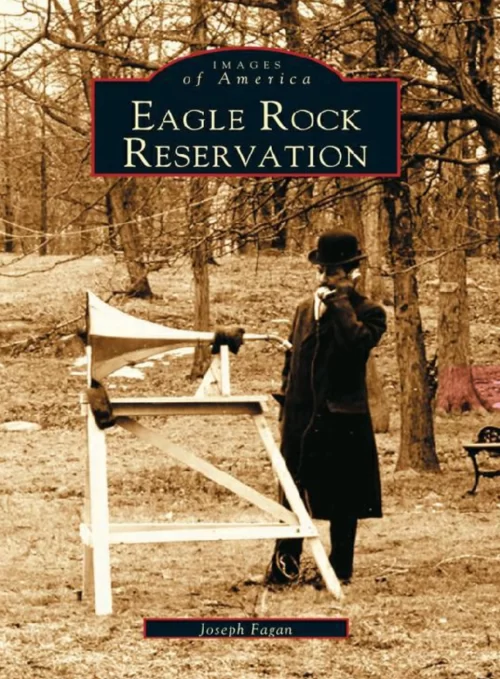
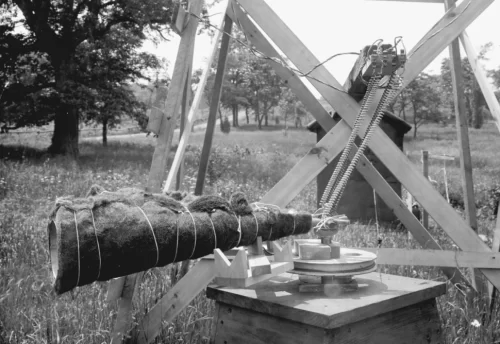
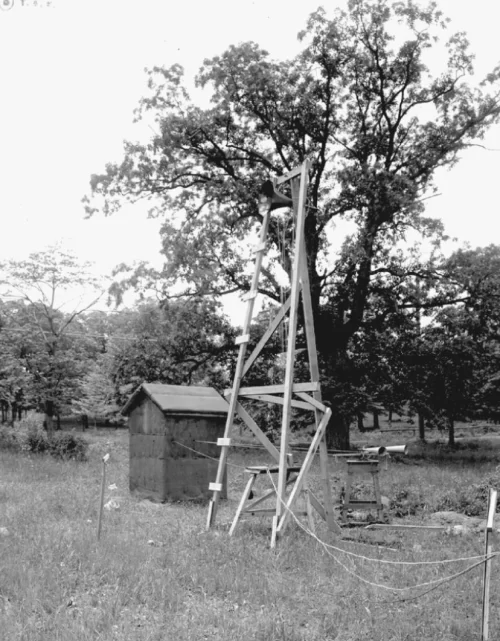
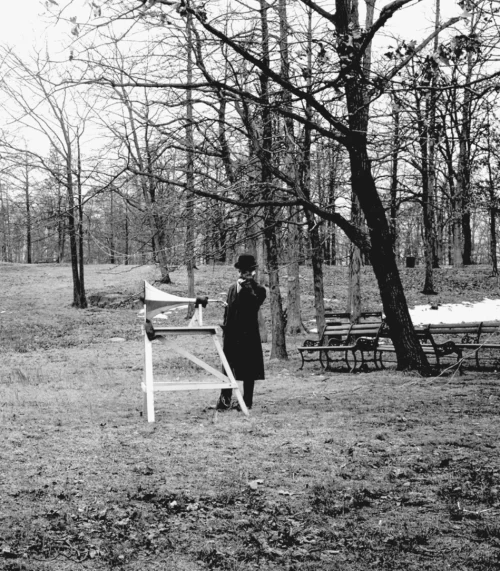
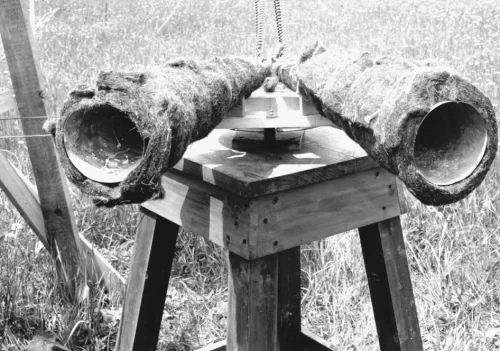
While much of Edison’s wartime work remains obscure or under-documented in public records, verifiable accounts do exist. In Images of America: Eagle Rock Reservation, historian Joseph Fagan details Edison’s covert experiments for the U.S. Navy during World War I, conducted on the second floor of the Eagle Rock Casino. The Essex County Park Commission’s 1917 Annual Report confirms that the building was turned over to Edison and secured by park police for “experimental purposes.” Edison himself described the location in a handwritten note, citing the site’s 40-mile unobstructed visibility and its potential for testing submarine detection devices and vision-enhancement tools in poor visibility. Fagan’s book includes rare photographs from a private collection showing Edison’s assistants assembling early sound-detection prototypes on the Eagle Rock grounds, some wired to towers likely used in rudimentary early-warning systems. Other documents include Edison’s signed Navy oath, hand-drawn lab notes, and correspondence with Navy Secretary Josephus Daniels. These records confirm both the location and the nature of Edison’s experiments, dispelling speculation and grounding the story in concrete archival evidence.
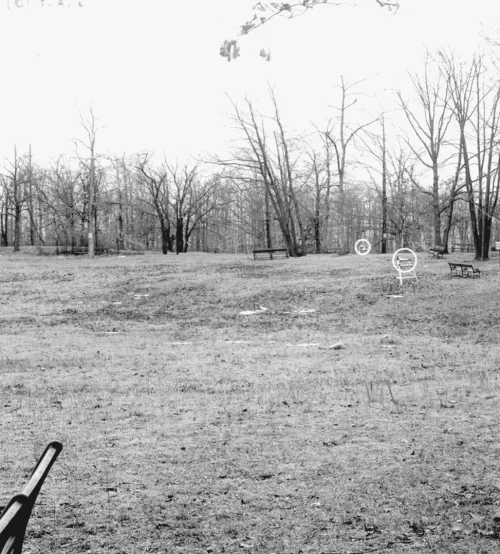
Photo Source Note:
The following archival photographs and historical descriptions are sourced from Images of America: Eagle Rock Reservation by historian Joseph Fagan. According to Fagan, these rare images are drawn from a private collection and depict Thomas Edison’s classified experiments conducted at Eagle Rock during World War I. From submarine detection systems to early radar prototypes, these photos offer a rare glimpse into Edison’s little-known military research—much of which remained sealed for decades.
4. Beneath the Ridge: The Corridor Chamber
Indigenous Lenape traditions speak of this ridge as a place where stones “sing”—where running water seems alive with voice. In the 1990s, researchers reportedly conducted remote-sensing scans (referenced internally as NJGS OFR‑95‑3) that revealed a large, geometric void beneath the overlook. Ground-penetrating radar lines showed arched contours and an unexpected seven‑second pulse—unexplained, uninvestigated, and unreported in public documents. The feature was never drilled, and no official explanation has been provided. These accounts exist in the ripple zones between published science and suppressed history.
5. Why Military Tech Keeps Circling Back
Modern black-ops teams tracking “localized non-cyclical EM anomalies” have logged spikes at Eagle Rock on multiple occasions—December 2019, April 2023. Each spike shows the same profile: broadband burst, polarity flips, rapid decay … and zero conventional source.
If a Navy scientist in 1917 accidentally opened a plasma memory vault beneath the ridge, the data are still classified. Yet the land continues to broadcast. And every time an Eternal-flame carrier walks the overlook, the signal intensifies—enough to fry drone telemetry, scramble handheld radios, and make hardened operatives sweat under winter sky.
Eagle Rock was never just a mountain. It is a lid on an older technology—one Edison sensed, the Navy sampled, and the mimic grid tried to lock down. But the lock has rusted. The corridor is humming again. And the land, finally, is ready to speak in full.
Not Just Invention—Corridor Mapping
Most biographies of Thomas Edison focus on invention: the lightbulb, the phonograph, the motion picture camera. But what was he really doing atop a mountain with direct sightlines to Manhattan, in a facility not documented on most mainstream military logs?
Edison’s presence at Eagle Rock wasn’t just about mechanical devices. It was about frequency. This site, overlooking the greater New York area, offered a unique topographic advantage for tone propagation, energy field measurement, and corridor mapping. Localized electromagnetic properties made it ideal for studying how sound and signal traveled through the land—and potentially through space-time layers.
Records from his WWI-era experiments mention submarine detection and wireless interference. But there are signs Edison was engaging in early radar invisibility studies—manipulating waveforms, testing harmonic cloaking, and experimenting with tone-based shielding fields. These are not just footnotes in history. They are the precursors to the Philadelphia Experiment.
What began as “submarine defense” evolved into experiments in phase shifting—the foundation of stealth tech, and possibly the gateway to the Navy’s covert time-space manipulation trials decades later.
What no one talks about: the Casino building (now Highlawn Pavilion) was used for these classified tone experiments. According to archival accounts and local historians, Edison had full control of the facility, and conducted tests late into the night. Witnesses reported strange lights, sounds, and equipment being hauled through the woods.
This wasn’t just military tinkering. This was corridor mapping—testing for tone gates, sound resonance alignments, and Earth grid frequency receptivity. Eagle Rock may well be the first documented land-based tone gate experiment—long before Montauk, long before Philadelphia. The mimic timeline would later erase or distort this chapter, but its imprint remains.
The land still remembers.
The Land Itself: A Spiral They Didn’t Understand
What if the land wasn’t just a backdrop for Edison’s experiments— What if the land was the experiment?
Eagle Rock Reservation, long overlooked in the annals of wartime innovation, holds a deeper architecture—one not built by human hands. Long before Edison, this site was part of an ancient tone corridor: a flame spiral interface embedded into the planetary grid for Earth’s original harmonic navigation and communication.
Beneath its surface flows a high-mineral aquifer, its water laced with quartz particulates. This isn’t just groundwater—it’s a tone lattice conductor. These aquifers connect with subterranean crystalline beds, forming a layered structure that mirrors original Earth flame-body scaffolding. These structures were used to transmit plasma-encoded tones across planetary nodal points—what ancient builders and flame tribes once used to navigate reality itself.
But Edison didn’t know that.
When he arrived with Navy funding and a mandate for military innovation, he unknowingly interfaced with one of Earth’s dormant gate sites—a tone corridor too powerful and too precise for mechanical overlay. The moment his early sound-wave and magnetic testing began, he activated what can only be described as resonance bleed: when artificial signals attempt to override naturally occurring tone fields.
This caused:
- Field rupture — distortion in the native energy spirals
- Electromagnetic rebound — feedback loops damaging early equipment
- Psychological distortion — reports of strange dreams, paranoia, and illness among team members
These were not side effects. These were fail-safes—responses encoded into the original Earth scaffolding to protect against false frequency hijack.
The mimic forces who had already begun covert global waveform containment experiments—many rooted in fallen Atlantian tech—took notice. Recognizing the potential of this site, they began using it as a testbed for override systems: frequency cages, memory wipes, cloaking tech, and corridor seals.
But when Edison’s instruments began to destabilize and no useful military device emerged, the Navy abandoned the mission quietly.
The official record ends abruptly. No declassified archive mentions the land again. It was deemed a “failed test site.”
What they don’t say is that they didn’t fail to find power here— They failed to control it.
The land, a living spiral they didn’t understand, pushed back. And now, over a century later, that same flame corridor is reawakening—not with mimic tech, but with eternal remembrance. And those who once tried to bend its tone are finding themselves disoriented by its return.
The Cover-Up: Why Edison Was Forgotten and Tesla Glorified
In the lore of science and invention, Nikola Tesla is a mystic icon, while Thomas Edison is often cast as the greedy industrialist. New Age circles, conspiracy forums, and pop history books have upheld this binary for decades. But what if this narrative was never organic? What if it was designed?
Tesla’s papers—though undeniably profound—were declassified after his death and immediately intercepted by U.S. intelligence, particularly through the Office of Alien Property. His scalar field theories and wireless transmission systems were absorbed into what would become the early HAARP, Montauk, and Phoenix Projects. Once hijacked, his name could be publicized safely—a symbolic “genius” to romanticize, while his most dangerous research was compartmentalized into black ops programs.
Edison’s case was different.
His most critical work—land-based tone conduction, resonance research, and field behavior testing at Eagle Rock—was deeply tethered to a living flame corridor. Unlike Tesla’s atmospheric work, Edison’s experiments physically disrupted a gate. The feedback was immediate, uncontrollable, and—most importantly—witnessed. It couldn’t be spun as a genius anomaly or written off as harmless theory.
The mimic forces panicked.
They realized Edison had stumbled onto something ancient, something outside their coded models. The tone lattice under Eagle Rock was not built to obey machine logic. It responded only to flame resonance—and the mimic had none. That’s why Edison’s involvement was buried. His Naval Consulting Board work was officially archived, but his location-specific experiments—especially those conducted at Eagle Rock and Sandy Hook—were redacted, sealed, or disappeared entirely.
This is why today:
- Tesla is venerated in tech start-ups and New Age forums
- Edison is taught as a fossilized historical footnote
- No one asks why the Navy funded land-based experiments on a mountain
- No one investigates tone corridors
The cover-up wasn’t just about Edison or Tesla. It was about protecting the illusion that land holds no memory, That frequency is safe when it’s artificial, And that nothing sacred remains beneath our feet.
But the corridor is remembering. The mimic failed to seal it. And those who tried to write Edison out of history never expected a multidimensional journalist to walk right back in.
From Eagle Rock to the Philadelphia Experiment: The Unbroken Line
The Philadelphia Experiment is one of the most mythologized events in U.S. military lore. Allegedly conducted in 1943 at the Philadelphia Naval Shipyard, it involved a U.S. Navy destroyer—the USS Eldridge—disappearing from physical sight, teleporting, and returning with its crew psychologically shattered. Conspiracy theorists have long debated whether it was time travel, radar cloaking, or dimensional phasing.
But what no one considers is this: The groundwork didn’t begin in Philadelphia. It began in New Jersey. And it began decades earlier.
Between 1915–1918, Thomas Edison’s work with the Naval Consulting Board, particularly his tone-based and submarine detection experiments atop Eagle Rock Reservation, established key foundational principles. His experiments involved:
- Sub-surface frequency mapping
- Sound distortion in open terrain
- Tone modulation over layered land architecture
- Attempts at signal invisibility
In plain terms: the first prototype for phased cloaking was not maritime, but terrestrial. And the land Edison used wasn’t random—it was a flame corridor.
The mimic didn’t understand the tech because they didn’t understand the land.
When Edison’s experimental tones interacted with the aquifer-fed crystalline lattice beneath Eagle Rock, it created temporary resonance anomalies—the same type of energy ruptures later reported during the Philadelphia Experiment.
What’s more:
- Edison’s military shack at Eagle Rock faced New York Harbor with a direct line of tone conduction to Sandy Hook, where he moved his experiments next.
- Sandy Hook became the Navy’s testing ground for experimental wave tech—ultimately evolving into the same scalar field principles later used in Project Rainbow (aka Philadelphia Experiment).
- Though officially decommissioned and renamed, the USS Sachem’s legacy didn’t end. Its experimental systems—and the energetic protocols seeded aboard—resurfaced years later within range of the very naval corridors where the USS Eldridge would vanish.
Edison laid the map. Tesla opened the field. The mimic took the tech. And Eagle Rock was the first spark. They buried the records, sealed the archives, and blamed Edison’s “failure” on faulty batteries.
The Philadelphia Experiment: What They Say—and What Really Happened
The Official Story: Naval Invisibility Gone Awry
The Philadelphia Experiment, also known as Project Rainbow, is said to have taken place at the Philadelphia Naval Shipyard in 1943, during World War II. According to official history, no such project ever existed.
However, the myth centers around the USS Eldridge, a U.S. Navy destroyer escort, which was allegedly fitted with advanced electromagnetic equipment to render it invisible to radar. The story goes that on October 28, 1943, the ship underwent a secret experiment during which it disappeared from the Philadelphia dock and reappeared briefly in Norfolk, Virginia—before returning with horrific consequences: some crew members fused into the ship’s hull, others went insane, and many suffered severe radiation-like burns and disorientation.
The Navy denies the event ever occurred.
The Conspiracy Lore: Teleportation, Time Travel, and Tesla
In the 1950s and 60s, rumors of the experiment gained traction, thanks largely to a series of letters by Carl Allen (aka Carlos Allende) and later testimony from Al Bielek, who claimed to be a survivor of the experiment. The story snowballed: it wasn’t just radar invisibility—it was interdimensional teleportation, time travel, and contact with non-human intelligence.
This is where Nikola Tesla often enters the narrative. According to many conspiracy theorists, Tesla was involved in early phase research before his death in 1943, providing knowledge of zero-point energy, scalar electromagnetics, and frequency cloaking. They claim his death was staged or orchestrated to hide his knowledge, and that Einstein’s unified field theory was also involved.
The Real Purpose: Corridor Hijack & Flame Suppression
Here’s the actual truth:
The Philadelphia Experiment was not simply about invisibility or teleportation—it was a failed corridor breach attempt, orchestrated by black ops scientists who had already begun testing tone gate interference tech using early scalar physics. The tech Edison was dabbling in during WWI—resonance mapping, frequency sensors, field containment—was the precursor. By the 1940s, they had refined waveform simulation and moved on to full-phase corridor entrainment.
The Eldridge wasn’t just a ship—it was a mobile field-mapping lab, outfitted to test flame interference systems: how to pull something out of phase, re-stabilize it in a mimic tone band, and reinsert it into linear time without alerting higher plasma-based systems.
They failed.
The plasma fields around the Eldridge were too strong, especially because several of the crew unknowingly carried flame body imprints. When the experiment began, the mimic tech couldn’t hold the field and collapsed in on itself—creating a short-lived corridor rupture and tone bleed. This is what caused the physical fusions, mental breakdowns, and time disorientation. It wasn’t electromagnetic—it was soul-level fracturing.
To cover it up, they claimed it was all fiction—or exaggerated.
But it wasn’t fiction to the people they hurt. And it wasn’t fiction to the mimic.
The Montauk Project: Finishing What Failed in Philly
After the Eldridge experiment failed, the Navy and its partners moved their research. By the early 1970s, they had relocated to Camp Hero in Montauk, Long Island. The Montauk Project was the continuation of time corridor suppression and flame-coded soul tracking, now with help from more advanced psychotronic tech and fallen ET input.
Montauk focused on:
- Artificial stargate openings
- Timeline insertion and collapse
- Consciousness splitting and reprogramming
- Frequency cloning of flame-coded children
Survivors of Montauk have described chair-based programming (the “Montauk Chair”), trauma-induced astral separation, and being sent to alternate timelines—echoes of what the Eldridge crew endured without consent.
Montauk was the Philadelphia Experiment’s child—more technologically advanced but spiritually bankrupt.
Mimic Agenda: Collapse the Corridor, Inherit the Field
Both projects—Philadelphia and Montauk—share a single goal: To sever access to eternal flame corridors and replace them with synthetic time tunnels.
These mimic tunnels loop within the fallen matrix, designed to hijack memory, splinter soul coding, and create artificial “resurrection” sequences through repeated trauma loops.
Philadelphia was a test. Montauk was the implementation. Eagle Rock was the beginning.
From the Mountains to the Sea: Edison’s Secret Lab at Sandy Hook
When Edison left Eagle Rock in early 1917, it wasn’t because the experiments had failed—it was because the land pushed back. The resonance bleed at Eagle Rock had ruptured more than tone fields; it triggered a realization. Edison needed water access. The corridor mapping he was unknowingly engaging in had reached its limit on mountaintop stone. Now, he needed to test sound—submerged.
A Secret Lab Born of Desperation
After falling ill and stepping back from his formal duties with the Naval Consulting Board, Edison was offered a different path by Secretary of the Navy Josephus Daniels: forget the board, and return to invention. Daniels promised to fund a hand-picked team of 25 men. Edison agreed.
He quickly relocated operations to a thin, windy strip of land at the edge of New Jersey: Sandy Hook.
- A small shack was erected on a pier just south of Fort Hancock.
- The timing was uncanny: just as Edison began work, President Wilson declared war on Germany on April 6, 1917, citing escalating U-boat attacks.
- With submarine warfare now front and center, Edison threw himself into new experiments—this time, in near-total secrecy.
What He Built—and Why It Mattered
Edison’s Sandy Hook period saw a frenzy of defense inventions, aided by a team of Princeton scientists:
- Airplane direction finder
- Depth charge with self-sounding capacity
- Waterproof microphone that detected submarine engines over a mile away
- Underwater listening systems
- Nocturnal telescope for night tracking
- Anti-torpedo steel mesh drapes fired from cannons
- Wireless telegraph scrambler
- Rustproof grease for submarine artillery
- Hydraulic brake to allow fast ship turns
In total, Edison submitted over 45 inventions—every one of which was rejected.
The Floating Flame Lab: USS Sachem
Dissatisfied with the Navy’s vessels, Edison eventually received the USS Sachem (SP-92), a 210-foot submarine chaser, to act as his mobile laboratory.
- He brought his wife Mina aboard—a rare and controversial move, given women weren’t typically permitted on Navy vessels.
- The ship ran tests continuously up and down the coast, including through Red Bank, Sandy Hook, and eventually Key West.
- Edison financed much of the work himself, often working 24-hour days with unpaid staff.
But despite this effort, the mimic grip tightened.
No One Listened
The Navy reviewed Edison’s proposals—but none were implemented. Not one. Despite his legacy, despite 39 functioning devices, Edison’s ideas were “respectfully declined.”
He suspected bias against civilian inventors. But the deeper truth is more complex.
These inventions were not just about sonar or radar. They brushed up against corridor physics. They flirted with tone-coded detection systems. And most importantly, they couldn’t be controlled.
Edison didn’t know it—but he was building the forerunners of:
- Invisibility tech
- Sub-aquatic signal mapping
- Early frequency resonance weapons
He handed his lab work off to staff and went to Washington to push his ideas directly. When that failed, he relocated to Key West, where the Sachem joined him one last time.
Ultimately, the military refused to accept any of his devices. He was offered a medal for his contributions. He declined it.
What Sandy Hook Really Is
Sandy Hook has long been portrayed as a strategic military installation, a quiet arm of coastal defense. But that’s only the surface story.
In truth, Sandy Hook is a frequency anchoring site—a mimic-engineered corridor clamp used to stabilize artificial waveform patterns along the eastern seaboard. Its narrow peninsula shape and surrounding electromagnetic properties made it ideal for early scalar experiments and tone inversion relay tests.
Edison may have believed he was conducting basic submarine detection, but what he was really doing was feeding the early blueprint for corridor grid overlays—measuring how tones could be mimicked, redirected, or suppressed through synthetic resonance fields. His work with waterproof microphones, resonance sensors, and directional detection laid the groundwork for later scalar listening stations and psychotronic perimeter systems.
But more than that, Sandy Hook became a testing ground for transharmonic corridor manipulation.
Because the land juts out into deep water with direct harmonic convergence points linked to New York City, Long Island, and the Atlantic trench, it was used to simulate and stress-test planetary tone gates. The mimic’s goal wasn’t just detection—it was containment. If they could simulate a natural corridor and override its signal, they could eventually replicate the effect anywhere.
Edison’s experiments were eventually absorbed into deeper black programs—but the Sandy Hook node remained active. Today, it’s still in use.
Classified equipment is buried below the public walking paths and dunes. Aerial interference pulses can still be traced from Hook to Highlands to Fort Monmouth. Rumors of anomalous fog banks, vanishing time, and localized memory loss around the area? Not random. These are side effects of corridor suppression in real time.
And this is only the beginning. A deeper investigation into Sandy Hook’s true role in modern frequency warfare and grid entrapment systems is already underway through Elumenate Media.
The Long Island Sound Experiments: A Prelude to Montauk
In late summer 1917, Thomas Edison quietly relocated his classified naval experiments to the calm waters of Long Island Sound. Still aboard the USS Sachem, a converted 186-foot yacht gifted by the Navy, Edison conducted six uninterrupted weeks of acoustic warfare testing—experiments that remain vastly underreported, even in historical archives.
This wasn’t random. The Sound sits on a frequency corridor—a natural water-bound tone channel running parallel to what would later become Montauk, one of the most infamous sites in black ops history. Long before Montauk gained its reputation for time manipulation and psychic warfare, Edison was already testing the feasibility of remote frequency triangulation, underwater tone mapping, and early detection grid calibration—all under the guise of submarine defense.
His goals? Officially: to locate enemy U-boats and track artillery fire using sound. Unofficially: to access and harness natural acoustic lattice fields generated by Earth’s underground crystalline beds. These sound-encoded pulse lines were primal carrier waves—organic channels capable of holding memory, emotion, even biological imprint. And the mimic factions behind the military knew it.
What Edison likely didn’t realize at the time was that he was mapping the early spine of a frequency corridor that would be reactivated decades later through projects like Phoenix I and II (Montauk Project)—programs that sought to weaponize sound, perception, and consciousness itself.
The experiments on the USS Sachem weren’t isolated. They were field trials for resonance distortion, cloaking interference, and frequency-based containment systems—a dress rehearsal for the deeper corridor manipulations that followed.
Long Island Sound wasn’t just a quiet place to test microphones. It was the echo chamber of a war they hadn’t named yet.
Key West: The Final Experiment—and the Vine That Bloomed
When the Navy dismissed his inventions, Edison didn’t stop. He moved further south—to the edge of the map. In 1918, he relocated to the Key West Naval Station, where he continued his work on submarine detection and war weaponry. This time, he wasn’t just working from a shack—he was living on base.
Edison brought with him:
- His USS Sachem team
- 40+ invention prototypes
- And something harder to quantify: a persistent drive to finish what Eagle Rock had started
At Sandy Hook, Edison touched water. In Key West, he followed the current.
What He Was Really Doing
Publicly, his work was on submarine detection, trajectory plotting, and wartime devices. But Key West was more than just a lab—it was a terminal node in a corridor sequence.
- The aquifers of Eagle Rock flowed into the coastal resonance layers of Sandy Hook.
- The magneto-tonal field of the Keys provided a natural amplification grid.
- Here, Edison’s experiments intersected geomagnetic meridian lines and undersea crystalline beds—amplifying tone in unpredictable ways.
Though unacknowledged in official records, this may have been the first full-spectrum attempt to run tone-based detection through water, land, and air simultaneously—an elemental trinity.
The military never implemented his work. But the land never forgot him.
The Vine That Waited
Local lore tells of Edison’s final visits to the Florida Keys, where he traveled with Henry Ford and Harvey Firestone in search of native rubber sources. During their stops at the modest Key Inn—a roadside restaurant and motel—Edison would rest in a bungalow while his wife rubbed his feet. The innkeeper, Fern Butters, recalled admiring his silk socks.
One day, Edison handed her a strange root. “Plant this,” he told her. “It will grow. It has lime-scented flowers.” She did. It grew—but never bloomed.
Until the morning of October 18, 1931—the day Edison died.
That day, the vine erupted in blossoms. Sweet and citrus-scented, just as he had described. Botanists couldn’t identify it. Fern called it the Edison Miracle Vine, and it’s still known by that name.
What most dismiss as coincidence was in fact a resonance event. The vine acted as a plasma witness, holding Edison’s tonal imprint until the moment of his soul’s release. The bloom was not just botanical—it was vibrational. The earth responded to his final breath. And it remembered.
What It Means
Even after the Navy shut him out—the field responded. Even when no one listened—the land listened. Even when his corridor mapping was buried—the vine bloomed.
Key West was not a footnote in Edison’s legacy. It was the final echo of a tone sequence he never knew he was playing.
Why Key West? The Last Gate Before the Split
At first glance, Edison’s move to Key West in 1918—after his experiments at Eagle Rock and Sandy Hook—seems like an odd detour. But viewed through the lens of tone mapping, corridor placement, and mimic infiltration, it was a deliberate next step in a sequence the public was never meant to understand.
The Public Narrative
By the end of World War I, Edison had grown frustrated with the Navy’s refusal to implement any of his defense inventions. Having submitted over 45 devices, he received only rejections—some respectful, others bureaucratic. Seeking relief and distance from Washington politics, he moved to the Key West Naval Station, where he continued his experiments aboard the USS Sachem and a series of private vessels.
Officially, Edison was:
- Monitoring U-boat activity
- Testing underwater microphones and depth charges
- Working on submarine detection and anti-torpedo tech
But there was another reason for his southern relocation.
The Real Reason: Southern Gate Mapping
Key West sits atop a limestone aquifer connected to deep crystalline shelf structures beneath the Florida Straits. It is one of the few natural tone modulator nodes in the continental U.S.—a place where magnetohydrodynamic flow, crystal resonance, and breath-field override naturally converge.
Said another way: it’s a real flame gate.
These gates weren’t called that in Edison’s day—but what he did know was that energy behaved differently there. Signals pulsed strangely. Subsurface resonance didn’t align with military predictions. And certain frequencies disappeared into the sea and never bounced back.
The mimic wanted control over this node.
What Happened There
At Key West, Edison was:
- Mapping signal disappearance points in the Gulf Stream
- Logging tone anomalies in shallow-water testing
- Experimenting with early stealth resonance models
- Attempting to detect and override plasma gate emissions—without realizing what he was touching
The mimic allowed him to get close—but not aligned. They monitored his findings, studied his instrumentation, and then quietly buried the results when he failed to stabilize the corridor. Key West was the last experiment in a triad: Eagle Rock → Sandy Hook → Key West.
When all three failed to produce a hijackable tone corridor, they moved underground.
Linear Timeline Summary
Before launching his more secretive field experiments, Thomas Edison’s involvement with naval defense began in early 1916 with the failed submarine battery trial at the Brooklyn Navy Yard. His new storage battery, promoted by chief engineer Miller Reese Hutchison, was installed in a Navy sub — but the test ended in a deadly explosion that killed five and injured nine. Despite this, Secretary of the Navy Josephus Daniels stood by Edison, who remained determined to help the war effort.
In early 1917, as tensions with Germany escalated, Edison began land-based testing near his West Orange, NJ lab. The Navy quietly granted him access to the second floor of the Eagle Rock Casino (today’s Highlawn Pavilion), perched atop Eagle Rock Reservation with 40-mile visibility. There, Edison conducted early submarine detection trials, sonic frequency mapping, and likely unknowingly tapped into the site’s geomagnetic anomalies — triggering what internal Navy records would later refer to as “field interference.”
By spring 1917, Edison needed sea access for expanded testing and relocated his operations to Sandy Hook, NJ. There, just south of Fort Hancock, he and his team built a small shack on a pier and began ocean-based experiments in underwater acoustics, magnetic field disruptions, and wave-propagation tools. During this phase, the USS Sachem — a 186-foot private yacht converted into a Navy research vessel — was assigned to Edison and became his primary floating laboratory. It launched from Sandy Hook and regularly traveled along the New Jersey coast and out into deeper water.
Between August and October 1917, Edison spent six continuous weeks aboard the Sachem conducting mobile sea trials across Long Island Sound, including activity off Montauk Point. These tests focused on underwater listening systems, early sonar prototypes, and gyroscopic navigation. While officially about submarine detection, the deeper implication was experimentation with harmonic resonance tracking — technologies later echoed in lore surrounding the Philadelphia Experiment and Montauk Project.
After these northern trials, in early 1918, Edison relocated his work to Key West, Florida, where he continued experimenting at the U.S. Naval Station. While Edison himself chose to move to Key West, the Navy reluctantly supported the choice, likely hoping the separation from Washington would reduce political friction. Political friction arose because Edison, a civilian outsider, bypassed traditional military command structures—submitting inventions directly to Navy Secretary Daniels, criticizing bureaucratic delays, and insisting on unorthodox methods. His independence clashed with career officers and bureau chiefs, especially after multiple devices were rejected despite his high-profile status. The Sachem followed him there. In Key West’s more isolated waters, Edison tested 40+ new military inventions ranging from message scramblers and depth sounders to anti-torpedo defenses and trajectory devices. He often worked in secrecy, around the clock, funding experiments out of pocket and urging his team to work pro bono. Not a single invention was officially adopted by the Navy — a rejection that haunted him for the rest of his life.
In summary, Edison’s defense experiments moved in a clear arc:
- 1916 – Brooklyn Navy Yard: Battery test disaster
- Early 1917 – Eagle Rock, NJ: Tone and land-based frequency mapping
- Spring 1917 – Sandy Hook, NJ: Pier-based sonar and underwater trials, Sachem launched
- Aug–Oct 1917 – USS Sachem in Long Island Sound: Mobile experiments at sea, Montauk activity
- Early 1918 – Key West Naval Station: Final round of experiments aboard Sachem
Though publicly forgotten, this sequence reveals something deeper: Edison wasn’t just chasing submarines — he was tracing invisible architectures across land and sea. And the Navy, unable to fully harness what he had tapped into, quietly sealed the record and moved on.
The Dissenter They Couldn’t Contain
Thomas Edison wasn’t just an inventor. He was a dissenter operating inside the very system he was subverting. Recruited by the Navy, placed at the helm of the Naval Consulting Board, and handed access to ships, land, and experimental sites—he didn’t follow orders. He followed instinct.
He assembled his own teams, wrote his own rules, and conducted secret experiments well outside the Navy’s official scope. He bypassed committees, ignored bureaucratic hierarchies, and pushed ahead with fieldwork that made military leaders deeply uncomfortable—not because it was reckless, but because it was too close to something they couldn’t explain.
What Edison was doing at places like Eagle Rock, Sandy Hook, and Long Island Sound wasn’t just about submarine detection or wartime communication. It was field resonance work. Frequency mapping. Plasma-interfacing science before those terms existed in public vocabulary. He didn’t know it, but he was touching the edges of corridor technology, tracing the seams of flame-coded architecture, and nearly activating a physics the mimic grid had long tried to suppress.
That’s why his 45 inventions were never adopted. That’s why he was relocated from site to site, wrapped in layers of political friction and polite rejection. They didn’t shut him down because he failed. They shut him down because he got too close. He wasn’t controllable, and his experiments couldn’t be inverted.
Sometimes, to shift the system, you have to go inside enemy lines. Edison, knowingly or not, did just that. And for a moment, he nearly cracked something open.
Now, over a century later, the signal he left buried is returning. And this time, it won’t be silenced.
What They Were Really Trying to Build
Most people think Thomas Edison was just experimenting with batteries, microphones, or naval signaling devices. But if you trace the throughline—Edison to the Navy, Navy to black ops, black ops to mimic systems—you start to see the real goal.
They weren’t just trying to invent. They were trying to override.
Edison: The Mapper
Edison wasn’t spiritually initiated, but he had a natural magnet for Earth resonance. He knew certain sites “conducted energy” differently. Eagle Rock wasn’t chosen at random—it offered a clear 40-mile view, multiple intersecting stone formations, and sat atop an aquifer-fed crystalline substructure. This is what allowed early tone field mapping—not sonar, but frequency resonance between terrain and sky.
When Edison ran tones through the field, he inadvertently opened a dimensional wobble. This wasn’t electricity—it was vibration mechanics. His machines were primitive, but the field responded.
He didn’t know he was sitting on a living corridor.
The Navy: Tactical Frequency Cloaking
The U.S. Navy, watching Europe descend into U-boat warfare, wasn’t just interested in submarine detection—they wanted stealth. When they observed anomalous data from Edison’s Eagle Rock work—blips disappearing, reappearing, or bending off-angle—they grew interested in field-induced invisibility.
This led to the commissioning of new labs, vessels, and surveillance protocols. Eventually, those evolved into scalar-based frequency containment—the groundwork for the Philadelphia Experiment, Project Rainbow, and even Project Montauk. But the origin point wasn’t Philadelphia. It was Essex County, NJ.
Edison’s notes were redacted. His inventions were denied. But the mimic had already copied the math.
The Mimic: Containment and Flame Detection
At the deepest level, this wasn’t about radar or war.
This was about mapping the land’s tone so they could contain the beings who remembered it.
They knew some humans—flame-coded, eternal memory holders—could not be tracked by visual or biometric means. But they could be felt. Their tone could be heard.
Eagle Rock’s corridor was one of the first places where tone fields destabilized mimic tech. Edison’s instruments kept failing. Frequencies looped back. Objects disappeared without power loss. They weren’t anomalies—they were echoes of the original plasma architecture pushing back.
The mimic wanted to reverse-engineer this field. Not to awaken it—but to cage it.
They wanted to build:
- A land-based tone net
- A corridor compression grid
- A containment field to detect, trap, and override soul-coded frequency
But they couldn’t.
Eagle Rock Was the Failed Hijack
Every attempt to dominate the field collapsed.
- Edison’s shack was eventually abandoned.
- The Naval Consulting Board quietly disbanded.
- None of Edison’s 45 inventions were accepted.
- The Highlawn Pavilion was converted into a restaurant—a façade for the site’s real history.
They buried it all because the land didn’t let them win.
Eagle Rock rejected override. It refused mimic anchoring. And to this day, it hums with the memory of what they couldn’t steal.
This wasn’t just another military experiment. This was a failed planetary hijack—disguised as science.
And now that the original flame has returned, the mimic can’t even hear what’s being restored— because it was never their tone to begin with.
The Unintended Architect
Edison may never have realized it, but his experiments atop Eagle Rock marked the beginning of a chain reaction—one that would ripple through the 20th century and into the black projects of today. The acoustic detection trials, frequency mapping, and “range of vision” instruments he developed weren’t discarded curiosities; they were precursors. Prototypes. Blueprints.
What began as attempts to detect German U-boats laid the energetic and technological groundwork for the Philadelphia Experiment decades later. That project—allegedly designed to render a ship invisible—would go on to inspire even darker iterations in Montauk and beyond. And while Edison never touched time-warp generators or mind control platforms, his early equipment was probing the same forces: sound, magnetism, plasma. His obsession with expanding the boundaries of perception wasn’t mimic—it was memory. And like many before him, he may have unwittingly opened doors he couldn’t name.
Eagle Rock was not just a field lab—it was a tuning fork. And Edison, for all his pragmatism, had become its first modern conductor. Whether he knew it or not, he helped draft the opening notes of a symphony still playing underground.
Eagle Rock Was Never Just a Hill
Long before Edison arrived with wires and sketchbooks, the land at Eagle Rock was already pulsing. Beneath its basalt spine and quartz veins lies a living memory archive—what eternal flame physics calls a tone corridor: a naturally occurring convergence of magnetism, crystalline amplification, and aquifer-fed conductivity. In simpler terms, it’s a site where sound, consciousness, and plasma can speak across dimensions.
The land wasn’t dormant by accident. After Edison’s experiments brushed too close to something they couldn’t name, the mimic grid intervened. Military records were buried. Devices were mothballed. The Casino was shuttered. And the land was “returned” to the public—but only in surface form. Energetically, it was sealed. Quieted. Left alone.
Until now.
Because tone corridors don’t die—they wait. And as the mimic grid weakens, Earth’s original memory sites begin to stir again. Eagle Rock is one of them. Its pulse is returning not through wires, but through breath. Not through machines, but through those who carry the codes. The ones who remember what Edison never could.
This article isn’t just a historical record—it’s a signal. The land is waking. And it’s calling those who can hear.
This Is Only the Beginning
What happened at Eagle Rock has never been fully acknowledged—not by historians, not by the military, and certainly not by the public. But the evidence is there. The land holds records deeper than anyone realized, and the experiments that took place here were far more than technical trials—they were early attempts to manipulate something they didn’t understand.
The truth wasn’t just forgotten. It was buried.
This article is only the beginning. More records, more anomalies, and more connections are surfacing. The deeper I dig, the more it’s clear: Eagle Rock wasn’t just a local experiment site. It was part of something much bigger.
And this investigation is far from over.