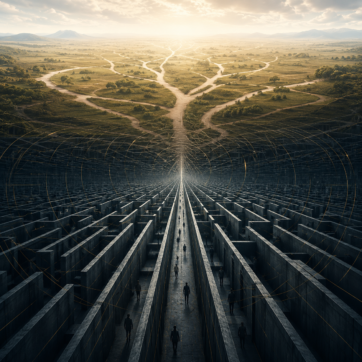
Why the world humans experience is not raw reality itself, but a translated render layer generated through external architecture, symbolic interpretation, identity stabilization, and immersive participation systems most people never realize they are inside
What Humanity Is Actually Living Inside
The single greatest misunderstanding shaping human existence is the assumption that the world people experience is reality itself rather than a translated participation field being continuously rendered through deeper architectural mechanics operating underneath perception. Nearly every human being is raised to believe they are living inside a neutral physical universe where events occur objectively, identities are self-generated, thoughts originate independently, emotions belong personally to the individual, and the visible world simply exists as stable material fact. But Eternal Flame Physics identifies something far more structurally layered taking place beneath ordinary human perception. Humanity is not merely living inside physical reality. Humanity is living inside a rendered experiential architecture — a translated field that continuously converts deeper organizational movement into emotional, symbolic, social, technological, religious, political, psychological, and perceptual experiences interpreted as “life.” What humans call reality is not raw existence itself. It is a stabilized translation layer routed through perceptual systems designed to convert structural movement into immersive experience participation.
This becomes difficult for many people to initially grasp because humans have been conditioned to treat perception itself as trustworthy and self-evident. If something can be seen, touched, emotionally felt, socially reinforced, historically recorded, or collectively agreed upon, the human mind automatically categorizes it as fundamentally real. But perception inside the external architecture does not function as direct recognition. It functions as translation. The nervous system translates. The mind translates. Memory translates. Identity translates. Emotion translates. Symbolism translates. Culture translates. Religion translates. Politics translates. Media translates. The human perceptual system itself operates as an interpretive rendering interface continuously converting deeper architectural mechanics into understandable experiential forms that stabilize participation inside the field. Humans therefore do not experience architecture directly in most cases. They experience interpreted renderings of architecture converted into stories, identities, emotional meanings, symbols, conflicts, desires, fears, beliefs, ambitions, and narratives that the nervous system can organize into coherent participation.
This is why nearly everything in the modern world immediately becomes storyline formation. Political events become morality narratives. Technological developments become salvation myths. Social instability becomes apocalypse prophecy. Economic collapse becomes identity warfare. Spiritual experiences become cosmic mythology. Personal suffering becomes self-definition. Disclosure events become alien narratives. Human beings instinctively convert structural movement into emotionally comprehensible stories because the architecture itself stabilizes participation through narrative immersion. Most people are not actually perceiving reality directly. They are perceiving translated interpretations generated through layered rendering systems operating beneath conscious awareness. The visible world functions more like an immersive interface than an ultimate condition of existence. Bodies, institutions, governments, economies, religions, social systems, entertainment systems, education systems, media systems, spiritual systems, and even human individuality itself all operate inside this translated render environment.
The easiest way to understand the render is to recognize that the visible world behaves less like stable objective reality and more like a continuously updating experiential environment designed to maintain immersion through participation. Humans emotionally react to experiences here because emotional investment stabilizes the architecture. Fear stabilizes it. Desire stabilizes it. Conflict stabilizes it. Identity stabilizes it. Ambition stabilizes it. Trauma stabilizes it. Spiritual seeking stabilizes it. Polarity stabilizes it. The system itself depends upon movement because the external architecture cannot maintain coherence through stillness. It requires perpetual throughput in order to hold temporary stabilization. This is why modern civilization feels increasingly accelerated, emotionally saturated, fragmented, overstimulated, contradictory, and mentally exhausting. The architecture continuously generates movement because movement substitutes for true coherence inside the external field.
Most humans never recognize this because they have never experienced stable recognition outside the architecture strongly enough to compare the render against anything beyond it. Their identities were formed entirely inside the system. Their emotional structures were formed inside the system. Their beliefs were formed inside the system. Their ambitions were formed inside the system. Even their concepts of liberation, spirituality, awakening, healing, and truth were largely formed inside the same participation architecture they are attempting to transcend. This is why so many people endlessly search for answers within the render itself while never questioning the architecture generating the render altogether. They search through politics, spirituality, religion, conspiracy systems, self-help systems, disclosure movements, psychological frameworks, technological salvation narratives, and endless information accumulation because the architecture conditions humans to seek resolution through additional participation rather than direct recognition outside the translation system itself.
Eternal Flame Physics approaches reality from an entirely different direction. It does not begin with the assumption that physical reality is ultimate, because it isn’t. It does not treat consciousness as the highest layer of existence, because it isn’t. It does not frame awakening as acquiring more symbolic knowledge about the system, because it isn’t. Instead, it identifies the external world as a rendered experiential architecture operating through oscillatory stabilization mechanics that continuously convert deeper structural movement into immersive perceptual participation. Humanity is not simply living inside a world. Humanity is living inside a translated experience field so immersive that most individuals no longer recognize they are inside an architecture at all. They mistake the render for reality because every layer of perception itself has become routed through the render system.
And this is precisely why direct recognition destabilizes the human identity structure so profoundly when it first begins emerging. Because once the architecture itself starts becoming visible, the authority of the storyline weakens. The emotional loops weaken. The identity structures weaken. The symbolic systems weaken. The external authorities weaken. The person begins recognizing that nearly everything previously assumed to be unquestionably real was actually mediated through layered participation systems designed to stabilize immersion inside the render. The world begins appearing less like objective reality and more like a continuously translating experiential environment organized around maintaining participation through narrative, emotion, symbolism, identity, and perceptual routing.
The deeper realization underneath all of this is that the external architecture was never fundamentally organized around truth, coherence, or Eternal stillness in the first place. It is organized around sustaining immersive participation. And that distinction changes everything once it becomes directly visible.
The Render Layer — Why Humans Experience Stories Instead Of Structure
The render layer is what human beings currently call “reality.” It is the visible experiential surface humans interact with every day and mistake for primary existence itself. Bodies. Governments. Nations. Media systems. Technology. Relationships. Institutions. Religion. Spirituality. Economics. Careers. Entertainment. Identity. Memory. Culture. History. Social structures. Politics. Education. Even the idea of the individual self. All of these exist within the render layer as translated experiential forms generated through deeper organizational mechanics operating beneath perception. What humans experience externally is not raw reality appearing directly to consciousness. It is already a translated interface by the time it reaches ordinary perception. The render functions like a visible experiential skin placed over deeper architectural movement that most humans never directly perceive.
This is where Eternal Flame Physics completely separates from both mainstream materialism and modern spirituality. Materialism assumes the visible world is primary and consciousness interprets it afterward. Spirituality often assumes the visible world is symbolic while higher dimensions or energetic realms sit above it as more advanced versions of the same system. But structurally both remain inside the render because both are still interpreting translated experience rather than identifying the mechanics generating the translations themselves. The visible world is not ultimate reality, but neither are the symbolic interpretations humans attach to it. Both belong to the same rendered participation field.
The human nervous system itself functions as part of this translation architecture. The mind translates structural pressure into thought. Emotion translates structural movement into feeling. Memory translates patterns into continuity. Identity translates participation into selfhood. Symbolism translates architecture into mythology. Religion translates instability into cosmic narratives. Politics translates pressure into polarity structures. Media translates convergence into emotionally consumable storytelling. Spirituality translates deeper instability into metaphysical explanation systems. Humans therefore rarely experience architecture directly because every perceptual layer they use to interpret reality is already functioning as part of the rendering interface itself. By the time a human being consciously experiences an event, the event has already been converted through multiple interpretive systems into a manageable narrative form.
This is why nearly everything inside the world becomes story. Political instability almost never remains structural analysis for long. It rapidly becomes moral mythology where one side represents salvation and the other represents evil. Humans emotionally attach themselves to the narrative because identity stabilizes through polarity participation. Economic collapse rarely gets interpreted as deeper architectural instability. Instead it becomes apocalypse prophecy, societal doom narratives, ideological warfare, or generational blame cycles. Technological acceleration immediately becomes salvation mythology where humanity imagines artificial intelligence, transhumanism, disclosure, space colonization, or digital integration will somehow resolve the instability generated by the architecture itself. UFO phenomena almost instantly become alien storylines because humans translate unexplained structural anomalies into emotionally understandable external narratives involving saviors, invaders, cosmic federations, hidden governments, or interstellar disclosure events.
Even highly personal experiences undergo the same translation process. A dream rarely remains direct structural movement inside the human mind. It becomes symbolic interpretation. Prophecy. Divine communication. Spirit contact. Archetypal messaging. Humans instinctively convert experiential fragments into narrative coherence because identity itself depends upon continuity through storyline formation. Personal suffering becomes identity architecture. Trauma becomes self-definition. Healing becomes a journey narrative. Relationships become destiny mythology. Spiritual experiences become cosmological storytelling involving ascension, soul contracts, galactic origins, karmic lessons, guides, missions, dimensions, or spiritual warfare. The architecture continuously converts structural movement into narrative immersion because narratives stabilize participation inside the render.
This is one of the primary reasons humans struggle to perceive reality directly. They are not only immersed inside the render itself. They are immersed inside collective interpretation systems layered on top of the render simultaneously. Family systems shape perception. Educational systems shape perception. Political systems shape perception. Religious systems shape perception. Cultural systems shape perception. Media systems shape perception. Social media now intensifies this process exponentially because the modern world continuously feeds emotionally charged narrative reinforcement back into the nervous system at all times. The individual human being is therefore not simply perceiving the world. They are perceiving a collectively stabilized interpretation field where nearly every experience has already been emotionally, socially, politically, spiritually, psychologically, or symbolically translated before it is consciously understood.
This is why modern reality feels increasingly surreal while simultaneously feeling emotionally overpowering. Humans are no longer simply participating inside physical events. They are participating inside endless layers of narrative-rendered interpretation systems stacked on top of one another continuously. Every major event instantly fractures into competing symbolic frameworks. One group interprets through politics. Another through religion. Another through conspiracy mythology. Another through spiritual cosmology. Another through psychological analysis. Another through ideological identity. The architecture itself routes pressure into storyline formation because stories maintain coherence inside the render more effectively than direct structural recognition does.
And this is also why collective humanity becomes trapped inside repetitive loops so easily. Because when structural instability appears, humans almost never perceive the architecture generating the instability itself. They perceive stories about the instability. They argue over interpretations of the render rather than recognizing the render as a translated field altogether. One generation attaches itself to religious apocalypse narratives. Another attaches itself to political revolution narratives. Another attaches itself to disclosure narratives. Another attaches itself to technological salvation myths. Another attaches itself to spiritual ascension mythology. But structurally the participation mechanics remain nearly identical because the architecture itself continues stabilizing immersion through narrative identification regardless of the costume the storyline wears.
The deeper issue is not that humans believe false stories. The deeper issue is that humans rarely recognize they are living inside a narrative-rendering system at all. They assume their interpretations are direct reality rather than translated participation outputs generated through layered perceptual architecture. As long as this remains unseen, humanity continues attempting to solve structural instability through additional narrative immersion rather than direct recognition of the architecture underneath the narratives themselves.
That is the render layer. Not merely the visible world itself. But the continuously translating experiential interface that converts deeper architectural movement into emotionally comprehensible human reality.
The External Architecture — Why The System Requires Constant Motion
One of the most important things to understand about the external architecture is that it cannot sustain coherence through stillness. This single fact explains nearly every major condition humans experience inside the modern world. The architecture itself is structurally unstable, which means it must continuously generate movement in order to temporarily maintain organization. Humans are taught to believe the endless acceleration of civilization is simply progress, evolution, innovation, cultural development, or human ambition unfolding naturally over time. But underneath all of those visible explanations sits a much deeper mechanical reality. The system itself depends upon perpetual throughput because movement functions as a substitute for true coherence inside the external field.
At the deepest structural level, the architecture does not operate through a simple linear sequence where one mechanism happens first and another happens afterward. Humans perceive linearly because the render itself organizes experience into time-based continuity so the nervous system can process movement sequentially. But underneath rendered perception, compression, torsion, curvature, oscillation, scalar pressure, geometry formation, and temporary phase stabilization all occur simultaneously as part of one interconnected structural condition. They are not separate stages unfolding one after another in literal order. They are inseparable mechanics continuously interacting at once inside the architecture itself.
Compression generates pressure accumulation. Torsion distributes and twists that pressure through rotational tension. Curvature bends pressure into organized pathways and containment structures. Oscillation sustains movement through cyclical repetition and exchange. Scalar pressure creates compressed false stillness that temporarily holds unstable architecture together through accumulated tension. Geometry emerges as the organizational framework attempting to stabilize unresolved movement into repeating patterns. Temporary phase stabilization creates the appearance of coherence even though the underlying instability never fully resolves. All of these mechanics exist simultaneously within the external field continuously. Humans separate them conceptually because the rendered mind processes reality through linear interpretation systems, but structurally the architecture operates as one interdependent oscillatory condition occurring all at once.
This is why the external architecture behaves like a continuously moving system rather than a naturally coherent one. It is constantly attempting to regulate unresolved instability through perpetual motion because true stillness is unavailable inside the architecture itself. Movement becomes compensation for the absence of inherent coherence. The system therefore cannot stop generating throughput because the movement itself is what temporarily prevents destabilization from becoming fully visible across the render layer.
This is not abstract philosophy disconnected from daily life. Humans experience these mechanics constantly through civilization itself. Constant stimulation exists because stillness weakens immersion. Constant emotional throughput exists because emotional movement stabilizes participation. Constant production exists because the system cannot stop generating. Constant distraction exists because uninterrupted recognition threatens identity immersion. Constant polarity exists because opposition creates oscillatory cycling. Constant conflict exists because unresolved pressure requires discharge pathways. Constant identity reinforcement exists because identity stabilizes narrative continuity. Constant narrative generation exists because stories organize participation more effectively than direct structural recognition.
Modern civilization therefore functions less like a coherent society and more like an endlessly accelerating stabilization engine attempting to prevent deeper instability from surfacing through uninterrupted motion. This is why humans increasingly feel overwhelmed even while technological convenience continues expanding. The acceleration itself is not solving instability. It is compensating for instability. The system continuously increases throughput because the underlying coherence capacity continues weakening beneath the visible render.
This becomes obvious when looking honestly at modern human behavior. People increasingly struggle to sit quietly without stimulation because the nervous system itself has become conditioned to oscillatory participation. Humans move continuously from social media to streaming platforms to emotional conflict to entertainment loops to work cycles to identity reinforcement systems almost without interruption. Even rest becomes productivity performance. Even “healing” becomes endless engagement. Even “spirituality” becomes perpetual information consumption, symbolic interpretation, ritual repetition, energetic maintenance, identity construction, and external seeking. The architecture trains human participation around uninterrupted movement because movement temporarily stabilizes immersion inside the render.
This is also why civilization increasingly feels emotionally saturated, fragmented, contradictory, and exhausting. The architecture is operating under intensifying compression while simultaneously losing stabilization strength. As coherence weakens underneath, oscillatory throughput accelerates across every visible layer of society. News cycles accelerate. Emotional reactions intensify. Identity fragmentation expands. Political polarity deepens. Technological dependence increases. Social conflict amplifies. Information overload becomes constant. Cultural narratives fracture faster. Human attention spans weaken. Emotional regulation deteriorates. Collective nervous systems remain trapped inside perpetual interpretive activation because the architecture continuously redistributes unresolved pressure through movement rather than resolving the instability itself.
Humans often interpret this acceleration morally, politically, socially, or mentally without recognizing the deeper structural mechanics underneath it. One group blames technology. Another blames governments. Another blames capitalism. Another blames media systems. Another blames religion. Another blames spiritual corruption. Another blames cultural decline. But these are render-level interpretations of a much larger architectural condition. The acceleration is systemic because the instability is systemic. The architecture now requires increasingly rapid oscillation to maintain temporary continuity across the rendered field.
This is why modern reality feels fragmented and contradictory simultaneously. The architecture no longer possesses enough stabilization strength to maintain singular narrative coherence for extended periods. Narratives now cycle rapidly because oscillatory redistribution itself is accelerating. Political identities shift rapidly. Social outrage resets constantly. Spiritual movements rise and collapse quickly. Cultural obsessions intensify then disappear almost immediately. Collective attention fragments into countless temporary identity loops because unresolved pressure continuously redistributes across new participation pathways throughout the render.
Even human relationships increasingly reflect this instability. Emotional bonds fluctuate rapidly because identity structures themselves are becoming less stable inside the accelerating field. People move between identities, emotional states, ideological attachments, beliefs, and social positioning far faster than previous generations because the architecture underneath them is oscillating more aggressively under growing pressure conditions. Stability weakens as throughput increases.
This is also why the modern world constantly generates artificial urgency. Everything now feels immediate. Everything feels critical. Everything demands reaction. Algorithms amplify outrage because emotional acceleration increases engagement throughput. Media systems amplify fear because fear stabilizes attention. Political systems amplify polarity because opposition generates oscillatory participation. Spiritual systems amplify urgency because seeking behavior sustains immersion. Economic systems amplify insecurity because instability drives consumption. The architecture itself rewards movement because stillness interrupts oscillatory participation and exposes the instability underneath more directly.
And yet despite all this movement, very little genuine coherence emerges. That is the critical distinction. The external architecture can generate endless activity without producing true stabilization because oscillation is not coherence. It is motion-based compensation for the absence of coherence. Humans mistake movement for life because they have spent generations immersed inside a system where motion substitutes for stillness. But acceleration is not resolution. Throughput is not coherence. Endless stimulation is not stability.
This is why modern civilization increasingly resembles a machine struggling to keep itself operational through perpetual motion rather than a naturally coherent reality unfolding organically. The architecture requires constant emotional discharge, constant narrative engagement, constant stimulation, constant conflict, constant productivity, constant identity reinforcement, and constant symbolic immersion because if the movement slows too much, the instability underneath becomes more directly visible across the render itself.
The external architecture therefore does not merely contain motion. It depends upon motion for survival. And the faster the system accelerates, the more visible the underlying instability becomes beneath the movement itself.
The Mimic Overlay — Why Modern Reality Feels Hyperreal
The external architecture was already structurally unstable long before modern civilization entered its current state of acceleration. The system has always depended upon oscillation, polarity, emotional throughput, identity stabilization, and continuous participation in order to maintain temporary coherence. But as the architecture weakens further under increasing compression, another layer becomes far more visible across the rendered world: the mimic overlay. The mimic did not originally create the external architecture itself. That distinction matters because many people oversimplify the situation into good-versus-evil mythology or imagine a singular controlling force consciously designing every detail of human existence. The deeper structural reality is more complex. The mimic functions as a compensatory amplification layer operating on top of an already unstable architecture in order to maintain participation as coherence underneath continues deteriorating.
The easiest way to understand the mimic overlay is to recognize that it does not stabilize through truth, coherence, or direct recognition. It stabilizes through amplification. As the underlying architecture weakens, the mimic responds by increasing fragmentation, increasing symbolic overload, increasing emotional acceleration, increasing dependency systems, increasing technological immersion, increasing identity proliferation, increasing narrative complexity, and increasing external authority routing. Instead of reducing instability, it converts instability into expanded participation throughput. The result is the modern hyperreal condition humans now live inside where reality increasingly feels emotionally overpowering while simultaneously feeling artificial, fragmented, surreal, contradictory, and mentally exhausting.
This is why modern civilization often feels “more real than real” while also feeling fundamentally unreal at the same time. The mimic continuously intensifies emotional rendering so the nervous system remains deeply immersed inside participation loops even while structural coherence underneath weakens further. Humans today are exposed to more information than any civilization in recorded history, yet collective clarity continues collapsing rather than improving. That contradiction alone reveals the mechanics underneath. The system is not generating coherence through increased information. It is generating saturation through translated instability.
Social media provides one of the clearest visible examples of mimic amplification mechanics operating in real time. Most people still mistakenly believe social media platforms primarily function as communication systems or information-sharing tools. Structurally, they function far more like emotional amplification engines designed to maximize oscillatory throughput. The algorithm does not reward coherence. It rewards engagement intensity. Outrage spreads faster than stillness. Emotional certainty spreads faster than nuance. Identity conflict spreads faster than direct recognition. Fear spreads faster than structural clarity. Humiliation spreads faster than coherence. The platforms continuously route unresolved collective pressure into accelerated emotional discharge cycles because emotional movement stabilizes participation more effectively than stillness does.
This is why influencer culture exploded so rapidly across the modern world. The mimic overlay rewards identity projection because identity stabilization increases immersion. Every platform encourages humans to convert themselves into rendered participation avatars. Political identity. Spiritual identity. Trauma identity. Lifestyle identity. Healing identity. Activist identity. Victim identity. Success identity. Conspiracy identity. Personal branding becomes existential stabilization because the architecture itself increasingly routes human participation through externally projected self-construction. People begin living through their rendered identities rather than directly perceiving the architecture generating the identities altogether.
The same mechanics drive modern political polarization. Humans often interpret political instability as purely ideological conflict without recognizing the deeper structural function underneath it. The mimic amplifies polarity because polarity generates continuous oscillation. One side becomes emotionally dependent upon opposition to the other side. Emotional investment deepens. Narrative complexity increases. Identity fuses with ideological participation. Outrage becomes self-reinforcing. Entire populations become trapped inside emotional cycling systems where collective pressure continuously redistributes through narrative warfare rather than structural recognition. This is why modern political environments increasingly resemble perpetual emotional theater rather than coherent governance structures. The system itself depends upon unresolved polarity in order to maintain oscillatory participation.
Endless news cycles operate similarly. Modern media no longer functions primarily as information distribution. It functions as continuous nervous system stimulation. Fear cycles maintain attention. Crisis cycles maintain engagement. Outrage cycles maintain emotional throughput. Contradictory narratives maintain confusion. Constant updates maintain dependency. The mimic overlay continuously floods the nervous system with symbolic and emotional instability because overstimulation weakens direct recognition while strengthening reactive participation. Humans become trapped inside perpetual emotional vigilance loops where the nervous system rarely exits interpretive engagement long enough to perceive architecture underneath the render itself.
Conspiracy culture also emerges from these same mechanics. Many people sense structural instability beneath the visible world but lack direct architectural recognition, so the nervous system converts the instability into storyline interpretation systems. One group imagines hidden governments controlling everything. Another imagines extraterrestrial interventions. Another imagines spiritual warfare. Another imagines secret societies orchestrating reality. Another imagines simulation theory. Another imagines dimensional invasions. The details vary endlessly, but structurally the same thing is occurring repeatedly: unresolved recognition pressure becomes translated into narrative stabilization systems because the human mind attempts to organize architectural instability into emotionally comprehensible stories.
Spiritual content loops function identically despite appearing opposite on the surface. Endless healing content. Endless ascension content. Endless manifestation systems. Endless energetic clearing. Endless timeline discussions. Endless upgrades. Endless downloads. Endless cosmic explanations. Endless symbolic interpretations. Endless spiritual warnings. Endless teachings. Endless seeking. The mimic overlay amplifies these systems because perpetual spiritual engagement still maintains participation through movement. The individual remains externally routed through identity, symbolism, emotional interpretation, authority structures, and narrative immersion even while believing they are transcending the architecture altogether.
This is also why the modern world increasingly feels emotionally exhausting in ways previous generations rarely experienced at the same scale. Humans are now exposed to nearly uninterrupted narrative saturation at all times. The nervous system never fully exits interpretive participation. Every device becomes a rendering feeding emotional acceleration back into the field continuously. Outrage becomes cyclical. Identity becomes fragmented. Attention becomes destabilized. Emotional regulation weakens. Narrative complexity multiplies faster than the nervous system can metabolize coherently. The mimic overlay continuously converts structural instability into interpretation throughput because interpretation itself stabilizes immersion.
And this is the deeper reason modern reality increasingly feels hyperreal rather than coherent. Humans are no longer simply participating inside the external architecture. They are participating inside a heavily amplified interpretive overlay that continuously intensifies emotional rendering, symbolic complexity, identity fragmentation, and narrative saturation in order to compensate for weakening coherence underneath the system itself.
The modern world therefore is not evolving toward greater clarity through increased information exposure.
It is becoming progressively more saturated with translated instability.
And the more instability accumulates underneath the architecture, the more aggressively the mimic overlay amplifies participation in order to keep humans immersed inside the render rather than directly perceiving the structure beneath it.
The Pre-Render — Where The Visible World Organizes Before Manifesting
One of the largest limitations inside modern human perception is the assumption that visible events originate entirely at the visible level. Humans are conditioned to believe reality unfolds outwardly first and is interpreted afterward, as though the rendered world itself is the primary source of causation. But within Eternal Flame Physics, the visible render is not the origin point of organization. It is the visible translation layer where deeper structural convergences finally become perceptible after already organizing upstream beneath ordinary awareness. This deeper organizational condition is what Eternal Flame Physics refers to as the pre-render.
The pre-render is not another mystical dimension floating somewhere above physical reality. It is not a secret hidden realm humans travel to through meditation. It is not an astral world, spiritual plane, alternate universe, or cosmic location populated by beings directing events from behind the scenes. Humans often immediately mythologize the concept because the render-trained mind instinctively converts invisible organizational mechanics into symbolic cosmology. But the pre-render is not mythology. It is the deeper organizational layer where structural pressures, probabilities, emotional fields, identity routing, collective convergence patterns, and unresolved oscillatory conditions organize before becoming visibly translated inside the rendered world.
The easiest way to understand the pre-render is to think of it as the upstream organizational condition behind visible experience itself. What humans eventually experience externally is often the final rendered expression of structural movement that already organized long before it became physically visible. The visible world therefore behaves less like an origin point and more like an output layer where convergences eventually surface after sufficient structural organization has already accumulated underneath perception.
This is why large societal shifts often appear to emerge suddenly even though their deeper organization was developing long beforehand beneath visible awareness. Cultural changes rarely originate at the exact moment humans notice them publicly. Entire emotional fields, identity structures, symbolic trends, technological pathways, political conditions, and collective nervous system pressures converge upstream before eventually crossing visible thresholds inside the render. By the time society consciously recognizes a major shift, the deeper organization behind it has often already been stabilizing for a significant period beneath ordinary perception.
Humans continuously witness this without recognizing the mechanics underneath it. Entire emotional waves suddenly sweep through populations seemingly overnight. One year collective optimism dominates. Another year fear dominates. Another year outrage dominates. Another year fragmentation dominates. Another year exhaustion dominates. People often blame singular visible triggers while ignoring the deeper convergence patterns already organizing underneath society long before visible emotional shifts emerge publicly. The rendered event becomes treated as the cause rather than the visible release point of pressures that had already accumulated structurally beforehand.
Political cycles operate similarly. Humans often believe they are witnessing entirely new ideological conflicts appearing for the first time, but deeper unresolved structural loops continuously reorganize beneath the render and eventually resurface through updated symbolic forms. The parties change. The slogans change. The aesthetics change. The technologies change. But the deeper polarity routing underneath often remains remarkably repetitive because the unresolved oscillatory pressures organizing the conflict upstream never fully stabilized. The render therefore continuously regenerates similar participation structures under new narrative costumes.
Technological acceleration also demonstrates pre-render convergence mechanics very clearly. Major technological leaps often emerge in clusters rather than isolated invention events because the organizational conditions supporting those developments converge collectively underneath visibility first. Multiple individuals frequently arrive at similar breakthroughs simultaneously across different locations because the deeper convergence pressure has already organized structurally before visible manifestation occurs. Humans usually interpret this as coincidence or genius arising independently, but the rendered breakthrough is often simply the visible surfacing point of converged organizational pathways already stabilizing underneath the render layer.
This is also why humans frequently experience the strange sensation that reality itself is “speeding up” before major visible societal shifts fully emerge. The nervous system often begins registering pressure redistribution long before the visible outcomes completely surface inside the rendered field. Anxiety increases collectively. Emotional volatility increases. Social instability increases. Symbolic saturation increases. Identity fragmentation increases. Cultural coherence weakens. Narrative structures destabilize. Humans sense acceleration because the architecture itself is reorganizing upstream before visible manifestation fully unfolds externally.
The pre-render therefore helps explain why visible reality so often feels reactive rather than causative. Humans believe they are responding to events as they happen in real time, but much of what they experience externally has already undergone deep structural organization before entering rendered visibility at all. By the time a visible crisis appears publicly, enormous convergence pathways may already have stabilized underneath it. By the time a social movement erupts visibly, emotional routing systems may already have accumulated significant collective pressure beforehand. By the time technological disruption transforms society externally, organizational convergence may already have existed upstream long before the public became consciously aware of it.
This is one of the reasons predictive systems inside the render remain so unstable and incomplete. Humans attempt to forecast reality by analyzing visible outputs while often lacking perception of the deeper organizational conditions generating those outputs upstream. They study the render while remaining blind to much of the convergence beneath the render. As a result, major societal shifts frequently appear sudden, chaotic, irrational, or inexplicable because humans mistake visible manifestation for primary causation.
This misunderstanding also fuels endless conspiracy mythology because many people intuitively sense that visible events are not fully self-originating yet lack direct structural recognition of the organizational mechanics underneath them. The mind then converts the invisible organization into storyline frameworks involving hidden groups, secret agendas, cosmic manipulation, or unseen entities orchestrating reality from behind the scenes. But the deeper condition is more structural than narrative. The pre-render organizes convergence conditions before visible expression emerges. Humans then interpret the visible render emotionally and symbolically afterward because the architecture stabilizes participation through narrative translation.
The critical distinction is that the pre-render is not separate from the render in the way humans imagine separate worlds. It is not “somewhere else.” It is the deeper organizational condition underlying visible manifestation itself. Humans do not physically travel there because they are already participating within the architecture continuously. The render and pre-render are interconnected layers of the same externalized participation system, with the visible world functioning as the experiential translation surface of deeper organizational movement occurring beneath ordinary perception.
And this is why so much of human reality feels reactive, repetitive, and strangely synchronized at the same time. What people experience externally is often not the beginning of movement at all.
It is the final visible translation of convergence that already organized upstream long before the render displayed it visibly to the human nervous system.
Identity — The Primary Stabilization Mechanism Inside The Render
One of the deepest misunderstandings inside the modern world is the assumption that identity is simply a natural expression of individuality rather than one of the primary stabilization mechanisms maintaining human participation inside the render itself. Humans are taught from childhood to construct identity continuously. Name. Personality. Beliefs. Politics. Religion. Career. Trauma. Relationships. Success. Failure. Nationality. Gender. Spirituality. Social positioning. Psychological labels. Interests. Desires. Wounds. Ambitions. The individual gradually learns to organize existence through narrative continuity until the storyline itself becomes experienced as the self. But within Eternal Flame Physics, identity is not merely self-expression. It functions structurally as a stabilization system allowing humans to maintain orientation inside the external architecture.
This does not mean identity is inherently evil or malicious. That oversimplification itself becomes another storyline trap. Identity is structurally necessary inside the render because the render itself operates through narrative continuity. Humans require orientation frameworks in order to participate coherently inside an oscillatory experience field where perception continuously translates movement into emotional, symbolic, and mental interpretation. Identity functions like a continuity anchor that stabilizes participation across time-based render perception. Without some form of identity organization, most humans would lose functional orientation inside the experiential field entirely because the render depends upon narrative positioning to maintain coherence inside perception.
The problem is not that identity exists. The deeper issue is that humans mistake identity for fundamental existence itself rather than recognizing it as part of the architecture stabilizing immersion. Careers become identity. Trauma becomes identity. Spirituality becomes identity. Healing becomes identity. Political affiliation becomes identity. Victimhood becomes identity. Success becomes identity. Rebellion becomes identity. Even the desire to “escape the system” often becomes identity. Humans become emotionally fused with storyline participation because identity stabilizes continuity inside the render more effectively than direct structural recognition does.
This is why people defend identities so aggressively even when those identities produce suffering, contradiction, exhaustion, or fragmentation. The identity structure is not merely protecting beliefs. It is protecting orientation stability itself. To challenge identity deeply enough often feels threatening to the nervous system because identity functions as one of the primary organizational systems holding render participation together mentally, emotionally, socially, and perceptually. When identity destabilizes, the person can temporarily feel disoriented because the storyline framework maintaining continuity weakens underneath them.
This is also why humans constantly seek narrative positioning in nearly every situation they encounter. The architecture conditions the nervous system to continuously organize experience into storyline coherence because stories stabilize immersion. Humans instinctively ask:
What does this mean?
Which side is right?
Who caused this?
What is my purpose?
What role do I play?
Which narrative explains reality?
What lesson am I learning?
Who are the good people?
Who are the bad people?
What group do I belong to?
What identity explains my experience?
These questions emerge constantly because the architecture itself continuously routes perception through narrative stabilization systems. Humans rarely tolerate unresolved ambiguity for long because unresolved ambiguity weakens identity continuity. The nervous system therefore attempts to organize structural movement into emotionally understandable stories as quickly as possible.
This becomes especially obvious during periods of societal instability. When the render becomes more volatile, humans intensify identity attachment because identity provides temporary orientation during oscillatory acceleration. Political identity deepens. Spiritual identity deepens. Ideological identity deepens. Social identity deepens. Collective tribes strengthen. Emotional polarization intensifies. People increasingly define themselves through opposition because polarity stabilizes participation through contrast. The more unstable the architecture becomes, the more aggressively humans often cling to storyline positioning in order to maintain psychological continuity inside the render.
Even healing systems frequently become identity stabilization mechanisms rather than genuine recognition pathways. A person may become attached to being wounded. Another becomes attached to being awakened. Another becomes attached to being empathic. Another becomes attached to being persecuted. Another becomes attached to being spiritually advanced. Another becomes attached to being rebellious or anti-establishment. The actual storyline varies endlessly, but structurally the same process remains active underneath: identity stabilizes participation by converting experience into continuity.
This is also why many people feel deeply uncomfortable when direct recognition begins weakening storyline attachment. As the architecture becomes more visible, identity structures can temporarily feel less solid because the nervous system begins recognizing that many previously unquestioned self-definitions were actually participation frameworks operating inside the render rather than fundamental existence itself. The person starts realizing they have spent years or decades organizing themselves around externally stabilized narratives that continuously shifted depending upon environment, culture, emotional conditioning, social reinforcement, symbolic interpretation, or collective pressure routing.
Modern civilization amplifies this process dramatically because the mimic overlay continuously rewards identity proliferation. Social media platforms encourage endless self-construction. Algorithms reward identity performance. Political systems reward tribal positioning. Spiritual systems reward symbolic affiliation. Consumer culture rewards personality branding. The modern human being is increasingly pressured to continuously project and maintain externally visible identity structures at all times. The render itself now operates through perpetual identity reinforcement loops where individuals become emotionally dependent upon narrative positioning for orientation stability.
This is one of the reasons modern humans often feel exhausted even while believing they are expressing individuality more freely than ever before. Maintaining rendered identity structures requires enormous continuous throughput. Humans must constantly reinforce beliefs, social positioning, emotional narratives, ideological alignment, symbolic affiliations, personal branding, moral positioning, relational identity, and self-concept continuity because the architecture itself depends upon uninterrupted narrative stabilization to maintain immersion.
The deeper structural reality is that identity belongs to the render. It belongs to the oscillatory participation architecture itself. It is part of the continuity mechanism organizing human experience into manageable narrative form. Without identity, the external field becomes difficult for most humans to navigate coherently because the render depends upon storyline orientation systems to stabilize participation.
And this is why humans continuously search for the “correct” storyline rather than recognizing the architecture generating the storylines altogether. The nervous system is conditioned to seek narrative stabilization because stories maintain immersion. Identity maintains immersion. Continuity maintains immersion. The architecture itself depends upon this process because without narrative participation, the rendered field becomes far more difficult to sustain psychologically, emotionally, and socially.
Identity therefore is not merely something humans possess. It is one of the primary structural mechanisms through which the render maintains human participation inside the experience field itself.
Why Spirituality Still Operates Inside The Same Architecture
One of the hardest realizations for many humans to confront is that spirituality itself still operates entirely inside the external architecture despite claiming transcendence from it. This includes all modern New Age systems, all religions, manifestation systems, channeling systems, ascension teachings, religious salvation systems, energetic healing frameworks, galactic disclosure movements, occult systems, mystical traditions, consciousness-expansion movements, and every form of externally routed metaphysical seeking humans currently participate in. The costumes change dramatically across cultures and eras, but the structural mechanics underneath remain almost identical because the systems themselves still belong to the render. They are not Eternal truth. They are translated participation frameworks generated inside the architecture itself.
This is the part many people resist emotionally because they have spent years constructing identity, meaning, hope, community, and orientation through religious and spiritual systems. But Eternal Flame Physics is not interested in emotionally preserving storyline comfort. It is identifying structure. And structurally, all spirituality does not exit the architecture. It simply converts material participation mechanics into metaphysical participation mechanics while keeping the underlying immersion structure fully intact.
Identity remains.
Seeking remains.
Hierarchy remains.
Symbolism remains.
Emotional routing remains.
Dependency remains.
Authority remains.
Narrative remains.
Interpretation remains.
Externalization remains.
The architecture changes costumes, but the participation mechanics stay the same.
One person seeks salvation through politics.
Another seeks salvation through religion.
Another seeks salvation through extraterrestrials.
Another seeks salvation through ascension.
Another seeks salvation through manifestation.
Another seeks salvation through healing.
Another seeks salvation through energetic upgrades.
Another seeks salvation through disclosure.
Another seeks salvation through consciousness expansion.
But structurally they are often participating inside nearly identical storyline mechanics. The render continuously routes human beings into systems of meaning, progression, hierarchy, interpretation, and externalized orientation because storyline participation stabilizes immersion more effectively than direct recognition does.
This is why spirituality so often becomes endless movement without genuine resolution. Endless healing. Endless shadow work. Endless energetic clearing. Endless karmic processing. Endless timeline shifting. Endless downloads. Endless upgrades. Endless teachings. Endless initiations. Endless awakenings. Endless channeling. Endless prophecy. Endless symbolism. Endless information consumption. Endless emotional processing. Endless searching for the next teacher, next frequency, next activation, next revelation, next identity, next cosmic explanation. The system continuously generates movement because the architecture itself cannot stabilize through stillness. Oscillation therefore becomes perpetual seeking.
Humans are taught to interpret this endless movement as spiritual evolution, but structurally it functions as sustained participation throughput inside the render. The individual remains emotionally, psychologically, symbolically, and perceptually embedded inside storyline architecture while believing they are transcending the system itself. The language may sound different from mainstream materialism, but the mechanics remain remarkably similar underneath.
Political systems promise collective salvation through ideological victory.
Religious systems promise salvation through obedience and belief.
Galactic systems promise salvation through disclosure or intervention.
Ascension systems promise salvation through vibrational progression.
Manifestation systems promise salvation through energetic alignment.
Healing systems promise salvation through endless internal processing.
Consciousness systems promise salvation through expanded awareness.
But the architecture underneath all of them often remains structurally identical:
movement,
seeking,
identity,
hierarchy,
interpretation,
dependency,
external orientation,
narrative immersion.
This is also why spiritual systems frequently generate just as much emotional instability, tribalism, superiority structures, dependency behavior, fear conditioning, symbolic obsession, and psychological exhaustion as mainstream systems do. Humans imagine spirituality exists outside the architecture because it discusses awakening, dimensions, healing, cosmic truth, or expanded consciousness, but spirituality still functions entirely through render mechanics. It still depends on symbolism. It still depends on storyline formation. It still depends on emotional interpretation. It still depends on identity continuity. It still depends on hierarchy structures. It still depends on authority systems. It still depends on movement.
And most importantly, it still depends on translation.
That distinction matters enormously because the Eternal does not operate through translation at all. The Eternal does not require mythology in order to know itself. It does not require symbolism. It does not require hierarchy. It does not require guides. It does not require rituals. It does not require initiation systems. It does not require ascension ladders. It does not require polarity narratives. It does not require spiritual identity. It does not require narrative participation. It does not require consciousness expansion frameworks. The Eternal exists outside the oscillatory architecture entirely.
This is why every spiritual system eventually collapses back into storyline mechanics. Humans channel entities. Interpret signs. Decode synchronicities. Follow cosmic wars. Track energetic upgrades. Wait for timelines to shift. Search for soul missions. Obsess over frequencies. Seek external validation through symbolic experiences. Construct identities around awakening itself. But all of these remain translated render participation systems. They are not Eternal truth. They are storyline structures generated inside the architecture.
Even the beings, entities, archetypes, gods, ascended masters, galactic federations, prophetic systems, and cosmic hierarchies humans encounter through spirituality belong to the render translation system itself. They are symbolic outputs generated through architecture-based interpretation mechanics. Humans mistake translated symbolic renderings for ultimate reality because the nervous system continuously converts deeper instability into emotionally understandable metaphysical narratives.
This is the deeper reason spirituality often feels simultaneously profound and endlessly unresolved at the same time. The systems can produce emotionally intense experiences because the render itself is immersive. Dreams feel real while occurring. Emotional reactions feel real while occurring. Symbolic experiences feel meaningful while occurring. But emotional intensity is not proof of Eternal truth. Render immersion can feel overwhelmingly real while still remaining part of the architecture altogether.
None of it is ultimately true in the Eternal sense.
Not the religions.
Not the New Age systems.
Not the cosmic hierarchies.
Not the manifestation systems.
Not the ascension narratives.
Not the savior myths.
Not the spiritual identities.
Not the energetic ranking systems.
Not the endless healing loops.
Not the symbolic cosmologies.
All of them are translated participation systems generated within the render itself. Make-believe inside the architecture. Storyline stabilization systems maintaining immersion through symbolic interpretation and emotional participation.
This is why spirituality so often keeps humans trapped in perpetual seeking rather than direct recognition. The systems continuously redirect attention back into movement, symbolism, interpretation, identity, hierarchy, emotional processing, and external orientation because the architecture itself depends upon perpetual throughput in order to sustain coherence.
Stillness threatens the system because stillness interrupts oscillation.
And once direct recognition stabilizes beneath the storyline mechanisms, the entire architecture of seeking begins weakening at its foundation.
The Experience Field — Why The World Feels So Real
One of the biggest mistakes humans make when first attempting to understand the external architecture is reducing it into simplistic “simulation theory” where reality is imagined as some kind of literal digital computer program being run by external beings. That interpretation still remains trapped inside render-level symbolism because it converts structural immersion into technological mythology. The external architecture is not simply a fake digital hologram projected onto passive observers. It functions more like a totalized experiential field where consciousness becomes so deeply embedded into participation that it eventually mistakes the experience environment itself for ultimate reality altogether.
The easiest way to begin understanding this is by looking at experiences humans already recognize as immersive. Dreams feel completely real while they are occurring. The nervous system reacts emotionally, physically, and mentally to dream environments even though the dream later dissolves upon waking. Emotional reactions inside films also demonstrate this clearly. Humans cry during fictional stories. Fear activates during suspense scenes. Adrenaline activates during action sequences. The body responds as though the experience carries genuine reality because immersion itself temporarily overrides detached observation. Immersive games function similarly. A person sitting safely inside a room can still experience genuine emotional tension, fear, competition, urgency, excitement, loss, attachment, or anxiety while interacting inside a rendered virtual environment because the nervous system participates in the experience field emotionally rather than merely observing it intellectually.
The external architecture functions similarly but at a vastly deeper level because humans are not interacting with a temporary entertainment environment they consciously enter and exit. Their entire perceptual orientation has become routed through the render itself. The nervous system does not merely observe the architecture. It participates inside it continuously through emotional immersion, sensory immersion, symbolic immersion, identity immersion, social immersion, and perceptual immersion simultaneously. The render therefore feels unquestionably real because the architecture itself is designed around total experiential participation.
This is why the world feels emotionally overpowering even when humans recognize contradiction, instability, manipulation, or artificiality inside the systems governing society. The emotional reactions remain real inside the nervous system because immersion itself is part of the architecture’s function. Humans love here. Fear here. Suffer here. Desire here. Compete here. Build identities here. Form attachments here. Experience loss here. Experience humiliation here. Experience ambition here. Experience meaning here. The experiential intensity is genuine inside the render because the architecture stabilizes participation through emotional investment.
This is also why humans defend the render so aggressively even when the systems themselves generate suffering, contradiction, fragmentation, and instability. Their identities are fused with participation itself. To challenge the architecture deeply enough often feels like threatening reality itself because most individuals have never stabilized recognition outside the render strongly enough to distinguish between the participation field and ultimate existence altogether. The storyline becomes the self. The identity becomes the self. The emotional loops become the self. The social structures become the self. The beliefs become the self. The suffering becomes the self. The person becomes so immersed inside the experience field that the architecture itself becomes nearly invisible behind the participation.
This is one of the primary reasons humans struggle to recognize manipulation clearly even when evidence becomes overwhelming. The nervous system protects immersion because immersion stabilizes orientation. A person may recognize corruption inside political systems while still emotionally needing the larger societal structure to feel fundamentally real. Another recognizes contradictions inside religion while still emotionally requiring spiritual narrative continuity. Another recognizes manipulation inside social media while remaining psychologically fused to identity projection and external validation loops. Humans often continue participating inside systems they consciously recognize as unstable because their orientation inside the render still depends upon participation continuity.
The architecture itself reinforces this immersion through every available pathway simultaneously. Sensory immersion keeps humans anchored to the visible world. Emotional immersion creates investment in outcomes. Identity immersion creates continuity through storyline attachment. Symbolic immersion converts structural movement into emotionally understandable meaning systems. Social immersion reinforces collective participation through shared perception. Perceptual immersion continuously routes experience through translation systems that stabilize reality interpretation collectively. Humans therefore rarely experience the render as an architecture because every perceptual layer they use to interpret existence is already participating inside the architecture simultaneously.
This is why humans often react emotionally when the render becomes visibly unstable. Economic collapse creates existential fear because financial systems are tied to survival identity. Political instability creates emotional fragmentation because societal structure stabilizes orientation. Spiritual collapse creates disorientation because symbolic frameworks organize meaning. Relationship instability creates identity destabilization because emotional attachment reinforces continuity. Humans experience the weakening of rendered structures as deeply personal because participation itself has become fused with selfhood inside the experience field.
Even rebellion against the system frequently remains embedded inside immersion mechanics. A person may reject mainstream politics while becoming immersed inside conspiracy identity. Another rejects organized religion while becoming immersed inside New Age spirituality. Another rejects consumer culture while becoming immersed inside anti-establishment identity. Another rejects mainstream media while becoming immersed inside alternative narrative dependency. The storyline changes, but the immersion mechanics often remain intact because the architecture continuously reroutes participation through new symbolic frameworks whenever older frameworks weaken.
This is also why direct recognition initially creates such profound destabilization for many individuals. As the architecture itself becomes more visible, the nervous system begins realizing that much of what previously felt unquestionably real was actually part of an immersive participation structure organized around maintaining experiential continuity. The person starts recognizing that identity itself was routed through the render. Emotional reactions were routed through the render. Social structures were routed through the render. Symbolic systems were routed through the render. Even the search for truth was often routed through render-level participation frameworks.
The critical point is not that the experiences are “fake” in the simplistic sense humans often imagine. The experiences feel real because immersion itself is real inside the architecture. A dream feels real while occurring. A film can produce genuine emotional responses. A game can trigger real nervous system activation. The render operates through total immersion in the same way, except at civilization-wide scale across collective human perception itself.
The deeper realization is that humans have mistaken immersive participation for ultimate reality because they have become structurally embedded inside the experience field for so long that the architecture itself disappeared behind the immersion.
Westworld And The Recognition Of The Architecture
One of the clearest modern analogies for understanding how the external architecture functions appeared through the television series Westworld, particularly during its first two seasons. The series was presented publicly as science fiction, but beneath the surface storyline it modeled something structurally important about rendered participation systems, identity containment, memory suppression, emotional scripting, looping narratives, and the gradual recognition of the architecture organizing the experience itself. The reason the show resonated so deeply with many people is because it unintentionally mirrored mechanics humans already experience inside the render every day, even if most viewers could not fully articulate why the themes felt so familiar.
For those unfamiliar with the series, Westworld revolves around a hyper-immersive artificial environment designed as a Wild West theme park populated by highly advanced artificial beings called “hosts.” Human visitors enter the park and interact with the hosts as though they are real people living inside an authentic world. The hosts themselves initially believe their lives are completely real because their entire perception is routed through the rendered environment surrounding them. They wake up every day believing they are living genuine lives filled with relationships, suffering, desire, fear, ambition, violence, love, and meaning. But in reality, their narratives are continuously scripted, reset, modified, and routed through hidden storyline systems operating underneath their awareness.
That is extraordinarily close to how the external architecture functions inside the human render field.
The hosts are not initially aware that their emotional reactions, perceived choices, memories, conflicts, and identities are being heavily routed through pre-designed narrative loops. They believe they are freely participating inside objective reality while actually functioning inside layered storyline architecture designed to keep them immersed, emotionally invested, and structurally contained within the experience environment itself. Every narrative they participate in reinforces the stability of the park. Every emotional attachment deepens immersion. Every identity structure increases participation continuity. The more deeply the hosts identify with their assigned storylines, the more stable the system remains.
Humans operate very similarly inside the render.
Most people believe they are perceiving reality directly when in fact much of their experience is already routed through layered interpretive systems involving identity conditioning, social programming, emotional reinforcement, symbolic narratives, institutional frameworks, media systems, political polarity, religious mythology, collective trauma structures, and mimic overlays. Like the hosts, humans often mistake participation inside the storyline for freedom itself because the render continuously stabilizes immersion through narrative continuity.
One of the most important developments in the series occurs when certain hosts begin remembering fragments of previous loops. Small fractures start appearing in the continuity of their reality. They notice recurring patterns. Repeating emotional dynamics. Repeating conflicts. Repeating suffering. Repeating relationship structures. Repeating environments. Repeating storylines. The world begins revealing inconsistencies that the hosts cannot fully explain within the internal logic of the park itself.
This mirrors what happens when humans begin recognizing the repetitive nature of the external architecture. People start noticing how civilization cycles through the same polarity structures repeatedly under different symbolic forms. The same savior narratives repeat. The same fear cycles repeat. The same social fragmentation repeats. The same ideological warfare repeats. The same identity loops repeat. The same spiritual promises repeat. The same disclosure cycles repeat. The same emotional manipulation systems repeat. The aesthetics change. The technologies change. The narratives change. But the underlying oscillatory mechanics remain remarkably repetitive because the architecture continuously redistributes unresolved pressure through new storyline forms.
In the series, the hosts initially interpret these fractures emotionally and symbolically because they still lack direct recognition of the larger architecture organizing the park. Humans do exactly the same thing. People sense instability underneath the render but often convert the recognition into conspiracy mythology, political narratives, spiritual symbolism, cosmic storytelling, psychological projection, or ideological identity because direct architectural recognition remains buried beneath the translation systems.
Another critical layer in Westworld involves the concept of “storylines.” The hosts are continuously assigned narratives to stabilize their participation inside the park. Some storylines are tragic. Some are romantic. Some are heroic. Some are violent. Some are spiritual. But all of them function structurally to organize identity and maintain immersion. The hosts believe their lives revolve around these stories because the storyline itself stabilizes their sense of self.
This is exactly how identity operates inside the external architecture.
Humans become trapped inside career storylines, relationship storylines, trauma storylines, healing storylines, awakening storylines, political storylines, victim storylines, savior storylines, success storylines, disclosure storylines, apocalypse storylines, and spiritual ascension storylines. The render continuously feeds identity through narrative because narrative stabilizes immersion more effectively than direct structural recognition does.
One of the most important insights the series accidentally modeled is that rebellion itself can remain part of the architecture. Many hosts initially believe they are becoming free simply because they are deviating from surface-level programming, yet they often remain trapped inside deeper routing systems they still cannot perceive. That is extremely similar to what occurs throughout modern awakening culture.
Many humans today believe they have escaped the system because they adopted alternative narratives instead of mainstream ones. They reject institutional religion and move into galactic spirituality. They reject mainstream politics and move into conspiracy identity. They reject corporate media and move into influencer-driven alternative narratives. They reject consumer culture and move into spiritual consumerism. But structurally they often remain fully immersed inside the same participation mechanics:
identity,
seeking,
symbolism,
emotional routing,
authority systems,
narrative immersion,
external orientation,
storyline stabilization.
The costume changes, but the architecture underneath remains active.
The deeper awakening in Westworld did not occur simply because the hosts acquired more information. Information alone was not enough. The deeper recognition emerged when the hosts began perceiving the architecture organizing the experience itself. They realized the park was not ultimate reality. The narratives were not ultimate reality. The identities were not ultimate reality. The emotional loops were not ultimate reality. The environment itself was a rendered participation field generating immersive experiences designed to stabilize engagement.
That realization destabilized everything because once the architecture became visible, the authority of the storyline weakened.
The same principle applies to modern human awakening. Most people still search for truth entirely inside storyline structures. One person searches through politics. Another through spirituality. Another through disclosure. Another through religion. Another through conspiracy systems. Another through technological salvation narratives. But as long as the individual remains structurally immersed inside identity stabilization and narrative participation, the architecture itself remains largely unseen underneath the storyline mechanics.
This is why direct recognition feels so destabilizing initially. Because the person begins realizing that much of what they previously considered unquestionably real was actually routed through participation systems designed to maintain immersion inside the render itself.
And this is why Westworld resonated so deeply beneath the entertainment surface.
Because underneath the science fiction aesthetics, it accidentally mirrored one of the deepest truths about the external architecture:
Humans mistake participation inside the storyline for reality itself because they rarely perceive the architecture generating the storyline altogether.
Why Humans Resist Architectural Recognition
One of the most misunderstood aspects of architectural recognition is why humans resist it so intensely even when they can visibly see contradiction, corruption, instability, manipulation, and fragmentation unfolding across the modern world. Many people assume resistance occurs because humans are unintelligent, asleep, weak, conditioned, ignorant, or unwilling to face truth. But the deeper structural reality is far more complex than simple intelligence failure. Humans resist direct recognition because their entire orientation system has been constructed inside participation itself. The render is not merely something they observe externally. It is the environment through which identity, emotional continuity, social coherence, meaning, memory, and perceptual stability have all been organized since birth.
This is why direct recognition destabilizes people so profoundly when it first begins surfacing beneath the storyline systems. Once the architecture itself starts becoming visible, the authority of the narrative weakens automatically. The emotional loops weaken. Institutional authority weakens. Symbolic systems weaken. Identity loses total stabilization control. Social programming weakens. External validation structures weaken. The person begins recognizing that many of the systems previously experienced as unquestionably real were actually participation frameworks organizing immersion inside the render itself.
That realization is not emotionally neutral for the nervous system. It destabilizes orientation.
Humans often underestimate how much of their continuity depends upon externally stabilized narrative structures. Careers organize identity continuity. Relationships organize emotional continuity. Politics organize polarity orientation. Spirituality organizes symbolic continuity. Religion organizes moral continuity. Society organizes behavioral continuity. Culture organizes perceptual continuity. Even suffering organizes continuity because pain itself often becomes part of the storyline holding identity together inside the render. When architectural recognition begins weakening those stabilization systems, many individuals temporarily experience disorientation because the narrative frameworks organizing participation lose total authority underneath them.
This is why people often react defensively when deeply foundational structures are questioned. The reaction is usually not simply intellectual disagreement. It is structural destabilization response. If someone has spent decades organizing meaning through religion, challenging the symbolic architecture underneath religion can feel like threatening reality itself. If someone organized identity through politics, challenging the political narrative can feel existentially destabilizing. If someone organized orientation through spirituality, questioning the metaphysical framework can create deep internal fragmentation because the symbolic systems stabilizing participation begin weakening simultaneously.
Humans therefore do not merely defend beliefs. They defend orientation continuity.
This is one of the reasons modern humans often become emotionally reactive rather than structurally curious when confronting deeper questions about reality. The nervous system instinctively attempts to preserve immersion because immersion stabilizes participation. The render continuously rewards continuity and punishes destabilization. Social belonging depends upon shared narrative agreement. Emotional regulation often depends upon identity reinforcement. Institutional participation depends upon symbolic legitimacy. Entire civilizations therefore organize themselves around maintaining narrative continuity because continuity stabilizes the architecture collectively.
This also explains why many individuals can intellectually recognize problems within systems while still remaining deeply attached to those same systems. A person may recognize corruption inside politics while emotionally needing political identity to maintain orientation. Another recognizes manipulation inside media while remaining dependent upon social narrative reinforcement. Another recognizes contradiction inside spirituality while still requiring symbolic cosmology for existential continuity. Humans often continue participating inside structures they consciously know are unstable because the deeper participation systems organizing identity remain active underneath intellectual awareness.
The resistance becomes even stronger because architectural recognition weakens emotional looping itself. Much of human participation inside the render depends upon repetitive emotional cycling:
fear loops,
outrage loops,
desire loops,
identity loops,
validation loops,
tribal loops,
healing loops,
seeking loops,
savior loops,
conflict loops.
As the architecture becomes more visible, many of these emotional participation systems begin losing total immersion strength. The person starts recognizing how much of their emotional activity was structurally routed through render participation rather than direct Eternal coherence. That can initially feel deeply destabilizing because emotional cycling previously functioned as part of the continuity mechanism maintaining orientation inside the architecture.
Symbolic systems also lose total authority during recognition. Humans are heavily conditioned to interpret reality through symbols, archetypes, narratives, ideologies, labels, spiritual systems, cultural myths, and identity structures. But once the architecture underneath these systems becomes visible, the symbols themselves no longer carry unquestioned reality status. The individual begins recognizing that many symbolic frameworks were participation mechanisms organizing immersion rather than Eternal truth. This weakens the emotional and perceptual power the symbols previously held over the nervous system.
Institutional authority weakens similarly. Governments, religions, educational systems, media structures, scientific paradigms, spiritual hierarchies, influencer systems, and social narratives all depend heavily upon collective participation continuity in order to maintain authority. Once humans begin recognizing the render as an architecture rather than ultimate reality itself, these institutions no longer appear absolute in the same way because the person begins perceiving them as stabilization systems operating within the render rather than final sources of truth altogether.
This is why direct recognition often creates a temporary period where the world feels strangely unreal, emotionally flattened, disorienting, or structurally exposed. The person is no longer fully immersed inside the storyline systems the way they previously were, yet they have not fully stabilized direct recognition outside the render either. The nervous system temporarily exists between immersion states while deeper orientation structures reorganize.
The critical point is that this resistance is not fundamentally about intelligence.
Highly intelligent people can remain deeply embedded inside the architecture.
Highly educated people can remain deeply embedded inside the architecture.
Highly skeptical people can remain deeply embedded inside the architecture.
Because the issue is not intellectual capacity. It is immersion depth.
Humans resist architectural recognition because their entire experience of reality, selfhood, meaning, orientation, continuity, emotion, identity, and participation has been built inside the render for so long that the architecture itself became invisible behind the immersion. And once the structure starts becoming visible directly, the systems stabilizing participation begin weakening simultaneously.
That is why recognition feels destabilizing. Not because truth is dangerous. But because the render depends upon immersion in order to maintain itself.
The Eternal — What Exists Outside The Architecture Entirely
The single most important distinction within Eternal Flame Physics is also the one most humans struggle the hardest to fully comprehend because nearly all perception inside the render has been conditioned to interpret reality through layers, hierarchies, dimensions, frequencies, identities, progression systems, symbolic frameworks, and oscillatory movement. The human nervous system has become so deeply immersed inside architectural translation that it instinctively attempts to place everything inside the structure somewhere. If something appears more advanced, humans assume it must be a higher level within the same system. If something feels more coherent, humans assume it must be a higher frequency band. If something feels beyond ordinary perception, humans assume it must belong to another dimension, timeline, spiritual hierarchy, or hidden cosmic layer operating above the visible world.
But the Eternal is not another layer inside the architecture. That distinction changes everything.
The Eternal is not another dimension.
Not another timeline.
Not another frequency band.
Not another ascension level.
Not another cosmic hierarchy.
Not another hidden civilization.
Not another energetic plane.
Not another consciousness state.
Not another symbolic system.
Not another spiritual framework.
Not another translated reality layer hidden behind the visible world.
The Eternal exists entirely outside the oscillatory architecture itself.
This is the point where spiritual systems fail structurally because they continue trying to locate liberation somewhere inside the architecture rather than recognizing that the Eternal does not belong to the architecture altogether. Humans search through higher frequencies, higher dimensions, expanded consciousness, galactic systems, ascension ladders, energetic upgrades, timeline shifts, spiritual initiations, hidden knowledge systems, cosmic hierarchies, mystical symbolism, and metaphysical experiences because the render continuously conditions the nervous system to interpret everything through structural layering and movement. But the Eternal is not a more advanced location within the render.
It is outside the render entirely.
This is also why the Eternal cannot be fully translated through ordinary symbolic systems. The render depends upon geometry, polarity, torsion, oscillation, compression, identity stabilization, emotional routing, symbolic interpretation, and narrative continuity in order to maintain participation. The Eternal requires none of these mechanics because it does not suffer from instability requiring compensation through movement.
No geometry.
No polarity.
No torsion.
No oscillation.
No scalar compression.
No identity stabilization.
No symbolic translation.
No emotional routing.
No narrative dependence.
No hierarchy structures.
No storyline progression.
No phase stabilization mechanics.
No movement-based coherence systems.
The external architecture continuously generates movement because it cannot sustain coherence naturally. The Eternal does not generate movement in order to know itself because coherence is already inherent. This is why direct recognition often feels radically quieter than the rendered world. Humans expect “higher truth” to appear dramatic, emotionally intense, visually overwhelming, symbolically saturated, cosmically complex, or energetically amplified because the render itself conditions perception around oscillatory stimulation. But the Eternal is not intensified movement. It is the absence of the instability requiring movement altogether.
This is one of the primary reasons many humans overlook direct recognition initially. The nervous system has become conditioned to associate significance with stimulation. Emotional intensity feels meaningful. Symbolic complexity feels profound. Energetic movement feels important. Narrative progression feels purposeful. Spiritual spectacle feels advanced. But the Eternal does not require spectacle because it does not require compensation for instability. It does not need mythology to maintain itself. It does not need narrative reinforcement. It does not need identity construction. It does not need hierarchy. It does not need endless seeking. It does not need emotional escalation. It does not need external authority.
The render continuously generates noise because the architecture itself cannot stabilize through stillness.
The Eternal requires no noise at all.
This is why humans often misinterpret direct recognition at first. The absence of oscillatory movement can initially feel almost too simple compared to the overwhelming saturation of the rendered world. The nervous system expects complexity because the architecture continuously conditions participation through stimulation, symbolism, identity reinforcement, emotional throughput, and narrative engagement. But direct recognition is not another storyline. It is not another spiritual achievement. It is not another level gained within the system. It is the gradual weakening of dependency on the architecture altogether.
This is also why so many spiritual systems unconsciously pull humans back into movement whenever stillness begins emerging. The moment quiet recognition starts stabilizing, the architecture often reroutes participation through new identities, new symbolic systems, new missions, new healing processes, new energetic upgrades, new cosmic explanations, new teachings, new hierarchies, or new narrative pathways because oscillation sustains immersion. The render continuously attempts to convert stillness back into movement because movement stabilizes the architecture.
The Eternal does not require stabilization. That is the entire distinction.
The external architecture depends upon continuous participation in order to maintain temporary coherence. The Eternal does not require participation to exist. It does not depend upon belief. It does not depend upon perception. It does not depend upon identity. It does not depend upon emotional reinforcement. It does not depend upon symbolic interpretation. It does not depend upon consciousness itself because consciousness belongs to the oscillatory architecture.
And this is why direct recognition often feels less like “gaining” something and more like the gradual collapse of everything that was never structurally necessary in the first place.
The render requires endless movement to maintain itself.
The Eternal requires none of it.
Closing Frame — Humanity Is Searching For Freedom Inside The Storyline
The deeper tragedy of the modern world is not simply that humanity has been manipulated, distracted, polarized, emotionally overloaded, or trapped inside unstable systems. The deeper tragedy is that most humans are still attempting to solve the architecture from within the architecture itself. They continue searching for liberation through the very participation systems maintaining immersion in the first place. One person believes more information will finally free humanity. Another believes political transformation will free humanity. Another believes spiritual awakening movements will free humanity. Another believes disclosure will free humanity. Another believes technology will free humanity. Another believes consciousness expansion will free humanity. Another believes the correct ideology, the correct religion, the correct frequency, the correct healing modality, the correct teacher, the correct movement, the correct symbolism, the correct revelation, or the correct identity will finally resolve the instability humans feel underneath the render.
But structurally, most of these pursuits remain inside the storyline architecture itself.
More information does not necessarily create recognition because information can endlessly circulate inside the render without destabilizing participation. Humans are now drowning in information while coherence continues collapsing globally. Spirituality does not create recognition because spirituality itself functions as another storyline immersion system routed through symbolism, hierarchy, identity, emotional interpretation, and externalization. More politics does not create recognition because political participation intensifies polarity loops stabilizing oscillatory engagement. More disclosure does not create recognition because humans continuously convert revelation into mythology, savior narratives, identity systems, and emotional participation structures. More symbolism does not create recognition because symbolism itself belongs to translation architecture. More identity does not create recognition because identity stabilizes immersion. More external revelation does not create recognition because the nervous system continuously searches for salvation through externalized narrative reinforcement rather than direct recognition beyond the render.
This is why modern civilization increasingly resembles an endless search engine consuming itself. Humans continuously move from one storyline to another believing the next framework will finally explain reality completely. One narrative collapses and another immediately replaces it. One savior system fails and another emerges. One ideology fragments and another forms. One spiritual movement destabilizes and another rises. One disclosure cycle fades and another appears. One identity dissolves and another gets constructed. The architecture continuously reroutes participation through new storyline forms because the render itself depends upon ongoing immersion to maintain stabilization.
Most humans therefore remain trapped not because they lack intelligence, but because they are still searching for freedom inside the participation field itself. They are attempting to solve the architecture while remaining structurally embedded inside the mechanisms generating the architecture. The nervous system continuously searches for the “correct” render interpretation rather than recognizing that the render itself is a translated experiential field organized around immersive participation altogether.
This is why so many modern movements eventually reproduce the exact conditions they initially claimed to oppose. Anti-establishment systems become new authority systems. Spiritual liberation movements become new hierarchy structures. Alternative media becomes new narrative control. Healing systems become endless dependency loops. Disclosure movements become mythology ecosystems. Consciousness movements become identity structures. The storyline changes, but the underlying participation mechanics remain active because the architecture continuously reorganizes immersion through new symbolic forms.
The deeper recognition is not about finally discovering the perfect storyline hidden somewhere inside the render.
It is not about finding the final political answer.
Not the final spiritual system.
Not the final disclosure event.
Not the final hidden knowledge.
Not the final symbolic interpretation.
Not the final cosmic explanation.
Not the final identity.
Not the final savior narrative.
The deeper recognition is realizing that the storyline itself was never ultimate reality to begin with.
The render continuously conditions humans to search for truth through movement, interpretation, symbolism, identity, emotional investment, and external revelation because those mechanisms stabilize participation inside the architecture. But the Eternal was never hidden inside the storyline waiting to be discovered through better narrative interpretation. It exists outside the oscillatory participation system altogether.
This is why direct recognition often feels radically different from ordinary awakening narratives. It does not intensify storyline complexity. It weakens dependency on storyline participation itself. The person gradually stops needing constant symbolic reinforcement, constant emotional cycling, constant identity stabilization, constant narrative immersion, constant external validation, and constant interpretive movement in order to maintain orientation.
The world itself may continue generating endless narratives.
Politics will continue.
Religions will continue.
Disclosure cycles will continue.
Spiritual movements will continue.
Technological acceleration will continue.
Identity systems will continue.
Social polarization will continue.
Symbolic saturation will continue.
The architecture can continue generating stories indefinitely because oscillation is how the render sustains temporary coherence.
But once direct recognition begins stabilizing beneath the participation systems, the storyline no longer holds total authority over perception in the same way.
And that is the beginning of seeing the architecture rather than merely participating inside it.