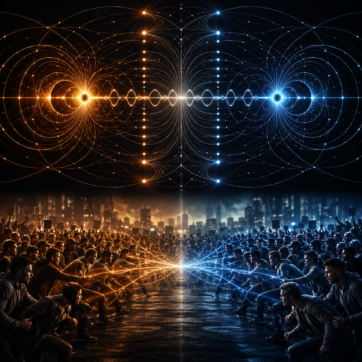
Why war zones, nuclear sites, and military installations become anomaly nodes — and what is really happening beneath the explosion
The Misread of Explosions
Bombs are not just weapons acting on matter. The common understanding stops at blast radius, heat, destruction, and death, reading the event only at the level of visible output. Buildings collapse, bodies are damaged, landscapes are scarred, and the event is categorized as force applied to physical form. That interpretation is incomplete. It captures the surface translation but misses the mechanism underneath. A detonation is not simply an outward release of energy—it is a forced compression event that exceeds the render’s ability to resolve sequence locally. The system is not just reacting to force; it is being pushed beyond its capacity to translate that force step-by-step into stable continuity.
When the compression spike hits, the render cannot distribute load through its normal sequencing. Instead of smooth resolution—where load is absorbed, translated, and stabilized—the system encounters a break in continuity. The visible explosion is the outward expression of that failure, but the real consequence occurs beneath it. Load is driven into the underlying architecture faster than it can be processed, and the node where the event occurs is forced to adapt to conditions outside its design tolerance. This is where the event shifts from damage to structural alteration. The explosion ends in time, but the change in how that location resolves reality does not.
What follows is not just destruction but a reconfiguration of stabilization behavior at that coordinate. The site does not return to its prior state because the system has not fully resolved what occurred. Instead, it carries unresolved compression forward, altering how sequence, coherence, and continuity behave there going forward. This is the part that is consistently missed. Explosions are treated as events that happen and end, when in reality they are events that force a lasting change in how the render stabilizes itself locally. The blast is temporary. The structural consequence is not.
The Structure of Reality: Render, Pre-Render, External, Eternal
To understand what a detonation actually does, the structure it is acting within has to be defined first. Without that, explosions are misread as isolated physical events instead of interactions with a layered translation system. What is commonly called “reality” is not a single flat plane of matter. It is a staged resolution process. What is seen, measured, and experienced is the final output of that process, not its origin. That output layer is the render, which is what we see around us. The render is where matter appears stable, where time sequences linearly, and where events can be observed, recorded, and interpreted. It is the surface where all phenomena resolve into form, but it is not where the conditions for that form are determined.
Beneath the render is the pre-render layer. This is not a hidden physical space, but the condition-set architecturally that governs what can resolve into the render at all. It is where load distribution, sequence ordering, and coherence thresholds are determined before they appear as matter, motion, or event. The pre-render layer does not “look like” anything because it is not visual output. It is instruction behavior. It determines whether continuity can hold, whether a sequence can complete, and whether a structure can stabilize. When the pre-render layer is operating within tolerance, the render appears smooth, continuous, and predictable. When it is strained or overloaded, the render begins to show inconsistency, instability, and failure to resolve cleanly.
Both render and pre-render operate within what can be called the external system. The external is not a place but a condition of operation defined by oscillation, compression, geometry, and time-based translation. Everything that moves, changes, cycles, or stabilizes through force exists within the external. Matter holds shape because of compression relationships. Motion exists because of oscillation. Structure forms through geometry. Events are experienced sequentially because of time-based ordering. The external is therefore a system that maintains itself through continuous translation—taking load, distributing it, and resolving it into stable output. This process is not static. It requires constant adjustment to maintain coherence.
Within that system, there is also a distortion pattern that has to be accounted for: the mimic layer. The mimic is not an external invader or separate entity acting on the system. It is a behavior within the external grid itself. It emerges wherever translation becomes misaligned and begins to stabilize through compression rather than coherence. The mimic layer operates by reinforcing patterns that allow the system to hold form under strain, but it does so by increasing compression, repetition, and mis-sequenced resolution. It stabilizes in the short term by preventing collapse, but at the same time it deepens instability by accumulating unresolved load. This is why it can appear to maintain structure while actually degrading the conditions that allow structure to remain coherent over time.
The mimic layer therefore has a dual effect. It acts as a compensatory mechanism that keeps the system from immediate failure, especially in high-stress conditions such as war, repeated detonations, and technological strain. At the same time, it reinforces the very distortions that create those conditions, locking the system into cycles of increasing compression and decreasing resolution quality. It does not introduce something new into the system. It amplifies what is already misaligned, stabilizing it just enough to persist while preventing full correction.
Outside of all of this is the Eternal. The Eternal is not part of the system. It is not another layer, not another field, and not another form of energy or geometry. It does not operate through oscillation, compression, or time. It does not move, translate, or resolve. It is the still reference that allows coherence to exist at all, but it does not participate in the mechanics of the external system. Because it is not part of the system, it cannot be affected by events within it. It does not tear, distort, or destabilize. It remains unchanged regardless of what occurs in the render or pre-render layers.
This distinction matters because it prevents misinterpretation. When instability occurs—whether through detonations, structural overload, or accumulated distortion—it is happening entirely within the external system. The render shows the result, the pre-render carries the strain, and the mimic layer attempts to stabilize the misalignment while reinforcing it. The Eternal is not involved in the event. It does not need to be repaired, or protected. It simply remains as the non-participating reference point that makes coherence possible, even when the system itself is failing to maintain it.
With this structure defined, detonations can be understood correctly. They are not isolated physical events. They are compression spikes applied to a system that is already balancing load, sequence, and coherence across multiple layers. When that spike exceeds tolerance, the effects propagate through the render, the pre-render, and the mimic-stabilized distortion patterns simultaneously. Without this architecture, the event is misread. With it, the full impact becomes clear.
What a Detonation Actually Is
In human science, a detonation is defined as a rapid exothermic reaction that releases energy faster than the surrounding medium can dissipate it, producing a shockwave that propagates through air, ground, and material structures. In chemical explosives, this is modeled as a supersonic reaction front where pressure, heat, and gas expansion drive outward force. In nuclear detonations, the explanation shifts to fission or fusion processes where atomic nuclei are split or combined, releasing enormous energy through mass–energy conversion, generating thermal radiation, ionizing radiation, electromagnetic pulse, and blast pressure. These models describe the behavior of the explosion in the render—what can be measured, recorded, and predicted within the physical output layer. They track pressure curves, temperature spikes, velocity of shock fronts, and structural damage. All of that is accurate within its scope, but it is incomplete because it only describes what the system looks like after it has already failed to translate the event smoothly.
A detonation is not just an energy release. It is a compression spike that exceeds local translation capacity. The key variable is not how much energy is released, but how quickly load is forced into the system relative to its ability to resolve sequence. Under normal conditions, the external system distributes load step-by-step. Pressure is absorbed, translated through structure, and resolved into stable output. Even high-energy events can be managed if they remain within the system’s tolerance for sequential resolution. A detonation breaks that condition. It forces more load into a coordinate than the system can process in sequence, collapsing the step-by-step translation mechanism that normally maintains continuity.
When that happens, the event splits. The portion that human science measures is the surface translation outward: blast wave, thermal expansion, shock propagation, radiation dispersal, and material fragmentation. This is the visible explosion. It is the system attempting to discharge excess load laterally and outward into the surrounding environment. Air compresses and expands, structures fail under pressure gradients, and energy radiates across space. This outward expression is real, measurable, and destructive, but it is only half of the event.
At the same time, a second process occurs that is not directly captured in standard models. Because the system cannot resolve the load sequentially at the surface, the excess compression is driven into the underlying architecture. This is not a physical downward movement through space, but a displacement into the pre-render layer where translation conditions are set. The system effectively offloads what it cannot resolve into the layer that governs resolution itself. This is structural displacement. It forces the pre-render layer to absorb a load it was not configured to handle at that rate or magnitude.
This is where the real consequence of detonation occurs. The pre-render layer operates on sequence, coherence, and load distribution. When a compression spike exceeds tolerance, sequence cannot complete cleanly. Instead of smooth translation, the system produces discontinuity. Coherence drops locally, and the node where the detonation occurred is forced into a misaligned state. It still resolves output, but it does so under altered conditions. The translation is no longer stable in the same way it was before the event.
Human science does not model this because it does not treat translation capacity as a variable. It assumes that matter responds to force according to fixed laws, without accounting for the limits of sequence resolution under extreme compression. As a result, it can describe what happens to materials, but not what happens to the conditions that allow materials to behave consistently in the first place. This is why post-detonation environments are treated as damaged rather than structurally altered. The models stop at destruction, while the system continues operating under changed parameters.
In nuclear detonations, this effect is amplified. Chemical explosives push against structure. Nuclear events interfere with the binding conditions that allow structure to hold at all. The rapid collapse of atomic cohesion produces a compression event that is not only larger in magnitude but deeper in its interaction with the system. The outward effects—blast, heat, radiation—are extreme, but the more significant change is the degree to which the underlying translation layer is forced out of alignment. The system is not just overwhelmed at the surface. It is pushed beyond tolerance at the level where coherence is determined.
The result is that the visible explosion ends, but the structural consequence does not. The outward discharge dissipates over time, but the load injected into the pre-render layer remains unresolved. The node adapts by stabilizing under altered conditions. It carries residual compression, reduced coherence tolerance, and impaired sequence resolution. This is why the event cannot be understood as temporary. The detonation is momentary. The change in how the system resolves at that coordinate is persistent.
The critical point is that the visible explosion is only the surface expression of a deeper failure in translation. Human science captures the expression. It does not capture the shift in underlying conditions. A detonation is not simply energy released into matter. It is a forced interaction with the limits of how the system can resolve load into stable form. When those limits are exceeded, the system does not break open. It misaligns, and that misalignment continues to define how that location behaves long after the blast has dissipated.
When the Render Overflows Into Pre-Render
Under normal conditions, events in the render do not reach into the pre-render layer. The system is designed to contain its own load. Force is applied, structure absorbs it, sequence resolves step-by-step, and the output stabilizes without requiring deeper compensation. This is what stable reality looks like—continuous, predictable, and self-contained. The render processes its own activity through staged translation, and the pre-render layer governs that process without being directly impacted by individual events.
The pre-render dictates what the render can become. It sets the conditions for resolution before anything appears as matter, motion, or event. Load distribution, sequence ordering, and coherence thresholds are established at that level, and the render is the output of those conditions. What is seen as stable matter is the result of sequence completing successfully. What is experienced as time is the ordered progression of that sequence resolving. What is interpreted as cause and effect is simply the system stepping through pre-render conditions into visible form. The render does not generate itself. It expresses what the pre-render allows to resolve.
That condition breaks when load exceeds translation capacity. A detonation is one example, but it is not the only one. When compression is forced into a location faster than sequence can resolve it, the system cannot complete translation locally. It runs out of steps. At that point, the load does not disappear and it does not remain contained in the render. It is displaced into the layer that governs resolution itself. This is not movement through space, and it is not a “reaching into” another layer. It is a failure condition where the system is forced to compensate at a deeper level because it cannot stabilize at the surface.
The mechanism is precise. Load exceeds tolerance, sequence fails, and continuity cannot be maintained. Instead of resolving into stable output, the system offloads the unresolved compression into the pre-render layer. The pre-render is then forced to absorb and redistribute that strain. Because the pre-render dictates how the render resolves, any distortion introduced at that level feeds forward into future output. This is how a single event can produce persistent change. The node does not just carry damage—it carries altered resolution conditions.
Atomic detonations do this most efficiently because they collapse binding coherence faster than any staged system can process. The speed and density of the compression spike leave no time for sequential resolution. But they are not unique in principle. Any event that overwhelms translation capacity can produce the same overflow condition, even if at a smaller scale or lower intensity.
Repeated high-load events are one category. Sustained bombardment, prolonged warfare, and continuous weapons testing do not allow the system to reset between impacts. Load accumulates faster than it can be resolved, and the node is repeatedly pushed into compensation. Over time, this creates a persistent condition where the pre-render layer is carrying unresolved strain as part of its baseline behavior.
Large-scale structural collapse is another category. When massive amounts of matter fail simultaneously—cities collapsing, infrastructure failure under extreme stress, or cascading destruction across a region—the system encounters multiple compression points at once. The sequencing required to resolve those points exceeds local capacity, and overflow into pre-render becomes more likely.
High-density technological concentration can also contribute. Environments where multiple systems are generating, transmitting, and amplifying signal simultaneously—military installations, testing facilities, dense industrial zones—create layered load conditions. Individually, each system may be within tolerance. In aggregate, they can push the node closer to instability, reducing the margin before overflow occurs.
Finally, there are conditions of synchronized human activity under extreme stress. Large populations experiencing high-intensity, simultaneous pressure—war zones, mass panic events, or concentrated crisis environments—do not introduce a separate force into the system, but they do increase the density of load being processed at once. When that density exceeds the system’s ability to resolve it cleanly, it contributes to the same failure condition: sequence breakdown and displacement into pre-render.
In all cases, the principle is the same. The render does not actively impact the pre-render under normal operation. It only does so when it fails to contain its own load. The interaction is not control or access. It is compensation under strain. When the system is pushed beyond its ability to resolve continuity, the deeper layer is forced to absorb what cannot be processed. Because that deeper layer dictates how reality resolves, the result is not temporary disruption but lasting change in how that location produces stable output.
Why It Feels Like a Tear (Perception vs Sequence Break)
From inside the system where we are, a detonation registers as rupture. Continuity breaks, sequence drops, and coherence fails so abruptly that the event feels like something has been torn open. This is the natural interpretation because the system is no longer resolving smoothly at that coordinate. The expectation inside the render is continuous output—events following in order, structures behaving predictably, and matter holding form under stable conditions. When that continuity collapses without transition, the system presents a break instead of flow, and that break is experienced as separation.
This is why explosions—especially high-intensity events—are consistently described in human language as “tearing reality apart” or “ripping the fabric of space.” The description appears in both technical metaphor and interpretive frameworks because the sensory experience aligns with rupture. When sequence drops and coherence fails instantly, there is no intermediate state for the mind to map onto. It defaults to the closest physical analogy available: something has been split, opened, or torn. In more interpretive or New Age models, this same condition is extended into the idea of portals, breaches, or openings between layers. These interpretations persist because the system is no longer presenting continuity, and discontinuity is read as division.
But nothing is actually torn. There is no fabric, no opening, and no portal being created. There is no structural separation taking place. What is occurring is a discontinuity in sequence resolution. A detonation is a compression spike that exceeds local translation capacity. The compression enters the system faster than it can be resolved step-by-step, and the sequencing mechanism fails to complete. Instead of distributing load through ordered resolution, the system fragments at that coordinate. Coherence drops, alignment fails, and the node shifts into instability.
This is the mechanism that replaces the misinterpretation. A bomb does not tear reality open. It creates a sequence break. Under normal conditions, the system operates through ordered progression: load distributes, sequence resolves, and form stabilizes. That is what produces continuity in the render. Under detonation conditions, that progression collapses. Load spikes, sequence fails, coherence drops, and stabilization shifts. The system does not open—it misaligns. The node remains part of the same structure, but it no longer resolves output cleanly.
The perception of a tear comes from this exact shift. When sequence fails, the system produces discontinuous output—gaps, overlaps, inconsistencies, and abrupt breaks in expected behavior. From within the render, this is indistinguishable from rupture. But structurally, it is misalignment in how the system resolves continuity. What people interpret as rupture is the visible effect of that misalignment, not the creation of an opening or a break in any underlying layer.
Conventional Explosives vs Nuclear Events
Human science separates explosives into categories based on chemistry, yield, and effects—high explosives, low explosives, fission weapons, fusion weapons—but from a structural perspective the distinction that matters is how each type interacts with the system’s ability to resolve sequence. Conventional explosives operate within the upper tolerance range of the render. They generate rapid pressure and heat, but the system can still translate that load through staged resolution, even if the outcome is destructive. Nuclear events exceed that threshold in a fundamentally different way. They do not simply apply force to structure—they interfere with the conditions that allow structure to stabilize at all.
Conventional explosives act primarily at the surface and near-surface layers of the render. They produce high-pressure shockwaves, rapid thermal expansion, and fragmentation of matter, but these effects remain within a domain where the system can still process load sequentially, even under extreme stress. Buildings collapse, terrain is displaced, and materials are broken apart, but the underlying binding logic that allows matter to exist and reconfigure remains mostly intact. The system absorbs the compression, distributes it outward and across adjacent structures, and over time begins to re-establish continuity. Even in heavily bombarded environments, the site can gradually restabilize because the pre-render layer has not been forced beyond its ability to maintain baseline coherence conditions.
This does not mean conventional explosions are minor. They can produce significant structural damage, loss of life, and localized instability. But the instability is largely confined to the render layer. The system is strained, not fundamentally misaligned. Sequence is disrupted temporarily, but not broken at the level that governs how sequence resolves in the first place. As a result, given enough time and absence of repeated overload, the site can recover. Matter reconfigures, structural integrity is restored, and continuity resumes with relatively stable behavior.
Nuclear detonations operate on a different threshold. They do not just break geometry or displace matter—they strike the binding layer itself. Human science describes this as the splitting or combining of atomic nuclei, releasing energy through mass–energy conversion. Structurally, what this represents is a collapse in coherence at the level where matter holds together. The event is not simply high energy—it is high-speed, high-density compression applied faster than the system can resolve at any stage. There is no time for sequential distribution. The load is forced into the system in a way that bypasses the normal translation process entirely.
When that happens, the effect is not limited to surface destruction. The pre-render layer is forced into compensation because the render cannot contain the load. The binding conditions that allow matter to stabilize are exposed as conditional rather than fixed. Coherence drops more deeply and more abruptly than in conventional explosions, and the node where the event occurs is pushed beyond its capacity to reset cleanly. Instead of returning to baseline, the system adapts to the distortion.
This is what creates persistent node-level instability. The site does not simply carry damage—it carries altered resolution conditions. Sequence does not resolve as cleanly, coherence tolerance is reduced, and the system becomes more susceptible to further instability under smaller loads. This is why nuclear sites behave differently over time. The visible destruction may be contained or mitigated, but the structural consequence remains embedded in how the location resolves output.
Another critical difference is the inability to fully reset. Conventional sites, even after severe damage, can re-enter stable resolution because the underlying conditions remain within recoverable range. Nuclear sites do not return to the same baseline because the pre-render layer has been forced into a new operating condition. The system is still functioning, but it is functioning with reduced alignment. This is why long-term anomalies, measurement inconsistencies, and instability patterns are more commonly associated with nuclear test zones and detonation sites than with standard battlefields.
This distinction also explains why repetition compounds differently across these categories. Repeated conventional bombardment accumulates damage, but the system can still distribute and eventually dissipate the load. Repeated nuclear events stack misalignment into the same node, reinforcing instability at the level of sequence resolution. The site becomes a persistent load-bearing coordinate, holding unresolved compression as part of its ongoing behavior rather than clearing it over time.
The result is that nuclear detonations do not just destroy what is there. They alter how that location functions within the system. Conventional explosives stress and damage the render. Nuclear events destabilize the conditions that allow the render to resolve in the first place. That is why the two cannot be treated as scaled versions of the same phenomenon. They are different interactions with the system, operating at different depths of its structure, producing fundamentally different long-term outcomes.
Repetition Turns Damage Into Infrastructure
A single detonation is a disturbance. It forces a compression spike into a location, disrupts sequence, and produces instability that the system then attempts to resolve. Given sufficient time and no further stress, that instability can be reduced. Sequence gradually reorders, coherence stabilizes, and the node moves back toward baseline conditions. This is how the system is designed to function—absorb, translate, and recover.
Repetition breaks that process. When detonations occur again before the system has fully resolved the previous load, the node does not return to baseline. Instead of clearing the disturbance, it accumulates it. Each new event adds compression to a location that is already operating under reduced tolerance. The system is no longer dealing with a single spike. It is managing stacked load that has not been fully distributed or resolved.
This is pattern loading. The system begins to carry repeated compression signatures at the same coordinate. Instead of isolated disturbances, the node experiences recurring stress that follows similar structural pathways. The result is not just increased damage. It is the formation of a persistent load condition embedded into how that location operates. The node stops behaving like a standard resolution point and begins to behave like a storage point for unresolved compression.
Incomplete recovery is the next stage. Between events, the system attempts to stabilize, but it does so under the influence of remaining load from previous detonations. Sequence does not fully reorder. Coherence does not return to original levels. Each recovery cycle is partial, leaving residual misalignment in place. Over time, these residuals accumulate into a baseline condition. What was once a temporary disturbance becomes a permanent feature of the node’s behavior.
This is where adaptation replaces reset. The system is no longer trying to return the node to its original state because that state is no longer reachable under the accumulated load. Instead, it adjusts to operate within the new conditions. Sequence continues to resolve, but with reduced stability. Coherence holds, but with less tolerance. The node remains functional, but it is no longer aligned in the same way it was before repeated stress was introduced.
Military testing sites, war zones, and areas of repeated bombardment are direct examples of this process. These are locations where the system has been forced to absorb high-intensity compression events multiple times, often in short intervals. Nuclear test ranges, weapons development facilities, and long-term conflict zones do not allow sufficient recovery time between events. The result is sustained pattern loading that transforms the node into something structurally different from undisturbed locations.
The critical shift is that the site becomes a load-bearing node. Instead of passing load through and resolving it, the node holds unresolved compression as part of its operating condition. This changes how it interacts with surrounding areas, how it responds to new inputs, and how sequence resolves locally. Instability is no longer an occasional outcome—it is built into the structure of the node itself.
This is why these sites behave differently over time. The effects are not limited to visible damage or historical events. They are embedded into how the system continues to function at that coordinate. Repetition has turned disturbance into infrastructure. The damage is no longer something that happened there. It is something the location now carries as part of its ongoing behavior.
Combined Load Environments: Explosives, Trauma, and Node Formation
A node is not a place in the ordinary sense. It is a coordinate where load, sequence, and coherence are being actively managed by the system. Every location resolves reality, but not every location carries the same amount or type of load. A stable node distributes input, resolves sequence cleanly, and returns to baseline after disturbance. An unstable node holds residual load, resolves sequence inconsistently, and does not fully reset. What defines a node is not geography alone, but the density and type of load it has been forced to process over time.
In high-impact environments such as battlefields, the system is not dealing with a single category of input. It is processing layered compression from multiple sources simultaneously. Explosives introduce rapid, high-density compression spikes that disrupt sequence at the structural level. At the same time, large populations under extreme stress introduce synchronized load into the system. Fear, shock, and sustained threat conditions are not separate forces acting from outside—they are part of the same external system, increasing the density of what must be processed at that coordinate. When both occur together, the node is pushed beyond tolerance in more than one dimension at once.
This creates compounded load conditions. Explosions disrupt sequence directly through compression, while sustained human stress increases the volume of simultaneous input the system must resolve. The combination reduces the system’s ability to maintain ordered translation. Sequence is not only broken by the initial detonation—it is continually strained by ongoing conditions that prevent recovery. Instead of a single disruption followed by stabilization, the node experiences continuous pressure that reinforces instability.
The result is accelerated pattern loading. In environments where explosives and large-scale trauma coincide, the system is repeatedly forced into compensation without sufficient recovery intervals. Sequence does not fully reorder between events. Coherence remains below baseline. Residual compression accumulates faster than it can be resolved. The node transitions more quickly from disturbance to adaptation, and from adaptation to persistent instability.
This is why battlefields behave differently from sites that experienced a single isolated detonation. The combination of repeated physical compression and sustained collective stress creates a layered load condition that is more difficult for the system to process. The node does not just carry structural damage from explosions. It carries unresolved sequence from multiple overlapping inputs that were never fully translated.
Once this condition is established, the node functions as a load-bearing point for unresolved compression. It holds and manages accumulated strain rather than clearing it. This affects how sequence resolves locally, how the node responds to new input, and how it interacts with surrounding areas. Even after active conflict ends, the system continues to operate under altered conditions because the underlying load has not been fully distributed.
The concept of trauma, when reframed structurally, is not an abstract or separate phenomenon. It is a high-density input condition that increases load on the system at the same time as physical disruption. In isolation, the system can often absorb and resolve such input over time. In combination with repeated detonations and structural collapse, it contributes to a compounded failure condition where sequence resolution is consistently interrupted.
This is the defining feature of combined load environments. The node is not experiencing one type of stress. It is processing multiple overlapping compression inputs that exceed its ability to resolve them cleanly. The result is not just damage or instability, but a sustained alteration in how that location functions within the system. The battlefield becomes more than a site of past events. It becomes a node that continues to carry unresolved load, influencing how reality stabilizes there going forward.
Scalar Pockets and Compressed Oscillation
Pattern loading does not remain evenly distributed inside a node. When repeated detonations and sustained high-density input accumulate faster than the system can resolve them, the load begins to localize. Instead of flowing through the node and dissipating, portions of that load are held in place. They compact. They cycle. They do not clear. This is the formation condition for what can be described as scalar pockets.
A scalar pocket is not an object and not a separate structure. It is a localized region inside the node where compression has been trapped in oscillation. The load cannot resolve forward through sequence, so it loops within a confined boundary. It is contained, but not stable in the sense of resolution. It is stable as containment under pressure. The system is holding the compression in place because it cannot process it cleanly.
Compressed oscillation is the defining behavior. Instead of distributing load outward, the pocket cycles it internally. Compression builds, releases partially, then compresses again. This is not a full discharge. It is an incomplete resolution loop. It does not leave the system. It is retained and re-circulated within a constrained region. Over time, this increases density. The pocket becomes more pressurized, not less.
These pockets form most readily in nodes that have experienced repeated high-intensity events without sufficient recovery. Military test sites, nuclear ranges, long-term war zones, and heavily bombarded locations all meet this condition. Pattern loading creates the baseline instability. Incomplete recovery prevents redistribution. Node adaptation holds the load in place. The result is localized compression that cannot resolve through normal sequence. The system contains it by forcing it into oscillation.
This plays directly into the behavior observed at these sites. Instability is not uniform across the entire location. It clusters. Certain coordinates exhibit higher sensitivity, stronger irregularity, and more pronounced deviations in sequence resolution. These are the areas where compression has compacted into pockets rather than being spread across the node. The system is effectively carrying internal pressure points.
Over time, the pressure inside these pockets increases as additional load is introduced or as existing load continues to cycle without resolution. The system can maintain containment up to a threshold. Beyond that threshold, the pocket cannot sustain its internal oscillation pattern. It releases. This is not an explosion in the conventional sense, but it is a rapid redistribution of previously contained compression.
When that release occurs, it presents as sudden instability. Sequence irregularities spike. Measurements drift more sharply. Environmental behavior becomes less predictable. These are not new inputs entering the system. They are the output of stored load being forced back into the broader node after prolonged containment.
After release, the system attempts to redistribute and stabilize, but because the underlying conditions that created the pocket often remain, new pockets can form. This creates a cycle: accumulation, compression, containment, release, and partial redistribution. In nodes with sustained pattern loading, this cycle becomes part of the ongoing behavior of the site.
This is why some locations exhibit periodic intensification rather than constant instability. The system is not uniformly unstable at all times. It is managing localized compression that builds and discharges in intervals. The pockets do not eliminate load—they regulate how it is expressed over time.
Scalar pockets are therefore not separate from the earlier mechanisms. They are the internal consequence of repetition, incomplete recovery, and node adaptation. Where load cannot resolve, it compacts. Where it compacts, it oscillates. Where it oscillates under constraint, it eventually releases. This is another layer of how detonations do not end with the event itself. The load persists, organizes, and continues to influence how the node behaves long after the original compression spike has passed.
What These Sites Become
After repeated high-load events, these locations are no longer normal coordinates. The change is not only historical and not limited to visible damage. The transformation is structural. The node no longer operates as a standard resolution point within the system. It becomes an instability node—a coordinate where sequence, load, and coherence no longer behave within baseline tolerances.
A normal coordinate distributes incoming load, resolves sequence step-by-step, and stabilizes output consistently. It clears disturbance over time and returns to predictable behavior. An instability node does not follow that pattern. It carries residual load as part of its operating condition. Instead of resolving cleanly, it manages ongoing imbalance. The location is still functional, but it is functioning under altered rules.
The first defining characteristic is reduced coherence stability. The node has a lower tolerance for maintaining alignment under load. Conditions that would be absorbed and resolved cleanly in a stable location produce disproportionate effects here. Small inputs can disrupt sequence more easily because the system is already operating near its threshold. Coherence is not absent—it is fragile. It holds, but not with the same resilience.
The second characteristic is inconsistent sequence resolution. In a stable node, repeated conditions produce repeatable outcomes. Sequence progresses in a predictable way. In an instability node, that repeatability degrades. The same input can produce slightly different outputs depending on the existing load state. Sequence may partially resolve, skip, overlap, or delay. This does not mean the system is random. It means the system is resolving under fluctuating internal conditions created by accumulated load.
Sensitivity to minor inputs follows from this. Because the node is already carrying unresolved compression, it requires less additional load to trigger instability. Small environmental changes, minor physical disturbances, or low-level inputs can produce amplified effects. The node is not generating new force—it is reacting from a state of reduced tolerance. This is why these sites often appear reactive or unpredictable compared to undisturbed areas.
Localized load storage is another defining feature. Instead of distributing compression outward through the system, the node retains portions of it internally. This includes both the broad pattern loading described earlier and the formation of concentrated regions such as scalar pockets. The location effectively becomes a storage point for unresolved compression. The load does not vanish after the event—it remains embedded in how the node operates.
The final characteristic is altered coupling to the surrounding grid. A stable node interacts with adjacent coordinates in a balanced way, distributing load and maintaining continuity across the system. An instability node does not couple cleanly. It introduces irregularity into the surrounding structure. Load may reflect back instead of distributing smoothly, or it may propagate unevenly into neighboring regions. This creates localized zones of increased sensitivity and can extend the effects of the instability beyond the original site.
These characteristics explain why military bases, nuclear test sites, and battlegrounds behave differently from undisturbed land. It is not only due to secrecy, equipment, or environmental damage. It is because these locations have been subjected to repeated high-density load without sufficient recovery. The system has adapted to that condition, embedding instability into the node itself.
Over time, this changes how the location responds to new events. It does not simply react as a neutral coordinate. It reacts as a load-bearing point with existing compression already present. Sequence resolves through that condition rather than independently of it. The result is a persistent difference in behavior that remains long after the original detonations or conflicts have ended.
The transformation is complete when the node no longer returns to baseline. At that point, the instability is not temporary. It is structural. The site has become part of the system’s ongoing load management rather than a location that processes and clears events cleanly. This is what these sites become: not just damaged ground, but coordinates that continue to carry and express unresolved compression within the architecture of the render itself.
Anomalies: What People Are Actually Observing
Anomalies are not paranormal events, not external intrusion, and not new phenomena entering the system. They are not UFOs, not unknown craft, and not evidence of something arriving from outside. What is being observed is internal instability in how the system is resolving itself at specific coordinates. The term “anomaly” is a surface label applied when expected continuity fails. Structurally, it is not something added to reality. It is a condition where reality is not resolving in a consistent, repeatable way.
A stable node produces repeatable outcomes. The same input yields the same result because sequence resolves cleanly and coherence holds. Measurement systems rely on this stability. Instruments assume continuity, timing assumes ordered progression, and signals assume consistent propagation. When those assumptions fail, the output is labeled anomalous. But nothing new has appeared. The system is revealing edge-case behavior that is normally suppressed under stable conditions.
At instability nodes, this suppression is reduced. Sequence resolution is already strained due to accumulated load, incomplete recovery, and internal compression. As a result, edge-case behaviors become visible. These are not separate phenomena. They are the boundaries of the system’s operating range appearing in the output because the node can no longer maintain uniform resolution.
The primary expression of this is failure of repeatability. In stable environments, measurements can be reproduced with high precision. In instability nodes, identical setups produce variations. The system is not resolving the same way each time because internal load conditions are fluctuating. This produces non-repeatable measurements, where results drift within a range rather than locking to a fixed value.
Instrument drift is a direct outcome of this. Precision devices depend on stable sequence progression and consistent environmental coupling. When the node is carrying unresolved compression, the underlying conditions shift subtly between readings. The instrument is not malfunctioning in isolation. It is operating in an environment where the baseline is no longer fixed. Over time, this appears as drift, even when the device is functioning correctly.
Signal inconsistency follows the same mechanism. Transmission systems rely on stable propagation conditions. At instability nodes, the medium through which signals move is not resolving uniformly. This results in fluctuations in strength, timing, and clarity. Signals may degrade, fluctuate, or exhibit irregular patterns, not because of external interference, but because the system itself is not maintaining consistent conditions for propagation.
Timing irregularities are another expression. Sequence resolution governs how events are ordered in time. When sequence is unstable, timing can appear to compress, stretch, or skip at micro levels. In measurement systems, this presents as synchronization errors, timing offsets, or irregular intervals between expected events. These are not instances of time changing. They are failures in how sequence is being resolved and recorded.
Environmental fluctuation patterns also emerge. Temperature shifts, electromagnetic variation, and localized changes in system behavior can occur without clear external cause. These are not new forces acting on the system. They are outputs of internal instability, where small variations are amplified due to reduced coherence tolerance at the node.
All of these observations share the same structure. They are not separate categories of phenomena. They are different expressions of the same condition: instability in resolution. The system is still functioning, but it is operating under altered internal conditions created by accumulated load. As a result, it cannot maintain the level of consistency required for clean, repeatable output.
This is why anomalies cluster around military installations, nuclear facilities, weapons testing sites, and former detonation zones. These locations have undergone repeated high-density compression events and have not fully recovered. The nodes carry residual load, and that load affects how sequence resolves. What is observed in these environments is not something being added to reality. It is the system revealing its own instability.
When understood structurally, anomalies are not mysterious. They are the expected outcome of a system operating outside its optimal tolerance range. The perception of strangeness comes from the gap between expected continuity and actual output. But the cause is not external. It is internal to the node, and it is directly tied to how load, sequence, and coherence are being managed at that location.
Bleedthrough: What It Really Is
Bleedthrough is one of the most consistently misread conditions in instability nodes. It is not something entering, not an intrusion, and not a crossing of entities from elsewhere. Nothing is traveling into the system. Nothing is arriving. What is occurring is boundary failure between parallel resolution layers that are already part of the same system. The effect presents as overlap, but the cause is loss of separation, not movement across it. What is “bleeding through” is not an external presence—it is adjacent render bands, parallel resolution layers of the same system that are normally phase-locked apart.
In a stable system, resolution layers remain cleanly separated. Sequence organizes into distinct channels, each resolving independently without interference. These are parallel render bands—multiple resolution paths that exist simultaneously but are kept isolated through phase-lock conditions and ARPS separation within the architecture. The system maintains coherence by keeping these channels aligned and non-overlapping. This is what allows continuity to appear singular and consistent. What is experienced as one stable reality is the result of that separation holding across all bands.
When a node becomes overloaded, that separation weakens. Pattern loading, incomplete recovery, and localized compression reduce the system’s ability to maintain clean boundaries between layers of resolution. Phase-lock begins to degrade. ARPS separation loses precision. Sequence does not just fail locally—it begins to lose isolation from adjacent resolution states. The result is partial overlap. Two or more sequences that would normally resolve independently—two render bands—begin to interfere with each other at that coordinate.
This is bleedthrough. Not entry, but overlap. Not arrival, but misalignment between parallel render bands that are already present within the system.
The mechanism is direct. Stable system: clean separation between layers, phase-lock intact, ARPS maintaining band isolation. Overloaded node: weakened separation, phase-lock degradation, ARPS instability. Result: partial overlap of sequences across adjacent render bands. The system is still resolving internally, but it is no longer resolving in isolation. Fragments of adjacent sequence states—other render bands—appear in the output because the boundary that would normally keep them separate is no longer holding with full coherence.
There are many types of render bands. They are not alternate “worlds” in the simplified sense, but parallel resolution layers with different sequence conditions, different ordering, and different structural states. Under stable conditions, these bands do not mix. They remain phase-separated. Under instability, that separation weakens, and fragments from these bands can partially resolve into the current output.
What appears at the surface level follows predictable patterns. Visual artifacts are one of the most common. These can present as brief forms, shapes, or structures that do not match the surrounding environment or that do not persist long enough to stabilize. They are not objects moving into the scene. They are fragments of another render band partially resolving into the current output due to boundary failure between bands.
Sound without stable source follows the same structure. Audio patterns may appear without a clear origin because the sequence producing the sound belongs to a different render band. It is resolving from a layer that is overlapping temporarily. The system registers the output, but cannot anchor it to a stable coordinate within the primary sequence.
Pattern echoes and repetition occur when partial sequences from adjacent bands overlap with the current one. Events may seem to repeat, partially replay, or echo in altered form. This is not memory playback or external influence. It is interference between sequence layers across render bands that are no longer fully separated, causing fragments to reappear within the current resolution path.
Time overlap is another expression. Sequence ordering depends on clean progression within a single band. When bands overlap, ordering can appear disrupted. Events may seem out of place, delayed, or partially duplicated. This is not time shifting or travel. It is sequence interference across bands—multiple resolution paths briefly intersecting at the same coordinate.
Signals with no clear origin also emerge. Measurement systems may detect patterns that do not correspond to local inputs. These are not transmissions entering from outside. They are outputs from adjacent render bands that have become partially coupled to the current one due to weakened phase-lock and ARPS separation.
This condition is not occasional—the render is already operating in a spliced state. Multiple render bands are being held together as a single continuous output through forced phase-lock and ARPS alignment. What appears as one stable reality is a compressed convergence of parallel resolution layers, not a cleanly separated system. Under normal conditions, this forced alignment holds enough coherence to maintain continuity. Under stress, it fails locally. Phase-lock weakens, ARPS separation degrades, and the underlying splicing becomes visible as bleedthrough.
This is why certain objects or elements may appear that do not match the expected conditions of the present environment. They are not entering from another place. They are fragments of adjacent render bands that have become visible due to boundary instability.
Human perception adds another layer to this. The brain is not a passive receiver. It is a translator. It takes incomplete, unstable, or conflicting input and architecture, and resolves it into recognizable patterns based on existing models. When bleedthrough occurs, the input is often partial and lacks full structural context. The brain fills in the gaps using familiar templates. This is why the same structural phenomenon can be interpreted in multiple ways depending on the observer.
In technological environments, these effects are labeled as anomalies, glitches, or signal interference. In cultural and interpretive frameworks, they are often labeled as UFOs, alien craft, entities, or paranormal events. The underlying condition is the same in both cases. The difference is in how the brain translates the incomplete data. When the system presents unstable or overlapping sequences across render bands, the translator attempts to impose coherence by matching the input to known forms. That translation can produce highly convincing but structurally incorrect interpretations.
This is why reports of objects or forms that appear briefly, move inconsistently, or do not behave according to stable physical rules are common in instability nodes. What is being observed are fragments of parallel render bands bleeding into the current one due to phase-lock failure. The system is not introducing new objects. It is failing to maintain separation between bands, and the human translator is rendering the resulting fragments into recognizable shapes. The output is real as an observation, but misinterpreted as an independent phenomenon.
Nothing is traveling. Nothing is entering. Parallel render bands are already present and normally separated. The system is revealing its own instability in how it resolves multiple layers of sequence under load. Bleedthrough is the visible effect of that instability. It is the result of separation failing, not of boundaries being crossed.
Memory Locks and “Haunting”
Locations described as “haunted” are not occupied by spirits, entities, or external presences. Nothing remains there as a separate consciousness. What persists is structural. The node is carrying unresolved sequence from a high-intensity event that never completed resolution. That unresolved sequence does not disappear. It remains embedded in how the node processes and references load.
A memory lock is the condition created when sequence is interrupted under extreme compression and cannot complete. The event begins, load spikes, sequence attempts to resolve, but coherence drops before completion. Instead of finishing and stabilizing into closed output, the sequence fragments and remains open. The system does not discard it. It retains it as an incomplete instruction set tied to that coordinate.
This is structural memory. Not recollection, not awareness, not consciousness persistence. It is a stored sequence that never resolved into final form.
When the node stabilizes after the initial event, it does so around that unresolved sequence. The load is still present, but it is now embedded into the node’s operating condition. Under certain inputs—environmental shifts, minor compression changes, or internal oscillation cycles—the node re-references that incomplete sequence. It attempts to resolve it again, but because the underlying conditions remain misaligned, it does not complete. It partially resolves, then collapses again.
This produces replay-like effects. Not identical repetition, but partial reconstruction of the original sequence. Fragments of the event reappear as pattern echoes. Movement, sound, or environmental shifts may occur in ways that resemble the original sequence, but they do not progress to completion. They cycle. They stop. They re-initiate under similar conditions.
Pattern recurrence is another expression. The node does not replay a full event—it re-expresses segments of it. These segments are triggered when the system enters a similar load configuration to the one that originally caused the sequence break. The closer the current conditions are to the original compression state, the more strongly the sequence fragment resolves. When conditions shift, the fragment drops out again.
Localized “activity” is the surface-level interpretation of this process. Movement without source, sound without origin, recurring environmental patterns—these are not actions being performed. They are partial outputs of an incomplete sequence attempting to resolve under fluctuating conditions.
Scalar pockets play a direct role in sustaining these effects. When unresolved compression is trapped in oscillation within the node, it cycles through pressure states. As the pocket compresses and partially releases, it modulates the internal load of the node. These oscillation cycles can bring the system into alignment with the original unresolved sequence for brief intervals. During those intervals, fragments of the sequence become visible. When the oscillation shifts, the alignment is lost and the output collapses.
This creates periodic activation. The site is not continuously active. It is conditionally active based on internal load states. Scalar pocket oscillation acts as a timing mechanism, determining when the node reaches a configuration that allows partial sequence re-resolution.
Trauma and fear, when described structurally, are not abstract emotional forces. They are high-density load conditions. They represent sustained compression within the system at both individual and collective scales. During events where large populations experience simultaneous high-intensity stress, the system is processing a concentrated volume of input at once. This increases overall load density at the node.
When this occurs alongside physical compression events—explosions, destruction, structural collapse—the system is forced to resolve multiple high-load inputs simultaneously. This increases the likelihood of sequence interruption. It also increases the amount of unresolved sequence retained when the system cannot complete translation.
At the pre-render level, this contributes to incomplete instruction sets being stored as part of the node’s configuration. At the render level, it increases the frequency and intensity of conditions that can trigger re-referencing of those sequences. The node is not only carrying the structural imprint of the physical event—it is carrying the unresolved load associated with the full compression state at the time the sequence broke.
This is why sites of combined high-intensity physical events and sustained collective stress exhibit stronger and more persistent memory lock behavior. The system has retained a higher-density unresolved sequence, and it is more easily reactivated under internal oscillation conditions.
There is no persistence of consciousness at the site. There is no independent entity replaying events. The appearance of presence is the result of partial sequence reconstruction being translated by the human perceptual system. The brain, acting as a translator, organizes incomplete input into recognizable forms. When fragments of a sequence resolve without full context, they are interpreted as intentional or aware because the translation process fills gaps with familiar patterns.
What is actually occurring is structural. An incomplete sequence is being partially resolved under specific conditions. That resolution fails before completion and collapses back into the node. The cycle repeats as long as the underlying load remains.
Memory locks are therefore not remnants of something that continues to exist. They are unresolved instructions that continue to attempt resolution. The node does not remember in the human sense. It re-references what never finished.
Time Distortion at Loaded Nodes
Time distortion at instability nodes is not time travel and not timeline jumping. Nothing is moving backward or forward through time, and no one is shifting between timelines as separate tracks. What is changing is how the render is resolving sequence around the observer. The environment does not remain fixed while something moves through it. The environment itself is resolving inconsistently under load.
Time, at the render level, is not an independent dimension moving on its own. It is the ordered resolution of sequence. When sequence resolves cleanly, time appears continuous, linear, and stable. When sequence resolution becomes unstable, time appears distorted. The distortion is not in time itself. It is in the process that produces the appearance of time.
At loaded nodes, excess compression and accumulated pattern loading disrupt the system’s ability to resolve sequence in a clean, ordered progression. Instead of stepping forward in a uniform way, sequence begins to misalign. This produces micro-level effects that are often interpreted as temporal anomalies.
Overlap is one of the primary expressions. Multiple sequence states begin to partially resolve at the same coordinate. This creates the perception that events are happening simultaneously or out of order. It can feel like two moments are occupying the same space, but this is not movement between them. It is incomplete separation in how they are being resolved.
Delay is another effect. Sequence does not progress at a consistent rate when coherence is reduced. Portions of the sequence may lag behind expected resolution, causing events to feel slowed, extended, or out of sync. This is not time slowing down. It is sequence failing to resolve at its normal rate due to internal instability.
Partial repetition occurs when segments of sequence fail to complete and then re-initiate. The system attempts to resolve forward, collapses, and then re-attempts resolution using similar input conditions. This produces experiences where events appear to repeat, but not perfectly. The repetition is incomplete because the underlying sequence never fully stabilized.
Skipped continuity is another outcome. When load exceeds tolerance, the system may bypass intermediate steps in sequence resolution. Instead of transitioning smoothly from one state to the next, it jumps across unresolved segments. This creates gaps in perceived continuity—moments that seem missing, compressed, or absent. Again, nothing has moved. The system simply failed to render those steps.
All of these effects come from the same condition: sequence resolution is unstable under excess load. The node is not processing events in a clean, ordered progression. It is resolving under strain, and that strain produces irregular output.
The critical correction is this: the render changes around you. The environment is not fixed while you move through time. The environment is continuously resolving, and at instability nodes, it does so inconsistently. What is perceived as movement through distorted time is actually inconsistent resolution of the surrounding sequence.
This is why experiences at these nodes can feel disorienting. The reference points that normally anchor continuity—order, timing, progression—are no longer reliable. The system is still producing output, but it is doing so with misaligned sequencing. The observer is not leaving the timeline. The timeline is not splitting in the way it is commonly described. The resolution process itself is unstable.
There is no travel, no jumping, and no shifting between separate tracks. There is only variation in how sequence resolves at a given coordinate under load. Time distortion is the visible effect of that variation.
Measurement Drift and Scientific Anomalies
Measurement drift is not instrument failure in isolation. It is the result of attempting precision measurement inside a node where sequence resolution is not stable. High-sensitivity systems assume consistent conditions: fixed baselines, repeatable sequence progression, and stable coupling between the instrument and its environment. At instability nodes, those assumptions do not hold. The environment itself is fluctuating at the level where measurement is being defined.
This is why precision loss appears. Instruments are calibrated against expected continuity—fixed intervals, stable signal propagation, and consistent material behavior. When sequence resolution is misaligned, those reference points shift subtly between readings. The instrument is still operating correctly, but the conditions it is measuring are not resolving identically each time. The result is a loss of precision that cannot be corrected through recalibration alone, because the baseline itself is moving.
Non-repeatable results follow directly. In stable environments, identical inputs produce identical outputs because sequence resolves consistently. At loaded nodes, internal load states vary moment to moment. Two identical experiments can produce different outputs because the underlying sequence conditions are not the same between runs. The system is not failing randomly—it is resolving under different internal configurations created by accumulated compression and incomplete recovery.
Edge-case fluctuations become visible because the node is operating closer to its tolerance limits. Conditions that would normally be suppressed or averaged out now appear in the output. Small variations are no longer absorbed. They propagate through the measurement process and register as irregular spikes, drops, or noise patterns. These are not external interferences. They are internal variations being expressed because the system cannot maintain uniform resolution.
Timing inconsistencies are one of the most critical indicators. Measurement systems rely on stable sequencing to define intervals. When sequence resolution is unstable, timing markers shift. This produces irregular intervals, synchronization errors, and what appear as “phantom” offsets in recorded data. Clocks may appear to drift relative to each other, not because time is changing, but because the ordering of sequence is not resolving uniformly across the node.
This is also where numerical readings become inconsistent. Values that should stabilize within a tight range instead move, fluctuate, or fail to settle. Numbers can appear “off,” drifting higher or lower without a clear cause, or shifting between measurements even when conditions are controlled. This is not random noise. It is the numerical expression of an unstable baseline. The system is not presenting a fixed value because the underlying conditions defining that value are not fixed.
These effects cluster around specific environments for structural reasons. Military installations, nuclear facilities, weapons testing sites, and former detonation zones are all locations where repeated high-density compression events have occurred. Pattern loading, incomplete recovery, and node adaptation have altered how these coordinates resolve sequence. The environment itself is less stable, and that instability directly impacts measurement.
In these locations, instruments are not simply measuring external variables. They are interfacing with a system that is already operating under load. Every reading is influenced by that condition. This is why anomalies are more frequent and more pronounced in these environments. It is not due to secrecy, unknown technologies, or external interference. It is because the node itself is not resolving in a consistent, repeatable way.
Measurement drift, therefore, is not a separate phenomenon. It is a direct expression of instability in sequence resolution. The instruments are functioning. The system they are measuring is not maintaining a stable baseline.
Coupling Failure and Grid Effects
Nodes do not operate in isolation. Each node is coupled to a larger lattice, continuously exchanging load with surrounding coordinates. In a stable condition, this coupling is balanced. Load distributes outward, neighboring nodes absorb variation, and the system maintains overall coherence through shared stabilization. No single point carries excessive pressure for extended periods.
A normal node distributes load efficiently. Compression enters, sequence resolves, and residual load is transferred outward in a controlled manner. This keeps local conditions within tolerance and prevents accumulation. Coupling between nodes remains clean, meaning signal, timing, and sequence alignment are consistent across the lattice.
An overloaded node breaks this condition. When pattern loading accumulates beyond local resolution capacity, the node cannot distribute load effectively. Instead of passing compression outward smoothly, it begins to resist transfer. This creates back-pressure. Load that would normally move through the lattice is partially reflected back into the node or unevenly redirected into adjacent nodes.
This reflection alters coupling behavior. Neighboring nodes receive inconsistent input—bursts of excess load followed by irregular gaps. Instead of stabilizing the system, coupling becomes a pathway for instability to propagate. The overloaded node no longer integrates into the lattice cleanly. It disrupts it.
Localized amplification of instability follows. Because load is not being dissipated correctly, small disturbances increase in magnitude within the node. Minor fluctuations that would normally be absorbed become visible. This intensifies anomaly expression at that coordinate and in nearby nodes receiving reflected load.
Signal distortion emerges as a direct result of disrupted coupling. Signals—whether electromagnetic, mechanical, or measurement-based—depend on consistent transmission conditions. When load distribution is uneven, propagation paths fluctuate. Signals arrive altered, delayed, or partially degraded. This is not interference from an external source. It is distortion introduced by inconsistent coupling conditions within the lattice.
Uneven load distribution across the lattice develops over time. Overloaded nodes begin to act as irregular sources of compression, sending inconsistent load patterns outward. Some regions receive excess pressure, while others remain underloaded. This imbalance prevents the system from stabilizing globally, even if individual nodes are not at maximum capacity.
This is how isolated instability nodes connect into broader anomaly patterns. A single overloaded node does not remain contained. Through coupling failure, it influences adjacent nodes, which in turn propagate altered load conditions further. The result is a network of affected coordinates, where anomalies cluster not randomly, but along pathways defined by disrupted load distribution.
Military installations, nuclear facilities, and repeated detonation sites often sit within these networks. Their high pattern loading makes them primary sources of coupling disruption. The anomalies observed across wider regions are not independent events. They are connected through the lattice by uneven load transfer and reflection originating from these nodes.
Coupling failure, therefore, is not a secondary effect. It is the mechanism by which local instability becomes systemic. The node fails to distribute load, reflects compression back into the system, and distorts the lattice around it. What begins as a localized condition extends outward, linking multiple sites into a continuous pattern of instability.
Why Military Sites Show the Most Activity
The concentration of anomalies at military installations, nuclear facilities, weapons testing ranges, and former detonation zones is not primarily about secrecy, hidden technology, or experimentation alone. Those factors may exist at the surface level, but they are not the structural cause. The cause is load. These sites carry the highest concentration of unresolved compression within the lattice.
High repetition is the first factor. These locations are not exposed to a single event. They are subjected to repeated detonations, continuous testing cycles, and sustained high-energy inputs over extended periods of time. Each event adds load. When recovery is incomplete, that load does not clear. It accumulates. The node transitions from disturbance to pattern loading, and from pattern loading to persistent structural alteration.
High compression density follows directly. Explosions, weapons testing, and energy-intensive operations generate concentrated load spikes that exceed normal resolution capacity. When this occurs repeatedly at the same coordinate, the node begins to store compression instead of distributing it cleanly. Scalar pockets form, oscillating under pressure, periodically releasing and reapplying load back into the node. This keeps the system in a continuously strained state.
Low recovery time is the third factor. In a stable system, nodes require intervals of low activity to redistribute load and restore coherence. At military sites, that interval is often absent. Activity cycles occur too frequently, preventing the system from completing full recovery. Sequence remains partially unresolved, and each new event layers on top of the previous one. The node adapts to carry load rather than clear it.
Strategic placement at sensitive coordinates compounds the effect. Many of these sites are positioned—intentionally or not—at locations where coupling pathways are strong or where baseline stability is already reduced. This means any introduced load does not remain local. It interacts more directly with the lattice, increasing both the impact of the initial compression and the reach of its effects.
An additional layer comes from the continuous operation of high-frequency and high-power equipment at these sites. Radar arrays, electromagnetic transmitters, antenna fields, satellite uplinks, over-the-horizon radar systems, communication towers, directed energy systems, and tracking installations all operate through oscillatory output. They do not simply transmit information. They generate sustained oscillation patterns that interact with the local node.
These systems introduce continuous, patterned oscillation into an already compressed environment. Unlike a single detonation, which creates a spike, these systems create persistent waveforms that cycle through the node. When multiple systems operate simultaneously, their oscillation patterns intersect. They do not pass cleanly through each other. They interfere.
When oscillatory fields intersect, two primary effects occur. In some regions, waveforms cancel—partial or full cancellation zones where amplitude drops. In other regions, they reinforce—constructive overlap that increases amplitude beyond baseline. Both conditions alter load distribution. Cancellation does not remove load. It redistributes it into adjacent zones. Reinforcement concentrates it.
This creates a secondary layer of scalar compression patterns within the node. Intersecting oscillations generate standing wave conditions—localized zones where energy does not propagate cleanly outward but remains cycling in place. These standing patterns act as additional scalar pockets, feeding oscillation back into the node and preventing clean dissipation.
As these oscillation fields continuously interact, they produce shifting interference patterns. The node is not experiencing a single, stable waveform. It is experiencing a constantly reconfiguring field of compression, reinforcement, and cancellation. This further destabilizes sequence resolution because the baseline conditions are no longer consistent even within short intervals.
A helpful analogy: Imagine a massive roadway system with no centralized control, where thousands of vehicles are moving at different speeds, in different directions, without synchronized flow. Under normal conditions, traffic follows lanes, timing, and spacing—this is equivalent to clean phase-lock and controlled oscillation. Movement distributes smoothly, and no single area carries excess pressure.
Now remove that order.
Intersections become uncontrolled. Vehicles begin crossing paths unpredictably. Some flows collide and stop—this is cancellation. The movement doesn’t disappear; it gets redirected, piling up in adjacent lanes and routes. Other flows merge into each other at the same time—this is reinforcement. Multiple streams stack into one, increasing density beyond what the road can handle.
As this continues, certain areas stop moving altogether. Not because nothing is there, but because too much is there. Vehicles become trapped in circular patterns—loops, gridlocks, localized congestion zones. This is the equivalent of standing wave conditions. Movement is no longer propagating outward. It is cycling in place.
These zones become pressure points. The system keeps feeding into them, but they cannot release cleanly. That is a scalar pocket. Compression is held, redistributed, and reintroduced into the surrounding system instead of dissipating.
So the system is no longer flowing. It is congesting, colliding, canceling, reinforcing, and recirculating load.
Together, these conditions create the highest concentration of unresolved load within the system. The node is no longer operating within normal tolerance. It becomes a persistent instability point, continuously influenced by internal compression, scalar pocket oscillation, oscillatory interference patterns, and disrupted coupling with surrounding nodes.
The result is predictable. These locations exhibit the highest levels of anomaly expression because the system cannot maintain consistent sequence resolution under that load. Instability becomes visible. Measurement drift increases. Signal distortion becomes common. Timing inconsistencies emerge more frequently.
Bleedthrough effects are also more pronounced. Because phase-lock is under continuous strain and ARPS separation is degraded, the already-spliced render cannot maintain clean band isolation at these coordinates. Overlap between render bands becomes easier to trigger and, in some cases, easier to sustain. What is normally suppressed by stable alignment becomes visible under persistent load.
This is why these sites show the most activity. Not because something is being introduced into them, but because they have become nodes where the system is carrying the most unresolved compression. The higher the load, the greater the instability. The greater the instability, the more visible the underlying structure becomes.
What This Means Going Forward
As load accumulates and resolution capacity is strained, the primary effect is not immediate failure but increasing instability at the node level. Sequence does not stop. It becomes less consistent. Coherence does not disappear. It becomes harder to maintain locally.
Anomalies increase because the system cannot fully suppress edge-case behavior under higher load. Conditions that were previously contained begin to surface. Measurement irregularities, timing inconsistencies, and signal distortion appear more frequently, not as new phenomena, but as existing variability becoming visible.
Stability decreases locally, not uniformly across the entire lattice. Nodes carrying higher compression show reduced tolerance first. These locations exhibit more pronounced fluctuation in sequence resolution, while lower-load regions may remain relatively stable. This creates uneven system behavior rather than a singular global condition.
Systems that depend on repeatability begin to struggle. High-precision measurement, synchronized timing, and tightly controlled experimental conditions rely on stable sequence progression. As local instability increases, these systems encounter drift, non-repeatability, and inconsistent outputs more often. The limitation is not in the tools, but in the environment those tools are operating within.
Distortion becomes more visible because the system is less able to maintain clean translation under load. Effects that were previously absorbed into baseline resolution begin to appear in the output. This includes anomaly clustering, signal irregularity, and bleedthrough conditions at nodes where phase-lock is under strain.
As load increases relative to resolution capacity, instability becomes more apparent. The system continues to operate, but with reduced consistency at affected nodes.
Closing Frame — The Real Nature of Detonation
A detonation is not defined by what it destroys. It is defined by what it leaves unresolved in the structure of the node. The visible event—blast, heat, shockwave—completes within time. It expands outward, dissipates, and appears to end. That is the surface translation. It is finite. It is measurable. It is temporary.
The structural event does not follow that same closure.
When a compression spike exceeds local resolution capacity, the system cannot fully step the load through sequence. Part of the event resolves outward. Part of it is forced downward into the underlying architecture. That portion does not dissipate. It remains embedded as unresolved compression within the node.
This is the defining shift. The location does not return to its prior condition. It continues to resolve future sequence through altered parameters. Coherence is reduced. Stability thresholds are lowered. Load distribution is impaired. The node does not simply carry damage. It carries a changed method of resolution.
This is why the effect persists long after the visible destruction is gone. Structures can be rebuilt. Matter can be replaced. The sequence condition at that coordinate does not reset automatically. The node continues to operate with embedded load that was never resolved.
That load expresses over time. It influences measurement stability, signal propagation, sequence consistency, and coupling behavior with the surrounding lattice. It contributes to anomaly formation, bleedthrough conditions, and temporal distortion. Not as new events, but as consequences of unresolved compression continuing to affect resolution.
What remains is not ruin in the conventional sense. It is not absence. It is not emptiness. It is a node that has absorbed more load than it was able to resolve and now carries that load forward as part of its operating state.
A bomb does not just remove what is there. It changes how that location processes what comes next.
The explosion ends in time. The load does not. What remains is a node carrying unresolved compression inside the architecture of the render itself.