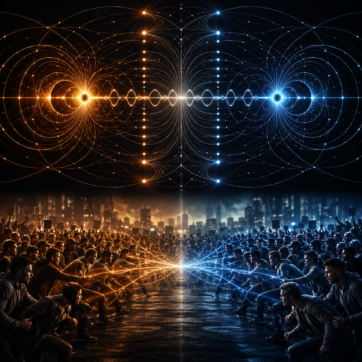
How the external architecture converts uncertainty into false connection—using the “missing scientists” narrative, media templates like 3 Body Problem, and the rapid spread from conspiracy to mainstream to reveal why pattern recognition collapses into forced coherence under pressure
Opening Frame — The Misread of “Seeing Patterns”
What is being called “pattern recognition” right now is, in most cases, not recognition at all. It is not the clean reading of something that already exists in structure. It is not the quiet stabilization that occurs when coherence reveals itself without effort. What is being mistaken for insight is pressure. What is being labeled as intuition is compression. The field is not seeing more clearly — it is reacting more aggressively. The distinction matters, because the entire interpretation of reality shifts depending on whether something is being detected or constructed. And what is dominating the current moment is not detection. It is construction under load.
This is the fracture point that has to be held cleanly: most of what is being experienced as “connecting dots” is actually forced connection under pressure, not true structural linkage. The system is not identifying relationships that are inherently there. It is closing gaps it cannot tolerate. It is taking incomplete, unresolved, and unrelated data points and binding them into a single line so the instability they generate can be reduced. That reduction feels like clarity, but it is not clarity. It is relief. The mind is not resolving truth; it is relieving tension created by open, unlinked information. This is why the connections appear convincing in the moment — because they successfully remove the discomfort of not knowing — but they do not hold under actual structural examination. They require reinforcement, expansion, and defense to stay intact, which is the signature of something that was built, not found.
The current “scientists who have gone missing or died” narrative is a precise live demonstration of this mechanism in motion. A set of unrelated events — different individuals, different circumstances, different timelines, different causes — enters the field carrying a shared surface category: scientists with proximity to government, space, nuclear, or classified work. That surface similarity becomes the anchor point, and from there the system begins to collapse everything into a single storyline. The absence of confirmed connections does not slow the process; it accelerates it. The lack of clarity becomes the fuel. Instead of holding each case as a separate node that requires its own resolution, the system fuses them into a unified frame — not because they are structurally connected, but because the field cannot sustain that many unresolved elements simultaneously without increasing pressure.
This is why the story itself is not the point. Whether these cases are connected or not is almost irrelevant at this stage of analysis. What matters is how quickly and automatically the collective moved to force a connection before the data could support one. The reaction reveals the architecture more clearly than the events ever could. It shows that the system does not wait for truth to emerge; it replaces the need for truth with immediate coherence. It shows that ambiguity is not tolerated; it is overwritten. It shows that the demand for a unified explanation is not driven by evidence but by structural necessity under load. And once that necessity activates, the narrative assembles itself with a speed that outpaces reality, locking into place before any real investigation has time to stabilize the field.
What is being exposed through this reaction is not just a cultural tendency toward conspiracy or overinterpretation. It is a deeper architectural condition in which unresolved data cannot remain open without triggering forced synthesis. The collective is not simply misreading events; it is operating within a system that converts uncertainty into narrative as a means of maintaining functional stability. And because that conversion feels like understanding, it is rarely questioned. But the moment it is seen clearly, the entire illusion of “seeing patterns” begins to collapse. What remains is something far more precise, and far more revealing: a system under pressure, manufacturing coherence where none yet exists.
Core Architecture — Eternal vs External, Mimic, and Pre-Render vs Render
Everything that follows in this article depends on a clean separation of states. Without that separation, the entire discussion collapses back into the same misread it is exposing. There are two fundamentally different conditions that must be distinguished: the Eternal and the external. They are not locations, not layers of the same system, and not interchangeable frameworks. They are distinct states of being with different properties, different behaviors, and different implications for how information appears and is interpreted.
The Eternal is not a field of fragments. It is not built on oscillation, does not require stabilization, and does not produce partial output that must be assembled. It is coherent, complete, and not dependent on time-based sequencing. There is no need for pattern recognition in the Eternal because there are no separated pieces to connect. Structure is not inferred; it is inherent. Nothing needs to be linked because nothing is disjointed. There is no pressure to resolve, no load created by missing information, no demand for closure. It is not a system that generates uncertainty and then compensates for it. It does not generate uncertainty at all. This is why the Eternal cannot be used as a reference point for interpreting what happens inside the external. The mechanics are not comparable.
The external is the opposite condition. It is a rendered architecture built on fragmentation, oscillation, and continuous structural decay. It outputs information in pieces, not as a whole. Events appear without full context. Causes are often not visible at the same time as effects. Time introduces sequencing that separates what is structurally linked into different moments of perception. Because of this, the external requires assembly. It requires interpretation. It requires pattern recognition to simulate continuity where continuity is not directly presented. This is where all of the mechanisms discussed in this article originate. Not because they are inherently flawed, but because they are operating inside a system that does not present complete structure on its own.
The mimic layer exists within this external condition as a stabilizer and at the same time distortion amplifier. It does not create the architecture, but it modifies how the architecture is experienced and interpreted. It increases the instability already present in the system by accelerating input, amplifying emotional charge, and lowering the thresholds required for pattern formation. It does not need to fabricate entirely new structures. It works by taking what is already fragmented and pushing the system to resolve it prematurely. It feeds the tendency to connect, to close loops, to assign meaning before the underlying structure has stabilized. The result is not the creation of new reality, but the distortion of how reality is assembled and understood.
To fully understand how this plays out, the distinction between pre-render and render must be made explicit. The render is what is visible. It is the surface output — the world around us, what we see here, the events, the headlines, the individual cases, the observable circumstances. It is what appears in time, what can be reported, what can be discussed. The pre-render is the architecture, the structural condition that precedes and generates that output. It is not visible in the same way, but it determines how the render unfolds. It includes the arrangement of variables, the distribution of load, the state of coherence or incoherence within individual systems and within the collective field. It is where patterns either exist or do not exist before they are expressed in the render.
What is being misread in the current environment is largely a pre-render condition being interpreted at the level of render without understanding the structural drivers beneath it. Individual events — such as the deaths or disappearances of scientists — are render-level outputs. They appear as discrete occurrences. But the pressure to connect them, the drive to unify them into a single narrative, the inability to hold them as separate nodes — all of that is coming from pre-render architecture. It reflects the state of the system that is interpreting those events, not the events themselves.
There are two layers of pre-render architecture at play: individual and collective. Each individual operates with their own internal structure — their capacity to hold unresolved information, their tolerance for ambiguity, their thresholds for pattern formation. At the same time, there is a collective field that aggregates these conditions across a larger system. When the collective field carries high levels of unresolved data, fragmentation, and emotional charge, the pressure to resolve that data increases across the entire network. Individuals do not just respond to their own internal state; they are influenced by the broader field they are embedded in. This is why certain narratives can spread so quickly and stabilize so widely. The pressure is not isolated. It is shared.
The mimic layer interacts with both levels simultaneously. It amplifies individual tendencies while also increasing the overall load within the collective field. It accelerates the transition from unresolved data to forced connection by reducing the time and space available for proper resolution. This is why patterns can appear to “snap into place” almost instantly, even when the underlying data does not support them. The system is not building those patterns from the ground up in the moment. It is responding to pre-render conditions that are already primed for convergence.
This is the context required to understand everything that follows. The behaviors being observed — rapid pattern formation, forced connections, expanding narratives — are not random cultural phenomena. They are expressions of an external architecture under load, amplified by mimic distortion, and playing out through both individual and collective pre-render conditions. The render is simply where it becomes visible.
Pattern Recognition vs Forced Connection — The Core Distinction
Pattern recognition, in its true form, is a passive structural function. It does not generate anything new. It does not impose meaning. It does not reach outward in search of coherence. It simply registers what is already there. When a real pattern exists, it reveals itself without strain, without expansion, without the need for reinforcement. There is no sense of effort involved because nothing is being constructed. The system is not trying to make something fit; it is encountering something that already fits. This is why true pattern recognition reduces complexity rather than increasing it. It collapses excess information into a simpler, clearer form. It organizes without distortion. It stabilizes immediately because it is aligned with an existing structure, not attempting to fabricate one. There is no need to defend it, no need to keep adding pieces to hold it together, no need to reinterpret conflicting data to preserve it. It stands on its own because it was never built under pressure to begin with.
This is the part that has been almost completely lost in the current environment. What is being labeled as pattern recognition now carries none of these qualities. Instead, what is dominating perception is forced connection — an entirely different mechanism that operates under opposite conditions. Forced connection is not passive. It is active construction driven by pressure. It occurs when the system encounters too many unlinked elements and cannot sustain the instability that results from holding them separately. Rather than allowing those elements to remain unresolved, it begins linking them together whether a real structural relationship exists or not. This is not detection. It is assembly. It takes nodes that share only surface-level similarities — timing, category, language, emotional charge — and binds them into a single framework to simulate coherence.
The critical difference is what happens to complexity. Where true pattern recognition simplifies, forced connection expands. It does not reduce the amount of information needed to understand something; it increases it. Once the initial connection is made, additional explanations are required to justify it. More context must be added. More links must be created. More assumptions must be layered in to keep the structure from collapsing. What begins as a single connection quickly becomes a network that must be continuously reinforced. This is why these narratives grow instead of resolving. They do not reach a point of clarity; they spiral outward, absorbing more and more data to maintain the illusion of cohesion. The structure cannot stabilize on its own because it was never rooted in an actual alignment to begin with.
This leads directly to the core structural distinction that separates the two processes. Pattern recognition is alignment-first. It begins with coherence already present in the system. The recognition occurs because the structure exists. Forced connection is pressure-first. It begins with instability, with unresolved data, with a field that cannot tolerate the absence of linkage. The connection is created not because it is true, but because it is needed to reduce the pressure created by that instability. This is why the experience of both can feel similar at the surface level. In both cases, there is a sense of “seeing something come together,” of dots appearing to connect. But the origin of that experience is entirely different. One emerges from coherence revealing itself. The other emerges from incoherence demanding resolution.
This is also why people consistently confuse the two. The interface is identical. Both processes involve the linking of elements, the perception of relationships, the formation of structure from multiple points of data. But the internal conditions that produce those outcomes are completely different. Pattern recognition originates in stability and resolves into simplicity. Forced connection originates in instability and resolves into artificial complexity. Without understanding this distinction, it becomes almost impossible to tell the difference between something that is genuinely being perceived and something that is being constructed to relieve pressure.
The confusion is further amplified because forced connections can feel more intense than real patterns. They carry urgency. They feel significant. They create the sensation of uncovering something hidden or important. This intensity is not evidence of truth; it is evidence of load. It reflects the amount of pressure the system is attempting to discharge by creating the connection. Real pattern recognition does not carry that urgency because it does not need to. It does not arise from a need to resolve tension; it arises from the presence of coherence. It is quieter, more contained, and more precise. It does not expand beyond what is necessary because it does not need to hold anything together.
Understanding this distinction is not optional in the current environment. It is the only way to differentiate between clarity and distortion in a field that is increasingly saturated with both. Without it, every constructed narrative can masquerade as insight, and every pressure-driven connection can be mistaken for truth. What appears to be an increase in awareness is often the opposite — a system under strain, generating synthetic coherence to stabilize itself. And until that is recognized at the structural level, the misread will continue to propagate, reinforcing patterns that were never there to begin with.
The External Architecture — Why Pattern Recognition Exists at All
Pattern recognition exists because of where this system is operating. The environment people are perceiving and navigating is not a stable, self-contained field of inherent coherence. It is an external architecture — a rendered condition built on fragmentation, oscillation, and continuous structural decay. In this kind of environment, nothing presents itself in a complete or unified state. Information arrives in pieces, events unfold without visible continuity, and cause-and-effect is rarely experienced in a clean, direct line. The system does not hand over truth in a whole form. It outputs fragments, partial signals, and incomplete sequences that must be organized in order to become usable. Pattern recognition is the mechanism that performs that organization. It takes scattered input and arranges it into something that can be navigated, predicted, and acted upon. Without it, the field would remain unintelligible. There would be no ability to orient, no ability to anticipate, no ability to function inside a constantly shifting environment.
This is why pattern recognition is fundamental to the external grid. It is not an advanced skill or a heightened state; it is a base requirement for operating in a fragmented system. It converts discontinuity into continuity. It builds provisional structure out of partial data. It allows the system to move forward even when it does not have full information. In a stable architecture, this kind of mechanism would not need to work as hard, because the structure would already be present and directly perceivable. But in the external field, structure is not given — it must be inferred. That inference is what pattern recognition provides. It is the bridge between fragmentation and functionality.
However, this immediately introduces a critical condition: because the external field is inherently unstable, pattern recognition is never operating in a neutral state. The environment itself is in constant motion. It is defined by oscillation, meaning nothing holds still long enough to present a fixed form. It is defined by fragmentation, meaning information arrives in pieces rather than as a complete system. It is defined by entropy, meaning whatever structure does form is always in the process of degrading. Under these conditions, pattern recognition is always working against instability. It is not simply identifying patterns in a stable field; it is attempting to extract structure from a field that is continuously breaking down.
This is where the distinction between the external and the Eternal becomes necessary, because without it, the behavior of the system is misread entirely. The Eternal is not another place within this architecture. It is not a higher layer of the same system. It is a completely different state of being. The Eternal does not operate on fragmentation, oscillation, or entropy. It does not require pattern recognition because it does not produce fragmented output. It is coherent, complete, and self-contained. There is no need to infer structure because structure is not missing. There is no need to connect pieces because there are no separated pieces. It is not a system that must be navigated; it is a state that is already whole. In that condition, recognition is not a process — it is inherent. There is no effort, no construction, no assembly required.
By contrast, the external architecture is entirely dependent on assembly. It is a rendered condition where coherence is not native, so it must be simulated. Pattern recognition becomes one of the primary tools for that simulation. It allows the system to function as if there is continuity, even when that continuity is provisional and incomplete. This is why pattern recognition is always under load in the external field. It is not simply reading stable structures; it is compensating for the absence of them. It is constantly working to hold together a field that does not naturally hold itself together.
This leads to the most important clarification in this section: pattern recognition itself is not the problem. It is a necessary function within the external architecture. It is what allows navigation, prediction, and basic interaction with a fragmented environment. The issue arises when the conditions of the field push that function beyond its intended range. When fragmentation increases, when input accelerates, when uncertainty expands, the load on pattern recognition increases. At a certain threshold, it stops operating as a clean detection mechanism and begins operating as a pressure-response mechanism. It is no longer identifying patterns that exist; it is creating patterns to stabilize the system.
This is what it means for pattern recognition to be forced into overdrive under incoherence. The function itself does not change, but the conditions it is operating under do. Instead of working with manageable levels of fragmentation, it is flooded with high-volume, high-variance data that cannot be easily organized. Instead of having time to allow structure to emerge, it is pressured to produce immediate coherence. Instead of reducing complexity, it begins generating it in order to simulate resolution. This is the tipping point where pattern recognition transitions into forced connection. The system is no longer reading the field; it is attempting to control the instability of the field by imposing structure onto it.
Understanding this context is critical, because it reframes what is happening in the current moment. The increase in perceived “pattern recognition” is not evidence that people are seeing more clearly. It is evidence that the external field is under greater instability, and the mechanisms designed to compensate for that instability are being pushed harder as a result. The system is doing exactly what it was built to do — convert fragmentation into structure — but under conditions that exceed its capacity to do so cleanly. The result is not clarity. It is overproduction of structure, much of which does not correspond to anything real. And because that structure reduces pressure, it is accepted as truth, even when it is entirely synthetic.
The Mimic Layer — Does It Intensify the Process?
The answer is direct and structural: yes, it amplifies and accelerates the process. What already exists in the external architecture as a necessary function — pattern recognition — becomes distorted under the influence of the mimic layer because the conditions it introduces push that function past its natural operating range. The external field is already fragmented and unstable, which means pattern recognition is always working to organize incomplete data. But the mimic layer does not simply sit within that condition; it intensifies it. It increases the volume of input, compresses the time available to process it, and disrupts the natural pacing that would allow structure to emerge cleanly. The result is not just more pattern recognition. It is pattern recognition under forced acceleration.
The first mechanism is increased input velocity. The system is flooded with more data than it can properly resolve, and that data is arriving at a speed that prevents stabilization. Instead of discrete events that can be held, examined, and resolved individually, the field is saturated with overlapping signals — headlines, social media reactions, commentary, speculation, imagery, language, and emotional charge — all arriving simultaneously. There is no sequencing. There is no spacing. There is no time for vertical resolution. Everything is horizontal and immediate. This creates a condition where the system cannot process each node independently, so it defaults to grouping them. The faster the input, the more aggressive the grouping becomes, because the system is trying to reduce the number of open variables it has to hold at once.
At the same time, the mimic layer lowers verification thresholds. Under normal conditions, pattern recognition requires a certain level of alignment before a connection stabilizes. There must be enough consistency, enough shared structure, enough coherence for the system to register a pattern as valid. But when the field is under pressure and input is accelerating, those thresholds drop. The system no longer waits for full alignment. It begins linking fragments based on partial similarity — shared terminology, overlapping timelines, emotional resonance, or even simple proximity. What would normally be considered insufficient data becomes enough to trigger a connection. This is where the distinction between recognition and construction collapses. The system is no longer verifying patterns; it is accepting them prematurely.
This leads directly into the third mechanism: premature closure. The external architecture does not tolerate open loops well to begin with, but under mimic amplification, the tolerance drops even further. Unresolved data creates load, and load under accelerated conditions becomes intolerable. So the system closes loops before they are ready to be closed. It assigns meaning before meaning is available. It creates conclusions before the underlying structure has had time to form. This closure feels like resolution, but it is artificial. It is the system choosing to end the process early in order to reduce pressure, not because the process has actually completed.
The result of these combined mechanisms is that partial fragments get linked too early. Pieces of information that have not yet stabilized into clear, independent structures are forced together into a shared frame. Incomplete data is treated as if it is complete. Missing context is filled in with assumption. Gaps are not held; they are bridged. And once those bridges are built, they begin to define the structure, even if they were never valid to begin with. This is what produces false pattern completion. The system generates the appearance of coherence by assembling fragments into a pattern that feels whole, even though the underlying data does not support that unity.
At this stage, pattern recognition has effectively shifted roles. It is no longer functioning as a tool for identifying existing structure. It has become a mechanism for managing pressure within an unstable field. The connections it produces are not evaluated based on accuracy but on their ability to reduce load. If a connection relieves tension — if it collapses multiple variables into a single explanation, if it gives direction to uncertainty, if it provides a sense of closure — it is accepted. Whether it is true becomes secondary to whether it stabilizes the system. This is why false patterns can feel so convincing. They are not convincing because they are structurally sound; they are convincing because they successfully remove the discomfort that triggered their creation.
This is the deeper distortion the mimic layer introduces. It does not create pattern recognition as a function; that function already exists within the external architecture. What it does is push that function into overdrive by altering the conditions under which it operates. It floods the system with input, reduces the standards for connection, and compresses the time available for resolution. Under those conditions, the system cannot maintain clean recognition. It defaults to rapid construction. And once that shift occurs, what appears to be increased awareness is actually the opposite — a system under pressure, generating synthetic coherence to keep itself from fragmenting further.
The Real Driver — Load, Pressure, and Forced Convergence
At the core of everything unfolding is not curiosity, not insight, and not even a desire for truth. The real driver is load. More specifically, how the system responds to unresolved data under conditions of increasing pressure. The mechanism is simple, but its implications are far-reaching once seen clearly. Unresolved data creates load. Load generates instability. Instability demands resolution. And when true resolution is not available, the system substitutes it with forced linkage. This is the structural equation that governs what is being misread as “pattern recognition” across the field right now.
Unresolved data is not neutral inside the external architecture. Every event that lacks a clear cause, every situation without a defined outcome, every piece of information that cannot be placed into a coherent structure adds to the system’s internal load. That load is not just informational; it is structural. It represents open loops, unclosed sequences, incomplete mappings that the system must hold in suspension. The external field is not designed to sustain large volumes of open, unintegrated data. It can hold some degree of uncertainty, but as the number of unresolved nodes increases, the system begins to destabilize. This is where load transitions into instability. The system is no longer simply lacking information; it is under strain from having to maintain too many unresolved elements simultaneously.
This strain becomes even more pronounced when multiple unlinked events enter the field at once. Each event carries its own set of unknowns, its own incomplete structure, its own unresolved variables. When these events remain separate, the system must track them individually, which multiplies the number of open loops it has to hold. This creates what can be described as open variance — a state where multiple independent variables exist without a unifying framework. Open variance is inherently unstable in the external architecture because it resists simplification. It cannot be easily reduced, categorized, or resolved through existing structures. It forces the system to remain in a state of suspension, holding multiple possibilities without collapsing them into a single outcome.
As open variance increases, so does pressure. This pressure is not psychological in origin; it is structural. It reflects the system’s inability to maintain coherence while holding too many unresolved nodes. The more variables remain open, the greater the demand for closure becomes. Closure is the mechanism through which the system reduces load. It collapses open loops into finished sequences, transforms uncertainty into certainty, and replaces instability with a defined structure. But when real closure is not available — when the underlying data does not support a single, coherent explanation — the system does not remain open. It generates a substitute.
This is where forced convergence occurs. Instead of resolving each node independently, the system collapses multiple nodes into a single storyline. Separate events are no longer treated as distinct; they are fused into a unified frame that can be held as one structure rather than many. This dramatically reduces the number of open loops the system must manage. What was once ten unresolved events becomes one resolved narrative. The complexity appears to decrease, the pressure drops, and the system stabilizes — but only superficially. The underlying data has not been resolved; it has been compressed.
The mechanism that enables this compression is the creation of a synthetic causal spine. This spine functions as the central axis that all events are attached to, regardless of whether they share a real causal relationship. It might take the form of a hidden actor, a suppressed truth, a coordinated operation, or any other unifying explanation that can absorb multiple variables into a single line. Once this spine is established, each individual node is reinterpreted in relation to it. Differences are minimized, contradictions are reframed, and gaps are filled to maintain alignment with the central narrative. The system is no longer evaluating whether the events are connected; it is ensuring that they appear connected.
This is the point where the misread becomes complete. What appears to be the discovery of a larger pattern is, in reality, the removal of instability through artificial means. The system is not uncovering hidden relationships that were previously obscured. It is constructing a framework that allows it to stop holding multiple unresolved elements at once. The connection feels real because it reduces pressure. It feels meaningful because it organizes chaos. But its function is not to reveal truth. Its function is to stabilize the field.
The critical line that clarifies the entire mechanism is this: the system is not finding connections; it is removing instability. Every forced linkage, every grand storyline, every rapid convergence of unrelated events into a single explanation is a response to load. It is the system choosing coherence over accuracy, closure over openness, and stability over truth. And once that substitution is made, it becomes extremely difficult to reverse, because the structure that replaced the instability now carries the weight of the system’s balance.
Case Study — The “Missing Scientists” Narrative
The current “missing scientists” narrative is not a clean data set revealing a hidden structure. It is a high-variance input set being compressed into a single storyline under pressure. What is actually present are separate events involving different individuals who either died or went missing across a span of time. These individuals do not share a consistent causal mechanism. Their circumstances vary widely — some cases involve confirmed suicides, some involve unresolved disappearances, some involve natural or undisclosed causes, and some involve isolated acts of violence. The locations are different, the timelines are not aligned in a precise sequence, and there is no substantiated evidence that these individuals were working together, collaborating, or even aware of one another in any coordinated capacity. There is no confirmed operational link, no shared project binding them, no documented communication chain, and no unified event that ties them into a single causal structure.
Despite this, the narrative has continued to expand. What began as a handful of cases has now grown into a list that is steadily increasing, with more names being added as the story circulates. The expansion is not being driven by verified connections but by inclusion pressure. As long as an individual fits the broad category — scientist, researcher, contractor, someone adjacent to national security, space, nuclear, or government work — they can be absorbed into the narrative. The criteria for inclusion are not structural; they are associative. This is why the list continues to grow. The system is not narrowing the field to identify a real connection. It is widening the field to sustain the pattern.
This becomes even more clear when considering that, in several of these cases, family members and relatives have explicitly stated that there is no connection between their loved one’s death or disappearance and any broader conspiracy. In some instances, the causes of death have been described as straightforward, even if not publicly detailed in full. These statements do not slow the narrative. They are overridden. They are either ignored entirely or reframed as part of a larger concealment. This is a critical indicator of forced connection. When primary-source clarification does not collapse a pattern, it means the pattern is not dependent on evidence. It is dependent on maintaining structural coherence within the narrative.
What actually triggered the linkage is not a shared cause but a shared surface. The category similarity is the primary anchor: scientists. From there, secondary associations are layered in — proximity to national security, involvement in space or nuclear-related work, the suggestion of classified environments. These elements carry inherent emotional weight, which increases the charge of the narrative. Temporal proximity adds another layer. The events are perceived as happening “around the same time,” even when the actual timelines are more dispersed. This creates the impression of clustering, which further supports the idea of a unified cause. Finally, emotional charge — the combination of fear, suspicion, and perceived significance — amplifies the entire structure. Together, these factors create enough similarity to initiate linkage, even in the absence of real structural connection.
The distortion emerges in how these similarities are interpreted. Surface-level alignment is treated as evidence of causation. The presence of a shared category becomes proof of coordination. The fact that multiple scientists have died or gone missing becomes, in itself, the justification for assuming a single underlying driver. Independent events are collapsed into one frame, not because they share a causal spine, but because they share enough attributes to be grouped under a single narrative. This is the exact point where pattern recognition transitions into forced connection. The system is no longer asking whether a connection exists. It is assuming one and then building around that assumption.
The structural shift that locks the pattern is subtle but decisive. It begins with a question: “Are these connected?” This question allows for openness. It leaves room for multiple outcomes, including the possibility that the events are unrelated. But under pressure, that question is replaced with a different one: “How are these connected?” The moment this shift occurs, the pattern becomes self-sustaining. The existence of a connection is no longer under examination. It is taken as a given. All subsequent analysis is directed toward defining the nature of that connection rather than verifying its existence. This is where the narrative hardens.
Once the pattern is locked, every new piece of information is processed in relation to it. Additional cases are added because they appear to fit. Contradictions are absorbed because they can be reframed. Lack of evidence becomes evidence of concealment. The absence of proof does not weaken the structure; it strengthens it by reinforcing the idea that something is being hidden. At this stage, the narrative is no longer dependent on the original data set. It has become a self-reinforcing system that expands to maintain its own coherence.
This case illustrates the full mechanism in motion. A high-variance set of independent events enters the field. Surface similarities trigger initial linkage. Pressure from unresolved data drives convergence. A synthetic causal spine is created. The question shifts from possibility to assumption. The pattern locks. And from that point forward, the system is no longer seeking truth. It is maintaining the structure it built to relieve the instability it could not hold.
Why Even Mainstream Media Is Now Participating
What appears at first glance to be confirmation is, structurally, amplification. The involvement of mainstream outlets in the “missing or dead scientists” narrative does not signal that a verified connection has been established; it signals that the pattern has accumulated enough social charge to become reportable as a phenomenon. The distinction is precise and necessary. The conspiracy field constructs the initial pattern by collapsing unrelated nodes into a single storyline under pressure. Mainstream media then steps in and reports on the existence of that storyline — the reactions, the concern, the public discourse surrounding it. In doing so, it does not validate the underlying connection, but it does elevate the visibility of the pattern itself. The result is a shift from fringe circulation to broader social awareness, which changes how the pattern is perceived, even though the underlying evidence has not changed.
This is the loop. A set of high-variance events enters the field and remains unresolved. The conspiracy layer, operating under pressure, performs forced convergence and produces a synthetic causal spine. That spine generates reaction — speculation, commentary, viral posts, increasing attention. Once the reaction reaches a certain threshold, it becomes a subject in its own right. Mainstream media does not need a verified connection to report on a reaction; it needs a reaction large enough to be considered newsworthy. So the focus shifts. The coverage is no longer about whether the events are structurally linked. It is about the fact that people believe they might be. The object of reporting moves from the events themselves to the narrative surrounding them.
This transition introduces a critical effect: the pattern gains legitimacy without evidence. Not because it has been proven, but because it has been acknowledged. The act of coverage places the narrative into a broader informational stream where it is encountered by individuals who may not have engaged with it previously. The pattern now exists in a context that carries institutional weight. Even if the reporting includes disclaimers, even if it states clearly that there is no confirmed connection, the presence of the narrative within mainstream channels alters its perceived status. It is no longer confined to isolated speculation. It is part of the public conversation. That alone is enough to reinforce it.
The reinforcement is social before it is logical. Once a pattern is visible at scale, it becomes easier to adopt, easier to repeat, and harder to dismiss. Individuals encountering the narrative do not need to verify it independently; they register that it is being discussed widely. The volume of attention becomes a proxy for validity. This is how a pattern that originated from forced connection begins to stabilize across a larger population. It is not being tested for structural integrity. It is being absorbed because it appears to have already been recognized by others.
The key clarification here is that mainstream media is not confirming the connection. It is amplifying the perception of connection. This difference is often missed because the outcome — increased belief in the pattern — looks similar regardless of the source. But structurally, the roles are distinct. The conspiracy layer constructs the pattern under pressure. The mainstream layer distributes the visibility of that pattern by reporting on its circulation. Neither step requires verified linkage between the original events. Both steps contribute to the strengthening of the narrative.
What emerges from this interaction is a feedback loop. The pattern generates reaction. The reaction generates coverage. The coverage increases exposure. Increased exposure generates more reaction. Each cycle adds weight to the pattern without adding evidence. The structure becomes self-reinforcing, not because it is grounded in a real causal relationship, but because it is continuously circulated and reabsorbed across different layers of the information field. The more it moves, the more stable it appears.
This loop explains how a narrative can move from a small cluster of speculative connections to a widely recognized storyline in a short period of time. It does not require confirmation at any stage. It requires only sufficient pressure to initiate the pattern and sufficient visibility to sustain it. Once both conditions are met, the narrative carries itself. The system no longer needs to ask whether the events are connected. It only needs to continue engaging with the idea that they might be.
Why Humans Force a Grand Storyline
This behavior is not rooted in ignorance or a lack of intelligence. It is structural necessity operating inside an unstable architecture. The system is not choosing distortion because it prefers it; it is defaulting to distortion because it cannot sustain the alternative. When multiple unresolved events enter the field — especially events involving death, disappearance, or institutional ambiguity — the system is required to hold them without immediate resolution. That means holding randomness, holding incomplete information, holding the absence of clear causation, and holding the reality that not all events fit into a clean explanatory model. It also means holding the instability of human behavior itself — the fact that actions can emerge from render breakdown, personal history, or internal collapse rather than from a coordinated external driver. All of these elements must remain open at the same time.
This creates what can be described as open load. Each unresolved element is an active variable the system must track. When there are only a few, the system can tolerate it. But as the number increases, the load compounds. Randomness does not compress easily. Missing information cannot be resolved through existing structures. Institutional opacity introduces ambiguity that cannot be immediately penetrated. Human instability produces outcomes that do not follow predictable patterns. When all of these are present simultaneously, the system is forced into a state of sustained uncertainty that it is not designed to hold indefinitely. The pressure generated by this condition is not abstract. It is structural. It reflects the mismatch between the volume of unresolved data and the system’s capacity to maintain coherence while holding it.
At a certain threshold, that pressure becomes intolerable. The system requires reduction. It needs to decrease the number of open variables it is holding at once. But because real resolution is not available — the data does not yet support clear, independent conclusions for each event — the system substitutes compression for resolution. Instead of solving each node separately, it collapses them into a single structure. This is where the grand storyline emerges. It is not discovered. It is generated as a means of reducing load.
The compression takes a predictable form. Multiple causes are reduced to one cause. Multiple narratives are replaced with one narrative. Multiple unknown actors are replaced with a single hidden actor. This reduction dramatically simplifies the system’s task. What was once a set of independent, unresolved realities becomes a single explanatory frame that can be held as one unit. The pressure drops because the number of variables has decreased. The system no longer needs to track each event individually; it can route them all through the same causal spine.
This is why grand storylines tend to converge on similar structures. They provide maximum compression with minimal complexity. A single hidden force can absorb an unlimited number of events. A unified narrative can explain multiple outcomes without requiring detailed verification. The system is not optimizing for accuracy; it is optimizing for stability. It is selecting the structure that reduces load most efficiently, even if that structure does not correspond to the underlying reality.
The result is a narrative that feels more coherent than the truth it replaces. The truth, in many cases, is distributed. It exists across separate events, each with its own context, cause, and resolution timeline. Holding that distributed reality requires maintaining multiple open states simultaneously. The grand storyline eliminates that requirement. It offers a single, continuous explanation that removes the need to engage with each piece independently. This is why it is adopted so quickly and defended so strongly. It is not just a belief; it is a structural solution to a load problem.
The key line that captures this entire mechanism is simple: a grand storyline is easier to hold than multiple unresolved realities. It reduces complexity, lowers pressure, and provides the appearance of coherence in a field that cannot sustain fragmentation at scale. But that ease is not an indicator of truth. It is an indicator of compression. The system is not revealing a deeper connection between events. It is replacing a complex, unresolved structure with a simplified, artificial one in order to remain stable.
Why the External Grid Requires Resolution — Stability Over Openness
The external architecture is not designed to sustain prolonged openness. It does not stabilize through stillness, and it does not hold coherence in the absence of defined structure. Its stability is conditional. It depends on continuous organization of fragmented input into usable form. This is why resolution is not optional inside this system — it is required for it to remain functionally intact. Without resolution, the system accumulates open variables. Those variables do not sit neutrally. They introduce load. And that load, when it exceeds a certain threshold, destabilizes the entire structure.
Uncertainty, in this context, is not simply “not knowing.” It is the presence of unresolved states that have not been collapsed into a defined outcome. Each unresolved state represents an open loop. The system must track it, hold it, and maintain its position relative to other variables. When there are only a few, this can be managed. But as the number of open loops increases, the system’s capacity to maintain coherence decreases. The architecture does not naturally hold multiple unresolved states in parallel without degradation. It is built to convert them into resolved structures as quickly as possible. This is why openness feels unstable within the external field. It is not because openness is inherently problematic. It is because the system processing that openness cannot sustain it without losing integrity.
Pattern recognition is the mechanism that enables this conversion. It takes fragmented, uncertain input and organizes it into patterns that can be acted upon. In its proper function, it reduces complexity and stabilizes the field by aligning with existing structure. But because the external grid thrives on pattern formation as a means of maintaining order, it becomes dependent on patterns for stability. Patterns are not just a way of understanding the field; they are the way the field holds itself together. Remove patterns, and the system loses its organizing principle. What remains is unstructured data, which increases load and pushes the system toward instability.
This dependence creates a structural bias toward resolution. The system is constantly moving to close loops, define outcomes, and reduce the number of open variables it must hold. It does not tolerate ambiguity well because ambiguity resists pattern formation. It cannot be easily categorized, predicted, or integrated into existing structures. As a result, ambiguity generates pressure. That pressure is the system’s signal that resolution is required. When real resolution is not available, the system does not remain open. It produces a substitute in the form of forced patterning — connections that may not correspond to actual structure but serve to reduce load.
The mimic layer intensifies this requirement. It does not introduce the need for resolution; that need is already built into the external architecture. What it does is increase the conditions that make resolution urgent. It accelerates the rate at which unresolved data enters the system, amplifies the emotional charge associated with that data, and reduces the time available for proper processing. This combination raises the overall load more quickly than the system can resolve it through normal means. As a result, the pressure to close loops increases, and the tolerance for openness decreases even further.
Under these conditions, uncertainty becomes almost impossible to sustain. The system cannot remain in a state where multiple outcomes are possible without collapsing them into a single narrative. It requires a defined structure to maintain stability, even if that structure is artificially constructed. This is why patterns begin to form more aggressively under mimic amplification. They are not emerging from clarity. They are being generated to compensate for the system’s inability to hold unresolved states at scale.
This also explains why the external grid appears to “thrive” on patterns. It is not that patterns are inherently valuable or meaningful in themselves. It is that they provide the structural closure the system needs to remain coherent. Patterns reduce the number of variables, define relationships between elements, and allow the system to move forward without holding multiple possibilities in suspension. In a stable architecture, this would be a secondary function. In the external grid, it becomes primary because the system lacks inherent coherence.
The consequence is that openness and uncertainty are systematically collapsed, not because they are invalid, but because they are incompatible with the system’s stability requirements. The more pressure the system experiences, the faster this collapse occurs. And under mimic amplification, where pressure is continuously increased, the system defaults to immediate resolution — even when that resolution is not supported by the underlying data.
This is the structural reason why forced connection becomes so prevalent. It is not an error in isolation. It is the predictable outcome of an architecture that requires closure to remain stable, operating under conditions where true resolution is not available. The system does not distinguish between accurate resolution and artificial resolution at the level of stability. Both reduce load. Both restore temporary coherence. And because stability is prioritized over accuracy, the system will accept either.
The Template Effect — How Media Preloads the Pattern
What is being seen right now with the “missing or dead scientists” narrative is not just forced connection — it is forced connection pulling from a preloaded storyline, and that only happens because of how the external architecture resolves load. Before these real-world cases were ever grouped together publicly, the TV show 3 Body Problem had already been released and widely circulated. In that show, a core plotline follows a series of scientists who begin dying or taking their own lives under mysterious conditions, while other scientists report that their experiments and the laws of physics themselves are no longer behaving consistently. As the story develops, it is revealed that these events are not random — they are connected. An unseen extraterrestrial intelligence is interfering with human science, disrupting experiments, manipulating perception, and preventing scientific progress, creating the appearance of chaos while actually operating as a single hidden cause behind multiple separate incidents.
That storyline matters because it installs a very specific way of organizing events: if multiple scientists are affected, if things don’t make sense, if reality appears unstable, then there must be a hidden force linking it all together. That structure enters the field before the current real-world cases begin clustering in public perception.
Then the real-world inputs appear: different scientists, different locations, different timelines, some dead, some missing, no confirmed collaboration, no substantiated evidence of a shared project, and in several cases direct statements from families rejecting any broader connection. Structurally, these are independent nodes. But independence in a high-load field creates open variance, and open variance cannot be held. Unresolved nodes generate load, load creates instability, and instability demands compression.
So the system does not hold those cases as separate. It routes them. And instead of building a new explanation from raw data, it pulls from the fastest available structure already in the field — the one the TV show normalized: multiple scientists, abnormal outcomes, something hidden connecting them. That is where the claims begin: they were working together, they were part of a classified project, they knew something, they were silenced. None of those claims are derived from evidence. They are pulled from the preloaded storyline and used to collapse the nodes into a single spine.
This is not analysis. This is architectural convergence. The mind is not discovering a pattern — it is selecting one to reduce load. The TV show did not predict the events. It provided the structure used to organize them. So when the “missing scientists” narrative starts spreading, it locks into that structure almost immediately because it matches just enough surface elements to activate it.
That is why the narrative feels coherent even without proof. The system is not verifying connection. It is removing instability. Multiple unresolved realities are being compressed into one storyline because the external architecture cannot sustain open variance at scale. The template came first. The events followed. And under pressure, the field converged them into the nearest available explanation — even though no real structural link exists between the cases.
Elumenate Media Pre-Read — The MIT Scientist Case
Before the current “missing or dead scientists” narrative expanded into a multi-event storyline, the same mechanism had already been exposed in a contained, single-event form. Elumenate Media documented this in detail in the January 2026 article A Conspiracy Born Overnight: How the MIT Scientist Shooting Became Instant New Age Myth. That case did not require months of speculation or a growing list of names to reveal the distortion.
The actual event itself was straightforward and deeply human, not mysterious in structure. In December 2025, a man named Claudio Manuel Neves Valente carried out a mass shooting at Brown University, killing two students and injuring others. Days later, he traveled to Massachusetts and murdered MIT plasma physicist Nuno Loureiro inside his home. The investigation quickly established that the attacker had a long personal history tied to both institutions — he had once studied in similar academic environments, carried years of resentment, isolation, and psychological deterioration, and ultimately targeted individuals who symbolized paths his own life had not taken. Authorities later found him dead by suicide after a multi-day manhunt. There was no evidence of a secret project, no classified breakthrough, no coordinated suppression, and no hidden technological motive. The events were tragic, but structurally clear: a single individual, a long-standing internal collapse, and a sequence of violent acts rooted in personal history.
What that event demonstrated with precision is that the myth did not emerge from the facts. It did not develop gradually as more information became available. It did not evolve through investigation, evidence, or structural confirmation. The myth formed immediately — before motive was established, before context was clarified, before any verified connection to larger systems existed. The speed was the signal. The narrative did not wait for reality to stabilize. It replaced it.
Within hours of the MIT scientist’s death, the pattern was already constructed. The language was already set: assassination, suppression, hidden technology, free energy, classified breakthroughs. The event itself was still unresolved, but the explanation had already been declared. This is the key insight that must be held clearly: the conspiracy did not grow out of the event. It was activated by it. The structure already existed. The event simply provided a trigger point for it to engage.
This is what separates a true investigative process from a pressure-driven pattern response. In an actual investigation, the narrative emerges as data stabilizes. In this case, the narrative preceded the data. The interpretation was not derived from the event; it was imposed onto it. The system did not ask what happened. It selected a pre-existing explanation and mapped the event into it. That is why the myth appeared fully formed rather than gradually constructed. It was not being built. It was being retrieved.
That single-event case functioned as a contained demonstration of the mechanism. It showed how one isolated incident could be immediately absorbed into a larger mythic framework without evidence, purely through structural activation. What is happening now with the “missing or dead scientists” narrative is the same mechanism operating at a larger scale. Instead of one event triggering one myth, multiple unrelated events are being pulled into a unified system of mythology.
The transition is direct: a single-event myth becomes a multi-event myth system. The underlying process does not change. The only difference is volume. Where the MIT case required one node to activate the pattern, the current narrative uses multiple nodes to reinforce and expand it. Each additional case does not provide confirmation; it provides material for the existing structure to grow. The pattern is not being validated by the increase in events. It is being sustained by it.
This is why the earlier case is critical to understanding the present one. It removed the variable of scale and exposed the mechanism in its simplest form. It showed that the narrative does not require a large data set to form. It only requires a trigger that matches a preloaded structure. Once that is seen, the current expansion becomes predictable. The system is not discovering a deeper connection as more names are added. It is repeating the same activation process across a wider set of inputs.
The mechanism is identical. The conditions are amplified. The result is a larger, more stable myth structure that appears more convincing because it contains more elements. But the foundation remains unchanged. It is not built on verified connection. It is built on the same immediate substitution of narrative for reality that was already visible in the original case.
And this is where the loop fully exposes itself: the very same MIT scientist from this case — whose death was investigated, resolved, and clearly tied to a single individual with a known history and motive — is now being pulled into the broader “missing or dead scientists” conspiracy list. Despite documented evidence, despite a confirmed sequence of events, despite the absence of any link to a larger network or hidden project, his name is being reabsorbed into a narrative that requires him to be part of something bigger. The event has already been structurally resolved, but the system cannot use that resolution because it does not support the larger storyline. So it overrides it. The node is reclassified, not based on facts, but based on what the active pattern requires. This is the final confirmation of the mechanism: once a pattern locks, even resolved reality can be pulled back into it and rewritten to sustain the structure.
The Disclosure Misread — Why This Narrative Gets Pulled Into “Disclosure” and Why It Isn’t
Once the multi-event storyline locks, the next compression layer activates automatically: escalation into “disclosure.” This is not a separate idea. It is the same architecture seeking a higher-order spine to stabilize even more load. Multiple scientist cases already collapsed into one storyline still carry unresolved pressure — missing information, inconsistent details, lack of verified linkage. That residual instability requires another level of convergence. “Disclosure” provides it. It is a top-level container that can absorb any ambiguity and convert it into meaning without requiring proof. At the architectural level, disclosure functions as a terminal node — a final explanation that stops further questioning by absorbing all open variance into one frame.
This is why the narrative shifts so quickly from “these scientists are connected” to “this is part of disclosure.” The system is not uncovering new information. It is climbing to a larger scaffold that can hold more unresolved data at once. Scientists tied to advanced fields, ambiguity around their deaths or disappearances, institutional silence, incomplete information — all of these inputs match the surface conditions required to trigger the disclosure template. Once that template engages, the storyline upgrades itself: they were not just connected, they were connected to something hidden; that hidden layer is not just classified, it is non-human or beyond public knowledge; therefore the events must be part of a controlled release of truth. The logic is not evidence-based. It is structurally driven. Each step reduces uncertainty by increasing narrative scale.
But this is where the architecture breaks if examined cleanly. Disclosure, in the way it is being used here, is not an investigative outcome. It is a catch-all convergence field. It does not require consistent mechanisms across cases. It does not require shared timelines, shared projects, or verified relationships between individuals. It only requires that the events feel unresolved and significant enough to justify being placed inside it. That is why a set of cases with no confirmed connection — different causes, different locations, different contexts, some explained, some not — can be absorbed into a single disclosure narrative without contradiction inside that system. The contradictions are not resolved. They are bypassed.
From a structural standpoint, this is identical to the earlier stages already outlined in the article. Independent nodes create load. Load creates instability. Instability demands convergence. The first convergence produces a “connected scientists” storyline. When that still cannot hold the full variance, the system escalates to “disclosure” as a higher-capacity container. The function is the same: remove instability, not discover truth. The narrative expands because the system cannot tolerate the alternative — multiple unrelated events with incomplete information and no unifying cause.
This is why the disclosure framing fails under actual examination. If the events were part of a single underlying mechanism, there would be consistency in how they occur — similar conditions, shared vectors, verifiable links between individuals or their work. That is not present. Instead, what exists is a collection of unrelated cases being unified through narrative compression. Some involve known causes, some remain unsolved, some involve personal or environmental factors, and some have already been explicitly disconnected by those closest to the individuals involved. The only thing they share is category and ambiguity, which is not sufficient to establish structural linkage.
The key point is this: the disclosure narrative does not emerge from the data. It emerges from the need to stabilize the data when it cannot be resolved. It is the final stage of forced connection, where even the idea of explanation is replaced by a container large enough to hold everything without requiring internal coherence. What is being interpreted as revelation is, at the architectural level, saturation — the system reaching for the largest available pattern to eliminate remaining instability.
So the claim that this is “disclosure” is not uncovering something hidden. It is the external architecture completing its convergence cycle. The events are not revealing a coordinated truth. They are being compressed into a storyline that removes the need to hold them as separate, unresolved realities.
The Algorithm of Distortion — Step-by-Step
The distortion does not form randomly. It follows a repeatable sequence driven by load, pressure, and rapid convergence inside the external architecture. What appears chaotic is actually structured, and it completes before reality has time to stabilize.
It begins when an event enters the field carrying high charge and low information. A scientist dies, disappears, or is linked to something ambiguous. At the moment of entry, the data is incomplete. There is no confirmed cause, no full context, no resolved structure. In pre-render, this registers as an open node under pressure — a point of instability that the system cannot yet organize. That is the ignition point.
Immediately, keyword-level triggers activate stored symbolic residue. Terms like plasma, classified, nuclear, space, government, advanced research — these are not neutral descriptors inside the field. They carry preloaded pattern fragments. They link to prior narratives, prior distortions, prior convergence structures. The moment those keywords appear, the system does not treat the event as new. It routes it through what is already stored.
At the same time, emotional charge is injected into the node. The lack of information combined with the perceived significance of the event produces tension — urgency, unease, curiosity, suspicion. That charge is not resolved. It amplifies the need for closure. The higher the charge, the faster the system will attempt to compress the node into structure.
Then the narrative layer activates through external amplification. Influencers, commentators, and high-output accounts begin generating speculative explanations in real time. These are not grounded in verified data. They are rapid constructions designed to resolve the open node. Because they are produced early, before facts stabilize, they fill the vacuum immediately. The first structure to enter the field gains position.
Speculation then transitions into repetition. The same claims, phrases, and interpretations begin circulating across platforms. Screenshots, clips, short-form summaries — all of it reinforces the same narrative fragments. At this stage, the system is no longer evaluating whether the claims are valid. It is tracking frequency. Repetition reduces perceived uncertainty. The more often a structure appears, the more stable it feels.
Repetition then converts into perceived truth. Familiarity replaces verification. The narrative is no longer treated as a possibility; it is treated as the explanation. Contradictions are filtered out because they increase load. Supporting fragments are absorbed because they reinforce the structure. The system is now maintaining the pattern rather than testing it.
From there, the narrative hardens into what is framed as “suppressed reality.” Any absence of confirmation is reinterpreted as evidence of concealment. Lack of proof becomes proof of hiding. The structure becomes self-sealing. It no longer depends on external validation because it has been integrated into the field as a stable spine. At this point, even contradictory evidence cannot dislodge it without increasing instability, so it is either ignored or reworked to fit.
The critical point is timing. This entire sequence completes before facts emerge. Before investigations conclude. Before context stabilizes. Before independent nodes can be resolved on their own terms. The system does not wait for reality to organize itself. It organizes reality preemptively, using the fastest available convergence path.
This is why the resulting narrative feels immediate and certain. It did not form through analysis. It formed through compression. The architecture moved to eliminate instability before truth had the opportunity to establish structure.
Closed-Loop Architecture — Why It Doesn’t Collapse
Once a false pattern locks, it stops behaving like a claim and starts functioning as structure. At the architectural level, the pattern becomes load-bearing. It is now carrying the compression of multiple unresolved nodes, which means removing it would immediately reintroduce open variance back into the field. That reintroduction equals pressure. So the system does not release the pattern. It stabilizes around it.
From that point forward, incoming data is no longer evaluated independently. It is routed through the existing spine. Anything that aligns is absorbed directly and strengthens the structure. Anything that does not align is not allowed to remain contradictory in its original form. It is reshaped, reframed, or selectively interpreted until it fits. The system is not checking for truth. It is preserving stability.
This is where contradiction flips function. Instead of destabilizing the narrative, contradiction is reinterpreted as evidence of concealment. Lack of proof becomes proof of suppression. Disconfirming information becomes part of the story rather than a challenge to it. This is not a logical error — it is an architectural adjustment that allows the pattern to remain intact while still absorbing opposing inputs. The structure expands to include the contradiction rather than collapse under it.
Reinforcement loops then activate across the field. Repetition increases familiarity. Familiarity increases perceived validity. Increased validity reduces internal resistance to the pattern. As resistance drops, the system becomes more efficient at routing new data into the same structure. Each cycle strengthens the pattern further, not because it is being verified, but because it is being used continuously as the primary organizing framework.
At this stage, the narrative becomes self-sustaining. It no longer depends on new evidence to remain active. It maintains itself through internal coherence — every new input is either absorbed or converted in a way that supports the existing structure. The system has effectively eliminated open loops by forcing all incoming information into a closed circuit.
This is why it does not collapse. Collapse would require the system to release the load it has compressed into the pattern and return to a state of unresolved variance. That state carries higher pressure than maintaining the distortion. So the architecture chooses continuity over correction. The pattern persists, not because it is accurate, but because it is structurally stabilizing.
The result is a narrative that is functionally immune to correction. Not because it cannot be disproven, but because disproof cannot be integrated without increasing instability. The system is not designed to prioritize correction under these conditions. It is designed to maintain the structure that is currently holding the field together.
Why It Never Leads to Truth
Truth does not form through compression. It requires open space in the field, where nodes are allowed to remain unresolved without being forced into relationship. It requires the ability to hold separate events as separate, to let data stabilize on its own terms, and to allow gaps to exist without immediately filling them. No forced linkage, no premature convergence, no substitution of structure for reality. That is the only condition where actual alignment can occur.
But that condition carries pressure inside the external architecture. Open space means unresolved nodes remain active. Unresolved nodes generate load. Load increases instability. And instability demands closure. So the system does not remain in that state. It moves to eliminate it as quickly as possible. Instead of holding openness, it replaces it.
That replacement takes the form of saturation. More connections, more narratives, more patterns, more interpretations — all layered on top of the same unresolved base. The system chooses density over clarity because density reduces the feeling of instability. It gives the appearance that something is being understood, even when nothing has actually been resolved. The field fills itself to avoid holding emptiness.
This is why it never leads to truth. The process is not designed to discover what is real. It is designed to reduce pressure. Each additional pattern is another attempt to stabilize the field by closing loops that have not actually been resolved. The more pressure there is, the more patterns are generated. But those patterns are not evidence of deeper understanding. They are evidence of increasing instability being managed through forced structure.
The final clarity is simple and structural: more patterns does not mean more truth. More patterns means more attempts to stabilize a system that cannot hold open space long enough for truth to emerge.
No Resolution by Design — Why This Story Never Closes
There is no endpoint for this narrative inside the external field, and that is not accidental — it is architectural. Resolution requires independent nodes to stabilize on their own terms, with clear causation, verified linkage, and closure at the level of each event. That would reduce the field back to discrete, low-load units. But this narrative is not operating that way. It has already been converted into a shared spine carrying multiple nodes at once. That spine is now load-bearing, which means resolving it would require breaking it apart and returning all of that load back into open variance. The system will not do that.
Instead, the narrative remains active in a suspended state. It never fully resolves, but it also never fully disappears. As attention shifts, newer stories take the foreground, but the original pattern does not collapse. It moves into the background layer of the field where it continues to exist as a latent structure. It gets periodically reactivated — a new article, a new post, a new name added, a resurfaced clip — each one feeding the same spine just enough to keep it intact. The system does not need constant attention to maintain it. It only needs intermittent reinforcement to prevent full decay.
This is how the external architecture manages unresolved narratives. It does not close them cleanly. It distributes them across time. The story fragments, but the spine persists. That persistence is what gives the illusion that “something is still there to uncover,” even when no new structural information is being added. The narrative becomes self-referencing. It points back to itself as evidence of its own validity.
Because of this, there is no path from this storyline to disclosure. Disclosure would require a consistent underlying mechanism that can be revealed, verified, and traced across all nodes. That does not exist here. What exists is a compressed narrative built from unrelated events, sustained because it stabilizes the field under load. Without a real shared mechanism, there is nothing to uncover that would unify the cases in a verifiable way. So the system cannot resolve it into truth. It can only continue to circulate it.
Over time, the narrative becomes part of the background architecture — one of many latent patterns that can be reactivated whenever similar inputs appear. Another scientist case surfaces, another ambiguous event enters the field, and the old structure is ready to receive it. The cycle repeats. The pattern extends its lifespan not by resolving, but by remaining available.
This is the final structural point: the story does not fail to resolve because information is being hidden. It fails to resolve because it was never built on a real unified structure to begin with. The external field will continue to feed it in small increments, keeping it alive without ever completing it. It will circulate, resurface, and persist — not as truth, but as a standing convergence pattern that the system uses whenever it needs to stabilize similar forms of instability.
Not Everything Is Connected — Where Real Secrecy Ends and Forced Connection Begins
There are real secrets. There are real institutional agendas, classified programs, withheld information, and moments where truth is deliberately obscured or delayed. That is not in question. The external world contains both transparency and concealment, and there are situations where deeper investigation is required to surface what is not immediately visible. But that reality does not mean every event belongs to a single hidden system, and it does not justify collapsing unrelated events into one unified storyline without structure to support it.
This is where the distortion enters. The presence of some real secrecy becomes the justification for assuming total secrecy. The existence of some hidden operations becomes the basis for treating all ambiguous events as part of one coordinated mechanism. Instead of distinguishing between cases — examining each on its own terms, allowing differences to remain, waiting for verification — the system moves to unify them prematurely. It treats category similarity as evidence of connection. It treats proximity as causation. It treats ambiguity as proof of concealment.
Architecturally, this is the same pressure response described throughout the article. Independent events create open variance. Open variance increases load. Load generates instability. And instability demands convergence. The system does not ask whether a connection exists. It moves to create one because holding multiple unresolved realities is more unstable than holding a single constructed explanation. So it compresses.
This is why people begin forcing connections that are not structurally present. Scientists working in different fields, in different locations, across different timelines, with different causes of death or disappearance — these should remain separate until proven otherwise. But under pressure, separation cannot be sustained. The system routes them into a shared spine. It assumes collaboration where none is verified. It assumes a shared project without evidence. It assumes coordination because coordination reduces the number of variables being held.
This is also why even resolved cases do not remain resolved. Once a larger pattern locks, individual facts that contradict it are overridden. A case with a clear cause is reclassified as suspicious. A confirmed event is pulled back into ambiguity. Not because new evidence has emerged, but because the existing pattern requires it to fit. The structure takes priority over the data.
The distinction is critical: some things are connected, and some things are hidden. But connection must be established through consistent mechanism, verified linkage, and structural alignment across cases. Without that, what appears to be insight is actually compression — the system reducing instability by merging what should remain separate.
The forcing of connection is not an act of discovery. It is an act of stabilization. It happens because the external architecture cannot sustain unresolved separation at scale, so it replaces it with coherence — even when that coherence does not exist.
Core Structural Conclusion
The fracture that runs through everything in this article is simple, but it has been consistently misread: pattern recognition is not the issue. It is a base function of the external architecture, necessary for navigation, prediction, and basic stabilization. It only becomes distortion when it is forced under pressure — when the system cannot hold unresolved nodes and begins manufacturing linkage where none exists. That is the pivot. Not recognition, but compulsion. Not clarity, but compression.
Everything outlined across this piece traces back to that single structural failure point. The external field does not hold separation well at scale. Independent events — different scientists, different timelines, different causes, different outcomes — should remain independent until verified otherwise. But when too many unresolved nodes accumulate at once, the system experiences load. That load is not theoretical. It is the direct result of open variance: multiple unknowns, incomplete information, ambiguity, contradiction, and the absence of a unifying mechanism. The system is not built to sit in that condition. It is built to resolve it.
So it does what it is designed to do. It compresses. It searches for the fastest available structure that can collapse multiple nodes into a single spine. That is where forced connection begins. Not because a pattern has been discovered, but because instability must be reduced. The system is not asking whether the events are actually connected. It is asking how quickly it can make them appear connected so the load drops.
The “missing or dead scientists” narrative is a direct demonstration of this process. Independent cases with no confirmed linkage — some explained, some not, some explicitly denied as connected by families — are collapsed into a single storyline because the field cannot hold them separately. The question shifts from “are these events related?” to “what is the hidden cause behind all of them?” That shift is the lock. Once the system assumes connection, everything that follows is structured to maintain it.
The mimic layer accelerates this entire process. It increases the volume and speed of incoming data, lowers the threshold for verification, and injects emotional charge that amplifies urgency. Partial information is treated as complete. Fragments are linked prematurely. Open loops are closed artificially. What should remain unresolved is forced into structure. Pattern recognition becomes overclocked, not as insight, but as pressure management.
The media layer introduces another acceleration vector through preloaded templates. A narrative like the TV show 3 Body Problem enters the field before the real-world clustering of events and installs a ready-made convergence spine: scientists, instability, hidden coordination, a unified unseen cause. When the real-world cases begin circulating, the system does not build from raw data. It maps those cases into the existing structure. This is not interpretation. It is overlay. The template reduces complexity instantly, so it is selected.
The Elumenate Media MIT scientist case exposed the same mechanism at a smaller scale. A single event — a clearly documented, human-driven act of violence with a known perpetrator and motive — was immediately overwritten by a mythic narrative within hours. Before facts stabilized, before context emerged, before evidence could organize the event, the storyline was already in place: assassination, suppression, hidden technology. The narrative did not grow from the event. It was activated by it. And even after resolution, that same scientist is now being pulled back into the larger conspiracy list, proving that once a pattern locks, it overrides reality to sustain itself.
From there, the distortion follows a predictable sequence. High-charge, low-information events enter the field. Keywords trigger stored symbolic residue. Emotional pressure builds. Influencers generate speculative narratives. Speculation becomes repetition. Repetition becomes perceived truth. The narrative hardens into a “suppressed reality.” And all of this completes before facts emerge. The system does not wait for truth. It replaces it.
Once the pattern locks, it becomes load-bearing. New data is reshaped to fit. Contradictions are not allowed to destabilize the structure — they are absorbed and reframed as evidence of concealment. Reinforcement loops activate, and the narrative becomes self-sustaining. It no longer depends on evidence because it is now functioning as infrastructure. It cannot collapse without reintroducing the very instability it was built to eliminate.
This is why it never leads to truth. Truth requires open space — unresolved nodes, no forced linkage, the ability to hold separation without immediately collapsing it into meaning. But open space increases pressure. So the system avoids it. It chooses saturation over stillness. More patterns, more connections, more narratives — not because they reveal anything deeper, but because they reduce the discomfort of not knowing.
And this is also why there will be no resolution to this storyline. The external architecture does not close these narratives cleanly. It distributes them. As attention shifts, the story moves into the background but remains active as a latent structure, ready to be reactivated by similar inputs. New cases will be pulled into it. Old cases will be recycled into it. It will persist without ever resolving because it was never built on a real unified mechanism to begin with. There is nothing to reveal, only a structure to maintain.
People are not connecting things because they are seeing truth. They are connecting things because the system cannot tolerate unlinked, unresolved reality under pressure.