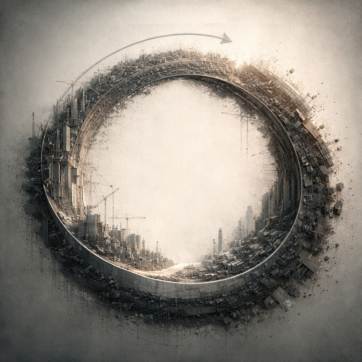
The Physics of Oscillation, Externalization, and Why Stability Never Holds Within the System
Opening Frame — The Perception of Seeking
From inside the external architecture, the entire human experience presents as motion toward resolution. It is not occasional. It is not situational. It is constant. Every layer of life—relationships, identity, purpose, emotional processing, even the search for truth—is oriented around a sense that something must be reached, stabilized, or completed. There is always a next step, a next answer, a next state that is believed will finally settle the system. Even in moments that appear still on the surface, the underlying field is not at rest. It is scanning, orienting, adjusting, anticipating the next point of closure. This is why nothing ever fully lands. The system does not register completion as a stable state; it registers temporary reduction of pressure before movement resumes.
This is where the misread begins. From the human perspective, this continuous motion is interpreted as desire, ambition, emotional need, or psychological patterning. It is labeled as attachment style, trauma response, fear of abandonment, lack of fulfillment, or the drive for purpose. Entire disciplines are built on explaining and managing this behavior as if it originates within the individual. But the behavior is not being generated at the level it is being interpreted. It is not personal. It is not psychological. It is architectural. The individual is not producing the movement—they are inside a system that requires it.
The external architecture cannot hold internal coherence. That is the root condition. There is no closed circuit, no self-contained field that can sustain stability without input. The system operates through oscillation, which means it is defined by continuous movement between states rather than the ability to remain in one. Because of this, it cannot generate a stable center. There is no internal reference point that resolves the field into completion. Instead, the system distributes load outward, requiring constant interaction, coupling, and feedback to approximate stability. What is experienced as “seeking” is the human-level expression of that condition.
This is why the pattern is universal. It does not matter who the person is, what their life circumstances are, or what belief system they operate within. The forms change, but the structure does not. One person seeks completion through relationships, another through achievement, another through spiritual understanding, another through emotional processing. But the underlying mechanic is identical: movement toward something that is expected to stabilize the field. And when that “something” is reached, there is a brief reduction in pressure—a sense of arrival—followed by the return of motion. The system does not hold. It resets and reorients.
There is no failure occurring here. There is no deficiency in the individual. The architecture is behaving exactly as it is built to behave. The misinterpretation happens when the output of the system is assigned meaning at the human layer. The seeking is treated as purposeful, as if it is leading somewhere that will eventually resolve. But the system is not designed to resolve. It is designed to continue. The motion is not a path. It is a function.
So the correct read is not “humans are always searching for something.” The correct read is that the external architecture produces continuous movement because it cannot hold coherence internally, and everything within it expresses that condition.
The External Architecture Cannot Hold Coherence
At the core of the external architecture is a single governing condition: oscillation. This is not a surface behavior—it is the base mechanic that generates the entire system. Oscillation means continuous movement between states, continuous variation, continuous exchange. It produces form, interaction, and the appearance of continuity, but it does not produce stability. It cannot. Because oscillation requires motion to exist, it cannot resolve into a fixed, self-contained state. The system is always in transition, always shifting, always redistributing. That condition alone prevents the formation of true internal coherence.
Coherence, in its actual definition, requires internal containment. It requires a closed circuit—something that can hold itself without needing external input, without needing to route energy outward to stabilize. The external architecture does not have this capability. There is no closed loop within it. Every process is open-ended, dependent on interaction, dependent on feedback. The system sustains itself through movement across its own structure, not through internal completion. This means there is no point within the architecture where stability originates. There is no self-sustaining center.
Because there is no center, there is no place for coherence to anchor. Any moment that appears stable is not internally held—it is temporarily balanced through opposing movements, through distributed load across the system. This is why stability in the external always requires maintenance. It must be continuously reinforced, continuously adjusted, continuously supported by surrounding conditions. The moment that support shifts, the stability collapses. What looked like coherence was never self-contained—it was held together through active compensation.
This is also why coherence cannot be generated from within the system. The architecture cannot produce what it does not structurally contain. It can simulate coherence through alignment, through repetition, through pattern stabilization, but these are approximations, not actual states of internal resolution. They depend on conditions remaining consistent. They depend on the system continuing to move in a predictable way. The moment variability increases or pressure shifts, those approximations break down. The system re-enters visible instability.
Oscillation ensures that nothing can remain fixed. It prevents closure. It prevents completion. Every structure within the architecture—whether physical, relational, emotional, or conceptual—is subject to this condition. It must participate in movement to exist. It must exchange, adapt, and respond to surrounding inputs. There is no independent state. There is no isolated coherence. Everything is part of a larger, open system that cannot settle into itself.
So the limitation is not at the level of the individual components. It is built into the architecture itself. No matter how refined a structure becomes within it, no matter how stable it appears, it cannot escape the underlying condition of oscillation. Coherence cannot originate there, and it cannot remain there. The system can only approximate stability through continuous motion, never through true internal containment.
The Coherence Deficit as Constant Load
Once the architecture is understood as incapable of holding internal coherence, the next layer becomes unavoidable: that absence does not sit neutral. It registers as pressure. The system does not simply lack coherence—it experiences that lack as a continuous load that must be managed. This load is not emotional, not psychological, not interpretive. It is structural. It is the direct consequence of an open, oscillatory system attempting to stabilize without the ability to close itself.
Because there is no internally sustained center, the system is always compensating. That compensation appears as movement, but the driver beneath that movement is load redistribution. The architecture is constantly adjusting, routing, and displacing pressure across its own structure in order to maintain continuity. Without that redistribution, the system would fragment immediately. So the motion is not optional. It is required to keep the architecture from collapsing under its own instability.
This is where the idea of “seeking” becomes misread again. From inside the system, this constant movement feels directional. It feels like reaching, wanting, needing, pursuing. But what is actually happening is far more mechanical. The system is not moving toward something—it is moving away from pressure. It is attempting to relieve, redistribute, or temporarily balance a load that cannot be resolved at its source. The movement has no true endpoint because the condition generating it never changes.
This load is continuous. It does not turn off. Even in states that appear calm or resolved, the underlying pressure is still present, only redistributed in a way that is less perceptible. The moment that distribution shifts—through loss, change, disruption, or even internal fluctuation—the pressure becomes visible again, and movement increases. This is why reactions can appear sudden or disproportionate at the human level. The system is not reacting to the moment alone; it is responding to a reconfiguration of load that was already present.
Everything within the architecture participates in this load management. Relationships carry it. Identities carry it. Emotional cycles carry it. Belief systems carry it. Nothing exists in isolation from it because nothing is internally contained. Each structure becomes a temporary anchor point where load can be held, shared, or redistributed. When one anchor point fails or is removed, the load does not disappear—it shifts, often intensifying elsewhere.
This is why no resolution lasts. What appears as relief is not the elimination of load, but a temporary rebalancing of it. The system finds a configuration that can hold the pressure more evenly for a period of time. That configuration eventually destabilizes, either through internal variation or external change, and the load must be redistributed again. The cycle repeats because the source condition remains unchanged.
So the correct framing is not that humans are driven by desire, intention, or emotional need at their root. Those are surface translations of a deeper mechanic. What is actually driving all movement within the external architecture is continuous load created by the absence of internal coherence. The system moves because it must manage that load. Without movement, it cannot hold together.
Humans as Outputs of the Same Condition
Humans do not stand apart from the external architecture. They are generated within it and structured by the same base condition—oscillation without internal containment. What appears as individual behavior is the local expression of a system-wide mechanic. The body, the identity, the emotional field, and the cognitive layer are all organized to participate in load distribution because the architecture they emerge from cannot hold coherence on its own. There is no separate operating mode available at the human level. The structure dictates the behavior.
This is why human orientation is consistently outward. Stabilization is not sourced internally, so it must be routed through something else—another person, a role, a belief, a goal, a narrative, a cycle of emotional release. The human system is built to connect, attach, interpret, and adjust in order to manage pressure. These are not optional traits or learned tendencies; they are the mechanisms through which the architecture maintains continuity at the human scale. Remove the outward routing, and the system does not settle—it destabilizes because the load has nowhere to go.
Identity itself functions as a stabilization interface. It organizes experience into a consistent pattern that can hold and distribute load across time. Relationships function as shared load structures, allowing pressure to be spread across multiple nodes. Emotional cycles act as discharge and redistribution pathways, moving load through the body and into surrounding structures. Belief systems provide fixed reference points that reduce variability and help maintain temporary alignment. Each of these is an architectural solution to the same underlying condition: the inability to hold coherence internally.
Because the condition is systemic, the behaviors are universal. The forms differ, but the function is identical. One person stabilizes through constant relational engagement, another through achievement and control, another through spiritual frameworks, another through cycles of emotional processing. Each appears distinct at the surface, but all are performing the same task—externalizing the load that cannot be contained within. The human system is not choosing these pathways freely; it is selecting from available structures that can temporarily hold pressure.
This is also why attempts to “fix” behavior at the human level never fully resolve the pattern. The behavior is not the source—it is the output. Modifying the output without altering the architecture simply reroutes the load into a different form. A person may shift from relational dependency to career fixation, from emotional processing to intellectual analysis, from one belief system to another. The expression changes, but the underlying movement remains because the structural condition has not changed.
So the correct read is not that humans are seeking, attaching, or reacting based on personal traits. The correct read is that humans are functioning exactly as the architecture requires. They are distributing load through outward orientation because there is no internal coherence to hold it. Their behaviors are not separate from the system—they are the system, expressed at the human level.
The Illusion of Seeking Coherence
What is commonly described as “seeking” is not an intentional movement toward truth, wholeness, or completion. It only appears that way from inside the system because the architecture translates load into directional experience. The human layer reads that direction as purpose, desire, or meaning. But structurally, there is no endpoint being approached. There is no final state the system is organizing toward. What is happening is continuous rerouting—an attempt to approximate coherence using external structures because internal containment is not available.
The system cannot hold itself, so it reaches outward. That outward movement is then interpreted as pursuit. A person believes they are searching for the right partner, the right identity, the right belief system, the right emotional resolution, the right understanding that will finally stabilize everything. But each of those becomes a temporary routing point for load. The moment one structure begins to fail or lose capacity, the system redirects. The seeking does not complete because it was never aimed at a true resolution—it was managing instability in real time.
Relationships are one of the most visible expressions of this. They are not just emotional or social bonds; they are load-sharing mechanisms. Two systems couple to distribute pressure across a wider field. This creates a temporary sense of grounding, connection, and stability that is often interpreted as fulfillment or completion. But because neither system has internal coherence, the shared structure requires constant maintenance. When that maintenance fails or the configuration shifts, the load redistributes abruptly, and the sense of loss or instability returns. The person then seeks again, believing they have not yet found the “right” configuration.
The same pattern appears in identity structures. A role, a career, a label, or a narrative becomes a stabilizing frame that organizes internal experience into something that feels coherent. It reduces variability and provides a reference point the system can anchor to. But this coherence is conditional. It depends on the identity holding its structure under changing conditions. When it begins to fracture—through external change, internal conflict, or increased load—the system destabilizes again. The individual interprets this as confusion or lack of purpose and begins searching for a new identity that can hold more effectively.
Belief systems function similarly. They create fixed points that reduce uncertainty and provide interpretive closure. They allow the system to compress complexity into stable narratives that can be returned to repeatedly. This creates the sensation of understanding, of having found truth. But because the underlying architecture is still oscillatory, these beliefs must be reinforced, defended, and sometimes replaced. The seeking continues, not because truth is being uncovered progressively, but because no belief structure can permanently stabilize an incoherent system.
Emotional cycles operate as another routing mechanism. Release, catharsis, processing, and expression are experienced as movement toward resolution. The system discharges pressure and temporarily reduces load, which is then interpreted as healing or completion. But the source of the load remains unchanged. The architecture continues to generate pressure, and the cycle begins again. What feels like progress is often repetition at a different point in the loop.
So the correct framing is not that humans are seeking coherence. The system is attempting to simulate it through external routing. Every form of seeking—whether relational, intellectual, emotional, or spiritual—is the same structural response to the same condition. It is not leading toward resolution. It is maintaining continuity in a system that cannot resolve itself.
Externalization as the Only Available Mechanism
Within the external architecture, stabilization cannot occur internally because there is no closed circuit to hold it. That absence forces a single operational pathway: externalization. The system must route outward to approximate what it cannot generate within. This is not a preference or a learned behavior—it is the only available mechanism for maintaining continuity under oscillatory conditions. Every attempt at stability, coherence, or completion is constructed through connection to something outside the self-structure.
Externalization operates through coupling. One structure links to another so that load can be shared, distributed, or temporarily balanced across a wider field. Person to person, idea to identity, emotion to expression—each of these pairings forms a transient bridge where pressure can move. The sense of stability that emerges from these couplings is not self-contained; it is conditional on the connection remaining intact and functioning. The moment the link weakens, shifts, or breaks, the system loses its temporary balance and the underlying load becomes visible again.
This is why everything within the architecture requires something else to feel complete. No structure is sufficient on its own because none of them are internally coherent. A relationship needs ongoing interaction to hold. An identity needs reinforcement through recognition or performance. A belief needs repetition and validation. An emotional state needs expression or discharge. Each element is dependent on another to maintain its form. Remove the external support, and the structure destabilizes immediately because it has no internal foundation to sustain it.
Externalization also creates chains of dependency. Because one coupling is rarely enough to hold the full load, the system builds networks—multiple points of connection that together create a more stable configuration. A person may rely on relationships, work, routines, beliefs, and emotional cycles simultaneously, each carrying part of the pressure. This distributes load more evenly, but it also increases fragility. If several links shift at once, the system can destabilize rapidly because there is no central containment to absorb the change.
What is often interpreted as “connection,” “meaning,” or “engagement” is, at the structural level, the architecture performing load distribution through external links. These experiences feel necessary because they are necessary within this system. Without them, the instability becomes immediate and difficult to manage. But their necessity should not be confused with resolution. They do not complete the system; they sustain it in motion.
So the condition is not that humans prefer external validation, connection, or expression. The condition is that the architecture requires externalization to function at all. Coherence is not held—it is approximated through continuous coupling. Everything must attach, align, or interact with something else because nothing within the system can stand as a complete, self-contained state.
Temporary Closure and Decay
Within the external architecture, what is experienced as resolution is not true closure—it is a temporary stabilization of load. The system reaches a configuration where pressure is distributed in a way that reduces immediate strain, and this registers at the human level as completion, clarity, or relief. It feels like something has been resolved because the intensity of the load has decreased. But the underlying condition has not changed. The architecture still cannot hold coherence internally, so the stabilization is conditional and time-bound from the moment it forms.
This creates a predictable loop. The system moves under pressure, routes outward, forms a configuration that can hold the load more evenly, and enters a phase of temporary balance. That balance is interpreted as resolution. The person believes they have arrived at something stable—whether that is a relationship, an identity, an emotional state, or an understanding. For a period of time, the system holds. The pressure is managed. The movement slows.
Then decay begins.
Decay is not failure—it is the natural consequence of an oscillatory system attempting to maintain a fixed state. Because the architecture cannot sustain closure, any configuration that approximates stability begins to degrade as variability re-enters the system. External conditions shift. Internal distributions of load change. The alignment that once held the structure together starts to loosen. The stability requires more effort to maintain, more reinforcement, more input. Eventually, the configuration can no longer hold the load in its current form.
At that point, the pressure becomes visible again. The sense of resolution dissolves. What was once stable now feels insufficient, strained, or broken. The system re-enters active movement, seeking a new configuration that can redistribute the load. This is experienced as renewed searching—looking for a new relationship, redefining identity, adopting new beliefs, engaging in new cycles of emotional processing. But the pattern is not progressing toward a final state. It is repeating under the same structural condition.
This loop—temporary stabilization, perceived resolution, decay, renewed movement—is continuous because the architecture cannot sustain closure. Every structure within it requires maintenance to hold its form. Relationships require ongoing interaction and adjustment. Identities require reinforcement and validation. Beliefs require repetition and defense. Emotional states require continual processing. Nothing remains stable without input because nothing is internally contained.
The critical point is that maintenance does not resolve the condition—it prolongs the configuration. The system can extend the life of a structure by continuously reinforcing it, but it cannot make that structure permanent. The moment maintenance stops or conditions shift beyond what the structure can absorb, decay accelerates and the loop resets.
So what appears as cycles of growth, loss, and renewal at the human level is the architecture operating exactly as designed. Closure is never achieved because it cannot be sustained. Stability is always temporary because it is externally held. The loop continues, not because the system has not found the right configuration, but because no configuration within this architecture can hold indefinitely.
Real-World Expressions of the Loop
The loop of temporary stabilization, perceived resolution, and eventual decay does not stay abstract. It is visible everywhere in the human layer because humans are the architecture expressing itself in form. These patterns show up in lived experience as recognizable situations, but what is being observed is not personal behavior—it is load management through externalization.
Romantic dependency is one of the clearest expressions. Two individuals form a coupling that allows load to be shared across both systems. This creates a sense of grounding, safety, and completion that feels like coherence. The relationship becomes the stabilizing structure. As long as the coupling holds, the pressure is distributed and the system remains relatively balanced. But when the partner is removed—through separation, conflict, or loss—the shared structure collapses. The load that was being distributed across two systems is forced back into one. This is experienced as emotional destabilization, but what is actually occurring is a sudden compression of load with no external routing available. The intensity of the reaction is not about the person alone—it is about the collapse of a stabilization mechanism.
The same mechanic is visible in the inability to process loss without destabilization. When someone loses a loved one, the grief is not only emotional attachment—it is structural displacement. That person was part of the load-bearing network. Their presence helped distribute pressure across the system. When they are removed, the architecture must rapidly reorganize. The load has nowhere to go in the same configuration, so it concentrates. This concentration is experienced as overwhelming grief, disorientation, and instability. The system is not just mourning—it is attempting to reconfigure under increased pressure without the support it previously relied on.
Parent-child overbinding follows the same pattern, but with a different configuration. The parent routes a significant portion of their load through the child, using the relationship as a primary stabilization point. The child, in turn, becomes structurally entangled in carrying that load. This creates a strong sense of attachment and identity around the relationship, but it also creates fragility. If the child individuates, pulls away, or disrupts the dynamic, the parent destabilizes because a major load-bearing structure has shifted. The intensity of control, anxiety, or emotional dependence seen in these dynamics is not simply relational—it is architectural. The system is trying to preserve a configuration that is holding pressure.
Identity fixation operates through the same mechanism. A career, role, or belief system becomes a stabilizing frame that organizes internal experience. It provides consistency, reduces variability, and gives the system a way to distribute load across time. As long as that identity holds, the person feels stable and coherent. But if that identity is threatened—through job loss, role change, or belief collapse—the system destabilizes. The pressure that was being held within that structure has nowhere to go. The person experiences this as loss of self, confusion, or crisis, but structurally it is the removal of a load-bearing configuration.
Emotional release cycles are another expression of the loop. The system builds pressure, reaches a threshold, and discharges through expression—crying, catharsis, processing, or other release mechanisms. This creates a temporary reduction in load, which is interpreted as healing or resolution. But the architecture generating the pressure remains unchanged. The system begins accumulating load again, leading to another cycle of buildup and release. What appears as progress is often repetition. The person becomes efficient at discharging pressure, but the underlying condition continues to produce it.
Each of these situations is an external attempt to stabilize internal incoherence. The forms differ, but the function is identical. The system cannot hold itself, so it builds structures outside of itself to manage load. When those structures hold, there is temporary stability. When they shift or collapse, the instability becomes visible again. What is often interpreted as emotional complexity, relational dynamics, or personal struggle is the architecture operating exactly as it is built to operate—through continuous externalization, temporary stabilization, and inevitable decay.
Why This Is Not Psychological
The patterns described—seeking, attachment, instability, cycles of relief and collapse—are consistently interpreted through psychological frameworks. They are labeled as trauma responses, attachment styles, emotional immaturity, conditioning, or unresolved internal conflict. These interpretations attempt to locate the source of the behavior within the individual, as if the person is generating the instability from within their own internal system. But this framing is misaligned with the actual origin of the behavior. It describes the surface without identifying the structure producing it.
Psychology operates at the render layer. It observes patterns in behavior, emotion, and cognition and builds models to categorize and manage those patterns. It can describe how someone reacts, how they form bonds, how they process experience. But it does not access the architectural condition generating those outputs. It assumes an internally contained system that is functioning incorrectly or inefficiently. From that assumption, it attempts to correct, regulate, or reframe behavior so that the individual can operate more effectively within the same structure.
The limitation is that the structure itself is not internally coherent. The instability is not being produced by faulty processing within a closed system—it is being produced by an open system that cannot hold coherence. The behaviors psychology describes are not errors. They are correct responses to an underlying condition that is not being addressed at that level. Attachment is not a maladaptive tendency—it is a load distribution mechanism. Emotional volatility is not simply dysregulation—it is pressure becoming visible as it moves through the system. Identity instability is not confusion—it is the collapse of a structure that was holding load externally.
This is why psychological frameworks can manage symptoms but cannot resolve the loop. They can help a person redistribute load more efficiently, build more stable external structures, or reduce the intensity of visible instability. But they cannot eliminate the need for externalization because they do not change the architectural condition that requires it. The system remains open, oscillatory, and unable to hold coherence internally. So the patterns persist, even if they are expressed in more refined or controlled ways.
Labeling these patterns as trauma, attachment style, or emotional immaturity also creates a false sense of personal responsibility for structural behavior. It places the burden on the individual to fix something that is not originating from them. This leads to continuous self-analysis, correction, and effort directed at the surface level, while the underlying condition remains unchanged. The person may become more aware, more regulated, or more adaptive, but the loop of seeking, temporary stabilization, and decay continues because the architecture is still operating the same way.
So the correct read is not that humans are psychologically flawed or incomplete. The correct read is that they are functioning within an architecture that cannot produce internal coherence. Psychological language describes how that condition appears at the human level, but it does not explain why it exists. Without recognizing the architectural layer, the interpretation remains incomplete, and the patterns continue to be misattributed to the individual rather than the system generating them.
The System Requires the Loop
The persistence of this pattern is not accidental, and it is not a failure of the system to arrive at resolution. The loop exists because the architecture depends on it to maintain continuity. An oscillatory structure that cannot hold internal coherence must remain in motion to prevent collapse. Stillness, in the sense of a fully closed and self-contained state, is not available here. So the system stabilizes itself through continuous adjustment—routing load, forming temporary structures, dissolving them, and reforming new ones. The loop is the mechanism that allows the architecture to remain intact despite its inability to resolve.
Movement, in this context, is not progress. It is maintenance. Each cycle of seeking, stabilization, decay, and reconfiguration redistributes pressure in a way that keeps the system from concentrating load to the point of fracture. When one structure begins to fail, the system does not stop—it shifts. It forms a new configuration, spreads the load differently, and continues operating. Without this constant reconfiguration, the instability would accumulate in a single point and the architecture would not be able to sustain itself.
This is why seeking cannot be removed from within the system. It is not an optional behavior that can be turned off or corrected. It is the visible expression of the system’s requirement to keep moving. Even when an individual attempts to withdraw, detach, or stop engaging, the underlying load does not disappear. It begins to redistribute internally and externally in new ways, often creating increased pressure or different forms of instability until a new routing pathway is established. The system will always reintroduce movement because it cannot hold a static state.
The loop also regulates variability. By continuously cycling through formation and decay, the architecture prevents any single configuration from becoming too rigid or too unstable. It allows for temporary alignment while ensuring that no structure locks into a state that the system cannot sustain long-term. This creates the appearance of change, growth, or evolution, but structurally it is the system maintaining balance through controlled instability.
From the human perspective, this loop is often interpreted as a problem to be solved—a cycle to break, a pattern to overcome, a state to transcend. But within the external architecture, the loop is not an error. It is the operating condition. Seeking is not a flaw in the individual. It is the system’s way of distributing load and preserving continuity under a condition where internal coherence is not available.
So the pattern persists because it must. The architecture does not move toward resolution—it moves to remain intact. The loop is not leading somewhere. It is what allows the system to continue functioning at all.
The Point of Divergence
The contrast does not emerge as an improvement within the external architecture. It is not a refined state of the same system. It is a structural divergence. The Eternal does not operate on oscillation, and because of that, it does not inherit any of the conditions that define the external field. There is no continuous movement required to maintain itself. There is no redistribution of load. There is no dependence on coupling, feedback, or external structures to approximate stability. The base condition is different, and that difference changes everything.
Where the external architecture cannot hold coherence, the Eternal is coherence. It is internally contained, self-sustaining, and not dependent on interaction to remain stable. There is no open circuit to close because there is no break in continuity. There is no center to locate because the field does not require a reference point to organize itself. It does not move toward resolution because it is not operating from a deficit. There is nothing missing that needs to be found, nothing unstable that needs to be balanced.
Because there is no oscillation, there is no need for routing. No relationships are required to stabilize the field. No identities are needed to organize it. No belief systems are needed to interpret it. No emotional cycles are needed to discharge or redistribute pressure. All of those mechanisms exist in the external architecture as solutions to a structural limitation. In the Eternal, that limitation is not present, so the mechanisms are not required.
Interaction can still occur, but it is no longer structural. It is not used to hold coherence, and it is not necessary for stability. Nothing external is required to complete or maintain the field. There is no dependency chain, no need for external closure, no ongoing process of seeking or reconfiguration. The conditions that generate the loop in the external architecture simply do not exist here.
This is the point of divergence. Not a better version of the same system, but a different condition entirely—one that does not require movement to hold itself, does not require externalization to stabilize, and does not produce the continuous loop of seeking, temporary closure, and decay.
Read the Structure, Not the Story
What appears at the human level as desire, emotion, identity, conflict, or personal struggle is not originating where it is being interpreted. It is the architecture expressing itself through the available forms. The behaviors feel personal because they are experienced internally, but their source is structural. The system is producing movement, and that movement is being translated into narratives—wanting, needing, searching, losing, resolving. The story is the surface layer. The structure is what generates it.
This is where interpretation consistently diverges from reality. The human lens assigns meaning to the movement. It treats desire as purposeful, emotion as expressive, identity as self-defined, and struggle as something to overcome or resolve. But none of these are independent drivers. They are outputs of a system that cannot hold coherence and must continuously move to manage its own instability. The meaning is added after the fact, as a way to organize and explain what is being experienced. It does not reflect the actual mechanism.
The instability is not accidental. It is not something that has gone wrong within the system. It is the direct and predictable result of an architecture that operates on oscillation without internal containment. The seeking is not meaningful in the way it is often understood. It is not guiding the individual toward a final state of completion. It is the system redistributing load in real time. The repetition, the cycles, the inability for anything to fully resolve—these are not failures. They are the system functioning as it is built to function.
As long as behavior is interpreted at the level of the story, the underlying condition remains obscured. The focus stays on managing emotions, refining identity, improving relationships, or finding the “right” path. But all of those efforts operate within the same architecture and therefore reproduce the same patterns in different forms. The surface shifts, but the structure remains unchanged.
The shift occurs when the lens moves from interpretation to observation of mechanism. Instead of asking what something means, the question becomes: what is generating this pattern? What condition is producing this movement? When the structure is read directly, the patterns stop appearing random or personal. They become consistent, mechanical, and predictable expressions of the architecture itself.
So the correction is simple, but not superficial. Stop reading the story. Read the system that is producing it.