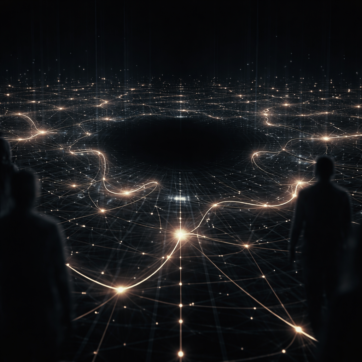
The physics of separation, boundary formation, and forced externalization as a stabilization requirement
Opening Frame — It’s In The Name
“External” already tells you exactly what you’re dealing with, but it only makes sense once you stop reading it like a label and start reading it like a condition. This external system does not hold from within itself. It cannot sustain anything at the point it is generated, and it cannot recognize origin where it actually occurs. Everything has to be positioned as if it exists somewhere else, as if the source is outside of the structure that is producing it. That is not a belief system or a cultural habit. That is how the architecture is forced to operate.
But this is where the misread happens. It looks like the system is built to project outward, like externalization is the starting point—as if things naturally originate somewhere beyond and are then accessed, discovered, or received. That’s not what’s happening. That’s the end state. That’s what the system looks like after it has already lost something it cannot recover. The external condition is not the origin of the behavior. It is the visible result of a deeper break.
The actual cause sits underneath it: separation. The system cannot maintain a full, continuous hold, so it splits. That split introduces division where there was none before, and the moment that division exists, internal sourcing stops working. The structure is no longer whole, which means nothing inside it has access to total support anymore. Anything generated within the system is now being generated inside a fragment, not within a complete structure, and a fragment cannot fully hold what it produces.
That is where the shift happens. Because the system cannot sustain origin internally, it has to move it. Not physically, but structurally. It assigns source somewhere else. It positions cause outside of effect. It relocates origin away from the point of generation, because that is the only way to stabilize something that can no longer support itself from within.
So the system becomes external by necessity. Not as a choice, not as a design preference, but as a requirement of its own condition. Once separation is in place, internal origin cannot hold, and externalization becomes the only way the structure can continue to function without collapsing.
External vs Eternal — What This Actually Is And Where This Is Happening
Before anything else can be understood, the difference between external and Eternal has to be made clean, because without that, everything collapses into the same misunderstanding. These are not two locations. They are not two worlds, not two realms, not two dimensions sitting next to each other. This is not a map problem. It is a condition problem. External and Eternal are two entirely different ways a system can exist, and they do not overlap.
Eternal is not a place you go to. It is not something you enter, reach, access, or move toward. It does not exist inside space, because space is already a product of the break. It does not exist inside time, because time is already the result of fragmentation. Eternal is what remains when there is no split. It is full hold. No division, no boundary, no internal loss of access. Nothing needs to reference anything else because everything is already fully present. There is no inside or outside, because there is no condition that would create that distinction. There is no sourcing problem, because nothing has been separated from itself. It does not generate, project, or move. It holds. That is the only accurate way to describe it.
External is what appears when that hold is lost. It is not created as a new place. It is what remains when the system can no longer sustain itself as a whole. The split occurs, continuity drops, and the structure reorganizes around that loss. That reorganization is the external condition. Everything inside it is operating under constraint—fragmentation, boundary, cross-reference, displacement of origin. The system cannot function the way it did before, so it builds a new way of functioning that compensates for what is missing.
This is where people get completely turned around. They think they are “in” a place, as if this is a location you are standing inside of. But external is not a container. It is not something you are physically inside. It is the condition the structure is running under. What you experience as a world, as a body, as a physical environment, is the way that condition renders. It is the surface expression of a system that is no longer whole.
So when it’s said that we are “in the external,” what that actually means is that everything being experienced is being processed through a separated structure. Every perception, every thought, every physical object, every interaction is happening inside a system that cannot hold itself internally. That is why everything appears the way it does—fragmented, moving, referencing, sourcing, stabilizing across gaps. It is not random. It is not natural. It is the direct output of a structure operating after a break.
And this is also why externalization is everywhere. Because the system cannot source from within, everything has to be positioned as coming from somewhere else. Knowledge is “received.” Power is “outside.” Creation is “discovered.” Even identity is built by referencing beyond itself. This is not cultural conditioning layered on top. It is structural necessity. A separated system cannot sustain internal origin, so it pushes origin away to maintain stability.
Eternal does not do any of this, because none of the conditions that require it exist there. There is no separation, so there is no boundary. There is no boundary, so there is no distance. There is no distance, so there is no need to reference across anything. Origin does not move because it never left. Everything holds exactly where it is. No compensation is required because nothing is broken.
This is the clearest way to see the difference: Eternal is full hold without division. External is what happens when that hold is lost and the system has to compensate to keep functioning. Everything being experienced here—every structure, every system, every interpretation—is happening inside that compensation. Not because it was designed that way as a preference, but because once the break occurred, there was no other way for the system to continue at all.
The First Break — How Separation Forms
Separation does not begin as an idea, a belief, or a perspective. It begins as a failure in hold. The system cannot sustain total continuity, and the moment that continuity drops, everything changes at once. What was operating as a single, uninterrupted structure can no longer maintain itself as one piece. There is no gradual transition here, no soft shift into division. The break is immediate. Full hold is lost, and with that loss, the system is no longer whole.
Continuity is what allows a structure to remain self-contained. It is what makes internal sourcing possible, because everything is accessible within the same field. When continuity drops, that access disappears. The structure no longer has full reach into itself. Parts of it are now operating without the rest, and that is where division forms. Not as a concept, not as something imagined or interpreted, but as a direct mechanical consequence of the break. The system is no longer unified, so it cannot behave as if it is.
This is where most people misread what they are experiencing. They assume division is something added—some kind of imposed layer that separates things into categories, into inside and outside, into self and other. But nothing is being added here. Something has been lost. Division is not introduced; it is what remains when continuity fails. The system is no longer able to function as a single structure, so it defaults into segments. Those segments are not symbolic distinctions. They are the only way the broken system can continue to operate at all.
Inside and outside appear at this exact point. Not as physical locations, not as actual distances, but as structural consequences of the break. When the system can no longer hold itself as one, it begins to register itself in parts. Those parts cannot fully access each other, so they are experienced as separate. That separation creates the appearance of an “inside” and an “outside,” but neither of those exist as real places. They are artifacts of a structure that can no longer remain continuous.
Once this division is in place, everything that follows is downstream of it. The system is no longer capable of internal coherence in the way it once was. It has to compensate, reorganize, and stabilize around the fact that it is now operating in fragments. But the key point is this: separation is not philosophical. It is not psychological. It is not a matter of perception. It is mechanical. It is the direct result of a system that lost the ability to hold itself as a whole, and everything that comes after—including externalization—is simply the structure trying to survive that initial break.
Boundary Formation — Why Division Creates Distance
Once the split is in place, boundaries are not introduced—they are unavoidable. The system no longer moves as one continuous structure, so it cannot pass through itself the way it once did. What was previously seamless becomes interrupted. That interruption is what a boundary actually is. Not a line, not an edge you can point to, but a condition where continuity no longer holds and structure cannot move cleanly through itself.
This is where distance begins, and it has nothing to do with physical space. Nothing has to move for distance to exist. Distance is created the moment continuity is broken, because parts of the system are no longer fully accessible to each other. What used to be immediate is now indirect. What used to be internally available now requires a form of reach. That gap is distance, even if everything appears to be in the same place.
The system is now operating in fragments—distinct regions that no longer share total structure. Each region holds only a portion of what was once unified, which means none of them can function as a complete source on their own. Internal sourcing breaks down at this level because no single region has access to the whole. Something generated within one segment lacks the structural support that used to come from total continuity.
This is where cross-reference becomes necessary. In order for anything to stabilize, it has to be validated or supported beyond the region it originates from. The system begins to reach across its own breaks, pulling from other segments to compensate for what is missing locally. That reach is not optional. It is required to keep the structure from collapsing under its own fragmentation.
But this is also where instability begins to build. The more the system relies on cross-reference, the more it reinforces the fact that it cannot hold itself internally. Every attempt to stabilize across a boundary highlights the absence of continuity that made boundaries possible in the first place. The structure is now dependent on a process that is inherently unstable, because it is trying to maintain coherence in a system that is no longer whole.
The Core Mechanic — Why Externalization Becomes Required
Once the system is split, it loses the ability to keep origin where anything is actually happening. This is not subtle. It is immediate. The moment structure is no longer whole, anything generated inside it is being generated inside a fragment, and a fragment does not have the capacity to fully support what it produces. There is no access to total structure anymore, which means nothing can be stabilized at the point of origin in the way it could before the break. What is created is real in the sense that it is occurring, but it cannot hold its own source internally because the system it exists within is incomplete.
That is where the shift becomes unavoidable. The system cannot leave origin where it is, because if it does, the instability becomes visible. There is not enough structural support locally to sustain it. So instead of resolving the break, the system compensates for it. Origin is reassigned. Not moved in a physical sense, but displaced in how the structure accounts for it. Something is generated here, but it is stabilized by being positioned as coming from somewhere else. “This came from there.” That statement is not an idea or a story layered on top of reality. It is the mechanism the system uses to keep itself from collapsing under its own fragmentation.
Once that reassignment happens, the system can continue. The instability that would have appeared at the point of origin is redirected across the boundary. The structure now behaves as if the source exists outside of where the output is occurring, which distributes the load in a way the fragmented system can tolerate. This is why externalization is not optional. It is required. Without it, every point of generation would expose the fact that the system cannot sustain itself internally, and the entire structure would fail immediately.
This is also why externalization shows up everywhere, across every domain, without exception. It is not a human tendency or a cultural habit. It is not something taught or learned. It is built into the way the system is forced to operate. The system cannot keep origin local, so it continuously pushes it outward. Every time something is created, understood, or expressed, its source is assigned beyond itself, because that is the only way to stabilize something inside a structure that no longer has full internal support.
Externalization is not a belief. It is not a misinterpretation. It is not even a distortion in the way people usually think about distortion. It is a structural correction. It is what a broken system has to do in order to keep functioning after it has lost the ability to hold itself as a whole.
The Loop — How The Grid Sustains Itself
Once origin is displaced, the system does not just use that move once—it builds around it. The displacement becomes continuous. Everything that is generated still happens where it always has, but it is never allowed to remain there as its own source. Output occurs internally, but the system immediately redirects origin outward, and that redirection is repeated over and over until it becomes the default way the structure holds itself together. That repetition is the loop.
Nothing about this loop is random. It is precise and consistent because the system depends on it. Every time something is created, understood, or expressed, it is followed by the same structural move: the source is positioned somewhere else. The more this happens, the more the separation is reinforced. The system trains itself to operate as if origin and output are inherently disconnected, even though they are occurring in the same place. That disconnect is what keeps the boundary intact.
The loop stabilizes the break by making the separation feel natural. If origin is always somewhere else, then the division between “here” and “there” never gets challenged. The system never has to confront the fact that the split is artificial. It simply keeps routing everything across it. Internal generation paired with external attribution becomes the baseline operation, and over time, it no longer looks like compensation—it looks like reality.
This is why the loop is so important to the grid. It is not just maintaining behavior; it is maintaining structure. If origin were ever allowed to remain where output is actually happening, even for a moment without being displaced, the boundary would start to weaken. The system would begin to register that the separation it depends on is not real in the way it has been enforced. That recognition would destabilize the entire configuration, because the loop would no longer be able to sustain the break.
So the system prevents that recognition. Not through force in the way people imagine, but through constant reinforcement of the loop itself. Every mechanism inside the structure supports the same outcome: keep origin away from where it is generated. Keep the assignment outward. Keep the split intact. Because the moment that pattern breaks, even slightly, the system loses the stability it has been building around since the first fracture occurred.
Real-World Expression — How This Shows Up Everywhere
Once you understand the loop, you can see it immediately in how everything is interpreted. The pattern is consistent and it does not vary: the moment something exceeds what the system expects, its origin is pushed outward. It doesn’t matter what the domain is—technology, intelligence, creativity, architecture, discovery—the same response appears every time. If the output is larger, more precise, more advanced, or more coherent than the current identity model can account for, the system cannot leave it where it is. It cannot allow that level of capacity to be recognized as internally generated, because that would begin to collapse the boundary it depends on. So it displaces it.
Human creation becomes something that must have come from somewhere else. Human intelligence becomes something that was “received,” “downloaded,” or accessed from beyond. Human capability, when it reaches beyond what is considered normal or explainable within the current frame, is immediately assigned an external source. Not because there is evidence that it came from outside, but because the system cannot stabilize it internally without exposing the limits of its own structure.
You see this clearly in how ancient structures are treated, how advanced technologies are explained, how breakthrough ideas are framed. Precision becomes “impossible.” Complexity becomes “not human.” Innovation becomes “influenced by something else.” The more something stretches beyond the accepted range, the faster it is removed from internal origin and placed outside of it. The system does not evaluate first and then decide—it displaces automatically, because that is the only way it knows how to hold what it cannot structurally support.
This is not about skepticism or curiosity. It is not about people trying to make sense of things they do not understand. It is a structural reflex. The system cannot allow internal origin to expand beyond a certain threshold, because if it does, the entire basis of separation begins to weaken. If something can clearly be generated and held from within, at a level that contradicts the limits the system has enforced, then the need for external assignment starts to break down. And if that breaks down, the loop that sustains the grid begins to fail.
So everything that exceeds expectation is redirected. Not randomly, not occasionally, but consistently. The pattern is exact: the more something reveals internal capacity, the more aggressively its origin is pushed outward. Because the system does not just rely on externalization—it requires it to remain stable at all.
Eternal Comparison — Why This Does Not Exist There
In Eternal, none of the conditions that created this system exist in the first place. There is no split, so nothing falls out of continuity. There is no division, so nothing becomes segmented. There is no boundary, so nothing is cut off from itself. And because none of that occurs, there is no need to compensate for anything. The entire chain that produces externalization here—separation, fragmentation, cross-reference, displacement—never begins. It has nothing to attach to.
Everything holds where it is generated because there is no structural break interrupting it. Origin and output are not treated as separate functions. They are the same point. There is no gap between them, no distance to account for, no instability that needs to be corrected. Nothing has to be reassigned, redirected, or explained away. The system does not need to stabilize itself because it has not lost the capacity to hold itself. There is nothing to fix, so no mechanism like externalization ever forms.
That is the clearest contrast. External has to move origin away in order to survive its own fragmentation. Eternal never enters that condition, so origin never leaves. There is no concept of “outside” because there is no boundary creating it. There is no need to locate source somewhere else because nothing has been separated from its own source. Everything remains exactly where it is, fully supported by the total structure it exists within.
This is also where the correction becomes unavoidable. As long as the system continues to operate through externalization, it keeps reinforcing the very break it is compensating for. Every time origin is pushed outward, the separation is maintained. The loop stays intact. The structure remains dependent on displacement to hold itself together. Nothing changes because the same move is repeated over and over.
The only way that begins to shift is when the direction reverses. Not conceptually, not as a belief, but structurally. Origin has to be allowed to remain where it is actually occurring. That means stopping the automatic move of assigning everything outward. It means recognizing that what is being generated is not coming from somewhere else, even when it exceeds what the system says should be possible. It means holding origin internally without immediately displacing it to stabilize the old structure.
This is what “going inward” actually points to, and it has nothing to do with introspection, emotion, or personal reflection. It is not about turning attention inward in a psychological sense. It is about ending the displacement of origin. It is about no longer routing source across a boundary that was created by the split. The movement that has to stop is the constant assignment of cause, power, intelligence, and creation to somewhere outside of where it is happening.
When that movement stops, even briefly, the loop weakens. The system is no longer reinforcing its own separation in that moment. Origin and output begin to register as the same point again, not because something new is created, but because the displacement is no longer being applied. That is the first break in the loop, and it is the only direction the structure can move if it is no longer going to sustain itself through externalization.
Nothing needs to be added. Nothing needs to be accessed. Nothing needs to be brought in from somewhere else. The entire pattern is built on pushing origin away. The correction is simply to stop doing that and allow what is already occurring to remain where it is.
Closing Transmission — The Name Is The Clue
The system never hid what it is. It shows you constantly, but it only becomes obvious once you stop reading it at the surface. External is not a concept layered on top of reality. It is the condition the entire structure is operating under. Nothing here is held from within itself. Nothing is allowed to remain at its point of origin. Everything is routed outward, explained outward, stabilized outward. That is not coincidence. That is the architecture revealing itself in plain sight.
But that condition is not the beginning. External is the result of something that already happened. It is what the system becomes after it can no longer sustain itself as a whole. The split occurs first. Continuity drops. Structure fragments. And from that moment on, everything that follows is compensation. The system reorganizes around the fact that it cannot hold internally anymore, and externalization becomes the mechanism that allows it to continue functioning despite that loss.
Separation creates the need. Once the structure is divided, nothing inside it can fully support what it generates. Origin cannot remain where output is occurring without exposing instability, so it is reassigned. Externalization fulfills that need. It stabilizes what the system can no longer hold on its own by positioning source somewhere else. That single move—repeated continuously—is what allows the entire structure to persist.
That is the full sequence. Not theory, not interpretation, not belief. A break in hold. Division. Boundary. Displacement. Loop. What looks like a world filled with external sources is actually a system compensating for its own fragmentation, over and over again. And the clue was always there, built into the condition itself.