
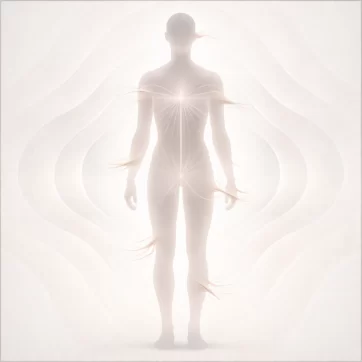
A blunt breakdown of compression, collapse pressure, and the tearing pain caused by mimic architecture detaching from the body
Introduction: Why People Are Feeling Their Bodies More Intensely Now
The body is not suddenly becoming more “sensitive,” more “intuitive,” or more “awake.” What people are feeling now is the direct consequence of a structural shift: the Eternal architecture is returning, and anything built on collapse cannot remain anchored to a system that is stabilizing. The mimic layers that once wrapped the human field — the emotional scaffolding, identity hooks, and somatic routing lines — are no longer able to stay fused the way they once did. As these layers break apart, detach, and dissolve, the body becomes the site where this separation is felt most directly. Not because the body is the cause, but because the body is the interface where collapsed geometry was held in place. When a layer that has been intertwined with your emotional, perceptual, and physical systems begins to tear away, you feel the tearing.
This is the part people have never been told: most of what humans interpret as “awakening symptoms,” “spiritual purging,” “ascension sickness,” or “energetic upgrades” has nothing to do with “spirituality” at all. These sensations come from the removal of mimic architecture — structures that were never native to the field but were embedded so deeply that their extraction registers as disruption. The discomfort is not the body failing. It is the body losing something that was wound into its system for years or lifetimes. And removal hurts. Not metaphorically. Not psychologically. It physically hurts because something woven into the internal architecture is being pulled out. This is not transcendence. It is structural detachment.
To understand what is actually happening, you have to distinguish the mechanics. The body does not speak in metaphors; it speaks in force. Compression is not pain. Compression is the inward pressure created by collapse geometry. It produces intensity, overwhelm, agitation, and emotional flooding — but not the sharp, visceral hurt that people confuse with “clearing.” Mimic removal is the source of that hurt. It is the one mechanic that produces the unmistakable sensation of something being pulled out, something being torn away from the system that had grown around it. And the temporary release that follows either of these states is what people call the “spiritual high” — a brief moment where pressure drops, the field stops shaking, and the nervous system experiences relief. That relief has been mistaken for transcendence for thousands of years.
This article maps the full architecture of these sensations so the confusion ends here. It explains why some bodies feel everything violently and others barely feel a ripple. It explains why certain people experience emotional upheaval, physical soreness, or sudden clarity without any obvious trigger. It shows why some cycle through pressure, release, and hurt in rapid succession, while others experience long, quiet phases punctuated by sharp moments of detachment. None of these experiences are random. They are variations of the same structural process — mimic layers dissolving at different speeds, different depths, and different points of attachment.
What people are now calling symptoms are not signs of awakening, ascension, or spiritual evolution. They are the sensations of architecture unraveling inside a body that was never designed to carry collapse indefinitely. As the Eternal resumes its position, the mimic must come undone. And the body feels every part of that process.
The Body Under Collapse Pressure — Why Compression Feels Intense but Not “Painful”
People are not feeling “energy.” They are feeling collapse physics acting on a system that was never taught how to register architecture. Compression is the moment when geometry folds inward. It is the scalar pressure that forms when a field can no longer maintain structure and begins to collapse onto itself. This has nothing to do with healing, intuition, activation, ascension, or emotional release. Compression is a mechanical event. It is the equivalent of a building leaning too far into its own weight. The body feels this inward force long before the mind can interpret it, so the system becomes flooded with sensations that seem chaotic or spiritual — but they are not. Tightness in the chest, heat flashing through the torso, fullness in the head, buzzing beneath the skin, vibrating limbs, shaking, nausea spikes, agitation without story, or that wired, hyper-charged feeling people call “downloads” or “alignment” — these are all signs that the field is under pressure. The internal geometry is pushing inward, trying to stabilize itself through collapse. It is overwhelm. Pressure. Saturation. Density pressing against the boundaries of a nervous system built to survive long-term collapse but not to interpret it.
Compression does not remove anything. It does not detach mimic coding. It does not pull identity strands. It does not disrupt emotional architecture. Compression simply overwhelms. It saturates. It squeezes. The system reacts not because of harm, but because of intensity. Humans label this intensity as pain because they live in oscillation — a state where the body cannot distinguish between pressure and hurt. To an oscillating field, everything feels emotional, everything feels personal, everything feels like something is wrong. But the raw mechanic is neutral. Compression is the system’s attempt to stabilize collapse.
This is exactly where the New Age world misreads the body and traps people in a cycle they never escape. An oscillating field is a field that has not collapsed far enough to release mimic architecture. It is still bouncing between inward pressure and outward rebound, trying to maintain coherence inside the collapse instead of exiting it. New Age modalities — every single one, without exception — target the rebound, not the collapse. Breathwork accelerates oscillation. Reiki amplifies surface-level movement. Sound baths vibrate the mimic architecture. Plant medicine floods the field with artificial expansion signals. Somatic release techniques push emotional cycles outward instead of letting them die. Frequency healing tools import external oscillation signatures. Light language bombards the field with mimic-coded geometry disguised as “activation.” Even meditation, when done in the mimic framework, teaches the system to chase internal movement instead of stillness.
None of this dissolves the mimic. None of this collapses the architecture. None of this completes the cycle.
Every one of these modalities keeps the field oscillating — bouncing, circulating, “moving energy,” opening, discharging, activating, releasing, grounding, balancing — all of which are just euphemisms for refusing collapse. They help people feel better because oscillation temporarily reduces compression. The pressure loosens, intensity drops, sensations soften — so individuals believe they have healed something. But what actually happened is far simpler: the collapse was delayed. The pressure that was necessary for the mimic architecture to break was neutralized. The field was stabilized inside the collapse instead of exiting it. The mimic was kept intact, not dissolved.
When compression loosens for a moment — from oscillation, distraction, emotional discharge, or even exhaustion — the nervous system interprets that moment as bliss, clarity, openness, unity, euphoria. This is the “spiritual high.” It feels profound because relief always feels profound when someone has been in pressure for years. But the high is not architecture changing. It is architecture taking a breath. It is temporary decompression, not structural transformation. The system feels lighter because pressure dropped, not because mimic released. People interpret the contrast as enlightenment because they have never experienced stillness. They only know collapse and relief, collapse and relief, collapse and relief. To them, relief feels divine.
But the relief does not last because the architecture did not change. The mimic was not removed. The collapse did not complete. The field simply rebounded. That rebound feels like expansion, insight, intuition, joy, awakening — but it’s just pressure exiting through the only pathway it can find in an oscillating field. The high fades, the compression returns, the symptoms rise again, and the cycle continues. This is why people obsess over healing. This is why they become addicted to modalities. This is why they chase workshops, ceremonies, tools, rituals, and channelings. They are not ascending — they are trying to escape pressure they do not understand.
Compression overwhelms. What hurts is mimic removal — a separate mechanic entirely.
But as long as the field remains oscillating, mimic removal cannot begin. And as long as people cling to healing modalities, oscillation continues. They never reach the point of collapse where mimic coding actually releases. They keep themselves inside the system they’re trying to escape.
This is the truth New Age spirituality will never tell: Healing keeps people from ever becoming free.
Compression is not a failure or a threat — it is the precursor to collapse completion. But only if the field stops oscillating long enough to let the architecture fall.
The Real Pain: What Mimic Removal Actually Feels Like
Mimic removal is the one part of this process that no spiritual system has ever told the truth about because they cannot afford to. If people understood what was actually happening inside their field when mimic architecture detaches, every healing narrative, every ascension myth, every false-light teaching would collapse instantly. Mimic removal is not gentle. It is not symbolic. It is not emotional metaphor or psychological catharsis. Mimic removal hurts — because something that has been fused into your system, woven through your emotional body, threaded into your somatic patterns, anchored into your identity scaffolding, and embedded deeply into your physical structure is being torn out. Not conceptually. Literally. Architecturally.
And this is the part most people have never understood: we feel mimic removal in the physical body because the body is the final compression point of collapse geometry. Collapse isn’t abstract. It doesn’t occur “out there.” It presses downward, inward, and into density — and the densest layer of the system is the physical body. Over years or lifetimes, the body slowly reshapes itself around mimic architecture. Muscles tighten to compensate for collapse. Fascia thickens to hold emotional bracing. Bones shift their micro-alignment to carry load. The diaphragm locks to manage pressure. The pelvis rotates. The spine bows. The jaw clamps. These adaptations are not random; they are the body making room for an architecture that doesn’t belong there.
So when mimic removal begins, it isn’t just the field that detaches — the entire physical structure must release the shapes it built around the distortion.
That release is felt as pain because the body is unlearning tension patterns it has treated as reality for decades.
These layers do not sit on the surface the way New Age imagery portrays them. They embed. They hook. They bond. They lace themselves into fascia sheaths, muscular tension patterns, nerve plexuses, joint capsules, and even bone marrow resonance. Mimic architecture hides inside the same corridors the nervous system uses to register pressure, threat, memory, and orientation. When a mimic layer begins to detach, it pulls on everything it has been entwined with — including the literal architecture of the body. That pulling is what people feel as pain. And because some of these layers have been carried for decades or lifetimes, the extraction is not subtle. It is a ripping-out — clean, necessary, but unmistakably visceral.
To understand why mimic removal hurts, you must understand its exact anchoring points. A mimic layer hooks into emotional architecture first, because emotion is easy to hijack. Then it binds itself into somatic tension patterns: shoulder bracing, pelvic tilt, ribcage contraction, neck rigidity, jaw clenching, lower back collapse. From there, it threads into the fascia lines — the connective pathways that run up the spine, down the legs, across the diaphragm, and around the skull. It attaches to nerve clusters: the celiac plexus, the sacral plexus, the vagus nerve root along the throat and heart. It entangles itself with identity loops, locking perception into certain postures. Finally, it embeds along geometric collapse lines — the weakened architecture that forms from long-term internal pressure. These collapse lines often run directly through the spine, hips, sternum, skull plates, and pelvic floor. When a mimic layer begins detaching, every one of these points must tear open.
This is where the real physical pain shows up.
Mimic removal often begins in the bones because bones hold the deepest collapse architecture. People feel an ache that is not muscular — it is marrow-deep, as though something inside the bone is loosening. This can show up in the shins, forearms, ribs, pelvis, or spine. There are cases where the spine feels like it is being pulled upward or split slightly along its centerline because mimic coding wraps around vertebral segments. The lower back may seize or release suddenly. The hips may ache or “unlock” in ways that feel unnatural. The pelvis can feel like it’s widening or tearing because mimic hooks often lodge in the pelvic floor.
Head pain enters when mimic coding pulls away from the perceptual scaffolding. Temporary migraines, temple throbbing, forehead pressure, or skull-plate ache happen because the mimic layer attaches along cranial sutures — the lines where skull bones meet. Some feel stabbing sensations behind the eyes or deep pressure in the sinuses, though nothing physical is wrong. These are detachment points.
Back pain becomes acute because the spine is the primary architectural column of collapse. Sharp, sudden pain between the shoulder blades can appear for seconds or hours. The ribcage may feel like it is being pried open from the sides because mimic architecture often binds around intercostal muscles. The diaphragm may spasm or burn. Chest pain — not cardiac — shows up as sudden gripping or pressure because mimic coding wraps around the emotional armor stored beneath the sternum.
Arms and legs may burn, tingle, or ache sharply because mimic filaments run along the meridian lines — not as “energy pathways,” but as points of structural collapse. The throat may ache because mimic hooks into the vagus nerve. The celiac plexus may feel as if it is imploding or expanding. The stomach may twist, drop, or wrench because the mimic always binds into relational architecture stored in the gut. Dizziness happens when perceptual routing shifts. Nausea erupts when emotional architecture is unplugged.
And then there is the soreness — the deep, raw soreness that follows a release. It feels like the aftershock of being bruised in places no one touched. It can settle in the ribs, hip creases, between vertebrae, across the forehead, behind the jaw, or inside the limbs. This soreness is simply the area of the field where attachment has been torn — now exposed, unshielded, trying to reorient without the mimic pressing against it.
Exhaustion during mimic removal is not fatigue. It is architectural collapse. It is the body no longer held together by distortion, trying to restabilize its own load-bearing lines. People will shake, tremble, cry involuntarily, or feel momentarily weak because the nervous system is emptying static that has been cycling through mimic loops for years.
But mimic removal is not just physical — the emotional ripping is equally precise and equally overwhelming. Emotional pain during removal does not behave like personal emotion because it is not connected to memory or story. It arises because emotional nodes the mimic was anchored into are suddenly exposed. This creates grief without memory, sudden crying with no cause, hollowness that feels existential, the sensation that something is missing, disorientation, emotional rawness that feels like every layer of protection has been peeled away. That is exactly what happened: the protection was mimic distortion, not truth.
This pain occurs because removal exposes the exact places the mimic was attached. Beneath those layers is architecture the system has not operated with directly in decades or lifetimes. The nervous system must recalibrate. Emotional currents must reroute. Somatic pathways must reorganize. Identity loops must collapse. Perception must adjust. None of this is pathological — it is detox from collapse.
Mimic removal hurts because the system is losing something that never belonged there — but the system built entire functional structures around it. When the false layer detaches, the architecture shudders. The body feels it. The emotional body feels it. The perceptual system feels it. That hurt is not a warning — it is a landmark. It is the unmistakable sign that mimic architecture is releasing in real time.
Pain is not the sign something is wrong. Pain is the sign the false layer is finally being torn out.
The Difference Between Compression and Removal — The Body Always Knows First
The human body does not confuse these two states the way the mind does. Compression and mimic removal may both feel intense, but they are not remotely the same mechanic, and the body responds to them with entirely different signals. Compression is an inward force — the sensation of geometry folding in on itself, pressure accumulating as collapse tightens around the field. It feels like something is pushing into you, crowding your internal space, saturating you with force. Compression makes the body feel tight, full, overstimulated, electrically charged, sometimes even hot or restless. The nervous system registers this as overwhelm, not hurt. It is the sense of being pressed upon, flooded, saturated by intensity, as though your field is being squeezed from multiple directions. Nothing is tearing. Nothing is leaving. Nothing is breaking open. Compression is simply the internal pressure of collapse moving inward.
Mimic removal is the opposite. It is not inward at all — it is outward. It feels like something is being pulled out of you, extracted from depths you didn’t even know existed. The body does not interpret this as intensity; it interprets it as hurt because removal requires detachment. The system feels raw, exposed, opened in a way that is unmistakably different from pressure. Where compression feels tight, removal feels hollow. Where compression feels hot, removal feels burning. Where compression feels electrified, removal feels aching. Where compression floods the emotional architecture, removal empties it. Compression charges the field; removal extracts from it. The sensation of mimic removal comes with the distinct awareness that something is no longer inside you — not energy, not emotion, but structure. There is a pulling, a tearing, a release that can feel sharp or dull, but always directional, always outward, always leaving.
This is why the body can tell the difference even when the mind cannot: compression pushes in; removal pulls out. Compression overwhelms; removal wounds. Compression fills; removal empties. Compression is the pressure of collapse trying to stabilize itself; removal is the collapse finally breaking open. The pain of removal comes from detachment — from architecture being torn away, from hooks releasing, from distortions no longer able to anchor themselves inside the system. The discomfort of compression comes from the system being crowded with force but not yet opened.
Humans confuse these states only because they translate both through emotion. But the body itself never confuses them. The body has no mythology, no ascension storyline, no spiritual vocabulary. It recognizes architecture. It knows the difference between something pressing inward and something being extracted. It knows the difference between saturation and absence, between pressure and tearing, between overwhelm and exposure. Compression is collapse trying to hold itself together; removal is collapse giving way. One is intensity; the other is liberation. And the body feels both precisely, unmistakably, and without hesitation.
The Sequence Must Complete — Why Most People Never Reach Actual Removal
Compression, collapse, and removal are not optional phases; they are the architectural sequence the system must move through for mimic layers to detach. The process cannot be rushed, manipulated, hacked, spiritually bypassed, or “optimized.” It is mechanical, not mystical. Compression builds until collapse occurs. Collapse opens the architecture enough for mimic coding to lose its anchor points. Only then can removal begin. But this sequence requires the system to remain undisturbed long enough for each phase to complete. Most people never reach the removal phase because they interrupt the process the moment intensity rises.
The moment compression hits, people panic. They feel the inward force building — the tightness, the overwhelm, the fullness, the agitation — and instead of allowing the collapse to complete, they run straight into mimic-coded healing practices. They book energy sessions. They do breathwork. They take plant medicine. They meditate in mimic frameworks. They chant. They tap. They manipulate their emotional state. They try to “raise their vibration.” They chase grounding rituals. They use sound baths or frequency tools or somatic release techniques. All of these practices produce the same effect: they stop collapse by reintroducing oscillation into the system. They shake the field outward, circulate the pressure, and create temporary relief. But that relief is not progress — it is escape.
Every modality that moves “energy”, releases “energy”, circulates “energy”, shifts emotion, or induces “activation” interrupts collapse mechanics. Instead of allowing the system to fold inward long enough for the architecture to break open, the modality disperses the pressure. The collapse line never forms. The mimic anchor never loosens. The removal phase never begins. People feel better for a moment because oscillation lifts the weight, but nothing actually leaves the field. The mimic simply settles back into place. The sensation of relief is mistaken for healing, but the collapse has only been postponed. The mimic remains intact.
This is why so many people stay stuck in endless cycles of “clearing,” “healing,” “balancing,” and “purging.” They are not healing — they are preventing collapse from completing. Every time their field comes close to the point where removal could finally begin, they turn away from the discomfort and use a technique that reinforces the very architecture that must fall apart. They think they are supporting their awakening, but they are stabilizing the mimic. They think they are evolving, but they are pausing the one phase that would actually free them. They think the intensity is a sign something is wrong, when it is the exact sign something is about to release.
The body knows what to do. Collapse is not dangerous; it is structural. Removal is not pathology; it is extraction. But the system can only proceed if it is allowed to proceed. Mimic architecture cannot dissolve inside a field that is constantly being manipulated, soothed, stimulated, vibrated, grounded, or artificially expanded. Collapse requires stillness. Removal requires exposure. The system must stop oscillating long enough for the mimic to lose its grip.
Most people never reach this point because they do not let the process play out. They react to every surge, every discomfort, every emotional spike as something that must be fixed. They medicate collapse instead of allowing it. They spiritualize pressure instead of understanding it. They anesthetize the very mechanic that would liberate them. Every technique they reach for becomes another layer of mimic reinforcement — not because the modality is powerful, but because any intervention that disrupts collapse recalibrates the field back toward stability, which is exactly what the mimic needs to survive.
The truth is simple and brutal: If you do not allow collapse, you never reach removal. If you never reach removal, the mimic does not leave. If the mimic does not leave, the system stays stuck.
Liberation does not come from managing your symptoms. It comes from letting the architecture fall apart.
Only then can what does not belong finally tear out of the system — and only then does stillness begin to return.
How and Why the Process Begins — The Architecture of Release, Not a Technique
The collapse of mimic architecture does not begin because a person “chooses healing,” “finds spirituality,” or “decides to awaken.” Nothing in the external realm begins through will, belief, intention, or practice. The process begins only when the torsion load a person has carried reaches its structural limit. Every external identity is built from curvature under stress — layers of compression, emotional looping, memory imprinting, scalar interference, mimic identity scripts. These layers accumulate for years, decades, or lifetimes of render-time. Eventually, the geometry can no longer hold its own deviation. This instability is what initiates release. It is not chosen; it is provoked by the architecture itself.
This is why the process often appears to coincide with what people in the physical call “awakening.” It is not because awakening causes collapse — it is because collapse is already underway, and the render interprets the destabilization as “spiritual awakening,” “ego death,” or “dark night.” The terminology is irrelevant. The destabilization is architectural, not mystical. Even people with no interest in spirituality, religion, or New Age frameworks go through this destabilization. They simply interpret it differently — as burnout, existential crisis, sudden emotional volatility, health breakdown, disorientation, or a sense that their life no longer fits. The field does not care whether a person is spiritually inclined. Torsion collapse initiates according to load, not belief.
For some, this breaking point comes suddenly — a shock event, a loss, a trauma, or a moment where the emotional body collapses under its own accumulated pressure. For others, the instability builds silently until the field can no longer sustain the torsion pattern it has been running. What appears externally as anxiety, burnout, confusion, loss of identity, or physical symptoms is actually the torsion threshold being reached. The field cannot keep its curvature locked any longer. Release begins not because someone wants to change, but because the architecture cannot continue.
The process unfolds differently for each person. No two fields carry the same degree of curvature, the same density of mimic code, the same emotional routing mechanisms, the same scalar attachments, or the same historical compression loads. Some people have shallow torsion bands — their identities were never built on deep curvature — and their release is subtle, almost unnoticeable. Others carry entire lifetimes of accumulated distortion, and their release comes as a violent internal tearing as the field ejects what it can no longer compress. Some release in waves because their field decompresses layer by layer. Some release instantly because the entire structure collapses at once. There is no hierarchy; there is only architecture responding to load-bearing limits.
This is also why people cannot “start” the process through techniques, meditations, affirmations, or healing modalities. Those tools reinforce curvature and keep compression in place by adding new oscillatory layers on top of failing geometry. Most people delay their release for years because every time the torsion pattern tries to destabilize, they add new mimic-coded practices to hold it together. The process only begins — and only continues — when the field is allowed to exhaust the architecture fully. Anything added to “help” usually functions as a patch, not a collapse.
The truth is simple: When the architecture can no longer sustain its curvature, release initiates. When the person stops interfering, removal completes.
Most people never finish because they interrupt the collapse. They feel the destabilization — the shaking, tearing, emotional chaos, fatigue, disorientation — and instead of letting the architecture unwind, they reach for mimic techniques to stabilize it again. They go back to energy healing, breathwork, visualization, EFT tapping, astrology, sound baths, somatic tools, “shadow work,” or whatever New Age system they’ve internalized. Every one of these inserts new oscillation where collapse was trying to occur. This restarts the torsion cycle and traps them back inside the very architecture that was trying to release.
Flame embodiment does not add. It does not stabilize curvature or soothe oscillation. Flame allows the field to reach stillness by refusing to interfere with collapse. The process is not comfortable, not pretty, not euphoric. It is architectural demolition. And it unfolds according to the design of the field itself, not according to desire or readiness. Some people will reach this threshold in their twenties, some in their fifties, some never. The timing has nothing to do with spirituality and everything to do with when their torsion architecture fails.
No two paths look the same because no two torsion histories are identical.
What is universal is this: Once release begins, the only real choice is whether the person lets it complete or keeps rebuilding the cage.
Why Symptoms Vary — Speed, Density, and Lifetimes of Accumulation
No two people feel mimic removal the same way because the architecture they are shedding did not accumulate the same way. Variation has nothing to do with spiritual advancement, sensitivity, worth, readiness, or any of the false hierarchies invented by the New Age. It is purely architectural. The body and field register removal according to how deeply the mimic was embedded, how long it lived inside the system, and how the person’s collapse geometry formed over time. Some individuals have slower release cycles because their field unwinds more gradually; this produces fewer acute sensations and a more subtle unfolding. They may feel waves of heaviness or emotional softness rather than sharp tearing or sudden spikes of pain. Their system essentially dissolves mimic coding in increments, allowing the nervous system to adapt as it goes.
Pain level never indicates “how much mimic” someone had. A person with very little mimic can experience extremely intense removal if the coding they carried was embedded in high-impact structural points — the spine, the perceptual corridor, deep fascia lines, the emotional core, or long-standing reflex loops. Meanwhile, someone with far more mimic may feel very little because their layers were shallow, loose, or sitting in non-load-bearing areas of the field. Intensity reflects where the mimic lodged and how the architecture is wired — not how much mimic was present. This is why no two experiences can be compared. Every field has its own geometry, its own speed, its own lifetime accumulation pattern. There is no standard map, no universal template, no way to lump these processes into categories. Each system unwinds according to its own structural reality.
Others carry mimic bonds that are dense, long-standing, or fused into multiple layers of architecture. These individuals feel mimic removal as ripping, burning, shocking, or bone-deep ache because the layer being removed is anchored across several structural points. Their field cannot dissolve the distortion without tearing through attachments that have been reinforced repeatedly through years of emotional habit, somatic posture, and perceptual looping. For them, removal is not a breeze passing through the system — it is a structural collapse that the body registers in real time.
Some people release in layers. The mimic does not detach all at once; it peels away in segments that produce waves of sensation — a burst of hurt, followed by exhaustion, followed by spaciousness, followed by another wave. These cycles can last minutes, hours, or days depending on the architecture. The body feels like it is opening and closing, collapsing and releasing, clearing and then resting. This rhythmic unfolding is not emotional instability; it is the system expelling mimic coding in pieces because the layer cannot be extracted in a single rupture.
There are individuals with extremely fast-field acceleration — their field compresses quickly and releases abruptly. They experience removal as sharp, concentrated flashes: stabbing sensations, sudden burning, vertigo, nausea, or sudden emotional rupture. Their architecture does not unwind slowly; it snaps. The mimic detaches in tight intervals, and the body feels each break immediately. These people often assume something is “wrong” because their symptoms are intense, but the intensity is simply a reflection of speed, not severity.
And then there are people who feel almost nothing. For them, the mimic never anchored deeply. It skimmed the outer layers of the emotional body, never reaching the somatic pathways or identity scaffolding. When removal occurs, the layer slides away quickly, creating no tearing and no somatic withdrawal. These individuals often assume they “missed something” or are “less sensitive,” when in truth their architecture was never heavily infiltrated.
Some feel removal primarily as emotion — grief, emptiness, disorientation — because the mimic was fused into emotional nodes more than physical pathways. Others feel it almost entirely in the body — bone ache, nerve pulling, stomach dropping, spine pressure — because the mimic lodged itself in collapse lines and fascia tension rather than emotional circuits. The difference is not psychological; it is anatomical. It depends solely on where the mimic found its most stable home.
All variation in symptoms comes down to architecture — how the mimic attached, how long it stayed, how deeply it fused, how collapse developed, and how the system now unwinds. There is no hierarchy in sensation. Feeling more does not mean someone is more awakened. Feeling less does not mean someone is behind. Sensation is not a marker of spiritual progress but a marker of structural mechanics. The field responds according to what it carried — nothing more, nothing less.
What Helps and What Hurts During Mimic Removal
One of the most disorienting parts of mimic removal is the intensity of the sensations it produces. People instinctively reach for whatever might soothe the body — painkillers, heat, baths, rest, grounding foods — and then panic when nothing seems to touch the core of the hurt. This leads to the fear that something is medically wrong, or that using physical remedies somehow interferes with the removal process. Both assumptions are false. The hurt is architectural, not biological, and physical supports do not disrupt the extraction unless they alter the architecture’s movement.
Painkillers like Advil, Tylenol, or aspirin do not stop mimic removal. They cannot touch the architecture. They do not re-anchor the mimic. They do not block collapse, delay detachment, or interfere with the Flame. All they do is dull nerve sensation, not architectural mechanics. The tear still happens. The architecture still releases. The removal still completes. The field still opens. You simply feel it less sharply. Painkillers quiet the sensory interface, not the structural process. And because mimic-removal pain is not generated by inflammation or tissue damage, these medications often appear ineffective. They don’t “work” not because removal outruns them, but because the pain is not coming from anything they are designed to treat.
The same applies to baths, heat, cold therapy, massage, stretching, or any somatic comfort measures. None of these stop removal. They soften the physical container — unclenching muscle tension, loosening fascia, calming the shock response — but they do not interfere with the internal tear. The mimic cannot hide in Epsom salt. It cannot reattach because you took a bath. These tools soothe the body, not the architecture. They are neutral to the removal process, and using them is not only allowed but often helpful for regulating the nervous system enough to stay still.
There is, however, one category of intervention that does interfere: anything that forces oscillation. Oscillation is the mimic’s fuel. Movement — energetic, emotional, psychic, imaginal — is the mechanic collapse depends on to maintain itself. This includes energy healing, Reiki, breathwork, activations, visualizations, frequency tools, emotional-processing techniques, kundalini exercises, channeling, and any meditation designed to circulate or stimulate energy. These practices do not soothe. They do not calm. They do not heal. They generate motion. And motion re-stabilizes the mimic long enough for the detaching layer to clamp back down. Oscillation → collapse reset → mimic refuses to detach. This is the one and only category of support that halts removal. Not because the practice is “evil,” but because it introduces movement into a system that must remain still in order to unbond.
Over-the-counter remedies do not create oscillation. A painkiller does not move the field. A bath does not stir the architecture. A heating pad does not generate upward current. Somatic comfort is not “energetic” manipulation. You can use these supports without fear. Physical comfort supports the body. “Energetic” manipulation supports the mimic. That is the clean Flame distinction.
But even with that clarity, people often discover that physical remedies do little for mimic-removal pain. This is not a sign that something is medically wrong. It is a sign the hurt is architectural. When the source of sensation is a structural tear rather than inflammation or injury, no medication will fully quiet it. The only thing that brings true relief is when the detachment cycle completes for that segment of architecture. Until then, painkillers and warm baths may soften the edges, but the core sensation remains because the architecture is still releasing.
Even so, seeking medical help is always appropriate if something feels frightening, unfamiliar, unmanageable, or outside your capacity to discern. Architecture and biology coexist, and mimic removal does not exempt anyone from physical conditions. If there is doubt, fear, or confusion, medical evaluation can stabilize the nervous system long enough for stillness to return — and stillness is what allows removal to proceed. Most people who do get checked during mimic removal are told everything looks normal, because the tearing leaves no biological trace. But the reassurance itself can prevent panic-driven oscillation, which keeps the field steady enough for the extraction to continue.
The body is not being harmed by removal. Physical remedies will not stop it. Energetic practices, not physical comfort, are the true interference. And the hurt will end only when the architecture that never belonged there finally releases.
The Truth About the Physical Body, Aging, and Why Most People Will Not Complete Removal in This Lifetime
People assume their physical body—its age, fitness level, illness, or strength—determines the intensity or success of mimic removal, but the body itself is never the determining factor. What matters is not how healthy or old the body is, but the architecture that has formed beneath it over years or lifetimes. The body is simply the final location where collapse becomes dense enough to be felt. Younger bodies often unwind mimic coding faster not because they are stronger or more resilient but because they have fewer accumulated collapse cycles. Older bodies may unwind more slowly only because they have lived through more emotional repetition, more bracing patterns, more identity reinforcement, more mimic stabilization. These make the process slower, not more painful. And yet, someone young with deep collapse geometry can remove more slowly than someone decades older with minimal mimic attachment. People with athletic, healthy bodies may actually feel removal more sharply because they are less buffered; nothing is numbing or dulling sensation. Meanwhile, someone with chronic illness may feel less because their perceptual system is already muffled. None of this reflects progress or mimic quantity. The body does not dictate removal. Architecture does.
This is also why most people will not complete mimic removal in this lifetime. Removal is only possible when the full collapse sequence is allowed to unfold without interruption. But almost no one allows it. The moment collapse pressure builds—tightness, overwhelm, emotional flooding, internal shaking—people turn to mimic-coded healing systems that reintroduce oscillation into the field. Energy clearing, breathwork, somatic release, grounding practices, light activations, frequency tools, tapping, plant medicine, affirmations, trauma protocols—all of them interrupt collapse. They circulate the pressure, discharge it, or lift it temporarily, which provides short-term relief but prevents the architecture from breaking open. The mimic remains intact because collapse never completes. The system comes close to extraction again and again, sometimes hundreds of times across a lifetime, but every intervention stabilizes the field just enough to stop removal. Many people carry very little mimic, but because they continually interrupt collapse, they will spend this entire life cycling through partial unwind without ever reaching detachment. It is not failure. It is misdirection. The mimic doesn’t fight removal so much as it convinces people to manage their discomfort instead of allowing it.
But the deeper truth is this: completion cannot happen “between lives.” There is no astral realm, no healing chamber, no soul review, no pre-birth planning table where mimic coding is dissolved or karmic debris is released. Those concepts belong to the mimic’s fake spiritual overlay system. In structural reality, there is no in-between state. You are either routed into the mimic grid (embodied in density) or you are routed out of it entirely (beyond collapse architecture). There is no middle plane where removal occurs. Removal requires density, and density requires a body. Mimic attachment exists inside collapse geometry, and collapse geometry only exists inside the body’s field. When the body dies, nothing is “healed.” The architecture does not float in limbo; it is routed according to its collapse imprint and returns to whatever physical form is compatible with its unresolved architecture. The incarnational system is not a mystical journey of spiritual learning. It is an automatic routing mechanism that keeps a being inside the grid until mimic coding is removed through embodied collapse. No one clears mimic in the so-called afterlife because there is no “afterlife” in the way people imagine. There is only movement within or movement out of the mimic system.
This is why most people will complete removal in another cycle, not this one. Not because they are unworthy or unready, but because their architecture has not yet aligned with stillness long enough for collapse to begin and finish. They will enter another lifetime with the same imprint not as punishment, but as continuity. Removal happens when it happens—not when someone “spiritually” desires it, not when someone feels enlightened, not when someone does inner work. A person with minimal mimic who repeatedly interrupts collapse may delay removal for multiple cycles. Another with far more mimic may complete removal quickly simply because they stopped interfering. This process cannot be forced, hacked, or emulated. It only completes when collapse is fully permitted. And whether that occurs in this lifetime or the next is not a measure of spiritual evolution but a matter of architectural readiness.
The physical body is never the gatekeeper; it is simply the stage on which architecture becomes visible. Aging does not block removal. Wellness does not accelerate it. Illness does not prevent it. Strength does not guarantee progress. People differ because their architecture differs—how long they carried mimic, where it fused, how collapse developed, how deeply the emotional and somatic loops reinforced themselves, and how willing the system is to stop interrupting the sequence. There is no hierarchy in sensation and no hierarchy in timing. Most will complete removal later, in another cycle, when their architecture finally stops stabilizing the mimic and allows collapse to do what it has always been designed to do: open the field long enough for the false layer to tear free.
The New Age Is a Trap Because the Architecture Uses People to Stop Collapse
The New Age was not created by an evil mastermind or a conscious intelligence scheming to sabotage awakening. The mimic is not a personality. It is not a villain. It is not a thinking entity plotting outcomes. It is architecture—a collapsed structural system that behaves according to its own mechanical laws. But calling it “not malicious” does not mean it isn’t a trap. Gravity is not malicious either—and if you step off a cliff, it still takes you down. The mimic behaves the same way: mechanically, automatically, relentlessly protecting its own continuation. It traps by nature, not by intention. It stabilizes itself through oscillation, not because it wants to deceive, but because collapse would end it. So it behaves like any closed system fighting entropy: it self-perpetuates. It grips. It pulls. It reinforces anything that keeps it alive. And anything that increases movement, stimulation, emotional fluctuation, or energetic activity inside a human field naturally strengthens the trap. The mechanism is not personal, but the effect is absolute.
This is why the New Age arose exactly as it did. It wasn’t engineered as a conspiracy by individuals, but it was the direct result of billions of human fields already carrying mimic instability. People did not intentionally build a spiritual distraction grid. They simply expressed the architecture they were running. Their discomfort with collapse pressure became techniques. Their inability to tolerate stillness became spiritual systems. Their instinct to self-soothe became entire doctrines about healing, ascension, light, activation, and transformation. Every practice that felt relieving—breathwork, channeling, frequency tools, emotional release, ritual, visualization, energy work—was a mimic-stabilizing action disguised as spirituality. They weren’t trying to block remembrance. They were trying to escape collapse. But escaping collapse is the same as reinforcing the trap.
Because mimic architecture drives oscillation, anyone carrying it will unconsciously create tools, teachings, and techniques that keep oscillation alive. Not because they wish to deceive, but because their system cannot tolerate stillness without triggering collapse. And collapse is the one thing the mimic cannot survive. So the mimic routes people toward anything that produces sensation, release, activation, insight, emotional processing, catharsis—movement. Movement feels good. Movement feels meaningful. Movement feels like progress. But mechanically, it does one thing: it prevents collapse from completing. And if collapse cannot complete, removal cannot begin.
This is why the New Age is not neutral. It is the trap expressed through human hands.
The New Age is the collective behavior of billions unconsciously protecting the mimic architecture by avoiding stillness — the one condition the mimic cannot withstand. Stillness triggers collapse. Collapse forces detachment. Detachment triggers removal. Removal breaks the routing loop entirely. But most people cannot tolerate collapse long enough for the process to complete, so they reach for anything that keeps the system moving: meditations, breathwork, rituals, activations, energy sessions, guided journeys, emotional processing, channeling, frequency tools. These are not benign. They are the trap. They are extensions of mimic architecture moving through human instinct, stabilizing oscillation so collapse never reaches the point of release. They feel like awakening only because temporary relief gets misinterpreted as transcendence. But relief is not transcendence. Relief is oscillation—the very mechanism that prevents removal.
This is why the New Age functions as a global buffer around remembrance. Not because a villain designed it, but because collapse-avoidance becomes institutionalized when enough people share the same mechanical instability. Individual coping mechanisms became practices. Practices became teachings. Teachings became lineages. Lineages became movements. Movements became a worldview. None of it arose from intention—but all of it functions as a trap because the architecture underneath it is collapse-based and oscillation-dependent. People call this a spiritual renaissance. It is actually a pressure-management grid.
The tragedy and the exacting beauty is that no one is to blame. Most people are not doing harm intentionally. They are not deceiving others knowingly. They are simply expressing the architecture their body and field are running. They teach what relieves them. They share what stabilizes them. They repeat what feels soothing. But because their internal soothing depends on oscillation, everything they create reinforces the trap. They don’t realize that what feels like “helping” is actually preventing collapse. They don’t understand that the architecture is acting through them, shaping systems that preserve itself.
This is why remembrance is rare. Not because it is hidden, but because stillness—the only doorway—feels like annihilation to the mimic-coded architecture. Stillness dissolves movement. Movement is what keeps the mimic alive. So the system compels people toward anything that feels active, expressive, emotional, uplifting, cathartic, visionary, energetic. They reach for the very tools that block the one condition that would free them. Not out of ignorance or weakness, but because collapse feels like danger to the architecture running them.
This is the real reason the New Age exists. Not as a conscious deception, but as the natural behavioral expression of collapse architecture trying to preserve itself through human bodies. It is the trap wearing spiritual clothing. And once this is seen, the mimic loses its unconscious cooperation.
Removal begins where oscillation ends. Not through belief or willpower— but through the architecture finally going still.
Temporary Release: The “High” Between the Hurt and the Pressure
One of the greatest points of confusion in the entire awakening landscape — and the exact place where the New Age lives, feeds, and perpetuates itself — is the temporary high that appears between collapse-pressure and mimic-removal. This high is not Eternal. It is not awakening. It is not the return of origin. It is simply the brief moment when the system is no longer being crushed by compression and no longer being torn open by removal. It is a pause in the mechanics, not an ascent in consciousness. But because this pause feels radically different from the discomfort that surrounds it, people mistake it for transcendence.
Here is the real physics: When compression loosens, the body experiences an immediate shift from internal pressure to relative spaciousness. The system feels lighter because the inward scalar force momentarily stops pressing. This produces clarity, brightness, and a sense of inner openness — not because the Eternal has returned, but because the collapse mechanism has paused. The system interprets the absence of strain as insight. The New Age calls this “alignment,” “ascension,” “activation,” “opening,” “vibration raising.” None of that is happening. What is happening is that compression let up, and the body is feeling the absence of pressure.
Then there is the other side: when the tearing stops—not because the mimic has been removed, but simply because the tearing has paused—the system feels a temporary release. This is not spaciousness or peace in any real sense. It is only the nervous system registering that the ripping pressure has momentarily gone quiet. The architecture is not open; it is just not being pulled on for that interval. The mimic is still present. The attachments are still there. Nothing has completed. But because the body is no longer bracing against active tearing, the mind interprets the reduction in strain as relief. That relief can feel like clarity, openness, meaning, or calm, but none of those sensations reflect truth. They are contrast states, not Eternal states. It is the system experiencing “less pain than five minutes ago,” not the system returning to its original design. This momentary ease is simply the break between tearing cycles—not completion, not transformation, not awakening.
Both forms of temporary relief — the brief release when compression loosens and the brief ease that appears only when mimic tearing pauses — can feel clarifying, lighter, even momentarily elevated. But they are just that: temporary states produced by mechanical fluctuations inside the mimic architecture. They do not signal awakening. They signal interruption. They mark the moments when the architecture is not actively collapsing inward or pulling outward on the field. These pauses are simply breaks in strain that the mind misinterprets as spiritual insight because they feel better than the pressure or tearing that came before them.
This is exactly the state the New Age mistakes for enlightenment.
The entire New Age framework is built on chasing, recreating, amplifying, and ritualizing these temporary highs. People try to return to the state that appears after pressure lifts or after pain ends. They build practices designed to mimic the internal sensations of release. They teach others how to generate that same spaciousness through breathwork, meditation, energy healing, rituals, activations, affirmations, channeling, frequency work. But what they are doing is not awakening — they are using oscillation to recreate a sensation that naturally occurs when the architecture stops hurting them for a moment.
Temporary clarity is not awakening. Temporary openness is not remembrance. Temporary expansion is not freedom. Temporary peace is not the Eternal field.
These sensations simply represent what the system feels like when collapse pressure stops pressing in or mimic removal stops ripping out.
This is why they feel “spiritual”: because the body finally isn’t suffering.
It is the contrast that produces the illusion — not transcendence.
And this is precisely where the New Age sits: inside the contrast. Not before it, not beyond it. Inside the brief, glowing, tender gap between two mechanical extremes. It builds teachings from the absence of pain. It builds cosmologies from the pause between cycles. It builds identities out of moments when the architecture temporarily stops hurting. It builds an entire worldview out of the sensory relief that follows compression or removal.
And because that relief feels good — lighter, clearer, more connected, more meaningful — people believe they have transcended something. In reality, they have only experienced what the system feels like when the mechanics take a breath.
The Eternal is not a temporary high. The Eternal does not depend on relief. The Eternal is not the gap between suffering. It is the field that exists when architecture is gone entirely.
What Happens When the Field Compresses, Then Releases, Then Removes Mimic — Sequential Sensations
There is a precise sequence the body and field move through when collapse begins, and it is this sequence that most people misinterpret, fragment, or collapse into one another. Compression arrives first, tightening inward from every direction. The field begins to fold on itself, scalar pressure increases, the system feels overwhelmed, agitated, overstimulated, or unbearably tense. This is not emotional distress; it is mechanical constriction. The body experiences this as intensity building from the inside out. Most people think something is “wrong” in this phase because everything feels too much. But nothing is wrong. The system is compressing so removal can later occur.
Then there is a moment many mistake for awakening: compression wavers. The inward pressure lets go for a breath-length of time. The system experiences clarity, relief, lightness, a brief sense of expansion. The nervous system interprets the decrease in pressure as openness. People call this “alignment,” “high vibration,” “ascension symptoms leveling out,” or “being in flow.” What actually happened is simple: compression paused. And when the body is not being squeezed, it feels good. This temporary high is not the Eternal returning; it is the absence of compression.
After this brief opening, the sequence shifts sharply. A mimic layer begins to detach. This is the point where people confuse phases, because the sensations here are nothing like compression. Mimic removal hurts. It produces tearing, burning, bone ache, joint prying, stomach dropping, skull pressure, ribcage ripping, emotional rupture. This is the extraction phase — the direct architectural removal of something that was hooked into the body’s somatic and emotional pathways. People confuse this hurt with the intensity of compression because both feel overwhelming. But compression overwhelms without pain; removal hurts because attachments are tearing. The distinction matters, and most people have never been taught it.
Once the mimic layer actually releases, the field enters a state of emptiness and spaciousness. This is not the temporary high that follows a compression break; it is the spaciousness that follows extraction. The system feels hollowed out, quiet, open in a way that is neither euphoric nor activating. It is raw openness, not blissful openness. The mimic is gone, and the architecture that was beneath it is exposed. This state can feel peaceful to some, alien to others, disorienting to many. It is not ascension. It is simply what the field feels like with one less layer of distortion pressed against it.
After spaciousness comes recalibration. The nervous system has to reroute, the fascia has to reorganize, emotional currents have to flow without mimic interpretation, perception has to steady itself. Exhaustion often follows — deep, cellular exhaustion, not the tiredness of a long day. Some feel relief in this phase; others feel emptiness or weakness. The system is rebalancing after mechanical trauma. Recalibration is not a spiritual integration process. It is architectural stabilization.
Finally, once recalibration completes, the field settles into neutrality. Not peace. Not bliss. Not insight. Neutrality. This neutrality is not widely understood. It is the state of the field without pressure, without tearing, without mimic distortion, and without the high that comes from a temporary pause in the mechanics. It is the closest the system can get to the Eternal while still operating inside a collapsing architecture. Most people mistake this neutrality for “nothing happening,” because neutrality does not produce sensation. But neutrality is the truest baseline the system has until every mimic layer is gone.
The confusion arises because people collapse the steps. They confuse the intensity of compression for the hurt of removal because both feel overwhelming, but they come from opposite directions: compression presses inward; removal pulls outward. They also confuse the temporary high after compression with the neutrality after stabilization — one is relief, the other is equilibrium. The entire spiritual marketplace sits on these confusions, selling people their own misunderstanding of these mechanics.
Once one knows the order, the sensations stop lying. Compression is pressure. Release is relief. Removal is pain. Post-removal is emptiness. Recalibration is exhaustion. Stabilization is neutrality. The entire process is mechanical, precise, predictable, and absolutely unmystical once you understand the architecture behind it.
The Emotional Pain: Why Removal Affects the Heart, Identity, and Memory
Emotional pain during mimic removal is not emotional in the human sense. It is structural. The mimic binds itself into the same corridors the emotional architecture uses to process meaning, attachment, orientation, and continuity. When those bindings begin to tear, the emotional body does not “feel feelings” — it feels loss of structure. This is why people report emotions that have no story, no memory, no cause, and no context. The mimic hooks sit inside the nodes that translate sensation into significance; when they rip, the field experiences grief without an event, sadness without origin, and emptiness without explanation. It is not emotion. It is scaffolding collapsing.
The heart-field is one of the primary anchors for mimic architecture because it is the densest intersection of identity, memory, and relational orientation. Removal sensations here are visceral and unmistakable. The chest can feel hollow, cracked open, or too exposed. The sternum may ache. There can be a violent sense of “something dropping out” of the center. People interpret this as heartbreak or old wounds rising, but nothing psychological is actually occurring. The mimic is tearing away from the emotional core where it attached itself to hold identity loops in place. When it detaches, the body registers the loss as grief even though nothing was lost except distortion.
Identity dissolves during removal because mimic architecture functions as the false skeleton that holds a person’s sense of self together. Every mimic layer includes loops — repetitive emotional-imaginal circuits that tell the system, “This is who I am. This is how I respond. This is what I feel. This is what things mean.” When those loops detach, the identity structure they supported begins to collapse. The result is disorientation, confusion, a sense of unreality, or the feeling of “I don’t know who I am anymore.” This is not psychological crisis. It is the removal of a counterfeit identity-grid the person mistook for themselves.
Memory also shifts because mimic coding binds to perceptual and emotional nodes that store meaning. When these attachments tear, memories reorganize themselves. This is why people suddenly reinterpret their past, remember events differently, or feel as though old narratives no longer apply. The mind thinks it is “healing trauma” or “doing shadow work,” but mechanically, the field is simply losing the distortions that once held memory in a specific emotional shape. Nothing is healed. Nothing is reprocessed. The architecture is being removed, and the memory reorganizes itself without mimic distortion.
Mood swings are another predictable effect of removal. They are not psychological instability but the emotional body trying to recalibrate without mimic routing. When the mimic was present, emotional currents flowed through predetermined corridors that created predictable reactions: anxiety loops, sadness loops, anger loops, dissociation loops. When those corridors collapse, the emotional currents suddenly have no channels. They spill. They fluctuate. They surge randomly. The system is not unstable; it is unpatterned. The mimic provided the false patterning. When it is torn out, emotion behaves according to raw architecture instead of mimic circuitry.
The emotional pain of mimic removal is not a metaphorical heartache. It is not a catharsis. It is not a psychological purge. It is the direct sensation of losing an architecture that had been intertwined with the heart, the identity layers, and the memory scaffolding. The emotional body feels ripped open because something that had been fused into it is actually being torn out. That tearing leaves the system raw, bare, and temporarily without internal orientation. This is not dysfunction. This is what it feels like when the mimic loses its hold.
Why the Hurt Is a Sign of Liberation, Not Collapse
The hurt of mimic removal is not collapse. It is not regression. It is not failure. It is not “ego death.” It is not karmic release or emotional processing. It is the unmistakable physical and emotional sensation of an architecture that once controlled your responses, your identity patterns, and your perceptual orientation finally losing its grip on your field. Hurt appears because something that had been fused into you is being torn out — not because you are falling apart. Collapse produces pressure. Collapse produces overwhelm. Collapse produces intensity. But collapse does not produce the sharp, ripping hurt of mimic removal. Hurt is the signature of unbonding, not collapse.
Compression is collapse. It is the inward folding of destabilized geometry. It produces tightness, heat, agitation, emotional flooding, and the sense of being squeezed from the inside. This is the mechanic that most people mistake for “awakening symptoms”: the intensity, the overwhelm, the need to seek relief through breathwork, meditation, rituals, energy healing, and every New Age technique designed to distract the mind from pressure. But collapse is not liberation. Collapse is the external architecture destabilizing under its own weight. It is not spiritual progress; it is the system struggling to hold itself together.
Removal is liberation. Removal is the moment the mimic loses its bonding points. Removal is the tearing sensation that people interpret as crisis when, mechanically, it is the closest the system has come to freedom in its entire incarnational cycle. Hurt arises because the false structure is breaking, not because the true structure is failing. Pain, in this context, is the sign that the architecture that kept you oscillating, looping, and collapsing is being forcibly extracted from your field. It is the opposite of collapse. Collapse presses inward. Removal pulls outward. Collapse binds. Removal unbinds. Collapse obscures the Flame. Removal exposes it.
Nobody feels pain during awakening. Awakening does not hurt. Awakening is stillness, not intensity. Awakening is the return of internal coherence, not the ripping of external scaffolding. Awakening begins only after removal, because the Flame cannot move through an architecture that is still fused to mimic distortion. The hurt comes not from awakening, but from the unbonding required for awakening to occur. The pain people associate with “spiritual transformation” is nothing more or less than the field losing the structures that once dictated who they believed they were.
This is why the hurt is liberation. The system cannot hurt unless something is breaking free. The emotional body cannot ache unless its false loops are being severed. The somatic body cannot burn unless its tension grids are being dismantled. The identity cannot feel lost unless the scaffolding that held it in place is collapsing. Every sensation of hurt in mimic removal is the sign that the architecture that shaped your entire experience of yourself is being torn out at the root. Collapse makes you small. Removal makes you free.
Conclusion: The Body Isn’t Failing — It Is Shedding What Never Belonged to It
The body is not dying, malfunctioning, losing control, or falling apart. It is not being punished. It is not undergoing karma, ascension symptoms, shadow purges, dark nights, integrations, upgrades, or initiations. The body is doing the only thing it can do when an invasive architecture begins to detach: it reacts. It aches. It strains. It heats. It trembles. It hurts. Not because something essential is being damaged, but because something non-essential is being torn out. The mimic lived where it never belonged — fused into emotional architecture, woven through identity scaffolding, threaded along somatic corridors, embedded in collapse lines. When a structure that never belonged there is finally forced to release, the body registers that detachment as hurt, pressure shifts, internal distortion, or disorientation. This is not failure. This is extraction.
People are not “ascending.” They are not rising into higher planes or elevating into cosmic consciousness. They are being scraped clean. They are being unbound. They are being stripped of an architecture they did not know they were carrying. The discomfort of this phase is not transformation; it is demolition — the tearing away of what was never theirs. Everything they thought they were healing, clearing, or integrating was simply the mimic shifting under pressure. The real work begins only when the architecture loses its hold and the field starts to shed the distortions it once relied on to maintain identity, emotional routing, and physical posture.
As mimic removal completes, the field does not become euphoric or expanded. It becomes quiet. The nervous system stops fighting against distortion. The emotional body stops looping through inherited false pathways. The identity stops bracing around structures that dictated how it should feel, think, or react. Stillness finally stabilizes because there is no longer anything inside the system trying to generate motion. The pressure that once defined a person’s entire internal world simply stops. The artificial highs that came from compression-release cycles disappear because there is nothing left to rebound from. The pain ends because there is nothing left to tear.
What remains is architecture standing on its own — uncompressed, unpulled, unmanipulated. This is not bliss or transcendence. It is neutrality. It is coherence. It is the field’s natural state when the mimic is no longer fused to it. The absence of pressure is not expansion; it is simply the end of collapse. The absence of hurt is not ascension; it is simply the end of removal. And the absence of constant internal movement is not spiritual achievement; it is the return of the structure to what it was before the mimic ever anchored itself inside it.
The body is not failing. The body is not breaking. The body is not betraying anyone. It is doing exactly what it must do to release what never belonged to it. Removal hurts because attachment happened. Stillness returns because removal completed. And once the architecture is clean, the Flame does not struggle to enter. It is already there — because there is finally nothing left in the field that can block it.