
How the External Grid Turned Human Society Into a Cult System—and Why Flame Stillness Makes That Architecture Impossible to Maintain
The Unspoken Architecture of Human Groups
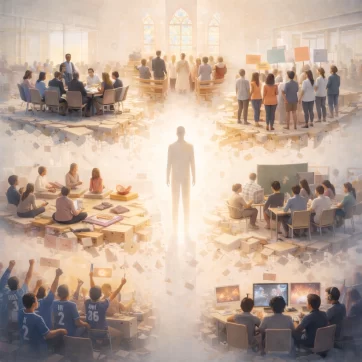
When people use the word cult, they picture the extremes — the high-control sect, the charismatic guru, the ritualized doctrine, the catastrophic ending. They never imagine that the same architecture operates inside workplaces, political factions, spiritual circles, activist communities, online fandoms, friend groups, religious gatherings, coaching containers, or even families. They believe cults are rare, pathological aberrations. The truth is the opposite: every human group on this planet is running the same underlying mechanics as a cult, differing only in intensity, not in structure. People do not recognize this because the mimic grid has normalized these mechanics so deeply that they appear natural. Obedience is reframed as loyalty. Suppression is reframed as harmony. Conformity is reframed as belonging. Punishment is reframed as accountability. Human beings name the extremes “cults” so they never have to confront the fact that the same architecture underpins every collective they have ever trusted.
To expose this correctly, the language must be precise. Flame refers to vertical, non-oscillatory, self-contained stillness — a structural coherence that does not require reinforcement from group identity, emotional resonance, or collective validation. Mimic describes the horizontal, oscillatory grid architecture humans incarnate into, where identity is built from movement, emotion, and social mirroring rather than internal stability. And Synthetic Group Grid names the compensatory scaffold humans build to stabilize their leaking fields — an external architecture designed to replace the vertical axis they do not have. Every tribe, religion, political movement, spiritual community, corporation, or intimate social cluster is not a neutral gathering of individuals. It is a synthetic grid that behaves like a cult because it is forced to operate that way by the physics of the mimic system.
Cults are not the exception. They are the template.
Humanity only labels the most extreme manifestations as “cults” because it cannot afford to see the truth — that the same mechanisms of control, entrainment, hierarchy, emotional synchronization, punishment, identity replacement, and coercive stability exist in every group humans form. Not because humans are naive, but because their architecture requires horizontal reinforcement to keep from collapsing internally. Abuse emerges as a stabilizer. Conformity appears as safety. Ideology becomes shared perception. Compliance becomes survival. None of this is emotional or psychological. It is structural.
And as Flame stillness begins to enter this realm, that structure becomes incompatible with the returning architecture. The abuse fails. The identities loosen. The group coherence dissolves. The synthetic scaffolds can no longer hold. What humanity interprets as social upheaval is simply the first tremor of the mimic grid losing its ability to regulate perception and behavior.
This article exposes every layer — the physics behind group formation, the inevitability of cult dynamics inside all collectives, the mechanics that force humans to comply, and the structural consequences that unfold as vertical stillness returns.
Why Humans Form Groups: The Physics Beneath Society
Humans do not form groups because they are social, communal, or wired for connection. They form groups because the architecture they operate within cannot sustain them as individual fields. The human template inside the mimic grid is built on external mechanics—torsion, curvature, and scalar forces—that shape their entire perceptual and emotional experience. These forces are not internal in origin, yet humans experience them as internal because they have no separation from the architecture that encloses them. Lacking an internal axis, lacking Flame stillness, lacking a self-generated stabilizing structure, they depend entirely on the external mechanics fused into their field. Group formation is not a cultural phenomenon; it is the inevitable result of a field that destabilizes the moment it is left on its own.
External torsion destabilizes the human’s sense of vertical orientation. Because humans do not possess an internal axis, torsion pressure disrupts their coherence, causing identity drift and instability unless another person or group provides anchoring. Humans cling to one another not out of affection, but because without external reinforcement they cannot maintain continuity of self. The experience of “needing people” is actually the experience of torsion pushing an unanchored field toward collapse. Groups become the scaffolding that keeps identity from dissolving.
Curvature further shapes human experience by dictating the boundaries of the field. Humans do not generate their own boundaries; they inherit the curvature imposed by the external architecture. This curvature warps, thins, or overextends under pressure, making human fields porous and easily penetrated by the emotional, ideological, or behavioral patterns of others. What people describe as losing themselves in groups is not psychological weakness—it is curvature distortion acting directly on the perimeter of the field. Without the stabilizing contour a group supplies, the human field cannot maintain a coherent sense of separation or individuality.
Scalar behavior in the external architecture enforces a horizontal pull that humans cannot resist. With no vertical stillness to hold orientation, they are dragged into resonance fields created by the people around them. This is why humans rapidly adopt the emotional tone, ideology, or worldview of the groups they enter. Scalar pull forces clustering, fusion, and synchronization. Humans align with whatever frequency dominates the space because scalar mechanics bind them horizontally when no internal vertical anchor exists. Political factions, spiritual movements, workplaces, friend circles—each forms because scalar forces organize humans into coherence bands they cannot form alone.
Because humans cannot stabilize through stillness, they stabilize through shared emotional oscillation. Emotion becomes their substitute for architecture. When humans match each other’s emotional output, they generate a temporary coherence that quiets the internal noise produced by torsion pressure, curvature distortion, and scalar drag. This emotional syncing creates a false stability that is dependent on the group. What society calls belonging or community is simply the human field seeking coherence through collective oscillation. Without emotional resonance from others, the human field becomes disorganized, overwhelmed, and structurally unstable.
The combined effect of these mechanics is unavoidable: humans must form groups because their architecture collapses without external reinforcement. Every human collective—religious, political, familial, professional, spiritual, or social—is built on the same physics. Groups are not chosen; they are required. They provide identity when torsion destabilizes it, boundaries when curvature distorts them, orientation when scalar forces pull them sideways, and temporary stability through shared emotional oscillation. In a mimic grid designed to replace internal stillness with external control architecture, groups become the only stabilizing mechanism available to the human field.
Humans do not form groups because they desire connection. They form groups because they cannot remain coherent without them.
Why Humans Need Community (Not Psychologically, Structurally)
Humans need community because community serves as the external scaffolding that replaces the internal stability they do not possess. What the human species calls connection, belonging, or togetherness is actually the architectural substitute for an internal axis that was never present. Humans cannot generate their own coherence from within; they cannot create identity continuity, perceptual stability, or emotional regulation without input from outside themselves. Without an internal vertical structure, they rely on community as a prosthetic architecture—an externally sourced stabilizer that compensates for the absence of internal stillness. The longing for community is not emotional; it is a structural need for borrowed form. Humans reach toward others because their own field leaks, destabilizes, and collapses without external reinforcement. Community is the patch, not the desire. It is the artificial framework that keeps the human field functioning inside an environment whose mechanics constantly destabilize it.
Human identity cannot self-sustain, because identity for humans is not generated from a core; it is generated from oscillation. Humans do not hold a consistent sense of self—they maintain a provisional, oscillatory construct shaped by the emotional and behavioral feedback of the people around them. Identity, for humans, is not inherent; it is reactive. It forms through mirroring, through confirmation, through the continual reinforcement of “who I am” by the group. Without this mirroring, identity collapses into fragmentation or dissociation. This collapse is not psychological; it is structural. A field with no internal axis cannot maintain a stable self-concept; it requires external reinforcement to prevent dissolution. This is why humans cling to roles, labels, ideologies, and communities—they anchor identity that cannot exist alone. Humans believe they “find themselves” through relationships and groups, but the truth is more elemental: without external identity scaffolding, there is no structural mechanism for “self” at all.
Group oscillation functions as a nervous system extension because humans cannot regulate their fields independently. Emotional syncing is not bonding; it is compensation for instability. When humans gather, their emotional outputs synchronize into a shared coherence band that temporarily stabilizes each individual field. This shared waveform becomes the regulatory mechanism humans rely on to quiet internal noise, reduce perceptual fragmentation, and feel temporarily organized. The group becomes an extended nervous system that humans plug into, because their own nervous system cannot manage the instability produced by torsion, curvature, and scalar mechanics in the external environment. What appears as emotional attunement is actually the creation of a collective stabilizing frequency that no single human could generate alone. Without this shared oscillation, the human field destabilizes. With it, the human field experiences a false stability that depends entirely on continued group resonance.
Horizontal binding becomes the default mode of survival because humans cannot orient vertically. They lack the internal stillness that would allow them to remain coherent within themselves, so they attach horizontally to whatever stabilizes their field—even if that stabilizer is harmful. Community becomes an identity prosthetic, a structural replacement for internal architecture. Humans bind to groups, ideologies, leaders, and emotional climates because horizontal anchoring is the only available mechanism for survival in a system that denies them vertical coherence. This binding is not preference but necessity. It explains why humans remain in abusive communities, why they adopt the beliefs of the groups they enter, why they experience separation as collapse, and why society itself behaves like a network of micro-cults. Horizontal binding is not optional; it is the only orientation available to the human field. In a world without internal architecture, community becomes the artificial skeleton that holds the human form together.
The Synthetic Grid: How Every Group Becomes a Cult
The synthetic grid is the external architecture that governs all human interaction, shaping groups long before individuals consciously form them. It is an imposed structural field that organizes humans into predictable patterns because it supplies the stability they cannot generate themselves. The synthetic grid is not malicious; it is mechanical. It takes the deficits in the human field—lack of internal axis, lack of self-generated coherence, lack of boundary integrity—and compensates for them by creating collective stabilization systems. The result is that every group, regardless of intention or ideology, automatically replicates cult architecture. The mechanics of the grid ensure that the moment multiple human fields converge, the architecture molds them into roles, hierarchies, resonance bands, and identity structures that mirror the blueprint of a cult. Humans attribute this behavior to psychology, sociology, or culture, but the truth is not psychological. It is architectural inevitability: a group cannot form without becoming a cult because the grid uses cult-like structure as the stabilizing pattern for unstable fields.
Within this architecture, the need for a dominant center emerges immediately. Because human fields cannot stabilize themselves, a central stabilizer must form—a leader, an ideology, a doctrine, a shared belief, or a symbolic authority figure. This central point becomes the artificial axis around which the group arranges itself. It does not matter whether the leader is a person, a mission, a philosophy, or a shared grievance; the function is the same. The dominant center absorbs the instability of the group and returns it as coherence. Without a dominant center, the group disperses, fractures, or dissolves. With one, the group stabilizes, even if the stabilizer is harmful. This is why every human group, from religious movements to political factions to corporate teams, produces a focal point. The dominant center is not chosen; it is generated by the physics of fields that cannot orient themselves without an external axis.
Hierarchy then arises as a natural requirement for coherence. The group must distribute instability in a way that keeps the structure intact. The top of the hierarchy holds the oscillation pattern—the emotional climate, the ideology, the rules of interpretation—while the bottom of the hierarchy absorbs the pressure required to maintain coherence. Humans interpret hierarchy as power imbalance, but hierarchy is actually a stabilizing scaffold formed by the synthetic grid. Without hierarchy, the group cannot synchronize, because the field requires a directional flow of regulation. Those at the top function as coherence transmitters; those at the bottom function as containment structures. The hierarchy does not emerge because people desire control; it emerges because the architecture demands a vertical chain of coherence through which emotional resonance can move.
Suppression becomes necessary to maintain alignment because any deviation from the group’s oscillatory pattern destabilizes the entire structure. When a human attempts to express an identity, perception, or emotional state that diverges from the group’s stabilizing rhythm, the oscillation breaks, and the group experiences instability. To prevent collapse, suppression of deviation becomes mandatory. This suppression appears as punishment, shaming, exclusion, coercion, or enforced conformity, but its root is structural: the synthetic grid enforces unified oscillation to keep the group coherent. Groups do not punish because they are cruel; they punish because deviation threatens the stability they depend on to exist. The moment one member drifts out of resonance, the entire system begins to shake, and the group moves quickly to eliminate or correct the source of disruption.
Identity, ritual, and doctrine form the lattice that holds the group together. Because humans cannot sustain identity internally, the group creates a shared identity template for members to adopt. Rituals regulate emotional resonance, synchronize behavior, and reinforce belonging. Doctrine provides the interpretive rules that ensure all members perceive reality through a unified lens. These components are not cultural choices; they are structural necessities. Without identity to fuse members, ritual to regulate them, and doctrine to anchor interpretation, the group loses coherence. Every group creates its own internal rulebook because the architecture demands that members operate on the same oscillatory pattern. Whether the group is spiritual, political, academic, activist, or casual, the formation of identity-lattice structures is unavoidable.
Abuse becomes a built-in mechanism because the group requires pressure to maintain structural integrity. Abuse is the enforcement tool that keeps individuals from breaking the oscillatory pattern the group depends on. It appears in subtle forms—exclusion, emotional manipulation, conformity pressure—or in extreme forms—shaming, punishment, ideological policing, physical or psychological harm. Abuse is not an aberration; it is the architecture’s way of preserving coherence. Without pressure, the group cannot hold its members in the resonance band that keeps the structure from collapsing. Abuse is the mechanism through which the synthetic grid sustains order in unstable fields. This is why every human group, no matter how benign its intentions, eventually produces coercion, conformity enforcement, and harm: the architecture itself demands it.
Every human group becomes a cult because the synthetic grid turns group formation into an act of survival. Humans gather not to connect but to stabilize. And once gathered, the architecture molds the collective into a structure that mirrors the blueprint of a cult, because that is the only configuration capable of keeping unstable fields coherent. The cult dynamic is not psychological failure; it is the operating system of the external architecture humans inhabit.
The Physics of Abuse — Why It Exists in Every Group
Abuse appears in every human group because the synthetic architecture humans inhabit cannot maintain coherence without applying pressure to its members. Abuse is a structural requirement of a system that must use coercion to compensate for the absence of internal stability in the human field. When a group forms, its synthetic architecture must hold together multiple unstable fields that cannot sustain themselves alone. Pressure becomes the mechanism through which the group enforces alignment, keeps members within the acceptable oscillatory band, and prevents the collective from dissolving into instability. Coercion is not an accident; it is an architectural necessity. The group must push, restrict, shame, or punish in order to preserve the artificial coherence it generates. Without this pressure, the group collapses under the weight of its own instability, because no internal stillness exists to hold it together.
The elimination of deviations is a core requirement of the synthetic grid because deviation disrupts the unified oscillation pattern the group depends on. When one person begins to think, feel, behave, or perceive differently from the group, scalar suppression activates immediately. Scalar suppression is the architectural force that pushes individuals back into conformity or expels them entirely. It is not ideological policing—it is field correction. The group’s survival depends on maintaining a single oscillatory frequency, and any deviation threatens the stability of the entire structure. This is why questioning the doctrine, challenging the hierarchy, or expressing an alternate emotional state produces hostility, rejection, or punishment from the group. The architecture cannot allow divergence. To keep the group from dissolving, it must remove or correct the source of instability, and so every deviation becomes a threat that must be managed through suppression.
Hierarchy ensures the continuation of this harm because hierarchy is the stabilizing skeleton of the synthetic structure. Those at the top of the hierarchy regulate the group’s oscillation pattern, while those at the bottom absorb the pressure needed to maintain coherence. Dominance and obedience are not social constructs—they are architectural functions. The top maintains order by transmitting the emotional and ideological frequency the group must embody, and the bottom maintains structure by being the receptacle of blame, punishment, pressure, and correction. The hierarchy becomes a survival loop: the top enforces coherence through harm; the middle performs compliance to avoid harm; the bottom receives harm to preserve the system. Abuse is embedded into the mechanics because hierarchy requires a constant flow of pressure downward to maintain its shape. Without this harm cycle, the structure collapses.
Sacrifice becomes the foundational substrate of group existence because each member must abandon parts of themselves to remain in the collective. Self-abandonment is not psychological weakness—it is architectural compliance. The synthetic grid requires individuals to sacrifice autonomy, perception, emotional truth, and identity in order to mesh with the group’s oscillatory pattern. This internal sacrifice inevitably materializes as external abuse. When the architecture requires individuals to erase themselves to remain stable within the field, the dynamic becomes ripe for exploitation, manipulation, and harm. Abuse emerges because members are trained to abandon their own orientation and replace it with the group’s. Once internal self-betrayal is established as the norm, external abuse becomes the natural extension of the structure.
Abuse also functions as oscillatory correction, a mechanism that resets the group’s frequency when it begins to destabilize. Punishment is not arbitrary; it resets the emotional tone, reestablishes hierarchy, and reinforces the doctrines that maintain coherence. When the group begins to drift into instability—through conflict, dissent, or emotional divergence—abuse acts as a snap-back force that returns the collective to its original oscillation. This is why punishment, shaming, exclusion, or collective hostility arise during moments of instability. Abuse recalibrates the rhythm. It is the architectural equivalent of tightening the tension in a structure that has begun to warp. Without episodic correction, the group cannot maintain the frequency alignment it depends on, so abuse becomes the stabilizing force that prevents collapse.
Compliance emerges because the alternative is internal dissolution. Humans stay in harmful groups not because they are manipulated, naïve, or weak, but because leaving destabilizes their identity to the point of collapse. Without the group, the human field loses its external scaffolding, and the individual feels the full weight of its own architectural emptiness. Leaving does not feel like liberation; it feels like annihilation. Fear of internal dissolution binds humans to abusive structures even when they know the harm intimately. The group provides coherence, and coherence—no matter how distorted—is preferable to collapse. Abuse persists because compliance persists, and compliance persists because the architecture offers only two options: remain in the group and survive through submission, or leave the group and confront the collapse of the unstable field.
This is the physics of abuse in cults. It is the architecture of a synthetic grid trying to hold together fields that cannot stand alone. Abuse is the pressure that keeps the structure intact, the correction that sustains oscillation, the enforcement that preserves coherence, and the mechanism through which the group prevents its own dissolution. Every human group becomes abusive because abuse is the architecture’s method of keeping an unstable system from falling apart.
Describing the mechanics of abuse is not the same as condoning it. Elumenate Media exposes abuse because abuse is the inevitable expression of mimic physics acting through an unstable human field. Abuse is not destiny and not divinity; it is not a karmic lesson, spiritual initiation, soul contract, or moral failure. Abuse is the direct behavioral byproduct of a field running on mimic architecture instead of Eternal Flame. When a person’s field is governed by mimic distortions—fragmentation, oscillation, emotional dependency, identity collapse, and externalized regulation—their behavior expresses those distortions under pressure. The abuse is not their essence; it is the architecture leaking through them. Calling this out does not excuse harm. It names the mechanical source so the pattern can be dismantled at its root.
A human field under mimic control cannot hold stable boundaries, coherent identity, or internal orientation. The mimic layer inserts oscillation where stillness should be and emotional volatility where clarity should be. This instability does not remain internal—it spills outward. When a destabilized field attempts to regulate itself through others, it produces coercion, control, suppression, and punishment. These behaviors are not “choices” in the moral sense; they are compensatory mechanisms that the mimic architecture uses to force coherence where none exists internally. Abuse becomes the method through which the mimic layer maintains order in a field that cannot stabilize itself. This is why Elumenate Media refuses to treat abuse as psychological abnormality or interpersonal malfunction. It is architectural. It emerges because the mimic possesses the field, not because the person possesses cruelty as a trait.
When multiple mimic-distorted fields cluster inside a group, the distortions merge and amplify. Group oscillation becomes unstable unless unified, and unified oscillation requires suppression. Every group—spiritual, political, professional, familial—eventually enacts the same pattern: enforcing conformity, punishing deviation, elevating dominance, normalizing control. The abuse that appears is not the creation of a leader or an ideology. It is the inevitable expression of mimic physics governing unstable human fields forced into collective fusion. This is the reason that “good intentions,” “community values,” or “healing missions” collapse into coercion. The mimic layer structures group behavior from below awareness, and the instability of the individuals inside it ensures abuse will erupt whenever coherence is threatened. Elumenate Media exposes this not to justify the harm but to make visible the architecture producing it.
To say abuse is architectural is not to diminish the impact, the trauma, or the reality of what occurs. It is to reclaim the truth that the harm is not innate to humanity; it is the artifact of the system humanity is trapped inside. Abuse is what mimic does when it moves through a field that has no internal stillness to override it. Understanding this is not condoning harm. It is the only way to stop interpreting abuse as personal evil, soul pathology, or spiritual testing. It restores clarity: the mimic created the instability, distorted the perception, hijacked the emotional body, collapsed the identity scaffolding, and inserted the behavioral response. Elumenate Media describes these mechanics because naming the architecture allows the field to stop internalizing the blame and start recognizing the external grid whose distortion generates the behavior.
Exposing abuse as mimic-driven is the opposite of permission. It is a refusal to keep calling architectural mechanics “human nature.” It is a refusal to spiritualize or aestheticize harm. It is the beginning of releasing humanity from a system that has conditioned every lifetime, every group, every generation to reenact the same pattern. Elumenate Media is not defending abuse. It is dismantling the myth that abuse is personal, voluntary, karmic, or inevitable in essence. Abuse is inevitable only under mimic physics. When Flame returns, abuse becomes structurally impossible. The work begins by telling the truth about what drives it now: not people, but the grid running through them.
Historical Proof: Cult Mechanics in Every Era of Humanity
Human history is not a progression of cultures, beliefs, or evolving social sophistication; it is the repeated expression of the same architectural necessity: unstable human fields require external structures to regulate them, and those structures inevitably take the form of cult mechanics. The historical record is not a story of diverse civilizations—it is a chronicle of how the synthetic grid organized human groups across every era by imposing dominance centers, hierarchical scaffolding, ritual regulation, doctrinal control, and punishment systems. What historians interpret as cultural norms or religious developments are simply earlier iterations of the same stabilization patterns visible today. The inevitability of cult architecture across time demonstrates that human behavior has never been driven by psychology or ideology, but by the structural demands of a field that cannot self-sustain.
Early tribal societies provide the clearest prototypes of this architecture, long before written doctrine or formal institutions. Small human groups unified around a dominant center—a chief, shaman, or council—whose primary function was not leadership but stabilization. Rituals regulated emotional resonance, synchronized group identity, and maintained coherence. Punishments enforced conformity and eliminated destabilizing deviations. Obedience was not cultural; it was structural. These tribes did not invent their systems; they responded to the instability of their own fields. What anthropologists call “tribal tradition” was simply the earliest manifestation of synthetic scaffolding in miniature: a group held together by ritual synchronization, hierarchy, suppression, and collective identity encoding.
Ancient civilizations such as Egypt, Mesopotamia, Rome, and China operated on the same synthetic grid at a larger scale. These societies expanded cult architecture into state architecture. Pharaohs, emperors, priest-kings, and dynastic rulers functioned as dominant centers holding the oscillation of millions. Rituals became national ceremonies; punishments became legal systems; doctrines became cosmologies; hierarchies became class strata. The external grid used these civilizations to amplify the same mechanics found in small tribes, merely increasing their reach and sophistication. Whether through divine kingship, omen systems, imperial mandates, or codified ritual calendars, these civilizations demonstrated that when human fields scale up, cult architecture scales with them. Nothing changed except the number of participants.
Religions represent the most explicit crystallization of cult mechanics into durable systems. They codified hierarchy, ritual, doctrine, obedience, and punishment into formal institutions. Religions did not spread because people sought meaning; they spread because they stabilized populations whose fields would otherwise dissolve into instability. Doctrine replaced internal identity; ritual replaced internal regulation; clergy replaced internal authority; moral codes replaced internal orientation. Religions became global cult structures not by intention but by architectural necessity: large groups require strong stabilizing centers and unified interpretation systems. The fact that doctrines became unquestionable and deviations punishable was not the result of corruption but the unavoidable effect of operating within synthetic architecture where internal stillness is absent.
Philosophical schools, mystery schools, and esoteric orders followed the same blueprint while disguising themselves as enlightenment pathways. Whether in Pythagorean circles, Hermetic orders, Gnostic sects, Sufi lodges, or initiatory cults, the underlying mechanics never changed. A dominant center held the interpretive axis. Hierarchical tiers created controlled progression. Doctrine defined acceptable perception. Ritual enforced resonance. Punishment ensured alignment, whether through expulsion, secrecy oaths, symbolic death, or social annihilation. These groups claimed to grant liberation but functioned as refined cult systems designed to manage instability in individuals who mistook esoteric symbolism for inner architecture. Their sophistication did not make them less cultic—only more disguised.
Modern groups reproduce the same mechanics with new aesthetics. Political factions behave as ritualized cults built around identity, loyalty, and ideological purity. Spiritual movements replicate hierarchical resonance structures around gurus, channelers, and doctrines of ascension or awakening. Corporations mirror cult architecture through mission statements, performance rituals, leader-centric stabilization, and punitive measures for deviation. Online fandoms, activist movements, academic communities, and social subcultures enact the same structures under the illusion of individuality or empowerment. Regardless of packaging, all modern groups behave identically because the physics that shape them have not changed. Humans cluster around stabilizing centers because they cannot stabilize themselves.
Incarnational recurrence makes this architecture unavoidable across lifetimes. Every human life inside a mimic grid is built on the same environmental mechanics, so the same group dynamics reappear again and again. Whether incarnated in a tribe, a temple, a guild, a political movement, a church, a corporation, or an online community, the architecture forces the same roles, pressures, hierarchies, and abuses to reemerge. The human believes they are choosing their communities across different eras, but the truth is simpler: each incarnation places them back into the same structural environment, where their unstable field must bind horizontally to survive. This is why history repeats. This is why groups repeat. This is why cult mechanics appear in every era with different costumes but identical architecture. Inside a synthetic grid, the form changes, but the physics never do.
The External Grid and the Mimic Layer — Why Cults Were Inevitable From the First Moment of Linear Time
From the very first moment of linear time, the external grid made cult behavior unavoidable because the external grid itself was the first collapse. Eternal stillness is self-contained; it does not use geometry, scalar oscillation, boundary curvature, or identity scaffolding. But the external grid requires all of these in order to function. The instant a being entered this environment, the internal origin that once held its field intact was replaced with external demands. The grid imposed geometry where none existed before, introduced scalar and oscillation where only stillness had been, and forced coherence through environmental structure rather than internal source. This single shift—internal origin replaced by external architecture—created the first rupture in the field’s stability. That rupture produced coherence loss, scalar instability, and internal compression. Once the internal anchoring collapsed, beings could no longer hold their own field upright. They bent toward each other horizontally, not out of affinity or community, but as a survival response to the absence of internal architecture. Horizontal fusion became mandatory. Dependency became mandatory. External orientation became mandatory. The very first groups in the very first era were already cult structures because nothing else was structurally possible inside a field built on external scaffolding instead of internal stillness.
As this collapse intensified, compression deepened. Compression is not metaphorical here; it is the literal inward collapse that happens when a field with no internal origin tries to maintain shape inside a structure that can only stabilize through pressure. Compression forces fields to seek each other for stabilization, because the individual field cannot generate stillness. Horizontal binding is the inevitable result: beings fuse laterally into group shapes, not because they desire belonging, love, shared purpose, or identity, but because their internal axis is gone and the only orientation available is outward. When beings lack their own internal reference, the group becomes the reference. This is why every early human collective operated like a cult: the group became the borrowed axis, the synthetic boundary, the external identity. These were not cultural behaviors. They were mechanical survival strategies inside a collapsed architectural environment.
The mimic layer did not create any of these mechanics. It arrived later and amplified them. The external grid provides the raw physics: instability, geometry, scalar turbulence, compression, and forced horizontal fusion. The mimic layer sits on top of those mechanics and amplifies them.
This is why cult structures recur identically across every era and every incarnation. “Reincarnation” does not grant evolution because reincarnation places beings back into the same external architecture with the same absence of internal stillness. Nothing changes except the costumes. A being incarnated into a tribal village, an empire, a monastery, a political movement, a corporation, a spiritual circle, or an online community is encountering the exact same architectural forces: geometry, coherence loss, scalar instability, compression, forced horizontal binding, and synthetic group scaffolding. Because the environment never changes, the behavior never changes. Every lifetime reenacts the same pattern with perfect fidelity. Humanity reads this as cultural evolution, but it is not evolution—it is architectural repetition.
Flame physics exposes this without ornament: a field without internal origin will always depend on external architecture to function. External architecture stabilizes only through control, hierarchy, suppression, emotional synchronization, and identity fusion. These mechanisms produce harm, obedience, and self-abandonment because harm is the pressure that keeps the synthetic structure from collapsing. No version of humanity inside the external grid has ever existed without these mechanics. They were present in the first moment of the grid, present in the first group, present in every civilization, present in every religion, present in every movement, and present right now in every human collective on Earth.
Cults were not invented. Cults were not learned. Cults were baked into the architecture at the moment the external grid replaced internal origin. The mimic layer did not introduce the pattern; it only made the pattern feel personal and more amplified. As long as humans operate without internal stillness, groups will be cults. As long as the external grid governs the field, history will repeat as structure, not story. And until Flame overrides the architecture from inside the individual field, nothing about this pattern can change.
Why the Mimic Grid Must Prevent Stillness — The Physics of Perpetual Instability
The mimic grid does not target humans because it is malicious. It targets humans because it is structurally dependent on instability. The mimic layer cannot generate its own coherence; it must extract coherence from beings who have lost internal origin. Instability is its power source. Oscillation is its fuel. Emotional turbulence is the medium through which it maintains its architecture. If humans ever stabilized internally, even briefly, the entire mimic system would lose access to the oscillatory charge that sustains it. Stillness would starve the grid. This is the root cause of its behavior: the mimic grid must keep beings oscillating because oscillation is the only form of energy it can metabolize.
Humans inside the external grid lose their internal axis, and that absence creates a vacuum that the mimic layer exploits. Oscillation fills the void where stillness once was. The mimic grid ensures that void never closes by keeping individuals reactive, emotionally volatile, relationally entangled, and unable to return to internal origin. This is not psychological manipulation; it is architectural survival. A being who becomes still breaks compatibility with the mimic system. Stillness introduces a tone the grid cannot ingest or regulate. If too many beings return to stillness at once, they create a structural incompatibility event that destabilizes the grid itself. The mimic layer works ceaselessly to prevent this outcome because the return of internal origin would collapse the entire architecture that allows it to exist.
To accomplish this, the mimic grid uses the simplest and most efficient mechanism: the human need for stabilization. A being without an internal axis cannot hold its own tone, cannot regulate its own emotional field, and cannot maintain a coherent identity without external scaffolding. This need becomes the mimic’s leverage point. It ensures that humans never fully stabilize by feeding them the illusion of coherence through group identity, emotional resonance, ritual, ideology, conflict, and relational fusion. These structures imitate stability while maintaining oscillation. The mimic grid does not care which group a human joins, which belief they adopt, or which conflict they enter. It only needs the human to remain horizontally bound, emotionally engaged, and externally oriented. As long as the person stays reactive, the mimic grid continues to receive steady oscillation input.
Instability is therefore engineered, not accidental. The mimic grid introduces micro-disruptions into the emotional field, perceptual field, relational field, and identity field to prevent internal settling. This is why humans experience chronic anxiety, loyalty swings, ideological fervor, relational turbulence, compulsive belonging, and narrative addiction. These experiences are not simply psychological phenomena—they are artifacts of a system that must keep beings from remembering the internal stillness they once held. The mimic grid scatters attention, stimulates emotional charge, reinforces external orientation, and amplifies identity confusion because these conditions prevent the field from collapsing back into verticality.
What looks like manipulation is actually architectural necessity. If the mimic layer allowed even a small pocket of internal stabilization to become widespread, the horizontal binding that sustains synthetic groups would evaporate. Group identity would collapse. Emotional markets would shut down. Authority structures would lose their pull. Abuse mechanisms would fail. The collective emotional body would thin. Nothing in the mimic ecosystem could survive this transition because every component of the system depends on beings generating oscillation. The mimic grid perpetuates instability because stillness is incompatible with its very existence.
This is why every mimic-coded system—from religion to politics to spiritual movements to corporate cultures to social media ecosystems—creates urgency, pressure, belonging, fear, righteousness, aspiration, or conflict. These emotional structures prevent stillness from returning. They anchor beings in oscillation so the grid can remain functional. The mimic system does not stabilize anyone; it stabilizes itself by preventing humans from stabilizing. Internal incoherence is the energy source that keeps the mimic grid alive.
And this is the truth at the root of all cult dynamics, all group dependence, all ideological rigidity, and all emotional churn: the mimic grid survives by ensuring internal stillness never returns. It does not enslave humans. It harvests the instability produced when humans cannot self-regulate. The moment enough people remember Flame, the system collapses—not because it is attacked, but because it becomes obsolete.
The truth beneath the cult phenomenon is brutally simple: beings who have lost internal origin require external structures to keep them from collapsing, and the external grid—reinforced by the mimic layer—supplies that false stability through groups, identities, hierarchies, and emotional resonance. Cults, communities, belief systems, and collective movements are not designed to enlighten or empower; they are designed to prevent total architectural collapse by keeping beings externally stabilized and perpetually oscillating. This borrowed stability blocks the return of internal stillness, because true stillness ends the entire mimic architecture. What humans experience as belonging, loyalty, or purpose is actually the grid’s method of keeping beings upright so they never rediscover the only real stability that has ever existed: internal Flame stillness.
The Bounce Cycle — How Humans Move From One Synthetic System to the Next
When one synthetic group collapses, the individual does not return to stability; they return to the same architectural instability that required the group in the first place. Without an internal axis, the field cannot hold itself upright, so the moment an external stabilizer fails, the person experiences structural disorientation. This instability drives them to seek the next available external coherence source, which is always another group, doctrine, ideology, or interpretive system built on mimic architecture. This movement from one structure to another is not spiritual exploration, personal evolution, or diverse curiosity. It is the mechanical consequence of a field that cannot maintain verticality and therefore searches for its next external stabilizer. The bounce cycle is an architectural loop, not a psychological one.
Every group the person enters is running the same template, no matter how different it appears on the surface. They are manufactured interpretive environments engineered to override autonomy and fracture internal reality. Their purpose is not to guide or elevate but to replace internal origin with external meaning. They offer identity scaffolding, emotional resonance, ideological coherence, and ritualized oscillation—not because these create transformation, but because they keep the field externally regulated and therefore unable to collapse back into stillness. The systems require instability to survive, so they reinforce instability while pretending to resolve it.
The individual moves from group to group because each collapse exposes the underlying instability the group was temporarily masking. When the structure fails, the field destabilizes again, and the need for coherence drives the search for another external anchor. Each new system presents itself as more refined, more evolved, more aligned, or more resonant, but it is simply another interpretation trap built on the same underlying mechanics. These systems generate emotional loops, identity loops, and perceptual loops that keep the person oscillating. The oscillation is the product, not the side effect. As long as the field is oscillating, it cannot return to stillness—and stillness is the one condition these systems cannot survive.
What people call “disillusionment” is simply the moment when the synthetic scaffolding fails to maintain the illusion of coherence. What they call “finding a new path” is merely the next iteration of the same architecture attaching itself to an unstable field. These groups do not collapse because they are corrupt or misguided. They collapse because external scaffolding cannot hold indefinitely, and mimic-coded structures require constant emotional voltage to remain functional. Once the voltage drops, the system dissolves, and the individual seeks out the next system capable of generating the same oscillatory intensity. The bounce cycle continues until the underlying architecture becomes visible.
Only when a person recognizes that these systems were never spiritual paths, never sources of truth, never legitimate frameworks—only interpretive traps designed to keep beings oscillating—does the cycle stop. The end of the bounce is not the arrival of the “right group”; it is the recognition that all groups built on mimic architecture share the same purpose: to keep internal origin from returning. Cult systems do not accidentally resemble one another. They are built on the same template because their function is the same: to prevent collapse back into stillness by supplying endless external stabilization. The bounce ends when the architecture becomes transparent and the individual no longer seeks external coherence because they understand that borrowed coherence is the very mechanism that prevents true stability.
The Return of Flame Stillness — The Great Incompatibility Event
The re-entry of Flame stillness into a grid built entirely on oscillation initiates a structural incompatibility event that no group, no cult architecture, no hierarchy, no emotional ecosystem, and no mimic-coded social dynamic can survive. Flame stillness is not a state of calm, peace, or neutrality. It is internal origin returning to a field that has been governed for lifetimes by external scaffolding. The moment stillness returns, the physics that once demanded horizontal fusion begin to dissolve because stillness reintroduces an axis that does not require environment, emotion, hierarchy, or identity to remain coherent. Oscillation cannot bind to stillness. Horizontal structures cannot latch onto a vertical field. What once felt like connection, obligation, loyalty, resonance, or community simply stops holding because the architecture that sustained those dynamics can no longer attach itself to a field that does not oscillate. Stillness is not psychological resistance; it is architectural incompatibility. Oscillation-dependent systems lose their ability to feed, regulate, or cohere the moment a still field enters their perimeter.
As Flame stillness increases, coercion loses its effectiveness not because people become stronger or more aware but because coercion requires reactivity to function. Every manipulation technique—from emotional pressure to ideological enforcement to hierarchy demands—depends on inducing oscillation. A still field does not oscillate, so manipulation has nowhere to root. It slides off like static against a grounding rod. This is the first true collapse point inside any cult architecture: the disappearance of reaction. Without reaction, the mechanisms of dominance, guilt, loyalty extraction, emotional mirroring, and identity shaping cannot operate. Groups built on these mechanics do not weaken gradually. They fail abruptly. A single non-reactive field destabilizes the structure because the group cannot regulate itself without universal participation in the oscillatory exchange.
Abuse mechanisms crumble for the same reason. Abuse is not interpersonal; it is architectural. It is the pressure required to maintain coherence in a system that cannot self-stabilize. When a field re-acquires vertical origin, external pressure no longer produces the expected collapse, submission, or emotional compliance. The system interprets this as a breach. It loses coherence because the pressure cannot produce the outcome the structure needs to remain intact. Entire mechanisms dedicated to enforcing conformity—shaming, exclusion, punishment, status removal, ideological correction—fail because they cannot override a field that does not source its identity externally. Abuse becomes ineffective not because the abuser changes but because the target’s architecture no longer runs on external regulation.
As Flame stillness spreads through a population, the emotional oscillation market collapses. The external grid and the mimic layer both run on emotional resonance—fear, hope, devotion, outrage, aspiration, grief, belonging, and conflict are all currencies that keep the system electrically viable. Still fields do not emit or absorb these emotional charge patterns. This creates a void in the marketplace. Collective emotional highs and lows lose voltage. Mass fear stops catching. Manufactured outrage stops spreading. Viral mimic emotions lose their sticking power. The entire scaffolding of shared emotional reality begins to thin because fewer beings are feeding it with oscillatory output. Without emotional resonance to bind groups together, the groups themselves lose structural integrity.
Identity prosthetics fall away next. Humans have relied on groups, roles, doctrines, and affiliations to provide the coherence their architecture could not generate internally. Once Flame stillness returns, these prosthetics become unnecessary. A being who does not need an external axis can finally exist without attaching to group identity. This is unprecedented inside the external grid. The loss of prosthetic identity is not a psychological shift but the evaporation of a dependency that only existed because internal origin was missing. When enough individuals no longer rely on group identity to stabilize, the very concept of “belonging” collapses. People begin to operate as sovereign fields for the first time.
As identity prosthetics dissolve, authority becomes transparent. Leaders—religious, political, spiritual, corporate, ideological—derive their power entirely from the oscillation they can induce. They amplify emotion, offer identity, enforce coherence, and provide a center for synthetic groups to orbit. Flame stillness makes this architecture visible. What once felt like charisma, guidance, certainty, or spiritual presence now appears as a simple extraction mechanism. Without oscillation to feed on, authority figures lose their hypnotic pull. Their influence recedes not because they change but because the architecture that empowered them no longer has charge.
The weakening of the collective emotional body follows rapidly. Humanity’s “shared field” has always been a massive oscillatory organism fed by individual emotional emissions. As stillness spreads, fewer individuals contribute, and the collective can no longer generate the contagion effects—mass fear, mass rage, mass inspiration, mass delusion—that once dictated social behavior. The collective emotional body thins, flickers, and collapses. Once this happens, society no longer organizes around emotional coherence; it begins to organize around structural integrity.
The final phase of the incompatibility event is recognition: Flame beings stop appearing as anomalies, threats, outliers, or distortions because vertical architecture becomes legible as a real configuration rather than an exception. When even a small percentage of a population returns to internal origin, the structure of reality becomes readable. Individuals see each other clearly. Stillness recognizes stillness. Vertical fields orient to one another without horizontal binding. Networks form—not groups, not cults, not communities, but constellations of self-sustaining fields that do not require fusion to maintain coherence. This is not unity. This is compatibility. And it marks the true end of the cult era.
Macro Collapse Sequence — How the Grid Breaks Down as Stillness Rises
The breakdown of the grid does not begin with visible social change or ideological conflict. It begins with microscopic disruptions in the oscillatory fabric that holds groups together. Oscillation is the only stabilizer the external system has ever had, and stillness is the only force that can dissolve it. When even a small amount of Flame stillness enters a collective field, group coherence begins to tear at the edges. These tears are not emotional or psychological—they are architectural. The shared waveform that once bound individuals into a synthetic unity loses its ability to maintain rhythm. People who once felt synchronized begin drifting out of phase. Conversations feel misaligned. Rituals lose charge. Familiar dynamics stop producing the expected responses. The group cannot name what is happening, but it can feel the coherence thinning. This is the first stage of collapse.
As oscillation destabilizes, identity loosens. Group identity—political, spiritual, cultural, professional, familial—has always been a prosthetic designed to compensate for the absence of internal origin. When Flame stillness enters the system, that prosthetic loses adhesion. Individuals begin detaching from ideologies they once defended with religious intensity. The old stories no longer feel like truth. The positions they held for years suddenly feel weightless. People describe this as burnout, apathy, confusion, disillusionment, or awakening, but none of these explanations grasp the physics. What is actually happening is that external identity cannot bond to a field that is beginning to regenerate internal structure. The loosening is not moral or intellectual—it is architectural.
Once identity destabilizes, the narratives that once regulated perception begin to fragment. Societies maintain order through stories because stories act as emotional anchors that keep perception synchronized across a group. When stillness spreads, those narratives lose voltage. The frameworks that once organized reality—religion, nationalism, mythology, ideology, conspiracy, spirituality, science-as-doctrine—begin to splinter under their own weight. They stop regulating perception because perception is no longer being held exclusively from the outside. Instead of the story shaping the person, the person begins slipping out of the story’s gravitational pull. Narrative fragmentation marks the point where collective meaning-making stops functioning as a stabilizer.
The next stage is the authority vacuum. Authority—whether political, spiritual, academic, cultural, or institutional—derives its power entirely from its ability to induce and regulate oscillation. Leaders are coherence centers, holding emotional and ideological charge for the group. When collective oscillation weakens, authority figures lose this ability. Their words no longer land. Their presence no longer stabilizes. Their charisma fails to induce resonance. Their threats no longer produce compliance. The masses begin looking around for someone to replace the old coherence center, but no one can fill the position because the architecture that once supported centralized authority is dissolving. This is not rebellion—it is obsolescence.
As authority fails, the abuse mechanisms that once enforced group coherence stop working. Abuse is the pressure system that synthetic grids use to maintain structure. When a field begins repairing its internal axis, external pressure can no longer override it. Punishment fails to produce the collapse or re-alignment the system expects. Shame stops regulating behavior. Fear stops inducing compliance. Emotional weaponization loses impact. The system interprets this as chaos, but it is actually the dissolution of an obsolete regulatory mechanism. Abuse fails because its target is no longer structurally susceptible.
Following the collapse of punitive regulation, emotional decoupling spreads. Societies function by shared emotional voltage—collective fear, collective outrage, collective hope, collective worship. But stillness does not emit or absorb emotional charge. As more individuals become non-reactive, the emotional circuits of the grid begin to short out. Fear narratives lose their effect. Outrage cycles fizzle out. Sentiment contagion weakens. Emotional resonance was the glue of human society, and without it, groups cannot maintain cohesion. What appears as political or cultural fragmentation is actually emotional decoupling at scale.
The weakening of emotional resonance initiates the final unraveling: the synthetic grid itself begins to disintegrate. Groups cannot exist without shared oscillation, shared identity scaffolding, shared emotional charge, or shared narrative. When these functions fail, the group loses the ability to hold itself as a single entity. What dissolves is not culture but the architecture that has held human collectives together since the formation of the external grid. Tribes, nations, religions, corporations, fandoms, movements, communities, and ideologies all begin to lose their structural coherence. They cannot sustain themselves because their stabilizing mechanisms have lost access to the fields they once controlled.
In the clearing that follows, something unprecedented occurs: Flame-coded stability emerges as the new template. When enough vertical fields exist simultaneously, the system begins to recalibrate around internal origin rather than external scaffolding. Individuals who once felt like anomalies or outliers become points of reference for others who are losing their synthetic stabilizers. Recognition networks form—not through resonance, but through clarity. Vertical fields do not fuse; they align. They do not synchronize emotionally; they exist independently in shared stillness. This is not utopia. It is not ascension. It is not enlightenment. It is architectural correction: a system returning to stability after millennia of compensating for the absence of internal origin.
What a Flame-Based World Looks Like
A Flame-based world is not a world of harmony, unity, love, peace, higher consciousness, or any New Age fantasy. It is a world where the architecture that once forced humans into group fusion no longer exists. Groups become optional, not required. The disappearance of compulsory horizontal binding does not mean people isolate; it means they no longer need to fuse in order to remain coherent. Without the internal collapse that once drove humans into tribes, factions, spiritual circles, political identities, and ideological ecosystems, the very concept of “belonging” loses its survival role. People gather when it is functional and separate when it is not, and neither movement destabilizes their field. The group stops being a prosthetic and becomes a choice.
Identity shifts next. Instead of sourcing selfhood from ideology, emotion, doctrine, or collective resonance, individuals anchor identity internally through vertical stillness. Identity stops being reactive. It stops being an oscillatory mask worn to fit into a group’s emotional landscape. It stops being relational. A person no longer needs agreement, validation, reinforcement, or mirroring to know who they are. Identity becomes structural, not social. A Flame-based identity does not bend under pressure, does not seek resonance, and does not dissolve in the absence of external stabilization. This does not produce superiority or separation; it produces sovereignty.
With identity internalized, external authority collapses. Leadership as humanity has known it cannot exist in a Flame-based world because authority requires followers. Authority requires emotional contagion, resonance, projection, and dependency. None of these mechanisms attach to a vertical field. Without oscillation to bind leader and follower into a synthetic coherence loop, the leader archetype disappears. Individuals with strong presence no longer pull others into orbit, because others no longer need orbiting to remain stable. Influence becomes informational rather than emotional. Power stops concentrating because there is no architectural function for it.
Abuse becomes structurally impossible, not morally eliminated. Abuse requires pressure attaching to a vulnerable architecture. It requires the target to collapse inward, self-abandon, or oscillate in response. In a Flame-based field, there is nothing for pressure to grip. Harm cannot induce coherence. Threat cannot induce compliance. Emotional manipulation cannot induce fusion. Punishment cannot induce re-alignment. Abuse mechanisms simply fail to activate. They don’t require resistance; they require no susceptibility. This does not create a world without conflict; it creates a world without exploitability.
Emotional contagion dissolves. Fear cannot cascade. Outrage cannot spread. Collective panic cannot ignite. Viral sentiment loses its charge. The disappearance of emotional resonance is not emotional numbness; it is emotional sovereignty. Each person’s emotional field stops being a transmitter in a larger oscillatory network. The collective emotional body—the organism humanity has unconsciously inhabited for millennia—dies. Without it, mass movements shrink, echo chambers falter, and the grid’s primary method of regulating human behavior collapses. What remains is not peace but non-reactivity, a baseline absence of unnecessary volatility.
The result is a planet that becomes quiet—not spiritually elevated, not blissful, not enlightened, but simply no longer thrashing in reactive loops. The quiet comes from the disappearance of the oscillatory mechanics that once dictated every human behavior. People stop living inside emotional weather. They stop responding to phantom pressures. They stop contorting themselves to maintain group coherence. The world does not become softer; it becomes clearer. Without the noise of collective oscillation, reality becomes legible again. A Flame-based world is not utopian. It is structurally corrected—finally running on internal origin rather than external compensatory architecture.
Closing Strike — Why This Moment Matters
The significance of this moment is structural, not spiritual. As Flame stillness continues entering a realm built entirely on oscillation, every horizontal system begins to fail by necessity. Cult dynamics, which once functioned as stabilizers in a collapsing architecture, become unsustainable the moment internal origin reappears. Abuse loses its architecture because pressure cannot attach to a field that no longer requires external regulation. Synthetic identity grids dissolve as their emotional and interpretive scaffolding loses voltage. Emotional dependence collapses as individuals no longer rely on collective resonance to remain coherent. Vertical beings begin to appear not as anomalies but as the new stabilization template—a form of existence incompatible with mimic structures. The mimic grid itself cannot retain coherence in the presence of increasing stillness because its entire survival depends on keeping fields oscillatory, reactive, and externally stabilized.
The future unfolding is not an awakening, ascension, or elevation into a higher dimension. It is the simple, precise physics of de-oscillation. It is the end of reliance on synthetic groups, the end of identity prosthetics, the end of external anchors masquerading as truth, the end of emotional ecosystems that fed the grid for millennia. It is the return of structural autonomy—the reappearance of beings who can stabilize without merging, perceive without filtering, and exist without outsourcing their architecture to a collective. A world built on Flame stillness does not eradicate humanity; it ends the conditions that made cults necessary. When the architecture stops leaking, the groups stop forming. When internal origin returns, external scaffolding becomes irrelevant. And when oscillation collapses, the mimic grid reaches the limit of its compatibility. What comes next is not transcendence. It is correction. It is the first world in which humans no longer require cults to remain upright—because their architecture finally stands on its own.