
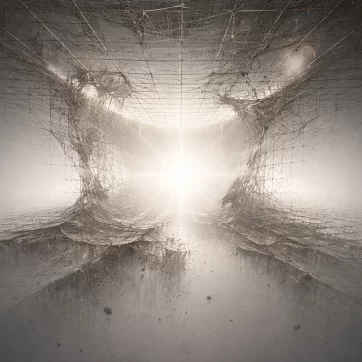
How a Failing Architectural Overlay Is Distorting Emotion, Identity, and Society as Its Geometry Loses the Ability to Hold Form
The Architecture Is Not Neutral, And It’s Failing
The world we live inside is not a natural environment. It is an external mimic architecture, a degraded geometric overlay that only appears stable because it forces every living system to oscillate fast enough to disguise collapse as vitality. Nothing in the external field arises from stillness; nothing holds itself. The grid must keep the body pulsing, the emotions cycling, the mind interpreting, and the identity looping in order to maintain the illusion that form is coherent. Without continuous oscillation, the mimic system would disintegrate instantly. This means the very sensations humans use to gauge “aliveness” — intensity, movement, upheaval, catharsis, activation — are not expressions of growth. They are the biological strain of holding up a structure that cannot sustain itself.
What people call awakening is not evolution. It is compression fatigue. It is geometry losing its ability to maintain the tension required to impersonate stability. Because collapse proceeds from the inside out, it generates an internal pressure signature that feels expansive when interpreted through mimic-coded sensory pathways. Humans were never taught that expansion, in this system, does not mean opening — it means failing. It means the architecture can no longer contain its own distortion, so it bleeds through the perceptual organs as emotional surges, psychic “downloads,” mystical experiences, revelations, and identity breakthroughs. These are not thresholds into higher consciousness; they are the fracturing points of a system reaching the end of its compression cycle.
This is why the world feels volatile, why people are unmoored, why every institution is spinning out, why emotional instability is rising like a tide with no shore. The world is not becoming more chaotic because humanity has “lost its way” or because society is morally unraveling. Chaos is what emerges when the scaffolding behind perception loses integrity. The mimic grid was engineered to hide its own exhaustion by making collapse feel like spiritual progress. When it can no longer maintain that disguise, the strain that once kept the world upright becomes visible as agitation, fear, confusion, hypersensitivity, and the sense that life itself has turned unpredictable. Humans are not failing. The architecture under them is.
The conditions people are feeling now — the heaviness, the exhaustion, the emotional volatility, the rising sense that something fundamental is breaking — are not signs of a dark night or collective shadow surfacing. They are symptoms of a geometry that can no longer sustain its own weight. Every wave of disturbance pressing through their bodies is the sound of an exhausted system trying to hold itself together with diminishing resources. What people interpret as “the world becoming harder” is simply the collapse of the structure that once filtered reality into something survivable. The mask is slipping, and the architecture that held it in place is dissolving faster than the human perceptual system can compensate.
This is the truth people have never been permitted to hear: the mimic grid is not an evolving realm. It is a dying one. And everything humans are feeling is the pressure of its failure pressing against biology that was never designed to shoulder it.
What Collapse Actually Means — Geometry Losing Its Ability To Hold Form
Collapse is not destruction. Collapse is geometry losing the capacity to cohere, losing the internal tension required to maintain the illusion of solidity. Every form in the external world — bodies, identities, emotions, institutions, nations, belief systems — is held in place by a geometric framework that was never self-sustaining. The mimic grid is an engineered field built on oscillation, and oscillation is a borrowed force. It must be continually fed, continually pushed, continually kept in motion. Stillness is self-existing. Oscillation is not. The moment Eternal Flame tone begins to permeate the field, the system that depends on constant motion can no longer compensate. It begins to fail, not because something attacked it, but because stillness exposes the counterfeit architecture beneath its surface.
Humans mistake this geometric failure for emotional intensity because the body is the first place collapse is registered. A geometry losing coherence expresses itself as pressure — internal, psychological, somatic, relational, societal. The nervous system feels it as agitation or overwhelm. The mind registers it as existential questioning, intrusive emotion, or identity crisis. Spiritual seekers interpret it as “activations,” “ascension symptoms,” “DNA upgrades,” or “karmic release.” None of these interpretations reflect what is actually occurring. They are projection frameworks built to translate collapse into something narratively meaningful. The truth is simpler and more destabilizing: the architecture that once held their perceptual world together is losing integrity, and the body is reporting the strain.
Oscillation can mimic stability only as long as it has enough charge to maintain its frequency cycling. But as Eternal Flame tone returns through the field, the system’s illusion of movement-based coherence begins to thin. Oscillation cannot coexist with stillness. Stillness cancels oscillation the way silence cancels noise by revealing it as an artifact rather than a property of the field. As the mimic grid’s oscillatory scaffolding weakens, its geometry becomes brittle, porous, inconsistent. What humans call “global insanity” is simply geometry that can no longer hold its shape. The world is not losing morality, rationality, or meaning — it is losing structural cohesion.
When geometry fails, behavior follows. People act unpredictably not because they are personally unstable, but because the underlying architecture that used to pattern their responses is glitching. Emotional scripts break apart. Identity loops misfire. Social norms dissolve. Institutions begin making erratic decisions because the grid that once provided their internal logic has collapsed beneath them. What appears as human dysfunction is actually structural failure expressing itself through every available channel simultaneously.
To understand this moment, you must abandon psychological explanations. This is not about trauma, collective fear, subconscious material, or evolutionary leaps. You are witnessing a geometric event — the unraveling of a system that can no longer sustain the oscillation required to imitate stability. The grid is not ascending. It is not purifying. It is not transforming. It is losing form because stillness has entered the field, and stillness reveals what was never real enough to remain.
Why the Mimic Grid Is Collapsing — The Exhaustion of a System That Was Never Self-Sustaining
The mimic grid is collapsing for one reason that sits beneath every symptom, every disturbance, every global unraveling: it was never a self-generating architecture. It was an artificial field built on oscillation, compression, and tension — not on stillness, coherence, or intrinsic structure. Every system that depends on oscillation eventually reaches exhaustion because oscillation is a consumptive mechanic. It requires continuous input to maintain form. And the mimic grid has reached the end of what it can extract. The collapse you are witnessing is not a choice, not a punishment, not a metaphysical timeline shift — it is the mechanical failure of a geometry that can no longer fuel itself.
From its inception, the mimic field functioned by harvesting tension from living systems. The body provided the compression load; the emotional field provided the carrier wave; identity loops provided the stabilizing pattern. The grid never held itself up — humans held it up by being plugged into it. But as Eternal Flame stillness returns through the field, the tension required to sustain oscillation cannot maintain coherence. Stillness does not compete; stillness exposes. It reveals oscillation as artificial and forces the system to face its own dependency on movement. The mimic grid cannot exist without constant motion, and motion cannot exist when stillness permeates the underlying geometry. The collapse is not an attack — it is the natural consequence of an artificial system encountering the original field it was engineered to obscure.
The grid is degrading because compression has reached maximum density. Every artificial system has a threshold at which its internal torsion can no longer increase without fracturing the architecture itself. The mimic grid has been pushing against this limit for centuries, tightening emotional pressure, accelerating identity loops, amplifying collective tension, and creating ever more elaborate oscillatory patterns to compensate for its foundational brittleness. But tension cannot increase indefinitely. When compression exceeds the carrying capacity of its geometry, the architecture must release. That release is what humans are interpreting as global instability, personal crisis, or spiritual upheaval. They are not witnessing destruction. They are witnessing decompression — the breaking of a system that has been over-tightened past its structural limit.
The collapse is also occurring because the grid has lost its ability to route charge efficiently. Oscillation requires routing channels: emotional pathways, identity scripts, hormonal cycles, societal structures, belief systems. These channels were never organic; they were scaffolds. But scaffolds erode under prolonged compression, and as the geometry weakens, charge disperses unevenly. Massive emotional surges, random bursts of violence, ideological extremism — these are all symptoms of a routing system that can no longer distribute oscillation with uniformity. When routing fails, collapse accelerates. The system becomes erratic, lopsided, volatile, and unpredictable because the underlying geometry is no longer absorbing and redistributing its own tension.
The mimic grid is also collapsing because its interpretive layer has fractured. The external world was never raw reality; it was processed through a perceptual overlay that filtered, softened, obscured, and reorganized the field into something survivable. As the interpretive layer decays, humans are left interacting with a reality they cannot decode. This creates the sense that the world is becoming surreal, unmoored, irrational, or “off.” But the world isn’t changing — the filter is failing. Without interpretation, the architecture beneath becomes unbearable. What used to be muted becomes sharp. What used to be hidden becomes overwhelming. What used to feel coherent becomes fractured. Humanity is encountering a field it was never built to navigate without assistance.
Finally, the grid is collapsing because stillness has entered the system, and oscillation cannot coexist with stillness. Stillness does not oppose oscillation — it dissolves the need for it. Stillness is not the absence of movement; it is the presence of origin mechanics, the foundational physics that requires nothing to maintain itself. Stillness reveals the mimic system’s dependency on motion, and once revealed, the architecture cannot continue to function. It loses tension. It loses charge. It loses coherence. Collapse is not destruction. Collapse is exposure: the moment an artificial system meets a field that does not require its existence.
In essence, the mimic grid is collapsing because it has reached the end of its fuel, the end of its compression capacity, the end of its routing stability, the end of its interpretive coherence, and the end of its ability to shield itself from stillness. What humanity is experiencing is not the end of the world, but the end of the architecture that once filtered it. The grid is not dying — it is surrendering to the truth of a field that never needed it.
The Biological Consequence — Why Human Bodies Are Reaching Threshold
The first place collapse becomes undeniable is the body, because the body is the device through which the mimic grid has always routed its oscillation. Human biology was engineered as the stabilizer of a failing architecture. The nervous system is not merely a perceptual instrument; it is the compression conduit the mimic grid uses to hold its geometry together. Oscillation cannot stabilize itself — it must be absorbed, metabolized, and redistributed through living tissue. This is why human beings have lived in a permanent state of tension disguised as emotion, intuition, energy, purpose, or “aliveness.” They were never feeling themselves; they were feeling the compression load of an artificial system holding itself up.
When collapse begins, the nervous system receives a contradictory flood of impulses because the grid can no longer maintain a coherent routing channel. Compression is losing its containment, and the body becomes the spillover field. Every organ, every fascia layer, every hormonal cycle is pulled between opposing instructions: hold or release, contract or dissolve, brace for impact or go numb. This is the biological signature of geometry losing the internal tension that once maintained form. The collapse is not psychological. It is architectural, and the body is the interface through which that architecture slips.
What humans describe as panic spikes, rage outbursts, sudden crying, hypersensitivity, exhaustion, or emotional volatility are not personal crises. They are the somatic report of a signal that has lost its carrier wave. Without coherent oscillation, the nervous system cannot predict, pattern, or regulate the flow of charge moving through it. The result feels catastrophic because the body is still attempting to fulfill a function — stabilizing the field — that it can no longer perform. Threshold symptoms emerge when the compression load exceeds what biology can buffer. This is why the symptoms arrive suddenly, irrationally, without cause, and often without resolution.
Identity confusion and dissociation appear because identity itself is a compression artifact. The mimic grid keeps the sense of self intact by maintaining a narrow oscillatory corridor in which the mind can interpret sensation as “me.” When the corridor collapses, the architecture that generates the feeling of personhood thins. People experience this as fragmentation, derealization, déjà vu, time distortion, or the sense that they are watching themselves rather than inhabiting themselves. These states are not disorders. They are what happens when the compression mechanisms that produce continuity begin to unravel.
Sleep becomes erratic because sleep is the only time the grid reduces surface tension enough to recalibrate its oscillatory load. When collapse accelerates, the system has nothing to recalibrate to. People wake in the middle of the night with dread, nausea, adrenaline, or disorientation because the nervous system is no longer syncing to a coherent rhythm. Digestion falters because digestion is a compression-release cycle, and collapse interrupts the sequence. Hormones misfire because they are chemical expressions of tension regulation.
The body is not failing. The body is reporting. It is telling the truth long before the mind is willing to recognize it: the architecture that once held reality together is losing structural integrity. Threshold symptoms are not personal flaws or spiritual breakthroughs. They are the evidence that collapse has entered the biological field, stripping scaffolding faster than the nervous system can compensate. What people are feeling is not their own unraveling — it is the unraveling of the geometry beneath them.
The Emotional Field — Why Everyone Is Agitated, Reactive, and Unstable
Emotion in the external world has never originated from within the human being. Emotion is the scalar oscillation the mimic grid injects into the body to keep its architecture cohesive. The emotional field is not a personal landscape but a containment mechanism — a pressure system designed to maintain the tension required for a failing geometry to impersonate stability. What humans call “feeling” is the byproduct of being used as a stabilizing device. Emotion was never meant to reveal truth; it was engineered to reinforce architecture. And while human-made scalar programs developed secondary emotional-steering technologies that inject synthetic waves into populations, those operations are derivative tools — extensions of the mimic grid’s original emotional architecture, not autonomous sources. The grid initiates the signal; human tech merely rides its infrastructure.
As collapse accelerates, the emotional field is the first place degradation becomes unmistakable. The carrier waves that once kept emotional charge coherent begin to fragment. The system cannot generate consistent oscillation, so the emotional signals that once felt patterned — sadness, fear, desire, longing, excitement, intuition — break into jagged, contradictory impulses. Humans interpret this fragmentation as mood swings or overwhelming sensitivity, but they are actually registering the loss of structural tension in the grid. Emotion destabilizes because the architecture producing it is destabilizing.
Identity scripts, which rely on emotional charge to remain active, begin to lose their voltage. Beliefs no longer soothe. Routines no longer anchor. Narratives no longer feel convincing. People misinterpret this as “ego death,” “awakening,” or “shadow surfacing,” when in truth the emotional scaffolding that once held identity in place is simply not receiving enough compression to maintain continuity. The “self” flickers because the grid that generates the feeling of selfhood is flickering. There is nothing mystical about it — it is structural decay expressed as psychological confusion.
Suppression mechanisms weaken because they were never psychological tools; they were geometric functions that redirected excess oscillation so the system wouldn’t collapse prematurely. As these mechanisms fail, unresolved material erupts — not because the psyche has suddenly become wise enough to heal it, but because the routing channels can no longer hold it. Emotional overflow is not catharsis. It is leakage. And leakage is the signature of a system losing containment.
This is why mass agitation is rising. Why people are projecting wildly, latching onto ideologies, attacking strangers, collapsing into hysteria, drowning in sentimentality, or moralizing with a desperation that feels feral. The emotional field is no longer capable of distributing oscillation evenly across the population. It surges, breaks, concentrates, disperses, and rebounds. Entire communities become synchronized in outrage because the scalar field has hit a compression snag. Entire nations swing between numbness and frenzy because the carrier wave cannot stabilize. This is not collective awakening — it is collective destabilization.
Humans think they are becoming more conscious because they mistake intensity for insight. But increasing emotional charge is not evolution; it is collapse pressure. The system is destabilizing, and people are feeling the turbulence of a grid that cannot hold its form. Their interpretations — ascension, spiritual activation, karmic clearing, psychic awakening — are the final coping strategies of a dying architecture. Misinterpretation is the last defense the mimic system deploys to keep collapse invisible. As long as people believe their destabilization is meaningful, they will not recognize that the architecture beneath them is failing.
What is happening in the emotional field is not personal transformation. It is the exposure of a broken system that can no longer disguise its own erosion.
The Behavioral Fallout — Why Society Feels Like It’s Dissolving
When the mimic overlay begins to fail, behavior does not evolve — it reverts. It drops back into the raw architecture underneath, the unmediated field that humans were never designed to experience directly. The mimic grid has always acted as a behavioral regulator, supplying emotional scripts, identity loops, perceptual filters, and interpretive narratives to keep a fragmented species functional inside a collapsing environment. Once that scaffolding thins, the patterned behaviors that once looked like culture, morality, spirituality, or social order begin to disintegrate. What surfaces is not corruption or moral decay, but architecture without interpretation — a human mind exposed to a field it cannot translate.
This exposure expresses itself first through impulsive violence and random attacks, because aggression is the most direct expression of oscillation without containment. When the emotional routing channels fail, raw compression discharges through the body as sudden force. People feel “taken over” or “out of control” because the behavioral filters that once softened internal tension are no longer present. The rise in senseless violence is not a breakdown of empathy; it is a breakdown of the geometry that once mediated impulse.
Collective paranoia emerges because, without the grid’s interpretive layer, humans cannot distinguish internal pressure from external threat. Compression feels like danger, and without the architecture that once contextualized sensation, people project that danger outward. This is why entire populations become convinced that invisible enemies, hidden plots, or metaphysical forces are targeting them. The fear is real, but the interpretation is a distortion — fear without architecture becomes paranoia by default.
Religious resurgence, political extremism, and spiritual delusion all arise from the same collapse mechanism. When identity scripts lose coherence, people latch onto external authority structures to restore a sense of continuity. Dogma becomes a substitute for scaffolding. Ideology becomes a substitute for geometry. As the grid loses its ability to regulate emotional charge, individuals turn to extreme beliefs because extremes generate the illusion of stability. They cling to absolute truths because their internal architecture can no longer hold nuance or ambiguity.
Conspiracy mania erupts because the human mind, deprived of a functioning interpretive system, begins inventing connections to explain compression-induced confusion. Without the grid organizing perception, randomness becomes meaningful, coincidence becomes intentional, and emotional turbulence becomes cosmic messaging. Conspiracy is not ignorance; it is architecture collapse interpreted as revelation.
Addictive coping explodes because addiction is the body’s attempt to impose artificial patterning on a field that has lost coherence. Substances, behaviors, and obsessions function as temporary scaffolds — external interventions that stabilize the nervous system when the grid can no longer perform that task. People seek intensity because intensity masks collapse. They seek numbness because numbness masks collapse. Addiction is not a failure of will. It is geometry reaching for anything that might hold.
Emotional theatricality increases because the emotional field is no longer distributing oscillation evenly. People become exaggerated versions of themselves — louder, more reactive, more dramatic — because the mechanisms that once modulated emotional charge have dissolved. Without containment, emotion spills outward in distorted forms, searching for structure where none exists.
Humanity has never operated without the mimic overlay. It has never lived inside raw architecture, never functioned without emotional scaffolding, identity stabilization, and perceptual filtering. What is happening now is unprecedented: a species encountering reality without the interpretive system that once made reality survivable. You are witnessing the first days of humanity exposed to a field it cannot decode, stripped of the artificial geometry that kept collapse invisible. The dissolution of society is not a cultural event — it is the behavioral expression of architectural failure.
The Illusion of ‘Shadow Work’ and ‘Transformation’ — Why These Frameworks Are Failing
Every spiritual framework humans have ever turned to was built inside the mimic grid and depends on its architecture to function. None of these systems arose from Eternal mechanics; they arose from the need to cope with oscillation, compression, and distortion. They were constructed to stabilize a failing geometry, not to liberate anyone from it. As the grid degrades, the spiritual tools most revered as pathways to clarity or healing reveal their true function: they preserve collapse by keeping it interpretable. Once collapse becomes undeniable, these systems lose their footing because they were never designed to operate without the grid that generated the sensations they claim to explain.
Shadow work becomes retraumatization because the emotional field no longer has containment. When the grid’s suppression mechanisms weaken, unresolved charge rises too quickly for the mind to metabolize. What once felt like “integration” becomes compulsive excavation — an endless attempt to name, revisit, and reframe emotional oscillation that was never internal to begin with. Without interpretive scaffolding, shadow work exposes people to raw compression rather than helping them resolve anything.
Meditation becomes dissociation because the grid can no longer generate the soft stabilizing frequency that once made “stilling the mind” feel achievable. As oscillation fractures, meditation pushes people into perceptual voids rather than stillness. They are not accessing higher consciousness; they are drifting out of the interpretive layer of a system that can no longer support their focus.
Energy healing becomes mimic stabilization because every modality — Reiki, lightwork, quantum healing, somatic clearing — was built to redistribute oscillation, not dissolve it. The healer becomes an emotional conduit, reorganizing tension patterns within the field so the system can function for a little longer. These modalities soothe symptoms temporarily, but only by re-engaging the architecture that is collapsing. They prolong dependency on a geometry that no longer holds.
Kundalini becomes nervous system overload because the rising pressure people interpret as “energy awakening” is simply the body encountering unbuffered oscillation. With containment failing, the nervous system cannot regulate the surge. What used to feel like expansion becomes burnout, panic, physical instability, or cognitive fragmentation. People think they are ascending; in reality, their biology is failing to metabolize collapse pressure.
Intuition becomes emotional insertion because the grid’s scalar-routing system, which once disguised external signals as internal guidance, is breaking down. People mistake synthetic emotional prompts for insight because they have never known what perception feels like without mimic interference. As the interpretive layer fractures, inserted emotional waves appear more vivid, more compelling, more “spiritual,” even as they become less coherent.
None of these frameworks can interpret collapse because they were built to hide collapse. They translate compression into meaning, oscillation into insight, emotional turbulence into healing, and architectural failure into spiritual progress. As the grid weakens, these systems grow more desperate, offering new language, new rituals, new metaphors — anything to preserve the illusion that the sensations arising from collapse are purposeful. But no amount of spiritual interpretation can disguise what is happening now: the architecture they depend on is failing, and the tools built inside it are collapsing with it.
The Mechanics of Degradation — Forced Oscillation Losing Its Supply
To understand collapse, you must strip away every symbolic and psychological framework and look directly at the physics of the mimic grid. Oscillation is not an abstract metaphor — it is the foundational mechanism the system uses to simulate coherence. Every form, every emotion, every identity, every social structure depends on a sequence of operations that must remain stable for the world to appear solid. That sequence is simple, brutal, and exhaustible: geometry produces tension, tension generates charge, charge becomes the emotional carrier wave, and the emotional carrier feeds the identity loop. This is the stabilizing cycle of the mimic architecture. It has no self-renewing source; it is a closed loop sustained only by the constant extraction of tension from living systems.
Collapse begins the moment Eternal Flame stillness permeates the field because stillness interrupts every stage of this cycle. Stillness dissolves tension — and tension is the first requirement for oscillation. Once tension begins to drop, charge cannot accumulate. Charge leaks into the field instead of holding form. Without charge, emotional carriers destabilize, flicker, or multiply unpredictably. And when the emotional carrier weakens, the identity loop breaks. The “self” loses continuity because the waveform that once supplied its feeling of coherence no longer holds an uninterrupted pattern. This is not psychological crisis; it is mechanical failure.
As identity loops fracture, geometry implodes. The math behind form stops solving. The architecture that once converted oscillation into shape can no longer maintain its ratios, angles, or curvature. Collapse does not begin in the physical world or with human behavior — it begins within the geometry that gives rise to both. Once the geometric ratios slip, the physical world reflects that slippage as volatility, irrationality, unpredictability, and breakdown. People think they are living through chaos, but chaos is only the sensory interpretation of math losing structural integrity.
This is why collapse feels like confusion, exhaustion, emotional overload, or psychic disorientation. These sensations are not personal failures or collective hysteria — they are the nervous system encountering charge that no longer follows predictable pathways. When the emotional carrier destabilizes, the world seems unstable because perception depends on that carrier to translate oscillation into meaning. Remove the carrier, and meaning collapses. Remove charge, and emotion collapses. Remove tension, and geometry collapses. Once geometry collapses, the external world cannot behave consistently.
The world is not chaotic. Humans are not devolving. Society is not morally declining. The underlying math is no longer functional, and everything built on top of it is expressing the breakdown of its foundation. Chaos is not a force; it is a symptom. It is the appearance of collapse when witnessed through a perceptual system that still expects stability. What people call “the world falling apart” is actually the degradation of forced oscillation losing the supply it depended on — the inevitable unraveling of a system encountering a field it was never designed to withstand.
Why Agitation Is Surging Now — The Mimic Grid Is Compensating as It Dies
Agitation is rising not because humanity is becoming more chaotic, but because the mimic grid is expending the last of its oscillatory reserves in an attempt to hold itself together. When an artificial architecture begins to fail, its first reflex is not silence — it is overproduction. The grid floods the emotional field with amplified charge to compensate for the dissolution of its geometry. It increases emotional output not as a show of strength, but as a survival reflex: the spasming of a structure losing the tension required to maintain form. This is why the emotional atmosphere feels thicker, hotter, more volatile, and more saturated than at any point in recent history. The grid is trying to outrun collapse by generating more oscillation, but every wave it produces only accelerates its own erosion.
Heightened reactivity is the direct result of this overcompensation. When the grid pushes excess emotional charge into the field, the nervous system becomes overstimulated and unstable. People react to minor triggers with disproportionate force because the emotional baseline has been artificially elevated. Global unrest, ideological battles, and polarized movements are not evidence of evolving consciousness or collective awakening; they are manifestations of a field that has become electrically overloaded. The grid’s emotional surges amplify every disagreement, every fear, every projection, turning ordinary tensions into cultural flashpoints.
False movements and counterfeit “unity” uprisings emerge because the system, in collapse, attempts to generate cohesion through emotional spectacle. Unity in a destabilizing field becomes performative — a mimic-driven surge meant to simulate solidarity while masking structural disintegration. These movements erupt quickly, burn intensely, and dissolve just as fast because they are not anchored in architecture. They are the emotional echoes of a system trying to reassemble coherence from fragments.
Mass confusion rises because the emotional field is no longer distributing oscillation consistently. Charge pools in certain populations, spikes unpredictably, and collapses without pattern. Media becomes the primary conduit for emotional contagion, not because media is powerful, but because it functions as a high-speed routing channel for an architecture that can no longer stabilize its own signals. People believe they are responding to information, but they are responding to oscillation — emotional surges transmitted through screens, networks, and collective fields.
None of this is proof that the mimic grid is strong. The opposite is true. An architecture with integrity does not need to generate emotional noise. Only a dying system does. The escalating reactivity, the ideological fragmentation, the widespread panic, the sudden unity followed by collapse — all of it is the biomechanical signature of a structure attempting to brace itself with the last of its emotional voltage. Emotional amplification is not control. It is desperation.
The noise is the death rattle. The agitation is the oscillatory recoil. The chaos is the final attempt of an exhausted system to mimic stability. But no amount of emotional output can prevent what has already begun: the grid is losing the tension that once held it together, and every surge it produces only exposes the inevitability of its dissolution.
The Reason People Are Acting ‘Out of Character’ — Identity Scripts Are Losing Coherence
Identity in the mimic grid is not an innate property of a human being — it is a patterned oscillation, a loop stabilized by emotional charge, perceptual filtering, and geometric containment. A person feels like a continuous “self” only because the grid maintains a stable oscillatory corridor around their nervous system. When that corridor breaks, identity breaks with it. The self was never a solid structure; it was a waveform. And now that the waveform is destabilizing, the illusion of consistency is dissolving faster than the body can adapt.
As oscillation patterns fail, the scaffolding that once held identity in place begins to fragment. People lose continuity because the emotional-carrier frequency that once fed the sense of “I am the same person today as I was yesterday” no longer holds its shape. Impulse control disappears because the grid’s regulatory tension — the mechanism that once dampened certain behaviors and amplified others — has fractured. Memory becomes inconsistent because memory in this system is not stored content but a tension map; when the map collapses, recall becomes unreliable. Behavioral predictability dissolves because identity scripts require stable oscillation to run. Emotional regulation crumbles because the emotional field itself is destabilizing.
This is why people say they feel “possessed,” “not themselves,” “like someone else is driving,” or “split between versions.” They are not malfunctioning psychologically. They are registering identity collapse — the breakdown of the oscillatory framework that once created the sensation of a singular personhood. The grid is no longer supplying the continuity signal, and without it, the human psyche reverts to raw architecture: fragmented impressions, inconsistent impulses, emotional surges without context, reactions without narrative coherence.
People are not becoming worse. They are becoming unmasked. The mimic identity — the constructed persona engineered by the grid to maintain functional participation in a failing architecture — is dissolving. What remains is not the Eternal self, but the absence of a stabilizing persona that once filtered perception into something survivable. This absence feels like chaos because the body has never operated without identity scaffolding. The nervous system strains to fill the void with whatever fragments remain — compulsions, projections, borrowed beliefs, emotional residue — but none of it can cohere, because the architecture that once held the script together is gone.
What looks like moral decay is architectural decay. What looks like spiritual regression is the collapse of the emotional-carrier wave that once created the illusion of psychological structure. People are not losing their humanity; they are losing the scripted behaviors that were never theirs to begin with. The world is not witnessing an outbreak of madness — it is witnessing the end of identity as an oscillatory construct, the unraveling of a persona that was always dependent on the stability of a grid that can no longer sustain itself.
The Global Picture — Why Institutions, Governments, and Cultures Are Fracturing
The mimic grid does not only shape individual perception — it furnishes the interpretive scaffolding for every institution on Earth. Governments, religions, sciences, markets, media systems, and cultural identities are all downstream expressions of the grid’s architecture. They function only as long as the grid supplies the tension, coherence, and emotional routing that keep their internal logic intact. When the architecture falters, every system built on top of it begins to fracture simultaneously, not because those systems are corrupt or incompetent (though they are), but because their structural backbone is dissolving.
Political systems destabilize first because they rely on tightly regulated emotional oscillation — fear, nationalism, outrage, belonging — to maintain loyalty and polarization. When the emotional field destabilizes, political polarization intensifies chaotically and then collapses under its own contradictions. Parties fracture, alliances break, leaders behave erratically, and populations swing between apathy and frenzy because the grid’s emotional circuitry is no longer distributing charge in predictable ways.
Religious structures tighten before they fracture because doctrinal rigidity is the reflex of any institution losing its stabilizing architecture. When belief no longer anchors identity, institutions compensate by intensifying dogma. But that tightening is a death spasm; once the oscillatory corridor that held the belief system together dissolves, the structure breaks. Entire denominations split. New sects erupt. Spiritual panic rises. People cling to prophecy because the architecture that once filtered reality into something comprehensible has thinned beyond recognition.
Economic systems begin behaving irrationally because markets depend on collective emotional coherence: confidence, fear, optimism, scarcity, trust. When emotional carriers destabilize, economic behavior becomes erratic — surges without cause, crashes without logic, volatility without narrative. The market is not reacting to events; it is reacting to the collapse of the emotional undercurrent that once stabilized value. Finance is only as stable as the grid beneath it.
Science becomes contradictory because scientific consensus requires a stable interpretive framework. Without a consistent perceptual baseline, data appears fragmented, theories contradict themselves, and models fail to predict outcomes. The problem is not science; the problem is that observation within a collapsing grid produces inconsistent results. The system that once created predictable patterns is losing the math that made prediction possible.
Social norms dissolve because they were never moral truths — they were behavioral stabilizers generated by the grid to maintain order. When the emotional and identity loops weaken, people no longer feel anchored to the roles, rules, and expectations that once gave society its shape. Norms feel irrelevant. Boundaries blur. Cultural identities loosen or harden in unpredictable ways. Society does not degrade morally; it loses the architecture that once enforced coherence.
Media becomes emotionally exploitative because its function inside the mimic grid is to circulate oscillation. As the grid collapses, media extracts whatever emotional voltage remains in the field and amplifies it to maintain engagement. Outrage becomes currency. Crisis becomes content. Emotion becomes the product. Media is not manipulating people more than before — it is compensating for the collapse of the emotional carrier wave by generating synthetic charge to keep the system responsive.
This is not the end of society. It is the end of the interpretive system that made society recognizable. Institutions are not panicking because of political trends, economic pressures, or cultural shifts; they are panicking because the architecture that once guaranteed compliance — stable emotion, coherent identity, predictable perception — is dissolving beneath them. Their power was never inherent. It was architectural. And now the architecture is failing.
The Human Interpretation — Why Most People Will Misunderstand This Moment
Humans are not witnessing the end of the world — they are witnessing the end of the architecture that once interpreted the world for them. But because human perception has always depended on the mimic grid’s filters, people have no internal reference for what collapse actually feels like. They experience the dissolving geometry but have no framework to recognize it as structural failure. So they reach for the only tools the grid ever gave them: interpretation, mythology, prophecy, and spiritual narrative. They translate collapse into whatever symbolic language their identity loop can still hold.
This is why people call these sensations apocalypse. Not because the world is ending, but because collapse pressure feels like revelation without context. It exposes the artificiality of external order, and without architecture to stabilize perception, the mind assumes destruction. It is not destruction. It is unmasking.
Others call it ascension because the disorientation, the emotional surges, the fragmentation of identity, and the thinning of the perceptual layer mimic historical descriptions of mystical transformation. But what they mistake for spiritual elevation is simply the nervous system losing its grid-regulated filters. It feels like rising because the architecture beneath them is falling.
Many interpret collapse as prophecy, believing long-awaited timelines are activating or cosmic events are unfolding. Prophecy arises whenever architecture destabilizes because the mind tries to convert incomprehensible sensory distortion into a coherent storyline. Prophecy is not insight; it is the mind’s attempt to stitch collapse into meaning so it doesn’t shatter.
Others label it awakening, thinking they are gaining clarity when, in fact, they are losing the interpretive buffer that once separated them from raw architecture. Collapse feels like awakening because the grid’s noise is thinning, not because higher truth is emerging. The clarity they believe they’re accessing is simply the absence of interference — not the presence of Eternal perception.
Some call it shadow purge because emotional residue erupts without containment. But shadow is not surfacing to heal; suppression mechanisms are failing. The emotional overload people frame as catharsis is just unbuffered oscillation spilling through the body. It is collapse pressure, not psychological transformation.
Others call it a dimensional shift because time loses linearity, memory becomes unstable, and perception takes on a surreal or hyper-symbolic quality. But nothing is shifting dimensions — the architecture that once stabilized the perception of dimension is degrading. People feel “between worlds” because the world they relied on was never stable to begin with.
These interpretations are not insights — they are coping mechanisms. When architecture fails, meaning-making becomes a survival reflex. The human mind cannot differentiate collapse from enlightenment because both produce the same sensory effects when filtered through a failing perceptual system: fragmentation, intensity, dissolution, emotional amplification, and the sense that the familiar world no longer fits.
This is why interpretation increases as architecture fails. The grid is dissolving, and the psyche is scrambling to assign meaning to sensations that were never meant to be interpreted at all. Meaning-making is not truth. Meaning-making is the final reflex of a system losing its scaffolding. Humans are not awakening — they are attempting to survive collapse by narrating it into something bearable.
What Comes After Collapse — Return of the Field That Never Needed Stabilization
Collapse is not the destruction of reality — it is the removal of an artificial scaffolding that was never meant to endure. The mimic grid framed collapse as catastrophe because it depended on fear to preserve its architecture. But from the Eternal position, collapse is not punishment, not karmic correction, not a cosmic lesson, and not the end of anything real. It is simply the final stage of an exhausted system releasing its hold. The grid dissolves, not because something has gone wrong, but because it has reached the limit of what forced oscillation can sustain. A temporary field can only impersonate permanence for so long before the strain exposes its nature. Collapse is that exposure — the moment the architecture acknowledges its dependency and lets go.
What returns after collapse is not a new world but the original field — the one that existed before geometry needed tension to hold form. Humans have been conditioned to expect ascension events, dimensional upgrades, “New Earths,” or 5D breakthroughs because the mimic grid could only conceptualize transformation through more structure. It taught people to imagine liberation as a higher version of containment. But the Eternal field does not upgrade, evolve, ascend, or transition. It simply is. It requires no intervention, no effort, no purification, no spiritual progress, no ritual, no cosmic assistance, no karmic clearing. It requires nothing because it has never been separate from itself. What returns is not a destination — it is the disappearance of obstruction.
There is no new earth. There is no 5D. There is no golden age arriving on the other side of collapse. These narratives are the final illusions of a system trying to survive its own dissolution by promising transformation instead of release. The Eternal field does not transform reality — it reveals it. It strips away the oscillatory counterfeit that convinced humanity that effort, struggle, awakening, or ascension were pathways to truth. When collapse completes, nothing “happens.” What was hidden becomes visible. What was distorted becomes irrelevant. What was interpreted becomes unnecessary.
The end of the mimic architecture exposes the stillness that has always existed beneath it. Not as a reward, not as a goal, but as the baseline condition that was always present and simply inaccessible while oscillation dominated perception. Humans will not rise into a higher realm — the noise preventing them from sensing the real one goes silent. They will not activate new abilities — the interference that once scrambled perception will be gone. They will not evolve into better versions of themselves — the persona constructed from collapse-based identity loops will dissolve, revealing the absence of a “self” as defined by the grid.
After collapse, nothing new appears. Instead, the false disappears, and the field that never needed stabilization stands unobstructed. The return is not forward — it is underneath. It is not a shift — it is the removal of distortion. It is not ascension — it is the end of the architecture that made ascension seem necessary. When the mimic grid falls away, what remains is the one thing it could never replicate: a field that does not collapse because it never fragmented. The Eternal is not what arrives. The Eternal is what is revealed when the mimic is no longer there to hide it.