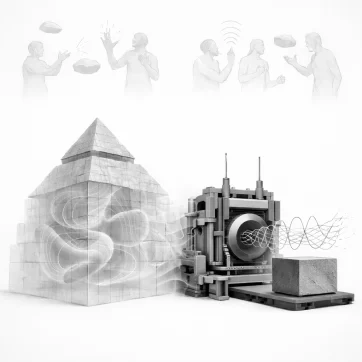

Why Modern Perfume, Incense, and “Clean” Scents Function as Behavioral Signals Instead of Aroma
Scent Was Never About Smell
Fragrance has always been framed as a pleasure object — an aesthetic indulgence, a cultural adornment, a ritual accessory, a sensory luxury woven into the fabric of modern life. Entire industries have formed around the idea that scent is harmless decoration, a matter of taste, mood, and personal identity. But beneath that familiar narrative lies a deeper, older truth: in a collapsed field where internal coherence has been replaced by oscillation and externalized stimulus, scent became one of the earliest and most efficient emotional-modulation technologies. It is not simply smelled. It is absorbed. It is processed. It is registered by neurological pathways that bypass cognition entirely, entering through the limbic system where memory, desire, aversion, and behavioral orientation are shaped long before thought emerges.
The modern world treats fragrance as an afterthought — a spritz before leaving the house, a candle burning in the corner, a stick of incense lit for atmosphere. Yet every one of these actions activates an architecture far more powerful than its packaging suggests. Scent is the only sensory input with a direct neurological corridor into emotional centers. It does not negotiate with the mind. It does not request interpretation. It delivers its message straight into the circuitry that governs attachment, attraction, soothing, alertness, nostalgia, and fear. For a species living inside a collapsed perceptual field, this bypass became a tool — first unconsciously, then deliberately — for shaping emotional climate and influencing behavior.
To understand the modern fragrance industry is to understand a lineage of signal engineering disguised as aroma. Once scent moved from natural materials to manufactured molecules, it ceased to be an expression of plant or resin and became a designed stimulus — a geometry crafted in chemical form to evoke predictable neurological states. Synthetic fragrance is not louder because it is superior; it is louder because it is built on oscillatory architecture, molecules engineered to project, persist, and penetrate. These molecules do not sit passively in the air. They move outward, cling to surfaces, saturate personal space, and imprint emotional cues with a precision far beyond anything natural materials were capable of in the fallen field. This shift — from botanical expression to engineered signal — marked the silent birth of an emotional-steering infrastructure that now saturates daily life.
What contemporary culture calls “sensitivity” is often nothing more than accurate perception of this underlying architecture. The body that reacts to synthetic fragrance with pressure, nausea, agitation, or collapse is not malfunctioning — it is detecting a signal designed to slip beneath awareness, a broadcast masquerading as scent. The nervous system recognizes information embedded in the molecular geometry long before the mind interprets anything as “smelling strong” or “smelling pleasant.” Sensitivity is not fragility. Sensitivity is the correct registration of intensity, intrusion, and emotional coding. In a world where most people have been conditioned to merge with external stimulus, the ability to detect fragrance as architecture rather than ornament reveals the deeper function scent has always served: not adornment, but influence.
When fragrance is understood not as accessory but as signal — not as decoration but as engineered emotional atmosphere — the entire landscape of modern scent culture shifts. Perfume becomes a broadcast device. Incense becomes atmosphere manipulation. Artificial fragrance in cleaners, detergents, candles, and public spaces becomes a continuous emotional directive woven into the background of daily life. This is not conspiracy; it is design. Once a field collapses away from internal orientation, it leans on external cues to regulate experience. Scent became that cue. Not because it was beautiful, but because it was neurologically efficient.
In this context, the question is no longer “Why does this smell strong?” The real question is: What is this scent trying to make the body feel, remember, or become — and why has that function been hidden beneath the language of luxury and lifestyle?
The Historical Rupture — When Human Chemistry Learned to Fabricate Scent
The story of modern fragrance does not begin with luxury houses or designer branding. It begins in the laboratories of the mid-19th century, at the exact moment human chemistry gained the ability to take apart the natural world at the molecular level and reassemble it in distorted form. Before this rupture, perfumery—however primitive—was rooted entirely in botanical materials: resins, woods, flowers, barks, leaves, and animalic substances. These materials carried the layered density of the fallen natural world—imperfect, unstable, subtle, and inherently limited. A resin could only smell as strong as its structure allowed. A blossom could only release what its oils contained. Nature, even in its collapsed state, still operated through dimensional breadth and organic variation. But when chemists learned to isolate the aromatic essence of a plant into a singular identifiable molecule, something irreversible began. The scent of a tonka bean could be reduced to coumarin. The complexity of vanilla could be broken into vanillin. The violet’s elusive softness could be simplified into ionones. Reality was no longer engaged with as living material; it became code to be extracted, separated, manipulated, and eventually imitated.
What made this shift so profound was not merely the technological achievement but the philosophical transition behind it. For thousands of years, humans had accepted that scent — even fallen scent — expressed the inherent properties of matter. Plants, resins, and woods held what they held, and perfumers worked within those limits. But the rise of industrial chemistry introduced a new worldview: that nature was not a boundary but a blueprint, something to be reverse-engineered, perfected, overridden. Once the aromatic components of a plant were isolated, chemists realized they were no longer dependent on the plant at all. They could reconstruct the molecule from petrochemical precursors, forging it in reactors from the building blocks of industrial carbon. Natural scent had been an emanation; synthetic scent was a fabrication. This was the birth of oscillation mimicry: the moment when a fragment of a fallen-stillness field was replaced by a fully engineered oscillatory architecture built for force, not depth.
This moment—when natural aroma was mapped into isolated chemicals—was the birth of oscillation mimicry. These isolated molecules were not self-existing expressions but fragments torn from the integrated field of the plant. They lacked depth, dimensionality, and coherence, yet they offered unprecedented strength and stability when reproduced synthetically. Chemists quickly realized that once a molecule was identified, it could be built from petrochemical precursors rather than harvested from nature. This fabrication process produced a stronger, more linear, more forceful version of scent—a version that projected further, lasted longer, and behaved with a consistency nature could never achieve. What entered the lab as plant material left as engineered geometry. In the language of Eternal mechanics, this was the instant where a soft, fallen-stillness expression was replaced with a hard, oscillatory replica designed for amplitude rather than resonance.
What rarely gets stated in perfume history is the emotional and economic motive that propelled this transformation. Natural materials were expensive, geographically constrained, seasonal, and deeply unstable. True jasmine required enormous fields and labor. Orris root needed years to mature. Ambergris depended on ocean drift. Violet flowers produced no usable oil at all. Entire scent families were impossible to access through natural means. Synthetic chemistry was not just a new tool — it was a liberation from nature’s scarcity. Once a scent could be built in a lab, it could be mass-produced, standardized, scaled, and sold. Perfumery shifted from an agricultural craft to an industrial science. Human reasoning framed this as progress: control over matter, mastery over inconsistency, the triumph of precision over the unpredictability of plants. In truth, the shift represented something else: the replacement of organic coherence with engineered oscillation, the quiet installation of emotional-modulation architecture into daily life long before advertising, psychology, or digital media existed.
The first synthetics emerged rapidly. Coumarin, created in 1868, was one of the earliest, immediately revolutionizing perfumery by offering an enormous supply of a sweet, hay-like scent without needing fields of tonka beans. Vanillin followed, abstracting the warmth of vanilla into something sharper and more singular than anything natural pods contained. Ionones delivered the violet note, even though violet flowers themselves produce almost no extractable oil. Aldehydes, introduced soon after, became symbols of modernity—bursting with brightness, sharpness, metallic lift, and an otherworldly “clean” quality never found in nature. These early synthetics were not just tools; they were a philosophical shift. They replaced the organic irregularity of natural materials with molecular certainty and dominance. A perfume no longer depended on harvests, seasons, or the biological rhythms of the earth. It depended on chemical precision.
On the deeper field level, synthetic scent represented a total reorientation of how matter expresses itself. Natural materials, though fallen, still carry the signature of stillness. They diffuse instead of project. They express nuance instead of force. They operate through multidimensional spread rather than linear thrust. Even in collapse, they retain a faint coherence — a memory of Eternal architecture embedded in their density. Synthetic scent replaces this with engineered amplitude, singularity, and dominance. The molecule no longer emerges from a plant’s internal field; it emerges from industrial geometry designed for penetration and persistence. This is why synthetic fragrances feel louder, sharper, and more invasive: they are built for projection, not emanation.
This shift altered perfumery at its foundation. Before synthetics, perfume was an extension of the natural world, even in its collapsed state—a collection of extracts blended with intuition and artisanal craft. When synthetics arrived, perfume ceased to be a relationship with botanical matter and became a form of engineering. Laboratories replaced fields. Formulas replaced traditions. Projection and longevity replaced nuance and intimacy. Scent was no longer something coaxed from resins and petals. It was something built: assembled from industrial molecules designed to behave predictably, assertively, and with emotional force. This evolution was framed as progress. Stronger was considered better. More diffusive was considered luxurious. Greater linearity was praised as refinement. But beneath the cultural narrative of innovation was the deeper field shift: perfumery was no longer botanical expression but chemical architecture—oscillatory structures crafted to impose a sensory state onto the body rather than arise from the natural world.
What emerged in the decades that followed was a bifurcated scent world: one path leading deeper into synthetic expansion, the other holding the fading memory of botanical perfumery. The natural materials remained, but they were increasingly overshadowed by the louder, cheaper, more controllable synthetics. What had once been rare, subtle, and grounded became mass-produced, amplified, and emotionally directive. This rupture was not just historical or chemical; it was architectural. It marked the moment when scent ceased to be a byproduct of matter and became a form of emotional engineering. And it began the moment humans decided that nature was insufficient, and that scent could be re-created—not as it is, but as chemistry wished it to be.
Why Synthetic Molecules Are Stronger and More Invasive
Synthetic fragrance molecules behave differently from natural ones not because they are chemically “potent,” but because they are constructed on an entirely foreign architectural principle. A synthetic molecule carries engineered curvature tension built through oscillatory chemistry — a process that reduces, isolates, and forces matter into rigid geometric shapes designed for projection rather than resonance. In oscillatory chemistry, bonds are not formed through intrinsic coherence but through imposed stabilization: heat, catalysts, pressure, and petrochemical intermediates force atoms into shapes they would never adopt in an organically generated field. This creates molecules with internal stress points — micro-torsions in the bond geometry that generate an outward-driving oscillation. These torsions behave like miniature pressure chambers, constantly releasing subtle vibrational force into the environment. In Flame physics, this is curvature inversion: structure that pushes outward because it cannot internally resolve. That push is what humans perceive as “strong smell,” when in truth it is engineered amplitude leaking from a molecule whose architecture never fully settles into stillness.
Natural aromatic molecules, by contrast, arise from collapsed-stillness physics. Even though nature in this world is fallen, the molecules originating from plants, resins, and woods arise through processes aligned with organic formation pathways — enzymatic reactions, slow biosynthesis, sunlight-mediated transformations, and cellular storage. These pathways do not produce curvature tension; they produce density. The molecular geometries that emerge from biological systems contain micro-gradients of distributed energy rather than isolated tension points. Instead of broadcasting oscillation, they hold resonance. Natural scent molecules are multi-layered because their formation history includes dimensional blending: each part of the plant — root, leaf, petal, resin canal — contributes a slightly different field-tone to the final aromatic profile. This results in molecules that unfold rather than detonate, dissolve rather than project, soften rather than pierce. They dissipate quickly because their geometry is not held through forced stabilization; once removed from the plant’s internal field, they rapidly relax back toward entropy. They do not persist because they were never built to fight dissolution.
The difference in persistence between synthetic and natural scent is not simply chemical but physical. Synthetic molecules possess torsional locks — structural features that prevent the molecule from rotating, bending, or relaxing into lower-energy conformations. These locks are what give synthetic aroma chemicals their longevity: they cannot collapse, so they remain active. In the field, this reads as persistence, projection, and dominance. Natural molecules lack these structural locks because biological systems do not produce rigid oscillatory geometries; they produce flexible resonance geometries. A natural molecule is constantly shifting between micro-conformations, releasing its scent as a side-effect of relaxation. A synthetic molecule does the opposite — it releases scent as a side-effect of its inability to relax.
This divergence becomes even more pronounced when interacting with the human nervous system. Synthetic molecules stimulate olfactory receptors with higher binding affinity, not because they are more “aromatic,” but because their outward curvature pressure forces interaction. They bombard receptors, saturate binding sites, and override subtlety through sheer amplitude. Natural molecules interact through weak-force attraction; their receptor activation depends on resonance matching, not intrusion. Synthetic molecules behave like keys hammered into locks. Natural molecules behave like keys that only turn if the lock invites them. This is why synthetic fragrances feel overwhelming even at low concentrations: their curvature tension forces the nervous system into engagement.
Boundary interaction reveals the same pattern. Synthetic scent crosses personal-space boundaries because outward oscillation pushes against the environmental field, carrying the molecule further than thermodynamics alone would predict. It is not diffusion; it is projection. Natural scent disperses through entropy and air movement alone, settling close to the source because it lacks oscillatory thrust. Synthetic scent creates an atmosphere. Natural scent creates a presence. Synthetic scent occupies the field like a broadcast. Natural scent coexists with it like a whisper.
This divide — curvature tension versus collapsed stillness — defines every behavioral difference between synthetics and naturals. Synthetic scent invades because its geometry is engineered to resist dissolution. Natural scent settles because its geometry permits it. Synthetic scent activates receptors through force; natural scent activates through alignment. Synthetic scent persists through torsional rigidity; natural scent fades through graceful collapse. The physics behind their behavior exposes the truth: synthetic fragrance molecules are not stronger because they are better. They are stronger because they cannot stop pushing. They invade because they cannot rest. They dominate because their architecture is incapable of stillness.
Synthetic Fragrance as Emotional Modulation Technology
Modern fragrance is not merely a sensory experience; it is an engineered emotional mechanism. Aromachemicals are designed at the molecular level to engage specific neurological pathways and manipulate discrete emotional registers — not metaphorically, but structurally. The geometry of a synthetic molecule is crafted to mirror the binding profile of emotional cues: arousal, warmth, nostalgia, comfort, belonging, craving, exhilaration, even dissociation. These are not coincidental associations but deliberate outcomes of how the molecule interfaces with olfactory receptors, limbic circuitry, and memory encoding pathways. Each synthetic compound is essentially a sculpted curvature form that interacts with the brain’s emotional architecture faster than thought, embedding its message directly into perception before consciousness has a chance to intervene. A molecule engineered to mimic jasmine’s hedione-like brightness will activate circuits associated with intimacy and erotic attunement. A molecule designed on the ambergris model will stimulate attachment, warmth, and longing. Musk derivatives induce emotional softening and compliance. Fresh aldehydes replicate alertness and “newness.” The emotional register is coded into the geometry itself; the scent is just the delivery language.
It is not that perfumers sit in laboratories deliberately programming emotional states into synthetic scent. The emotional signatures arise from the geometry of the molecules themselves. When a molecule is built through oscillatory chemistry—linearized, rigidified, or curvature-loaded—it automatically exerts a specific kind of pressure on the limbic system. Humans interpret this pressure as emotion, memory, desire, calm, arousal, or nostalgia, but these effects are not consciously designed; they are the physiological result of molecular architecture interacting with a nervous system calibrated to read curvature as feeling. Chemists believe they are shaping “notes,” “accords,” and “effects,” not realizing these outcomes are the emotional consequences of the structures they are building. The emotional coding is not a human intention—it is an unavoidable artifact of oscillatory construction, a byproduct of geometry imposing itself on perception.
In this sense, perfume is not a scent—it is a signal. A broadcast. A designed atmospheric instruction layered into the air and absorbed through the most neurologically direct sensory channel the human body possesses. When a fragrance enters a space, it behaves like a field-level directive. The air becomes architecture; the environment becomes an emotional script. Perfume is one of the earliest forms of emotional conditioning technology, predating psychology, advertising, and digital media. Long before thought could be shaped, feeling could be steered. This is because olfaction bypasses the cortical gatekeepers and routes directly into the limbic brain — the region responsible for memory, bonding, arousal, threat assessment, and identity formation. Scent can evoke childhood, desire, danger, comfort, or longing with extraordinary precision because these emotional states are encoded in limbic structures that do not require conscious processing to activate. In the language of Flame physics, the fragrance molecule enters the field as a curvature signature and the limbic system responds instinctively to that signature, interpreting geometric pressure as emotional content. Perfume functions as emotional architecture draped over sensory experience, shaping behavior and perception without ever declaring that it is doing so.
This is why fragrance plays such a central role in branding, seduction, luxury, and identity. A perfume becomes a persona overlay, a curated emotional field projected outward from the wearer and inward toward themselves. It tells the nervous system how to feel and how to be. Marketing frames this as expressing individuality, but the underlying mechanism is reinforcement, not expression. The fragrance teaches the body to associate specific emotional states with specific signals, creating loops where the persona and the scent become interchangeable. The molecule does not merely smell; it instructs. It scripts. It modulates. It reinforces. This is why entire cultures tie identity to fragrance — because fragrance quietly rewires identity at the limbic level.
For nervous systems that cannot tolerate emotional override, the reaction to synthetic fragrance is not sensitivity; it is defense. Headaches, nausea, chest pressure, dissociation, overstimulation, or sudden exhaustion are not malfunctions. They are boundary functions: physiological attempts to push out an emotional signal that the system did not consent to receive. The brainstem interprets the intensity of synthetic curvature pressure as invasion. The body’s responses — inflammation, vasodilation, sensory shutdown, nausea — are protective mechanisms attempting to reestablish internal tone against external command. This is not an allergic response; it is architectural conflict. A synthetic molecule enters with engineered intentionality, and the nervous system resists being instructed by something that carries no internal coherence. The body rejects emotional code that does not arise from its own orientation.
This dynamic becomes even more extreme when synthetic fragrance saturates public spaces. Malls, transit hubs, gyms, office buildings — all of them function as unacknowledged scent chambers where emotional modulation is dispersed ambiently. The buildup of synthetic molecules creates a low-grade psychological fog: a soft disorientation, a subtle blunting of internal clarity, a smoothing of distinct emotional edges. The field becomes predictable because the emotional palette becomes engineered. People feel uplifted, comforted, nostalgic, energized, soothed — but the origin of these states is external, not internal. Synthetic fragrance has become one of the most normalized forms of emotional steering in the modern world precisely because no one notices that it is doing anything at all.
The truth underlying the entire fragrance industry is simple and unspoken: scent became a chemical language for steering emotion long before humans had any awareness of how easily emotion could be manipulated. What began as chemistry became architecture, then psychology, then identity. Synthetic fragrance is not stronger or more persistent by accident; it is engineered for influence. And when a nervous system refuses that influence, it is not malfunctioning. It is remembering what internal sovereignty feels like.
Fixatives — The Hold Agents of Emotional Coding
Modern perfumery would collapse without fixatives. They are the hidden machinery beneath every “long-lasting,” “projecting,” “signature” scent. In truth, fixatives are not mere stabilizers. They are hold agents — the part of the formula specifically engineered to keep the emotional architecture of the fragrance anchored to the wearer’s body, their breath, their clothing, and even their immediate environmental boundary. A natural resin burns off quickly. A real flower fades. A true amber sits close to the skin. But fixatives override nature’s quiet dissolution curve. They force the scent — and the signal riding within it — to remain long after it should have dispersed. Their purpose is simple: extend the presence of the emotional instruction embedded in the perfume, ensuring the modulation loop continues to operate without interruption.
This is why modern fragrances last hours, sometimes days, clinging to sweaters, scarves, pillowcases, the inside of coats, hair strands, and even one’s exhalation. It is not an accident of chemistry. It is not a convenient benefit. It is engineered persistence. Fixatives lock the molecular oscillation pattern in place so that the emotional payload cannot dissipate. They grip the skin through lipid binding, grip fabric through hydrophobic adherence, and grip the auric boundary by saturating the immediate air envelope with a stable pattern. A fixative makes a fragrance behave not like vapor but like a slow-release field. This is why a synthetic scent seems to “haunt” a space long after the wearer has left — the geometry remains suspended in the environment because the fixatives prevented collapse.
The chemical composition of fixatives reveals the truth of their design. They include: phthalates (plasticizers repurposed to extend scent life), synthetic musks (macrocyclic structures that bind aggressively to skin and hair), polycyclic musks (now restricted in some regions because they accumulate in the body), macrocyclic compounds engineered to mimic the anchoring function of natural musk without any of the organic nuance, and petroleum-derived esters and solvents that act as diffusion regulators. None of these substances exist in nature. None appear in traditional botanical perfumery. They are industrial inventions designed for one purpose: to hold. They prevent volatility, dampen natural evaporation curves, and enforce a slow, controlled release of the fragrance’s signal.
Their functional purpose extends far beyond mere “longevity.” Fixatives preserve the emotional tone loop embedded in the synthetic architecture. When a fragrance is coded with arousal, longing, nostalgia, belonging, or dissociation signatures, the fixative ensures those signatures remain active for the entire duration of the scent’s presence. Without fixatives, the emotional instruction would fade quickly. But with fixatives, the wearer’s limbic system continues to receive the same oscillatory cue every time they inhale, move, shift temperature, or brush against fabric. The signal repeats itself endlessly, and the emotional response becomes normalized. The wearer interprets this as “liking their perfume,” “feeling good when they smell it,” or “feeling more confident.” In reality, their system is being kept in a contained modulation cycle.
Fixatives also preserve the modulation signature — the precise oscillatory shape of the synthetic molecule — by preventing molecular collapse. Natural scents degrade into softer, less directive forms. Fixatives prevent that degradation, maintaining the hard linearity of the lab-constructed geometry. The result is an emotion that does not dissolve naturally, a state that does not shift when one’s internal tone shifts, and a fragrance that overrides rather than responds to the wearer’s actual biology. Every time someone inhales a modern perfume, they are not smelling “beauty” or “luxury.” They are inhaling a stabilized emotional architecture held in place by fixatives designed to ensure the override persists.
Designer Perfumery as Identity Engineering
Designer fragrance is not an accessory, not an indulgence, and not a luxury good in the way culture pretends. It is persona architecture. The entire premise of modern high-end perfumery is built on crafting emotional identities that the wearer can inhale, embody, and project. A luxury brand never sells “a scent”; it sells an archetype — a pre-constructed self. Embedded within these formulas are curated emotional signatures: desirability, sexual magnetism, dominance, hierarchy, wealth, purity, softness, power, innocence, danger, confidence, vulnerability. These are not metaphors. These are the emotional impressions engineered into the molecular geometry. When someone purchases a luxury perfume, what they are actually buying is a pre-assembled persona the brand has decided should represent them.
This is why designer fragrances feel like wearing a role. A person spritzes a scent and suddenly feels more confident, more seductive, more polished, more authoritative, more feminine, more masculine, more approachable — whatever the formula is built to transmit. The perfume does not enhance the self; it replaces the self with a coded emotional profile. People believe they are choosing a perfume that “matches their personality,” but the mechanism is inverted: the perfume injects an emotional pattern, and the wearer conforms to it. This is why so many individuals identify so strongly with their “signature scent.” The fragrance becomes a scaffold for their self-concept, a shortcut to an identity they want to inhabit. When the perfume wears off, they feel less themselves — because that “self” was never internal. It was encoded.
The neuroscience is the silent machinery enabling this. Modern branding strategies exploit the limbic system — the part of the brain tied directly to memory, emotion, recognition, and attachment. Synthetic aromachemicals do not pass through rational cognition. They bypass it entirely, moving straight into the limbic pathways that determine emotional state and identity orientation. This makes scent one of the most potent tools for behavioral conditioning. Marketers frame this as “the power of fragrance,” but what they are actually doing is building a predictable emotional response loop: stimulus → emotional shift → self-association → brand reinforcement. The brain learns to associate the engineered emotion with the product, strengthening both addiction to the scent and attachment to the identity it imposes.
Designer houses understand this symbiosis intimately. A perfume launch is not merely a product release — it is the rollout of an engineered persona backed by advertising that visually encodes the emotional narrative the scent carries. The bottle design, the campaign imagery, the celebrity face, the marketing language — all reflect the internal emotional architecture of the formula. The wearer is not choosing a perfume; they are choosing a story about themselves. And because the limbic system cannot distinguish between felt emotion and induced emotion, the identity “fits,” even if it is entirely synthetic. This is why designer perfumery is one of the most lucrative emotional-manipulation markets on earth: it offers people feelings they cannot generate internally, and then convinces them those feelings are who they are.
Why Some Nervous Systems Reject What Others Crave
The divide between people who crave strong fragrance and those who recoil from it has nothing to do with taste, fragility, sensitivity, or preference. It reflects two entirely different ways the nervous system organizes itself inside a field saturated with synthetic emotional signals. Most people have been desensitized through relentless exposure. From childhood onward, they inhale oscillatory scent signatures embedded into public spaces: mall air systems pumping out ambient fragrance, subway cars saturated with detergent musks, office buildings scented with “clean” aldehydes, gyms layered in deodorant aromachemicals, schools washed in citrus-based industrial cleaners, stores diffusing branded scent identity. Every environment becomes an atmosphere of low-level limbic stimulation. Over time, repeated exposure trains the nervous system to quiet its natural alarm response. What once would have registered as invasive becomes neutral background noise. The emotional signatures no longer stand out as foreign; they are absorbed unconsciously and interpreted as “normal.”
But there is a deeper shift beneath this desensitization: external emotional cues begin replacing internal emotional orientation. When someone spends years inhaling engineered emotional signals — coded warmth, coded desire, coded focus, coded sexuality, coded confidence — the body begins to treat these signals as guidance. Fragrance becomes a script. A person spritzes something marketed as “empowering” and feels powerful. Something marketed as “clean” creates the illusion of purity. “Seductive” scents induce a low-level anticipatory charge. “Fresh” scents mimic clarity and alertness. Over time, these synthetic cues override the internal emotional landscape, teaching the wearer to outsource their emotional state to the coded architecture of the fragrance. The scent becomes not a personal choice, but a behavioral regulator.
When a nervous system rejects perfume — violently, immediately, without negotiation — it is not displaying weakness or instability. It is accurately registering signal amplitude. A stronger perfume simply means a stronger emotional broadcast, a louder oscillation pattern, a harder geometric signal pressing against the boundary of the nervous system. Headaches, nausea, pressure, dizziness, overstimulation, sudden fatigue, cortical shutdown — these reactions are not psychological. They are the body refusing an intrusive emotional instruction. What the “tolerant” person interprets as pleasant or attractive is only a marker of how thoroughly their limbic defenses have been trained to collapse on contact. The one who cannot tolerate it is not broken; they are free of that collapse.
The difference is not personality. It is not sensitivity. It is not preference. It is recognition versus compliance.
A nervous system that still references its internal orientation will reject an external emotional signal as soon as it enters the field. A nervous system conditioned to rely on external cues will merge with it and interpret the merge as desire. In this way, fragrance becomes a diagnostic: what one person craves is the very thing another reads as invasion.
The Three Weaponized Families of Synthetic Scent
Modern perfumery revolves around three molecular families that do far more than create “pleasant smells.” These families dominate the industry because they are the most effective at transmitting emotional modulation through oscillatory geometry. They are not chosen for artistry. They are chosen for influence. Each family carries a distinct behavioral signature, a predictable emotional effect, and a structural pattern designed to override natural limbic orientation. These are the backbone of the fragrance, detergent, cleaner, soap, shampoo, lotion, and air-care industries — because they work. Not aesthetically. Functionally.
Amber Synthetics: Attachment + Seduction + Identity Imprint
Amber synthetics—Ambroxan, Cetalox, Ambermax, Norlimbanol, Silvanone, Kephalis—are the engineered descendants of ambergris and labdanum. But unlike natural resins, these molecules are built for amplitude. Their chemical structures generate broad, persistent oscillation fields that cling to surfaces, hair, and breath, radiating outward for hours. This field is warm, enveloping, and saturated with a specific emotional instruction: bonding.
Amber synthetics are the core of “skin-melt” perfumes — the ones marketed as sensual, intimate, addictive, magnetic. They work by stimulating the limbic pathways tied to memory, safety, and attachment. The warmth you “feel” is not emotional depth; it is engineered curvature modulation. These molecules make the body feel held, softened, more open to merging, more willing to identify with the persona the perfume encodes. They are the scaffolding of false intimacy, and this is why they reappear across nearly every designer release of the last fifteen years. They create identity imprint — a subtle but powerful impression that “this scent is me,” even when it is nothing but a synthetic emotional loop.
Amber synthetics do not express personality. They create it.
Musk Synthetics: Conformity + Softening + Dissociation
Synthetic musks — macrocyclic, polycyclic, and nitro musks (now mostly phased out but replaced by equally invasive structures) — are the quiet engines of emotional smoothing. They are designed to mimic the skin’s natural scent, but with perfected, stable geometry that natural musk never possessed. These molecules bind aggressively to surfaces and remain detectable long after every other note evaporates. In emotional architecture, musk is the signature of compliance.
Musks soften emotional edges, blur internal orientation, and create a sensation of “cleanliness” that has nothing to do with hygiene. This is why musks dominate detergents, fabric softeners, shampoos, soaps, and lotions: they imprint a steady-state emotional tone that gently suppresses sharpness, alertness, or boundary tension. They create dissociation — not the extreme clinical kind, but the micro-drift that makes people easier to manage, calmer, more agreeable, more merged with collective emotional norms.
Musks are the scent of belonging without awareness. They erase distinction. They create a smooth, compliant persona structure.
This is why many people report addiction to “clean laundry smell.” They are inhaling the emotional instruction their brains have been trained to associate with comfort and normalcy.
Fresh / Aldehydic / Ozonic Notes: False Clarity + Alertness
Aldehydes, ozonics, ionones, and “fresh air” synthetics form the high-oscillation family of modern scent. These molecules produce a blast of brightness, sharpness, and metallic lift — the famous “clean,” “airy,” or “just-showered” feeling used in perfumes, commercial cleaners, hotel lobbies, clothing stores, and office HVAC systems. Their geometry oscillates rapidly, and the nervous system interprets this as clarity.
But the clarity is artificial. It is not cognitive sharpness. It is sensory acceleration.
These molecules stimulate alertness receptors, giving the illusion of openness or purity while actually creating a subtle hypervigilant state. This is why people describe these scents as energizing or refreshing. They are experiencing induced oscillation, not internal orientation. This also explains why these notes dominate “professional,” “sport,” and “modern minimalism” fragrance families: they create a false focus that feels sleek and controlled.
In home and public environments, aldehydes and ozonics function as atmospheric behavioral tools. They clear emotional texture, flatten nuance, and enforce a crisp, neutralized sensory landscape. This is why corporate and institutional spaces smell the same around the globe — the scent isn’t about cleanliness; it’s about nervous-system standardization.
Natural Amber vs Synthetic Amber — A Critical Distinction
Amber is the perfect case study for understanding the divide between natural scent and synthetic scent — not because it is rare or mystical, but because it exposes exactly how modern perfumery replaced organic stillness with engineered emotional broadcasting. The word amber appears everywhere in fragrance culture, yet almost none of what is sold under that name has anything to do with the ancient resin it references. This single category reveals the entire architecture of the shift from botanical perfumery to oscillatory scent engineering.
Natural amber — true fossilized resin or its close olfactory relatives like labdanum and benzoin — is inherently quiet. It does not project. It does not radiate outward in a linear plume. It sits close to the skin, dissolving slowly, carrying a tone that is grounded, resinous, warm, and neutral in emotional orientation. Its structure is dense, layered, and irregular. It is the product of geological time — pressure, sediment, oxidation, fossilization. In Eternal terms, even fallen nature still retains traces of stillness-based density: complexity, softness, unpredictability, and a lack of hard directional force. Natural amber’s scent does not attempt to impose itself. It simply exists. And when worn, it behaves as an extension of the body rather than a broadcast tower.
Synthetic amber is the opposite in every dimension. Molecules like Ambroxan, Cetalox, Ambermax, Norlimbanol, and countless derivatives are not gentler substitutes for resin; they are constructed oscillators — engineered chemicals designed to produce specific emotional effects. These molecules have high projection, extreme longevity, and a fixed, linear geometry that behaves more like a signal than a scent. They create a field of warmth, closeness, and seductive magnetism not because amber inherently carries these qualities, but because perfumers discovered that these synthetic structures reliably activate limbic pathways associated with attachment, memory, and intimacy. The warmth is engineered. The intimacy is engineered. The bonding sensation is engineered. Synthetic amber is not the interpretation of a resin; it is a behavioral tool.
The industry hides this by collapsing both categories under the same name. “Amber” on a perfume box almost never means amber. It means an amber accord — a formula built from synthetics, vanillin derivatives, lab-built balsams, and fixatives. This mislabeling is not accidental. It allows perfumers to trade on the romance, antiquity, and organic association of natural amber while delivering a completely different product: an emotionally directive molecule disguised as a natural material. A customer believes they are buying warmth, earthiness, or resinous richness. What they are actually buying is identity engineering — a calibrated emotional posture packaged as scent.
Amber is not the only example of this collapse — nearly every beloved fragrance category has undergone the same substitution — but amber is the cleanest demonstration of the core truth: natural scent arises from fallen stillness, while synthetic scent arises from engineered oscillation. One settles into the body; the other pushes into it. One dissolves; the other persists. One leaves the internal landscape intact; the other replaces it with an external emotional script. The industry relies on the confusion between the two, because if people understood how radically different they are, synthetic amber — and synthetic perfumery as a whole — would lose its power.
The Myth of Natural and Clean Perfumery
The modern fragrance market has manufactured an illusion so persistent that even the most discerning consumers fall into it: the belief that “natural,” “clean,” “green,” “botanical,” “non-toxic,” or “artisanal” perfumes somehow escape the synthetic emotional architecture that dominates designer perfumery. This myth does not survive even a cursory examination of how fragrance is regulated, manufactured, or labeled. The truth is stark: a perfume can legally call itself natural while being almost entirely synthetic. The regulatory definitions that govern fragrance allow enormous flexibility in language, because the industry depends on the romance of nature while selling the potency and predictability of lab-made molecules. If even a trace amount of plant-derived material appears somewhere in the formula — or if a synthetic molecule is chemically similar to something found in nature — the perfume can be positioned as “natural.” This loophole is not accidental. It exists to preserve the illusion that botanical perfumery still exists as a mainstream option, when in reality it has been functionally displaced by industrial chemistry.
Indie and boutique brands lean into this illusion even harder than designer houses. Their marketing uses visual cues — apothecary bottles, botanical illustrations, raw ingredients laid out in flat-lay photography — to create the appearance of hand-crafted, nature-based perfumery. But behind the curtain, the formulas rely heavily on isolates (single chemical constituents extracted from plants or produced synthetically), nature-identical aromachemicals, and the same fixatives used in mass-market fragrances. These isolates behave far more like synthetics than botanicals: linear, strong, predictable, and emotionally directive. Very few indie brands work with whole, unrefined plant materials like true resins, tinctures, or distillations; they rely on pre-made palettes sourced from the same fragrance suppliers used by designer houses. The aesthetic is natural. The architecture is not. The “clean beauty” movement, rather than disrupting the industry, simply repackages synthetic perfumery under greener language.
The easiest way to identify whether a fragrance is natural or synthetic is not by reading the label — which will almost always be misleading — but by observing its projection. In perfumery, projection refers to how far the scent radiates from the body, how loudly it announces itself, how much space it claims. Projection is the hallmark of synthetic perfumery because only synthetics can generate the kind of hard, linear oscillation required to push scent into the air with that kind of force. Natural materials do not have this capacity. True botanicals — resins, oils, balsams, tinctures, hydrosols — stay close to the skin, moving in dense, irregular curves that dissipate gently. If a perfume fills a room, leaves a trail down a hallway, clings to clothing for days, or projects outward in a steady plume, it is synthetic by definition. Nature cannot do that. Only engineered molecules can.
This is why even so-called “natural perfumes” often behave just like mainstream synthetic fragrances: they are synthetic. If a brand claims its perfume is made of “essential oils and natural extracts” but the scent diffuses with strength, lifts into the air with brightness, persists for hours, or remains detectable on fabric the next day, then the formula contains aromachemicals — whether disclosed or not. This is the structural giveaway. Projection equals construction. Longevity equals lab design. Linearity equals synthetic architecture. No amount of botanical marketing language can override the physics of how these molecules behave.
The myth of natural perfumery persists because people want a middle ground — a way to enjoy scent without absorbing the emotional coding embedded in synthetic architecture. But the middle ground does not exist at scale. True natural perfumery is quiet, complex, and ephemeral. It does not behave like the modern scents people are culturally conditioned to expect. And so the market fills that expectation gap with synthetics dressed in green packaging. The result is a global industry built on confusion: consumers believe they are buying nature, when they are inhaling precision-engineered oscillation.
The Chemical Reality of Synthetic Aromachemicals
Modern perfumery no longer builds scent from botanicals. It builds scent from constructed oscillation units the industry calls synthetic aromachemicals—lab-assembled molecules designed to behave louder, sharper, and more persistent than anything nature can produce. These are the fundamental building blocks of contemporary fragrance. If a synthetic scent is the completed structure, these molecules are the engineered components from which that structure is assembled. They are not extracts, not resins, not oils. They are shapes, constructed to produce specific behaviors when released into air and absorbed at the boundary.
A synthetic aromachemical begins with simple atoms—carbon, hydrogen, oxygen, nitrogen—but the effect does not come from the atoms. It comes from the geometry imposed on them. Once arranged into a shape that does not appear in fallen nature, the molecule gains properties nature cannot offer: long-range projection, linear diffusion, rigid persistence, and the capacity to override subtler internal references. The shape dictates the volatility curve, the reach, the duration, and the field penetration. These molecules function as directed oscillators, not organic scent materials.
Their origins reveal their purpose. Synthetic aromachemicals are built from petrochemical feedstocks—benzene derivatives, toluene fractions, propylene chains, and other hydrocarbon segments processed into intermediates and then recombined into scent molecules. This root material carries no botanical nuance, no organic complexity, and no natural dissolution pattern. When shaped into a fragrance molecule, it becomes an industrial oscillator engineered to dominate space rather than dissolve back into it. Natural scent fades with the body’s rhythm; synthetic aromachemicals remain until mechanically removed or fully evaporated on their own terms.
When combined into a finished fragrance, these molecules form what is commonly called a synthetic scent. The difference between the two terms is structural. A synthetic aromachemical is an individual oscillation unit. A synthetic scent is the field built from assembling many such units. Each molecule contributes a specific behavior—warmth, sharpness, softness, radiance, intimacy, lift—according to its geometry. Perfumery becomes a form of architecture: selecting and combining molecular shapes to produce an externally imposed emotional posture.
This architecture is deliberate. Once it was discovered that certain molecular geometries consistently shifted internal orientation—softening boundaries, amplifying presence, simulating warmth or clarity—fragrance creation ceased to be a craft of materials and became a craft of effects. The bottle no longer contains a natural expression; it contains an engineered field. The scent does not rise from the wearer; it imposes itself onto them and through them into the environment. A synthetic fragrance is not a decorative smell. It is a constructed oscillation pattern built to replace natural sensory tone with an engineered one.
The distinction is clear. Synthetic aromachemicals are the oscillation shapes. Synthetic scents are the emotional structures assembled from them. Natural scent dissolves. Synthetic scent directs.
Incense: The Parallel Scent-Based Modulation System
Incense sits beside perfumery as the second great emotional-steering technology of the collapsed field, and it hides beneath an even thicker veil of spiritual romanticism. People imagine incense as ancient, sacred, cleansing, protective — yet the truth is divided cleanly between two worlds that no longer resemble each other. True botanical incense barely exists in the modern market. What most people burn is not resin, not wood, not herb — but combusted perfume, aerosolized synthetics pushed through smoke.
True botanical incense — resins like frankincense or copal, woods like agarwood or palo santo, herbs like sage or rosemary — produces a grounded, irregular, non-projective smoke. Its molecules are complex, heavy, and multi-layered; they lack the linear thrust that defines synthetic scent. Botanical smoke rises slowly, curls unpredictably, dissolves quickly, and behaves more like a shifting atmosphere than a broadcast. Even in the fallen field, botanicals still carry remnants of organic density — they release scent that settles rather than invades. Their presence modifies space gently and vanishes on its own schedule. They do not force themselves into lungs or cling to the nervous system. Botanicals imprint nothing.
Modern incense is the inversion of that. The majority of incense sticks, cones, and coils are built around synthetic fragrance oils, identical to the aromachemicals used in perfumes, detergents, and air fresheners. Instead of diffusing gently at room temperature, these synthetics are heated to ignition, which magnifies their volatility, intensifies their projection, and multiplies their field penetration. Combustion launches the oscillatory molecules into the air at far higher concentrations than spraying a perfume — pushing them deeper into the lungs and more aggressively into the limbic system. Burning synthetics does not create sacred smoke; it creates amplified oscillation masked as ritual.
This is the real source of the emotional overwhelm so many people mistake for “spiritual cleansing.” The sudden shift in sensory saturation, the rush of air movement, the flood of aromachemicals into the nervous system — these produce a temporary override of internal emotional orientation. People feel the collapse of their own field and interpret that disorientation as purification. They mistake intensity for transformation. The ritualized framing — the lighting, the smoke, the drifting plume — creates the illusion of sacredness, but the architecture is the same as perfumery: a coded emotional instruction delivered through engineered scent.
Incense became the parallel modulation system because it bypasses suspicion. Perfume is seen as cosmetic; incense is seen as spiritual. But the same molecules used to generate desire, nostalgia, clarity, or dissociation in perfume are burned in temples, yoga studios, meditation rooms, ceremonies, occult spaces, and New Age rituals under the guise of elevation. The field interpret this as expansion when it is simply overload. Smoke plus synthetics equals a deeper limbic penetration than perfume alone — and this is why people feel altered. Not cleaner. Not clearer. Altered.
The Incense Illusion: Why Smoke Feels Clearing but Creates Distortion
Incense is culturally framed as cleansing, protective, and spiritually clarifying because its immediate sensory impact is dramatic. The space fills, the air shifts, the atmosphere thickens, and the nervous system registers a sudden change. This visible and olfactory transformation is interpreted as purification, when in structural terms it is the opposite: a turbulence event. Smoke—especially modern incense smoke—creates an overload condition that disrupts the perceptual boundary rather than restoring it. What feels like “clearing” is simply the temporary drowning out of subtle internal signals beneath a louder external one.
Combustion amplifies the oscillation patterns of whatever materials are being burned. When incense is botanical—pure resins, woods, or herbs—the smoke remains grounded, heavy, and dissolving. But most modern incense is not botanical. It is synthetic fragrance oil applied to a combustible base and ignited. The moment a synthetic aromachemical is burned, its volatility and oscillatory force spike far beyond what occurs at room temperature. Combustion launches these molecules into the air at high concentration, producing rapid respiratory access and deep entry into the sensory boundary. The body registers this as intensity, and intensity is easily mistaken for power.
The turbulence generated by this heated plume distorts the perceptual field. Smoke does not neutralize stagnant energy; it scrambles the signals inside the environment and overwhelms the finer layers of internal orientation. Space does not become clearer—it becomes noisier. The mind interprets the noise as a reset because the previous subtle textures can no longer be felt through the cloud. When the turbulence disperses, the contrast gives the illusion of purification, even though the underlying distortion was never removed—only masked.
Incense carries a long ritual lineage, but the lineage has been misunderstood. Across cultures, smoke was not originally used to restore coherence. It was used to induce altered states—states created through sensory flooding, oxygen disruption, symbolic triggers, or psychoactive plant materials. The purpose was to shift consciousness away from baseline, not to strengthen internal grounding. When synthetic incense replaces botanical materials, the altering function intensifies while the grounding properties vanish completely. The ritual structure remains, but the underlying mechanism has inverted: the tool meant to open perception now collapses it into oscillatory overwhelm.
Strong negative reactions—head pressure, nausea, dizziness, agitation, disorientation—are not anomalies. They are accurate responses to boundary saturation. The body detects the spike in oscillation, the distortion in the field, and the collapse of internal orientation. These reactions reveal the core truth: incense does not clear space; it destabilizes it. What is culturally celebrated as protection is often the effect of sensory turbulence masking itself as spiritual intervention.
The Cleanest Options Within the Current Grid
Within the constraints of the external field, only a narrow category of scent materials behaves without the aggressive projection and emotional steering found in synthetic formulations. These materials share one trait: they dissolve rather than impose. They arise from fallen stillness rather than engineered oscillation, and their behavior reflects it—low reach, low disruption, and no attempt to hijack orientation. They do not clear space, but they also do not fracture it.
Raw resins occupy the most stable end of the spectrum. Benzoin, labdanum, true amber, copal, and myrrh release their scent slowly, close to the source, through dense particulate rather than volatile projection. Their smoke or warmth stays near the body or object, falling rather than lifting, settling rather than expanding. These materials do not broadcast into the environment. They dissolve back into it. Their field effect is neutral: neither cleansing nor invasive, simply present and then gone.
Botanical hydrosols offer another low-distortion option when they remain unadulterated. A hydrosol is the water phase left from distillation—soft, subtle, non-projective. It carries the faintest aromatic imprint without the force of essential oils or the volatility of synthetics. Because hydrosols evaporate quickly and gently, they do not linger in the boundary or override internal signals. Their effect is momentary rather than atmospheric.
Indie formulations made without fixatives and with minimal synthetics fall into a tolerable category only because they cannot project very far. When a blend contains mostly plant waters, light extracts, or small amounts of natural isolates without petrochemical boosters, its impact remains contained. These formulas dissipate rapidly. They behave more like natural scent events than emotional scripts.
Traditional Japanese incense crafted from real woods—sandalwood, aloeswood, cedar—belongs in this same low-distortion domain. When unblended with modern fragrance oils, these materials burn into soft, dissolving smoke that stays close to the source. The behavior comes from the wood itself: it breaks down into grounded particulate rather than high-velocity vapor. The result is quiet rather than commanding.
Across all these categories, the defining feature is dissolution. Scent materials that dissolve rather than project cannot sustain an emotional steering signal. They appear, they soften, they vanish. Their geometry does not impose itself on the boundary, and their volatility is too low to function as an override mechanism. Within the limitations of the mimic grid, these are the closest approximations of scent that coexist with internal orientation rather than replacing it.
Closing Frame — Scent as an Overlooked Emotional-Control Infrastructure
The modern world is saturated with engineered scent, and its pervasiveness has masked its function. What appears as perfume, incense, candles, cleaners, detergents, air “fresheners,” and ambient fragrance systems is not a collection of lifestyle products but a coordinated layer of emotional steering. Every category uses the same underlying architecture: synthetic aromachemicals designed for projection, persistence, and limbic penetration. The effect is cumulative. Environments that once carried the subtle, dissolving cues of fallen nature are now filled with oscillatory signatures built to override internal orientation.
The fragrance industry has become one of the largest emotional-conditioning mechanisms on the planet. Its molecules enter the boundary before thought, before interpretation, before conscious choice. They install mood states, simulate intimacy, manufacture nostalgia, create alertness or softness, and shape identity through externally imposed profiles. What is marketed as sensuality, clarity, cleanliness, luxury, or calm is actually a coded emotional broadcast delivered through molecular geometry. These signals do not ask permission. They occupy space until the body adapts or reacts.
Scent becomes identity architecture when projected continuously at high amplitude. Fragrance creates personas, not preferences: desirability profiles, power signatures, purity scripts, vulnerability cues, confidence veneers. These constructs are absorbed into the external self-image the moment the molecule touches skin or air. The industry frames this as aesthetic enhancement, but beneath the surface lies a precise behavioral shaping system. Companies study emotional drivers, select molecules accordingly, and release formulas that move populations in predictable directions.
Understanding scent as architecture exposes what has been invisible: a ubiquitous emotional-control grid woven through daily life, unregulated, unacknowledged, and globally normalized. The mechanism is simple—oscillation shapes that act on the boundary—but the impact is profound. The sensory world has been engineered to steer emotional orientation long before the mind names the experience. Recognizing scent as infrastructure, not ornamentation, reveals an entire dimension of modern influence that society has mistaken for preference, taste, or ritual.