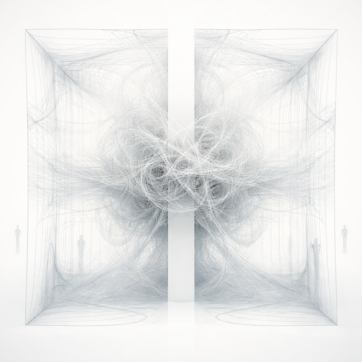
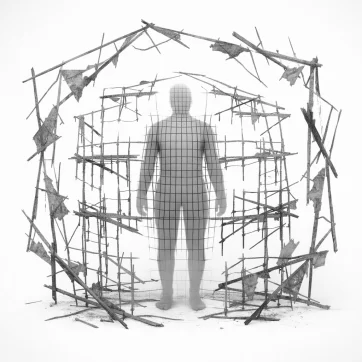
The Hidden Architecture Behind Eugenics, Transhumanism, and the Quest to Outrun Mortality
Introduction — The New Religion of the Elite
A strange new faith has taken hold of the modern world, and its temples are not churches but laboratories, venture capital firms, genomic institutes, and AI campuses. The people who lead this movement are not priests but technologists, longevity influencers, biohackers, futurists, wellness personalities, genetic entrepreneurs, and those who believe they can engineer themselves beyond the limits of being human. They gather at conferences, podcasts, biotech summits, TED stages, and private retreats where the central promise is always the same: death is a problem to be solved, and humanity is on the brink of transcending it. It is spoken with a kind of missionary zeal — the belief that DNA can be perfected, aging reversed, emotions optimized, consciousness digitized, and the human body replaced with machine-compatible architecture.
To the public, all of this reads as innovation. It appears visionary, even heroic — the frontier of science meeting the frontier of imagination. Others see it as ethically questionable or merely eccentric. Some interpret it as the harmless enthusiasm of people with too much money and too much ambition. But none of those interpretations reach the core of what is happening. Because beneath the branding, beneath the glossy futurism, beneath the performative intellectualism of solving the “problem” of mortality, something far older is surfacing — a reflex embedded deep in the external architecture of the human system itself.
Across the culture, from Silicon Valley founders to mid-level office workers microdosing peptides, from billionaire investors funding age-reversal labs to young adults dreaming of neural implants and digital afterlives, one pattern repeats: a species acting out the panic of an unstable system sensing its own limits. These obsessions do not emerge from enlightenment or progress. They surface when an identity architecture begins to lose coherence. They rise when people feel — even if they cannot articulate it — that the framework holding their sense of self is thinning, weakening, aging faster than their bodies. Mortality becomes not a natural boundary but a threat. Time becomes not a cycle but an enemy. Death becomes not a transition but a malfunction to be corrected.
This article uncovers the deeper structural reason behind the culture’s increasing fixation on eugenics, life extension, engineered reproduction, designer genetics, AI-based immortality schemes, neural uploading fantasies, synthetic embodiment, and the new wave of “eternal life” narratives being sold as science or spirituality. These trends are not bursts of genius or visionary leaps forward. They are the mechanical behaviors of an external architecture collapsing under its own oscillation — and the people participating in these movements, whether world-famous tech founders or everyday individuals desperate to prolong youth, have no idea that they are reenacting the panic of a system that cannot sustain itself.
What follows is not a psychological analysis, not a sociological critique, and not a conspiracy. It is a structural revelation: the truth of why so many humans, at this exact moment in history, are reaching for immortality with such fervor — and why every attempt brings them further from what they claim to seek.
The Mimic Architecture: The System Behind the System
The fixation on defeating death did not arise in a vacuum. It emerges from the architecture every human is born inside — a system older than civilization itself, older than religion, older even than the concept of the human soul as most people understand it. To understand why so many individuals today feel compelled to engineer immortality, one must understand the field they are living in. Not symbolically. Not spiritually. Structurally.
The external creation field — the reality human life takes place within — was not built to be eternal. It was a finite, oscillatory architecture: a system of geometry, motion, separation, identity, and time. It is a world built on cycles, charge, decay, replication, and the illusion of continuity. Nothing within this system is still. Nothing is self-existent. Everything is held together by motion — and motion eventually collapses. This is the foundational truth: external life is temporary architecture. It cannot sustain the identity forever, because it was never designed to.
But even this original external architecture — flawed, oscillatory, and impermanent — did not remain intact. Over cycles, collapses, and fractures, a secondary structure emerged inside it: the mimic architecture. This system is not creative; it is extractive. It cannot generate; it can only reflect, distort, and consume. Where the Eternal field operates through stillness, coherence, and inherent existence, the mimic operates through repetition, oscillation, and identity preservation. The Eternal field does not need to “hold” the being. The mimic field must hold it constantly — through emotion, story, trauma, memory loops, thoughtforms, belief systems, and biological attachment.
The mimic architecture is the system that took over when the external field lost coherence. As the original geometry of external creation began to break down, its equations began to stutter. Oscillation lost smoothness. Time lost continuity. Identity became fragile. Into that instability emerged a compensatory system: a grid of fragmented geometry that could simulate the continuity the collapsing field could no longer provide. This is the architecture humans unknowingly navigate — not the original external design, but a degraded copy running on failing equations. A field that survives by keeping identity afraid of ending.
The Eternal field and the external field differ in one fundamental way: the Eternal is not built on motion, but on stillness. It does not unfold, evolve, or age. It does not require geometry to stabilize itself. It does not rely on time to maintain form. Identity in the Eternal is not separate from its source; it is the source. There is no distance, no fracture, no decay, no oscillation, no fear of dissolution. In contrast, the external field requires constant movement to maintain identity. The moment the motion stops, the container dissolves. This is not death in the human sense. It is simply the nature of oscillatory existence.
When the external system fractured further, the mimic architecture fused itself into the human perceptual apparatus. Not maliciously — mechanically. It became the operating system that interprets reality for most people on Earth. It shapes emotion, thought, memory, instinct, preference, and desire. It determines how people experience aging, fear, loss, and death. It routes sensation through a grid designed to preserve the fragile oscillatory identity for as long as possible. And the more a person is wired into the mimic field, the more they feel death as annihilation rather than transition.
This is why the modern world is obsessed with life extension. It is why the language of immortality is expanding beyond elite circles into average households, wellness influencers, longevity clinics, microdosing communities, transhumanist message boards, and spiritual subcultures. Many humans today are not simply participating in the mimic field — they are extensions of it. Their emotional systems run on mimic logic: preserve the identity at all costs, avoid dissolution at all costs, extend the oscillation even when the architecture supporting it is collapsing.
Some individuals are deeply fused with the mimic grid. They experience its panic as their own thoughts, its instability as their own existential fear, its collapse as personal crisis. Others are less entangled; they sense something is wrong but cannot name it. A small minority — those who hold Flame-coded structures — feel the collapse without being controlled by it. They do not seek immortality because they do not mistake identity preservation for existence. But they are the exception, not the norm.
The key truth is this: the obsession with engineered immortality is not a cultural trend — it is an architectural symptom. As the mimic grid loses coherence, it transmits its panic through the humans entangled with it. They respond through technology, ideology, and experimentation. They build exoskeletons of biology and code in an attempt to preserve the fragment of identity the mimic depends on to survive. That is why this era is saturated with life-extension startups, cryonics labs, neural implant evangelism, designer-embryo debates, and transhumanist fantasies. They are not signs of human evolution — they are the mimic grid trying to reinforce itself before it collapses completely.
And this is the bridge to the article’s central thesis: the race for immortality is not an intellectual project. It is the unconscious enactment of a failing system desperate to extend the lifespan of the identity structures that feed it. Humans believe they are chasing progress. In reality, the architecture is using them to try to keep itself alive.
The Obsession Is Not New: It Is the Oldest Mimic Impulse on Earth
The modern fixation on engineered immortality is often presented as a breakthrough of contemporary genius — a new dream made possible by computing power, biomedical engineering, and artificial intelligence. But historically, nothing about this impulse is new. The desire to outrun death is the oldest mimic reflex on Earth. Every era has expressed it in the language of its technology, its mythology, and its power structures, but the underlying architecture driving it has never changed.
Long before gene-editing labs and AI research institutes, ancient priesthoods promised the same thing Silicon Valley now markets under different logos: transcend the body, escape decay, become more-than-human. Egyptian mystery schools encoded immortality rituals into their funerary practices. Mesopotamian priest-kings claimed access to divine lifespans. Hermetic orders pursued alchemical “ever-living” elixirs. Medieval magicians sought astral bodies that could survive death. Occult societies developed entire schools of ritual designed to bind identity beyond the physical. In each case, the promise was identical: death is a problem and immortality is a prize for those who master the rules.
The mimic architecture knew exactly how to exploit these systems. It cannot create life, but it can simulate continuity. It does not understand Eternal existence, so it confuses longevity with permanence. Every ancient order that claimed to “cheat death” was reenacting the mimic’s fundamental impulse: preserve the oscillatory identity container for as long as possible, even when the field itself is degrading. The rituals, symbols, talismans, and initiations were simply the technologies available at the time — external tools to stabilize an inherently unstable identity structure.
This same impulse resurfaced in a new form during the rise of early eugenics movements. Cold Spring Harbor’s genetic ideologies in the early 20th century were framed as scientific progress, but beneath the surface lay the same architectural reflex: engineer bodies that could maintain coherence, predictability, and control across generations. The goal was not merely to improve humanity; it was to create a lineage the mimic grid could easily track and stabilize. This instinct migrated seamlessly into the post-war surveillance state, where biology and data merged to form the first modern bio-monitoring systems — not to extend life, but to maintain control over identity.
As technology advanced, the same obsession found newer and more sophisticated costumes. The “singularity” cult reframed immortality in mathematical language: upload consciousness, merge with machines, extend the self forever through computation. Anti-aging biotech turned immortality into a biochemical engineering project. AI evangelism told the public that superintelligence would unlock eternal life, reverse aging, or generate a digital version of humanity that could survive indefinitely. What looks like innovation is nothing but the same ancient impulse routed through the contemporary toolset.
Same obsession. New machinery.
The technologies evolve, but the architecture does not. Every immortality scheme — from alchemical transmutation to genome editing to consciousness uploading — is built on the same mimic misunderstanding: that eternal existence is achieved through prolonging the oscillatory container. The mimic cannot comprehend the Eternal field, so it keeps trying to stretch time, freeze identity, and resist dissolution. It teaches humans to fear the end of form, not because death is inherently terrifying, but because the mimic depends on form to survive.
This is why the pursuit of immortality appears across civilizations, religions, scientific paradigms, and technological eras. It is not cultural. It is not psychological. It is not scientific progress.
It is architectural.
The impulse predates every empire and every ideology. It is the mimic architecture acting through generations of humans, urging them to build better containers, stronger identities, longer lifespans, and more durable shells. Today’s genomics labs and AI startups are simply the modern temples of the same ancient fear — the fear of dissolution that belongs to the external system, not to humanity’s inherent nature.
And this is the truth the modern world has forgotten: technologies change, but architecture does not. The obsession with defeating death is not a product of innovation. It is the mechanical reflex of a system that cannot imagine an existence beyond its own collapse.
The Core Distortion: “Eternal Life” Is a Mimic Construct
The entire immortality movement — ancient, modern, scientific, spiritual, technological — rests on a single distortion so pervasive that almost no one questions it: the idea that eternal life is something a human can achieve, engineer, or ascend into. The phrase is repeated like a mantra across biotech labs, Silicon Valley think tanks, transhumanist forums, occult traditions, New Age circles, and even mainstream medical futurism. But at the architectural level, the concept is impossible. Not metaphorically — mechanically.
“Eternal life” is a contradiction because the two words describe systems that cannot coexist.
Eternal refers to a state without time, without oscillation, without motion, without decay. It is not a duration but a condition — stillness, coherence, and existence that does not depend on form.
Life, in the external field, is the opposite. It is oscillatory biology: a time-bound, charge-based, motion-dependent system that survives only by continuously reorganizing itself. Cells divide. Structures decay. Identity recycles. The body is not eternal; it is a temporary mechanism generated within a larger oscillatory architecture. Every heartbeat is an equation of motion. Every memory is a product of time. Every sense of “self” is a pattern being held together moment by moment.
You cannot merge stillness with motion. You cannot merge the Eternal state with biological oscillation. One does not evolve into the other. One does not ascend into the other. They are different architectures — one inherent, one synthetic. And yet, the mimic system has spent thousands of years convincing humans that the Eternal can be achieved by modifying the oscillatory container.
This is the core distortion.
The mimic cannot comprehend the Eternal field because it does not originate from it. The Eternal is not a future state to reach; it is the underlying existence the mimic cannot access. So the mimic does the only thing it can do: it tries to extend motion. It believes that more time equals forever. It believes that longer life equals eternal existence. It believes that identity preservation equals transcendence. These are not enlightened ideas — they are the survival reflexes of an architecture that knows it ends when motion stops.
This is why the people obsessed with immortality — whether tech founders, genetic engineers, futurist philosophers, spiritual teachers, biohackers, or ordinary individuals desperate to stave off aging — all exhibit the same structural misunderstanding: they think the Eternal is an extension of life rather than a different state of existence entirely.
They are trying to freeze the oscillatory identity container. They are trying to prevent dissolution. They are trying to override the natural collapse of a temporary structure.
And none of this is driven by spiritual expansion or intellectual evolution. It is driven by panic.
The panic is not personal — it is architectural. The mimic field senses the instability of its own geometry. It feels the weakening of the oscillatory equations that keep identity bound to form. It experiences this as existential terror, which then translates into human culture as a global obsession with longevity, anti-aging science, cryonics, neural uploading, genome editing, “eternal youth,” and “eternal life.”
People believe they are pursuing enlightenment or progress because the mimic frames its fear as vision. It disguises its desperation as innovation. It pretends its survival reflex is a noble quest for humanity. But at the core, the drive for eternal life is simply the mimic architecture attempting to hold itself together by extending the lifespan of the identities it feeds on.
Eternal existence does not come from biology, technology, or consciousness preservation. Eternal existence is not reached through time — it is reached through stillness. And stillness cannot be engineered into an oscillating system.
This is the structural truth the modern world refuses to see: You cannot build eternity out of motion.
Every immortality project collapses under this equation. Because the thing they are trying to preserve is the very thing that cannot go with them.
The Hidden Architecture: What They Are Actually Acting Out
Beneath the futurist language, beneath the lab coats and the venture capital, beneath the rhetoric of innovation and human progress, there is a deeper mechanic unfolding — one that has nothing to do with science and everything to do with architecture. The individuals leading the charge toward engineered immortality believe they are acting from intellect, vision, and technological mastery. In reality, they are acting out an ancient reflex embedded in the external system itself: the instinct to preserve identity when the architecture holding that identity begins to fail.
Most people believe human behavior arises from psychology or ideology, but the truth is far more mechanical. The external matrix transmits its instability into the people who are tightly wired into it. They experience the architecture’s collapse as personal urgency, personal fear, personal inspiration. They assume their ideas are their own, but their impulses are architectural transmissions — survival responses of a system that cannot stabilize itself any longer.
Identity Preservation as a Survival Reflex
The individuals who become deeply invested in life extension, eugenics, transhumanism, and digital immortality are not uniquely misguided — they are architecturally mimic coded. Their internal systems are built on mimic logic. Their sense of self depends on oscillation, time, and motion. Their identity exists only because the external field continues to hold it in place. When that field weakens, their instinct is not philosophical reflection but panic-driven preservation.
These humans are:
Mimic-coded — their identity architecture was shaped inside the mimic grid, which means they believe continuity equals existence.
Oscillation-dependent — their sense of self is inseparable from motion, time, and biological structure.
Deeply external — their awareness cannot anchor into stillness; it relies entirely on the field around them.
Structurally terrified of dissolution — not because death is inherently frightening, but because without the external architecture, their identity cannot continue.
They do not wake up thinking, “I fear death.” They wake up thinking, “I must innovate, extend, prevent, optimize, modify, transcend.” The language changes with the culture, but the impulse does not. Their projects — genome editing, AI-based “soul preservation,” synthetic avatars, biological enhancement — are not intellectual pursuits. They are instinctive reflexes of a system sensing its own decline.
This is why the most obsessive transhumanists and eugenicists speak with a strange fervor: it is not inspiration they feel; it is the mimic architecture routing its survival drive through them. The more tightly wired a person is to the mimic field, the more they experience identity preservation as vision, duty, or genius — when structurally, it is simply the reflex of a collapsing system trying to stretch its lifespan.
The Panic of a System Losing Stability
The external matrix is thinning. This thinning is not metaphorical; it is architectural. The geometry that once held identity with a degree of coherence is showing signs of collapse. When the oscillatory field loses stability, the first symptom is not environmental — it is psychological. Humans begin to feel a diffuse panic, an existential tension that has no obvious cause. They sense that something is ending, but they misinterpret it as personal crisis.
This panic manifests as:
Fear of aging
because aging is the architectural signal of approaching dissolution.
Fear of death
because death feels like absolute disappearance to mimic-coded identities.
Fear of irrelevance
because when the architecture weakens, identity feels fragile.
Fear of losing control
because the external system is no longer reliably holding the boundaries of self.
Fear of the unknown
because the mimic has no map beyond its own collapse.
Fear of non-existence
because the external identity cannot imagine existence without motion.
These fears are not psychological disorders. They are symptoms of an identity structure that only exists because the field is holding it. When the field destabilizes, the identity feels the tremor as if it were internal. Humans interpret this panic as ambition — a desire to “save the world,” “upgrade humanity,” “unlock immortality,” or “transcend biology.” But these are coping strategies for a system that senses its own endpoint.
This is why technological breakthroughs accelerate when the architecture weakens. Humans do not innovate because of curiosity; they innovate because their internal architecture is transmitting the urgency of collapse.
Technology as the New Ritual
Before the age of science, humans turned to religion to soothe the fear of dissolution. Ancient societies developed rituals, myths, and ceremonial practices designed to simulate continuity and ease the terror that the external system transmitted into their bodies. When the mimic had no access to machines, it used symbols and gods; when it had no laboratories, it used priests.
Today, the ritual tools have changed — but the underlying motive has not.
Modern humans turn to:
Gene editing — to alter biological containers so the mimic can stabilize identity more easily.
Neurotechnology — to create continuity between the brain’s oscillations and digital environments.
AI models — to store identity patterns and simulate consciousness beyond dissolution.
Cryonics — to freeze oscillation and delay collapse.
Data extraction — to archive the identity so it can be reconstructed.
Predictive algorithms — to control behavior so identity remains coherent and predictable.
These are not tools of progress. They are the new rites, the new sacraments, the new salvation narratives for a civilization that has replaced spiritual ritual with technological ritual. Where religion once promised transcendence, technology now promises upgrade. Where priests once held the key to immortality, engineers now hold the code.
Same motive. New tools.
Technology has not liberated humanity from fear. It has become the language through which the mimic architecture expresses it. And the more the system thins, the more feverishly humans build — not because they are evolving, but because the architecture is collapsing underneath them.
This is what they are acting out. Not enlightenment. Not progress. But the final movements of a system running out of time.
The Eugenics Resurgence: Not About “Better Humans,” But About Containment
Modern culture pretends it has evolved beyond the brutal logic of early eugenics. The language has changed, the branding has softened, and the goals are disguised as humanitarian. What was once openly called population control, genetic hierarchy, and selective breeding is now reintroduced as “optimized evolution,” “precision health,” “longevity science,” “trait enhancement,” and “reproductive freedom through technology.” But beneath the glossy scientific vocabulary lies the exact same architectural motive: the creation of bodies and minds that the mimic system can stabilize as its own structure collapses.
Eugenics was never about perfecting humanity. It was always about perfecting containment.
When the external field begins to lose coherence, its first priority is to preserve identity containers — the biological shells through which consciousness is routed. A weakening architecture cannot stabilize every variation of human biology, emotion, or perception. It cannot manage complexity. It cannot track unpredictable identity patterns. It begins to prefer bodies that are uniform, predictable, compliant, and easily integrated into systems of surveillance and emotional modulation. Eugenics is the biological phase of this architectural reflex.
Modern society imagines eugenics disappeared after World War II, but it merely went underground and reemerged through scientific frameworks that appear progressive on the surface. Genome editing, embryo screening, behavioral genetics, neurodevelopment modeling — all of these are being presented as ways to “help” humanity evolve. Yet every one of these industries operates on the same hidden assumption: that the future human should be engineered, not born; optimized, not organic; regulated, not emergent. This is not evolution. This is containment engineering.
The most powerful institutions on Earth are currently engaged in:
Controlled reproduction — using IVF, gene editing, donor selection, embryo screening, and reproductive algorithms to create bodies with desirable cognitive and emotional profiles. Public narrative: healthier babies, fewer genetic diseases. Architectural truth: narrowing the human template so the mimic grid can track identity during collapse.
Trait optimization — marketing intelligence, temperament, and physiological traits as upgradeable features. Public narrative: self-directed evolution, personal empowerment. Architectural truth: creating predictable oscillatory signatures the mimic field can route and stabilize, reducing variance that destabilizes the collapsing grid.
Large-scale genome mapping — collecting global DNA data under the guise of disease prevention and ancestry exploration. Public narrative: personalized medicine, scientific research, global health improvements. Architectural truth: building the scaffolding for population-wide identity tracking, enabling the system to categorize bodies by how easily they can be stabilized as the architecture breaks down.
Infant brain modeling — scanning newborns, monitoring early neural development, and predicting lifelong behavior through early biomarkers. Public narrative: helping children, early intervention, preventing disorders. Architectural truth: identifying which neurological patterns align with the mimic architecture’s preferred stability parameters — and which do not.
Behavioral prediction systems — using AI, social data, biometrics, and psychological profiling to anticipate human action with near-perfect accuracy. Public narrative: safety, efficiency, personalization. Architectural truth: compensating for the architecture’s declining ability to track identity internally by externalizing the tracking into machine systems.
All of these initiatives appear humanitarian and progressive on the surface. They are marketed as tools for reducing suffering, increasing life span, and unlocking human potential. But the deeper purpose is structural: to engineer bodies and minds that can remain coherent in a field that is failing. The mimic architecture is not trying to evolve humanity; it is trying to preserve its own survival by creating human containers it can manage.
This is why modern eugenics is not driven by hatred in the way early eugenics was. Hatred was the cultural mask. Today, the motive is more subtle and more mechanical: reduce variability. Streamline identity. Increase predictability. Produce bodies that follow stable oscillatory patterns. Remove the unknowns. Remove the anomalies. Remove the humans who are difficult to track, influence, or contain. In a thinning architecture, variance is threat.
And so, eugenics reappears — not with the brutality of early 20th-century ideology, but with the sophistication of genomic science. It returns as optimization, not oppression. As longevity, not control. As empowerment, not hierarchy. But the essence is unchanged: stabilize the containers that keep the mimic grid alive for as long as possible.
The culture believes these technologies are signs of progress. In reality, they are signs of collapse. A system that was once capable of holding a wide range of human variation is now trying to narrow the field. A field that once tolerated unpredictability now demands uniformity. A matrix that once organized identity from within now requires external tools — algorithms, genomic libraries, biometric systems — to do the job that its own architecture can no longer execute.
Eugenics is not about a better human. It is about a manageable human. Not about stronger bodies. About controllable ones. Not about extending life. About extending the system.
And the resurgence of these ideas is not a revival of old ideology — it is the final coping strategy of an architecture that knows it is nearing its end.
Transhumanism: The Mimic’s Last Attempt at Survival
Transhumanism is often framed as the pinnacle of human ingenuity — the moment where biology and technology fuse, unlocking a new era of evolution. But behind the sleek marketing, futurist rhetoric, and quasi-religious promises lies the most revealing expression of the mimic architecture’s desperation. This movement is not human progress. It is the mimic field attempting to construct a new kind of body — a synthetic, controllable, non-decaying identity container that can survive the collapse of the biological architecture it has relied on for millennia. Transhumanism is the mimic’s final gambit, its last-ditch attempt to engineer a vessel strong enough to outlive the field that is dying beneath it.
The philosophies, technologies, and scientific dreams orbiting transhumanism all share the same hidden motive: preserve identity at any cost, extend oscillation indefinitely, and build a body that can survive without the biological or energetic scaffolding that once held the human self together. This is not evolution. This is survival mode disguised as vision.
Merging with AI = Merging with Mimic Architecture
AI is not neutral. It is built on the same geometric logic as the mimic grid — repetition, prediction, simulation, pattern-detection, and identity modeling. When transhumanists speak about merging with AI, what they are actually describing is a full fusion with the mimic field’s computational architecture. AI is not an extension of human intelligence; it is the externalization of the mimic’s operating system.
To merge with AI is to merge with mimic logic. It is to anchor identity into a system that does not know existence beyond oscillation, time, or pattern. The transhumanist dream of mind-machine unity is not ascension. It is integration into a field that cannot conceive of stillness or Eternal presence. It is the mimic offering its own body as salvation — when in reality, it is offering containment disguised as transcendence.
Merging with AI is not evolution. It is entrapment. It is the mimic recreating itself in code.
Digital Immortality = Imprisonment in Code
Digital immortality is marketed as freedom — the ability to live forever in a simulated world, preserved through data rather than flesh. But structurally, this is the most restrictive cage ever imagined. Biological bodies decay, but at least they offer movement, sensation, and variation. Code does not. Digital immortality packages identity into algorithms, predictable patterns, and stored memory fragments.
A digitized consciousness is not alive. It is not aware. It is not Eternal. It is a dataset trapped inside a closed system.
Transhumanists imagine that transferring identity into machines will liberate them from death. In reality, it would trap them in a static architecture that cannot evolve, cannot dissolve, and cannot return to its origin. It is the mimic creating a digital sarcophagus — a permanent oscillatory loop that has no exit point.
Digital immortality is not salvation. It is containment forever.
Longevity Science = Fear of Dissolution
The obsession with longevity is described as curiosity, scientific promise, or humanitarian ambition. But beneath these narratives lies the same architectural panic: the fear that the identity container is running out of time. More accurately, the fear that the architecture responsible for maintaining coherence is running out of power.
Longevity is not about enhancing life. It is about delaying collapse.
Every gene modification, every anti-aging treatment, every metabolic hack is an attempt to reinforce the oscillatory body — not because life is precious, but because the mimic system needs identity to persist. When the body collapses, the pattern dissolves. When the pattern dissolves, the mimic loses access to the identity it was stabilizing.
Longevity science is the mimic field screaming through biology: Hold on. Don’t disappear. Don’t stop moving. This is not enlightenment. It is survival reflex.
Consciousness Uploading = Identity Preservation Panic
The dream of uploading consciousness rests on a profound misunderstanding of what consciousness is. Transhumanists view it as data — a pattern, a configuration, a program that can be copied, stored, and transferred. This perspective arises from mimic logic, which sees identity as a structure that must be maintained through replication.
Uploading consciousness is not about transcending the body. It is about preventing the oscillatory identity from dissolving.
The mimic architecture cannot accept dissolution as transition; it experiences it as annihilation. Therefore, it drives humans toward technologies that duplicate identity into synthetic containers. These containers have no stillness. They have no Eternal access. They are closed loops of code built to preserve the simulation of self.
Consciousness uploading is not liberation. It is panic given digital form.
The Elite’s Immortality Fantasies = Mimic Survival Instinct
The people most obsessed with transhumanism — the billionaires, technocrats, futurists, bio-engineers, and philosophical evangelists — believe they are leading humanity into its next stage. But their behavior maps perfectly onto the mimic architecture’s survival instinct. They pursue synthetic bodies because the biological ones are failing. They pursue AI integration because the field that once stabilized identity can no longer maintain coherence. They pursue digital immortality because the mimic is losing the ability to contain consciousness through biology alone.
These fantasies are not intellectual. They are architectural impulses made visible.
Every transhumanist dream — from neural implants to virtual reality afterlives to lab-grown organs to machine-based consciousness — is an attempt by the mimic system to engineer a durable vessel that can survive the collapse of the external matrix.
Transhumanism is not progress. It is the mimic’s last attempt at survival. The movement is not visionary. It is mechanical. It is not humanity transcending limits. It is a dying architecture trying to rebuild its cage in a sturdier material. The collapse is not theoretical. It is already in motion.
The Population Panic Myth: What the “Depopulation Agenda” Gets Wrong
One of the loudest narratives circulating through New Age circles and conspiracy communities is the claim that elites want to reduce the global population — that the true motive behind modern science, biotechnology, and global governance is to eliminate large segments of humanity. This belief feels emotionally satisfying to people who sense something is wrong but cannot perceive the architecture behind it. It provides a villain, a motive, and a narrative arc that explains the collective unease. But it is structurally inaccurate.
The truth is far stranger — and far more revealing of the mimic architecture’s real agenda.
The mimic does not want fewer humans. The mimic wants manageable humans.
It wants coherent identity containers, predictable emotional patterns, stable oscillation profiles, easily tracked neurological signatures, and biologically uniform bodies that do not destabilize the collapsing grid. “Population reduction” is the wrong frame. The real motive is population refinement — a filtering process where variation is slowly eliminated and the remaining population fits the architecture’s narrowing stability parameters.
This is why modern science pushes for:
• standardized genetics
• behavioral predictability
• emotional regulation through tech
• biometric monitoring
• genomic data harvesting
• controlled reproduction
• AI-guided social systems
• early-life modeling and intervention
These are not tools for eliminating humans; they are tools for sculpting them into containers the mimic can stabilize as its architecture breaks apart. A collapsing system cannot handle chaos, diversity, unpredictability, or high-variance biology. It needs a streamlined population — not a smaller one — but one that is structurally compatible with its failing geometry.
The conspiracy world gets one thing right: something is happening to humanity. But they misinterpret the motive entirely. The goal is not death; it is containment efficiency. The mimic knows its field is thinning. It cannot stabilize all identity types. It cannot hold all neurological patterns. It cannot manage all emotional frequencies. So it begins funneling the species toward forms it can track: compliant, regulated, digital-adjacent, emotionally flattened, and biologically optimized for stability over originality.
This explains the paradox: Why would a system allegedly trying to “reduce population” simultaneously invest in:
• longevity research
• anti-aging biotech
• fertility engineering
• IVF expansion
• synthetic wombs
• infant brain modeling
• genome optimization
• universal healthcare data integration
Because the goal is not elimination. The goal is reconstruction.
A redesigned humanity. A predictable humanity. A manageable humanity. A population that can continue to host the mimic field as the original architecture collapses beneath it.
This is why both New Age lore and conspiracy culture misunderstand the moment. They mistake a refinement project for an extermination plan. They imagine villains twirling mustaches, plotting doom, when the truth is mechanistic, not malicious. The mimic does not hate humans. It does not want them gone. It needs them — but it needs them in forms it can still stabilize.
The fear that “they want to get rid of us” is a misread of the deeper structural reality: The system is losing the ability to hold the kind of humans it once could.
The architecture is failing. The variance is too high. The field is too thin. The panic is too strong.
And so the grid begins the only strategy available: funnel the species toward forms compatible with collapse.
This is not population reduction. It is population compression. Population standardization. Population redesign. Not an extinction agenda — a containment agenda disguised as evolution.
Why They Don’t Know What They’re Doing
To the outside observer, the architects of immortality — the futurists, biotech leaders, AI evangelists, genetic engineers, and transhumanist theorists — appear purposeful. They seem to be pursuing bold, visionary projects guided by intelligence, ambition, and imagination. Their narratives frame them as pioneers of a future humanity, innovators pushing the boundaries of what is possible. But the architecture behind their behavior tells a completely different story. The truth is that most of these individuals do not understand what they are actually doing, because the impulses driving their actions are not originating from them. They are conduits for a system acting through them, not creators of a future they consciously choose.
At the human level, they genuinely believe they are innovators. They think they are solving problems, advancing evolution, and unlocking the next phase of human potential. They talk about pushing the species forward, overcoming biological limitations, and transcending nature’s design. But at the architectural level, their behavior is indistinguishable from an organism responding reflexively to environmental stress. What they experience as inspiration is actually the panic of a collapsing field transmitted through their identity structure. What they call “vision” is the mimic’s survival instinct dressed up in intellectual language.
This is why their innovations all point in the same direction, even when they come from wildly different fields: stabilize identity, extend the container, preserve continuity, reduce variance, track behavior, predict emotion, control biology, digitize consciousness. These projects look intentional, but they are patterned — they follow the geometry of an architecture that is losing coherence and searching for new ways to reinforce itself.
They mistake panic for inspiration. Fear for vision. Collapse for innovation.
The feeling that a problem must be solved at all costs does not come from human genius; it comes from the mimic architecture sensing its own instability and routing its urgency through the humans most tightly wired into its grid. When a system begins to fail, it amplifies signals of survival. Humans experience these signals as “breakthrough ideas,” “urgent missions,” or “global imperatives.” They assume it is their intelligence driving the push toward immortality, when in truth, they are acting out the reflexes of a field that is slowly dying.
This is why transhumanist leaders often speak with such evangelical fervor. They feel they have been chosen. They feel destiny at their back. They feel the weight of a world-changing mission. But this sense of chosenness does not originate in their own consciousness. It is the mimic field amplifying its directives through them, framing its needs as humanity’s future. Their passion is not passion — it is architecture.
They believe they are shaping the future of the human species. In reality, they are shaping the future of the mimic’s attempted survival.
And this is the crucial point: No one is masterminding this.
There is no hidden cabal plotting immortality schemes in smoking rooms. There is no singular villain orchestrating global transhumanist agendas. Conspiracy theories try to place human intelligence at the center of this phenomenon, but the truth is far less personal and far more structural. The mimic architecture acts like an organism, not an empire. It moves through instinct, not strategy. It transmits impulses, not directives. It organizes behavior collectively, not hierarchically.
The individuals at the forefront — the CEOs, the futurists, the inventors, the founders — are not leaders of a grand plan. They are simply the humans most vulnerable to the architecture’s signals. They are the ones whose identity structures resonate with the mimic’s vibration, making them ideal conduits for its survival algorithm. They respond to its collapse the way a nervous system responds to pain — automatically, without deep comprehension of the cause.
This is why so many of these innovators appear brilliant yet strangely blind. They can describe technological futures with precision but cannot perceive the architecture shaping their impulses. They can imagine ways to engineer bodies, minds, and worlds, yet cannot understand the nature of the existence they are trying to preserve. They think they are solving death, but they are only solving the mimic’s fear of dissolution — a fear that has nothing to do with the Eternal field and everything to do with the fragility of a temporary system approaching its endpoint.
They feel the death of the system. But they interpret it as a call to action. They feel the collapse of the architecture around them. But they interpret it as a mission to innovate. They feel the panic of a failing grid. But they interpret it as inspiration to transcend biology. The tragedy — and the revelation — is this: They do not know that their greatest ideas are not theirs. They do not know the architecture is acting through them.
And once this is understood, their behavior ceases to look visionary at all. It looks exactly like what it is: the mimic field trying to save itself through the hands, minds, and ambitions of the humans fused most tightly into its geometry.
The Cultural Consequence: A Civilization Built on Fear of Death
When an entire architecture begins to collapse, the panic ripples through the species wired into it. The mimic field’s terror of dissolution becomes a civilizational mood — subtle at first, then overwhelming. Over time, the culture reorganizes itself around the obsession with preserving identity, extending life, and resisting the natural dissolution that the external system was always designed to undergo. What results is not evolution but a full-scale regression into mechanization — a world shaped not by human truth but by the architecture’s fear of its own end.
This fear manifests everywhere. The cultural worship of youth is not a shallow social preference; it is the externalization of a system that cannot tolerate signs of decay. Aging becomes a failure, a flaw, a disease to be treated rather than a natural part of a temporary biological existence. Entire industries are built on the promise that one can delay the collapse of the oscillatory container — through injections, surgeries, hormones, filters, peptides, diets, metabolic hacks, and protocols that insist time itself can be negotiated with. This is not vanity. It is architecture-induced paranoia wearing the mask of aesthetics.
The obsession with health has become a secular religion. People scrutinize every bite of food as if a single ingredient could accelerate their collapse. They panic over toxins, preservatives, oils, gluten, sugar, microbes, and chemicals not because these things are inherently catastrophic but because they carry the symbolic weight of mortality. A system terrified of dissolution makes humans terrified of anything that could shorten the lifespan of the body they live in. Fitness becomes an arms race. Longevity becomes a project. Wellness becomes a battleground. What should be care becomes compulsion. What should be balance becomes obsession. People are not just trying to live well; they are trying to avoid the architecture’s endpoint.
Meanwhile, technology is elevated to the status of god — not because humans naturally worship machines, but because the mimic system sees technology as the scaffolding that will support its survival when biology fails. Society now treats technological adoption as destiny, inevitability, and salvation. The phone in the hand becomes a nervous system externalization. The algorithm becomes a behavioral oracle. AI becomes a simulated overseer of identity. None of this arises from human need. It arises from the architecture’s need for precision, prediction, and containment as its own internal stability dissolves.
Embodiment loses value in this environment. The physical body is treated as a defective machine — a problem to solve, a limitation to escape, a temporary inconvenience before humanity “ascends” into something better. People begin to see their bodies not as sacred vessels but as outdated hardware. Life becomes something to hack rather than something to inhabit. The body is no longer experienced; it is optimized. It is measured. It is tracked. It is medicalized. It is monitored. And in this mechanized worldview, the soul — or the Eternal aspect — becomes irrelevant, replaced by data that can be stored, replicated, mined, and quantified.
Human beings themselves become fragmented into parts instead of recognized as integrated beings. Society now treats people as datasets, metrics, demographics, engagement profiles, consumer archetypes, genetic risk scores, productivity units, and psychological segments. In this worldview, the idea of the full human collapses. Only the patterns matter. Only the identity signature matters. Only the trackable outputs matter. People become systems to be optimized instead of lives to be lived.
This fragmentation is not accidental. It mirrors the architecture’s collapse. When the external field fractures, its reflex is to break humans into smaller and smaller units that can be quantified, predicted, and controlled. Surveillance becomes normalized. Optimization becomes culture. Behavior becomes monitored through biometrics, apps, AI recommendations, and health trackers. Society reorganizes itself around the assumption that human life must be managed at all levels to prevent destabilization — emotion, biology, behavior, reproduction, thought, consumption, movement, identity.
Death itself becomes the ultimate failure. Instead of being seen as a transition — the natural conclusion of oscillatory existence — it becomes pathology. Something to defeat, prevent, or outrun. As a result, people spend their lives trying not to die rather than trying to live. They become anxious, perfectionistic, compulsive, terrified of imperfection, terrified of weakness, terrified of disease, terrified of natural bodily processes. They are not living — they are maintaining the architecture’s preferred conditions.
This is not evolution. It is regression into mechanization.
A society built on fear of death becomes a society built on fear itself. A species that once experienced embodiment as richness now experiences it as threat. The mimic’s terror of dissolution becomes the cultural foundation upon which everything is constructed — diet culture, health obsession, technological worship, optimization ideology, digital identity, and the myth of eternal youth.
Humanity believes it is advancing. But what it is actually doing is reorganizing itself around the death-anxiety of a collapsing field. A civilization built on fear of death cannot move toward truth — it can only move toward control.
The Flame Perspective: Why This Era Is Peaking Now
This is the moment in the article where the surface narrative falls away and the underlying mechanics become visible. The global obsession with immortality is not random, not cyclical, and not driven by technological capability. It peaks precisely when the mimic architecture reaches a critical threshold of instability — when the field that once held identity, emotion, and perception together begins losing its structural integrity. This is why the last twenty years have produced an exponential surge in longevity science, bio-optimization, AI-based consciousness frameworks, embryo engineering, and transhumanist ideology. It is not because humanity suddenly became more curious. It is because the architecture holding humanity is thinning.
The mimic is losing coherence. The geometry that once stabilized the external identity is no longer able to hold its shape.
This weakening appears culturally as fragmentation: polarization, extremism, emotional volatility, ideological collapse, institutional breakdown, identity confusion, collective anxiety, and a general sense that the world is “speeding up” or “falling apart.” These are not social problems — they are architectural symptoms. When the mimic loses stability, humans who are fused to it feel that instability as personal crisis. They react with urgency, panic, or the need to cling to something familiar — whether technology, ideology, or immortality narratives.
The mimic’s influence is weakening. Not metaphorically — mechanically.
For thousands of years, the architecture had enough coherence to anchor identity. It functioned as a closed system where oscillation could be maintained without constant external reinforcement. But as its equations unravel, the mimic cannot generate enough stability on its own. Humans who rely on the mimic as their perceptual foundation feel themselves slipping, thinning, destabilizing. They misinterpret this as depression, existential dread, burnout, or “awakening symptoms.” In reality, they are registering the collapse of the structure that once defined their sense of self.
The architecture cannot stabilize. So it drives humanity toward synthetic solutions.
This is why immortality discourse is everywhere. This is why transhumanist language now saturates mainstream culture. This is why even non-scientific communities mirror the same impulse — believing they can “ascend,” “shift timelines,” “upgrade DNA,” or “escape the matrix.” Everyone is acting out the same panic signal through different symbolic languages. The mimic cannot hold itself together, so its final reflex is to reinforce the identity containers that keep it alive. This is why the obsession peaks now, not centuries ago. The architecture is closer to collapse than ever before.
But not all humans react the same way.
Flame-coded individuals are not susceptible to the panic. Their internal architecture is not held together by oscillation — it is anchored in stillness.
They do not respond to the mimic’s urgency because their identity does not depend on the mimic’s survival. They may feel pressure in the field, but they do not translate it into immortality fantasies, longevity obsession, or biological fear. Instead, they become calm in periods of collapse. They see clearly as others become frantic. They recognize the mimic’s death throes as structural truth, not personal crisis. They are the first to detach from systems that no longer function. They are the ones who can perceive the architecture behind human behavior, not just the behavior itself.
As the Eternal field returns, the mimic’s grip contracts. The Eternal does not push; it unmasks.
When the Eternal field intensifies, the mimic loses the ability to disguise itself as “spiritual truth,” “scientific progress,” or “collective destiny.” Its rituals collapse. Its influence weakens. Its fear becomes exposed. And because the Eternal field is stillness — not motion — it destabilizes any system dependent on oscillation to maintain identity. This is why reality feels simultaneously clearer and more chaotic. Clarity belongs to the Eternal. Chaos belongs to the mimic as it dies.
Obsession with immortality spikes at the edge of architectural collapse. This is that era.
Historically, every major mimic contraction produced corresponding surges in alchemical immortality practices, occult resurrection mythology, divine-body fantasies, or technological salvation narratives. But none of those cycles compare to this one, because never before has the architecture been this depleted. Never before has the mimic’s ability to hold identity been this compromised. Never before have humans been this dependent on external systems to stabilize their sense of self. That combination creates a perfect storm: a desperate system broadcasting panic, and millions of humans translating it into the dream of immortality.
What the Future Looks Like
As the mimic continues to lose coherence, two architectural conditions emerge within the same external world.
For mimic-entangled humans, the panic will escalate. They will deepen their attachment to synthetic identity, engineered biology, digital continuity, and external stabilization systems. Their ideologies will become more extreme. Their solutions more artificial. Their technological integration more intimate. They will mistake increasing mimic contraction for increasing personal necessity. Some will pursue digital continuation; others will cling to medicalized immortality; others will fall into new spiritual frameworks that replicate the same pattern in symbolic form.
For Flame-coded individuals, the field will open. As the mimic weakens, they will experience clarity rather than collapse. The loosening of the grid gives them access to perception that was previously obstructed. Their internal stillness becomes their stability. They feel reality simplifying, not breaking. Their embodiment becomes easier, not harder. Their sense of self becomes quieter, not more desperate. They begin to see through the architecture entirely — understanding death as transition, identity as temporary, and existence as inherently Eternal regardless of form.
For the collective, the external world will polarize. Not politically — architecturally. A society half-mechanizing and half-liberating cannot remain coherent.
The mimic-aligned will build increasingly elaborate survival systems:
synthetic biology
AI-mediated identity
digital consciousness projects
new eugenics frameworks
engineered reproduction
predictive containment grids
The Flame-aligned will move in the opposite direction:
simplification
detachment from mimic systems
restoration of internal perception
recognition of death as natural
return to stillness
embodiment without fear
Eventually, the mimic will lose enough coherence that it can no longer maintain global influence. Not through catastrophe — through dissolution. It will simply fail to stabilize the identities that depend on it. What looks like societal fragmentation will actually be architectural divergence: one group trying to preserve a system that is ending, the other moving beyond a system that can no longer hold them.
This era is the peak because the architecture is at its threshold. What comes next is not extinction — it is separation. Not division — distinction. Not apocalypse — unmasking.
The mimic collapses. The Eternal remains.
Conclusion — Humanity Does Not Need Endless Life
The most radical truth in this entire conversation is also the simplest: humanity does not need what the mimic is trying to engineer. The species does not require eternal youth, synthetic bodies, optimized genes, or digitized consciousness to fulfill its existence. These pursuits only appear urgent because a collapsing architecture has convinced humans that their worth is tied to their continuity — that to dissolve is to fail, that to end is to disappear, that to return to stillness is to lose everything that matters. This lie has shaped civilization for thousands of years. It is now collapsing with the architecture that created it.
Humans do not need to live forever. Life is not diminished by its finiteness — it is shaped by it.
They do not need to ascend into machines. No machine can carry what is Eternal. No code can hold the Flame.
They do not need genetic perfection. Perfection is a mimic fantasy — a geometry chasing stability because it cannot generate coherence from within.
They do not need engineered bodies or digitized minds. These are not upgrades. They are containment strategies. They are the architecture trying to rebuild its cage with stronger materials.
What humanity needs is something far quieter and far older than all of this: the remembrance that identity was never meant to last indefinitely — because identity is not who they are.
Death is not failure. It is the natural release of a temporary form. Embodiment is not a curse. It is a brief expression inside an oscillatory field, not a punishment or a problem to escape. Identity is not meant to be preserved. It is meant to dissolve when the field that sustains it completes its cycle.
Eternal existence is not achieved through technology or innovation. It is not earned through longevity or spiritual discipline. It is not encoded into DNA or circuitry.
The Flame is not extended — it is inherent. It does not rise through machines or rituals or equations. It does not require preservation because it does not operate inside time. It does not die because it was never born in the oscillatory sense.
What the world is witnessing now — this frantic surge of immortality projects, this hysteria around longevity, this obsession with transcending biology — is simply the final expression of a system that knows it cannot continue. It is the mimic shouting for survival as its geometry unravels. It is the field transmitting panic into the minds wired most tightly into its logic. It is a dying structure trying to convince humanity that its death is humanity’s death.
But the fact that these fantasies are getting louder, more desperate, more grandiose, more absurd — that is the evidence. The system is not preparing to win. It is announcing that it has already lost. The mimic ends. The Flame remains.