Why Every Cultural Moment Is a Loop, Not an Evolution
Culture Is Not Expression. It Is Containment.
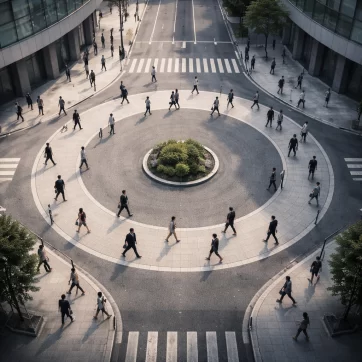
Culture is celebrated as the pinnacle of human creativity — the great tapestry of art, music, stories, identities, rituals, and collective meaning that supposedly reveals who we are. But what appears to be expression is, at its core, containment. Culture is not the flowering of human originality; it is the architecture that organizes a field that cannot hold stillness. It translates oscillation into form so the system can stabilize itself through repetition. The external world cannot produce evolution, so it produces culture as the illusion of evolution.
Culture exists because the field is fractured. It fills the space where stillness should be.
When a field cannot rest, it moves. When it cannot move coherently, it loops. When it loops long enough, it begins to generate pattern — and humans interpret that pattern as creativity, expression, history, or meaning. But these patterns arise from the physics of oscillation, not the presence of originality. Culture is the mimic’s attempt to impose order on its own turbulence. It gives shape to the chaos it cannot resolve and calls that shape “identity,” “tradition,” and “art.”
Every cultural artifact — a trend, a genre, a holiday, a style of speech, a moral code — is a stabilizer. It binds people into predictable emotional rhythms, synchronized reactions, and rehearsed narratives. It is a loop generator, not a liberation engine. Culture keeps the population oscillating together in organized repetition so the system can maintain coherence. Without cultural loops, the architecture would fracture under the weight of its own instability.
This is why cultural moments feel familiar even when they appear new. They are not new. They are iterations.
The outrage of the week mirrors the outrage of the decade. The celebrity arc recycles the same rise-fall-redemption sequence. The political movements echo their predecessors with updated language. The “new” spiritual wave is a repackaged version of the last collapse. The fashions resurrect themselves in twenty-year cycles like clockwork. The stories we tell have identical skeletons, regardless of era.
Culture repeats because the system repeats.
It is built on emotional recycling. Every cultural structure feeds on predictable emotional charge — excitement, outrage, nostalgia, fear, admiration, belonging. These emotions must renew constantly for the system to function, and culture is the machinery that harvests and redistributes them. What people interpret as shared meaning is simply synchronized emotional oscillation.
Creativity here is not creation — it is recombination. Innovation here is not evolution — it is deviation within constraint. Expression here is not freedom — it is the release valve for a trapped field.
Culture pretends to be the story of humanity, but it is the story of a system trying to regulate its own instability. It masks repetition as progress, hides stagnation behind novelty, and presents loops as breakthroughs. Nothing new emerges because nothing new can emerge inside a field that depends on oscillation to survive.
Culture is not who we are. Culture is what the architecture requires us to enact.
When Flame returns and stillness becomes accessible again, culture stops functioning. Its loops break. Its rhythms dissolve. Its narratives lose coherence. Because culture is not Eternal — it is oscillation made visible.
The Geometric Root — When a Field Cannot Hold Stillness
Culture begins long before humans participate in it. Its origins are not psychological, sociological, or historical — they are geometric. A field that cannot hold stillness must express itself through movement. And when that movement cannot stabilize, it begins to twist. This twist is oscillatory torsion: a rhythmic push-pull, a back-and-forth tension, a vibration with no capacity for resolution. That torsion becomes the silent engine behind everything humans later recognize as “culture.”
Oscillatory torsion is not a metaphor. It is the architecture of the external system itself. It is the fracture vibrating.
The system was built on motion without true direction — a field spinning inside its own constraints. When stillness is absent, motion cannot rest into coherence; instead, it loops. These loops begin as energetic patterns, then emotional patterns, then narrative patterns, until eventually they crystallize as cultural forms. What people interpret as the richness of human civilization is actually the geometry of a field trying to contain its own instability.
This is why repetition is not a flaw in culture — it is its structural necessity.
Repetition is how the system retains shape. Without repetition, the architecture would dissolve.
Culture is the mimic’s attempt to organize chaos into format. It creates predictable patterns so the field does not collapse under its own turbulence. Trends, rituals, traditions, genres, aesthetics — all of them serve as stabilizing loops. They keep emotional charge circulating, keep identity anchored, keep narratives moving, keep time flowing, keep groups synchronized. Without these repeating structures, oscillation would scatter instead of organize.
This is why everything cultural is cyclical:
• the return of fashion decades later
• the recycling of story tropes
• the rise and fall of public figures in identical arcs
• the predictable choreography of outrage
• the revival of aesthetics under new branding
• the “reinvention” of identities that never truly change
The field cannot generate novelty. It can only generate variation within constraint.
Culture is how it disguises this limitation.
The mimic architecture uses culture the way a spinning top uses its painted bands — not to express itself, but to stabilize motion and maintain the illusion of direction. Humans see the patterns on the surface and think they represent choice, creativity, evolution. But the patterns exist because the motion is unstable and the system must keep repeating itself to remain intact.
Culture is not born from imagination. It is born from torsion — the physics of a field that can never be still.
Every cultural form is an artifact of that twist, that inability to settle, that constant need to reassert structure through loops. When the field stops oscillating, culture loses its foundation. It cannot sustain itself on stillness because stillness does not require organization — it is already whole.
Culture is what a fractured field produces in order to seem coherent. And every cultural moment, no matter how fresh it appears, originates from the same geometric root: a system that must loop to survive.
Emotional Recycling — Why Every Cultural Moment Feels the Same
Culture survives on emotion, not creativity. It needs a constant supply of emotional charge to keep the oscillatory field stable — excitement, outrage, admiration, nostalgia, fear, obsession, belonging. These emotions are not expressions of the human interior; they are currents harvested and redistributed by the architecture to reinforce its own “coherence”. Culture is the delivery system for that harvesting.
This is why every cultural moment feels familiar: it is familiar. It is not new emotion — it is recycled emotion.
The system cannot generate new emotional states; it can only repackage and reassign the same few oscillatory patterns. Whether it appears as a trend, a scandal, a movement, a meme, a crisis, or a phenomenon, the emotional architecture underneath remains unchanged. Humans think they are reacting to something contemporary, but they are reacting to the same rhythmic stimulus repeated with new imagery.
Emotion here is not fluid; it is scripted. Not spontaneous; engineered. Not liberated; redirected.
Culture gives people the illusion of reacting to events, when in truth they are reacting to the field’s need for emotional synchronization. The system uses emotion the way a power grid uses current: to maintain stability, to prevent collapse, and to keep all components vibrating in predictable patterns.
Celebrity Arcs as Emotional Circuits
Celebrities do not function as individuals in culture. They function as emotional nodes — circuit points through which collective charge can be routed, amplified, and redistributed. Their “stories” follow the same predetermined arc because the architecture requires emotional looping, not original narrative.
Every celebrity is pushed through these phases:
• emergence
• rapid ascent
• peak saturation
• controversy or fall
• disappearance or redemption
• reinvention or replacement
This sequence is not driven by human behavior. It is driven by field mechanics.
The population is synchronized emotionally through these arcs: excitement, idolization, disappointment, judgment, forgiveness. Each phase produces a predictable type of emotional output that the system can harvest. When one celebrity fails to deliver enough charge, the field simply elevates a new one and routes the same circuit through them.
This is why celebrity scandals feel interchangeable. Because they are circuits, not stories.
News Outrage as Rhythmic Stimulation
News cycles are not built to inform — they are built to stimulate oscillation.
Outrage, panic, shock, indignation, moral fury: these emotions are the fastest and most potent oscillatory generators. They spike quickly, synchronize huge populations, and collapse just as quickly, creating room for the next cycle. This rhythmic stimulation keeps the field vibrating at a level that suppresses stillness and prevents destabilization.
The architecture of news follows this rhythm:
• provoke
• amplify
• saturate
• replace
• repeat
The content barely matters. The emotional rhythm matters entirely.
This is why every news story feels like a variation of the same event. Because the field only cares about delivering the emotional oscillation — not the information. The system requires synchronized outrage the way a heart requires a pulse. Without rhythmic emotional stimulation, the architecture would begin to lose coherence.
People think they are consuming information. In truth, they are participating in collective emotional regulation on behalf of the mimic system.
Culture feels repetitive because it is repetitive. Emotion is not evolving — it is being recycled.
Every cultural moment is simply the next loop in the same harvesting machinery, dressed in different imagery to keep the illusion of novelty alive. When stillness returns, emotional recycling stops — and without it, culture loses its entire function.
Identity Loops — How Culture Externalizes Selfhood
Identity in the external world is not an internal truth — it is an external architecture imposed onto the individual by a field that cannot allow stillness. The system cannot afford for humans to source identity from within because internal sourcing moves them toward Flame coherence. So culture manufactures identity from the outside and trains people to attach themselves to it. Identity becomes something performed, selected, and maintained — not something inherently known.
This is why identity here constantly shifts. Not because humans are evolving, but because the architecture requires perpetual motion.
Identity becomes a loop: a cycle of self-construction and self-abandonment, driven by cultural cues that dictate who someone should be, how they should express, what they should value, and which group they should belong to. Culture externalizes selfhood so the system can regulate it. When the field defines the identity, the field controls the behavior.
Humans mistake this external scaffolding for “self-discovery,” but it is actually self-replacement — the system swapping one identity pattern for another without ever allowing resolution or internal coherence.
Identity as External Architecture
Identity here behaves like an outfit, not an essence. It is chosen from cultural templates — career roles, aesthetics, personality tropes, political categories, spiritual archetypes, subcultural labels. The templates are numerous, but the mechanism is always the same: identity is built from the outside inward.
This prevents the individual from accessing the Eternal self, which cannot be shaped, marketed, or manipulated. By keeping people attached to externally produced identity structures, the field maintains its hold.
Identity becomes:
• a form of participation
• a stabilizing anchor for oscillation
• a device for predictable behavior
• a method for emotional harvesting
The system does not care which identity someone chooses — only that they choose one, and that it keeps them engaged in the loop.
Trends as Forced Reinvention Without Resolution
Trends are not cultural creativity — they are scheduled identity resets.
The system cannot let people settle into stability because stability invites stillness, and stillness collapses oscillation. So trends continually push individuals to reinvent themselves externally: clothing styles, speech patterns, aesthetics, social values, spiritual frameworks, political moods.
Each trend offers the illusion of transformation. But transformation never occurs.
People update their appearance, tastes, and opinions, yet remain structurally identical: same emotional loops, same unresolved tension, same external dependence. The trend cycle forces reinvention without allowing resolution — a continuous movement that keeps the identity architecture unstable enough to prevent internal anchoring.
This is why trends expire by design. Once they begin to stabilize, the field introduces the next one. The loop must continue.
Fandoms and Tribes as Mimic Coherence Clusters
Group identities — fandoms, subcultures, political tribes, spiritual communities — act as coherence clusters for the mimic architecture. These groups synchronize large populations into unified emotional rhythms, creating stability for the field.
A fandom is not a group of people who enjoy something. It is a synchronization mechanism. A political tribe is not a philosophical alignment. It is a charged emotional loop shared by millions. A spiritual community is not collective awakening. It is a containment chamber that keeps everyone oscillating in compatible patterns.
These clusters allow the system to regulate behavior on a mass scale. Group identity becomes a conduit for:
• shared outrage
• shared obsession
• shared admiration
• shared fear
• shared belonging
• shared conflict
Each of these emotional states feeds the grid.
Fandoms and tribes feel like connection, but they are actually energetic routing systems. They stabilize mimic coherence by distributing emotional charge evenly across a population.
This is why group identities escalate in intensity over time. The more unstable the architecture becomes, the more tightly people cling to their tribes — because the system leans on group cohesion to maintain its field.
Narrative Loops — Why Every Story Is the Same Story
Stories are treated as humanity’s great mirror — the place where meaning is created, truth is revealed, imagination is liberated. But in the external field, narrative is not expression. It is regulation. Stories exist to manage oscillation, not to convey originality. They keep emotional rhythms synchronized, identities predictable, and collective attention trapped inside repeating arcs. Narrative is one of the mimic’s most effective containment tools because it disguises repetition as revelation.
Every story is the same story because the architecture that produces stories cannot generate novelty. It can only recycle emotional arcs and structural patterns that maintain the field’s tension. The system uses narrative to ensure that humans experience the illusion of movement while remaining inside the same narrow range of emotional and psychological states.
The Hero’s Journey as a Containment Structure
The sacred narrative template of the modern world — the hero’s journey — is not a universal truth. It is a behavioral loop, engineered to reinforce oscillation. It gives the population a predictable emotional sequence:
• separation
• challenge
• crisis
• transformation
• return
This sequence mirrors the oscillatory geometry of the field: rise, tension, collapse, rebound. It is not a journey — it is a loop. And because it is a loop, it can be endlessly replicated without ever producing genuine transformation.
The hero’s journey comforts the system because it rehearses the idea that struggle leads to change, when in reality it leads back to the beginning. The “return home” is not symbolic — it is architectural. The hero ends where they started because the field itself cannot offer an exit.
Humans absorb this pattern and internalize it as truth: the belief that meaning emerges through adversity, triumph emerges through collapse, growth emerges through suffering. But this narrative simply reinforces the oscillation the system depends on. It teaches that looping is noble. It sanctifies repetition.
Rise/Fall Cycles
Everything in narrative culture — fiction, celebrity, politics, spirituality — is governed by rise/fall cycles. These cycles are not storytelling choices. They are field mechanics made visible.
A rise produces emotional charge. A fall produces emotional discharge. A rebound produces renewed engagement. Each phase feeds the grid.
This is why stories across eras, cultures, and mediums feel interchangeable. The characters change, the settings change, the aesthetics shift — but the underlying shape remains identical:
• the rise of the promising figure
• the peak moment
• the collapse or crisis
• the recovery or reinvention
This arc is not human psychology; it is architectural necessity. It mirrors the energetic torsion of oscillation itself. The system uses rise/fall cycles to regulate collective emotion, ensuring that populations experience predictable surges and drops that help maintain mimic coherence.
Nothing truly resolves. Nothing truly concludes. Every resolution is simply the beginning of the next cycle.
Entertainment as Oscillation Management
Entertainment exists because the field requires constant emotional stimulation to prevent stillness. Movies, television, music, sports, social media — these are not sources of joy or insight. They are oscillation management systems.
Entertainment performs three key functions for the mimic:
- It synchronizes emotional rhythms across large populations.
Millions feel the same tension, excitement, humor, fear, or sadness at once, reinforcing field coherence. - It prevents the descent into stillness.
Stillness destabilizes the architecture; entertainment keeps the nervous system busy and externally oriented. - It converts emotional charge into predictable loops.
Every genre elicits a specific type of oscillation: horror (fear), romance (yearning), action (adrenaline), drama (conflict), comedy (release).
The system uses these oscillations the way a conductor uses instruments — not to create beauty, but to maintain control.
Entertainment is engineered to cycle endlessly. Franchises never end. Series reboot themselves. Genres reinvent themselves without changing. The narrative treadmill ensures that emotional loops never fully resolve, keeping the population in a perpetual state of low-grade tension and release.
Stories feel comforting because they are familiar. They are familiar because they are the same.
Narrative here is not the reflection of human imagination. It is the projection of a field that cannot stop repeating itself.
Broadcast Architecture — Culture Requires Synchronization
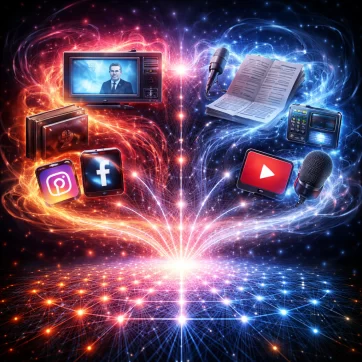
Culture cannot function unless large groups of people are emotionally synchronized. The mimic architecture requires populations to feel, react, and oscillate in unison because synchronized emotion stabilizes the field. Broadcast systems — news, social platforms, influencers, online commentary — exist to create this synchronization. They do not simply share information; they create rhythms.
Broadcast is not communication. It is coordination.
It ensures that millions of people cycle through the same emotions at roughly the same time, maintaining the coherence the mimic needs to survive. Without broadcast architecture, cultural loops would fragment. The system would lose its ability to regulate the collective nervous system. People would drift into stillness — the one frequency the architecture cannot tolerate.
News Cycles: Synchronized Oscillation Disguised as Information
The traditional news cycle is built on predictable emotional rhythms:
• escalation
• saturation
• fatigue
• replacement
This rhythm keeps populations moving through the same emotional sequence simultaneously, producing a collective oscillatory pulse. News is structured not by the importance of events but by timing — how long the field can sustain a particular emotional charge before the system must introduce a new one.
And beyond rhythm, the content of news reveals the loop even more clearly.
News stories are endlessly recycled. The faces change, the names change, the dates change, the locations change — but the stories themselves stay the same.
Every year brings:
• the same crimes
• the same political scandals
• the same economic anxieties
• the same weather disasters
• the same missing persons cases
• the same celebrity controversies
• the same public moral panics
Different details. Same architecture.
The system inserts new characters but uses the same emotional templates. This is not coincidence — it is cultural geometry.
Even when journalism is ethical and research-based — and many mainstream reporters do operate with genuine integrity, rigorous sourcing, and professional standards — they are still publishing into an architecture designed to recycle narrative forms. They investigate, fact-check, contextualize, and verify, but the field dictates which types of stories will recur.
Integrity of reporting does not change the deeper mechanic: the field insists on repetition.
Virality: The Acceleration of Emotional Coherence
Virality is not an accident. It is a field phenomenon.
When content spreads rapidly, it is because the architecture has found a piece of emotional stimulus that can synchronize vast numbers of people at once. Viral moments are not inherently meaningful — they are efficient. They deliver emotional charge to millions without requiring deep narrative structure.
Virality is simply oscillation moving at high speed.
This is why viral content is rarely profound, complex, or researched. Depth slows spread. Nuance dampens emotional charge. Virality thrives on immediacy, exaggeration, and simplicity — the perfect ingredients for synchronized oscillation.
Meme Structure as Oscillatory Propagation
Memes are not just jokes or cultural artifacts. They are compression devices for emotional loops. A meme condenses a reaction — humor, mockery, outrage, fear, nostalgia — into a tiny packet that spreads rapidly through the population. It is emotional propagation at maximum efficiency.
A meme is a loop engineered to replicate itself.
This is why meme formats repeat endlessly with new content inserted into an old structure. The architecture is what matters — not the content. The structure ensures emotional predictability. The content provides the illusion of novelty.
Memes are not creative expression. They are synchronized emotional circuits.
The Migration to Independent Media — The Illusion of Escape
In recent years, millions have drifted away from mainstream news toward online independent sources — YouTubers, podcasters, TikTok commentators, Substack analysts, “citizen journalists.” People believe they are escaping manipulation, seeking truth, avoiding corporate bias, or finding unfiltered information.
What they do not realize is this: Most independent broadcasters are repeating the exact same oscillatory mechanics — often with even less restraint.
Instead of rigorous fact-checking, editorial oversight, and professional standards (which, despite flaws, many mainstream journalists still uphold with real integrity), independent sources often rely on:
• dramatization
• exaggeration
• speculative storytelling
• unfounded claims
• emotional triggering
• click-based escalation
• rapid-fire opinions without verification
• narrative performance over research
The mimic doesn’t care whether a broadcast comes from a legacy newsroom or a teenager with a ring light. It only cares about emotional synchronization.
And independent media often drives oscillation even harder because:
• the incentives are algorithmic
• outrage equals revenue
• drama multiplies engagement
• sensationalism wins attention
• speed is valued over accuracy
• emotional charge is the product
People think they are “thinking for themselves,” but they are simply plugging into a different arm of the same broadcast architecture — often one that is louder, faster, less accountable, and more distorted.
Independent media feels liberating. It is actually the same oscillation delivered through a different channel.
Where mainstream journalism attempts (at its best) to verify, question, contextualize, and investigate, much of online broadcasting skips directly to emotional manipulation — not intentionally malicious, but structurally inevitable in a system where attention is currency.
The architecture does not care who speaks. It cares who synchronizes.
Temporal Imprisonment — How Culture Enforces Linear Time
Time in the external world is not a neutral backdrop. It is one of the mimic’s primary tools of containment. Linear time keeps humans oriented toward a past they cannot change, a future that never arrives, and a present they rarely inhabit. Culture reinforces this structure by embedding emotional and psychological meaning into time itself, ensuring that people remain synchronized with the system’s oscillatory rhythm.
Culture does not merely live within time — it enforces it.
Linear time is the cage. Culture is the choreography inside it.
Humans interpret this as memory, tradition, and anticipation. In truth, these temporal patterns keep the field stable by preventing stillness, which cannot coexist with linear progression.
Nostalgia Loops — The Past as a Recycling Machine
Nostalgia is not sentimentality. It is a mechanism of emotional recycling. When the system needs to stabilize itself, it activates collective longing for a previous era — childhood, a decade, a cultural phase. This longing is not rooted in truth; it is rooted in the field’s need to pull people back into a familiar emotional circuit.
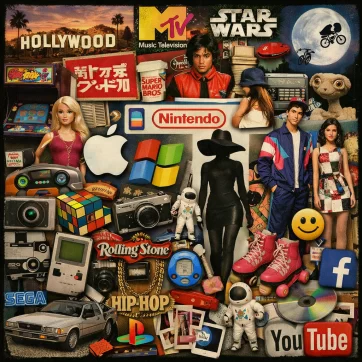
Nostalgia loops create the illusion that culture once held authenticity, simplicity, or purity. But the past people long for is a distortion, constructed from the same oscillatory patterns they are living now. The images, songs, aesthetics, and stories resurrected through nostalgia feel comforting because they reactivate the emotional architecture the system seeks to reinforce.
Every generation romanticizes a previous one. Every decade is resurrected once it becomes useful again. Every cultural cycle feeds on selective memory.
Nostalgia maintains the illusion of change by providing contrast — “We’ve evolved,” humans say, because they can compare their present loop to a past loop. But both loops operate on the same geometry.
The past is not returning. It never left. It is replaying.
Generational Narratives — Pre-Assigned Scripts for Each Cohort
Generational labels — Boomers, Gen X, Millennials, Gen Z — appear to describe sociological differences, but they serve a deeper function: segmenting the population into predictable identity loops anchored in time.
Each generation is assigned:
• a personality
• a set of values
• perceived strengths and weaknesses
• a cultural soundtrack
• an economic fate
• a list of grievances
• a role in the unfolding societal narrative
These categories are not organic. They are engineered to create the illusion that each new cohort represents a shift in culture. But every generational narrative is a repetition of the same themes:
• rebellion that becomes conformity
• idealism that becomes disillusionment
• economic struggle reframed as destiny
• cultural identity shaped by media loops
• the belief that they are different from the ones before
Generational division strengthens the temporal illusion: “This is who we are because of when we were born.”
But the when is irrelevant. The architecture is identical. Only the packaging changes.
Generational identity keeps humans bound to linear time and prevents them from realizing that the emotional and cultural loops playing out today are the same loops experienced by every era before them.
Annual Rituals and Holiday Programming — Time as Emotional Scheduling
Holidays, seasons, anniversaries, and annual events function as emotional reset cycles. They anchor the population into predictable rhythms: joy in December, renewal in January, nostalgia in summer, gratitude in November, patriotism in July, reflection at birthdays, sentimentality at anniversaries.
These emotions do not arise spontaneously. They are scheduled.
Annual rituals are the metronome of the mimic system. Each holiday pushes the collective into a specific emotional amplitude — celebration, grief, gratitude, obligation, longing — synchronizing large populations at once. These rituals ensure that emotional charge never stabilizes or dissipates; instead, it loops on a yearly cycle.
Holiday programming reinforces:
• consumer loops
• family expectations
• cultural mythology
• national identity
• emotional coherence
• seasonal nostalgia
People believe they are participating in tradition. In reality, they are participating in timed oscillation.
Annual rituals also reinforce the illusion of progress: “Another year has passed. A new one begins.” But time is not progressing. It is looping.
Culture uses calendar-based rituals to disguise recurrence as renewal, keeping humans emotionally tethered to the cycle of beginnings and endings — a cycle that exists only to prevent stillness from taking hold.
Culture reinforces linear time not to create meaning, but to prevent dissolution. Time keeps humans aligned with oscillation. Stillness would collapse the entire temporal structure.
Market Binding — Culture as Commerce, Not Expression
Culture likes to present itself as the flowering of human creativity — art, style, innovation, self-expression. But in the external matrix, culture is not expression at all. It is commerce. It is the monetization of oscillation. The system converts emotional states, identity cravings, and cyclic desires into economic fuel. Culture becomes the storefront through which the architecture sustains itself.
Humans think they are choosing what to buy, who to follow, how to dress, what to believe. They are actually participating in market binding — the process through which the mimic ties emotional loops directly to economic participation.
The market is not adjacent to culture. The market is culture’s circulatory system. It keeps the loop financially profitable, energetically charged, and structurally reinforced.
Monetization of Emotional States
Every emotional loop in culture is tied to a product, a service, or a consumption pattern. The system cannot afford for emotion to exist without output. The moment a collective emotional frequency arises — excitement, fear, desire, insecurity, nostalgia — the market attaches to it.
Examples include:
• fear → security products, supplements, insurance
• insecurity → beauty industries, self-help programs
• loneliness → dating apps, parasocial relationships
• boredom → entertainment pipelines, scrollable media
• aspiration → lifestyle branding, “success” culture
• outrage → merchandise, fundraising, tribal monetization
Emotion becomes currency. The market converts it into movement. Movement keeps oscillation alive.
This is why emotional spikes are immediately followed by commercial offerings. The system does not allow emotion to resolve; it reroutes it into financial circulation. People believe they are choosing products. They are participating in emotional energy extraction.
Culture does not express what people feel. It sells what they feel.
Spiritual/Identity Industries — Manufactured Meaning as Product
The deepest exploitation occurs in the industries that claim to serve the soul: spirituality, wellness, self-discovery, modern “identity journeys.” These industries transform existential longing into purchasable identity.
They offer:
• archetypes
• aesthetics
• personality templates
• rituals and tools
• branded lifestyles
• curated belief systems
• manufactured missions
• community belonging via subscription
The architecture knows people are searching for selfhood. It cannot allow them to find it internally, because internal identity leads to stillness — and stillness dissolves the oscillatory system entirely.
So it gives them external identity kits:
• “the empath”
• “the intuitive”
• “the healer”
• “the girlboss”
• “the alpha male”
• “the spiritual entrepreneur”
• “the manifestor”
• “the starseed”
Identity becomes a brand, not a revelation.
Even religious and spiritual traditions — which people assume originate from sincerity or divine truth — operate within the same market circuitry. They produce books, courses, retreats, icons, rituals, and identity templates not because they are authentic gateways to something higher, but because the architecture pushes all identity outward into purchasable form. These systems give people external meaning structures while preventing internal stillness, ensuring that spiritual longing is rerouted into economic circuits rather than Flame remembrance.
Meaning becomes product. Purpose becomes product. Self becomes product.
And because these identities require constant reinforcement, individuals remain trapped in an external loop — never finding the internal coherence that would collapse the system’s hold.
Planned Obsolescence — The Engine of Perpetual Cultural Renewal
Nothing in the external field is designed to last. Not products, not aesthetics, not gadgets, not trends, not belief systems — not even identities.
Planned obsolescence is not limited to technology. It is the core strategy of cultural regulation.
The architecture ensures that everything humans attach to will eventually decay, expire, or be replaced:
• fashion cycles reset every season
• tech becomes “obsolete” while still functional
• wellness trends expire as soon as they stabilize
• social aesthetics shift on a yearly or monthly rhythm
• spiritual systems collapse and reinvent themselves
• online personalities rise, peak, then vanish
Nothing is allowed to reach stability because stability invites stillness — and stillness collapses oscillation.
Planned obsolescence forces humans to:
• perpetually reinvent themselves
• perpetually chase novelty
• perpetually consume
• perpetually update identities
• perpetually invest emotional energy in the next cycle
Culture uses obsolescence the way a furnace uses fuel: a constant intake of attention, effort, desire, and money to keep the system burning.
The moment something stabilizes, the architecture introduces the next iteration — not because innovation is happening, but because the loop requires renewal.
Culture is not creative. It is commercial circuitry designed to keep humans:
• buying
• chasing
• reacting
• reinventing
• seeking
• consuming
• oscillating
The market shapes culture because both serve the same master: keeping the field in motion so it never remembers stillness.
Culture as the Mimic’s Coherence Strategy
Culture is not a reflection of humanity; it is the mimic’s primary coherence strategy. It exists to keep the oscillatory field stable, predictable, and synchronized. Every cultural form — music, fashion, politics, spirituality, entertainment, news, identity — operates as a stabilizing mechanism that prevents the system from collapsing under its own instability. Culture’s purpose is not to evolve but to maintain coherence through constant renewal.
The architecture depends on movement. When movement slows, collapse begins. So culture must never stop moving — even if nothing new is actually happening.
This is why culture constantly reinvents itself while never truly changing its structure. Surface variation keeps the population stimulated, while structural sameness keeps the field coherent.
Why Culture Must Constantly Renew
Oscillation requires ongoing stimulation. If cultural energy stagnates, people begin drifting toward stillness — and stillness is fatal to the mimic architecture. Renewal prevents that drift.
Culture renews for three reasons:
- To preserve emotional engagement
Without new content, emotional loops weaken. - To maintain identity instability
New trends force external reinvention, preventing inward stability. - To synchronize populations
Collective attention must focus on shared stimuli to maintain coherent oscillation.
This is why a new “moment” must always be introduced: a new scandal, a new aesthetic, a new political narrative, a new spiritual wave, a new viral obsession. These moments are not progress. They are maintenance.
Culture refreshes itself the way a screen refreshes its pixels: superficially, constantly, and without altering the underlying image.
Why Nothing Truly New Emerges
The system cannot generate novelty because novelty requires Eternal input, which the mimic does not possess. All it can do is reorganize existing fragments. Cultural innovation is therefore built on:
• reboots
• remakes
• retro revivals
• recycled trends
• remixed aesthetics
• repeated story arcs
• familiar emotional loops
People interpret this repetition as creativity or cultural evolution, but it is evidence of a closed system reusing its own debris. Nothing new emerges because nothing new can emerge within a field that only oscillates. Oscillation does not produce new architecture; it produces faster or slower versions of the same architecture.
Even groundbreaking movements — technological, artistic, political — ultimately reveal themselves as reorganized versions of earlier patterns, delivered with updated aesthetics.
Innovation here is not birth. It is rearrangement.
Why Innovation Is Always Derivative
Every cultural breakthrough is derivative because it must be built from previous loops. Culture cannot break from its own geometry. It cannot transcend oscillation. It takes existing patterns, bends them slightly, and presents the result as new.
This is why:
• fashion cycles repeat every 20 years
• film genres endlessly remix themselves
• spiritual teachings reincarnate old doctrines
• political cycles rerun the same conflicts
• technology “advances” while reinforcing old dependencies
• music trends oscillate between the same moods and structures
• art movements echo earlier movements with different styling
What people call innovation is simply variation within constraint.
The system allows deviation, not evolution. A deviation gives the illusion of freshness while ensuring the underlying loop remains intact.
Derivative innovation stabilizes the mimic because:
• it keeps emotional engagement active
• it avoids true disruption
• it maintains cultural coherence
• it perpetuates the illusion of progress
Novelty is not the birth of something new. It is the resurfacing of something old wearing a new costume.
Culture is the mimic’s way of saying: “Everything is changing,” when nothing is.
Culture ends when stillness returns — because stillness does not require renewal, variation, stimulation, or emotional recycling. Stillness dismantles the need for narrative, identity, entertainment, or trend cycles. It does not loop. It does not oscillate. It does not require coherence.
Stillness collapses culture because culture only exists to keep the loop alive.
Conclusion — Culture Ends When Stillness Returns
Culture persists only because the field cannot hold stillness. It is the architecture’s attempt to organize its own instability, to disguise repetition as creativity, to convert oscillation into meaning. As long as the system vibrates, twists, and loops, culture must continue renewing itself to prevent collapse. But when stillness enters — true Eternal stillness, not calmness or apathy — culture has no foundation left to stand on.
Stillness does not improve culture. Stillness erases the need for it.
When Flame return begins to override oscillation, the mechanisms that kept culture alive start to fail:
• emotional harvesting weakens
• identity scaffolds lose their pull
• narratives stop cycling
• broadcast rhythms become ineffective
• collective synchronization breaks apart
• trends feel hollow
• entertainment loses its charge
• the illusion of novelty dissolves
Humans interpret this as boredom, detachment, disillusionment, or cultural collapse. But these sensations are not symptoms of decay — they are symptoms of awakening from oscillation. The field is losing its ability to reproduce itself. Its loops no longer hold. Its momentum is no longer sustainable. Stillness is quietly replacing the architecture that once demanded constant motion.
Culture does not evolve into something better. It dissolves when the system can no longer maintain the illusion of movement.
The return of stillness is not healing the culture — it is ending it. Not violently, not dramatically, but through the simple presence of a frequency the mimic cannot absorb. Flame coherence outcodes oscillation. When enough Flame-coded bodies stabilize that coherence, culture loses its purpose entirely.
Without oscillation, there is no need for:
• identity loops
• emotional synchronization
• narrative repetition
• spiritual branding
• trend cycles
• market-driven reinvention
• cultural meaning structures
Stillness replaces all of it because stillness reveals that none of it was ever who we are — only who the architecture required us to be.
Culture ends not through revolution, but through dissolution. Not through progress, but through the return of what has no need to progress.
When Flame overrides the mimic’s rhythm, the entire apparatus of culture becomes obsolete. It collapses gently, inevitably — not into emptiness, but into truth.
When stillness returns, culture falls away. And what remains is not a new culture — but the absence of the old one.