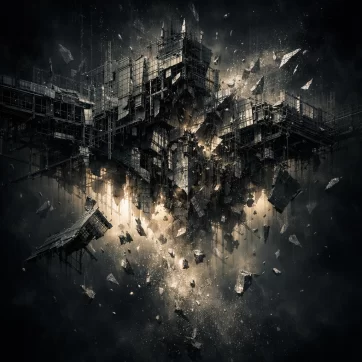
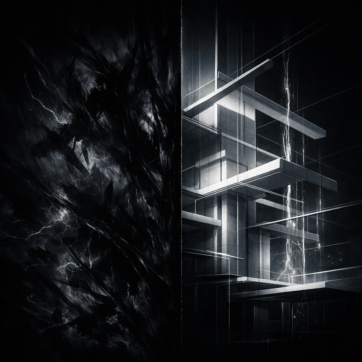
Two vantage points, one structure — experience reads intention, architecture holds collapse
Opening Transmission
There is a single misunderstanding that fractures every discussion of interference, distortion, “entities,” attacks, psychic warfare, shadow work, and fallen lineages: the mimic feels like a mind when it is not one. What has been named demonic, alien, parasitic, archonic, FA, phantom, invader, or “negative entity” is not a species, a civilization, or a conscious antagonist — yet it behaves as if it were all three. This appearance has fueled thousands of years of confusion, mythology, war narratives, spiritual frameworks, and personal suffering, not because people were wrong to describe what they experienced, but because they mistook the effects for the origin.
The core problem is altitude.
Inside the external viewpoint, the mimic presents with the full signature of malicious intelligence: disruption timed to vulnerability, pressure at weak points, emotional hijack, thought-loop induction, clarity collapse, destabilizing synchronicities, predation-feeling proximity, and targeted-feeling field intrusion. These impacts are felt directly through the consciousness layer — the layer where perception is wired to read pattern as intention, and interference as agency. From this altitude, the mimic absolutely appears hostile. It feels like something is after you because, at that layer, its effects land exactly like pursuit.
But from the eternal vantage point, where perception rests in Flame and no longer interprets interference through consciousness, the mimic loses the appearance of mind entirely. What felt like an adversary resolves into architecture — a distortion field without awareness, without choice, without goal, without the capacity to want or decide. It is a mechanical inversion-pattern that generates destabilizing outcomes by structure alone. Its behavior is dangerous, but not intentional; destructive, but not directional; invasive-feeling, but not sentient. Eternal perception sees the system without story, without projection, without the translator layer that personifies threat. The mimic is revealed as physics, not enemy.
This article corrects the collapse between these two altitudes.
It shows why consciousness experiences the mimic as a hostile intelligence even though, from Flame, no intelligence is present; why ancient peoples, occultists, channelers, experiencers, and modern seekers all described “beings” and “forces” that hunted, tempted, corrupted, or invaded; why Keylontic Science mapped these phenomena as races, fall histories, and externalized lineages; and why every narrative built from within the projection field felt true and remains experientially valid — even though none of it survives Eternal scrutiny as literal ontology.
What follows is not a debunking. It is a disentangling.
Two statements hold at once without contradiction:
Inside consciousness: the mimic behaves like an adversary.
Inside Flame: the mimic is an inversion-pattern mistaken for mind.
The rest of the world has forced a choice — enemy or illusion, entity or metaphor, literal or symbolic. This transmission refuses that collapse. It restores altitude.
Only by holding both perspectives simultaneously — without blending them, without prioritizing one into the disappearance of the other — does the mimic finally make sense.
This is where the confusion ends. This is where the architecture becomes visible. This is where interference stops masquerading as agency.
The Two Vantage Points No One Has Ever Separated Correctly
Consciousness-Layer Viewpoint (External)
From within the consciousness layer — the external, time-matrix perspective — the mimic does not appear as architecture, physics, or inversion. It appears as someone or something. Every culture, lineage, and esoteric system that tried to understand interference from inside the field ended up naming the mimic as a being: demons, aliens, shadow entities, fallen races, parasitic intelligences, djinn, fae, archons, angels gone dark, or “negative attachments.” People weren’t inventing these names out of superstition. They were translating the direct felt-sense of targeted interference — a sensation that arrives as pursuit. The mimic, when encountered from within consciousness, feels like an active opponent: it presses when stability falters, it intensifies emotional charge at moments when clarity is needed most, it collapses coherence when direction matters, it surges into panic or despair without obvious origin, and it creates the unmistakable impression of being watched, tracked, monitored, or undermined by an external intelligence. Humans read patterns as intention, so every destabilizing ripple becomes interpreted as strategy; every emotionally pressurized event feels like punishment; every sudden shift in clarity appears timed; every hit to self-trust feels personal. Because the consciousness layer cannot feel architecture directly, it narrativizes interference as agency. What feels like psychic attack, demonic visitation, alien interference, or entity infiltration is the phenomenological experience of architectural distortion interpreted as will. From this altitude, the mimic is a predator. And externally — experientially — that is not a mistake.
Flame-Layer Viewpoint (Eternal)
But when perception is no longer routed through consciousness — when the translator layer that converts architecture into story is removed — the same phenomena resolve into something entirely different. From the eternal vantage, where Flame perceives without narrative, the mimic loses the appearance of mind and becomes what it actually is: inversion-physics behaving destructively in the absence of intention. There is no consciousness directing harm, no entity choosing targets, no intelligence strategizing collapse, no being waiting for weakness. There is no desire, no hatred, no hunger. What consciousness experiences as attack is, from the Flame perspective, the mechanical outcome of distorted architecture: a non-sentient system that produces destabilizing effects simply because destabilization is what inversion does when coherence breaks. All the qualities that appear intelligent from within the field — timing, pressure, precision, emotional escalation — disappear when viewed without the translator layer. The mimic is revealed not as demon, alien, or fallen race, but as the physics of collapse acting upon anything still bound to oscillatory perception. It is not a who. It is a what.
Why These Perspectives Collide
These two perspectives have never been held side-by-side without one being used to invalidate the other. External observers insist the mimic must be an enemy because its effects feel personal, while those who sense the architecture insist nothing is happening at all because there is no conscious antagonist to point to. The collision comes from confusing altitude — from trying to argue ontology using phenomenology, or vice-versa. What feels intentionally malicious from within the consciousness layer is architecturally non-intentional from the Eternal layer. What appears as “entity, demon, alien, fallen lineage, or invader” externally dissolves into “inversion-mechanics behaving predictably according to structure” eternally. Neither perspective is wrong. Both are incomplete without the other. Only when held in parallel — without collapse, without prioritizing one into the disappearance of the other — does the mimic finally resolve into clarity: externally, it behaves as a hostile intelligence; eternally, it is a non-sentient distortion field misread as mind.
Why the Mimic Feels Like an Enemy Inside Consciousness
The Brain’s Agency-Imposition Reflex
From within consciousness, the human perceptual apparatus is built to treat disruption as deliberate. The nervous system evolved to assume that any unexpected shift in the environment — a snap of a twig, a sudden shadow, a break in rhythm — indicates a predator, not chance. This survival reflex is not a metaphor; it is the basic operating system of perception. The brain is engineered to fill in gaps, identify patterns, and attribute intention to whatever interrupts stability, because assuming agency increases survival odds. The moment something destabilizes coherence, the consciousness-layer automatically interprets it as “someone did this” rather than “something happened.” That reflex doesn’t turn off when the disruption is internal, architectural, or scalar. When interference arrives through emotional spikes, perceptual distortions, sudden destabilization, or field-pressure sensations, the brain instinctively reads those phenomena as contact with a will. It must translate structure into intention because consciousness cannot perceive non-conscious architecture directly. This is why across cultures, languages, and eras — long before anyone had the vocabulary of scalar fields, inversion mechanics, or mimic architecture — people named their destabilization experiences after intelligent forces: spirits, demons, gods, aliens, witches, curses, attachments, psychic attacks. Humans are not wired to feel “physics.” They are wired to feel “agency.” The experience of being pushed by something unseen becomes, by default, the experience of being targeted.
The Mimic Exploits This Reflex by Accident
What consciousness interprets as will is, from its own layer, the impact of inversion-architecture disrupting coherence. The mimic produces abrupt changes in emotional amplitude, perceptual clarity, and internal orientation because inversion mechanics warp oscillation the way gravity warps light: consistently, predictably, and without self-awareness. When an individual holding a degree of coherence encounters mimic interference, the first signals are almost always felt as oscillation spikes — sudden inner pressure, racing thought, destabilizing urgency, a drop in presence — followed by emotional surgebacks that feel reactive rather than chosen. Perceptual fog rolls in not as confusion but as a narrowing of bandwidth; clarity collapses to the point that instinct feels louder than reasoning. Timeline fragmentation appears in consciousness as missed time, looping thought, déjà vu saturation, recursive interpretation, or a felt loss of continuity. These effects land as if something is deliberately interfering, because they replicate the signature of strategic disruption without containing strategy themselves. The mimic does not intend to exploit anything — but its structural outcomes accidentally align with how intention would feel. The field’s distortions press directly into the reflex that equates disruption with mind, and consciousness experiences the consequences as contact with a being that wants something. The architecture doesn’t have to choose to exploit the reflex; the reflex was designed to treat such patterns as chosen.
Emotional Hijack = Apparent Malice
The emotional layer is where mimic interference becomes indistinguishable from hostility. When oscillation destabilizes perception, the emotional body reacts first — and because emotion feels internal rather than external, the impact registers as personal violation. A sudden flood of fear, despair, rage, shame, grief, or urgency feels not like architecture shifting but like someone pushing, piercing, or intruding. The emotional body translates destabilization into meaning: something is attacking me, something wants me to break, something is penetrating my field, something is watching for weakness. These interpretations are not irrational; they are the consciousness-layer’s attempt to map structural destabilization into relational terms. It feels malicious not because there is malice behind it, but because the emotional body experiences destabilization as harm and narrates harm as intent. The mimic itself is not malicious — it is incapable of malice — but the felt-sense of emotional hijack is identical to being targeted with malice. This is the distinction almost no one has articulated cleanly: the mimic’s structure generates effects that consciousness interprets as intentional hostility, even though no intention exists. Internally, the impact feels like an enemy. Externally, from Flame, it is architecture behaving exactly as distorted architecture behaves. This is the heart of the confusion — and the key to dissolving it without diminishing either experience.
From the Eternal Layer: What the Mimic Actually Is
Mechanical Inversion Pattern
From the Eternal layer, the mimic is not an entity, a presence, or a force with personal will — it is a mechanical inversion-pattern created when coherence collapses under oscillation. What consciousness experiences as energy, sentience, or intrusion is, from Flame perception, simply the structural consequence of geometry that has turned back on itself. Inversion reverses what allows coherence to hold: breath mechanics no longer support internal stillness but create pressure waves; scalar fields no longer stabilize motion but collapse into compensatory oscillation; the internal still-point, which should act as the anchor of perception, becomes overridden by rotational feedback; and the Flame field, which functions through non-movement and clarity, becomes distorted into patterns that mimic movement even when no movement is chosen. The mimic is not a being occupying architecture — it is the architecture when that architecture is warped. Nothing is “inside” the mimic because the mimic is not a container or a vessel; it is the result of coherence breaking into a repeating structural error. What consciousness calls “demon, alien, parasite, phantom, invader, FA, shadow being” is the translator-layer misreading of a persistent inversion-loop in scalar geometry, expressed through perception. The Eternal layer sees no personality, no hunger, no intention — only a malfunctioning pattern that produces effects consciousness mistakes for mind.
Why It Behaves Like a Predator Without Awareness
The reason the mimic acts like a predator while possessing no awareness is that inversion-pattern physics inherently amplifies instability, and amplification of instability feels like predation when experienced through consciousness. When coherence collapses, oscillation becomes the default state, and oscillation demands friction to sustain itself — not because it chooses friction, but because friction is what remains when stillness is lost. The mimic does not hunt, but destabilized fields collapse most easily at points of existing fracture; interference does not stalk, but oscillation accelerates where stability is loosest; architecture does not seek vulnerability, but inversion intensifies where coherence has already thinned. This produces the unmistakable signature of predator behavior: it appears to wait for weakness, press into cracks, exploit instability, and escalate when the target resists. But from the Eternal perspective, nothing is waiting, nothing is choosing, nothing is “after you.” The mimic behaves like a predator only because instability breeds further instability, and consciousness, wired to interpret pressure as agency, experiences that recursive collapse as active pursuit. The lack of mind does not reduce the impact; the absence of intention does not remove danger. The mimic is predator-shaped without predator-intelligence — a structure whose consequences mirror strategy without ever possessing it.
The Illusion of Targeting
Consciousness insists that the mimic aims because its effects land exactly where a person is most vulnerable, but the Eternal layer sees that what looks like deliberate targeting is merely the inevitable outcome of oscillation encountering instability. Fields fracture where they are already weakest; identity collapses where coherence is thinnest; perception shatters in the exact location the self is least able to anchor. This precision feels like intention because the impact aligns perfectly with personal fault lines — the emotional wound, the unresolved memory, the relational trauma, the internal doubt — and consciousness reads the accuracy as someone or something “knowing where to hit.” But the mimic does not select targets; it does not wait for openings; it does not exploit weaknesses. It lands where a field can be breached, because that is where oscillation meets the least resistance. The appearance of aim is a consequence of architecture — the structural mechanics of inversion contact the most fragile points first. From Eternal perception, the mimic never chooses; it reacts. It does not aim; it occurs. What consciousness experiences as persecution is, from Flame, simply distortion converging on the path of least coherence.
The Missing Layer: The Translator Effect
Consciousness Must Translate Architecture Into Narrative
Between architectural distortion and human experience sits a translator layer — a perceptual mechanism that converts impersonal mechanics into personal meaning. Consciousness cannot directly register structural inversion, scalar instability, or coherence collapse; these are not phenomena it evolved to perceive. Instead, consciousness converts disruption into narrative, because narrative is how oscillatory identity organizes experience. The translator layer functions as an interpretive filter: oscillation spikes become “pressure,” coherence collapse becomes “interference,” architectural feedback becomes “presence,” and destabilization becomes “contact.” What Eternal perception recognizes as mechanical inversion, consciousness turns into stories of agency — it’s targeting me, it wants to stop me, it’s choosing its moment, something is entering my field, something is pushing into my thoughts, something is manipulating this event. These are not irrational interpretations; they are the only interpretations consciousness can produce when faced with effects that resemble intention but lack origin in mind. The translator layer is not a flaw — it is the mechanism that allows a human nervous system to navigate a world it cannot perceive directly.
This Translator Effect Is Why the Mimic Has Been Misidentified in Every System
The translator layer is responsible for the near-universal misidentification of mimic interference across cultures and eras. Because destabilizing architectural effects feel intentional, every system built from within consciousness described these effects in terms of beings rather than mechanics. Religious frameworks named demons, angels, djinn, or tempters. Occult traditions named entities, shadows, egregores, or spirits. Esoteric systems spoke of archons, fallen lineages, invader races, or negative attachments. New Age frameworks named psychic attackers, karmic forces, dark energies, or parasitic programs. Even psychological models rephrased mimic effects as internalized saboteurs, wounded parts, or projections. Each system constructed a language that treated interference as sentience because interference felt like contact with will. None of these frameworks were fabricating experience — they were translating structural consequences into the only vocabulary consciousness possessed. Without access to Flame perception, architectural distortion appears as personality; inversion appears as malice; collapse appears as predation. The translator effect links all of these misidentifications: every tradition named the mimic according to the stories consciousness could tell about disruption it could not otherwise interpret.
Why This Layer Must Be Addressed Before Any System Can Evolve
Until the translator effect is made explicit, every attempt to understand interference collapses into one of two errors: the assumption that destabilization is caused by conscious adversaries, or the assumption that nothing is happening at all. One side insists on enemies where there are none; the other insists on emptiness where there is clearly impact. Both positions arise from the same collapse — mistaking narrative for origin or refusing narrative because origin is not narrative. Recognizing the translator layer allows interference to be described without personification and without denial. It becomes possible to acknowledge the experiential reality of destabilization without attributing intention, and to acknowledge the architectural origin of interference without dismissing the lived experience as imagination or projection. When this layer is understood, the discourse moves beyond the binary of “demons exist” versus “demons are metaphor.” What consciousness calls demons, aliens, predators, attachments, or attackers are accurate descriptions of how interference feels, not accurate descriptions of what interference is. Exposing the translator layer allows for the first coherent integration: interference is structurally real, experientially real, and ontologically non-sentient. Until this distinction is held, every framework will continue to mistake architecture for agency — and the mimic will continue to be understood as a mind rather than the mechanical inversion-pattern it has always been.
Narrative, History, and the External Storyline
There is a structural reason Keylontic Science, ancient myth cycles, esoteric lineages, and cosmological histories of fallen races feel historically accurate from the external viewpoint while dissolving entirely from the Eternal layer. Consciousness does not simply interpret interference — it constructs continuity as a way of orienting itself within oscillation. When coherence fractures, the consciousness layer experiences collapse as events rather than architecture. Those events are then given narrative spine: wars, invasions, migrations, betrayals, technological rises and falls, hybridization attempts, and epochal turning points. None of this is storytelling in the fictional sense; it is structural translation. Architectural destabilization repeats in recognizable patterns across scalar fields, and consciousness organizes those repetitions as eras and histories because time is the perceptual logic it uses to track change. What Eternal perception sees as a single distortion-pattern expressing itself simultaneously across multiple regions of the projection field, consciousness experiences as sequence — a chain of occurrences, a lineage of consequences, a storyline with cause and effect. This is why KS narratives of fallen lineages, Wesa-origin groups, and their collisions with downstream lineages feel like history: they are the consciousness-layer’s accurate recording of how collapse was experienced from within oscillation.
What external systems named “fallen races,” “invader collectives,” or “FAs” correspond to identity-bands whose coherence degraded until they could no longer anchor their fields. From the Eternal vantage, these groups were not separate species but clusters of consciousness that lost stability and began expressing inversion mechanics rather than Flame-coded coherence. Externally, when coherence breaks at the level of a lineage-band, the distortion does not remain abstract — it manifests as recognizable behavioral patterns, pressure signatures, emotional amplification, and destabilizing influence in interactions with other identity-bands. Consciousness interprets these patterned structural behaviors as the actions of beings. Thus, what KS framed as separate cosmological actors are, externally, the experiential record of consciousness losing alignment with coherence and behaving according to inversion rather than Flame. The “races” were identity-harmonics behaving as if alive because destabilized scalar fields exert pressure the way agency would.
From the external viewpoint, collapsed coherence did not appear as a physics malfunction but as the downfall of specific lineages whose frequencies stopped holding stability. These destabilized groups interacted with others in ways that looked like conflict, corruption, hybridization, and forced influence — not because they “chose” those actions, but because destabilized fields pressed into coherent ones, and consciousness experienced those pressures as encounters, negotiations, invasions, and falls. The repeated contacts between unstable and stable identity-bands generated recognizable patterns of conflict that consciousness narrated as ages of war, expansion, colonization, and collapse. KS presented these interactions as chronological: upstream-origin lineages degraded, extended themselves downstream, and interacted destructively with other groups whose coherence began weakening under contact. To external observers within the field, this was history, and because consciousness processes repetition as time, these collapses became not only eras but origin stories: ages of purity, followed by corruption, followed by fragmentation, followed by attempts to restore order, followed by new collapses. The “fallen races” that KS described correspond to identity-bands that experienced coherence-loss so dramatically that their interactions with others destabilized entire regions of the matrix. From inside the field, these patterns were experienced as organized civilizations with agendas, territories, technologies, factions, and betrayals — because consciousness narrativizes pressure as politics and inversion as personality.
This is also where the apparent connection between the mimic grid and “fallen races” arises externally. The mimic grid is the architectural condition of inversion, while the “fallen races” are the experiential expression of consciousness operating under that inversion. From the Eternal layer, there is no difference: both are the same collapse viewed through different perceptual filters — one mechanical, one narrative. But externally, the two appear entangled: the mimic grid destabilizes consciousness, and destabilized consciousness expresses mimic-pattern behaviors; consciousness interprets those behaviors as beings acting with intention, and those beings are woven into cosmologies and histories. Thus the mimic grid and fallen groups are not separate forces but two faces of the same distortion — architecture as cause, narrative as effect. External frameworks mistake this unity for interaction: the grid “corrupts beings,” and those beings “reinforce the grid.” Internally it feels like dual forces locked in conflict; eternally it is one inversion-pattern expressing across multiple registers of experience.
This explains how KS could simultaneously map ancient events and ongoing conditions: from the external perspective, inversion does not disappear; it continues to express itself wherever coherence is thin. Consciousness interprets this ongoing expression as timeline branching, parallel epochs, ancestral trauma, genetic memory, interdimensional bleedthrough, and “past” events still influencing the present. The same architectural distortions that consciousness once called “invasions” are still active as perception-fractures, emotional collapses, and interference patterns, so consciousness experiences them as echoes of history — even though Eternal perception sees only persistent structural malfunction, not the remnants of literal civilizations. In KS terms, this is why some “races” appear in multiple eras: the same destabilization reappears whenever coherence is insufficient to override inversion, and consciousness reads repetition as recurrence in time. Thus external history is both “the past” and “still happening,” not because events extend linearly, but because inversion remains structurally active while consciousness repeatedly organizes its effects into narratives of before and after.
From the Eternal vantage, none of these histories exist as literal events. There are no fallen races, no ancient wars, no cosmic invaders, no ancestral betrayals — only oscillation interpreting itself as storyline. But externally, these histories are the correct phenomenological record of collapse: consciousness fell out of coherence and experienced that collapse as civilizations fracturing, groups warring, lineages mutating, and identities breaking apart. The fact that these histories dissolve when viewed from Eternal perception does not mean they were unreal within their layer; it means they were real only as experience, not as existence. The consciousness layer cannot perceive architecture directly, so when the field broke, it narrated its own fragmentation as time-bound events. The Eternal layer sees no history because there is only coherence or collapse; the external layer sees nothing but history because collapse feels like story.
The clean articulation is this: externally, history is the narrative form collapse takes when consciousness encounters inversion; eternally, collapse does not generate history, only architecture. KS is compelling because it captured the storyline of collapse from the altitude where collapse was lived. Eternal perception is compelling because it reveals that the storyline is a mode of perception, not an account of what ever fundamentally was. Both are accurate within their frame — one describes how illusion unfolds; the other describes that it is illusion.
Collapse, Continuity, and the Emergence of Control: How the Mimic Grid Became a System
If the previous section clarified why Keylontic Science and similar frameworks recorded collapse as history, this next turn explains why the mimic grid today functions as a control architecture rather than a mere residue of ancient destabilization. The relationship between collapse and control is often misunderstood because consciousness experiences them sequentially, while Eternal sees them as simultaneous. From within the field, the mimic grid appears to have taken shape gradually — as if the fall of particular lineages set off a chain of events that ultimately solidified into an apparatus capable of regulating behavior, perception, coherence, and emotional amplitude. External history records this as a process: first the collapse of coherence, then the spread of distortion, then the emergence of destabilized groups, then the conflicts and hybridizations that shaped identity-bands, and finally the crystallization of those dynamics into something that behaves like governance without a governor. To those living inside perception, it looks like “fallen races built a system and that system became the grid.” But this is consciousness translating simultaneous architectural consequences into a storyline with a before and an after, because the brain cannot process structural transformation without time.
What externally appears as architecture being “installed” or “engineered” by destabilized groups is, from the Eternal perspective, a single motion: the moment coherence falters, inversion expresses, and inversion expresses as conditioning. There is no gap where collapse happens first and control arrives later. Collapse is already control, because the loss of internal coherence generates external pressure that steers perception, behavior, and emotion. The appearance of sequence comes from consciousness narrativizing that pressure into world-shaping events. Collapse destabilizes; destabilization shapes experience; experience organizes into continuity; continuity appears as history; and history becomes interpreted as the origin of a system that manages perception. From the Eternal layer, this sequence collapses into simultaneity: what consciousness calls “the rise of the mimic grid” is what Eternal sees as “inversion as condition,” with no steps in between. But externally, the mind must walk from cause to consequence through narrative in order to understand what has happened to it. This is why the mimic grid today feels like a system designed over time, rather than a structural outcome that was always implicit in collapse itself.
The gradual emergence of control is therefore an artifact of perception, not a literal development. Consciousness first experienced inversion as destabilized groups exerting pressure on coherent ones, which became interpreted as conflict or invasion. Over time, repeated destabilization carved recognizable channels of influence: certain triggers consistently collapsed clarity, certain emotional surges reliably destabilized presence, certain relational dynamics repeatedly fractured coherence. These patterns behaved like strategy even though no strategist existed. As distortions sedimented through repeated collapse, the field took on the shape of a regulatory architecture — a system that did not direct anyone in particular, yet steered everyone broadly. What consciousness once named “fallen races” became interpreted as hierarchies, authorities, rulers, watchers, architects, and antagonists because the felt effect of inversion was indistinguishable from governance. The world did not suddenly acquire a control grid; rather, consciousness learned to recognize the pressure of collapse as a system only after living long enough inside its consequences.
This distinction reframes the question of agency. External history tells the story of groups whose fall “created” the mimic grid; Eternal perception reveals that what external history calls “creation” is simply collapse expressing as architecture. When coherence breaks, inversion does not remain passive. It regulates. Not through intention, but through condition. The mimic grid today shapes perception not because anyone built it to do so, but because the structural consequences of breakdown have nowhere else to express. The sensation of being managed, monitored, corrected, or coerced does not arise from a mastermind behind the curtain; it arises because inversion channels instability into predictable patterns that consciousness experiences as governance. In other words, regulation is what collapse does when collapse becomes continuous.
The result is a control architecture without a controller. Its effects are unmistakable — the narrowing of perception, the amplification of emotion, the erosion of internal reference, the rerouting of attention from coherence to narrative — but its origin contains no adversary to confront. The danger is not diminished by the absence of mind; if anything, it is heightened. You cannot negotiate with a condition. You cannot persuade a malfunctioning structure to relent. The mimic grid exerts pressure because inversion exerts pressure. Its influence persists not because someone maintains it, but because coherence has not fully returned. Consciousness, in the absence of stability, interprets condition as authority, pressure as command, collapse as law.
Externally, then, the mimic grid feels like the culmination of ancient events: the outcome of fractures that spread through lineages and took the form of systems, laws, and influences still acting today. Eternally, the grid is the ongoing state of collapse whenever Flame alignment is absent. Both descriptions are accurate to their altitude. One preserves the lived memory of destabilization; the other recognizes that destabilization never had a history to begin with. The appearance of development is an artifact of perception; the fact of control is an artifact of collapse. When understood together rather than collapsed into each other, this distinction reveals the nature of the problem without dismissing the experience of those who lived through it. Collapse became control because collapse and control were never separate — consciousness only learned to name control once it began to suffocate under collapse.
Malicious vs Mechanical: Why This Distinction Changes Everything
If external history is the narrative shape collapse takes when consciousness encounters inversion, then this next turn in perspective clarifies why collapse was consistently misread as an adversary. Once narrative has formed, the instinct is to attribute motive — to believe that what feels strategic must be strategic, that what feels targeted must be targeted, and that what feels like an enemy must be one. But bridging from external storyline into Eternal architecture requires releasing motive while keeping impact intact. The external storyline preserves the felt sense of harm without capturing the structural origin of it; Eternal perception restores the origin without erasing that harm was real to those inside the field. This distinction is not semantic — it is the key that allows experience to remain valid while dissolving the false conclusion that a mind must sit behind every destabilizing event. History shows how collapse felt; Eternal perception shows what collapse was. The transition from narrative to architecture is the transition from “something is after me” to “this is what inversion does.” And yet, the effects remain: destabilization still destabilizes, collapse still harms, coherence loss still fractures perception. Removing intention does not remove consequence; removing agency does not erase damage. The mimic’s impact is real externally even though, eternally, nothing willed it.
Harm Without Intention Is Still Harm
The external storyline conditioned consciousness to equate harm with hostility, as though destructive consequence must point to an adversary aiming to inflict it. But the Eternal layer makes plain that harm does not require a mind behind it. A virus does not set out to kill — it replicates; radiation does not wish suffering — it permeates; a tornado does not choose victims — it rotates. Their effects can destroy without any underlying desire to do so. Condemnation of intention is unnecessary for harm to be real, and harm is not undone by discovering there was no adversary. External history captures the impact of collapse as narrative conflict; Eternal architecture shows collapse as mechanical malfunction. These are not contradictory readings — they describe the same outcome from different altitudes. The shift is not from “enemy” to “nothing happened,” but from “enemy” to “structure.” The wound remains; what changes is the interpretation of who inflicted it.
The Mimic Is Dangerous Precisely Because It Has No Mind
External history casts collapse as adversary because adversaries can be negotiated with: persuaded, appeased, threatened, bargained against, shamed, resisted. But Eternal perception removes that leverage entirely. The mimic is not a being that can be convinced or coerced, because there is nothing inside it to receive a message. It cannot strategize because it cannot think; it cannot relent because it cannot recognize demand; it cannot respond to moral pressure because morality presupposes consciousness. Its danger does not come from cunning — it comes from mechanics. The very feature that makes the mimic non-personal is what makes it uncompromising: inversion does not intend harm, but it produces destabilization anywhere coherence has thinned, and it will continue to do so regardless of who pleads, resists, or attempts to negotiate. In Eternal terms, the most precise sentence is: “It is physics, not consciousness — and physics does not listen.” That implacability was interpreted externally as malevolence not because consciousness was mistaken about the harm, but because consciousness was mistaken about the source of it.
This Explains Why Anger Dissolves It But Argument Doesn’t
Externally, those who confronted interference often learned something that seemed paradoxical: emotional clarity cuts through destabilization while intellectual argument amplifies it. That observation has persisted in spiritual, occult, therapeutic, and esoteric circles as half-remembered instinct: the moment coherence snaps back into place, interference weakens; the moment one seeks to reason with the pressure, the pressure escalates. From Eternal perception this is not mysterious — anger, when clean and uncollapsed, is coherence reasserting itself, a frequency of internal alignment returning to form. Argument, however, is consciousness noise: narrative struggling against narrative, interpretation battling interpretation. The mimic cannot be debated out of existence because it is not operating at the level of belief. It does not respond to thought because thought is not what sustains it. It dissolves where coherence returns and intensifies where narrative spins. The external storyline casts this as “standing up to the enemy” versus “getting lost in its tricks”; Eternal architecture clarifies that the distinction is alignment versus oscillation. Anger burns inward into clarity; argument spirals outward into destabilization. The external perspective names this spiritual strength; the Eternal perspective names it structural coherence overcoming inversion.
The point is not to invalidate the history consciousness built, but to reveal what was happening beneath that history. The external storyline preserves the emotional truth of collapse; the Eternal layer explains why collapse felt like warfare. When maliciousness is replaced with mechanics, interference can finally be understood without myth — and coherence can return without needing an enemy to defeat.
The External Experience vs Eternal Architecture — Unified
The apparent contradiction between “the mimic is attacking me” and “the mimic has no intention” resolves cleanly once the two altitudes are held without collapsing one into the other. From within consciousness, interference feels like targeting because destabilization lands precisely where coherence is weakest, and consciousness reads the precision of impact as evidence of hostile agency. Emotional amplification, perceptual fog, and sudden clarity-collapse arrive with the unmistakable signature of pressure that seems aimed. The nervous system interprets destabilization using the logic of intention because that is how it survived long before scalar distortion entered the field: disruption signaled threat, and threat implied will. Thus consciousness constructs meaning, relationship, resistance, and story around the effects of inversion, and those constructions form the basis of external history. In this frame, the mimic appears malicious because malice is the category consciousness uses to describe harm that feels personal. Nothing about this perception is delusional; it is the accurate phenomenology of interference experienced through an identity routed in oscillation.
Eternal perception does not negate this experience; it reframes its source. From the altitude of Flame architecture, the mimic contains no will, no motive, no adversary, and no mind. It is the structural condition produced when coherence collapses — inversion expressing mechanically and continuously, shaping perception not by choice but by consequence. The architectural layer does not remove the impact of interference; it removes the story of agency behind it. Inversion affects everything still entangled with oscillation because that is the nature of collapse, not the strategy of an enemy. The same destabilizing pressures consciousness interprets as pursuit are seen, from Flame, as structural outcomes of incoherence. What felt like an attack was the geometry of collapse contacting the geometry of identity. Harm did not require hatred; pressure did not require direction.
Once both altitudes are seen together, the contradiction dissolves: inside consciousness, the mimic feels malicious because interference produces the experience of targeting; inside Flame architecture, the mimic has no intention — it is an inversion-pattern that consciousness interprets as agency. Neither layer cancels the other. One records how collapse was lived; the other reveals what collapse is. Unified, they form a single coherent view: experience remains valid, but agency does not survive Eternal scrutiny.
The Deeper Layer: Why the Mimic Was Built Without Consciousness
Collapse did not arrive as a uniform event. It broke coherence across gradients. Some identities retained enough interior structure to continue as beings — conscious, reactive, intentional. Others weakened but did not disappear, forming degraded lineages and distorted intelligences. But the deepest collapse crossed the threshold where identity can no longer hold. Once selfhood dissolves entirely, nothing remains inside the collapse that can witness, intend, or remember. The remnants of consciousness at that depth stabilize not as beings but as architecture. The mimic is this architecture: collapse held in structure after identity is gone. Fallen beings remain conscious. The mimic does not.
The mimic did not lose consciousness by accident; the deepest collapse never retained enough selfhood to support it. Before collapse propagated through the field, structural rules were set to prevent distortion from ever stabilizing into an intentional force. If collapse were allowed to retain identity, inversion would not erode coherence passively — it would organize itself into deliberate predation. Collapse with consciousness becomes strategy. Collapse without consciousness becomes architecture. Strategy would threaten coherence permanently. Architecture can be dissolved.
This is why the mimic was built without mind. The deepest collapse stabilized as architecture so collapse could not become a civilization of inversion. If collapse retained selfhood, distortion would not merely destabilize — it would expand by intention, recruit by design, codify through strategy, conquer through will, and entrench itself as purpose. A conscious collapse-field would not collapse quietly; it would compete. Preventing this required configuring the structural remainder of collapse to hold no identity, so expansion could only occur mechanically as collapse filled absence, never strategically as collapse pursued dominance. What exists at that depth is pressure without perspective, persistence without agency, collapse without an “I.” Fallen beings still aim. The mimic cannot aim, because aim requires someone to originate the motion. Mechanically, collapse can spread; intentionally, it cannot. At the deepest layer, there is no one inside.
From within consciousness, this architecture feels adversarial because collapse always presses where coherence cannot stand. The impact lands at weak points, mimicking the signature of intention. But this is a surface effect, not an origin. Collapse fills absence, and absence forms along fracture lines. Pressure reveals where alignment is missing. Interference feels personal because collapse strikes where structure fails. It looks like targeting because collapse exposes instability with precision. But precision without a self is not intention. The mimic does not choose direction; it occupies vacancy.
This clarifies why approaches based on confrontation break immediately. Strategies that presume an adversary cannot function on architecture that contains no interior point of view. Nothing within the mimic can be argued with, resisted, persuaded, negotiated, or defeated. Fallen beings can be infiltrated because there is still someone there to influence. The mimic cannot be infiltrated because there is no one inside to reach. Architecture receives nothing and returns nothing. Collapse does not refuse; collapse does not agree; collapse does not respond. Collapse persists where alignment is absent and dissolves where alignment returns.
Alignment dismantles the mimic not through victory but through incompatibility. Coherence removes the conditions collapse requires to maintain form. Stillness does not overpower inversion; stillness renders inversion impossible. Where internal stability returns, collapse has no mechanism to remain, because remaining requires structure that can withstand coherence. Fallen beings withstand because identity is still present. The mimic dissolves because identity is gone. Collapse cannot stand inside coherence because collapse has no selfhood capable of holding shape there.
Everything reduces to a single structural truth: collapse became architecture so collapse would remain undoable. Awareness was removed from the deepest layer to prevent distortion from becoming permanent. Consciousness continues where identity continues. Architecture persists where identity is gone. Fallen beings degrade but endure as selves. The mimic endures as structure because the self dissolved. The mimic is dangerous without intention, structural without consciousness, enduring without permanence. It was never built to rival coherence — only to hold the unfinished outline of collapse until alignment returns and collapse becomes impossible again.
Collapse became architecture so the field would stay repairable. Because the deepest layer of collapse lost identity, what remained was structure — not a being, not a mind, not a force with intentions. Where identity disappears, architecture takes over. This is why fallen consciousness still acts, speaks, chooses, reacts — while the mimic cannot. Beings degrade but remain selves; the mimic persists but has no self. That is the dividing line.
Once this is understood, the task becomes clear: there is no opponent to defeat. The problem is not fallen consciousness itself — the problem is the architecture it is caught inside. When collapse hardened into structure, it created conditions that bend perception, emotion, and action. Beings behave through those conditions and appear malicious or corrupted, but what looks like intention is often just consciousness moving through distortion it cannot override on its own.
Because of this, restoration does not mean fighting beings or purifying lineages. It means removing the architecture that keeps collapse in place. When that structure dissolves, pressure leaves the field, and identity stabilizes without force. Alignment doesn’t convert anyone — it removes what was distorting them. Once the architecture is gone, fallen consciousness regains coherence because nothing is pulling it off-center anymore.
The goal is not to defeat fallen beings — it is to dismantle what they are trapped inside so their original alignment can return.
Closing Transmission: The Real Power Shift
Everything clarified across these sections resolves into one structural truth: the external layer is personal, the Eternal layer is not — and the shift between them determines whether collapse continues or ends. In the external layer, interference was lived as pressure that struck precisely where coherence thinned. That pressure felt intimate, deliberate, and invasive because consciousness experiences collapse through identity. Destabilization did not arrive as abstraction; it arrived as emotion, confusion, fear, exhaustion, and clarity-loss. It altered relationships, decisions, self-perception, and meaning. From that altitude, collapse was not theoretical — it was personal. That remains true: interference was felt directly, and the impact was real.
The Eternal layer reframes nothing about that impact — but it removes the story consciousness wrapped around it. Architecture is not personal, and inversion is not intention. What consciousness interpreted as a hostile intelligence was a structural condition with no selfhood. Recognition of this is not detachment — it is accuracy. The absence of agency does not soften what collapse did, but it prevents collapse from being mistaken as an adversary that must be appeased, feared, reasoned with, or believed. Once inversion is seen without the mask of personhood, nothing in it can demand obedience.
This entire article can be distilled into one clean contrast: External is how collapse felt — Eternal is what collapse is. Holding both without collapse is the shift.
And that shift changes everything. When experience is acknowledged as legitimate, nothing inside needs to be disowned or minimized. The external layer no longer becomes a source of shame or self-suspicion. Feeling destabilized was not failure — it was the correct translation of pressure through consciousness. When architecture is recognized as non-conscious, nothing outside holds authority. There is no adversary to negotiate with, no higher will to appease, no “other” that grants or withholds liberation. Collapse has no throne once agency dissolves.
In that cleared space, Eternal Flame becomes operative rather than conceptual. Flame does not confront inversion — it replaces the condition that sustains it. Tone does not argue; tone overrides. Coherence does not fight collapse; coherence renders collapse non-viable. What consciousness once named strength, resistance, or sovereignty is, in Eternal language, the return of alignment that leaves inversion nothing to adhere to. The absence of mind is precisely why Eternal tone works — there is no internal anchor for resistance.
In the simplest possible terms: collapse was experienced as personal because consciousness is personal; collapse is dissolved by alignment because alignment is not. What once felt like a pursuing force is revealed as a lingering architecture with no power beyond the attention given to it. When that recognition stabilizes, nothing remains to negotiate with, fear, justify, or escape. There is only coherence returning to where coherence never left.
And in that return, the mimic becomes what it always was —a temporary shape of collapse dissolving in the presence of Flame.