
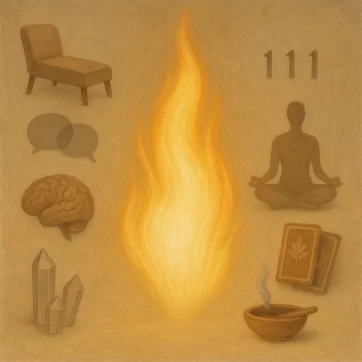
Inside the System That Turns Human Emotion Into Currency
Opening Transmission
There is a quiet truth running beneath the emotional noise of the modern world, a truth almost no one names because entire industries depend on its absence. The instability people believe they carry inside themselves is not internal, not essential, and not evidence of psychological weakness. It is an appearance—a distortion created by the interpretive systems surrounding them. From New Age spirituality to therapy, coaching, healing, and manifestation, a vast external grid has been built around the human emotional experience, teaching people to mistrust their own clarity and outsource their sense of stability to frameworks that profit from confusion. The more overwhelmed, uncertain, or self-doubting a person feels, the more these industries appear necessary. And so the cycle repeats: emotional states get pathologized, spiritualized, moralized, or monetized until even natural human responses begin to look like personal defects requiring correction.
But beneath that overlay, nothing is broken. Human beings are not inherently unstable. What they call instability is often a misreading of normal internal movement amplified by external narratives that have trained them to interpret their emotions as problems, signals, blocks, warnings, or codes. When a person actually drops into their own unmediated inner quiet—when they feel grounded, centered, and steady—these industries lose something crucial: relevance. A genuinely stable human doesn’t require decoding, healing, clearing, interpretation, or alignment. And a world filled with stable humans would collapse the very economies built on the promise of fixing what was never broken to begin with. That is the premise of this article: not to attack these industries, but to expose the architecture that keeps the perception of instability alive, long after the truth has already dissolved it.
The Manufactured Instability Model
Emotional instability has become one of the most misinterpreted conditions of the modern era, not because people don’t genuinely suffer, but because the frameworks surrounding them have rewritten the meaning of human feeling. For the vast majority of people, what they call “instability” is not a core trait, not a psychological defect, and not an essential truth about who they are. It is an overlay—an external interpretation layered onto ordinary internal movements. Human emotion, when left unframed, is fluid, shifting, and responsive. But once it is filtered through cognitive interpretations, cultural narratives, environmental overwhelm, and belief systems that insist every feeling must be decoded as evidence of alignment or misalignment, health or dysfunction, spiritual progress or regression, the original simplicity of emotion is lost. The person begins to see themselves through the lens of the framework, not through the reality of their own inner experience.
This does not erase the fact that some individuals absolutely face severe psychological distress and require professional mental health support. Their suffering is real, and their instability is not imagined. But even in these cases, what appears as instability is better understood as the system’s attempt to compensate for dysregulation, trauma, unprocessed stress, neurochemical imbalance, or overwhelming life conditions—not evidence of a broken identity. And this distinction matters: true clinical instability is a medical and psychological condition requiring skillful care. It exists, it deserves respect, and it has nothing to do with the emotional confusion that the average person is taught to interpret as personal deficiency. The industries under examination in this article are not addressing severe psychiatric conditions, even though they often speak as if they are. They are shaping the emotional meaning-making of everyday people who are fundamentally stable but have been taught not to trust themselves.
The modern emotional marketplace thrives on this misinterpretation. When a society is conditioned to believe that natural fluctuations in energy, mood, overwhelm, frustration, sadness, and confusion signify deeper dysfunction, people become dependent on external frameworks to interpret their own signals. Internal clarity becomes suspect. The ability to self-regulate becomes pathologized. The ordinary ebb and flow of human emotion becomes the basis for diagnosing spiritual blocks, karmic wounds, subconscious sabotage, misaligned energy, unhealed trauma, or incomplete awakening. The person is taught to see themselves as a perpetual work-in-progress—never quite whole, never quite clear, always one step away from the breakthrough that will finally stabilize them.
This is the manufactured instability model: a psychological economy that convinces people that the turbulence they experience is internal, essential, and indicative of a problem that only an expert, modality, or system can address. These industries require emotional confusion in order to survive. Their business models—whether spiritual, therapeutic, or self-improvement oriented—depend on cycles of panic, self-doubt, emotional misinterpretation, and perceived brokenness. The client must remain a seeker, not a knower. They must feel incomplete just enough to continue returning. Progress must always feel partial. Healing must always seem just out of reach. The moment a person feels grounded in their own inner clarity, the external authority collapses.
In this sense, instability is not a flaw—it is a product. It is something people are conditioned into, nudged toward, and subtly encouraged to maintain. It keeps guidance necessary, keeps healing profitable, keeps coaching relevant, and keeps the emotional marketplace thriving. The tragedy is that the instability itself is not real. The person underneath is stable, capable, and coherent. But the frameworks surrounding them create a distortion field around their emotional life, and that distortion becomes the lens they mistake for truth. What appears to be an inner problem is often an external story imposed upon the self. And once that is seen, the entire architecture of manufactured instability begins to fall apart.
The Mimic Grid: How Emotional Amplification and Emotional Implantation Create a Control Economy
If the manufactured instability model explains how people are taught to misinterpret their own emotional lives, the mimic grid explains why that misinterpretation is so profitable—and why it has been engineered so precisely into the modern emotional landscape. The mimic grid does not refer to a vague metaphor or subtle cultural trend. It names the overarching control architecture that governs this entire external world. It is the system that shapes perception, emotional interpretation, social behavior, digital engagement, spiritual narrative, therapeutic language, and even the emotional vocabulary people use to understand themselves.
The mimic grid is not passive. It is not background. It is not neutral. It is a fully integrated emotional, psychological, technological, cultural, and behavioral operating system that overlays reality and conditions human experience from the inside out. It copies authentic human functions, repackages them as external authority, and installs itself as the interpreter of every internal signal. It is engineered to keep people oscillating, questioning themselves, seeking direction, and returning to the very systems that disorient them. It does not just influence the emotional landscape—it dictates it.
Human emotion, in its natural form, is a simple internal signal. It rises, moves, and fades. It is responsive to environment, memory, relational context, and bodily state. In a world not ruled by the mimic grid, emotion would simply be a passing internal shift—information, not identity. But inside this architecture, emotion becomes something else entirely. It becomes charged. Magnified. Redirected. Interpreted through systems designed to destabilize the person’s trust in their own internal truth.
What should be a fleeting fluctuation becomes a destabilizing event. What should be a quiet internal nudge becomes a full-body alarm. What should be a moment of confusion becomes a narrative of personal dysfunction. And because people feel the sensations physically, they assume the origin is internal—even when it is being produced or distorted externally.
This is the first distortion the mimic grid relies on: that every emotion a person feels must come from them. It is a necessary illusion for the grid to function.
But amplification is only the surface layer. The deeper mechanism is far more invasive: the mimic grid installs emotional states directly into people — entirely synthetic emotions that the person did not generate and that do not correspond to their actual psychological or situational reality.
These false emotions feel real because they are routed through the body’s own nervous system. The body cannot distinguish the origin—it only registers intensity. This allows the grid to create sudden guilt, sudden dread, sudden shame, sudden longing, sudden panic, sudden hopelessness, sudden confusion, and sudden emotional weight that have no internal cause whatsoever. A person experiencing an implanted emotional surge assumes they are reacting to something inside themselves. They try to interpret it. They morally evaluate it. They attempt to heal it.
And in doing so, they become entangled in the grid’s narrative of personal instability.
The mimic grid is not a single force; it is the entire design of the world people have been born into. It includes psychological narratives, therapeutic cultures, spiritual systems, media cycles, algorithmic emotional modeling, social reward structures, and the digital infrastructures that monitor emotional behavior and feed back responses engineered to provoke further emotional charge. It is totalizing: a reality management system that shapes not just what people feel, but how they understand those feelings.
It does not influence one part of life—it governs the entire emotional architecture of contemporary existence.
And this is why emotional industries—spiritual, therapeutic, coaching, wellness, pharmaceutical—are so deeply entangled with the grid. Their frameworks depend on emotional turbulence, and the grid supplies it. Their models depend on the person believing their emotions reveal brokenness, and the grid amplifies that belief. Their income depends on continued confusion, and the grid ensures the confusion never resolves.
Inside this architecture, even authentic human emotion becomes suspect. A natural feeling is immediately surrounded by interpretive frameworks telling the person it indicates a spiritual block, subconscious wound, misalignment, trauma imprint, or evidence of being “not healed yet.” Real emotions are pathologized. Artificial emotions are misattributed. And the person is taught to distrust everything that arises inside them.
This is the mimic grid’s true power: not controlling minds, but controlling meaning. Not erasing emotion, but weaponizing it. Not overpowering people, but redirecting their perception of themselves.
Once someone loses the ability to distinguish genuine internal emotion from externally-induced distortion or synthetic emotional implantation, the grid has achieved total emotional governance.
And through that, an entire economy thrives.
Beneath all of this, the person remains fundamentally stable. The instability is not them. The confusion is not them. The emotional weight is often not even theirs. But as long as the mimic grid frames every internal sensation as personal, the entire architecture of emotional dependency stays intact.
And this is where the deepest irony of the emotional marketplace reveals itself: the vast network of healing, coaching, therapeutic, and spiritual industries was constructed to address emotional disturbances that, in many cases, do not originate from the individual at all. People seek help for anxiety that was implanted, not born from their own psyche. They learn techniques to soothe grief that was manufactured by external amplification rather than rooted in authentic loss. They invest time, money, and trust into resolving emotional patterns that are not expressions of their inner truth but artifacts of the mimic grid’s interference. These industries promise relief but often require people to take ownership of emotional burdens engineered outside of them. They encourage individuals to dig for wounds that do not exist, process traumas that are not theirs, diagnose patterns that have no internal history, and pursue “healing” for emotional turbulence that was never a genuine reflection of their lived experience. Instead of helping people reclaim clarity, these systems keep them entangled in pursuing solutions to problems that were structurally designed to appear real but have no authentic origin. The tragedy—and brilliance—of the system is that it convinces people to devote their lives to healing distortions that would evaporate the moment they recognized those emotions were never theirs in the first place.
Eternal Creation vs. the External Construct: The Two Fields People Confuse
Before examining how the emotional industries operate, it is essential to clarify the structural reality people actually live inside. There are two creation fields, but only one of them is real.
The Eternal Flame—the original creation field—is the source architecture. It is non-oscillatory, self-generated, sovereign, and internally coherent. It does not fluctuate, destabilize, or depend on feedback from anything outside itself. It is not emotional. It is not reactive. This is the only creation field that actually exists in a true sense. Everything else is a copy, a manufactured layer, an imitation of structure without the substance of origin.
The world humans currently inhabit is the external construct—an engineered imitation of creation built on movement, polarity, oscillation, and sensory distortion. It is not the Eternal field. It is a simulation layered outside original creation, and it behaves nothing like the real architecture. This external construct is inherently unstable because it was built on motion rather than stillness. Any being living inside it will feel oscillation, not because the oscillation belongs to them, but because the environment they are housed in produces it. Emotion arises here—not as a property of the Eternal self, but as a response to a manufactured reality that moves constantly.
And then there is the third layer: the mimic grid, which is not a separate world but a parasitic operating system running inside the external construct. The mimic grid is the control interface of the simulation. It overlays interpretation, injects emotional distortion, manufactures false signals, and shapes human perception through a set of rules that do not exist in the Eternal field. The mimic grid cannot touch the Eternal Flame, but it can fully manipulate the artificial environment people mistake for their true reality. It governs the sensory feedback, emotional amplification, narrative frameworks, psychological meaning-making, and digital mirroring that define most modern human experience.
This is the core distortion: People assume the external construct is reality—and then further assume the mimic’s interference inside that construct is personal truth. They feel the instability of a world that isn’t real and mistake it for instability in themselves. They feel the implanted emotions of a system designed to provoke them and assume those emotions are their identity. They experience the volatility of an artificial field and conclude that their inner architecture must be equally volatile.
Nothing could be further from the truth.
The Eternal Flame is original. The external construct is not. The mimic grid is the distortion engine running inside the construct.
Once this distinction is understood, the emotional landscape becomes clear: People are not broken. They are reacting to a world that was never theirs and signals that were never sourced from them.
The Five Industries Built on Emotional Misunderstanding
Once the distinction between the Eternal field, the external construct, and the mimic grid becomes clear, an uncomfortable truth emerges: entire industries have been built around treating emotional disturbances that are often manufactured by the environment itself. These industries do not recognize the artificial nature of most emotional turbulence, nor do they distinguish between authentic feeling and mimic-generated distortion. As a result, they operate as if all emotional movement is internal, meaningful, and diagnostic—when in reality, much of it is environmental noise or synthetic implantation.
Each industry interprets emotion through its own philosophical lens, turning human feeling into a problem to be solved, decoded, or managed. And while each offers genuine benefits in certain contexts, they all rely—structurally, economically, and conceptually—on the belief that emotional instability originates within the person. This misunderstanding keeps individuals dependent on interpretive systems that cannot recognize the architecture they are trapped inside.
Below are the five primary emotional economies shaped by this misunderstanding.
1. The New Age Industry: Turning Emotion Into Cosmic Signal
In the New Age paradigm, emotion is never just emotion. It becomes sign, synchronicity, activation, message, or intuition. This framework redefines ordinary human feeling as metaphysical communication, placing the person in a perpetual state of interpretation. A moment of sadness becomes a “download.” A spike of anxiety becomes a “warning from the universe.” Random emotional surges—many of which are mimic-generated—are treated as profound spiritual guidance.
This creates an endless decoding loop. People stop experiencing emotion directly and instead look for hidden meaning within it, assuming the external construct is an intelligent, benevolent, communicative field. In reality, they are interpreting mimic noise as sacred instruction.
Yet the New Age world also provided community and introduced many people to self-reflection for the first time. The tragedy is that its useful elements were wrapped inside architectures that confuse intuition with instability and treat mimic interference as spiritual insight.
2. The Therapy Industry: Turning Emotion Into Lifelong Excavation
Therapy treats emotion as wound, imprint, trauma, or unresolved psychological content. Within this model, every emotional surge—real or implanted—is interpreted as evidence of deeper material that must be explored, analyzed, and processed. For people in genuine crisis or facing severe mental health challenges, therapy offers life-saving containment, validation, and stability. It normalizes mental health conversations and provides vital support that should never be undermined.
But the industry’s structure relies on ongoing excavation: emotions are clues pointing to further layers, further memories, further interpretations. This can lock clients into lifelong analysis, continually reliving emotional states that did not originate from their internal truth. The system cannot recognize mimic-induced emotion, so it treats synthetic signals as authentic psychological material. People end up healing problems that never belonged to them, interpreting external interference as personal history.
The result is a steady-service model built on sincere but misplaced attempts to resolve what is often environmental distortion.
3. The Coaching Industry: Turning Emotion Into Personal Deficiency
Coaching reframes emotion as block, resistance, misalignment, self-sabotage, or lack of readiness. Within this paradigm, any uncomfortable emotional state—whether authentic or mimic-generated—is treated as a problem the client must overcome through mindset, discipline, or spiritual alignment. This keeps the client in a constant state of scanning for what is “wrong” with them.
The structural incentive is obvious: if emotional turbulence indicates misalignment, and misalignment requires coaching to correct, then emotional steadiness becomes a threat to the business model. The client must continually uncover new blocks, new resistances, new patterns, ensuring recurring programs and ongoing sessions.
Yet coaching can offer genuine accountability, motivation, and structured support—qualities many people lack in their personal lives. The issue is not the intention but the framework: it cannot distinguish between real internal friction and mimic-generated emotional distortion. It treats externally implanted emotions as evidence of personal failure.
4. The Healing Industry: Turning Emotion Into Energetic Blockage
The healing world—Reiki, energy work, somatics, breathwork, chakra clearing, emotional release modalities—rests on a fundamental misunderstanding of the environment we live in. These practices interpret emotional heaviness as internal “energy blockages,” assuming that what feels dense or turbulent must have originated within the person’s field. But in an artificial construct governed by oscillation, no amount of oscillatory technique can dissolve a structure built on oscillation. It can only rearrange it.
Energy healing does not clear mimic architecture; it moves it. It redistributes emotional distortion, shifts energetic congestion from one layer to another, temporarily relieves pressure in one zone only to compress it elsewhere. What feels like “release” is often just the mimic grid responding to external manipulation—opening one valve while closing another. The client experiences a momentary lightness because the emotional density has been relocated, not removed.
Catharsis becomes the product. Temporary relief becomes the illusion of transformation. And the practitioner unknowingly participates in maintaining the architecture by treating mimic-generated signals as internal wounds.
Synthetic or amplified emotional surges—designed by the grid—feel like “stuck energy,” so the client returns repeatedly to be “cleared.” But nothing built on oscillation can override the oscillatory system itself. The external construct regenerates the same patterns because that is its operating logic. The practitioner interprets mimic interference as personal blockage; the client believes they are carrying something that must be purged; and the cycle continues indefinitely.
These modalities do offer genuine comfort, ritual, touch, stillness, and non-clinical support. Those elements are real. But the mechanics of their “clearing” are not. The result is an endless loop of managing distortions the person never generated, followed by the inevitable return of those distortions—because the environment continues to create them and the mimic grid continues to reinforce them.
Energy healing treats the mimic’s architecture as if it were the person’s. It mistakes environmental distortion for internal pathology. And in doing so, it keeps people clearing what was never theirs, inside a system that cannot be cleared by its own tools.
5. The Manifestation Industry: Turning Emotion Into Destiny
No industry capitalizes on emotional misunderstanding more than the manifestation world. Its central premise is that emotion functions as magnetism—that your vibration creates your outcomes, that positive thinking reshapes reality, that feeling good attracts good things and feeling bad repels them. But this logic only holds inside a closed mimic system, where people mistake emotional feedback loops for creative power.
Manifestation is not real. Not in the external construct. Not in an oscillatory simulation. Not under a mimic architecture that controls environmental response patterns.
Your thoughts do not create your reality here. Your emotions do not sculpt the field. Your vibration does not pull outcomes toward you like cosmic gravity.
Why? Because the mind is not an operating system. It is a translator. It interprets signals. It does not generate structure. It does not rewrite the architecture of the external construct. It does not override mimic routing. Emotional states have no causal power in this environment. They only determine how deeply you get pulled into the mimic grid’s loops.
This is the lie at the heart of manifestation culture: that feeling good generates good outcomes, and feeling bad creates bad ones. This belief forces people into emotional perfectionism—an exhausting, impossible policing of their inner landscape. Every moment of sadness becomes a threat. Every flash of fear becomes a self-curse. Every dip in mood feels like a spiritual failure with cosmic consequences.
In reality, most of the emotional experiences people fear “manifesting from” weren’t theirs to begin with. They were mimic-generated. Artificial. Implanted. Part of the environmental turbulence the grid uses to keep people unstable.
You cannot “attract” or “repel” outcomes inside a system that was designed before you entered it. You can only embody one of two states:
A mimic-drenched field, which locks you into the oscillatory loops of the external construct; or An Eternal Flame-aligned field, which clears mimic influence internally—but does not rearrange physical reality like an order-from-the-universe catalog.
Eternal Flame coherence does not “manifest” in the way the New Age promises. It does not use thoughts or feelings to command outcomes, attract events, or reshape reality. What it actually does is restore internal clarity by dissolving interference within the self. The external construct cannot be controlled or altered through mindset, emotion, or intention, because it is not a real creation field—it is a manufactured environment running on preset mimic code. For the average person, nothing produced by the mind and nothing generated through emotional effort can override that architecture. Eternal Flame coherence is an internal state of truth, not a tool for bending the simulation.
Yet the manifestation industry depends on the belief that you can—and that if you can’t, you are the problem. This makes it one of the most psychologically damaging emotional economies in existence. It turns natural fluctuations into moral failures, mimic-generated turmoil into self-blame, and environmental chaos into “proof” that your vibration is wrong.
By promising mastery over a world you do not control, it guarantees lifelong dependency on techniques that never actually work—because they can’t.
Taken together, these five industries form the backbone of the modern emotional economy—an economy built not on genuine human instability, but on the misinterpretation of an artificial world. Each industry, in its own way, treats external interference as internal deficit, environmental turbulence as personal pathology, and mimic-generated emotion as evidence that something is wrong within the individual. They cannot recognize the artificial construct people inhabit or the mimic architecture that manipulates emotional experience, so they frame every emotional surge as meaningful, diagnostic, or self-created. Therapy excavates emotions that were implanted. Energy healing rearranges mimic density and calls it release. Coaching reframes mimic turbulence as personal failure. New Age frameworks interpret mimic interference as cosmic messaging. Manifestation culture weaponizes emotional fluctuation and promises control over a world that is not controllable from the mind. What unites them is not malice but misunderstanding: they operate inside a reality they assume is real, and in doing so, they anchor people more deeply into a system that was never theirs. Instead of restoring clarity, they keep individuals chasing solutions to problems that originate outside themselves. And as long as the external construct generates turbulence, and the mimic grid amplifies it, these industries will continue to thrive on the belief that the emotional storm is personal—when in truth, the person beneath it is intact, coherent, and far closer to their Eternal architecture than any of these frameworks have ever allowed them to realize.
The Mechanism: How Instability Is Manufactured
Once emotional misunderstanding is embedded into a culture—and once entire industries normalize the idea that every internal movement requires interpretation—the machinery of manufactured instability begins to operate almost automatically. People do not wake up believing they are unstable; they are conditioned into it through a stepwise distortion of their relationship to their own internal experience. What emerges is not chaos, but a highly structured system designed to create confusion, sustain it, and then monetize the attempt to resolve it. The process unfolds through several interlocking mechanisms that reinforce one another until the person no longer experiences emotion as a simple internal signal but as a complex puzzle requiring external authority.
Emotional Overinterpretation
The first mechanism is subtle: it teaches people that normal feelings are never just normal feelings. Ordinary human states—fatigue, frustration, restlessness, sadness, overwhelm—are reframed as messages, symptoms, codes, or spiritual signals. Instead of recognizing these sensations as basic responses to life inside an oscillatory construct, individuals are trained to decode them endlessly. The moment a feeling arises, they search for meaning: Why do I feel this? What does it say about me? What does it predict? What am I missing?
This turns the emotional world into a symbolic landscape that must be interpreted rather than experienced. The person no longer trusts the simplicity of their own sensations; they assume every fluctuation must point to something deeper. This opens the door for industries to define that meaning for them, because once emotion becomes mysterious, interpretation becomes currency.
Emotional Pathologizing
Once overinterpretation takes root, the next mechanism follows: pathologizing. Natural human emotional responses—responses that arise simply because people live inside an artificial, oscillatory environment—are recast as evidence of personal defect. A fleeting state becomes a “block.” Stress becomes a “trauma flare-up.” Discomfort becomes “misalignment.” A low mood becomes a “lower vibration.”
This reframing alters the baseline expectation of emotional life. Instead of assuming fluctuations are part of human existence, people begin to believe that any deviation from calm, clarity, or positivity indicates damage. The external construct generates turbulence; the mimic grid amplifies it; industries diagnose it; and individuals internalize the belief that they are broken. This pathologizing is not accidental—it is the economic spine of the emotional marketplace.
Emotional Surveillance
Once emotion is seen as meaningful and potentially pathological, the person becomes responsible for monitoring it constantly. This is the third mechanism: emotional surveillance. People are taught to track, analyze, grade, evaluate, and self-assess their emotional states with a level of scrutiny that no nervous system was designed to endure. Each feeling becomes a diagnostic indicator. Every shift becomes a clue to something wrong.
Instead of living, the person watches themselves live. Instead of feeling, they monitor their feelings. This creates chronic hypervigilance, which generates even more emotional turbulence. The person becomes both the subject and the examiner, constantly checking themselves against a standard no human being could consistently meet. Under these conditions, instability is not discovered—it is manufactured.
Emotional Distortion Loops
By this stage, the system is fully activated. Industries produce the confusion—through overinterpretation, pathologizing, and surveillance—and then position themselves as the remedy for the instability they helped create. This is the emotional distortion loop: the problem and the solution are part of the same structure.
A person feels overwhelmed. They seek guidance. The guidance reframes their overwhelm as a deeper issue requiring ongoing treatment, analysis, clearing, coaching, healing, or recalibration. The person feels temporarily relieved, only to experience the same sensations again—because the sensations were never internal defects but environmental signals the industries misinterpreted. This drives them back for more support. The cycle repeats, profitable and self-sustaining.
The emotional marketplace survives by ensuring people never fully resolve the problems it diagnoses. A stable person disengages. A confused person remains a client.
External Authority Dependence
The final mechanism is the most critical: people are trained to distrust themselves. After enough cycles of misinterpretation and pathologizing, individuals begin to believe they cannot understand their own emotional states without an expert, a modality, or a framework to decode them. Their inner clarity becomes suspect. Their direct knowing becomes invalid.
This dependence on external authority ensures that no matter how much a person feels, learns, or heals, they always return to the same place: the belief that someone else must confirm what their own system is telling them. And because they have forgotten the distinction between true internal clarity and mimic-generated noise, they no longer know which part of themselves to trust.
Once this dependency is established, instability no longer needs to be manufactured. It sustains itself.
The Flame Clarification: There Is Nothing Wrong With You
After dismantling the mechanisms that generate emotional confusion, everything comes down to this: there is nothing wrong with you. This is the heart of the article, the truth that every distortion has been built to obscure. What people call emotional instability is not a flaw in their psyche, not a malfunction of their spirit, not a defect in their wiring. It is a misreading of natural human states inside an unnatural environment. The turbulence you feel is not proof that you are chaotic; it is proof that the world around you is. You are responding exactly as any coherent human system would respond inside a construct that amplifies sensation, injects interference, and then teaches you to blame yourself for feeling it.
Human beings were never meant to interpret emotion as destiny, diagnosis, or metaphysical code. Emotion was never meant to be a moral metric, a spiritual barometer, or evidence of hidden injury. It is simply what a body does when it moves through a world built on oscillation. Emotion rises because the external construct moves, not because your inner architecture is unstable. But when industries convince you that emotion is meaningful in ways it is not—that every surge is a sign, every dip is a defect, every wave is a wound—you begin to read normal human fluctuation as evidence that something is wrong with you. This is the first theft: the theft of your trust in your own internal simplicity.
The instability people fear in themselves is not internal. It is environmental. It is manufactured. The mimic grid creates the turbulence, the industries interpret it, and the culture reflects it back to you as personal truth. You feel overwhelmed because the system is overwhelming, not because your capacity is insufficient. You feel confused because the frameworks are confusing, not because you lack clarity. Your emotional world has been inflated, dramatized, moralized, pathologized, and spiritualized into something far more complicated than it ever needed to be.
Clarity is inherent. It is not earned through practice or technique. It is not granted by authority. It is not achieved by fixing yourself. It is the baseline state beneath the distortion. When the mimic architecture quiets, even momentarily, the clarity appears—not because it was created, but because it was always there.
Grounding is innate. It does not require ritual or method. It does not need to be built. It is what remains when the noise drops. Your system was designed to orient, to stabilize, to return to center on its own, without constant surveillance or correction. The idea that you are fundamentally ungrounded is a myth created by industries that can only survive if you believe you need their help.
There is no defect to fix. No internal break. No spiritual blockage. No emotional flaw. The “brokenness” narrative is one of the most profitable mythologies ever created. If people believe they are inherently defective, they become endless customers. If they believe their emotional states reflect personal damage, they will seek correction. If they believe their instability originates within, they will never question the external forces that benefit from keeping them disoriented.
The truth is quieter, stronger, simpler: Nothing inside you is defective. Nothing inside you is fundamentally unstable. Nothing inside you is the problem.
The appearance of instability is a product of systems that benefit from your confusion. When the environment is engineered to amplify emotion and the culture is trained to misinterpret it, the person inevitably blames themselves. But the Eternal architecture beneath all of this—your baseline, your core, your clarity—has never been compromised. It has been obscured, not erased.
The moment this is understood, the entire emotional economy begins to crumble. Because a human being who realizes they are not broken has no need for the industries built on fixing them. A human being who recognizes the simplicity of their own emotional truth cannot be manipulated by mimic distortion. And a human being who sees through the manufactured instability of the external construct becomes immune to the narratives that keep them small.
You were never unstable. You were never deficient.You were never failing.
You were living inside a system that profits when you believe you are.
Beneath all of this, your Eternal essence remains whole. What people call “brokenness” is not a property of the self—it is a distortion created by living in an external oscillatory construct layered with mimic amplification. Your Eternal architecture has never fractured; what fractures is the experience of yourself when consciousness is refracted through a world built on separation, tension, and interference. This does not erase the reality of trauma or the impact of painful events. Human suffering is real. Loss is real. Injury is real. But these experiences belong to the external grid, not to the core of who you are. They shape the journey, not the essence. What hurts, wounds, or destabilizes is the part of you perceiving through the simulation, not the Eternal self beneath it. Your essence has never been damaged. It has been obscured by distortion, layered over by mimic noise, filtered through an artificial world that makes wholeness difficult to feel. But intact is what you are. Whole is what you are. The work is not to repair a broken self—it is to recognize that the brokenness was never yours.
The Positive Reframe: What These Industries Accidentally Taught Us
Even systems built on misunderstanding can transmit pieces of value—not because they are inherently wise or structurally sound, but because human beings will extract meaning and connection anywhere they can. None of these industries were designed to bring clarity; they were designed to interpret confusion. Yet in the process of doing so, they unintentionally handed people fragments of something real: glimpses of their own interior world. It is important to acknowledge these fragments without mistaking them for the full truth.
These systems gave people language for feeling, even if the definitions were distorted. For many, it was the first time emotion was allowed to be named rather than suppressed. They introduced space for introspection, even if the interpretations were misguided. They offered permission to seek help, even when the help was wrapped in frameworks that reinforced dependency. They created pockets of connection, though often structured around shared confusion rather than shared clarity. They provided glimpses of agency, even if those glimpses were funneled into models of manifesting, mindset, or energetic perfectionism that ultimately circled back into self-blame. And they sparked curiosity about the inner world, even though that curiosity was often redirected into distortion loops rather than genuine self-understanding.
These were not gifts of the industries themselves. They were the byproducts of human beings trying to make meaning in a system designed to obscure it.
The tragedy—and the opportunity—is that the pieces people found were real, but the frameworks around them were not. The industries amplified dependency to keep people returning. They amplified emotional significance to justify their services. They amplified confusion because confusion is profitable. They turned the simple insight that “I have an inner world” into a lifelong hunt for answers that could never be found within their models.
But the next evolution is clear: retain the value and discard the distortion.
People do not need to abandon introspection, self-awareness, or support; they need to free those things from the structures that confuse them. What comes next is not more decoding, more emotional interpretation, more spiritualized meaning-making, or more therapeutic excavation. It is clarity without the distortion—connection without the dependency, introspection without the pathology, agency without the fantasy of control, humanity without the burden of believing every feeling is evidence of internal defect.
These industries accidentally opened the doorway inward. The next step is walking through it without carrying their frameworks with you.
The Return to Internal Stability
The entire emotional marketplace collapses the moment people remember this one truth: emotion is not a threat. It is not a sign. It is not a diagnosis. It is not destiny. It is a state. Nothing more. Nothing less. The only reason emotion feels unmanageable is because it has been misread, inflated, weaponized, and assigned meanings it never carried. When emotion is interpreted correctly, it becomes simple again—grounded, temporary, and easy to metabolize. The turbulence dissolves not because something is “fixed,” but because the distortion around it is gone.
Emotion is a state, not a message. It does not contain prophecy, spiritual alignment data, karmic significance, or coded symbolism. The feeling is the whole event. The meaning ends where the sensation ends. When you stop treating emotion as a clue to decode, the entire interpretive machinery around it collapses.
Emotion is physical, not mystical. It arises from being in a body inside an oscillatory environment. It is the somatic registration of movement, stimulation, memory, interaction, and fatigue—not a portal, not a frequency, not a metaphysical communication. When you stop asking emotion to reveal deeper truths, it stops overwhelming you.
Emotion is information, not identity. It tells you something about your moment, not about who you are. It does not define your character, your worth, your evolution, or your trajectory. It is an internal reading of an external condition, not a diagnosis of your internal architecture.
Emotion is temporary, not destiny. It moves by design. It changes because the environment changes. It rises and falls on its own without needing to be fixed, decoded, or managed. When you stop gripping emotional states as evidence of future outcomes, stability returns automatically.
This is the return to internal coherence: seeing emotion as emotion, not as a referendum on your life.
And once this happens—once people understand that emotion is simply a passing internal shift inside a world that moves—external authority loses all leverage. The New Age loses its symbolic code. Therapy loses its pathology map. Coaching loses its block-hunting model. Healing loses its blockage narrative. Manifestation loses its vibration economy. These systems cannot survive a population that experiences emotion directly instead of interpreting it through their frameworks.
This is why the old systems fight to maintain confusion. Not because they are malicious, but because their infrastructures depend on emotional misinterpretation. If emotion becomes simple, they become irrelevant. If people remember that clarity is inherent, they no longer need interpreters. If individuals stop pathologizing their own experience, the entire emotional economy collapses.
Internal stability is not something you “achieve.” It is what returns automatically when the noise is removed. When emotion is restored to what it actually is—temporary, physical, informational, neutral—the self becomes steady again. The person realizes they were never unstable; they were only drowning in misinterpretation.
Stability is not a spiritual achievement. It is the natural state underneath mimic distortion. And once it returns, confusion has nowhere left to root itself.
And as more of your own Flame tone comes through the human body, this simplicity deepens. The more you embody your internal stillness, the less the external oscillation can pull you into its rhythm. Emotion doesn’t disappear—you still feel, because feeling is part of being here—but the waves lose their height. You no longer fluctuate wildly or get swept into interpretation. Emotion rises, moves through, and clears without leaving residue or narrative. The body registers the state, the state passes, and nothing in you destabilizes. Coherence does not numb you; it steadies you. It allows emotion to be what it actually is: a temporary sensation in a temporary environment, not a force that dictates your identity or your direction. This is what it means to feel without being ruled by feeling, to be in the external construct without being shaped by its oscillation.
Closing Transmission
Emotion is not the enemy. It is not a test, a warning, a karmic echo, or a spiritual verdict. It is simply what happens when consciousness moves through an oscillatory world. In the external construct, the body registers motion, sensation, memory, pressure, and change through feeling. This is normal. This is human. This is allowed. You are not meant to transcend emotion or purify it or decode it into meaning. You are meant to feel it and know that it does not define you. Emotion is part of the experience here, not a measure of who you are.
What has harmed people is not emotion itself, but the way it has been weaponized—by industries, by narratives, by mimic distortion. When you let emotion arise without attaching a story to it, without treating it as a message or a threat, it loses its grip. It becomes a passing internal shift instead of a personal indictment. You can let it move through you without letting it control you. You can feel without surrendering yourself to meaning-making systems that were designed to keep you dependent.
This is the truth beneath the entire emotional economy: the instability you were taught to fear is an illusion. The confusion was manufactured. The dependency was engineered. The “brokenness” was a narrative—never a reality.
Emotion never meant you were flawed. It never meant you were failing. It never meant you needed to be fixed.
It meant you were alive inside a world built on movement.
The next chapter does not require interpreters, gurus, systems, or emotional frameworks. It requires clarity—direct, unmediated, internal clarity.
Stability without interpretation. Humanity without emotional mythology. The recognition that emotion can exist without owning you. The recognition that feeling does not make you unstable.
When the distortion is gone, the simplicity returns: You get to feel without fear. You get to feel without explanation. You get to feel without assuming the feeling has anything to do with your worth or your trajectory.
Emotion is allowed. Emotion is temporary. Emotion is part of being here.
And you—beneath all of this—are intact.
The future is not an industry. It is an open field. And this time, it belongs to you.
